1944 Half Dollar Value Checker: Errors List, “D”, “S” & No Mint Mark Worth

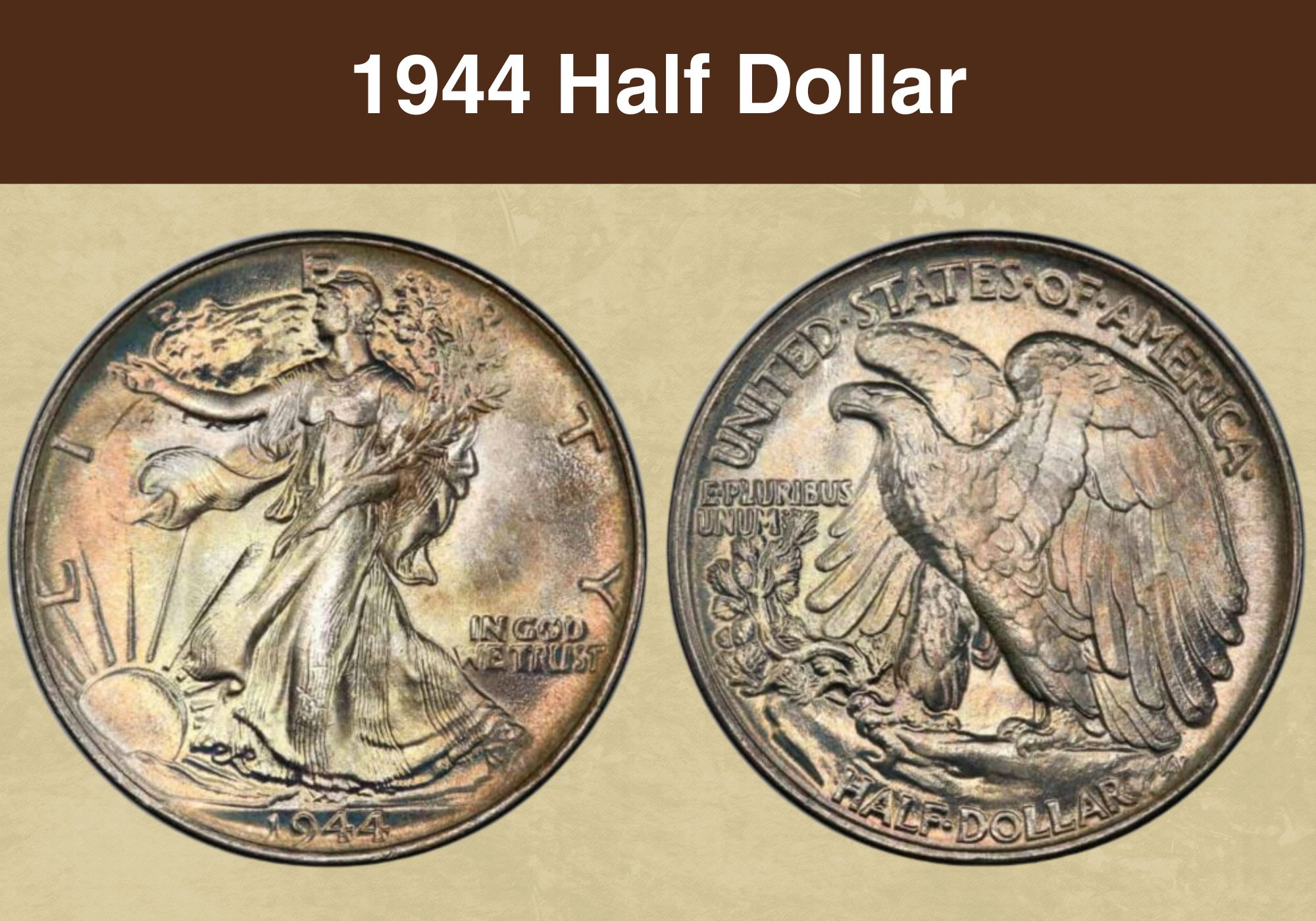
1944 Half Dollar

Collectors often overlook coins that hold surprises. The 1944-S Walking Liberty half dollar remained “long overlooked” for decades, dismissed as common due to wartime production assumptions.

The higher grades of this coin have proven to be even scarcer. The San Francisco strike carries an estimate of $131.40, while the Philadelphia and Denver strikes each carry an estimate of $118.00.

CoinWeek’s investigation solved the mystery about 1944 Philadelphia “No AW” coins — what collectors thought was a valuable variety missing designer initials turned out to be worn die states from wartime overuse.

These discoveries highlight why understanding 1944 half dollar values requires looking beyond surface assumptions. The 1944 Walking Liberty series offers more complexity and opportunity than many collectors realize.

One important note before diving in: no Proof strikes exist for 1944. The U.S. Mint suspended all Proof coinage programs after 1942 to conserve resources for World War II, and Proof production did not resume until 1950. Any coin sold as a “1944 Proof” is either a misidentified high-grade business strike or a counterfeit — walk away from those listings.

1944 Half Dollar Value Checker

Identify 1944 Half Dollar D, S and No Mint Mark Price

✨ No Sign-up Required
Obv

Front Obverse

Upload or Take a Photo

Rev

Back Reverse

Upload or Take a Photo


1944 Half Dollar Value By Variety

The value of the 1944 half dollar series varies significantly depending on the mintmark and condition of the coin. If you know the grade of your coin, you can find the exact price below in the Value Guides section.

1944 Half Dollar Value Chart

TYPEGOODFINEAUMSPR
1944 No Mint Mark Half Dollar Value$35.52$40.33$51.00$123.33
1944 D Half Dollar Value$35.52$40.33$51.00$123.33
1944 S Half Dollar Value$35.52$40.33$51.00$132.00
Updated: 2026-05-12 02:11:00

Also Read: Top 100 Most Valuable Kennedy Half Dollar Worth Money (1964 – Present)


Top 10 Most Valuable 1944 Half Dollar Worth Money

Most Valuable 1944 Half Dollar Chart

2000 - Present

This value chart reveals the significant price differences between grades and varieties of the 1944 Walking Liberty half dollar. The 1944 MS68 half dollar dominated, achieving $109,250, nearly double the price of the 1944-D half dollar in MS68 ($57,600). The 1944-S half dollar, MS67, came in third at $40,800.

What makes those top prices so dramatic is the scarcity at the very top grades. According to certified population data, only three MS68 examples have been graded by PCGS and three by NGC for the Philadelphia issue — a combined population of just six coins at the highest known grade. That extreme scarcity explains why a June 2021 Stack’s Bowers MS68 sold for $84,000, an August 2020 Heritage Auctions example realized only $4,920, and the record-setting August 2010 Heritage specimen achieved $109,250 — the same grade, three wildly different prices, all driven by the quality of luster and eye appeal within that tiny top-grade pool.

Two San Francisco varieties — the inverted mintmark (FS-511) at $900 and the re-punched mintmark (FS-502) at $893 — demonstrate nearly identical collector valuations in MS66 grade. These prices reflect sustained collector interest in documented production anomalies from the San Francisco Mint’s challenging wartime operations.

Grade significantly impacts value. The Philadelphia specimens in MS67 and MS68 jumped from $5,160 to $109,250 — a reflection of the value collectors place on the pristine quality of wartime coins.


History Of The 1944 Half Dollar

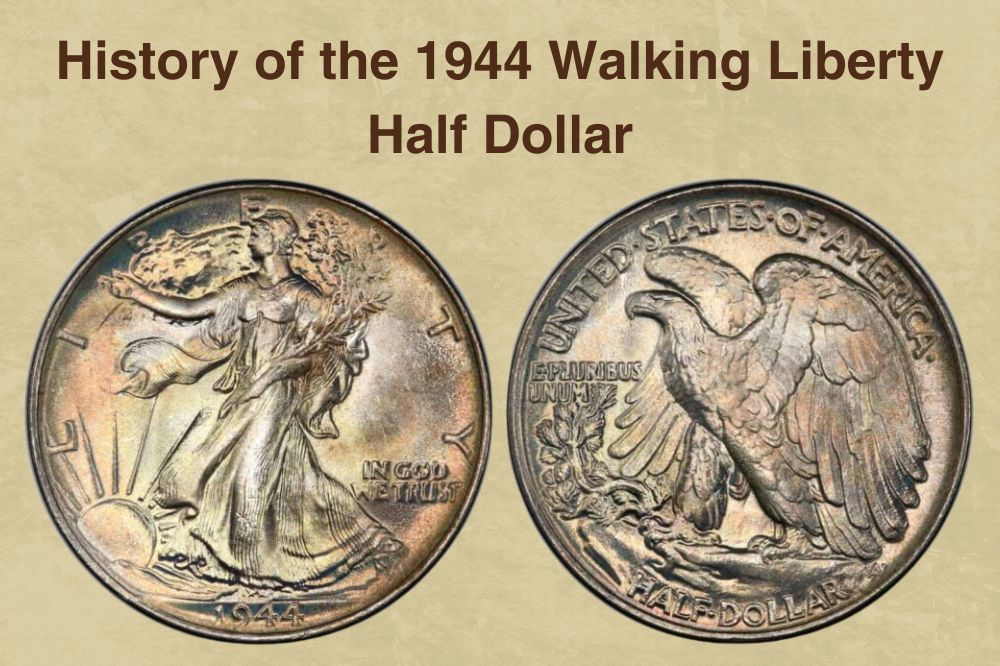
The 1944 Walking Liberty Half Dollar was created by German-born American sculptor Adolph Alexander Weinman, and this coin has been celebrated as one of the most beautiful pieces ever produced by the U.S. Mint.

The design features Lady Liberty striding confidently toward the rising sun, symbolizing America’s forward-looking spirit during one of the most challenging periods of the 20th century.

The Walking Liberty series began in 1916 during World War I and concluded in 1947, just after World War II ended. This timing created a unique historical narrative — a coin offering hope and determination during the darkest moments of modern history.

The series emerged when Mint Director Robert Woolley held a design competition, ultimately choosing Weinman’s artistic vision over competing proposals. Weinman also designed the Mercury dime of the same era, making 1916 one of the most artistically significant years in American coinage history.

Three varieties were produced in 1944 across different mints: Philadelphia (no mint mark), Denver (“D” mark), and San Francisco (“S” mark). Wartime production challenges resulted in quality control issues, with many coins showing soft, mushy details. Some specimens lost Weinman’s “AW” designer initials due to die wear from wartime overuse — not a rare variety, but a sign of the era’s production stress.

The overall combined mintage for all three 1944 mints was approximately 46.8 million coins, the vast majority of which saw heavy circulation immediately after striking. Despite its artistic merit, the Walking Liberty design was replaced by the Franklin half dollar in 1947 and has since gained tremendous appreciation as a collectible masterpiece.

Also Read: Top 35 Most Valuable Franklin Half Dollar Worth Money (1948 – 1963)


Is Your 1944 Half Dollar Rare?

27

1944 No Mint Mark Half Dollar

Scarce
Ranked 64 in Walking Liberty Half Dollar
26

1944-D Half Dollar

Scarce
Ranked 70 in Walking Liberty Half Dollar
34

1944-S Half Dollar

Scarce
Ranked 54 in Walking Liberty Half Dollar

For collectors seeking comprehensive insights, our Coin Value Checker App provides detailed scarcity ratings and current market valuations to help you better assess your numismatic investments.


Key Features Of The 1944 Half Dollar

As the Walking Liberty Half Dollar series neared its end in 1947, the 1944 edition represents one of the penultimate years of production. It is thus named a wartime coin, minted while World War II was still being fought across multiple theaters of conflict.

This unique combination of artistic excellence and historical significance has made the 1944 Walking Liberty Half Dollar highly desirable among collectors. Its substantial silver content — 90% silver, 10% copper — also enhances its appeal as both a collectible treasure and a sound investment opportunity backed by real precious metal.

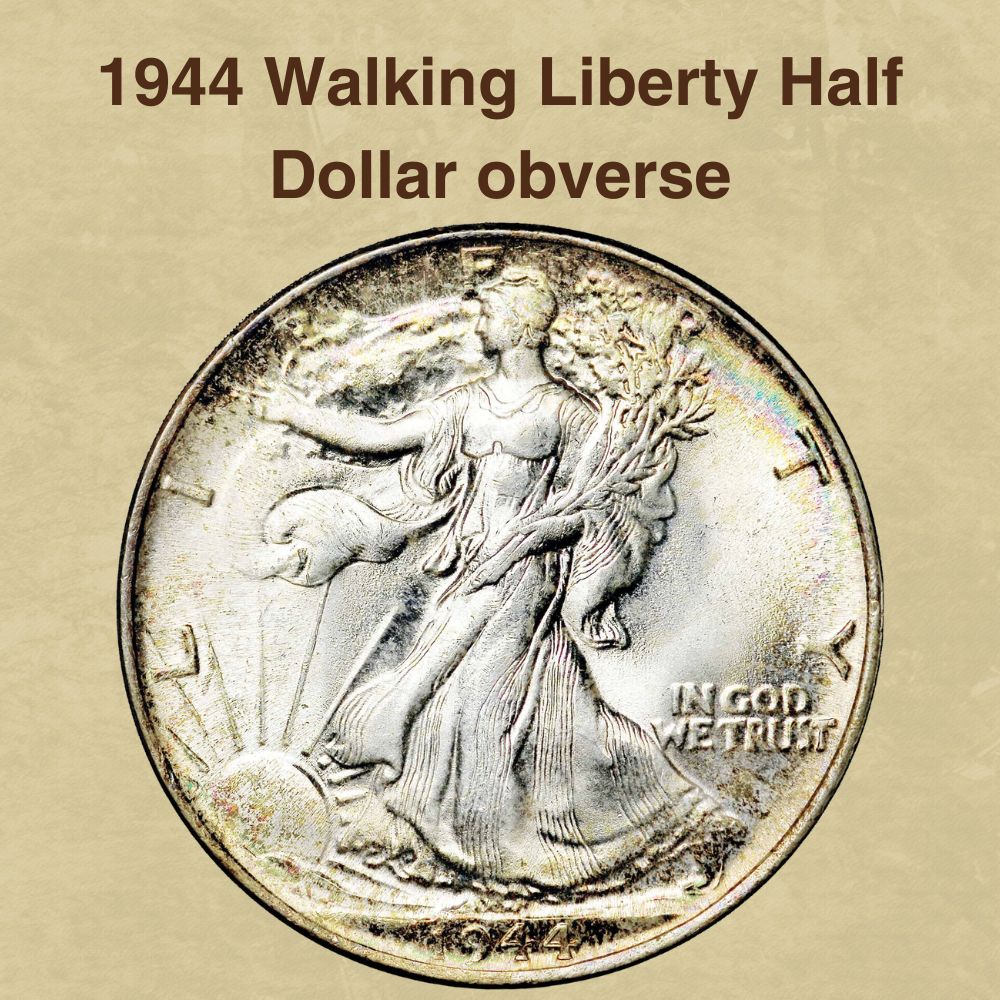
The Obverse Of The 1944 Half Dollar

The Obverse Of The 1944 Half Dollar

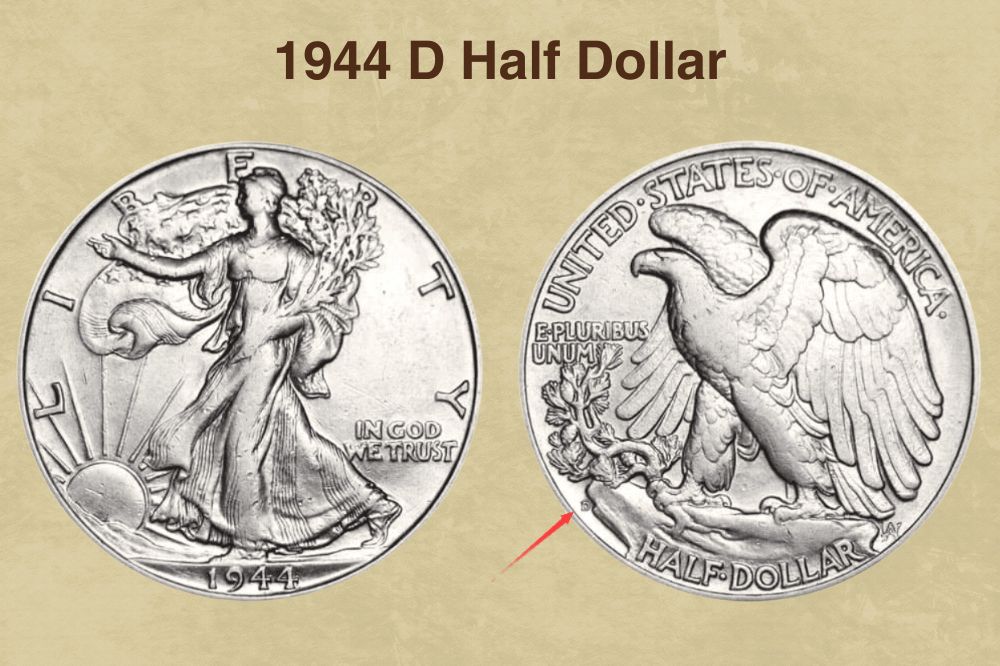
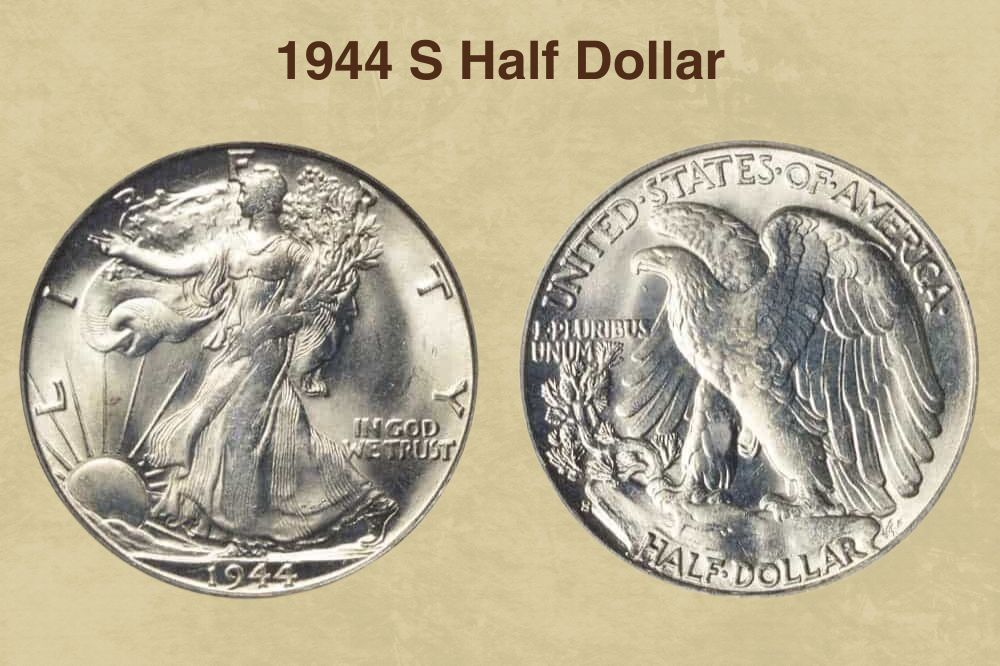
The obverse displays Lady Liberty walking toward the rising sun, carrying laurel and oak branches in her left arm, symbolizing civil and military glory respectively.

“LIBERTY” appears along the left edge, with “IN GOD WE TRUST” inscribed in the lower left field. The date “1944” is positioned at the bottom right. Weinman’s initials “AW” can be found near the hem of Liberty’s gown on well-struck specimens — their absence typically signals die wear, not a rare variety.

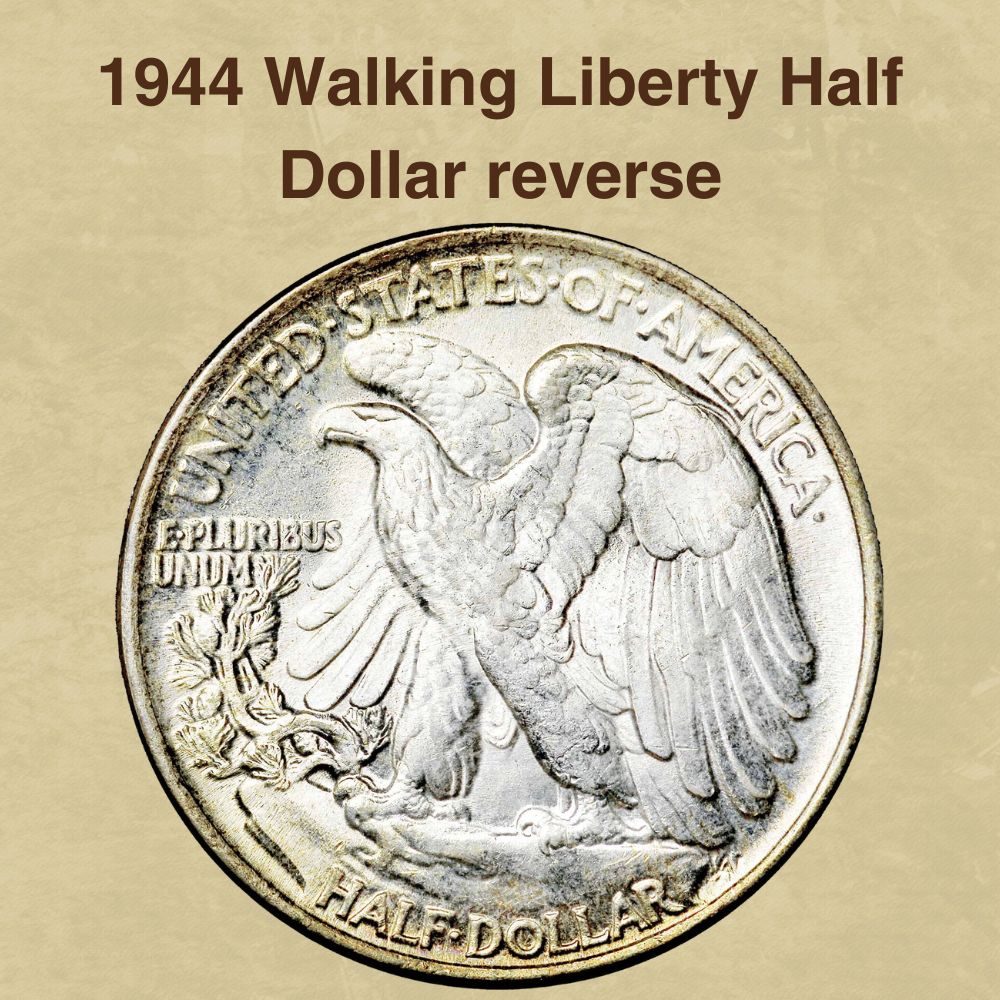
The Reverse Of The 1944 Half Dollar

The Reverse Of The 1944 Half Dollar

The reverse shows an American eagle perched on a rocky crag with wings spread. The eagle holds an olive branch in its talons, representing America’s desire for peace even during wartime.

“UNITED STATES OF AMERICA” arcs above the eagle, while “E PLURIBUS UNUM” appears on the left side. “HALF DOLLAR” is inscribed below the eagle. The mint mark (D, S, or none for Philadelphia) is located on the lower left between the rock and rim — specifically to the left of the “H” in “HALF DOLLAR.”

Other Features Of The 1944 Half Dollar

The coin measures 30mm in diameter with a thickness of 1.8mm and weighs 12.5 grams. The composition consists of 90% silver and 10% copper, containing 0.3617 troy ounces of pure silver. The edge features vertical reeding.

Based on November 2025 silver prices of approximately $47.85 per troy ounce, the silver melt value of a 1944 half dollar is roughly $17.31 — this is the absolute floor for any example in any condition. Three varieties exist based on mint location: Philadelphia (no mint mark), Denver (D), and San Francisco (S).

The overall design philosophy reflects the coin’s wartime context, with the forward-striding Liberty symbolizing America’s determination and the eagle representing national strength. The artistic composition demonstrates Weinman’s mastery of relief sculpture, creating depth and movement within the constraints of coin design.

Also Read: Top 60+ Most Valuable Walking Liberty Half Dollar (1916 -1947)


1944 Half Dollar Value Mintage & Survival Data

1944 Half Dollar Mintage & Survival Chart

Mintage Comparison

Survival Distribution

TypeMintageSurvivalSurvival Rate
No Mint28,206,0001,400,0004.9635%
D9,769,000500,0005.1182%
S8,904,000500,0005.6155%

The 1944 Half Dollar production varied dramatically across the three mints, with Philadelphia leading at 28.206 million — nearly three times Denver’s 9.769 million and San Francisco’s 8.904 million. This distribution pattern reflects the wartime capacity differences among the facilities, with Philadelphia serving as the primary production hub during World War II.

While Philadelphia coins have the highest absolute survival count at 1.4 million, their survival rate stands at just 4.9635%. In contrast, both Denver and San Francisco variants show identical survival numbers of 0.5 million each, but higher survival rates at 5.1182% and 5.6155% respectively. This result suggests better preservation conditions or reduced circulation in certain regions.

The survival distribution shows Philadelphia coins dominating at approximately 58% of surviving specimens, with Denver and San Francisco each representing roughly 21% of the extant population. This distribution indicates that the lower-mintage Denver and San Francisco issues offer greater relative scarcity at the top of the condition scale.

One important survivorship note: although 1944 Philadelphia coins have the most survivors overall, PCGS CoinFacts confirms the 1944 Philadelphia issue is actually scarcer in mint state condition than the 1941, 1942, 1943, and 1945 Philadelphia issues. High-grade Philadelphia coins from 1944 are rarer than their large mintage might imply.

Also Read: What Half Dollars Are Worth Money?

CoinVaueChecker App 10


The Easy Way to Know Your 1944 Half Dollar Value

Between silver content fluctuations and condition-based premiums, calculating your 1944 half dollar’s value involves variables that change constantly. What sold for $15 last month might fetch $20 today — or less, depending on grade nuances only experienced numismatists recognize.

The Coin Value Checker APP removes the uncertainty by instantly evaluating your specific coin against live market benchmarks. Rather than sifting through outdated price guides or conflicting online estimates, you’ll get a clear, current valuation tailored to your coin’s actual condition.

Coin Value Checker APP Screenshot


1944 Half Dollar Value Guides

The 1944 Walking Liberty Half Dollar was produced at three different U.S. Mint facilities, some of which had their own unique mintmark located between the rock layer and the rim on the reverse of the coin.

  • 1944 No Mint Mark Half Dollar – Philadelphia Mint
  • 1944-D Half Dollar – Denver Mint
  • 1944-S Half Dollar – San Francisco Mint

Philadelphia produced coins without any mint mark. The Denver Mint struck coins with a “D” designation, while the San Francisco Mint struck coins with an “S” designation. Due to wartime production restrictions, quality control varied between mints.

Each mint maintained the same design and specifications, but relative scarcity and collectible value varied based on production quantities and surviving coins. Strike quality — how crisply the design elements were pressed into the coin — is a major factor that separates an average 1944 half from a truly premium specimen.


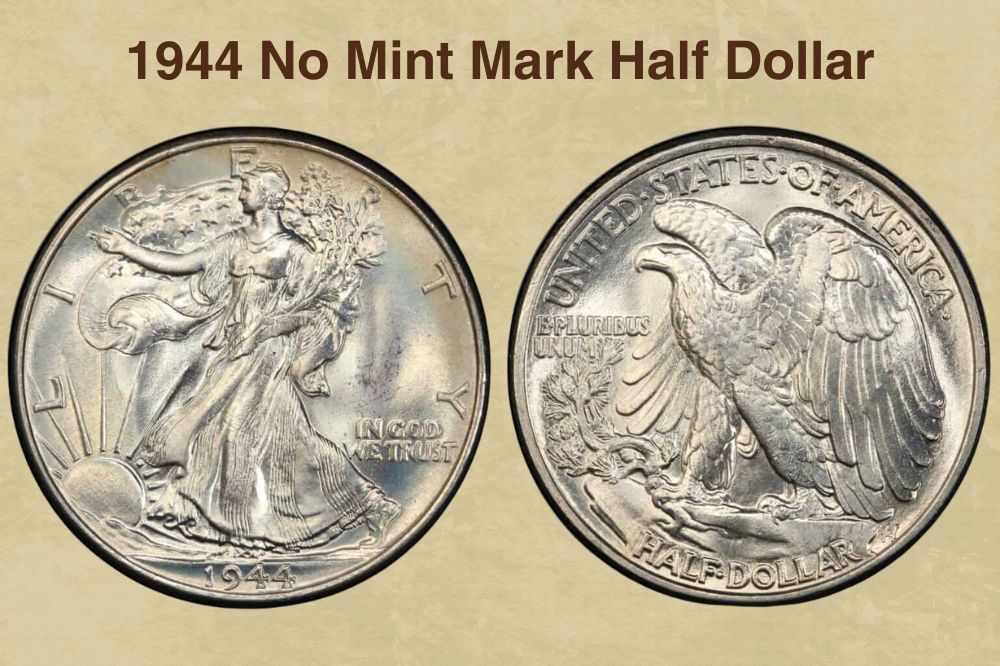
1944 No Mint Mark Half Dollar Value

1944 No Mint Mark Half Dollar Value

The 1944 No Mint Mark Half Dollar, produced at the Philadelphia Mint, was the highest-producing coinage that year. The Mint produced 28,206,000 pieces, representing over 60% of the total 1944 Walking Liberty half dollar production. In keeping with the tradition of the United States Mint, coins struck at the Philadelphia Mint bear no mint mark.

Wartime production pressures posed unique quality control challenges for these coins. Because wartime production prioritized quantity over quality, many 1944-(P) coins exhibited a “mushy and distorted appearance,” with some even losing the Weinman designer’s initials, “AW,” due to die wear or excessive use. PCGS notes this explicitly: unlike other 1940s Philadelphia Mint issues, strike on the 1944 can sometimes be soft and mushy — making sharply struck examples more desirable and more valuable.

These subtle differences create meaningful value separations among collector-grade specimens. In August 2010, a Heritage Auctions MS68 half dollar sold for $109,250 — the all-time auction record for this issue. Notably, a second MS68 example sold at the same 2010 Heritage auction for only $6,900, and an August 2020 Heritage MS68 realized $4,920, demonstrating how dramatically eye appeal and luster quality affect prices even within the same grade. A less-than-1% share of 1944-P coins has been certified in MS64 or better, making this a true condition rarity despite its large mintage.

1944 No Mint Mark Half Dollar Price/Grade Chart

Price by 1-70 Grade (Latest Auction Records Included)

Updated: 2026-05-12 02:11:01

The performance of high-grade 1944 no mint mark half dollars at major numismatic auctions demonstrates their value potential.

Date PlatformPrice Grade

Currently, market activity reflects collectors’ interest in seeking high-quality specimens.

Market activity: 1944 No Mint Mark Half Dollar


1944-D Half Dollar Value

1944-D Half Dollar Value

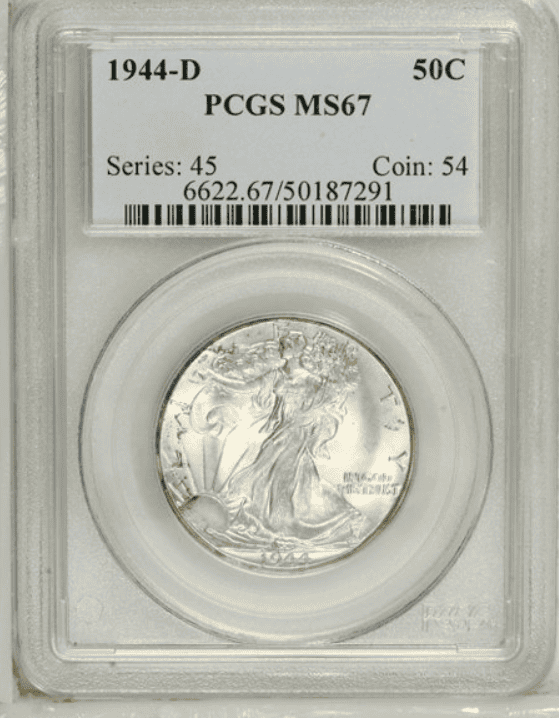
The 1944-D Half Dollar from the Denver Mint had a mintage of 9,769,000 pieces. It falls between the Philadelphia Mint and the San Francisco Mint in terms of output, and although slightly scarcer than the Philadelphia strike, it is not extremely rare.

PCGS CoinFacts specifically notes that the 1944-D “is often found with fantastic white frosty luster” and that “strike is not usually a problem with this issue” — a sharp contrast to the notorious softness of the 1944-S. NGC further observes that fully struck examples are still scarce for the Denver issue, with weakness sometimes appearing on Liberty’s head, the olive branch, and the date area — so strike quality still rewards careful selection. In mint state condition, the 1944-D is scarcer than the 1945-D and 1946-D, but not as difficult to find as the 1941-D, 1942-D, or 1943-D.

A single example graded MS68 achieved $57,600 at Stack’s Bowers on June 16, 2021 — the auction record for this issue. The scarcity of high-grade versions and their generally superior strike quality make the 1944-D an attractive option for collectors seeking premium wartime coins.

1944-D Half Dollar Price/Grade Chart

Price by 1-70 Grade (Latest Auction Records Included)

Updated: 2026-05-12 02:11:01

The high-grade 1944-D half dollar’s auction performance reflects the market’s recognition of its quality and relative scarcity.

Date PlatformPrice Grade

Market activity demonstrates collectors’ appreciation for the coin’s historical significance and mint quality.

Market activity: 1944-D Half Dollar

1944-D FS-901 Hand Engraved Initials

1944-D FS-901 Hand Engraved Initials

The 1944-D FS-901 Hand Engraved Initials is a fascinating manufacturing variant. The designer’s monogram “AW” was accidentally worn off during the making of a working die, and a mint employee then added the initials back by hand-engraving directly into the die surface.

According to Greysheet, the “AW” initials on the reverse “were omitted from the original die and were subsequently hand engraved,” and the resulting lettering is “broader than normal” because the initials were carved by hand rather than machine-stamped. This is most clearly seen beneath the eagle’s right wingtip on the reverse — the engraved letters appear slightly rougher and more irregular than standard specimens.

This variety was discovered by Heritage Auctions cataloger Brian Koller and first reported in a February 2004 Coin World cover story, highlighting its significance in numismatic research. Auction records show that in 2014, an MS67+ was sold for $3,290. Typical certified examples range from $31 to $1,412 depending on condition, making this an affordable entry point for variety collectors at lower grades.

1944-D FS-901 Hand Engraved Initials Price/Grade Chart

Price by 1-70 Grade (Latest Auction Records Included)

Updated: 2026-05-12 02:11:01

The auction history below demonstrates the strong interest in this unique, hand-engraved version among collectors of varying levels.

Date PlatformPrice Grade

Market activity for this variant is shown below.

Market activity: 1944-D FS-901 Hand Engraved Initials


1944-S Half Dollar Value

1944-S Half Dollar Value

The San Francisco Mint’s 1944-S half dollar had the lowest mintage of the three 1944 issues, at just 8,904,000. Strike is a major problem with the 1944-S, and many mint-state specimens are very softly struck through the central devices, specifically Liberty’s left hand.

According to PCGS CoinFacts, the 1944-S holds the distinction of being the second weakest strike in the entire Walking Liberty half dollar series — only the 1940-S is worse. This isn’t a minor quirk: it means that a fully, sharply struck 1944-S half dollar is a genuinely rare coin, and 100% fully struck examples basically do not exist. When grading a 1944-S, collectors should examine strike quality separately from surface preservation, because a sharply struck MS65 can actually be worth more than a weakly struck MS66. At the MS-67 level, there is a significant price guide divergence — NGC values the grade at around $850 while PCGS places it at $5,250, with recent auction results trending closer to the NGC figure for typical examples.

A high-quality 1944-S example graded MS67 sold for $40,800 in 2021, reflecting the rarity of quality specimens from this problematic issue.

1944-S Half Dollar Price/Grade Chart

Price by 1-70 Grade (Latest Auction Records Included)

Updated: 2026-05-12 02:11:01

The auction history of 1944-S specimens reflects the market’s appreciation for the few well-struck examples that have survived from this challenging San Francisco issue.

Date PlatformPrice Grade

Market activity for the 1944-S remains steady among collectors who understand both its scarcity and the inherent difficulties in finding quality examples from this mint.

Market activity: 1944-S Half Dollar

1944-S FS-511, Inverted Mintmark

1944-S FS-511, Inverted Mintmark

The 1944-S FS-511 Inverted Mintmark represents a manufacturing anomaly that combines the mint’s existing strike quality problems with a rare positional error, creating significant collector appeal.

This variety features the “S” mintmark positioned upside down compared to its normal orientation. The error likely occurred when the mintmark punch was accidentally inverted during the die preparation process at the San Francisco Mint. Auction records show the highest price achieved for an MS66+ reached $1,320. Entry-level examples across various grades typically range from $20 to $100, making this error accessible at lower grades while premium specimens command the higher figures.

1944-S FS-511, Inverted Mintmark Price/Grade Chart

Price by 1-70 Grade (Latest Auction Records Included)

Updated: 2026-05-12 02:11:01

The auction performance below demonstrates that this inverted mintmark version maintains a premium across grades.

Date PlatformPrice Grade

The market activity data shown below demonstrates continued collector interest in this inverted mintmark.

Market activity: 1944-S FS-511, Inverted Mintmark

Also Read: Rare Half Dollar Coins to Look For

CoinVaueChecker App 10


Rare 1944 Half Dollar Error List

While 1944 Walking Liberty Half Dollars are generally common, certain production anomalies create collectible varieties. These errors occurred during the wartime minting process when quality control was less stringent, resulting in several identifiable mistakes.

1944-S/S RPM (FS-501 To FS-502)

1944-S/S RPM (FS-501)

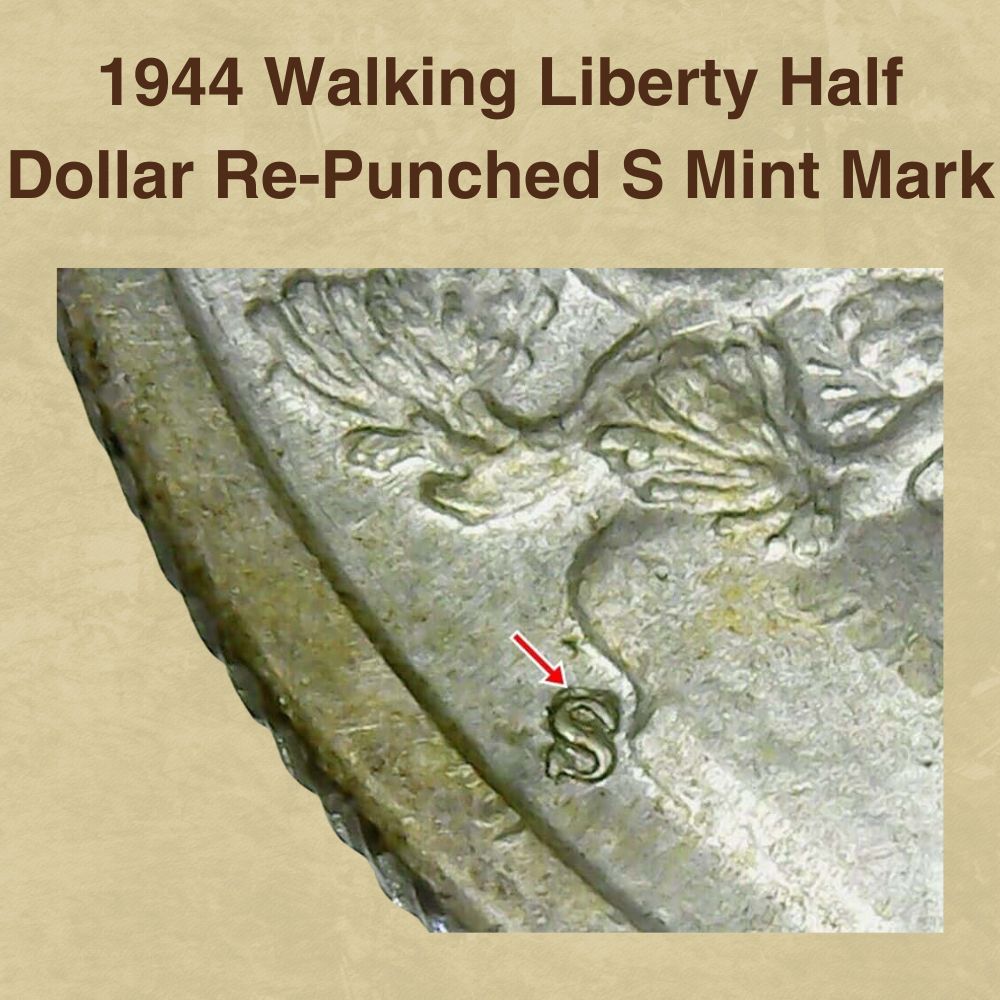
The 1944-S Re-Punched Mint Mark — also called an RPM — is an error where the “S” mintmark was struck twice in slightly different positions. An RPM (Repunched Mint Mark) occurs when the first mintmark punch was improperly positioned, requiring a second application that creates visible doubling.

FS-501 and FS-502 represent two distinct degrees of separation and orientation for the double strike. These subtle classification differences can typically only be accurately identified under 10x magnification or higher. Most specimens grade in circulated to lower mint state conditions, as the San Francisco Mint’s weak strikes often affected detail preservation. According to auction data, the MS62 FS-501 pattern sold for $588 and the MS66 FS-502 pattern sold for $893 — reflecting their status as affordable collector-quality errors rather than high-priced rarities.

According to GreatCollections data, the 1944-S/S RPM FS-502 has appeared in sales with prices ranging from $24 to $260 across grades 30 to 64 over 15 years of tracked sales — making it a cherry-picker’s coin that rewards careful die examination.

1944-S/S RPM (FS-501 To FS-502) Price/Grade Chart

Price by 1-70 Grade (Latest Auction Records Included)

Updated: 2026-05-12 02:11:01


Where To Sell Your 1944 Half Dollar?

With your 1944 half dollar values in hand, it’s time to explore your selling options. From auction houses to direct-sale platforms, there are multiple strong online destinations where these wartime Walking Liberty coins find eager buyers, highlighting what works best for different coin conditions and seller preferences.

Check out now: Best Places To Sell Coins Online (Pros & Cons)


1944 Half Dollar Market Trend

Market Interest Trend Chart - 1944 Half Dollar

*Market Trend Chart showing the number of people paying attention to this coin.


FAQ About The 1944 Half Dollar

1. Which 1944 Walking Liberty coins are the costliest?

The three highest auction records are: the 1944 Philadelphia MS68 at $109,250 (Heritage Auctions, August 2010); the 1944-D MS68 at $57,600 (Stack’s Bowers, June 2021); and the 1944-S MS67 at $40,800 (2021 auction). All three records belong to the top Mint State grades, where certified population is in the single digits.

2. How much is a 1944 Philadelphia (no mint mark) half dollar worth?

Silver 1944 Walking Liberty coins without a mint mark came from Philadelphia. Worn circulated examples are worth roughly $17 to $50 depending on how much detail remains. Uncirculated pieces (MS60–MS64) range from about $55 to $300, while gem-quality MS65 examples sell for $100–$150. At the very top, MS67 specimens have sold for $450 to $2,174, and the extremely rare MS68 has ranged from $4,920 to $109,250 depending on luster and eye appeal.

3. Why is the 1944-S half dollar so valuable in high grades?

PCGS CoinFacts confirms that the 1944-S has the second weakest strike in the entire Walking Liberty series — only the 1940-S is worse. Strike weakness concentrated in Liberty’s left hand means that a fully struck 1944-S is genuinely rare, and 100% fully struck examples basically do not exist. Collectors pay steep premiums for the few sharply struck high-grade examples that have survived.

4. How do I spot a repunched mintmark on my 1944-S half dollar?

Examine the “S” mintmark on the reverse using 10x magnification, located between the rock and rim below the eagle. Look for doubling, shadowing, or notching around the mintmark edges where a secondary impression appears. The FS-501 and FS-502 varieties show different directional separation patterns — one displays doubling to the north/northeast, while the other shows south/southwest displacement. Compare your coin against a normal “S” mintmark image to identify the additional impression, and be careful not to confuse true RPMs with die polishing marks or scratches.

5. Does the 1944 half dollar contain real silver?

Yes, every 1944 half dollar is 90% silver and 10% copper, containing 0.3617 troy ounces of pure silver. Based on November 2025 silver prices of approximately $47.85 per troy ounce, the silver melt value is roughly $17.31. Even heavily worn examples are worth that floor value, and most trade slightly above melt due to collector demand.

6. Is there a 1944 Proof half dollar?

No. The U.S. Mint suspended all Proof coinage programs after 1942 to conserve wartime resources, and Proof production did not resume until 1950. Any coin described or sold as a “1944 Proof half dollar” is either a misidentified high-quality business strike or a counterfeit — do not pay a Proof premium for it.

7. What is the 1944-D FS-901 Hand Engraved Initials variety?

The FS-901 is a documented die variety where a Denver Mint employee hand-carved the “AW” designer initials back onto a working die after they were accidentally worn off. The hand-engraved letters appear broader and less refined than normal machine-applied initials. Discovered by Heritage Auctions cataloger Brian Koller and first reported in Coin World in February 2004, this variety has sold for as much as $3,290 in MS67+ grade, with typical certified examples ranging from $31 to $1,412.

8. How do I find the mint mark on a 1944 half dollar?

Flip the coin to the reverse (eagle side) and look at the lower left area, between the rocky base and the coin’s rim — specifically to the left of the “H” in “HALF DOLLAR.” A “D” indicates Denver, an “S” indicates San Francisco, and no letter means Philadelphia. The mintmark is small, so use a loupe or magnifying glass for a clear view.

9. What does a 1944 half dollar broadstrike error look like, and what is it worth?

A broadstrike error occurs when the retaining collar fails during striking, causing the coin to spread wider and thinner than normal with a flattened, irregular rim. A 1944 Philadelphia MS62 broadstrike has been documented by PCGS. Value depends on the degree of spread and the coin’s overall condition — dramatic examples with full design visibility and strong luster can command significant premiums over a normal example of the same grade, often several hundred dollars or more.

10. Should I clean my 1944 half dollar before selling it?

Never clean a coin you intend to sell. Professional numismatists and third-party grading services like PCGS (Professional Coin Grading Service) and NGC (Numismatic Guaranty Company) can instantly identify a cleaned coin, and cleaning permanently reduces collector value — often by 30% to 80% depending on grade.

Natural toning that has developed over decades is considered desirable by many collectors. If you want the best price, submit the coin in its original, uncleaned state to a professional grading service, especially for any specimen you believe might grade MS65 or higher.

You May Also Like