Coin Value Contents Table
- 1951 half-dollar Value Chart
- History of the 1951 Half Dollar
- 1951 Franklin half-dollar Types
- Features of the 1951 Franklin Half Dollar
- 1951 Franklin Half Dollar Grading
- 1951 Franklin Half Dollar Value Guides
- 1951 No Mint Mark half-dollar Value
- 1951 proof half-dollar Value
- 1951 D half-dollar Value
- 1951 S half-dollar Value
- Rare 1951 Franklin Half Dollar Error List
- Where to Sell Your 1951 Franklin Half Dollar ?
- FAQ about the 1951 Franklin Half Dollar
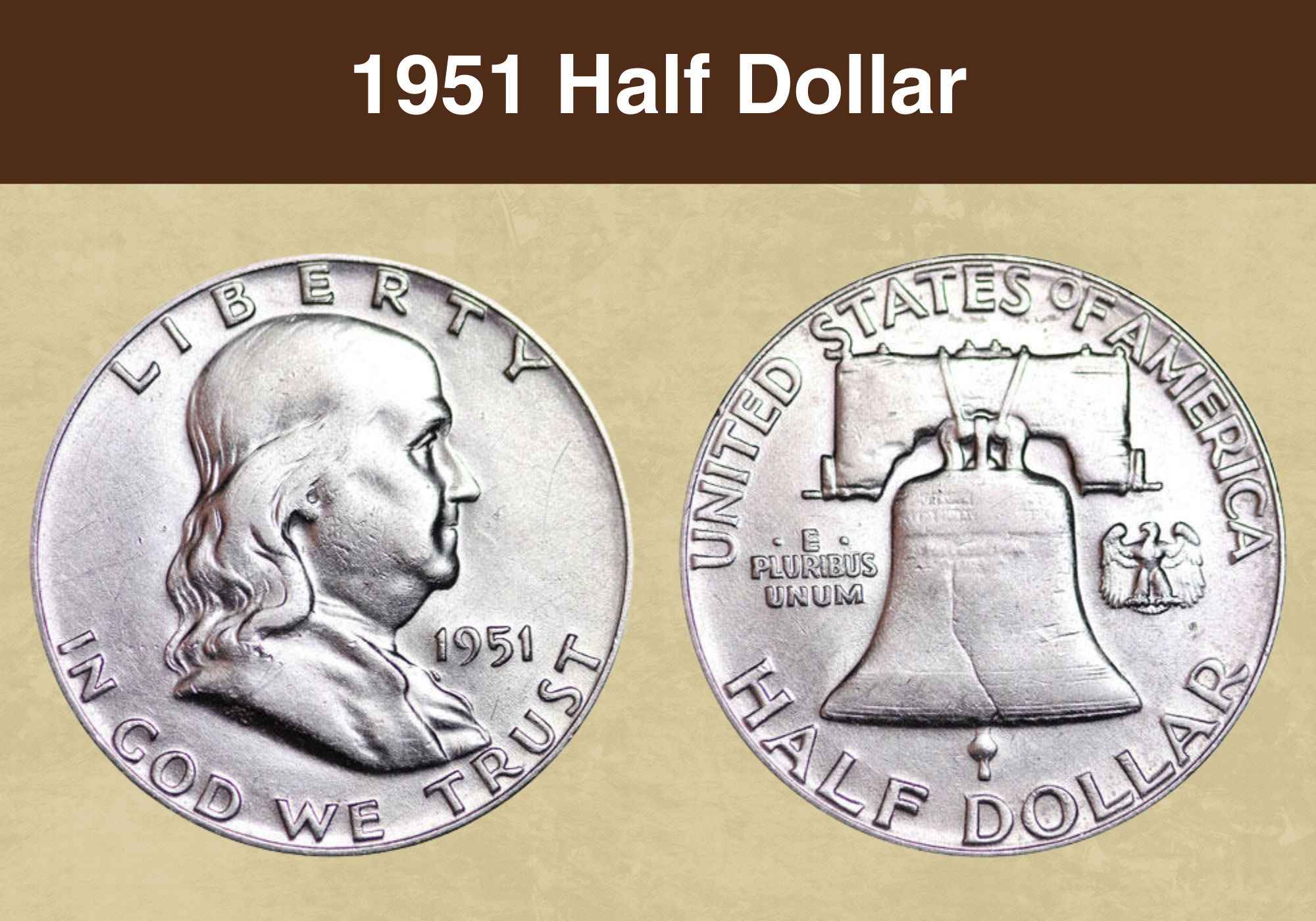
The US Mint struck Half Dollars with Franklin on the obverse, popular American coins, from 1948 to 1963 when halves dedicated to a tragically assassinated President replaced them. You can find only 35 date and mint mark combinations in this series, although about 498 million pieces were totally struck.
Like with most other coins with this Founding Father on the obverse, the 1951 Half Dollar value is almost always over their face value. Only rare pieces reached extraordinary prices on the market, and some owners earned impressive sums at auctions.
1951 half-dollar Value Chart |
|||
| Condition | 1951 No Mint mark half-dollar | 1951 D half-dollar | 1951 S half-dollar |
| Good | $14 | $15 | $15 |
| Very good | $14 | $15 | $15 |
| Fine | $14 | $15 | $15 |
| Very fine | $14 | $15 | $15 |
| Extra fine | $14 | $15 | $15 |
| AU | $14 | $22 | $17 |
| MS 60 | $24 | $36 | $26 |
| MS 65 | $75 | $185 | $75 |
| PR 65 | $475 | / | / |
History of the 1951 Half Dollar
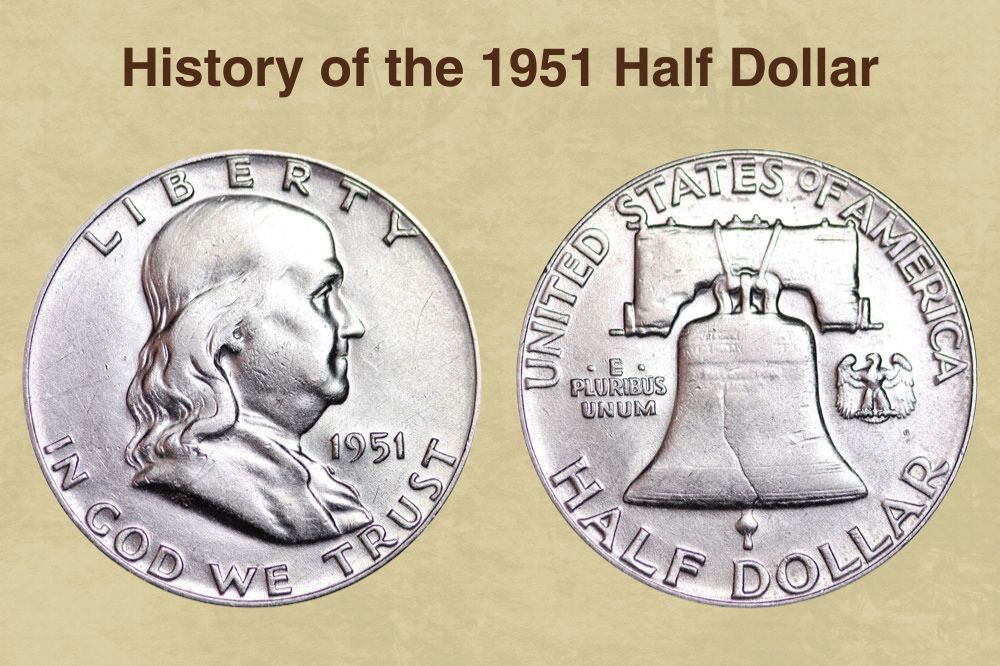
The US Mint produced silver Franklin half-dollars from 1948 to 1963. Mint director Nellie Tayloe Ross was credited with the appearance of these coins, primarily because of her deep admiration for this Founding Father.
1951 Franklin half-dollar Types |
||
| Location | Year | Minted |
| Philadelphia | 1951 No Mint Mark half-dollar | 16,802,102 |
| Philadelphia | 1951 proof half-dollar | 57,500 |
| Denver | 1951 D half-dollar | 9,475,200 |
| San Francisco | 1951 S half-dollar | 13,696,000 |
| Total | / | 40,030,802 |
Even though three mints struck these coins during that period, the one in San Francisco issued them only in five years, 1949, 1951, 1952, 1953, and 1954. These coins were the last 90% silver coinage in American numismatic history intended for circulation, except for Kennedi halves minted in 1964.
Also read: 13 Most Valuable Franklin Half Dollars Worth Money
Features of the 1951 Franklin Half Dollar
John Sinnock designed the Franklin half-dollar obverse minted from 1948 to 1963. The situation was slightly different with the coin reverse since the Liberty Bell with the accompanying details was not completed before the designer’s death. Therefore, Gilroy Roberts finished the job as a co-designer.
The obverse of the 1951 Franklin half-dollar
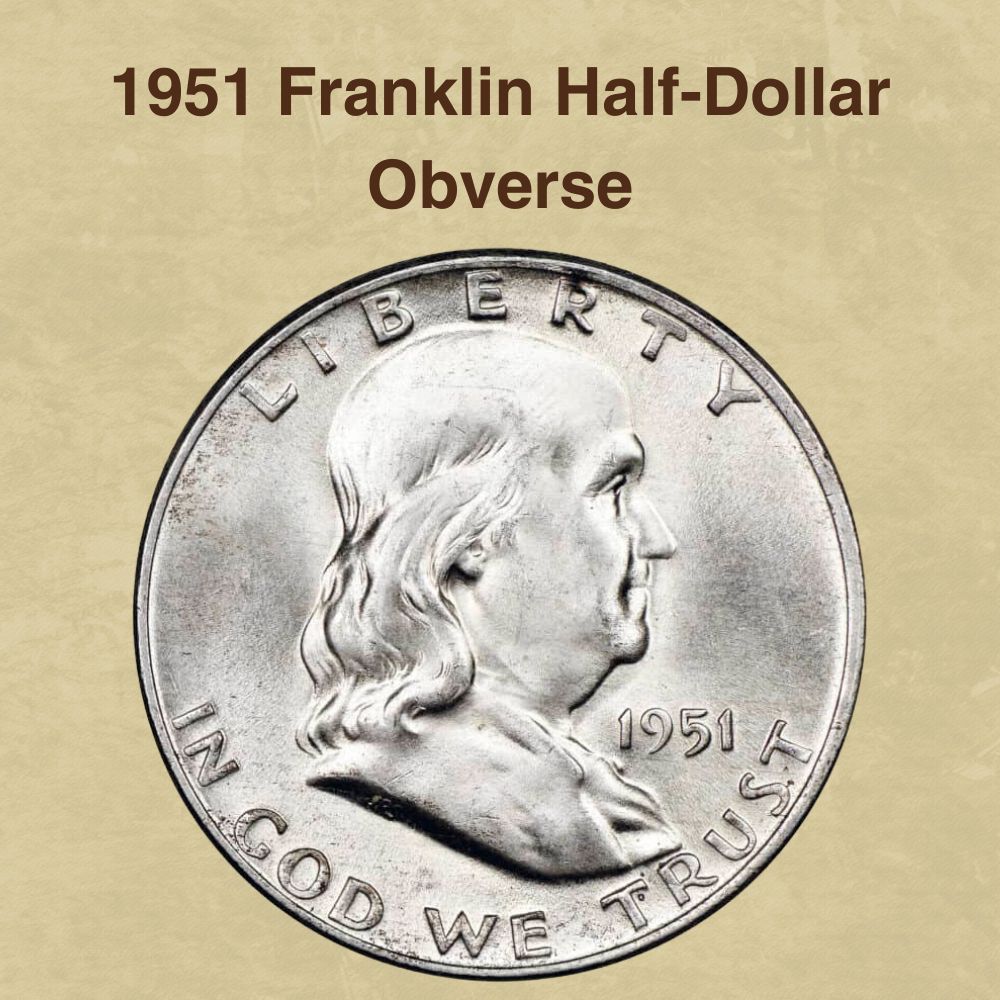
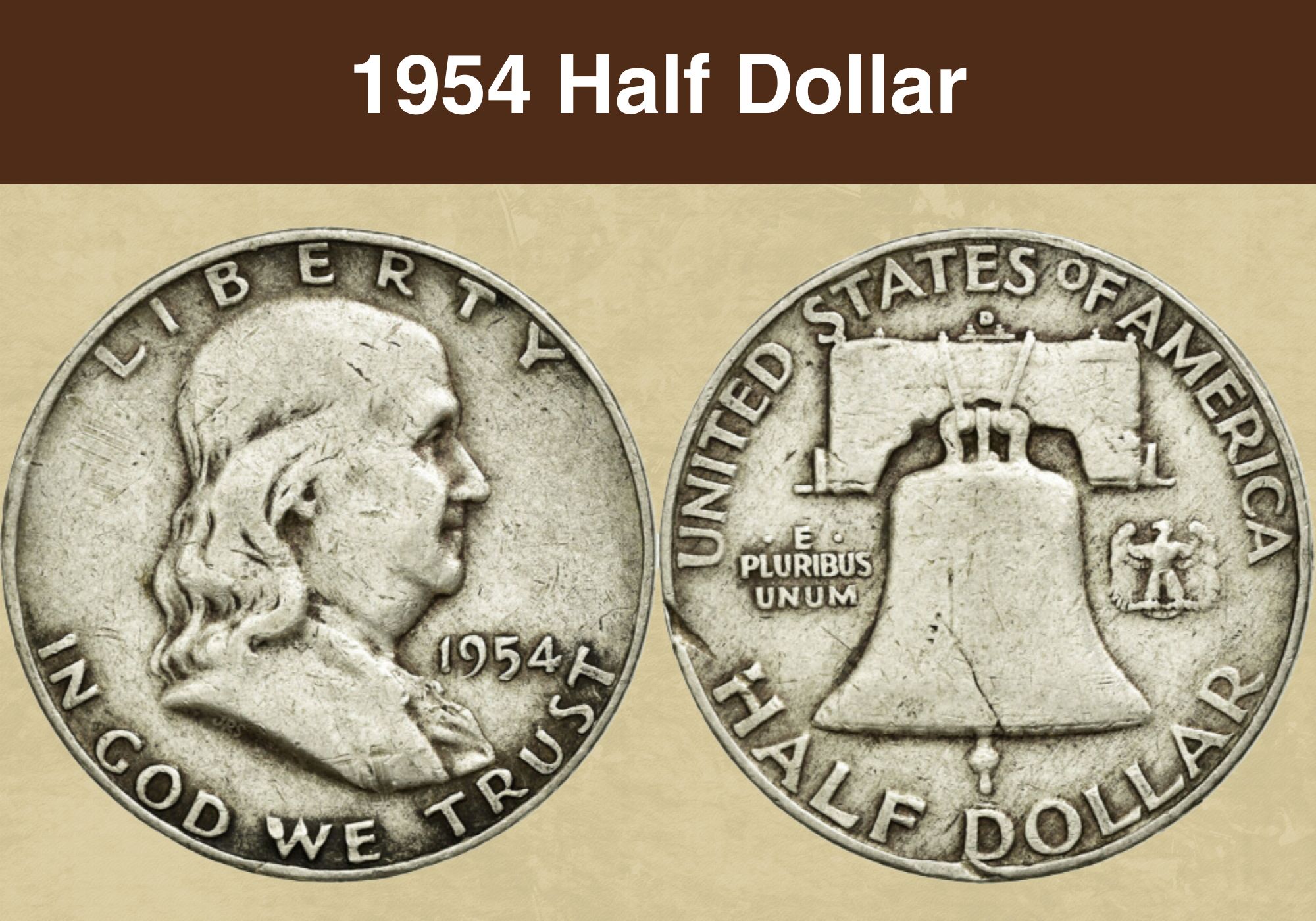
The 1951 half-dollar has Benjamin Franklin on the simple obverse, along with the date, John R. Sinnock’s initials, and inscriptions:
- LIBERTY
- IN GOD WE TRUST
The reverse of the 1951 Franklin half-dollar
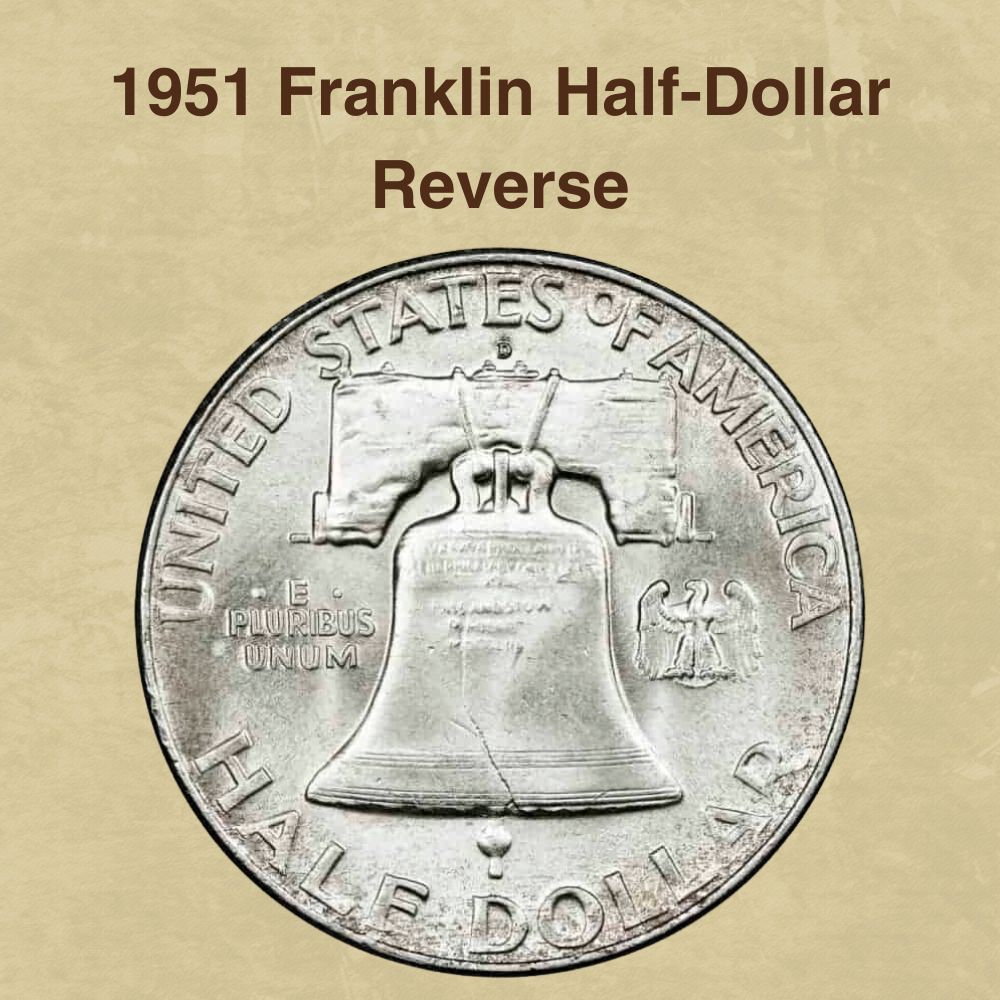
Besides the centrally placed Liberty Bell on the reverse, you can also recognize the following:
- Tiny eagle
- Denomination (HALF DOLLAR)
- UNITED STATES oF AMERICA
- E·PLURIBUS UNUM
1951 Franklin half-dollar Details |
|
| Face value | Fifty cents ($0.50) |
| Compound | 90% silver with 10% added copper |
| Coin diameter | 30.60 mm (1,20472 inches) |
| Coin thickness | 1.80 mm (0,07087 inches) |
| Silver weight | 11.25 g (0.36169 troy ounces) |
| Total coin weight | 12.5 g (0.40188 troy ounces) |
| Shape | Round |
| Edge | Reeded |
Other features of the 1951 Franklin half-dollar
The 1951 silver Franklin half-dollars have a diameter of 30.60 mm (1,20472 inches), while their thickness is 1.80 mm (0,07087 inches). Since they contain 90% silver, you can expect each coin weighing 12.5 g (0.40188 troy ounces) to include 11.25 g (0.36169 troy ounces) of this precious metal.
Also read: 13 Most Valuable Kennedy Half Dollar Worth Money
1951 Franklin Half Dollar Grading
The coin grading is a rigorous process that precisely determines each inspected piece’s quality, level of preservation, existing errors, and possible imperfections and damage. Since the 1951 Franklin half-dollars can be incredibly valuable in the highest grades, you should consider professional evaluation. Only such coins have a chance to reach the maximum prices at auctions.
| # | Grade |
|---|---|
| 1 | Basal State-1 |
| 2 | Fair |
| 3 | Very Fair |
| 4, 5, 6 | Good |
| 7, 8, 10 | Very Good |
| 12, 15 | Fine |
| 20, 30 | Very Fine |
| 40 | Extremely Fine |
| 50 | About Uncirculated |
| 60 | Mint State |
| 65 | Mint State |
| 70 | Mint State |
Please check our grading guides to know your coin scale, It’s the necessary step to know the exact value of your coin.
Check out now: How to Grade Franklin Half Dollar?
1951 Franklin Half Dollar Value Guides
The total mintage of 1951 Franklin half-dollars was 40,030,802 coins from three mints. While two produced only regular coins, the one in Philadelphia issued regular halves and proofs.
1951 No Mint Mark half-dollar Value
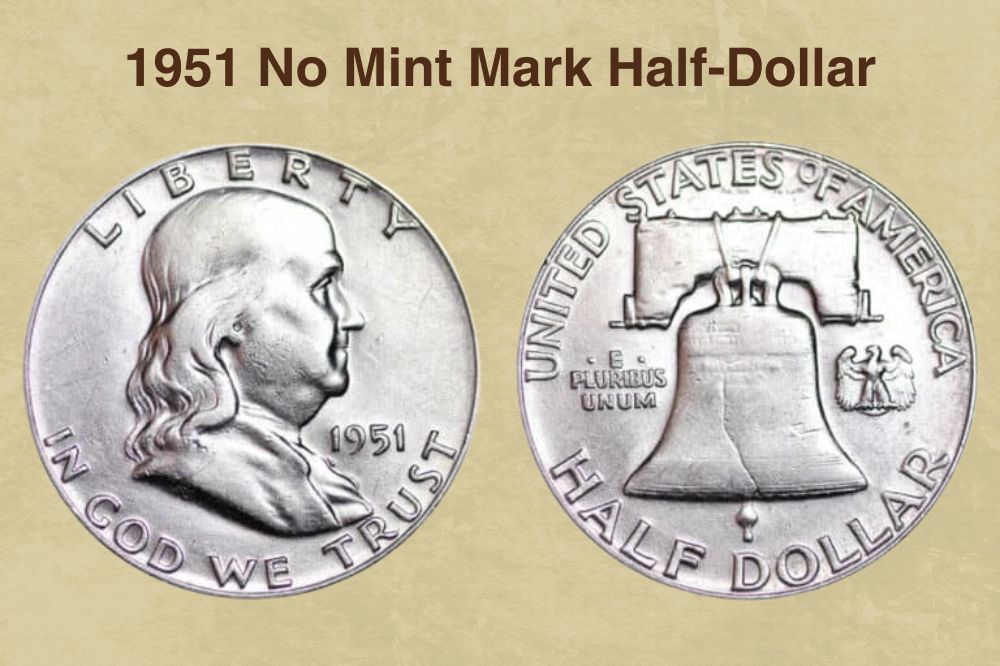
In most cases, the Philadelphia mint had the highest coin mintage, and it was the same with the 1951 Franklin half-dollars. The total number of minted pieces was 16,802,102, causing a relatively affordable price range for circulated specimens of $12 to $22.
Even most coins in the mint state are not particularly expensive, and you can find those in MS 60 to MS 65 grades for $20 to $75 on average.
Less available MS 66-ranked pieces cost approximately $215, while the rarest ones in MS 67 grade are estimated at $1,150. The most expensive 1951 half-dollar is in MS 67+ rank, sold at $2,625 in 2021.
As expected, the 1951 half-dollars with Full Bell Lines are more collectible and often reach higher prices. For instance, most coins in the mint state cost $28 to $450, but the best-ranking ones can be worth much more.
The assessed price for halves in MS 67 grade is $7,750, but they often reach higher prices at auctions. For instance, one dedicated collector purchased one of these coins for $26,400 in August 2019.
1951 proof half-dollar Value
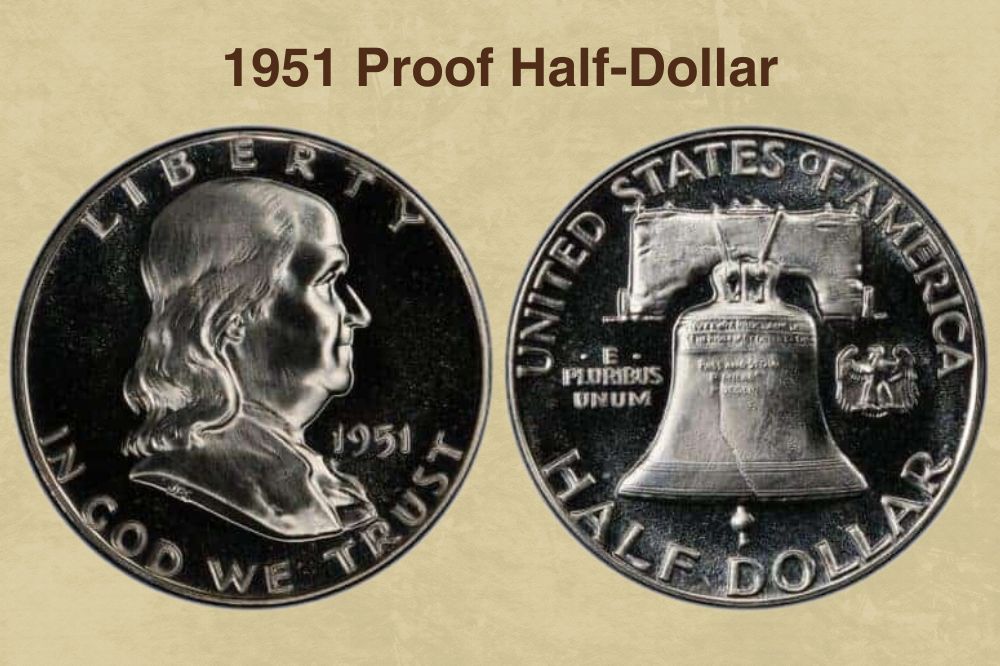
The Philadelphia mint issued 57,500 proof half-dollars with 1951 struck on the obverse. You can recognize three varieties that come with different price ranges. For instance, most proof halves cost $160 to $650, with a few rare and precious exceptions that cost:
- $2,150 (PR 67-graded coins)
- $7,250 (PR 68-graded coins)
- $15,000 to $17,250 (PR 69-graded coins)
Another option is to buy the 1951 CAM half-dollar, which can cost you $300 to $19,000, depending on the quality you are looking for. Despite estimations, one of these pieces in the highest possible rank was sold at $21,600 in 2018.
Finally, you can choose one 1951 DCAM half-dollar at an estimated price of $325 to $10,000. Only scarce, almost perfect coins in PR 67 and PR 68 grades cost more, around $26,000 and even more. The best-paying specimen by now is the 1951 PR 67+ DCAM coin, sold at $82,250 in 2017.
1951 D half-dollar Value
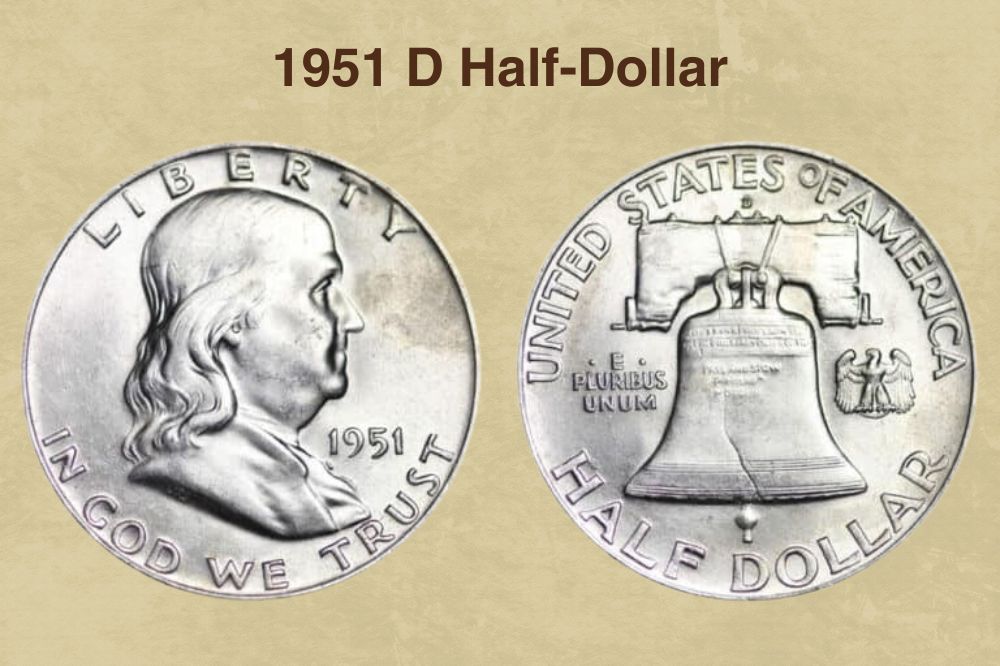
With 9,475,200 half-dollars struck in 1951, the Denver mint released the lowest number of coins. Interestingly, that fact doesn’t significantly affect their prices, except for specimens in the highest grades.
For instance, you can buy the 1951 Franklin half-dollar in circulated condition for $15 to $32, while most in the mint state are assessed at $36 to $525.
You can also find the 1951 D FBL half-dollars for about $38 to $550, depending on their look and preservation. However, be prepared that specimens in MS 67 grade are unbelievably rare. Thus, their estimated prices are $17,500.
For now, the most expensive piece from this mint is a coin in MS 66 grade that reached $3,680 in 2004. The 1951 D MS 66+ coin with FBL quality was more expensive and sold at $5,500 nine years later.
1951 S half-dollar Value
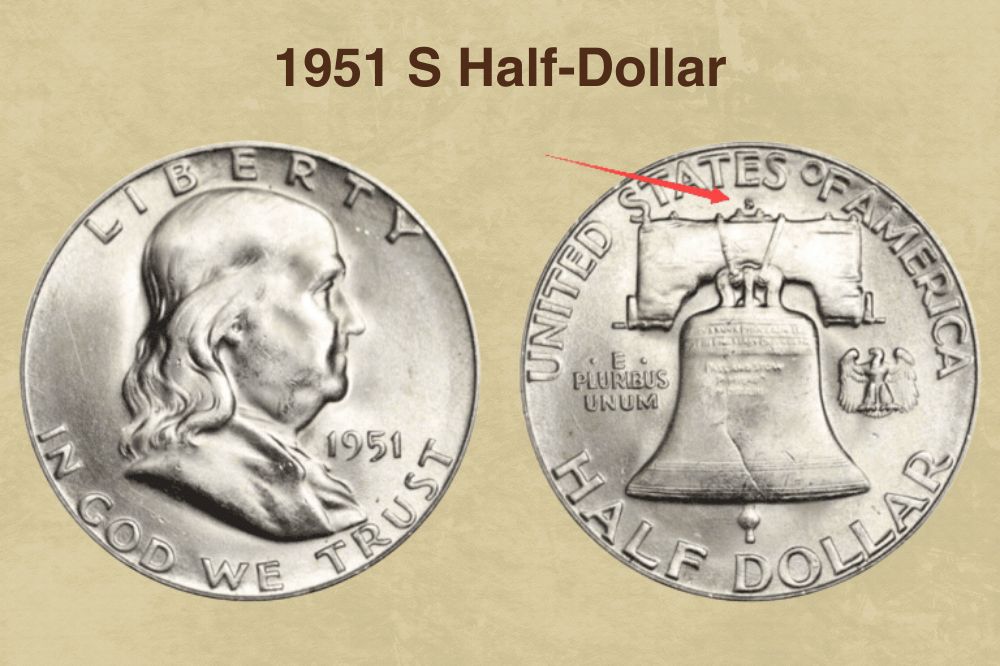
Depending on their condition, any of the 13,696,000 half-dollars spending some time in circulation is worth $15 to $24. On the other hand, those that have never been used cost about $26 to $175, depending on their quality and level of perfection.
As always, you can find coins that stand out from the crowd and look beautiful. These almost ideally preserved pieces in MS 67 grade cost $2,100, based on experts’ estimations.
Besides these regular coins, this set includes a particular number of FBL half-dollars. Their prices range from $190 (MS 64) to $900 (MS 66). The best-preserved ones in MS 67 rank can reach $4,800 to $9,000 at auctions.
As is often the case, auction records are significantly higher than the best estimates. One eBay visitor bought the 1951 S MS 67+ half-dollar on this shopping website for $5,247 in 2021. The real surprise was the coin of similar quality but with Full Bell Lines sold in 2013 at $30,550.
Also read: 11 Most Valuable Half Dollars In Circulation
Rare 1951 Franklin Half Dollar Error List
The 1951 half-dollars are known for a few specific errors and one valuable variation. Be aware that every deviation from the standard look potentially leads to increased prices on the market.
Full Bell Lines
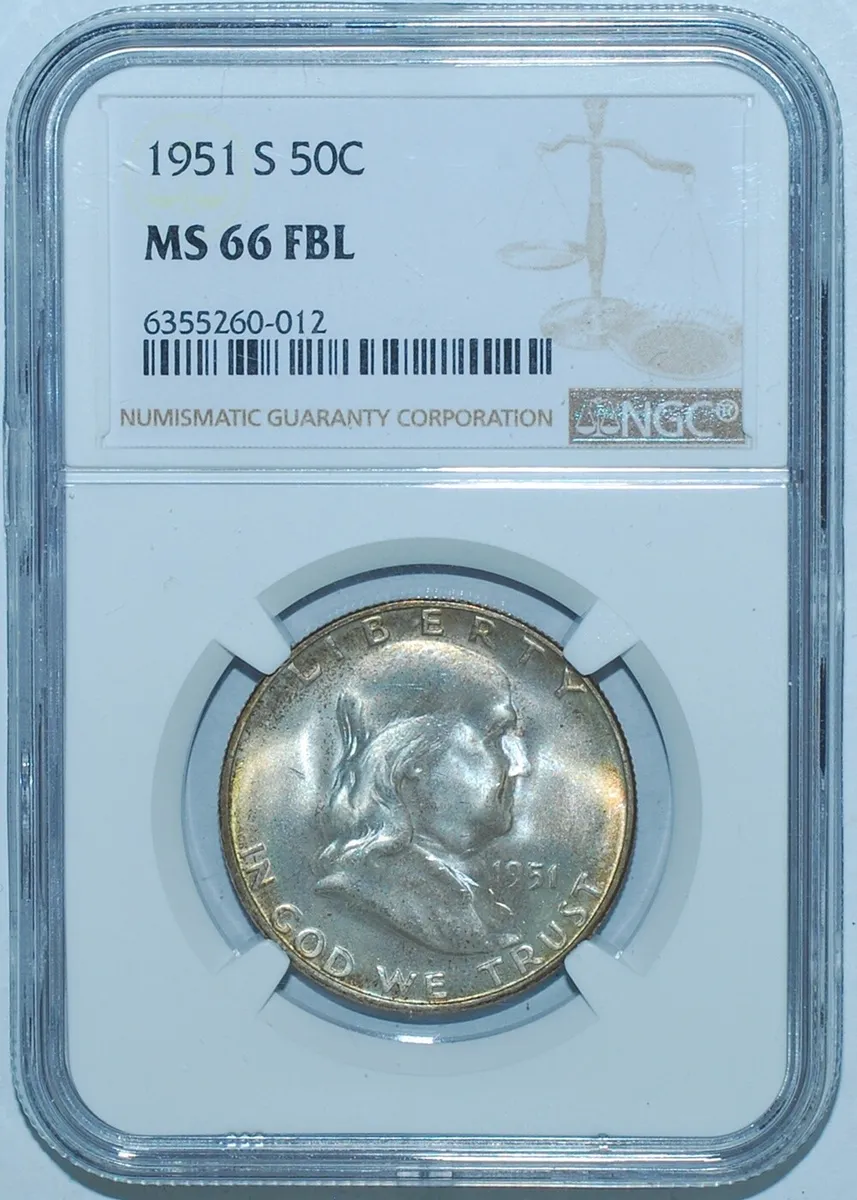
The 1951 Franklin half-dollars with Full Bell Lines almost always mean a higher value than regular coins. Pieces with this rare variation that feature complete horizontal lines come with at least 50% higher prices. In the highest grades, they are worth thousands, sometimes even a few tens of thousands of dollars.
Obverse die clash
This error appeared among the 1951 half-dollars from Philadelphia when the obverse and reverse die failed to simultaneously strike the coin.
That resulted in transferring the design from one to another die. That way, you get the specimen with the obverse design traces on the reverse or vice versa. The costliest coin with this error was bought for $800 in 2022.
Bugs Bunny
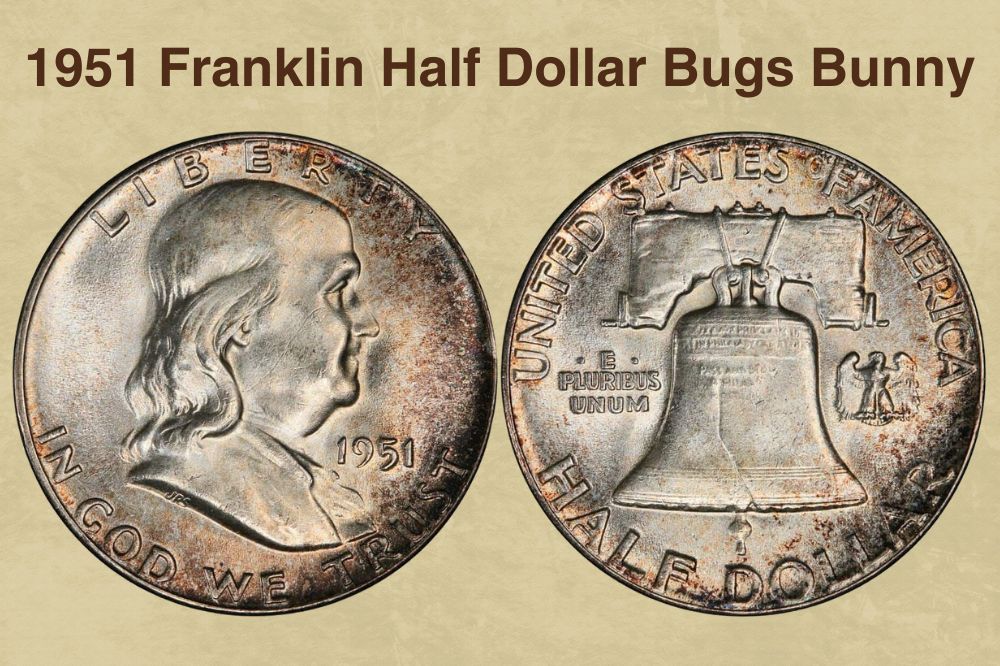
This error is specific to Franklin half-dollars, including those minted in 1951. Collectors like these atypical pieces showing Benjamin Franklin with ‘buck teeth.’ They result from a unique die clash error and are visible only under the magnifying glass.
Such error coins typically cost tens or hundreds of dollars. The most expensive specimen was the one in MS 64 grade. It was sold on eBay at $538 in 2010. Interestingly, the coin with FBL quality and the same rank reached only $235 in November 2020 on the same website.
RPM
The re-punched mint mark error half-dollars from San Francisco are typically more valuable than regular ones. You should set aside several hundred dollars to get one, while the most expensive S/S specimen in MS 67 grade won the auction record after being sold at $1,920 in 2022.
DDR
The 1951 half-dollars struck in San Francisco may come with DDR error with a visible overlapping effect on letters and numbers. The record price for one such coin is $805, how much one collector paid for the 1951 S MS 65 half-dollar in 2007. A piece with FBL in the same grade was sold at $633 in 2010.
This error also appears on proof coins minted this year. They are more expensive than pieces with the S mint mark and reach $1,000 more or less at auctions.
Where to Sell Your 1951 Franklin Half Dollar ?
Now that you know the value of your coins, do you know where to sell those coins online easily? Don’t worry, I’ve compiled a list of these sites, including their introduction, pros, and cons.
Check out now: Best Places To Sell Coins Online (Pros & Cons)
FAQ about the 1951 Franklin Half Dollar
What makes a 1951 Franklin half-dollar rare?
The 1951 Franklin half-dollars are available coins you can find at reasonable prices. Only those in the highest ranks and FBL quality are sometimes considered rare, affecting their estimated value.
Which 1951 Franklin half-dollars are extraordinarily valuable?
- 1951 PR 67+ half-dollar DCAM sold at $82,250 (August 2017, Heritage Auctions)
- 1951 S MS 67 half-dollar FBL sold at $30,550 (April 2013, Heritage Auctions)
- 1951 MS 67 half-dollar FBL sold at $26,400 (August 2019, Stack’s Bowers)
- 1951 PR 68 half-dollar CAM sold at $21,600 (March 2018, Stack’s Bowers)
- 1951 PR 68 half-dollar sold at $12,000 (July 2018, Heritage Auctions)
- 1951 D MS 66+ half-dollar FBL sold at $5,500 (September 2013, eBay)
- 1951 S MS 67+ half-dollar sold at $5,247 (September 2021, eBay)
- 1951 D MS 66 half-dollar sold at $3,680 (March 2004, American Numismatic Rarities)
- 1951 MS 67+ half-dollar sold at $2,625 (July 2021, David Lawrence RC)
- 1951 S/S MS 67 half-dollar RPM sold at $1,920 (August 2022, Heritage Auctions)
- 1951 S/S MS 66 half-dollar FBL, RPM sold at $1,880 (July 2019, eBay)
- 1951 PR 66 DDR half-dollar sold at $1,110 (March 2021 • Heritage Auctions)
- 1951 PR 65 half-dollar DDR, CAM sold at $940 (November 2013, Heritage Auctions)
- 1951 S MS 65 half-dollar DDR sold at $805 (January 2007, Heritage Auctions)
- 1951 MS 65 half-dollar obverse die clash sold at $800 (August 2022, eBay)
- 1951 S MS 65 half-dollar DDR, FBL sold at $633 (July 2010, Heritage Auctions)
- 1951 MS 64 half-dollar Bugs Bunny sold at $538 (November 2010, eBay)
- 1951 MS 64 half-dollar Bugs Bunny, FBL sold at $235 (November 2020, eBay)
- 1951 S MS 62 half-dollar, PL sold at $34 (July 2023, eBay)
How much are the 1951 Franklin Half Dollars expensive?
Most circulated 1951 Franklin half-dollars are affordable, with an average price range of $14 to $22. Coins in uncirculated condition have different values, depending on the condition.
For instance, coins in MS 60 to MS 65 grades are assessed at $24 to $75 on average, while better-ranked pieces can cost $215 (MS 66) or even $1,150 (MS 67). Remember that half-dollars with Full Bell Lines minted this year are worth $28 to $7,750, depending on preservation.
What is the priciest Franklin half-dollar?
- 1958 MS 67+ half-dollar FBL – $129,250 (2018)
- 1963 MS 66+ half-dollar FBL – $85,187.50 (2019)
- 1951 PR 67+ half-dollar DCAM – $82,250 (2017)
- 1953 S MS 66 half-dollar – $69,000 (2001)
- 1950 PR 66 half-dollar DCAM – $66,000 (2023)