Rare 2022 Dime Errors Worth Money (Full List With Pictures)
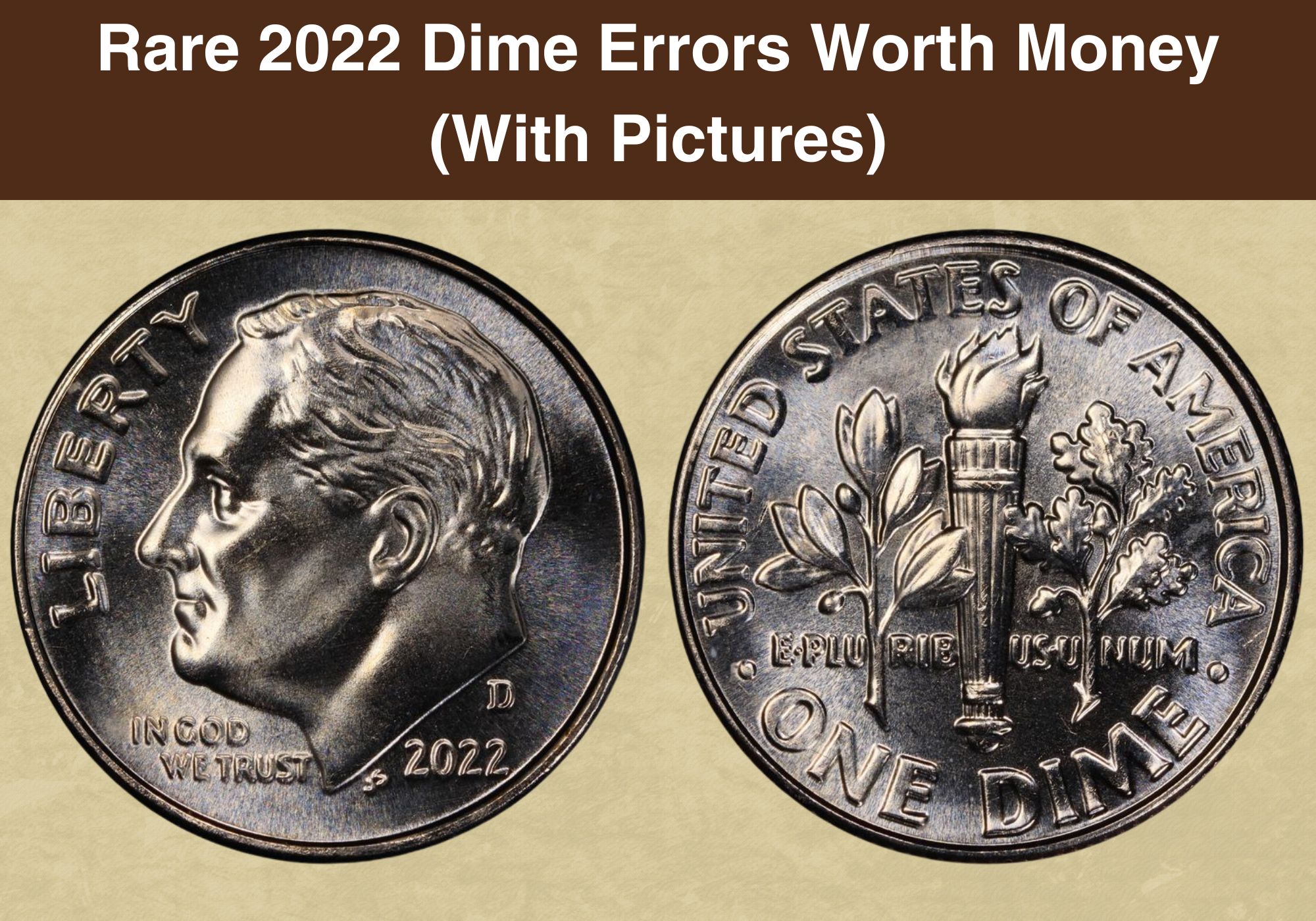
A 2022 Roosevelt dime struck on a Lincoln cent planchet could be worth up to $1,500 based on comparable modern dime wrong planchet sales. The complete 2022 dime error list covers errors ranging from $5 die cuds to four-figure wrong planchet strikes. The U.S. Mint produced approximately 3.1 billion dimes in 2022 between Philadelphia and Denver, but modern Schuler presses equipped with laser sensors catch most mistakes before they escape — making genuine 2022 errors rarer than their older counterparts. Here’s what to look for in your pocket change.
1. 2022 Roosevelt Dime Drooling Frank Error (Up to $10)
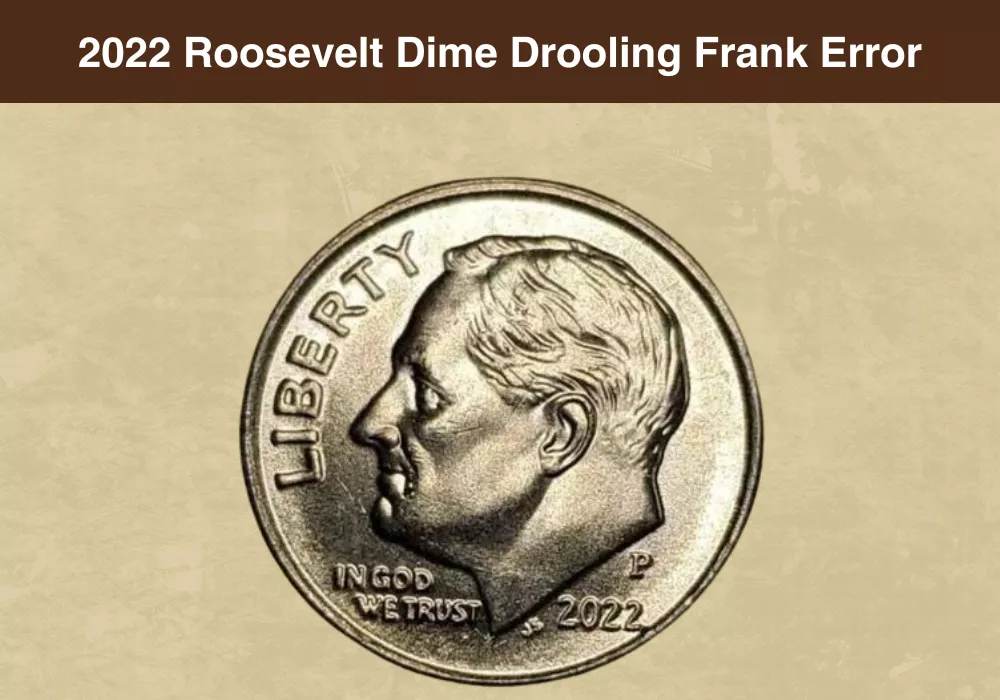
The Drooling Frank error gets its name from a die cud that forms on Roosevelt’s lips, giving him the appearance of drooling. This happens when a small piece of the die breaks away from metal fatigue, leaving a void that fills with planchet metal during subsequent strikes.
The result is a raised blob on Roosevelt’s lower lip or chin area. This is a die deterioration defect, not a design variety — it occurred because the die was wearing out, not because of a hubbing mistake. The error is fairly common among 2022 dimes because the Mint pushes dies through millions of strikes before replacement. Different dies produce slightly different cud positions.
Value: Drooling Frank errors on 2022 dimes sell for $5 to $10 on eBay depending on the size and clarity of the cud and the coin’s overall condition. No major auction house records exist for this specific variety. Uncirculated examples with large, clearly visible cuds bring the upper end of the range.
How to Identify: Examine Roosevelt’s lips and chin area under a 5x loupe. Look for a raised, shapeless blob of metal that sits above the normal surface level. The blob should be smooth-topped and rounded — not rough or jagged like post-mint damage.
Compare to a normal 2022 dime. The standard Roosevelt portrait has clean, flowing lines around the mouth with no bumps or irregularities. A genuine die cud will be in the same position on every coin struck by that particular die. If you find two coins with the blob in identical positions, that confirms the die origin. Don’t confuse with a struck-through error, which creates a depression rather than a raised area. Fastest check: a raised smooth blob specifically on or near Roosevelt’s lips.
Use Our 2022 Dime Value Checker
2. 2022 Roosevelt Dime Struck-Through Grease Error (Up to $30)
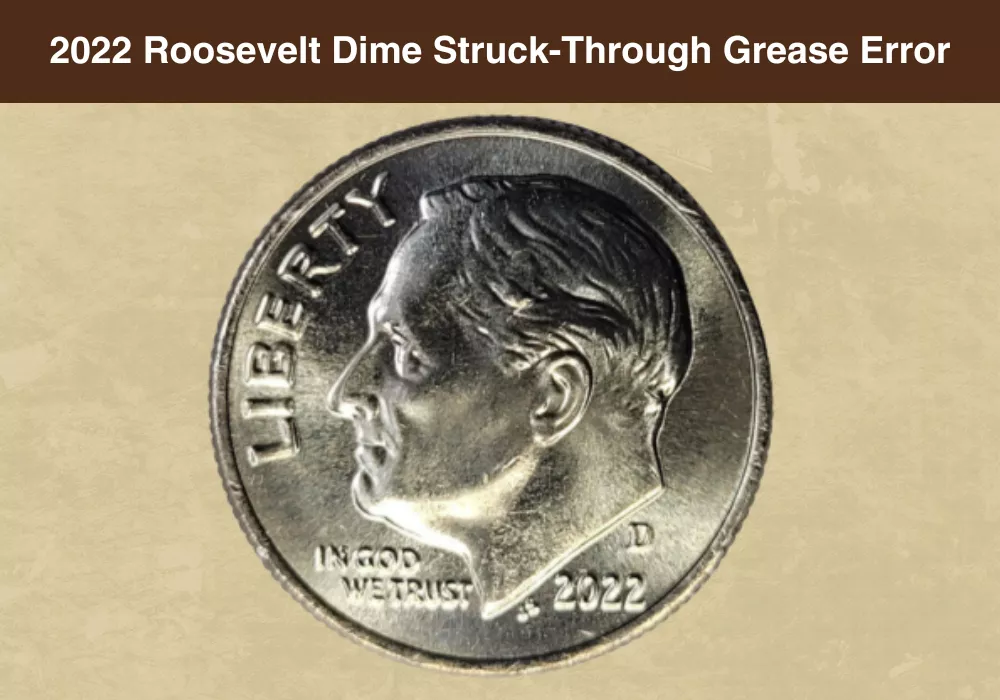
Grease, oil, and metallic debris accumulate in die recesses during high-speed production. When enough material packs into a design element, the planchet metal can’t flow into that area during striking, and the affected detail comes out weak or entirely absent.
The “Burning Torch” or “Smokey Torch” variety is a specific presentation of this error on 2022 dimes. The left portion of the flame on the reverse torch appears barely visible or missing entirely, with only a faint outline remaining where the full flame should be. A foreign object or packed grease blocked that specific section of the die, preventing the flame from striking fully. The torch bands are another common grease fill location because those thin horizontal lines fill up fast.
Value: Minor grease fills affecting a single letter or small design element sell for $5 to $15. The Burning Torch variety — where the flame is clearly affected — brings $15 to $30 in uncirculated grades. No major auction house records exist specifically for 2022 dime grease fills.
How to Identify: Look for areas where design elements are mushy or completely absent while surrounding details remain sharp. Under a 5x loupe, the missing area should blend smoothly into the field — not look gouged or scratched.
For the Burning Torch specifically, examine the reverse torch flame. The left portion of the flame should be weak, ghostly, or missing while the right side and the torch body remain normally struck. The distinction from wear is specificity — a grease fill erases particular elements while leaving adjacent features crisp. A worn coin loses detail evenly across high points. Check the opposite side — weakness from insufficient striking pressure affects both sides, while grease typically hits one side or specific areas only. Fastest check: a cleanly absent torch flame with everything around it sharp.
Use Our 2022 Dime Value Checker
3. 2022 Roosevelt Dime Die Chip Error (Up to $30)
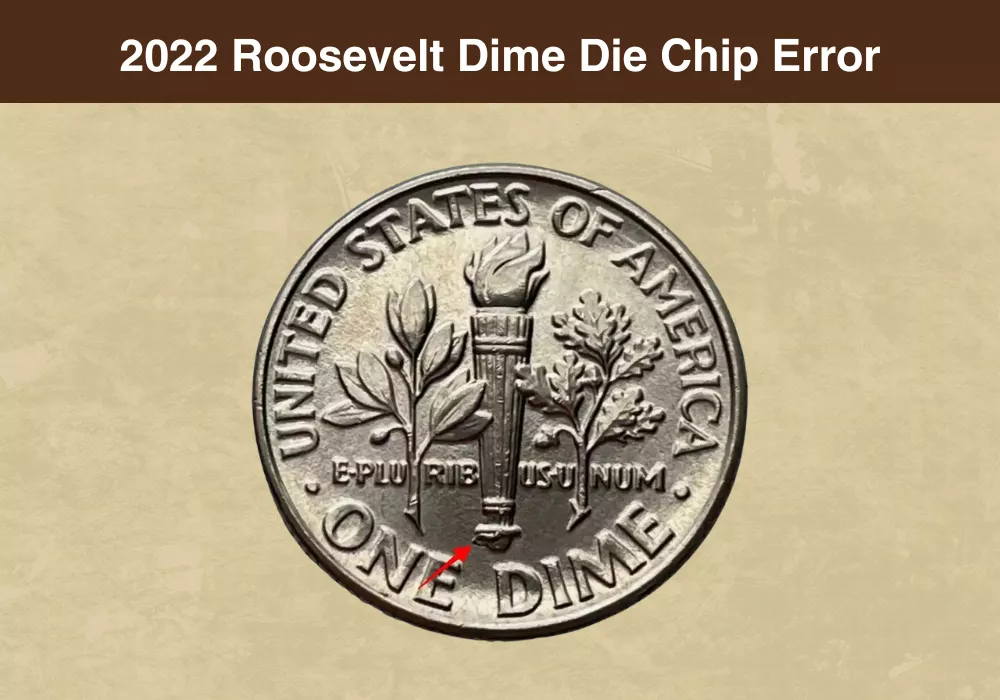
Die chips occur when a small fragment breaks away from the die surface, leaving a void that fills with metal during striking. The result is a raised bump on the finished coin wherever the chip was located.
On 2022 dimes, the most collected presentation is a blob on Roosevelt’s nose — a raised circular bump that looks like a mole or wart. Different dies produce chips in different positions, so the blob’s exact size and location vary. Die chips are a progressive error — they start small and grow as the die continues to deteriorate. Early-stage chips produce tiny dots while late-stage chips can create substantial bumps that distort surrounding design elements.
Value: Die chip errors on 2022 dimes with the blob on Roosevelt’s nose sell for $20 to $30 depending on the size of the chip and coin condition. Uncirculated examples bring the higher end. Chips in less prominent locations sell for $5 to $15. No major auction house records exist for 2022 dime die chips.
How to Identify: Under a 5x–10x loupe, look for a raised, rounded bump on the coin’s surface that isn’t part of the original design. Die chips appear as shapeless blobs — not as crisp design elements.
Run your fingernail across the suspected area. A genuine die chip feels raised above the surface, not depressed. Compare the spot to the same location on a normal 2022 dime — the standard portrait has smooth contours without bumps. Die chips should not be confused with struck-through errors, which create depressions, or with contact marks, which produce flat or concave damage rather than raised features. A die chip blob on Roosevelt’s nose is easy to spot because the nose should be a smooth, continuous curve. Fastest check: a raised bump on the nose that feels elevated when you run a fingernail across it.
Use Our 2022 Dime Value Checker
4. 2022 Roosevelt Dime Die Crack / Cud Error (Up to $100)
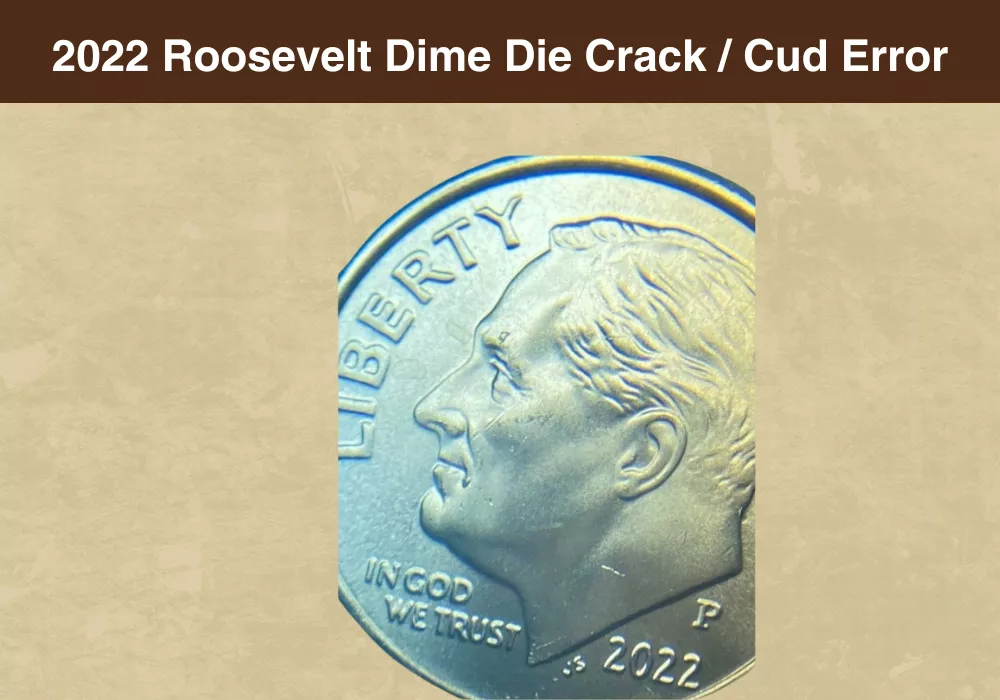
Dies crack under the pressure of millions of strikes. These fractures transfer to coins as raised lines because planchet metal flows into the crack during striking.
Small die cracks are relatively common on 2022 dimes given the enormous production volume. A cud is a more advanced stage of die failure — when a piece breaks away at the rim, the result is a raised, featureless blob of metal at the coin’s edge. Cuds are rarer and more valuable than standard cracks. When a die crack or cud appears on the same coin as another error — doubling, for example — the combination can push the value substantially higher. Multiple-error coins fetch premiums beyond what either error would bring individually.
Value: Minor die cracks on 2022 dimes sell for $5 to $25. Prominent cuds at the rim can reach $50. Cud plus doubling combinations have sold for $100 or more on eBay for modern Roosevelt dimes. No Heritage or GreatCollections records exist specifically for 2022 examples.
How to Identify: Under a 5x loupe, look for raised lines on the coin’s surface that aren’t part of the original design. Die cracks follow mechanical stress paths — typically radiating from high-stress areas toward the rim or between closely spaced letters.
For cuds, look for a raised, flat-topped blob connected to the rim. The blob should be featureless on top because the die was missing in that area. Cracks are raised above the surface; scratches are incuse (cut in). This is the fundamental distinction. Post-mint contact marks appear random, while die cracks follow consistent paths that make mechanical sense. If you find two coins with identical crack patterns, that confirms die origin. Check both the obverse and reverse under magnification. Fastest check: if the line is raised rather than cut into the surface, it’s a die crack.
Use Our 2022 Dime Value Checker
5. 2022 Roosevelt Dime Raised Rim Error (Up to $50)
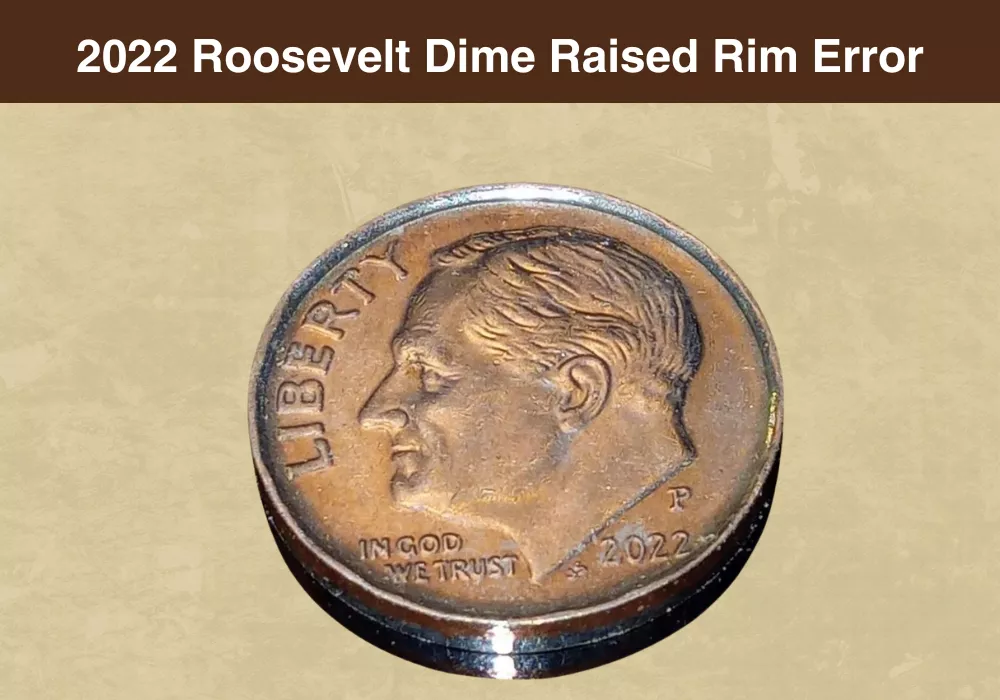
Raised rim errors occur when excessive pressure in the coining press forces too much metal between the collar die and the striking die edge. The result is a rim that’s abnormally high, thick, or sharp compared to a standard dime.
Die misalignment and incorrect striking pressure are the typical causes. The error can produce a rim that’s uniformly too high around the entire coin, or — more commonly — a rim that’s exaggerated on one side while normal on the other. The asymmetric version indicates a tilted die. Extreme raised rims can interfere with coin stacking and vending machine acceptance, which is one reason these errors sometimes get pulled from circulation before reaching the public.
Value: Raised rim errors on 2022 dimes sell for $20 to $50 depending on how dramatic the rim appears and the coin’s condition. Asymmetric examples where one side is dramatically higher than the other bring more than uniformly raised rims. No major auction records exist for this error on 2022 dimes.

Coin Identifier and Value App
Not sure what your coins are worth? Get Instant Value • Grade • Error Detection with coin identifier and value app (FREE Usage Daily)
How to Identify: Hold the coin at eye level and compare the rim height to a normal 2022 dime. The error rim should be visibly taller or thicker, and it may appear sharp or knife-like rather than the normal rounded profile.
Check whether the rim is uniform or varies in height around the circumference. An asymmetric raised rim — high on one side, normal on the other — indicates a tilted die, which is a more interesting mechanical story. Measure rim height with calipers if possible. Don’t confuse with a partial collar error, which creates a stepped rim with a smooth flare on one side. A raised rim maintains reeding and normal edge characteristics — it’s just taller. Post-mint damage like rim dings creates irregular dents, not uniform elevation. Fastest check: visibly taller rim compared to a normal dime when held side by side at eye level.
Use Our 2022 Dime Value Checker
6. 2022 Roosevelt Dime Feeder Finger Error (Up to $100)
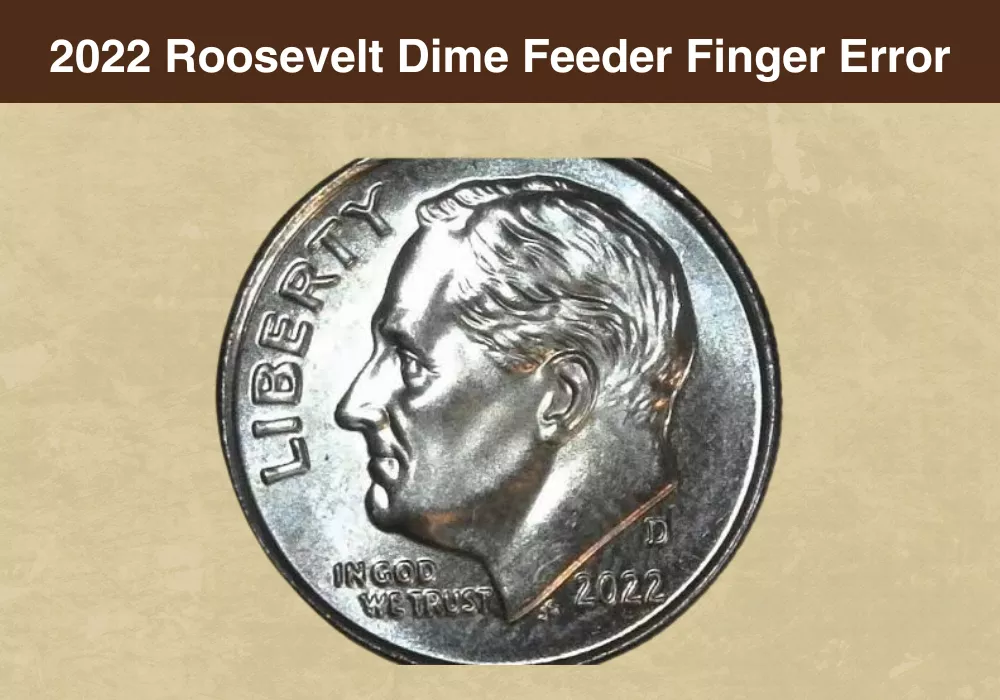
The feeder finger is a metal component of the coining press that pushes planchets into position for striking. When a feeder finger scrapes against the face of a die, it leaves parallel scratch-like abrasions on the die surface.
Every subsequent coin struck by that damaged die carries those parallel lines. On 2022 Roosevelt dimes, feeder finger marks most commonly appear at the top of the obverse above Roosevelt’s head, running vertically or at a slight angle. They can also appear on the reverse behind the torch. The marks look like fine, evenly spaced parallel lines — almost like comb teeth dragged across the coin. The uniform spacing and consistent depth distinguish them from random scratches.
Value: Feeder finger errors on 2022 dimes sell for $85 to $100 for clearly visible examples in uncirculated condition. Circulated examples with visible marks bring $50 to $85. The value depends on how prominently the lines show and whether they affect major design elements.
How to Identify: Under 10x magnification, look for parallel, evenly spaced raised lines running across the coin’s surface — typically above Roosevelt’s head on the obverse. The lines should be uniform in spacing and depth, creating a pattern that looks mechanical rather than random.
The key distinction from post-mint scratches is uniformity. Random scratches from pocket wear or coin-counting machines run in different directions at varying depths. Feeder finger marks are parallel, evenly spaced, and consistent because they originated from a single mechanical scrape on the die. All coins struck by that die will show identical marks in identical positions. Check whether the lines are raised (from the die) or incuse (from post-mint contact). Raised parallel lines consistent across multiple coins from the same die confirm feeder finger origin. Fastest check: uniform parallel raised lines above Roosevelt’s head.
Use Our 2022 Dime Value Checker
7. 2022 Roosevelt Dime Broadstrike Error (Up to $150)
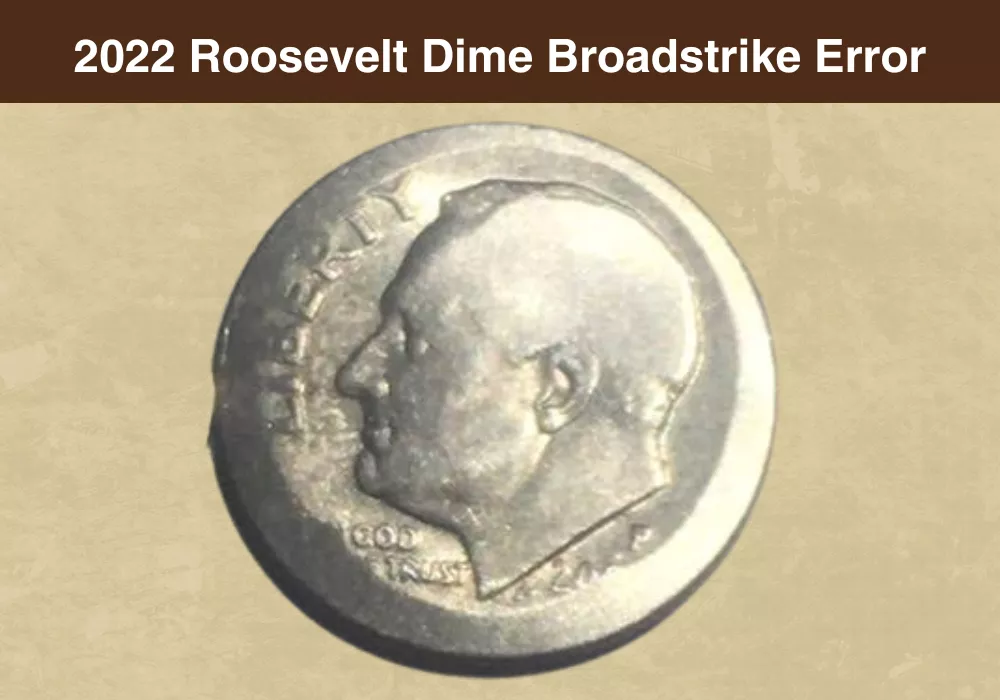
A broadstrike happens when the collar die — the ring that holds the planchet in place during striking — is absent or malfunctions. Without the collar constraining the metal, the planchet spreads outward under die pressure, producing a coin with a larger diameter than normal and no reeded edge.
On modern presses with Schuler technology, collar failures are uncommon because sensors detect malfunctions and halt the press. That makes genuine 2022 broadstrikes scarcer than pre-2002 examples. The coin retains its full design but everything appears slightly stretched and softer. The edge is smooth and plain instead of reeded.
Value: Standard broadstrikes on 2022 dimes sell for $25 to $75 depending on how much expansion occurred. Specimens significantly oversized — 20% or more larger than the standard 17.91mm — can reach $100 to $150. Broadstrikes combined with other errors like off-center strikes can exceed $200. No major auction house records exist for 2022 dime broadstrikes.
How to Identify: Measure the coin’s diameter with calipers. A normal dime is 17.91mm; a broadstrike will exceed this, sometimes reaching 19–21mm or more. The coin should feel thinner and wider than a standard dime.
The edge should be completely smooth — no reeding whatsoever, since the collar that creates reeding was absent. Weight should remain approximately 2.268 grams because no metal was added or removed. The critical distinction is from a dryer coin — a dime tumbled in a clothes dryer. A dryer coin has a smooth edge but measures 17.91mm or less because tumbling compresses the metal. A genuine broadstrike measures larger than normal. If the diameter is standard or smaller with a smooth edge, it’s dryer damage, not a mint error. Fastest check: smooth edge plus larger-than-normal diameter plus normal weight.
Use Our 2022 Dime Value Checker
8. 2022 Roosevelt Dime Clipped Planchet Error (Up to $200)
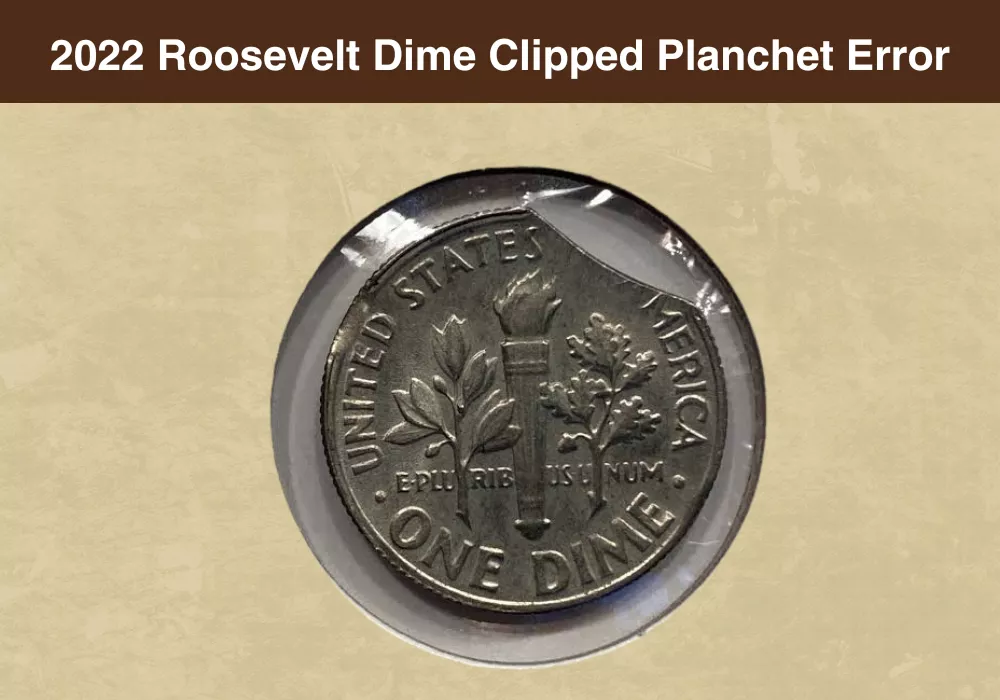
Before striking, circular blanks are punched from a continuous metal strip. If the strip doesn’t advance far enough between punches, the next punch overlaps the previous hole and creates a planchet with a crescent-shaped bite missing.
The defective blank gets struck as normal. On 2022 dimes, clips that remove part of Roosevelt’s portrait or the torch are more dramatic than clips that only nick the rim. Clip size directly determines value. Modern blanking presses are more precise than older equipment, so large clips on 2022 dimes are genuinely uncommon — the quality control sensors catch most defective planchets before they reach the coining press.
Value: Small clips removing 5–10% of the planchet sell for $10 to $25. Moderate clips in the 15–25% range bring $30 to $75. Large clips exceeding 30% with the date still visible can reach $100 to $200. No major auction records exist specifically for 2022 dime clips.
How to Identify: Look for a smooth, curved area of missing metal along the rim. The diagnostic marker is the Blakesley effect — on the opposite side of the coin from the clip, the rim will be weak or flat because the planchet didn’t upset properly before striking.
Weigh the coin. A normal dime is 2.268 grams; a clipped planchet will come in under that proportional to the missing metal. Run your finger along the clipped edge — a genuine clip feels smooth because it formed before striking, while a post-mint cut feels sharp with visible tool marks. Curved clips show a smooth arc-shaped indentation from where another planchet was previously punched. Straight clips appear as a straight edge cut from the edge of the metal strip. The reeding along the clip area will be absent or distorted. Fastest check: Blakesley effect on the rim directly opposite the clip.
Use Our 2022 Dime Value Checker
9. 2022 Roosevelt Dime Off-Center Strike Error (Up to $500)
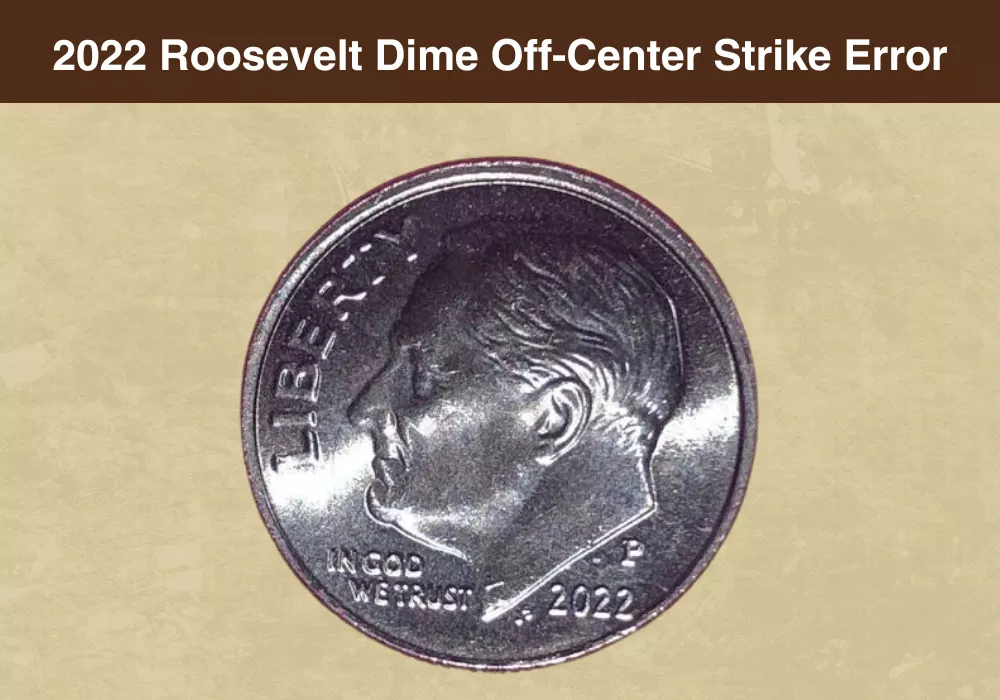
An off-center strike happens when the planchet isn’t centered between the dies during striking. Part of the design hits metal while the rest hits air, leaving a crescent-shaped blank area.
Modern Schuler presses at the U.S. Mint use laser sensors and load monitors to detect misaligned planchets. If the sensor catches an anomaly, the press typically stops or ejects the coin for destruction. A genuine 2022 off-center dime had to defeat this detection system and escape in a sealed bag — making it a legitimate rarity compared to off-center dimes from the 1960s or 1970s.
Value: Minor off-center strikes of 5–10% sell for $15 to $35. Moderate shifts of 20–40% with the date visible bring $75 to $200. Major off-center errors exceeding 50% with a visible date can reach $300 to $500. No verified 2022 Roosevelt dime off-center records from major auction houses exist as of early 2026.
How to Identify: This error is visible without magnification. The design is shifted toward one edge with a blank crescent on the opposite side where the die never contacted the planchet.
Estimate the displacement by measuring how much design is missing. The date must be visible for maximum value — without it, the coin can’t be confirmed as 2022. The full circular planchet should be present; the disc isn’t broken, just misaligned. Weight should remain approximately 2.268 grams since no metal is missing. Both sides show the same directional shift. Don’t confuse with a misaligned die (MAD) error, which shows the full design shifted slightly within the rim — MAD errors are common and worth face value to $5. A true off-center shows a blank unstruck area where the die never touched the metal. Fastest check: blank unstruck crescent with design pushed to the opposite side.
Use Our 2022 Dime Value Checker
Coin Identifier and Value App
Not sure what your coins are worth? Get Instant Value • Grade • Error Detection with coin identifier and value app (FREE Usage Daily)
10. 2022 Roosevelt Dime Missing Clad Layer Error (Up to $500)
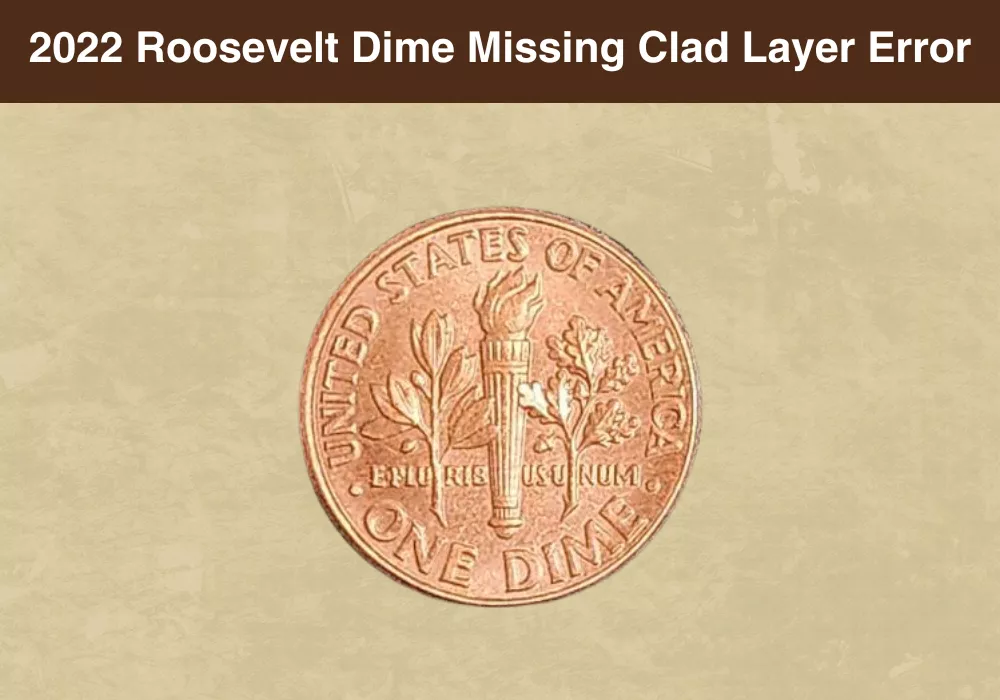
Roosevelt dimes are a three-layer sandwich: copper-nickel outer layers bonded to a pure copper core. A missing clad layer error occurs when one of those outer layers fails to bond during planchet manufacturing — a defect called delamination.
The result is a coin where one side looks normal while the other side is reddish-brown from the exposed copper core. The weight drops noticeably because an entire metal layer is absent. This error occurs before striking, during the planchet production phase. Comparable modern dime examples have sold well at auction — a 2002-D Roosevelt dime graded MS67 with a missing clad layer brought $1,180 at Heritage Auctions in 2016, and a 2010-D dime in MS65 sold for $1,320 at Heritage in 2015.
Value: No Heritage or GreatCollections auction records exist specifically for 2022 missing clad layer dimes as of early 2026. Based on comparable modern dime sales, the expected range sits between $200 and $500 for circulated to lower Mint State examples. Higher-grade specimens could exceed these figures given the post-2002 rarity premium.
How to Identify: Weigh the coin. A normal dime is 2.268 grams. A missing clad layer will read noticeably lighter — the exact weight depends on which layer is missing, but expect a reading well below the 2.178-gram lower tolerance limit.
One side will appear reddish-brown copper while the other looks normal silver-toned. Check the edge for asymmetric layer separation — the copper-nickel sandwich should show only two layers instead of three. The most common fake is an acid-dipped coin. An acid-dipped dime weighs near-normal, has mushy corroded design details, and shows copper discoloration on the reeded edge. A genuine missing clad error has sharp, crisp design details on the copper side because it was struck that way. The copper surface should show normal striking luster, not the dull matte of chemical damage. Fastest check: weigh it — significantly underweight with sharp details and one copper side means it’s genuine.
Use Our 2022 Dime Value Checker
11. 2022 Roosevelt Dime Wrong Planchet Error (Up to $2,000)
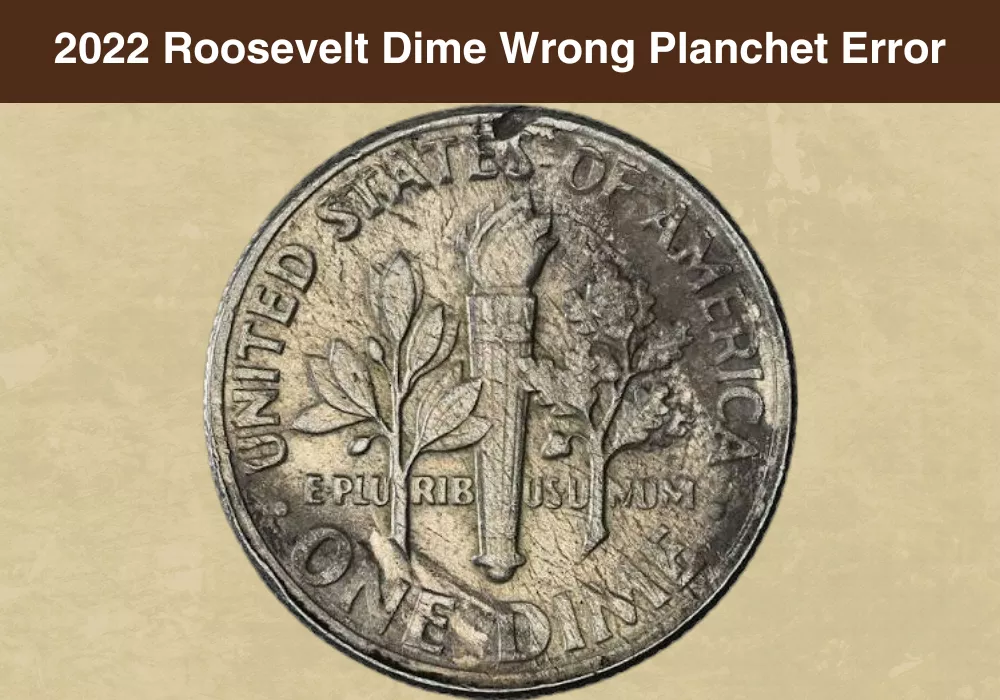
A wrong planchet error occurs when a blank intended for one denomination accidentally enters the press for another. A 2022 dime struck on a Lincoln cent planchet would produce a copper-colored dime that’s noticeably larger (19.05mm versus 17.91mm) and heavier (3.11 grams versus 2.268 grams) than normal.
These errors happen when stray blanks left in transportation hoppers between production lines get mixed into the wrong feed. Modern Mint quality control catches most wrong planchets before striking, making post-2002 examples substantially rarer than older ones. A 2022 dime on a cent planchet would be copper-colored with the full Roosevelt design — an immediately obvious error. A dime struck on a quarter planchet would be dramatically oversized, with the design appearing small and centered on the larger blank.
Value: No specific auction records exist for 2022 dime wrong planchet errors. Based on comparable modern dime sales, a dime struck on a cent planchet is estimated at $1,000 to $1,500. A dime struck on a quarter planchet would bring $750 to $1,200. A dime struck on a nickel planchet sits in the $500 to $800 range. Authentication by PCGS or NGC is essential at these values.
How to Identify: Wrong color or wrong size is the first clue. A dime on a cent planchet will be copper-colored and slightly larger than normal. A dime on a quarter planchet will be dramatically oversized at 24.26mm.
Weigh the coin on a precision scale. A cent planchet weighs 2.5 grams (zinc) or 3.11 grams (copper); a nickel planchet weighs 5.0 grams; a quarter planchet weighs 5.67 grams. The Roosevelt dime design will appear either compressed (on a smaller blank) or centered with extra blank space (on a larger blank). Check the edge — cent planchets are smooth while dime planchets should be reeded. A reeded edge on an oversized coin suggests quarter planchet. Don’t confuse with a plated or altered coin — genuine wrong planchets show normal striking luster and crisp design details where the die contacted the metal. Fastest check: wrong weight plus wrong size plus dime design confirms wrong planchet.
Use Our 2022 Dime Value Checker
Conclusion
The 2022 dime error range runs from $5 Drooling Frank cuds to an estimated $1,500 for a wrong planchet strike — a wide spread for a coin worth ten cents. The practical collecting range sits between $20 and $200, where die chips, broadstrikes, clipped planchets, and off-center strikes appear with some regularity on eBay. Modern Schuler press technology means genuine 2022 errors that escaped quality control are scarcer than their pre-2002 counterparts, which actually supports higher long-term values. A precision scale accurate to 0.01 grams and a 10x loupe are the two tools that matter most.