Coin Value Contents Table
- 1986 Half Dollar Value Charts (Business Strike)
- 1986 Half Dollar Value Charts (Proofs)
- History of the 1986 Half Dollar
- Features of the 1986 Half Dollar
- 1986 Half Dollar Grading Guides
- 1986 Half Dollar Value Guides
- 1986 Kennedy Half Dollar Value Guides
- 1986 Statue of Liberty Half Dollar Value Guides
- Rare 1986 Half Dollar Errors List
- Where to Sell Your 1986 Half Dollar ?
- 1986 Half Dollar FAQ
In 1986, the US Mint made two types of Half Dollars – the usual JFKs and the Statue of Liberty Half Dollar, which some people call the Immigration Half Dollar. It was coined to mark the 100th Anniversary of the famous French-born statue and it features Miss Liberty in all her glory. We’ll study both coins as we explore the 1986 Half Dollar Value and its history.
1986 Half Dollar Value Charts (Business Strike) |
||||||
| Coin | MS 65 | MS 66 | MS 67 | MS 67+ | MS 68 | MS 68+ |
| 1986-P Kennedy Half Dollar | $15 | $40 | $160 | $460 | $3,500 | $5,000 |
| 1986-D Kennedy Half Dollar | $18 | $28 | $85 | $275 | $4,250 | – |
| 1986-D Statue of Liberty Half Dollar | $9 | $10 | $10 | – | $13 | – |
1986 Half Dollar Value Charts (Proofs) |
||||||
| Coin | MS 60 DCAM | PR 64 DCAM | PR 66+ DCAM | PR 68 DCAM | PR 69 DCAM | PR 70 DCAM |
| 1986-S Proof Kennedy Half Dollar | $2 | $4 | $6 | $8 | $16 | $46 |
| 1986-S Proof Statue of Liberty Half Dollar | – | $8 | $11 | $13 | $22 | $52 |
History of the 1986 Half Dollar
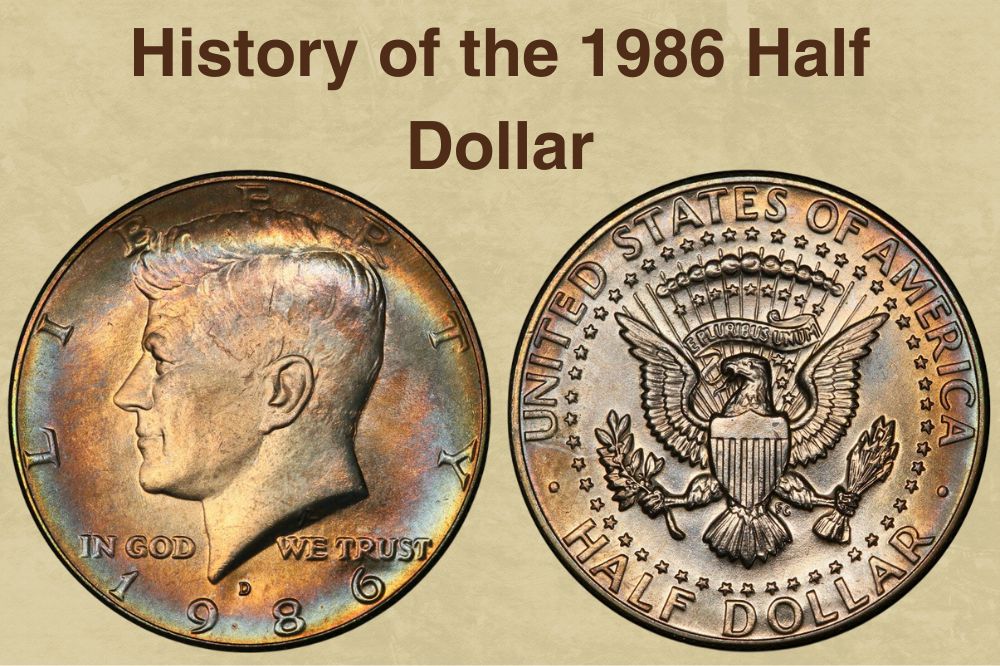
Ordinarily, US coins come in two styles. The first are circulating coins, sometimes called regular strikes or business strikes. These are the ones we use to buy and sell stuff. The second set includes proof coins, mint sets, special strikes, and other collectible coins. They generally live in display cases and aren’t meant for public use. Some accidentally trickle into the wild.
Commemoratives are their own category, and they can include both circulating coins and collectible ones. These coins are made to celebrate a historic milestone, important person, or place of note. When Kennedy Half Dollars first came out in January 1964, they marked his recent assassination in November 1963. But they were coined for use as circulating currency.
Initially, JFK Half Dollars were 90% Silver and 10% Copper. But they were coined during the coin shortage of the 1960s, which was driven by spikes in silver prices. So within a year, they had to reduce their silver content to 40%, and in 1971, they gave up all their silver for a coat of cupronickel. As a result, 1986 Kennedy Half Dollars employed the usual Johnson Sandwich.
The 1986 Statue of Liberty Half Dollar
The Sandwich was a copper core topped with the 75% Copper and 25% mixture used in all Nickels. It was named after Lyndon Johnson, the 36th US President who approved its use in 1965. It’s now employed on most American coins, and it’s also the metal composition of the 1986 Statue of Liberty Half Dollar. As we confirmed, it marked Lady Liberty’s 100th birthday.
The copper statue was a gift from the French government, designed by Frédéric Auguste Bartholdi and structured by Gustave Eiffel. The formal English name for the statue is Liberty Enlightening the World and it’s a portrayal of the Roman goddess of Liberty aka Libertas. The concept came from Édouard de Laboulaye, who wanted to mark independence and abolition.
French and American citizens collected the funds to make it, though most of their donations were under a dollar. The statue was constructed in France. Its separate parts were shipped to New York for assembly. The completion prompted a ticker tape parade and today, the statue symbolically welcomes seafaring immigrants to the US, hence the nickname of the 1986 coin.
Also read: 13 Most Valuable Franklin Half Dollars Worth Money
Features of the 1986 Half Dollar
Let’s go over some technical terms you can use to describe coins. The front or heads side is the obverse while the back is the reverse and the thin side is the edge. The words on a coin are mottos or legends while the images are devices and the background is the field. The rim or collar is the raised coin border and planchets are blank discs that are struck to make coins.
The Obverse of the 1986 Kennedy Half Dollar
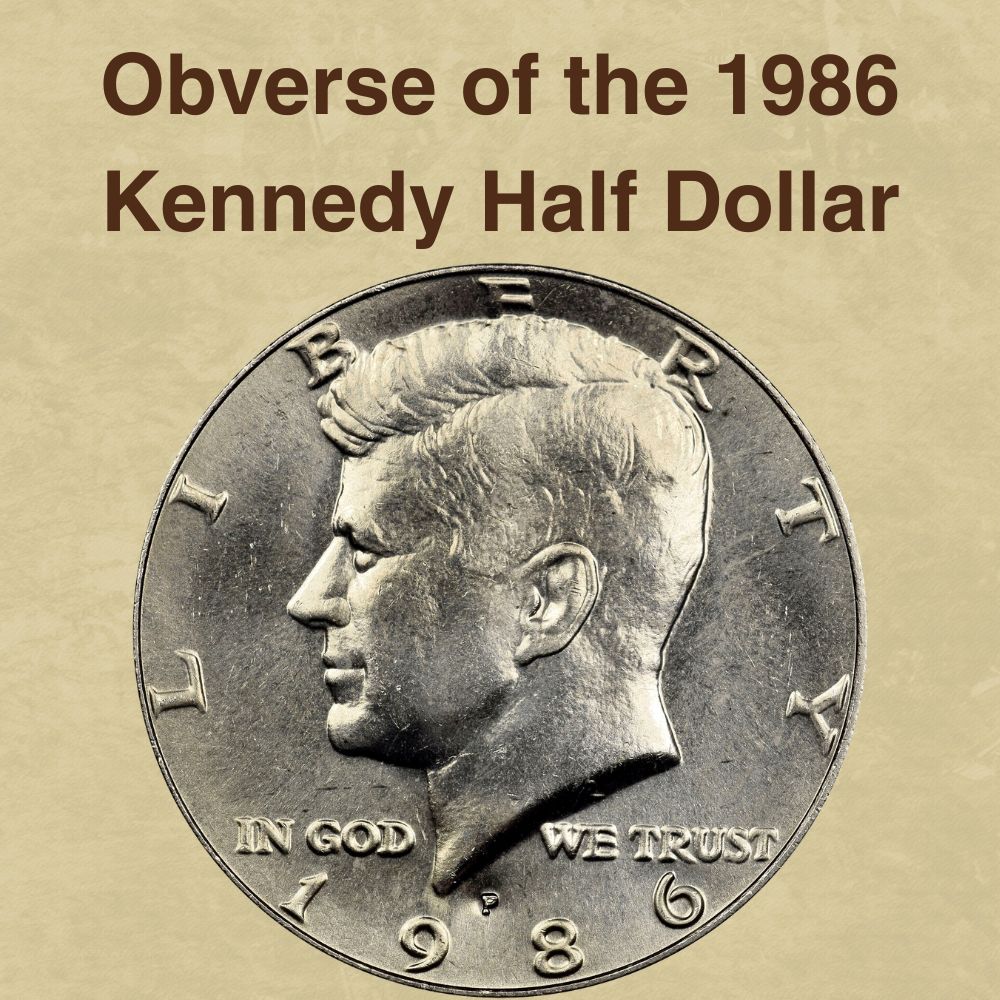
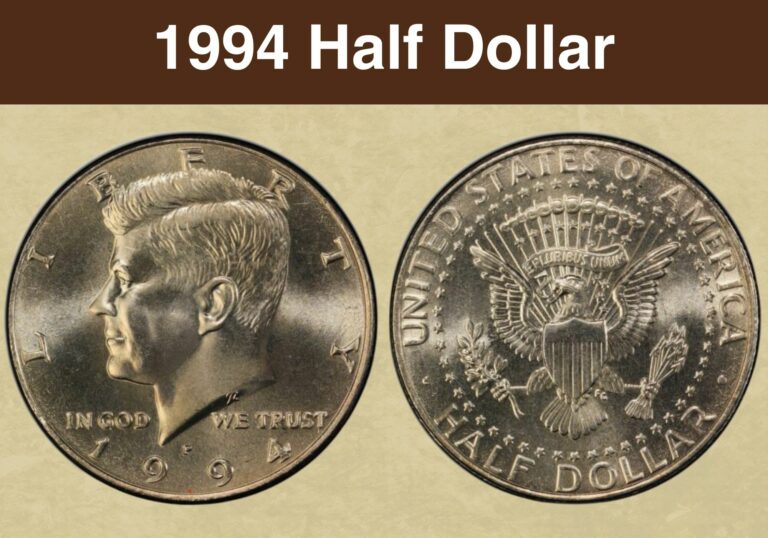
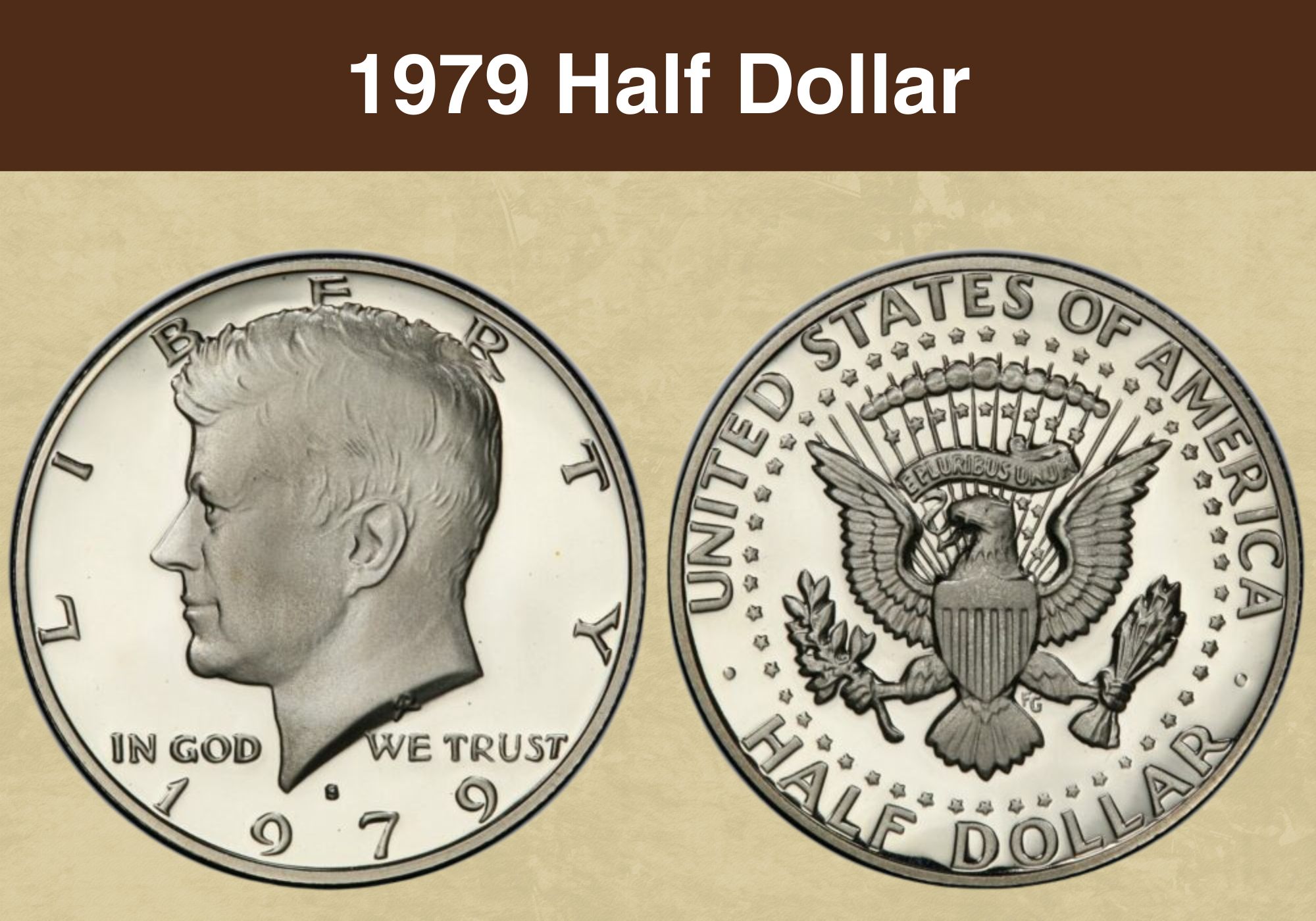
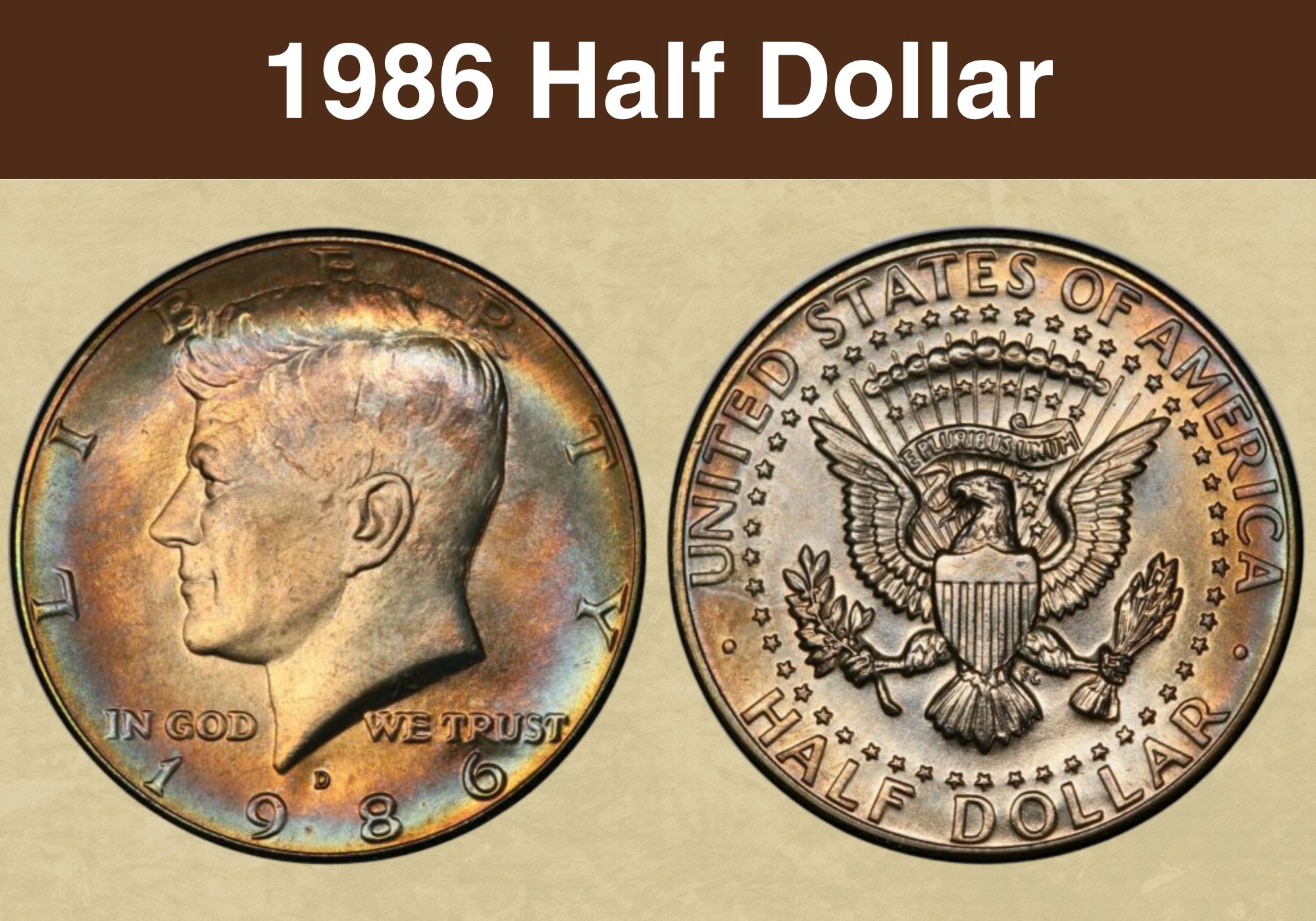
It shows JFK, the 35th US President. He’s facing left with Liberty over his head. BER is partly hidden in his hair. On the left of his neck, it says In God. On the right, it says We Trust. His neckline cut-off has GR engraved for coin designer Gilroy Roberts. The date is at the bottom of the coin with the mint mark directly above it, positioned between the 9 and the 8 in 1986.
The Reverse of the 1986 Kennedy Half Dollar
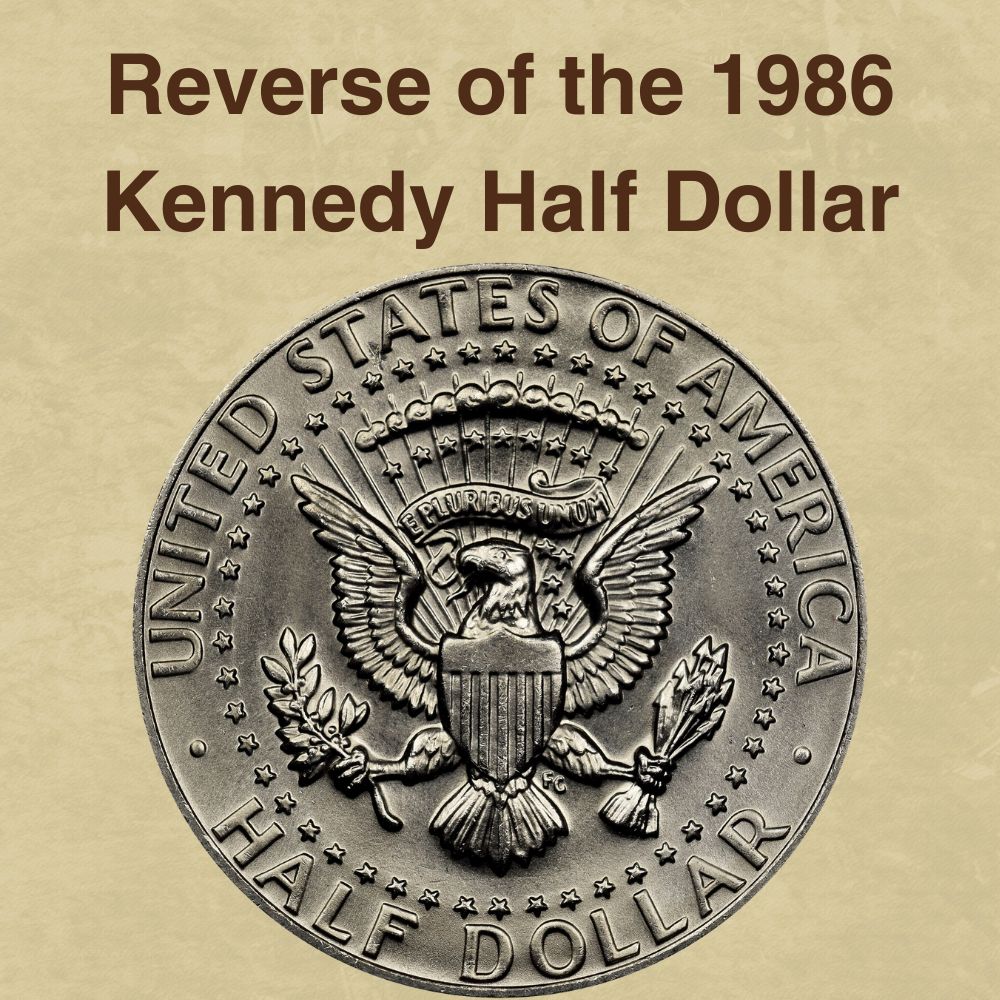
It shows the US Presidential Seal, an eagle with a shield, an olive branch, 13 arrows, and a banner that reads E Pluribus Unum. The seal also has 13 clouds, stars, and sun rays. 50 more stars circle the seal. The top of the coin says United States of America. The bottom says Half Dollar. FG is between the eagle’s tail and right leg to identify coin designer Frank Gasparro.
Other Features of the 1986 Kennedy Half Dollar
The 1986 Kennedy Half Dollar is 91.67% Copper and 8.33% Nickel. As we explained earlier, this means its pure copper core was plated with 75% Copper and 25% Nickel to simulate the silver appearance of the original JFK Half Dollar. The 1986 Half Dollar weighed 11.34g and was 30.6mm in diameter (1.205”). The coin was 2.15mm thick and had 150 reeds on its edge.
The Obverse of the Statue of Liberty Half Dollar
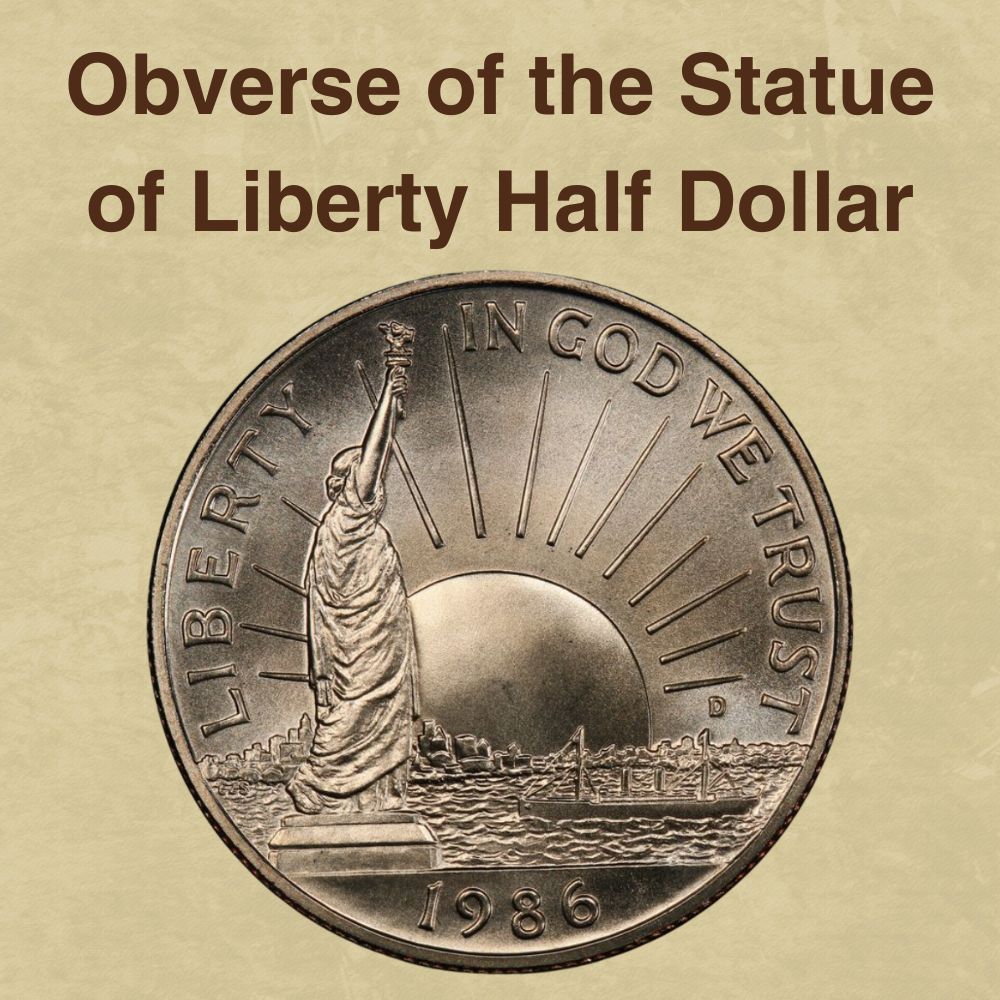
It shows a back view of Miss Liberty watching the ocean as the sun rises in front of her. The field shows the silhouette of the city and a ship coming into the harbor. Along the coin rim, the legend Liberty is behind the statue, and the motto In God We Trust is in front of her torch.
The mint mark is above the boat, between the sun and the Y in Liberty. The mint date sits at the bottom of the coin. On the lower left of the coin, at the boundary between the water and the city’s skyline, EZS is engraved to identify the coin’s obverse designer, Edgar Z. Steever.
The Reverse of the Statue of Liberty Half Dollar
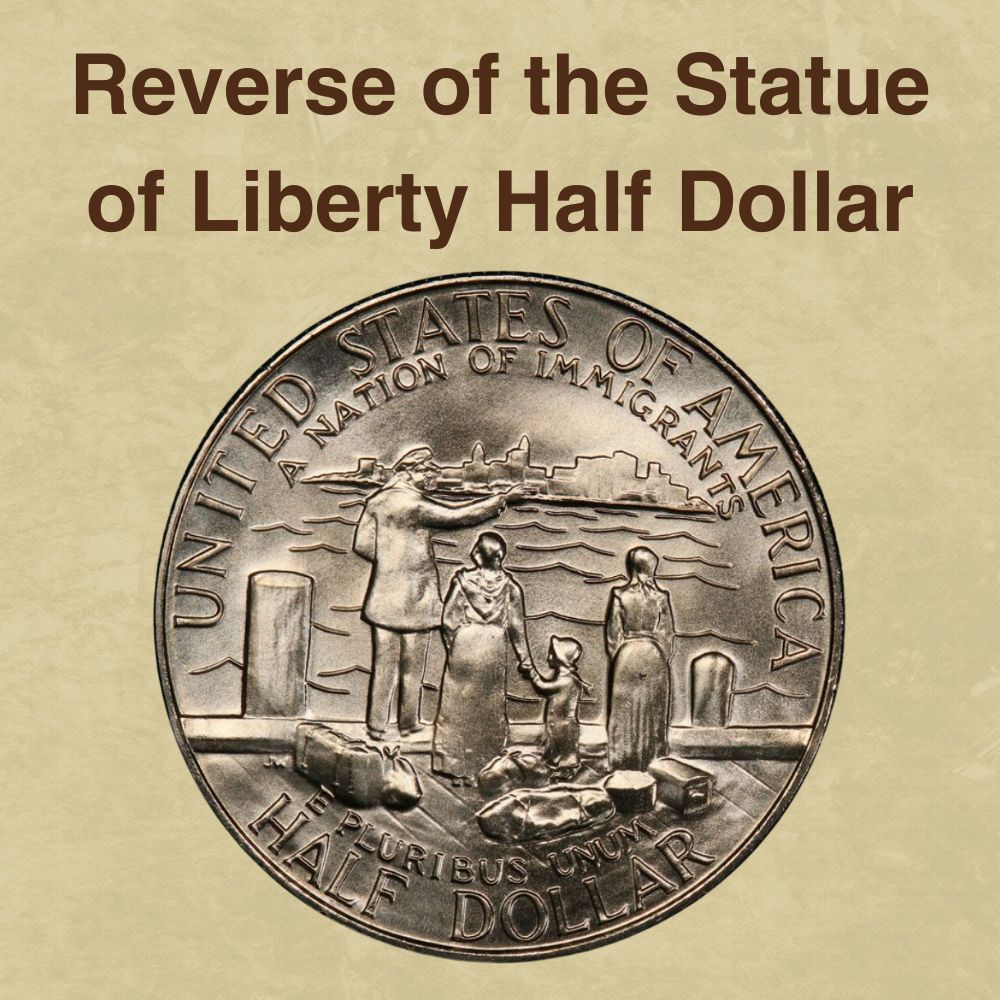
It shows an immigrant family that has just arrived on Ellis Island. The four of them are watching the water with the man pointing at the city silhouetted in the distance. Their bags are all around them. The bottom of the coin has the motto E Pluribus Unum and Half Dollar.
The top of the coin says United States of America followed by A Nation of Immigrants. JW is on the lower left, under the pole, next to one of the bags. It identifies Sheryl J. Winter, the coin’s reverse designer. Waves separate the newly arrived immigrants from the mainland.
Other Features of the Statue of Liberty Half Dollar
Like the Kennedy Half Dollar, the 1986 Statue of Liberty Half Dollar was a cupronickel-clad piece in 91.67% Copper and 8.33% Nickel. It had the same dimensions – 30.6mm across and 2.15mm thick, weighing in at 11.34g. As a commemorative coin, the Statue of Liberty-Ellis Island Foundation, Inc. was in charge of sales, using the proceeds to maintain the statue.
Also read: 13 Most Valuable Kennedy Half Dollar Worth Money
1986 Half Dollar Grading Guides
Coins are graded by appraisal companies like PCGS (Professional Coin Grading Service), NGC (Numismatic Guaranty Company/Corporation), and ANACS (American Numismatic Association Certification Service). They all use variations of the Sheldon Scale, which goes from 1 to 70. Start by comparing your coin to online samples before you send it for grading.
1986 Half Dollar Value Guides
In 1986, Half Dollars were minted in Philadelphia, San Francisco, and Denver. They were all cupronickel clad coins and they all had mint marks. Let’s review their prices by mint branch.
1986 Kennedy Half Dollar Value Guides
We’ll begin with the 1986 JFK Half Dollars. Philadelphia and Denver made business strikes while San Francisco made mirror-like clad proofs. Each mint branch has its own price range.
1986-P Kennedy Half Dollar Value
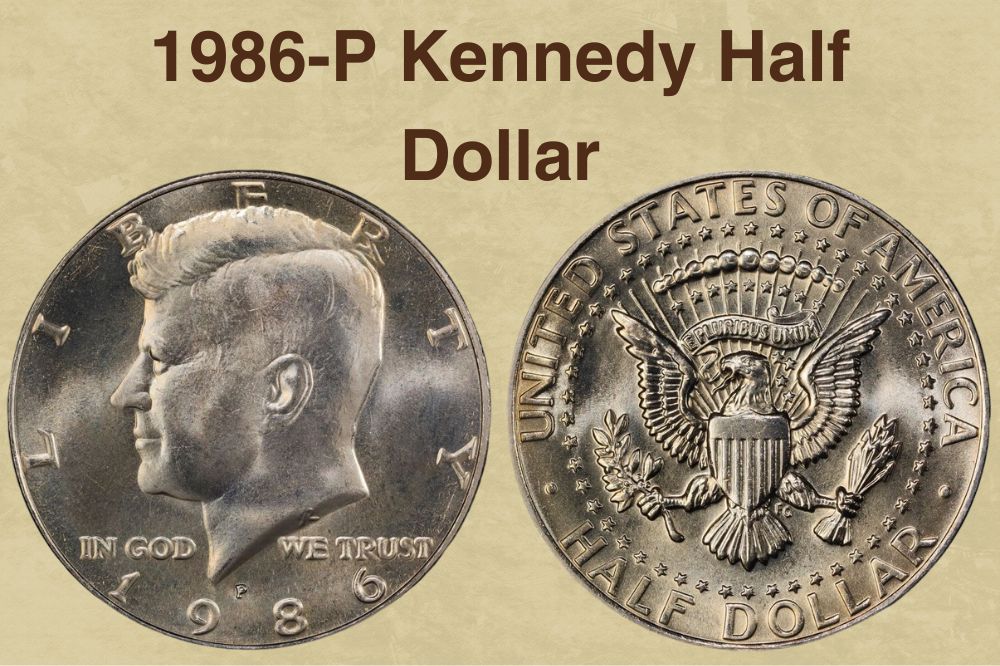
In 1986, the Philadelphia Mint made 13,107,633 Kennedy Half Dollars. They’re not especially expensive coins. On 2nd April 2021, an eBay vendor sold an MS 67 for $295. PCGS has rated a little over sixty so their value in October 2023 is $160. Several higher grades have shown up over the years though. The top grade at the moment is MS 68+ with at least one verified.
The single MS 68+ goes for $5,000 in October 2023. There’s also one MS 68 that’s estimated at $3,500 in October 2023. The three known coins in MS 67+ are evaluated at $460. A few steps down, an MS 65 goes for $15 since 115 coins have been submitted to PCGS so far. And with more than 250 coins sent to PCGS for grading, an MS 66 can sell for $40 in October 2023.
1986-D Kennedy Half Dollar Value
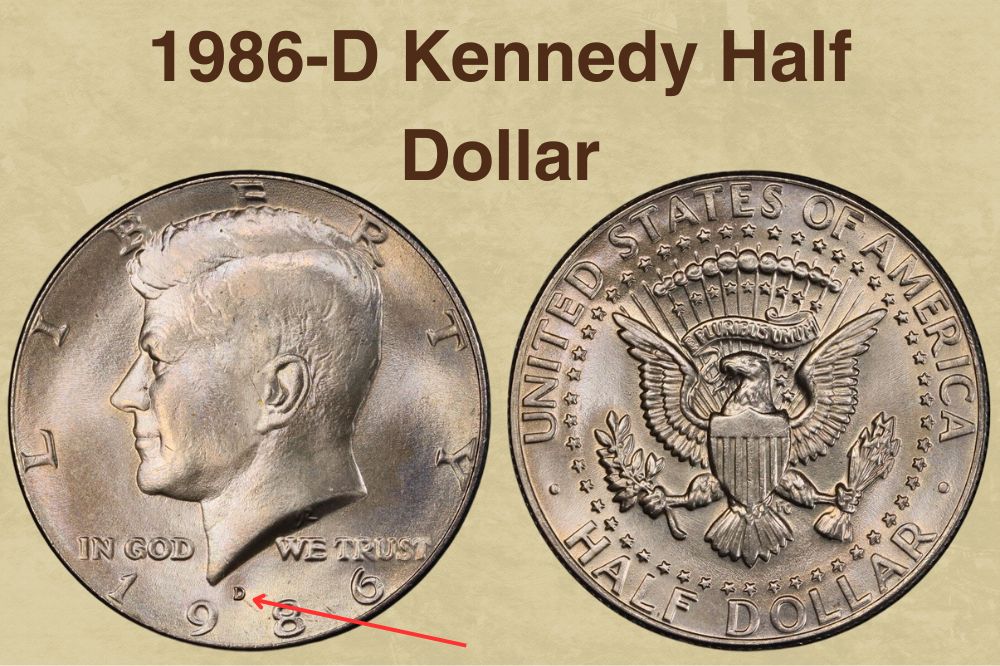
The Denver Mint made 15,336,145 Kennedy Half Dollars in 1986. On 26th September 2019, an MS 68 sold for $4,818. Four years later, only seven coins have been submitted to PCGS so their value in October 2023 is $4,250. One MS 69 is known to exist, but it hasn’t sold so far and no public auction records are available. Meanwhile, an MS 67+ goes for $275 in 2023.
Why the drastic difference in price? Well, PCGS has only seen six coins graded MS 67+ but it has received almost two hundred coins in MS 67 so they drag down the price of nearby coin grades. The MS 67 itself goes for $85 in October 2023. And with four hundred coins graded as MS 66, their current price is way down at $28. It’s still a solid profit for a 50c coin though.
1986-S Proof Kennedy Half Dollar Value
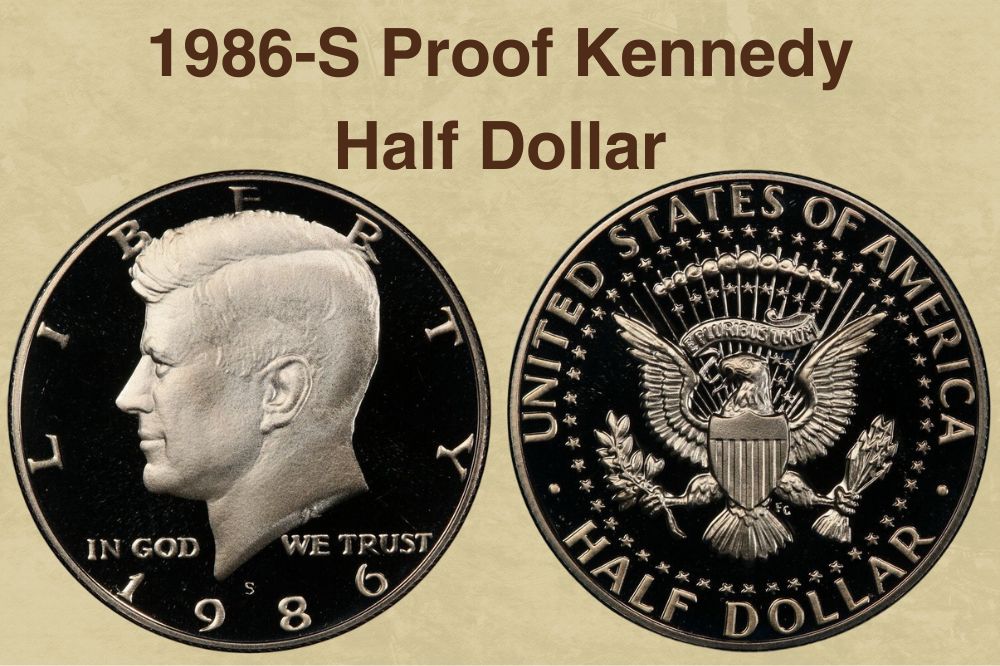
In 1986, Proof Half Dollars were mirror-like. That means they had a highly reflective field and a frosted device. To achieve this, both the dies and planchets were specially processed. The dies were scrubbed with horsehair brushes to make them shine, then frosted with lasers. And the blanks were burnished by tumbling them in vats full of 6mm stainless steel balls.
The San Francisco Mint made 3,010,497 Proof Kennedy Half Dollars. On 1st February 2001, a PR 70 DCAM sold for $575. It’s the highest possible grade, also known as the perfect grade. But PCGS has seen almost a thousand of these perfect coins so their value in October 2023 is only $46. A PR 65 DCAM is a mere $5 while a PR 60 DCAM currently sells for a measly $2.
1986 Statue of Liberty Half Dollar Value Guides
In 1986, the US Mint made commemorative Statue of Liberty Half Dollars in Philadelphia, Denver, and San Francisco. We have no Philly records, but we’ll look at the other two mints.
1986-D Statue of Liberty Half Dollar Value
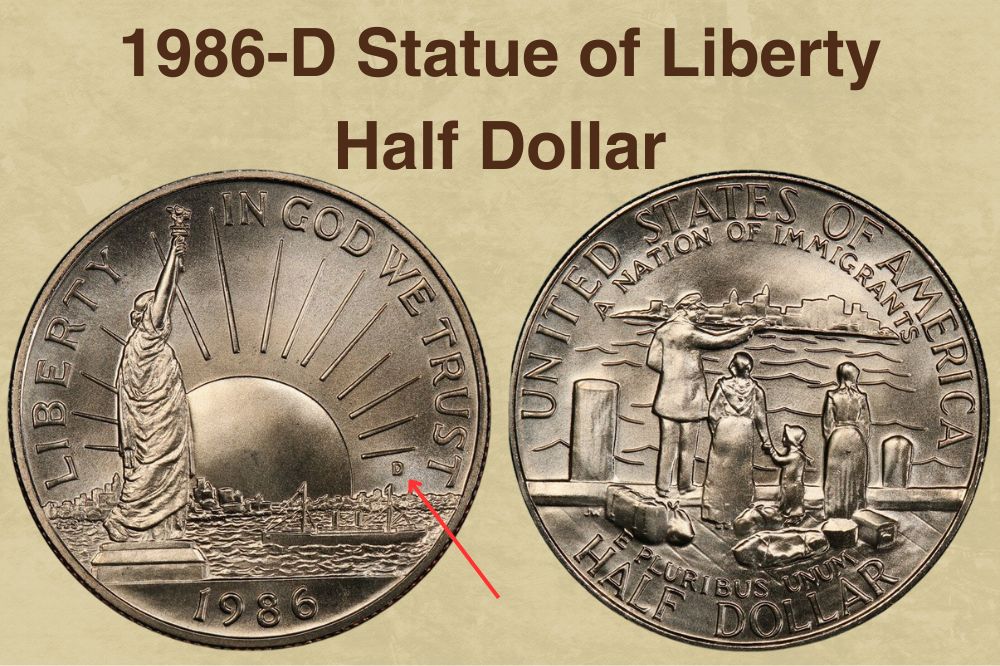
The Denver Mint made 928,008 Statue of Liberty Half Dollars in 1986. They were all regular strikes. On 31st March 2010, an eBay merchant sold an MS 70 for $1,425. Today, more than a hundred of these coins have been submitted to PCGS so their value is only $135 in October 2023. An an MS 69 is almost ten times cheaper at $18 because PCGS has graded over 3,700.
1986-S Statue of Liberty Half Dollar Value
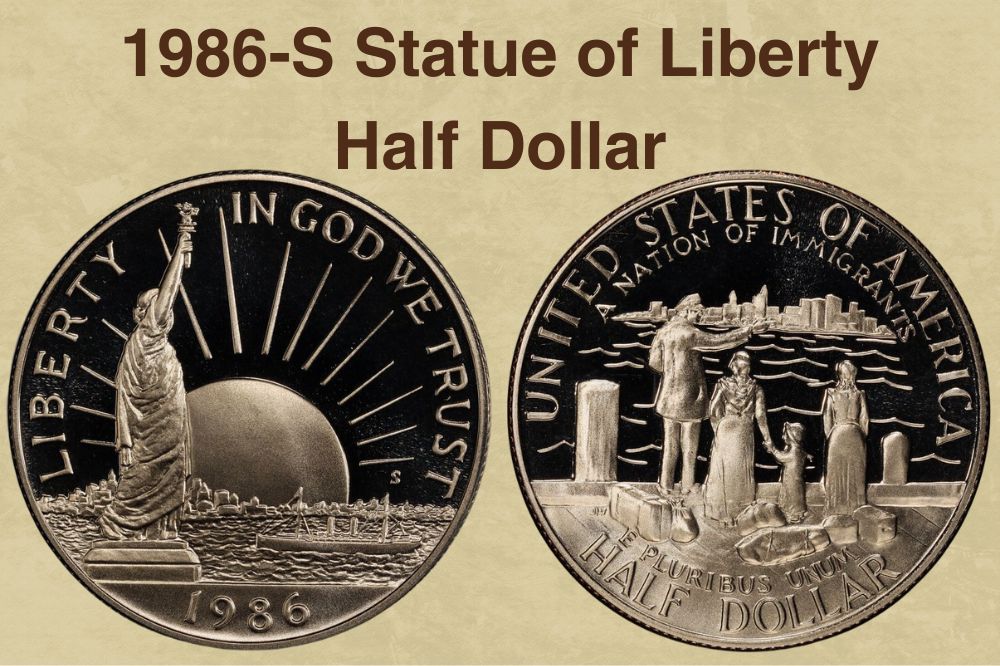
Before 1970, the frosting on proof coin devices was done with acid pickling. This effect would fade every time the die struck, so earlier coins would be Deep Cameo while later ones were ordinary proofs. But on newer coins, the devices, words, and rims are frosted with computer lasers that rarely fade. So contemporary Proof Coins are always Deep Cameo or Ultra Cameo.
The San Francisco Mint made 6,925,627 Proof Statue of Liberty Half Dollars in 1986. On 8th January 2007, a PR 69 DCAM sold for $690. For reference, while PCGS grades these coins as PR Deep Cameo, NGC grades them as PF Ultra Cameo. Either way, a PR 69 DCAM is $22 in October 2023 since almost 10,000 have shown up. A PR 70 DCAM is $52. Almost 300 exist.
Also read: 11 Most Valuable Half Dollars In Circulation
Rare 1986 Half Dollar Errors List
Mint errors can make a coin much more valuable. And on cupronickel coins like the 1986 Half Dollar, one common error is lamination. This is when the outer clad coating comes off, exposing the copper below. Other mint mistakes include wrong planchets, where the Half Dollar is struck on a blank that was intended for another denomination, making it lighter.
Where to Sell Your 1986 Half Dollar ?
Now that you know the value of your coins, do you know where to sell those coins online easily? Don’t worry, I’ve compiled a list of these sites, including their introduction, pros, and cons.
Check out now: Best Places To Sell Coins Online (Pros & Cons)
1986 Half Dollar FAQ
Is the 1986 Liberty Half Dollar Silver?
No. In 1986, all Half Dollars were 91.67% Copper and 8.33% Copper, including proof coins.