1962 Half Dollar Value Checker: Errors List, “D” & No Mint Mark Worth
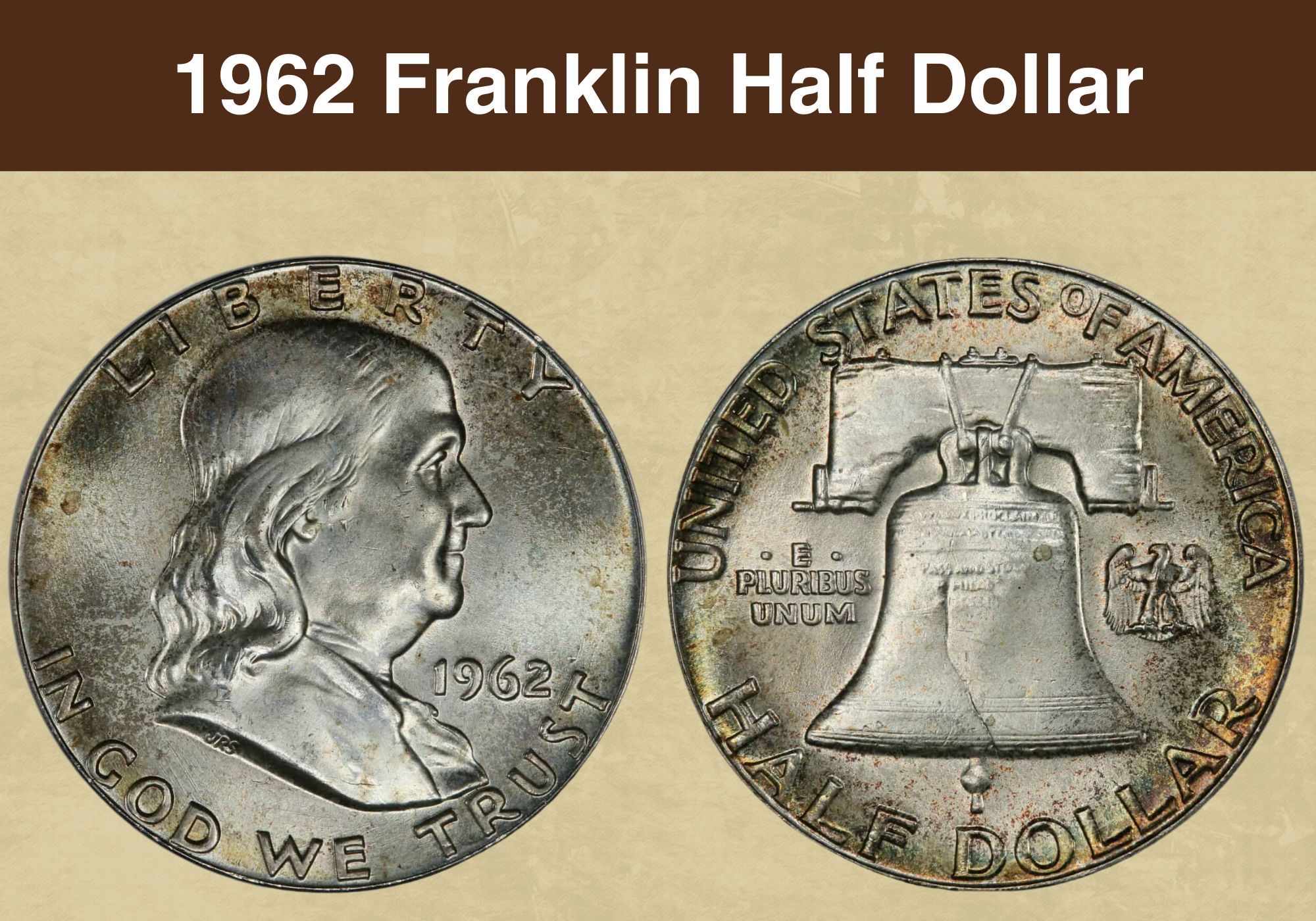
The 1962 Franklin Half Dollar is one of the most iconic silver coins in American numismatic history. Designed by John R. Sinnock, this half dollar bears the portrait of Benjamin Franklin — one of America’s most beloved Founding Fathers — and remains a popular piece among collectors today. Composed of 90% silver, the coin carries a solid base value tied to the precious metals market, and its worth varies significantly depending on condition and variety.
A standard circulated example typically starts around $18, while a rare Full Bell Lines (FBL) specimen in Mint State can command over $200 — and special proof strikes like the DCAM variety can reach nearly $111. The 1962 Half Dollar is considered common in most grades, yet it stands out as one of the scarcer dates when it comes to Full Bell Lines on the reverse — a distinction that can dramatically shift its market price.
Understanding the 1962 Half Dollar Value requires a closer look at mint marks, grading, and key varieties — all of which we’ll break down in detail below.
1962 Half Dollar Value Checker
Identify 1962 Half Dollar D and No Mint Mark Price
Front Obverse
Upload or Take a Photo
Back Reverse
Upload or Take a Photo
1962 Half Dollar Value By Variety
Not all 1962 Half Dollars are worth the same — the value varies depending on the mint mark, strike quality, and whether the coin is a standard issue or a special variety. If you know the grade of your coin, you can find the exact price below in the Value Guides section.
1962 Half Dollar Value Chart
| TYPE | GOOD | FINE | AU | MS | PR |
|---|---|---|---|---|---|
| 1962 No Mint Mark Half Dollar Value | $18.22 | $34.00 | $34.00 | $41.40 | — |
| 1962 No Mint Mark Half Dollar (FBL) Value | $2.90 | $9.92 | $25.40 | $206.60 | — |
| 1962 D Half Dollar Value | $18.22 | $34.00 | $34.00 | $41.40 | — |
| 1962 D Half Dollar (FBL) Value | $2.90 | $9.92 | $25.40 | $104.40 | — |
| 1962 Proof Half Dollar Value | — | — | $31.00 | — | $38.88 |
| 1962 CAM Half Dollar Value | — | — | — | — | $48.86 |
| 1962 DCAM Half Dollar Value | — | — | — | — | $110.88 |
Also Read: Franklin Half Dollar Coin Value (1948-1963)
Top 10 Most Valuable 1962 Half Dollar Worth Money
Most Valuable 1962 Half Dollar Chart
2002 - Present
Grade is everything. The top-performing examples — those graded MS66 and above — command prices that far outpace their lower-grade counterparts, with the finest known Philadelphia strike reaching $18,600, nearly double the equivalent Denver issue. At the highest grade levels, survival rates drop sharply, and competition among registry-set collectors intensifies accordingly.
What’s equally striking is how steeply value accelerates once a coin crosses into the MS65–MS66 range. Below that threshold, prices remain relatively modest and accessible. But cross it, and the market responds with exponential premiums — a pattern well-recognized by seasoned collectors. This “condition rarity” phenomenon is especially pronounced in the Franklin Half Dollar series, where Full Bell Lines and pristine surfaces are notoriously difficult to achieve due to the coin’s design and the striking standards of the era.
When evaluating a 1962 Half Dollar, grade isn’t just one factor among many — it is the single most decisive variable separating a common silver coin from a genuinely rare and highly sought-after numismatic treasure.
History of the 1962 Half Dollar
The 1796 Half Dollar stands at the very dawn of American coinage — a coin born out of ambition, political change, and the growing pains of a brand-new nation. The fledgling U.S. Mint was keenly sensitive to criticism and seemed to be experimenting constantly in an effort to find just the right monetary image for the brand-new nation. When Henry William DeSaussure replaced David Rittenhouse as Director of the United States Mint, he wanted to improve the designs of all coins, particularly the silver issues.
The stars on the coin’s obverse tell their own story of a nation rapidly expanding. Initially, the decision was made to add a star to the obverse of a coin for each new state that joined the Union. By 1796, the nation had grown to 15 states with the additions of Vermont and Kentucky. That year, Tennessee was admitted and a 16th star was added. Director of the Mint Elias Boudinot realized that the situation could not continue indefinitely and decreed that all coins would contain the original 13 stars.
Most bullion depositors at the Mint in the late 1790s requested silver dollars; half dollars were struck only upon specific request. Few were made, very few were preserved as keepsakes, and most today survive in circulated condition. This combination of historical turbulence, design experimentation, and extreme scarcity is precisely what makes the 1796 Half Dollar one of the most storied and coveted coins in all of American numismatics.
Also Read: Top 35 Most Valuable Franklin Half Dollars Worth Money List (1948-1963)
Is Your 1962 Half Dollar Rare?
1962 No Mint Mark Half Dollar
1962 No Mint Mark Half Dollar (FBL)
1962-D Half Dollar
1962-D Half Dollar (FBL)
1962 Proof Half Dollar
1962 CAM Half Dollar
1962 DCAM Half Dollar
Rarity is one of the biggest factors driving a coin’s value — and as the data above shows, not all 1962 Half Dollars are created equal. To instantly check where your coin stands, the Coin Value Checker App gives you a precise rarity score and ranking with just a few taps.
Key Features of the 1962 Half Dollar
The 1962 Franklin Half Dollar is the product of two hands, a Cold War controversy, and a reverse detail so unforgiving that it quietly governs the coin’s entire value hierarchy. Understanding what to look for — and where — is the foundation of accurate grading and smart collecting.
The Obverse of the 1962 Half Dollar
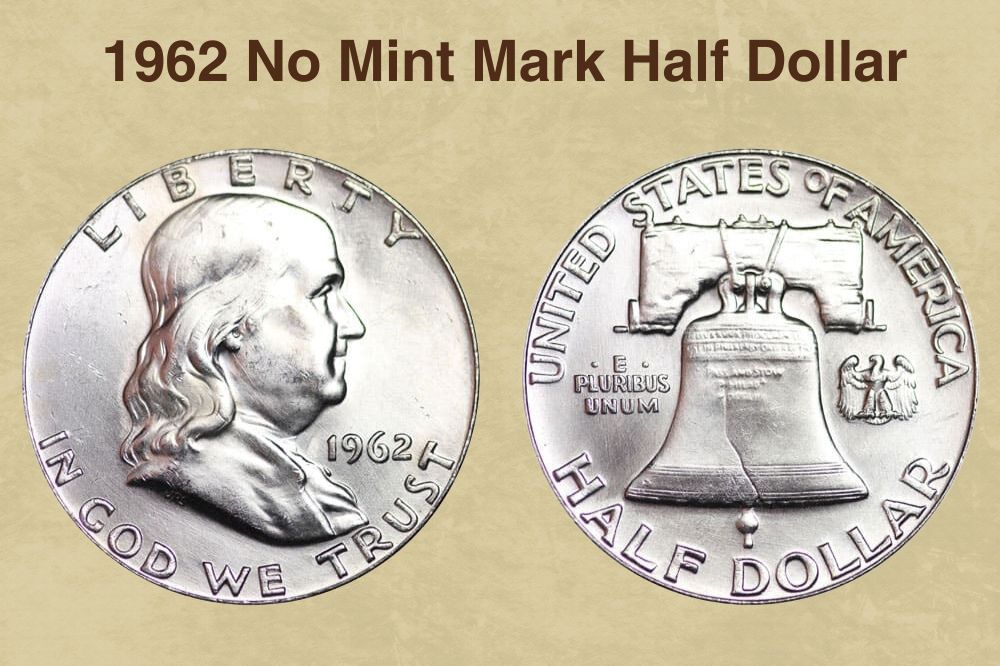
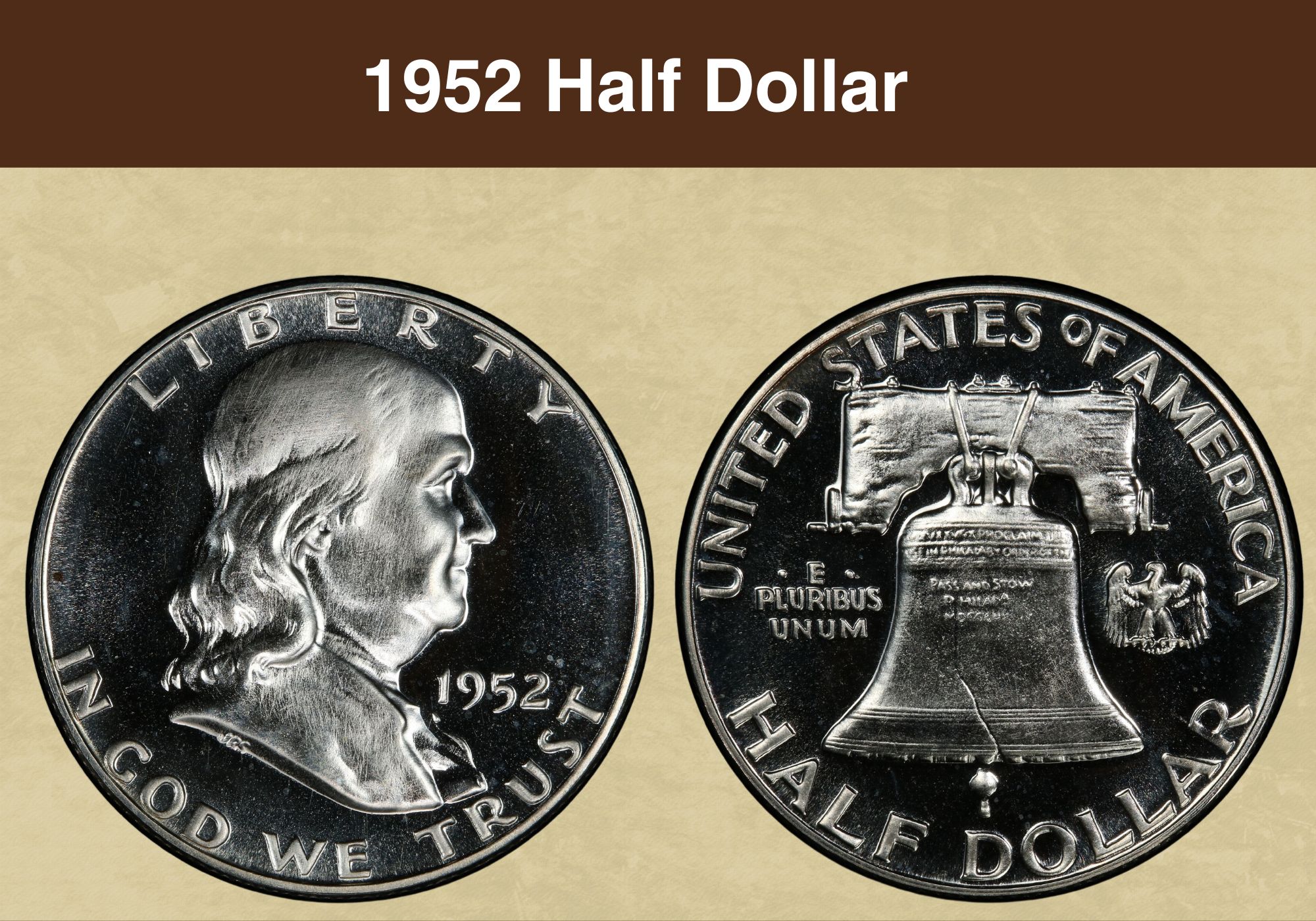
The obverse features a bust of Benjamin Franklin facing right, with LIBERTY inscribed along the top and IN GOD WE TRUST along the bottom. The mintage year appears to the right of the bust.
Sinnock adapted the Franklin bust from his design on the 1933 Benjamin Franklin Memorial bronze medallion, which was itself modeled after a bust by 18th-century French sculptor Jean-Antoine Houdon.
The designer’s initials JRS sit toward the left of Franklin’s shoulder cut-off.
On circulated examples, wear appears first on the high points of Franklin’s hair — particularly the wave behind the ear and the fine strands across the crown. As a coin moves from AU into the Fine range, these strands begin to merge and the wave loses its texture, making the hair the most reliable focal point for mid-grade assessment.
The Reverse of the 1962 Half Dollar
The reverse depicts the Liberty Bell alongside a small eagle placed to the right — included strictly to satisfy the legal requirement that half dollars bear an eagle. The Commission of Fine Arts, when reviewing the original design, objected to the eagle’s diminutive scale and worried that depicting the Bell’s famous crack would expose the coinage to public ridicule. Treasury Secretary John W. Snyder overruled them, and the design proceeded unchanged.
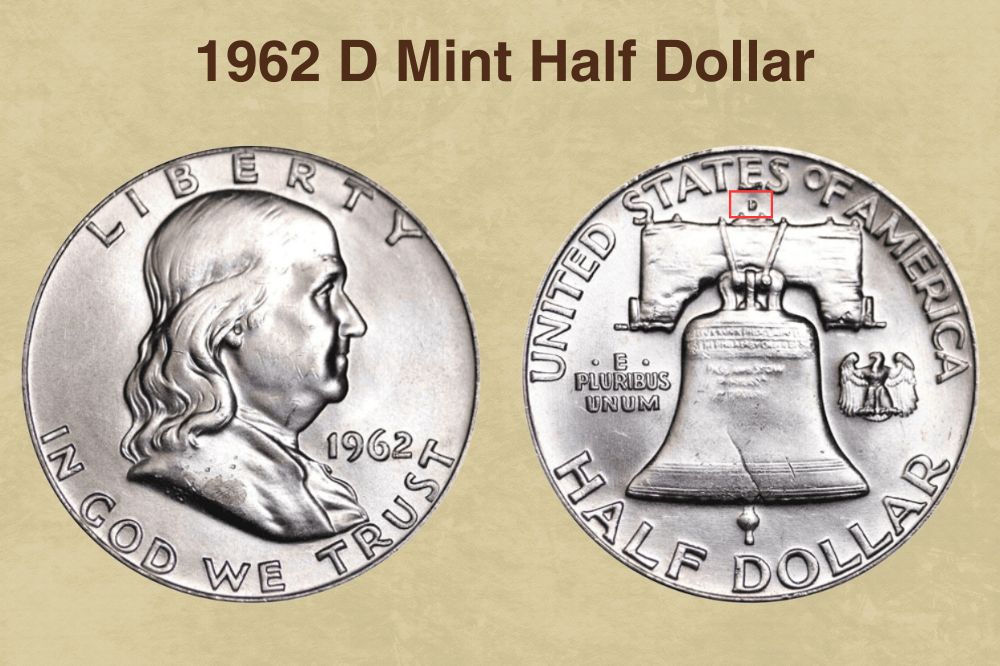
UNITED STATES OF AMERICA arches above the bell, HALF DOLLAR curves along the lower rim, and E PLURIBUS UNUM appears to the left. The mint mark, where present, sits above the bell’s yoke on the reverse.
To qualify for the Full Bell Lines designation, the seven parallel lines at the base of the Liberty Bell must be fully visible, and the three wisps of hair to the right of Franklin’s ear on the obverse must also show full separation without blending together. Achieving a clean FBL strike on this design was notoriously difficult, which is why the designation commands such a significant premium across the series.
Other Features of the 1962 Half Dollar
The coin is composed of 90% silver and 10% copper, weighs 12.5 grams, and measures 30.61 mm in diameter. The edge carries 150 reeds — a detail that serves both as an anti-counterfeiting measure and a practical authentication reference when examining suspect pieces.
Franklin half dollars have been extensively melted for their silver content. When silver prices reached record levels in 1979–1980, the coin was worth more as bullion than as a collectible in any condition — a historical footnote that helps explain why high-grade survivors are scarcer than raw mintage figures suggest.
Also Read: Top 100 Most Valuable Kennedy Half Dollar Worth Money List (1964-Present)
1962 Half Dollar Mintage & Survival Data
1962 Half Dollar Mintage & Survival Chart
Survival Distribution
| Type | Mintage | Survival | Survival Rate |
|---|---|---|---|
| No Mint | 9,714,000 | 971,400 | 10% |
| D | 35,473,281 | 3,547,328 | 10% |
| Proof | 3,218,019 | 2,500,000 | 77.6875% |
| CAM | 3,218,019 | 47,000 | 1.4605% |
| DCAM | 3,218,019 | 16,000 | 0.4972% |
The Denver Mint dominated output by a wide margin, striking more than three and a half times as many coins as Philadelphia. Yet despite this disparity, both circulation strikes share an identical 10% survival rate — a figure that reflects the indiscriminate nature of the silver melt waves of the late 1970s, which consumed circulated examples from both mints in roughly equal proportion. High mintage offered no protection when bullion value outpaced numismatic worth.
\With a survival rate approaching 78%, proof strikes were overwhelmingly preserved from the moment of issue — a direct consequence of intentional collector saving rather than chance. But within that same proof population, the contrast between standard proofs, Cameos, and DCAMs is where the real rarity hierarchy emerges.
CAM and DCAM coins were struck from the same dies as regular proofs, yet their survival rates drop to just 1.46% and 0.50% respectively — a reminder that the frosted, contrast-rich surfaces defining these varieties were a fleeting product of fresh dies, not a deliberate minting objective. The fewer the die strikes, the sharper the cameo effect, and the rarer the result.
Also Read: Top 11 Most Valuable Half Dollar Coins in Circulation (With Pictures)
The Easy Way to Know Your 1962 Half Dollar Value
Pinning down an accurate value for your 1962 Half Dollar comes down to three things: mint mark, grade, and strike quality. A circulated Philadelphia strike and a Denver FBL in MS65 can differ in value by a factor of ten — and that gap only widens at higher grades.
The fastest way to navigate this is with the Coin Value Checker App, which instantly identifies your coin’s grade, rarity rank, and current market value. Once you know where your coin sits on the grading spectrum, the numbers in this guide will tell you exactly what it’s worth.

1962 Half Dollar Value Guides
The 1962 Half Dollar was struck in five distinct varieties, each carrying its own rarity profile and market value. Understanding which variety you hold is the single most important step in determining what your coin is actually worth — the difference between a common circulated strike and a Deep Cameo proof, for instance, can mean hundreds of dollars.
- 1962 No Mint Mark Half Dollar
- 1962-D Half Dollar
- 1962 Proof Half Dollar
- 1962 CAM Half Dollar
- 1962 DCAM Half Dollar
1962 No Mint Mark Half Dollar Value

Coin Value Checker App
Not sure what your coins are worth? Get Instant Value • Grade • Error Detection with coin identifier and value app (FREE Usage Daily)
The 1962 No Mint Mark Half Dollar is a Philadelphia Mint issue. The coin is common in most grades, yet it ranks among the scarcer dates in the entire series when it comes to Full Bell Lines examples — with only the 1952-S, the ultra-rare 1953-S, and the 1963 recording lower FBL populations at PCGS.
No 1962 Philadelphia strike has been graded higher than MS-66. That hard ceiling at MS-66 is not a coincidence — it reflects the chronic striking inconsistencies at Philadelphia, where die pressure and planchet quality rarely aligned perfectly enough to produce gem-quality survivors in any meaningful number.
In terms of value, circulated examples trade close to their silver melt value, while MS-65 specimens can sell for around $55. The spread between grades, however, widens sharply once condition rarity enters the picture.
The all-time auction record for this variety stands at $5,463 — an MS-61 example sold by Heritage Auctions in January 2010. That a relatively modest MS-61 could command such a premium speaks volumes about how thin the certified population becomes even at mid-Mint State levels for this date.
1962 No Mint Mark Half Dollar Price/Grade Chart
Price by 1-70 Grade (Latest Auction Records Included)
Every number in this chart reflects a real transaction — and together, they map out exactly how the market has rewarded condition over time for the 1962 No Mint Mark Half Dollar.
| Date | Platform | Price | Grade |
|---|
Price alone doesn’t tell the full story — market activity do. Here’s a closer look at how collector demand for this coin has moved across the market.
Market activity: 1962 No Mint Mark Half Dollar
1962-D Half Dollar Value
The 1962-D reads as a common coin in circulated grades. But the Denver strike has a particular characteristic that separates it from its Philadelphia counterpart in the eyes of serious collectors: Denver coins carry a statistically higher likelihood of exhibiting Full Bell Lines, making them the preferred hunting ground for collectors willing to search through raw, uncertified examples. The gap between finding a clean strike and finding a *clean enough* strike is where the 1962-D’s real story lives.
The PCGS population data makes that story concrete. At MS65 FBL, 555 examples have been certified — a relatively healthy pool. But that population collapses sharply at MS65+, where only 21 coins are known, and again at MS66, where just 79 survive on the census. At MS66+, only 5 examples exist — with price guide values reflecting that scarcity at $11,000, a figure that has trended downward, signaling the market is watching this grade closely.
1962-D Half Dollar Price/Grade Chart
Price by 1-70 Grade (Latest Auction Records Included)
The records below don’t just track prices — they document the precise moments when the 1962-D’s condition rarity became impossible to ignore.
| Date | Platform | Price | Grade |
|---|
This chart shows the market activity trends for the 1962-D Half Dollar over the past year.
Market activity: 1962-D Half Dollar
1962 Proof Half Dollar Value
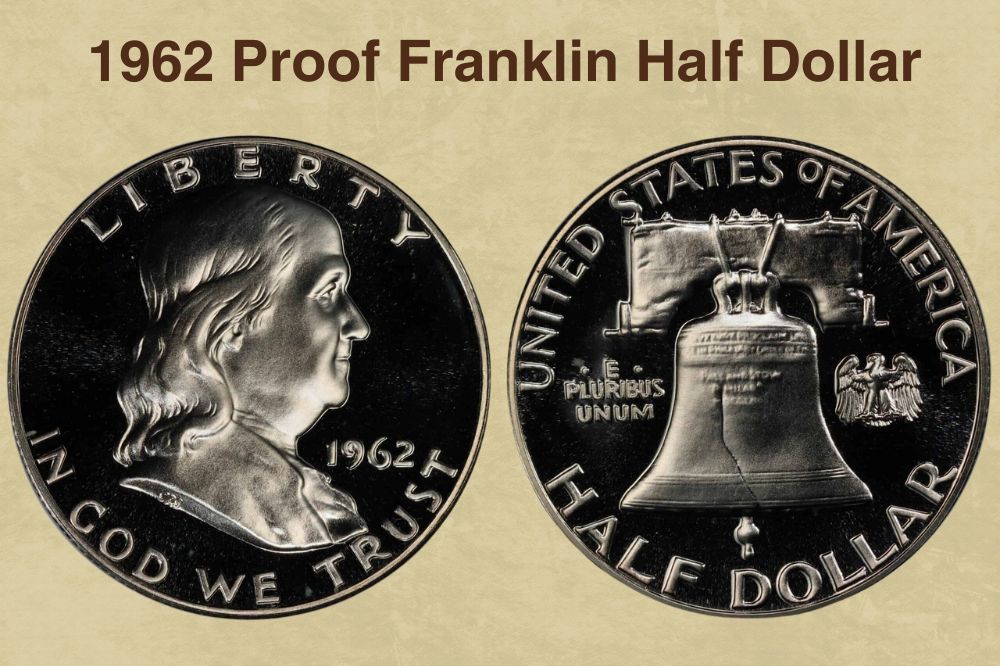
The 1962 Proof Franklin Half Dollar is one of the more common issues in the entire proof series, carrying the largest proof mintage of any Franklin Half Dollar.
That distinction cuts both ways: it makes the standard proof accessible to entry-level collectors, yet it also means the market is unforgiving — with so many examples in existence, only the finest surfaces and sharpest strikes command real attention.
Production quality for the 1962 issue is high, and collectors can locate appealing examples with relatively little difficulty. For those building a date set, this is one of the easier boxes to check. For those chasing the registry, it’s a different conversation entirely.
1962 Proof Half Dollar Price/Grade Chart
Price by 1-70 Grade (Latest Auction Records Included)
Each sale plotted here reflects the market’s verdict on a coin that exists in abundance.
| Date | Platform | Price | Grade |
|---|
The trading pattern below shows exactly where demand concentrates — and where the market grows indifferent.
Market activity: 1962 Proof Half Dollar
1962 CAM Half Dollar Value
The CAM designation on a 1962 Proof isn’t simply a grade upgrade — it marks a fundamentally different coin. Cameo contrast results from the interplay between freshly polished dies and prepared planchets, a condition that deteriorates with each successive strike. The earlier a coin is pulled from a given die pair, the more pronounced the frosting; which is precisely why CAM examples represent only a fraction of the total proof output despite sharing the same mintage pool.
In Cameo condition, examples up to about PR67 CAM are somewhat common, but anything higher becomes meaningfully scarcer. The auction record for the 1962 CAM stands at $4,600 for a PR69 example, sold by Heritage Auctions in November 2007 — a benchmark that reflects just how thin the population becomes at the top of the grade scale.
1962 CAM Half Dollar Price/Grade Chart
Price by 1-70 Grade (Latest Auction Records Included)
The prices recorded here aren’t just about condition — they’re about how early in a die’s life a given coin was struck, a detail the market has consistently rewarded.
| Date | Platform | Price | Grade |
|---|
CAM examples trade across a wide value spectrum depending on grade; the activity below reveals where the realistic collector market actually lives within that range.
Market activity: 1962 CAM Half Dollar
1962 DCAM Half Dollar Value
If the CAM represents the upper tier of 1962 proof production, the DCAM sits in a category of its own. Deep Cameo contrast — defined by stark, mirror-like fields set against fully frosted devices — is the result of striking from essentially fresh dies, often among the very first impressions of a new die pair.
For the 1962 DCAM, scarcity becomes meaningful at PR66, and examples in PR67–68 Deep Cameo are considerably tougher. In PR69 Deep Cameo, only a few dozen are believed to exist, with few or none known finer.
The finest certified examples are described as totally brilliant registry candidates with dramatic field-to-device contrast — language that signals the absolute ceiling of what this series can produce. The auction record for the 1962 DCAM stands at $9,200 for a PR69 example, realized at Heritage Auctions in January 2008.
1962 DCAM Half Dollar Price/Grade Chart
Price by 1-70 Grade (Latest Auction Records Included)
A coin this scarce at the top grades generates auction records that function less like price guides and more like historical events — each one a data point that may not repeat for years.
| Date | Platform | Price | Grade |
|---|
The pattern below captures the rhythm of a market built on scarcity rather than volume.
Market activity: 1962 DCAM Half Dollar
Also Read: 19 Rare Half Dollar Errors List with Pictures (By Year)
Rare 1962 Half Dollar Error List
Mint errors don’t follow a schedule — and the 1962 Half Dollar produced enough of them to keep specialists hunting decades later. Some are obvious to the naked eye; others require a loupe and patience.
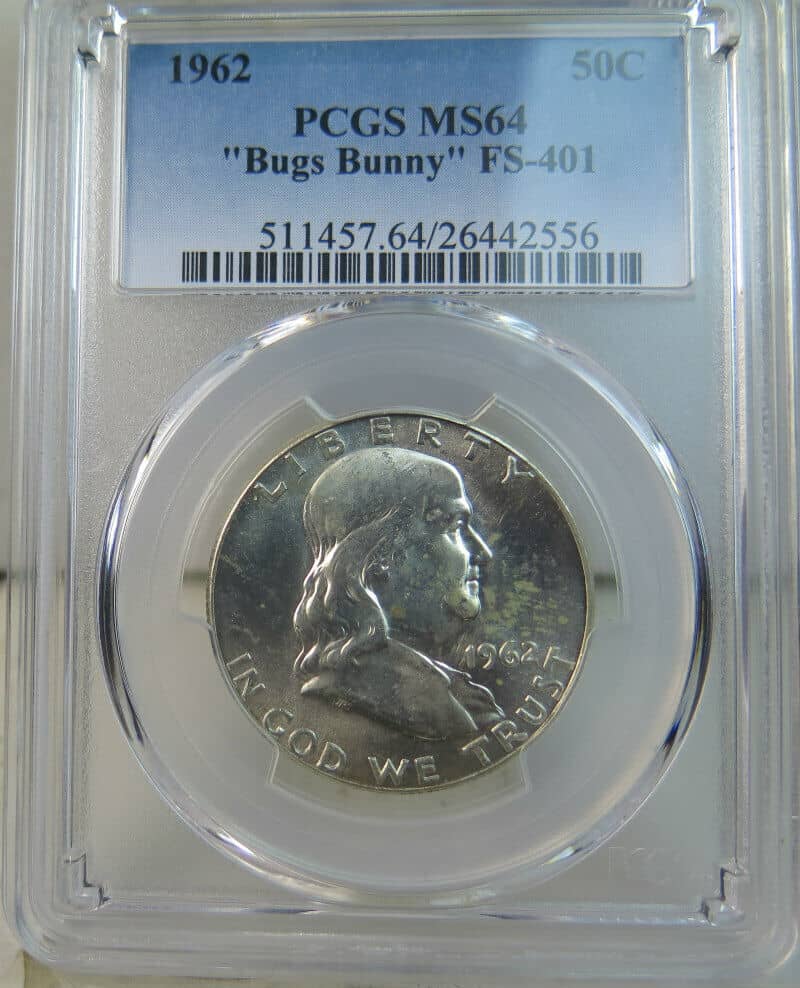
1. 1962 Bugs Bunny Die Clash (FS-401)
A die clash occurs when the obverse and reverse dies strike each other without a planchet between them. The tremendous pressure involved can impress elements from one die onto the other, and when coins are subsequently struck, the distorted image carries through.
On the 1962 Franklin Half Dollar, this produced the series’ most recognizable error: the eagle’s wing from the reverse transferred onto the obverse die, landing squarely at Franklin’s mouth and giving him the appearance of prominent buck teeth. The resemblance to the cartoon character was immediately obvious to collectors, and the nickname stuck.
The error attracts both serious collectors and novelty seekers alike, keeping demand broad across the hobby. Depending on condition, uncirculated examples command around $40 or more, with FBL-designated pieces climbing considerably higher on the Greysheet.
1962 Bugs Bunny Die Clash Price/Grade Chart
Price by 1-70 Grade (Latest Auction Records Included)
2. 1962 Doubled Die Obverse (DDO)
The Doubled Die Obverse on the 1962 Franklin Half Dollar is produced when the working die receives a misaligned second impression from the hub during the die-making process — a manufacturing error that permanently embeds doubling into every coin struck from that die.

Coin Value Checker App
Not sure what your coins are worth? Get Instant Value • Grade • Error Detection with coin identifier and value app (FREE Usage Daily)
On the 1962 issue, the doubling manifests most noticeably in the date and the legend LIBERTY, where a secondary shifted image sits alongside the primary. The more extreme the doubling, the more value the error adds — proof examples in PF68 have fetched as much as $312.
While not a five-figure rarity, the DDO rewards patient hunters willing to examine raw coins under magnification. Certified examples command a meaningful premium over standard strikes at equivalent grades, and the variety is fully recognized in PCGS and NGC population reports.
1962 Doubled Die Obverse Price/Grade Chart
Price by 1-70 Grade (Latest Auction Records Included)
3. 1962-D Repunched Mintmark (RPM)
The Repunched Mintmark on the 1962-D results from the “D” punch being applied to the working die more than once, with a slight misalignment between strikes — leaving a secondary impression that trails or overlaps the primary mintmark. Several Franklin half dollar dates exhibit this variety, where the mintmark was punched multiple times in slightly different positions.
On the 1962-D, the doubling of the “D” is visible under magnification, typically appearing as a shadow or offset mark adjacent to the primary letter. The variety is catalogued and collectable, though not dramatically rare — making it one of the more accessible error types for budget-conscious specialists. Recent sales of uncirculated examples have realized around $120, with stronger strikes and cleaner surfaces pushing values higher.
4. 1962 Proof D on Bell (FS-901)
The FS-901 “D on Bell” is one of the most sought-after Franklin varieties — a misplaced mintmark error where a “D” punch appears on the upper portion of the Liberty Bell on the reverse of a proof coin.
What makes this particularly striking is its context: the 1962 proof was a Philadelphia issue, meaning no “D” mintmark should exist anywhere on the coin. How a Denver “D” punch found its way onto a proof die remains one of the more intriguing production mysteries in the Franklin series.
Only 16 examples have been certified in NGC holders, with just 4 graded PF65 — a population so thin that the variety trades more like a rarity than a typical error. A cameo-designated example graded PF67 has sold for $1,300, while a Deep Cameo realized $720 at PF66.
Where to Sell Your 1962 Half Dollar?
Having established your 1962 Half Dollars’ value, you might be asking where to easily sell them online. I’ve put together a detailed list of recommended platforms, featuring their overviews, benefits, and limitations.
Check out now: Best Places To Sell Coins Online (Pros & Cons)
1962 Half Dollar Market Trend
Market Interest Trend Chart - 1962 Half Dollar
*Market Trend Chart showing the number of people paying attention to this coin.
FAQ about the 1962 Half Dollar
1. How do I know if my 1962 Half Dollar is worth more than its silver content?
The key is condition and strike quality. A coin with no visible wear that still shows mint luster — particularly on Franklin’s cheek and the high points of his hair — has collector value beyond its metal. The real premium kicks in if the Liberty Bell’s horizontal lines are fully separated, qualifying it for the Full Bell Lines designation. Without that, most circulated examples trade close to bullion.
2. What does “FBL” mean and why does it matter so much for value?
FBL stands for Full Bell Lines — a designation awarded when the seven horizontal lines at the base of the Liberty Bell are completely visible and uninterrupted. It’s the single most consequential grading detail in the Franklin series because achieving a clean strike on those lines was genuinely difficult. An FBL coin can be worth several times more than an identical non-FBL example at the same grade.
3. Is the 1962-D worth more than the Philadelphia issue?
In standard circulated grades, they trade at roughly the same level. The Denver coin becomes more desirable in the context of Full Bell Lines — Denver strikes were statistically more likely to exhibit clean bell lines than Philadelphia issues, making the 1962-D the preferred variety for FBL specialists searching raw coins.
4. Why does my 1962 Half Dollar look like Franklin has buck teeth?
That’s the “Bugs Bunny” die clash error. It happened when the obverse and reverse dies struck each other without a coin blank between them, transferring part of the eagle’s wing onto the obverse die — right at Franklin’s mouth. It’s one of the most recognizable errors in the entire Franklin series and has a dedicated collector following.
5. My 1962 proof looks different from others I’ve seen — shinier with a frosty portrait. Is it more valuable?
Almost certainly. What you’re describing is cameo contrast — frosted devices against mirror-like fields — which occurs only on coins struck early in a die’s life. If the contrast is sharp on both sides, it may qualify for a CAM or DCAM designation from PCGS or NGC, which can push the value well above a standard proof of the same grade.
6. How many 1962 Half Dollars actually survived to today?
Survival rates tell an interesting story. Roughly 10% of circulation strikes are estimated to survive — both Philadelphia and Denver issues were hit equally hard by the silver melt waves of the late 1970s. Proof coins fared far better, with nearly 78% believed to have been preserved by collectors from the moment of issue.
7. The “D on Bell” error sounds unusual — how do I spot it?
Look at the upper portion of the Liberty Bell on the reverse of a proof coin. If a small letter “D” appears embedded in the bell’s surface, you may have the FS-901 variety. It’s not visible to the naked eye and typically requires a loupe or coin microscope. Given that only 16 examples have been certified by NGC, having it professionally authenticated is essential before drawing any conclusions about value.
8. Does the 1962 Half Dollar have a maximum certified grade?
For circulation strikes, yes — no 1962 Philadelphia or Denver example has ever been graded above MS-66 by PCGS. That hard ceiling reflects the chronic striking inconsistencies of the era and explains why MS-66 examples command such strong premiums. Proof issues can reach PR69, though PR69 Deep Cameo examples number only in the dozens.
9. My coin has a slightly doubled “D” mintmark — is that an error?
It could be a Repunched Mintmark (RPM), a recognized variety where the “D” punch was applied to the die more than once with a slight misalignment. The secondary impression typically appears as a faint shadow or offset adjacent to the primary letter, visible under magnification. It’s a catalogued, collectible variety — not dramatically rare, but it does carry a modest premium over a standard strike.
10. Is now a good time to sell a high-grade 1962 Half Dollar?
That depends heavily on grade and designation. The market for common circulated examples tracks silver prices closely and moves with the broader bullion market. High-grade certified coins — particularly FBL, CAM, or DCAM specimens — follow collector demand, which has remained strong at the top of the grade scale. The MS66+ FBL price guide has shown some softening, which may indicate either a buyer’s opportunity or a shifting market — worth monitoring before committing to a sale.