Rare 2022 Nickel Errors Worth Money (Full List With Pictures)
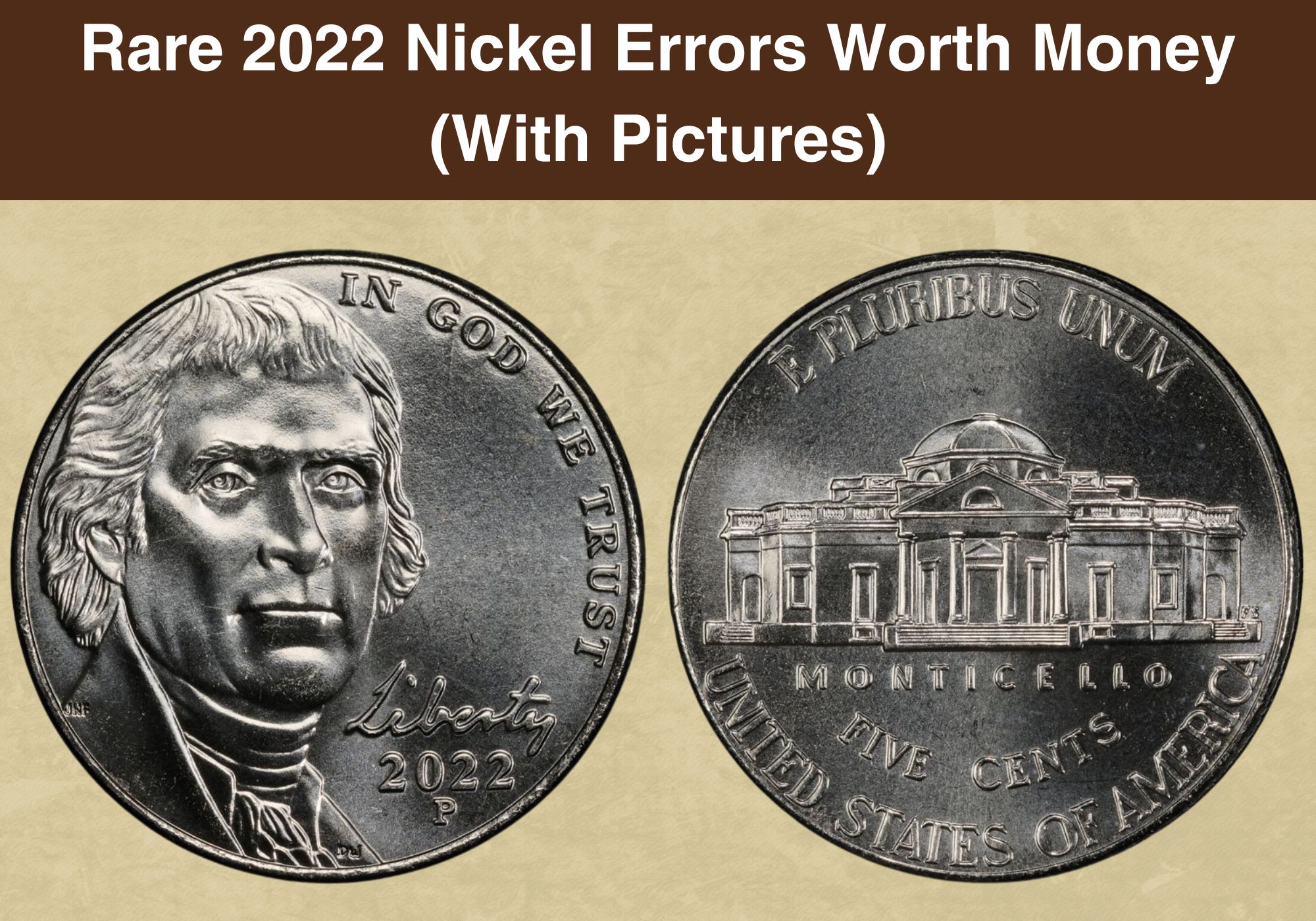
Dramatic 2022 nickel error varieties have sold for up to $250 in the collector market, with broadstruck examples commanding the top premiums. Even the most common mistakes on these coins trade for $5 to $15, well above the five-cent face value.
Philadelphia and Denver produced a combined 1.33 billion nickels in 2022, and quality control let its share of defects through. Below is every documented error type, sorted from least to most valuable.
1. 2022 Nickel Die Chip Error (Up to $10)

Die chips form when small steel fragments break away from the die surface during high-speed production. The void fills with metal during striking, creating raised bumps on the finished coin.
The most collected 2022 variety is the Philadelphia mint “Spear in Nose” error. A linear die chip extends from Jefferson’s nose area, creating what looks like a tiny spear piercing through it.
Another variety shows a chip affecting the word “FIVE” on the reverse. These chips are among the most common errors on 2022 nickels, appearing across multiple die pairs throughout the production run.
Value: The “Spear in Nose” variety sells for around $10 in circulated condition on eBay. Other die chip placements bring $3 to $8 depending on size and location.
Chips on prominent design features like Jefferson’s face command more than those landing in open field areas. Most sales are raw, ungraded coins — professional grading costs more than the coin is worth at this level.
How to Identify: Die chips appear as small raised lumps or blobs that do not match the original design. Use a 10x loupe under good lighting.
For the “Spear in Nose” variety, look for a raised linear feature near or extending from Jefferson’s nose on 2022-P nickels. The chip must be raised above the surface, not incuse.
A genuine die chip looks identical across multiple coins struck from the same die — this consistency separates it from random post-mint damage. Hits and scratches show displaced metal and disturbed surfaces around the impact point, while die chips have clean, rounded edges formed during striking.
Weight and diameter stay normal at 5.0 grams and 21.2 mm. The fastest confirmation is finding a second example from the same die with the identical chip in the same position.
Use Our 2022 Nickel Value Checker
2. 2022 Nickel Die Clash Error (Up to $15)

A die clash occurs when the obverse and reverse dies strike each other without a planchet between them. The collision transfers ghost impressions of one die’s design onto the other.
On 2022 nickels, the best-known variety is called the “Peeping Tom.” Jefferson’s portrait outline appears faintly beneath Monticello’s steps on the reverse, as if he is peeking out from under the building.
The obverse may also show traces of Monticello’s architecture across Jefferson’s face. Every coin struck after the clash event carries the same impressions until the dies are retired.
Value: Standalone die clash 2022 nickels sell for $5 to $15 on eBay. Strong “Peeping Tom” examples with clear Jefferson outlines on the reverse bring the upper end of that range.
Coins combining die clash with a doubled die error reach $10 to $20. Faint clash marks requiring magnification to detect trade closer to $5, and most transactions are raw coins.
How to Identify: Examine the reverse field around Monticello using a 10x loupe, particularly beneath the steps. Look for faint incuse lines tracing the outline of Jefferson’s portrait — this is the “Peeping Tom” diagnostic.
On the obverse, check behind Jefferson’s head for ghost traces of Monticello’s columns or reverse lettering. Die clash marks are incuse impressions in the flat field areas, not on the raised design elements.
Do not confuse them with machine doubling, which appears on raised features rather than in the fields. Contact marks and bag damage are another common misidentification.
True clash marks repeat consistently across every coin struck from the same damaged die pair. The quickest test is checking whether the ghost image matches the geometry of the opposite die’s design.
Use Our 2022 Nickel Value Checker
3. 2022 Nickel Improperly Annealed Planchet Error (Up to $20)

Before striking, blank planchets are heated in an annealing furnace to soften them, then washed and dried. When the temperature or exposure time goes wrong, the planchet develops abnormal coloring.
The 2022-D nickel is the most documented example. Affected coins show a dark brownish-black tone instead of the normal silvery appearance.
Despite the color shift, the coin retains its original luster and full design detail. The discoloration is uniform across the entire surface — unlike environmental toning, which tends to be blotchy and concentrated near the rim.
Value: A 2022-D nickel with this error sells for $15 to $20 in the collector market, with eBay as the primary venue. Price depends on how dramatic the color shift is — deep black or unusual purple tones bring stronger premiums than mild discoloration.
No major auction house sales have been documented for this specific 2022 variety. Most transactions land between $15 and $18 for typical brownish examples.
How to Identify: Color is the giveaway. A normal 2022 nickel is silvery-gray, while an improperly annealed example shows uniform dark brown, black, yellow, blue, or purple across the entire surface.
The key word is uniform. Environmental damage and artificial toning produce uneven, blotchy discoloration, especially around the rim.
Under a 10x loupe, the coin should show consistent luster despite the unusual color. Design details should be fully struck and sharp, matching a normal 2022 nickel in every respect except color.
Weigh the coin — it should hit 5.0 grams, confirming the correct planchet. The edge should show normal cupro-nickel composition with no copper core visible.
Do not confuse this error with chemical damage, heat exposure, or burial discoloration. The fastest check is luster consistency: genuine annealing errors have even luster matching the coin’s strike quality across the whole surface.
Use Our 2022 Nickel Value Checker
4. 2022 Nickel Struck Through Grease Error (Up to $25)

Struck-through errors happen when foreign material gets trapped between the die and planchet during striking. On 2022-D nickels, grease buildup in the die’s recesses is the most frequent culprit.
The grease prevents metal from flowing into those areas, producing weak, smudged, or partially missing design elements. Jefferson’s hair is the most commonly affected area because the deep die recesses for hair detail trap grease easily.
Each struck-through coin is unique — the specific pattern of missing detail depends on how the grease was distributed at the exact moment of impact.
Value: Struck-through-grease 2022 nickels typically sell for $13 to $15 in the general market. Examples with larger affected areas or visually dramatic missing detail bring $20 to $25.
Non-grease strike-throughs — where identifiable materials like cloth fibers or metal shavings left an impression — are rarer and command higher premiums. PCGS or NGC certification adds a modest bump over raw coins.
How to Identify: Look for areas where the design appears weak, mushy, or absent entirely. Under a 10x loupe, a struck-through-grease zone shows a smooth, slightly recessed surface where detail should be.
Compare the coin to a normal 2022 nickel. Any raised design element that appears flat or missing is worth investigating.
The critical distinction from wear: on a worn coin, detail loss is uniform across high points. On a struck-through, you get sharp detail immediately adjacent to the mushy area — wear does not produce that contrast.
Weight should be 5.0 grams, diameter 21.2 mm. Check the opposite side, since a strike-through typically affects only one face.
The fastest diagnostic is finding fully struck detail right next to the weak zone.
Use Our 2022 Nickel Value Checker

Coin Identifier and Value App
Not sure what your coins are worth? Get Instant Value • Grade • Error Detection with coin identifier and value app (FREE Usage Daily)
5. 2022 Nickel Cud Error (Up to $25)

A cud forms when a piece of the die breaks away along the rim, leaving a void that fills with metal during striking. The result is a shapeless raised blob attached to the coin’s edge.
On 2022-P nickels, the named variety is the “Detached Eye” cud. The break occurs near Jefferson’s eye area, giving the portrait an odd, disconnected appearance.
Cuds are terminal die errors, meaning the die was near the end of its service life when the break happened. The eye seems separated from the rest of the face by raised cud material.
Value: The “Detached Eye” cud on 2022-P nickels sells for approximately $8 in typical circulated examples. Larger cuds that obscure lettering or significant design portions bring $15 to $25.
Size and location drive value directly — rim cuds blocking major design elements command the most. eBay is the main marketplace, and professional grading costs more than most cud coins are worth.
How to Identify: Cuds appear as raised, shapeless masses of metal along the coin’s rim. They must connect to the rim — a raised blob in the middle of the coin is a die chip, not a cud.
Use a 10x loupe. The cud should have a smooth, featureless surface with no design detail, because the broken die left a void instead of imparting any image.
On the opposite side of the coin, you may notice a corresponding weak area or slight depression directly behind the cud. The broken die cannot exert full striking pressure there.
Do not confuse cuds with struck-through errors, which create incuse depressions rather than raised areas. Weigh the coin — it should be at or very slightly above 5.0 grams.
The fastest confirmation is verifying the raised blob connects directly to the rim.
Use Our 2022 Nickel Value Checker
6. 2022 Nickel Die Crack Error (Up to $30)

Die cracks develop when steel dies fracture from repeated use and metal fatigue. The fractures transfer to every coin struck afterward as raised lines on the surface.
The 2022 series has two named varieties worth knowing. One shows a prominent crack running through Jefferson’s left eyebrow on the obverse.
The other, called the “Scarred Eye,” has a vertical fracture crossing Jefferson’s right eye. It produces a dramatic visual effect resembling facial scarring, and both named varieties appear on Philadelphia mint coins.
Value: Basic die crack 2022 nickels sell for $5 to $15, with price determined by crack length and location. The “Scarred Eye” brings slightly higher premiums for its visual impact.
The real money is in combinations — a 2022 nickel with both a die crack and Full Steps designation reaches $20 to $30 in uncirculated condition. Circulated crack-plus-Full-Steps examples trade around $20.
How to Identify: Die cracks show as thin, raised lines on the coin’s surface running in any direction. Start with Jefferson’s face under a 10x loupe — this is where the collected 2022 varieties live.
The crack must be raised, not incuse. Run your fingernail perpendicular across it and you should feel a slight bump.
Genuine die cracks have consistent width along their length and follow an irregular natural fracture pattern. Scratches are incuse grooves cut into the surface with displaced metal along the edges — die cracks are raised ridges with no displaced metal.
For the “Scarred Eye” variety, look for a vertical raised line crossing Jefferson’s right eye specifically. Weight stays at 5.0 grams, diameter at 21.2 mm.
The fastest confirmation: if the line is raised, it is a die crack. If it is a groove, it is a scratch.
Use Our 2022 Nickel Value Checker
7. 2022 Nickel Doubled Die Error (Up to $50)

A doubled die occurs during die production when the hub strikes the working die more than once with slight misalignment. Every coin struck from that flawed die shows identical doubling, which is not the same as worthless machine doubling that happens during striking.
Researchers have documented at least ten different doubled die reverse varieties for 2022-P nickels alone, catalogued by CONECA and Brian’s Variety Coins. The strongest show Class VIII tilted hub doubling on “E PLURIBUS UNUM,” “UNITED STATES OF AMERICA,” and the Monticello building.
Both obverse (WDDO-001) and reverse (WDDR-011, WDDR-012, and others) varieties exist for this year.
Value: Circulated doubled die 2022 nickels sell for $10 to $20. Coins with doubling visible on both obverse and reverse command higher premiums.
The strongest varieties labeled “Best Of” by Brian’s Variety Coins reach $25 to $50 in uncirculated grades. The WDDO-001 and stronger WDDR listings are the most collected, while coins combining doubled die with die clash errors sell in the $10 to $20 range.
How to Identify: Use a 10x loupe and start on the obverse. Check “IN GOD WE TRUST” and “LIBERTY” for overlapping or shadow lettering, then examine the date and mint mark for doubled images.
On the reverse, focus on “MONTICELLO,” the door frame above the steps, and “E PLURIBUS UNUM.” These areas show the strongest doubling on known 2022 varieties.
True doubled dies produce raised, rounded shadow lettering with crisp separation between original and doubled images. Machine doubling looks flat, shelf-like, and mushy — that distinction matters more than any other single diagnostic.
On letters like “T” and “S,” look for split or notched serifs under magnification. Check reference images from Brian’s Variety Coins or Wexler’s files for exact die markers.
The fastest test: if the doubling looks flat and shelf-like, it is machine doubling — walk away.
Use Our 2022 Nickel Value Checker
8. 2022 Nickel Clipped Planchet Error (Up to $75)

A clipped planchet happens when the blanking press punches a new blank from a strip that was not advanced far enough. The punch overlaps a previously punched hole, and the resulting blank comes out missing a section.
That incomplete blank goes through the rest of production — rim upsetting and striking — with a chunk absent the whole time. On 2022 nickels, curved clips are the most common type.
The coin shows a crescent-shaped area of missing metal with corresponding design weakness near the clip. Straight clips from the edge of the metal strip also occur but less frequently.
Value: Small clips on modern Jefferson nickels bring $5 to $15. Larger clips removing 10% or more of the planchet sell for $25 to $50.
Dramatic examples with 25% or more missing material on certified coins can reach $50 to $75. No Heritage or GreatCollections sales specific to 2022 clipped nickels have been recorded, so eBay is the primary market where value scales directly with clip size.
How to Identify: The obvious sign is a missing section along the coin’s edge — a flat or curved indentation where the rim should be. Weigh the coin on a precision scale, since a clipped planchet will be under 5.0 grams proportional to the missing material.
The critical diagnostic is the Blakesley Effect. On the rim directly opposite the clip, you should see weakness or complete absence of the rim because the incomplete planchet cannot flow properly during upsetting.
If the opposite rim is fully formed, the missing metal is likely post-mint damage from pliers, a vise, or deliberate cutting. Examine the clip edge — a genuine clip shows a smooth, clean edge matching the blanking punch curvature.
Tool marks, rough edges, or file marks point to damage. The fastest confirmation is the Blakesley Effect opposite the clip — no Blakesley, no deal.
Use Our 2022 Nickel Value Checker
Coin Identifier and Value App
Not sure what your coins are worth? Get Instant Value • Grade • Error Detection with coin identifier and value app (FREE Usage Daily)
9. 2022 Nickel Off-Center Strike Error (Up to $225)

An off-center strike happens when the planchet is not properly seated between the dies at the moment of impact. Part of the design gets struck, and the rest of the planchet stays blank.
The shift can range from barely visible at 5% to dramatic at 50% or more. Minor off-center errors are relatively common on 2022 nickels.
The real prizes are significant displacements where the date remains legible. Once “2022” disappears off the edge, value drops sharply.
Multi-error coins combining off-center strikes with other defects have reached $225 in the collector market.
Value: Minor 5-10% off-center 2022 nickels sell for $5 to $20 on eBay. Coins showing 20-50% displacement with a clearly visible date bring $50 to $150, while multi-error examples have reached up to $225.
For context, a 2011-P off-center Jefferson nickel graded MS60 sold for $615 at GreatCollections in 2014, showing the potential ceiling for dramatic single-error examples with professional certification.
How to Identify: The design is shifted toward one edge with a smooth, blank crescent on the opposite side. The blank area should be completely featureless — no design, no rim, just flat metal.
Both sides of the coin show the same directional shift. If only one side is off-center, you have a misaligned die error instead.
Weigh the coin at 5.0 grams to confirm the correct planchet. Use calipers to check overall diameter — off-center coins maintain their original blank size, unlike broadstrikes which expand outward.
Post-mint damage from a rolling machine can produce a similar look but shows disturbed surface metal and lacks the clean boundary between design and blank. The fastest check is verifying the shift direction matches on both obverse and reverse.
Use Our 2022 Nickel Value Checker
10. 2022 Nickel Broadstruck Error (Up to $250)
A broadstrike occurs when the coin is struck without the retaining collar in place. The collar normally holds the planchet at proper diameter during impact.
Without it, the metal flows outward freely, producing a coin that is wider and thinner than normal with no defined rim. On 2022 nickels, broadstrikes can be centered or off-center.
Centered broadstrikes retain a full, legible design on both sides despite the expanded diameter. These are preferred by collectors and bring higher prices than off-center examples.
Value: Centered broadstruck 2022 nickels with full design sell for $30 to $75 on eBay. Off-center broadstrikes with significant expansion bring $50 to $125.
Dramatic examples showing major diameter increases can reach $150 to $250. A 2011-P broadstruck Jefferson nickel graded MS60 sold for $1,200 at Heritage Auctions, showing the potential when professional grading confirms a dramatic specimen — the 2022 market has not produced a comparable sale yet.
How to Identify: The most obvious tell is a coin wider than the standard 21.2 mm. Use calipers — any expansion beyond that figure indicates a broadstrike.
Weigh it. The coin should still hit 5.0 grams since no metal was added or removed, just redistributed outward.
The design should be complete or nearly complete on both sides, which separates this from an off-center strike where part of the design is entirely absent. A normally struck nickel shows faint collar contact marks around its circumference, while a broadstrike will not.
Post-mint flattening from a vise creates similar expansion but leaves tooling marks and uneven metal displacement. The fastest confirmation is measuring diameter with calipers — over 21.2 mm with full design and proper weight means broadstrike.
Use Our 2022 Nickel Value Checker
Conclusion
The 2022 Jefferson nickel error market runs from about $3 for minor die chips to $250 for dramatic broadstrikes. Most errors fall in the $10 to $30 range and are findable with patience and a loupe.
Professional grading only makes financial sense above $200. Philadelphia’s higher mintage means more die varieties to hunt, while Denver produced its own scarce planchet errors like the improperly annealed variety.