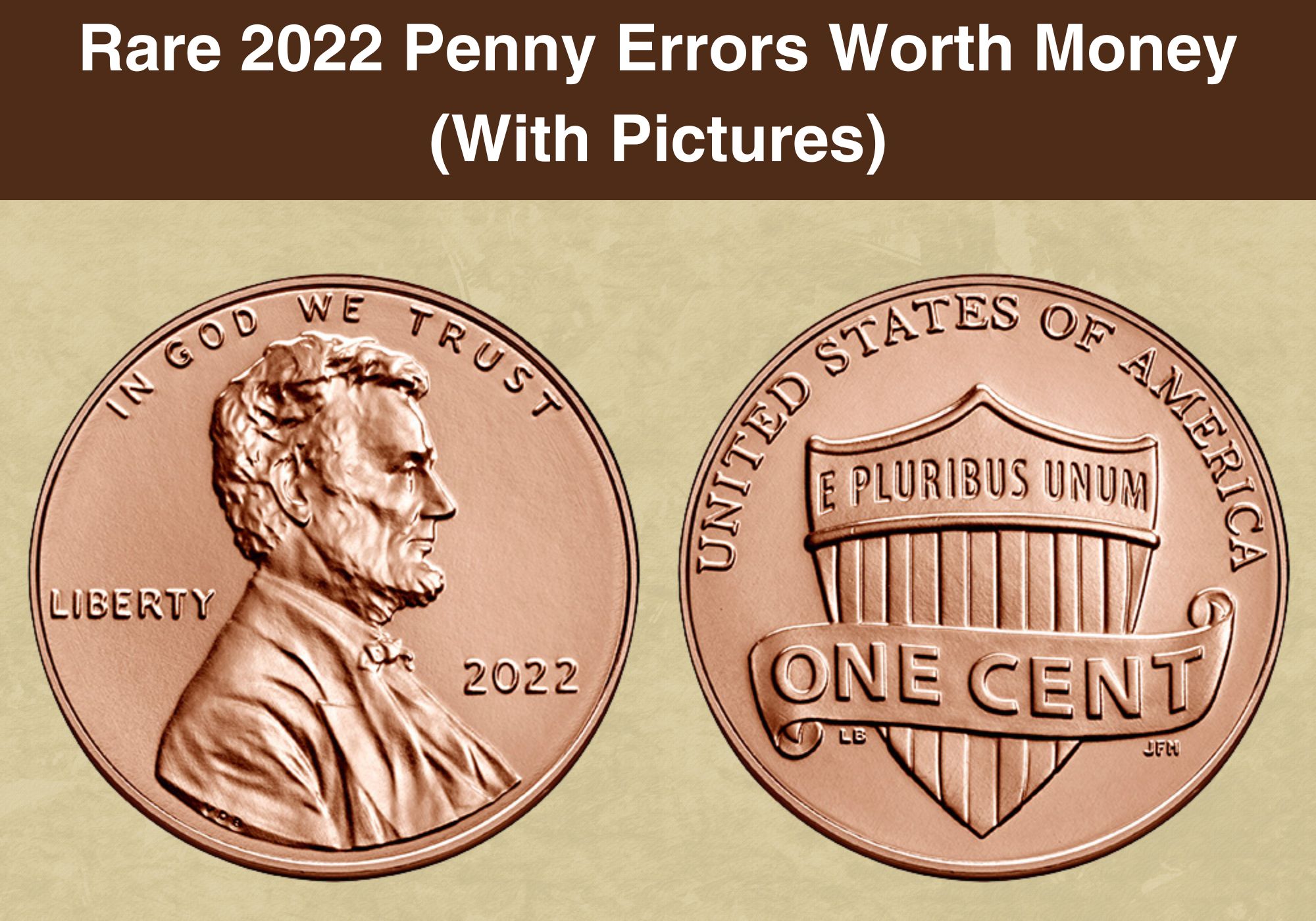
Rare 2022 Penny Errors Worth Money (Full List With Pictures)
A 2022-D Lincoln penny with a defective plating error — its reverse completely missing the copper layer — has been valued at $500 in the collector market. The full 2022 penny error list covers varieties priced from $5 BIE die breaks to that headline plating defect.
Philadelphia and Denver pushed out a combined 5.5 billion pennies that year, and the copper-plated zinc composition introduced its own category of errors impossible on older solid copper cents. Below is every documented error type, sorted from cheapest to most expensive.
1. 2022 Penny BIE Die Break Error (Up to $15)

The BIE error is exclusive to Lincoln cents. A vertical die crack develops between the letters “B” and “E” in the word LIBERTY on the obverse, creating what looks like a capital letter “I” between them.
The die fractures from repeated striking, and the crack fills with metal during each subsequent impression. The result is a raised vertical line that, by coincidence of location, mimics a letter.
Multiple BIE varieties can exist for a single year, each from a different cracked die. The 2022 series has produced several documented examples across both the Philadelphia and Denver mints.
Value: BIE pennies from 2022 sell for $5 to $15 on eBay depending on the crack’s clarity and the coin’s overall condition. Sharper, more letter-like cracks bring the upper end of that range.
No major auction house sales have been recorded for 2022 BIE pennies specifically, keeping this firmly in the affordable starter category. Raw, ungraded examples dominate the market at these modest price levels and professional grading is not cost-effective.
How to Identify: Look at the word LIBERTY on the obverse using a 10x loupe. Between the “B” and “E,” you should see a raised vertical line resembling the letter “I” that is not part of the original design.
The line must be raised above the surface, not incuse. It should have a slightly irregular width consistent with a natural die fracture rather than the uniform thickness of a machine-engraved letter.
Do not confuse BIE errors with general die cracks running through other parts of the coin — the crack must sit between “B” and “E” specifically to qualify. Weight remains 2.50 grams, diameter 19.05 mm.
The fastest confirmation is checking whether the raised line falls precisely between those two letters and nowhere else.
Use Our 2022 Penny Value Checker
2. 2022 Penny Strike-Through Error (Up to $20)

A strike-through occurs when foreign material lands between the die and planchet at the moment of striking. The object blocks the die from fully impressing the design, leaving its outline on the finished coin.
Common culprits include grease, cloth fibers, wire fragments, and shop debris. On 2022 Lincoln pennies, one named variety is the “Lincoln’s Assassination” — a strike-through that resembles a bullet aimed at Lincoln’s forehead.
The nickname is morbid but accurate. Each strike-through is unique because the foreign material lands differently every time the error occurs.
Value: The “Lincoln’s Assassination” strike-through variety on 2022 pennies is valued at $18 to $20 for uncirculated specimens graded Brilliant Red. General strike-through errors on 2022 cents bring $6 to $10 on eBay.
Larger affected areas or unusual impressed textures can push prices above $15 for visually dramatic examples. Most sales are raw, ungraded coins, and professional grading is not economically justified at this price level.
How to Identify: Strike-throughs appear as smooth, depressed areas where the design is weak or absent. Under a 10x loupe, look for an impressed outline or texture that does not match the normal design.
Cloth weave creates a regular grid pattern, while grease leaves a smooth, featureless depression. The affected area should be on one side only since the foreign object sat on one die.
Check that the surrounding design remains fully struck and sharp — this contrast between sharp adjacent detail and the mushy affected zone separates a strike-through from wear. Weight stays at 2.50 grams, diameter at 19.05 mm.
The fastest test is finding fully struck detail immediately next to the weak area, since wear cannot produce that boundary.
Use Our 2022 Penny Value Checker
3. 2022 Penny Die Crack Error (Up to $25)

Die cracks form when the steel dies develop fractures from metal fatigue after striking thousands of coins. The fracture fills with metal during each subsequent strike, transferring a raised line onto every coin produced by that damaged die.
On 2022 pennies, one dramatic variety shows a die break running through Lincoln’s head, creating the visual illusion of a bullet wound. The “bullet wound” die break carries a premium over generic cracks.
Standard die cracks elsewhere on the coin are common and less valuable. Both Philadelphia and Denver mints produced 2022 pennies with various die crack positions.
Value: Typical die crack 2022 pennies sell for $5 to $15 depending on length and placement. Die cracks crossing prominent design features like Lincoln’s face bring higher premiums than those in open field areas.
One exceptional 2022-D penny with a die crack on the Union Shield sold for $390, though this is an extreme outlier that does not represent the typical market. Most die crack sales on eBay fall between $5 and $25 for clearly visible examples.
How to Identify: Die cracks appear as thin, raised lines on the coin’s surface. Use a 10x loupe and examine both sides carefully since cracks can appear anywhere on either the obverse or reverse.
The line must be raised, not incuse. Run your fingernail perpendicular across it and you should feel a slight ridge.
Genuine die cracks follow irregular natural fracture patterns with slightly uneven width. Scratches are incuse grooves with displaced metal along their edges — the opposite of a die crack.
Weight stays at 2.50 grams, diameter at 19.05 mm. The fastest confirmation is the raised-versus-incuse test — if the line protrudes above the surface, it is a die crack.
Use Our 2022 Penny Value Checker
4. 2022 Penny Clipped Planchet Error (Up to $35)

A clipped planchet happens when the blanking press punches a new blank from a metal strip that was not advanced far enough. The punch overlaps a previously punched hole, producing a blank with a crescent-shaped bite missing.
That incomplete blank goes through upsetting and striking with the missing section intact. On 2022 copper-plated zinc cents, curved clips are the most common type.
The copper plating along the clip edge sometimes shows exposed zinc where the metal was sheared. This two-tone edge detail is not seen on older solid copper cents.
Value: Genuine clipped planchet 2022 pennies sell for $15 to $35 raw on eBay, with value scaling directly based on the size of the missing section. Larger clips removing more than 10% of the planchet command the top end of that range.
No major auction house sales specific to 2022 clipped cents have been documented, and the market consists primarily of direct collector-to-collector transactions. Professional grading is not cost-effective at these modest price levels.
How to Identify: The coin will show a curved or straight section of missing metal along one edge. Weigh it on a precision scale — a clipped planchet will be under 2.50 grams proportional to the missing material.
The critical test is the Blakesley Effect. On the rim directly opposite the clip, you should see weakness or complete absence of the rim because the incomplete blank cannot flow properly during upsetting.
If the opposite rim is fully intact, the missing metal is likely post-mint damage from wire cutters or pliers. Examine the clip edge for a clean shear consistent with the blanking punch — tool marks or jagged edges indicate damage.
The fastest confirmation is the Blakesley Effect opposite the clip — no Blakesley means it is not genuine.
Use Our 2022 Penny Value Checker
Coin Identifier and Value App
Not sure what your coins are worth? Get Instant Value • Grade • Error Detection with coin identifier and value app (FREE Usage Daily)
5. 2022 Penny Die Clash Error (Up to $40)

A die clash happens when the obverse and reverse dies strike each other without a planchet between them. The impact transfers ghost impressions of one die’s design onto the other die’s working surface.
On 2022-P pennies, the clash produced visible traces of the Union Shield’s outline and vertical bars on the obverse, appearing behind Lincoln’s portrait. The 2022-D mint also shows a misaligned die clash variety.
The misaligned version occurred when the dies were laterally shifted during collision, creating offset clash marks plus a compressed circle outline on the obverse.
Value: A 2022-P penny with a die clash showing the Union Shield outline on the obverse is valued at up to $40, with Brilliant Uncirculated examples potentially bringing more. The 2022-D misaligned die clash variety trades in a similar range.
Standard clash marks with faint, barely visible impressions sell closer to $10 to $15 on eBay. Most transactions at this price level involve raw, ungraded coins traded directly between collectors.
How to Identify: Examine the obverse field behind Lincoln’s portrait using a 10x loupe. Look for faint incuse lines that trace the outline of the Union Shield or its vertical bars — these are not part of the normal obverse design.
On the reverse, check for ghost traces of Lincoln’s profile in the field areas around the shield. Die clash marks appear as incuse impressions in the flat field, not on raised design elements.
For the misaligned variety, look for a compressed circular outline on the obverse that does not match any normal element. Weight remains 2.50 grams, diameter 19.05 mm.
The fastest test is checking whether the ghost image on the obverse matches the geometry of the reverse shield design.
Use Our 2022 Penny Value Checker
6. 2022 Penny Extra V (VDB Variety) Error (Up to $45)

On the obverse of Lincoln cents, the tiny initials “VDB” appear on Lincoln’s truncated shoulder, honoring original designer Victor David Brenner. On some 2022 pennies, an additional “V” appears just after the VDB initials.
There is no official Mint explanation for this extra letter. The most likely cause is a die gouge or progressive die deterioration that created a mark resembling a “V” in that location.
Whatever the origin, the variety is documented and collected. The extra V is small and requires magnification, but once you know where to look, it is distinctive.
Value: A 2022 Lincoln cent with the extra V variety sells for approximately $30 in circulated condition on eBay. Uncirculated examples with a strong, clearly defined extra V mark bring $45 or more.
This variety has a modest but consistent following among Lincoln cent specialists and researchers who track VDB-related anomalies. No major auction house sales have been recorded, so the market remains confined to collector-to-collector transactions.
How to Identify: Use a 10x loupe or stronger and examine the area immediately after the VDB initials on Lincoln’s shoulder truncation. You should see what appears to be an additional letter “V” following the existing three initials.
The extra V should be raised, matching the relief of the genuine VDB letters. Compare your coin against a normal 2022 penny without the variety — the difference is subtle but visible under magnification.
The mark must appear in a consistent location matching documented examples of this specific variety. Weight stays at 2.50 grams, diameter at 19.05 mm.
Check multiple reference images before attributing, as random die gouges can mimic letter shapes. The fastest confirmation is matching the position and angle against published images of the known variety.
Use Our 2022 Penny Value Checker
7. 2022 Penny Die Chip “Crying Lincoln” Error (Up to $50)

A die chip forms when a small fragment of steel breaks away from the die surface. The resulting void fills with metal during striking, creating a raised bump on the finished coin.
On 2022-D pennies, a documented die chip sits beneath Lincoln’s eye, producing what looks like a tear rolling down his cheek. The known examples combine this die chip with a doubled die error on the same coin, making them dual-error pieces.
The visual effect does not require magnification to appreciate, which adds to its appeal among variety collectors.
Value: The 2022-D “Crying Lincoln” die chip combined with a doubling error is valued at $40 to $50 depending on overall condition. The dual-error nature of this variety drives the premium above what either error would command alone.
Standard die chips on 2022 pennies without the tear-like placement or the accompanying doubling sell for $3 to $10 on eBay. Most transactions are raw coins in the direct collector market.
How to Identify: Examine the area directly below Lincoln’s right eye on 2022-D pennies using a 10x loupe. The die chip should appear as a small raised blob or elongated bump creating the illusion of a teardrop.
Confirm the chip is raised above the surface, not incuse. Also check for accompanying doubled die characteristics on the inscriptions, since documented examples of this variety show both errors together.
Do not confuse die chips with plating blisters — blisters are hollow bumps caused by gas trapped under the copper plating and carry zero collector value. Weight remains 2.50 grams, diameter 19.05 mm.
The fastest test is pressing gently on the bump: a plating blister may feel hollow, while a die chip is solid metal throughout.
Use Our 2022 Penny Value Checker
8. 2022 Penny Doubled Die Error (Up to $120)

A doubled die occurs during die production when the hub strikes the working die more than once with slight misalignment. Every coin struck from that flawed die carries identical doubling — this is not the same as worthless machine doubling.
The top verified 2022 variety is the 2022-D WDDO-001, showing Class VIII tilted hub doubling on the date, “IN GOD WE TRUST,” “LIBERTY,” and the VDB initials. A separate rare variety shows doubling on the Union Shield outline on the reverse.
Shield doubling is uncommon because it is mechanically harder to produce than inscription doubling.
Value: The 2022-D WDDO-001 sells for $10 to $35 raw and $60 to $120 or more when professionally certified at MS-65 or better. Minor doubled die varieties with reverse doubling on ONE CENT bring $10 to $15.
The shield reverse doubled die, with visible doubling along the shield outline, is valued at $100 to $150 depending on condition. This makes the doubled die category the broadest value range among all 2022 penny errors.
How to Identify: Use a 10x loupe and check the obverse first. On the WDDO-001, look for notching at the serif corners of letters in “IN GOD WE TRUST” and split serifs on the date numerals.
True doubled dies produce raised, rounded duplicate images with crisp separation between the original and doubled elements. Machine doubling creates flat, shelf-like shadows sitting lower than the primary design — this distinction accounts for the majority of false attributions.
For the shield reverse variety, examine the upper and lower outline of the Union Shield for doubled contour lines. Confirm by matching die markers against Wexler’s doubled die reference files.
The fastest test: if the doubling looks flat and shelf-like, it is machine doubling and worth nothing.
Use Our 2022 Penny Value Checker
9. 2022 Penny Off-Center Strike Error (Up to $150)

Coin Identifier and Value App
Not sure what your coins are worth? Get Instant Value • Grade • Error Detection with coin identifier and value app (FREE Usage Daily)
An off-center strike occurs when the planchet is not properly seated between the dies at the moment of impact. Part of the design gets struck onto the metal while the remainder stays blank.
The degree of displacement ranges from a barely perceptible 5% to a dramatic 50% or more. Minor off-center errors are relatively common on 2022 pennies given the massive mintage.
The collector sweet spot is 40-60% off-center with the full date still visible. That is enough displacement to look dramatic while retaining enough design to confirm the year.
Value: A 2022 off-center penny showing 5-10% displacement sells for $15 to $25 on eBay. Coins with 20-50% off-center and a visible date bring $75 to $150 or more.
The date is everything — once “2022” disappears off the edge, value drops sharply. A 2022-D penny with a 20% off-center combined with a partial collar error sold for $14 to $20, showing how moderate displacement yields modest returns.
How to Identify: The design will be shifted toward one edge with a smooth, blank crescent on the opposite side. The blank area should be completely featureless — no design, no rim, just flat metal.
Both sides must show the same directional shift. If only one side is off-center, you have a misaligned die error instead, which is worth less.
Weigh the coin at 2.50 grams to confirm the correct planchet. Use calipers to check diameter — off-center coins keep their original 19.05 mm blank size, unlike broadstrikes which expand outward.
Post-mint damage from machinery can mimic this but shows disturbed surface metal and lacks the clean boundary between struck design and blank. The fastest check is confirming the shift matches on both sides.
Use Our 2022 Penny Value Checker
10. 2022 Penny Defective Plating Error (Up to $500)

This error is unique to post-1982 copper-plated zinc cents and could not occur on earlier solid copper pennies. It happens when a zinc planchet either skips the copper electroplating step entirely or receives incomplete plating, exposing the silvery zinc core.
On one documented 2022-D penny, the reverse is completely missing its copper layer while the obverse retains full plating. This creates a two-tone coin — copper on one side, silver-gray on the other.
Partial plating errors showing streaks of exposed zinc are more common than full-side missing plating. Both types are collected.
Value: The documented 2022-D penny with a full reverse missing its copper plating is valued at approximately $500, making it the highest-value confirmed 2022 penny error. Partial plating defects and zinc streak exposures bring $25 to $100 depending on extent.
Certified unplated zinc pennies from other years sell for $50 to several hundred dollars through specialist dealers. NGC or PCGS authentication is critical because chemically stripped pennies, which are worthless, are extremely common.
How to Identify: Color is the primary diagnostic. A normal 2022 penny is copper-colored on both sides, while a defective plating error shows silver-gray zinc on part or all of one or both sides.
Weigh the coin — a genuine unplated or partially plated cent weighs approximately 2.42 to 2.50 grams. An acid-stripped fake also weighs less, but the surface shows pitting, weak detail, and chemical erosion.
A genuine plating error has a smooth matte surface with sharp, fully struck design detail and original Mint luster. Check these three diagnostics together — sharp strike, smooth surface, appropriate weight.
A magnetic test rules out steel fakes. The fastest confirmation is examining design detail under a loupe: sharp and fully struck means genuine error, pitted and eroded means chemically altered.
Use Our 2022 Penny Value Checker
Conclusion
The 2022 Lincoln penny error market ranges from $5 for a BIE die break to $500 for a dramatic defective plating error with missing copper. Most errors cluster in the $10 to $50 range.
The copper-plated zinc composition creates its own trap — plating blisters, zinc rot, and machine doubling are worth nothing and account for most false claims. A $5 precision scale and a 10x loupe will separate genuine finds from noise.