1969 Quarter Coin Value: Errors List, “D”, “S” & No Mint Mark Worth
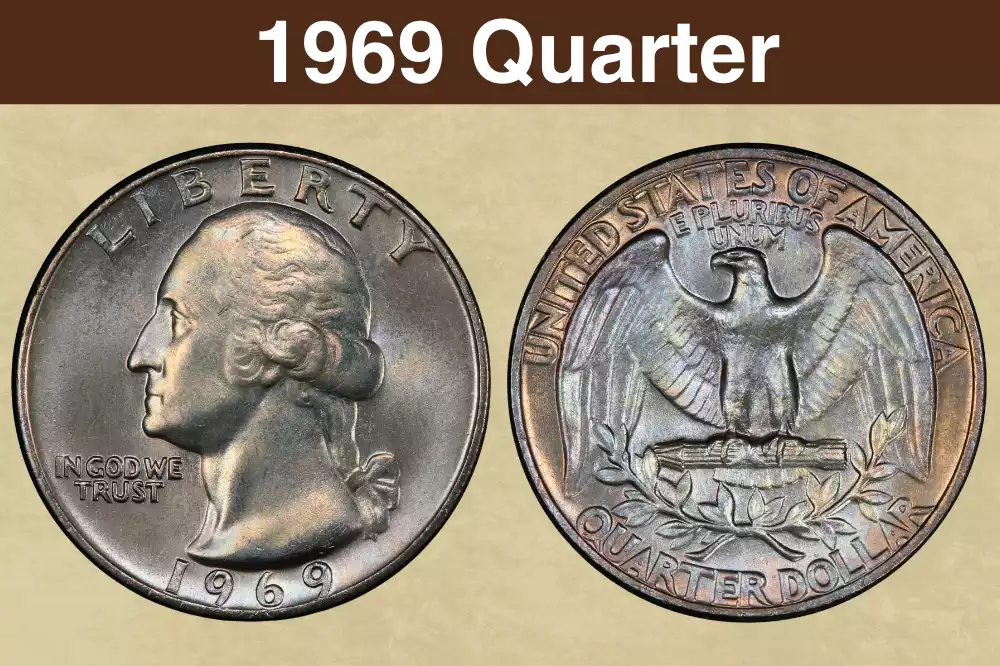
1969 quarter value ranges from $0.25 face value to $3,819. That record was a Grade 68 example sold through Heritage Auctions in November 2013. Upload a photo of yours below and you’ll get a quick value range right away. You can also scroll down to browse recent eBay sales and see what buyers are actually paying right now.
1969 Quarter Value Checker
Identify 1969 Quarter D, S and No Mint Mark Price
Front Obverse
Upload or Take a Photo
Back Reverse
Upload or Take a Photo
1969 Quarter Value By Variety
Here’s what your 1969 quarter could be worth depending on type and condition. If you already know the grade, jump to the **Value Guides** section for exact pricing.
| Type | Good(G4-6) | Fine(F12-15) | AU(AU50-58) | MS(MS60-70) | PR(PR60-70) |
|---|---|---|---|---|---|
| ▶1969 No Mint Mark Quarter Value | $0.25 | $0.25 | $0.60 - $0.90 | $1 - $2,390 | — |
| ▶1969 D Quarter Value | $0.25 | $0.25 | $0.60 - $0.90 | $1 - $1,150 | — |
| ▶1969 S Proof Quarter Value | — | — | — | — | $2 - $13 |
| ▶1969 S CAM Quarter Value | — | — | — | — | $3 - $33 |
| ▶1969 S DCAM Quarter Value | — | — | — | — | $9 - $550 |




Also Read: Top 100 Most Valuable Modern Quarter Worth Money (1932 – Present)
Top 10 Most Valuable 1969 Quarter Worth Money
Most Valuable 1969 Quarter Chart
2003 - Present
The all-time king is a 1969-D graded MS68 by PCGS. It brought $3,819 at Heritage Auctions on November 1, 2013. Denver coins tend to have sharper strikes than Philly issues, so they survive in higher grades more often — but MS68 is still a needle-in-a-haystack grade for any clad quarter.
Right behind it, a 1969 No Mint Mark in PCGS MS67 sold for $3,290 at Heritage Auctions in January 2015. That price tells you just how tough the Philadelphia coin is at the gem level. Error coins show up strong too — a 1969-D/D RPM FS-502 in MS66 brought $2,640 at auction in August 2022. A premium variety plus a solid grade can easily push into four figures.
History of the 1969 Quarter
The Washington Quarter launched in 1932 for George Washington’s 200th birthday. John Flanagan’s winning design drew from a bust sculpted by Jean-Antoine Houdon in 1786.
For the first 33 years, these quarters were 90% silver. That ended when rising silver prices in the early 1960s triggered mass hoarding and a nationwide coin shortage. President Lyndon B. Johnson signed the Coinage Act of 1965 on July 23, 1965, pulling silver out of quarters and dimes for good. The new copper-core, copper-nickel-clad coins picked up the nickname “Johnson sandwiches.”
The Mint also killed mint marks and suspended Proof sets from 1965 through 1967 to discourage hoarding. Collectors got Special Mint Sets instead — satin finish, better than a business strike, but not true Proofs.
Mint marks and Proof sets came back in 1968, one year before our coin. But the 1969 production run inherited serious quality problems from that transition era. Coin World editor Margo Russell noted collectors had “mixed feelings” about the new clad coins, and those concerns were justified. Philadelphia quarters in particular came off worn dies with weak strikes and rough planchets. That’s exactly why a gem 1969-P is so hard to find over 55 years later.
Also Read: Top 30 Most Valuable State Quarter Worth Money (1999 – 2008)
Is Your 1969 Quarter Rare?
1969 No Mint Mark Quarter
1969-D Quarter
1969-S Proof Quarter
1969-S CAM Quarter
1969-S DCAM Quarter
Here’s the counterintuitive part: the Philadelphia coin had the highest mintage of any 1969 quarter, yet it’s the hardest to find in top grades. Terrible strike quality at the Philly mint means almost nothing survived above MS66. Denver coins are far easier to locate in gem condition despite a lower mintage. And the San Francisco Proofs? They were sold directly to collectors, so survival rates are high — but a true DCAM from 1969 is still genuinely scarce because only the first few strikes off a fresh die earned that designation.
You can use our Coin Identifier and Value App to instantly check the rarity and value of any quarter in your collection.
Key Features of the 1969 Quarter
The 1969 quarter carries George Washington on the obverse and a heraldic eagle on the reverse — John Flanagan’s original 1932 design. It’s struck on a copper-nickel clad planchet: pure copper core sandwiched between layers of 75% copper and 25% nickel.
The Obverse of the 1969 Quarter

Washington’s bust faces left in the center. The portrait goes back to Houdon’s 1786 life mask, giving it an authentic, historically grounded look that carried over unchanged from the silver era.
Flanagan’s initials “JF” sit under the neck truncation. LIBERTY arcs above, the date 1969 appears below, and IN GOD WE TRUST runs along the left field. Here’s the detail worth knowing: starting in 1968, the mint mark moved from the reverse to the obverse. Look just behind Washington’s hair ribbon — that’s where you’ll find it on your coin.
The Reverse of the 1969 Quarter

Flip it over and you’ll see a heraldic eagle with outstretched wings. The eagle grips a bundle of arrows, with two olive branches below — the classic war-and-peace symbols.
UNITED STATES OF AMERICA arcs above, QUARTER DOLLAR runs along the lower rim, and E PLURIBUS UNUM sits between the eagle and the country name. Unlike silver-era quarters, there’s no precious metal content to think about here.
Other Features of the 1969 Washington Quarter
This cupronickel-clad coin has a reeded edge with approximately 119 reeds. Diameter is 24.30 mm (0.9567 inches), weight is 5.67 grams (0.200 oz). That silvery look comes from the nickel cladding — the 1969 quarter contains zero silver.
Also Read: Top 20 Most Valuable 1776-1976 Bicentennial Quarter
1969 Quarter Mintage & Survival Data
1969 Quarter Mintage & Survival Chart
Survival Distribution
| Type | Mintage | Survival | Survival Rate |
|---|---|---|---|
| No Mint | 176,212,000 | 44,053,000 | 25% |
| D | 114,372,000 | 28,593,000 | 25% |
| S Proof | 2,934,631 | unknown | unknown |
| S CAM | 2,934,631 | unknown | unknown |
| S DCAM | 2,934,631 | 1,247,218 | 42.5% |
Philadelphia cranked out 176,212,000 quarters in 1969 — the most of any facility that year. Denver added 114,372,000. Both show roughly 25% survival rates, meaning about three out of every four coins are gone — lost to wear, damage, or just plain disappearing into couches and parking lots.
San Francisco struck only Proofs: all 2,934,631 went directly to collectors in annual Proof sets. None hit circulation. That careful handling explains the much higher survival rates, especially for Deep Cameo coins.
The PCGS population data tells the real story at the top end. For the 1969-P, just 11 coins have been graded MS67 with only three finer at MS67+. At MS66, there are 175 certified examples. As dealer Mitch Spivack put it, above MS66 “the pops fall off the charts.”
Also Read: Top 100 Most Valuable Washington Quarter Worth Money (1932 – 1998)
The Easy Way to Know Your 1969 Quarter Value
No silver here, so melt value doesn’t matter. It’s all about condition and variety. Start by checking behind Washington’s hair ribbon for a mint mark: no mark means Philadelphia, D means Denver, S means San Francisco Proof.
Grab a loupe and look at the surfaces. On Philadelphia coins, focus on Washington’s hair detail and the eagle’s breast feathers — those spots show weak strikes and planchet problems first. On Denver coins, check just above and to the left of the D mint mark for signs of repunching (the RPM varieties). Most circulated 1969 quarters are worth face value. The premiums go to uncirculated survivors and certified errors.
Download the Coin Identifier and Value App to photograph your coin and receive an immediate grade determination with up-to-date pricing.

1969 Quarter Value Guides
Five main types of 1969 quarters exist:
- 1969 No Mint Mark — Philadelphia business strike
- 1969-D — Denver business strike
- 1969-S Proof — San Francisco standard proof
- 1969-S CAM — San Francisco proof with cameo contrast
- 1969-S DCAM — San Francisco proof with deep cameo contrast
Quick primer on the grading lingo: MS (Mint State) grades run 60 to 70 for uncirculated business strikes. PR (Proof) grades use the same scale for specially struck coins with mirror-like fields. CAM means Cameo — visible frosting contrast between the design and fields. DCAM means Deep Cameo — the strongest possible frost, and it commands the biggest premium among Proofs.
The circulation strikes (No Mint Mark and D) were made by the hundreds of millions, yet pristine survivors are genuinely scarce thanks to lousy production quality. The San Francisco Proofs were made for collectors, so they survive in much better shape on average.
1969 No Mint Mark Quarter Value

Over 176 million struck, and it’s still the most valuable variety in the entire 1969 series. That surprises a lot of collectors. The problem was Philadelphia’s production quality — it was awful.
Coin Identifier and Value App
Not sure what your coins are worth? Get Instant Value • Grade • Error Detection with coin identifier and value app (FREE Usage Daily)
PCGS CoinFacts ranks the 1969-P among the top three toughest dates in the entire clad series to find in MS67. Spivack has talked about going through thousands upon thousands of these over three decades, including large quantities of fresh US Mint Sets, and the nicest ones typically topped out at MS65. The population data backs him up: only 11 coins have been certified MS67, with just three at MS67+. If you find one raw that looks clean and sharp, you might be sitting on a serious coin.
1969 No Mint Mark Quarter Price/Grade Chart
Price by 1-70 Grade (Latest Auction Records Included)
Here’s how those grades have translated to real auction prices.
| Date | Platform | Price | Grade |
|---|---|---|---|
| 07/21 | HA | $71 | 66 |
| 06/21 | HA | $70 | 66 |
| 10/20 | HA | $79 | 66 |
| 05/20 | HA | $79 | 66 |
| 08/19 | HA | $528 | 66 |
| 06/19 | HA | $1,920 | 67 |
| 04/18 | HA | $168 | 66 |
| 02/17 | HA | $588 | 67 |
| 01/15 | HA | $3,290 | 67 |
| 10/14 | GC | $66 | 66 |
Recent market activity also shows strong collector interest in this variety.
Market activity: 1969 No Mint Mark Quarter
Market activity score: 50/100 as of Oct 2026 — unchanged since Jul 2026. 12-month peak: 53 (Sep 2026).
1969-D Quarter Value

Did you know the Denver coin holds the all-time auction record for any 1969 quarter? A PCGS MS68 brought $3,819 at Heritage Auctions on November 1, 2013. PCGS calls the 1969-D “one of the better struck coins in the series,” with MS67 examples plentiful enough that you can actually be picky — a huge contrast to the Philadelphia nightmare.
MS68 is a different story. Even with Denver’s better strike quality, that grade gets scarce fast. The 1969-D also ranks 133rd in rarity among all Washington quarters from 1932 to 1998, giving it semi-key date status. I think it’s one of the better values in the clad series for registry set builders.
1969-D Quarter Price/Grade Chart
Price by 1-70 Grade (Latest Auction Records Included)
Here’s how prices have played out at auction.
| Date | Platform | Price | Grade |
|---|---|---|---|
| 04/25 | SB | $840 | 58 |
| 01/24 | HA | $930 | 68 |
| 03/22 | HA | $810 | 68 |
| 12/21 | HA | $930 | 68 |
| 11/21 | HA | $66 | 67 |
| 07/20 | SB | $40 | 66 |
| 05/20 | DL | $45 | 66 |
| 03/20 | DL | $70 | 67 |
| 06/19 | HA | $1,920 | 68 |
| 08/18 | HA | $57 | 67 |
Current market activity reflects collector interest in this variety over time.
Market activity: 1969-D Quarter
Market activity score: 56/100 as of Oct 2026 — up 6 points from Jul 2026. Currently at its 12-month peak.
1969-S Proof Quarter Value

If you’ve got a 1969 quarter with an “S” mint mark, it’s a Proof. Period. San Francisco struck 2,934,631 quarters that year, and every single one was a Proof sold in annual sets. No business strikes exist with an S mint mark for 1969.
A Proof coin gets struck on a polished planchet with specially prepared dies, giving you mirror-like fields and razor-sharp detail. The base 1969-S Proof — without a Cameo or Deep Cameo call — may show some frosting on the devices, but not enough contrast to earn the upgrade. At around $6 for a basic specimen, it’s one of the cheapest ways to start collecting 1969 quarters.
1969-S Proof Quarter Price/Grade Chart
Price by 1-70 Grade (Latest Auction Records Included)
Auction results show where the market sits on these base Proofs.
| Date | Platform | Price | Grade |
|---|---|---|---|
| 08/24 | HA | $660 | 62 |
| 12/14 | GC | $18 | 69 |
| 11/14 | GC | $7 | 66 |
| 09/14 | GC | $30 | 69 |
| 08/14 | GC | $30 | 69 |
| 07/14 | GC | $10 | 69 |
| 04/14 | GC | $7 | 67 |
| 02/14 | GC | $9 | 67 |
| 02/14 | GC | $8 | 67 |
| 02/14 | GC | $12 | 68 |
Collector activity demonstrates the ongoing interest in this accessible proof variety.
Market activity: 1969-S Proof Quarter
Market activity score: 53/100 as of Oct 2026 — up 3 points from Jul 2026. 12-month peak: 56 (Aug 2026).
1969-S CAM Quarter Value

A lot of collectors confuse CAM and DCAM. Here’s the simple version: Cameo (CAM) means you can see white frosting on Washington’s portrait and the reverse eagle against the mirrored fields, but it’s not the heaviest frost possible. Fresh dies produce the strongest contrast, and that frost wears down with every strike. So early strikes earn CAM or DCAM, while later strikes from the same die don’t.
That makes true CAM examples less common than base Proofs. You’ll pay a modest premium for the visual pop, but it’s still well below DCAM pricing. Think of CAM as the middle tier — nicer than a standard Proof, not quite top shelf.
1969-S CAM Quarter Price/Grade Chart
Price by 1-70 Grade (Latest Auction Records Included)
Here’s what CAM examples have brought at auction.
| Date | Platform | Price | Grade |
|---|---|---|---|
| 04/19 | HA | $67 | 69 |
| 04/17 | HA | $35 | 68 |
| 11/16 | DL | $25 | 66 |
| 12/14 | GC | $25 | 69 |
| 11/14 | GC | $7 | 67 |
| 11/14 | GC | $8 | 67 |
| 11/14 | GC | $9 | 67 |
| 11/14 | GC | $6 | 68 |
| 10/14 | GC | $10 | 68 |
| 07/14 | GC | $35 | 68 |
Market activity reflects the appeal of this visually striking proof format.
Market activity: 1969-S CAM Quarter
Market activity score: 53/100 as of Oct 2026 — up 16 points from Jul 2026. Currently at its 12-month peak.
1969-S DCAM Quarter Value

These are the showstoppers. DCAM — Deep Cameo (NGC calls it Ultra Cameo) — means heavy, unbroken frost on the devices against deeply mirrored fields. The coin looks almost three-dimensional. Only the very first strikes from the freshest, most carefully prepared dies achieve this level of contrast.
With 2,934,631 Proofs minted and an estimated 42.5% survival rate, the base supply is reasonable. But top-grade DCAM examples are a completely different kind of rare. The auction record stands at $1,410 for a PCGS PR69, sold at Heritage Auctions in July 2013. At $61 for a standard PR example, DCAM commands the highest premium among all 1969 Proof varieties. We think these are underappreciated relative to their eye appeal.
1969-S DCAM Quarter Price/Grade Chart
Price by 1-70 Grade (Latest Auction Records Included)
Here’s what DCAM coins have sold for recently.
| Date | Platform | Price | Grade |
|---|---|---|---|
| 04/23 | DL | $900 | 69 |
| 04/23 | SB | $120 | 69 |
| 10/21 | DL | $34 | 68 |
| 10/20 | HA | $252 | 69 |
| 08/20 | HA | $228 | 69 |
| 07/20 | HA | $228 | 69 |
| 08/19 | HA | $240 | 69 |
| 08/19 | DL | $325 | 69 |
| 03/18 | HA | $780 | 69 |
| 04/17 | HA | $317 | 69 |
Trading activity shows collector demand for these visually stunning examples.
Market activity: 1969-S DCAM Quarter
Market activity score: 43/100 as of Oct 2026 — up 6 points from Jul 2026. 12-month peak: 44 (Jun 2026).
Also Read: What Quarters Are Worth Money
Rare 1969 Quarter Error List
The 1969 production year was a mess — worn dies, rushed planchets, spotty quality control. That’s bad for collectors wanting nice coins, but great for error hunters. Here are the known significant errors, including a few you won’t find in most basic guides.
1. 1969-D/D RPM (FS-501 And FS-502)

A Repunched Mint Mark (RPM) happens when the mint mark punch hit the working die more than once in slightly different positions. You get a doubled or shadowed D that’s visible under a loupe. Both FS-501 and FS-502 are catalogued separately in the Cherrypickers’ Guide to Rare Die Varieties.
The FS-502 is the one cherrypickers really want. It brought $2,640 in MS66 at auction in August 2022 — one of the top prices for any 1969 quarter error. Grab a 5x loupe and check every 1969-D you come across. The payoff can be real.
1969-D/D RPM Quarter Price/Grade Chart
Price by 1-70 Grade (Latest Auction Records Included)
2. 1969-S RPM FS-501

An RPM on a Proof coin is a fun find. The repunched “S” shows a distinct shadow or outline around the primary mint mark. Because Proof dies get extra preparation, the doubling shows up more crisply against those mirror-like fields than it would on a business strike.
This variety brought $195 in PR68 at auction in February 2019. Not a fortune, but a certified high-grade Proof with a visible variety makes a nice addition to any 1969 set.
1969-S RPM FS-501 Quarter Price/Grade Chart
Price by 1-70 Grade (Latest Auction Records Included)
3. 1969-S DDO FS-101

The Doubled Die Obverse (DDO) error comes from the hub-to-die transfer process — the die got a slightly shifted second impression. On the 1969-S DDO FS-101, look for doubling in “LIBERTY,” the date “1969,” and “IN GOD WE TRUST.”
Coin Identifier and Value App
Not sure what your coins are worth? Get Instant Value • Grade • Error Detection with coin identifier and value app (FREE Usage Daily)
A Proof coin with a major die error is two kinds of rare at once. This one brought $316 in PR66 at Heritage Auctions in April 2020. One important tip: don’t confuse true hub doubling with machine doubling, which creates a flat, shelf-like effect. Always get DDO claims authenticated by PCGS or NGC before you buy.
1969-S DDO FS-101 Quarter Price/Grade Chart
Price by 1-70 Grade (Latest Auction Records Included)
4. 1969 Quarter Struck on a Penny Planchet (Wrong Planchet Error)
This is one of the wildest errors from 1969. A quarter die struck a Lincoln cent planchet that got fed into the wrong press. You can spot it immediately — it’s copper-colored, weighs only 3.11 grams (versus the normal 5.67 grams), and measures just 19 mm across. Way smaller than a standard quarter.
Examples have sold for $805 (brown copper) to $1,483 (red copper) at auction. The Denver Mint produced notable examples — one on a penny planchet, another on a nickel planchet.
5. 1969 Quarter Struck on a Nickel Planchet
This one’s trickier to spot than the penny planchet error because both coins look silver-colored. Your clues are weight and size. A nickel planchet gives you a coin weighing about 4.9 grams instead of 5.67 grams, with a diameter of approximately 21.21 mm instead of 24.30 mm.
You need precise measurements and expert authentication to confirm wrong planchet errors. Nickel planchet strikes have brought prices similar to the penny planchet versions — roughly $700–$1,200 at auction.
6. 1969 Quarter Mated Pair Error
Two planchets enter the press at the same time and get struck together, fusing into a single two-coin unit. You can’t separate them without wrecking both coins. It’s one of the most dramatic mint errors you’ll ever see.
The 1969 Proof series produced at least one confirmed mated pair that brought $2,760 at auction — among the highest prices for any 1969 error. Extremely rare. Get it slabbed by PCGS or NGC before buying or selling.
Also Read: 20 Rare Washington Quarter Errors Worth Money (Full List with Pictures)
Where to Sell Your 1969 Quarter?
Now that you know the value of your 1969 quarters, do you know where to sell them for maximum profit? Don’t worry, I’ve compiled a guide covering the best platforms, timing strategies, and authentication requirements to help you get top dollar for your coins.
Check out now: Best Places To Sell Coins Online (Pros & Cons)
1969 Quarter Market Trend
Market Interest Trend Chart - 1969 Quarter
Market interest: 18,190 collectors tracking this coin as of Oct 2026 — up 1,000 from Mar 2026. 12-month peak: 19,710 (Dec 2025).
*Market Trend Chart showing the number of people paying attention to this coin.
FAQ about the 1969 Quarter Value
1. What makes a 1969 quarter rare?
It’s a condition rarity. With 176 million struck at Philadelphia, the mintage is huge. But worn dies, bad planchets, and weak strikes meant almost nothing left the Mint in great shape. PCGS shows only 11 coins graded MS67 and just three at MS67+. Finding a true gem is incredibly tough.
2. Which 1969 quarters are worth the most money?
- 1969-D quarter in MS68 — sold for $3,819 at Heritage Auctions, November 2013
- 1969 No Mint Mark quarter in MS67 — sold for $3,290 at Heritage Auctions, January 2015
- 1969-D/D RPM FS-502 in MS66 — sold for $2,640 at auction, August 2022
- 1969 Proof Mated Pair error — sold for $2,760 at auction
- 1969-S DCAM in PR69 — sold for $1,410 at Heritage Auctions, July 2013
- 1969 quarter struck on penny planchet (red copper) — sold for $1,483 at auction
- 1969-S Proof in PR66 — sold for $504, January 2022
- 1969-S DDO in PR66 — sold for $316 at Heritage Auctions, April 2020
- 1969-S RPM in PR68 — sold for $195, February 2019
- 1969-S CAM in PR66 — sold for $127, September 2003
3. How much is a 1969 No Mint Mark quarter worth?
Circulated examples? Face value — $0.25. Uncirculated coins start around $1 in MS60 and climb to about $11 at MS65. Hit MS67 and you’re looking at $745 or more. The all-time record is $3,290 for a PCGS MS67 sold at Heritage Auctions in January 2015.
4. Does the 1969 quarter contain silver?
No. Every 1969 quarter — Philadelphia, Denver, and San Francisco — is copper-nickel clad with zero silver. The Coinage Act of 1965, signed by President Lyndon B. Johnson on July 23, 1965, permanently removed silver from quarters and dimes. Melt value is roughly $0.06. Silver was last used in circulating quarters dated 1964 or earlier.
5. How do I find the mint mark on a 1969 quarter?
Look on the obverse, just behind and above Washington’s hair ribbon — that small tied bow at the back of his neck. Starting in 1968, the Mint moved all mint marks to this spot from the reverse. You’ll see D (Denver), S (San Francisco Proof), or nothing (Philadelphia). No Philadelphia quarters from 1965 through 1979 carry a P mint mark; the P wasn’t added until 1980.
6. What is the difference between a 1969-S CAM and DCAM quarter?
Both are San Francisco Proofs. The difference is frost intensity. CAM (Cameo) shows noticeable but moderate frosting contrast between the devices and mirror fields. DCAM (Deep Cameo, called Ultra Cameo by NGC) has the heaviest possible frost — the devices look almost white against glass-like fields. Only the earliest strikes from freshly prepared dies earn DCAM status. A typical DCAM is worth roughly 7× what a base Proof sells for.
7. What are the known 1969 quarter error types?
Confirmed errors include: Repunched Mint Mark (RPM) on Denver (FS-501 and FS-502) and San Francisco (FS-501) dies; Doubled Die Obverse (DDO FS-101) on the San Francisco Proof; wrong planchet strikes on penny planchets and nickel planchets; mated pair errors; off-center strikes; and struck fragment errors. Wrong planchet and mated pair examples are the rarest and most valuable.
8. Is it worth getting a 1969 quarter professionally graded?
Only if you’ve got something special. For a typical circulated coin worth $0.25, the $17–$20 grading fee makes no sense. But if you have an uncirculated example that looks MS65 or better, or a clear error variety like an RPM or DDO, professional grading through PCGS or NGC protects your investment and usually adds significant value at resale.
9. What is the 1969-D quarter’s population at PCGS in high grades?
PCGS CoinFacts calls the 1969-D “one of the better struck coins in the series,” with MS67 examples described as abundant — at least by clad gem standards. MS68 examples “begin to be much harder to find,” though several are known. Denver’s better average strike quality means more coins survive the cut for top grades, making the 1969-D a more realistic registry set target than the 1969-P.
10. What are the most valuable quarters of all time for comparison?
- 1932-D quarter in MS66 — $143,750 at the Chicago Rarities Sale, April 2008
- 1932-S quarter in MS66 — $45,500 at DLRC Internet Auction, March 2020
- 1949-D quarter in MS68 — $43,475 at Legend Rare Coin Auctions, June 2019
- 1948 quarter in MS68 — $43,200 at Stack’s Bowers, March 2021
- 1932 quarter (Philadelphia) in MS67 — $40,250 at Heritage Auctions, April 2012
- 1964-D quarter in MS68 — $38,400 at Stack’s Bowers, March 2021
- 1947 quarter in MS68 — $32,400 at Stack’s Bowers, March 2021