1967 Quarter Value (2026 Guide): Errors List & No Mint Mark Worth

1967 Quarter Value

The 1967 Washington Quarter looks like ordinary pocket change, but some examples have sold for over $8,000 at major auction houses. The trick is knowing which variety you have and what condition it’s in.

This coin is special for one big reason: it was produced during the most dramatic monetary crisis in modern American history, and the U.S. Mint made decisions during 1965–1967 that they’ve never repeated since. Read on to learn exactly what makes your 1967 quarter tick — and whether it’s worth more than its face value.


1967 Quarter Value By Variety

The value of your 1967 quarter varies dramatically by type, with regular business strikes worth face value in circulated condition while SMS Special Strike varieties can reach hundreds of dollars in top grades.

If you know the grade of your coin, you can find the exact price below in the Value Guides section.

1967 Quarter Value Chart

TYPEGOODFINEAUMSPR
1967 No Mint Mark Quarter Value$0.25$0.29$0.67$19.71—
Updated: 2026-04-10 02:31:28

Also Read: Top 100 Most Valuable Modern Quarter Worth Money (1932 – Present)


Top 10 Most Valuable 1967 Quarter Worth Money

Most Valuable 1967 Quarter Chart

2002 - Present

Looking at the most valuable 1967 quarters sold since 2002, the results reveal how dramatically condition can impact value for this transitional year.

The top performer among business strikes is a 1967 quarter graded PCGS MS-68, which sold for $8,812.50 at Heritage Auctions on January 5, 2017 (lot #4802). That same coin later sold at Heritage in June 2019 for $5,040, and again in January 2020 for $4,800 — illustrating how dramatically prices can shift even for the same certified coin over time.

For SMS coins, the biggest recent result came from an NGC MS-69 example (the sole finest certified at that level) which hammered for $8,156.25 at GreatCollections on August 11, 2024 — a stunning result that briefly surpassed the old business-strike record. As of May 2025, the top PCGS population for the regular business strike sits at MS-68 with just 3 certified examples, while NGC has certified a single coin at the extraordinary grade of MS-69.

These auction records prove the classic numismatic principle that exceptional preservation creates exceptional value, regardless of how many coins were originally struck.


1967 Quarter Value and History

The 1967 Washington Quarter is a product of one of the most turbulent periods in American monetary history. The Washington quarter series had been running since 1932, when it was introduced to mark the 200th anniversary of George Washington’s birth with sculptor John Flanagan’s iconic design.

By the early 1960s, a perfect storm was brewing. Rising silver prices made the metal in silver quarters worth more than 25 cents, triggering massive hoarding. Congress responded by passing the Coinage Act of 1965, signed into law by President Lyndon Johnson in July 1965, which eliminated silver from dimes and quarters entirely and reduced the silver content of half dollars from 90% to 40%.

Starting in 1965, quarters were struck using a new copper-nickel clad sandwich: a pure copper core covered by an outer layer of 75% copper and 25% nickel. To further discourage hoarding by collectors, the Coinage Act also banned the use of mint marks on all U.S. coins — a prohibition that remained in effect through 1967. This is why 1967 quarters carry no “D,” “S,” or “P” — they are intentionally unidentifiable by mint of origin.

Here is a fact most collectors miss: the 1967 total mintage of 1,524,031,848 coins was actually the combined output of all three mints. According to CoinWeek’s detailed analysis, Philadelphia struck 873,524,000, Denver contributed 632,767,848, and San Francisco added 17,740,000 — but because none carry a mint mark, grading services have never been able to certify which mint struck any particular coin.

Another important note: the U.S. Mint did not produce regular Uncirculated Coin Sets in 1967 (those had stopped in 1964 and didn’t resume until 1968). Instead, they produced Special Mint Sets (SMS) as a collector substitute. A total of 1,863,344 SMS sets were struck in 1967, each containing one coin of each denomination with a distinctive satin-like finish superior to business strikes. Congress repealed the mint mark ban in 1967, and marks officially returned to all coins in 1968 — moving from the reverse to the obverse for the first time.

Also Read: Top 30 Most Valuable State Quarter Worth Money (1999 – 2008)


Is Your 1967 Quarter Rare?

10

1967 No Mint Mark Quarter

Common
Ranked 351 in Washington Quarter

For quick verification of rarity levels on any quarter you’re considering, our CoinValueChecker App provides instant assessments.


Key Features of the 1967 Quarter

We’ll now look at the features of the 1967 quarter and what makes this a standout coin.

The Obverse of the 1967 Quarter
The Obverse of the 1967 Quarter

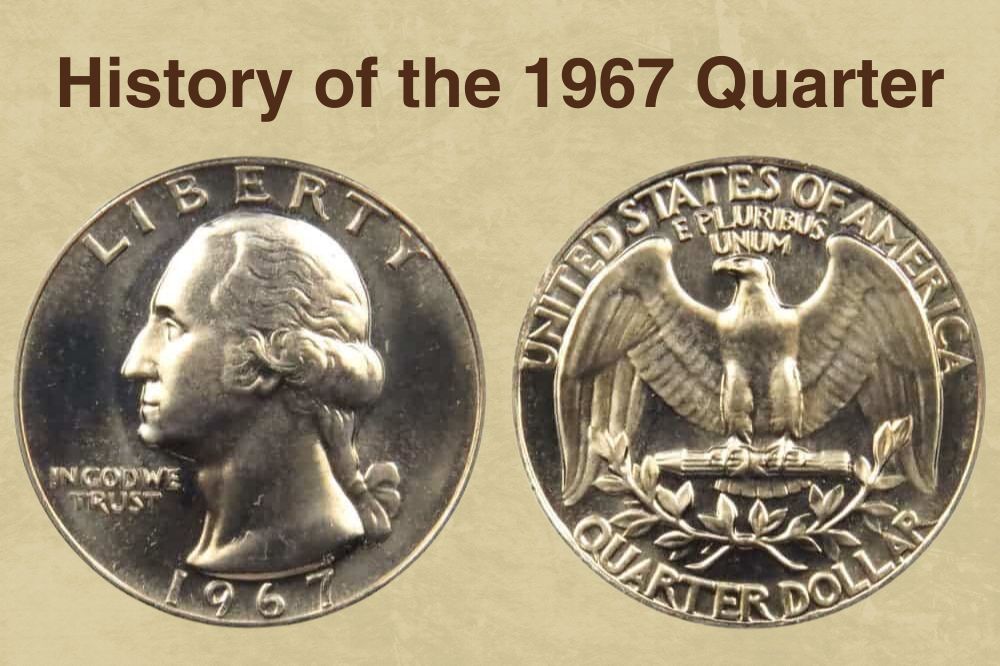
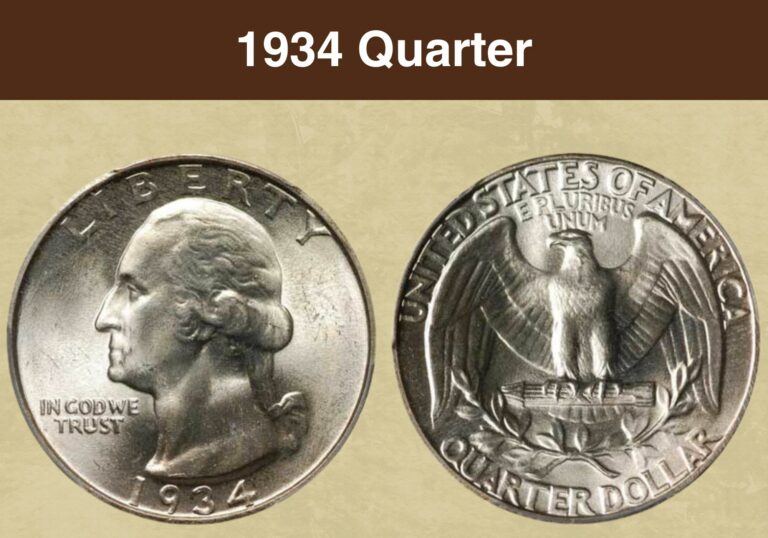
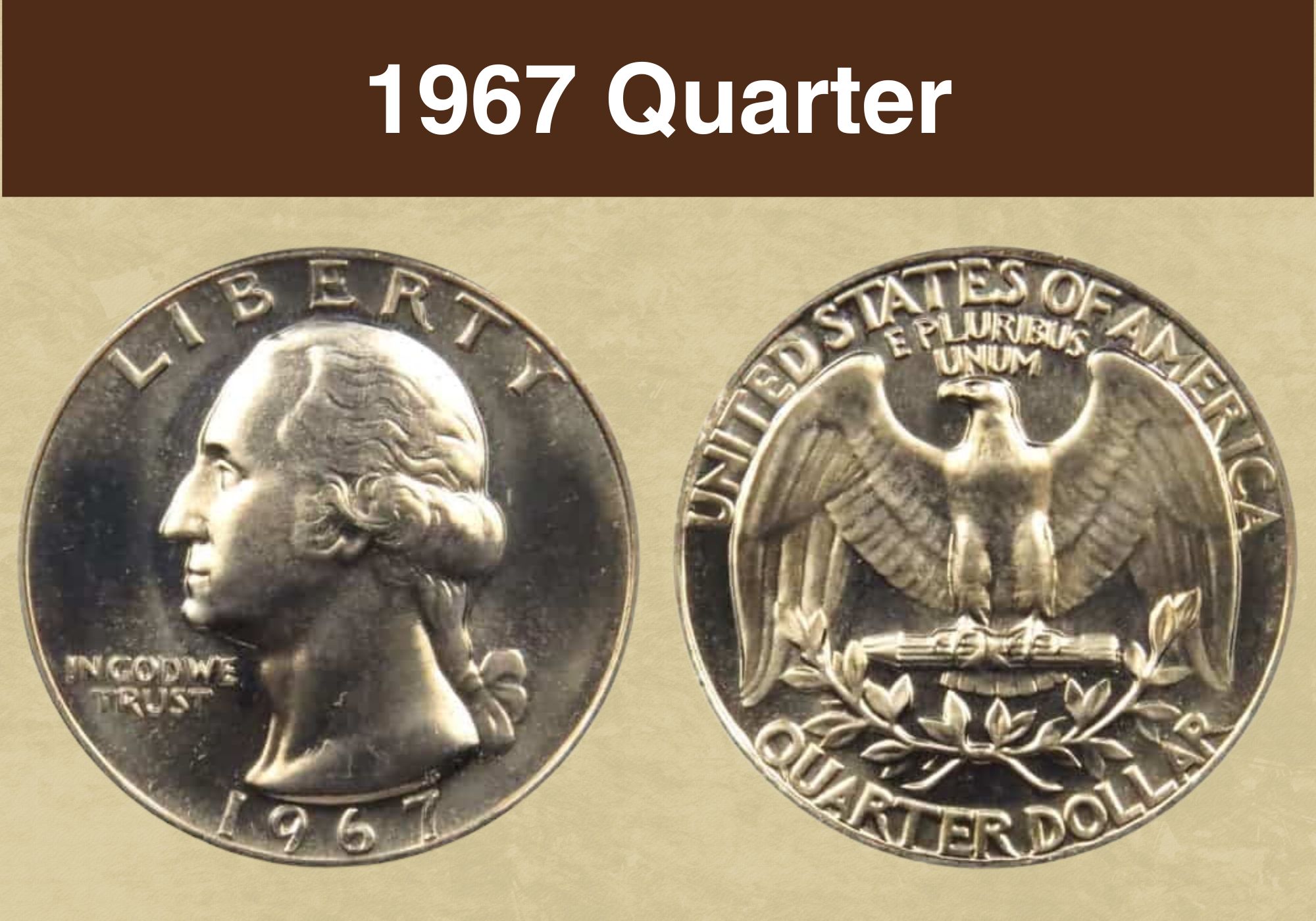
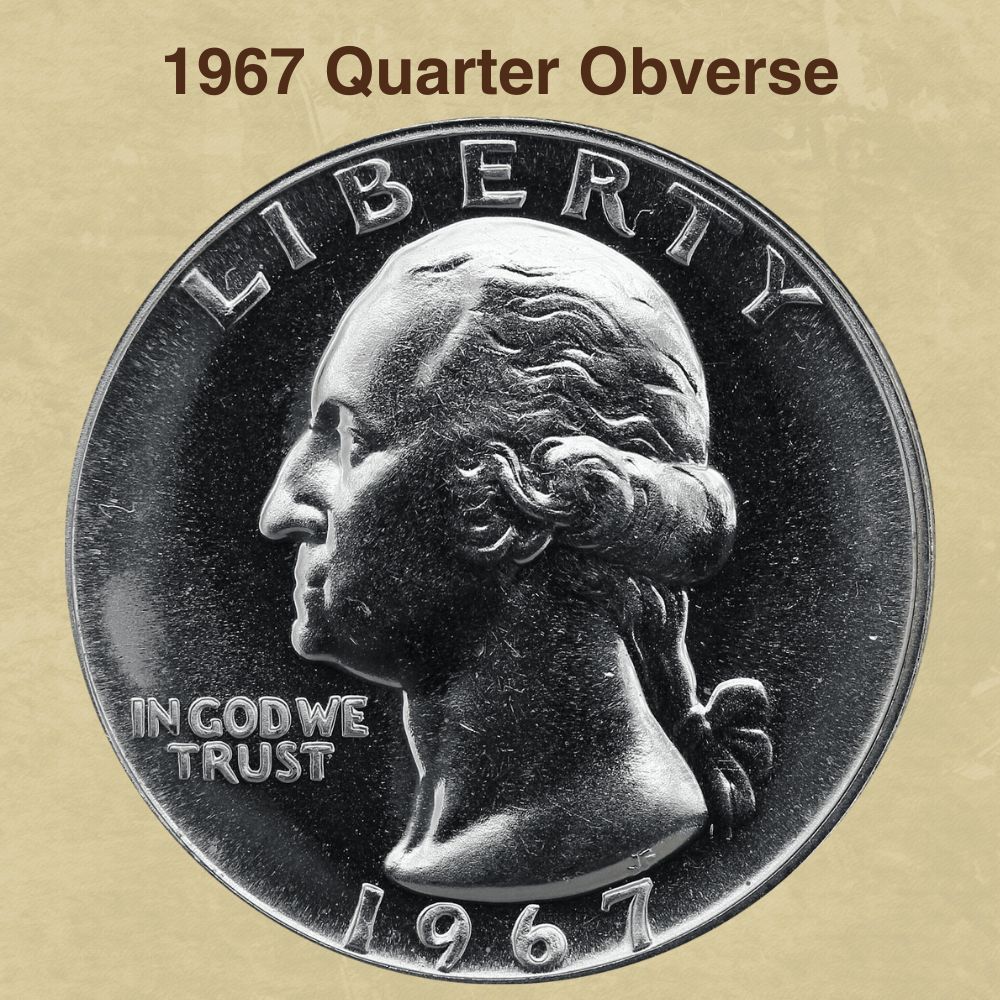
The obverse features a left-facing portrait of President Washington, based on a bust created by French sculptor Jean-Antoine Houdon in 1785 and modeled into coin form by John Flanagan. Washington’s hair is held back in a low ponytail adorned with a small ribbon, and Flanagan’s initials “JF” appear at the base of the neck truncation.

The word LIBERTY arcs around the top rim, and the date 1967 appears at the bottom. To the left of the portrait, you will find the nation’s motto IN GOD WE TRUST. There is no mint mark anywhere on this coin — that is normal for all 1967 quarters and is not an error.

The Reverse of the 1967 Quarter

The Reverse of the 1967 Quarter

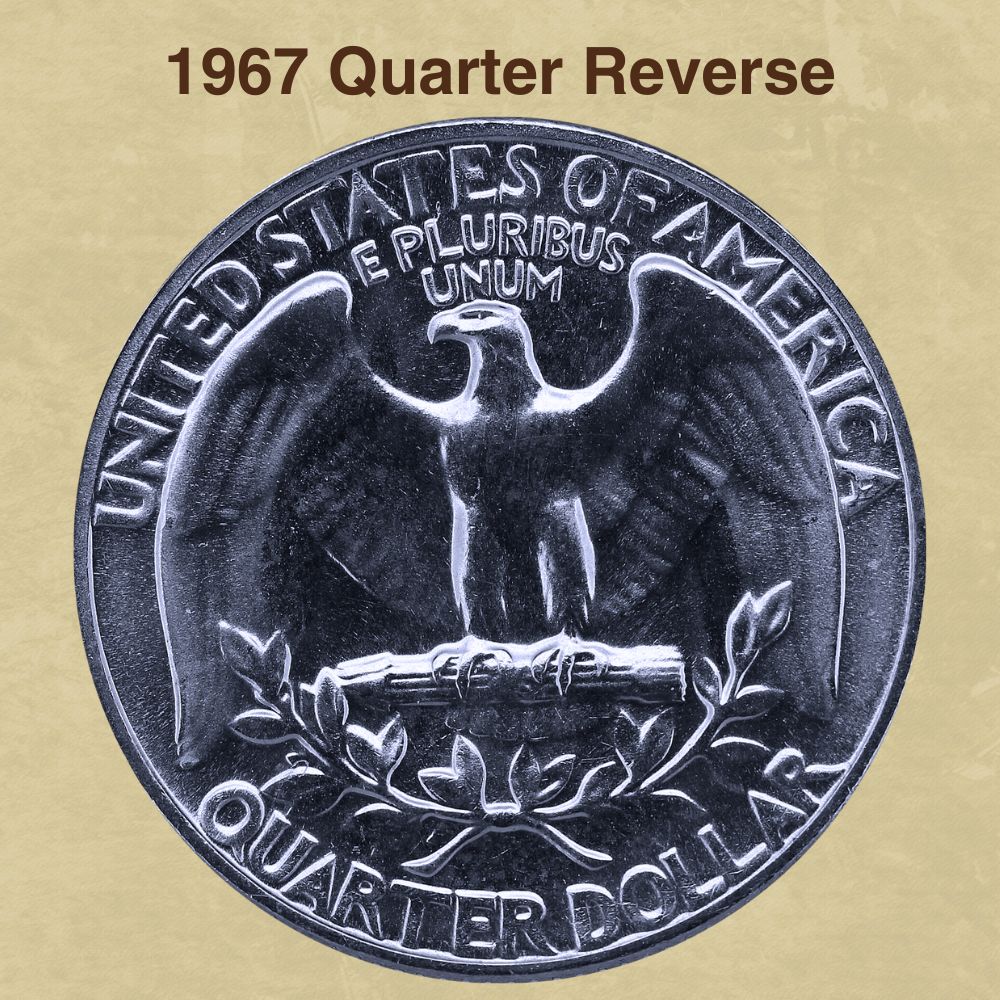
The reverse displays the American eagle with wings spread wide, gripping a bundle of arrows in its talons — representing military readiness — alongside an olive branch representing peace. The words UNITED STATES OF AMERICA appear around the top rim, followed by the motto E PLURIBUS UNUM (Latin for “out of many, one”).

The denomination QUARTER DOLLAR appears around the bottom rim. On Washington quarters before 1968, the mint mark would normally appear here on the reverse just above the motto; the absence of any such mark in 1965–1967 is entirely intentional.

Other Features of the 1967 Quarter

The 1967 quarter has a copper-nickel clad composition with a pure copper core covered by an outer layer of 75% copper and 25% nickel. It weighs 5.67 grams and measures 24.30 millimetres in diameter with a reeded (ridged) edge.

One quick way to check if you have a 1967 quarter vs. an older silver coin: weigh it. An old 90% silver quarter weighs 6.25 grams, while a 1967 clad quarter weighs 5.67 grams. If you find a coin dated 1967 that weighs 6.25 grams, that could be a silver planchet error — an extremely rare and valuable find (see errors section below).

Also Read: Top 20 Most Valuable 1776-1976 Bicentennial Quarter


1967 Quarter Value — Mintage & Survival Data

1967 Quarter Mintage & Survival Chart

Mintage Comparison

Survival Distribution

TypeMintageSurvivalSurvival Rate
No Mint1,524,031,848381,007,96225%
SMS SP1,800,000unknownunknown

A review of the mintage and surviving numbers for the 1967 quarter reveals the massive scale of coinage produced during this transitional year. All three mints combined to produce 1,524,031,848 circulation quarters — a number that was actually exceeded in 1965 (over 1.8 billion) but still dwarfs every year from the silver era.

Despite this massive mintage, only about 25% of the original coins remain, meaning that roughly three-quarters of all 1967 quarters have been lost, damaged, or destroyed over the decades. The U.S. Mint did not produce regular Mint Sets or Proof Sets in 1967, so there was no official mechanism for preserving high-quality specimens the way collectors could in other years.

SMS Special Mint Set data shows “Unknown” for both mintage and surviving numbers, reflecting the unique nature of these collector coins. What we do know is that 1,863,344 complete SMS sets were produced in 1967, each containing one quarter — giving at least that many SMS quarters as a starting point, though the exact survival figure among those remains undocumented.

Also Read: Top 100 Most Valuable Washington Quarter Worth Money (1932 – 1998)


The Easy Way to Know Your 1967 Quarter Value

Determining your 1967 quarter’s value doesn’t have to be complicated. Start by examining the coin’s condition — look for wear on Washington’s hair details and the eagle’s feathers, which are the highest points and show wear first.

Check whether your coin is a regular business strike or an SMS. An SMS coin will have a sharper, more detailed strike and a distinctive satin-like surface that looks different from a coin pulled out of circulation. Compare your coin against grading standards from Poor to Mint State (MS). While circulated 1967 quarters are typically worth face value to a few dollars, uncirculated specimens can fetch $20–$50 or more, and the finest examples can command thousands.

For an instant, accurate assessment of your coin’s grade and current market value, simply use our CoinValueChecker App to check the grade directly.

CoinValueChecker APP
CoinValueChecker APP Screenshot


CoinVaueChecker App 10

1967 Quarter Value Guides

Looking at the 1967 quarter varieties, collectors need to understand that this transitional year produced both regular business strikes and special collector coins with distinct characteristics and values.

The four main categories represent different production methods, with the SMS (Special Mint Set) varieties offering unique surface qualities that set them apart from standard strikes. Understanding these distinctions is essential for proper identification and valuation.

Here’s the complete breakdown of 1967 quarter varieties:

  • 1967 No Mint Mark Quarter — Regular business strike from Philadelphia mint with standard production finish
  • 1967 SMS Special Strike Quarter — Special Mint Set coin with enhanced surface quality and satin-like finish
  • 1967 SMS Special Strike CAM Quarter — Cameo (CAM) SMS variety featuring frosted devices against mirrored fields
  • 1967 SMS Special Strike DCAM Quarter — Deep Cameo (DCAM) SMS with the strongest contrast between heavily frosted devices and brilliant mirror backgrounds


1967 No Mint Mark Quarter Value

1967 No Mint Mark Quarter Value

The 1967 No Mint Mark quarter is the standard business strike — a coin designed for everyday spending, produced in over 1.5 billion copies. In circulated condition, it’s worth face value since it contains no precious metal. The numismatic value kicks in only at Mint State (MS) grades — meaning coins that were never put into circulation and show no wear.

One important fact from PCGS CoinFacts: the Mint did not produce Uncirculated Coin Sets in 1967, creating a historical gap that makes truly high-grade business strikes harder to find than you’d expect. Even coins cherry-picked by experienced submitters typically grade MS-65 or MS-66 at PCGS. MS-68 is the current top certified grade for business strikes, with only 3 examples certified at that level by PCGS as of May 2025. An NGC MS-69 coin exists, but it’s actually an SMS piece, not a business strike.

1967 No Mint Mark Quarter Price/Grade Chart

Price by 1-70 Grade (Latest Auction Records Included)

Updated: 2026-04-10 02:31:28

Recent auction performance shows how condition dramatically affects value for this common-date quarter.

Date ↓PlatformPrice ⇅Grade ⇅

Current market activity demonstrates steady collector interest with notable seasonal fluctuations in trading patterns.

Market activity: 1967 No Mint Mark Quarter


1967 SMS Special Strike Quarter Value

1967 SMS Special Strike Quarter Value

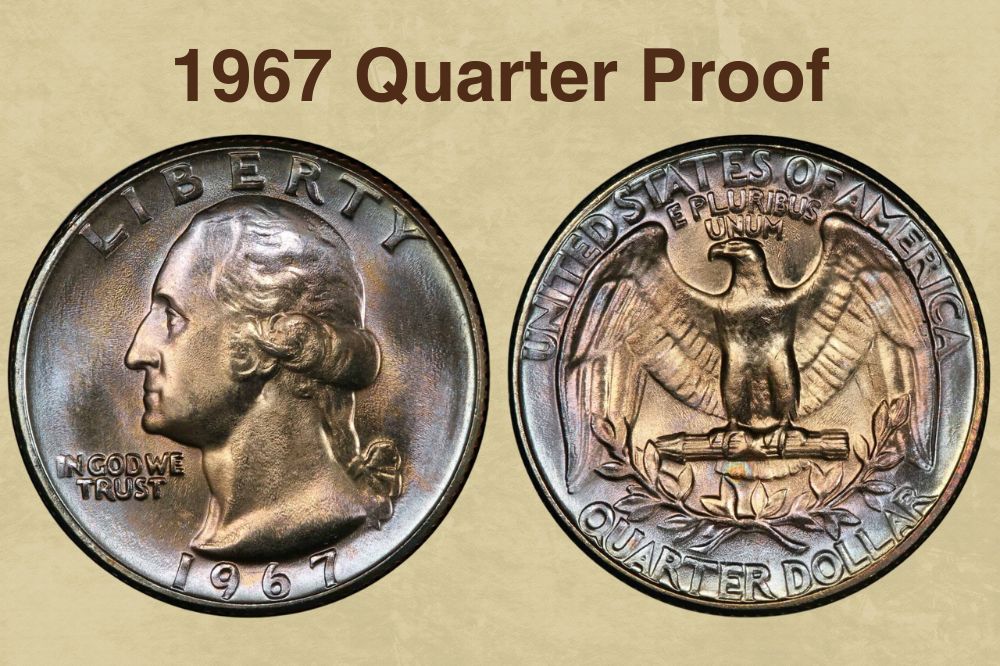
The 1967 SMS (Special Mint Set) Special Strike quarter is a completely different animal from the business strike. These coins were produced at the San Francisco Mint with enhanced production techniques — sharper strikes, cleaner planchets, and a distinctive satin-like surface finish that falls visually between a normal circulation strike and a full mirror-proof.

SMS coins were only sold to collectors in complete sets and never entered circulation. The “SP” or “MS” prefix on a certified SMS coin from PCGS or NGC (PCGS uses “SP” for Specimen; NGC uses “MS”) tells you this is a collector-grade piece. Grades of SP-67 and above are noticeably scarcer, with over 3,700 graded coins on NGC and over 2,000 on PCGS across all grades — but only a handful reach the top tiers.

1967 SMS Special Strike Quarter Price/Grade Chart

Price by 1-70 Grade (Latest Auction Records Included)

Updated: 2026-04-10 02:31:28

Auction records demonstrate how the SMS designation consistently commands premiums over regular business strikes of the same grade.

Date ↓PlatformPrice ⇅Grade ⇅


1967 SMS Special Strike CAM Quarter Value

1967 SMS Special Strike CAM Quarter Value

The 1967 SMS Special Strike CAM (Cameo) quarter adds a layer of visual drama to the already premium SMS designation. CAM stands for Cameo — a grading term used by PCGS and NGC to describe coins where the raised design elements (like Washington’s portrait) appear frosted or matte while the background fields are reflective and mirror-like. This contrast effect is the same visual quality seen on proof coins.

Not every SMS quarter earns the CAM designation — only those with sufficient contrast between the frosted devices and the reflective fields qualify. CAM SMS coins are scarcer than standard SMS examples and command a significant price premium. Online sales for SP-67 CAM coins start around $400, compared to $26 or so for a regular SP-67 SMS quarter.

1967 SMS Special Strike CAM Quarter Price/Grade Chart

Price by 1-70 Grade (Latest Auction Records Included)

Updated: 2026-04-10 02:31:28

Auction performance reveals how the CAM designation consistently commands substantial premiums over standard SMS examples.

Date ↓PlatformPrice ⇅Grade ⇅


1967 SMS Special Strike DCAM Quarter Value

1967 SMS Special Strike DCAM Quarter Value

The 1967 SMS Special Strike DCAM (Deep Cameo) quarter represents the absolute pinnacle of the 1967 quarter series. DCAM — short for Deep Cameo — describes coins with the most dramatic possible contrast: heavily frosted, almost white devices set against brilliantly reflective, mirror-like fields. NGC calls this designation “Ultra Cameo” on their holders.

Only SMS quarters with exceptional contrast quality earn the DCAM designation, making them the scarcest variety within the 1967 quarter series. According to research by The Coin Vault (which ranked 1965–1967 SMS Ultra Cameo coins in the book 100 Greatest U.S. Modern Coins), only a few dozen ultra cameo examples are known for each denomination including the quarter from these three years combined. The dramatic visual impact of the frosted portrait against the mirror fields makes these coins immediately recognizable as extraordinary pieces.

1967 SMS Special Strike DCAM Quarter Price/Grade Chart

Price by 1-70 Grade (Latest Auction Records Included)

Updated: 2026-04-10 02:31:28

Auction records showcase how the DCAM designation commands the highest premiums within the 1967 quarter market.

Date ↓PlatformPrice ⇅Grade ⇅

Also Read: What Quarters Are Worth Money


Rare 1967 Quarter Errors List

Error coins from 1967 represent some of the most sought-after varieties in the Washington quarter series, with certain errors commanding spectacular prices from specialist collectors.

These errors occurred at various stages of the minting process — from die preparation through striking — and created distinctive visual anomalies that are immediately recognizable once you know what to look for.

1. 1967 SMS DDR FS-801 (Doubled Die Reverse)

The 1967 DDR FS-801 (Doubled Die Reverse) features prominent doubling on the reverse design elements — particularly visible in the eagle’s features and the surrounding lettering. The FS-501 designation refers to the Cherrypickers’ Guide to Rare Die Varieties, the authoritative reference book for U.S. coin varieties by authors Bill Fivaz and J.T. Stanton.

A DDR (Doubled Die Reverse) error occurs when the die used to strike the reverse of the coin receives two slightly misaligned hub impressions during manufacture, creating a doubled or “ghost” image on the finished coins. The doubling is most apparent under 10× magnification. FS-801 specimens exist in regular SMS Special Strike format as well as CAM varieties, with the CAM examples commanding higher premiums due to their enhanced contrast.

1967 SMS DDR FS-801 SP Quarter Price/Grade Chart

Price by 1-70 Grade (Latest Auction Records Included)

Updated: 2026-04-10 02:31:28

1967 SMS DDR FS-801 CAM Quarter Price/Grade Chart

Price by 1-70 Grade (Latest Auction Records Included)

Updated: 2026-04-10 02:31:28

2. 1967 SMS DDO FS-101 (Doubled Die Obverse)

1967 SMS DDO FS-101

The 1967 DDO FS-101 (Doubled Die Obverse) displays noticeable doubling on the front of the coin, typically affecting Washington’s portrait details and the surrounding inscriptions including LIBERTY, IN GOD WE TRUST, and the date 1967. A DDO (Doubled Die Obverse) occurs during die production when the working die receives multiple hub impressions that aren’t perfectly aligned, creating the characteristic doubled appearance.

The doubling is most evident in the letters and numbers — look for a clear “shadow” or outline next to each letter. Circulated examples with minor DDO doubling typically sell for $50 to $100, while uncirculated specimens with pronounced doubling command $100 to $200 or more. SMS CAM specimens that combine the doubled die error with cameo contrast effects are the most prized by specialists.

1967 SMS DDO FS-101 SP Quarter Price/Grade Chart

Price by 1-70 Grade (Latest Auction Records Included)

Updated: 2026-04-10 02:31:28

1967 SMS DDO FS-101 CAM Quarter Price/Grade Chart

Price by 1-70 Grade (Latest Auction Records Included)

Updated: 2026-04-10 02:31:28

3. 1967 Quarter Wrong Planchet Error

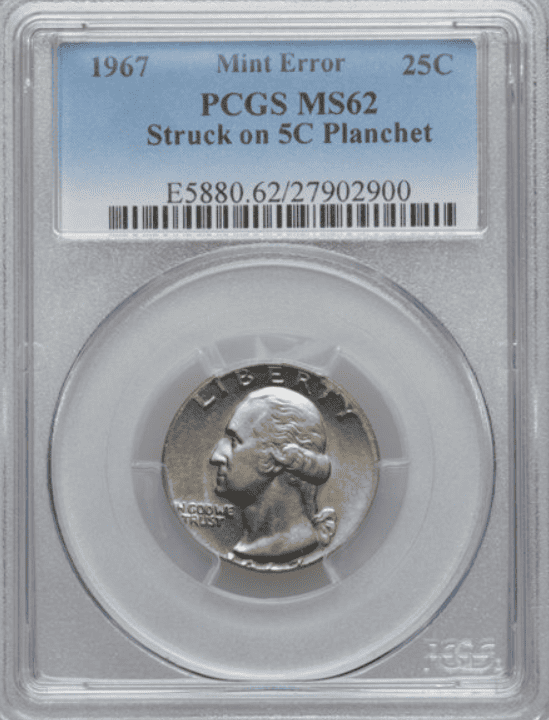
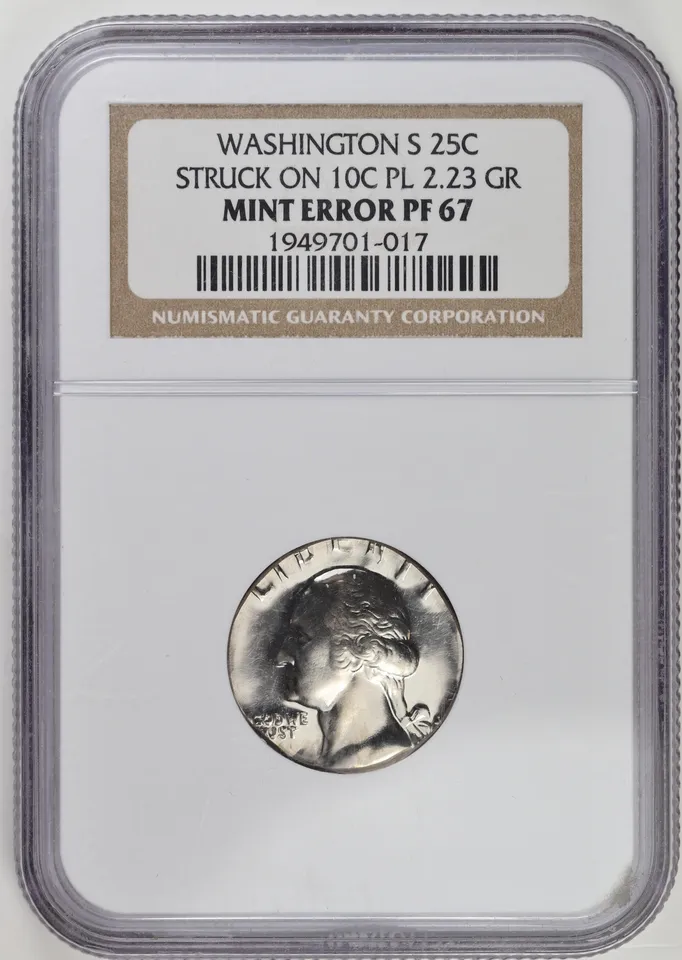
Wrong planchet errors are among the most spectacular — and valuable — errors a 1967 quarter can carry. They occur when a quarter die accidentally strikes a blank (planchet) meant for a completely different denomination. The coin ends up with the size, weight, and metal of the wrong coin but shows as much of the quarter design as fits on that smaller surface.

CoinVaueChecker App 10

The most remarkable documented example is a 1967 quarter struck on a copper cent planchet (producing a small, copper-colored coin weighing about 3.11 grams), which sold certified MS-65 Red and Brown by PCGS for $12,000 at Heritage Auctions in 2006. A 1967 quarter struck on a clad dime planchet graded MS-67 by PCGS brought $4,700 in 2016. If you find a 1967 coin that is noticeably small, unusually light, or the wrong color, weigh it immediately — a standard 1967 quarter weighs 5.67 grams, while a cent planchet weighs around 3.11 grams.

4. 1967 Quarter Off-Center Strike Error

An off-center strike occurs when the planchet is not properly centered in the coining press when struck, leaving part of the design missing and a blank crescent of metal visible. The value depends directly on how far off-center the coin is and whether the date is still legible.

A dramatic example of a 1967 quarter struck 50% off-center brought $3,840 at Heritage Auctions in 2015. Minor 5–10% off-center strikes with full dates sell for $20 to $50. More dramatic 20–30% displacements command $50 to $150 in circulated condition. Extreme 40–50%+ off-center examples with a visible date can exceed $200 to $400 in uncirculated grades.

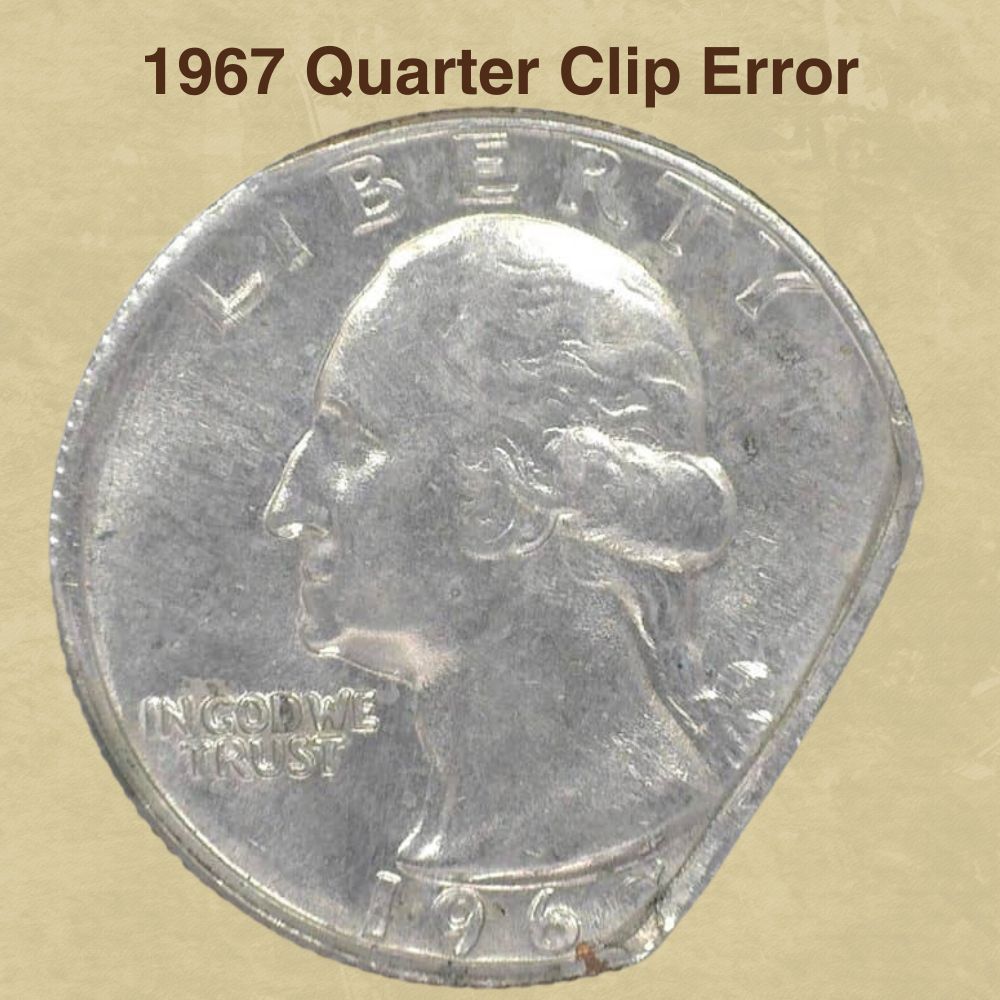
5. 1967 Quarter Clipped Planchet Error

A clipped planchet error occurs during the blanking process when the punch cuts overlapping areas from the metal strip, producing a blank with a distinctive curved or straight indentation cut out of its edge. The finished coin will always have a section of its rim visibly missing.

Small clips on circulated quarters typically sell for $5 to $10, while larger clips removing 10% to 20% of the planchet command $20 to $50. Dramatic clips affecting 25% or more can reach $100 to $400 on uncirculated examples. A 1967 quarter struck on a 23% rolled thin planchet was certified PCGS MS-64 and sold through GreatCollections, as documented in their auction archive.

Also Read: 20 Rare Washington Quarter Errors Worth Money (Full List with Pictures)


Where To Sell Your 1967 Quarter?

Now that you know the value of your coins, do you know where to sell those coins online easily? Don’t worry, I’ve compiled a list of these sites, including their introduction, pros, and cons.

Check out now: Best Places To Sell Coins Online (Pros & Cons)


1967 Quarter Market Trend

Market Interest Trend Chart - 1967 Quarter

*Market Trend Chart showing the number of people paying attention to this coin.


FAQ About The 1967 Quarter Value

1. Are 1967 quarters worth anything?

Most circulated 1967 quarters are worth face value (25 cents) due to their copper-nickel clad composition and massive mintage of over 1.5 billion. However, uncirculated coins start around $7 to $15 at MS-63 to MS-65 grades. The PCGS MS-68 business strike record is $8,812.50 (Heritage Auctions, January 2017), and an NGC MS-69 SMS coin sold for $8,156.25 at GreatCollections in August 2024. SMS DCAM examples can reach hundreds to thousands of dollars in top grades.

2. Why is a 1967 quarter rare?

The regular 1967 quarter is not rare — over 1.5 billion were struck at three mints combined. What is rare is finding one in exceptional Mint State condition. PCGS has certified only 3 examples at MS-68 (the current top grade for business strikes) as of May 2025. The U.S. Mint also did not produce Uncirculated Sets in 1967, so there was no mechanism to preserve pristine specimens, making high-grade survivors genuine condition rarities.

3. What is a 1967 quarter worth with no mint mark?

Every single 1967 quarter has no mint mark — this is normal and not an error. The Coinage Act of 1965 prohibited mint marks on all U.S. coins from 1965 through 1967 to discourage hoarding by collectors. All 1967 quarters from Philadelphia, Denver, and San Francisco are visually identical with no way to identify their source mint. The absence of a mint mark by itself adds no premium to the coin’s value.

4. What is the difference between a 1967 SMS quarter and a regular quarter?

An SMS (Special Mint Set) coin was made specifically for collectors at the San Francisco Mint, using polished planchets and dies for a sharper, more detailed strike with a distinctive satin-like finish. A regular business strike was made for everyday circulation with no special care. Under good lighting, an SMS coin will look more “crisp” and have better-defined design elements. PCGS uses the “SP” prefix for SMS coins, while NGC uses “MS.” At the top grades, an SP-67 SMS quarter can be worth ten times more than an MS-67 business strike.

5. Is a 1967 quarter silver?

No. The Coinage Act of 1965 eliminated silver from quarters (and dimes) beginning that year. The 1967 quarter is made entirely of a copper-nickel clad composition — a pure copper core with an outer layer of 75% copper and 25% nickel. It weighs 5.67 grams, compared to the 6.25 grams of a 90% silver quarter. If you find a coin dated 1967 that weighs 6.25 grams, that could be an extremely rare silver planchet error worth thousands.

6. What is the most valuable 1967 quarter ever sold?

For business strikes, a PCGS MS-68 coin sold for $8,812.50 at Heritage Auctions in January 2017. For SMS pieces, an NGC MS-69 (the sole finest certified) sold for $8,156.25 at GreatCollections in August 2024. For error coins, a 1967 quarter struck on a copper cent planchet, graded PCGS MS-65 Red and Brown, sold for $12,000 at Heritage Auctions in 2006 — making it the highest price ever paid for a 1967 quarter in any category.

7. What is a Cameo or Deep Cameo SMS quarter?

CAM stands for Cameo and DCAM stands for Deep Cameo — these are special designations added by PCGS and NGC (which calls it “Ultra Cameo”) to SMS coins with exceptional visual contrast. On a CAM coin, the raised design elements (Washington’s portrait, the eagle) appear frosty or white while the flat background fields are reflective like a mirror. A DCAM coin has an even more dramatic version of this contrast. Only a few dozen 1967 SMS quarters are believed to exist in the DCAM category, making them among the rarest non-error 1967 quarters. SP-66 DCAM coins sell for $600 or more.

8. How do I tell if my 1967 quarter is an SMS coin?

The best way is to compare the surface quality under good lighting. An SMS quarter will have a satin-like, slightly frosted surface with sharper design details than a business strike, which will look more “grainy” or “satiny” in a less controlled way. The most reliable method is to submit it to PCGS or NGC for certification — they will identify it as SP (PCGS) or MS with the SMS designation (NGC) if it qualifies. Be aware that authentication is worth the cost only for coins that might grade SP-65 or higher.

9. Can I find a valuable 1967 quarter in pocket change today?

Finding a high-grade business strike in circulation is nearly impossible — any coin that has passed through millions of hands will show wear and grade below MS-60. You will not find an SMS coin in pocket change since these were sold directly to collectors in sealed sets and never circulated. Your best chances for finding valuable 1967 quarters are at coin dealers, online auctions like Heritage Auctions or GreatCollections, or coin shows where dealers specialize in clad-era Washington quarters.

10. Should I get my 1967 quarter professionally graded?

Professional grading by PCGS or NGC is worth the cost only if your coin appears truly uncirculated (no wear anywhere on the surfaces) or is a potential SMS piece. For circulated coins, the grading fee will exceed the coin’s value. For uncirculated business strikes that might grade MS-65 or higher, or any SMS coin, certification provides authentication and dramatically boosts market value and credibility. For any suspected wrong planchet or major error coin, professional grading is essential — these errors are commonly faked, and without a certified holder, dealers and auction houses will discount them heavily.

Similar Posts