Coin Value Contents Table
- 1. 2021-O $1 Morgan Silver Dollar Obverse Struck Through Error (MS69)
- 2. 2021-D $1 Silver Dollar Reverse Struck Through Error (MS68)
- 3. 2021-D Morgan Silver Dollar Grease Error (MS64)
- 4. 2021-D Morgan Silver Dollar Rim Die Break (MS68)
- 5. 2021-D Morgan Dollar Cracked Planchet Error (MS65)
- 6. 2021-O Morgan Dollar, 75 Degree Rotated Die Error (MS65)
- 7. 2021-D Morgan Dollar Die Chip Alligator Eye Error (MS65)
- 8. 2021-Morgan Silver Dollar Clipped Planchet Error (MS67)
- 9. 2021-O Silver Dollar Reverse Die Cud Error (MS67)
- Summary
Are you curious whether 2021 dollar errors are worth adding to your collection?
Do you want to diversify your portfolio with high-value Morgan dollar coin varieties?
You’ve come to the right place!
We wrote this 2021 dollar errors list to help you identify modern Morgan dollar coins that will make your portfolio shine above all the rest.
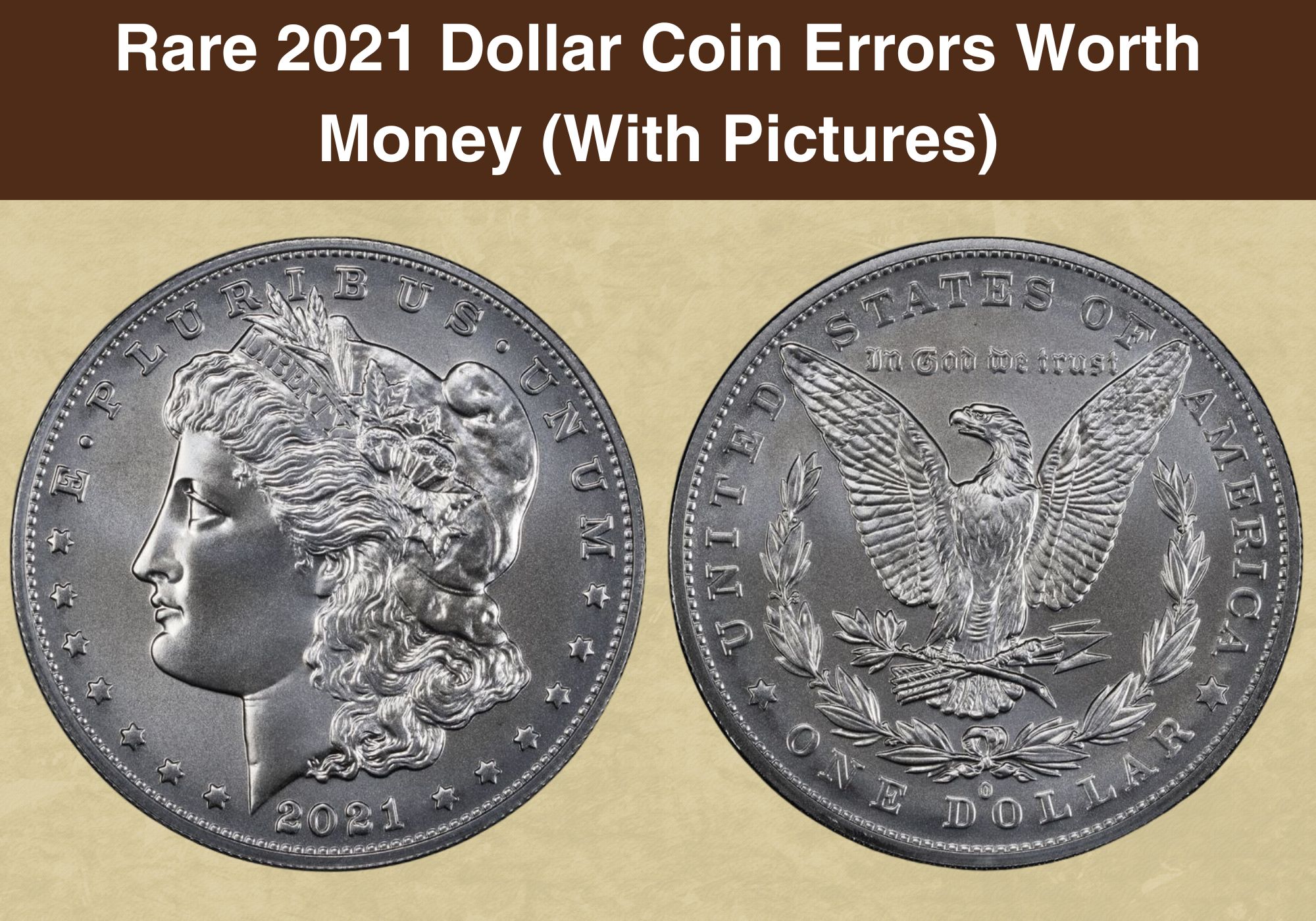
Morgan dollars were the first silver circulating coin produced by the United States after the passing of the Coinage Act of 1873, which ended the free coining of silver. These coins hold a special place in history as they espouse the country’s iconic industrial modernization.
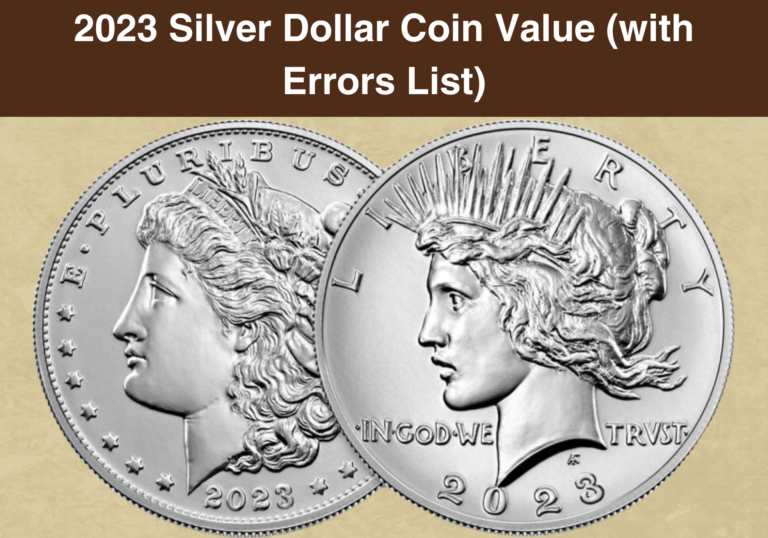
The Mint struck Morgan dollars from 1878 to 1904, and then in 1921, the final year. It was only in 2021 that the Mint reintroduced the silver dollar as part of the Morgan and Peace Dollar Anniversary Program to celebrate 100 years since the coin was last struck.
There aren’t as many 2021 dollar errors but those that exist are extremely valuable. Modern Morgan dollar errors can enrich and add value to your coin collection.
So, let’s get started with our comprehensive 2021 dollar errors list to discover the most valuable Morgan dollars to add to your portfolio.
1. 2021-O $1 Morgan Silver Dollar Obverse Struck Through Error (MS69)
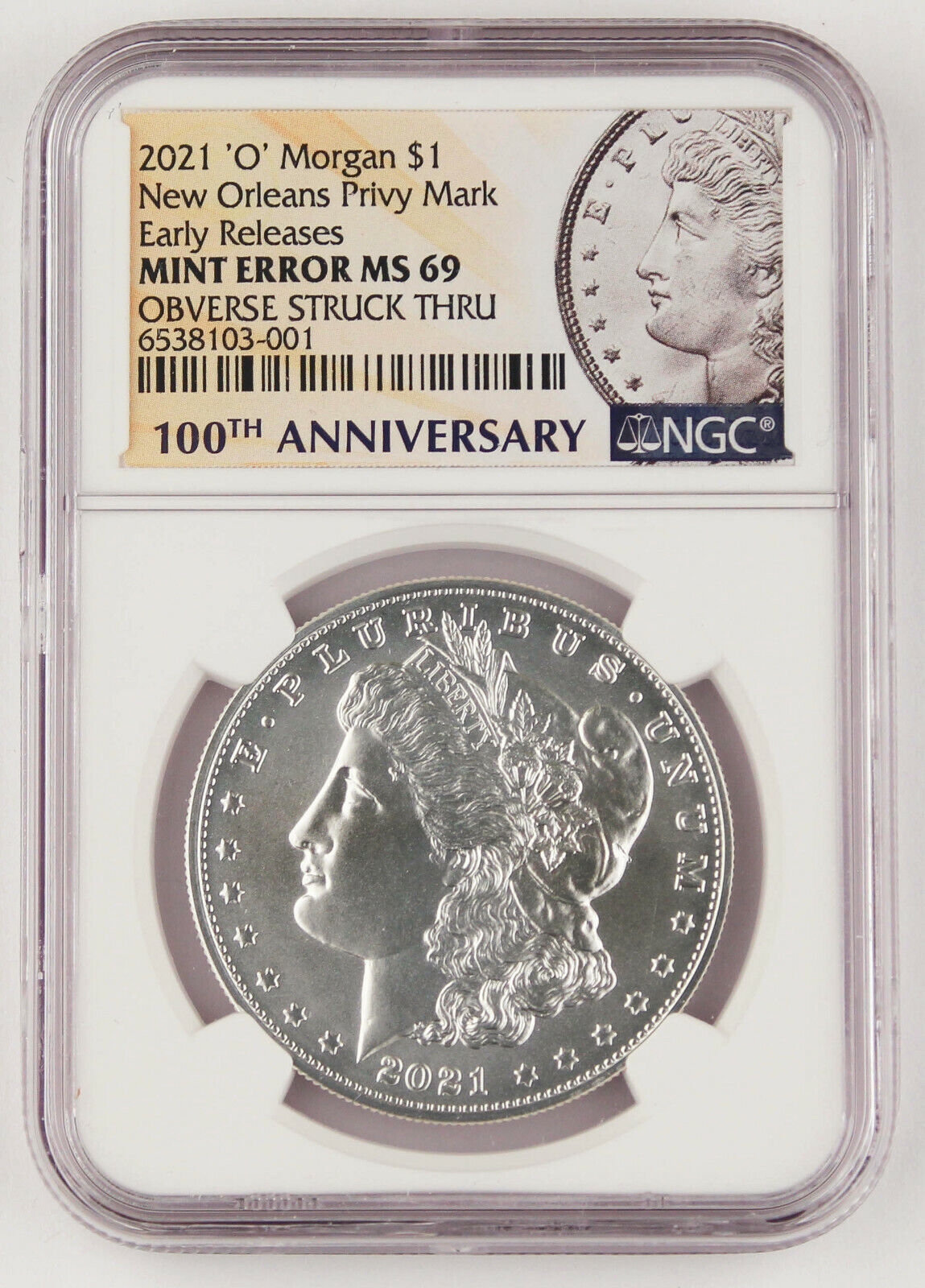
This commemorative silver dollar spots an obverse struck through, one of the most common errors in the Morgan dollar series.
A struck-through is an error in which a foreign object such as a speck of dust, debris, fiber, or strand of hair comes between the die and planchet.
When the die strikes the planchet, the pressure causes the foreign object to leave its impression on the planchet, resulting in a coin with an odd impression on the obverse or reverse.
In this case, what might have been a strand of hair or speck of wood was struck through, leaving a visible impression on Liberty’s temple close to her eyebrow.
Graded MS69, this gem quality 2021-O Morgan silver dollar with an obverse strike-through error is worth $479.
2. 2021-D $1 Silver Dollar Reverse Struck Through Error (MS68)
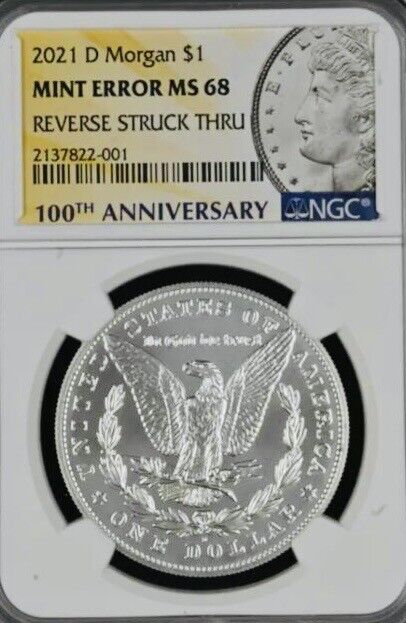
In addition to obverse struck-through errors, some dollar coins feature a reverse struck-through.
This coin features a struck-through error on the reverse where a faint non-linear line appears from the edge of the left wing to the bird’s beak. This could be the impression of a foreign object such as a hair strand.
This 2021 silver dollar with a reverse struck-through error was minted at the Denver facility and is graded MS68. It is worth an impressive $385 and therefore a worthwhile addition to your collection.
3. 2021-D Morgan Silver Dollar Grease Error (MS64)
A grease error can be categorized as a struck-through error. It occurs when a layer of grease is present on the die or the planchet.
When the die strikes, the grease obstructs the transfer of the design and inscriptions on the die to the planchet.
This can result in some parts of the coin’s surface looking dull and smudged, and may sometimes miss some details due to the obscuring grease.
In the case of this 2021 D dollar, the effects of the grease error can be seen on Liberty’s hat, which looks washed out, abnormally smooth, and lacking the minute details seen on other coins without the grease error.
On the reverse, the grease error is visible on the bird’s chest, which appears blurred or smoothened.
This 2021-D Morgan silver dollar with a grease error on the obverse and reverse is a true rarity. In addition, it boasts a gem-quality status with its MS69 grade.
Collectors are willing to pay as much as $979 for this unique error coin.
4. 2021-D Morgan Silver Dollar Rim Die Break (MS68)
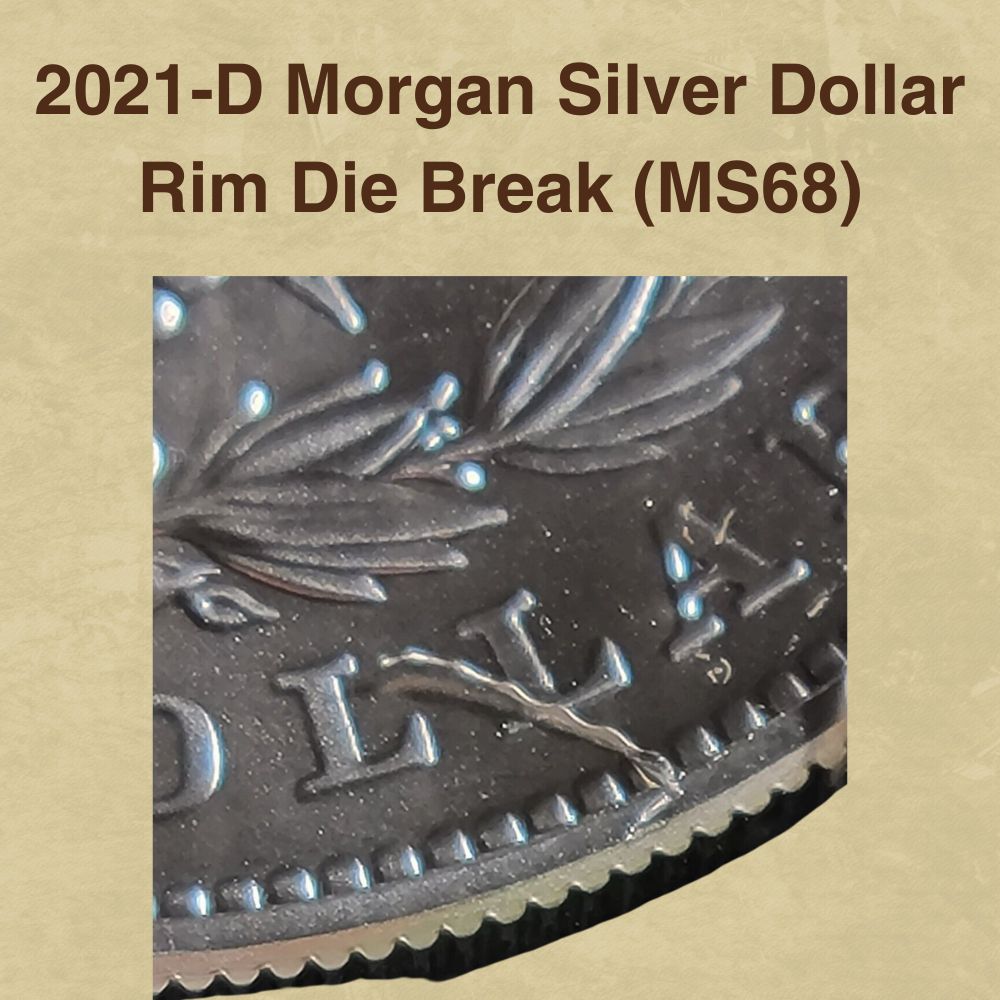
Other than the obverse and reverse a coin’s rim is also prone to minting errors.
One such error is the rim die break, which occurs when a crack forms on the die’s edge and fills with metal.
When the die strikes the planchet, the filled-in crack is impressed on the surface, resulting in a raised line close to the coin’s rim.
In this case, a raised line on the reverse runs from the rim to the first L in the word DOLLAR. This is a subtle error but when discovered makes for an excellent addition to any Morgan dollar collection.
This 2021 D Morgan silver dollar with a die error is graded MS68 and is worth $389 on the open coin market.
5. 2021-D Morgan Dollar Cracked Planchet Error (MS65)
Cracked planchets are a rare occurrence but they do happen. This error occurs due to impurities in the metal used to make the planchet.
Other factors such as poor annealing of the planchet can also contribute to weakness across the planchet.
As the name suggests, a cracked planchet presents as a fracture along or across the non-minted planchet.
This error is more common in early Morgan dollars, but collectors have come across a few 2021 dollars with a similar error.
This 2021-D Morgan silver dollar is graded MS65 and spots a crack on the reverse. The fracture cuts through from the rim up to the laurel. The coin is worth $70.
6. 2021-O Morgan Dollar, 75 Degree Rotated Die Error (MS65)
The hammer and anvil die must be aligned for the obverse and reverse design to be perfectly centered on the coin. Any misalignment will lead to flaws such as the rotated die error.
The rotated die error occurs when one of the dies, either the hammer or anvil, rotates from its original upright position causing the design on the obverse or reverse to be offset from the ideal or perfect 180-degree position.
The greater the degree of rotation the more valuable the coin. Professional grading bodies such as the Professional Coin Grading Service and the Numismatic Guaranty Company only consider and grade rotated die errors with at least 15 degrees of rotation.
This 2021-O silver dollar shows a dramatic rotated die error on the reverse. Although Liberty’s image is upright, the eagle’s image is rotated at a 75-degree angle so that the left wing is pointing north and the right one east.
This 2021-O Morgan dollar with a rotated die error is worth $100.
7. 2021-D Morgan Dollar Die Chip Alligator Eye Error (MS65)
This 2021 silver dollar features a die chip error that gives Liberty’s eye the appearance of the so-called alligator eyes.
A die chip error occurs when a small piece of the die’s face falls off and is then filled with metal. When the die strikes, it leaves the impression of the filled-in metal on the planchet.
This error typically appears like a raised bump on the coin’s surface. In this case, the impression was made on Liberty’s eye, giving it the engorged appearance of an alligator’s eye.
This 2021-D dollar with a die chip error is worth $49.
8. 2021-Morgan Silver Dollar Clipped Planchet Error (MS67)
Occasionally, errors can occur during the making of planchets or blank coins.
The Mint uses a special machine to cut round blank coins from a larger metal sheet. Sometimes, the machine mis-cuts the metal, resulting in some coins having a portion cut off.
The cut-off portion can be dramatically large, leaving a visible crescent shape on one side of the coin. Other times, it can be a small chunk of metal curved out of the coin’s rim.
This 2021-no-mint mark silver dollar spots a tiny clipped planchet error where a small portion of the rim seems cut off, leaving a curved outline.
The coin is graded MS66 and is valued at $67.
Keep in mind that the larger the clip on the planchet, the more valuable the coin. So if you come across a 2021 dollar with a much larger defect, it likely is worth adding to your collection.
9. 2021-O Silver Dollar Reverse Die Cud Error (MS67)
A die cud error is a type of die break with some distinct features. First, a die-cud error must be attached to the rim.
Another way to identify a cud error is that it is often flat and large compared to other die breaks that appear in the form of thin lines on the coin’s surface.
This 2021 silver dollar minted in New Orleans shows a dramatic die cud error on the reverse. The cud appears between the word AMERICA and the coin’s rim.
A die cud error occurs when a portion of the die’s edge breaks. The broken part can fall below the die’s surface or it can protrude above. So, when the die strikes the planchet, it leaves an impression of the broken part of the coin.
In this case, the broken portion of the die’s edge protruded above the surface, resulting in a large, flat impression that’s slightly raised relative to the rest of the coin.
This 2021-O silver dollar with a reverse die cud error is of gem quality and worth $527.
Summary
Morgan dollars hold great historical and sentimental value—they symbolize the dawn of industrialization and the expansion of the United States westward. It is no wonder that these coins attain high values in the coin market.
Commemorative coins such as the 2021 Morgan dollar are even more valuable given their scarcity and inherent worth. What’s more, these coins are minted in pure silver.
Adding 2021 dollar errors is a no-brainer if you are looking to increase your collection’s value. Hopefully, this 2021 dollar errors list serves as a useful launching pad whether you are a veteran or novice collector.