Coin Value Contents Table
- 1. 2021 P Quarter Crown Die Chip Error
- 2. 2021 D George Washington Quarter Double Die Obverse Error
- 3. 2021 P Washington Quarter Die Chips on ‘A’ Error
- 4. 2021 P Lip Mole and Snake Eye Crossing the Delaware Quarter Error
- 5. 2021 P Quarter Obverse/Reverse Misaligned Error
- 6. 2021 D Quarter Crossing the Delaware Smooth Edge Rim Error
- 7. 2021 D Improperly Annealed Quarter Error
- 8. 2021 P Crossing Delaware Re-Punched Mint Mark and Date
- 9. 2021 Washington Quarter Strike Through Error
- 10. 2021 P Washington Delaware Quarter Feeder Finger Error
- Summary
Are you interested in collecting 2021 quarter errors but don’t know where to start?
This guide is for you!
Here, we present a comprehensive 2021 quarter errors list to help you pick out the most valuable quarters to add to your collection.
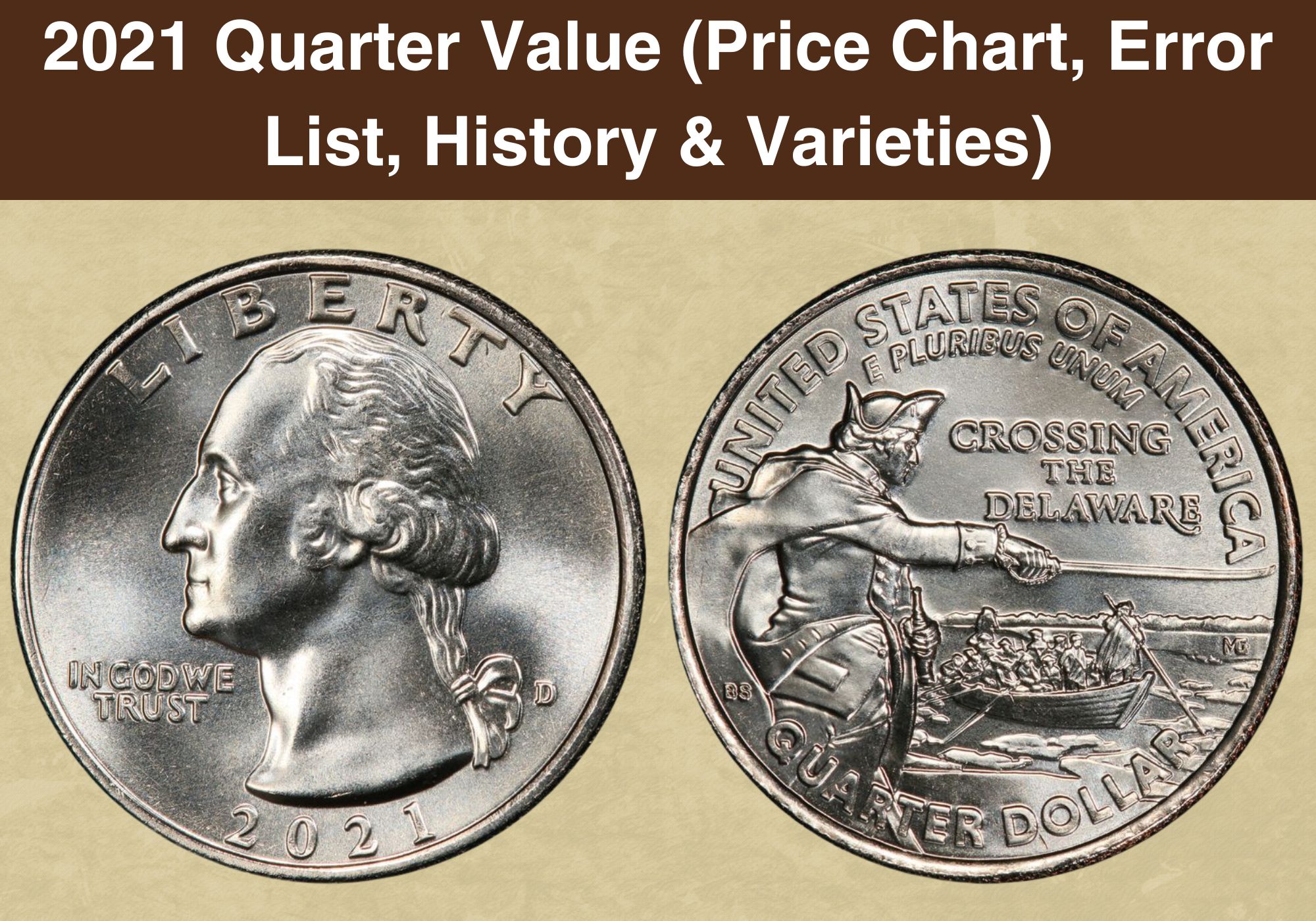
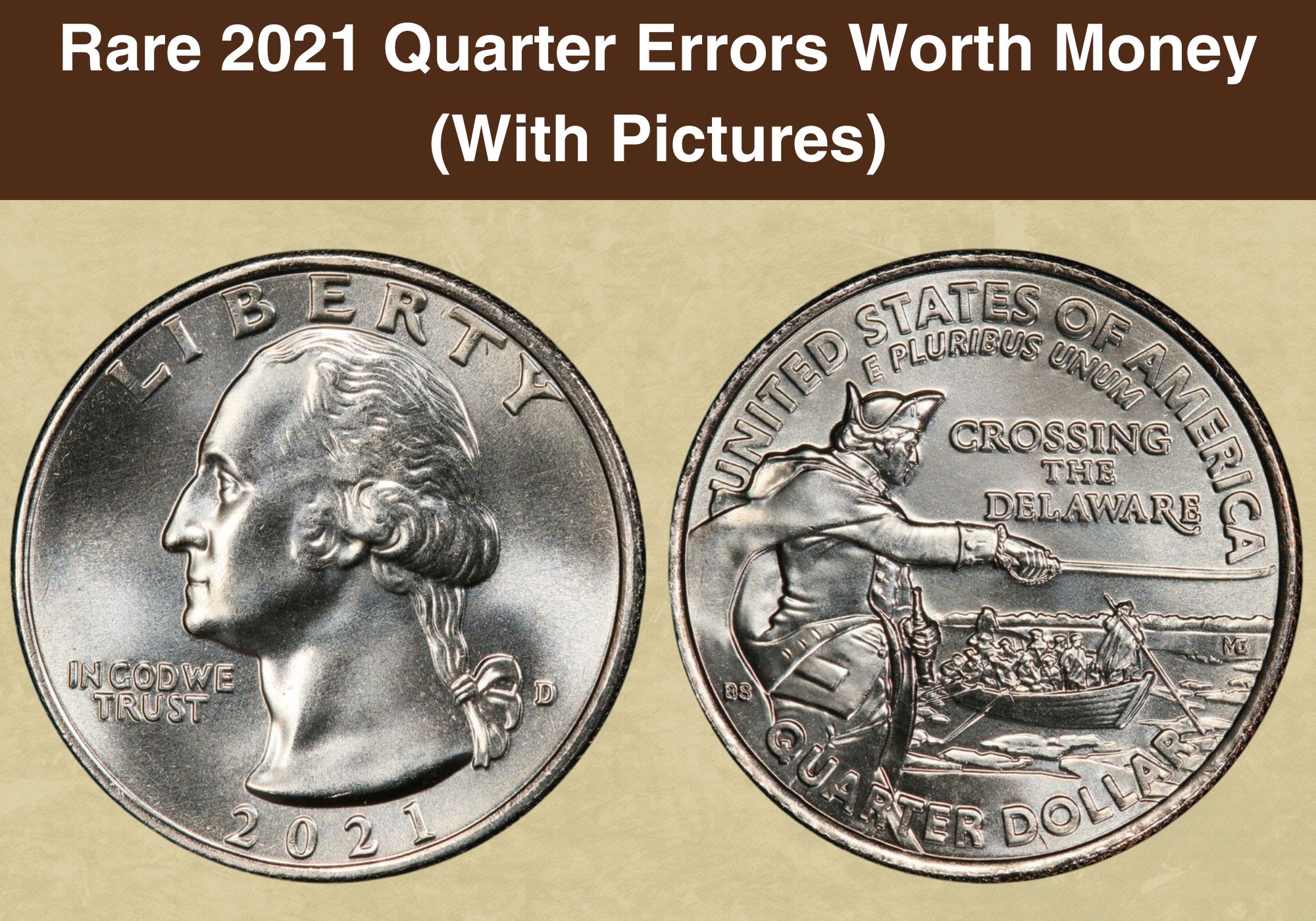
The 2021 quarter is a one-year only issue, making it extremely popular among collectors. It serves as a bridge between two important programs: America the Beautiful and American Women Quarters.
At face value, this popular coin is only worth about $0.25 in uncirculated condition while circulated pieces might be worth slightly less.
The good news is that 2021 quarter errors can be worth so much more than face value. In fact, some quarter errors fetch hundreds and even thousands of dollars.
Collecting 2021 quarter errors worth money starts with knowing what to look for in a coin. This guide will take you through the exact features and errors to look out for in the 2021 quarter errors.
So, without further ado, let’s get started with the ultimate 2021 quarter errors list.
1. 2021 P Quarter Crown Die Chip Error
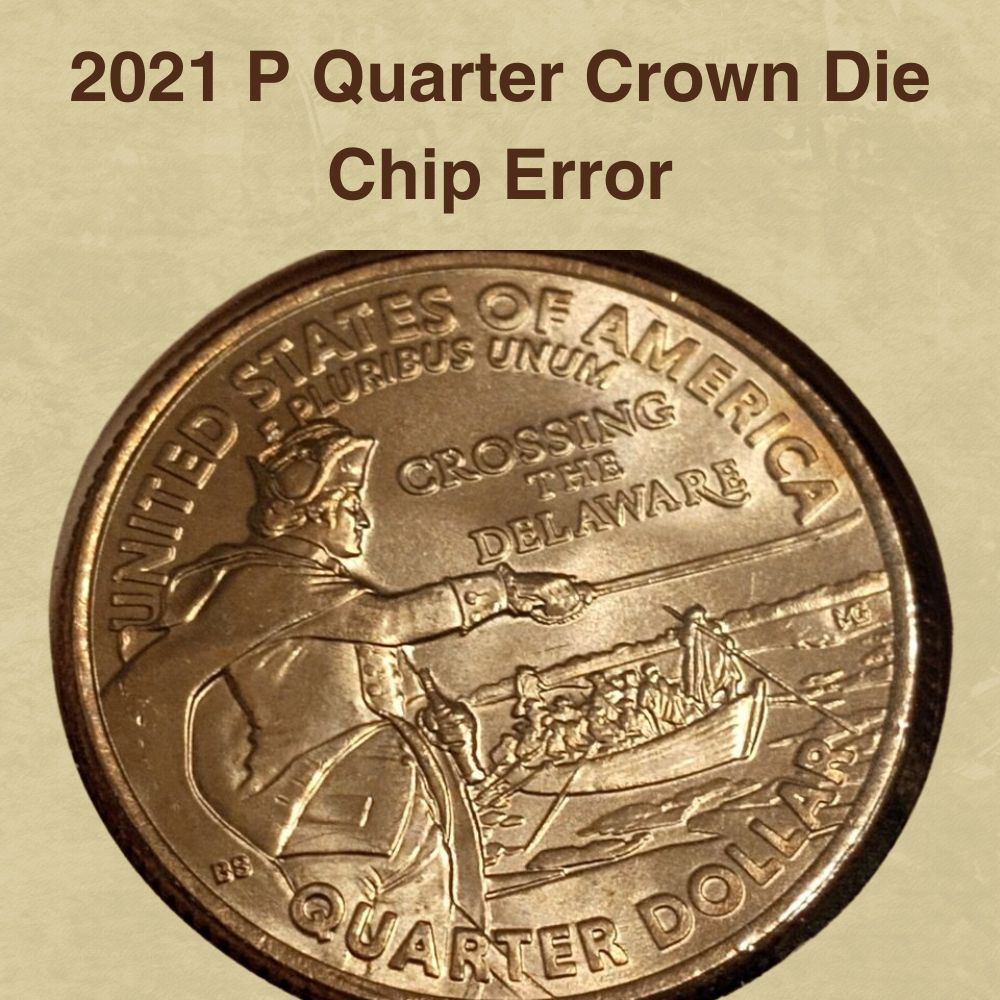
The die chip is the most common error you will find on 2021 Washington quarters.
This error typically forms in narrow crevices and tight spaces on the coin’s design. A die chip occurs when a tiny portion of the die falls off leaving a small hole which fills up with coin metal.
During minting, the filled-up metal is transferred to the coin’s surface and appears like a formless blob.
The die chip on the 2021 quarters appears on the reverse on General George Washington’s crown. The chip is quite visible, appearing like a raised blob fixed on the crown. The error is so prominent, you will easily spot it on your 2021 quarter.
This 2021 P quarter with a crown die chip error is worth $70 in mint condition.
2. 2021 D George Washington Quarter Double Die Obverse Error
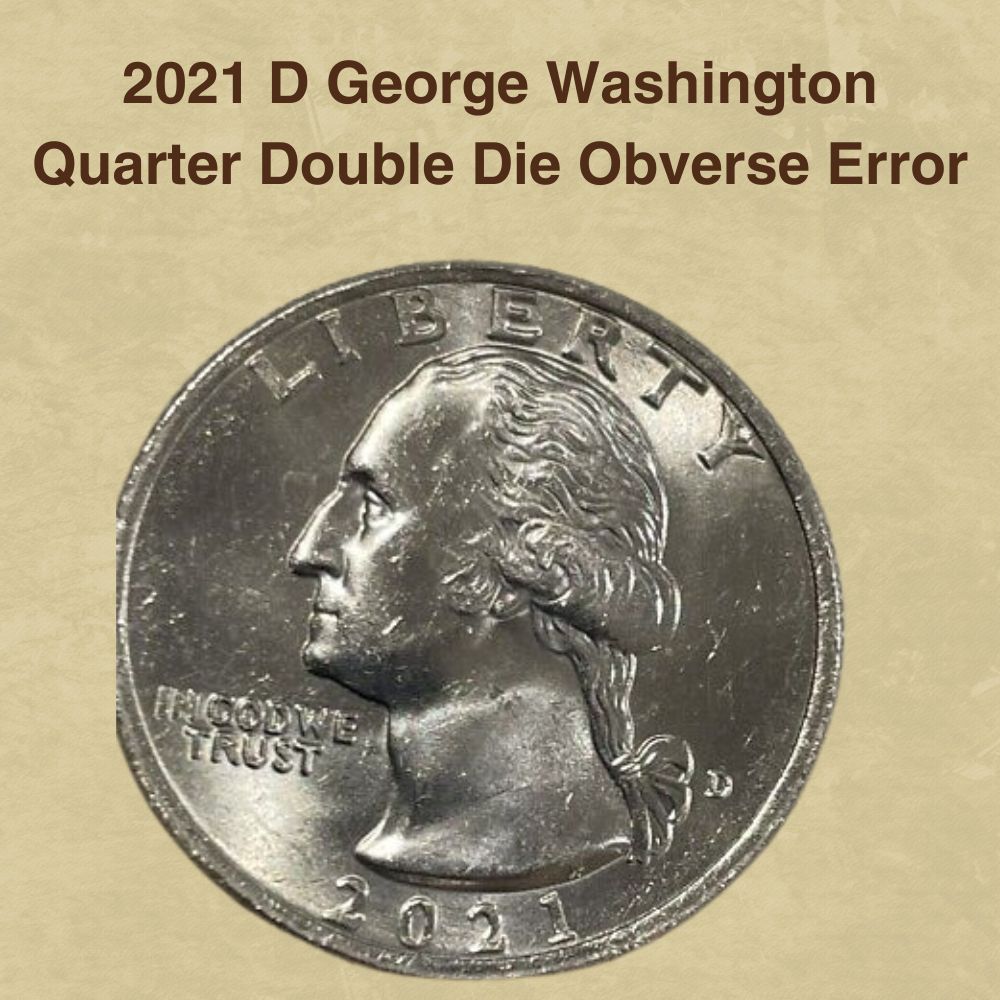
The doubled die is also quite common in the 2021 quarters series; chances are good that you might come across such an error coin in your day-to-day use of the 2021 quarter.
A doubled die error occurs when the die strikes the planchet at slightly different angles, causing the inscriptions and design to overlap and show visible doubling.
On this 2021 D quarter there is doubling on the inscriptions LIBERTY, IN GOD WE TRUST, and the year date, 2021. This example is valued at $300 in uncirculated condition.
3. 2021 P Washington Quarter Die Chips on ‘A’ Error
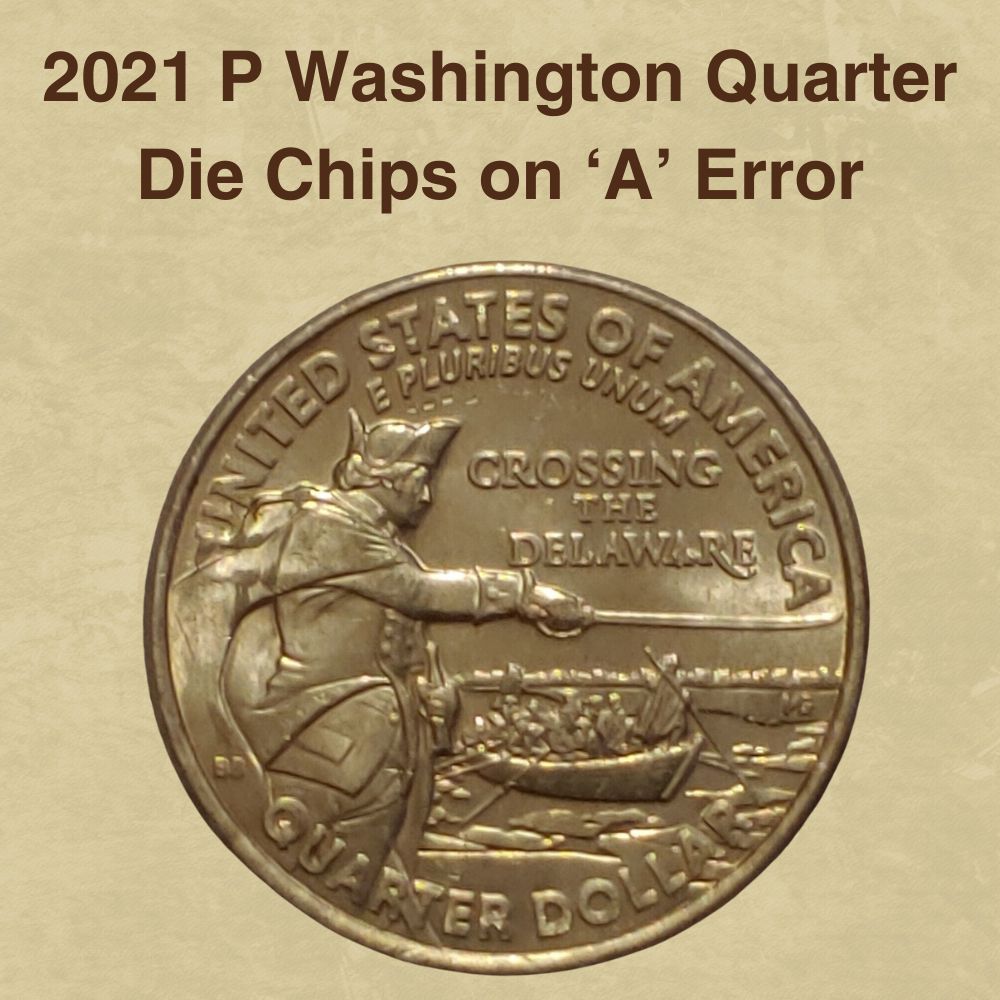
This is yet another variety of the die chip error. Although the most prominent die chip error is found on Washington’s crown on the reverse, this coin also presents other die chip errors.
In particular, this die chip error can be seen on the letter A on the word DELAWARE on the reverse. A close look will reveal two raised blobs on either side of the letter A, signifying a classic die chip error.
This 2021 P Washington quarter with two die chips on A was auctioned for a whopping $1990. It is a circulated but ungraded rare example of an interesting error on the 2021 quarter series.
4. 2021 P Lip Mole and Snake Eye Crossing the Delaware Quarter Error
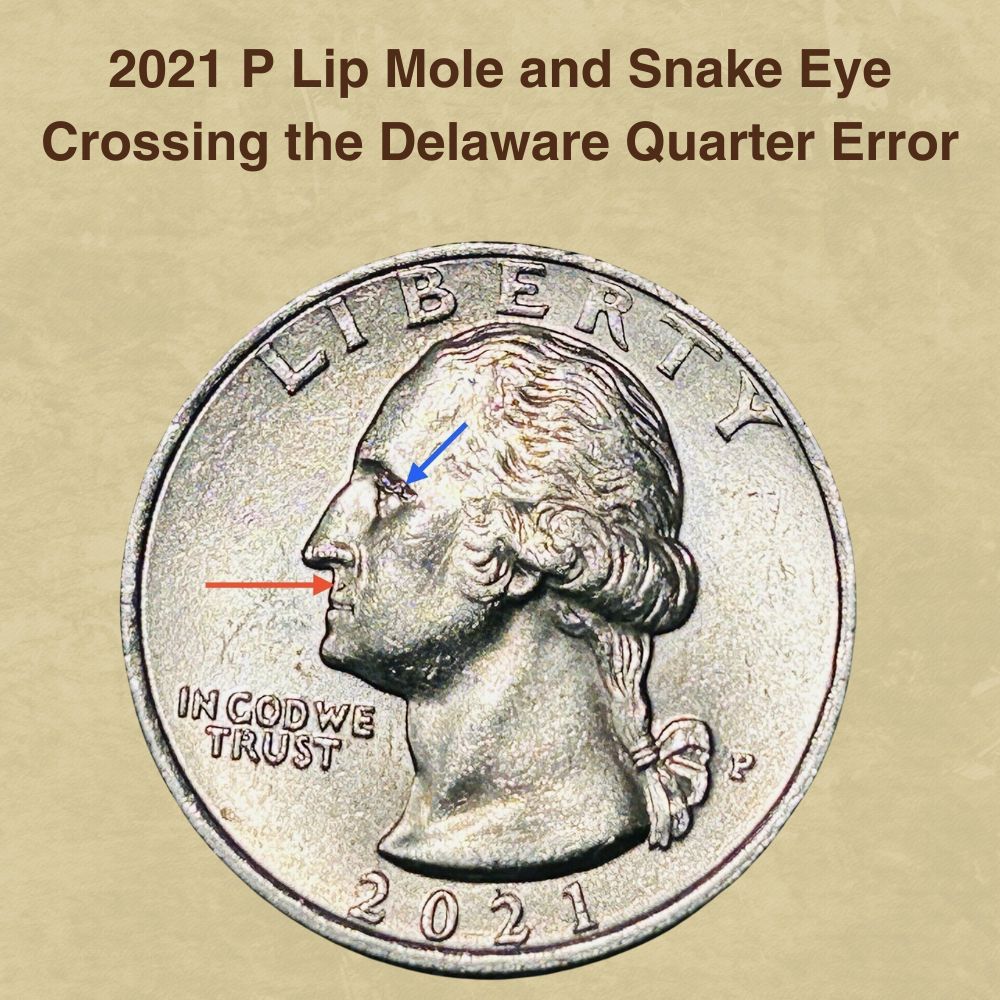
Errors that transform the image featured on a coin tend to be very popular and collectors will pay big bucks for them.
A good example is the lip mole and snake eye die chip error. In this coin, a raised blob of metal can be seen on the top of Washington’s corner lip and appears like a mole.
Another die chip appears on the folds of the eye or behind the eye lid and down to the side, giving Washington what collectors deem as “snake eyes.”
There is no doubt that having both die chips on one coin makes this variety a best-seller. Collectors are willing to pay as much as $1500 for this mint 2021 P Lip Mole and Snake Eye Crossing the Delaware quarter error.
5. 2021 P Quarter Obverse/Reverse Misaligned Error
A misaligned error is one in which the design is positioned away from the center of the coin. Due to a misaligned die, the design seems as though it has been struck more toward the coin’s edge and further away from the center.
Sometimes, as is the case here, the misalignment can result in a broad struck error in which the design pours out of the coin’s rim, leaving that portion of the coin looking stretched out and thin, and part of the design missing.
On this 2021 P quarter, the obverse image of George Washington and the reverse Crossing the Delaware image are subtly misaligned. A small part on the left of General George’s image is also missing due to the broad struck error.
This 2021 P quarter with an obverse/reverse misaligned and broad struck error is valued at $16. Although not super expensive, this error coin would still make a nice addition to your collection as it is worth more than face value.
6. 2021 D Quarter Crossing the Delaware Smooth Edge Rim Error
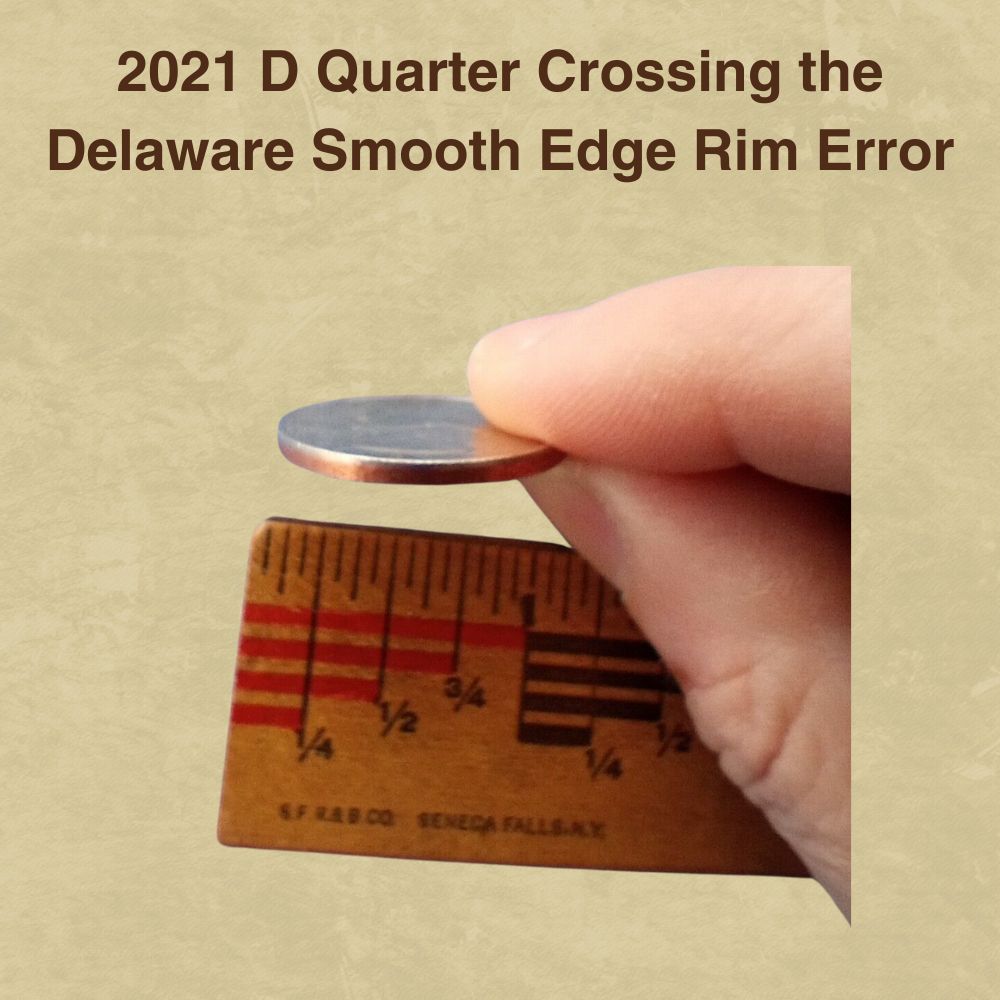
The 2021 quarters from the Denver and Philadelphia mints have a reeded edge. Reeds are the small grooves around the coin’s edge and are created at the time of striking.
But, a few 2021 Crossing the Delaware quarters have turned up with a smooth edge. One possible reason for this is that the coins were placed in a smooth collar so the final product came out with a smooth edge.
These quarters are definitely very rare and can be an excellent addition to your Washington quarters collection.
A 2021 D quarter with a smooth edge rim error can fetch up to $150 in circulated condition.
7. 2021 D Improperly Annealed Quarter Error
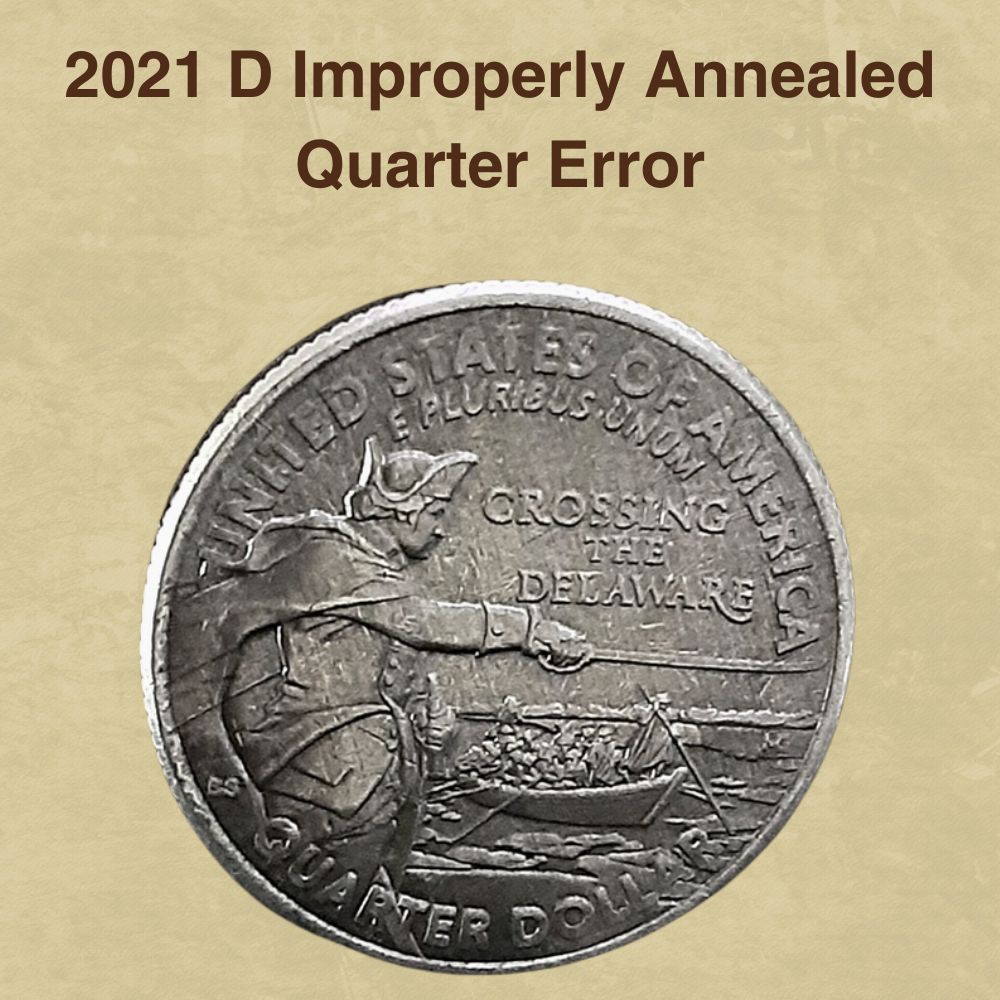
An improperly annealed coin is an error that occurs due to bio-chemical reactions during the minting process.
It is believed that during minting, the copper molecules move to the surface of the coin where they form layers. Combine this with the heat and oxygen from the minting process and what you get is an oxidization of the copper.
Due to the oxidization, the copper may appear black, greyish or reddish, resulting in an improperly annealed coin.
This 2021 D quarter shows an improperly annealed error on the obverse on Washington’s lower chin in the form of a red-brownish patch that stands out against the coin’s silverish background.
This improperly annealed 2021 D quarter is worth $10.
8. 2021 P Crossing Delaware Re-Punched Mint Mark and Date
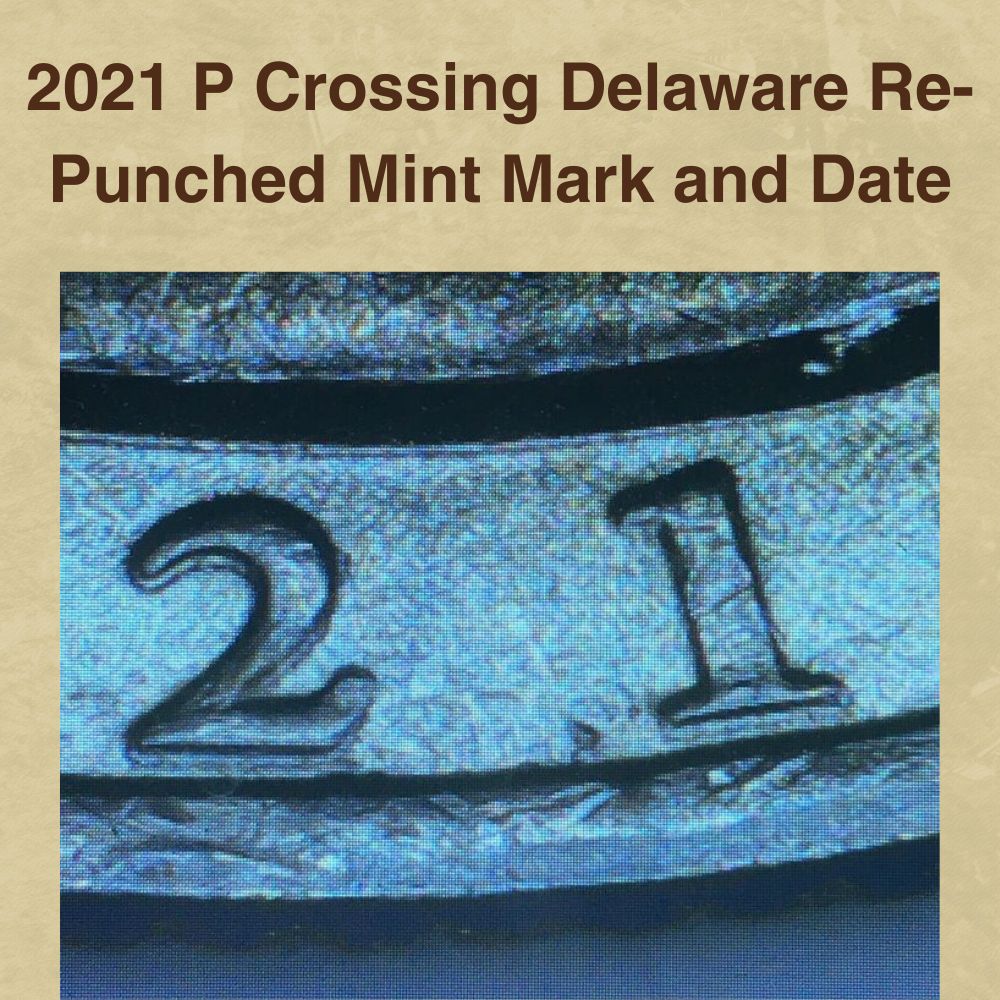
A re-punched mintmark occurs when the punch used to stamp the mintmark onto the die creates two or more mintmark impressions that overlap one over the other.
This error can happen due to several reasons such as improperly positioning the letter punch the first time, a bouncing or unstable letter punch, or an attempt to correct a misaligned mint mark.
Aside from the mint mark, the date can also show a re-punched error. In both cases, the secondary mint mark or date is typically smaller than the initial one.
This 2021 P Washington quarter with a re-punched mint mark and date is worth $10 in circulated condition.
9. 2021 Washington Quarter Strike Through Error
Strike-through errors are not too common in the 2021 quarters series, so if you come across a genuine one you should strongly consider adding it to your collection.
A strike through or struck-through error occurs when a foreign object comes between the die and planchet during the minting process.
The foreign object, struck under immense pressure, leaves an impression on the coin’s surface, creating a strike-through error.
In this 2021 P Crossing the Delaware quarter, there are three deep holes on the reverse surface right under General George’s arm. It seems as though a three-pronged object came between the planchet and die during striking and left its impression on the coin’s surface.
This rare 2021 P quarter with a strike-through error can fetch up to $20 in the open coin market.
10. 2021 P Washington Delaware Quarter Feeder Finger Error
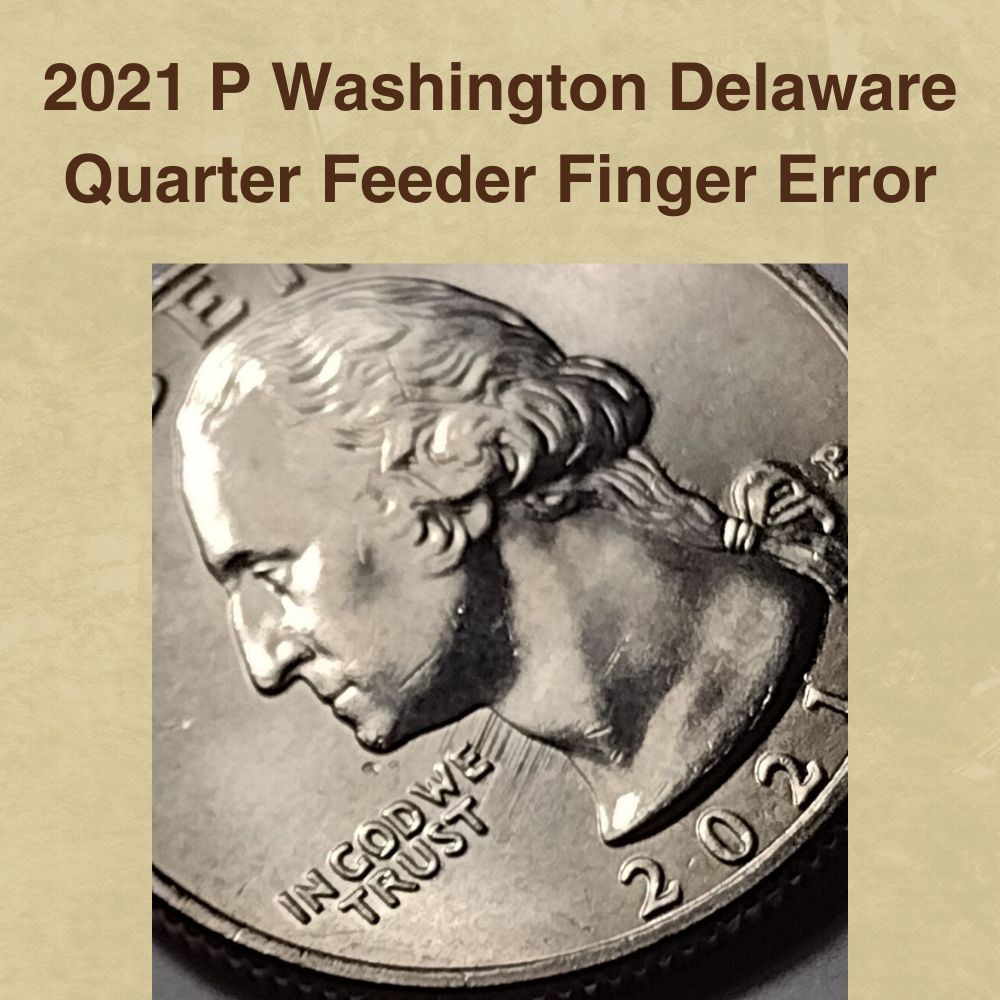
Feeder fingers are components of the coin minting hub. They help to pace the planchet into the collar, ready for striking.
Sometimes, these feeder fingers can get caught in the minting hub and end up scratching the planchet’s surface. This results in a feeder finger error which shows up as close, parallel scratch lines on the coin’s surface.
This 2021 P Washington quarter features a large feeder finger error on the obverse to the right just behind Washington’s pigtail.
This interesting error coin is worth $10.
Summary
Whether you are a novice or veteran, acquiring high-value errors is one of the smartest ways to diversify and enrich your coin collection.
This 2021 quarter errors list is a great place to start if you are looking to grow your Washington quarters collection.
But, don’t let this list limit you; always be on the look out for new 2021 Crossing the Delaware quarters discoveries; some might be worth a fortune and would be a nice addition to your portfolio.