1957 Quarter Value Checker: Errors List, “D” & No Mint Mark Worth

1957 Quarter Value

The 1957 Washington Quarter is one of the final silver quarters ever struck for everyday circulation in America — produced just eight years before President Lyndon B. Johnson signed the Coinage Act of 1965 on July 23rd, permanently ending the 90% silver composition in dimes and quarters.

That historical turning point makes every 1957 quarter worth saving. While a circulated example will fetch $7–$9 based on its silver melt value alone, a rare Deep Cameo (DCAM) proof specimen — graded by PCGS or NGC, meaning the Professional Coin Grading Service or Numismatic Guaranty Company — can reach as high as $12,500 at major auctions. A top-grade business strike is no slouch either: a 1957-D in MS68 (Mint State 68 on the 70-point Sheldon grading scale) sold for $11,400 at Stack’s Bowers on March 31, 2021.

1957 Quarter Value Checker

Identify 1957 Quarter D and No Mint Mark Price

✨ No Sign-up Required
Obv

Front Obverse

Upload or Take a Photo

Rev

Back Reverse

Upload or Take a Photo


1957 Quarter Value By Variety

The 1957 quarter series offers five distinct collecting opportunities, ranging from common circulated strikes worth $7–$9 to scarce gem-quality business strikes and ultra-rare Deep Cameo proofs. Understanding each variety is the key to knowing exactly what your coin is worth.

If you know the grade of your coin, you can find the exact price below in the Value Guides section.

1957 Quarter Value Chart

TYPEGOODFINEAUMSPR
1957 No Mint Mark Quarter Value$15.00$15.83$19.00$34.29
1957-D Quarter Value$15.00$15.83$19.00$25.33
1957 Proof Quarter Value$17.00$21.12
1957 CAM Quarter Value$38.62
1957 DCAM Quarter Value$600.40
Updated: 2026-05-09 13:35:56

Also Read: Top 100 Most Valuable Modern Quarter Worth Money (1932 – Present)


Top 10 Most Valuable 1957 Quarter Worth Money

Most Valuable 1957 Quarter Chart

2006 - Present

The 1957 quarter market tells a fascinating story of condition rarity at the top end. The 1957-D MS68 and 1957 DCAM PR69 both peak at $11,400, yet they represent entirely different types of scarcity.

Denver’s massive 77.9 million business strike mintage makes an MS68 survivor extraordinarily rare — PCGS numismatic expert David Hall has noted the 1957-D is “only a little scarcer” than the Philadelphia issue in Gem (MS65) condition, but the population drops off sharply in grades above that. PCGS expert Mitch Spivack has further observed that virtually every 1957 Philadelphia quarter that achieves MS67 is either a mint-set toned or album-toned specimen — pristine roll examples almost never break the MS66 barrier.

The Deep Cameo (DCAM) proof varieties represent a different kind of scarcity. With fewer than 100 DCAM examples certified across all grades by PCGS and NGC combined, these coins are among the rarest collectible Washington quarters of the entire 1932–1998 series relative to their year of issue.

At the more accessible end of the spectrum, standard proofs at PR69 realize around $548 — proof that the DCAM designation alone can multiply a coin’s value more than twenty-fold.

Business strike pricing rises gradually: MS67 examples range from $646–$960 and MS66 pieces sell for roughly $230, reflecting the natural scarcity curve at higher preservation levels.

To see how 1957 varieties rank against the most valuable Washington quarters ever sold, visit our comprehensive ranking below.


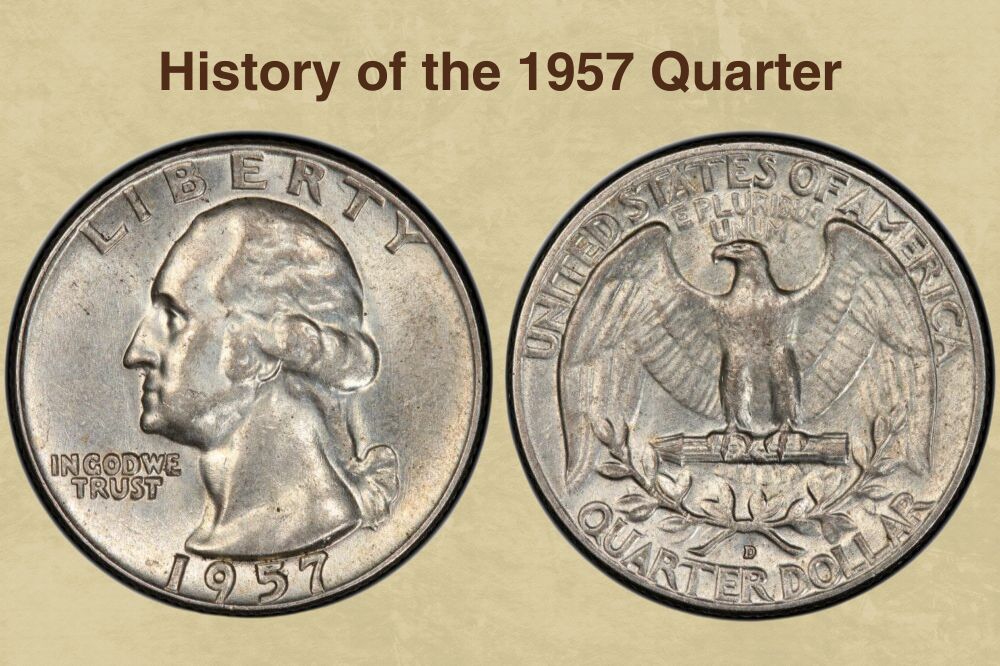
History of the 1957 Quarter

The 1957 quarter belongs to the Washington quarter dollar series, first struck in 1932 to commemorate President George Washington’s bicentennial birth anniversary.

Preparations for the bicentennial celebrations began almost ten years earlier when Congress established a Bicentennial Commission in 1924. This group, however, became dormant and was replaced by a new Commission in 1930 to oversee the celebrations, which would include the introduction of a Washington coin.

The Commission proposed replacing the Walking Liberty half dollar with the new Washington coin. But Congress was more inclined to replace the Standing Liberty Quarter instead.

Although half-heartedly, it was agreed that the new Washington coin would replace the Standing Liberty Quarter. The Commission already had a designer in mind, Lauren Gardin Fraser, for the new commemorative quarter dollar.

Although Fraser had extensive experience designing coins, the Treasury rejected the Commission’s choice and instead opted to hold a competition to find another designer.

Ultimately, the Mint and Treasury chose designer John Flanagan to create the obverse and reverse designs. Flanagan based his design on a 1785 Washington portrait created by French sculptor Jean-Antoine Houdon.

Production of the new Washington Quarter began in early July 1932, and by August, the Mint began releasing these quarter dollars into circulation.

Proof Washington quarters were first issued in 1936, then suspended during World War II from 1943 through 1949, before resuming in 1950. Washington quarters were struck in 90% silver all the way through 1964, when a nationwide silver shortage — driven by rising industrial demand and coin hoarding — prompted Congress to act. President Johnson signed the Coinage Act of 1965 that July, ending silver content in quarters entirely.

As you will see in the following sections, Washington quarters, including those produced in 1957, are highly collectible, especially in uncirculated condition.

This is one of the longest-running coin series in American coinage history, but this fact does not take away from the coin’s collectability within numismatic circles.

Also Read: Top 30 Most Valuable State Quarter Worth Money (1999 – 2008)


Is your 1957 Quarter rare?

28

1957 No Mint Mark Quarter

Scarce
Ranked 109 in Washington Quarter
30

1957-D Quarter

Scarce
Ranked 69 in Washington Quarter
17

1957 Proof Quarter

Uncommon
Ranked 160 in Washington Quarter
19

1957 CAM Quarter

Uncommon
Ranked 145 in Washington Quarter
28

1957 DCAM Quarter

Scarce
Ranked 108 in Washington Quarter

Use our Coin Value Checker App to instantly assess the specific rarity and current value of your 1957 quarter varieties.


Key Features of the 1957 Quarter

John Flanagan’s Washington quarter design continued its mature form in 1957, maintaining the refined elements established over two decades of production.

During this record-breaking mintage year, both Philadelphia and Denver mints produced quarters using well-established dies, though production challenges would create unique striking variations that distinguish 1957 quarters from other years in the series.

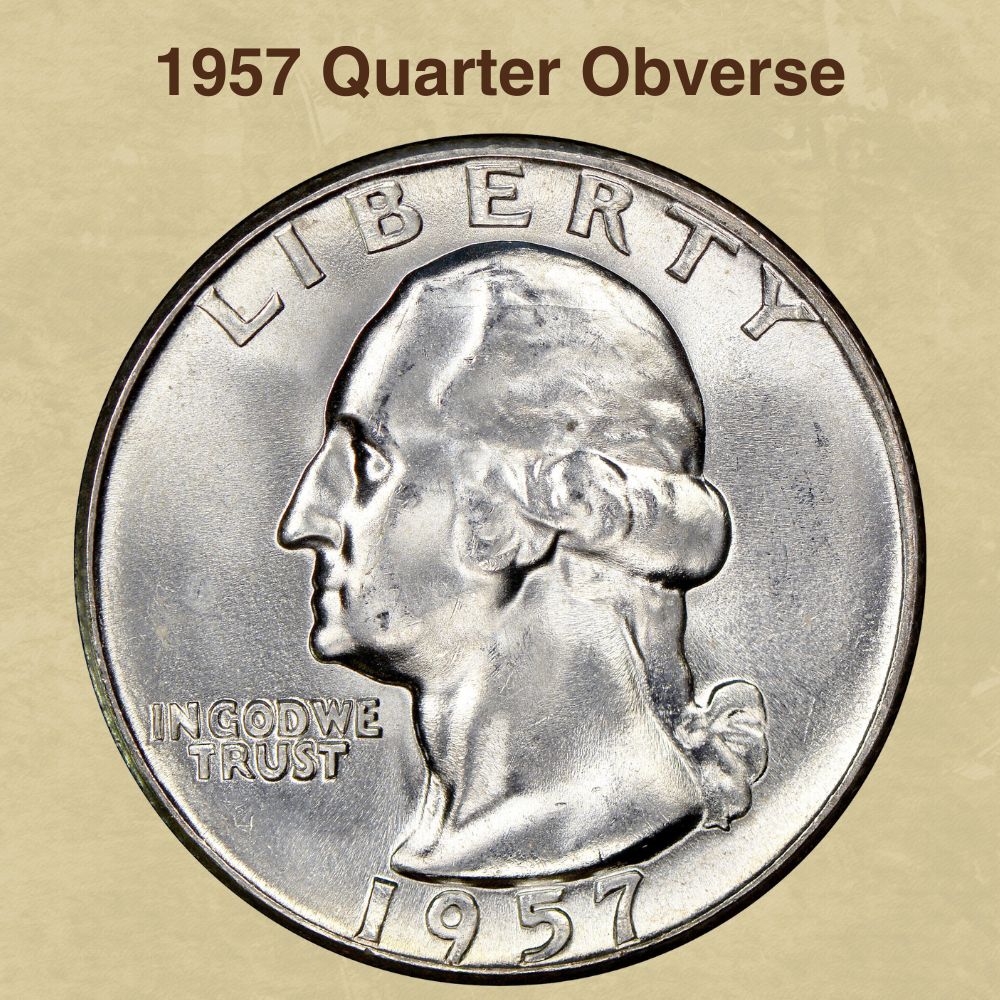
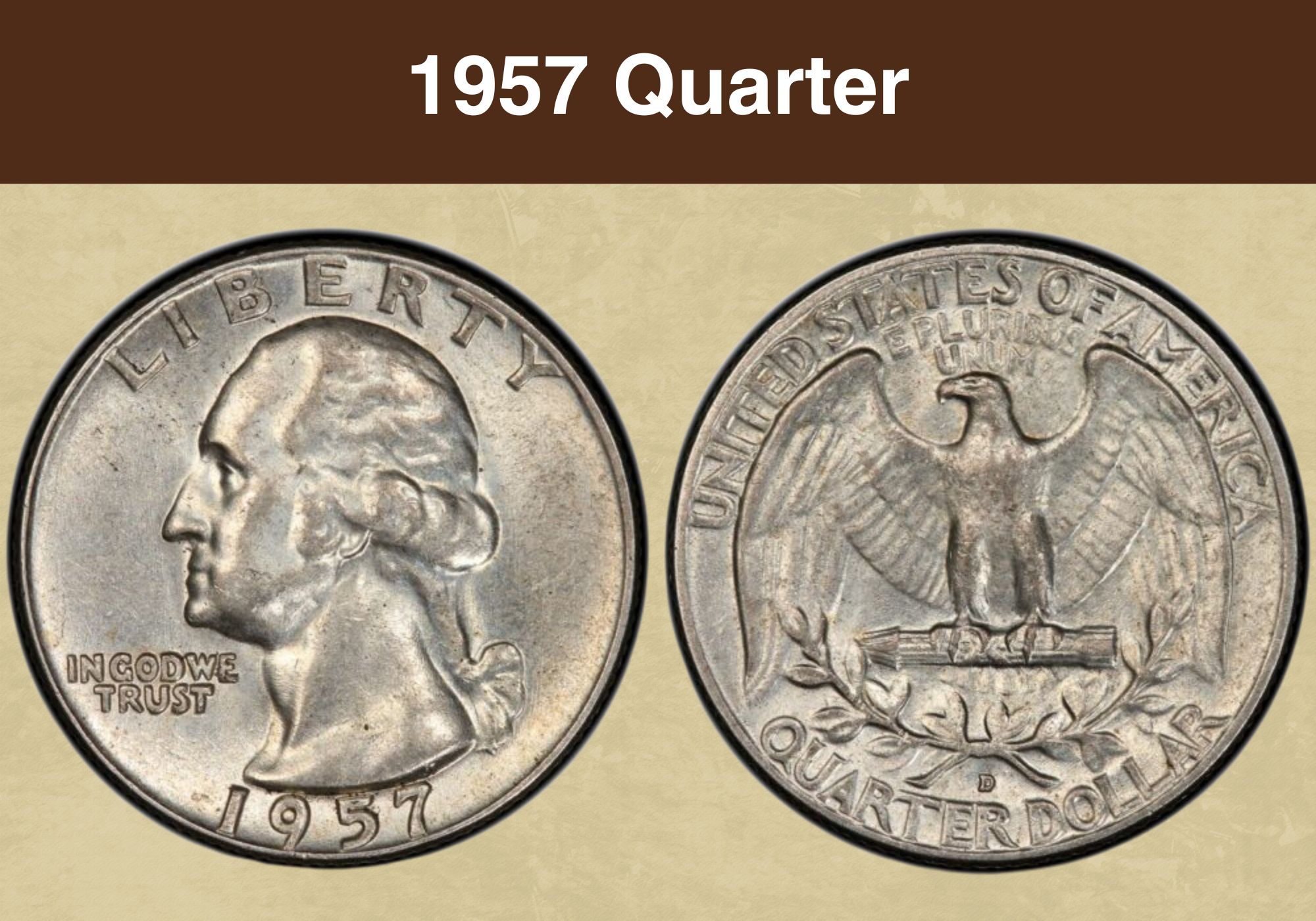
The Obverse of the 1957 Quarter

The Obverse of the 1957 Quarter

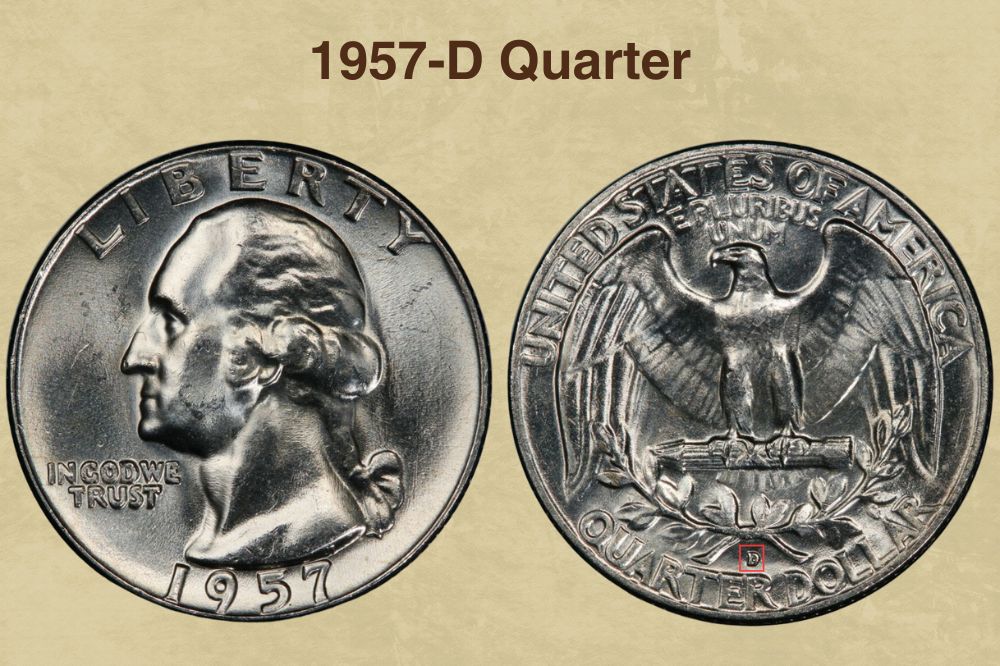
The 1957 quarter obverse displays George Washington’s dignified left-facing profile surrounded by:

  • LIBERTY inscribed above along the rim
  • 1957 (the date) positioned below
  • IN GOD WE TRUST along the left side
  • JF initials (John Flanagan’s mark) at the base of Washington’s neck

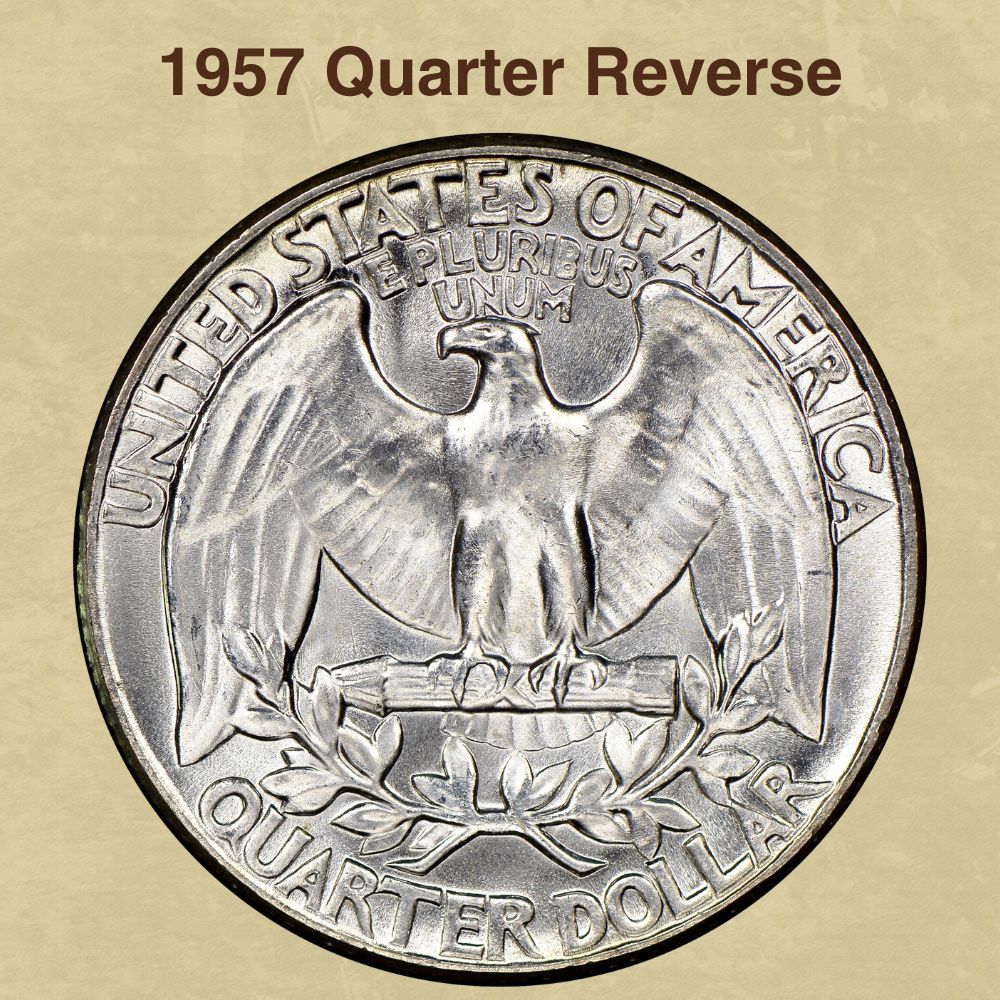
The Reverse of the 1957 Quarter

The Reverse of the 1957 Quarter

The reverse continues Flanagan’s iconic heraldic eagle design featuring:

  • A centrally positioned American bald eagle with outstretched wings
  • Arrow bundle beneath the eagle’s talons, symbolizing military strength
  • Two olive branches representing peace
  • QUARTER DOLLAR inscription below
  • UNITED STATES OF AMERICA around the top
  • E PLURIBUS UNUM motto
  • Mint mark D positioned between the eagle’s tail and QUARTER DOLLAR (Philadelphia coins have no mint mark)

Other Features of the 1957 Quarter

The 1957 quarters maintain the classic Washington specifications with 25 cents face value and a 90% silver, 10% copper composition containing 0.1808 troy ounces (5.623 g) of pure silver within the total weight of 6.25 grams.

Each perfectly round specimen features a reeded edge with standardized dimensions of 1.75 mm thickness and 24.3 mm diameter — specifications unchanged from the first Washington quarter struck in 1932.

Also Read: Top 20 Most Valuable 1776-1976 Bicentennial Quarter


1957 Quarter Mintage & Survival Data

1966 Quarter Mintage & Survival Chart

Mintage Comparison

Survival Distribution

TypeMintageSurvivalSurvival Rate
No Mint Mark46,532,0004,653,0009.9996%
D77,924,1607,792,0009.9995%
PR1,247,952525,00042.0689%
CAM1,247,952160,00012.821%
CAM1,247,95233,0002.6443%

The 1957 quarter mintage and survival data reveals fascinating insights into both business strike and proof production during this record-breaking year.

Denver dominated with nearly 78 million quarters compared to Philadelphia’s 46.5 million, yet both varieties show remarkably similar survival rates around 10%. This translates to approximately 7.79 million surviving Denver quarters versus 4.65 million Philadelphia examples.

The proof story is dramatically different. While over 1.2 million proofs were originally struck, survival rates drop sharply based on quality level. Regular proofs maintain a healthy 42% survival rate with roughly 525,000 examples remaining, Cameo (CAM) proofs drop to just 12.8% survival (around 160,000 pieces), and the coveted Deep Cameo (DCAM) variety survives at only 2.64% — a mere 33,000 specimens.

Independent research by numismatic scholar Dr. Richard S. Appel, published in CoinWeek, further confirms that DCAM examples from this era represent some of the true condition rarities of the entire Washington quarter series.

Also Read: Top 100 Most Valuable Washington Quarter Worth Money (1932 – 1998)


The Easy Way to Know Your 1957 Quarter Value

Evaluating your 1957 quarter comes down to three critical factors. First, check the mint — Philadelphia (no mint mark) produced weakly struck coins from worn dies, while Denver’s sharp, well-struck examples command higher premiums at the same grade level.

Second, determine the proof finish — standard proofs trade around $26, Cameo proofs (CAM designation, meaning frosted devices against mirror fields) jump to roughly $77, and Deep Cameo proofs (DCAM) command $1,553 and above thanks to their 2.64% survival rate.

Third, look for error varieties. The Type B Reverse hybrid (FS-901), Misplaced Mint Mark (FS-501), and Re-engraved TF (FS-901) can each add $200 to $2,363 in premium value depending on grade and specific variety.

The 90% silver content guarantees a baseline melt value of approximately $8–$14 depending on the current silver spot price — meaning every 1957 quarter is worth more than face value just to start.

CoinVaueChecker App 10

Coin Value Checker App eliminates guesswork — photograph your quarter to instantly distinguish proof finishes from business strikes, detect cameo designations, identify Type B Reverse errors, and receive accurate valuations reflecting survival data and real auction market premiums.

Coin Value Checker APP Screenshoot


1957 Quarter Guides

  • 1957 No Mint Mark Quarter (Philadelphia)
  • 1957-D Quarter (Denver)
  • 1957 Proof Quarter (Philadelphia)
  • 1957 Cameo Proof Quarter (Philadelphia)
  • 1957 Deep Cameo Proof Quarter (Philadelphia)

The 1957 Washington quarter series offers collectors an unusually diverse range of varieties, from affordable business strikes to highly coveted Deep Cameo proofs. Philadelphia produced both regular strikes and an extensive proof program totaling over 1.2 million specimens, while Denver focused solely on business strike production with a record-breaking 77.9 million coins — the highest Denver mintage since 1944.

The proof varieties showcase different levels of contrast and eye appeal, from standard proofs to the highly coveted Deep Cameo examples with frosted devices and mirror-like fields. This variety makes 1957 an interesting year for collectors seeking both affordable entry points and serious condition rarities within a single date.


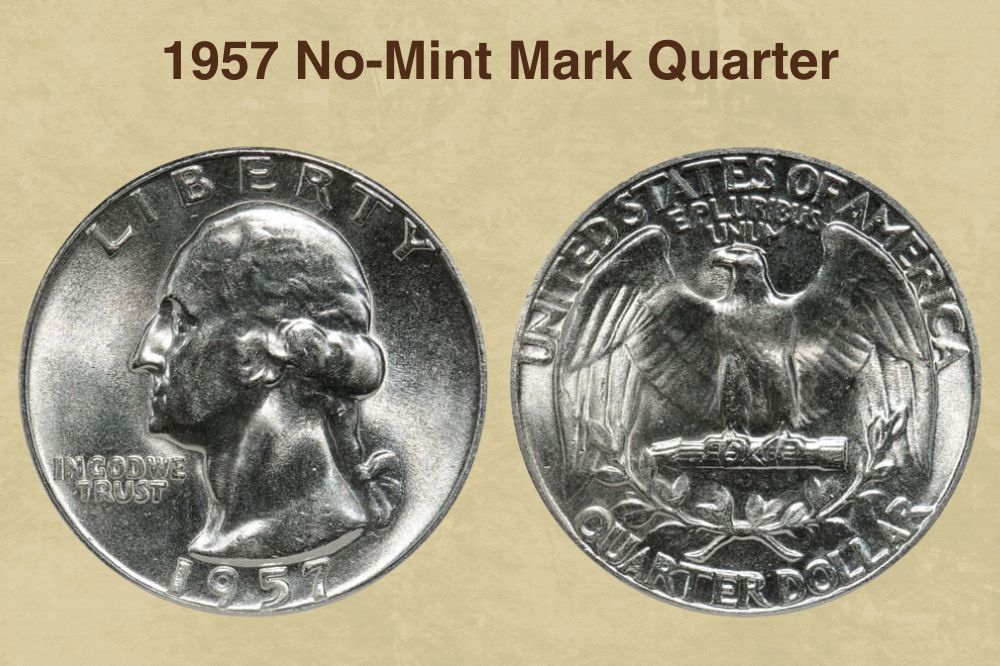
1957 No Mint Mark Quarter Value

1957 No Mint Mark Quarter Value

The 1957 No Mint Mark quarter from Philadelphia is a fascinating study in production struggles and hidden condition rarity. With 46,532,000 coins struck, these quarters are common in circulated grades — but genuinely scarce in pristine gem condition.

The Philadelphia Mint workers carried over worn, re-polished dies from 1956’s heavy production run, resulting in coins with characteristically weak strikes. In an attempt to fix the problem, mint personnel experimented with using proof dies on the reverse of regular strikes, creating the “Type B Reverse” hybrid that has become one of the most recognized varieties of this date. PCGS expert Mitch Spivack has noted that virtually every 1957 Philadelphia quarter to achieve MS67 is a toned specimen from a mint set or album — pristine brilliant examples almost never break MS66. The all-time auction record for the 1957-P is $3,819 for a PCGS MS68, sold by Heritage Auctions in August 2012.

1957 No Mint Mark Quarter Price/Grade Chart

Price by 1-70 Grade (Latest Auction Records Included)

Updated: 2026-05-09 13:35:56

Premium examples and condition rarities have achieved notable results at major numismatic auctions over the decades.

Date PlatformPrice Grade

The ongoing collector interest in these challenging Philadelphia quarters continues to generate steady market activity across all grade levels.

Market activity: 1957 No Mint Mark Quarter


1957-D Quarter Value

1957-D Quarter Value

The 1957-D quarter from Denver is the highest-mintage Washington quarter since 1944, with a record-breaking 77,924,160 coins struck. What makes this variety special is Denver’s superior striking quality compared to Philadelphia’s troubled production that same year.

While Philadelphia struggled with worn dies, Denver maintained sharper, more consistent strikes — creating better-defined details and more accessible gem-quality specimens at the MS65 level. However, above MS65 the story changes dramatically. PCGS expert David Hall has noted the 1957-D is “only a little scarcer” than the 1957-P at the Gem grade, but the population drops off sharply above that, making it a true “condition rarity” above MS67. The ultimate proof is the all-time auction record: a PCGS MS68 example hammered for $11,400 at Stack’s Bowers on March 31, 2021 — nearly triple the Philadelphia record — confirming just how scarce superb-gem Denver quarters really are.

1957-D Quarter Price/Grade Chart

Price by 1-70 Grade (Latest Auction Records Included)

Updated: 2026-05-09 13:35:56

Top-quality specimens and condition rarities have established impressive performance records at prestigious numismatic auction houses throughout the years.

Date PlatformPrice Grade

The sustained collector appreciation for Denver’s superior striking quality continues to drive active market participation across all collecting levels.

Market activity: 1957-D Quarter


1957 Proof Quarter Value

1957 Proof Quarter Value

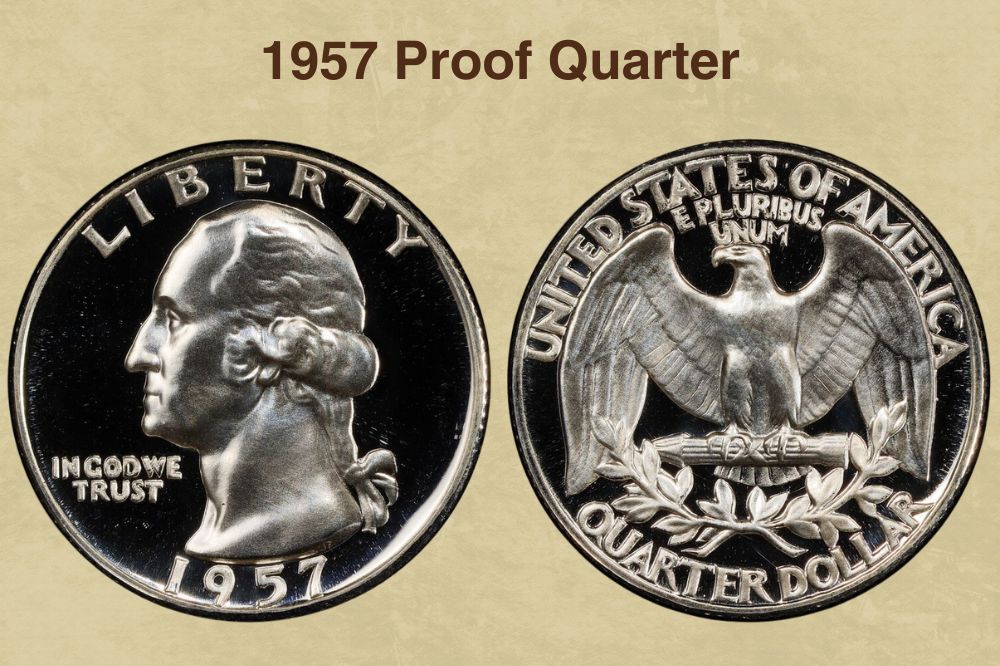
The 1957 Proof quarter from Philadelphia represents a cautionary tale in numismatic speculation. Excessive collector demand following 1956’s well-received proof sets caused massive over-ordering, forcing the U.S. Mint to strike a then-record 1,247,952 proof sets to meet demand.

The resulting quality suffered — proof dies became worn and over-polished from the sheer volume, producing coins that lacked the sharp detail and brilliant contrast expected from proof coinage. When the huge mintage became public knowledge, the secondary market for 1957 proof sets collapsed nearly overnight, establishing 1957 proofs as some of the most accessible entry-level proof coins in the Washington quarter series. It is worth noting that proof coin production had been suspended entirely from 1943 through 1949 due to World War II demands, so by 1957 collector appetite for proofs had built up considerably — which helps explain the speculative frenzy. A standard PR69 example sold for $548 (eBay, 2019), reflecting the relative abundance of high-grade standard proofs.

1957 Proof Price/Grade Chart

Price by 1-70 Grade (Latest Auction Records Included)

Updated: 2026-05-09 13:35:56

Exceptional quality examples and rare contrast varieties have achieved solid results at major auction events over the collecting decades.

1957 Proof Quarter Price/Grade Chart

Price by 1-70 Grade (Latest Auction Records Included)

Updated: 2026-05-09 13:35:56

The enduring appeal of affordable proof quarters continues to maintain consistent market interest among both novice and experienced collectors.

Market activity: 1957 Proof Quarter


1957 CAM Quarter Value

1957 CAM Quarter Value

The 1957 Cameo Proof (CAM) quarter represents a meaningful step up from the standard proof in both visual appeal and rarity. The CAM designation — meaning frosted, raised devices contrast against mirror-like background fields — can only be achieved from the earliest impressions of a fresh proof die before normal wear dulls the frosting.

With a survival rate of just 12.8%, only around 160,000 CAM examples remain from the original 1.24 million proof mintage. This dramatic attrition reflects the rigorous standards required for the Cameo designation — many proofs that initially showed some frosting have since lost it through handling or environmental exposure. An NGC PR69 CAM example has realized $290 at auction, demonstrating the premium the market assigns to even moderate contrast levels. The $77 premium over regular proofs rewards the eye appeal and technical quality that proper Cameo contrast provides.

1957 CAM Price/Grade Chart

Price by 1-70 Grade (Latest Auction Records Included)

Updated: 2026-05-09 13:35:56

Premium Cameo examples and exceptional quality specimens have delivered strong performance records at numismatic auction houses throughout the years.

1957 CAM Price/Grade Chart

Price by 1-70 Grade (Latest Auction Records Included)

Updated: 2026-05-09 13:35:56

The growing appreciation for proof varieties with superior contrast continues to fuel active collector interest in these visually striking quarters.

Market activity: 1957 CAM Quarter


1957 DCAM Quarter Value

1957 DCAM Quarter Value

The 1957 Deep Cameo Proof (DCAM) quarter is the rarest and most valuable of all 1957 varieties, featuring dramatic, heavy frosting on raised design elements set against deeply mirrored background fields. The DCAM designation requires perfect preservation of the original die surfaces — something most proofs have long since lost after six-plus decades.

With only a 2.64% survival rate and fewer than 100 DCAM examples certified across all grades by PCGS and NGC combined, these coins are among the most conditionally rare Washington quarters of the entire 1932–1998 silver series. The auction market confirms this scarcity: PR69 DCAM examples have hammered for $11,400 to $12,500 at Stack’s Bowers (2023), compared to just $548 for a standard PR69. That single DCAM designation transforms the same grade level into a coin worth more than twenty times its non-cameo counterpart.

1957 DCAM Price/Grade Chart

Price by 1-70 Grade (Latest Auction Records Included)

Updated: 2026-05-09 13:35:56

The finest Deep Cameo specimens and record-setting examples have achieved exceptional results at premier numismatic auction events over the years.

1957 DCAM Price/Grade Chart

Price by 1-70 Grade (Latest Auction Records Included)

Updated: 2026-05-09 13:35:56

The intense collector demand for these ultimate condition rarities continues to drive premium market activity among serious proof specialists.

Market activity: 1957 DCAM Quarter

Also Read: What Quarters Are Worth Money


Rare 1957 Quarter Error List

Error coins add serious excitement to 1957 quarter collecting, transforming high-mintage common coins into valuable numismatic prizes. With over 124 million quarters produced across Philadelphia and Denver that year, minting mistakes were inevitable.

The errors documented below range from accessible entry-level varieties to specialist-level rarities, and each one offers a window into the unique production challenges of 1957.

1. 1957 Type B Reverse FS-901

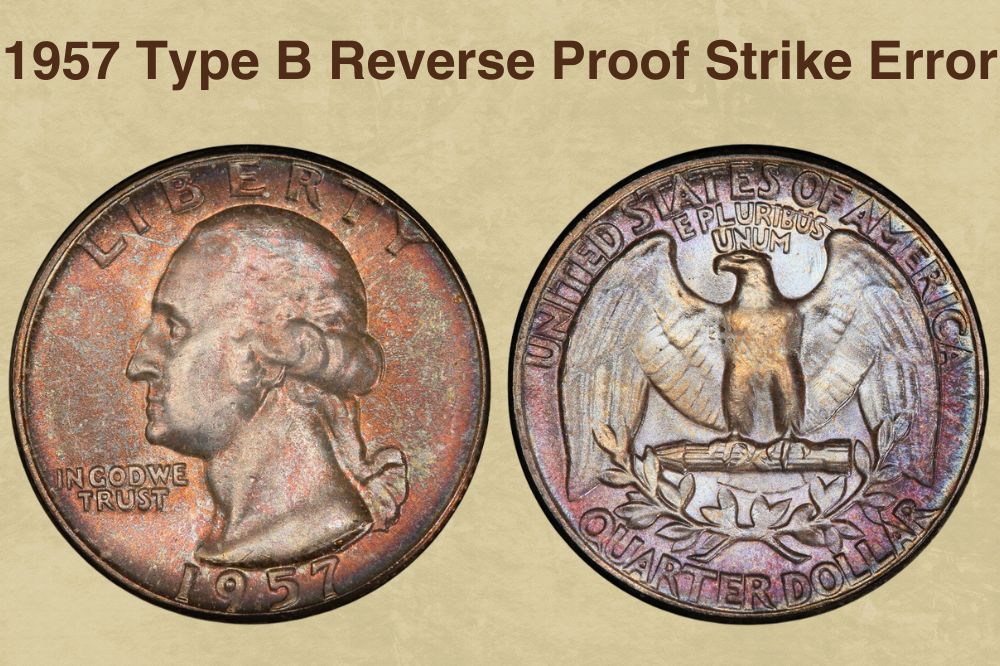
The 1957 Type B Reverse FS-901 is the most recognizable and historically significant error in the entire 1957 Washington quarter series. It occurred when Philadelphia mint workers, struggling with poorly performing regular dies, resorted to using proof dies on the reverse while keeping standard dies on the obverse.

The result is a coin with a characteristically dull, weakly struck obverse contrasted against a bright, sharp, proof-quality reverse — a hybrid that makes 1957 unique in the Washington quarter series. Dr. Richard S. Appel, writing for CoinWeek, described the 1957 Type B Reverse as “the most common issue” within the nine-coin Proof Reverse series spanning 1956–1964, yet noted it remains genuinely scarce in grades above MS66. The documented auction record stands at $423 for an MS67 (Heritage Auctions, 2015), while GreatCollections data shows top-grade examples reaching as high as $2,363 — far above the $200 baseline often cited for entry-level examples.

1957 Type B Rev FS-901 Quarter Price/Grade Chart

Price by 1-70 Grade (Latest Auction Records Included)

Updated: 2026-05-09 13:35:56

2. 1957-D Misplaced MM FS-501

1957-D Misplaced MM FS-501

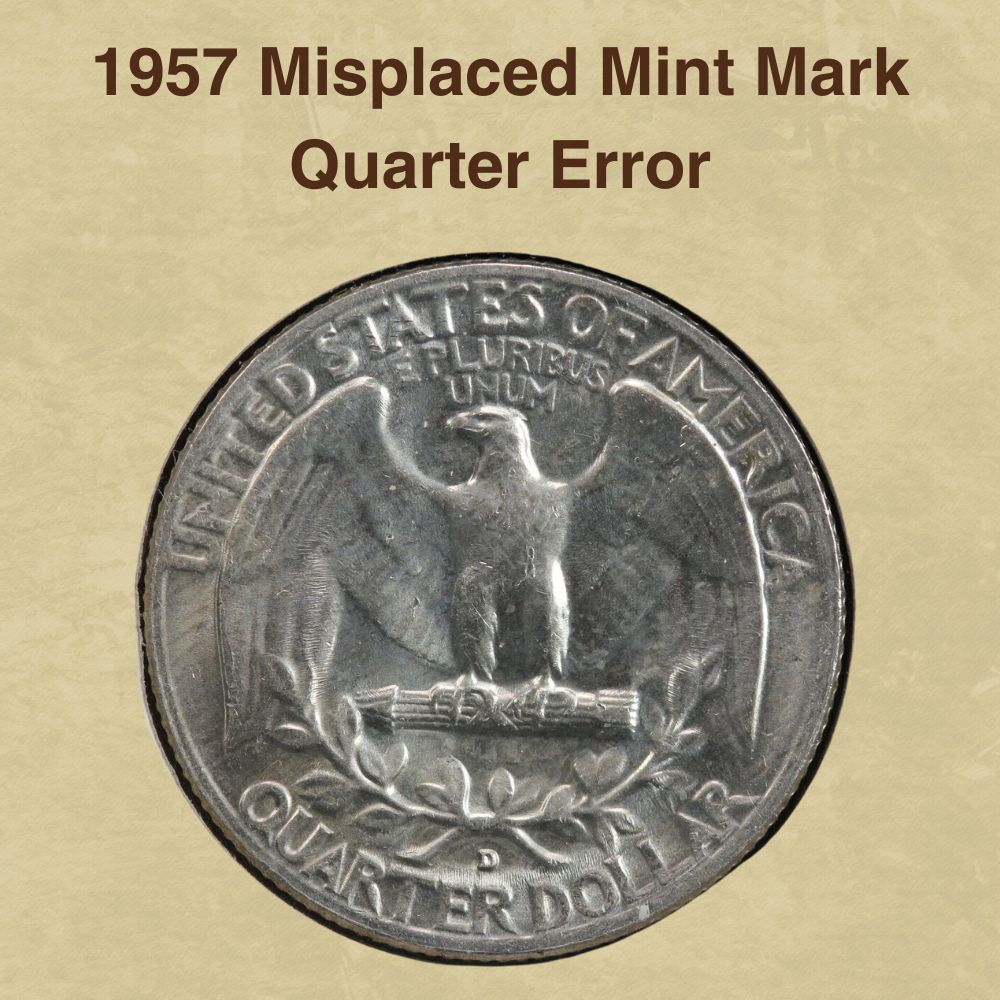
The 1957-D Misplaced Mint Mark FS-501 is one of the most popular variety errors in the Washington quarter series. It occurred when the mint mark punch tool was positioned incorrectly during die preparation, placing the “D” dramatically away from its standard location.

CoinVaueChecker App 10

On a normal 1957-D, Denver’s “D” appears centered just above the “R” in “QUARTER DOLLAR.” On the FS-501 variety, the “D” is noticeably displaced toward the left wreath stem — a bold misplacement visible without magnification on better examples. This variety has strong, well-established market data: PCGS values MS65 examples at $275, while actual auction realizations for MS65 specimens from 2021–2025 have ranged from $144–$192. The all-time auction record for this variety is $1,860 for a PCGS MS66+ graded example, sold by Heritage Auctions in 2021.

1957-D Misplaced MM FS-501 Quarter Price/Grade Chart

Price by 1-70 Grade (Latest Auction Records Included)

Updated: 2026-05-09 13:35:56

3. 1957-D Re-engraved TF FS-901

The 1957-D Re-engraved FS-901 is a die modification variety where mint engravers used an engraving tool to sharpen or enhance worn design details on a working die. Research published by CoinValueChecker confirms that this re-engraving specifically targeted the eagle’s tail feathers on the reverse — not just the “TF” lettering as some descriptions suggest — where heavy die wear had left the feather details mushy and indistinct.

The repair is visible under magnification as crude, incised lines that enhance the tail feathers but don’t perfectly follow the original contours, sometimes extending into the adjacent arrow bundle. The 1957-D FS-901 is one of the most famous examples in a small cluster of 1950s Washington quarters with similar re-engravings, alongside the 1952 “Superbird” (FS-902) and 1953 (FS-901) varieties. Specialists prize these coins for the rare insight they provide into die maintenance practices at the Denver Mint during this high-mintage production period.

1957-D Re-engraved TF FS-901 Quarter Price/Grade Chart

Price by 1-70 Grade (Latest Auction Records Included)

Updated: 2026-05-09 13:35:56

4. 1957 Doubled Die Obverse (DDO) and Doubled Die Reverse (DDR)

While not listed in the Cherrypickers’ Guide as major varieties, doubled die errors do exist for 1957 quarters and command strong collector premiums when the doubling is clear and dramatic. A Doubled Die Obverse (DDO) shows doubling on obverse elements such as “LIBERTY,” “IN GOD WE TRUST,” or Washington’s portrait details — the result of the die being hubbed twice at slightly different angles during manufacture.

DDO examples typically bring $150–$500 or more depending on the visibility of the doubling. A Doubled Die Reverse (DDR), where doubling appears on the eagle design or reverse lettering, can command $200–$600+ for strong examples. Always have suspected doubled dies authenticated by PCGS or NGC before assuming high value, as mechanical doubling — a common striking artifact with no collector premium — can mimic the look of a true doubled die variety.

5. 1957-D Repunched Mint Mark (RPM)

Repunched Mint Mark (RPM) errors occur when the mint mark punch strikes the die more than once at slightly different positions, creating a doubled or shadowed “D” on the finished coin. This was a common production outcome during the era of hand-punched mint marks, which ended in the early 1990s.

On a 1957-D RPM, look for a secondary shadow or outline around the primary “D” mint mark on the reverse, visible under 5–10x magnification. Minor RPMs on 1957-D quarters sell for $40–$75, while bold, dramatic examples with clear separation between impressions can reach higher premiums. Having a strong RPM authenticated and graded by PCGS or NGC significantly increases its marketability and realized price.

Also Read: 20 Rare Washington Quarter Errors Worth Money (Full List with Pictures)


Where to Sell Your 1957 Quarter?

Whether you’re selling common circulated examples for their silver content or premium Deep Cameo proofs for serious collector money, 1957 quarters offer multiple paths to profit while representing an accessible entry point into the fascinating world of Washington quarter collecting.

Check out now: Best Places To Sell Coins Online (Pros & Cons)


1957 Quarter Market Trend

Market Interest Trend Chart - 1957 Quarter

*Market Trend Chart showing the number of people paying attention to this coin.


FAQ about the 1957 Quarter Value

1. Is a 1957 quarter made out of silver?

Yes. All Washington quarters struck before 1965 — including every 1957 quarter — contain 90% silver and 10% copper, with 0.1808 troy ounces of pure silver per coin. The Coinage Act of 1965, signed by President Johnson on July 23, 1965, ended silver content in quarters starting with the 1965 date. At current silver prices, the melt value of a 1957 quarter is approximately $8–$14, depending on the spot price.

2. What is a 1957 quarter worth today in 2025?

Values range widely depending on condition and variety. Circulated examples are worth $7–$9 based on silver melt value. Uncirculated MS63 coins bring around $15, MS65 grades fetch roughly $50–$100, and MS67 examples sell for $100–$960 depending on mint. The top auction record is $11,400 for a 1957-D MS68 (Stack’s Bowers, 2021) and $12,500 for a 1957 PR69 DCAM (Stack’s Bowers, 2023).

3. What makes a 1957 quarter rare?

Rarity in 1957 quarters is driven by condition rather than low mintage. Both Philadelphia (46.5 million) and Denver (77.9 million) had high production. What creates rarity is the extreme difficulty of finding gem-quality examples: PCGS expert Mitch Spivack has noted that virtually every 1957-P in MS67 is a toned specimen, and blazing brilliant examples almost never exceed MS66. For proofs, Deep Cameo examples with fewer than 100 certified examples across all grades by PCGS/NGC combined represent the true rarities of the date.

4. What is the 1957 Type B Reverse quarter, and how do I spot it?

The Type B Reverse (FS-901) is a hybrid variety where Philadelphia mint workers used a proof die on the reverse while striking with a normal obverse die. The result is a coin with a dull, weakly struck obverse but a bright, sharp, proof-quality reverse. To spot it, compare the sharpness of the obverse (Washington’s portrait) against the reverse (eagle and lettering) — a strong contrast between a flat obverse and a crisp reverse is the telltale sign. These coins trade for $200–$2,363+ depending on grade.

5. How do I tell if my 1957 quarter is a proof?

Proof quarters were struck exclusively at the Philadelphia Mint (no mint mark) using specially prepared dies and polished planchets. They display mirror-like reflective fields (the flat background areas) and sharply struck devices (raised design elements). Proof coins were not released into circulation and typically come from original proof sets. If your coin has a “D” mint mark, it is a business strike, not a proof. Regular proofs have some reflectivity but no frosting; Cameo proofs (CAM) show frosted devices; Deep Cameo proofs (DCAM) have the most dramatic frost-to-mirror contrast and are the rarest and most valuable.

6. What 1957 quarter errors are worth money?

The most valuable 1957 quarter errors are the Type B Reverse FS-901 (worth $200–$2,363+ based on grade), the 1957-D Misplaced Mint Mark FS-501 (worth $144–$1,860+), and the 1957-D Re-engraved FS-901 (featuring enhanced eagle tail feathers). Doubled Die Obverse (DDO) errors can bring $150–$500+, Doubled Die Reverse (DDR) errors fetch $200–$600+, and Repunched Mint Marks (RPMs) range from $40 for minor examples to higher premiums for bold, clear doubling.

7. Should I get my 1957 quarter graded by PCGS or NGC?

Absolutely, if the coin appears to be in uncirculated condition (no wear), is a proof variety, or shows any potential error. PCGS (Professional Coin Grading Service) and NGC (Numismatic Guaranty Company) are the two most respected third-party grading services. Their encapsulated (“slabbed”) coins sell for dramatically more than raw coins — for example, a 1957-D MS68 in a PCGS holder sold for $11,400, far beyond what an ungraded coin of the same quality would fetch. Authentication is especially critical for error varieties like the Type B Reverse or Misplaced Mint Mark.

8. Does toning affect my 1957 quarter’s value?

Yes, and often positively. PCGS expert Mitch Spivack has specifically noted that virtually every 1957-P quarter to achieve the MS67 grade level is a toned specimen from a mint set or album. Attractive original toning — rich blues, golds, and reds that develop naturally over decades — can significantly enhance a coin’s eye appeal and push it over the threshold into the next grade level. Artificially induced or “processed” toning, however, has the opposite effect, reducing value sharply. Never attempt to clean or chemically treat your coin; present it to a professional grader as found.

9. How does the 1957 quarter’s silver content compare to modern quarters?

The 1957 quarter contains 0.1808 troy ounces of 90% pure silver, giving it real precious metal value tied to the silver market. Modern quarters (post-1964) contain zero silver — they are struck from a copper-nickel clad composition with a pure copper core. At a silver spot price of around $30–$35 per troy ounce (typical 2024–2025 range), a 1957 quarter is worth $5.50–$6.50 in raw silver alone, compared to exactly 25 cents in metal value for a modern clad quarter.

10. How much does a 1957 silver quarter weigh, and how can I use that to check authenticity?

A genuine 1957 Washington quarter weighs exactly 6.25 grams (0.2204 troy ounces) and measures 24.3 mm in diameter. If you have an accurate digital scale, any coin weighing significantly less than 6.25 grams should raise suspicion. Genuine silver quarters also produce a distinctive high-pitched ring when dropped on a hard surface, versus a dull thud from a copper-nickel clad coin. The edge of a silver quarter is solid silver-grey with no copper layer visible, while a clad coin shows a distinct reddish-copper line around the edge.

You May Also Like