1944 Quarter Value (2026 Guide): Errors List, “D”, “S” & No Mint Mark Worth

1944 Quarter

The 1944 Washington Quarter stands as a remarkable testament to America’s wartime industrial might, with the Philadelphia Mint producing a record-breaking 104.9 million coins — the highest production in the series’ first three decades.

During this pivotal wartime year, all three operating US mints — Philadelphia, Denver, and San Francisco — produced quarters using standard 90% silver composition, working around the clock to meet the nation’s coinage demands.

Today, these wartime silver quarters carry a built-in silver floor value of approximately $8.64 (based on late 2025 silver prices near $47.76 per troy ounce), with collector premiums pushing top-grade and error specimens all the way to $16,800 or more.


1944 Quarter Value By Variety

The value of your 1944 quarter depends significantly on which mint produced it, with Philadelphia (no mint mark), Denver (D), and San Francisco (S) varieties each having different mintages and market values.

If you know the grade of your coin, you can find the exact price below in the Value Guides section.

1944 Quarter Value Chart

TYPEGOODFINEAUMSPR
1944 No Mint Mark Quarter Value$17.00$17.17$19.00$27.83
1944-D Quarter Value$17.00$17.17$19.00$29.83
1944-S Quarter Value$17.00$17.17$19.00$33.50
Updated: 2026-03-16 02:32:57

Also Read: Top 100 Most Valuable Modern Quarter Worth Money (1932 – Present)


Top 10 Most Valuable 1944 Quarter Value Records Worth Money

Most Valuable 1944 Quarter Chart

2008 - Present

The MS68 grade (Mint State — meaning the coin shows absolutely no wear and scores 68 out of a possible 70 on the Sheldon Scale) represents the absolute pinnacle of preservation for 1944 quarters, with fewer than a dozen known examples across all three mints combined.

The 1944 Philadelphia leads at $16,800 at Heritage Auctions in August 2022, despite producing over 104 million coins — its superior strike quality from fresh dies early in the production run contributed to better long-term preservation. PCGS (Professional Coin Grading Service, the leading third-party authentication firm) specifically notes that the 1944 is the highest-mintage pre-1962 Washington quarter.

The 1944-S commands $16,100 — achieved at Stack’s Bowers in March 2011 for a CAC-approved specimen — while the 1944-D’s $10,575 at Heritage Auctions in 2015 reflects Denver’s intermediate production of 14.6 million pieces. CAC stands for Certified Acceptance Corporation, a secondary verification service that reviews already-graded coins and stamps its approval sticker on examples that genuinely meet or exceed their assigned grade, typically adding 10–30% to market value.

The dramatic price escalation from MS67 to MS68 illustrates how “conditional rarity” drives values in the top tier. This concept means a coin can be extremely common in worn grades yet genuinely scarce in pristine Mint State condition — exactly the situation with the 1944 quarter.

Lower grades like MS65–MS67 show more reasonable price gaps, with MS67 examples ranging from $900 to $1,469. Third-party authentication by PCGS or NGC (Numismatic Guaranty Corporation, the other major grading service) becomes essential at these price levels, as a single-grade difference can mean thousands of dollars.


History Behind the 1944 Quarter Value

The first Washington quarters appeared in circulation in 1932 as commemorative coins. The initial idea was to celebrate George Washington’s 200th birthday, and designer John Flanagan based his left-facing portrait on a famous marble bust sculpted by French artist Jean-Antoine Houdon in 1785 — one of the most accurate likenesses of Washington ever created.

Thanks to these coins’ immediate popularity, the US Mint continued their issue in 1934, after a one-year break. Unlike some American coins that lasted only a decade or two, the Washington quarter design has survived to this day.

There was, however, a moment when officials seriously considered replacing Washington’s portrait with Kennedy’s. After President Kennedy’s 1963 assassination, one proposal was to put his image on the quarter, but Mrs. Jacqueline Kennedy opposed removing such a foundational figure from American coinage.

John F. Kennedy ultimately received the half-dollar instead, and Washington remained on the quarter. Unfortunately, rising silver prices made it impossible for their precious metal composition to survive much longer.

The Coinage Act of 1965 — passed by Congress and signed into law by President Lyndon B. Johnson — officially ended silver in circulating quarters, replacing 90% silver with copper-nickel clad. The 1944 quarter belongs to the final generation of silver quarters, and collectors prize it for both its historical resonance and its intrinsic metal content.

The 1944 quarter set was part of the silver era, and the Philadelphia Mint issued a record number of coins that year. This mintage was the highest in the first three decades of the series, but many coins were in relatively poor condition due to heavy wartime circulation. It is also worth noting that no proof quarters were produced from 1943 through 1949, as the US Mint suspended the proof program entirely during World War II — making all 1944 quarters business-strike issues.

Also Read: Top 30 Most Valuable State Quarter Worth Money (1999 – 2008)


Is Your 1944 Quarter Value Higher Than Face Value?

29

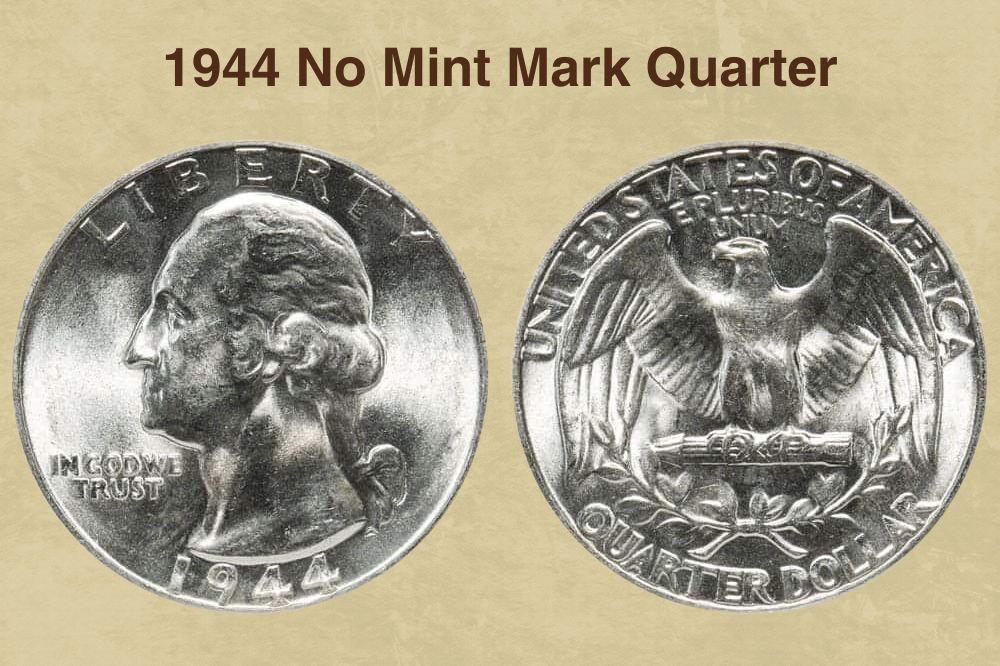
1944 No Mint Mark Quarter

Scarce
Ranked 87 in Washington Quarter
29

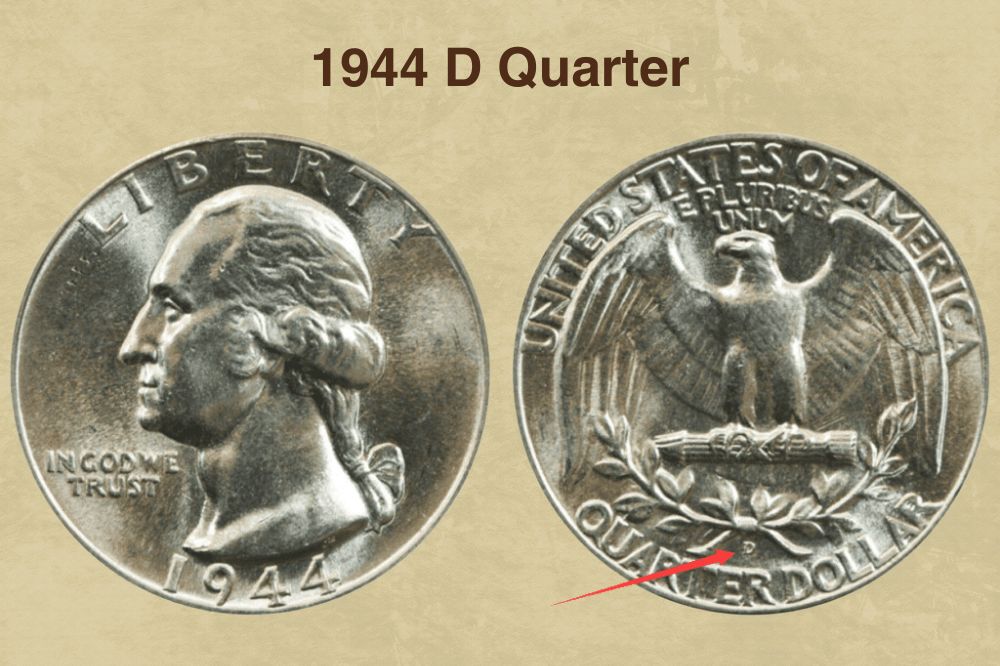
1944 D Quarter

Scarce
Ranked 90 in Washington Quarter
29

1944 S Quarter

Scarce
Ranked 93 in Washington Quarter

Use our CoinValueChecker App for instant rarity analysis and current market valuations of your specific 1944 quarter varieties.

Yes — every 1944 quarter is worth more than its 25-cent face value, because each coin contains 0.18084 troy ounces of pure silver. With silver prices hovering around $47.76 per troy ounce as of late 2025, that means even a heavily worn 1944 quarter carries an intrinsic silver melt value of approximately $8.64.

This melt value acts as your absolute floor price — no problem-free 1944 quarter should ever sell for less, because you could always melt it for that amount. Circulated examples typically trade at a $1–$3 numismatic premium above melt, while high-grade Mint State examples command significantly more.


Key Features Affecting 1944 Quarter Value

John Flanagan’s Washington quarter design reached maturity by 1944, representing the refined version of his original 1932 creation. His portrait was modeled after Jean-Antoine Houdon’s famous 1785 bust, giving the coin a historically authentic face that has stood unchanged for nearly a century.

During this pivotal wartime year, all three operating US mints — Philadelphia, Denver, and San Francisco — produced quarters using standardized dies, eliminating the motto varieties that had appeared in earlier years like 1934.

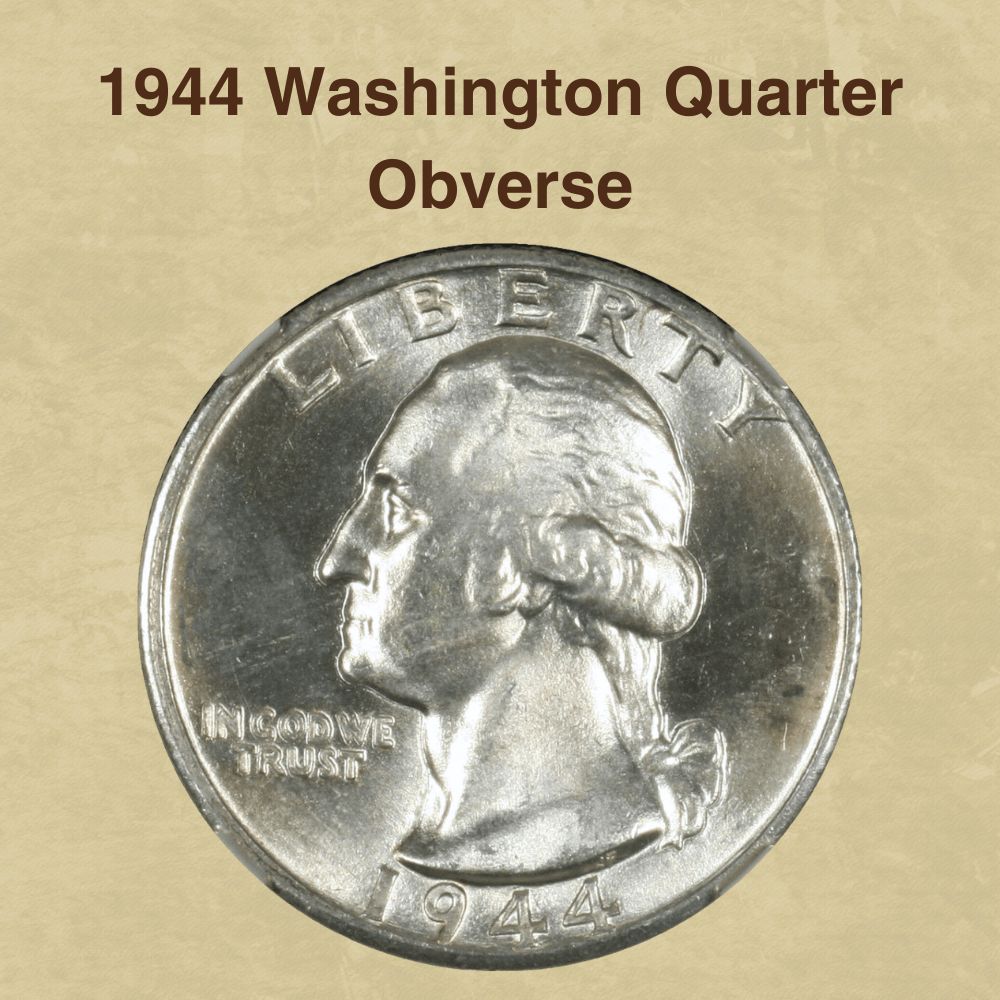
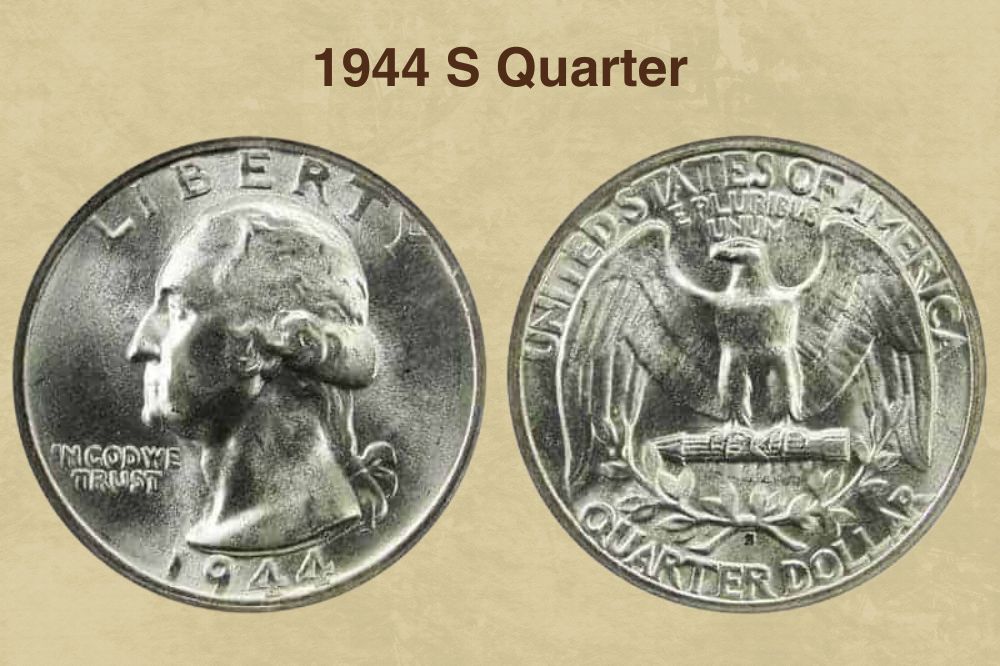
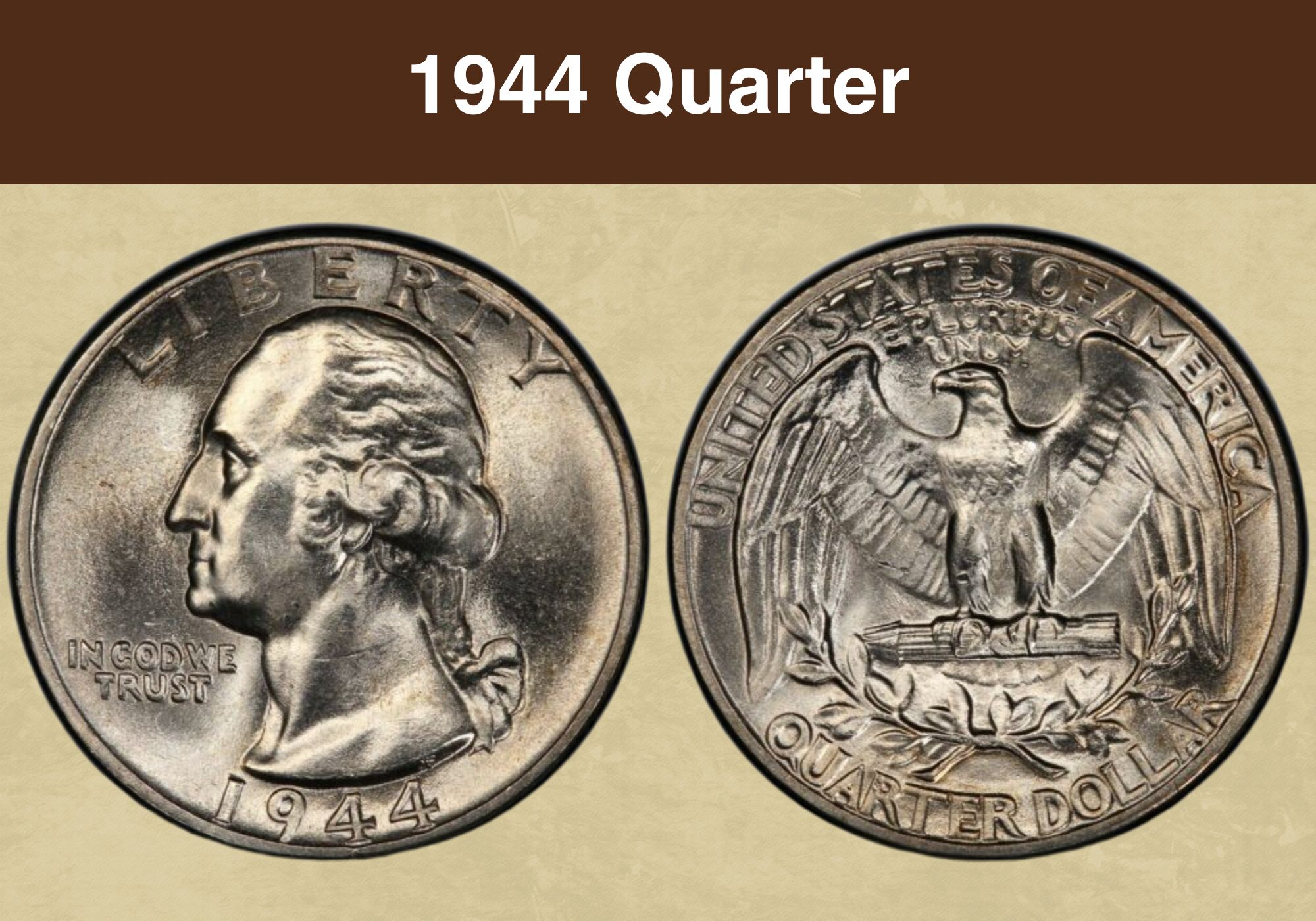
The Obverse of the 1944 quarter

The Obverse of the 1944 quarter

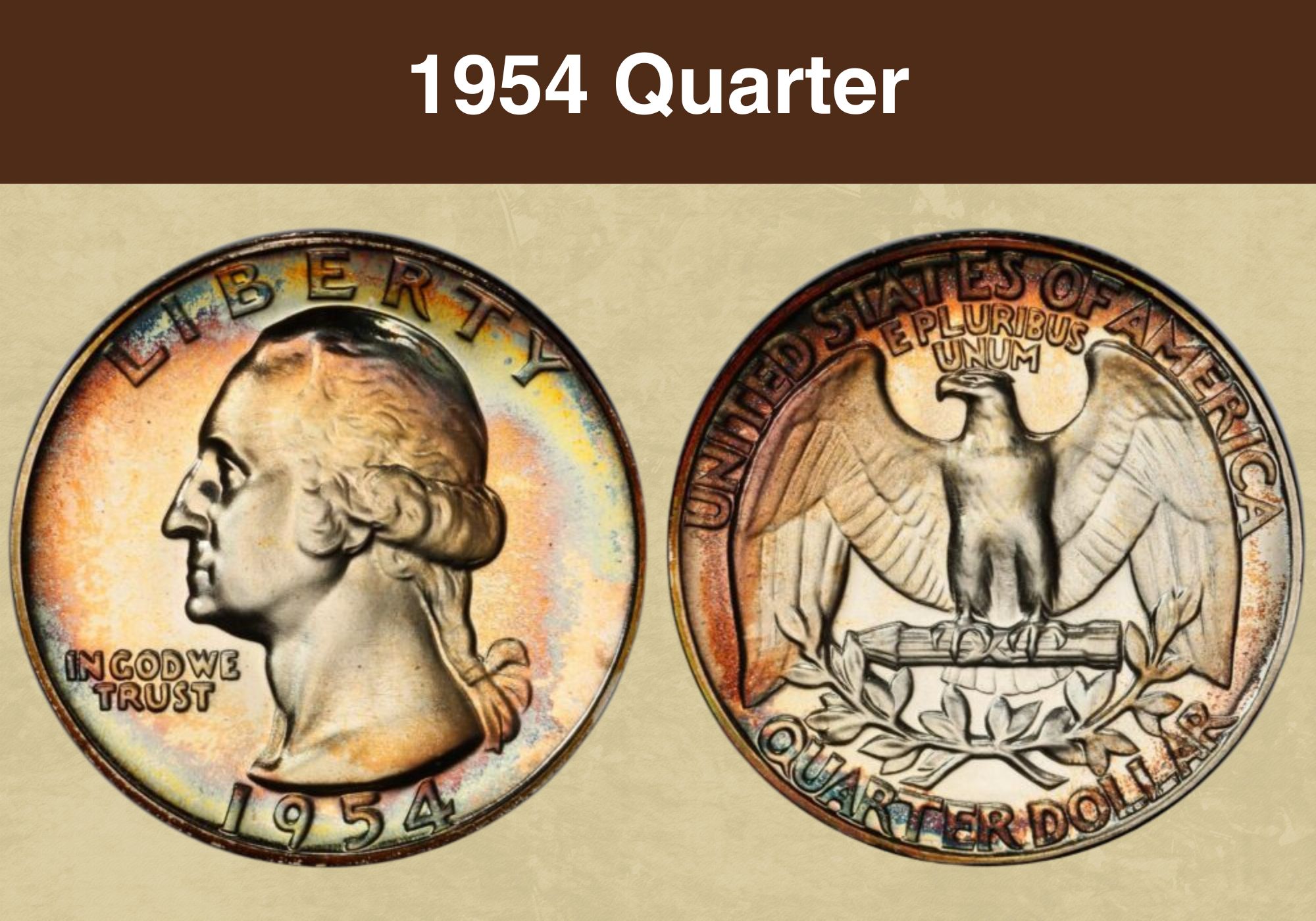
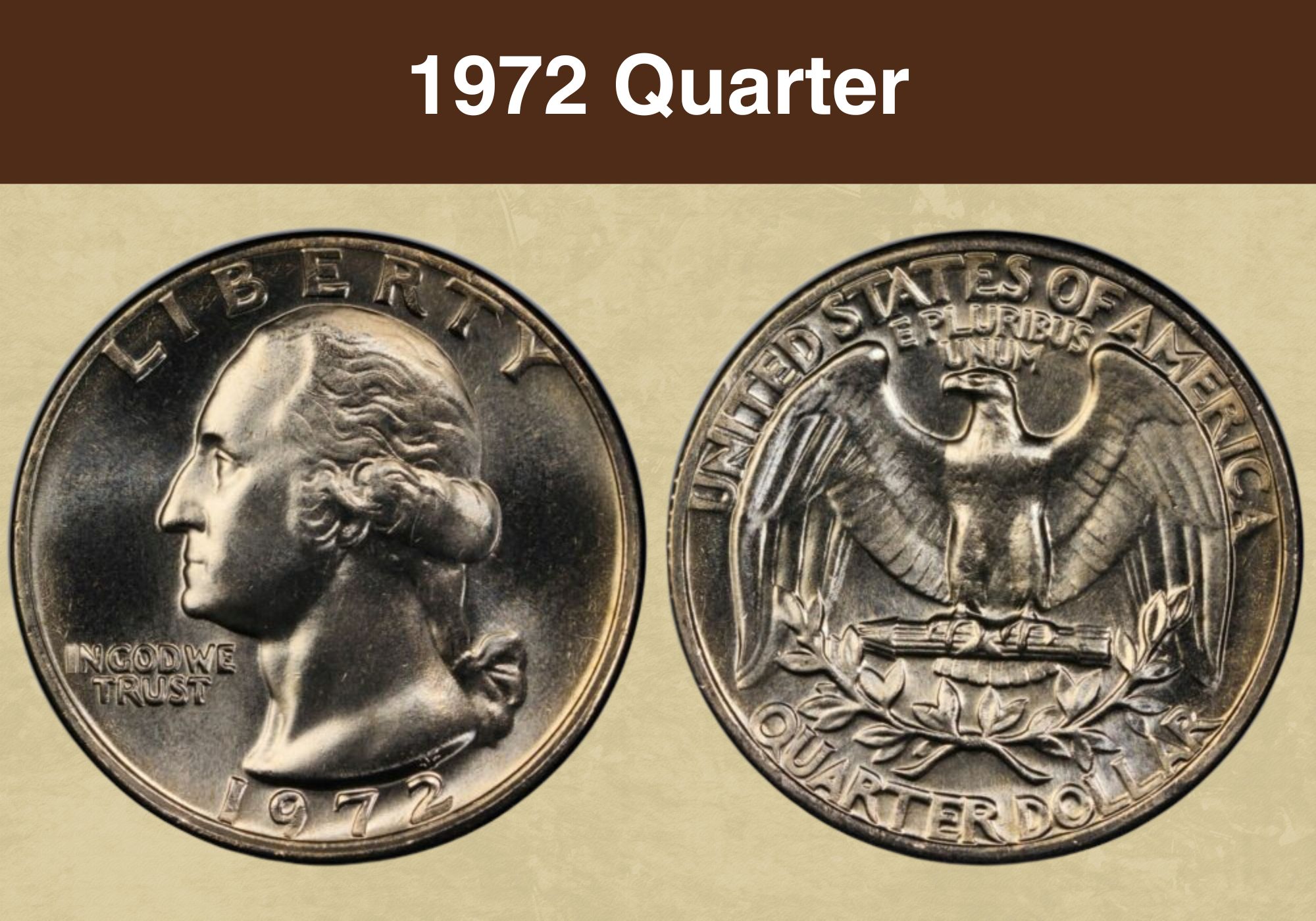
The 1944 quarter obverse showcases George Washington’s dignified left-facing profile surrounded by:

  • LIBERTY inscribed above
  • 1944 (the date) positioned below
  • IN GOD WE TRUST along the left side
  • JF initials (John Flanagan’s mark) at the base of Washington’s neck

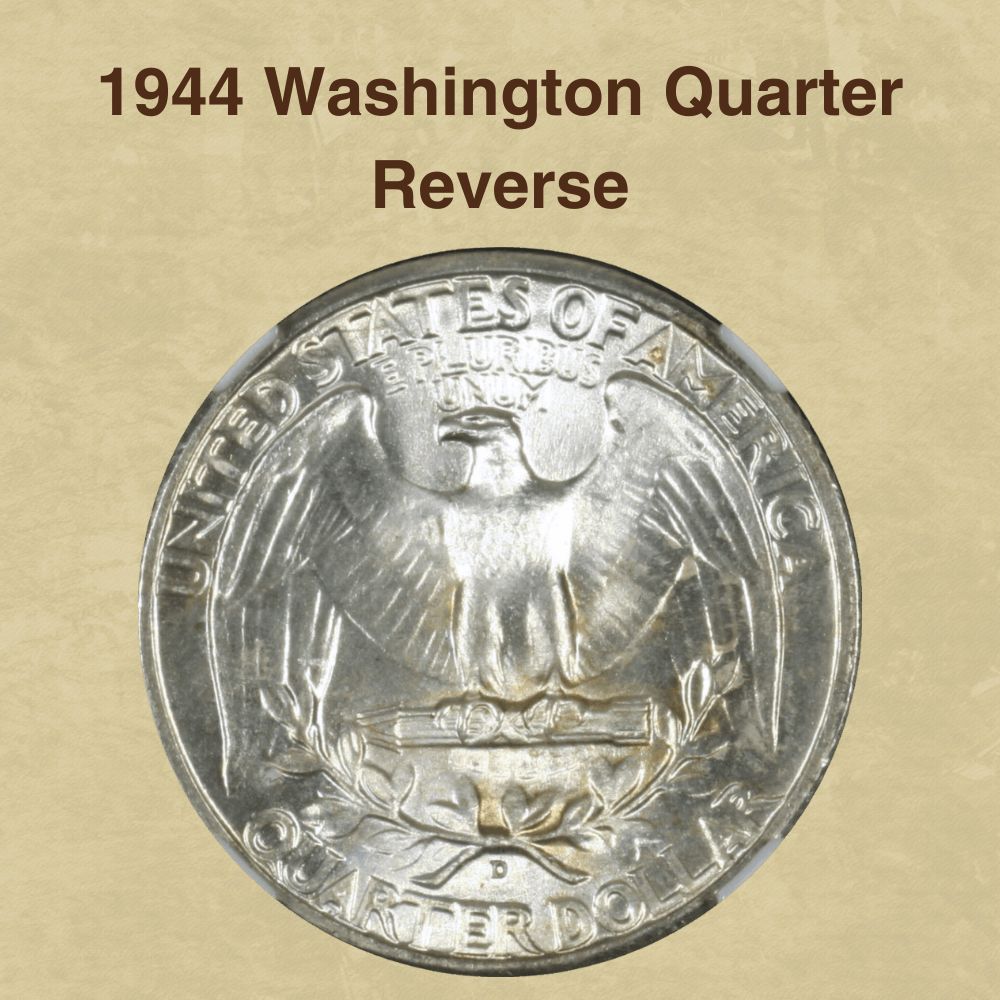
The Reverse of the 1944 quarter

The Reverse of the 1944 quarter

The reverse presents Flanagan’s iconic heraldic eagle design featuring:

  • A centrally positioned American bald eagle with outstretched wings
  • Arrow bundle beneath the eagle’s talons, symbolizing military strength
  • Two olive branches representing peace
  • QUARTER DOLLAR inscription below
  • UNITED STATES OF AMERICA around the top
  • E PLURIBUS UNUM motto
  • Mint mark D or S positioned between the eagle’s tail and QUARTER DOLLAR (Philadelphia coins have no mint mark)

Other features of the 1944 quarter

The 1944 quarters maintain the classic Washington specifications with 25 cents face value and premium 90% silver composition containing 0.1808 troy ounces (5.623 g) of pure silver within the total weight of 0.2204 troy ounces (6.25 g). Each perfectly round specimen features a reeded edge with standardized dimensions of 0.06870 inches (1.75 mm) thickness and 0.95669 inches (24.3 mm) diameter, representing the last generation of silver quarters before the Coinage Act of 1965 changed the composition forever.

Also Read: Top 20 Most Valuable 1776-1976 Bicentennial Quarter


1944 Quarter Value: Mintage & Survival Data

1944 Quarter Mintage & Survival Chart

Mintage Comparison

Survival Distribution

TypeMintageSurvivalSurvival Rate
No Mint Mark104,956,00010,500,00010.0042%
D14,600,8001,460,0009.9995%
S12,560,0001,256,00010%

The complete 1944 quarter mintage and survival data tells a compelling story of wartime production and long-term preservation.

Philadelphia’s massive output of nearly 105 million coins dwarfs the combined production of Denver (14.6 million) and San Francisco (12.56 million), yet all three varieties show remarkably consistent survival rates hovering around 10%. This translates to approximately 10.5 million surviving Philadelphia quarters compared to 1.46 million Denver and 1.256 million San Francisco examples.

The survival distribution dramatically illustrates Philadelphia’s dominance, with no-mint-mark quarters comprising roughly 80% of all surviving 1944 quarters. Despite the vast difference in original mintages, the uniform 10% survival rate across all three mints suggests similar circulation patterns and wear rates regardless of geographic distribution.

This consistency indicates that wartime economic conditions affected coin preservation equally across the country. These survival statistics place 1944 quarters in the middle tier of Washington quarter preservation rates — common enough to be accessible, yet scarce enough in top grades to drive serious premiums.

An important subtlety here is the concept of conditional rarity: the 1944 Philadelphia is extremely easy to find in Good through Fine grades, but progressively harder to locate in Gem condition (MS-65 and above), and virtually impossible to find in MS-68. The 1944-S, while the lowest mintage of the three, is described by PCGS numismatist David Hall as “fairly easy to locate in Gem condition,” because its smaller production run meant more coins were saved by collectors from the very beginning.

Also Read: Top 100 Most Valuable Washington Quarter Worth Money (1932 – 1998)


The Easy Way to Know Your 1944 Quarter Value

Understanding your 1944 quarter’s value involves systematic analysis of wartime production characteristics: survival rate assessment (consistent 10% preservation across all mints translates to actual scarcity despite high mintages), strike quality evaluation (sharply struck Washington hair and eagle breast feathers versus weak strikes from overused dies), and authentication of mint varieties (Philadelphia’s 104.9M, Denver’s 14.6M, San Francisco’s 12.56M).

Beyond the current silver melt floor of approximately $8.64 (at late-2025 spot prices), premium values emerge from exceptional preservation — MS67 examples range $900–$1,469, while ultra-rare MS68 grades achieve $10,575–$16,800. Error varieties like DDO FS-101 add substantial premiums, with the 1944-S version reaching $18,400, and dramatic wrong-planchet errors commanding $3,000 or more even in circulated condition.

CoinValueChecker App simplifies expert authentication — capture images to instantly analyze mint mark placement, grade preservation level, detect doubled die characteristics, and access real-time valuations based on population reports and auction benchmarks.

CoinValueChecker APP Screenshoot


1944 Quarter Value Guides

1944 Quarter Varieties:

CoinVaueChecker App 10

  • 1944 No Mint Mark Quarter (Philadelphia)
  • 1944-D Quarter (Denver)
  • 1944-S Quarter (San Francisco)

The 1944 Washington quarter was produced at all three operating US Mint facilities during World War II, creating three distinct varieties identifiable by their mint marks.

The Philadelphia Mint, following traditional protocol, produced coins without mint marks, while Denver and San Francisco issues feature small “D” and “S” mint marks respectively, located on the reverse between the eagle’s tail feathers and “QUARTER DOLLAR” inscription. It is also worth noting that no proof versions of the 1944 quarter exist — the US Mint suspended the proof coin program entirely from 1943 through 1949 due to wartime demands, so every authentic 1944 quarter you encounter is a business-strike circulation coin.

Despite different production quantities — Philadelphia’s record 104.9 million, Denver’s 14.6 million, and San Francisco’s 12.6 million — all three varieties maintain similar collectible values in circulated grades due to their substantial mintages and comparable survival rates of approximately 10%.


1944 No Mint Mark Quarter Value

1944 No Mint Mark Quarter Value

The 1944 No Mint Mark quarter from Philadelphia holds the distinction of being the most abundantly produced Washington quarter of its era, with a staggering 104.9 million coins struck — a production record that PCGS confirms was not surpassed in the pre-1962 Washington quarter series.

What makes this variety particularly interesting is the concept of conditional rarity at work: it is by far the easiest 1944 quarter to find in worn condition, yet it achieved the highest top-grade auction price of the three varieties ($16,800 for an MS68 at Heritage Auctions, August 2022). The absence of a mint mark, following Philadelphia’s traditional practice, creates a clean reverse design that many collectors prefer aesthetically.

1944 No Mint Mark Quarter Price/Grade Chart

Price by 1-70 Grade (Latest Auction Records Included)

Updated: 2026-03-16 02:32:57

Premium examples and rare high-grade specimens have consistently performed well at major numismatic auctions throughout the years.

Date PlatformPrice Grade

The sustained collector interest in these historically significant Philadelphia quarters continues to drive robust market activity.

Market activity: 1944 No Mint Mark Quarter


1944-D Quarter Value

1944-D Quarter Value

The 1944-D quarter from Denver represents a significant milestone in Western mint production, with 14.6 million coins struck during the height of World War II.

What makes this variety particularly noteworthy is Denver’s crucial role in supporting wartime commerce across the American West, where these quarters circulated heavily in mining communities and defense manufacturing centers. The small “D” mint mark, positioned between the eagle’s tail feathers and “QUARTER DOLLAR” on the reverse, identifies these coins as products of the Denver facility’s wartime coinage efforts.

Despite lower mintage compared to Philadelphia, the 1944-D maintains similar collector accessibility due to adequate survival rates, though high-grade examples command premiums reflecting their regional significance. In MS66, a Heritage Auctions sale recorded a DDO example bringing $460, while the finest-known MS68 reached $10,575 at Heritage Auctions in August 2015.

1944-D Quarter Price/Grade Chart

Price by 1-70 Grade (Latest Auction Records Included)

Updated: 2026-03-16 02:32:57

Top-quality specimens and error varieties have established strong performance records at prestigious numismatic auction houses over the decades.

Date PlatformPrice Grade

The enduring appeal of Denver mint quarters continues to generate consistent market activity among collectors specializing in Western coinage.

Market activity: 1944-D Quarter


1944-S Quarter Value

1944-S Quarter Value

The 1944-S quarter from San Francisco stands out as the lowest-mintage variety of the year, with only 12.56 million coins produced at the Pacific Coast facility during wartime operations.

What makes this variety particularly special is San Francisco’s strategic importance in supporting the Pacific Theater war effort, where these quarters circulated among defense workers in shipyards, aircraft factories, and military installations. The distinctive “S” mint mark, nestled between the eagle’s tail feathers and “QUARTER DOLLAR,” identifies these coins as products of the West Coast’s premier minting facility.

Recent auction data (2021–2023) shows MS67 specimens of the 1944-S selling in the $348–$763 range at auction — somewhat higher than retail price guide listings, suggesting a strengthening collector market for top-grade San Francisco examples. The finest known example, an MS68 with CAC approval (meaning it passed a secondary quality review by the Certified Acceptance Corporation), sold at Stack’s Bowers in March 2011 for $16,100.

1944-S Quarter Price/Grade Chart

Price by 1-70 Grade (Latest Auction Records Included)

Updated: 2026-03-16 02:32:57

Exceptional quality specimens and notable error varieties have achieved remarkable results at major auction events throughout collecting history.

Date PlatformPrice Grade

The sustained collector demand for San Francisco mint quarters continues to fuel active market participation across all grade levels.

Market activity: 1944-S Quarter

Also Read: What Quarters Are Worth Money


Rare 1944 Quarter Value: Complete Error List

Collecting 1944 quarters becomes truly exciting when you discover the various minting errors that occurred during their massive wartime production.

While the US Mint struck over 132 million quarters across three facilities in 1944, even the most careful production processes could not prevent occasional mistakes that create today’s most sought-after varieties. These error coins range from subtle doubled dies visible only under magnification to dramatic striking anomalies that stand out immediately.

Since error coins were unintentional and often went unnoticed for decades, surviving examples are significantly rarer than regular strikes, making them highly prized by collectors willing to pay substantial premiums for these fascinating minting mishaps.

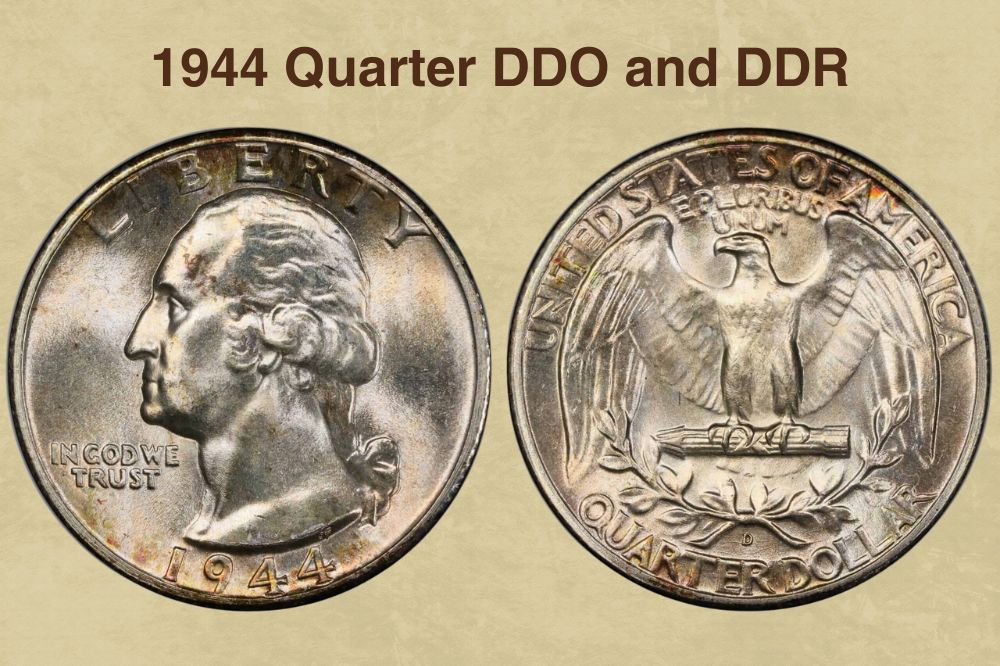
1. 1944 Doubled Die Obverse (DDO FS-101)

The 1944 DDO FS-101 stands as one of the most significant error varieties in the Washington quarter series, featuring dramatic doubling visible on the obverse inscriptions and date.

This error occurred when the working die received a second, slightly offset impression during the hubbing process (the mechanical step that transfers a design from a master hub onto a working die), creating the characteristic doubled appearance. The doubling is most pronounced on “LIBERTY,” the date “1944,” and Washington’s hair details, making it easily identifiable even to novice collectors. Unlike subtle doubled dies that require magnification, the FS-101 variety shows clear separation between the primary and secondary images.

With examples ranging from $75 in lower grades to over $18,000 for the finest known specimens, this error represents the pinnacle of 1944 quarter collecting and commands respect from serious numismatists worldwide.

1944 DDO (FS-101) Quarter Price/Grade Chart

Price by 1-70 Grade (Latest Auction Records Included)

Updated: 2026-03-16 02:32:57

2. 1944-D Doubled Die Obverse (DDO FS-101)

The 1944-D DDO FS-101 represents the Denver mint’s contribution to the doubled die error family, featuring clear doubling on the obverse elements including “LIBERTY,” the date, and portions of Washington’s portrait.

This error occurred during the die preparation process when the working die received multiple impressions from the master hub, creating the characteristic doubled appearance. The doubling is most pronounced on the upper inscription and date, making authentication straightforward for experienced collectors.

With values ranging from modest premiums in circulated grades to $460 in MS66 condition — as demonstrated by a Heritage Auctions sale — this Denver error provides an accessible entry point into doubled die collecting while maintaining strong appreciation potential.

1944-D DDO (FS-101) Quarter Price/Grade Chart

Price by 1-70 Grade (Latest Auction Records Included)

Updated: 2026-03-16 02:32:57

3. 1944-S Doubled Die Obverse (DDO FS-101)

The 1944-S DDO FS-101 represents the crown jewel of San Francisco quarter errors, featuring the most dramatic and valuable doubled die variety in the entire 1944 series.

This error showcases prominent doubling on “LIBERTY,” the date “1944,” and Washington’s hair details, with separation so clear it’s visible to the naked eye. What sets the San Francisco variety apart is the exceptional quality of the doubling combined with the lowest original mintage of any 1944 quarter.

With the record-breaking $18,400 sale of an MS63 example at Heritage Auctions in 2004 and current MS67 specimens valued over $1,000, this represents the ultimate prize for Washington quarter error collectors, commanding respect and premium prices that reflect both its visual impact and extreme scarcity.

1944-S DDO (FS-101) Quarter Price/Grade Chart

Price by 1-70 Grade (Latest Auction Records Included)

Updated: 2026-03-16 02:32:57

4. 1944 Quarter Wrong Planchet Error

One of the rarest and most spectacular errors from the wartime era is the wrong planchet strike, where quarter dies accidentally struck blanks intended for a different denomination or foreign coin.

During World War II, US Mint facilities were under enormous production pressure and occasionally processed foreign or different-denomination blanks alongside domestic quarter stock. The most notable example is a 1944 quarter struck on a wartime silver nickel planchet (5-cent blank) — this piece, graded MS62 by NGC, sold at Heritage Auctions’ 2007 CSNS sale in St. Louis from the famed Pacific Coast Mint Error Collection, bringing over $8,000 despite its circulated appearance. Even average circulated examples of quarters struck on nickel planchets are worth approximately $3,000.

A rarer variant involves 1944 quarters struck on Philippine 5-centavo planchets — these pieces, which were produced at US facilities under wartime agreements, typically sell for $500–$2,500 at auction depending on condition and strike quality. Any suspected wrong-planchet error should be submitted directly to PCGS or NGC for authentication before buying or selling, as these high-value attributions require expert verification.

5. 1944 Quarter Off-Center Strike

An off-center strike occurs when the planchet (blank coin) shifts out of position inside the collar ring before the dies come together, resulting in part of the design missing and an uneven, crescent-shaped blank area on one side.

CoinVaueChecker App 10

This type of error could happen at any of the three mints in 1944 and was not intentional — quality control during the wartime era was not always consistent due to high production demands. Value scales directly with how far off-center the coin is: a 5–10% off-center piece might bring $30–$75, while a dramatic 40–50% off-center example with the date still visible can sell for $300–$500 or more.

The most critical rule for off-center coins: the date must be visible to maximize value. A heavily off-center 1944 quarter with no readable date is worth considerably less than one where the date and even the mint mark are fully present.

6. 1944 Quarter Clipped Planchet Error

A clipped planchet error results from a malfunction in the automatic coin blank cutting machine, where the strip of metal is not fed through evenly and the punch overlaps a previously cut hole — producing a blank with a smooth, curved bite taken out of the edge.

These errors are found across all three 1944 mints and make for eye-catching, conversation-starting coins. Small clips (under 10%) typically sell for $20–$50, while larger or dramatic double-clip examples can reach $100–$200. The rarer “straight clip” variety (from the end of a metal strip) may bring slightly more from specialists.

To verify authenticity, apply the Blakesley Effect test: on a genuine clipped planchet, the rim and design directly opposite the clip will appear weak or incomplete, because metal flow was disrupted during striking. Also weigh the coin — a clipped planchet will weigh less than the standard 6.25 grams of a normal 1944 quarter.

7. 1944 Quarter Repunched Date (RPD)

Multiple Repunched Date (RPD) varieties exist for the 1944 quarter, occurring when the date was punched into the die more than once at a slightly different angle or position, leaving a ghostly secondary impression behind the primary digits.

These varieties require magnification to spot — look carefully at the “1,” “9,” and especially the “4” digits for signs of a secondary outline or shadow. Coins with strong, clearly separated RPD doubling command the best premiums, while faint examples may only bring a small bonus above the silver melt value.

Values for RPD varieties range from a modest $20–$50 premium on circulated examples to considerably more for sharply struck Mint State specimens with dramatic doubling that is clearly separated under 10× magnification.

Also Read: 20 Rare Washington Quarter Errors Worth Money (Full List with Pictures)


Where to Sell Your 1944 Quarter for Top Value

Whether you’re drawn to the record-breaking mintages, seeking high-grade condition rarities, or hunting for dramatic doubled die errors, 1944 Washington quarters offer something for every collector while representing a fascinating chapter in America’s wartime numismatic history.

For average circulated examples worth $8–$15 (near silver melt), selling to a local coin dealer or through an online silver coin marketplace will get you a fair price quickly. For Mint State examples graded MS65 and above, or any suspected error variety, consigning through Heritage Auctions, Stack’s Bowers, or GreatCollections will expose your coin to the widest audience of serious collectors and likely achieve the strongest result.

Check out now: Best Places To Sell Coins Online (Pros & Cons)


1944 Quarter Value Market Trend

Market Interest Trend Chart - 1944 Quarter

*Market Trend Chart showing the number of people paying attention to this coin.


FAQ about the 1944 Quarter Value

How much is a 1944 quarter worth in 2026?

With silver prices near $47.76 per troy ounce (late 2025), any 1944 quarter is worth at least $8.64 in silver melt value alone — that’s the floor price for even a heavily worn example. Circulated coins typically sell for $10–$15, mid-grade Mint State coins (MS63–MS65) range from $20 to $75, and pristine MS67 examples command $900–$1,469 depending on the mint. The very finest MS68 specimens have sold for $10,575 to $16,800 at major auction houses.

Which 1944 quarter variety is the rarest?

By original mintage, the 1944-S from San Francisco is the scarcest with only 12.56 million produced, compared to 14.6 million for Denver and 104.9 million for Philadelphia. However, PCGS expert David Hall notes the 1944-S is “fairly easy to locate in Gem condition” because its lower production led more collectors to save it from circulation early on. In true MS68 condition, all three varieties are extremely rare, with fewer than a dozen known examples combined across all mints.

Were any proof 1944 quarters made?

No — the US Mint suspended its proof coin program entirely from 1943 through 1949 due to World War II production demands. Every authentic 1944 quarter you encounter is a business-strike circulation coin. Proof production did not resume until 1950, when the Mint offered proofs in complete annual sets. This means there are no 1944 proof quarters for collectors to pursue, which simplifies the series but also means all collector value for this year comes from business-strike grades and error varieties.

What is a 1944 quarter struck on the wrong planchet worth?

Wrong-planchet errors are among the most valuable 1944 quarter errors you can find. A 1944 quarter struck on a wartime silver nickel planchet — certified MS62 by NGC — sold at Heritage Auctions’ 2007 CSNS sale for over $8,000. Even circulated examples of quarters struck on nickel planchets are worth approximately $3,000. A rarer variant involves 1944 quarters struck on Philippine 5-centavo planchets, which typically bring $500–$2,500. All suspected wrong-planchet errors must be authenticated by PCGS or NGC before buying or selling.

What does CAC mean on a 1944 quarter holder?

CAC stands for Certified Acceptance Corporation, a secondary grading verification service founded by prominent numismatist John Albanese. When a CAC sticker appears on a PCGS or NGC holder, it means a CAC expert has reviewed the coin and confirmed it genuinely meets or exceeds the quality standards for its assigned grade — essentially a “best of grade” endorsement. CAC-approved 1944 quarters typically command a 10–30% premium over non-CAC examples of the same grade. The record-setting 1944-S MS68 that sold at Stack’s Bowers in March 2011 for $16,100 carried CAC approval.

Which are the costliest 1944 Washington quarters ever sold?

  • At 2004 Heritage Auctions, one collector bought the 1944-S MS63 quarter (DDO error) for $18,400
  • At 2022 Heritage Auctions, one collector bought the 1944 MS68 quarter for $16,800
  • At 2011 Stack’s Bowers, one collector bought the 1944-S MS68 CAC quarter for $16,100
  • At 2015 Heritage Auctions, one collector bought the 1944-D MS68 quarter for $10,575
  • At 2007 Heritage Auctions (CSNS), one collector bought the 1944 wrong-planchet error (MS62 NGC) for over $8,000
  • At 2018 Heritage Auctions, one collector bought the 1944 MS66 quarter (DDO error) for $780
  • At 2018 Heritage Auctions, one collector bought the 1944-D MS66 quarter (DDO error) for $460

How much is a 1944 No Mint Mark quarter worth?

Most No Mint Mark 1944 quarters in circulated condition are worth $8–$15 today, reflecting the current silver melt floor plus a modest collector premium. Nicely preserved Mint State examples (MS63–MS65) range from roughly $20 to $75. Above that threshold, an MS67 example is valued at $900–$1,469, and the finest-known MS68 set the all-time auction record for this variety at $16,800 at Heritage Auctions in August 2022.

How do I identify the 1944 DDO (Doubled Die Obverse) error?

The 1944 DDO FS-101 shows clear doubling most prominently on the word “LIBERTY” at the top of the obverse, the date “1944” at the bottom, and in the fine details of Washington’s hair. Unlike very subtle doubled dies that require a jeweler’s loupe, the FS-101 variety on the 1944-S in particular shows separation visible to the naked eye. For the Philadelphia and Denver varieties, 5× to 10× magnification will reveal the secondary impression clearly. Always compare your coin against published diagnostics in the Cherrypickers’ Guide or on PCGS CoinFacts before submitting for authentication.

How does the Coinage Act of 1965 affect 1944 quarter value?

The Coinage Act of 1965, signed by President Lyndon B. Johnson, eliminated silver from circulating US dimes and quarters, replacing them with copper-nickel clad compositions. This legislation makes all pre-1965 Washington quarters — including every 1944 issue — permanently valuable as silver coins. Because the 1944 quarter contains 0.18084 troy ounces of pure silver, rising silver prices directly raise the floor value of every single 1944 quarter. At $50 per ounce silver, that melt floor would be approximately $9.04; at $60 per ounce, it reaches about $10.85.

Is a 1944 quarter with a clipped planchet valuable?

Yes, clipped planchet errors on 1944 quarters do carry a collector premium. Small clips (under 10% of the coin’s edge) typically add $20–$50 above the base silver melt value, while larger or dramatic double-clip examples can reach $100–$200. The rarest “straight clip” variety, produced from the very end of a metal strip, brings slightly more from specialists. To confirm a genuine clipped planchet (rather than post-mint damage), apply the Blakesley Effect test: the design directly opposite the clip should appear weak or incomplete, because the disrupted metal flow during striking always affects that opposite zone.

Similar Posts