Coin Value Contents Table
- 1935 half-dollar value Chart
- History of the 1935 Walking Liberty Half Dollar
- 1935 half-dollar Types
- Features of the 1935 Half Dollar
- 1935 Walking Liberty Half Dollar Grading
- 1935 Half Dollar Value Guides
- 1935 No Mint mark half-dollar Value
- 1935 D half-dollar Value
- 1935 S half-dollar Value
- Rare 1935 Half Dollar Errors List
- Where to Sell Your 1935 Half Dollar ?
- FAQ about the 1935 Half Dollar
Many numismatists believe the Liberty Walking half-dollar is the most beautiful American coin. Their minting began in 1916 after Adolph Alexander Weinman created this astonishing design and lasted until 1947.
As always when it comes to old coins, the 1935 Half Dollar value primarily depends on their look, quality, and unique imperfections, which they sometimes feature. Be careful when you come across one since perfectly preserved pieces can be worth a fortune.
1935 half-dollar value Chart |
|||
| Condition | 1935 no mint mark half-dollar | 1935 D half-dollar | 1935 S half-dollar |
| Good | $17 | $17 | $17 |
| Very good | $18 | $18 | $18 |
| Fine | $19 | $19 | $19 |
| Very fine | $20 | $25 | $25 |
| Extra fine | $30 | $50 | $85 |
| AU | $37 | $110 | $160 |
| MS 60 | $65 | $265 | $575 |
| MS 63 | $110 | $485 | $775 |
History of the 1935 Walking Liberty Half Dollar
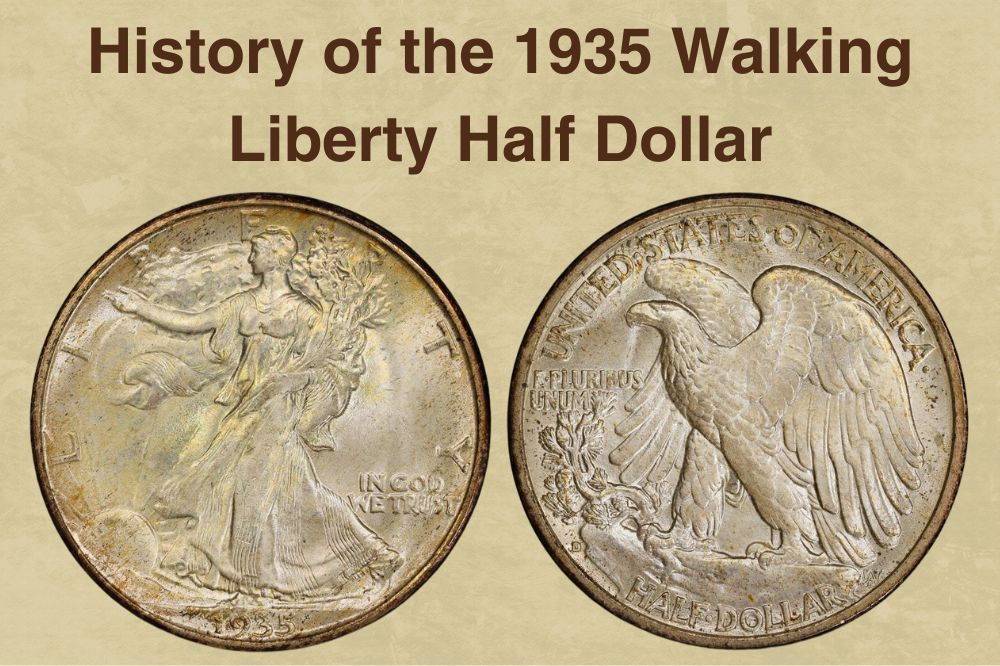
The Walking Liberty Half Dollars appeared in circulation for the first time in 1916 after Adolph Weinman won a contest for the new design. The goal was to replace unattractive Barber half-dollars, and the striking and iconic Lady Liberty image did the trick.
Unfortunately, the new design was aesthetically appealing, and people loved it, but it caused numerous difficulties for the mint workers. Therefore, these coins’ production was challenging and caused rapid wear of the dies.
The series lasted until 1947, and sets minted during the 1940s are easily available and affordable for most collectors. However, completing sets from the earlier period can be difficult, particularly when you look for pieces in the mint state.
1935 half-dollar Types |
||
| Location | Year | Minted |
| Philadelphia | 1935 No Mint mark half-dollar | 9,162,000 |
| San Francisco | 1935 S half-dollar | 3,854,000 |
| Denver | 1935 D half-dollar | 3,003,800 |
| Total | / | 16,019,800 |
The entire series had uneven production. For instance, the 1921 half-dollars struck in all three mints and those from 1938 minted in Denver had an incredibly low mintage.
Nine sets came with a mintage under a million, including the 1921 D Walking Liberty half-dollars. They were minted in 208,000 pieces, making them the lowest-struck coins in the series.
On the other hand, the highest mintage of 47,818,000 half-dollars was reached in the Philadelphia mint in 1942. Collectors calculated that the average mintage from the first to the last year in all three mints was 7,466,471 pieces.
The US Mint didn’t produce these coins in 1922, 1924, 1925, 1926, 1930, 1931, and 1932. Therefore, you could find only 65 half-dollar combinations with different dates and mint marks. Remember that there were two variations from 1917 with the D or S letter that appeared on the obverse or reverse.
Also read: 13 Most Valuable Franklin Half Dollars Worth Money
Features of the 1935 Half Dollar
Adolph Weinman was a talented engraver and sculptor and the one who created the most beautiful American coin, the Walking Liberty half-dollar. The US Mint started issuing these rich-in-symbol coins in 1916. The last pieces were released in 1947, when Franklin coins, the first half-dollars with a real person on the reverse, replaced them.
The obverse of the 1935 half-dollar
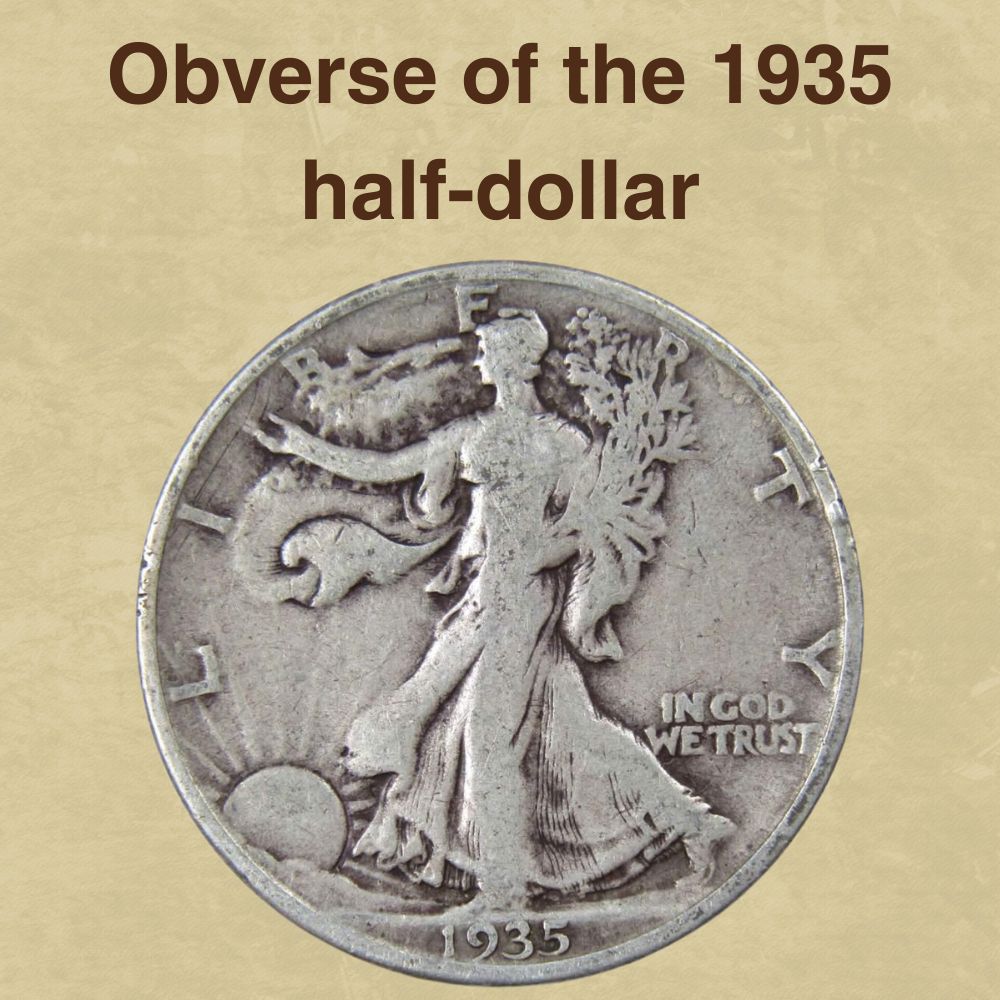
The 1935 half-dollars are high-quality coins with an attractive and striking design. They belong to the beautiful coin series that encouraged Americans to start collecting coins.
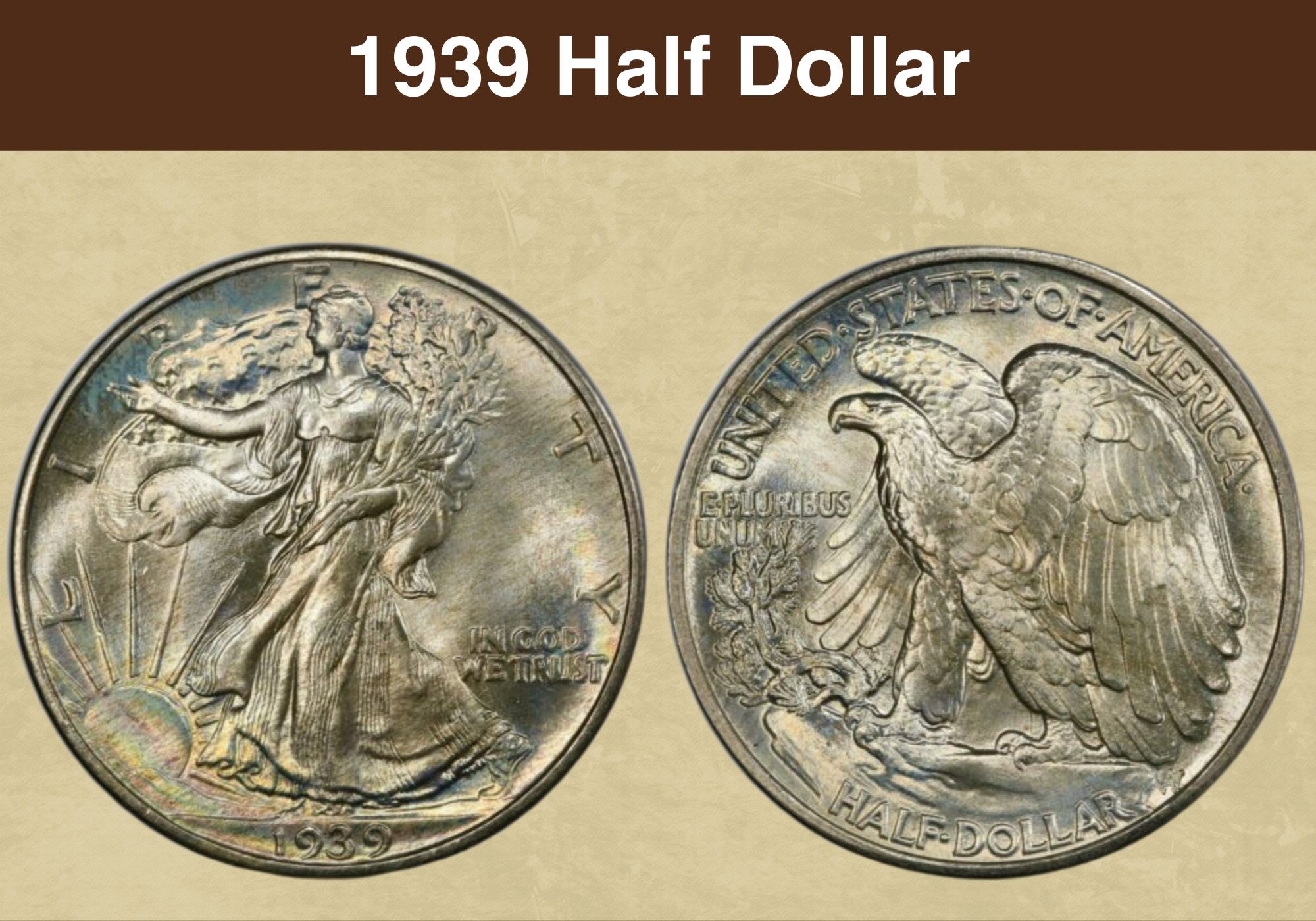
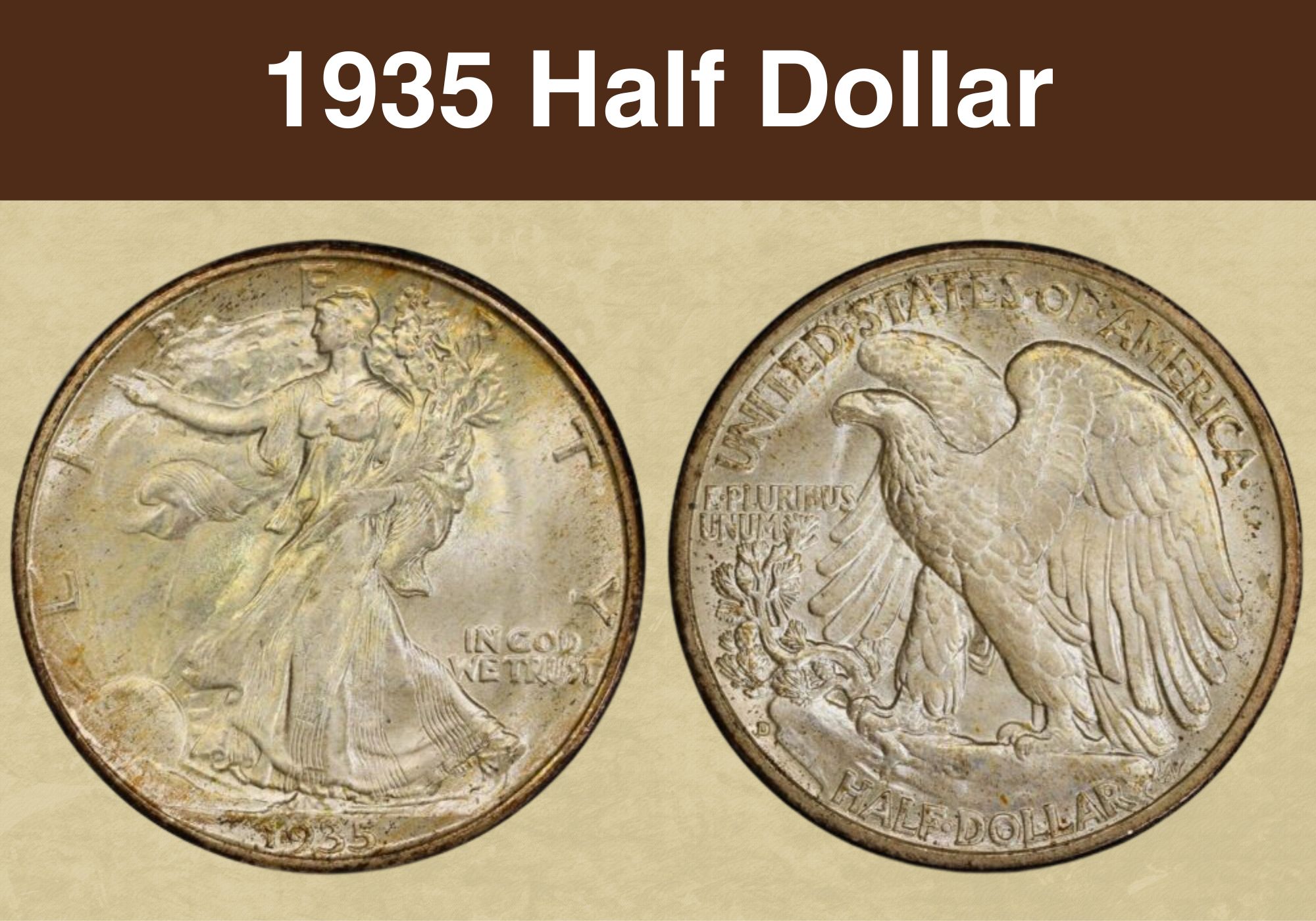
A.A. Weinman created both sides of these coins. The obverse included Lady Liberty walking toward the rising sun while its rays spread in front of her path. The image also depicts the American flag covering her shoulders while she holds branches of olive and oak with her left hand.
Under the path is the minting year, 1935 this time, while the IN GOD – WE TRUST is behind her outstretched leg. The word LIBERTY is written in the background of the central design.
The reverse of the 1935 half-dollar
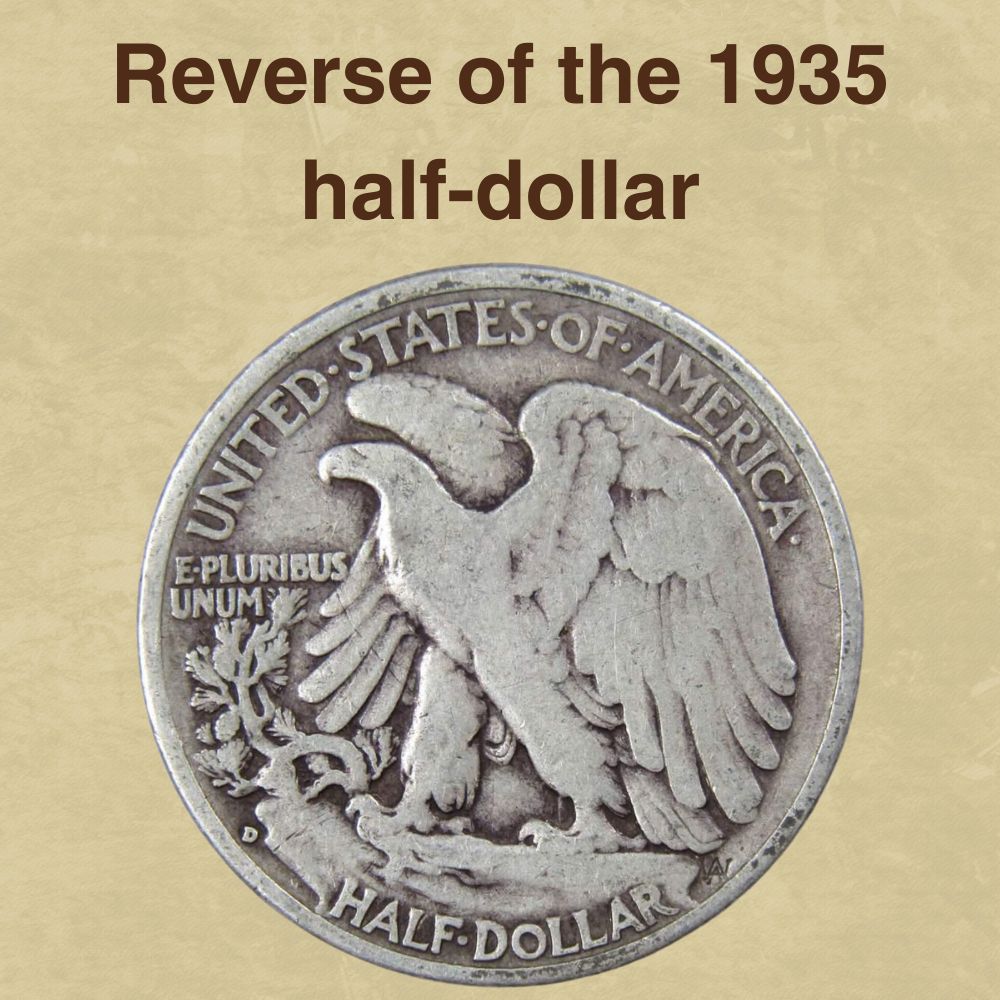
Weinman paid particular attention to the reverse look and did something entirely different than anyone before him. He placed an oversized eagle prepared for a flight in the center and used modest font for inscriptions surrounding it.
You can read E PLURIBUS UNUM (a saying in Latin), UNITED STATES OF AMERICA (the State’s full name), and HALF DOLLAR (the face value).
Besides, there is a mountain crag, serving the eagle as a stable ground, and a branch of mountain pine growing on the left. The final details are stylish initials with overlapped letters AW on all coins and the mint mark added to two of three types of coins.
1935 Walking Liberty half-dollar Details |
|
| Type | Standard circulation coin |
| Compound | Silver – copper (90% vs. 10%) |
| Coin diameter | 30.63 mm (1.2059 inches) |
| Face value | 1/2 dollar ($0.50, fifty cents) |
| Coin weight | 12.5 g (0.40188 troy ounces) |
| Silver weight | 11.25 g (0.36169 troy ounces) |
| Coin thickness | 1.8 mm (0,07086 inches) |
| Shape | Round |
| Edge | Reeded |
Other features of the 1935 half-dollar
The 1935 Walking half-dollars were minted in the middle of the series. Since all of these coins ever minted had the same features, you shouldn’t expect any surprises.
These fifty-cent coins were made of 90% silver, which was 11.25 g (0.36169 troy ounces) of a total coin weight of 12.5 g (0.40188 troy ounces). Each piece with a reeded edge had a diameter of 30.63 mm (1.2059 inches) and a thickness of 1.8 mm (0,07086 inches).
Also read: 13 Most Valuable Kennedy Half Dollar Worth Money
1935 Walking Liberty Half Dollar Grading
Half-dollars were typically rarely used in everyday transactions compared to coins with lower denominations, making most pieces better preserved. However, the 1935 half-dollars are almost 90 years old and had a weak strike, so only rare specimens have stayed intact and in the highest grades until now.
Therefore, the best you can do is to leave these coins’ quality and value evaluation to the experts. That is the best way to get the highest price for your half-dollar at the auction. You can pick out any of the reputable companies specialized for this job.
| # | Grade |
|---|---|
| 1 | Basal State-1 |
| 2 | Fair |
| 3 | Very Fair |
| 4, 5, 6 | Good |
| 7, 8, 10 | Very Good |
| 12, 15 | Fine |
| 20, 30 | Very Fine |
| 40 | Extremely Fine |
| 50 | About Uncirculated |
| 60 | Mint State |
| 65 | Mint State |
| 70 | Mint State |
Please check our grading guides to know your coin scale, It’s the necessary step to know the exact value of your coin.
Check out now: How to Grade Walking Liberty Half Dollar?
1935 Half Dollar Value Guides
The total mintage of the Walking Liberty coins was 16,019,800 coins in 1935. The mint in Philadelphia had the highest production of all three involved mints. This year was the last one with only regularly struck coins because the US Mint released proofs from 1936 to 1942.
1935 No Mint mark half-dollar Value
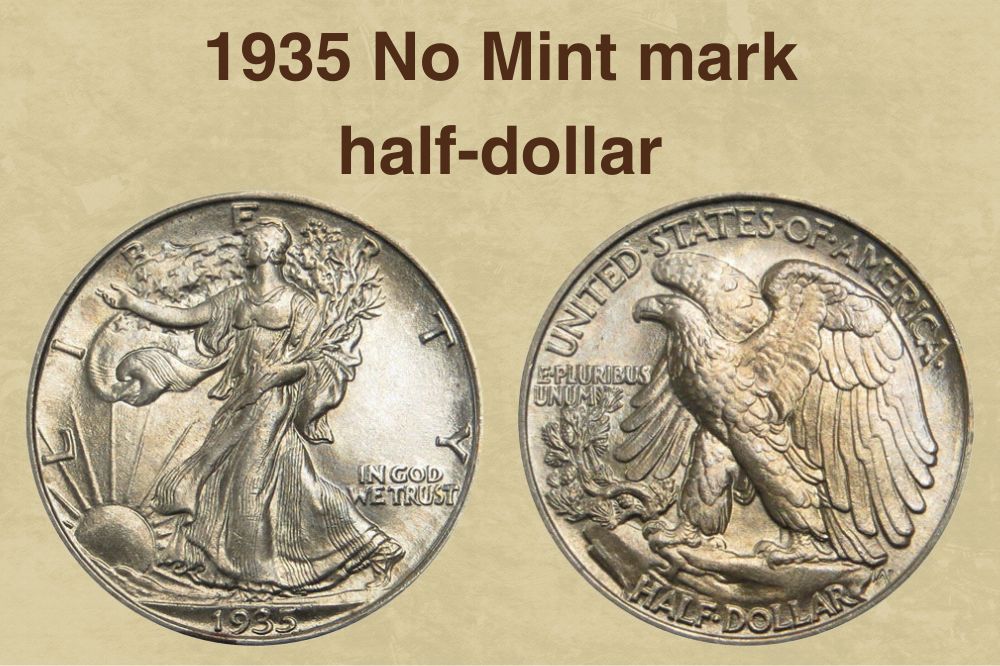
No one knows how many of the 9,162,000 Walking half-dollars minted in Philadelphia in 1935 still exist. However, you can look for your coin at an auction or a reputable dealer. Most pieces used for years are still valuable, with an average price from $10 to $54.
On the other hand, the cost of uncirculated specimens significantly varies and primarily depends on their look and preservation level. For instance, you can effortlessly find coins from MS 60 to MS 63 for less than $100. On the other hand, be prepared to set aside up to $500 for those rated MS 64 to MS 66.
Expectedly, the highest quality half-dollars in the set are those in the highest grades. So, those with an MS 67 rating are estimated at $3,250, while the most beautiful specimens in MS 68 can quickly reach $16,000 to $19,200 at auctions.
For now, the 1935 Walking Liberty half-dollar with the highest grade sold at an auction is the one in MS 67+ grade. One collector bought it at an auction organized in 2021 for $12,338.
1935 D half-dollar Value
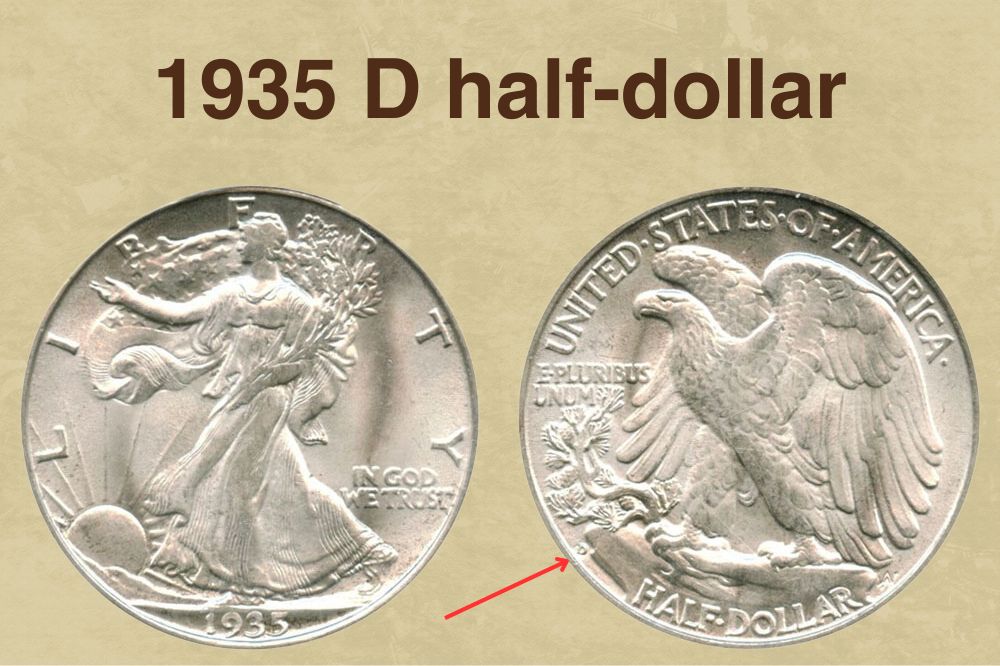
The 1935 D half-dollars from Denver had a mintage of 3,003,800 coins in 1935. Many circulated pieces have been saved until these days, and you can find any from GOOD to AU grades for $10.50 to $150.
Coins in lower mint state rankings typically cost $140 to $450, while the best-preserved specimens are assessed at:
- MS 65-graded half-dollars – $1,450
- MS 66-graded half-dollars – $2,850
- MS 67-graded half-dollars – $23,500
It is a rare situation that the auction record is lower than the coins’ value estimation. In this case, one 1935 half-dollar from Denver in MS 67 grade was sold at $23,500 in 2016.
1935 S half-dollar Value
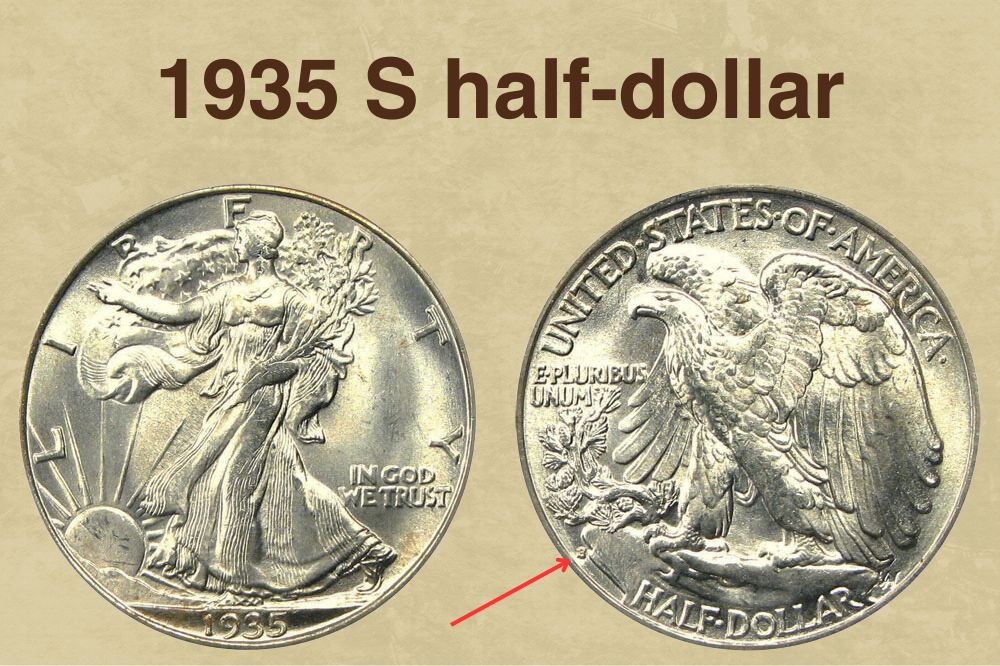
In 1935, the San Francisco mint had a slightly higher mintage than the one in Denver, 3,854,000 half-dollars.
Still, they are often better evaluated, and you should set aside up to $300 for circulated coins. Those in the mint state can cost differently, depending on their quality and appearance:
- $575 for half-dollars rated MS 60
- $625 for half-dollars rated MS 61
- $675 for half-dollars rated MS 62
- $775 for half-dollars rated MS 63
- $1,275 for half-dollars rated MS 64
- $2,000 for half-dollars rated MS 65
- $5,000 for half-dollars rated MS 66
- $47,500 for half-dollars rated MS 67
Interestingly, the auction record is more than double the price estimated. One lovely Walking half-dollar from San Francisco with an MS 67 rating won the 2023 auction record of $67,563.
Also read: 11 Most Valuable Half Dollars In Circulation
Rare 1935 Half Dollar Errors List
A list of 1935 half-dollar errors is not particularly long, but they can be fascinating and unusual. Many collectors like imperfect pieces, and some even choose to collect only such specimens. Since they are rarer than regular coins, you can expect that most cost more than the price for standard half-dollars.
Rotated die error
One of the typical errors for the 1935 Walking half-dollar is the rotated die error. It appears when the obverse and reverse dies are improperly oriented, so these two coin sides are placed at an angle to each other.
The rotation severity causes different prices, but most pieces with this imperfection cost about $15 to $20.
Doubled die error
This minting error appears on the half-dollar minted in 1935 when the die(s) engraved with doubled design strikes the planchet on one or both sides. In such cases, you can see a slight doubling in design elements, making the coin surface blurry at some parts.
Clipped planchet error
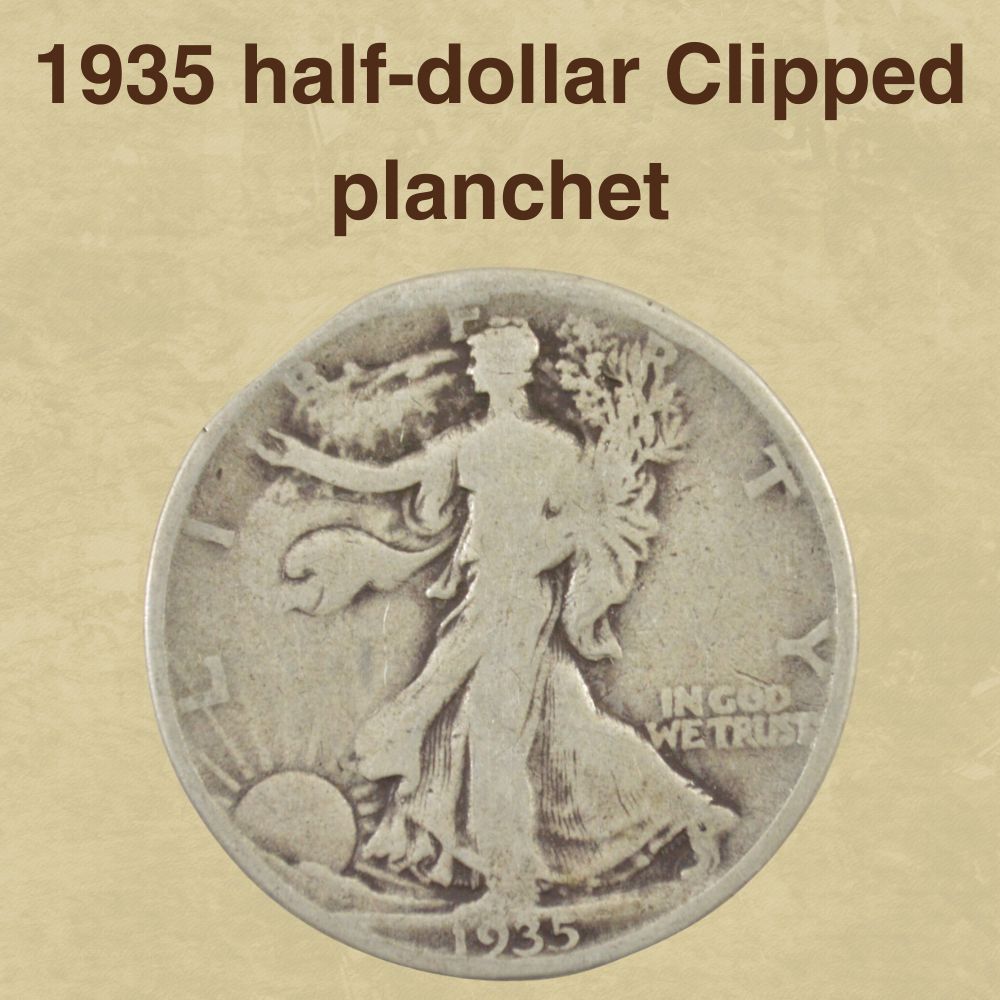
The 1935 half-dollars with a clipped edge resulted from the improperly placed planchet strip into its position. So, the cutting machine cut off a part of the coin edge, making this part curved or straight.
Such specimen’s value depends on the clipped area, but one owner has recently offered one MS 64-rated 50-cent piece from 1935 for $675.
Lamination error
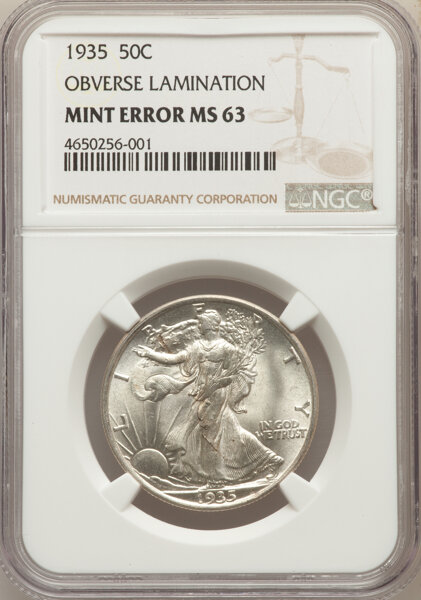
You can effortlessly recognize the 1935 Walking half-dollar with lamination error by the surface that flakes, peels away, and cracks.
Such a coin has a thin lamination-looking metal layer resulting from the contaminated planchet. You can expect a wide price range for these specimens, depending on the affected area size and location.
Where to Sell Your 1935 Half Dollar ?
Now that you know the value of your coins, do you know where to sell those coins online easily? Don’t worry, I’ve compiled a list of these sites, including their introduction, pros, and cons.
Check out now: Best Places To Sell Coins Online (Pros & Cons)
FAQ about the 1935 Half Dollar
What makes a 1935 Half Dollar (Walking Liberty) rare?
Most 1935 Walking half-dollars are not ultra-rare coins, despite their age, but you can sometimes come across a few surprises. Be aware that pieces in the mint state over MS 65 can be scarce and challenging to find, so their prices can be high.
Which 1935 Half Dollar (Walking Liberty) is worth a lot of money?
- The most expensive San Francisco Walking Liberty Half Dollar in MS 67 grade, minted in 1935, won the auction record of $67,563 in 2023
- The most expensive Denver Walking Liberty Half Dollar in MS 67 grade, minted in 1935, won the auction record of $23,500 in 2016
- The most expensive Philadelphia Walking Liberty Half Dollar in MS 67+ grade, minted in 1935, won the auction record of $12,338 in 2021
How much is the 1935 No Mint mark (Walking Liberty) Half Dollar worth?
The 1935 half-dollar minted in Philadelphia are relatively affordable in the lowest rankings, and you can expect to pay $10 to $54 for circulated coins. On the other hand, most pieces in the mint state cost approximately $55 to $500.
Only rare specimens in the highest grades are estimated better. So, Half Dollars rated MS 67 have an assessed price range from $1,600 to $1,920, while MS 68-graded coins cost from $16,000 to $19,200.
What is the priciest Half Dollar (Walking Liberty)?
The most precious regular Walking Liberty half-dollar is the 1918 D MS 66+ coin sold at Legend Rare Coin Auctions in 2021 at $340,750. The priciest proof in the series became the 1936 PR 68 specimen after one collector bought it for $80,500 in 2005.