1934 Quarter Value (2026 Guide): Errors List, “D” & No Mint Mark Worth

The 1934 Washington quarter is one of the most variety-rich coins in the entire Washington quarter series—and most people have no idea what they’re holding. With three distinct motto varieties from Philadelphia and two from Denver, plus rare doubled die and mintmark errors, this 90% silver coin from the heart of the Great Depression offers something for collectors at every level.

Even a common circulated example is worth well above face value thanks to its silver content alone. At current silver prices, every 1934 quarter contains approximately 0.1808 troy ounces of pure silver—giving it a built-in melt value floor before any collector premium is considered. Rare varieties and top-grade examples have sold for over $21,000 at major auction houses.


1934 Quarter Value By Variety

The value differences between 1934 quarter varieties can be shocking—what looks like a common quarter worth $5 might actually be a $500 variety. The table below shows average prices across varieties. If you know your coin’s grade, use the Value Guides section further below for exact figures.

1934 Quarter Value Chart

TYPEGOODFINEAUMSPR
1934 Light Motto Quarter Value$16.49$17.17$24.50$159.17
1934 Medium Motto Quarter Value$1.61$5.53$15.50$78.00
1934 Heavy Motto Quarter Value$17.00$17.17$22.50$174.83
1934-D Quarter Value$17.00$25.00$106.00$435.00
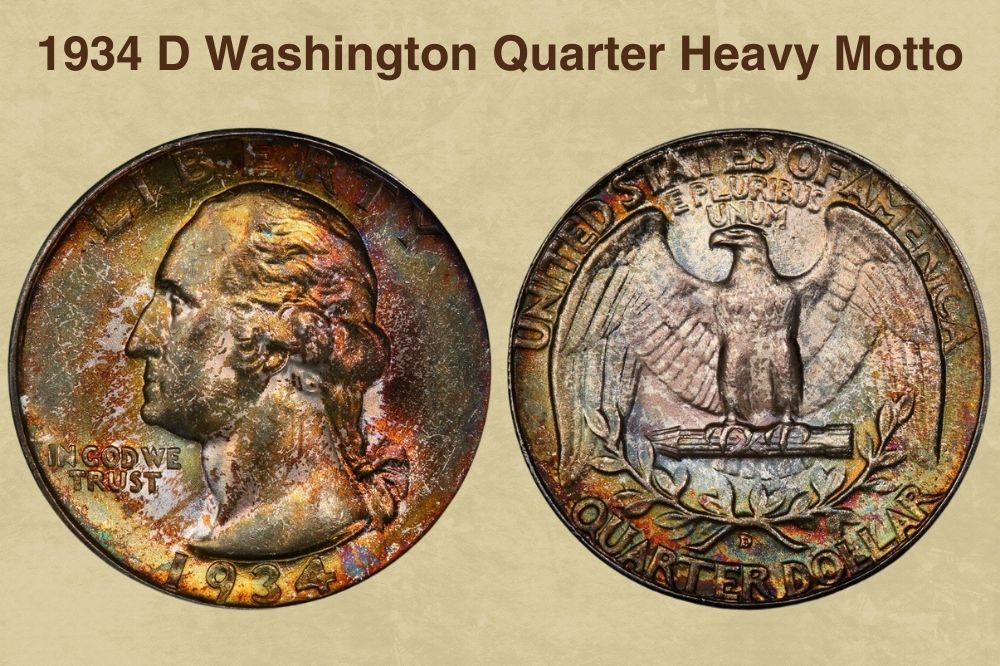
1934-D Heavy Motto Quarter Value$16.49$28.67$89.00$491.67
Updated: 2026-03-16 06:37:47

Also Read: Top 100 Most Valuable Modern Quarter Worth Money (1932 – Present)


Top 10 Most Valuable 1934 Quarter Worth Money

Most Valuable 1934 Quarter Chart

2005 - Present

The 1934 quarter market rewards collectors who study the details. While major auction houses spotlight pristine MS-67 examples fetching five figures, the real story lies in the overlooked middle market—AU-58 Doubled Dies, MS-64 Heavy Mottos, and authenticated variety examples that have quietly climbed in value over the past decade.

Real auction data tells the tale: a 1934-D in PCGS MS-67 sold for $21,850 at Heritage Auctions in May 2007, and a 1934-D Heavy Motto in PCGS MS-67+ brought $20,400 at Stack’s Bowers in April 2024. These aren’t flukes—they reflect growing collector recognition of how genuinely scarce top-grade examples are.

The Doubled Die Obverse—with an estimated surviving population of only 251 to 500 examples across all grades—is the rarest documented variety in the 1934 series. Even circulated examples command strong premiums, while mint state pieces can rival coins from much scarcer dates.

Smart collectors are also accumulating motto varieties before mainstream attention catches up. Heavy Motto examples typically command 10–20% premiums over Light and Medium Motto coins in comparable grades, and the gap widens significantly as condition improves.


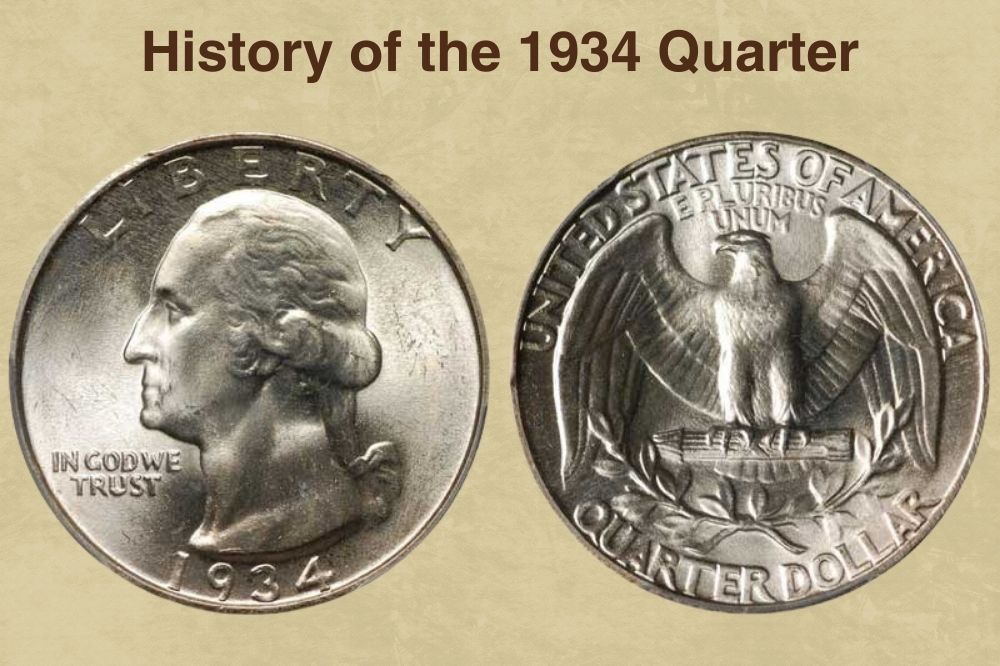
History of the 1934 Quarter

The 1934 Washington quarter arrived during one of the most turbulent chapters in American economic history—the Great Depression. Following the Banking Act of 1933 and President Roosevelt’s executive orders restricting gold ownership, Americans hoarded silver coins, creating a severe shortage in everyday commerce. The Philadelphia and Denver mints struck over 35 million quarters combined in 1934 in an urgent effort to restore circulation.

No quarters had been produced in 1931 or 1933, so the 1934 issue marked a return to regular production after an extended gap. The Washington quarter design itself had only been introduced two years earlier in 1932, conceived as a one-year commemorative honoring the 200th anniversary of George Washington’s birth—but it proved so popular it became the nation’s standard quarter.

Designer John Flanagan, a New Jersey-born sculptor who had trained under the legendary Augustus Saint-Gaudens, based his portrait of Washington on an 1786 marble bust by French neoclassical sculptor Jean-Antoine Houdon. That bust still stands at Washington’s Virginia estate, Mount Vernon. Flanagan’s initials “JF” appear at the base of Washington’s neck on every coin in the series.

The three motto varieties—Light, Medium, and Heavy—were not planned. The U.S. Mint’s engraving department had adjusted the obverse hub after 1932 to strengthen weak motto lettering, but die production was inconsistent under Depression-era production pressures. The result was three visually distinct states of “IN GOD WE TRUST” that numismatist David W. Lange later documented in his reference work The Washington Quarters of 1934. These accidental die varieties went largely unrecognized by collectors for decades—and are now among the most actively traded Washington quarter varieties on the market.

Importantly, no proof coins were struck in 1934. The U.S. Mint’s proof coinage program had been suspended and would not resume until 1936, making every 1934 quarter a business-strike coin.

Also Read: Top 30 Most Valuable State Quarter Worth Money (1999 – 2008)


Is Your 1934 Quarter Rare?

46

1934 Light Motto Quarter

Very Rare
Ranked 21 in Washington Quarter
30

1934 Medium Motto Quarter

Scarce
Ranked 70 in Washington Quarter
56

1934 Heavy Motto Quarter

Ultra Rare
Ranked 15 in Washington Quarter
44

1934-D Quarter

Rare
Ranked 25 in Washington Quarter
60

1934-D Heavy Motto Quarter

Ultra Rare
Ranked 11 in Washington Quarter

These rarity scores show how die varieties can dramatically shift a coin’s collectibility. PCGS founder David Hall has noted that the 1934-D is “one of the key dates of the Washington quarter series”—scarce in mint state and rare in Gem condition, with only the 1932-D and 1932-S ranking rarer in MS-65 or better. Survival estimates suggest roughly 3,000 examples of the 1934-D grade MS-65 or higher across all grading services combined.

For an instant rarity check on any coin in your collection, the CoinValueChecker App provides real-time scoring and ranking data at your fingertips.


Key Features of the 1934 Quarter

John Flanagan designed the Washington quarter, which debuted in 1932 and resumed production in 1934 after a year’s gap. The Philadelphia Mint produced three motto varieties in 1934—Light, Medium, and Heavy—while Denver issued only the Medium and Heavy types. No Light Motto 1934-D quarters are known to exist.

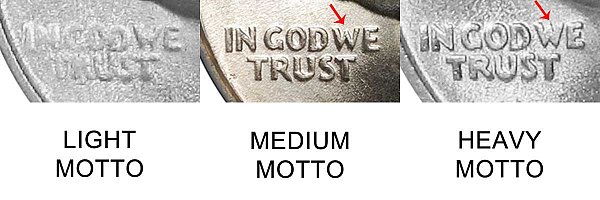
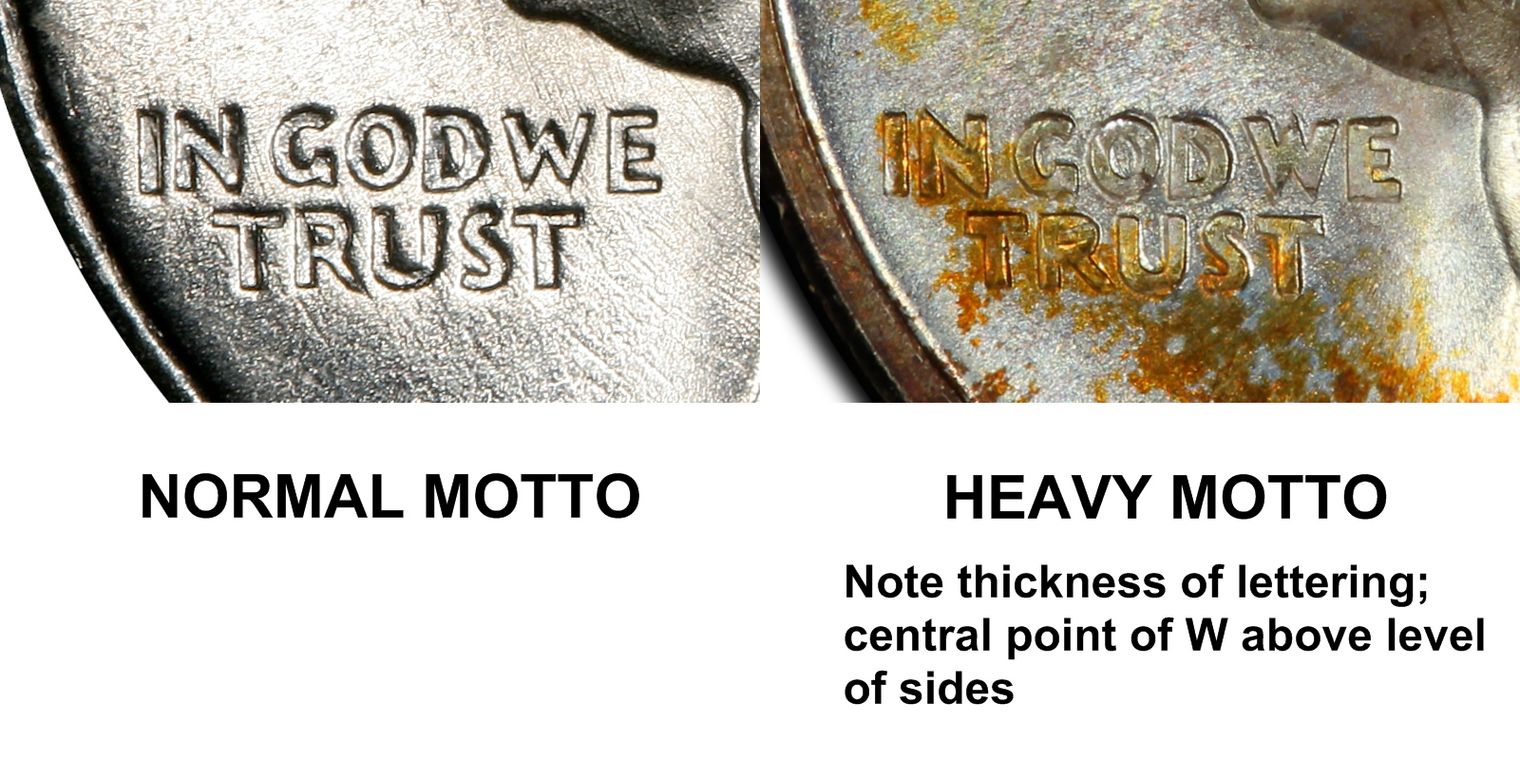
The key to identifying each variety lies in the letter “W” in the word “WE” within the motto. On the Medium Motto, the center peak of the W sits below the outer diagonal strokes. On the much scarcer Heavy Motto, the center peak extends above the outer strokes—a diagnostic that PCGS numismatist Gordon Wrubel recommends as the fastest way to distinguish the two.

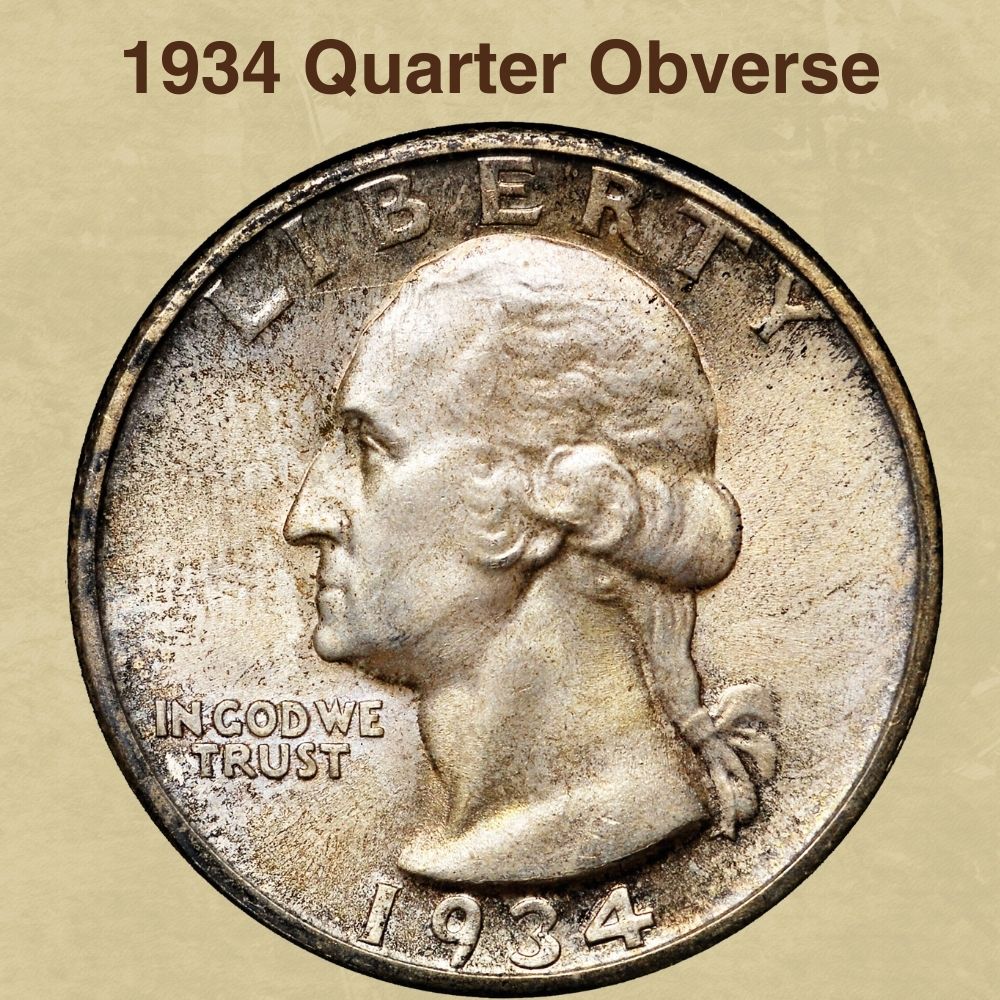
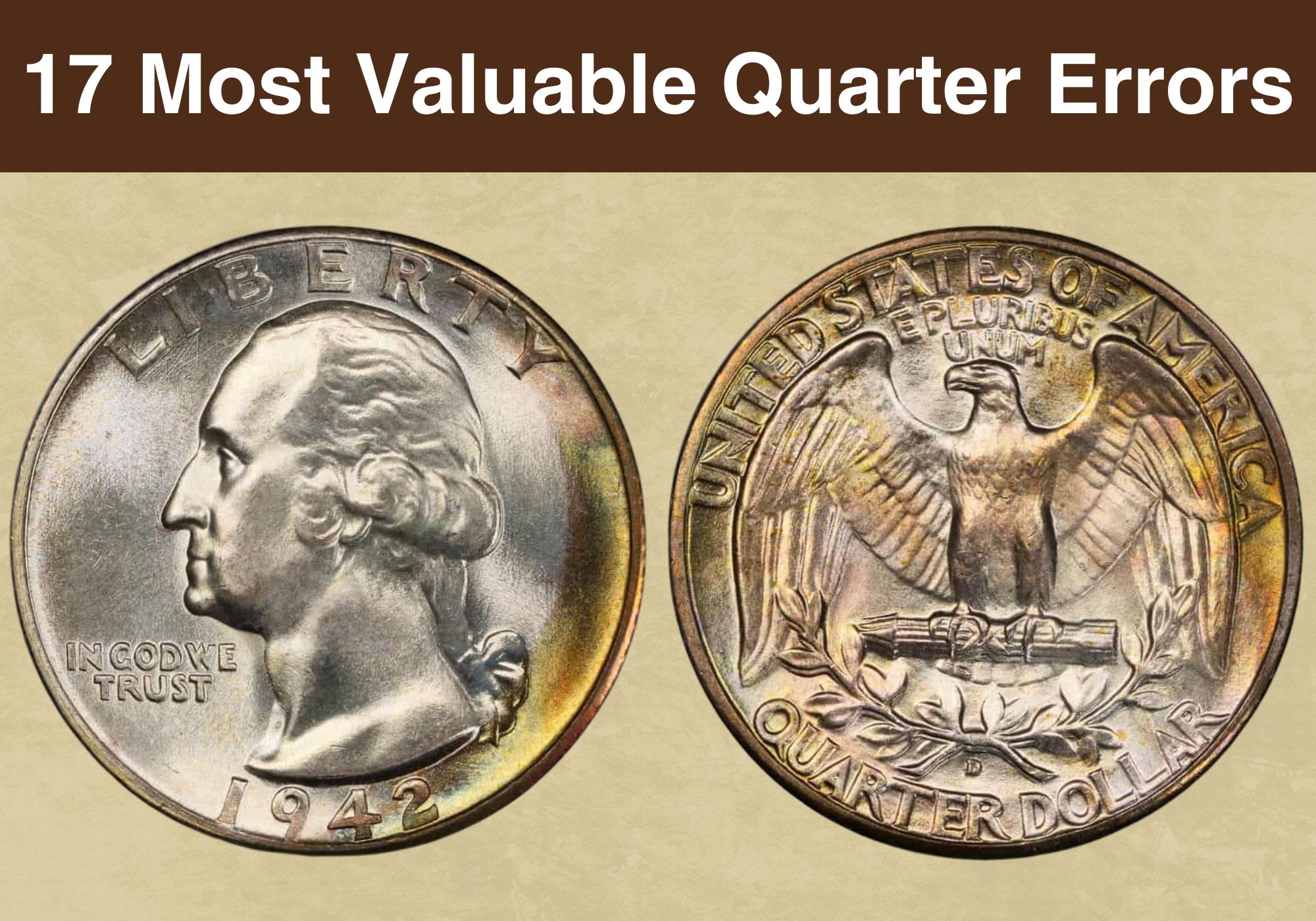
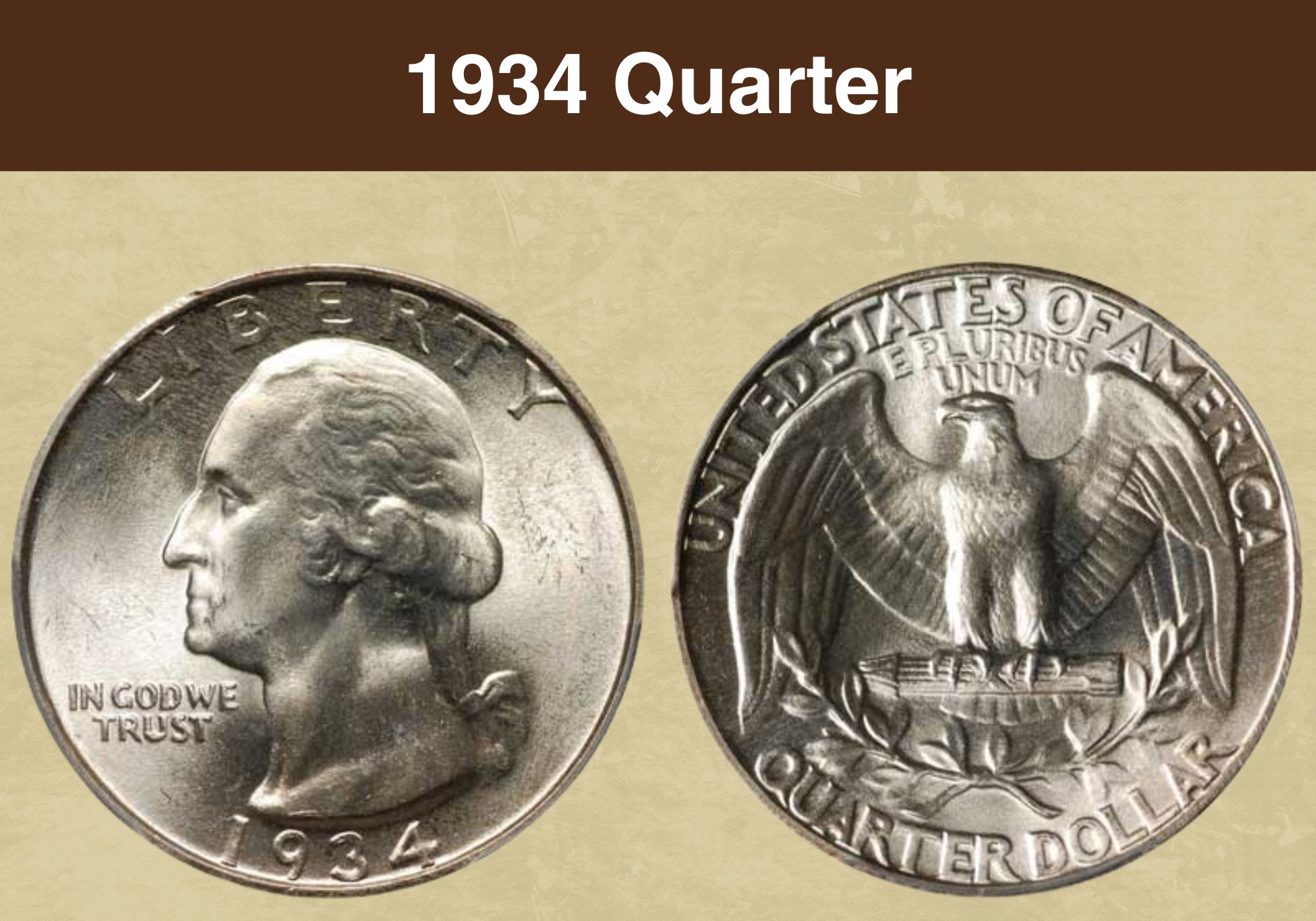
The obverse of the 1934 quarter

The 1934 quarter obverse features George Washington’s left-facing profile surrounded by:

  • LIBERTY arching above
  • 1934 date below
  • Light, Medium, or Heavy Motto “IN GOD WE TRUST” to the left
  • Flanagan’s “JF” initials at the base of Washington’s neck

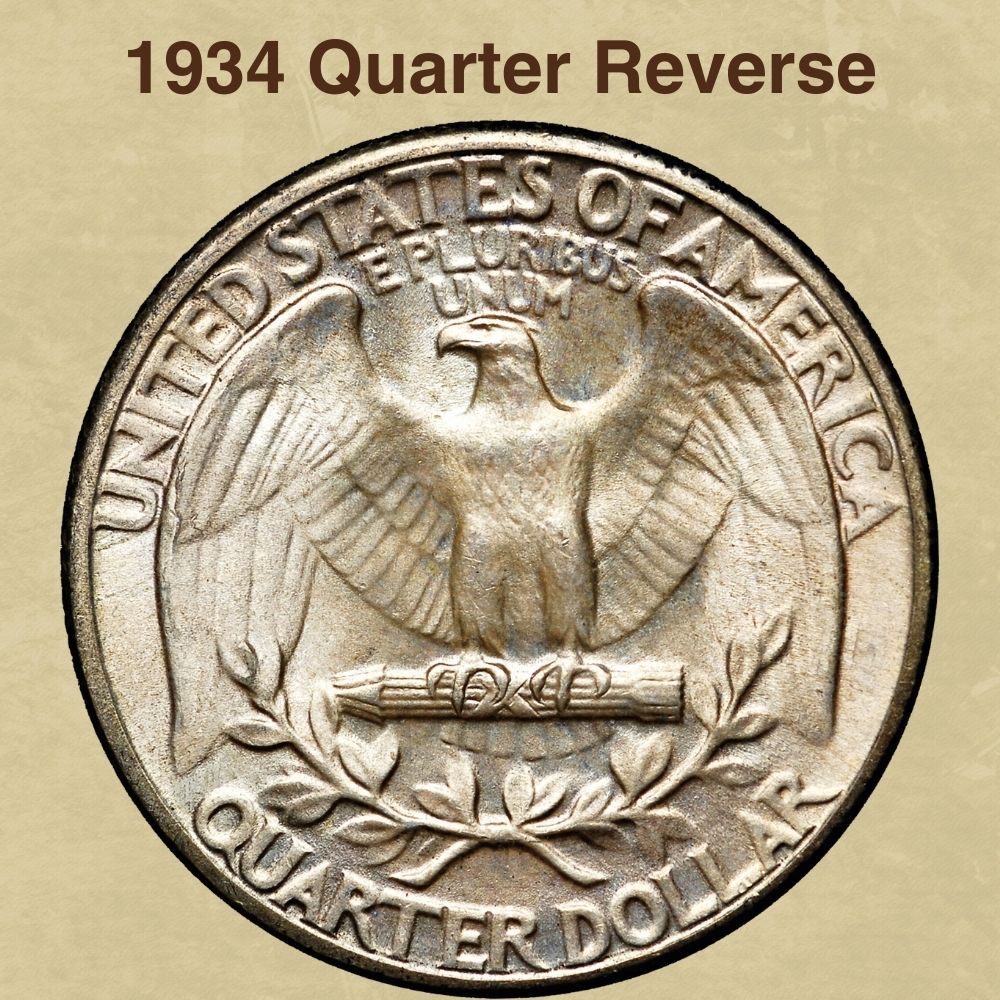
The reverse of the 1934 quarter

The reverse carries significant detail, including:

  • A centrally positioned bald eagle with outstretched wings
  • Olive twigs and arrows in the eagle’s talons
  • QUARTER DOLLAR below the eagle
  • UNITED STATES OF AMERICA along the top rim
  • E PLURIBUS UNUM on a ribbon
  • The “D” mint mark (Denver) or no mark (Philadelphia), positioned below the wreath knot above “R” in QUARTER

Other features of the 1934 quarter

All 1934 quarters are composed of 90% silver and 10% copper—the same composition used for every Washington quarter through 1964. Each coin weighs 6.25 grams (0.20094 troy oz) and contains 0.1808 troy ounces of pure silver, giving even the most worn example meaningful intrinsic value.

The coins share a standard diameter of 24.3 mm (0.95669 inches), thickness of 1.75 mm (0.06870 inches), and a reeded (ridged) edge.

Also Read: Top 20 Most Valuable 1776-1976 Bicentennial Quarter


1934 Quarter Mintage & Survival Data

1934 Quarter Mintage & Survival Chart

Mintage Comparison

Survival Distribution

TypeMintageSurvivalSurvival Rate
No Mint31,912,052575,0001.8018%
D3,527,200300,0008.5053%

Philadelphia struck 31,912,052 quarters in 1934—a huge number, but survival estimates suggest only about 1.8% of those coins remain today. Denver’s output was far smaller at 3,527,200, with an estimated 8.5% survival rate—but that still leaves far fewer total surviving Philadelphia coins in absolute terms than many collectors assume.

These coins were workhorses of the Depression economy, not collectibles. Most were spent, worn down, and eventually melted or lost. Even the Philadelphia issue, with its seemingly large mintage, becomes genuinely scarce when you focus on problem-free examples grading AU-58 or better.

The 1934-D’s low mintage places it third on the all-time rarity list for Washington Quarters in Gem condition—behind only the 1932-D (mintage: 436,800) and the 1932-S (mintage: 408,000). Finding a 1934-D above XF-40 requires real searching, and mint state examples are legitimately rare.

Also Read: Top 100 Most Valuable Washington Quarter Worth Money (1932 – 1998)


The Easy Way to Know Your 1934 Quarter Value

Your 1934 quarter’s value depends on its mint mark and variety—Philadelphia issues start around $8–$13 in average condition, while Denver quarters command higher prices, and top-grade or variety examples can reach thousands. Identifying motto varieties, assessing grades, and cross-referencing population reports traditionally requires significant numismatic knowledge.

The CoinValueChecker App simplifies this process with advanced image recognition technology—simply photograph your 1934 quarter to instantly receive accurate variety identification, grade estimates, and real-time market valuations.

CoinValueChecker App Screenshot


1934 Quarter Value Guides

The 1934 quarter series offers more variety than most collectors realize—and that’s where the real value differences live. While condition matters, motto variations and mint marks create the most dramatic price gaps. Here’s the complete lineup:

1934 No Mint Mark (Philadelphia)

  • 1934 Light Motto – Weak, mushy “IN GOD WE TRUST” impression (also called “Type of 1932”)
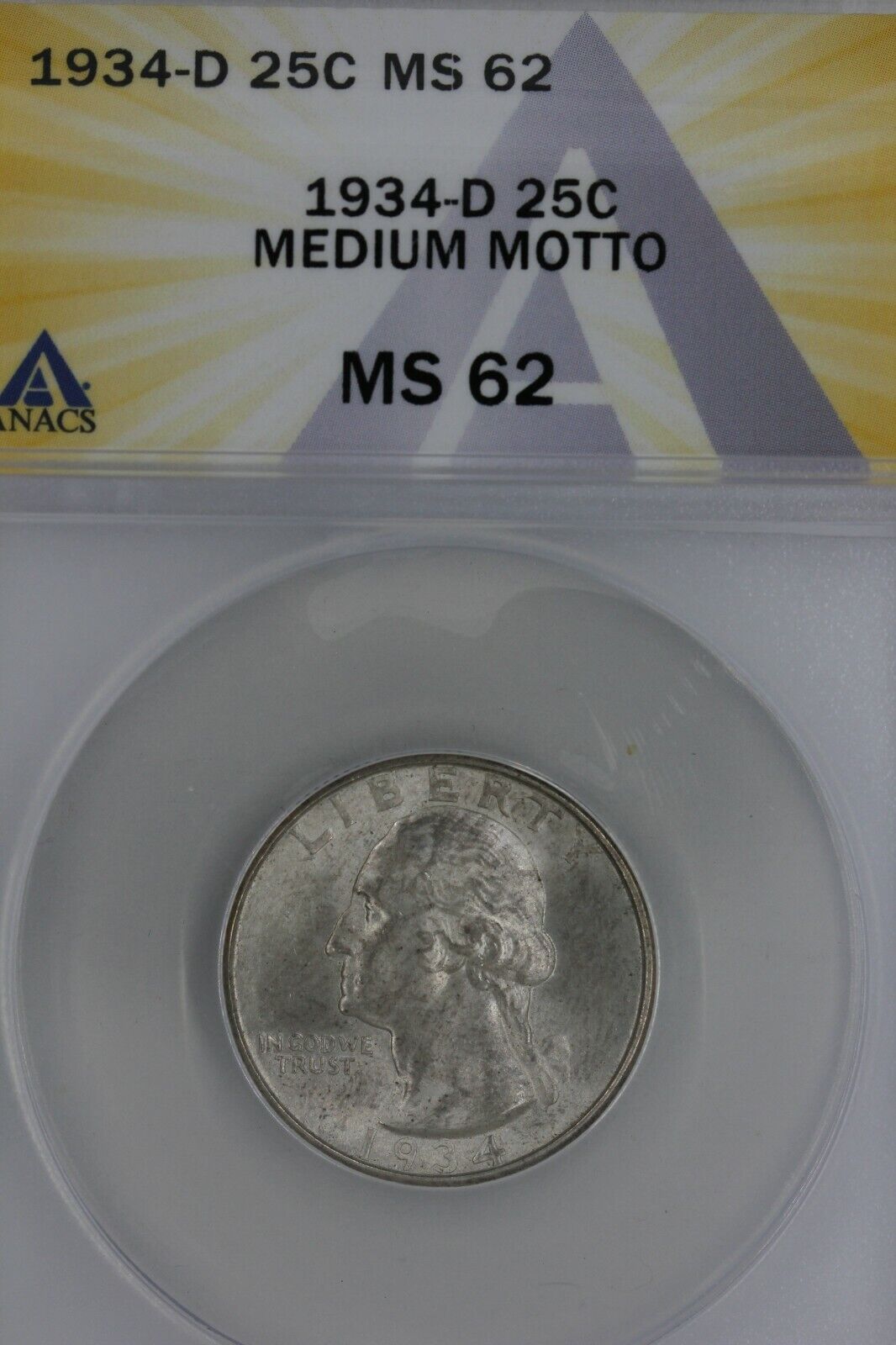
  • 1934 Medium Motto – Standard letter depth; W’s center peak sits below outer strokes (also called “Type of 1935”)
  • 1934 Heavy Motto – Bold, deeply struck motto; W’s center peak rises above outer strokes (also called “Type of 1936”)
  • 1934 Doubled Die Obverse – Dramatic doubling on lettering; only 251–500 examples estimated to survive

1934-D (Denver Mint)

  • 1934-D Regular Strike – No Light Motto known; Medium and Heavy Motto only
  • 1934-D Heavy Motto – Rarer than the Philadelphia Heavy Motto; finest known is a single PCGS MS-67

These aren’t minor differences—they represent distinct die states that collectors and grading services actively recognize. The accidental nature of these varieties, born from Depression-era production pressures, is precisely what makes them historically compelling.


1934 Quarter Value No Mint Mark (Light Motto)

The 1934 Light Motto Quarter—also cataloged as the “Type of 1932″—is the result of under-hubbed dies that entered production without sufficient motto detail. The lettering in “IN GOD WE TRUST” appears mushy and indistinct, sometimes fading on the right side of the motto.

At major auction, a Light Motto in PCGS MS-67 sold for $8,813 in 2014—a result that surprised many dealers who had overlooked the variety. The Light Motto flew entirely under the radar until sharp-eyed variety specialists began cataloging these die states in the 1950s and 1960s, and mainstream recognition only came decades later.

1934 No Mint Mark Quarter (Light Motto) Price/Grade Chart

Price by 1-70 Grade (Latest Auction Records Included)

Updated: 2026-03-16 06:37:48

Recent auction results show just how hot this variety has become—let’s look at the actual sale prices over the past decade.

Date PlatformPrice Grade

The Light Motto variety has been quietly gaining momentum among collectors who appreciate its subtle distinctions.

Market activity: 1934 No Mint Mark Quarter (Light Motto)


1934 Quarter Value No Mint Mark (Light Motto FS-401)

CoinVaueChecker App 10

The FS-401 (Fivaz-Stanton variety number 401) represents the most extreme Light Motto example in the 1934 series. The “W” in “WE” appears incomplete, and “TRUST” fades dramatically on the right side—characteristics so pronounced they earned a dedicated Cherrypickers’ Guide catalog number.

The Fivaz-Stanton (FS) catalog is the primary reference for die varieties in U.S. coinage, listing specific diagnostic markers that grading services use for attribution. A true FS-401, fully attributed by PCGS or NGC (Numismatic Guaranty Company), carries a meaningful premium over generic Light Motto examples, especially above VF-20.

1934 No Mint Mark Quarter (Light Motto) FS-401 Value/Grade Chart

Price by 1-70 Grade (Latest Auction Records Included)

Updated: 2026-03-16 06:37:48

Let’s see how the market has responded to this cataloged variety through recent auction results.

Date PlatformPrice Grade

This specific die variety has caught the attention of serious numismatists, creating interesting market movements.

Market activity: 1934 No Mint Mark Quarter (Light Motto) FS-401


1934 Quarter Value No Mint Mark (Medium Motto)

The 1934 Medium Motto Quarter—also known as the “Type of 1935″—represents the Mint’s intended standard strike: clear letters, balanced depth, and proper hub impression. It’s the baseline that makes the Light and Heavy varieties meaningful by comparison.

A Medium Motto in PCGS MS-68 set an auction record of $15,275—proving that even the “standard” variety commands serious money in superb condition. Most collectors overlook properly attributed Medium Motto examples, making them quietly difficult to source in gem grades.

1934 No Mint Mark Quarter (Medium Motto) Price/Grade Chart

Price by 1-70 Grade (Latest Auction Records Included)

Updated: 2026-03-16 06:37:48

Let’s examine how the market has valued these standard strikes across recent auction cycles.

Date PlatformPrice Grade

Sitting perfectly between its Light and Heavy counterparts, the Medium Motto has carved out its own collector following.

Market activity: 1934 No Mint Mark Quarter (Medium Motto)

1934 Quarter Value No Mint Mark (Medium Motto FS-402)

The FS-402 designation identifies the textbook Medium Motto strike—the reference standard variety specialists use to calibrate their identifications of Light and Heavy examples. Every letter in “IN GOD WE TRUST” shows perfectly balanced impressions with no lean toward either extreme.

Finding a true FS-402 in high grades is harder than it sounds—most Medium Motto quarters lean slightly toward Light or Heavy characteristics. A fully attributed FS-402 in MS-65 or above is a legitimate rarity for patient variety collectors.

1934 No Mint Mark Quarter (Medium Motto) FS-402 Price/Grade Chart

Price by 1-70 Grade (Latest Auction Records Included)

Updated: 2026-03-16 06:37:48

Auction data reveals how the market values these reference-quality strikes compared to regular Medium Motto examples.

Date PlatformPrice Grade

The FS-402 designation has sparked renewed interest from variety collectors seeking complete sets.

Market activity: 1934 No Mint Mark Quarter (Medium Motto) FS-402 Quarter


1934 Quarter Value No Mint Mark (Heavy Motto)

The 1934 Heavy Motto Quarter—cataloged by PCGS CoinFacts as the “Type of 1936″—showcases the boldest possible motto striking from fresh, aggressively prepared dies. Every letter in “IN GOD WE TRUST” appears thick, sharp, and deeply impressed, with the telltale diagnostic: the center peak of the “W” in “WE” rises visibly above the outer strokes.

This variety went largely unnoticed until the 1970s, when dedicated variety collectors began systematically cataloging 1934 die states. At auction, a Heavy Motto in PCGS MS-67 sold for $9,400 in 2022—and Heavy Motto examples routinely command 10–20% premiums over comparable Light and Medium Motto coins.

1934 No Mint Mark Quarter (Heavy Motto) Price/Grade Chart

Price by 1-70 Grade (Latest Auction Records Included)

Updated: 2026-03-16 06:37:48

The auction record reveals how dramatically values have shifted as this variety gains mainstream collector recognition.

Date PlatformPrice Grade

The Heavy Motto variant continues to command respect in the marketplace for its bold, distinctive appearance.

Market activity: 1934 No Mint Mark Quarter (Heavy Motto)

1934 Quarter Value No Mint Mark (Heavy Motto FS-403)

The FS-403 is the most extreme Heavy Motto variety in the 1934 series—letters so bold they appear almost three-dimensional, with visible die polish lines confirming the heavily prepared dies. This is what variety specialists refer to as the “poster child” of the Heavy Motto type, and genuine examples with all diagnostic markers intact are among the hardest 1934 Philadelphia varieties to locate.

Authentication by PCGS or NGC is strongly recommended for FS-403 candidates, as a standard Heavy Motto misidentified as FS-403 can lead to significant mispricing.

1934 No Mint Mark Quarter (Heavy Motto) FS-403 Price/Grade Chart

Price by 1-70 Grade (Latest Auction Records Included)

Updated: 2026-03-16 06:37:48

Recent auction results demonstrate how top variety collectors compete for properly attributed FS-403 specimens.

Date PlatformPrice Grade

Recent market activity shows collectors are becoming increasingly aware of this particular die state’s significance.

Market activity: 1934 No Mint Mark Quarter (Heavy Motto) FS-403


1934-D Quarter Value

1934-D Quarter Value

The 1934-D Quarter holds a unique position as the scarcest regular-issue Washington quarter of the 1930s, with only 3,527,200 struck at the Denver Mint. PCGS founder David Hall describes it plainly: “While not particularly rare in circulated grades, this is a scarce coin in mint state and a rare coin in Gem condition. In fact, only the 1932-D and 1932-S are rarer in MS65 or better.”

Survival estimates place only roughly 3,000 examples at MS-65 or above across all major grading services. The “D” mint mark sits on the reverse below the wreath knot, above the “R” in QUARTER—and it frequently shows weakness from worn dies. The auction record for the standard 1934-D stands at $21,850 for a PCGS MS-67 sold by Heritage Auctions in May 2007.

1934-D Quarter Price/Grade Chart

Price by 1-70 Grade (Latest Auction Records Included)

Updated: 2026-03-16 06:37:48

Recent auction performance demonstrates how this once-overlooked date has firmly established itself in the modern market.

Date PlatformPrice Grade

The Denver mint mark adds a layer of scarcity that collectors are actively pursuing in today’s market.

Market activity: 1934-D Quarter


1934-D Heavy Motto Quarter Value

The 1934-D Heavy Motto is one of the most compelling variety coins in the entire Washington quarter series, combining Denver’s limited production with a scarce die state. According to PCGS CoinFacts, among all certified 1934-D Heavy Motto examples, the finest known is a single PCGS MS-67—making true gem examples essentially unique.

This variety emerged when Denver mint employees, working with fresh and aggressively prepared dies, struck quarters with dramatically bold “IN GOD WE TRUST” lettering. Unlike Philadelphia Heavy Mottos—which are scarce—the 1934-D Heavy Motto is genuinely rare, as most of Denver’s small production run used standard Medium Motto dies. The auction record reached $20,400 for a PCGS MS-67+ example at Stack’s Bowers in April 2024.

1934-D Heavy Motto Quarter Price/Grade Chart

Price by 1-70 Grade (Latest Auction Records Included)

Updated: 2026-03-16 06:37:48

The auction record shows how this double-threat variety consistently outperforms regular 1934-D quarters across all grades.

Date PlatformPrice Grade

The 1934-D Heavy Motto ranks among the most sought-after Washington Quarter varieties as collectors recognize its true scarcity. This Denver-minted Heavy Motto combination represents one of the most actively traded variants in recent years.

Market activity: 1934-D Heavy Motto Quarter

Also Read: What Quarters Are Worth Money


Rare 1934 Quarter Error List

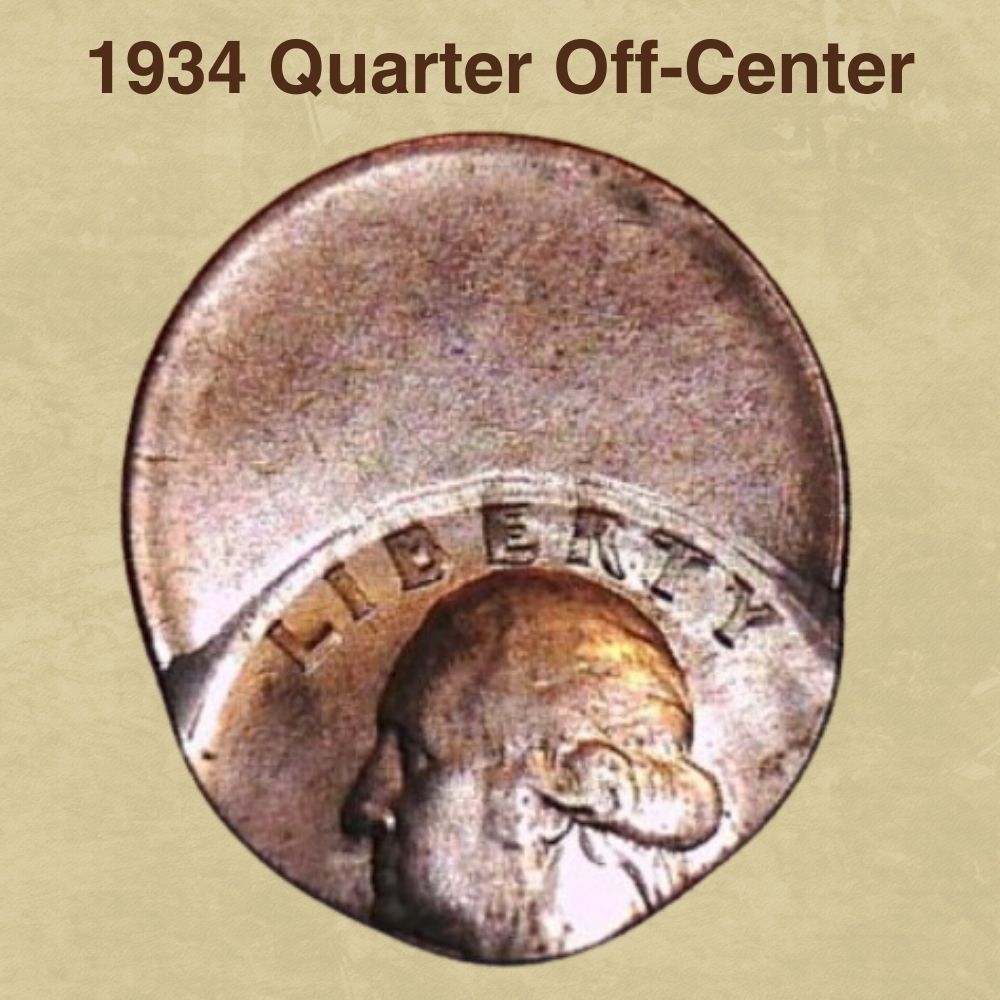
While most collectors focus on condition, the real action in 1934 quarters often happens with documented errors and die varieties. These minting anomalies transform common-date coins into genuine rarities worth multiples of a standard strike—and several were unrecognized for decades before variety specialists brought them to light.

1. 1934 Doubled Die Obverse Errors

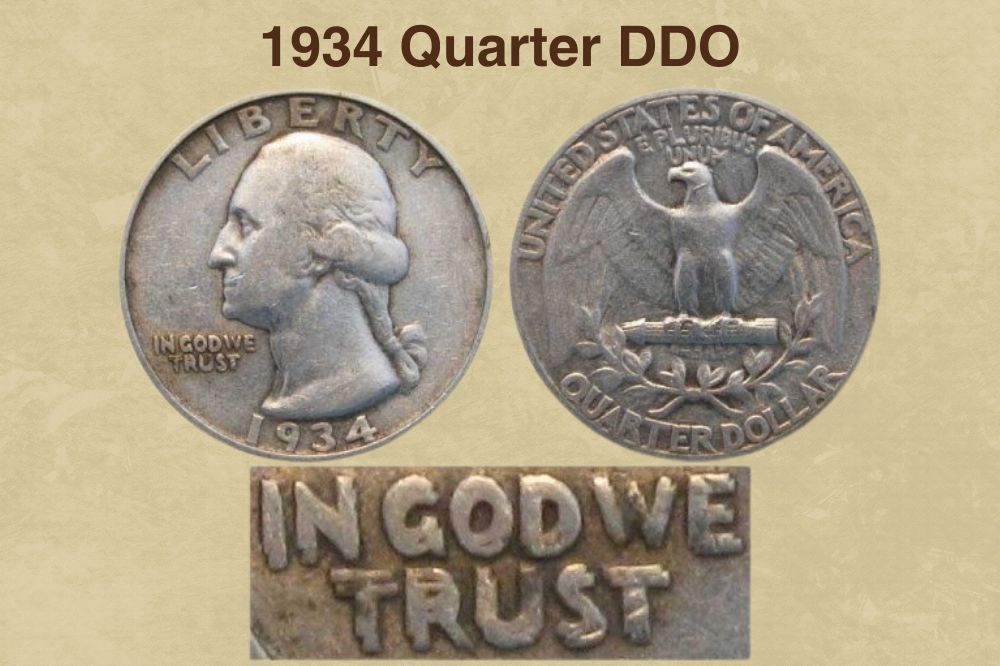
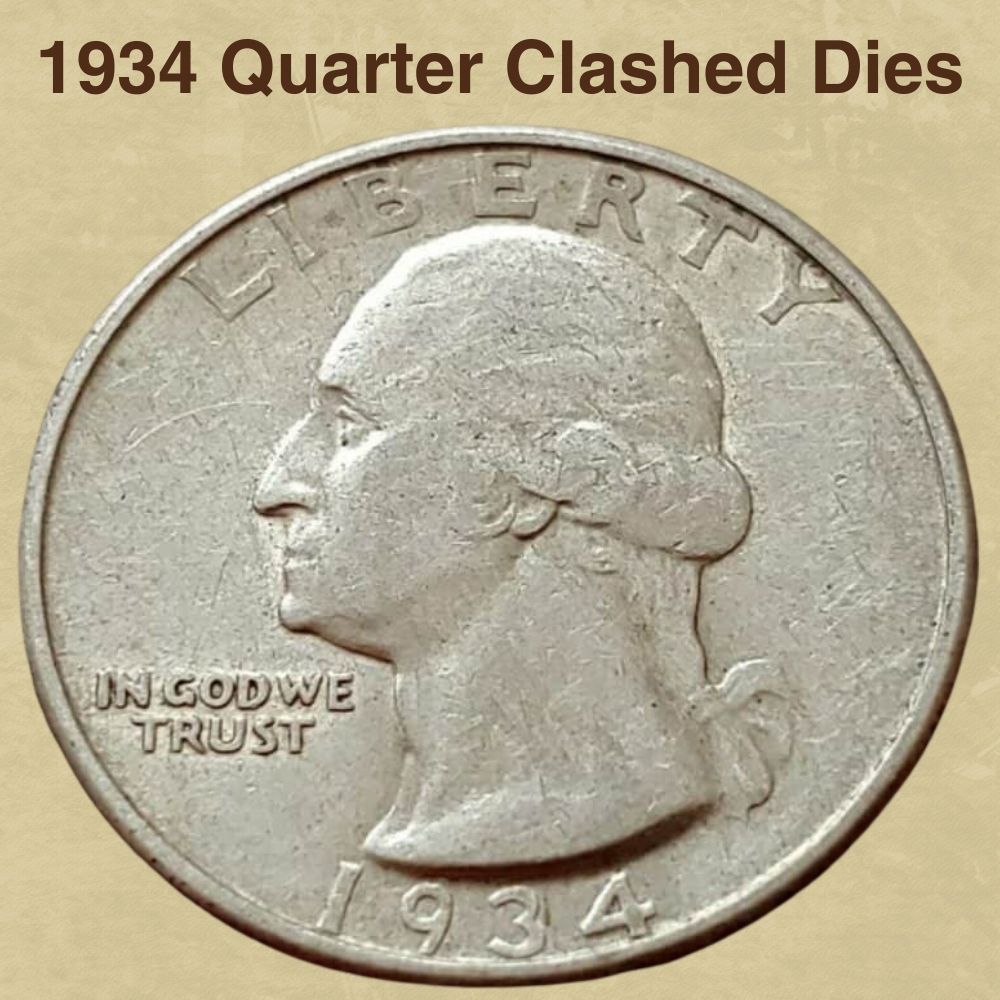
The 1934 Doubled Die Obverse (DDO) is described by researchers as the most dramatic doubled die error in the entire Washington Quarter series. With an estimated surviving population of only 251 to 500 examples across all grades, this error is genuinely rare—not just scarce.

Doubling is visible without magnification on “IN GOD WE TRUST” and “LIBERTY,” with the date “1934” also showing strong doubling on close inspection. The error occurred when the working die received multiple impressions from the hub at slightly different angles during the manufacturing process. In circulated condition, values range from approximately $45 to $650; uncirculated examples command $925 to $10,750 or more. The auction record is $10,350 for an MS-65 example sold in 2005.

1934 Doubled Die Obverse Quarter Price/Grade Chart

Price by 1-70 Grade (Latest Auction Records Included)

Updated: 2026-03-16 06:37:48

For instant authentication of suspected doubled die varieties, our CoinValueChecker App provides detailed error identification tools to help you spot these valuable anomalies.

CoinVaueChecker App 10

CoinValueChecker APp Screenshot3
CoinValueChecker APP Screenshot


2. 1934 DDO (FS-101) Errors

The FS-101 designation marks the first and most prominent documented doubled die obverse variety for 1934, cataloged in the Fivaz-Stanton reference guide—the standard reference for die variety attribution used by PCGS and NGC.

This variety shows stronger doubling than other 1934 DDO examples, making it the most desirable for collectors who pursue the series. Look for clear separation lines in the motto letters and visible spreading in the date digits. Both PCGS and NGC now specifically attribute FS-101 examples, which adds certification credibility and market liquidity.

1934 DDO (FS-101) Quarter Price/Grade Chart

Price by 1-70 Grade (Latest Auction Records Included)

Updated: 2026-03-16 06:37:48

3. 1934-D Small D FS-501 Hvy Motto Errors

The FS-501 represents the pinnacle of 1934 quarter variety collecting—a triple-threat coin combining Denver’s limited mintage, the Heavy Motto hub, and a noticeably smaller “D” mint mark punch than standard 1934-D quarters.

The small “D” resulted from the Denver Mint using an older, smaller punch tool during production—a detail that went entirely unnoticed until variety specialists began systematically examining the series. With perhaps only a few hundred examples surviving across all grades, properly attributed FS-501 pieces are exceptional finds at any condition level.

1934-D Small D FS-501 Hvy Motto Quarter Price/Grade Chart

Price by 1-70 Grade (Latest Auction Records Included)

Updated: 2026-03-16 06:37:48

Also Read: 20 Rare Washington Quarter Errors Worth Money (Full List with Pictures)


Where to Sell Your 1934 Quarter

Now that you know the value of your coins, do you know where to sell those coins online easily? Don’t worry, I’ve compiled a list of these sites, including their introduction, pros, and cons.

Check out now: Best Places To Sell Coins Online (Pros & Cons)

For high-value examples—any 1934-D in MS-65 or better, any attributed DDO, or any FS-designated variety—major auction houses like Heritage Auctions, Stack’s Bowers, and GreatCollections will reach the largest pool of serious collectors. For mid-range examples ($50–$500), authenticated listings on eBay from sellers with strong ratings work well. For common circulated examples near melt value, local coin shops or bullion dealers are the most efficient option.


1934 Quarter Market Trend

Market Interest Trend Chart - 1934 Quarter

*Market Trend Chart showing the number of people paying attention to this coin.


FAQ About the 1934 Quarter Value

1. What makes a 1934 quarter rare?

Rarity in the 1934 series depends on variety and condition. The Philadelphia Mint struck three motto varieties—Light, Medium, and Heavy—while Denver produced only Medium and Heavy types. The 1934-D is the scarcest regular-issue Washington quarter of the 1930s, ranking third-rarest in MS-65 or better after only the 1932-D and 1932-S. The Doubled Die Obverse, with only an estimated 251–500 surviving examples, is the rarest single variety across the entire 1934 production.

2. How much is a 1934 quarter from Philadelphia worth?

Values vary by motto type and condition. Light Motto examples range from roughly $6–$25 in circulated grades to $35–$8,813 in mint state (the MS-67 auction record reached $8,813 in 2014). Medium Motto coins run $6–$13 in circulated grades, reaching up to $15,275 at MS-68. Heavy Motto pieces start at $5–$30 for circulated examples and climb to $9,400 and beyond in MS-67 condition. All are 90% silver with a melt value floor around $5–$6 at current silver prices.

3. What is the priciest quarter with Washington on the obverse?

The all-time record is the 1932-D in MS-66, which sold for $143,750 at Bowers & Merena in April 2008. For the 1934 series specifically, the top realized price is $21,850 for a 1934-D PCGS MS-67 at Heritage Auctions in May 2007. Other notable Washington quarter records include a 1932-S MS-66 at $45,500 (David Lawrence RC, 2020), a 1948 MS-68+ at $43,200 (Stack’s Bowers, 2021), and a 1950 Proof-68 at $31,200 in 2022.

4. How do I tell the difference between Light, Medium, and Heavy Motto on a 1934 quarter?

Focus on the letter “W” in the word “WE” inside the motto “IN GOD WE TRUST.” On the Light Motto, all letters appear mushy and shallow. On the Medium Motto (also called Type of 1935), letters are clearer but thin, and the W’s center peak sits below the outer diagonal strokes. On the Heavy Motto (Type of 1936), letters are thick and bold, and the center peak of the W rises visibly above the outer strokes—the fastest single diagnostic, recommended by PCGS numismatist Gordon Wrubel.

5. Does a 1934 quarter have any silver in it?

Yes—every 1934 quarter is 90% silver and 10% copper, containing exactly 0.1808 troy ounces of pure silver. This gives even the most worn 1934 quarter a base melt value well above its 25-cent face value. At silver prices around $30–$35 per ounce, the silver alone is worth approximately $5.50–$6.50, before any collector premium is added. All Washington quarters dated 1964 and earlier share this silver composition.

6. What is the 1934 Doubled Die Obverse and how rare is it?

The 1934 Doubled Die Obverse (DDO) is the most dramatic doubled die error in the entire Washington quarter series. Only an estimated 251 to 500 examples survive across all grades, making it genuinely rare. Doubling is visible without magnification on “IN GOD WE TRUST,” “LIBERTY,” and the date. Circulated examples are worth $45–$650; uncirculated pieces command $925–$10,750 or more. The auction record stands at $10,350 for an MS-65 example sold in 2005. The FS-101 is the specific Fivaz-Stanton variety attribution for the strongest-doubling DDO example.

7. How rare is the 1934-D quarter in mint state condition?

The 1934-D is legitimately rare in mint state. Survival estimates suggest only approximately 3,000 examples grade MS-65 or higher across all major grading services combined. PCGS founder David Hall has written that only the 1932-D and 1932-S are rarer in Gem condition. Finding problem-free examples above XF-40 requires real searching, and the “D” mint mark often shows striking weakness from worn Denver dies—making sharp, full-detail examples especially desirable.

8. Were any 1934 quarters made as proofs?

No. The U.S. Mint did not produce proof coins of any denomination in 1934. The proof coinage program had been suspended and did not resume until 1936. Every 1934 Washington quarter is a business-strike coin produced for circulation. This means there are no 1934 Deep Cameo (DCAM) or Cameo (CAM) proof designations to pursue, unlike later dates in the Washington quarter series.

9. What is the 1934-D Small D FS-501 variety and why is it valuable?

The FS-501 is a triple-rarity variety that combines three desirable features: Denver’s limited 1934 mintage, the Heavy Motto die state, and a noticeably smaller “D” mint mark punch than standard 1934-D quarters. The smaller “D” resulted from Denver using an older mint mark tool during production. Fully attributed FS-501 examples are extremely scarce, with perhaps only a few hundred surviving in all grades—making them the single rarest variety within the already-scarce 1934-D issue.

10. Should I clean my 1934 quarter before selling or grading it?

Never clean a 1934 quarter—or any numismatic coin. Cleaning permanently damages the coin’s original surface luster and will cause PCGS or NGC to label it “details” grade rather than a clean numeric grade, dramatically reducing its market value. Even light polishing or wiping with a cloth can leave hairline scratches visible under magnification. A 1934 quarter with original, problem-free surfaces—even with honest wear—is always worth more than a cleaned example of the same apparent condition. Store coins in inert plastic holders or coin flips, away from humidity and direct contact with other coins.

Similar Posts