2002 Quarter Value Checker: Errors List, “D”, “S”, “P” Mint Mark Worth

2002 Quarter Value

Most 2002 quarters you find in pocket change are worth exactly face value—25 cents. But the right mint mark, the right grade, or a minting error can push that same coin into four-figure territory.

The 2002 quarter value depends on four things: which state design you have, which mint produced it (P, D, or S), the coin’s condition or grade, and whether any minting mistakes occurred. A Mississippi silver proof specimen contains 0.1808 troy ounces of 90% silver, giving it a precious-metal floor near $13 at current spot prices—before any collector premium applies.

Understanding these factors is the difference between spending a coin and selling it for hundreds of dollars.

2002 Quarter Value Checker

Identify 2002 Quarter D, S and P Mint Mark Price

✨ No Sign-up Required
Obv

Front Obverse

Upload or Take a Photo

Rev

Back Reverse

Upload or Take a Photo


2002 Quarter Value By Variety

Current market values reveal significant spreads between worn circulation strikes and pristine proof examples across different 2002 state designs. If you know the grade of your coin, you can find the exact price below in the Value Guides section.
 

2002 Quarter Value Chart

TYPEGOODFINEAUMSPR
2002 P Tennessee Quarter Value$0.25$0.32$0.79$7.25
2002 D Tennessee Quarter Value$0.25$0.32$0.79$6.00
2002 P Ohio Quarter Value$0.25$0.32$0.79$7.50
2002 D Ohio Quarter Value$0.25$0.32$0.79$6.00
2002 P Louisiana Quarter Value$0.25$0.32$0.79$8.12
2002 D Louisiana Quarter Value$0.25$0.32$0.79$5.71
2002 P Indiana Quarter Value$0.25$0.32$0.79$8.50
2002 D Indiana Quarter Value$0.25$0.32$0.79$5.71
2002 P Mississippi Quarter Value$0.25$0.32$0.79$9.75
2002 D Mississippi Quarter Value$0.25$0.32$0.79$5.71
2002 S Tennessee DCAM Quarter Value$6.67
2002 S Ohio DCAM Quarter Value$6.44
2002 S Louisiana DCAM Quarter Value$7.11
2002 S Indiana DCAM Quarter Value$7.11
2002 S Mississippi DCAM Quarter Value$7.11
2002 S Tennessee Silver DCAM Quarter Value$15.11
2002 S Ohio Silver DCAM Quarter Value$15.11
2002 S Louisiana Silver DCAM Quarter Value$15.11
2002 S Indiana Silver DCAM Quarter Value$15.11
2002 S Mississippi Silver DCAM Quarter Value$15.11
Updated: 2026-05-12 02:29:56

Also Read: State Quarter Value (1999-2008)


Top 10 Most Valuable 2002 Quarter Worth Money

Most Valuable 2002 Quarter Chart

2002 - Present

Grade scarcity separates thousand-dollar quarters from hundred-dollar ones. Tennessee pieces lead valuations—a 2002-D at MS65 sold for $6,600, while the Philadelphia MS64 reached $6,000.

Denver strikes claim three of the four highest business-strike prices. The 2002-D Indiana MS69 brought $3,760, and Ohio MS69 fetched $3,525. Fewer Denver quarters survived in pristine condition, creating genuine scarcity at gem grades.

Silver proofs occupy the middle range, from $1,860 for Louisiana PR64 down to $920 for Tennessee PR70. These collector editions contain 90% silver versus the standard copper-nickel clad composition used for circulation coins.

The price gaps between Denver business strikes and silver proofs reflect both preservation rates and production methods. Denver’s higher circulation figures reduced gem-grade survivors, while proof strikes began as collector products with careful handling from day one.


2002 Quarter Value: History of the 50 State Quarters Program

The 50 State Quarters Program, launched in January 1999, reimagined the quarter as a storytelling medium for each state’s heritage rather than a simple coin. Congress authorized it through the 50 States Commemorative Coin Program Act of 1997, signed by President Bill Clinton.

The program was inspired by Canada’s 1992 “Canada 125” commemorative series. Within a few years, roughly half the American population became casual or serious collectors, making it the most successful coin initiative in U.S. history. By the program’s end in 2008, the U.S. Mint had struck over 34 billion state quarters in total.

The 2002 quarters emerged during a pivotal year in American history. The nation was still processing the September 11, 2001 attacks, and the 2001 New York quarter featuring the Statue of Liberty had taken on profound symbolic weight. This transformed public perception of the entire series from novelty to something more emotionally resonant.

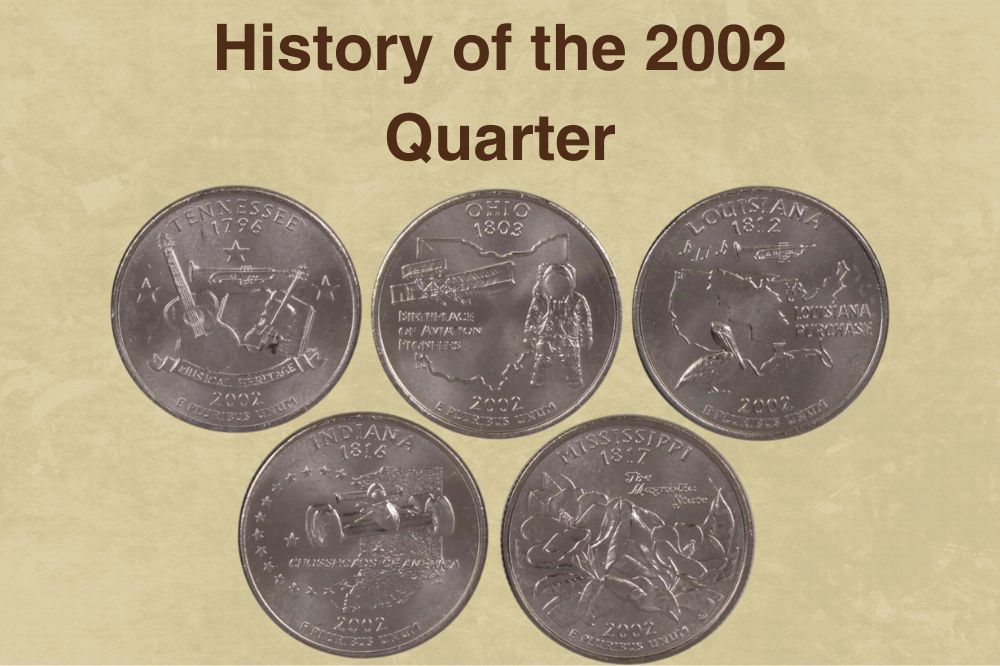
In 2002, quarters honoring Tennessee, Ohio, Louisiana, Indiana, and Mississippi were released in that order. Against the backdrop of national unity and reflection, these five coins served as small but meaningful tokens of America’s diverse cultural tapestry.

Notably, CoinWeek editor and numismatic journalist Beth Deisher served on Ohio’s quarter design committee. The program also generated some controversy—legendary coin dealer Tom Noe, later convicted in a coin investment scandal, also served on that same design committee.

Also Read: Top 100 Most Valuable Modern Quarters Worth Money List (1965-Present)


Is Your 2002 Quarter Rare?

10

2002-P Tennessee Quarter

Common
Ranked 209 in Washington 50 States Quarters
10

2002-D Tennessee Quarter

Common
Ranked 253 in Washington 50 States Quarters
10

2002-P Ohio Quarter

Common
Ranked 221 in Washington 50 States Quarters
10

2002-D Ohio Quarter

Common
Ranked 272 in Washington 50 States Quarters
10

2002-P Louisiana Quarter

Common
Ranked 193 in Washington 50 States Quarters
10

2002-D Louisiana Quarter

Common
Ranked 228 in Washington 50 States Quarters
10

2002-P Indiana Quarter

Common
Ranked 195 in Washington 50 States Quarters
10

2002-D Indiana Quarter

Common
Ranked 226 in Washington 50 States Quarters
10

2002-P Mississippi Quarter

Common
Ranked 96 in Washington 50 States Quarters
10

2002-D Mississippi Quarter

Common
Ranked 227 in Washington 50 States Quarters
10

2002-S Tennessee DCAM Quarter

Common
Ranked 313 in Washington 50 States Quarters
10

2002-S Ohio DCAM Quarter

Common
Ranked 281 in Washington 50 States Quarters
10

2002-S Louisiana DCAM Quarter

Common
Ranked 293 in Washington 50 States Quarters
10

2002-S Indiana DCAM Quarter

Common
Ranked 292 in Washington 50 States Quarters
10

2002-S Mississippi DCAM Quarter

Common
Ranked 290 in Washington 50 States Quarters
12

2002-S Tennessee Silver DCAM Quarter

Common
Ranked 12 in Washington 50 States Quarters
12

2002-S Ohio Silver DCAM Quarter

Common
Ranked 14 in Washington 50 States Quarters
12

2002-S Louisiana Silver DCAM Quarter

Common
Ranked 8 in Washington 50 States Quarters
12

2002-S Indiana Silver DCAM Quarter

Common
Ranked 10 in Washington 50 States Quarters
12

2002-S Mississippi Silver DCAM Quarter

Common
Ranked 17 in Washington 50 States Quarters

For a detailed rarity assessment of your specific coin, the Coin Value Checker App can help you quickly identify its scarcity and collectible potential.


Key Features of the 2002 Quarter

The 2002 quarters share a common obverse but feature five distinct reverse designs, each representing a different state’s heritage and symbols. Examining these details is essential for both authentication and valuation purposes.

The Obverse of the 2002 Quarter

The Obverse Of The 2002 Quarter

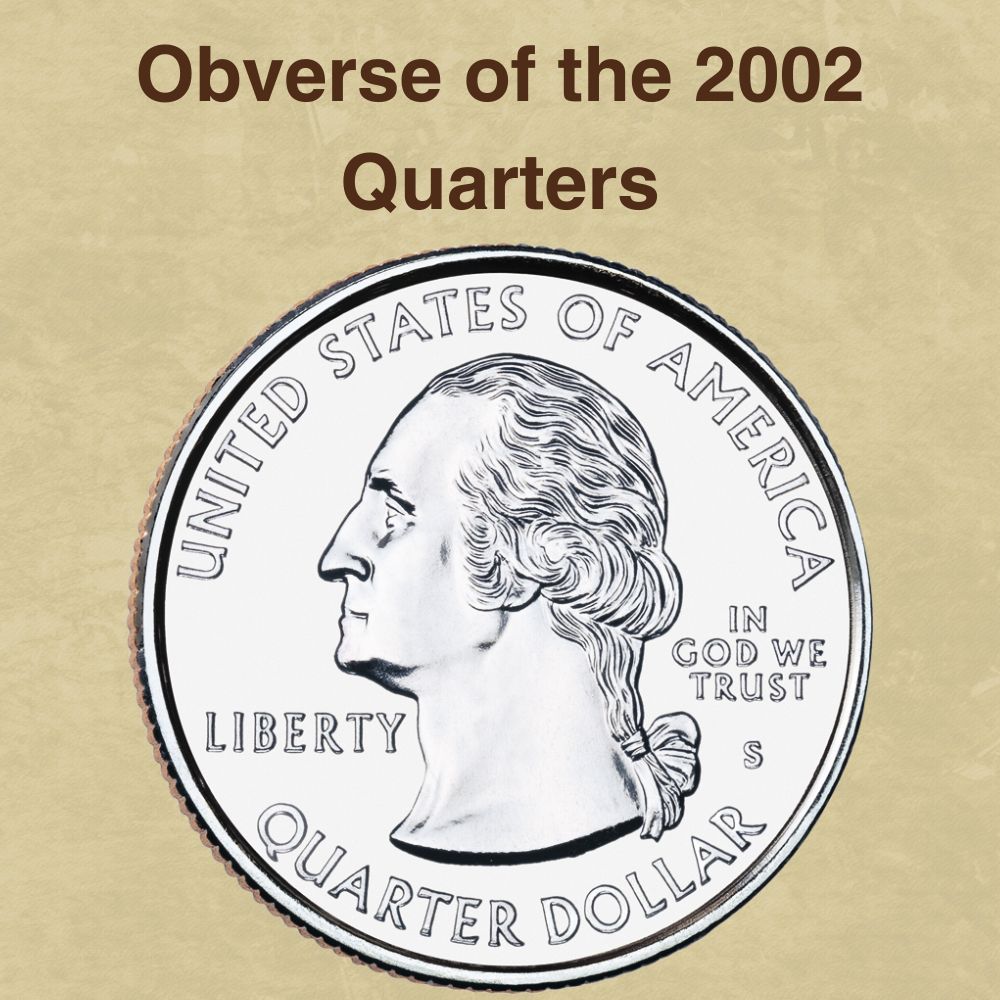
All five 2002 state quarters share an identical obverse design. The coin features a left-facing portrait of President George Washington, originally designed by sculptor John Flanagan in 1932.

For the 50 State Quarters Program, the portrait was slightly reduced in size to accommodate additional inscriptions that were previously placed on the reverse. The modification was executed by U.S. Mint sculptor-engraver William Cousins.

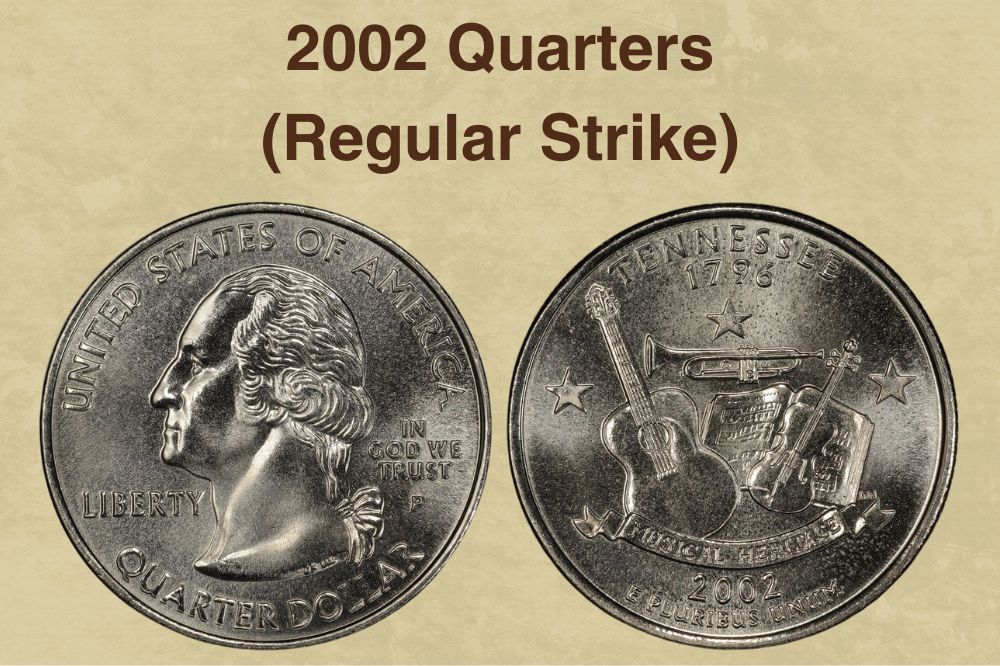
The inscription “UNITED STATES OF AMERICA” arches along the upper rim. At the base of the coin, “QUARTER DOLLAR” indicates the denomination. The word “LIBERTY” appears on the left side, while the national motto “IN GOD WE TRUST” sits on the right, behind Washington’s profile.

The mint mark—P for Philadelphia, D for Denver, or S for San Francisco—is located to the right of Washington’s ribbon. The designer’s initials “JF” for John Flanagan appear on the truncation of Washington’s neck.

The Reverse of the 2002 Quarter

The Reverse Of The 2002 Quarter

Each reverse design was developed through collaboration between the U.S. Treasury and the respective state governors. All five reverses include the state name, statehood year, mintage year “2002”, and the motto “E PLURIBUS UNUM.”

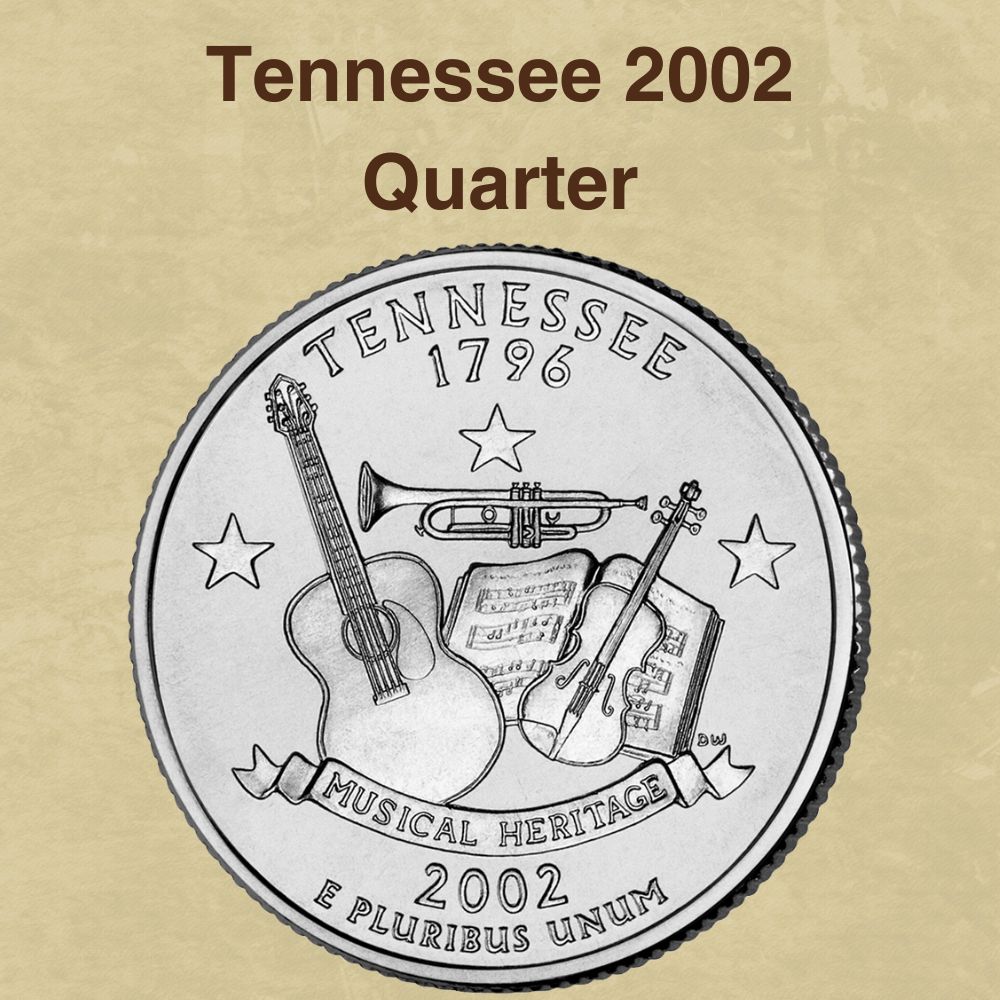
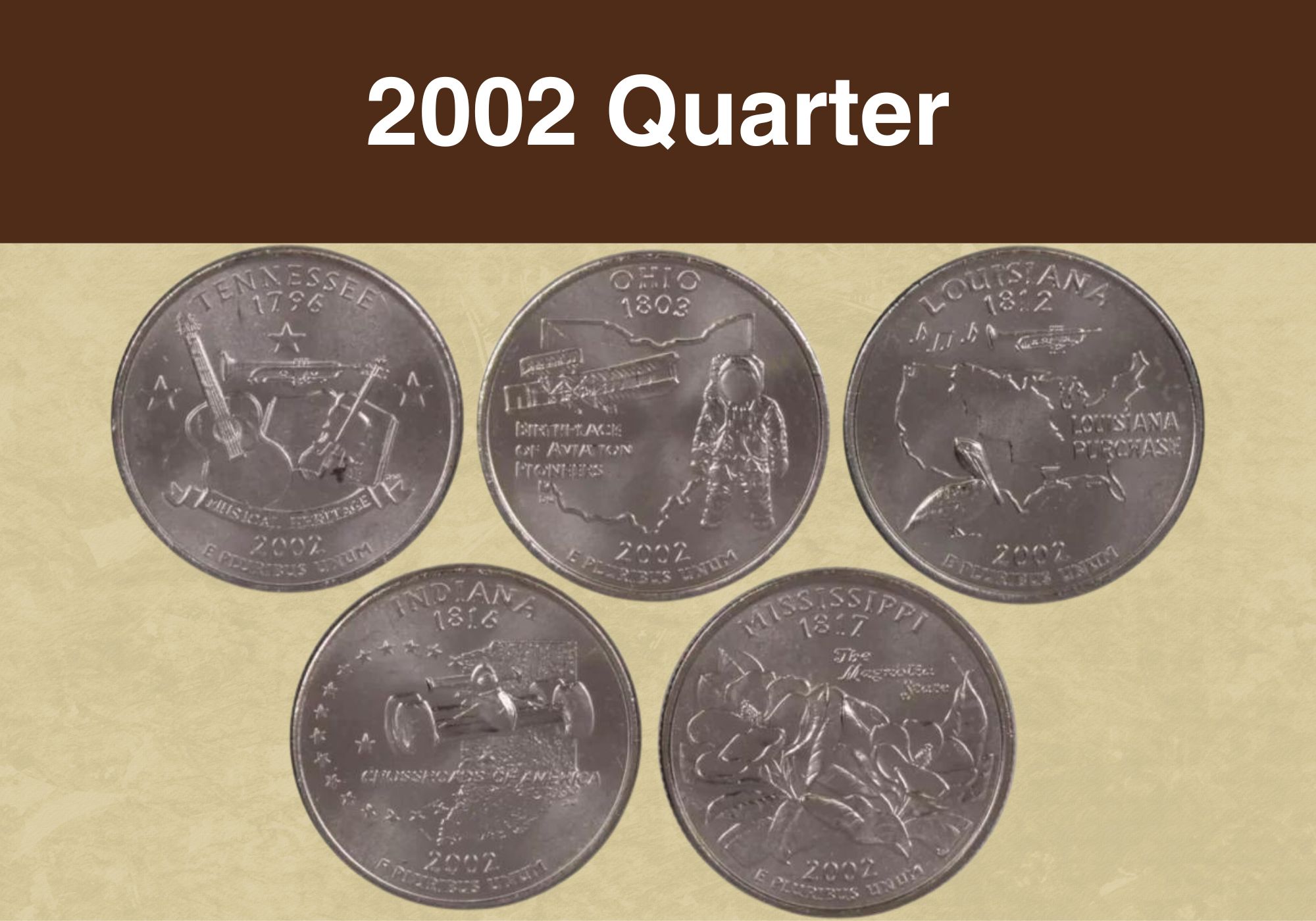
The Tennessee quarter features a fiddle, a trumpet, and a guitar arranged with a musical score. Three stars surround the instruments, and “MUSICAL HERITAGE” appears below. One guitar string famously disappears as it crosses the sound hole—an unintended detail on every coin struck from those dies.

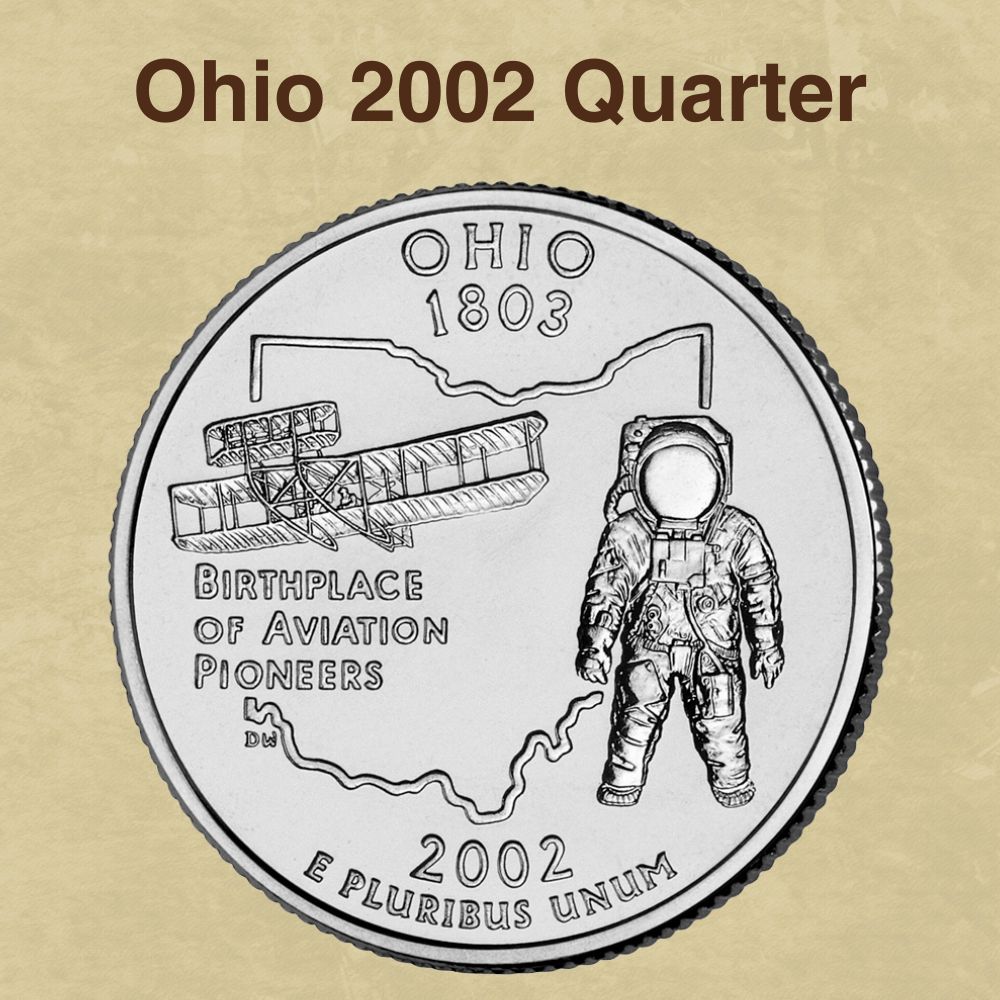
The Ohio quarter superimposes an early aircraft and an astronaut on an outline of the state, with “BIRTHPLACE OF AVIATION PIONEERS” running along the left. Ohio claims both Orville Wright and astronauts Neil Armstrong and John Glenn among its famous sons.

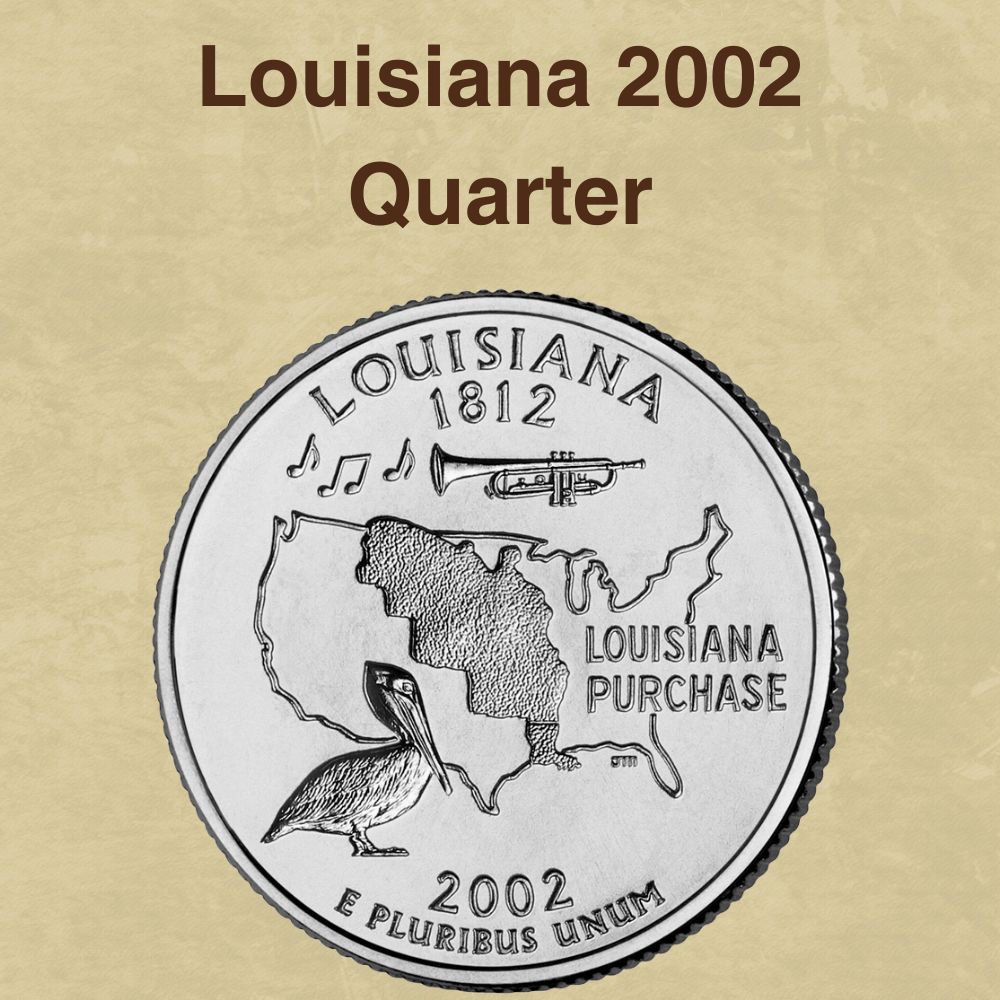
The Louisiana quarter displays the brown pelican (the state bird), an outline of the Louisiana Purchase territory, and a jazz trumpet, with the inscription “LOUISIANA PURCHASE.”

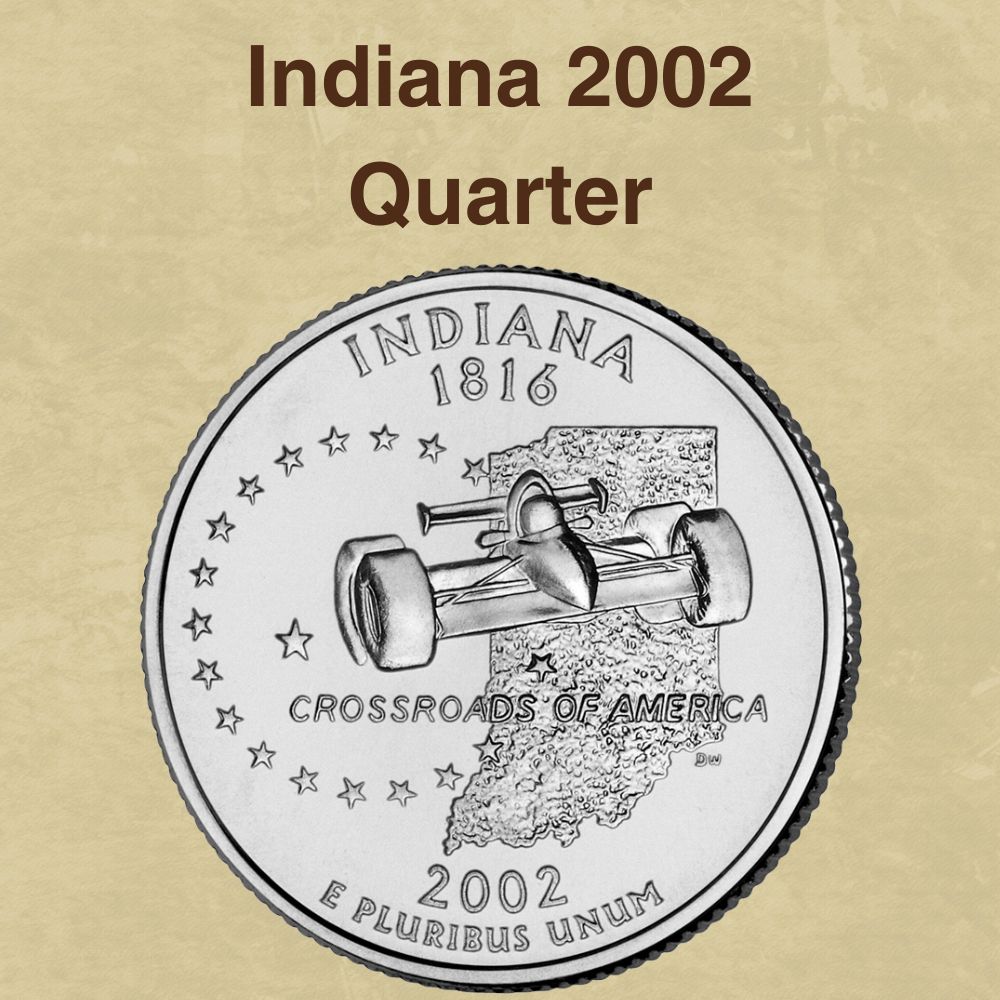
The Indiana quarter shows a race car superimposed on the state outline. Nineteen stars encircle the design—marking Indiana’s 1816 admission as the 19th state—and “CROSSROADS OF AMERICA” appears in the center.

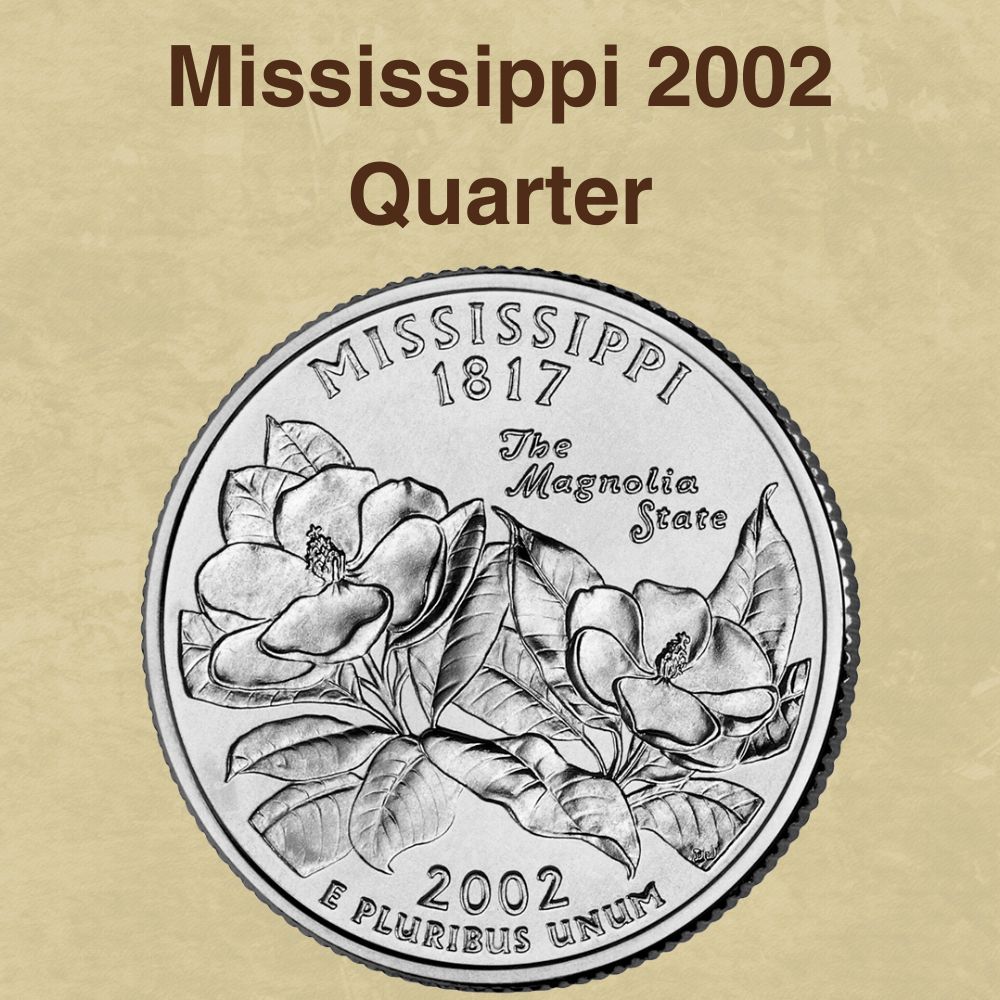
The Mississippi quarter presents two magnolia blossoms with leaves and the inscription “THE MAGNOLIA STATE.” The magnolia was officially designated the state flower following a public vote in 1900 in which it defeated cotton. The design was later noted by CoinWeek for appearing somewhat abstract at production scale.

Other Physical Features of the 2002 Quarter

Circulation strikes use standard clad composition: two outer layers of cupronickel (75% copper, 25% nickel) bonded to a pure copper core. The overall composition is 91.67% copper and 8.33% nickel. Each coin weighs 5.67 grams and measures 24.26 mm in diameter, with a thickness of 1.75 mm.

The edge is reeded, featuring 119 vertical grooves. This design historically prevented shaving of precious metals from coins and today aids in distinguishing quarters from other denominations.

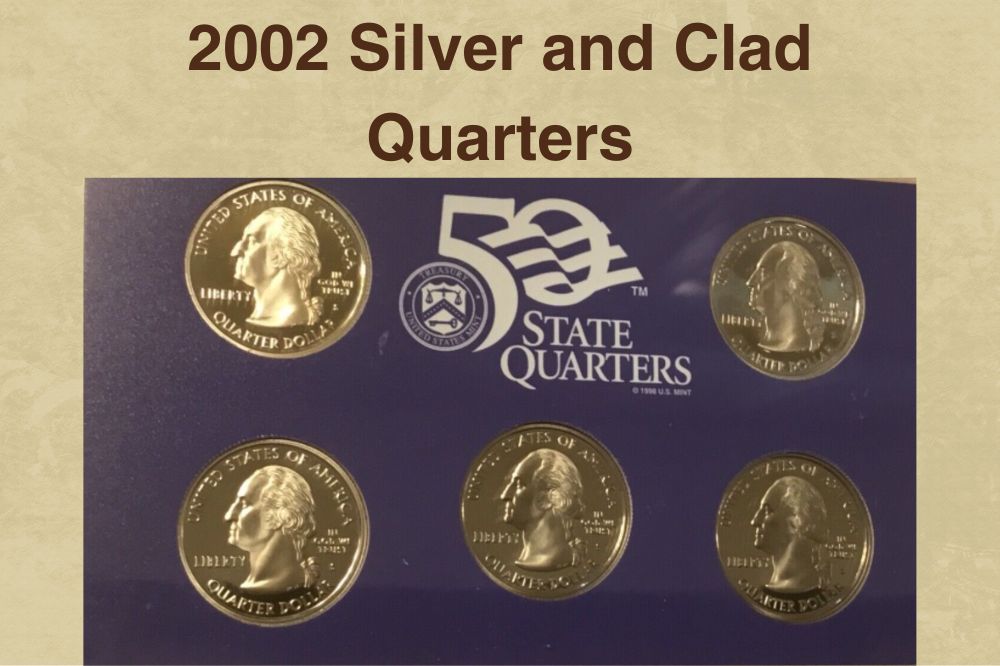
San Francisco silver proof versions contain 90% silver and 10% copper, weighing 6.25 grams—slightly heavier than the clad version. Their 0.1808 troy ounces of actual silver weight gives them a tangible precious-metal floor value. You can quickly tell a silver proof from a clad proof by looking at the coin’s edge: silver proofs show a solid, uniform edge, while clad proofs reveal a visible copper stripe in the reeding.

Also Read: Washington Quarter Value (1932-1998)


2002 Quarter Value and Mintage & Survival Data

2002 Quarter Mintage & Survival Chart

Mintage Comparison

Survival Distribution

TypeMintageSurvivalSurvival Rate
P Tennessee361,600,000307,360,00085%
P Ohio217,200,000184,620,00085%
P Louisiana362,000,000307,700,00085%
P Indiana362,600,000308,210,00085%
P Mississippi290,000,000246,500,00085%

Among the five 2002 Philadelphia mint state quarters, Indiana, Louisiana, and Tennessee share similar mintage figures, each exceeding 361 million. Ohio recorded the lowest mintage at just 217,200,000—making it notably scarcer than its counterparts.

Business-strike mintages for the 2002 series were slightly lower overall than the 1999 issues, reflecting a decrease in demand for new coins as the initial collecting frenzy subsided, according to CoinWeek’s historical analysis. The proof mintages, however, held relatively firm from year to year.

All five Philadelphia varieties maintain an estimated 85% survival rate, meaning roughly 15% of originals have been lost, damaged, or removed from circulation. Ohio therefore has the fewest surviving coins at approximately 184,620,000. Mississippi, with a mintage of 290,000,000, falls in the middle of the group.

An important concept when evaluating these coins is “conditional rarity.” Even though hundreds of millions of each variety were struck, the high-speed minting process caused the vast majority to bear contact marks and imperfections. Coins certified MS68 or MS69 by PCGS (Professional Coin Grading Service) or NGC (Numismatic Guaranty Company) represent genuine rarity regardless of total mintage.

Also Read: America The Beautiful Quarters Value (2010-2021)


The Easy Way to Know Your 2002 Quarter Value

The value of your 2002 50 States quarter depends on several key factors: mint mark, condition, strike quality, and the presence of minting errors.

Start by locating the mint mark (P, D, or S) on the obverse near Washington’s ribbon. Then examine the coin’s surface for luster, contact marks, and any unusual features such as doubled dies or struck-through errors.

For a quick and accurate appraisal, the Coin Value Checker App offers instant value estimates, grade references, and error detection to help you understand exactly what your coin is worth.

Coin Value Checker APP
Coin Value Checker APP Screenshot


2002 Quarter Value Guides

The 2002 50 States Quarters include five varieties, each available with P, D, and S mint marks. In circulated condition (grades below AU-50), these coins are worth face value or 30–40 cents at retail. Significant collector premiums begin at MS67 and above, driven by conditional rarity.

MS67 is roughly the break-even threshold where a coin’s value clearly exceeds the cost of professional certification. From MS67 to MS68, prices can jump dramatically due to Registry Set competition—where advanced collectors pay premiums for the highest-graded example in a series. Silver proof versions from San Francisco (S mint) carry additional value from their 90% silver content.

Here are the five 2002 state quarters listed in release order:

  • 2002 Tennessee Quarter – First release of 2002; highest auction records in the series
  • 2002 Ohio Quarter – Lowest P-mint mintage; remarkable scarcity at MS69
  • 2002 Louisiana Quarter – Strong die-quality distinction between P and D strikes
  • 2002 Indiana Quarter – Denver mint examples command the largest premiums
  • 2002 Mississippi Quarter – Final 2002 release; silver proofs carry meaningful melt value


2002 Tennessee Quarter Value

2002 Tennessee Quarter Value

The 2002 Tennessee Quarter celebrates the state’s musical heritage with three instruments: a fiddle for East Tennessee’s Appalachian roots, a guitar for Nashville’s country tradition, and a trumpet for West Tennessee’s blues legacy. The designer was Donna Weaver, working from the state’s selected design concept.

One quirk distinguishes the coin—a guitar string disappears as it crosses the sound hole, an unintended detail present on every Tennessee quarter struck. It’s a small imperfection in the master design, not a mint error, so it does not add value.

High-grade examples from Philadelphia and Denver in MS66 condition typically trade around $12, while MS68 pieces command $22 from Philadelphia and $70 from Denver. Philadelphia produced MS69 specimens valued at approximately $215, representing the finest regular strikes available to collectors.

San Francisco clad proof versions in PR70 (Deep Cameo, or DCAM—meaning crisp frosted devices against mirror-bright fields) reach approximately $30, while silver proofs at the same grade achieve around $60. The silver proof mintage was 888,826 pieces for the Tennessee design.

CoinVaueChecker App 10

2002-P Tennessee Quarter Price/Grade Chart

Price by 1-70 Grade (Latest Auction Records Included)

Updated: 2026-05-12 02:29:56

Historical auction records for this coin document its performance across all grades.

Date PlatformPrice Grade

Market activity over the past year reveals consistent collector interest in premium specimens.

Market Activity: 2002-P Tennessee Quarter


2002 Ohio Quarter Value

2002 Ohio Quarter Value

The 2002 Ohio Quarter honors the state as the birthplace of human flight, featuring astronaut Neil Armstrong, astronaut John Glenn, and aviation pioneer Orville Wright. Their figures and an early aircraft overlay Ohio’s outline beneath “Birthplace of Aviation Pioneers.”

Ohio holds a special distinction in the 2002 series: at 217,200,000 coins, the Philadelphia mint produced fewer Ohio quarters than any other 2002 design. In uncirculated grades MS65–MS67, a 2002-P Ohio quarter is worth roughly $0.80 to $11, similar to other 2002 issues. But at MS67 and above, that lower mintage creates measurable scarcity.

Philadelphia examples reaching MS69 commanded $495 at Heritage Auctions’ May 2003 sale. Denver mint pieces in identical MS69 condition soared to $3,525 at Heritage in January 2017—one of the highest prices ever realized for a 2002 business strike. That extraordinary gap reflects how few Denver-struck Ohio quarters survived production in truly flawless condition.

Clad proof specimens achieving PR70 DCAM brought $127 at Heritage’s February 2006 sale. Silver proofs at the same PR70 grade peaked at $935 in October 2003, demonstrating the premium for precious metal combined with technical perfection.

2002-D Ohio Quarter Price/Grade Chart

Price by 1-70 Grade (Latest Auction Records Included)

Updated: 2026-05-12 02:29:56

Displayed below are the highest confirmed auction prices that define the market ceiling for this issue.

Date PlatformPrice Grade

Tracking recent market movements reveals shifting collector priorities and emerging value patterns.

Market Activity: 2002-D Ohio Quarter


2002 Louisiana Quarter Value

2002 Louisiana Quarter Value

The 2002 Louisiana Quarter commemorates Thomas Jefferson’s 1803 Louisiana Purchase, which doubled the nation’s size and paved the way for thirteen future states. Its design combines the brown pelican, a jazz trumpet, and the Purchase territory outline to link territorial expansion with Louisiana’s cultural legacy.

Collectors who study this issue closely observe distinct strike characteristics between the two mint facilities. Philadelphia strikes typically display cleaner background fields, while Denver examples occasionally show slight graining across open surfaces—a subtle quality difference that becomes significant at premium grades.

Professional grading services have certified just 44 MS69 specimens from Philadelphia, with those examples typically valued around $275 and auction records reaching $495. Denver coins achieving MS68 commanded $225 at an August 2021 auction.

In 2013, a struck-through error on a 2002-S Louisiana quarter graded MS64—showing debris-caused indentation on the pelican’s wing—sold for $1,020 at Goldberg Auctions. A die clash error on the same S-mint variety brought $1,225 at Goldberg Auctions in 2014. These are exceptional error premiums for a modern coin series.

2002-S Louisiana Silver Quarter Price/Grade Chart

Price by 1-70 Grade (Latest Auction Records Included)

Updated: 2026-05-12 02:29:56

Here are the historical auction records for this coin across different grades.

Date PlatformPrice Grade

Shown below is a chart highlighting the market activity of the 2002-S Louisiana Silver Quarter over the past year.

Market Activity: 2002-S Louisiana Silver Quarter


2002 Indiana Quarter Value

2002 Indiana Quarter Value

The 2002 Indiana Quarter highlights the state’s identity as a crossroads of movement and innovation. The Indianapolis 500 race car reflects its automotive legacy, while nineteen stars mark Indiana’s 1816 admission as the 19th state.

Even within identical MS69 grades, mint origin dramatically affects value. Philadelphia examples achieved $690 at auction, but Denver specimens commanded $3,760—one of the widest mint-to-mint price gaps in the entire 50 State Quarters series. This extreme difference reveals just how rare flawless Denver strikes truly are.

San Francisco produced both clad and silver proof versions through a specialized process: multiple die impressions on hand-selected, polished planchets create the characteristic mirror-bright fields (called “prooflike fields”) with frosty, sculpted devices. When the contrast between those mirror fields and frosted devices is especially sharp, the coin earns the DCAM designation—Deep Cameo—the most valuable proof finish.

This technical precision translates to a stark market gap: clad proofs in PR70 DCAM reach approximately $123, while silver proofs at the same grade soar to $1,064, reflecting both precious metal content and collector preference.

2002-S Indiana Silver Quarter Price/Grade Chart

Price by 1-70 Grade (Latest Auction Records Included)

Updated: 2026-05-12 02:29:56

To understand its current market position, here are the historical auction results and recent trading activity.

Date PlatformPrice Grade

Market patterns over recent months provide additional context for valuation.

Market Activity: 2002-S Indiana Silver Quarter


2002 Mississippi Quarter Value

2002 Mississippi Quarter Value

The 2002 Mississippi Quarter is the final release of the 2002 series, honoring the magnolia’s designation as the official state flower since 1900. Two blooming branches beneath “The Magnolia State” celebrate this enduring symbol. The design was noted by observers for appearing somewhat abstract at normal production scale—CoinWeek described it as an “amorphous mass” recognizable mainly from the accompanying inscription.

While high-grade circulation strikes command substantial premiums, their scarcity makes acquisition challenging. Silver proofs offer a more accessible alternative: at current silver prices near $84 per ounce (March 2026), their intrinsic melt value stands near $15.24—a firm precious-metal floor beneath numismatic premiums.

A perfect PR70 DCAM example trades around $50 today, far below the $949 realized in a 2003 Heritage auction. That gap illustrates how early enthusiasm for newly issued proof coins often outpaces long-term valuations once supply stabilizes.

To tell a silver proof from a clad proof, examine the coin’s edge: a solid, uniform edge confirms silver composition, while a visible copper stripe in the reeding signals a clad proof. Never clean a proof coin—even a soft cloth creates hairlines that immediately reduce a coin’s grade and eliminate its numismatic premium above melt.

2002-S Mississippi Quarter Price/Grade Chart

Price by 1-70 Grade (Latest Auction Records Included)

Updated: 2026-05-12 02:29:56

Recent auction performance demonstrates collector interest across multiple grade levels and certification services.

Date PlatformPrice Grade

Observing current market trends helps gauge collector attention and liquidity for this quarter.

Market Activity: 2002-S Mississippi Quarter

Also Read: 22 Rare Quarter Errors List with Pictures (By Year)


Rare 2002 Quarter Value: Complete Error List

The 2002 quarter series honored five states from Tennessee to Mississippi. While millions circulated at face value, certain minting mishaps transformed ordinary pocket change into numismatic treasures worth hundreds or even thousands of dollars.

In 2002, the U.S. Mint changed production methods that resulted in fewer errors escaping into circulation—which means any 2002 error that did make it out is more valuable today than similar errors from earlier years.

1. Saddle Strike Errors

The saddle strike is one of the most visually dramatic mistakes in modern coinage. It occurs when a planchet receives two strikes from the dies but fails to eject properly between impressions, shifting position so the second strike creates a ghostly overlap.

On affected Tennessee quarters, Washington’s profile from the obverse bleeds faintly over the reverse musical instruments, creating an almost three-dimensional effect impossible to replicate through normal minting.

In 2019, Heritage Auctions sold a graded MS65 Tennessee saddle-strike example for $1,430. The Tennessee quarter’s relatively brief production window at Philadelphia makes any error from this design particularly scarce.

2. Wrong Planchet Errors

When Indiana quarter dies struck Roosevelt dime blanks—measuring just 17.91mm versus the quarter’s standard 24.26mm—the result was a dramatically undersized coin with truncated design elements. Peripheral legends like “UNITED STATES OF AMERICA” vanish entirely while central design elements remain relatively complete.

Modern mints use sophisticated sorting systems that separate planchets by weight and diameter. For a dime blank to bypass these safeguards requires multiple simultaneous failures, which is why approximately fifteen such examples are documented across the entire 50 State Quarter series.

A 2002 Indiana quarter struck on a dime planchet is among the most dramatic wrong-planchet errors in the state quarter program, and authenticated examples can command prices comparable to the highest business-strike auction records.

3. Doubled Die Obverse (DDO) Errors

A doubled die occurs during die production when the master hub strikes a working die multiple times at slightly different angles. This transfers doubled design elements onto every coin struck from that die until replacement.

On the 2002-P Ohio quarter, the doubled die obverse (DDO) affects Washington’s portrait and surrounding inscriptions. Under magnification, you can observe distinct separation between the primary and secondary impressions on elements like “LIBERTY” or “IN GOD WE TRUST.” True doubling shows a rounded shadow or twin line slightly offset from the main design—different from machine doubling, which produces a flat, shelf-like effect with no collector value.

A Heritage Auctions 2018 sale achieved $1,450 for an MS66 Ohio DDO specimen. DDO errors on post-1999 quarters are particularly noteworthy because modern quality-control improvements catch most die defects before production begins.

4. Struck-Through Errors

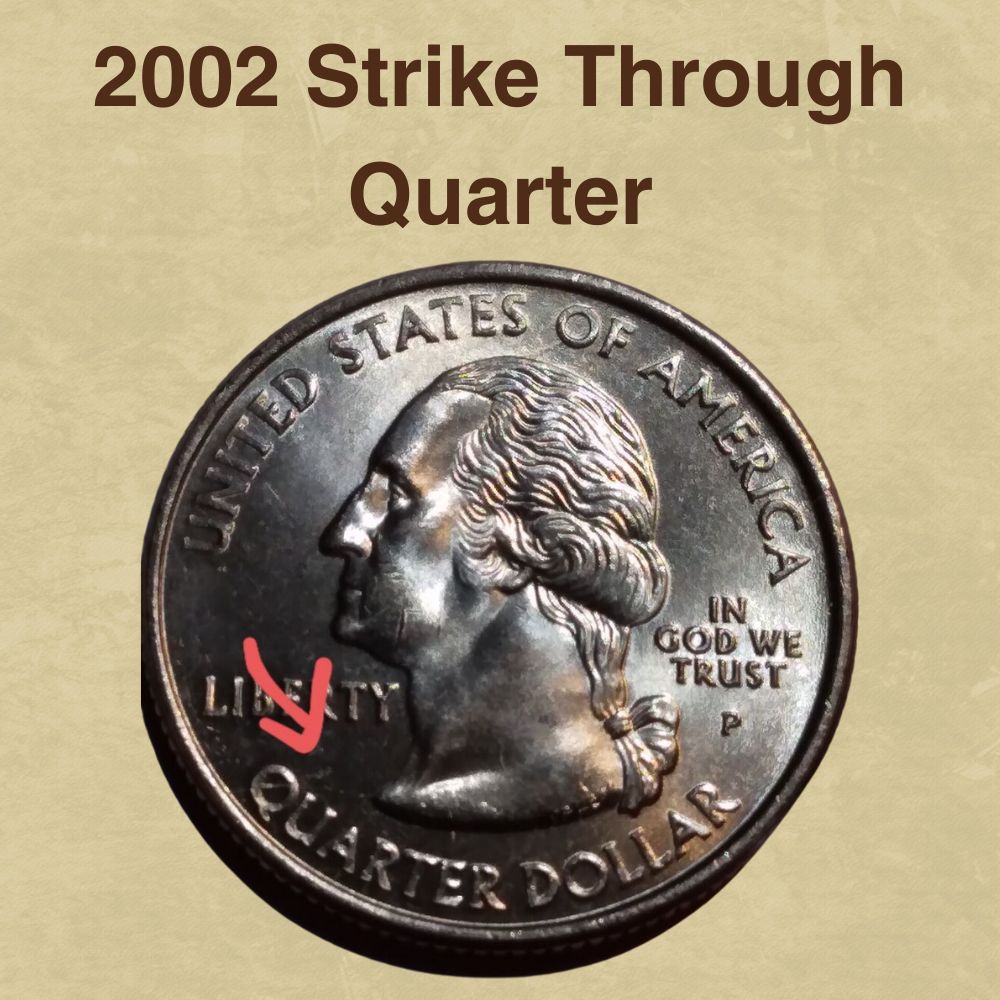
Struck-through errors occur when stray material—grease, dust, hair strands, or cloth fibers—lands between the die and planchet at the exact moment of striking. The foreign object leaves a depression, weak area, or missing detail on the finished coin.

In 2013, a 2002-S Louisiana quarter graded MS64 with a reverse struck-through error (showing a depression on the pelican’s wing) sold for $1,020 at Goldberg Auctions. Raking or angled lighting is the best way to reveal shallow struck-through errors on otherwise normal-looking coins.

5. Die Clash Errors

A die clash error occurs when the obverse and reverse dies collide without a planchet between them. The dies impress each other’s design details onto their opposing surfaces, and subsequent coins struck from those dies show ghost-like images from the wrong side.

In 2014, a 2002-S Louisiana quarter with a die clash error sold for $1,225 at Goldberg Auctions. The coin showed subtle, incomplete elements of the state design in the background alongside Washington’s profile on the obverse—a telltale sign of die-to-die contact.

6. Rotated Die Errors

Rotated die errors occur when the obverse and reverse dies are not properly aligned at 180 degrees to each other. On a normal U.S. coin, if you flip the coin left-to-right, the reverse image appears right-side-up—a “coin turn.” A rotated die produces an observable angle between the two sides.

Larger rotations are rarer and more valuable. In 2017, Heritage Auctions sold a 2002-D Indiana quarter graded MS64 with a rotated die error for $1,050.

7. Cud Errors

A cud is a dramatic form of die failure. As a coin die is used for hundreds of thousands or even millions of strikes, the steel fatigues and develops stress fractures. When a large chunk of the die breaks away entirely, metal flows into the void with each subsequent strike, creating a raised, rounded, blank area on the coin’s rim or design area.

In 2010, a 2002-P Mississippi quarter graded MS65 with a cud error sold for $1,125 at GreatCollections. The cud appeared at the rim, distorting part of the state outline.

8. Missing Clad Layer Errors

Modern quarters are made of a copper core sandwiched between two outer layers of copper-nickel. If one of those outer layers fails to bond to the planchet before striking, the finished coin exposes the copper core on that side—giving it a distinctly copper-colored appearance.

CoinVaueChecker App 10

A missing clad layer on the 2002 Louisiana quarter reduces the coin’s weight from the standard 5.67 grams to approximately 4.6 grams. Examples in this error category bring $40–$100 depending on which layer is missing and the coin’s overall grade.

9. Clipped Planchet Errors

A clipped planchet error occurs before the coin is ever struck. When the machine that punches circular blanks from metal strips overlaps a previous punch hole or the strip’s edge, it cuts out an incomplete disc. That malformed blank travels through the entire minting process and gets struck as-is.

The most reliable authentication test for a clipped planchet is the Blakesley Effect: on a genuine clip, the rim directly opposite the missing section will be noticeably weak, flat, or missing its reeding—because metal couldn’t flow properly to that area during rim formation. A filed or altered coin won’t show this effect.

10. Partial Die Break Errors

A partial die break is similar to a cud error but less severe—only a portion of the die chips or cracks, leaving a raised, irregular area on the coin without fully disrupting surrounding elements. These typically occur near high-stress areas like lettering or the coin’s edge.

A 2002-P quarter graded MS66 with a partial die break on the reverse sold at a Stack’s Bowers auction in 2018 for $1,200. Partial die breaks are clearly distinguishable from post-mint damage once you know what to look for: the anomaly should be raised above the surface and show the same patina as the rest of the coin.


Where to Sell Your 2002 Quarter

Getting a fair price depends on where you sell. Below is a guide to trusted online coin marketplaces, covering what each does well and where they fall short.

Check out now: Best Places to Sell Coins Online (Pros & Cons)


2002 Quarter Value Market Trend

Market Interest Trend Chart - 2002 Quarter

*Market Trend Chart showing the number of people paying attention to this coin.


FAQ About 2002 Quarter Value

1. What is the 2002 Ohio quarter worth, and why is it notable?

The 2002-P Ohio quarter has the lowest Philadelphia mintage among the five 2002 designs at 217,200,000 coins. In circulated condition, it trades near face value.

High-grade examples command significant premiums: a 2002-D Ohio quarter graded MS69 sold for $3,525 at Heritage Auctions in January 2017, demonstrating the extreme scarcity of pristine Denver strikes.

2. What are the most valuable 2002 quarter errors worth money?

The most valuable 2002 quarter errors include wrong planchet strikes, saddle strikes, and doubled dies. A saddle-strike Tennessee quarter graded MS65 sold for $1,430 at Heritage Auctions in 2019.

A doubled die obverse Ohio quarter graded MS66 sold for $1,450 at Heritage in 2018, while Louisiana struck-through and die clash errors at Goldberg Auctions have fetched $1,020 and $1,225 respectively.

3. Are 2002 quarters worth collecting today?

Circulated 2002 quarters remain common and trade near face value. However, uncirculated examples graded MS67 or higher carry meaningful premiums, and MS69 specimens are genuinely rare.

Denver mint coins in gem condition are particularly scarce—fewer survived due to circulation wear. Silver proofs offer accessible collector options with PR70 DCAM examples typically valued $50–$60, plus intrinsic silver value.

4. What does DCAM mean on a 2002 quarter proof?

DCAM stands for Deep Cameo, the most desirable finish designation for proof coins. It describes striking contrast between the frosted, sculpted devices (the raised design elements) and the mirror-bright fields (the flat background areas) of the coin.

On 2002 San Francisco proof quarters, DCAM coins command significantly higher prices than non-DCAM examples at the same grade. PR70 DCAM is the top possible designation for a proof coin.

5. How do I tell a 2002 silver proof quarter from a clad proof?

The simplest test is the edge: a silver proof shows a solid, uniform edge color, while a clad proof reveals a distinct copper stripe visible in the reeding. You can also weigh the coin—silver proofs weigh 6.25 grams versus 5.67 grams for clad versions.

The silver content matters for value: at current silver prices, each 2002-S silver proof contains approximately $15 in intrinsic metal value, providing a floor beneath the numismatic premium.

6. Why do Denver 2002 quarters sell for so much more than Philadelphia strikes at MS69?

High-speed production at the Denver Mint caused most coins to contact each other in bins and bags, creating surface marks that prevent top grades. Very few pieces from Denver escaped this process in perfect condition.

As a result, certified MS69 examples from Denver are dramatically rarer than the same grade from Philadelphia—and PCGS and NGC population reports confirm this. That supply scarcity, combined with collector demand, drives prices like the $3,760 Indiana and $3,525 Ohio sales.

7. What is the 2002 quarter composition, and does it contain silver?

Standard 2002 P and D mint quarters are clad coins—91.67% copper and 8.33% nickel—with no silver content at all. The San Francisco S-mint proof quarters sold in special collector sets are 90% silver and 10% copper.

The silver proof versions weigh 6.25 grams and contain 0.1808 troy ounces of silver. No other 2002 quarter variety contains precious metal.

8. What are 2002 gold quarters, and are they valuable?

Gold 2002 quarters are regular circulation coins that were privately coated with a thin layer of 24-karat gold by companies like the American Mint, Danbury Mint, or Franklin Mint after leaving official production. They are legal U.S. currency that has been altered after minting.

The gold layer is extremely thin and adds essentially no precious-metal value. These coins are not considered numismatically valuable by PCGS or NGC and are generally worth face value or a small premium to certain buyers who find them decorative.

9. How can I identify a real doubled die error on a 2002 quarter?

Use a 5x to 10x magnifying loupe and examine the obverse inscriptions—”LIBERTY” and “IN GOD WE TRUST” are the prime areas. On a genuine DDO (Doubled Die Obverse), letters appear to have a rounded shadow or twin line slightly offset from the main design.

This is different from machine doubling, which creates a flat, shelf-like effect with no collector value. When in doubt, submit to PCGS or NGC for professional attribution before assigning significant value.

10. What is the best way to find a valuable 2002 quarter?

Start by searching bank rolls of quarters—ask your local bank for wrapped rolls or full $500 boxes. Sort by state design first, then examine mint marks under magnification. Focus on coins with strong luster, sharp rims, and no visible wear on Washington’s cheek or hair.

Weigh suspicious coins with a digital scale accurate to 0.01 grams—this immediately flags missing clad layer errors (which weigh approximately 4.6 grams instead of the standard 5.67 grams). Certify any strong error finds through PCGS or NGC before selling, as certification significantly increases realized prices at auction versus selling a raw coin.

You May Also Like