Coin Value Contents Table
- 2005 Quarter Value Chart
- History of the 2005 Quarter
- Features of the 2005 Quarter
- 2005 Quarter Grading Guides
- 2005 Quarter Value Guides
- 2005 P Quarter Value
- 2005 D Quarter Value
- 2005 P and 2005 D Special Strike Quarter Value
- 2005 S Clad Proof Quarter Value
- 2005 S Silver Proof Quarter Value
- Rare 2005 Quarter Errors List
- Where to Sell Your 2005 Quarter ?
- FAQs
Have you found a quarter dated 2005 in your pocket change? Or are you hoping to add one to your coin collection?
We’re going to investigate the 2005 quarter value, history and design. We’ll uncover the difference between an ordinary coin and one that’s rare and special. And we’ll answer some frequently asked questions too.
Ready to find out more? Then let’s go!
2005 Quarter Value Chart |
||||
| Mint mark | MS60 | MS63 | MS65 | MS68 |
| 2005 P California Quarter Value | $3 | $4 | $5 | $650 |
| 2005 D California Quarter Value | $3 | $5 | $5 | $225 |
| 2005 P Minnesota Quarter Value | $3 | $4 | $5 | $825 |
| 2005 P Minnesota Extra Tree Quarter Value | n/a | $20 | $35 | – |
| 2005 D Minnesota Quarter Value | $3 | $4 | $5 | $185 |
| 2005 P Oregon Quarter Value | $3 | $4 | $5 | $260 |
| 2005 D Oregon Quarter Value | $3 | $4 | $5 | $250 |
| 2005 P Kansas Quarter Value | $3 | $4 | $5 | $3,150 |
| 2005 D Kansas Quarter Value | $3 | $4 | $5 | $275 |
| 2005 P West Virginia Quarter Value | $3 | $4 | $5 | $2,250 |
| 2005 D West Virginia Quarter Value | $3 | $4 | $5 | $325 |
| SP60 | SP65 | SP68 | SP70 | |
| 2005 P California Satin Finish Special Strike Quarter Value | $2 | $3 | $12 | $1,800 |
| 2005 D California Satin Finish Special Strike Quarter Value | $2 | $3 | $10 | $4,500 |
| 2005 P Minnesota Satin Finish Special Strike Quarter Value | $2 | $3 | $12 | $1,450 |
| 2005 P Minnesota Extra Tree Satin Finish Special Strike Quarter Value | n/a | $50 | ? | n/a |
| 2005 D Minnesota Satin Finish Special Strike Quarter Value | $2 | $3 | $8 | $4,500 |
| 2005 D Minnesota Extra Tree Satin Finish Special Strike Quarter Value | n/a | ? | $400 | n/a |
| 2005 P Oregon Satin Finish Special Strike Quarter Value | $2 | $3 | $12 | $950 |
| 2005 D Oregon Satin Finish Special Strike Quarter Value | $2 | $3 | $12 | n/a |
| 2005 P Kansas Satin Finish Special Strike Quarter Value | $2 | $3 | $12 | $3,500 |
| 2005 D Kansas Satin Finish Special Strike Quarter Value | $2 | $3 | $12 | n/a |
| 2005 P West Virginia Satin Finish Special Strike Quarter Value | $2 | $3 | $12 | $3,250 |
| 2005 D West Virginia Satin Finish Special Strike Quarter Value | $2 | $5 | $18 | n/a |
|
|
PR60 | PR65 | PR68 | PR70 |
| 2005 S California Clad Proof Quarter Value | $5 | $8 | $8 | $35 |
| 2005 S Minnesota Clad Proof Quarter Value | $5 | $8 | $8 | $30 |
| 2005 S Oregon Clad Proof Quarter Value | $5 | $8 | $8 | $35 |
| 2005 S Kansas Clad Proof Quarter Value | $5 | $8 | $8 | $32 |
| 2005 S West Virginia Clad Proof Quarter Value | $5 | $8 | $8 | $25 |
| 2005 S California Silver Proof Quarter Value | $5 | $9 | $12 | $46 |
| 2005 S Minnesota Silver Proof Quarter Value | $5 | $9 | $12 | $46 |
| 2005 S Oregon Silver Proof Quarter Value | $5 | $9 | $12 | $45 |
| 2005 S Kansas Silver Proof Quarter Value | $5 | $9 | $12 | $40 |
| 2005 S West Virginia Silver Proof Quarter Value | $5 | $9 | $12 | $35 |
History of the 2005 Quarter
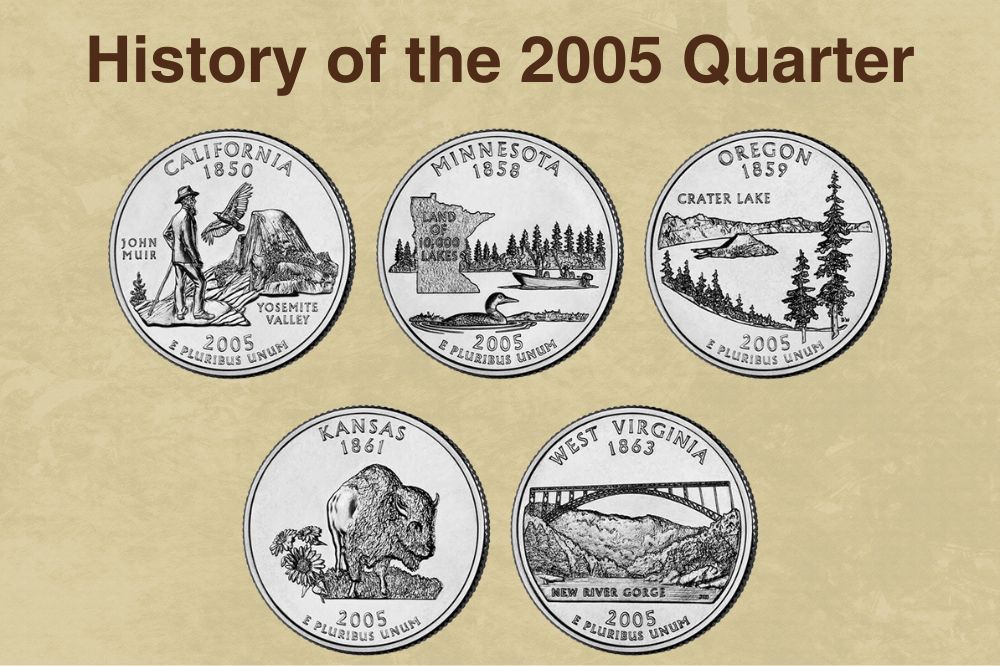
The quarters minted in 2005 are known as 50 States quarters. The series was launched in 1999, and aimed to stimulate a new generation of coin collectors. Each quarter honored a different US state.
The inspiration for the program came from north of the border. Canada had launched its own highly successful series of commemorative coins in 1992, marking the 125th anniversary of Confederation.
The US version was just as popular. Interest in the coins was so high, it’s believed half of all Americans collected them at some point in their lives.
A large number of people were also involved in the design of the coins. Many states ran competitions, and some put the shortlisted designs to a public vote. In all, it’s estimated that some 3.5 million people engaged in the process in some way.
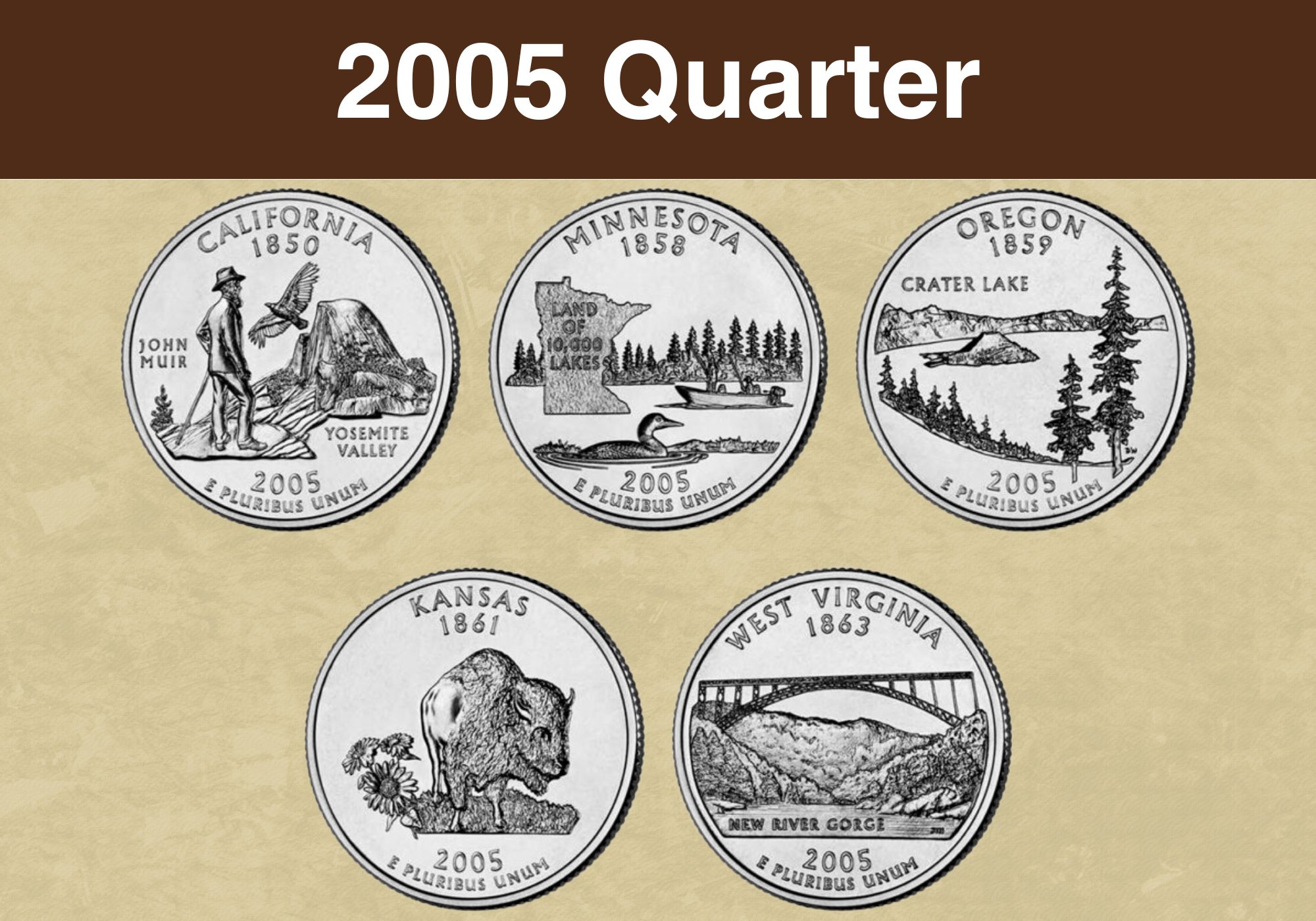
Coins for five states were issued each year, with a new coin appearing every ten weeks. The coins were launched in the order the states had signed the Constitution or joined the Union. 2005 saw quarters issued for California, Minnesota, Oregon, Kansas and West Virginia.
Business strike coins – i.e. those intended for everyday use – were struck by the Mint facilities at Philadelphia and Denver.
The same locations also struck coins for Special Mint Sets. These had a special satin finish.
The San Francisco Mint facility, meanwhile, struck proof quarters. These were produced using fine quality dies and highly polished planchets. Both clad and silver proofs were produced in 2005.
Also read: Top 13 Most Valuable State Quarters Worth Money
Features of the 2005 Quarter
The Obverse of the 2005 Quarter
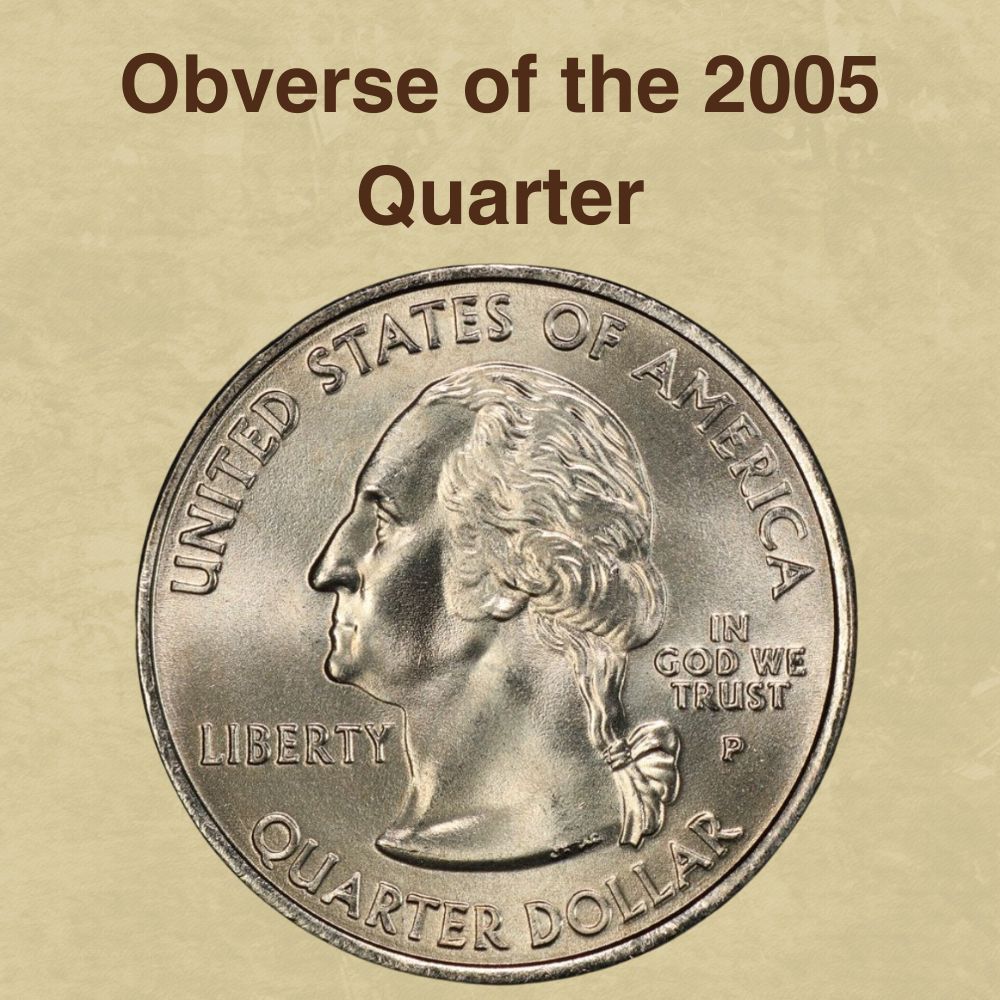
The obverse – or “heads” side – of all the quarters struck in 2005 looks the same. And they’re also the same as every other Washington quarter since 1932.
They carry the portrait of the first US president, George Washington. The portrait was the work of an artist named John Flanagan, and his initials appear on the cut-off of the bust.
Above the image, the name of the country is inscribed parallel to the upper coin edge. The word “LIBERTY” appears to the left of the portrait, while the motto “IN GOD WE TRUST” is to the right. The denomination, “QUARTER DOLLAR”, is along the bottom.
The mint mark is to the right of the coin. Coins struck in Philadelphia are marked with a “P”, those from Denver with a “D”, and proofs from San Francisco with an “S”.
The Reverse of the 2005 Quarter
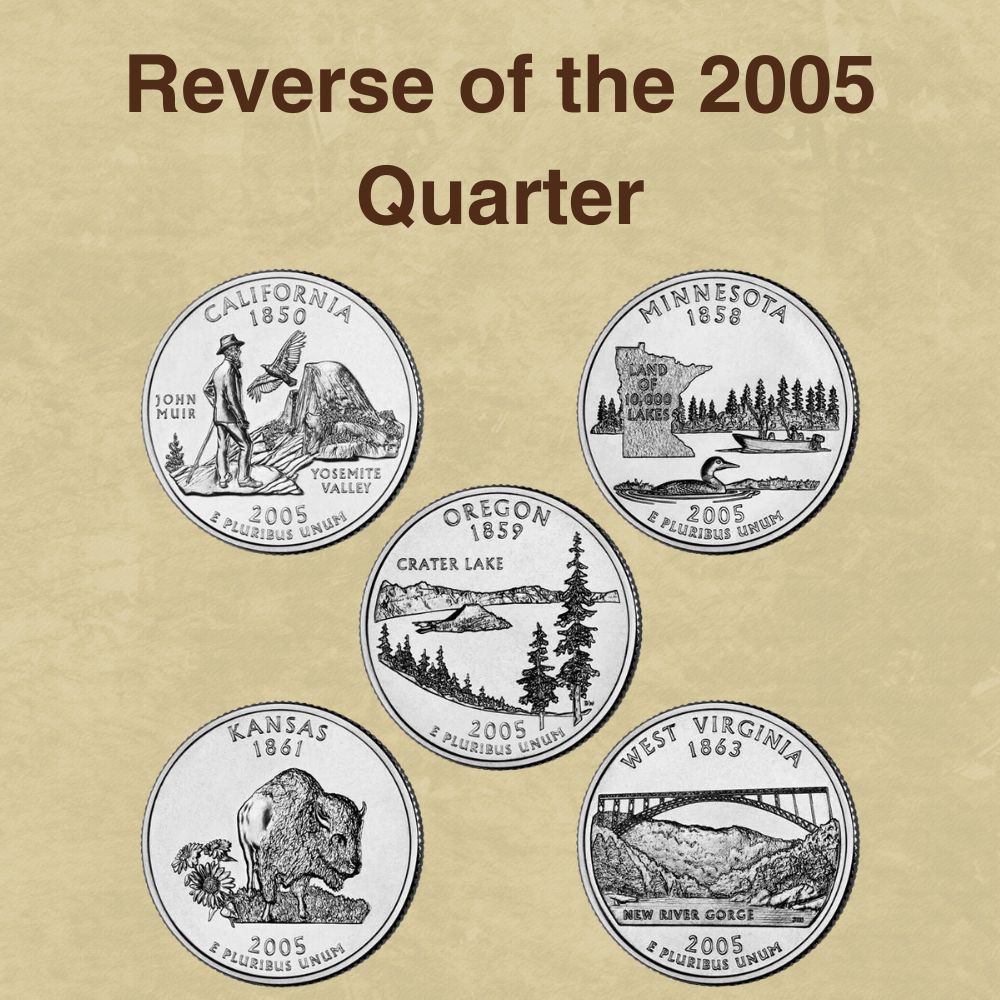
The reverse, or “tails” side, is where the image for the state appears.
The California quarter shows the conservationist, John Muir, gazing at the Yosemite Valley. A California condor also appears in the scene.
The Minnesota coin shows a tree-lined lake with two fishermen and a loon. There’s also an outline of the state superimposed with its nickname, “LAND OF 10,000 LAKES”.
For Oregon, the design again features a body of water, Crater Lake. The view includes Wizard Island, and Watchman and Hillman Peaks.
The Kansas quarter features a buffalo on a patch of grass, together with three sunflowers.
Finally, the West Virginia quarter returns to the watery theme with an image of the New River and New River Gorge Bridge.
For all the quarters, the state name and date of admission to the Union arch across the top of the coin. At the bottom is the year of mintage and the Latin motto “E PLURIBUS UNUM”, meaning “From the many, one”.
Other Features of the 2005 Quarter
The 2005 quarters struck for everyday use had a copper core. This was clad in an alloy of copper and nickel to give the coins their silver color.
The coins struck for Special Mint Sets had a different, satin-like finish, but their composition was the same.
The proof quarters were made to two different recipes. The majority were made from clad copper. But a smaller number were produced on planchets made from 90 per cent silver and 10 per cent copper.
The dimensions of all 2005 quarters are the same – 24.3 millimeters across. But their weight depends on whether they’re clad or silver.
Clad coins are slightly lighter. They weigh 5.67 grams, compared to 6.3 grams for the silver versions.
Also read: Top 16 Most Valuable Modern Quarters Worth Money
2005 Quarter Grading Guides
| # | Grade |
|---|---|
| 1 | Basal State-1 |
| 2 | Fair |
| 3 | Very Fair |
| 4, 5, 6 | Good |
| 7, 8, 10 | Very Good |
| 12, 15 | Fine |
| 20, 30 | Very Fine |
| 40 | Extremely Fine |
| 50 | About Uncirculated |
| 60 | Mint State |
| 65 | Mint State |
| 70 | Mint State |
Please check our grading guides to know your coin scale, It’s the necessary step to know the exact value of your coin.
Check out now: How to Grade Washington Quarter?
2005 Quarter Value Guides
2005 P Quarter Value
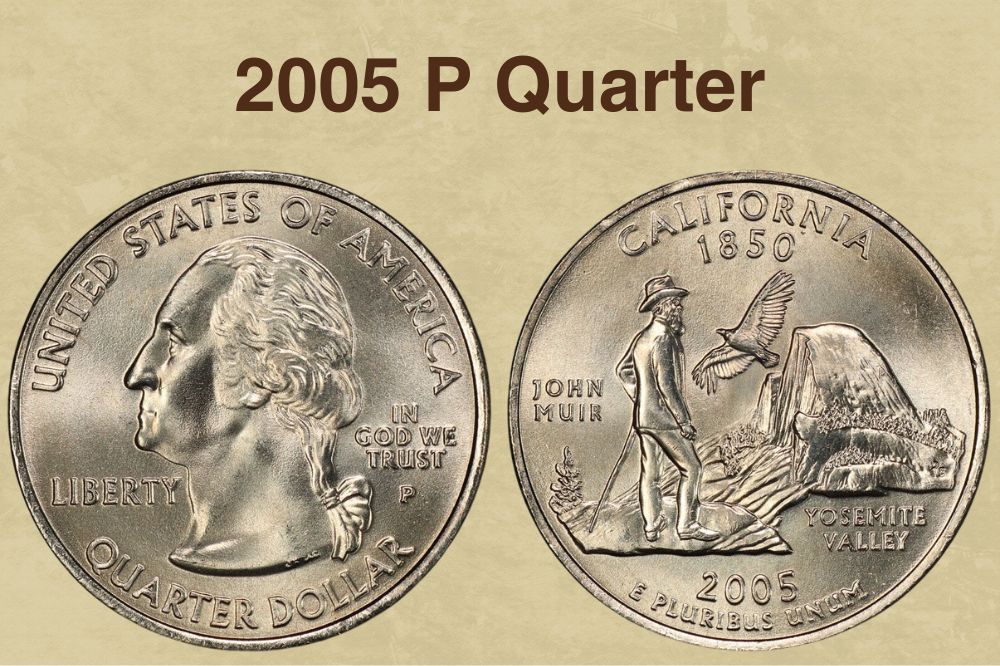
The mintages of the 2005 quarters struck in Philadelphia varies by state. But in all cases, very large numbers were produced.
The California quarters numbered over 257 million and the Minnesota quarters almost 240 million. The figure for the Oregon quarter was over 316 million, while for Kansas it was over 263 million. The West Virginia quarter was produced in the largest quantities of all – over 365 million coins.
All this means that finding a 2005 quarter today isn’t difficult. Examples in circulated condition will be worth only their face value, unless they have an interesting Mint error.
And even examples in mint state – i.e. those that have never been circulated – can be purchased for modest sums.
The coin grading scale runs from 1 to 70, with mint state coins graded 60 and above. Anything graded 65 or over is known as a “gem”.
At all but the very finest grades, values are consistent across all the designs. At MS60, a 2005 P quarter will be worth around $3. That rises to $4 at MS63 and $5 at MS65.
At MS67 and above, however, availability declines sharply. Prices rise too, and there’s more variation between values for the different states.
A 2005 P California quarter graded MS67 is valued by the PCGS (an independent coin grading agency) at $32. A Kansas coin at the same grade, however, is worth more than double that – $75.
The difference comes down to availability. 311 California quarters have been certified by the PCGS at MS67. But there are only 209 Kansas quarters at the same grade.
More importantly, while at least twelve California quarters have been certified higher than this, that’s the case for only two Kansas quarters – one at MS67+ and one at MS68. That makes an MS67 the finest example of its kind most coin collectors can expect to own.
The highest prices are achieved by coins that are the best in their class. For most of the 2005 quarters, the peak is MS68. Prices for examples at that grade range from $650 for a California quarter to $3,150 for a Kansas quarter.
In a couple of cases – the Minnesota and Oregon quarters – the finest examples are graded MS69. They are valued at $4,000 and $3,500 respectively.
2005 D Quarter Value
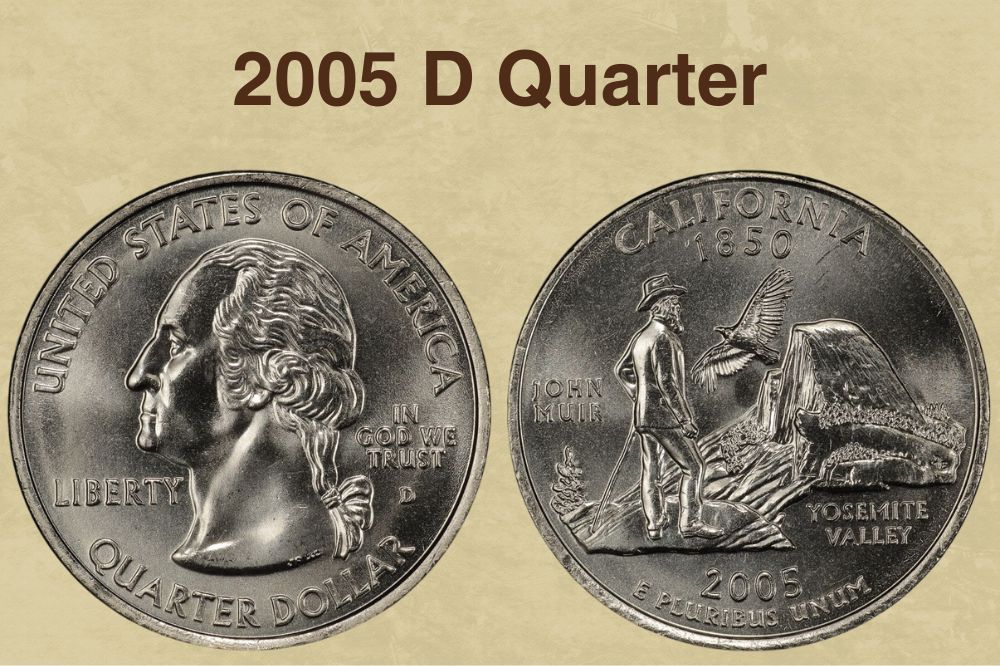
Like the 2005 P quarters, those from Denver were produced in very large numbers. Mintages ranged from 248 million (Minnesota) to 404 million (West Virginia).
As with their Philly equivalents, circulated 2005 quarters with the D mint mark will usually be worth no more than 25 cents. An interesting Mint error, however, will add a premium.
Mint state coins from MS60 to MS65 are valued the same as the P mint mark, from $3 to $5.
At MS67 and above, however, values diverge. A California quarter graded MS67 is valued by the PCGS at $18, a Minnesota quarter at the same grade is $32, and an Oregon quarter is $52.
Examples at the top grades tend to be slightly more plentiful than the P mint mark quarters. Prices are accordingly more modest.
There are 16 best in class MS68 Oregon quarters, each worth around $260. The 12 coins tied as the finest West Virginia quarters are the same grade, and are valued at $325 apiece.
2005 P and 2005 D Special Strike Quarter Value
2005 saw the Philadelphia and Denver Mint facilities producing “special strike” quarters with a satin finish for collectors. 1.16 million were struck for each state at each of the two Mint facilities.
Values at most grades are consistent – from $2 at SP60 (the prefix designates a special strike coin) to between $10 and $18 at SP65.
But coins in better condition than this are rare, and hence more valuable. A perfect SP70 quarter for any state is likely to cost around four figures.
An SP70 2005 California quarter with the P mint mark, for example, is worth around $1,800. And the equivalent coin with the D mint mark is worth much more – around $4,500.
2005 S Clad Proof Quarter Value
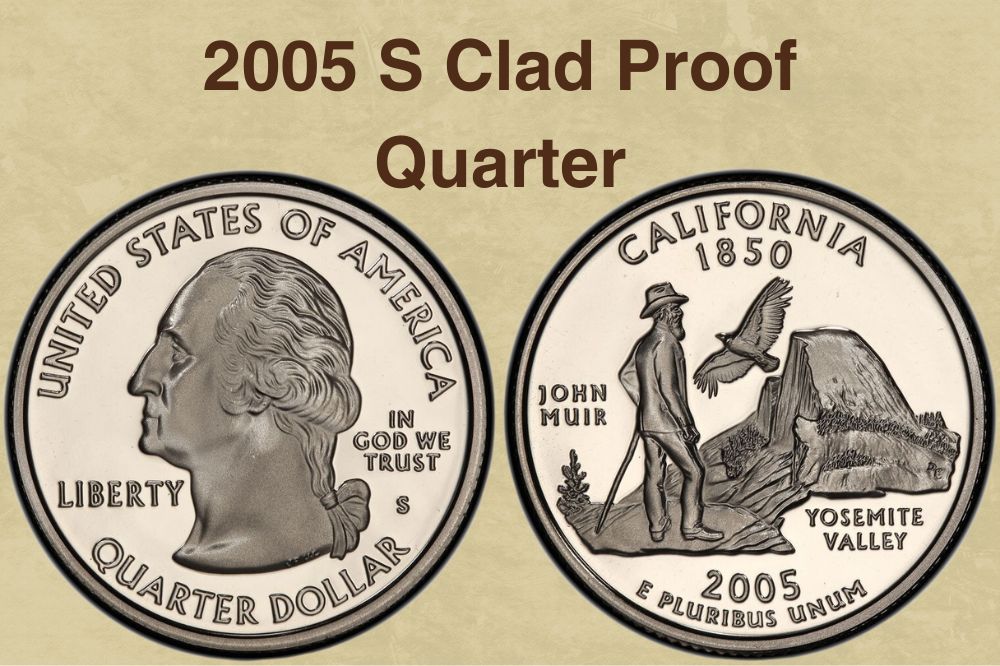
The San Francisco Mint facility produced proof 2005 quarters in both clad copper and silver. The former were struck in larger numbers – 3,262,960 for each state.
As they were marketed as collectors’ items, attrition rates are low. That means that you can still find excellent quality examples at modest prices.
At PR60, expect to pay no more than $5 for a clad proof quarter. And even a flawless PR70 example is valued at between only $25 (West Virginia) and $35 (California and Oregon).
2005 S Silver Proof Quarter Value
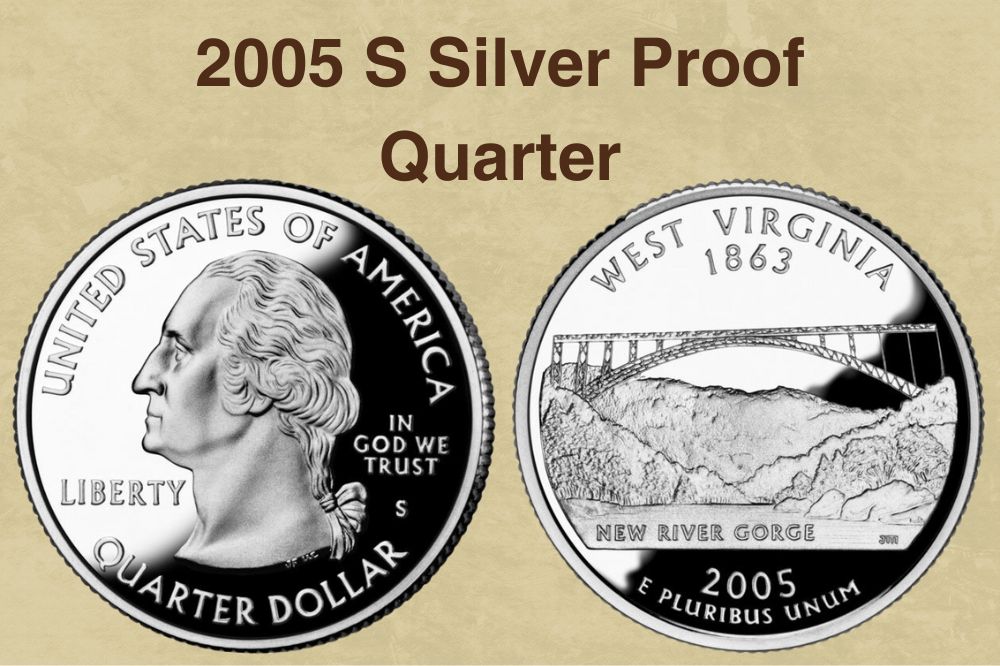
Each of the five state quarters had a mintage of 1,678,649 proof quarters made of silver. Like the clad coins, values are consistent across the different designs.
A 2005 silver proof quarter graded PR60 is worth around $5, the same as the clad versions. At MS65, the value is $9, and at MS68, $12.
Values for a perfect silver proof quarter range from $35 for the West Virginia design, to $46 for the California and Minnesota versions.
Also read: 17 Most Valuable Quarter Errors Worth Money
Rare 2005 Quarter Errors List
2005 P Minnesota Extra Tree Quarter
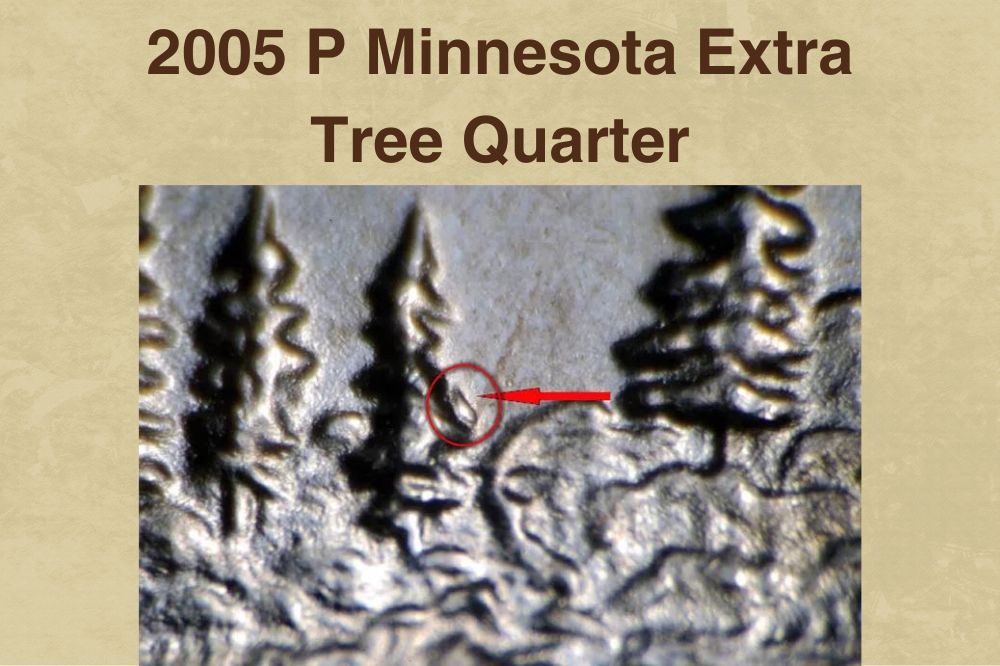
An error on one of the dies used to strike the 2005 P Minnesota quarter resulted in a variant known as the “Extra Tree”.
To identify this, you’ll need to put your coin under a microscope, or view it with a loupe.
Look at the three trees immediately to the right of the state outline. Look to the right of the third tree, which is also the smallest of the three. If you can see a few blobs that look a bit like the tip of another tree, you have an “extra tree” quarter.
The value of this error depends on how clearly visible the blobs are, and on the condition of the coin. The PCGS values an example graded MS62 at $10, rising to $90 at MS67.
2005 P Kansas Quarter, Missing Clad Layer on Reverse
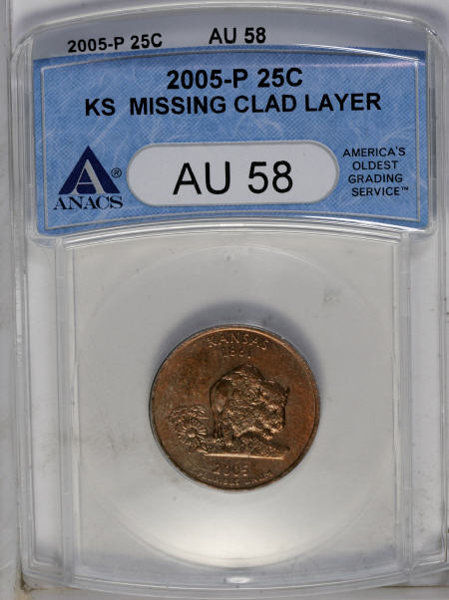
Very occasionally, something goes wrong in the process of covering the copper core of the planchet with the cupronickel cladding.
One 2005 Kansas quarter was struck in Philadelphia on a planchet with the cladding missing from the reverse. It was graded AU 58 (“about uncirculated”) by the grading agency ANACS. And it sold at auction for $500.
This YouTube video from Couch Collectibles looks at a range of different errors amongst 2005 quarters.
Where to Sell Your 2005 Quarter ?
Now that you know the value of your coins, do you know where to sell those coins online easily? Don’t worry, I’ve compiled a list of these sites, including their introduction, pros, and cons.
Check out now: Best Places To Sell Coins Online (Pros & Cons)
FAQs
Are 2005 quarters silver?
Most 2005 quarters are made of copper with a cupronickel cladding. But some proof quarters were made from 90 per cent silver and 10 per cent copper.
Look closely at the edge of your coin. If you can see any brown or red metal there, it’s a clad quarter.
If you can’t, and if it has a mirror finish, it may be silver. If it hasn’t been professionally certified, the only way to tell for sure is to weigh it with a very accurate set of scales. If it weighs around 5.67 grams, it’s clad. If it’s 6.3 grams, it’s silver.
What is special about the 2005 quarter?
2005 saw five different quarters released, each commemorating a different state. Most circulated coins are worth only their face value, and even mint state coins are usually worth only a few dollars.
But coins with interesting Mint errors are worth more. And the very finest examples can command four figure sums.
They range in quality from MS63 to MS67. The MS63 example is valued by the PCGS at $43,500. And the MS67 is worth a cool $200,000.