Coin Value Contents Table
The 50 Statehood Quarters program that started in 1999 was the most popular series in the history of American coinage collecting. Collectors, particularly novices, adored the idea of honoring each state. The first five issued coins were dedicated to states that ratified the Constitution first.
Each coin was minted for ten weeks without the possibility of producing it ever again. The 1999 quarter value is still determined by the first year of minting when collector enthusiasm peaked. Besides, pieces of the highest quality are rare nowadays, increasing their prices.
1999 Quarters value chart |
|||
| Coin type | MS (60) | MS (65) | PR (65) |
| 1999 P Delaware | $3 | $5 | / |
| 1999 D Delaware | $3 | $6 | / |
| 1999 S Delaware proof | / | / | $8 |
| 1999 S Delaware silver proof | / | / | $13 |
| 1999 P Pennsylvania | $3 | $5 | / |
| 1999 D Pennsylvania | $3 | $5 | / |
| 1999 S Pennsylvania proof | / | / | $8 |
| 1999 S Pennsylvania silver proof | / | / | $7 |
| 1999 P New Jersey | $3 | $5 | / |
| 1999 D New Jersey | $3 | $7 | / |
| 1999 S New Jersey proof | / | / | $8 |
| 1999 S New Jersey silver proof | / | / | $10 |
| 1999 P Georgia | $3 | $5 | / |
| 1999 D Georgia | $3 | $5 | / |
| 1999 S Georgia proof | / | / | $8 |
| 1999 S Georgia silver proof | / | / | $7 |
| 1999 P Connecticut | $3 | $5 | / |
| 1999 D Connecticut | $3 | $5 | / |
| 1999 S Connecticut proof | / | / | $8 |
| 1999 S Connecticut silver proof | / | / | $12 |
History of the 1999 Quarters
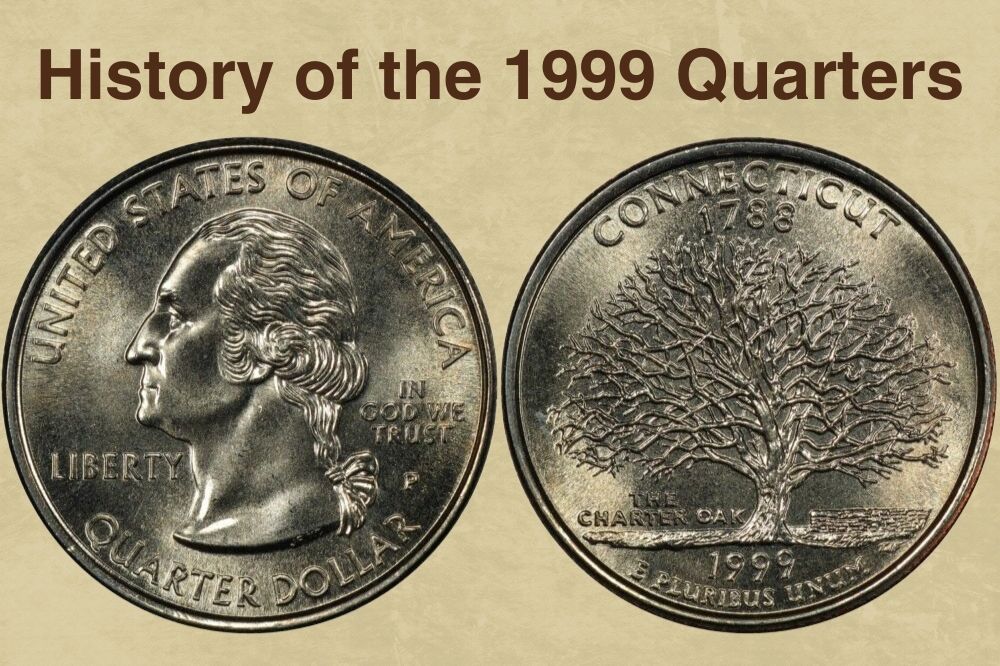
The US Mint started the 50 Statehood Quarters Program in 1999 with the first five state motifs on the reverse. The idea was to honor each American state, and the day it became a part of the union:
- Delaware state quarters appeared in circulation on January 4, 1999, as the first in the series
- Pennsylvania state quarters appeared in circulation on March 8, 1999, as the second in the series
- New Jersey state quarters appeared in circulation on May 17, 1999, as the third in the series
- Georgia state quarters appeared in circulation on July 19, 1999, as the fourth in the series
- Connecticut state quarters appeared in circulation on October 12, 1999, as the fifth in the series
1999 Washington Quarters Types |
||
| Coin type | Mintage | |
| Cupronickel coins | Silver proofs | |
| 1999 P Delaware | 373,400,000 | |
| 1999 D Delaware | 401,424,000 | |
| 1999 S Delaware proof | 3,713,359 | 804,565 |
| 1999 P Pennsylvania | 349,000,000 | |
| 1999 D Pennsylvania | 358,332,000 | |
| 1999 S Pennsylvania proof | 3,713,359 | 804,565 |
| 1999 P New Jersey | 363,200,000 | |
| 1999 D New Jersey | 299,028,000 | |
| 1999 S New Jersey proof | 3,713,359 | 804,565 |
| 1999 P Georgia | 451,188,000 | |
| 1999 D Georgia | 488,744,000 | |
| 1999 S Georgia proof | 3,713,359 | 804,565 |
| 1999 P Connecticut | 688,744,000 | |
| 1999 D Connecticut | 657,880,000 | |
| 1999 S Connecticut proof | 3,713,359 | 804,565 |
| Total | 4,449,506,795 | 4,022,825 |
| 4,453,529,620 | ||
Each coin was minted for exactly ten weeks when the next one took its place. The program started in 1999 and lasted until 2008, after the US Mint issued the last coin dedicated to Hawaii.
Also read: Top 13 Most Valuable State Quarters Worth Money
Features of the 1999 Quarters
The 50 State Quarter Program began with the first five states in 1999, honoring the first ones that ratified the Constitution. They have Washington’s portrait on the obverse and crucial symbols identifying each state on the reverse.
The obverse of the 1999 Quarters
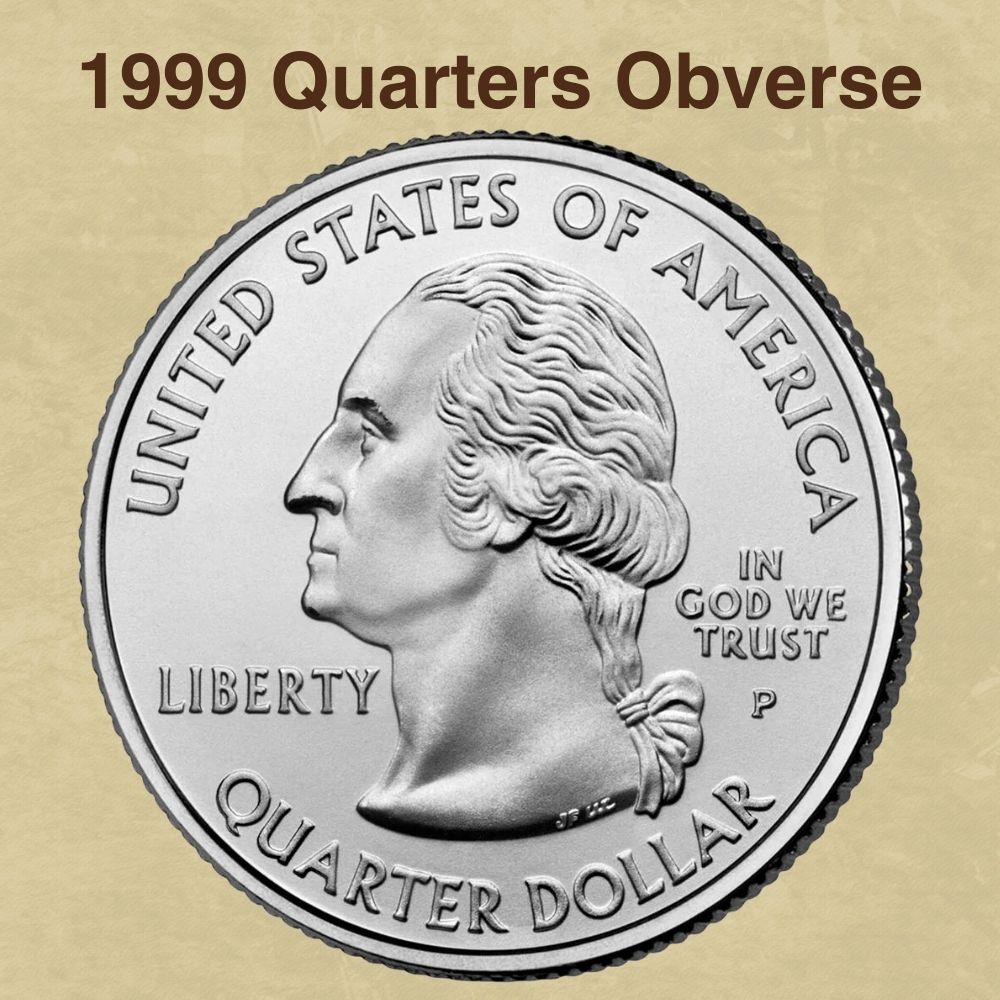
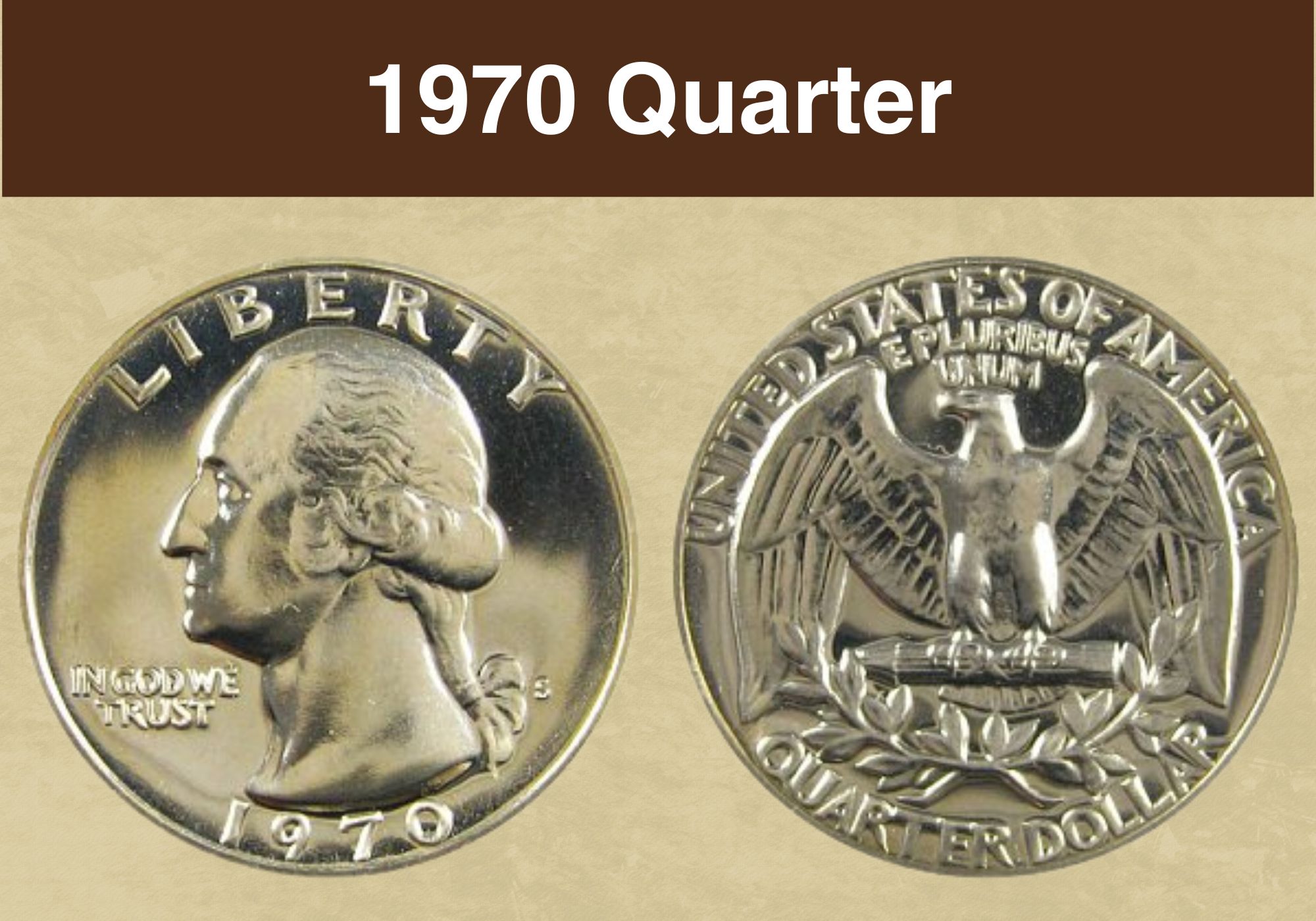
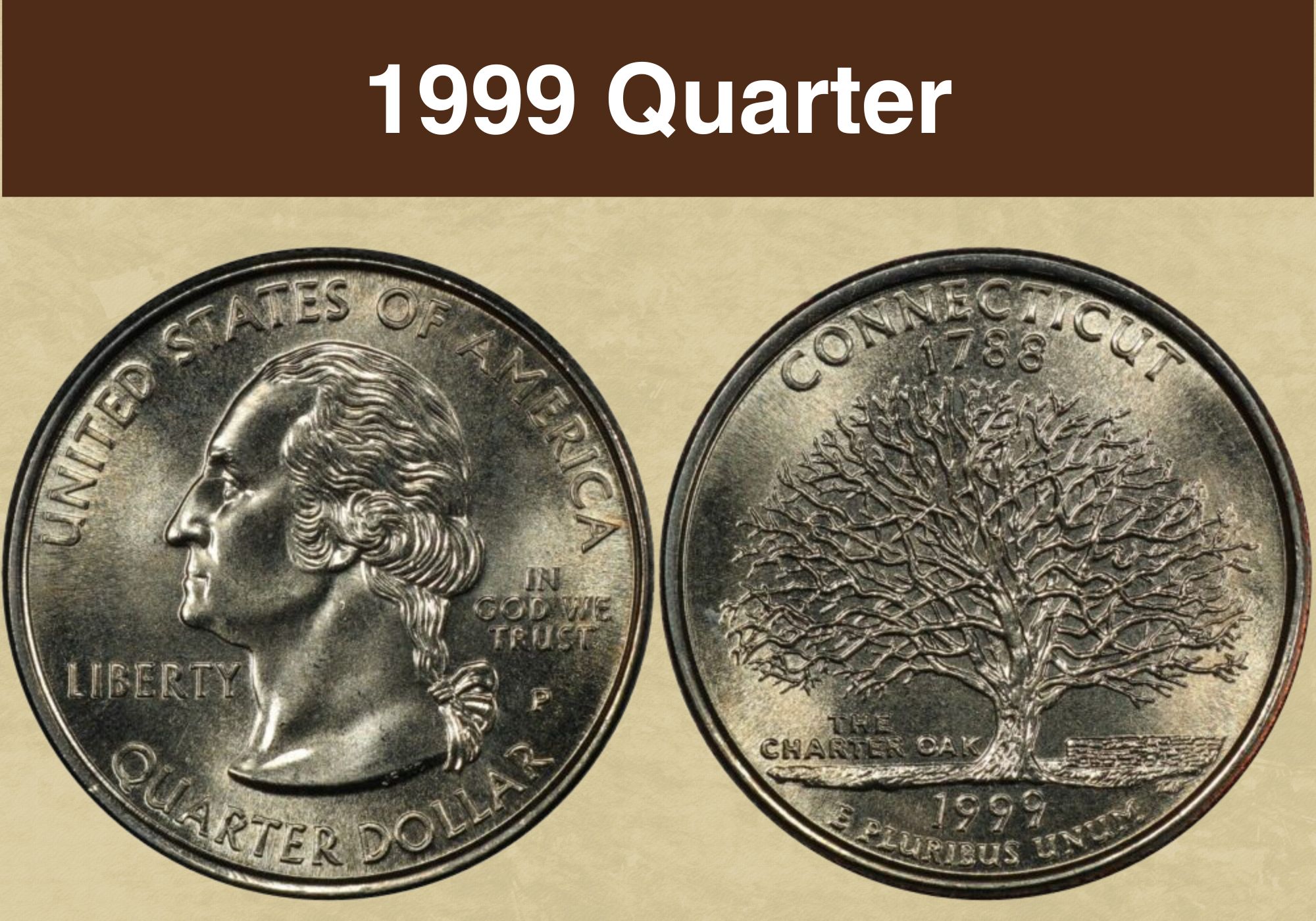
Each of the five 1999 quarters has a modified John Flanagan’s obverse design. It shows perfectly polished George Washington’s profile with inscriptions required by law, arranged in the following order:
- UNITED STATES OF AMERICA
- LIBERTY
- IN
- GOD WE
- TRUST
- The mint mark (P, D, or S)
- JF WC (initials of the original designer, John Flanagan, and engraver who revised the portrait, William Cousins)
- QUARTER DOLLAR
The reverse of the 1999 Quarters
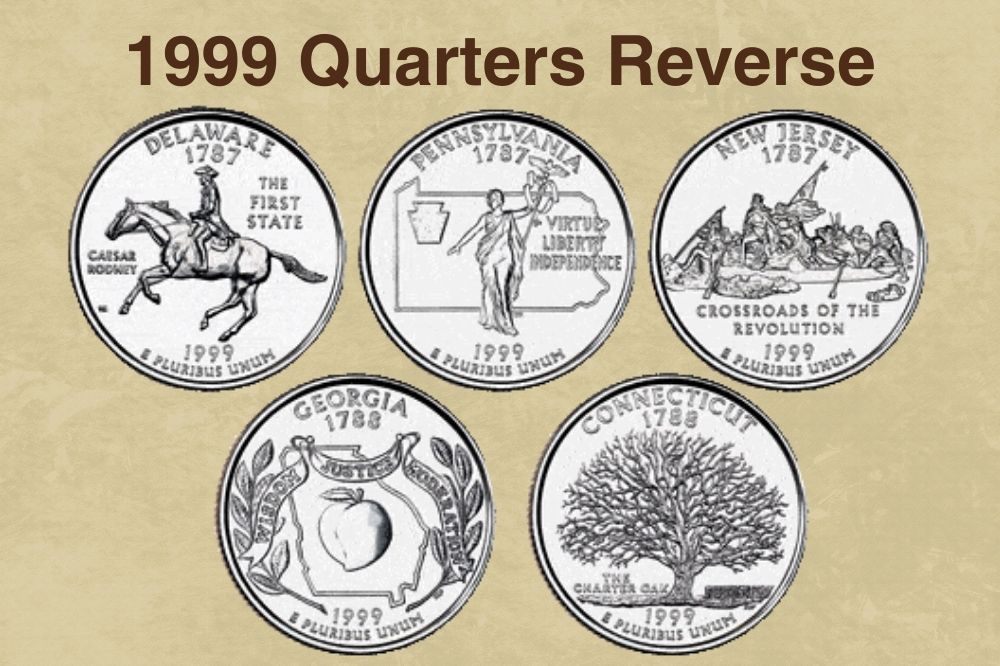
Expectedly, you can recognize five different reverse designs dedicated to the first five states.
Delaware reverse – It depicts the historic horseback ride of Caesar Rodney in 1776. His vote for signing the Declaration of Independence was deciding, and this state became the first state of many to come on December 7, 1787.
Pennsylvania reverse – It shows the Commonwealth statue from the capitol dome. The Keystone State was the second that joined the union on December 12, 1787.
New Jersey reverse – It depicts the first American President crossing the Delaware River in 1776 on his way to New Jersey. This state became the third union member on December 18, 1787.
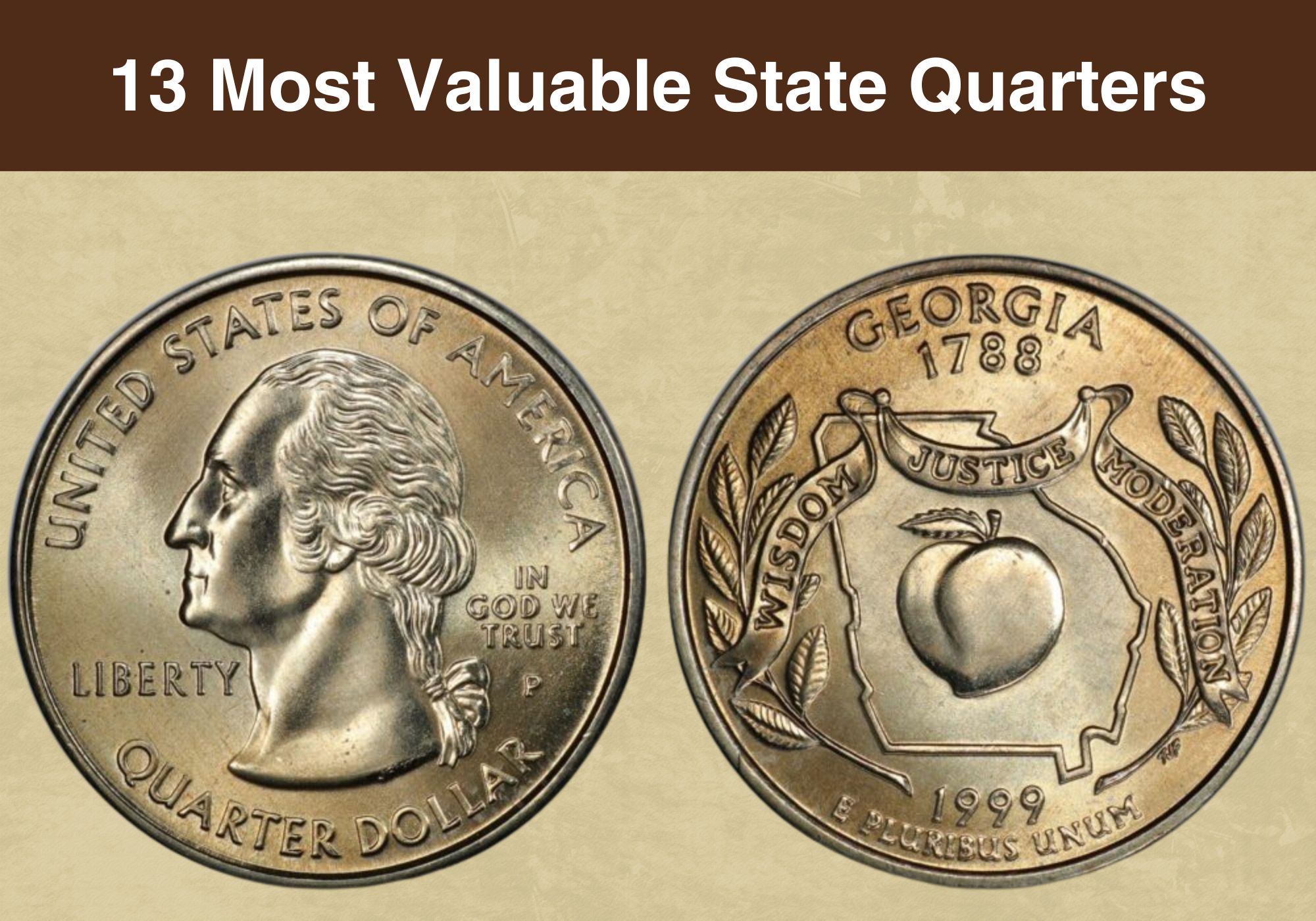
Georgia reverse – It shows peach, the official state fruit, surrounded by the Live Oak springs from the state tree. After joining the union on January 2, 1788, this state became the fourth in the line.
Connecticut reverse – It depicts the old Charter Oak that kept the Connecticut Charter safe from the British after Captain Joseph Wadsworth concealed it inside the tree’s root system. This state became a part of the union on January 9, 1788, as the fifth in a row.
1999 Quarters Details |
|
| Face value | Twenty-five cents ($0.25) |
| Compound | 91.67% copper plus nickel or 90% silver plus copper (proofs) |
| Coin weight | 0.20 ounces (5.67 g) or 0.20094 troy ounces (6.25 g), depending on their composition |
| Silver weight | 0.18085 troy ounces (5.625 g) |
| Coin diameter | 0.95511 inches (24.257 mm) |
| Coin thickness | 0.06889 inches (1.7526 mm) |
| Edge | Reeded (119 reeds) |
| Shape | Round |
Other features of the 1999 Quarters
Four 1999 Washington 50 States quarters from regular strikes and cupronickel proofs are made of 91.67% copper plus nickel. The other proof type contains 90% silver with additional copper.
The weight of cupronickel coins is 0.20 ounces (5.67 g), while silver coins weigh 0.20094 troy ounces (6.25 g), including 0.18085 troy ounces (5.625 g) of silver. Each specimen has an edge with 119 reeds and a diameter of 0.95511 inches (24.257 mm). Its thickness is 0.06889 inches (1.7526 mm).
1999 Quarters Grading
The best you can do when possessing one valuable collectible coin is to have it graded. Experts from grading companies can determine its condition and assess its value based on the 1 to 70 graded Sheldon scale. If you have a lower-quality piece, you can do the approximate estimation yourself.
| # | Grade |
|---|---|
| 1 | Basal State-1 |
| 2 | Fair |
| 3 | Very Fair |
| 4, 5, 6 | Good |
| 7, 8, 10 | Very Good |
| 12, 15 | Fine |
| 20, 30 | Very Fine |
| 40 | Extremely Fine |
| 50 | About Uncirculated |
| 60 | Mint State |
| 65 | Mint State |
| 70 | Mint State |
Please check our grading guides to know your coin scale, It’s the necessary step to know the exact value of your coin.
Check out now: How to Grade Washington Quarter?
1999 Washington Quarters Guides
Three mints produced 4,453,529,620 Washington 50 States quarters in 1999, including:
- Coins from regular strikes
- Cupronickel proofs
- Silver proofs
1999 P Quarters Value
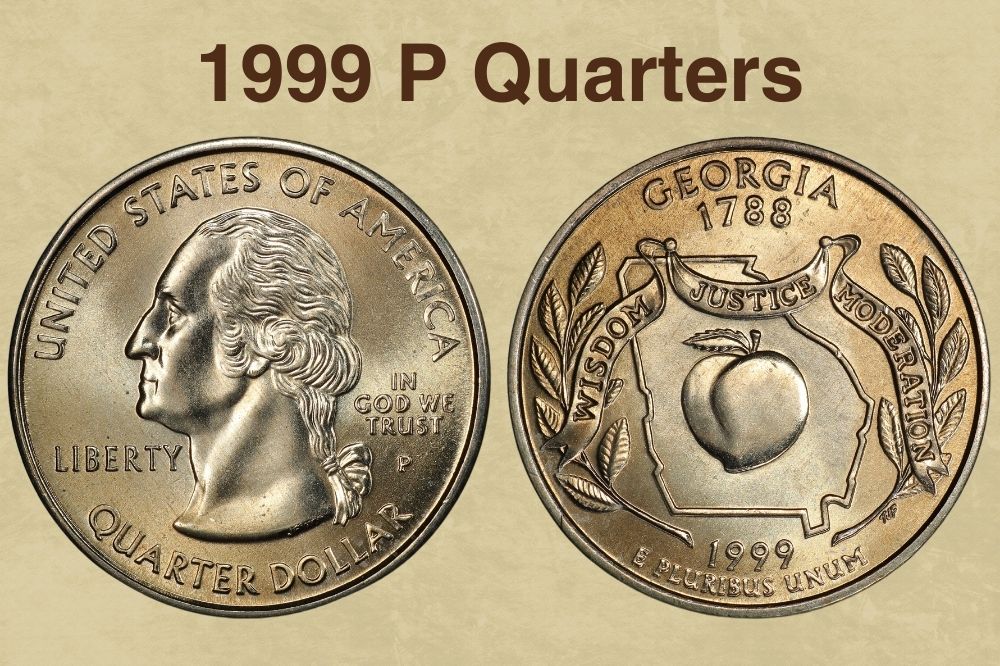
Most quarters from Philadelphia are worth their face value ($0.25). The situation changes with better-preserved coins, so those in MS 64 grade are worth $3, while MS 65-rated pieces cost approximately $5.
You can buy higher-graded coins for $3 to $8, regardless of the reverse design. However, the best-quality 1999 quarters in MS 68 grade are estimated differently, so you can expect them to cost:
- $1,250 for coins from Delaware, with an auction record of $4,888 for MS 66-rated coin
- $1,000 for coins from Pennsylvania, with an auction record of $10,200 for MS 67-rated coin
- $1,950 for coins from New Jersey, with an auction record of $2,354 for MS 68-rated coin
- $5,500 for coins from Georgia, with an auction record of $4,200 for MS 65-rated coin
- $875 for coins from Connecticut, with an auction record of $4,362 for MS 68-rated coin
1999 D Quarters Value
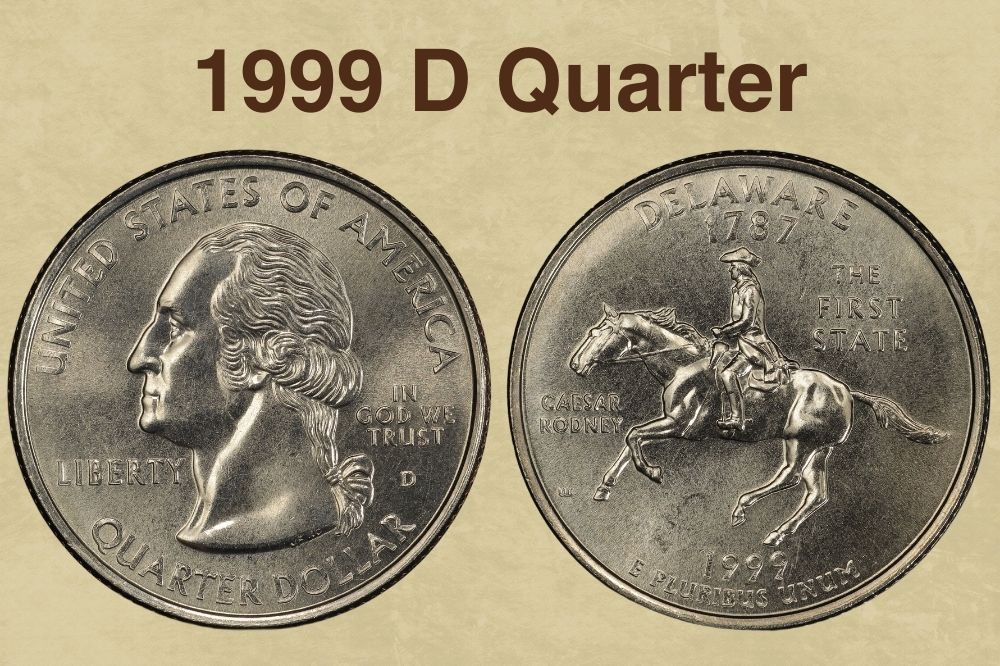
The 1999 D Statehood Quarters in AU to MS 63 quality are worth their face value. You can find pieces with MS 64 rating for $3, those in MS 65 grade for $5, and coins graded MS 66 cost $20 on the market.
Interestingly, it is impossible to find Delaware quarters in MS 68 grade, while those rating MS 67 are worth $75. The most expensive 1999 D MS 64 Delaware quarter was sold at $1,380. Estimated prices for other coins are:
- Pennsylvania – $120 (MS 67), $8,750 (MS 68), while the auction record is $855 for MS 67-rated coin
- New Jersey – $90 (MS 67), $8,850 (MS 68), while the auction record is $978 for MS 68-rated coin
- Georgia – $125 (MS 67), $6,250 (MS 68), while the auction record is $329 for MS 68-rated coin
- Connecticut – $37 (MS 67), $1,000 (MS 68), while the auction record is $2,300 for MS 68-rated coin
1999 S proof Quarters Value
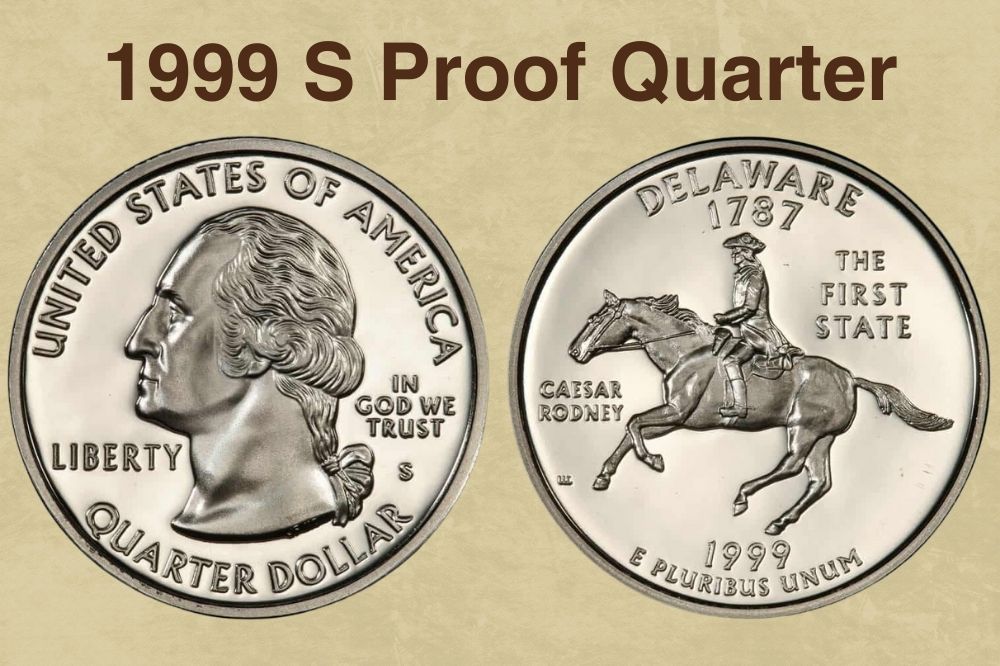
The 1999 cupronickel proof quarters in PR 65 to PR 67 grades are worth $8, while silver pieces are available at $7. Only Delaware DCAM silver coins can reach $8 on the market.
Depending on the rating, coins in PR 68 grade cost $8 to $10, while those in PR 69 quality have an estimated price range from $8 to $20. Such silver coins from Delaware are assessed to $24.
Expectedly, quarters in PR 70 are the most expensive, and you can buy one for $26 to $70, depending on the reverse design. Be prepared that Delaware DCAM silver coins cost up to $675. One such specimen won the auction record after selling for $17,250 in 2007.
Also read: Top 16 Most Valuable Modern Quarters Worth Money
1999 Quarters Errors List
Despite the modern technology, it is possible to find numerous error coins in the 1999 Statehood Quarters set. They are more or less expensive, depending on their condition, uniqueness, and rarity.
- The 1999 P quarters struck on an experimental planchet cost $4,800 to $9,800
- The 1999 quarters (Connecticut) with obverse brockage error cost over $3,000
- The 1999 S DDO clad quarters (Pennsylvania) cost $2,500, while most other pieces with this error are worth only $10
- The 1999 quarters with mated + bonded pair error cost $2,000 to $3,000
- The 1999 quarters (Delaware) with multiply struck error on feeder finger cost up to $1,000
- The 1999 P quarters with multiply struck die cap error on the reverse cost $800 to $1,600
- The 1999 P quarters (New Jersey) struck on a 5c planchet cost $750 to $1,600
- The 1999 quarters with triple or quadruple strike error cost $600 to $800
- The 1999 P missing reverse clad layer quarters (Connecticut) cost over $400
- The 1999 20% off-center quarters (Delaware) struck on 53% scrap cost $400
- The 1999 D quarters (Georgia) with 135° rotated reverse error cost $200
- The 1999 P die cap brock double struck quarters cost $170 to $1,200
- The 1999 quarters (Delaware) with die adjustment strike error cost $150
- The 1999 off-center quarters cost $100 to $1,000
- The 1999 clip quarters errors cost $70 to $300+
Also read: 17 Most Valuable Quarter Errors Worth Money
Where to Sell Your 1999 Quarter ?
Now that you know the value of your coins, do you know where to sell those coins online easily? Don’t worry, I’ve compiled a list of these sites, including their introduction, pros, and cons.
Check out now: Best Places To Sell Coins Online (Pros & Cons)
FAQ about the 1999 Quarters
What makes 1999 Quarters rare?
Since the 1999 Statehood Quarters are less than 50 years old, you can consider them modern. That means it is unlikely to find a scarce piece in the set. However, the best-graded specimens and unique errors can be challenging to find and pricey.
Which 1999 Quarters are worth a lot of money?
- 1999 S PR 70 DCAM Delaware silver quarter – $17,250 (2007)
- 1999 P MS 67 Pennsylvania clad quarter – $10,200 (2006)
- 1999 S PR 70 DCAM Georgia silver quarter – $6,038 (2007)
- 1999 P MS 66 Delaware clad quarter – $4,888 (2008)
- 1999 P MS 67 Connecticut clad quarter – $4,362 (2006)
- 1999 P MS 65 Georgia clad quarter – $4,200 (2022)
- 1999 S PR 70 DCAM New Jersey silver quarter – $2,530 (2007)
- 1999 P MS 68 New Jersey clad quarter – $2,354 (2023)
- 1999 D MS 68 Connecticut clad quarter – $2,300 (2018)
- 1999 S PR 70 DCAM Pennsylvania silver quarter – $1,725 (2009)
- 1999 S PR 70 DCAM Connecticut silver quarter – $1,610 (2007)
- 1999 D MS 64 Delaware clad quarter – $1,380 (2003)
- 1999 S PR 70 DCAM Delaware clad quarter – $1,323 (2007)
- 1999 S PR 70 DCAM Georgia clad quarter – $1,150 (2003)
- 1999 S PR 70 DCAM Connecticut clad quarter – $1,035 (2003)
- 1999 D MS 68 New Jersey clad quarter – $978 (2008)
- 1999 D MS 67 Pennsylvania clad quarter – $855 (2010)
- 1999 S PR 70 DCAM Pennsylvania clad quarter – $834 (2004)
- 1999 S PR 69 DCAM New Jersey clad quarter – $500 (2004)
- 1999 D MS 68 Georgia clad quarter – $329 (2013)
How much are the 1999 Quarters worth?
In lower grades, coins from the Philadelphia mint are worth their face value. You can buy better-rated ones for $0.30 to $8, but MS 68-graded specimens quickly reach $450 to $12,000, depending on the reverse design.
What are the priciest Washington 50 States Quarters?
- 1999 S PR 70 Delaware silver quarter – $17,250 (2007)
- 2003 S PR 69 Alabama quarter – $10,999 (2019)
- 1999 P MS 67 Pennsylvania quarter – $10,200 (2006)
- 1999 S PR 70 Georgia silver quarter – $6,038 (2007)
- 2004 D MS 67 Wisconsin quarter (Extra Leaf Low) – $6,000 (2020)