Coin Value Contents Table
Are you interested in selling or buying a 1992 penny and wonder how much it is worth?
Lincoln memorial pennies, like the ones struck in 1992, are historically significant as they commemorate one of our country’s most iconic and popular presidents, Abraham Lincoln.
So, the 1992 penny is quite collectible!
We wrote this guide to help you understand the 1992 penny value to make a smart decision and get value for your money.
These coins are not particularly rare, but some come with notable errors worth hundreds or even thousands of dollars.
If this has piqued your interest, read on to find out how much your 1992 Lincoln memorial penny is worth.
1992 Penny Value Chart |
||||
| Mint Mark | Good | Fine | Extremely Fine | Uncirculated |
| 1992 No-Mint Mark Penny | – | – | – | $0.34 |
| 1992-D Penny | $0.05 | $0.05 | $0.05 | $0.34 |
| 1992-S Proof Penny | – | – | – | $5.85 |
The History of the 1992 Penny
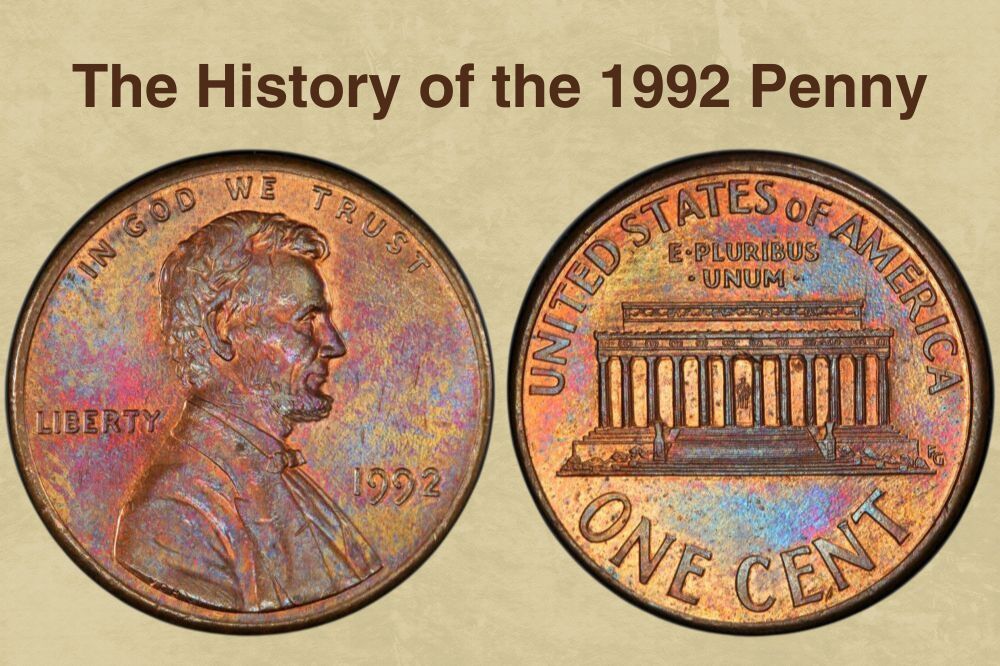
The United States Mint struck the Lincoln penny in 1901, making it one of the longest-circulating coins in our country’s history.
Initially designed by Victor David Brenner, the Lincoln penny has undergone several design changes since its release into circulation.
The obverse, which features a portrait of Abraham Lincoln, has largely remained the same. The reverse design has changed several times, first portraying wheat ears, then the Lincoln Memorial, the Bicentennial designs, and currently the Union Shield.
The 1992 penny is part of the Lincoln Memorial design cohort struck between 1959 and 2008. The Mint elected sculptor Frank Gasparro to redesign the Lincoln cent for the president’s centennial birth celebrations.
The newly designed penny retained its design on the obverse, featuring Abraham Lincoln. However, the design on the reverse changed from the two wheat pennies to a depiction of the iconic Lincoln Memorial.
Aside from the design changes, the coin’s metal composition also changed over the years. The Lincoln penny was initially struck from 95% copper with zinc and tin alloy. However, the percentage of copper in the coins continued to reduce over the years as the metal prices rose while the supply shrunk.
By the early 1980s, the Mint struck pennies with a zinc core and a copper covering. The 1992 Lincoln pennies were part of this change in composition and are aptly known as copper-clad pennies.
Also read: 12 Most Valuable Lincoln Penny Worth Money
Features of the 1992 Penny
Let’s now explore the unique physical attributes of the 1992 penny. When collecting coins, it is important to know the features so you can identify 1922 Lincoln pennies worth money.
The Obverse of the 1992 Penny
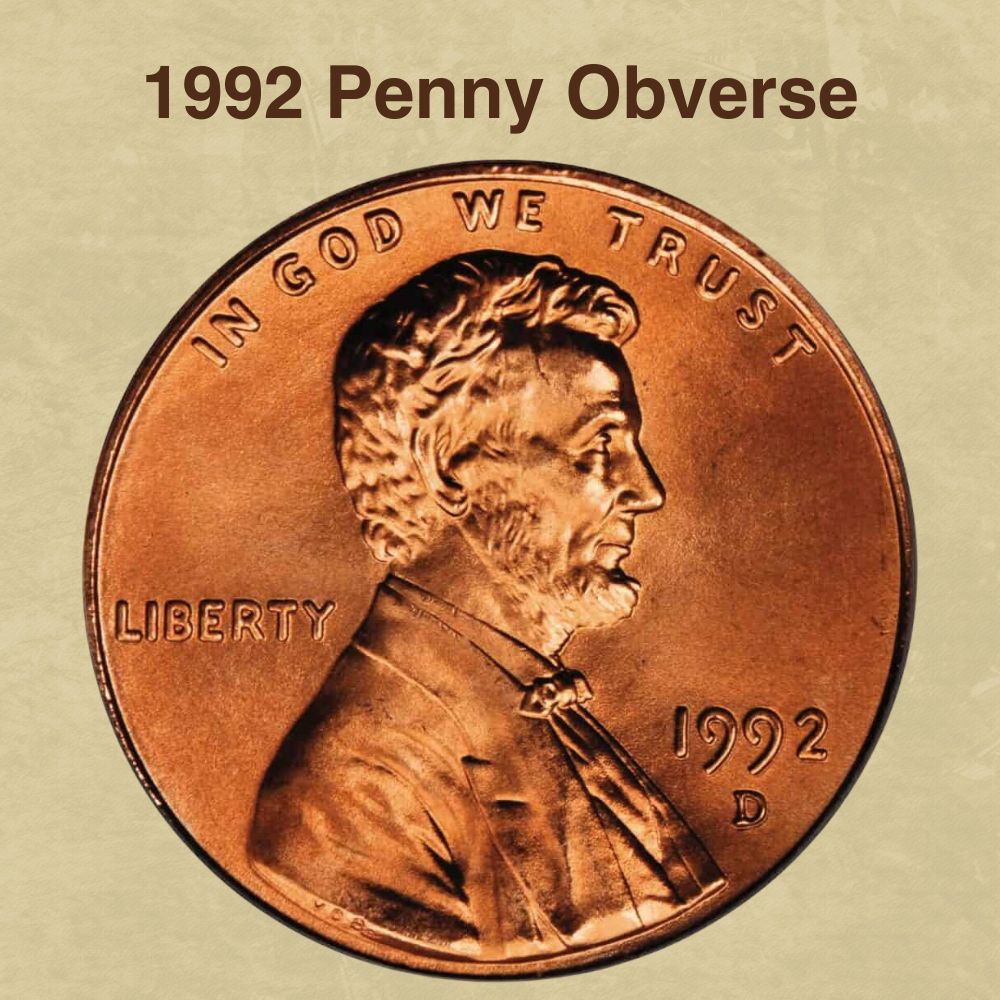
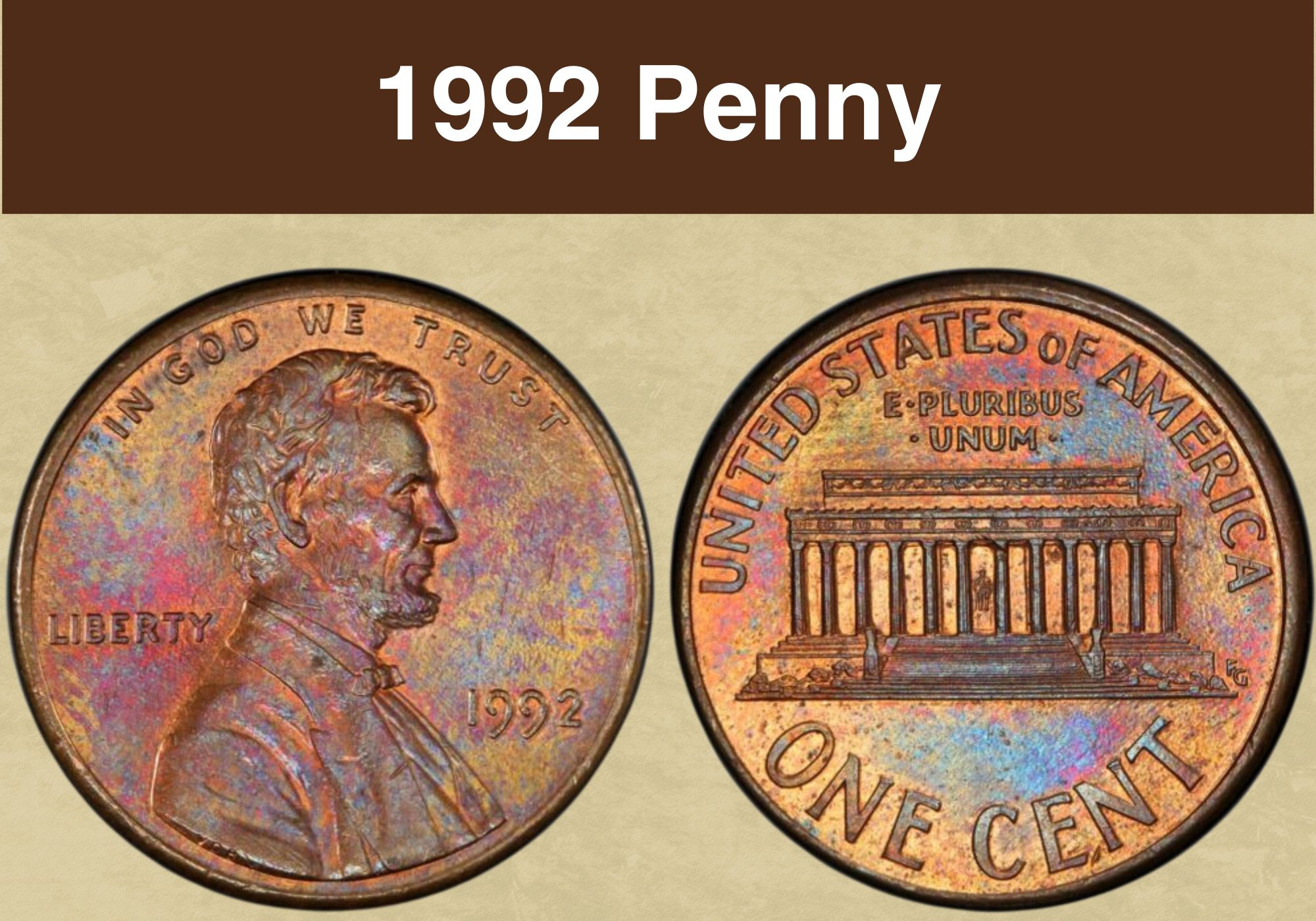
The 1992 penny features a prominent, right-facing portrait of Abraham Lincoln on the obverse.
Our country’s heavenly motto, IN GOD WE TRUST, appears around the coin’s top rim. You will notice the word LIBERTY on the left of the surface while the date, 1992, appears on the right, in front of Lincoln’s portrait.
The Reverse of the 1992 Penny
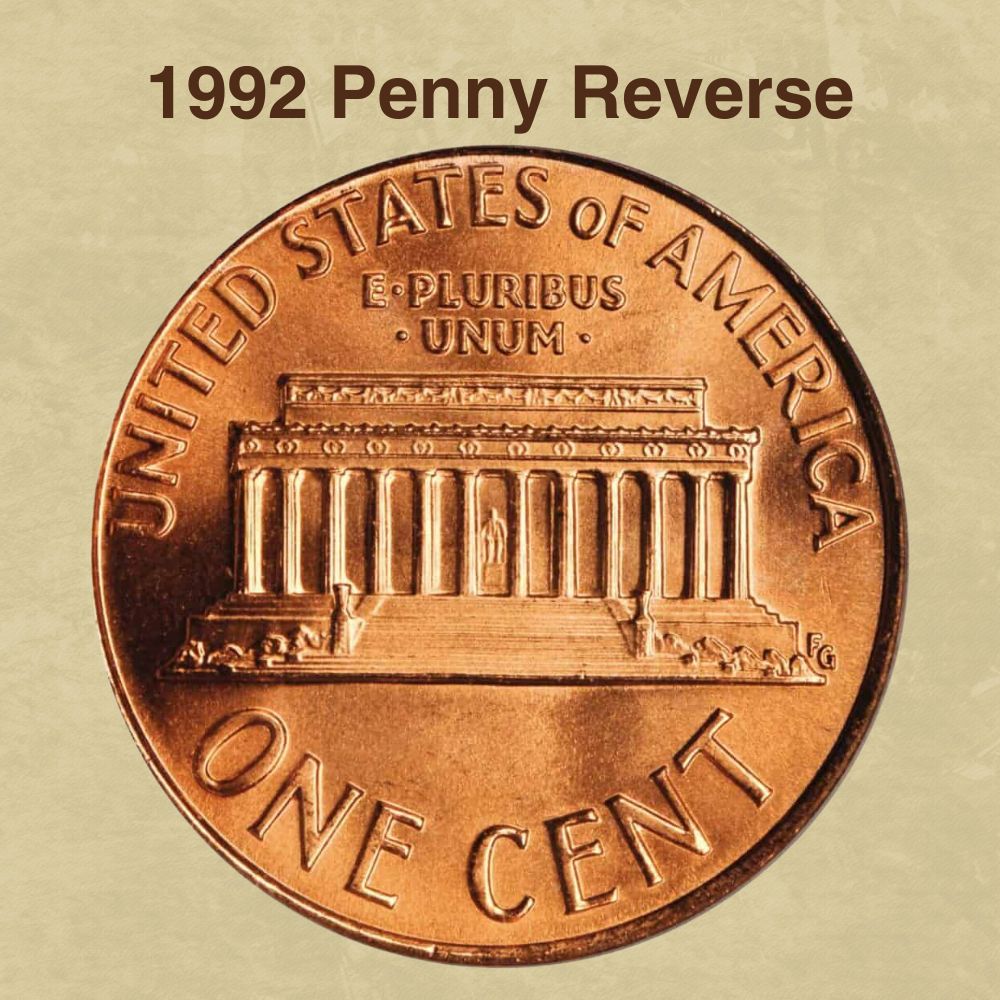
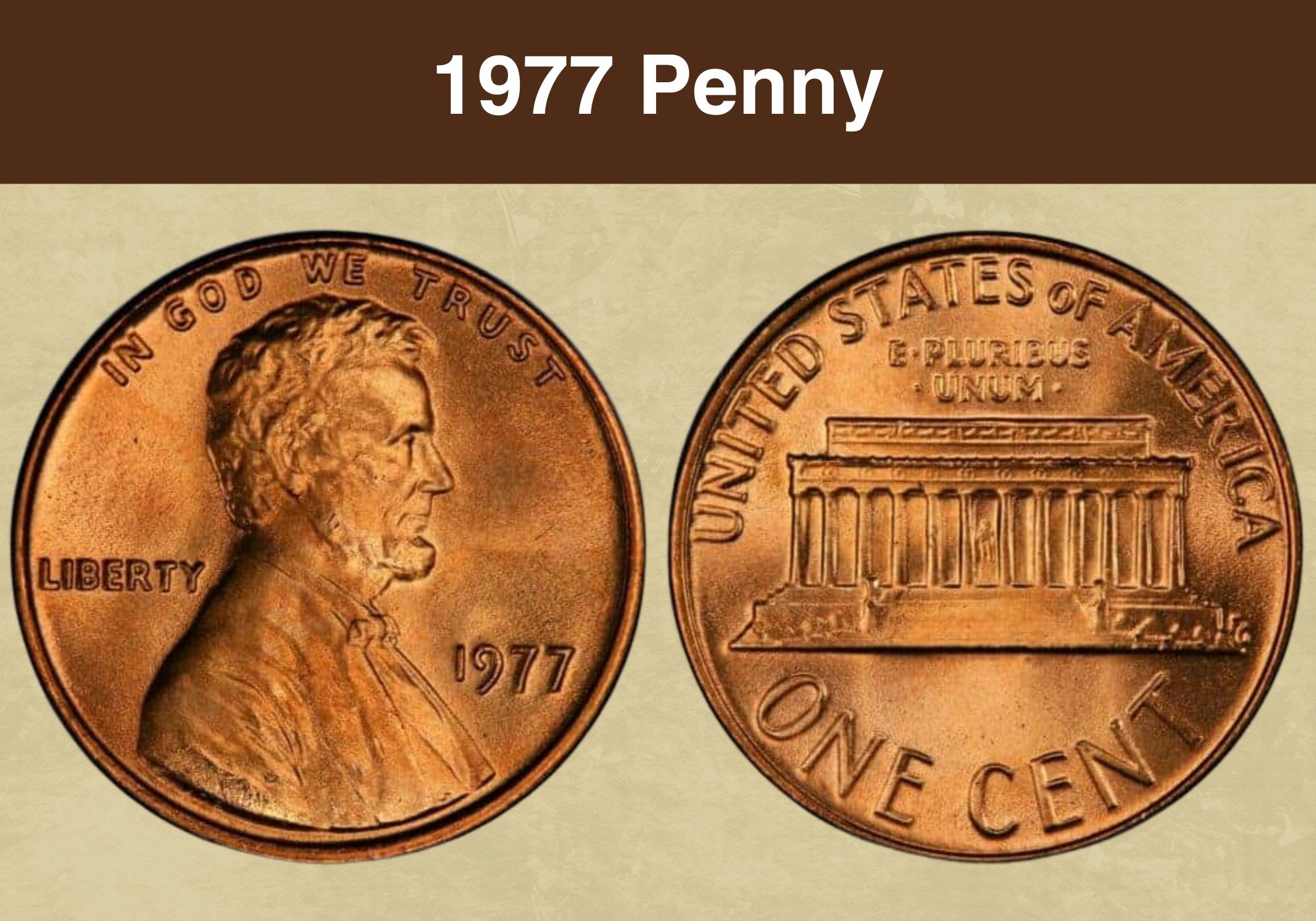
On the reverse or tail side of the 1992 penny, you will find a depiction of the iconic Lincoln Memorial.
The colossal building was constructed between 1914 and 1922 to celebrate President Abraham Lincoln, who abolished slavery after the bloody Civil War.
Although sculptor Frank Gasparro had never seen the Lincoln Memorial, he did a good job depicting it on the newly designed pennies. He even added a portrait of a seated statute of the president, which you can see in between the Memorial’s pillars on the reverse of the coin.
Aside from the iconic building, the coin also shows the country’s name at the top, immediately followed by the motto E PLURIBUS UNUM.
Below the Memorial, the coin’s denomination, ONE CENT, is shown. You will also notice Frank Gasparro’s initials, FG, on the furthest right of the staircase.
Other Features of the 1992 Penny
The 1992 penny is a pretty small coin measuring 19.00 millimeters and weighing 2.50 grams.
Its metal composition comprises copper-plated zinc, i.e., 97.5% zinc and 2.5% copper, meaning the coin has a zinc core covered in a copper outer layer.
The 1992 penny has a plain edge. Only the Denver coins have a mint mark, D, on the obverse below the year date.
In the next section, we’ll explore the real 1992 penny value and how much you can get for this coin in the market today.
Also read: 13 Most Valuable Wheat Penny Worth Money
1992 Penny Grading
Several factors come into play when grading Lincoln Memorial pennies, but the condition and color are the most important.
Lincoln cents or pennies come in red, red-brown, and brown coloration, with fully red coins being more desirable than the other two.
Red coins also tend to be uncirculated or less circulated, and this is where you should pay the most attention when collecting 1992 pennies.
These coins are worth more or less their face value in circulated condition, so it is best to focus more on circulated 1992 pennies to get value for money.
Uncirculated pennies will retain their original luster and demonstrate few signs of wear, especially around the high points such as Lincoln’s hair, beard, and shoulders.
You should also look for complete steps on the Lincoln Memorial and a full strike on the denomination, ONE CENT. These are good indications of an uncirculated coin that may fetch you more.
| # | Grade |
|---|---|
| 1 | Basal State-1 |
| 2 | Fair |
| 3 | Very Fair |
| 4, 5, 6 | Good |
| 7, 8, 10 | Very Good |
| 12, 15 | Fine |
| 20, 30 | Very Fine |
| 40 | Extremely Fine |
| 50 | About Uncirculated |
| 60 | Mint State |
| 65 | Mint State |
| 70 | Mint State |
Please check our grading guides to know your coin scale, It’s the necessary step to know the exact value of your coin.
Check out now: How to Grade Lincoln Wheat Penny?
1992 Penny Value Guides
So, how much is a 1922 penny worth?
This depends on several factors, such as the condition, rarity, color, mint mark, and errors. Uncirculated 1992 pennies are more desirable than circulated ones and are fully red examples.
Low-mintage coins and those with outstanding errors can also fetch significantly more than their face value.
There are three varieties of the 1992 penny. These include the:
- 1992 No-Mint Mark Penny
- 1992-D Penny
- 1992-S Proof Penny
Let’s find out how much each of these pennies is worth.
1992 No-Mint Mark Penny Value
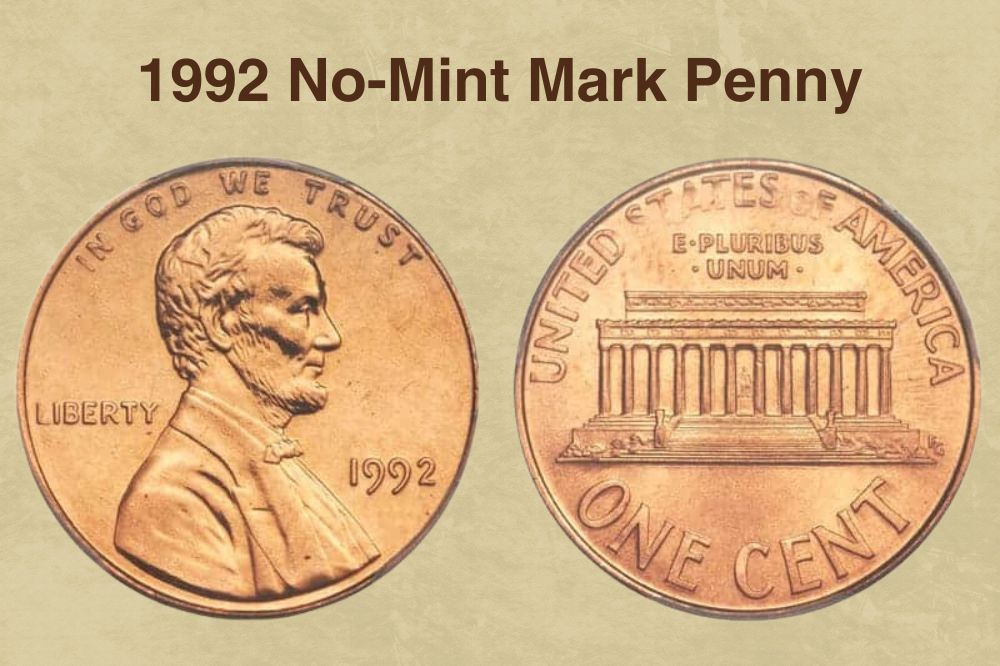
The Philadelphia mint produced the highest number of pennies in 1992, with about 4,648,905,000 coming from the facility that year.
This year’s Lincoln penny was generally well-struck, given significant improvements in minting technology. Still, with nearly 5 billion coins in circulation, 1992 no-mint mark pennies are very common and typically affordable even for new collectors.
A brown 1992 penny in circulated condition is worth more or less its face value, fetching between $0.05 and $0.10. Uncirculated examples are also very affordable, with pennies graded MS67 costing about $7.50.
Fully red examples are more desirable and will typically be worth more in higher grades. Even in higher-mint state grades, you can easily afford a red 1992 no-mint mark penny. For example, with about $10, you can get your hands on an MS65 specimen, while one graded MS67 is worth at least $800.
The most expensive 1992 no-mint mark specimen was graded MS67 and sold in 2017 for an eye-watering $25,840.
1992-D Penny Value
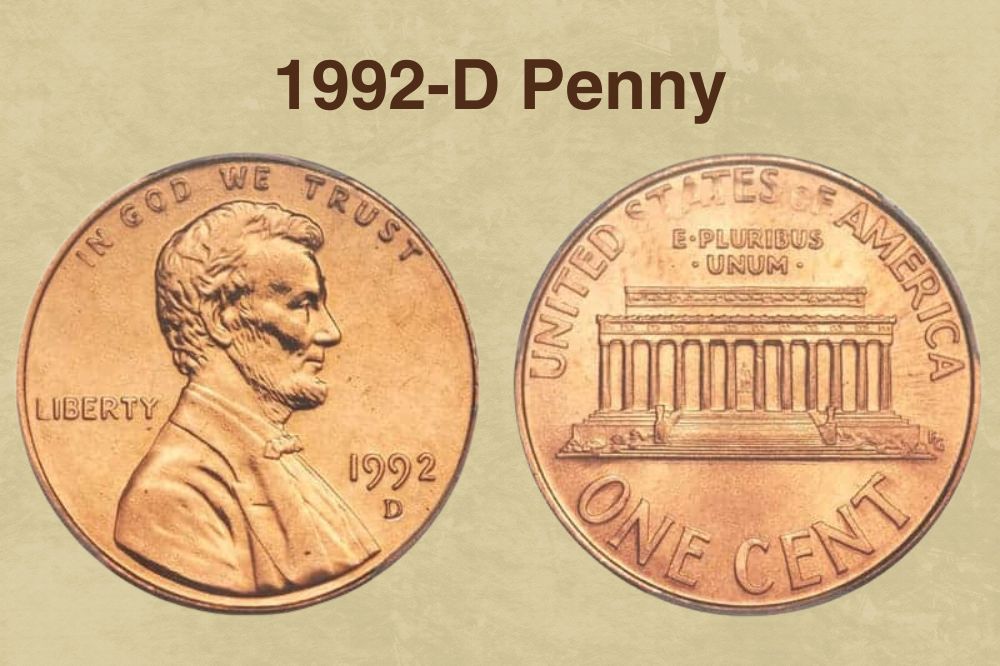
The Denver mint struck nearly the same pennies as the Philadelphia mint, with 4,448,673,300 Lincoln cents released into circulation in 1992.
With such a high mintage, the 1992-D pennies are very common and affordable across all grades. A brown 1992-D penny will be worth about $0.05 in circulated condition. Even examples in mint-state are extremely affordable, with a brown MS67 fetching about $7.
There tends to be a huge price disparity between fully red mint-state 1992-D pennies. An example graded MS65 is quite affordable, costing about $25, but this price can peak significantly for an MS67 specimen, which can fetch as much as $4,000.
A rare example graded MS69 was sold at a Stack’s Bowers auction in 2012, fetching a whopping $5,175.
1992-S Proof Penny Value
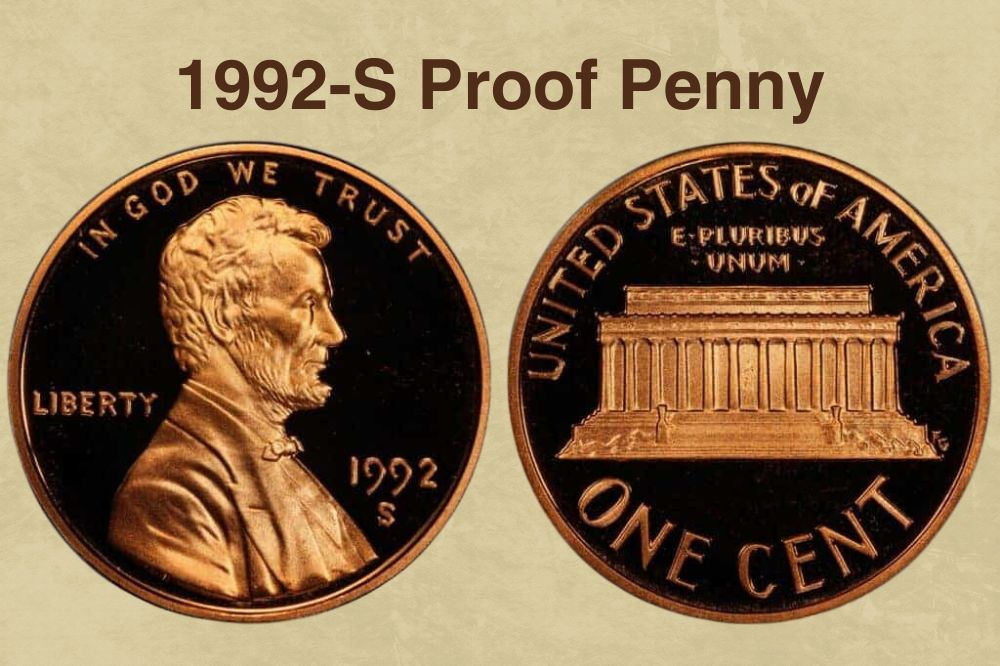
The San Francisco mint only produced proof Lincoln memorial pennies in 1992. Only about 4 176,000 proof pennies were struck that year.
Proof coins are specially struck for collectors and will feature a brilliant luster, intense details, and frosted surfaces.
With over 4 million examples struck, the 1992-S proof pennies are quite common and easily accessible for most collectors.
Proof 1992 pennies graded MS65 will bring in about $4, while an MS67 fully red specimen will cost about $22. Gem quality examples without exchanging hands are worth as much as $95.
A rare example of the 1992-S proof penny graded PF70 fetched an impressive $1,380 in a 2003 Heritage Auctions sale.
Also read: 17 Most Valuable Indian Head Penny Worth Money
Rare 1992 Penny Errors List
Minting errors are a natural part of the coin-making process. Although a perfect coin is ideal, some errors can increase the value of your coin.
The 1992 pennies were generally well-struck, but a few notable errors appeared in the series, some worth hundreds or thousands of dollars.
Let’s look at some 1992 penny errors worth money.
1992 Wide and Close AM Penny Errors
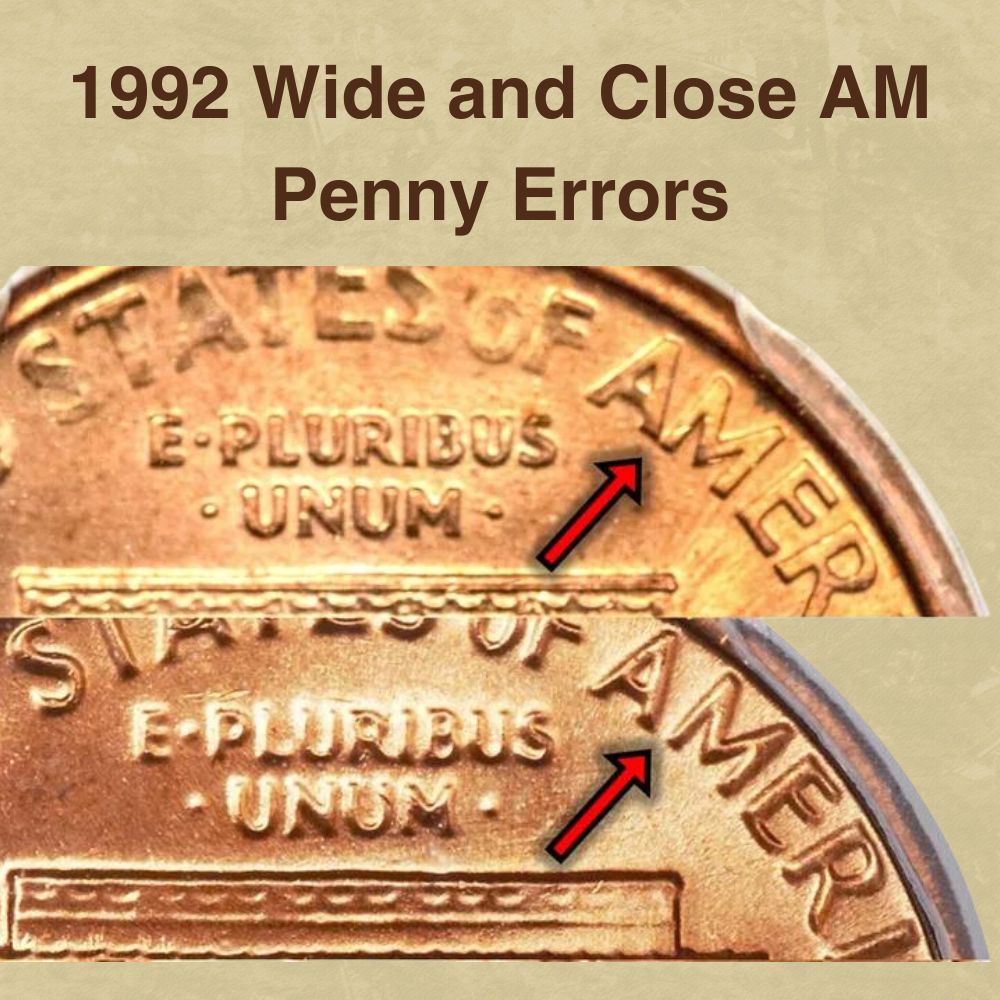
The wide and close AM error is the most popular among Lincoln Memorial pennies, including the ones minted in 1992.
This error refers to the letter arrangement in the word AMERICA on the coin’s reverse. In some coins, there is a notably wide space between the letters A and M, while in others, the letters are so close together that they are almost touching.
Frank Gasparro’s initials have a significant space between them in some close AM pennies, while in some wide AM Lincoln pennies, the initials are close together.
Both error varieties can be found in the 1992 no-mint mark and 1992-D pennies. But, close AM penny errors are rarer and will, therefore, fetch more.
According to the Professional Coin Grading Service (PCGS), a 1992 no-mint mark penny graded as a Numismatic Guaranty Company (NGC) genuine with a close AM error sold for an impressive $5,000 in a 2022 online auction.
Another close AM 1992-D penny graded About Uncirculated (AU) 58 sold for a whopping $3,525 at a Stack’s Bowers auction in 2012.
1992 Double-Die Crack Penny Error
Doubled die crack penny errors are quite common in the 1992 penny series. This error occurs when the striking die cracks due to overuse during coin-minting.
When mint workers continue using the broken die, the cracks’ impressions are left on the obverse or reverse, resulting in dings and dents on the coin’s surface.
Doubled die crack errors are a bit tricky. Too much of a crack can result in a completely undesirable circulating coin, so you want to look out for coins with moderate die cracks.
A 1992 doubled-die crack penny can fetch as much as $35 to $90, depending on the condition.
1992 Doubled Die Obverse/Reverse Penny Error
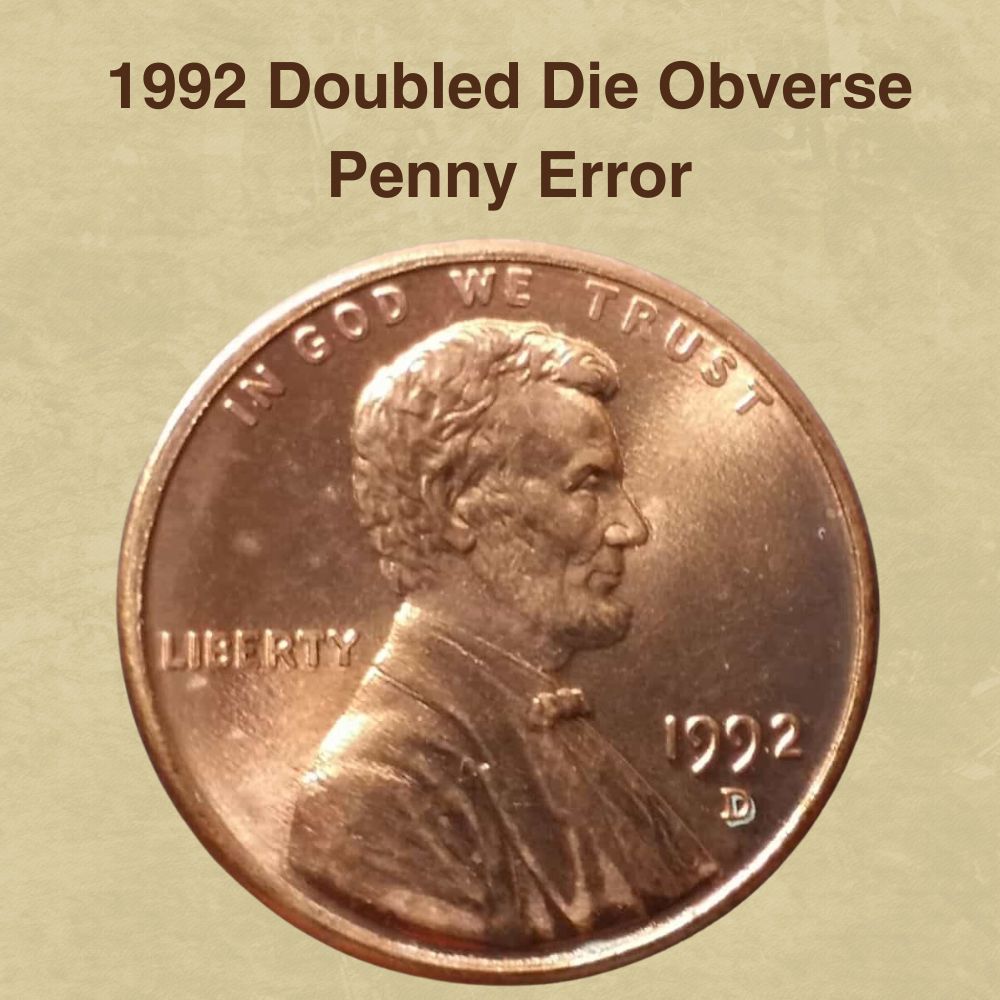
The doubled die obverse and reverse are another common error among Lincoln Memorial pennies, including those struck in 1992.
Doubled die errors occur when the punching die strikes the design and lettering on the coin twice (or more) at a slightly different angle, resulting in visible doubling on the elements on the obverse and reverse.
In the case of the 1992 pennies, you will notice a doubling on the lettering IN GOD WE TRUST, LIBERTY, the date, and the mint mark for coins struck in Denver. On the reverse, doubling is present in the motto E PLURIBUS UNUM.
A 1992 doubled die penny error can bring about $50 to $150, depending on the coin’s condition.
1992 Struck Through Penny Error
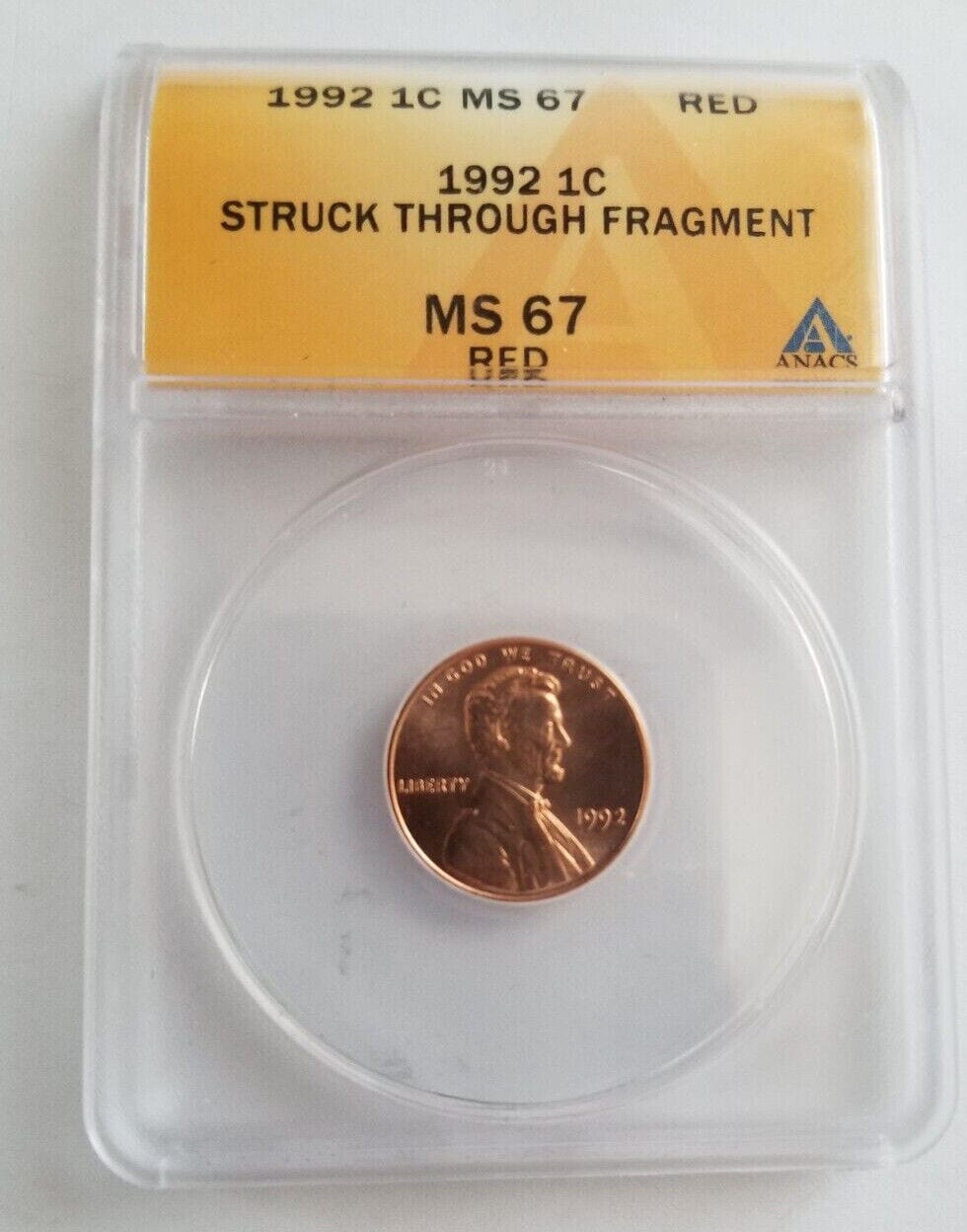
A struck-through penny error occurs when a foreign object gets caught between the planchet and the striking punch.
The object, a speck of metal, dust particles, minute debris, or even grease, is permanently imprinted into the coin, either on the obverse or in reverse.
A 1992 struck-through penny error is worth about $50 and $100, depending on the coin’s condition and the nature of the strike-through.
Also read: 11 Most Valuable Wheat Penny Errors
Where to Sell Your 1992 penny ?
Now that you know the value of your coins, do you know where to sell those coins online easily? Don’t worry, I’ve compiled a list of these sites, including their introduction, pros, and cons.
Check out now: Best Places To Sell Coins Online (Pros & Cons)
FAQ
What makes a 1992 penny rare?
The 1992 pennies are not rare, given that more than 9 billion were struck and circulated. That said, some pennies from 1992 are rare, and these are typically uncirculated, fully red examples. Since most of the Lincoln Memorial cents were released into circulation and are quite worn, gem, fully red examples are hard to come by, selling at a premium of hundreds or thousands of dollars.
How much is a 1992 penny with the A and M touching?
Close AM 1992 pennies are comparatively rarer than their wide AM counterparts. Due to their rarity, you can expect a close AM 1992 penny with the A and M touching to fetch significantly more. In the past, examples in mint state have brought as much as $5,000.
What error should I look for on a 1992 penny?
You may notice several errors across the 1992 pennies. Some are more visible and sought-after than others; for example, doubled die errors on the obverse and reverse, struck-through, and die crack errors are the most common. The close and wide AM errors are also worth looking for in a 1992 penny, as they can be worth hundreds or thousands of dollars depending on the coin’s condition.