Coin Value Contents Table
- 1968 Penny Value Chart
- History of the 1968 Penny
- 1968 Penny Types
- Features of the 1968 Penny
- 1968 Penny Grading
- 1968 Penny Value Guides
- 1968 No Mint mark Penny Value
- 1968 D Penny Value
- 1968 S Penny Value
- 1968 Penny Value (proof)
- Rare 1968 Penny Error List
- Where to Sell Your 1968 Penny ?
- FAQ about the 1968 Memorial Penny
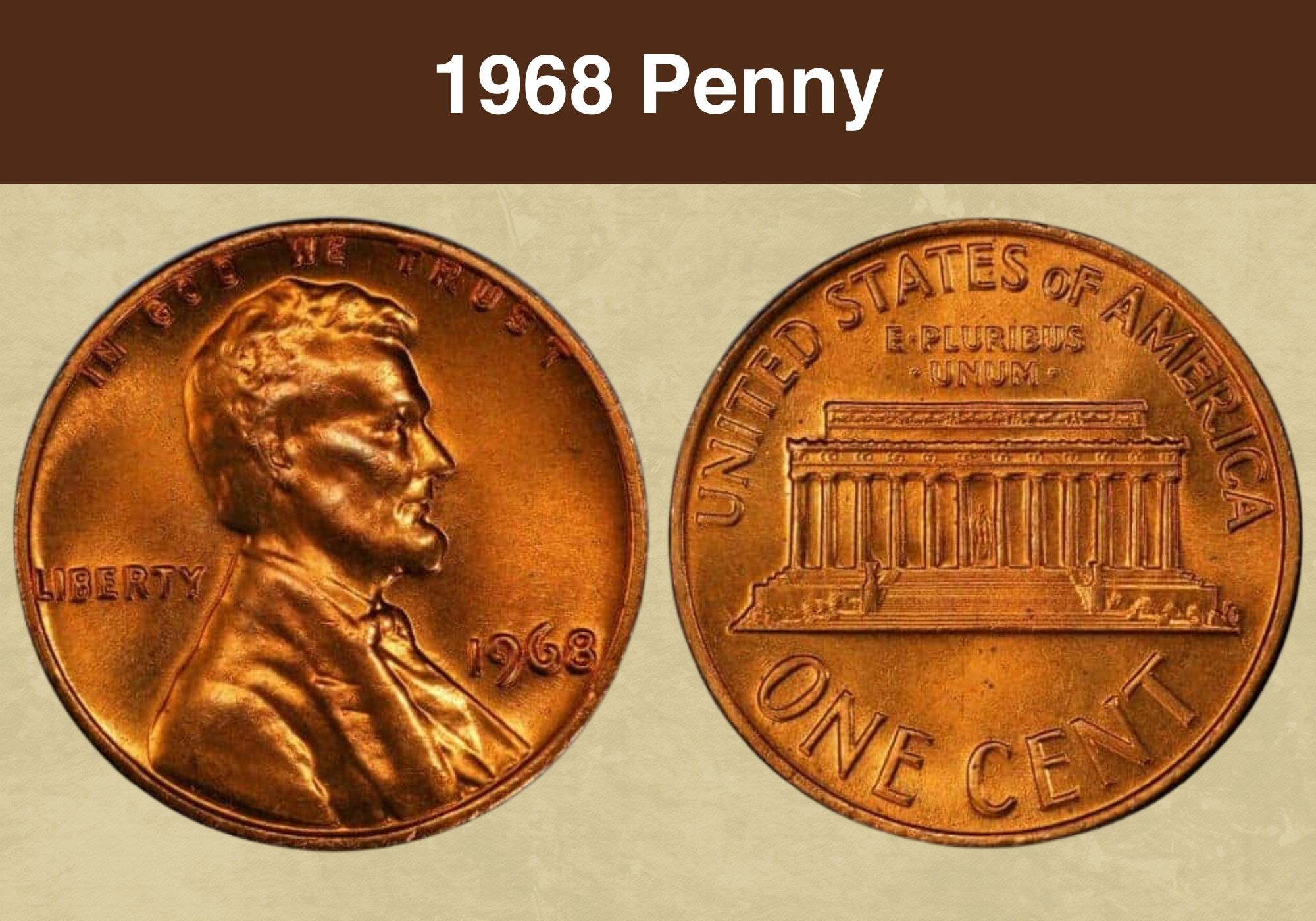
The 1968 Memorial reverse cent is a common coin that you can easily find in your pocket change money. It comes in three series with a few varieties, including three major, six minor, and six die. Even though low-graded pieces are affordable, the 1968 penny value is significant at MS 67 and PR 69 grades. Let’s check.
1968 Penny Value Chart |
|||
| Condition | 1968 No mint mark penny | 1968 D penny | 1968 S penny |
| MS 60 | $0.1 | $0.1 | $0.1 |
| MS 65 | $2.5 | $2.5 | $2.5 |
| PR 65 | / | / | $10 |
History of the 1968 Penny
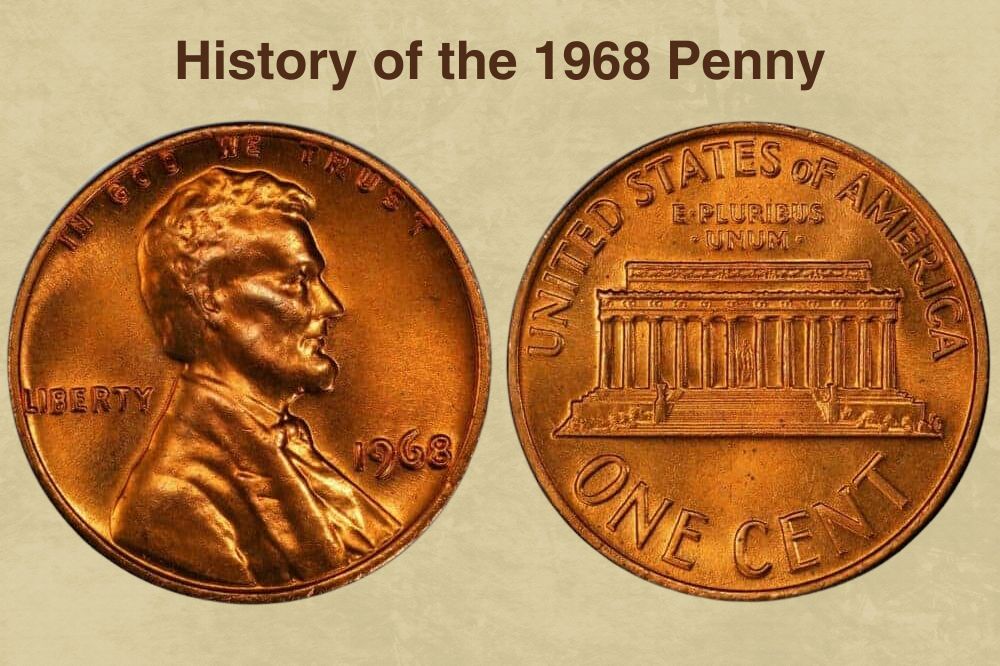
1909 was the first Lincoln cent release year. Minting coins featuring Lincoln’s bust on the obverse side was a way to commemorate the 100th anniversary of his birth. Victor D. Brenner designed the coin featuring a beloved President on the obverse and two stalks of wheat on the reverse side.
Fifty years later, in honor of the 150th Lincoln’s birth date, the US Mint changed the reverse side of this coin. The assistant designer Gasparro created the redesign featuring the Memorial on the coin reverse. Interestingly, the design also contained a small Lincoln statue inside the building.
It was the first American coin that featured the same person on both sides. This design remained the same until 2008, but the penny composition changed over time. From 1909 to 1942, these cents were made of 95% copper and 5% tin or zinc.
During WWII, pennies’ composition was completely zinc-plated steel for only one year (1943). As of 1944 and until 1982, the production returned to copper. Finally, the cent’s composition changed one more time to 97.5% zinc with copper in 1982 and has remained unchanged.
1968 Penny Types |
||
| Location | Year | Minted |
| Philadelphia | 1968 No Mint mark cent | 1,707,880,970 |
| San Francisco | 1968 S cent | 258,270,001 |
| San Francisco | 1968 proof cent | 3,041,506 |
| Denver | 1968 D cent | 2,886,269,600 |
| Total | / | 4,853,462,077 |
Abraham Lincoln was born in Kentucky in 1809 and worked as a lawyer before joining politics when he was only twenty-five. He became the 16th US President in 1860 and was elected once more in 1864.
This President did so many things during his presidency. For instance, he issued the Emancipation Proclamation in 1963 and established agriculture, the banking system, and the secret service. His major achievements were successfully balancing politics during Civil War and preserving the Union.
His ability to see events clearly, adapt to them, and decide fast when necessary were extraordinary and made the foundation of a democratic society. Unfortunately, all those activities stopped after his assassination in Ford’s Theatre in Washington.
Also read: 12 Most Valuable Lincoln Penny Worth Money
Features of the 1968 Penny
The 1968 Memorial cent design features Abraham Lincoln on both sides. His bust is on the obverse, and his statue positioned in the Memorial is on the coin’s reverse side.
The US Mint released this design for the first time in 1959 to honor the 150th anniversary of Lincoln’s birth and kept it until 2008. All three US Mints produced this penny in 1968.
The 1968 Penny (obverse)
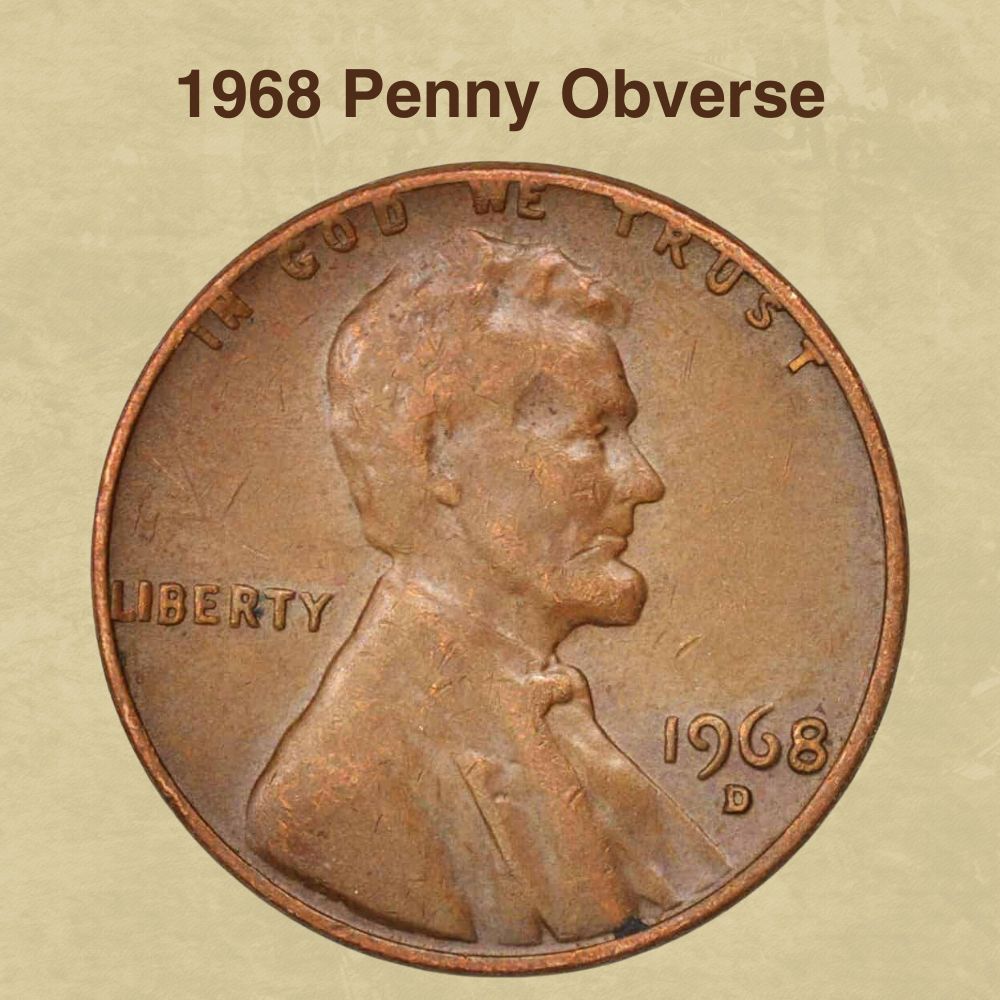
A central part of the 1968 Lincoln penny obverse side features Abraham Lincoln’s bust. The year (1968) is on the right, in line with his chest and above the mint mark. The LIBERTY is on the left behind Lincoln’s neck.
The motto IN GOD WE TRUST frames the cent’s upper rim. One of the 1968 penny’s characteristics is the motto’s letters that appear in two variations. Initials VDB (Victor D. Banner) are beneath the President’s right shoulder, honoring the designer who created this coin in 1909.
The 1968 Penny (reverse)
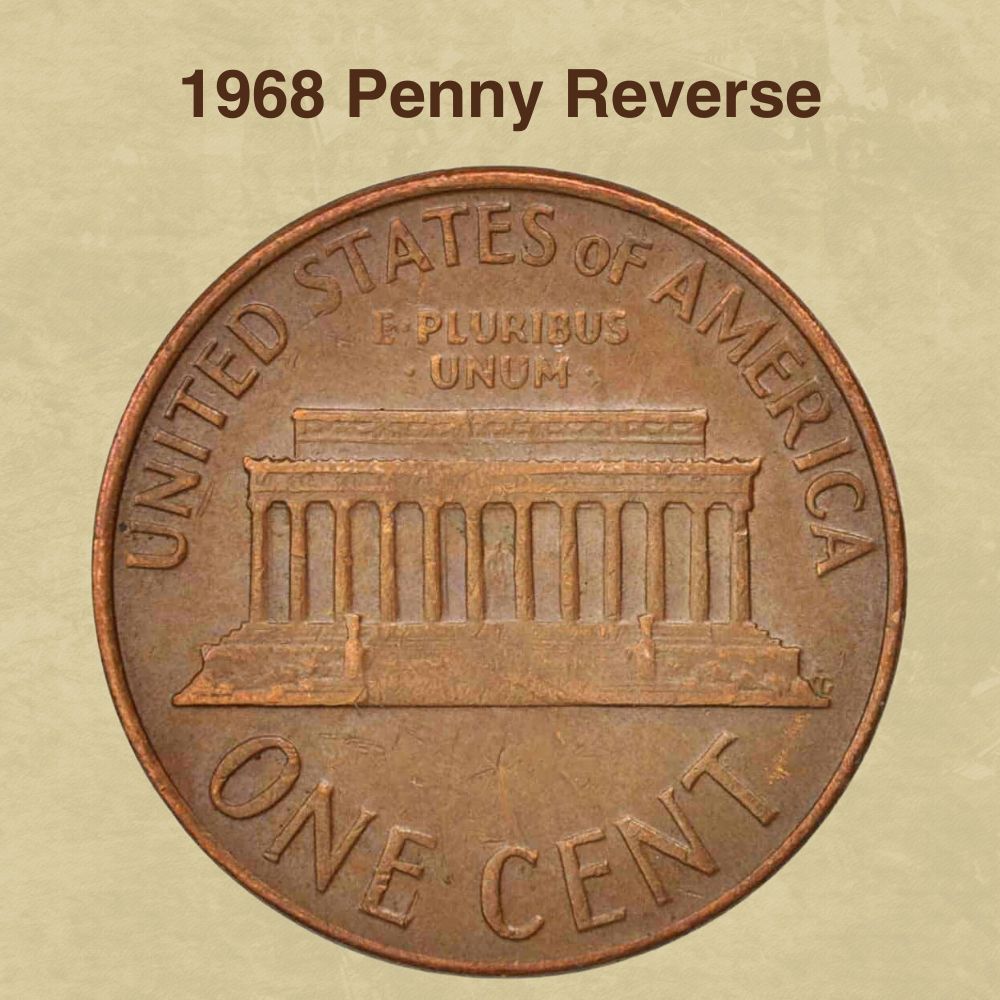
The modern Lincoln penny’s reverse design appeared in 1959, and you can also see it in 1968. It is Frank Gasparro’s work featuring the Memorial in the central area, with a small President’s statue positioned inside.
The motto E PLURIBUS UNUM is just above the Memorial, while the name UNITED STATES oF AMERICA is above it, lining the rim. Denomination ONE CENT is on the reverse side’s lower part. It also depicts the designer’s initials, FG, by the Memorial’s right corner.
1968 Penny Details |
|
| Face value | One cent ($0.01) |
| Shape | Round |
| Compound | Copper alloy with 5% zinc or tin |
| Coin diameter | 1.75 inches (19.05 mm) |
| Coin weight | 0.109 ounces (3.11 g) |
| Edge | Plain |
| Coin thickness | 0.059 inches (1.52 mm) |
The 1968 Penny (other features)
The 1968 Memorial reverse cent is round, with 1.75 inches (19.05 mm) in diameter and a plain edge. It weighs 0.109 ounces (3.11 g). The composition includes 95% copper with traces of other metals, giving the cent interesting color variations between red and brown. Its thickness is 0.059 inches (1.52 mm).
Also read: 13 Most Valuable Wheat Penny Worth Money
1968 Penny Grading
The 1968 cents with the Memorial building on the reverse comes in three variations, depending on the mint where they were struck. All series regular strikes grade up to MS 67, while rare better-ranking pieces are always more valuable. For instance, you can find proofs with deep cameo contrast in the PR 69 grade, but their number is limited nowadays.
| # | Grade |
|---|---|
| 1 | Basal State-1 |
| 2 | Fair |
| 3 | Very Fair |
| 4, 5, 6 | Good |
| 7, 8, 10 | Very Good |
| 12, 15 | Fine |
| 20, 30 | Very Fine |
| 40 | Extremely Fine |
| 50 | About Uncirculated |
| 60 | Mint State |
| 65 | Mint State |
| 70 | Mint State |
Please check our grading guides to know your coin scale, It’s the necessary step to know the exact value of your coin.
Check out now: How to Grade Lincoln Wheat Penny?
1968 Penny Value Guides
The 1968 Memorial reverse cent face value is $0.01, but many coins in the set can be more costly. Their price depends on the current copper melting value and each penny’s features and appearance.
1968 No Mint mark Penny Value
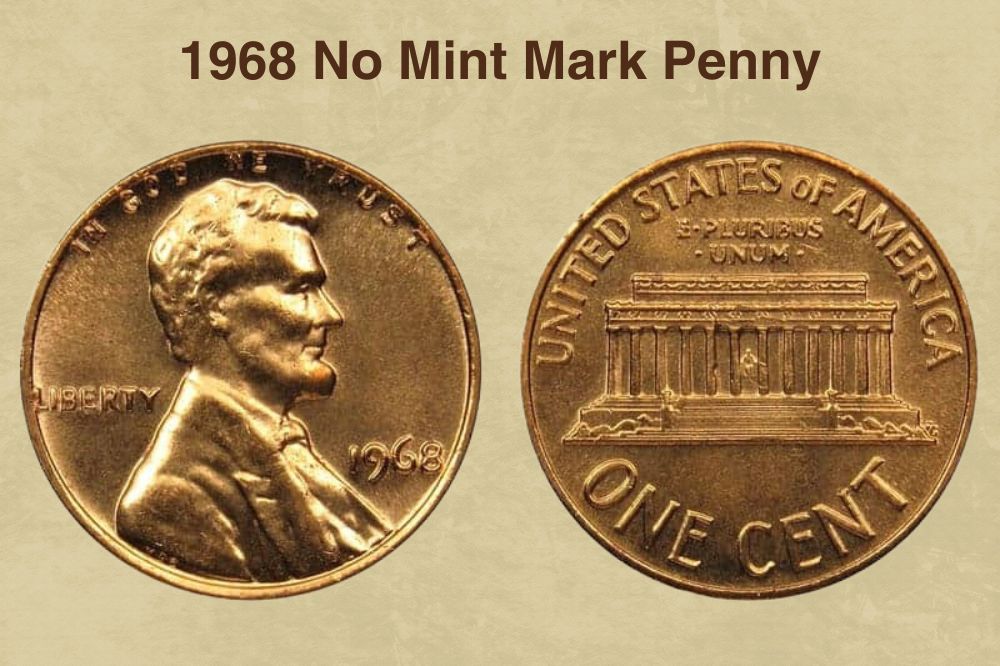
The mint in Philadelphia produced over one and a half billion 1968 cents without the P mark. Their value ranges from less than a dollar to a few hundred dollars, depending on grade. For instance, pieces in perfect condition cost approximately:
- The 1968 penny at MS 60 is $0.10
- The 1968 penny at MS 61 is $0.25
- The 1968 penny at MS 62 is $0.50
- The 1968 penny at MS 63 is $0.75
- The 1968 penny at MS 64 is $1
- The 1968 penny at MS 65 is $2.5
- The 1968 penny at MS 66 is $7.5
The most expensive 1968 cent is at the highest MS 67 grade, costing $225 or higher. However, one of these specimens reached a $2,880 sale price at an auction in August 2018.
1968 D Penny Value
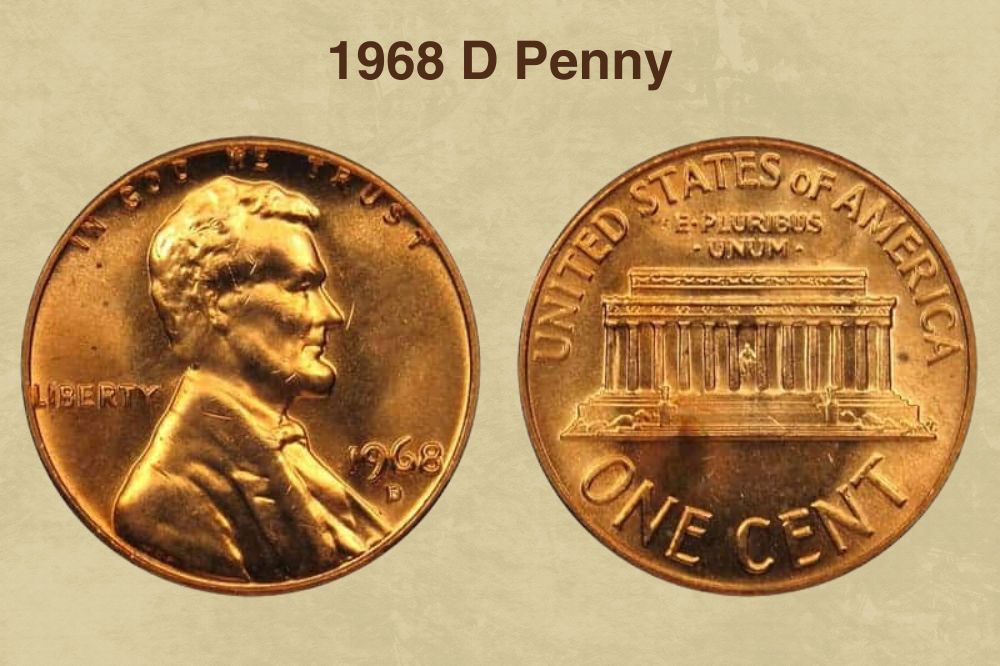
The mint in Denver was the most productive in 1968, with a 2.8 billion cent mintage. Their values are in the following price range:
- $0.1 for the 1968 D MS 60 penny
- $0.25 for the 1968 D MS 61 penny
- $0.50 for the 1968 D MS 62 penny
- $0.75 for the 1968 D MS 63 penny
- $1 for the 1968 D MS 64 penny
- $2.5 for the 1968 D MS 65 penny
- $5 for the 1968 D MS 66 penny
If you are after an MS 67 graded 1968 D cent, you should expect a $165 price or even higher. One such specimen was sold for $2,300 at Baltimore Auction in November 2008.
1968 S Penny Value
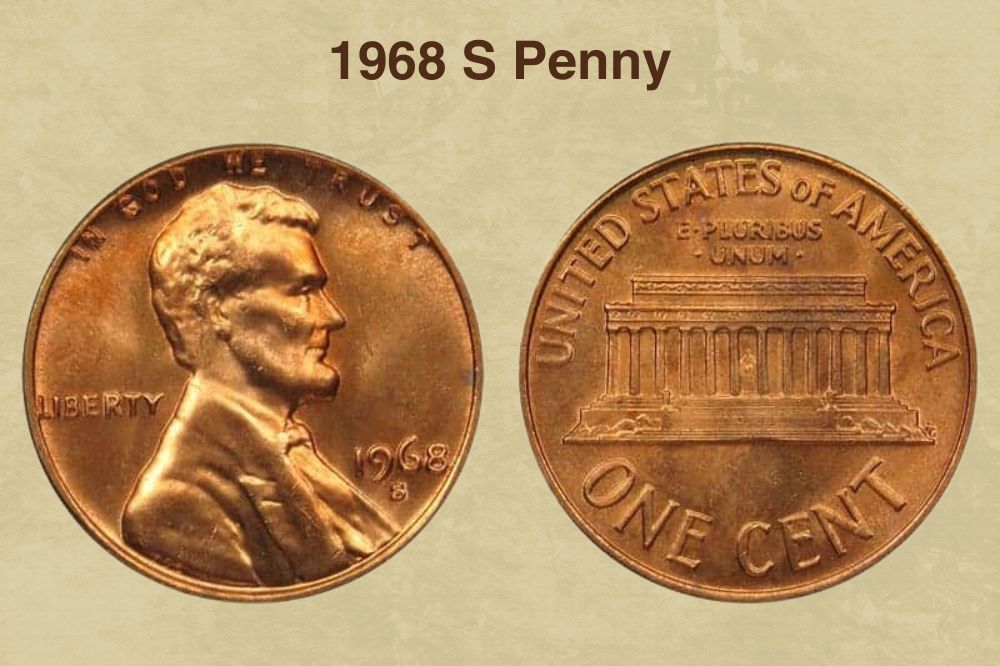
The mint in San Francisco released more than two hundred fifty million coins, reaching the lowest mintage among the three mints in 1968. These cents’ value goes from less than half a dollar to a couple of hundred dollars and directly depends on each piece’s ranking.
- At MS 60, the 1968 S penny costs $0.10
- At MS 61, the 1968 S penny costs $0.25
- At MS 62, the 1968 S penny costs $0.50
- At MS 63, the 1968 S penny costs $0.75
- At MS 64, the 1968 S penny costs $1
- At MS 65, the 1968 S penny costs $2.5
- At MS 66, the 1968 S penny costs $5
The most expensive 1968 cent is high-ranking (MS 67), with a $90 value. However, one such specimen reached a $499 sale price in April 2013.
1968 Penny Value (proof)
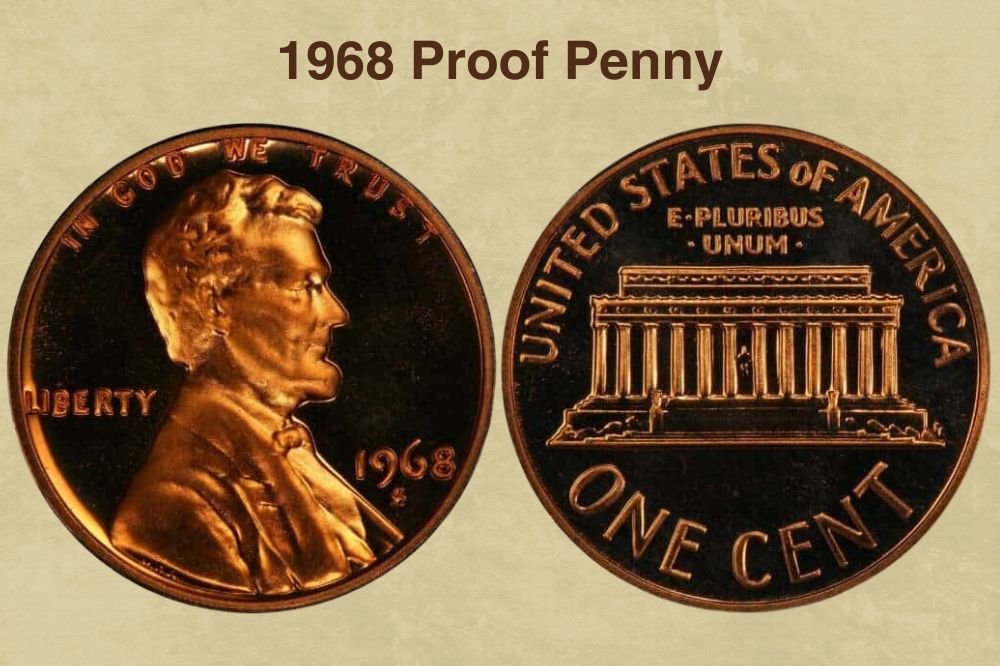
In 1968, the San Francisco mint released both circulated and proof coins. The proofs’ mintage volume was over three million, including three varieties (red pieces and those with CAM and DCAM). Their price range is:
- The 1968 penny costs from $7 to $12 (PR 63)
- The 1968 penny costs from $8 to $14 (PR 64)
- The 1968 penny costs from $10 to $15 (PR 65)
- The 1968 penny costs from $13 to $16 (PR 66)
- The 1968 penny costs from $15 to $25 (PR 67)
The 1968 penny RD DCAM variety ranking PR 68 costs $100, but the priciest PR 69 pennies often reach $1650. Interestingly, the costliest piece of such quality was sold in November 2002 for $3,795.
Also read: 17 Most Valuable Indian Head Penny Worth Money
Rare 1968 Penny Error List
The old hub used in 1968 for penny minting and the manual minting process caused lower-quality coins. Besides, numerous errors make these pieces collectible nowadays.
Off-center
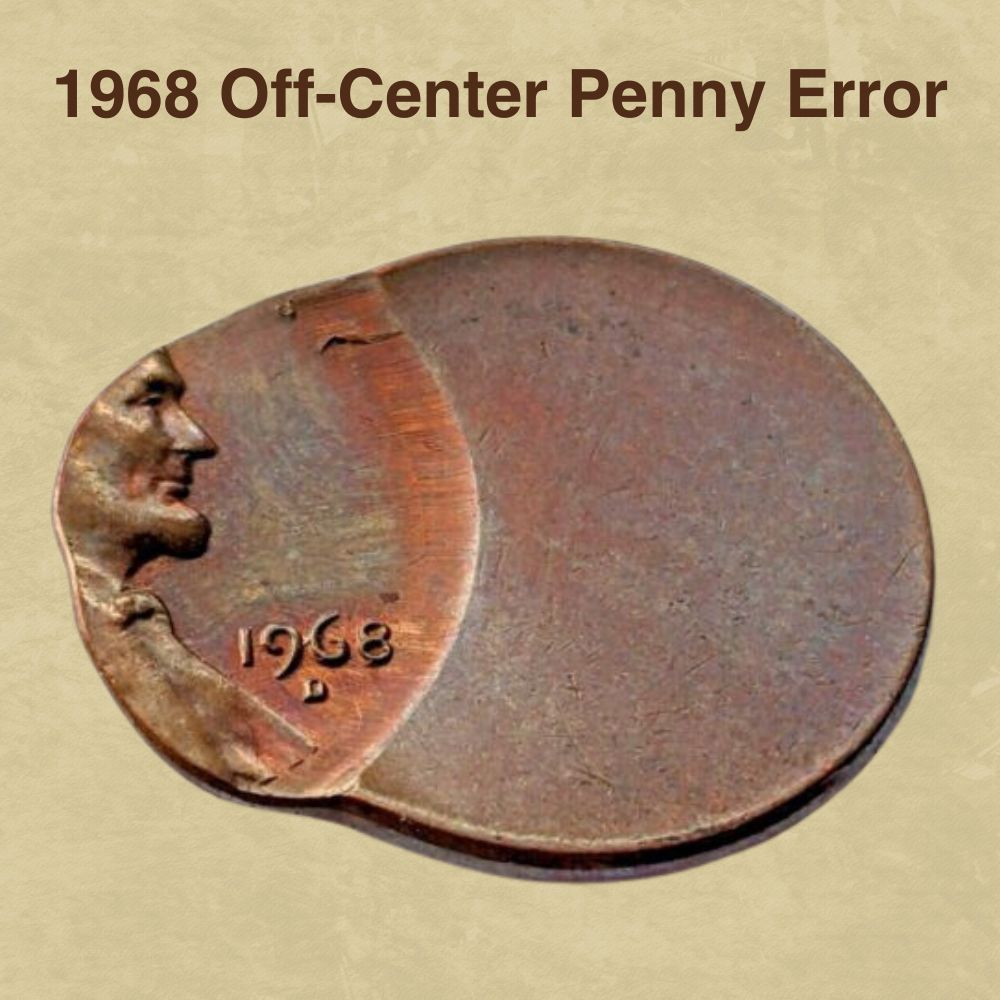
When the die strike on a planchet is unprecise, the coin image is off-center to a certain degree. The image can be significantly off-center, resulting in one left-out part. Most such coins reach higher prices than those from the regular strike.
Re-punched mint mark
The mint mark punching was one of the manual operations that led to numerous error coins. Sometimes, mint workers punched it upside down or on the wrong coin area.
After repeating the punch in the right direction, pennies were struck two or more times, resulting in RPM errors. One such piece from Denver was sold for $239 on eBay.
DDR and DDO
These two errors caused by improperly manufactured coins are common nowadays. Interestingly, the more noticeable the doubling, the higher the coin value. For instance, one beautiful red 1968 D DDR MS 65 cent was sold in Maj 2023 for $285.
1968 penny struck on a dime planchet
The 1968 D cent struck on a silver dime planchet is the rarest mint error in this year. Those silver blank planchets were used in this mint from 1964 to 1966 for Roosevelts dimes, so some were used for penny production by mistake.
One 1968 error cent made on the wrong planchet was discovered a few years ago, and it immediately got a PCGS genuine error certificate.
Also read: 11 Most Valuable Wheat Penny Errors
Where to Sell Your 1968 Penny ?
Now that you know the value of your coins, do you know where to sell those coins online easily? Don’t worry, I’ve compiled a list of these sites, including their introduction, pros, and cons.
Check out now: Best Places To Sell Coins Online (Pros & Cons)
FAQ about the 1968 Memorial Penny
What makes 1968 penny rare?
1968 was not a good year for pennies’ minting because of an old hub in the US Mint, so it can be hard to find good-struck coins. Unlike common and cheap regular pieces, some varieties and errors can be valuable.
Which 1968 penny are exceptionally expensive?
- The 1968 PR 67 penny (red) sold at $14,375 at Heritage Auctions in January 2004
- The 1968 S MS 66 penny (red) sold at $5,000 on eBay in October 2023
- The 1968 S PR 69 penny (DCAM) sold at $3,795 at Heritage Auctions in November 2002
- The 1968 MS 67 penny (red) sold at $2,880 at ANA US Coins Auction Philadelphia in August 2018
- The 1968 S PR 63 penny (CAM) sold at $2,760 at Heritage Auctions in January 2007
- The 1968 D MS 67 penny (red) sold at $2,300 at Baltimore Auction in November 2008
- The1968 D MS 62 penny (brown) sold at $546 at Heritage Auctions in July 2010
- The 1968 S MS 67 penny sold (red-brown) at $499 at Heritage Auctions in April 2013
- The 1968 D MS 63 penny (red-brown) sold at $253 Heritage Auctions in December 2004
- The 1968 S MS 65 penny (brown) sold at $225 on eBay in April 2018
- The 1968 MS 66 penny (red-brown) sold at $158 on eBay in December 2021
- The 1968 MS 68 penny (brown) sold at $154 on eBay in March 2019
How much money can you get for the 1968 penny from Philadelphia?
The 1968 penny without the mint mark in circulating condition is often worth only the copper melting value. On the other hand, uncirculated specimens can reach premium prices, particularly at auctions. For instance, you can get one with the MS 67 grade for about $225.
What is the most expensive penny?
- The sale price of the 1943 D MS 64 bronze brown cent with the wrong planchet was $840,000 (in 2021)
- The sale price of the 1943 S MS 63 bronze brown cent was $504,000 in 2022
- The sale price of the steel 1944 S MS 66 cent was $408,000 in 2021
- The sale price of the 1999 MS 66 die error cent was $138,000 in 2006
- The sale price of the 1969 S MS 64 DDO cent was $126,500 in 2008

I have a 1968 p double struck Lincoln very good condition
Hello, I have a 1968 lincon cent where it looks like the mint mark is a S over a D I’m trying to get a value it is in circulation condition, I’m unsure how to send a picture to you