1908 Indian Head Penny Value Checker: Errors List, “S” & No Mint Mark Worth
The 1908 Indian Head penny holds a special place among U.S. cent collectors — it’s one of the final issues in a series that ran for 50 years, and 1908 marked the first time these pennies were ever struck at the San Francisco Mint.
That historical milestone makes the 1908 penny genuinely interesting to pursue, whether you’re just starting out or building a more advanced set. The Philadelphia issue is accessible enough for beginners, with Good-condition examples available around $5.56, while the scarcer San Francisco “S” variety commands significantly more — starting near $29.73 even in well-worn grades.
Knowing the 1908 penny value across different conditions and mint marks is the first step to making smart decisions as a collector, and that’s exactly what this guide walks you through.
1908 Indian Head Penny Value Checker
Identify 1908 Indian Head Penny S and No Mint Mark Price
Front Obverse
Upload or Take a Photo
Back Reverse
Upload or Take a Photo
1908 Penny Value By Variety
The table below breaks down the 1908 penny value by type and grade, so you can quickly see where your coin stands. If you know the grade of your coin, you can find the exact price below in the Value Guides section.
1908 Penny Value Chart
| TYPE | GOOD | FINE | AU | MS | PR |
|---|---|---|---|---|---|
| 1908 No Mint Mark Penny Value (RD) | $5.56 | $19.05 | $48.79 | $540.33 | — |
| 1908 S Penny Value (RD) | $29.73 | $101.79 | $260.64 | $1796.67 | — |
| 1908 Proof Penny Value (RD) | — | — | — | — | $830.00 |
| 1908 CAM Penny Value | — | — | — | — | $1070.00 |
Also Read: Indian Head Penny Coin Value (1859-1909)
Top 10 Most Valuable 1908 Penny Worth Money
Most Valuable 1908 Penny Chart
2002 - Present
When it comes to the most valuable 1908 pennies sold at auction, the top spots are dominated by coins in exceptionally high grades — and the results can be surprisingly impressive.
The highest recorded sale for a Philadelphia issue belongs to a 1908 MS67 RD example that fetched $33,600 at Heritage Auctions in 2019. More recently, a 1908 MS67+ RD sold for $28,200 at Heritage in August 2023, and a 1908 MS66+ RD with outstanding eye appeal brought $8,400 at Legend Rare Coin Auctions in November 2023.
For the San Francisco issue, the top price belongs to a 1908-S MS67 RD at $21,600, sold at Heritage in January 2021. Stack’s Bowers also recorded a 1908-S MS66 RD sale for $21,600 in March 2024 — a clear signal of sustained collector demand for this key date in top condition.
Proof strikes have their own strong track record. A 1908 PR67 RD brought $17,038 in December 2017, while a 1908 PR66 CAM sold for $7,800. These figures are a good reminder that variety, color, and grade all multiply in ways that can push any 1908 penny far beyond face value.
History of the 1908 Penny
The Indian Head penny was introduced in 1859, just as America was heading into the Civil War. Designed by James B. Longacre, who served as the fourth Chief Engraver of the United States Mint, it carried a sense of national identity at a time of deep division — the oak wreath and Union shield on its reverse were deliberate symbols of unity and strength.
Longacre clarified before his death in 1869 that the design’s Liberty figure was inspired not by a family member, as popular legend suggests, but by a classical sculpture known as the “Crouching Venus,” a piece borrowed from the Vatican and held in Philadelphia at the time.
Over the next five decades, the Indian Head penny passed through an America that was transforming rapidly. Industrialization reshaped cities, waves of immigrants arrived looking for opportunity, and the penny became a practical part of daily commerce — used in stores, factories, and the growing number of coin-operated machines across urban America.
By 1908, the country was on the move in new ways. Henry Ford introduced the Model T that same year, the term “melting pot” entered the American vocabulary, and the newly formed Bureau of Investigation — later the FBI — began operations.
1908 also marked the direct aftermath of the Panic of 1907, a severe banking crisis that contracted the money supply across the country. That financial shock is part of why the 1908 Indian Head penny mintage fell so dramatically — fewer than one-third of the coins produced in 1907 were struck in 1908.
A key legislative milestone also shaped this coin’s existence. The Act of April 24, 1906 gave the U.S. Mint permission to strike base metal coins at any mint facility and quadrupled the annual appropriation for metal purchases from $50,000 to $200,000. Without that act, the 1908-S penny could never have existed — production of the cent had been legally restricted to Philadelphia since the series began.
It was also the second-to-last year of the Indian Head series, with the Lincoln cent arriving in 1909. That timing alone gives the 1908 penny a quiet but meaningful place in the story of American coinage.
Also Read: 54 Most Valuable Indian Head Penny Worth Money (1859-1909)
Is Your 1908 Penny Rare?
1908 No Mint Mark Penny (RD)
1908-S Penny (RD)
1908 Proof Penny (RD)
1908 CAM Penny
The Coin Value Checker App makes it easy to check your coin’s full rarity score and see exactly where it ranks in the Indian Cent series.
Key Features of the 1908 Penny
The 1908 Indian Head penny carries the same design that James B. Longacre introduced back in 1859 — a consistent look that makes these coins easy to recognize and a natural fit for collectors building a complete Indian Head set.
The Obverse of the 1908 Penny
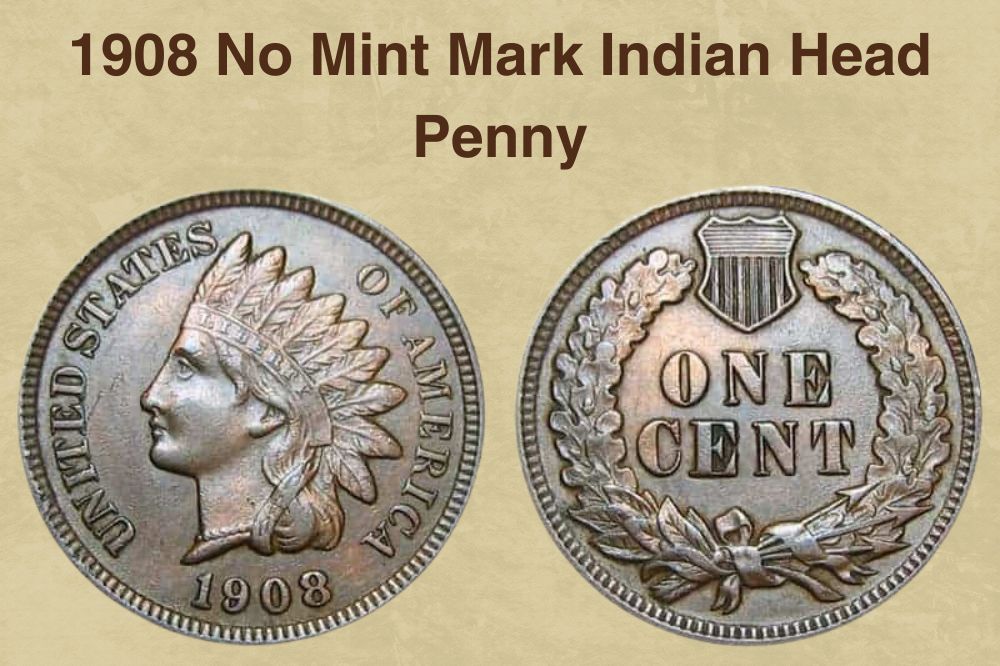
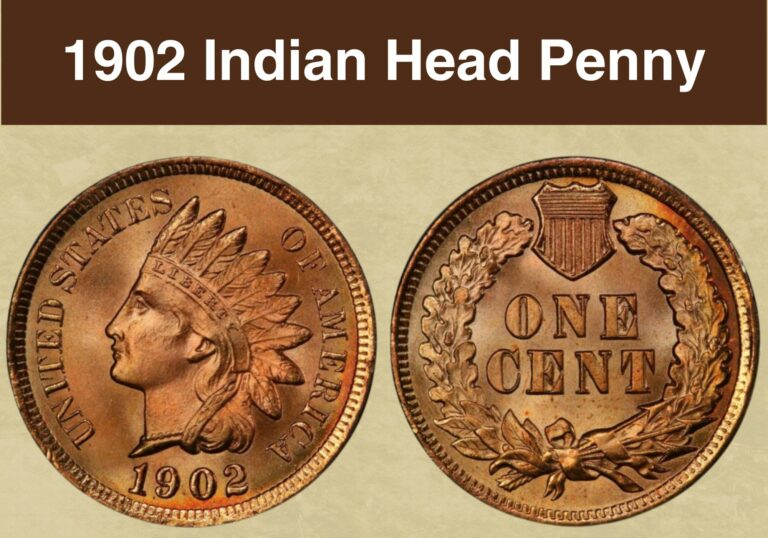
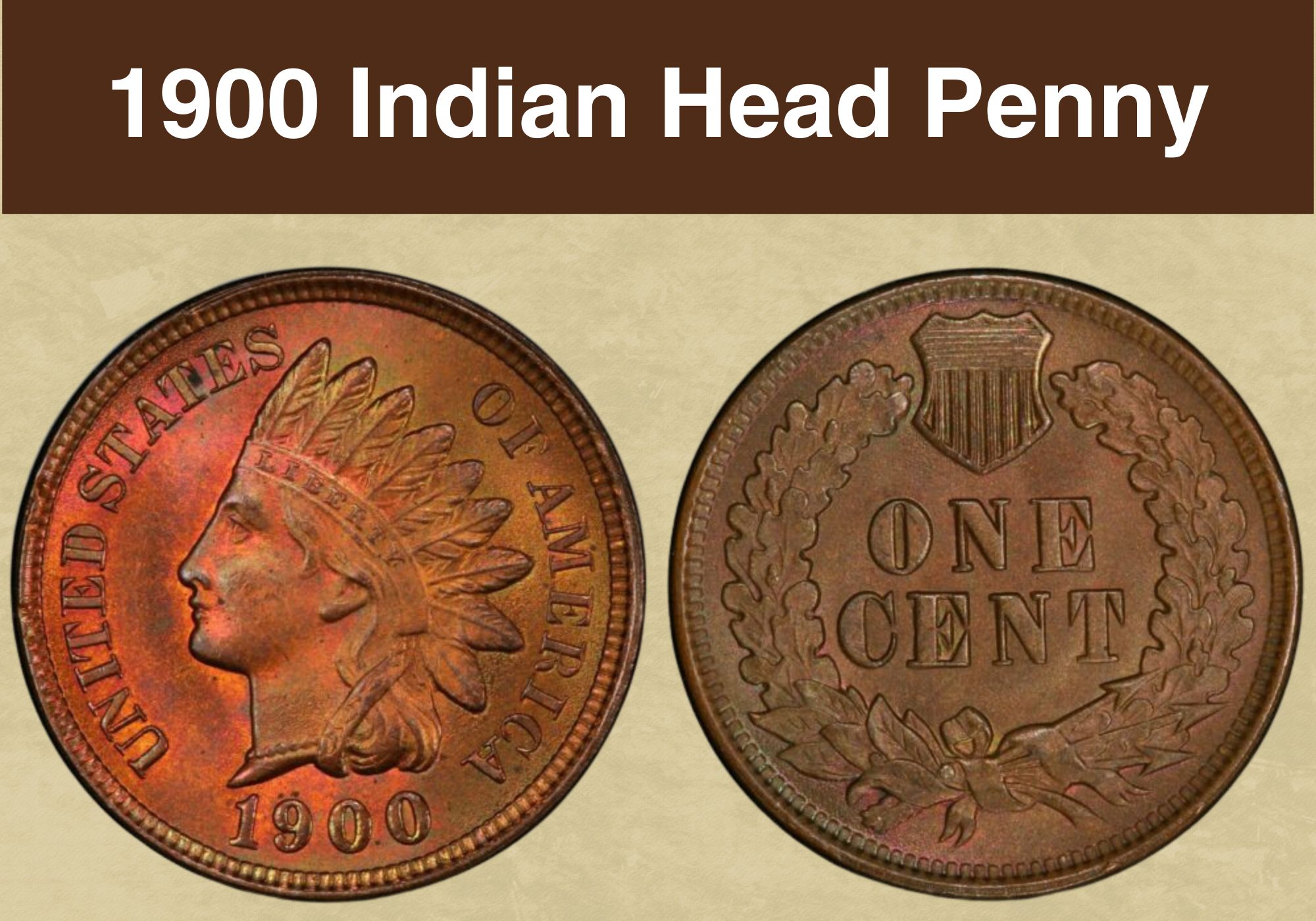
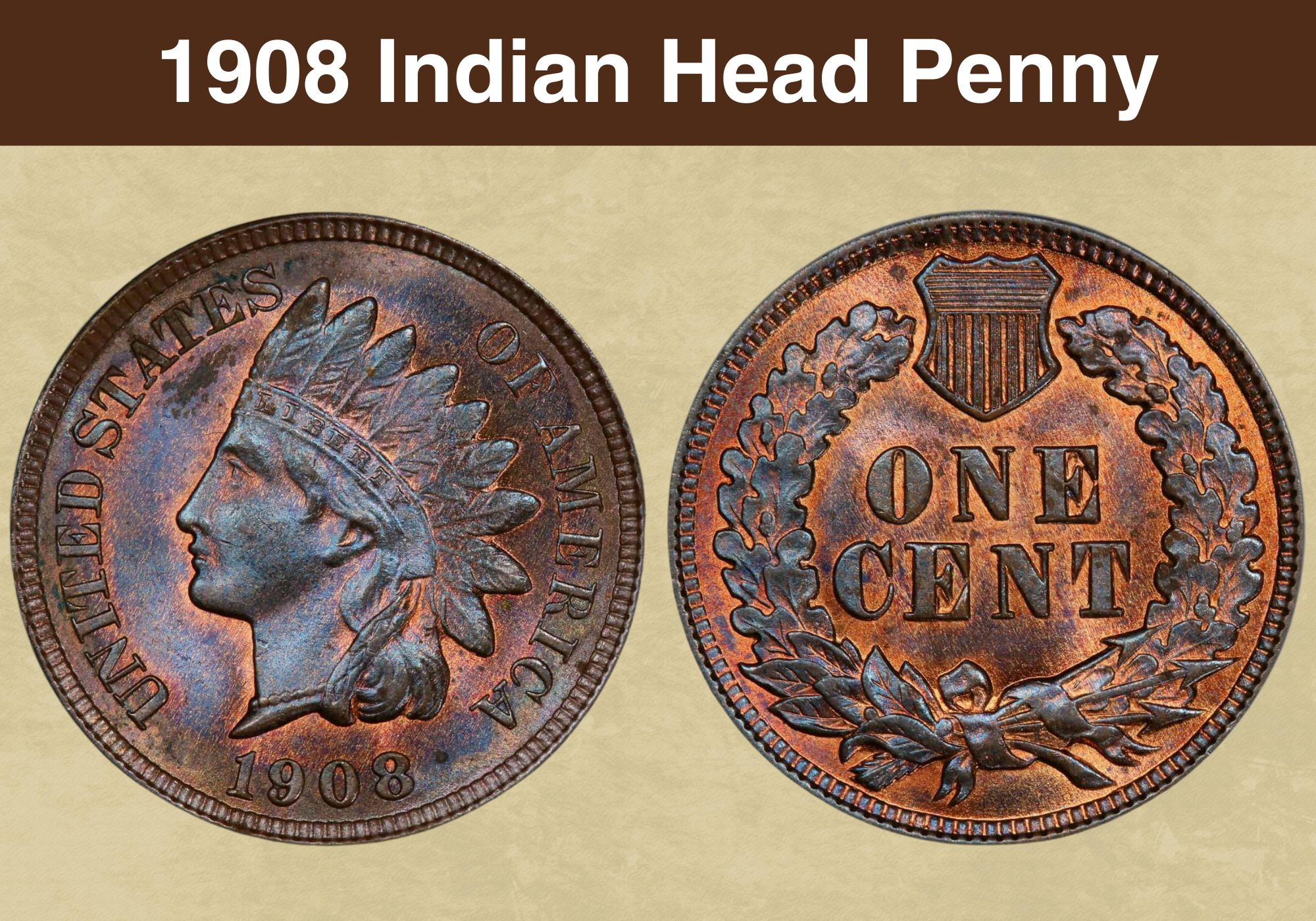
The obverse features Lady Liberty facing left, dressed in a full Native American feathered headdress. The word “LIBERTY” is inscribed on the headband of the headdress — this is the first detail to wear down on circulated examples, so it’s always worth inspecting closely.
“UNITED STATES OF AMERICA” arches along the upper rim, while “1908” appears at the bottom of the coin, just below Liberty’s portrait. The facial features are rendered in a classical European style, reflecting Longacre’s source material in classical sculpture rather than any actual Native American model.
The Reverse of the 1908 Penny
The reverse is centered on an oak wreath encircling the denomination “ONE CENT” in two lines. A Federal shield sits at the top where the two branches of the wreath separate, and three arrows bound by a ribbon rest at the base of the design.
This wreath pattern replaced the original laurel design in 1860 at the direction of Mint Director James Snowden, who wanted a design with “more National character.” It remained the standard reverse for the rest of the Indian Head series through 1909.
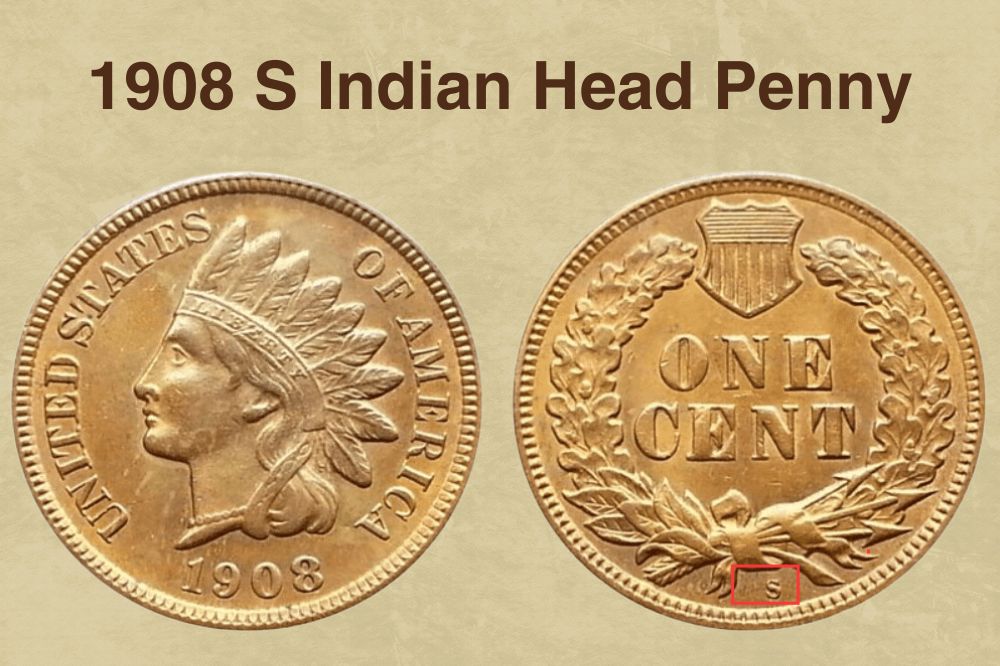
On the 1908-S penny, the “S” mint mark appears on the reverse, just below the ribbon that ties the wreath together, slightly to the right of center. Philadelphia-minted coins carry no mint mark at all.
Other Features of the 1908 Penny
The 1908 penny measures 19 millimeters across and weighs 3.11 grams, struck in a bronze alloy of 95% copper with 5% tin and zinc. The edge is plain — no reeding or lettering of any kind.
Note that the copper-nickel composition used in early Indian Head cents (1859–1864) had been replaced by this bronze formula back in 1864, giving later-series coins including the 1908 their distinctly warmer, redder appearance when fresh from the mint.
Also Read: Top 100 Most Valuable Pennies Coin Worth Money List (1959 – Present)
1908 Penny Mintage & Survival Data
1908 Penny Mintage & Survival Chart
Survival Distribution
| Type | Mintage | Survival | Survival Rate |
|---|---|---|---|
| No Mint | 32,326,317 | 1,400 | 0.0043% |
| S | 1,115,000 | 800 | 0.0717% |
| Proof | 1,620 | unknown | unknown |
| CAM | 1,620 | unknown | unknown |
The Philadelphia Mint produced 32,326,317 no mint mark pennies in 1908, while the San Francisco Mint struck just 1,115,000 “S” examples — a fraction of that output. Proof issues were limited to 1,620 pieces, made specifically for collectors rather than general circulation.
To put the 1908-S mintage in context: according to PCGS CoinFacts editor Jaime Hernandez, the 1908-S has the third-lowest mintage of any circulation-strike Indian cent in the entire series. Only the 1877 and 1909-S were produced in smaller numbers.
What stands out is how few of these coins have survived in gradable condition. Of all those Philadelphia coins, only around 1,400 are estimated to survive today — a survival rate of just 0.0043%. The 1908-S fares slightly better proportionally, with roughly 800 known survivors and a survival rate of 0.0717%.
In the MS65 range, PCGS data indicates fewer than a couple hundred 1908 Philadelphia examples are known across all colors. The 1908-S narrows dramatically: approximately 350 total examples are known in MS65 across all colors, and only around 40 to 50 examples in MS66 — with none grading higher than MS66.
These figures put into perspective just how much over a century of circulation and time can reduce even a large original mintage down to a relatively small pool of collectible coins.
Also Read: Top 100 Most Valuable Wheat Pennies Coin Worth Money (1909 – 1958)
The Easy Way to Know Your 1908 Penny Value
The 1908 penny value comes down to three things: the mint mark, the condition of the coin, and whether it’s a proof or business strike. A coin from San Francisco carries an “S” on the reverse — and that single letter can mean a significant difference in value compared to a Philadelphia issue.
Condition is where most of the work happens. Look closely at the word “LIBERTY” on the headband and the details in the feathers — these are the first areas to show wear, and their sharpness tells you a lot about the grade.
The Coin Value Checker App lets you check your coin’s grade and value directly, without any guesswork.


Coin Value Checker App
Not sure what your coins are worth? Get Instant Value • Grade • Error Detection with coin identifier and value app (FREE Usage Daily)
1908 Penny Value Guides
The 1908 penny comes in four distinct types, and knowing which one you have is the foundation of understanding its value.
- 1908 No Mint Mark Penny — the standard Philadelphia issue, the most commonly encountered type among collectors today
- 1908-S Penny — struck at the San Francisco Mint, considerably scarcer and more sought after in any grade
- 1908 Proof Penny — a collector-only strike with sharp, mirrored fields and a frosted design
- 1908 CAM Penny — a proof variety with enhanced contrast between the frosted devices and reflective background
Each type occupies a different place in the market, and condition plays a major role in how much any of them is worth.
1908 No Mint Mark Penny Value
The 1908 no mint mark penny is among the more accessible dates in the Indian Head series — circulated examples are easy to find and reasonably priced across most grades. Where things get more interesting is in the upper uncirculated range, where surviving examples become genuinely scarce, particularly MS65 and above.
Color plays a significant role in value here. At the MS65 level, a BN (Brown — meaning the coin has fully toned from its original copper color) example trades around $260, while an RB (Red-Brown — showing partial original luster) coin edges slightly higher at around $285. A fully RD (Red — retaining most of its original copper color) example at the same grade jumps to approximately $750 — more than double its Brown counterpart.
By MS66, PCGS data shows fewer than a couple hundred examples are known across all colors, making it a genuinely scarce coin. At MS67, the 1908 Philadelphia issue is extremely rare — less than a handful of examples documented — and only known in RD.
That scarcity is reflected directly in prices: a 1908 MS67 RD sold for $33,600 at Heritage Auctions in August 2019, while an MS67+ RD brought $28,200 at Heritage in August 2023.
1908 No Mint Mark Penny (RD) Price/Grade Chart
Price by 1-70 Grade (Latest Auction Records Included)
The auction history below shows how prices have shifted across different grades over the years.
| Date | Platform | Price | Grade |
|---|
The chart below gives a clear picture of how trading activity for the 1908 no mint mark penny has moved over the past year.
Market activity: 1908 No Mint Mark Penny
1908-S Penny Value
The 1908-S penny holds a specific distinction in the Indian Head series — it was the first cent ever struck at the San Francisco Mint, made possible by the Act of April 24, 1906 that opened branch mints for base metal coin production. It ranks among the three lowest-mintage dates in the entire series, alongside the 1877 and 1909-S.
Weak strikes are a well-documented characteristic of the 1908-S. Because San Francisco was new to cent production in 1908, the strike pressure was sometimes inconsistent, leaving feather tips and hair detail softer than expected even on uncirculated examples. Don’t mistake this for wear — it’s a production characteristic specific to this issue.
Most circulated examples survive in Fine to XF condition. In uncirculated grades, Red-Brown (RB) surfaces are the most commonly seen, while full Red (RD) examples are noticeably rarer than both RB and Brown (BN) — the reverse of what you might expect.
According to PCGS CoinFacts, approximately 350 total examples are known in MS65 across all colors, while only around 40 to 50 coins are known at MS66 — and PCGS has graded just 6 coins at MS67 RD, the finest-known grade for this issue.
Auction results reflect that scarcity: an MS66 BN brought $4,000, an MS66 RB reached $6,038 at Bowers & Merena in January 2009, and the finest-known MS67 RD sold for $21,600 at Heritage in January 2021. Stack’s Bowers confirmed continued demand with another MS66 RD sale of $21,600 in March 2024.
1908-S Penny (RD) Price/Grade Chart
Price by 1-70 Grade (Latest Auction Records Included)
A look at the auction table below shows how realized prices have varied across grades over the years.
| Date | Platform | Price | Grade |
|---|
Selling activity for the 1908-S penny points to sustained collector interest.
Market activity: 1908-S Penny
1908 Proof Penny Value
Proof coins from this era were made exclusively for collectors, and the 1908 proof penny is a good example of what that meant in practice. Each piece was struck multiple times on specially prepared planchets, producing sharp details and the distinctive mirror-like fields that set proof issues apart from regular circulation strikes.
In 1908, the Philadelphia Mint was still using acid pickling to create the frosted finish on proof coins. This technique produced strong frost on the first 50 to 100 coins struck from a fresh die, but the effect faded with each subsequent strike — which is why true cameo examples from this era are scarcer than standard proofs and command a premium.
What makes the 1908 proof worth understanding is how much surface color affects its value. A PR66 BN (Brown) example sold for $1,645 in December 2021, while a PR67 RB (Red-Brown) reached $4,313 in May 2007.
The gap widens substantially with fully Red examples: a PR67 RD brought $17,038 in December 2017, showing just how much collectors value original copper color in proof format.
1908 Proof Penny (RD) Price/Grade Chart
Price by 1-70 Grade (Latest Auction Records Included)
Realized prices across different grades are laid out in the auction records below.
| Date | Platform | Price | Grade |
|---|
The activity chart below shows how often the 1908 proof penny has changed hands over the past year.
Market activity: 1908 Proof Penny
1908 CAM Penny Value
The CAM designation — short for Cameo — means the raised design elements on a proof coin carry a light to moderate frosted finish that visually lifts them off the deeply mirrored fields beneath. On an early 20th-century coin like the 1908 penny, that kind of contrast was never intentional or guaranteed.
Before modern minting technology, cameo surfaces only appeared on the first coins struck from a freshly acid-pickled die. As the die was used repeatedly, the frosting wore down and the effect disappeared. That makes genuine cameo examples from this era genuinely scarce, since they represent a very small window in each die’s production lifespan.
The deeper, more pronounced version of this effect is called Deep Cameo (DCAM) by PCGS or Ultra Cameo by NGC — and these designations carry the highest premiums. A standard CAM example from 1908 is already rare; a true DCAM would be exceptional.
Auction records reflect that scarcity. A PR66 CAM sold for $7,800 in August 2019 — a meaningful premium over standard proof examples at the same grade. For a coin that shares the same original production run as the regular proofs, that price gap reflects what collectors place on surface quality and visual contrast.
1908 CAM Penny Price/Grade Chart
Price by 1-70 Grade (Latest Auction Records Included)
Recorded sales are captured in the auction table below, covering what the market has done with this designation over time.
| Date | Platform | Price | Grade |
|---|
The chart below shows how trading activity has moved over the past year.
Market activity: 1908 CAM Penny
Also Read: 42 Rare Penny Errors List with Pictures (By Year)
Rare 1908 Penny Error List
Error coins from 1908 are rare finds, and the varieties that have been documented tell you something specific about how these coins were made. Three stand out as the most recognized among collectors.
1. 1908 MPD (FS-301 And FS-302)
MPD stands for Misplaced Date — it occurs when digits from the date were punched into the wrong area of the die before being corrected into their final position. What gets left behind is a ghost-like remnant of those misplaced numbers, visible under a loupe or magnification.
FS-301 (also catalogued as Snow-4, S-4) shows extra date digit remnants in the denticles below the date field. FS-302 (Snow-9, S-9) is a separate die variety with the misplaced digits showing in a different position. Both varieties are listed in standard references including Richard Snow’s “Flying Eagle & Indian Cent Attribution Guide,” the definitive reference for Indian Head cent varieties.
Auction records for FS-301 include a VF35 BN that sold for $75 in 2019 and an MS65 RB that brought $1,187 in 2021. FS-302 recorded an XF40 BN at $798 in June 2013 and an MS64 RB at $630 in July 2019. A doubled die obverse on the 1908 Philadelphia issue, when clearly visible, can also command a 100–300% premium over a standard example at the same grade.
1908 MPD FS-301 Price/Grade Chart
Price by 1-70 Grade (Latest Auction Records Included)
2. 1908-S/S RPM FS-501 — The Only RPM in the Entire Indian Head Cent Series
RPM stands for Repunched Mint Mark, meaning the “S” on the reverse was stamped more than once, with the second punch landing slightly offset from the first. The result is a doubled or shadowed mint mark visible with a loupe.
What makes this variety especially significant is that the 1908-S/S RPM FS-501 (Snow-1) is the only repunched mint mark in the entire 50-year Indian Head cent series. That distinction alone sets it apart from typical RPM varieties found on other series.

Coin Value Checker App
Not sure what your coins are worth? Get Instant Value • Grade • Error Detection with coin identifier and value app (FREE Usage Daily)
The context behind this rarity is telling: only 10 reverse dies were ever used at San Francisco for the entire Indian Head series — 8 of them in 1908 and just 2 in 1909.
The repunching on FS-501 is confirmed as shifted to the south (not north), and the variety pairs with two separate non-variety obverse dies. Visibility of the secondary punch and overall coin condition are the two factors that matter most for value.
1908-S/S RPM FS-501 Price/Grade Chart
Price by 1-70 Grade (Latest Auction Records Included)
3. 1908 Off-Center Strike
Off-center strikes occur when the planchet — the blank coin disc — is not properly centered under the dies at the moment of striking. The result is a coin where part of the design is missing and the blank edge of the planchet is visible on one side.
On the 1908 Indian Head penny, an MS61 Brown example struck 20% off-center has been documented, with the mint mark area and the words “States Of” completely missing from the planchet. That piece sold for $400. The more dramatic the misalignment — and the more complete the date is still visible — the higher the premium off-center strikes command.
Where to Sell Your 1908 Penny?
Now that you know the 1908 penny value, are you wondering where to find buyers or sellers for your coins? Don’t worry — here’s a roundup of the best platforms available, complete with what each one offers and where they fall short.
Check out now: Best Places To Sell Coins Online (Pros & Cons)
1908 Penny Market Trend
Market Interest Trend Chart - 1908 Penny
*Market Trend Chart showing the number of people paying attention to this coin.
FAQ about the 1908 Penny
1. Why does the 1908-S penny strike quality vary so much?
The 1908-S is known for weak strikes — a characteristic tied directly to the San Francisco Mint’s inexperience with cent production rather than damage or wear.
Only 10 reverse dies were ever used at San Francisco for the entire series, and 8 of them were used in 1908 alone as the mint was just starting up. High points like the feather tips and hair detail may appear soft even on uncirculated examples, so don’t mistake a production strike weakness for circulation wear.
2. What does the color designation mean for 1908 penny value?
Uncirculated copper coins are graded by how much original red color remains. RD (Red) coins retain most of their original copper luster and are the most valuable. RB (Red-Brown) shows partial toning, and BN (Brown) has fully toned over time. At MS65, the difference between a BN and an RD example can be several hundred dollars — so color matters quite a bit in the upper grades.
3. Is the 1908 penny a good entry point for Indian Head penny collecting?
The Philadelphia issue is one of the more accessible later-date Indian Heads, with circulated examples available at modest prices. It also pairs naturally with the 1908-S, making it a good starting point for collectors who want to build toward a complete date-and-mintmark set. The variety and proof options give more advanced collectors something to pursue as well.
4. What law made the 1908-S penny possible?
The Act of April 24, 1906 authorized the U.S. Mint to strike base metal coins — like the bronze cent — at any mint facility, not just Philadelphia. It also quadrupled the annual appropriation for base metal purchases from $50,000 to $200,000. Without this legislation, San Francisco could never have struck cents in 1908, and the 1908-S penny would not exist.
5. How many 1908-S Indian Head pennies are known in top grades?
According to PCGS CoinFacts, approximately 350 examples of the 1908-S are known in MS65 across all color designations. In MS66 — the highest grade known for this issue — only around 40 to 50 examples exist. PCGS has graded just 6 coins at MS67 RD, making that the absolute finest-known population for the entire 1908-S issue.
6. What is the 1908-S/S RPM FS-501 and why is it significant?
The 1908-S/S RPM FS-501 is the only repunched mint mark in the entire 50-year Indian Head cent series. RPM stands for Repunched Mint Mark — the “S” was punched twice into the die, with the second strike landing to the south of the first, leaving a shadowed double image. Because the San Francisco Mint only used 10 reverse dies for the entire series, finding a documented die variety among them is especially notable.
7. What is the difference between a CAM and DCAM proof designation on the 1908 penny?
CAM (Cameo) means the raised design elements show a light to moderate frost against the mirrored fields. DCAM (Deep Cameo) — called Ultra Cameo by NGC — means the frosting is much heavier and the contrast far more dramatic.
On early 20th-century proofs like the 1908, the Philadelphia Mint used acid pickling to create the frosted finish, and the effect faded after the first 50 to 100 coins from each die. True DCAM examples from 1908 are extremely rare as a result.
8. How much did the Panic of 1907 affect the 1908 penny mintage?
Significantly. The financial Panic of 1907 contracted commercial activity and reduced demand for coinage going into 1908. The result was a Philadelphia mintage of just over 32 million coins — fewer than one-third of the 100+ million Indian Head cents struck in 1907. This drop is one reason why 1908 Philadelphia examples in the upper grades are rarer than the mintage number alone might suggest.
9. Should I clean my 1908 penny before selling it?
No — never clean a coin you intend to sell to a collector or submit for grading. Cleaning removes the original surface patina and leaves hairlines or unnatural color that professional graders can identify immediately.
A cleaned coin is designated as “details” by PCGS and NGC, which significantly reduces its value compared to a naturally toned example in the same grade. Even a heavily circulated 1908 penny is worth more with natural wear than with visible cleaning.
10. What reference books cover 1908 Indian Head penny varieties?
The primary reference is Richard Snow’s “Flying Eagle & Indian Cent Attribution Guide,” which catalogues die varieties for the entire Indian Head series including the 1908 MPD varieties (FS-301/Snow-4 and FS-302/Snow-9) and the 1908-S/S RPM (FS-501/Snow-1).
The “FS” prefix in variety names refers to the Fivas-Stanton numbering system used by the Cherry Pickers’ Guide, while the “S” prefix refers to Snow’s independent attributions. Collectors seriously pursuing varieties in this series typically consult both.