1980 Penny Value Checker: Errors List, “D”, “S” & No Mint Mark Worth
1980 Penny value ranges from $0.01 face value to $18,000. That record was set by a Grade 64 example sold through Heritage Auctions in August 2025. Upload a photo of yours below and we’ll give you a quick value range. You can also scroll down to check recent eBay sales and see what collectors are paying today.
1980 Penny Value Checker
Identify 1980 Penny D, S and No Mint Mark Price
Front Obverse
Upload or Take a Photo
Back Reverse
Upload or Take a Photo
1980 Penny Value By Variety
Here’s what your 1980 penny is worth based on condition and type. If you know the grade of your coin, you can find the exact price below in the Value Guides section.
| Type | Good(G4-6) | Fine(F12-15) | AU(AU50-58) | MS(MS60-70) | PR(PR60-70) |
|---|---|---|---|---|---|
| ▶1980 No Mint Mark Penny Value (RD) | $0.20 - $0.25 | $0.40 - $0.45 | $1 | $1 - $7,360 | — |
| ▶1980 D Penny Value (RD) | $0.15 - $0.20 | $0.35 - $0.40 | $1 | $1 - $120 | — |
| ▶1980 S DCAM Penny Value | — | — | — | — | $1 - $1,240 |
Also Read: Top 100 Most Valuable Modern Pennies Worth Money (1959 – Present)
Top 10 Most Valuable 1980 Penny Value Records
Most Valuable 1980 Penny Chart
2001 - Present
The top auction results for 1980 pennies reveal just how dramatically condition and variety move the needle on price. A coin worth 2 cents in worn shape can climb to thousands of dollars in a near-perfect state.
Leading the all-time chart is the 1980 Philadelphia Red penny in MS67+ grade, which realized $2,233 at Heritage Auctions in January 2017. The 1980-S DCAM proof in PR70 grade follows at $2,040, demonstrating the premium that flawless Deep Cameo surfaces command among serious collectors.
Doubled die varieties — especially the FS-101 specimens — consistently bring $250 to $360 at auction, proving that collector demand for certified error coins remains strong. The value jump between grades is steep: a typical MS65 Red sells for around $15, while an MS67 Red can push past $100, and the sole known MS68 example carries an estimated value of $8,000.
In a remarkable 2025 development, a 1980-D Lincoln cent graded MS64 Red sold for $18,000 at Heritage Auctions on August 31, 2025, setting a new auction record for the Denver issue. This sale underscores how extraordinary examples — whether for their visual appeal, pedigree, or other distinguishing features — can far exceed standard price-guide estimates for common dates.
Also Read: Lincoln Wheat Penny Value (1909-1958)
1980 Penny Value History: The Final Copper Era
The year 1980 marks one of the most consequential periods in Lincoln cent history, representing the twilight of a copper-based penny that had defined American pocket change since 1909. By this point, inflation and surging commodity prices had created a serious economic problem for the U.S. Mint.
Economists call it negative seigniorage — the situation where the metal inside a coin is worth more than the coin’s face value. In the early 1980s, copper prices had risen so sharply that a typical 1-cent penny contained nearly 2 to 3 cents worth of raw copper, making each coin a net loss for the government to produce.
In 1980, the Lincoln Memorial cent was still composed of 95% copper and 5% zinc, maintaining the basic metallic formula used since 1909 (with only the wartime 1943 steel cents as a brief exception). Production in 1980 was massive: Philadelphia struck 7,414,705,000 pennies, Denver contributed 5,140,098,660 regular-strike coins, and San Francisco produced 3,554,806 proof specimens exclusively for collectors.
That combined total of over 12.5 billion pennies reflected both strong public demand for small-denomination change and the Mint’s preparation for an inevitable material shift. The scale of production is staggering — more than 50 pennies were minted for every single American that year.
The 1980 penny retained the classic Lincoln Memorial reverse design created by Frank Gasparro in 1959, chosen from a pool of 23 competing models submitted by the Philadelphia Mint’s engraving staff. The obverse continued to display Victor David Brenner’s timeless Lincoln portrait, first introduced on the cent’s centennial anniversary in 1909.
By 1982, the Mint officially transitioned to a copper-plated zinc core (97.5% zinc, 2.5% copper) — a composition that looks nearly identical but weighs only 2.5 grams instead of 3.11 grams. That makes the 1980 penny one of the last genuine copper cents ever struck for everyday commerce in America.
Also Read: Top 100 Rarest Pennies Worth Money (1787 – Present)
Is Your 1980 Penny Value Hidden in Rarity?
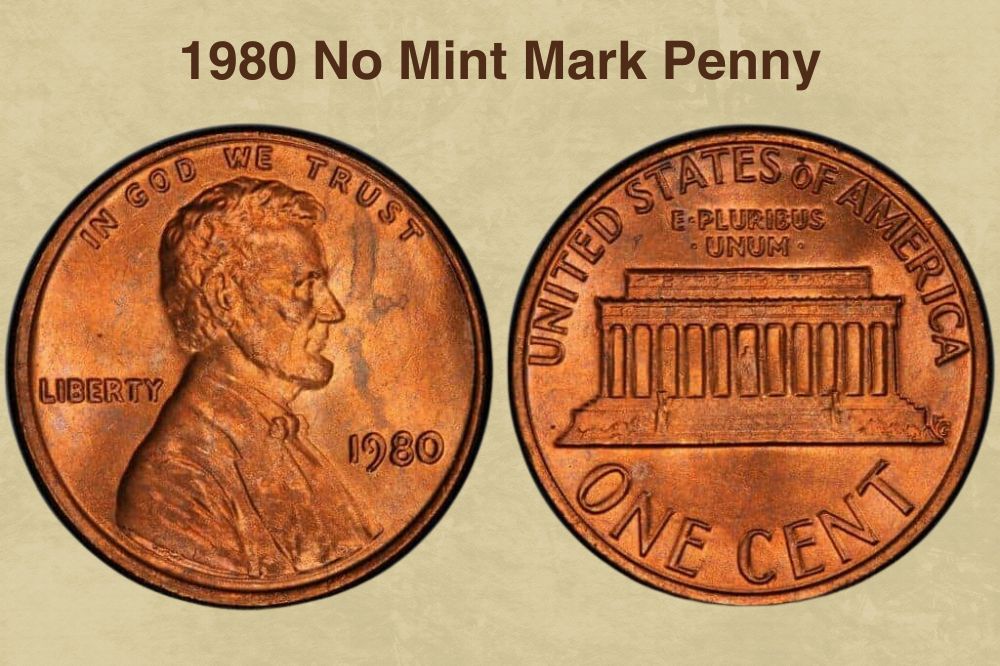
1980 No Mint Mark Penny (RD)
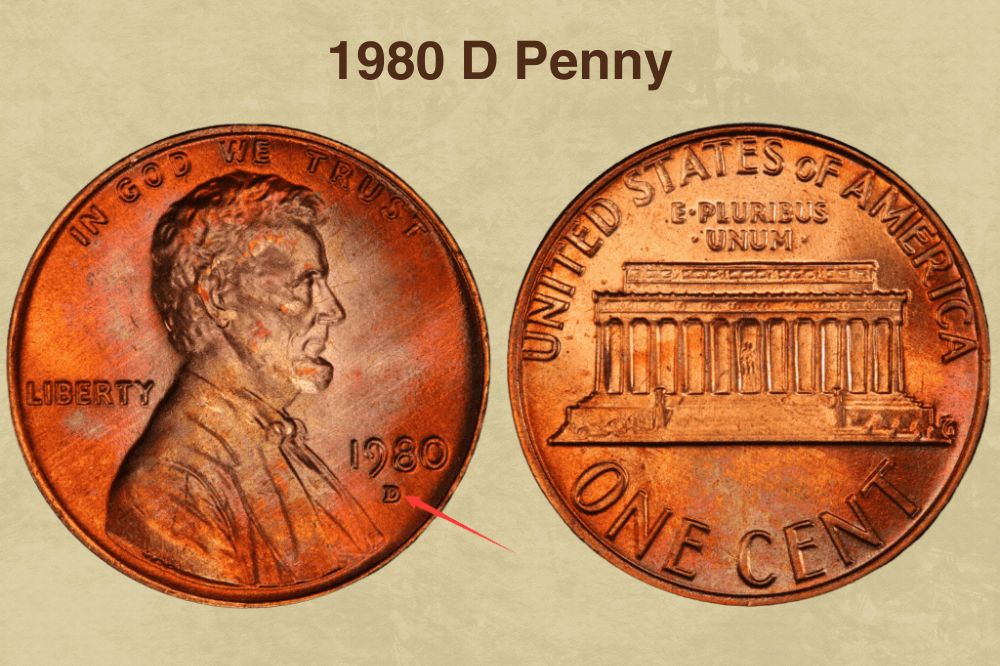
1980-D Penny (RD)
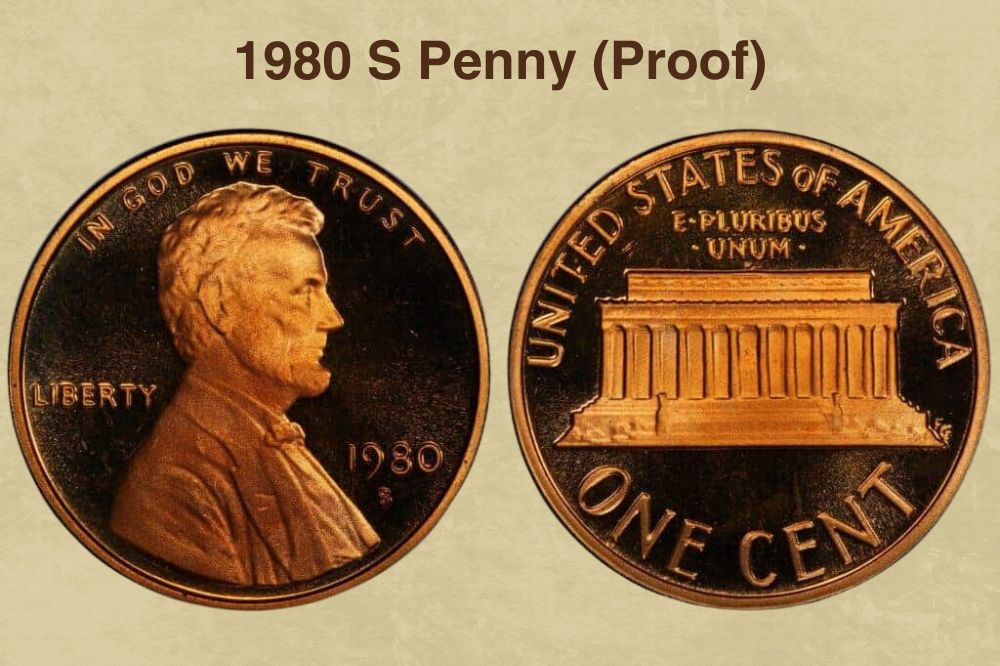
1980-S DCAM Penny
Use our Coin Identifier and Value App to instantly check the rarity ranking of any Lincoln penny in your collection and see how it compares to other dates in the series.
Key Features That Shape 1980 Penny Value
The Lincoln penny has gone through several design and composition changes since 1909, but coins minted in 1980 belong to the Lincoln Memorial series that ran from 1959 to 2008. Understanding the coin’s physical features helps you identify exactly what you have — and what it might be worth.
One critical factor specific to copper coins like the 1980 penny is color designation. Professional grading services like PCGS (Professional Coin Grading Service) and NGC (Numismatic Guaranty Company) assign one of three color grades to copper cents: Red (RD), Red-Brown (RB), or Brown (BN). Red coins retain nearly all of their original mint-orange luster and command the highest premiums, while Brown coins have toned naturally over time and are the most common and least expensive grade.
The Obverse of the 1980 Penny
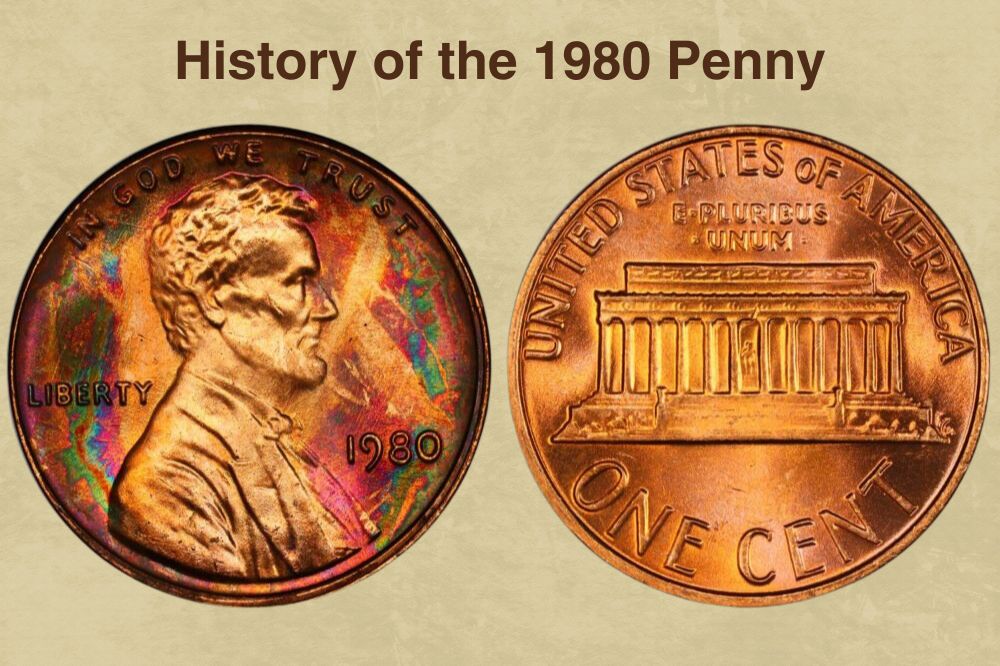
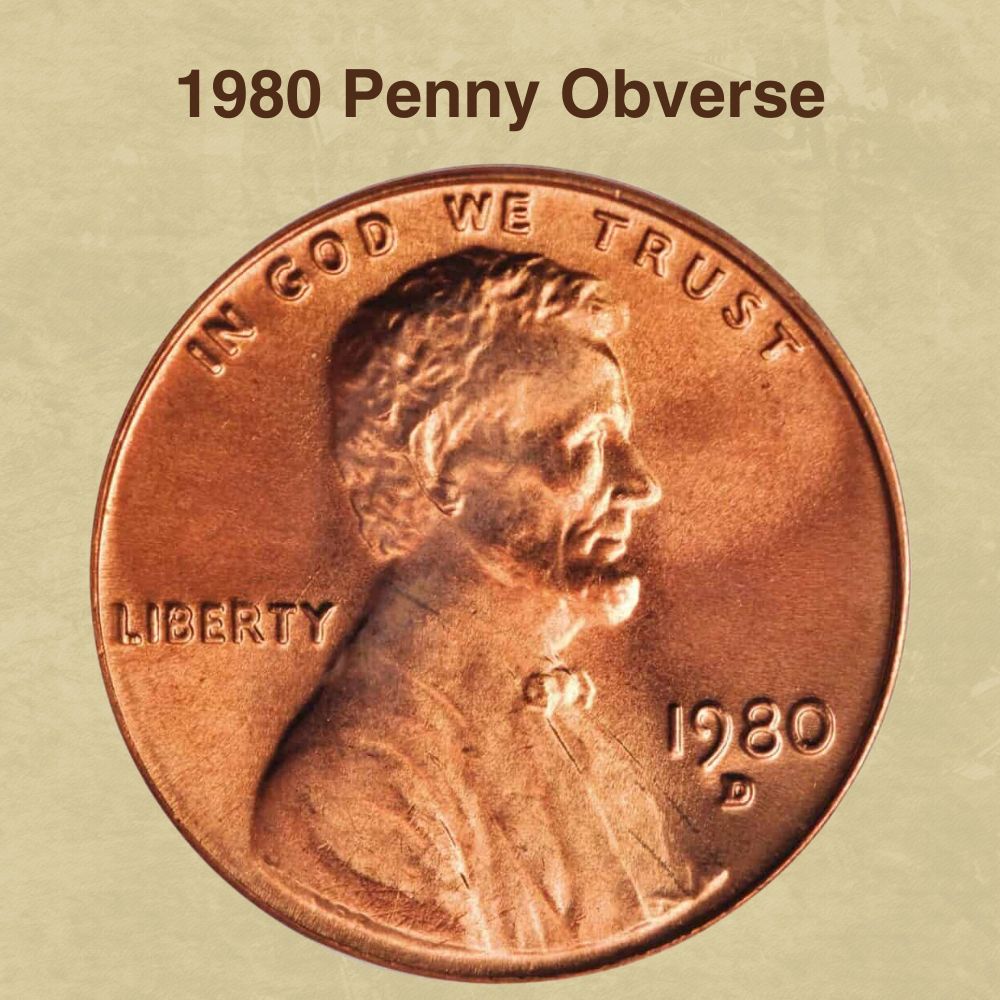
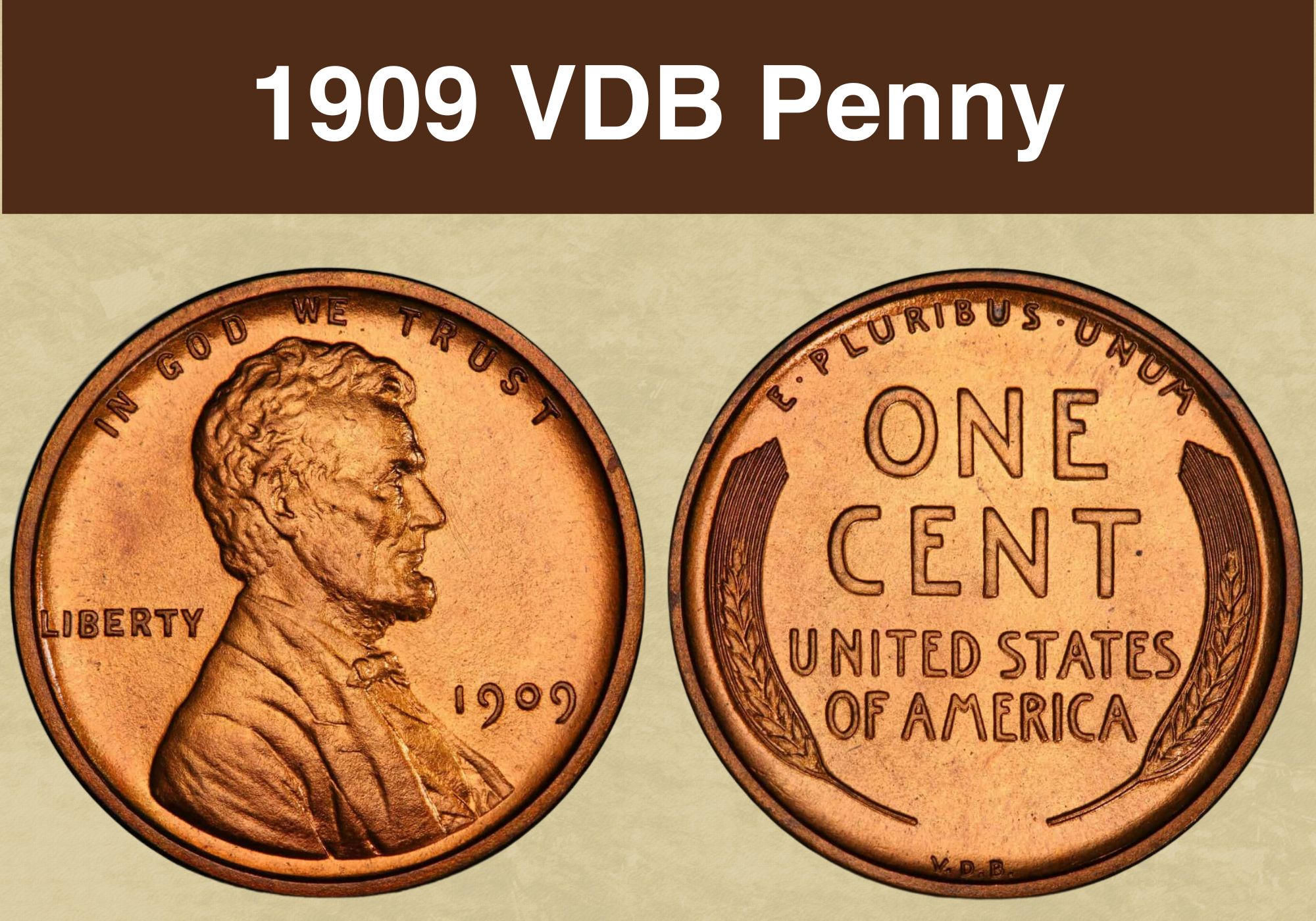
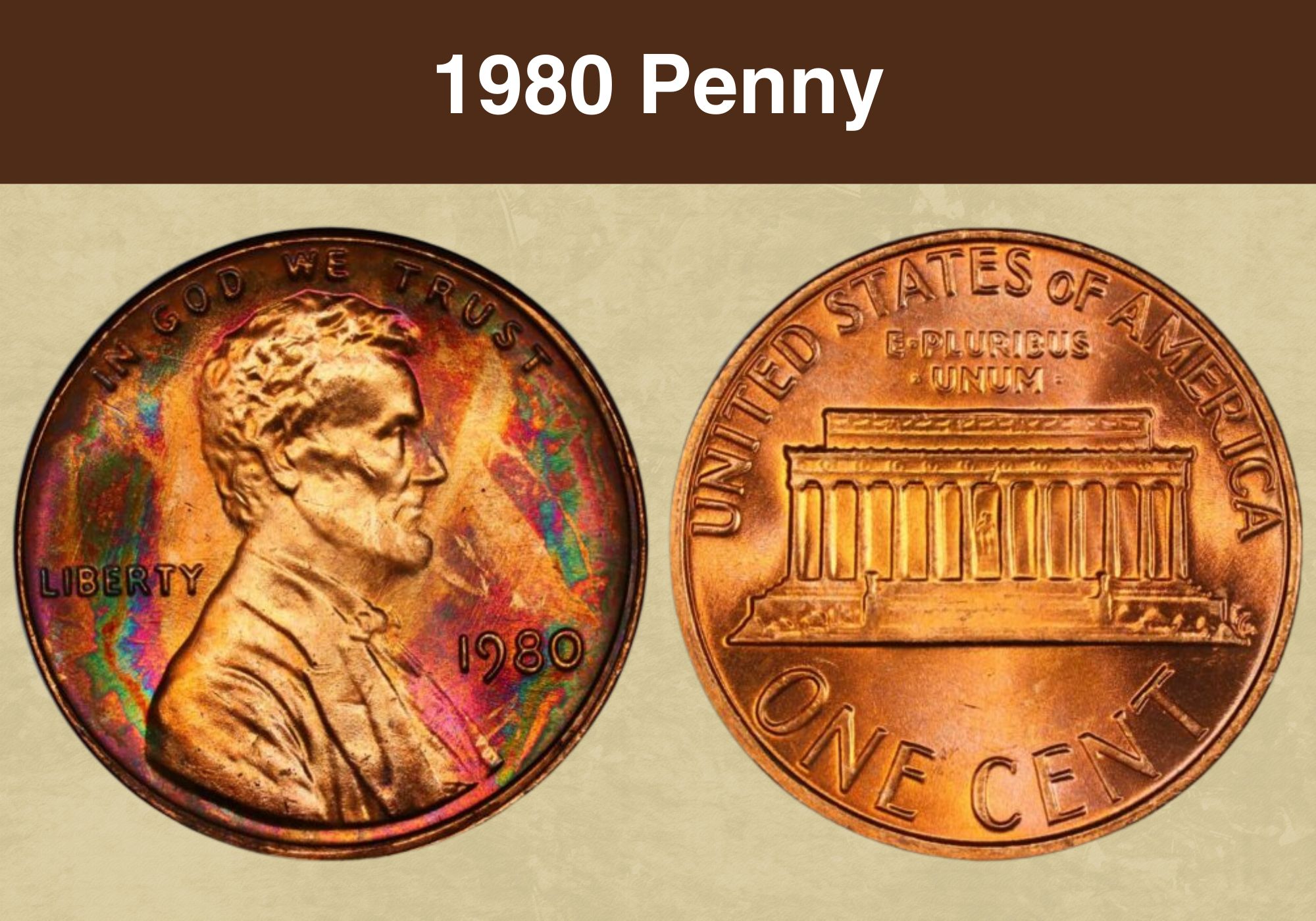
The obverse (front side) of the 1980 penny features Abraham Lincoln’s right-facing profile portrait, a design created by sculptor Victor David Brenner and first introduced in 1909 — making 1980 coins part of an unbroken design tradition spanning over seven decades. This portrait is the longest-running portrait on any circulating U.S. coin in history.
Along the top rim sits the national motto IN GOD WE TRUST, while the word LIBERTY appears to Lincoln’s right. The date 1980 is stamped at the lower right, and any mint mark appears just below the date. Brenner’s famous tiny initials, VDB, are engraved at the base of Lincoln’s shoulder — reinstated in small form in 1918 after being removed due to public controversy in 1909.
The Reverse of the 1980 Penny
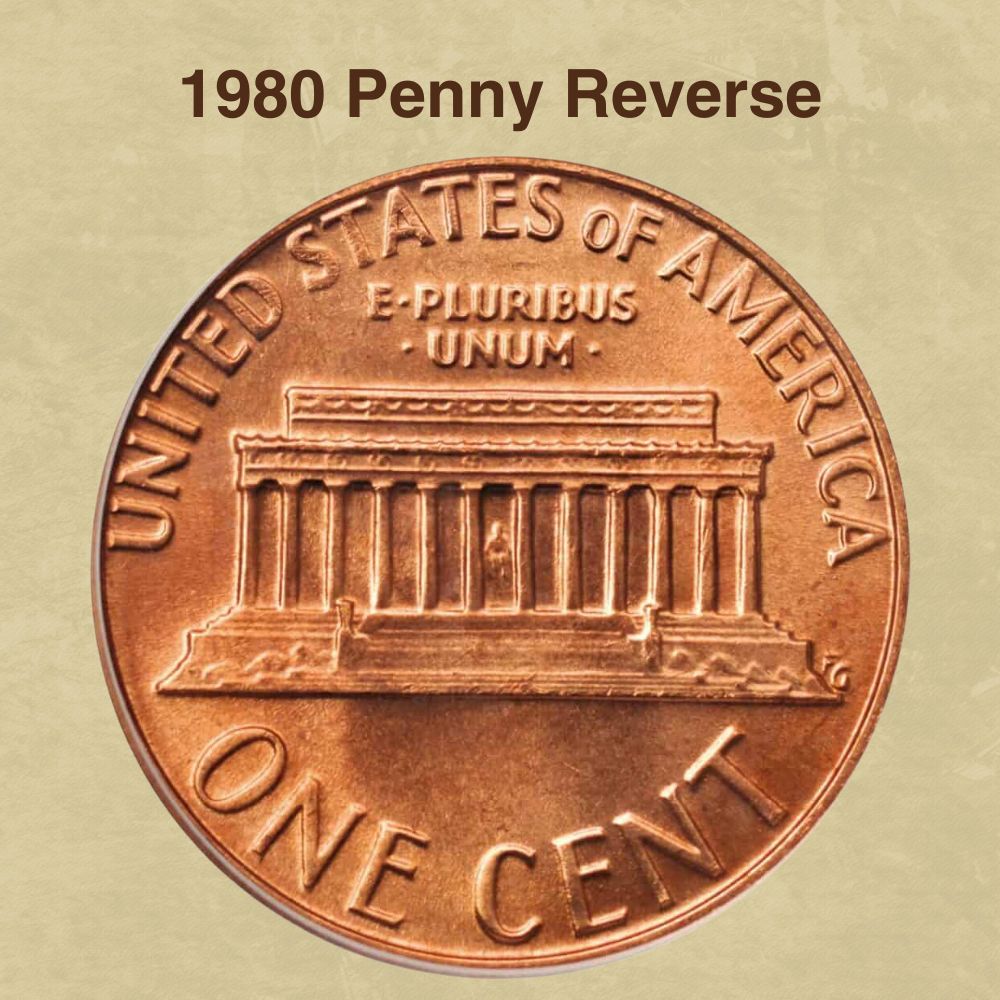
The reverse (back side) of the 1980 penny displays the Lincoln Memorial in Washington, D.C., a design Frank Gasparro created in 1959 to commemorate the 150th anniversary of Lincoln’s birth. If you look closely at the center of the Memorial building between the columns, you can actually spot a tiny representation of Lincoln’s seated statue.
Curving along the top rim is UNITED STATES OF AMERICA, with the Latin motto E PLURIBUS UNUM (“Out of many, one”) above the Memorial’s roof. The denomination ONE CENT appears at the lower center, and Gasparro’s initials FG are tucked neatly at the lower right corner of the building.
Other Physical Features of the 1980 Penny
The 1980 penny is a round coin with a plain (smooth) edge and a diameter of 0.750 inches (19.05 mm). It weighs 3.11 grams — a key fact for error-coin hunters, because any 1980 penny that weighs significantly less may have been struck on a planchet (blank disc) meant for another denomination.
The composition is 95% copper and 5% zinc, giving the coin its distinctive reddish-copper color. The thickness measures 0.0598 inches (1.52 mm), and the total copper content is worth roughly 2 to 3 cents at current metal prices — though melting U.S. pennies has been illegal under federal regulations since 2006.
Also Read: 100 Most Valuable Wheat Pennies Worth Money (1909 to 1958)
1980 Penny Value: Mintage and Survival Data
1980 Penny Mintage & Survival Chart
Survival Distribution
| Type | Mintage | Survival | Survival Rate |
|---|---|---|---|
| No Mint | 7,414,705,000 | 1,482,941,000 | 20% |
| D | 5,140,098,660 | 1,028,019,732 | 20% |
| S DCAM | 3,554,806 | 2,870,505 | 80.75% |
The survival patterns for 1980 pennies tell a fascinating two-part story: mass-produced circulation coins vs. carefully preserved proof specimens. Philadelphia produced 7.4 billion coins and Denver minted 5.1 billion pieces, yet both show identical survival rates of around 20% in collectible condition.
The contrast with San Francisco is dramatic. Only 3.55 million proof coins were struck there, but roughly 80% remain in Deep Cameo condition because collectors stored them carefully from the moment they were issued. Circulation coins, by contrast, suffered decades of wear in pockets and piggy banks, plus copper-hoarding that removed millions from the numismatic supply.
According to PCGS CoinFacts, examples up to MS66 grade are easily obtainable for both Philadelphia and Denver issues. The key insight for collectors: MS67 Philadelphia pennies are scarce, and anything grading MS68 or higher is genuinely rare — making the sole known MS68 Lincoln cent from 1980 a true condition-census trophy valued at approximately $8,000.
These survival patterns directly shape strategy for collectors. If you’re building a high-grade set on a budget, look for MS65 or MS66 Red examples, which offer excellent strike quality and original luster without the steep premium of MS67 and above.
Also Read: 100 Most Valuable Indian Head Penny Coins Worth Money (1859 – 1909)
The Easy Way to Know Your 1980 Penny Value
Start your assessment by identifying the mint mark: no mark means Philadelphia, “D” means Denver, and “S” means San Francisco — with S-mint proof coins always carrying the highest base premium. Then examine the coin under good light, looking for original copper-red luster rather than brown or mottled toning.

Coin Identifier and Value App
Not sure what your coins are worth? Get Instant Value • Grade • Error Detection with coin identifier and value app (FREE Usage Daily)
Next, check for any signs of doubling on the date or the word LIBERTY — these are hallmarks of the valuable DDO (Doubled Die Obverse) variety. Also weigh the coin with a digital scale: a genuine 1980 penny should register 3.11 grams; anything lighter could signal a rare wrong-planchet error worth hundreds or thousands of dollars.
Scan your penny with the Coin Identifier and Value App for automated variety detection, professional grading analysis, and up-to-date marketplace values.

1980 Penny Value Guides
The 1980 penny was produced at three different U.S. Mint facilities, each creating distinct varieties with unique characteristics and values.
- 1980 No Mint Mark Penny — Philadelphia Mint
- 1980-D Penny — Denver Mint
- 1980-S DCAM Penny — San Francisco Mint (proof coins only)
Philadelphia produced the highest-mintage no-mint-mark version and Denver struck circulation coins with the “D” designation, while San Francisco created limited proof coins exclusively for collectors using specially prepared, mirror-finish dies. Each type offers a different collecting experience and distinct value potential based on condition, color grade, and rarity.
Also Read: Value Of Old Pennies By Year (1959-Present)
1980 Penny Value: No Mint Mark (Philadelphia)
The 1980 No Mint Mark Penny, produced at the Philadelphia Mint, is one of the most abundant Lincoln cents ever struck — yet it remains appealing to collectors because of its copper composition and color-grade potential. With over 7.4 billion struck, these coins are composed of 95% copper and 5% zinc, placing them among the final full-copper pennies before the 1982 formula change.
Professional grading services PCGS and NGC classify these copper coins by color. Red (RD) coins retain full original copper luster with no oxidation and command the highest prices. Red-Brown (RB) examples show partial original color mixed with natural toning, offering a middle-ground option. Brown (BN) coins have fully toned over the decades and carry the lowest premiums — though a Brown MS67 still sold for a notable $1,840 at Bowers & Merena in 2003.
According to PCGS CoinFacts, examples up through MS66 Red are easy to locate. At MS67, the coin becomes scarce, and anything grading higher than MS67 is considered genuinely rare. The auction record stands at $2,233 for an MS67+ Red example sold by Heritage Auctions in January 2017.
1980 No Mint Mark Penny (RD) Price/Grade Chart
Price by 1-70 Grade (Latest Auction Records Included)
Let’s examine the auction records that reveal the true market performance of these Philadelphia-minted pennies.
| Date | Platform | Price | Grade |
|---|
Current market activity shows strong collector demand for high-grade examples in superior conditions.
Market activity: 1980 No Mint Mark Penny
1980-D Penny Value: Denver Mint Edition
The 1980-D Penny, struck at the Denver Mint, carries the small “D” mint mark just below the date on the obverse. With a mintage of 5,140,098,660 coins, it is one of the highest-production Denver issues in Lincoln cent history, yet top-condition examples have proven extremely difficult to locate.
Like their Philadelphia counterparts, 1980-D pennies are graded using the Red (RD), Red-Brown (RB), and Brown (BN) color designations, with Red examples fetching the strongest prices. PCGS notes that while MS65 and below specimens are very easy to obtain, coins at MS66 begin to be scarce, and MS67 examples are very difficult to locate — making anything grading above MS67 very hard to find and potentially very expensive.
In a stunning result at Heritage Auctions on August 31, 2025, a 1980-D Lincoln cent graded MS64 Red sold for $18,000, setting a new auction record for this variety. Earlier records include an MS67 Red example that realized $1,093 at Heritage Auctions in September 2007, along with a Red-Brown NGC Genuine-grade specimen that brought $290 on eBay in January 2019.
1980-D Penny (RD) Price/Grade Chart
Price by 1-70 Grade (Latest Auction Records Included)
Historical auction data reveals the premium collectors place on superior-condition Denver-minted examples.
| Date | Platform | Price | Grade |
|---|
Market activity reflects regular trading patterns for this Denver variety across various grade levels.
Market activity: 1980-D Penny
1980-S DCAM Penny Value: San Francisco Proof Edition
The 1980-S DCAM Penny is the crown jewel of the 1980 Lincoln cent series, produced exclusively at the San Francisco Mint as a special collector coin. “DCAM” stands for Deep Cameo — a designation reserved for proof coins with the strongest possible contrast between the frosted, raised design elements and the mirror-polished flat fields, creating a striking three-dimensional visual effect.
With only 3,554,806 proof specimens struck, these coins were sold in annual proof sets and never entered circulation. Their production involved specially prepared dies that were polished to a mirror finish, and the coins were individually struck multiple times at slower speeds to achieve their superior surface quality. No circulation-strike 1980 penny can match this level of visual perfection.
The auction record for the 1980-S DCAM is $3,680 for a PR70 example sold at Heritage Auctions in January 2003, where PR70 (Proof 70) represents absolute numismatic perfection — no post-production imperfections visible even under 5x magnification. A second PR70 DCAM from the Thomas Cleveland collection also brought $2,195 on eBay in September 2022. The San Francisco “S” mint mark used on these coins followed the style introduced in late 1979, replacing the earlier “Filled S” design.
1980-S DCAM Penny Price/Grade Chart
Price by 1-70 Grade (Latest Auction Records Included)
Auction records demonstrate the significant premiums collectors are willing to pay for these pristine proof specimens.
| Date | Platform | Price | Grade |
|---|
Trading patterns show active collector participation in this premium San Francisco proof variety.
Market activity: 1980-S DCAM Penny
Also Read: Top 100 Most Valuable Modern Pennies Worth Money (1959 – Present)
Rare 1980 Penny Value Errors: Complete List
While the vast majority of 1980 pennies are common circulation coins, a small number were affected by minting mistakes that can multiply their value dramatically. Error coins are produced by mechanical failures or human oversight during the minting process, and collectors prize them for their uniqueness.
Before we list them, here is a quick tip: always weigh a suspected error coin on a digital scale accurate to 0.01 grams. A standard 1980 penny should weigh exactly 3.11 grams — any coin that is significantly lighter or heavier deserves a closer look and professional authentication.
1. 1980 Doubled Die Obverse (DDO)
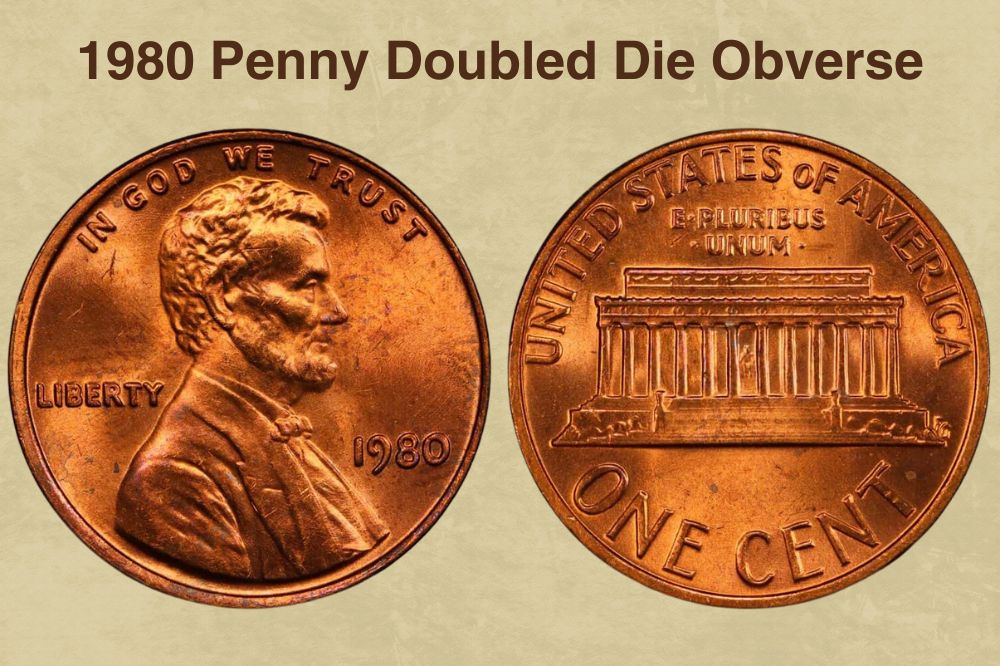
The Doubled Die Obverse (DDO) error occurs during the die-making process, when the working die receives a second, slightly misaligned impression from the master hub. The result is a coin where obverse design elements — including the date, the word LIBERTY, and sometimes the motto IN GOD WE TRUST — appear doubled, as if you’re seeing a faint shadow alongside the main design.
Most 1980 DDO pennies show subtle doubling that is only obvious under magnification, making them primarily of interest to specialist variety collectors. Key identifiers include thicker-than-normal date numerals and a heavier, bolder appearance on the letters in LIBERTY. Values range from $35 to $250 in circulated condition, with high-grade examples reaching further: a Red-Brown MS65 example sold for $715 at Great Collections in May 2014, and a Red MS65 brought $500 on eBay in August 2018.
1980 Doubled Die Obverse Penny (RD) Price/Grade Chart
Price by 1-70 Grade (Latest Auction Records Included)
2. 1980 DDO FS-101 Variety
The FS-101 designation identifies the most significant and visually accessible doubled die variety in the entire 1980 penny series. “FS” stands for Fivaz-Stanton, the numbering system used in the Cherrypickers’ Guide to Rare Die Varieties — the definitive reference publication for variety collectors.
What makes FS-101 special is that its doubling is strong enough to see without any magnification tools. The date numerals appear distinctly thicker and bolder than normal, and the letters in LIBERTY show a clear, shelf-like separation. This accessibility makes it an ideal starting point for beginners who want to try their hand at variety collecting. While not as famous as the 1972, 1983, 1984, or 1995 doubled dies, the 1980 FS-101 commands a solid $350 in MS63 condition, making it a worthwhile find.
1980 DDO FS-101 Penny (RD) Price/Grade Chart
Price by 1-70 Grade (Latest Auction Records Included)
3. 1980-D Repunched Mint Mark (RPM)
The Repunched Mint Mark (RPM) is an error exclusive to branch-mint coins from the era before 1989, when U.S. Mint workers hand-punched the mint mark letter onto each individual working die. If the first punch wasn’t positioned correctly or deeply enough, workers would punch again — sometimes at a slightly different angle — creating a faint “shadow” of a second letter alongside the primary mint mark.

Coin Identifier and Value App
Not sure what your coins are worth? Get Instant Value • Grade • Error Detection with coin identifier and value app (FREE Usage Daily)
Multiple RPM varieties are documented for 1980-D pennies. The most common patterns show the secondary “D” shifted north, south, or at a slight tilt relative to the primary mark — visible under 10x magnification as a doubled outline or extra serif lines on the letter. In circulated condition, 1980-D RPM varieties typically sell for $3 to $10; prominent MS65 Red examples with clearly visible secondary marks can reach $30 to $50. To locate the mint mark, look just below the date on the obverse — and compare your find to cataloged RPM reference images at varietyvista.com or through CONECA databases for proper attribution.
4. 1980 Wrong Planchet Error (Struck on Dime Planchet)
One of the most dramatic 1980 penny errors involves a coin that was accidentally struck on a planchet (the blank metal disc) intended for a Roosevelt dime rather than a Lincoln cent. This happens when planchet hoppers at the Mint are mixed, sending a dime blank into the penny press.
The result is immediately distinctive: the coin appears silver-white rather than copper-red, measures 17.9 mm in diameter instead of the normal 19 mm, and weighs approximately 2.27 grams instead of the standard 3.11 grams. A digital scale is your best first diagnostic tool. These wrong-planchet errors are worth $100 to $2,500 depending on condition and the quality of PCGS or NGC certification — and counterfeits exist, so professional authentication is essential before purchase or sale.
5. 1980 Off-Center Strike Error
An off-center strike occurs when the planchet is not properly seated in the collar ring before the dies come down, causing part of the design to miss and leaving a crescent-shaped blank area on the coin’s edge. The higher the percentage of off-center displacement, the more dramatic — and potentially more valuable — the error becomes.
A 1980 penny with a minor 5–10% off-center strike is fairly common and sells for $5 to $25. Examples that are 50% or more off-center while still showing the full date and mint mark are rare, fetching $75 to $150 or more. The most spectacular off-center strikes — showing 75% or more blank area — can command $200 to $500 at specialist auction houses like Heritage Auctions or Stack’s Bowers.
Also Read: 42 Rare Penny Errors List with Pictures (By Year)
Maximize Your 1980 Penny Value: Best Places to Sell
Armed with knowledge about your coin’s true value, the next step is finding the right marketplace to maximize your return. I’ve evaluated the leading coin selling platforms, detailing their unique features, seller advantages, and potential drawbacks to help you choose the right marketplace.
Check out now: Best Places To Sell Coins Online (Pros & Cons)
1980 Penny Value Market Trend
Market Interest Trend Chart - 1980 Penny
*Market Trend Chart showing the number of people paying attention to this coin.
FAQ About the 1980 Penny Value
1. What makes a 1980 penny rare and more valuable than face value?
Most 1980 pennies in average circulated condition are worth only 2 to 3 cents based on their copper content — not much more than face value. The exceptions are coins with minting errors such as Doubled Die Obverse varieties, coins struck on wrong planchets, and dramatic off-center strikes, plus any examples graded MS67 Red or higher by PCGS or NGC, where scarcity in top condition drives prices into the hundreds of dollars.
2. What are the highest recorded auction prices for a 1980 penny?
The most expensive 1980 pennies ever sold include:
- 1980-D Red penny in MS64 grade — $18,000 at Heritage Auctions, August 2025
- 1980-S DCAM penny in PR70 grade — $3,680 at Heritage Auctions, January 2003
- 1980 Red penny in MS67+ grade — $2,233 at Heritage Auctions, January 2017
- 1980-S DCAM penny (Thomas Cleveland pedigree) in PR70 grade — $2,195 on eBay, September 2022
- 1980-S DCAM penny in PR70 grade — $2,040 at Stack’s Bowers, 2021
- 1980 Brown penny in MS63 grade — $1,840 at Bowers & Merena, July 2003
- 1980-D Red penny in MS67 grade — $1,093 at Heritage Auctions, September 2007
- 1980 Red-Brown DDO penny in MS65 grade — $715 at Great Collections, May 2014
- 1980 Red DDO penny in MS65 grade — $500 on eBay, August 2018
- 1980 Red penny in MS65 grade — $358 at Great Collections, August 2013
3. How much is a regular 1980 penny with no mint mark worth?
A worn 1980 no-mint-mark penny in circulated condition is worth about 2 to 3 cents for its copper content. Uncirculated examples grade between 10 and 30 cents each. Certified MS65 Red examples sell for approximately $12 to $15, MS66 Red coins bring $25 to $50, and MS67 Red specimens can reach $100 to $160 or more depending on eye appeal.
4. What do the color grades Red, Red-Brown, and Brown mean for my 1980 penny — and which is most valuable?
Copper coins like the 1980 penny are assigned a color grade by grading services based on how much original mint luster they retain. Red (RD) means the coin has kept 95% or more of its original copper-orange color — the rarest and most valuable designation. Red-Brown (RB) indicates the coin retains between 5% and 95% original red color alongside natural toning — a middle-ground option. Brown (BN) means the coin has fully toned to a chocolate-brown color from natural oxidation — common and the least expensive. At the MS67 grade, a Red example can be worth five to ten times more than a Brown coin of the same date and grade.
5. What is the Repunched Mint Mark error on a 1980-D penny, and what is it worth?
The Repunched Mint Mark (RPM) is a variety that existed on Denver-minted pennies before the U.S. Mint changed its production process in 1989. Before that year, mint mark letters were individually hand-stamped onto each working die, and if the first punch was misaligned, workers would re-punch — sometimes at a slightly different position. On a 1980-D RPM, you can see traces of a secondary “D” above, below, or tilted relative to the main mark when viewed under 10x magnification. Values range from $3 to $10 in circulated grades, while strong MS65 Red examples with clearly visible doubling can bring $30 to $50.
6. Can I melt my 1980 penny for its copper value?
No — melting U.S. pennies is currently illegal under federal regulations that the U.S. Mint put in place in 2006. Those rules specifically forbid melting or exporting pennies and nickels to recover their metal value, in order to protect the supply of circulating coinage. Each 1980 penny contains approximately 2 to 3 cents worth of copper at today’s metal prices, so the melt value already exceeds face value — but cashing in on that difference is not legally permitted. Many collectors choose to save pre-1982 copper pennies as a speculative store of value, hoping the regulations may one day change.
7. How do I spot a genuine 1980 Doubled Die Obverse penny?
Use a 10x magnifying loupe and look first at the date “1980” and the word “LIBERTY” — on a genuine DDO, these elements will show a clear, raised second image slightly offset from the primary impression, like a shadow or shelf. True doubled-die doubling appears raised and rounded, not flat or mushy (flat doubling is usually “machine doubling,” a common die-wear effect with no collector premium). The FS-101 variety is strong enough to detect with the naked eye. Also check IN GOD WE TRUST for extra thickness on the lettering, and compare your coin to reference images in the Cherrypickers’ Guide to Rare Die Varieties.
8. What is a 1980 penny struck on a dime planchet worth, and how do I identify one?
A 1980 penny struck on a dime planchet is one of the most dramatic — and valuable — error coins in the series. The coin will appear silver-white rather than copper-red, will measure roughly 17.9 mm in diameter (smaller than the standard 19 mm), and will weigh approximately 2.27 grams instead of the normal 3.11 grams. Values range from $100 to $2,500 depending on strike quality and the grade assigned by a certified service like PCGS or NGC. Professional authentication is essential, as these errors attract counterfeiters — never clean or alter a suspected wrong-planchet coin before having it examined.
9. How does PCGS or NGC certification affect my 1980 penny’s value?
Submitting a coin to PCGS (Professional Coin Grading Service, established 1986) or NGC (Numismatic Guaranty Company, established 1987) for third-party grading and encapsulation in a tamper-evident “slab” can significantly increase both the credibility and the market value of a 1980 penny. A certified MS67 Red 1980 penny commands far more at auction than an ungraded example of the same apparent quality, because buyers trust the standardized grade and the tamper-proof holder. The PCGS and NGC population reports — which track how many coins of each date and grade exist — are invaluable tools for understanding just how rare your specific coin is relative to the market.
10. What are the most valuable Lincoln pennies of all time?
The all-time record holders for Lincoln cent auction prices are:
- 1943-D Bronze Wheat reverse cent (Brown) in MS64 grade — $840,000
- 1943-S Bronze Wheat reverse cent (Brown) in MS63 grade — $504,000
- 1944-S Steel Wheat reverse cent in MS66 grade — $408,000
These extraordinary prices reflect the wartime composition errors of 1943 and 1944, when the Mint accidentally struck pennies on the wrong metal planchets during World War II material transitions — making them among the rarest and most coveted coins in all of American numismatics.