1974 Penny Value Checker: Errors List, “D”, “S” & No Mint Mark Worth

1974 Penny

1974 Penny value ranges from $0.01 face value to $2,938. That record was set by a Grade 67 example sold through Stack’s Bowers in January 2013. Upload a photo of yours below and we’ll give you a quick value range. You can also scroll down to check recent eBay sales and see what collectors are paying today.

1974 Penny Value Checker

Identify 1974 Penny D, S and No Mint Mark Price

✨ No Sign-up Required
Obv

Front Obverse

Upload or Take a Photo

Rev

Back Reverse

Upload or Take a Photo


1974 Penny Value By Variety

Here’s the quick-reference chart. If you already know your coin’s grade, jump down to the **Value Guides** section for exact pricing.

TypeGood(G4-6)Fine(F12-15)AU(AU50-58)MS(MS60-70)PR(PR60-70)
1974 No Mint Mark Penny Value (RD)$0.35 - $0.40$0.60 - $0.70$1 - $2$3 - $5,980
1974 D Penny Value (RD)$0.20 - $0.25$0.40 - $0.45$1$1 - $4,600
1974 S Penny Value (RD)$0.35 - $0.40$0.60 - $0.70$1 - $2$3 - $500
1974 S CAM Penny Value$1 - $23
1974 S DCAM Penny Value$3 - $9,200
1974 No Mint Mark Penny Value (RD) — eBay market data
Price trend
View:
Recent eBay sales
Filter:
Sort:
Loading eBay data...
1974 D Penny Value (RD) — eBay market data
Price trend
View:
Recent eBay sales
Filter:
Sort:
Loading eBay data...
1974 S Penny Value (RD) — eBay market data
Price trend
View:
Recent eBay sales
Filter:
Sort:
Loading eBay data...
1974 S CAM Penny Value — eBay market data
Price trend
View:
Recent eBay sales
Filter:
Sort:
Loading eBay data...
1974 S DCAM Penny Value — eBay market data
Price trend
View:
Recent eBay sales
Filter:
Sort:
Loading eBay data...
Get more accurate values with AI grading
Our app identifies errors, varieties & exact grades that web can't — free download
Get the App

Also Read: Top 100 Most Valuable Modern Pennies Worth Money (1959 – Present)


Top 10 Most Valuable 1974 Penny Value Results Worth Money

Most Valuable 1974 Penny Chart

2003 - Present

The coin sitting at #1 is a 1974 No Mint Mark penny graded MS67+RD. It hammered for $2,938 at Stack’s Bowers in January 2013. That’s nearly three grand for a coin most people wouldn’t bother picking up off the sidewalk.

Business strikes own the top spots. The 1974-S RD 67 leads at $999, the Philadelphia no-mint-mark follows at $800, and a 1974-D RD 67 brought $477. Proof Deep Cameos show up throughout the list but don’t dominate it—1974-S DCAM examples range from $37 to $94, which makes them a solid entry point if you’re just getting started.

The takeaway for cherrypickers: a single grade point at the top of the scale can mean hundreds of dollars. That’s why storage and handling matter so much with these.

Also Read: Lincoln Wheat Penny Value (1909-1958)


1974 Penny Value: History and the Aluminum Cent Experiment

Nixon resigned. Gerald Ford stepped in. And the U.S. Mint was quietly dealing with its own crisis—copper prices had climbed steadily from 1971 to 1974, hitting nearly 86 cents per pound. Making pennies was becoming a money-losing proposition.

The Mint’s answer was bold: ditch copper entirely. Working behind closed doors, they started striking aluminum test pennies in late 1973 using 1974-dated dies.

Approximately 1.5 million of these aluminum test cents were struck at Philadelphia. They were 96% aluminum with trace elements for stability—not pure aluminum—and weighed only 0.93 grams. A standard copper cent weighs 3.11 grams. You’d notice the difference instantly.

To win congressional support, Mint officials handed sample coins to members of the House Banking and Currency Committee and the Senate Banking, Housing, and Urban Affairs Committee—nine congressmen and four senators total. Mint Director Mary Brooks also gave specimens to Treasury officials.

Opposition came from everywhere. Vending machine companies said the lighter coins would jam their equipment. Pediatric radiologists warned that swallowed aluminum pennies would be nearly invisible on X-rays because aluminum’s radiodensity is close to soft tissue. The copper industry lobbied hard against anything that would cut demand for their product.

On March 27, 1974, Congress reviewed the aluminum cent in the Consumer Affairs subcommittee of the House of Representatives. They rejected it. On October 11, 1974, Congress authorized the Treasury Secretary to reduce—but not eliminate—copper content in cents.

By year’s end, copper prices had dropped enough to keep the bronze alloy workable. The Mint ordered all test coins recalled and melted. Most were destroyed. A handful quietly survived in private hands.

The composition question came back in 1982, when the cent switched to copper-plated zinc (99.2% zinc, 0.8% copper). But in 1974, bronze held on—and those surviving aluminum cents became some of the most fascinating and legally complicated coins in U.S. numismatic history.

Also Read: Top 100 Rarest Pennies Worth Money (1787 – Present)


1974 Penny Value Rarity: Is Your Coin Actually Rare?

10

1974 No Mint Mark Penny (RD)

Common
Ranked 973 in Lincoln Cent (Modern)
10

1974-D Penny (RD)

Common
Ranked 979 in Lincoln Cent (Modern)
10

1974-S Penny (RD)

Common
Ranked 1029 in Lincoln Cent (Modern)
11

1974-S CAM Penny

Common
Ranked 913 in Lincoln Cent (Modern)
10

1974-S DCAM Penny

Common
Ranked 959 in Lincoln Cent (Modern)

To verify your coin’s specific condition and check for any valuable error varieties that might increase its worth, try our Coin Identifier and Value App for detailed authentication and current market pricing.


Key Features That Affect 1974 Penny Value

The 1974 Lincoln penny is one of the last years in the traditional bronze composition before the eventual switch to zinc-core planchets. It carries the classic Lincoln Memorial reverse that defined American pocket change for decades.

Here’s what to look for when you’re evaluating one.

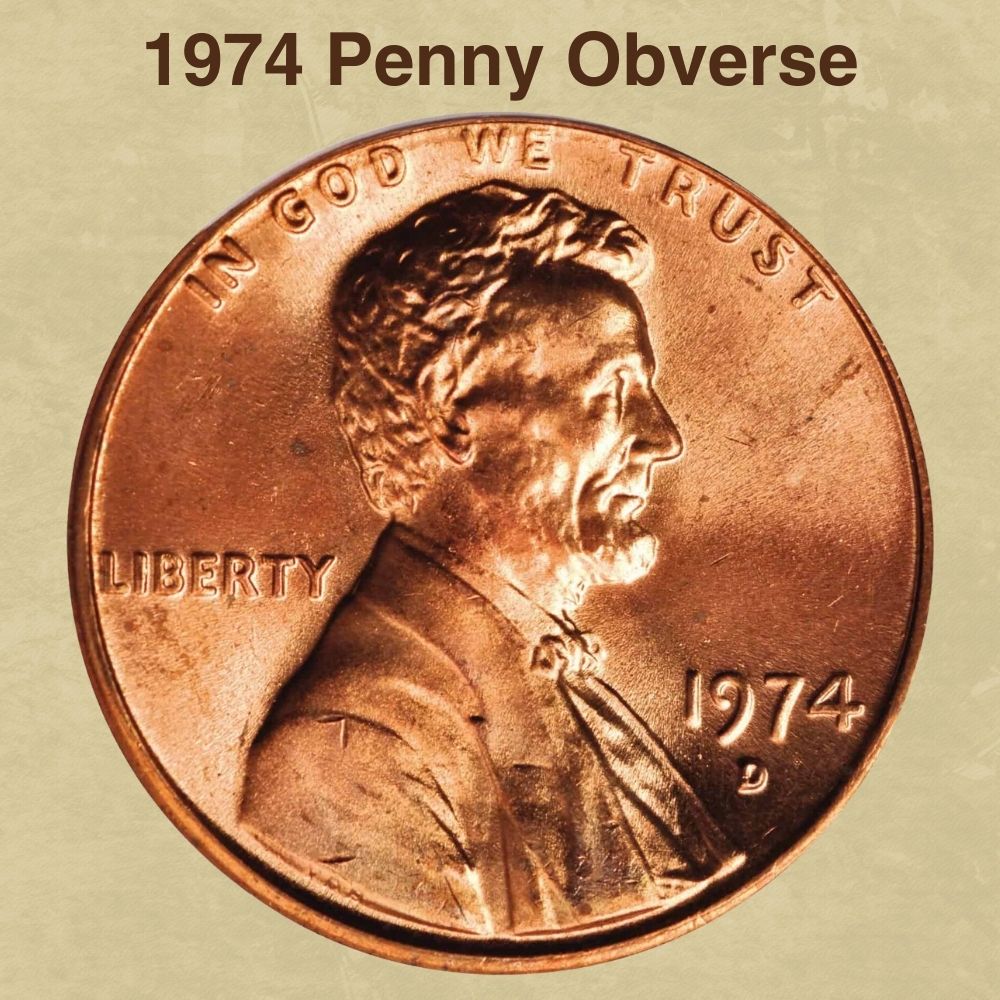
The Obverse Of The 1974 Penny

The Obverse Of The 1974 Penny

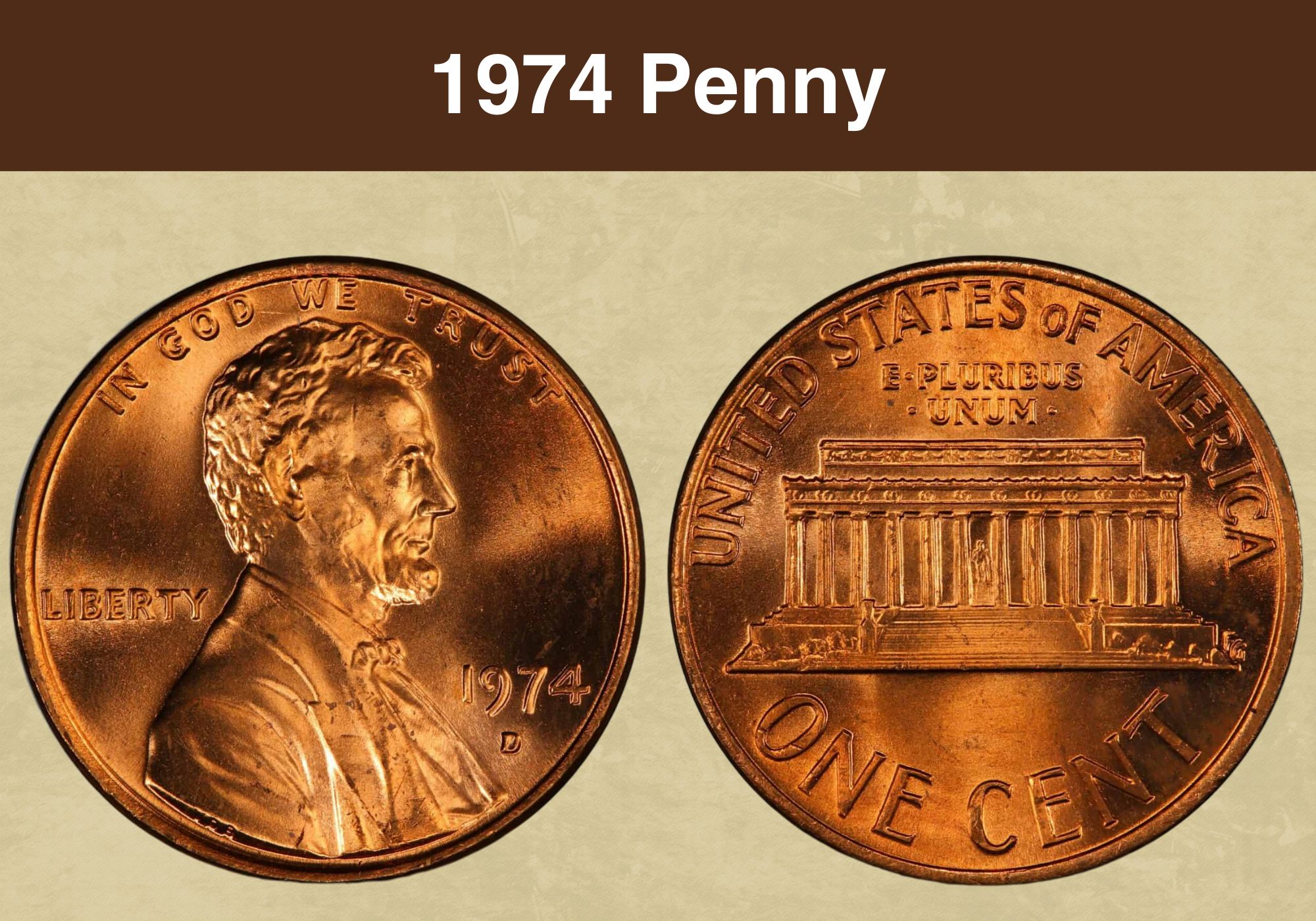
The front shows Abraham Lincoln’s right-facing portrait—the same Victor David Brenner design used since 1909, based on a Mathew Brady photograph from the Civil War era.

“LIBERTY” runs along the left side. The date “1974” sits on the right. “IN GOD WE TRUST” arcs above Lincoln’s head.

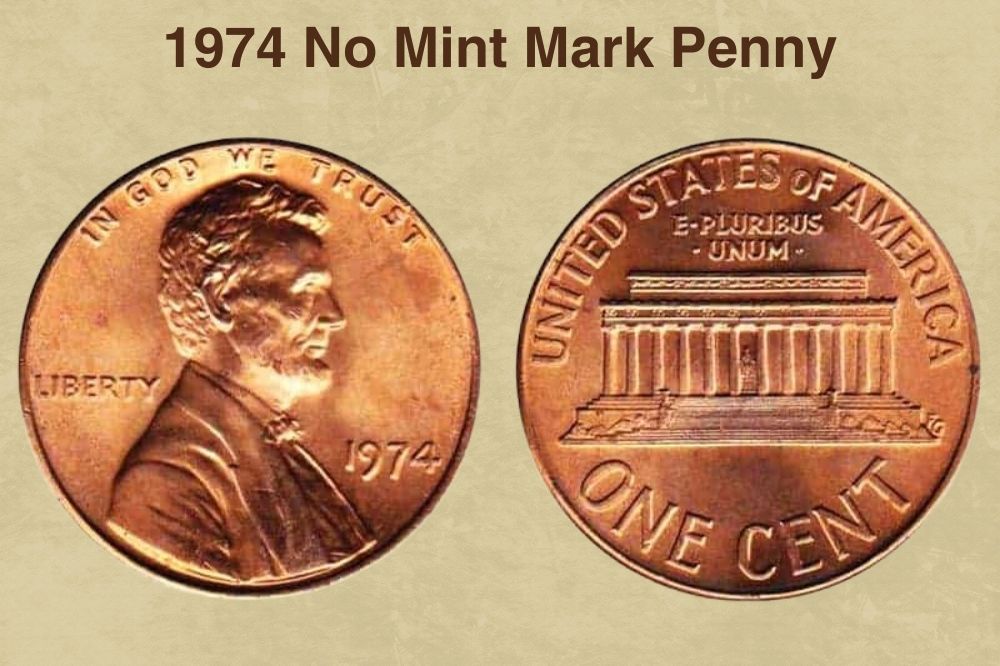
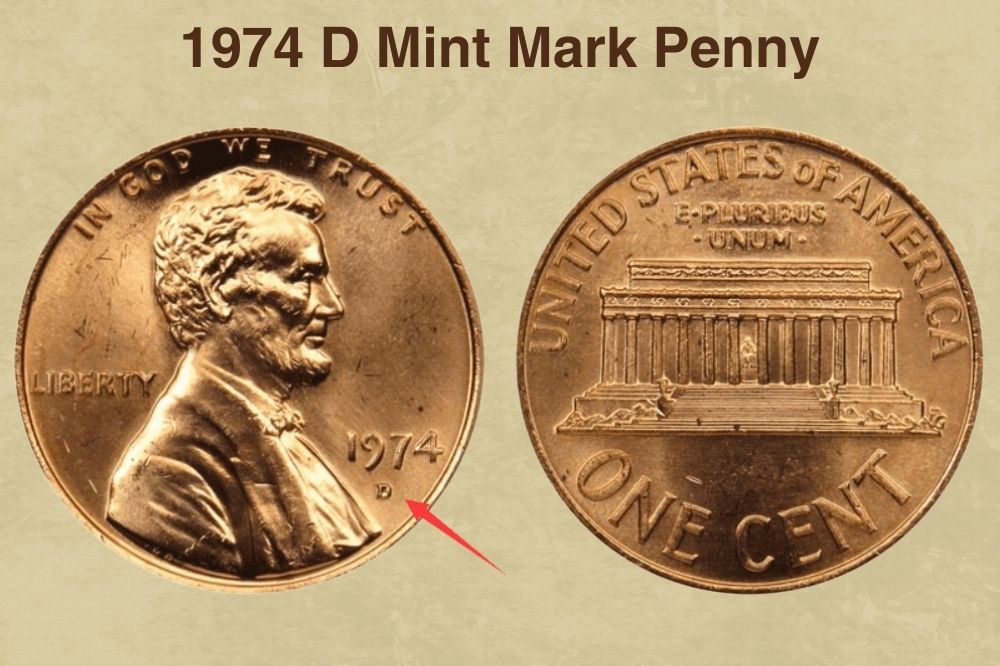
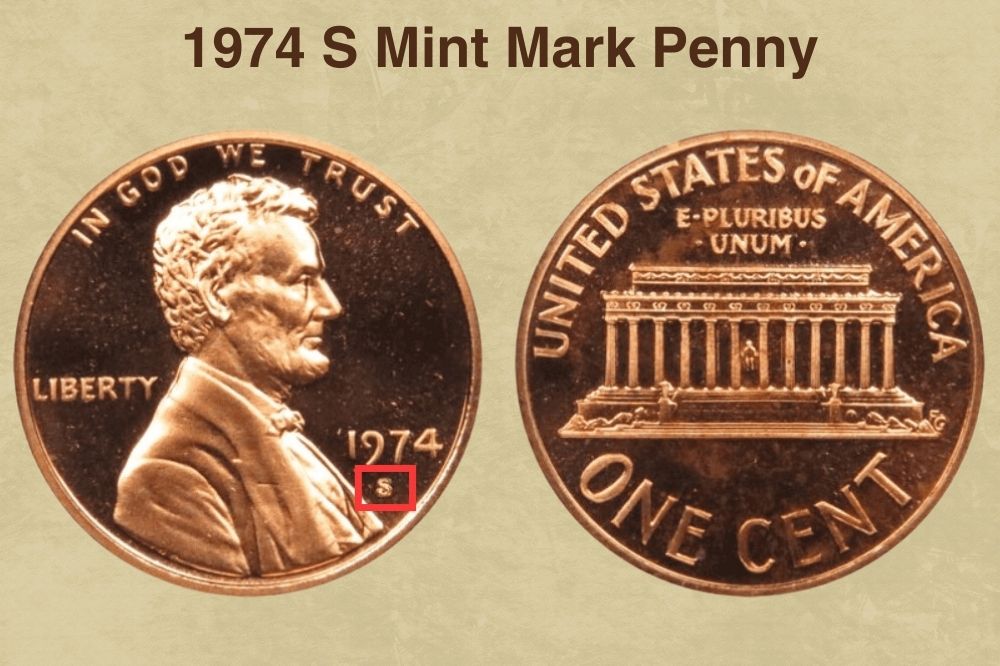
Denver coins carry a small “D” mint mark just below the date. Philadelphia coins have no mint mark at all—standard practice for that facility.

Here’s a fun detail: approximately 128,957,523 cents were actually struck at the West Point Mint in 1974 and lumped into Philadelphia’s reported total. These West Point coins carry no distinguishing mark whatsoever. You can’t tell them apart from Philly strikes. An original unopened Mint bag traced to West Point would carry a serious premium if one ever turned up.

The Reverse Of The 1974 Penny

The Reverse Of The 1974 Penny

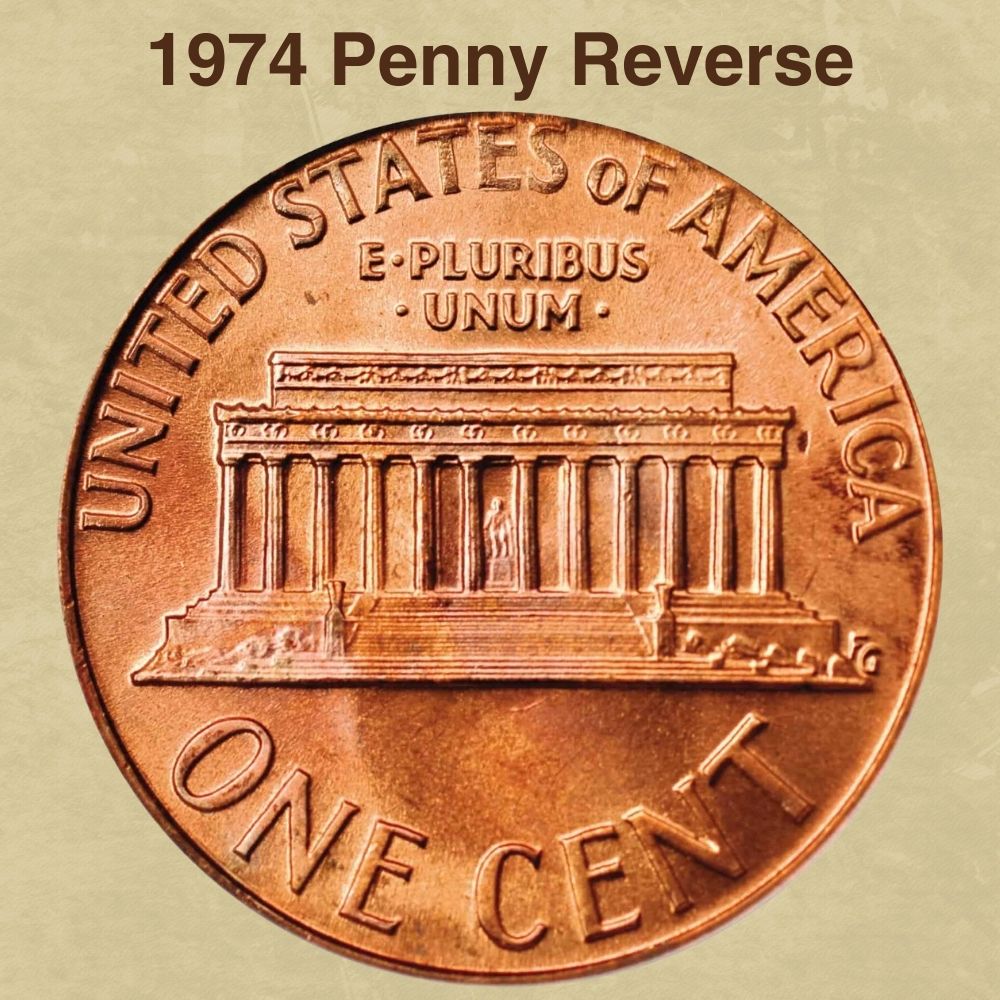
Flip it over and you’ll see the Lincoln Memorial, introduced in 1959 for the 150th anniversary of Lincoln’s birth. This replaced the wheat stalk design that ran from 1909 to 1958.

“UNITED STATES OF AMERICA” curves along the top. “ONE CENT” anchors the bottom. “E PLURIBUS UNUM” is inscribed in two lines above the memorial building.

Frank Gasparro designed this reverse—he later became Chief Engraver. Grab a magnifying glass and look inside the memorial. You can actually spot a tiny standing figure of Lincoln between the columns.

Other Features Of The 1974 Penny

The 1974 penny is 95% copper and 5% zinc, giving it that warm reddish-brown tone copper collectors love. This formula was standard from 1962 onward, after tin was dropped from the earlier alloy.

Each coin weighs 3.11 grams, measures 19 millimeters across, and has a plain (smooth) edge.

Color is everything for uncirculated examples. PCGS and NGC assign three color designations: RD (Red) for coins keeping 95% or more of their original copper luster, RB (Red-Brown) for coins showing 5% to 95% original red, and BN (Brown) for coins with less than 5% original red remaining.

RD coins bring the most money. Always. At the same numeric grade, an RD example can be worth two to ten times more than its BN counterpart. That’s a huge gap for what looks like a minor cosmetic difference.

Also Read: 100 Most Valuable Wheat Pennies Worth Money (1909 to 1958)


1974 Penny Value: Mintage & Survival Data

1974 Penny Mintage & Survival Chart

Mintage Comparison

Survival Distribution

TypeMintageSurvivalSurvival Rate
No Mint4,232,140,523634,821,07815%
D4,235,098,000635,264,70015%
S412,039,22861,805,88415%
S CAM2,612,568unknownunknown
S DCAM2,612,5682,220,68285%

Philadelphia struck 4.232 billion pennies. Denver made 4.235 billion. Virtually identical. Both have about a 15% survival rate, which works out to roughly 635 million survivors from each mint. That’s why circulated 1974-P and 1974-D cents are everywhere.

San Francisco struck 412 million business strikes with the same 15% survival rate—about 61.8 million still around. Fewer, but still not hard to find in lower grades.

Now compare that to the San Francisco DCAM proof. Only 2.6 million were minted, but an estimated 85% survived—roughly 2.2 million coins. Proof collectors tend to put their coins straight into holders and never touch them again. Coins bought for collections survive at far higher rates than coins spent at the grocery store.

Also Read: 100 Most Valuable Indian Head Penny Coins Worth Money (1859 – 1909)


The Easy Way to Know Your 1974 Penny Value

Check the mint mark first—look right below the date on the obverse. “D” means Denver, “S” means San Francisco, and no mark means Philadelphia (or West Point, which looks identical).

Circulated coins are worth roughly 2 cents for their copper content. Uncirculated examples range from $0.30 to $10 depending on grade. Hit MS67 or above and you’re looking at $950 or more. Always look for the RD (Red) designation—that’s where the real money is.

For precise evaluation considering mint marks, condition grades, and color designations, the Coin Identifier and Value App provides detailed assessments.

Coin Value Checker APP
Coin Value Checker APP Screenshot


1974 Penny Value Guides

Five varieties make up the 1974 penny series, from common pocket change to some of the most controversial coins in American history.

The Philadelphia, Denver, and San Francisco business strikes all had massive mintages. For standard copper coins, value comes down to grade and color—especially at MS67 and above, where certified populations drop off a cliff.

San Francisco proofs come in CAM (Cameo) and DCAM (Deep Cameo) versions, reflecting how much contrast exists between frosted design elements and mirrored fields. By 1974, San Francisco had its proof process dialed in, producing consistent deep cameo quality. That makes 1974-S DCAMs more available than earlier 1960s and early 1970s issues, where frosting was hit-or-miss.

1974 Penny Types:

  • 1974 No Mint Mark (Philadelphia Mint)
  • 1974-D (Denver Mint)
  • 1974-S (San Francisco Mint)
  • 1974-S CAM (San Francisco Cameo Proof)
  • 1974-S DCAM (San Francisco Deep Cameo Proof)

Also Read: Value Of Old Pennies By Year (1959-Present)


1974 No Mint Mark Penny Value

1974 No Mint Mark Penny Value

Most people assume a coin with 4,232,140,523 siblings can’t be worth anything. They’re right—until you get to MS67.

That official mintage includes about 128.9 million coins actually struck at West Point, completely indistinguishable from Philadelphia issues. Circulated examples are everywhere. Through MS66, they’re still easy to find in rolls and bags.

The grade cliff hits hard above that. As of May 2025, PCGS has certified just 5 examples at MS68RD. One NGC specimen has reached MS68+RD. Those are top-pop coins that most collectors will never hold.

The auction record belongs to an MS67+RD that sold for $2,938 at Stack’s Bowers in January 2013. Full original red color plus near-perfect preservation—that’s the combination that turns a common date into a four-figure coin.

CoinVaueChecker App 10

Brown (BN) and Red-Brown (RB) examples at the same numeric grades sell for significantly less. The RD designation commands the strongest prices because only coins retaining 95% or more of their original copper luster qualify.

1974 No Mint Mark Penny (RD) Price/Grade Chart

Price by 1-70 Grade (Latest Auction Records Included)

Updated: 2026-08-08 01:17:23

Recent auction records for this variety:

Date PlatformPrice Grade

Here’s the current market activity for the 1974 No Mint Mark penny:

Market activity: 1974 No Mint Mark Penny

1974 Aluminum Penny Value

1974 Aluminum Penny Value

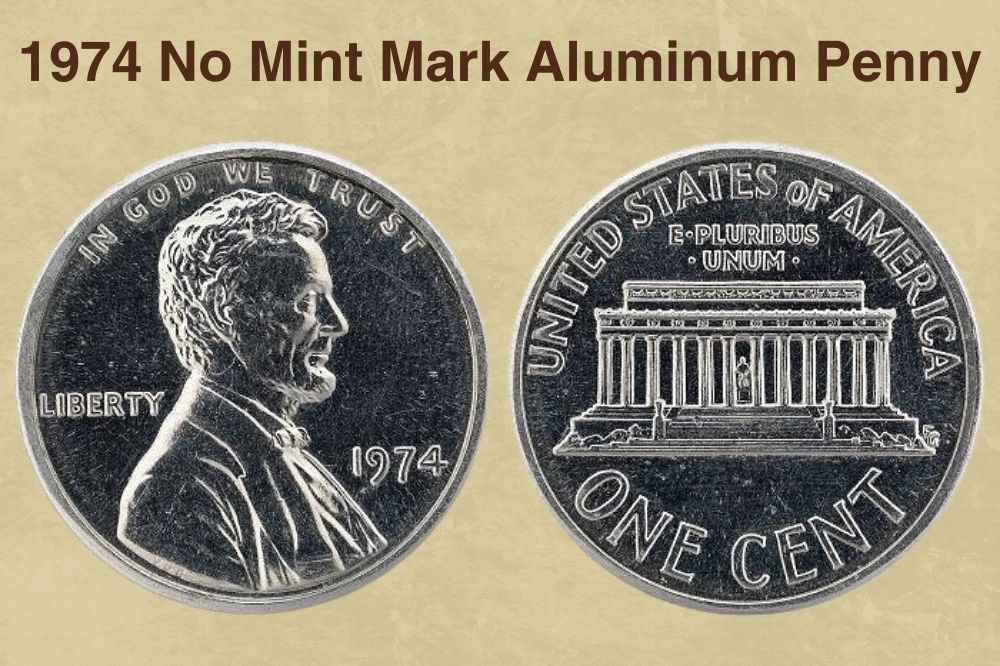
You can’t legally buy one. You can’t legally own one. And yet the 1974 aluminum penny might be the most talked-about Lincoln cent ever made.

Struck in late 1973 using 1974-dated dies, these experimental coins were 96% aluminum and weighed just 0.93 grams. That featherweight feel is actually the easiest way to spot one. Drop it on a hard surface and it makes a high-pitched “ping” nothing like a copper cent’s duller sound.

These coins were never authorized for release. The U.S. government classifies all surviving examples as federal property, and they’ve gone to court to get them back.

Estimates for what one might bring if it could ever be legally sold range from $160,000 for lower-condition examples up to $2 million or more for a gem. No legal sale has ever been completed, so those are educated guesses.

Market activity: 1974 Aluminum Penny


1974-D Penny Value

1974-D Penny Value

Here’s a question worth asking: why would anyone pay $477 for a penny that had 4,235,098,000 copies made? Because almost none of them survived in MS67 condition.

That’s the story of the 1974-D. Plentiful through MS66. Increasingly scarce at MS67. Genuinely rare at MS68 or higher. This grade cliff makes the Denver issue far more interesting than its mintage suggests.

Color designation matters just as much here. RD examples—95% or more original copper color—bring the biggest premiums. RB falls in the middle. BN carries the least premium. I think the 1974-D in high-grade RD is one of the better values in the Memorial cent series right now.

1974-D Penny (RD) Price/Grade Chart

Price by 1-70 Grade (Latest Auction Records Included)

Updated: 2026-08-08 01:17:23

Auction records for the 1974-D:

Date PlatformPrice Grade

Current market activity for the 1974-D penny:

Market activity: 1974-D Penny

1974-D Aluminum Penny Value

1974-D Aluminum Penny Value

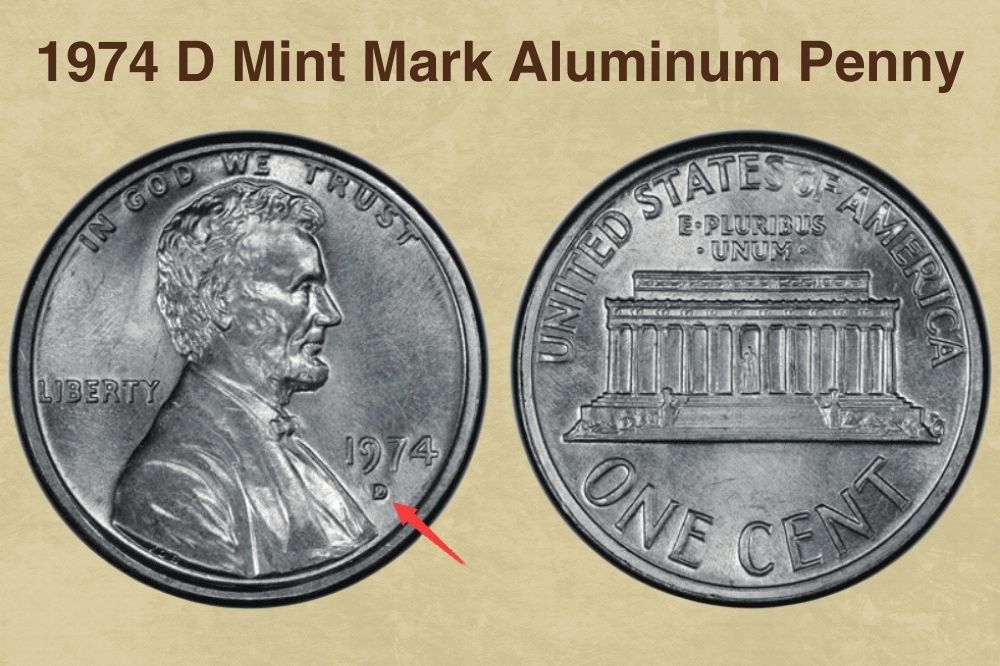
Only one is believed to exist. That makes the 1974-D aluminum penny arguably the single rarest coin in the entire Lincoln cent series. Unlike the Philadelphia aluminum cents struck during authorized testing, the Denver example was struck in 1974 without any official go-ahead from Washington.

The coin surfaced at a San Diego coin shop in 2013. Its owner, Randall Lawrence, was the son of Harry Edmund Lawrence—former Assistant Superintendent of the Denver Mint—who had kept the coin from retirement until his death in 1990.

PCGS authenticated it and assigned a grade of MS62. Lawrence and shop owner Michael McConnell arranged to sell it through Heritage Auctions at the April 2014 Central States Numismatic Society convention. Estimates reached $2 million.

The sale never happened. The U.S. Secret Service stepped in, and the Mint demanded the coin back. After a federal lawsuit—Judge William Q. Hayes ruled in March 2015 that the case could proceed—the two men surrendered the penny to the U.S. Mint on March 17, 2016, as part of a settlement.

U.S. Attorney Laura Duffy of the Southern District of California stated that the settlement confirmed government property “cannot be kept as a souvenir” by former employees or their heirs. The coin now sits at the United States Bullion Depository.

Market activity: 1974-D Aluminum Penny


1974-S Penny Value

1974-S Penny Value

A common misconception: people assume the San Francisco business strike is just a smaller version of the Philly and Denver runs. It’s actually a completely different kind of rare once you get into high grades.

San Francisco produced 412,039,228 regular pennies in 1974—a fraction of what the other two mints made. Most weren’t released into general circulation. PCGS has certified fewer than 200 examples at MS66 or higher, making this genuinely scarce in premium condition compared to most Memorial cents.

Yet the coin often trades at surprising discounts. We’d call that a market inefficiency worth watching. The auction record stands at $2,703 for a 1974-S MS67RD sold in 2016.

1974-S Penny (RD) Price/Grade Chart

Price by 1-70 Grade (Latest Auction Records Included)

Updated: 2026-08-08 01:17:23

Auction records for the 1974-S:

Date PlatformPrice Grade

Current market activity for the 1974-S penny:

Market activity: 1974-S Penny Penny


1974-S CAM Penny Value

1974-S CAM Penny Value

If you’ve never seen a cameo proof in person, you’re missing out. Lincoln’s portrait looks frosted white against a jet-black mirror field. It’s striking.

“CAM” stands for Cameo. The effect comes from specially prepared dies that develop frost on the raised design areas while keeping the flat fields polished to a mirror finish. Not every proof coin gets this look—die wear erases the frosting as production continues, so CAM examples come from earlier strikes in a die’s life.

From the total proof mintage of 2,612,568, only a portion hit the CAM standard. The “S” mint mark below the date confirms San Francisco proof production.

1974-S CAM Penny Price/Grade Chart

Price by 1-70 Grade (Latest Auction Records Included)

Updated: 2026-08-08 01:17:23

Auction records for this variety:

Date PlatformPrice Grade

Market activity for the 1974-S CAM penny:

Market activity: 1974-S CAM Penny


1974-S DCAM Penny Value

1974-S DCAM Penny Value

Want the dramatic cameo look without paying a king’s ransom? This is your coin.

DCAM stands for Deep Cameo—an even more pronounced version of the cameo effect, with thick white frost on the design and glass-like mirror fields. PCGS and NGC only award DCAM to proofs with the strongest contrast.

By 1974, San Francisco had its proof process refined to an impressive degree. DCAM examples remain relatively easy to obtain through PR68. Even PR69 specimens are reasonably priced compared to similar-quality proofs from 1968–1972, which can command enormous premiums because early frosting quality was so inconsistent.

That’s what makes the 1974-S DCAM a smart buy for budget-conscious collectors. Earlier deep cameos like the 1968-S and 1969-S are true condition rarities at high grades. The 1974-S gives you the same visual impact at a fraction of the cost.

1974-S DCAM Penny Price/Grade Chart

Price by 1-70 Grade (Latest Auction Records Included)

Updated: 2026-08-08 01:17:23

Auction records across different grades:

Date PlatformPrice Grade

Market activity for the 1974-S DCAM penny:

Market activity: 1974-S DCAM Penny

Also Read: Top 100 Most Valuable Modern Pennies Worth Money (1959 – Present)


1974 Penny Value Errors: Complete Rare Error List and What Each Is Worth

Error coins are one of the most exciting parts of this hobby, and the 1974 Lincoln penny has a surprisingly deep error list. Each type adds collector value above what the coin would normally bring.

Here’s the complete rundown, including several varieties that most guides skip over.

1. 1974 Penny Doubled Die Obverse (DDO) Errors

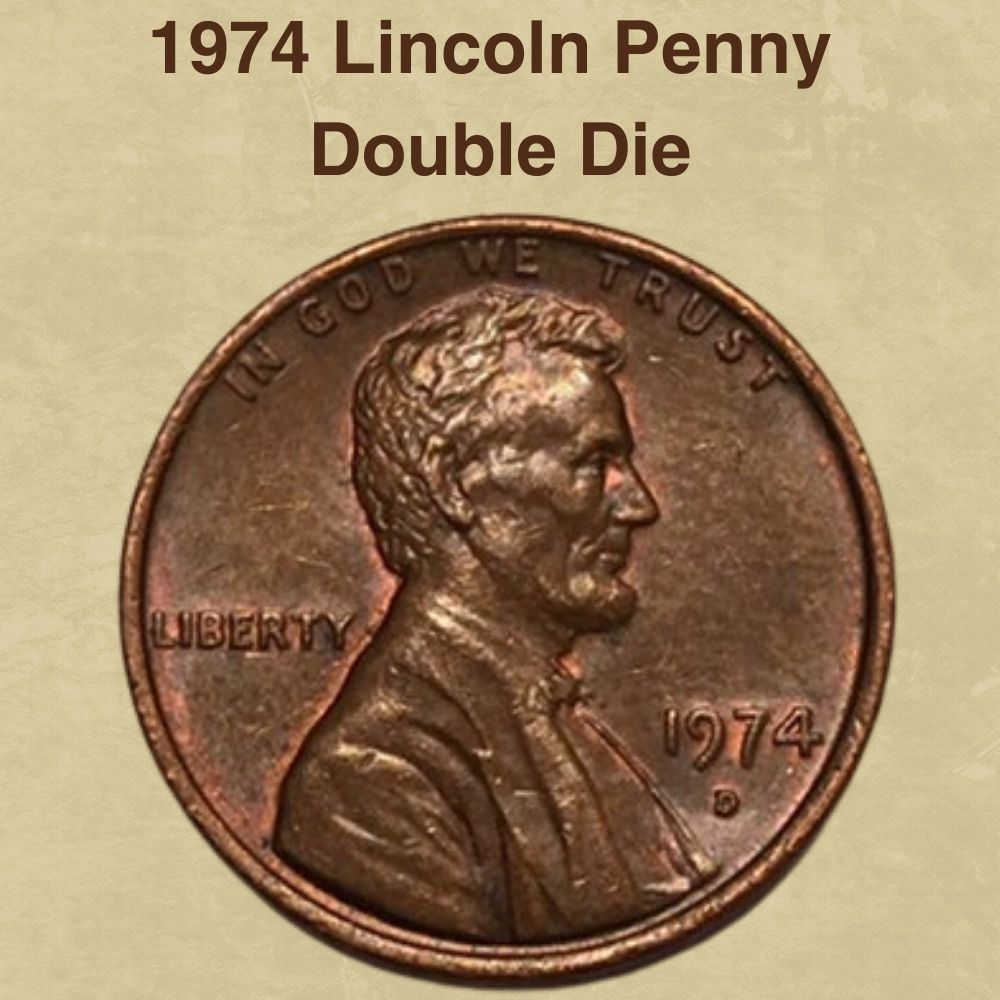
A Doubled Die Obverse (DDO) happens during die manufacturing when the design gets impressed into the die more than once at slightly different angles. The result is a ghost-like doubling on the coin’s face.

On 1974-D cents, look for doubling on the D mint mark, Lincoln’s nose, the date, and the legends “LIBERTY” and “IN GOD WE TRUST.” Doubled die reverse (DDR) examples show the same effect on the Memorial’s pillars and steps.

Here’s the critical distinction: true DDO errors show raised, three-dimensional doubling with a shadow-like echo. Machine doubling looks flat and shelf-like. Machine doubling adds almost nothing to value. Depending on strength and clarity, 1974 DDO pennies sell for $25 to $200, with uncirculated examples at the top.

2. 1974-D/S Over Mint Mark (OMM) Error

This is the sleeper of the 1974 series. The 1974-D/S Over Mint Mark was created when San Francisco dies got reassigned to Denver during a die shortage.

The original “S” was partially ground away before a “D” was punched over it. Under magnification, remnants of the “S” are clearly visible beneath the “D.” This confirms it as a genuine OMM variety—not just a Repunched Mint Mark (RPM). OMMs are significantly rarer than RPMs because they involve two different mint facilities.

Values range from approximately $200 to $2,000 or more depending on how clearly the underlying “S” shows and the coin’s grade. If you’re cherrypicking rolls, this is the one to hunt for.

3. 1974-S Penny Die Break Errors

Die breaks form when striking dies develop metal fatigue from repeated use. Cracks in the die show up as raised lines on the finished coin.

A break that reaches the rim is called a “cud”—those are the dramatic ones. Every coin struck from the same cracked die shows the break in the same spot, so collectors can catalog specific die break varieties. A well-preserved 1974-S die break example can sell for up to $184 or more depending on size and location.

4. 1974 Penny Double Head (Counter-Stamp) Errors

These show two Lincoln portraits on the obverse. Sounds exciting, but it’s a post-mint alteration—someone counter-stamped the coin after it left the facility. That means little to no numismatic value in most cases.

If you think yours might be a genuine mint error rather than a novelty piece, send it to PCGS or NGC for authentication.

5. 1974 Penny Off-Center Strike Errors

An off-center strike happens when the planchet isn’t properly centered between the dies. You get a crescent of blank metal on one side and a shifted design on the other.

CoinVaueChecker App 10

The sweet spot for collectors: 50% off-center with the date still fully visible. Those can bring $100 or more. Minor off-center errors of 5% to 10% are worth a modest $20 or so.

6. 1974 Penny Broadstrike Errors

When the collar die—the metal ring that holds the planchet in place—fails during striking, the coin’s metal flows outward freely. You get a thinner, wider coin with a soft or missing edge. Think pancake.

The full design must be visible to qualify as a broadstrike rather than an off-center strike. A 1974 broadstrike penny typically sells for $9 to $25 depending on how dramatically the coin spread.

7. 1974 Penny Clipped Planchet Errors

This one happens before the coin is struck. When the blanking machine misfires, the punch overlaps a previous cut and creates a blank with a curved bite missing from the edge.

Look for the “Blakesley effect”—a weakness in the design directly opposite the clip. That’s your confirmation it happened at the mint and isn’t post-mint damage. Clipped planchet pennies from 1974 sell for $15 to $35, with larger clips bringing more.

8. 1974 Penny Blank Planchet Errors

An unstruck coin blank that escaped the mint. Type I blanks have flat edges—they never went through the upsetting mill. Type II blanks show a raised rim but no design.

These are scarce because quality control usually catches them. A 1974 blank planchet penny sells for $5 to $20, with Type II (rim present) bringing slightly more.

Also Read: 42 Rare Penny Errors List with Pictures (By Year)


Where To Get the Best 1974 Penny Value When Selling

Whether you’re looking to sell a common 1974 penny or one of the rare high-grade specimens, choosing the right marketplace and understanding current demand can make all the difference in your final return.

Check out now: Best Places To Sell Coins Online (Pros & Cons)


1974 Penny Value Market Trend

Market Interest Trend Chart - 1974 Penny

*Market Trend Chart showing the number of people paying attention to this coin.


FAQ About The 1974 Penny Value

1. How much is a 1974 penny worth?

Most circulated 1974 pennies are worth about 2 cents—their copper melt value. That’s double face value, so they’re worth saving.

Uncirculated examples range from $0.30 to $10 depending on grade and color. MS67 coins can reach $477 to $999 depending on the mint. The auction record is $2,938 for a 1974 No Mint Mark MS67+RD sold at Stack’s Bowers in January 2013.

2. What makes a 1974 penny valuable?

Four things: mint mark, grade, color designation, and errors. The mint mark (D for Denver, S for San Francisco, none for Philadelphia) affects how easy the coin is to find in top condition.

Grade runs on the Sheldon scale from 1 to 70—MS67 and above is where premiums get serious. Color designation (RD, RB, or BN) can multiply or cut value by a factor of two to ten at the same numeric grade. Errors add their own premiums on top of everything else.

3. What is the 1974 aluminum penny, and how much is it worth?

The 1974 aluminum penny was an experimental coin struck in late 1973 using 1974-dated dies. The Mint was trying to cut production costs as copper prices climbed. These coins were 96% aluminum and weighed just 0.93 grams—way lighter than the standard 3.11-gram copper cent.

Approximately 1.5 million were produced at Philadelphia, and a tiny number at Denver. Nearly all were recalled and melted. The government considers surviving specimens federal property, so private ownership is technically illegal. If one could ever be legally sold, estimates range from $160,000 to $2 million or more.

4. Is a 1974 aluminum penny illegal to own?

Yes. The U.S. government says all 1974 aluminum pennies are government property never lawfully issued to the public. This was confirmed in federal court in 2016 when Randall Lawrence and Michael McConnell surrendered the sole known 1974-D aluminum penny rather than continue their lawsuit.

U.S. Attorney Laura Duffy’s settlement statement made clear that items made at Mint facilities but never officially issued “remain government property and are not souvenirs that government employees can merely remove and pass down to their heirs.” If you think you have one, you’re legally obligated to surrender it to the U.S. Mint.

5. How do I identify a 1974 aluminum penny?

A few quick tests. Color first: a genuine aluminum penny looks silvery-gray, like a dime or aluminum can—not the warm reddish-brown of copper.

Weight next: 0.93 grams versus 3.11 grams for standard copper. Drop it on a hard surface—aluminum makes a high-pitched “ping” compared to copper’s duller sound. Keep in mind that most “silver” 1974 pennies are just copper cents that were commercially plated after leaving the mint. Those are novelty items worth face value.

6. What are the most valuable 1974 penny errors?

The 1974-D/S Over Mint Mark (OMM) tops the list—remnants of an “S” visible beneath the “D” under magnification. Worth $200 to $2,000 or more depending on clarity and grade.

Doubled Die Obverse (DDO) errors are the most commonly found valuable errors, selling for $25 to $200. The 1974-S die break can reach $184 in pristine condition. Off-center strikes (50%+ with date visible), broadstrikes, and clipped planchets round things out at $9 to $100 or more for dramatic examples.

7. What does RD, RB, and BN mean on a 1974 penny?

These are color designations from PCGS and NGC describing how much original red color remains on a copper coin. RD (Red) means 95% or more original luster—highest prices. RB (Red-Brown) means 5% to 95% original red—middle tier. BN (Brown) means less than 5% original red remaining.

For a 1974 penny, an RD example can be worth two to ten times more than a BN at the same numeric grade. Copper is reactive. Exposure to air, humidity, and handling causes these color changes naturally over time.

8. Are 1974-S pennies rare?

In circulated grades, no—412 million were struck. In premium uncirculated grades, absolutely. PCGS has certified fewer than 200 examples at MS66 or higher, a significantly smaller population than comparable Philadelphia and Denver issues at the same grade levels.

That makes the 1974-S one of the more underappreciated condition rarities in the Memorial cent series. A 1974-S MS67RD sold for $2,703 in 2016, showing what truly gem-quality San Francisco examples can bring.

9. What is the oldest penny ever, and how does it compare to a 1974 cent?

The oldest official U.S. penny is the large cent struck in 1793—the year after the Philadelphia Mint was established. Those early “Chain Cents” and “Wreath Cents” were so big and heavy that people found them annoying to carry. The large-cent format was eventually replaced by the smaller Flying Eagle cent in 1857.

A circulated 1793 large cent can sell for thousands or tens of thousands depending on type and condition. A circulated 1974 penny? About 2 cents. But the 1974 series earns its collector interest from the aluminum penny experiment, its condition-rarity structure at MS67+, and a deep error variety list—not from age alone.

More U.S. Coin Value Guide