1989 Half Dollar Value Checker: Errors List, “D”, “S” & P Mint Mark Worth
1989 Half Dollar value ranges from $0.50 face value to $3,350. That record was a Grade 68 example sold on eBay in April 2022. If you’re curious what yours could fetch, upload a photo of your coin below for a quick value range. You can also scroll down to browse recent eBay sales and see what people are paying today.
1989 Half Dollar Value Checker
Identify 1989 Half Dollar P, D and S Mint Mark Price
Front Obverse
Upload or Take a Photo
Back Reverse
Upload or Take a Photo
1989 Half Dollar Value By Variety
The 1989 Kennedy Half Dollar value chart follows the classic modern Kennedy pattern: condition grade, not mintage scarcity, is the engine that drives collector premiums. If you already know the grade of your coin, jump directly to the Value Guides section below for exact pricing.
| Type | Good(G4-6) | Fine(F12-15) | AU(AU50-58) | MS(MS60-70) | PR(PR60-70) |
|---|---|---|---|---|---|
| ▶1989 P Half Dollar Value | $1 | $1 | $1 | $4 - $250 | — |
| ▶1989 D Half Dollar Value | $1 | $1 | $1 | $4 - $3,810 | — |
| ▶1989 S DCAM Half Dollar Value | — | — | — | — | $1 - $25 |
Also Read: Top 100 Most Valuable Kennedy Half Dollar Worth Money (1964 – Present)
Top 10 Most Valuable 1989 Half Dollar Worth Money
Most Valuable 1989 Half Dollar Chart
2000 - Present
The 1989 Kennedy Half Dollar auction hierarchy reveals that grade rarity, not mintage scarcity, creates the dramatic value differences you see in this chart.
The 1989-P MS68 leads the pack at $3,349.97 — an NGC-certified coin that sold on eBay in April 2022, representing nearly ten times the value of the MS67 grade. This steep cliff between grades is a hallmark of conditionally rare modern Kennedys, where even a single point on the Sheldon 1–70 grading scale can multiply value several times over.
Philadelphia Mint examples occupy the dominant positions, reflecting PCGS’s own finding that the 1989-P is “well struck” yet becomes significantly harder to find above MS66. Meanwhile, the 1989-D MS67+ brought $928.12 at GreatCollections, a figure that underscores how Denver’s slightly lower mintage creates subtle but real supply differences at the very top end of the grade spectrum.
Interestingly, the San Francisco PR70 DCAM proof reached only $552 at its all-time auction peak (Goldberg Auctioneers, May 2003), confirming that business-strike rarity at the highest grades outpaces proof perfection for this particular year.
History Of The 1989 Half Dollar
The 1989 Kennedy Half Dollar arrived in the final year of President Ronald Reagan’s administration, representing a notable production rebound following a dramatically unusual prior year.
In 1987, the U.S. Mint had issued Kennedy half dollars exclusively inside Mint Sets — none were released for general circulation at all. The return to large-scale business-strike production in 1988, and the continuation in 1989 at nearly double that volume, signaled renewed institutional confidence in the denomination.
Philadelphia’s 24,542,000-piece output and Denver’s 23,000,216 coins were the largest combined Kennedy half dollar mintages since the early 1980s. Despite these robust numbers, the half dollar was already fading from everyday transactions by the late 1980s, with most pieces being stockpiled by banks or retained by collectors rather than spending freely in commerce.
The San Francisco Mint added 3,220,194 proof specimens to the year’s production, available exclusively as part of the standard annual U.S. Proof Set. These copper-nickel clad proofs featured the specialized striking process — polished dies and specially prepared planchets — that produces the dramatic mirror-field and frosted-device contrast known as Deep Cameo (DCAM).
A historically significant fact about the 1989 production year: it was the final year the U.S. Mint hand-punched mint marks onto individual working dies. Beginning in 1990, mint marks were incorporated directly into the master hub, permanently ending the possibility of Repunched Mint Mark (RPM) errors on subsequent Kennedy halves. This makes 1989 the last year collectors can theoretically find RPM varieties on business-strike Kennedy half dollars.
Also Read: Top 35 Most Valuable Franklin Half Dollar Worth Money (1948 – 1963)
Is Your 1989 Half Dollar Rare?
1989-P Half Dollar
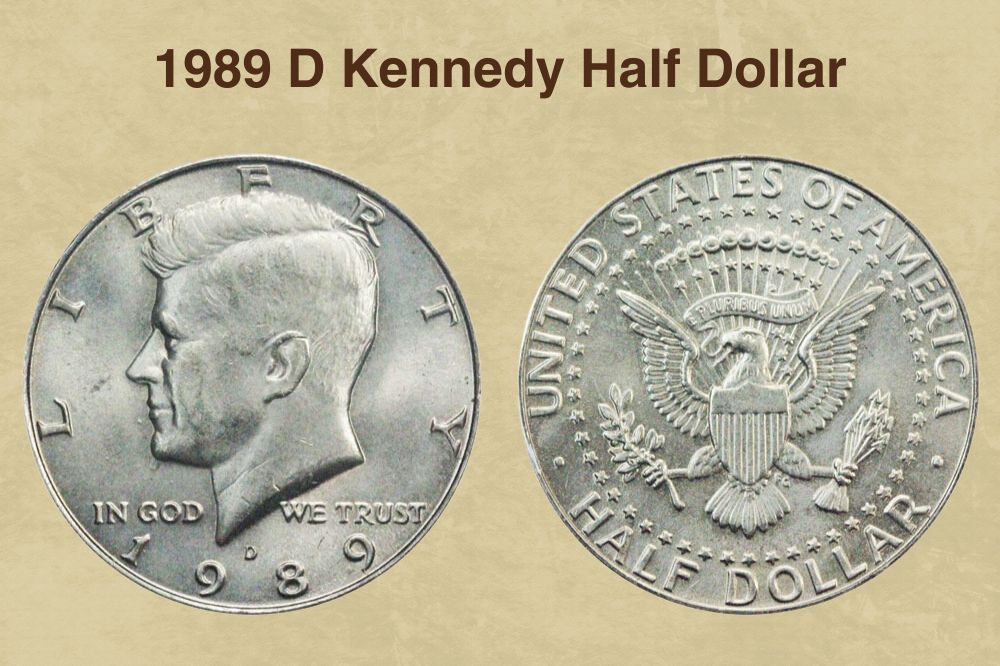
1989-D Half Dollar
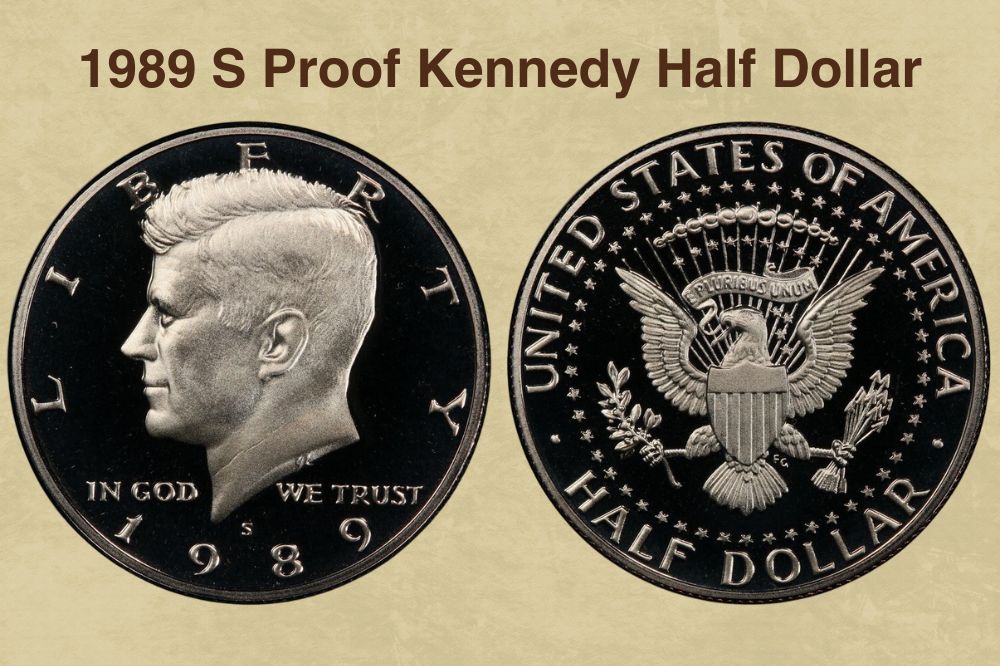
1989-S DCAM Half Dollar
According to PCGS CoinFacts, no single issue of the Kennedy half dollar series is considered rare in the traditional sense — but 1989 business strikes grading above MS67 are broadly regarded as “conditional rarities.” That means even with millions minted, examples in the very top grades are genuinely hard to find.
The Greysheet (CDN Publishing) lists the 1989 business strikes as having CPG values between $0.50 and $2,750, illustrating just how wide the condition-based value spectrum truly is. For real-time rarity assessments and current market positioning, our Coin Identifier and Value App provides updated rankings across all Kennedy varieties.
Key Features of The 1989 Half Dollar
The 1989 Kennedy Half Dollar preserves the iconic design partnership created immediately after President Kennedy’s assassination in November 1963 — Gilroy Roberts designed the obverse portrait and Frank Gasparro created the heraldic eagle reverse.
Roberts was the Chief Engraver of the U.S. Mint at the time, and his left-facing portrait of Kennedy was completed with extraordinary speed so that the new coin could be rushed into production within months of the president’s death. Gasparro’s reverse, featuring a modified version of the Presidential Seal, includes his initials “FG” just below the eagle’s left talon — a detail worth knowing, since missing “FG” initials on other Kennedy years are a documented and valuable error type.
The Obverse Of The 1989 Half Dollar
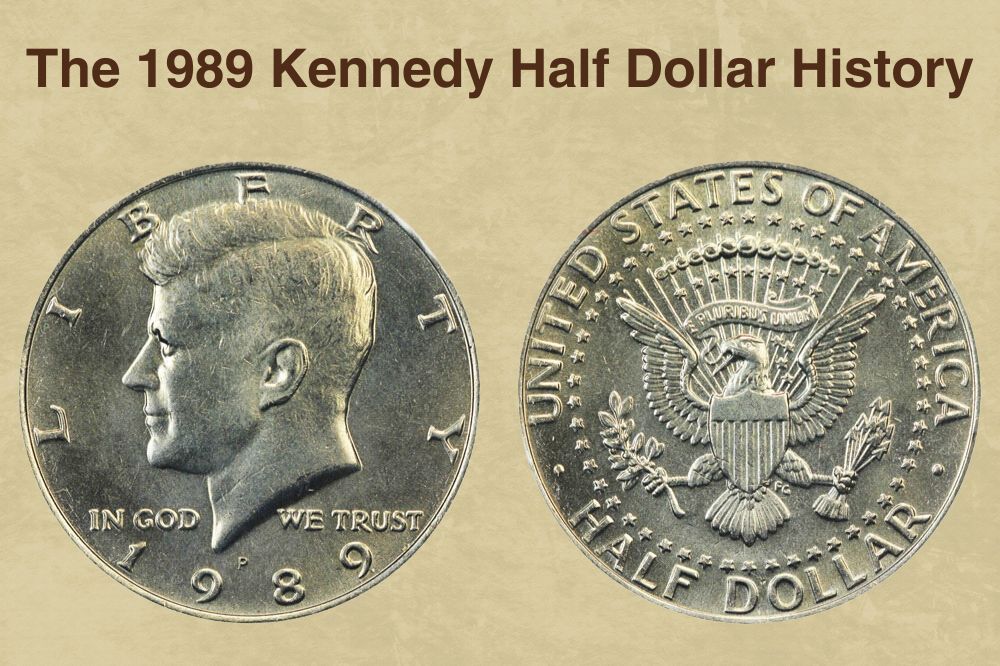
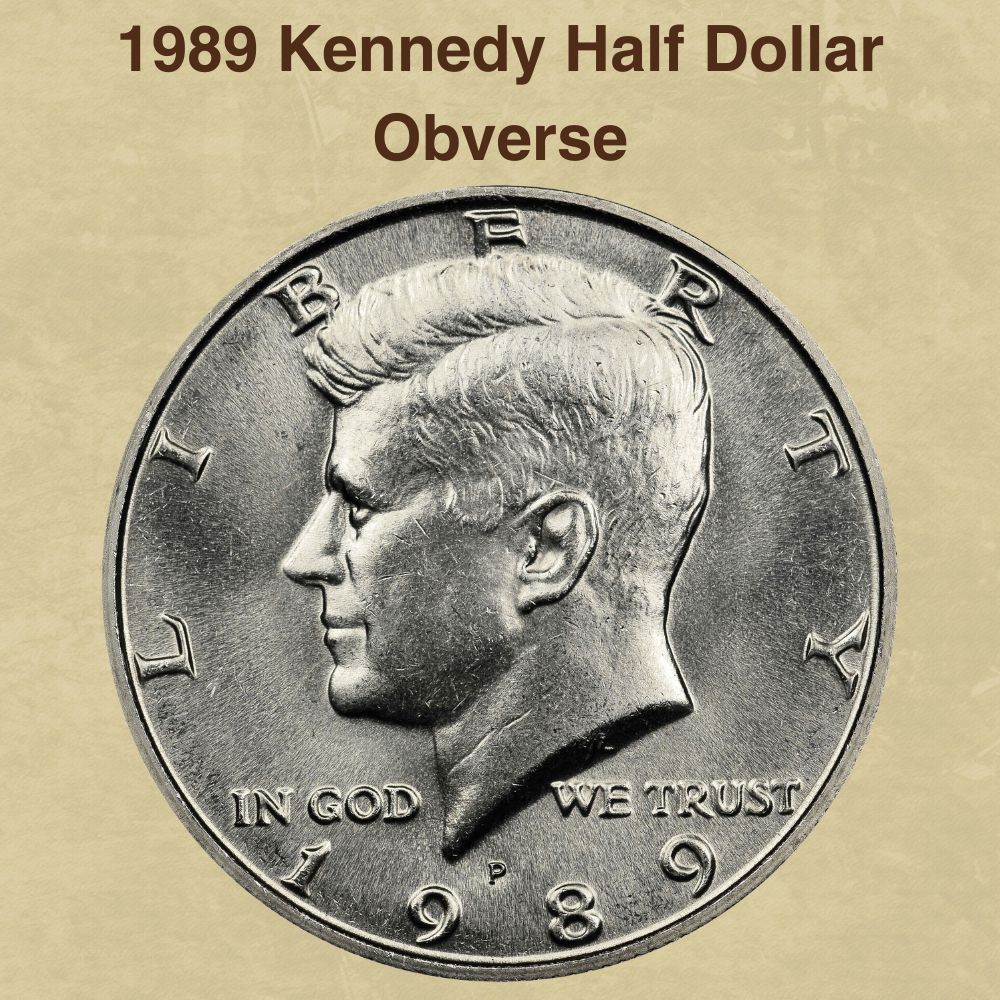
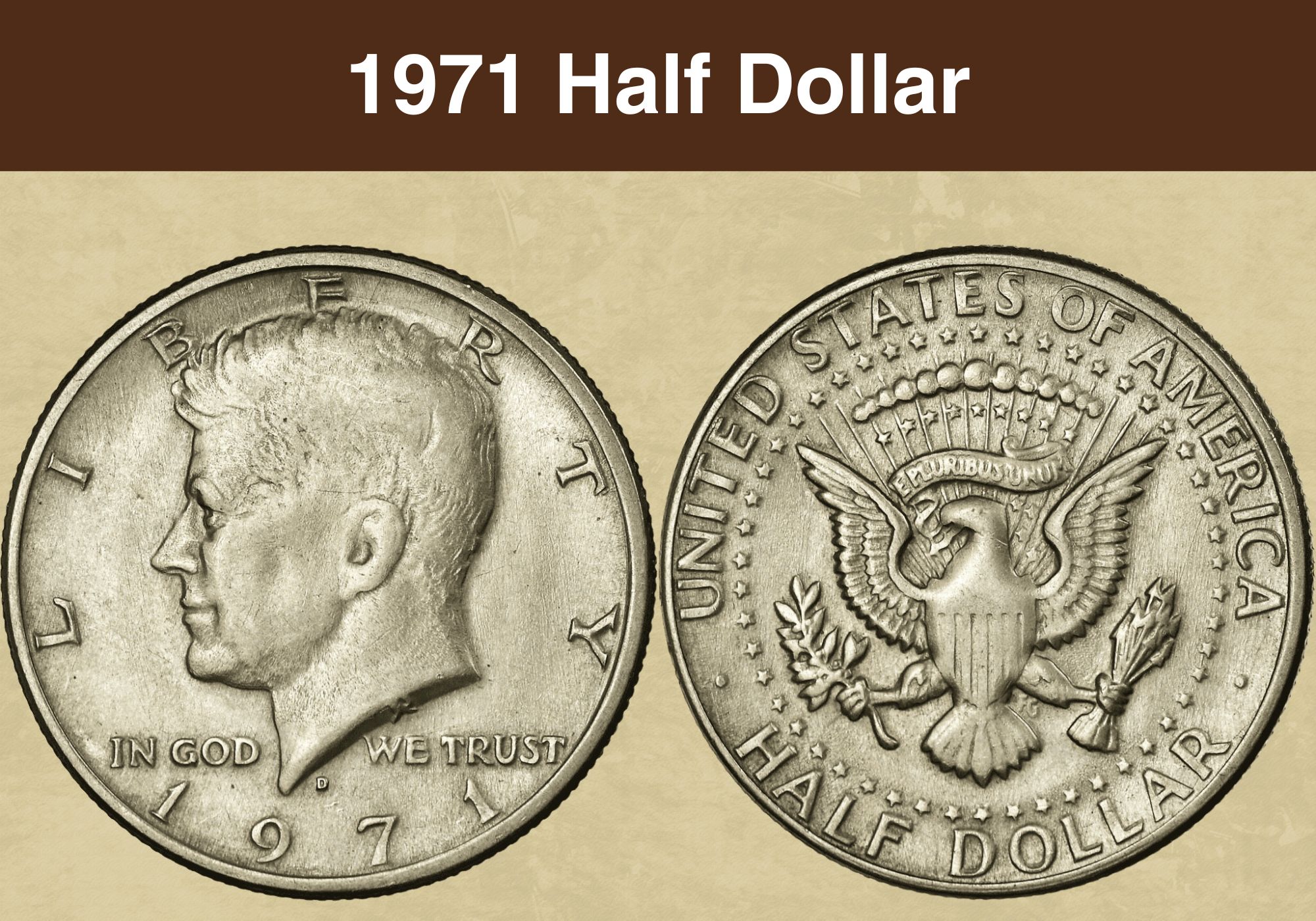
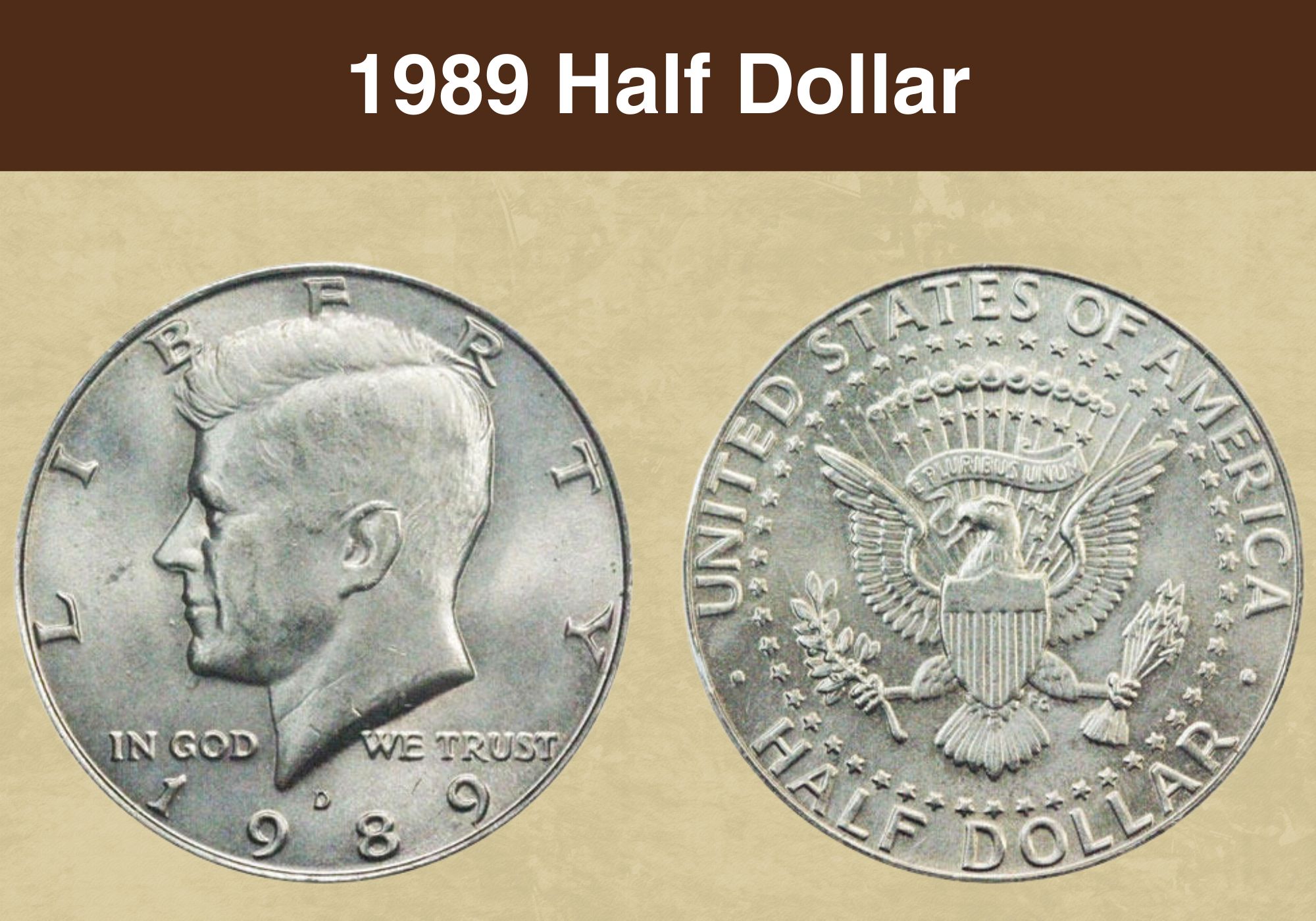
The obverse (heads side) shows a dominant left-facing portrait of President Kennedy positioned at the center of the coin. The word LIBERTY arcs across the upper rim, with Kennedy’s hair partially overlapping the inscription.
The motto IN GOD WE TRUST appears along the lower portion of the obverse, with the bust dividing the phrase into two parts. The minting year 1989 stretches along the bottom rim, and the mint mark (P or D) is placed just above it, to Kennedy’s right.
The Reverse Of The 1989 Half Dollar
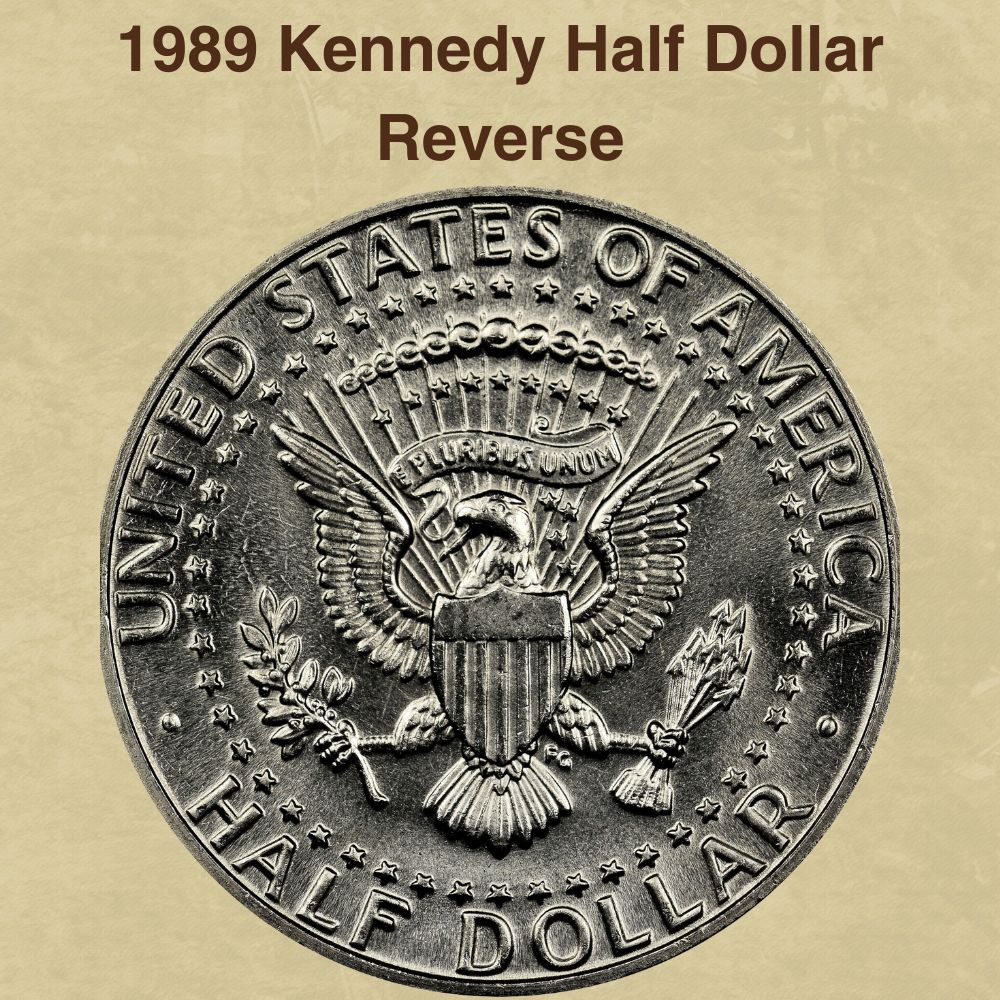
The reverse (tails side) features a detailed heraldic eagle at center, based on the Presidential Seal. The eagle’s outstretched wings symbolize strength, while one talon holds an olive branch (peace) and the other grips a bundle of 13 arrows (readiness to defend the nation).
Above the eagle is a banner reading E PLURIBUS UNUM (“Out of many, one”), with 13 stars above it representing the original colonies. The inscriptions UNITED STATES OF AMERICA and HALF DOLLAR appear on the upper and lower rims respectively, while a ring of 50 stars separating the eagle from the rim represents all 50 U.S. states.
Other Features Of The 1989 Half Dollar
The 1989 Kennedy Half Dollar is made of copper-nickel clad composition — a pure copper core bonded to outer layers of 75% copper and 25% nickel, giving it the familiar silvery appearance despite containing no silver at all. This composition has been standard for business-strike Kennedy halves since 1971, replacing the 40% silver alloy used from 1965 to 1970.
The coin measures 30.60 mm (1.20512 inches) in diameter, weighs 11.34 grams (0.4 oz), and has a thickness of 2.15 mm (0.08464 inches). Its edge features precisely 150 reeds, and the coin is perfectly round in shape.
Also Read: Top 60+ Most Valuable Walking Liberty Half Dollar (1916 -1947)
1989 Half Dollar Mintage & Survival Data
1989 Half Dollar Mintage & Survival Chart
Survival Distribution
| Type | Mintage | Survival | Survival Rate |
|---|---|---|---|
| P | 24,542,000 | 8,589,700 | 35% |
| D | 23,000,216 | 8,050,075 | 35% |
| S DCAM | 3,220,194 | 2,753,265 | 85.5% |
Philadelphia led production in 1989 with 24,542,000 business strikes, followed closely by Denver’s 23,000,216 — together representing the highest combined Kennedy half dollar output in several years. San Francisco added 3,220,194 proof specimens, creating a clear three-tier production hierarchy.
Survival data shows that both Philadelphia and Denver business strikes have identical 35% survival rates, meaning roughly one in three of the coins originally minted still exists in collectible condition today. The San Francisco proof, by contrast, has an 85.5% survival rate, reflecting the careful storage typical of collector-purchased proof sets that were never spent or circulated.
Also Read: What Half Dollars Are Worth Money?
The Easy Way to Know Your 1989 Half Dollar Value
Grading a copper-nickel coin like the 1989 Kennedy half dollar is trickier than it sounds — the alloy shows contact marks and bag marks more readily than silver, making condition assessment challenging without some expertise.
Standard uncirculated examples range from about $3.58 to $4.91, while MS67 specimens have sold for $275–$395 and the rare MS68 grade reached a record $3,349.97 on eBay in April 2022. The difference between MS66 and MS67 can mean the difference between a $27 coin and a $275 coin — which is why professional certification from PCGS (Professional Coin Grading Service) or NGC (Numismatic Guaranty Corporation) pays off for anything you believe might be above average.
For accurate grade assessment and current population data, our Coin Identifier and Value App provides real-time grading analysis and certified population reports to help identify optimal acquisition targets.


Coin Identifier and Value App
Not sure what your coins are worth? Get Instant Value • Grade • Error Detection with coin identifier and value app (FREE Usage Daily)
1989 Half Dollar Value Guides
1989 Half Dollar Types:
- 1989-P Half Dollar (Philadelphia Mint, copper-nickel clad, circulation intended)
- 1989-D Half Dollar (Denver Mint, copper-nickel clad, circulation intended)
- 1989-S DCAM Half Dollar (San Francisco Mint, copper-nickel proof, Deep Cameo finish)
The 1989 Kennedy Half Dollar was produced across three mint facilities, each creating a distinct collectible with its own value profile, rarity characteristics, and collector audience. Understanding which variety you have is the essential first step before looking up its value.
1989-P Half Dollar Value
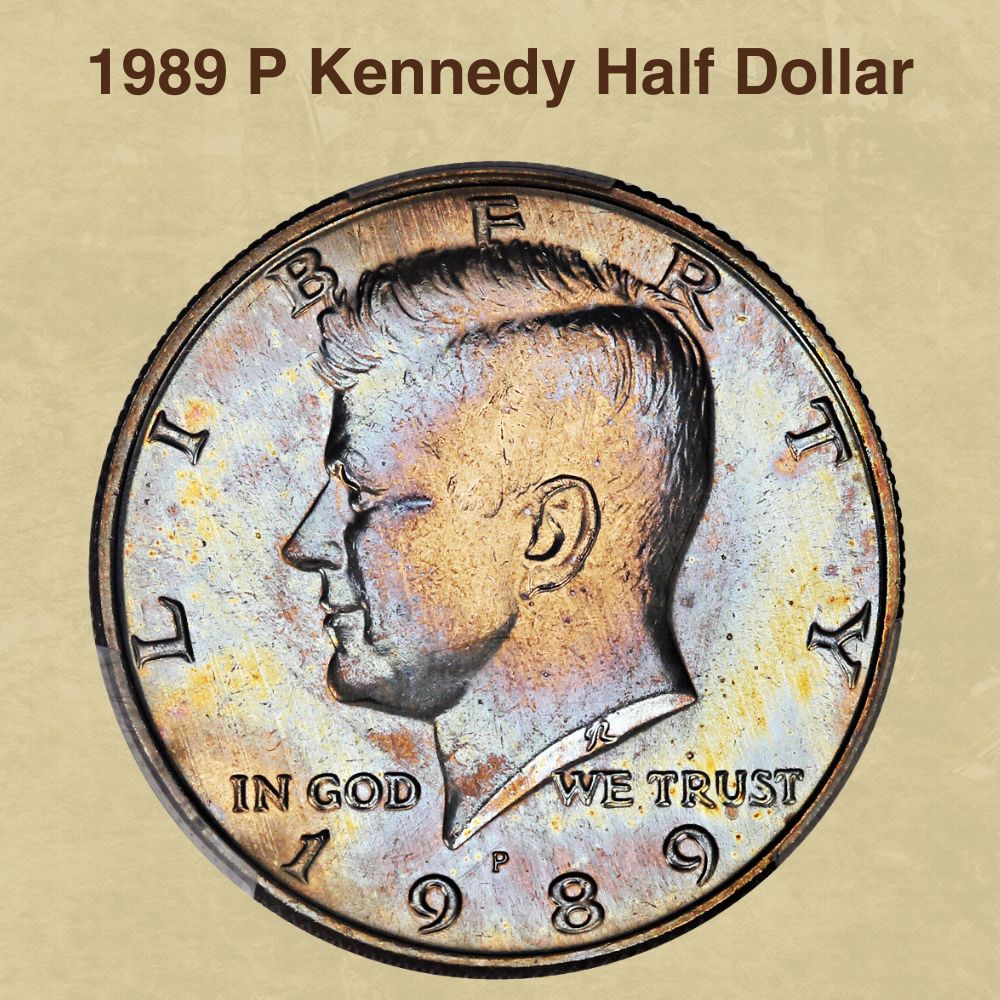
The 1989-P Kennedy Half Dollar represents Philadelphia Mint’s largest output among the three 1989 facilities, with 24,542,000 pieces struck. PCGS CoinFacts notes this coin typically comes well struck, making it easier to find in grades up through MS66 — but the jump to MS67 is where both supply and price change dramatically.
In mint state grades from MS60 to MS65, values range from about $5 to $16. MS66 examples are worth around $27, MS67 specimens command roughly $275–$336, and the exceptional MS68 grade reached the all-time record of $3,349.97 (NGC MS68, eBay, April 16, 2022). That single coin sold for nearly ten times what an MS67 fetches, illustrating the enormous premium that attaches to the highest certified grade.
1989-P Half Dollar Price/Grade Chart
Price by 1-70 Grade (Latest Auction Records Included)
The steep jump between MS67 and MS68 reflects extreme population constraints at that level — very few 1989-P examples have ever been certified MS68 by either major grading service. The copper-nickel clad composition picks up contact marks easily during the bulk-bag handling typical of mint production, making flawless preservation exceedingly rare.
| Date | Platform | Price | Grade |
|---|
Market tracking confirms sustained collector interest in Philadelphia specimens, particularly among type-set builders and Reagan-era Kennedy collectors seeking a representative 1989 example.
Market Activity:1989-P Half Dollar
1989-D Half Dollar Value
The Denver Mint produced 23,000,216 Kennedy half dollars in 1989 — approximately 1.5 million fewer than Philadelphia, a subtle supply difference that gains real significance at the very top of the grade spectrum. PCGS CoinFacts describes the 1989-D as “fairly easy to obtain” up through MS66, but states plainly that anything above MS67 is “very scarce or rare and worth a significant premium.”
The official PCGS auction record for the 1989-D stands at $395 for an NGC MS67 that sold on eBay in July 2019. However, GreatCollections has sold a PCGS MS67+ example for $928.12 — a number not reflected in some standard references but confirmed in their 16-year auction archive covering 67 total 1989-D sales ranging from $6 to $928. That MS67+ result demonstrates just how sharply the premium escalates even within the MS67 tier when the “plus” designation is added for exceptional eye appeal.
1989-D Half Dollar Price/Grade Chart
Price by 1-70 Grade (Latest Auction Records Included)
In typical circulated condition, a 1989-D is worth around 76 cents to $1. Standard uncirculated grades (MS63–MS65) bring $1–$7, while MS66 examples fetch around $17–$25. The key takeaway is that patience pays: finding a clean MS67 or better is genuinely difficult, and that’s precisely what drives strong auction results.
| Date | Platform | Price | Grade |
|---|
Current market dynamics show growing recognition of Denver Kennedy halves as undervalued at the MS67 level relative to their true population rarity, making them an interesting target for budget-conscious type collectors.
Market Activity: 1989-D Half Dollar
1989-S DCAM Half Dollar Value
The 1989-S proof Kennedy half dollar was produced exclusively at the San Francisco Mint in a mintage of 3,220,194 pieces, making it the lowest-production 1989 variety by a wide margin. These coins were available only as part of the standard annual U.S. Proof Set — they were never sold individually or released for circulation.
The DCAM designation stands for Deep Cameo (also called Ultra Cameo by NGC), describing coins with a dramatic contrast between frosted, satiny design elements (like Kennedy’s portrait) and deeply mirror-like background fields. This striking effect is achieved through specially polished dies and carefully prepared planchets used exclusively in proof production. The highest certified grade, PR70 DCAM (a perfect coin with no flaws under magnification), achieved the all-time auction record of $552 at Goldberg Auctioneers on May 27, 2003.
More recently, the market has evolved significantly. A certified PR70 DCAM example sold for approximately $100 in mid-2025 on a major online auction platform — a considerable decline from the 2003 peak that reflects both the large number of surviving proof sets and the general softening of modern proof prices. The Greysheet CPG values for the 1989-S DCAM range from $2.15 to $40.00 across all proof grades, confirming this is an affordable collector piece rather than a high-value investment target in typical condition.
1989-S DCAM Half Dollar Price/Grade Chart
Price by 1-70 Grade (Latest Auction Records Included)
The copper-nickel composition of the 1989-S proof eliminates any precious metal floor value, so collector interest focuses entirely on the coin’s craftsmanship, preservation, and cameo contrast quality. PR69 DCAM examples represent a sweet spot for value, typically available for under $15, while only PR70 examples command meaningful premiums over typical proof set prices.
| Date | Platform | Price | Grade |
|---|
Market trends show stable but modest demand for copper-nickel DCAM proof Kennedys, with collectors drawn more to the artistry of the format than to investment potential.
Market Activity: 1989-S DCAM Half Dollar
Also Read: Rare Half Dollar Coins to Look For
Rare 1989 Half Dollar Error List
The 1989 Kennedy Half Dollar series produced several notable minting errors that attract collector attention despite the year’s high production volumes. Importantly, 1989 was the final year mint marks were hand-punched onto individual working dies before the Mint transitioned to placing them on master hubs in 1990 — making it the last year RPM (Repunched Mint Mark) errors were theoretically possible on Kennedy business strikes.
1. Doubled Die Obverse (DDO) Error
A Doubled Die Obverse — abbreviated DDO — occurs during the die manufacturing process, when a hub stamp that creates working dies makes two impressions at slightly different angles or positions. Every coin struck from that flawed die will show the doubling, and both impressions appear raised to the same height, unlike the flattened “machine doubling” that has no collector value.
On 1989 Kennedy halves, a strong DDO error shows doubling on inscriptions like IN GOD WE TRUST or LIBERTY. An authenticated 1989 Kennedy Half Dollar with a prominent DDO error sold on a specialist numismatic auction site in late 2024 for $450. Always use a loupe or magnifier to check the lettering carefully — true DDOs are worth the effort of finding them.
2. Off-Center Strike Errors
Off-center strikes happen when the coin blank (called a planchet) is improperly positioned in the striking chamber, so the dies only contact part of the coin. The result is a partial design on one side and a blank crescent on the other, with the severity measured by the percentage of the design that is missing.
A 1989-D Kennedy half dollar with an off-center strike of approximately 15% sold at a coin show auction in early 2025 for $150. Higher percentages of off-center displacement, especially those above 20% where the date remains visible, command much stronger premiums — sometimes exceeding $200 to $400 for dramatic examples.
3. Clipped Planchet Errors
A clipped planchet error results when the metal strip feeding into the coin-blank punch was not advanced properly, causing a new blank to punch partially into a previously punched hole. The finished coin will have a smooth curved notch — called a curved clip — cut into its edge.
A certified 1989 Kennedy Half Dollar with a significant curved clip sold at a major numismatic trade show in early 2025 for $350. The value depends heavily on the size and visibility of the clip, with larger clips (10% or more of the coin’s diameter) being the most desirable to error collectors.
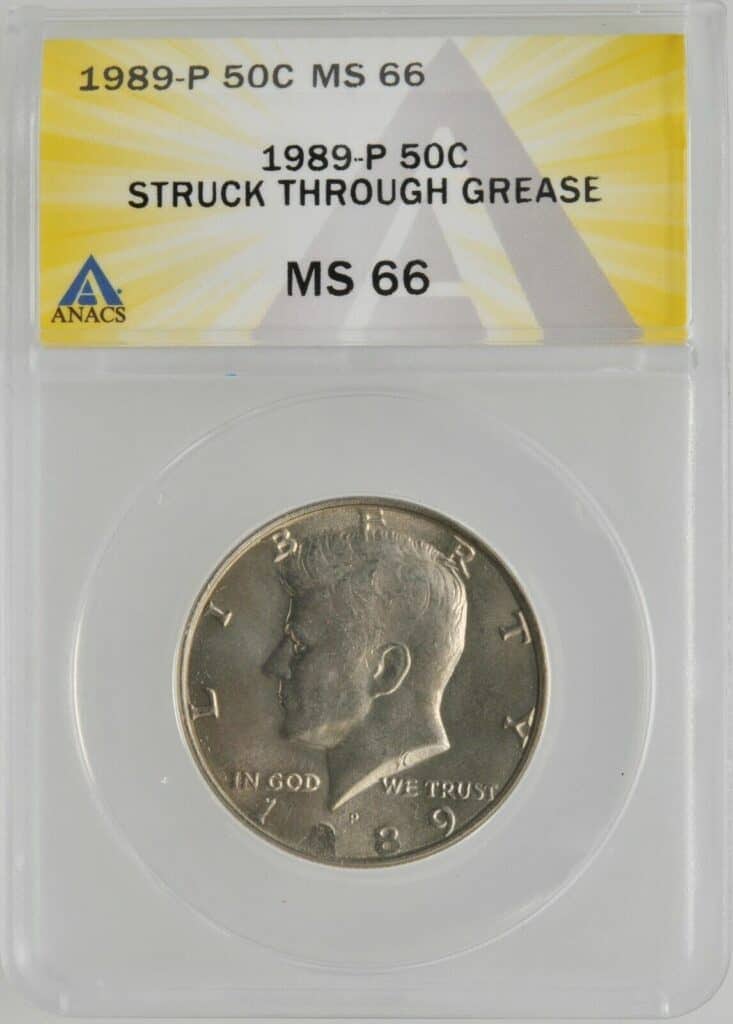
4. Struck-Through Errors
Struck-through errors occur when a foreign object — grease, cloth, wire, debris, or even a fragment of the metal cladding — becomes lodged between the die and the planchet at the moment of striking. The foreign material prevents the die from fully contacting the coin, leaving an impression of the object or a softened, obscured area in the design.
A particularly dramatic variety known as a “struck-through-clad-layer” error — where a loose fragment of the outer clad layer itself gets in the way — sold at a specialized error coin auction in early 2025 for $550. A more typical struck-through-cloth example sold for $80 on an online platform in late 2024.
5. Die Crack Errors
Die crack errors appear as small raised lines on the coin’s surface, running across the design in irregular patterns. They develop as the hardened steel die gradually fractures from the repeated stress of striking hundreds of thousands of coins.
On 1989 Kennedy halves, die cracks most commonly appear across Kennedy’s portrait or through the eagle’s wing feathers on the reverse. These errors are relatively affordable — minor die cracks add only modest premiums — but dramatic “cud” errors, where a full chunk of the die breaks away, can be significantly more valuable.
6. Misaligned / Rotated Die Errors
Rotated die errors occur when one die is mounted at an angle relative to the other, causing the obverse and reverse designs to be misaligned. On a normal coin, flipping it top-to-bottom will show the reverse right-side-up — a rotation error breaks this relationship.
Value depends entirely on the degree of rotation: a 45-degree rotation is noticeably more valuable than a minor 5- or 10-degree shift, while a full 180-degree rotation (called a “coin alignment” rather than medal alignment) is among the most desirable. Entry-level rotated die examples can be found for under $25, while dramatic rotations of 90 degrees or more in certified holders have sold for $100–$300.
Where to Sell Your 1989 Half Dollar?
The right selling venue for your 1989 Kennedy Half Dollar depends almost entirely on its condition grade, since that determines how large your potential audience is.
Certified high-grade examples — MS67 and above for business strikes, or PR70 DCAM for proofs — perform best at established numismatic auction platforms such as Heritage Auctions, Stack’s Bowers, or GreatCollections, where serious grade-focused collectors compete. Average circulated or low-to-mid-grade uncirculated coins typically do better through direct sales to local coin dealers, eBay, or coin show tables, where the transaction costs are lower and the buyer base is broader.
Check out now: Best Places To Sell Coins Online (Pros & Cons)

Coin Identifier and Value App
Not sure what your coins are worth? Get Instant Value • Grade • Error Detection with coin identifier and value app (FREE Usage Daily)
1989 Half Dollar Market Trend
Market Interest Trend Chart - 1989 Half Dollar
*Market Trend Chart showing the number of people paying attention to this coin.
FAQ About The 1989 Half Dollar
1. What is the most valuable 1989 Half Dollar ever sold?
The most valuable 1989 Half Dollar sold at auction is a 1989-P graded NGC MS68, which sold on eBay on April 16, 2022 for $3,349.97.
This represents the absolute pinnacle of grade rarity for the 1989 business strikes — MS68 examples from this year are extremely rare, and no higher grades have been certified. For comparison, a typical MS67 example sells for $275–$395, making the single-grade jump to MS68 worth nearly ten times as much.
2. How much is a circulated 1989 Half Dollar worth today?
A circulated 1989-P or 1989-D Kennedy Half Dollar is worth approximately 50–76 cents in average circulated condition — essentially face value or just slightly above.
These coins contain no silver (they are copper-nickel clad), so there is no precious metal floor value to support a higher price. Only certified mint-state examples command meaningful premiums above face value.
3. Is the 1989-P or 1989-D Half Dollar worth more?
For typical grades (MS60–MS66), the 1989-P and 1989-D values are nearly identical, ranging from about $5 to $27.
At the MS67 level and above, Philadelphia examples have shown slightly stronger auction results, with the 1989-P holding the overall record at $3,350. However, a PCGS MS67+ 1989-D brought $928.12 at GreatCollections, showing that high-plus examples from Denver can compete closely with Philadelphia at the very top grades.
4. What makes the 1989-S DCAM proof valuable, and how do I identify it?
The S mint mark on the obverse immediately identifies this as a San Francisco proof. The DCAM (Deep Cameo) designation means the coin shows strong contrast between deeply mirror-like background fields and frosty, satiny raised design elements — you can clearly see a “two-tone” effect when you tilt the coin in light.
Most 1989-S proofs that were properly stored in their original proof set packaging will already qualify for DCAM. The highest-value grade is PR70 DCAM (a perfect specimen with no marks or flaws under 5x magnification), which has sold for up to $552 historically, though recent sales have been closer to $100.
5. Can you still find 1989 Kennedy Half Dollars in circulation or coin rolls?
Finding a 1989 Kennedy half dollar through coin roll hunting is possible but uncommon. Most 1989 examples that remain are either in collector holdings, bank bags, or estate collections — not actively circulating in everyday commerce.
Some persistent coin roll hunters do report occasional finds in half-dollar rolls from banks, but this represents isolated luck rather than a reliable strategy. Your best odds are buying directly from coin dealers, at estate sales, or through online marketplaces.
6. Was 1989 the last year for Repunched Mint Mark errors on Kennedy Half Dollars?
Yes — 1989 was the final year the U.S. Mint hand-punched mint marks onto individual working dies, making it the last year RPM (Repunched Mint Mark) errors were possible on Kennedy business strikes.
Starting in 1990, mint marks were incorporated directly into the master hub, meaning all working dies from that year forward had the mint mark in exactly the same position. This historical distinction makes 1989 a meaningful boundary year for Kennedy error variety collectors.
7. Why do 1989 Half Dollar values jump so dramatically between MS67 and MS68?
The extreme value cliff between MS67 ($275–$395) and MS68 ($3,350) reflects a severe population constraint: very few 1989 Kennedy halves have ever been certified MS68 by PCGS or NGC.
The copper-nickel clad composition picks up contact marks and bag marks very easily during bulk production and handling, making flawless, mark-free surfaces statistically rare. Grading services like PCGS (Professional Coin Grading Service) and NGC (Numismatic Guaranty Corporation) grade on a 70-point Sheldon scale, and each increment at the top of that scale is exponentially harder to achieve — and therefore exponentially more valuable.
8. What 1989 Half Dollar errors should I look for, and are they worth finding?
The most valuable 1989 errors to watch for are: DDO (Doubled Die Obverse, worth up to $450 in late 2024 sales), clipped planchets (up to $350 for significant curved clips), struck-through-clad-layer errors (up to $550), and off-center strikes above 15% displacement (around $150).
Die cracks and minor rotated dies exist but carry more modest premiums — typically $10–$75 depending on severity. Always have potential errors authenticated by PCGS or NGC before buying or selling, as counterfeit or altered coins do circulate in the market.
9. Does the 1989-S proof come in a silver version?
No — the 1989-S Kennedy Half Dollar proof is copper-nickel clad only, containing no silver. The U.S. Mint did not offer silver proof Kennedy half dollars from 1971 through 1991.
Silver proof Kennedy halves were reintroduced in 1992 as part of the Silver Proof Set, and the 90% silver composition has been offered annually since then. If you want a silver proof Kennedy from the 1989 era, the closest options are the 40% silver proofs made from 1968 to 1970.
10. How do I grade my own 1989 Half Dollar before sending it to PCGS or NGC?
Start by examining the coin’s highest relief points — Kennedy’s cheek, hair above the ear, and the neck on the obverse; the eagle’s breast feathers and wing tips on the reverse. Any visible wear on these high points means the coin grades below MS60 (Mint State) and is considered circulated.
For uncirculated coins, look at the fields (flat background areas) under a single light source at an angle. The fewer contact marks and bag marks you can see, the higher the grade. Coins that look essentially perfect to the naked eye typically grade MS64 or MS65; those that require a loupe to find any flaws at all may reach MS66 or MS67. Send to PCGS or NGC for official grading if you believe your coin may grade MS67 or higher — certification adds significant credibility and market value at those grades.