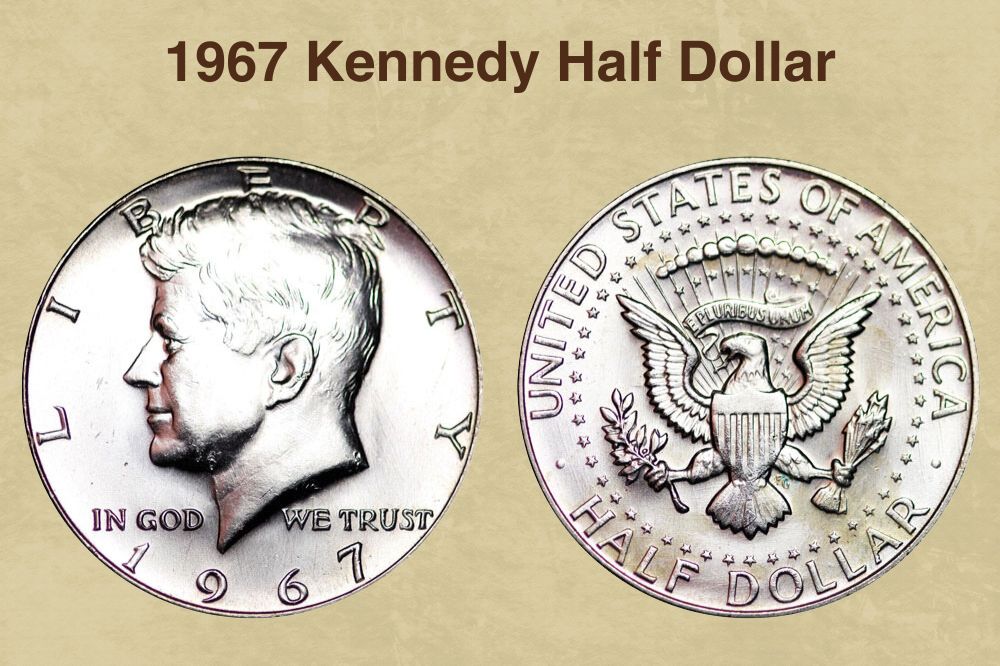
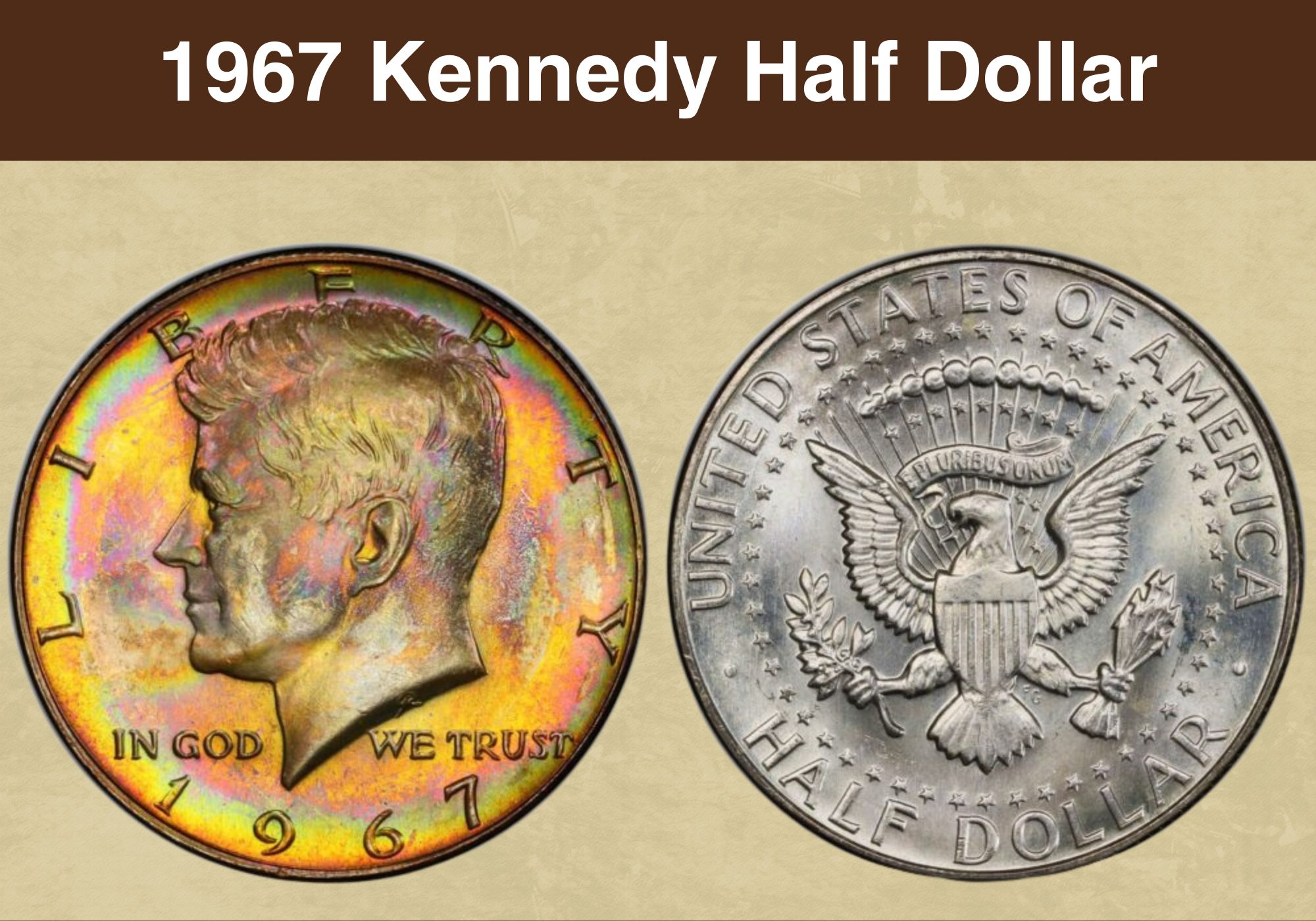
1967 Kennedy Half Dollar Value (2026 Guide): Errors List & No Mint Mark Worth

1967 Half Dollar Value

The 1967 Kennedy Half Dollar carries a deeper meaning than most people realize. It was the final year the U.S. Mint produced half dollars without a mint mark — and it was also the last year of the experimental Special Mint Set program that ran from 1965 to 1967.

Every single 1967 half dollar contains 40% silver and 60% copper, giving each coin a base silver melt value worth tracking. At silver prices of around $32 per troy ounce, each coin contains roughly 0.1479 troy ounces of pure silver, making it worth approximately $4.73 in silver alone — and more in collectible premium.

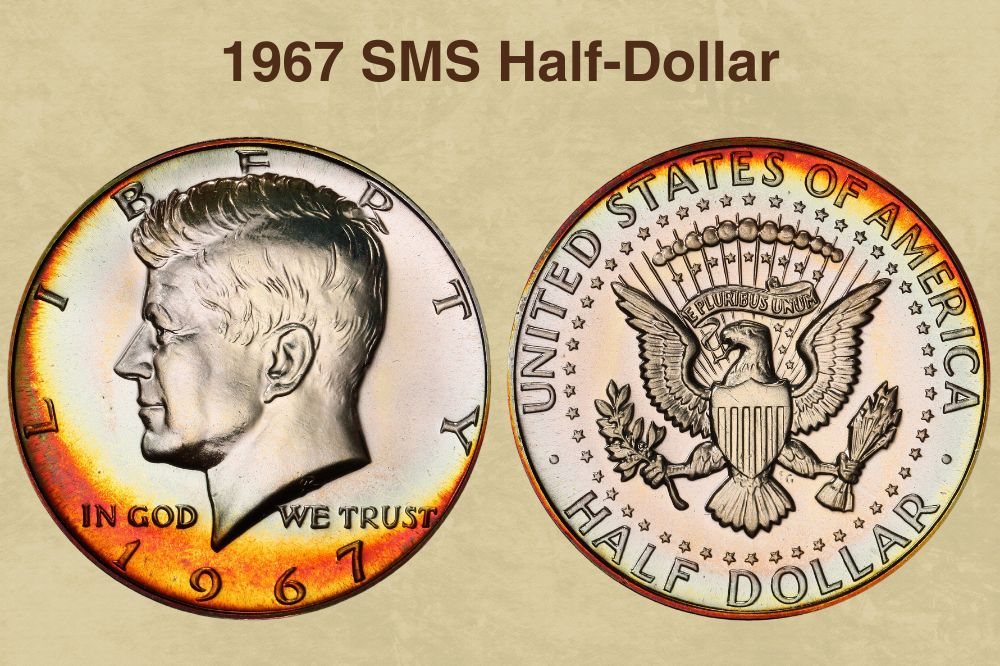
For most collectors, the real excitement starts with the Special Mint Set (SMS) coins. The top-graded SP69 Deep Cameo example sold for a record-shattering $31,200 at Heritage Auctions in January 2019 — a powerful reminder that even a coin from a 295-million-piece mintage can be an extraordinary treasure in the right grade.


1967 Half Dollar Value By Variety

The 1967 Kennedy Half Dollar comes in two main varieties: regular business strikes and Special Mint Set (SMS) coins, with SMS specimens commanding significantly higher premiums due to their superior finish and limited mintage of just 1.8 million pieces.

If you know the grade of your coin, you can find the exact price below in the Value Guides section.

1967 Half Dollar Value Chart

TYPEGOODFINEAUMSPR
1967 No Mint Mark Half Dollar Value$10.00$10.17$11.00$29.67
Updated: 2026-03-17 06:34:32

Also Read: Top 100 Most Valuable Kennedy Half Dollar Worth Money (1964 – Present)


Top 10 Most Valuable 1967 Half Dollar Worth Money

Most Valuable 1967 Half Dollar Chart

2005 - Present

The 1967 Half Dollar market shows clear value tiers based on strike type, grade, and surface contrast. SMS Deep Cameo specimens sit at the top of the rankings. The record-setting SP69 DCAM example fetched $31,200 at Heritage Auctions in January 2019, and it stands as the only NGC-certified SP69 Ultra Cameo example known — meaning no comparable coin at PCGS even exists.

For business strikes, the ceiling is an MS68 graded by PCGS that sold for $6,995 on eBay in November 2020. What makes that result even more striking is that the 40% silver-clad composition is notoriously prone to bag marks and handling damage, creating what collectors call a “superb-gem wall” at MS67. While an MS65 example trades for $45 to $85, an MS67 specimen commands $1,000 or more.

Notable error varieties including the SMS QDO FS-101 appear across all SMS finishes and show strong market performance, with DCAM examples reaching $2,585 for an SP67 grade at Heritage Auctions.


History Of The 1967 Half Dollar

The story of the 1967 Kennedy Half Dollar begins not in a mint building but in a moment of national tragedy. On November 22, 1963, President John F. Kennedy was assassinated in Dallas, Texas. Congress moved quickly, and within months approved a new half-dollar design to honor his legacy.

Gilroy Roberts designed the obverse portrait, adapting his earlier work on the Kennedy presidential medal. Frank Gasparro created the reverse, basing it on the presidential coat of arms. The coin debuted in 1964 with a 90% silver composition — and the public immediately began hoarding it as a keepsake.

The hoarding problem grew so severe that the U.S. Treasury faced a nationwide coin shortage. Congress responded with the Coinage Act of 1965 (Public Law 89-81), which did three critical things at once. It reduced the half dollar’s silver content from 90% to 40%, prohibited mint marks on all U.S. coins from 1965 through 1967, and temporarily replaced traditional Proof Sets and Mint Sets with Special Mint Sets.

By 1967, the situation was still far from normal. The Philadelphia Mint struck 295,046,978 regular circulation coins — one of the largest mintages in the Kennedy series. The SMS coins, 1,863,344 in total, were struck at the San Francisco Assay Office, which at the time did not hold official mint mark authority.

That’s why all 1967 half dollars, no matter where they were struck, carry no mint mark. A coin advertised as a “1967-D” or “1967-S” is either mislabeled or counterfeit.

One more historical note: 1967 marked the end of the Philadelphia Mint’s 174-year history of producing silver coinage for general circulation. It wouldn’t strike silver legal tender again until the 1983-P Los Angeles Olympics commemorative dollar.

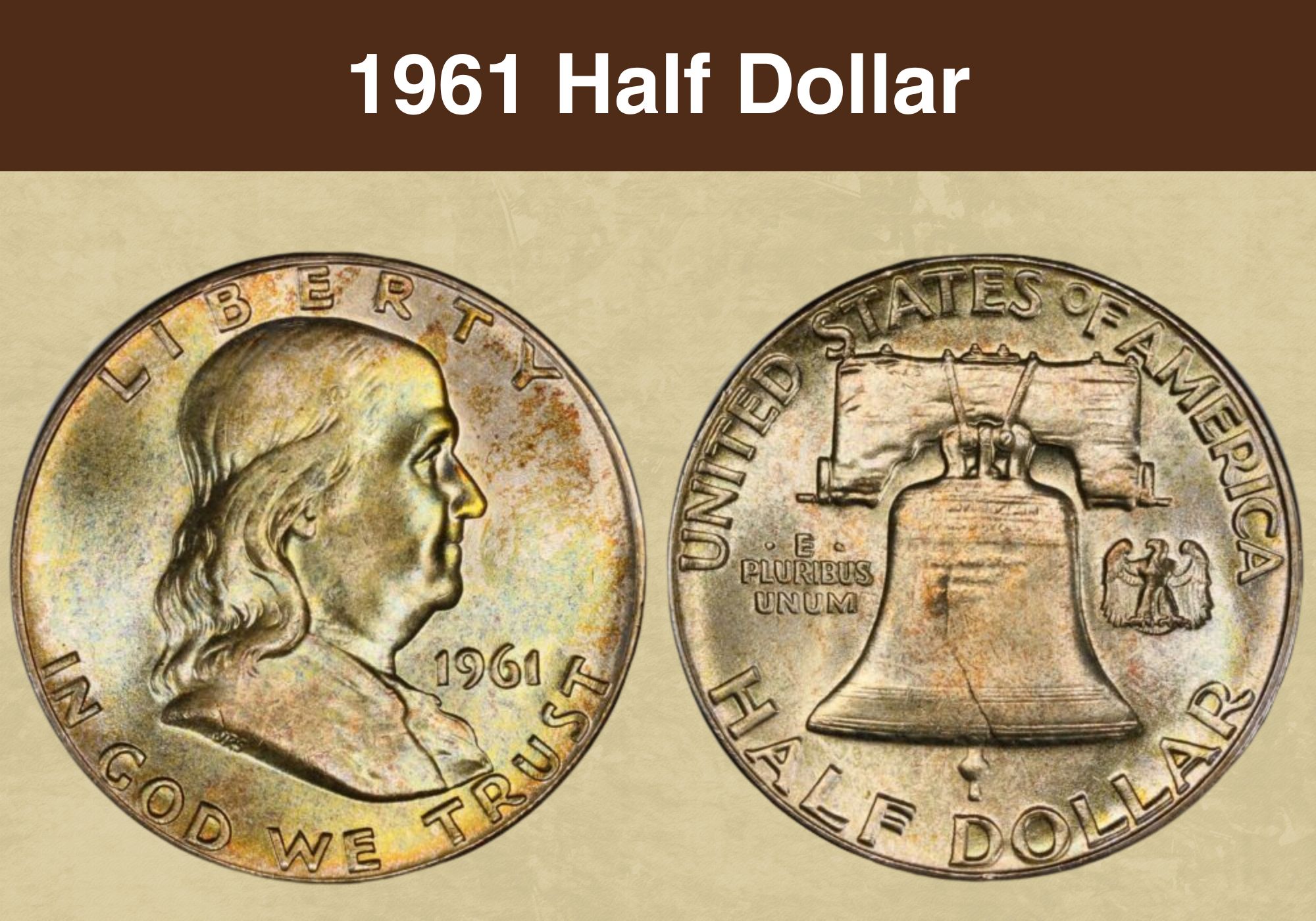
Also Read: Top 35 Most Valuable Franklin Half Dollar Worth Money (1948 – 1963)


Is Your 1967 Half Dollar Rare?

10

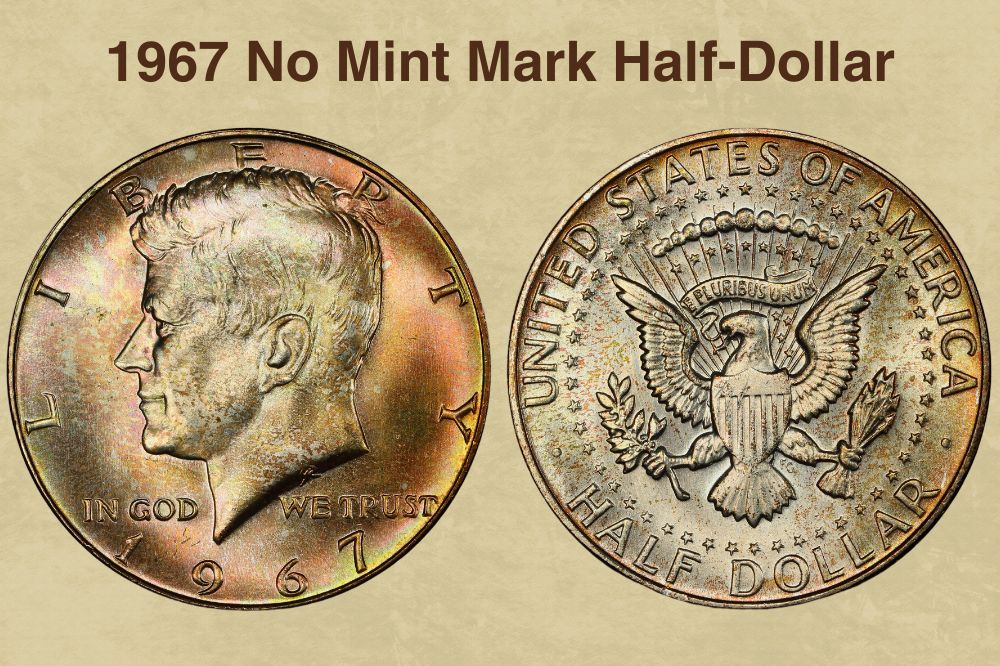
1967 No Mint Mark Half Dollar

Common
Ranked 261 in Kennedy Half Dollar

For detailed rarity assessments and updated values, try the CoinValueChecker App.


Key Features Of The 1967 Half Dollar

The 1967 Kennedy Half Dollar showcases distinctive design elements that reflect both artistic excellence and historical significance. Understanding these features helps collectors identify authentic specimens and spot potential errors more easily.

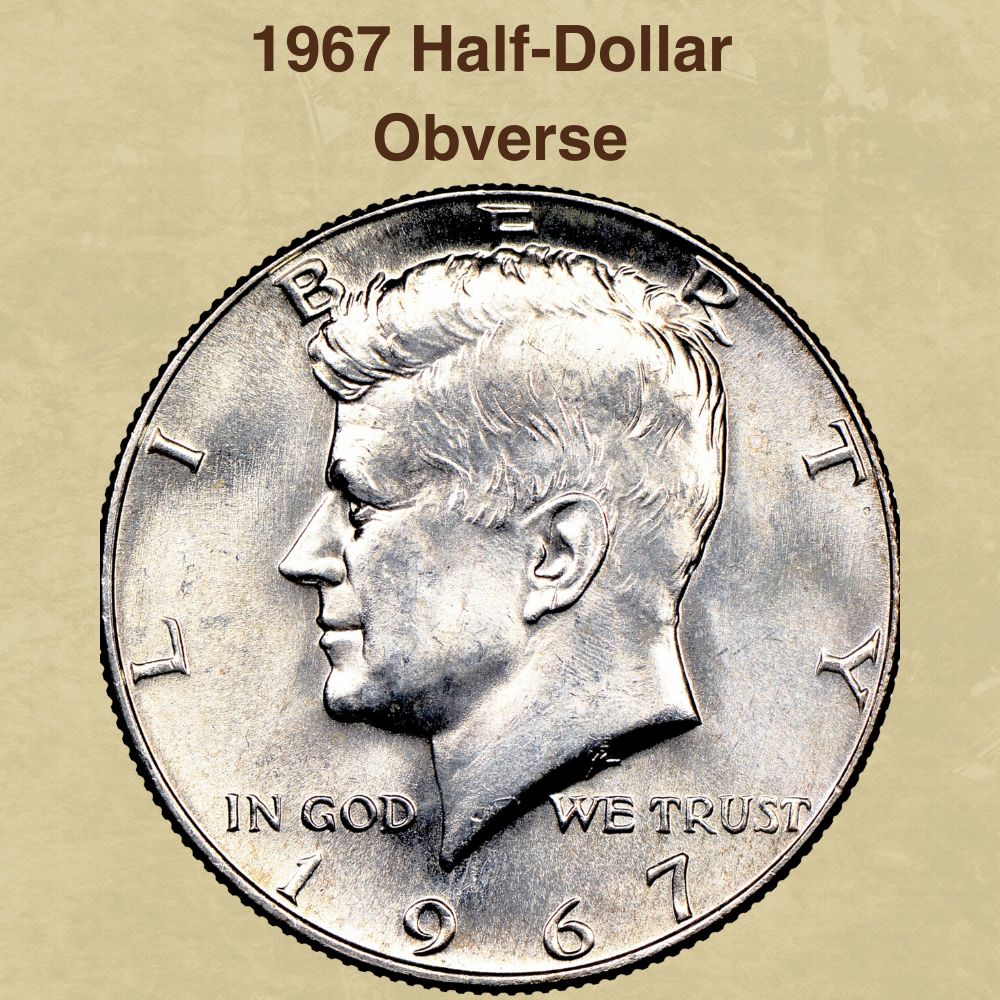
The Obverse Of The 1967 Half Dollar

The Obverse Of The 1967 Half Dollar

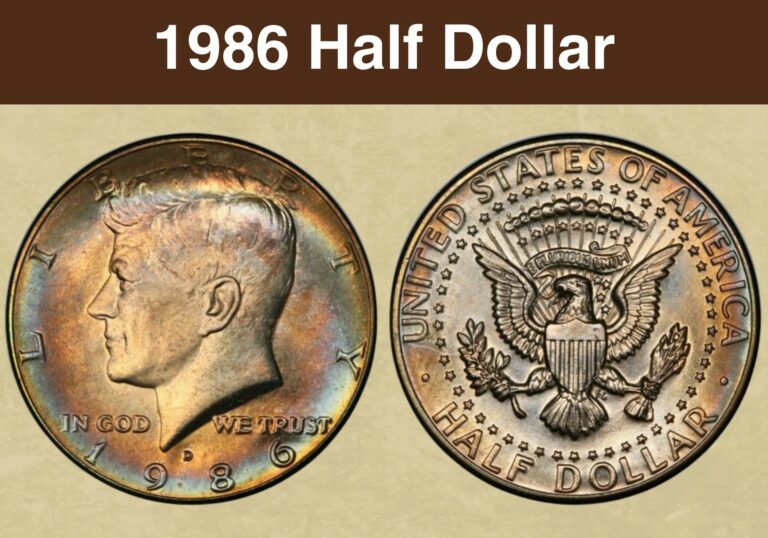
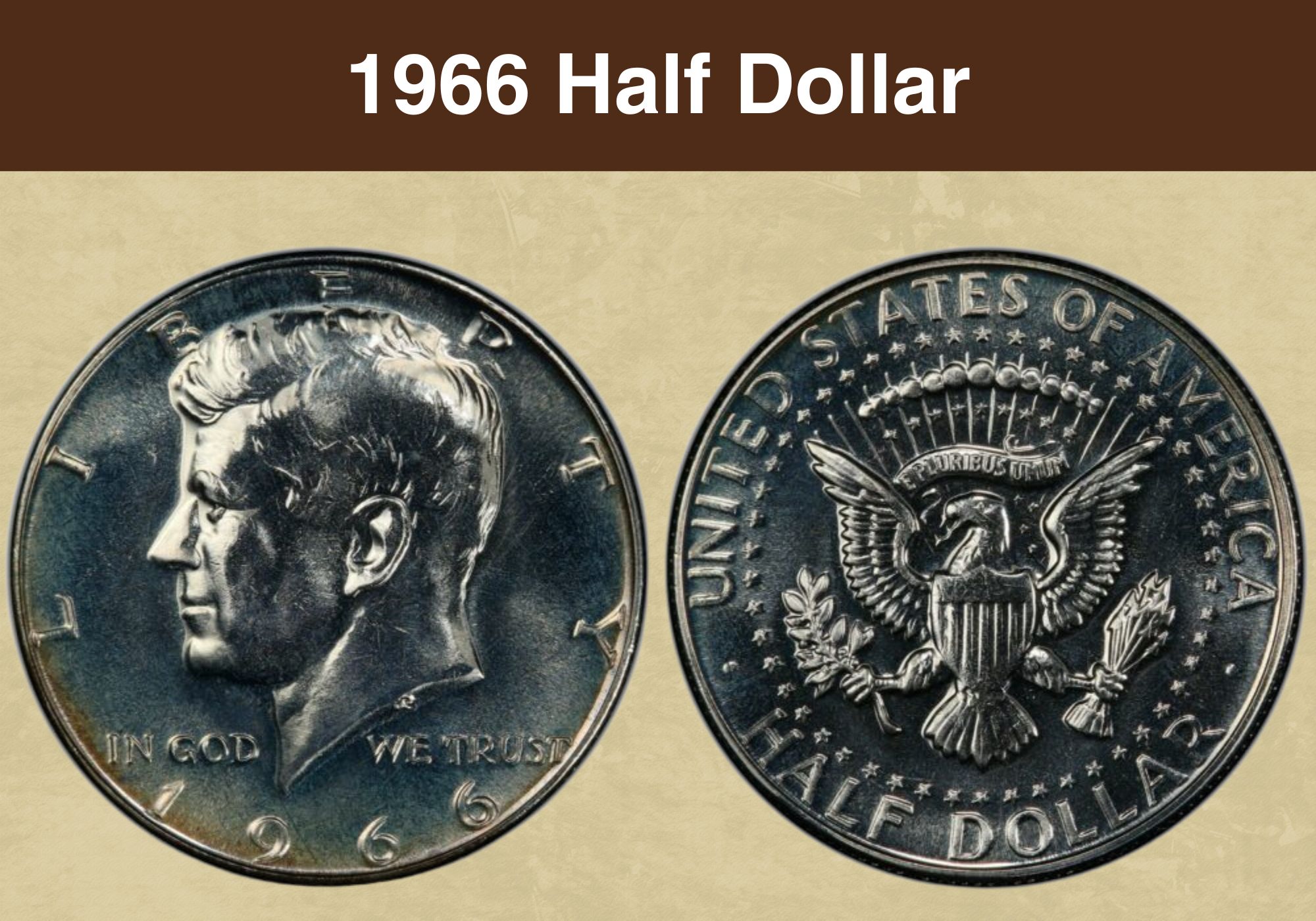
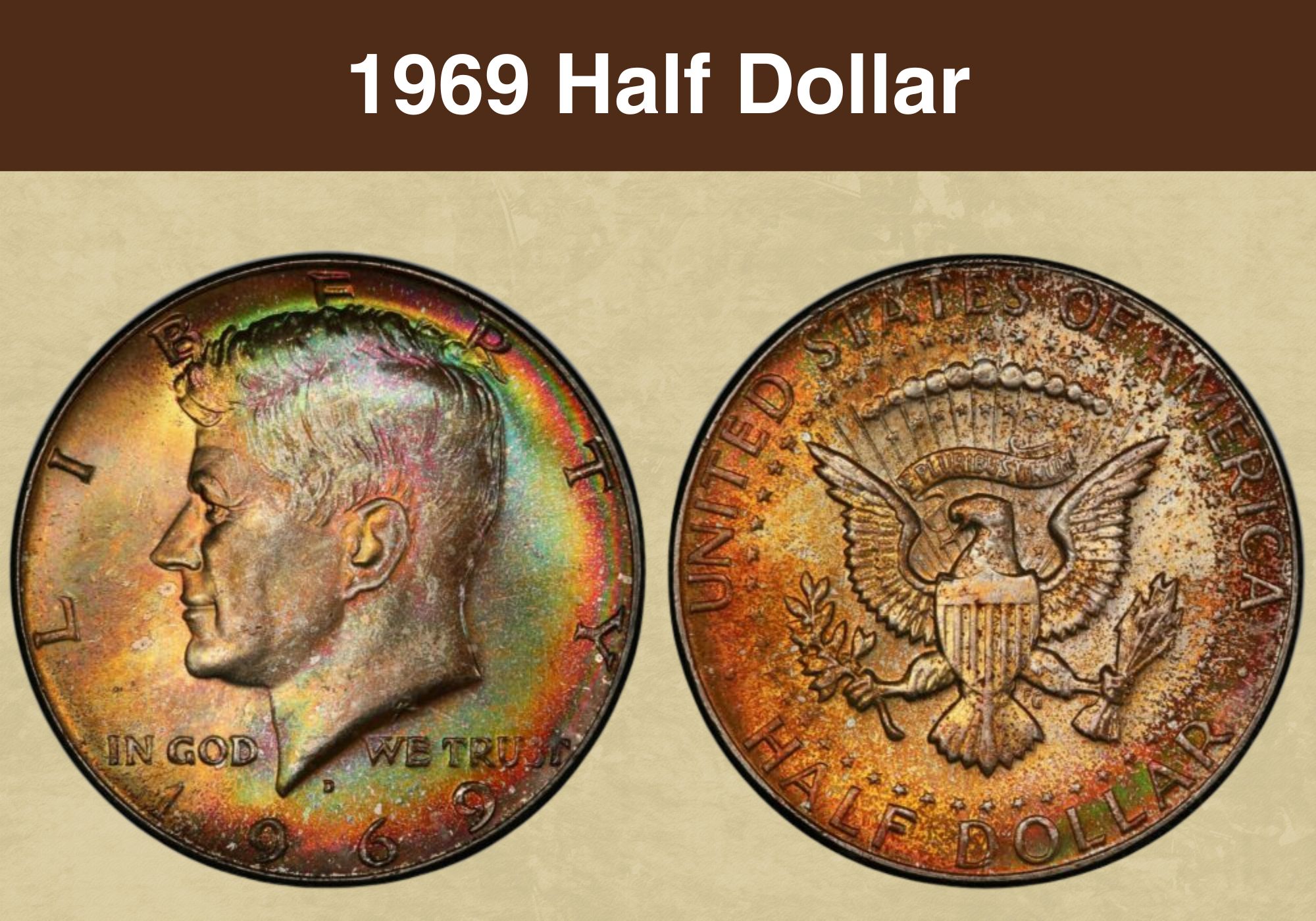
Gilroy Roberts designed the obverse with a dignified left-facing portrait of President Kennedy. The word “LIBERTY” arcs above his head, while “IN GOD WE TRUST” appears on either side of his neck. The year “1967” sits below the portrait, and — crucially — no mint mark appears anywhere on this face.

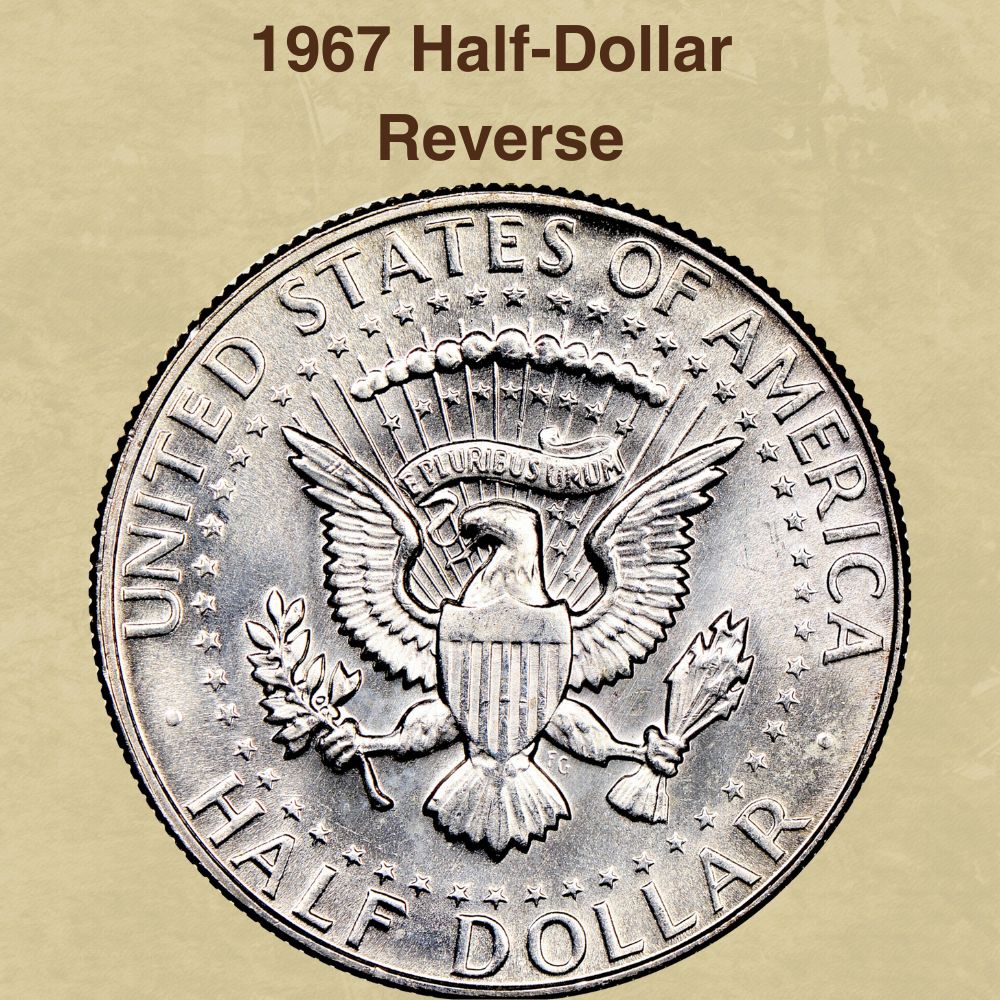
The Reverse Of The 1967 Half Dollar

The Reverse Of The 1967 Half Dollar

Frank Gasparro’s reverse depicts the Presidential Seal with a heraldic bald eagle at center. The eagle clutches an olive branch in its right talon and a bundle of arrows in its left, symbolizing both peace and readiness. Its outspread wings are framed by 13 stars representing the original colonies, and a small “E PLURIBUS UNUM” ribbon appears in the eagle’s beak.

Required inscriptions “UNITED STATES OF AMERICA” and “HALF DOLLAR” complete the reverse design. Gasparro’s initials “FG” are discreetly placed between the eagle’s leg and tail. A critical authentication note: check for “FG” because the rare FS-901 variety from related Kennedy years is known to be missing these initials, making their presence or absence a key diagnostic.

Other Features Of The 1967 Half Dollar

Each 1967 half dollar weighs 11.5 grams and measures 30.61 millimeters in diameter with a reeded edge of 150 reeds. The 40% silver, 60% copper clad composition means every coin carries 0.1479 troy ounces of pure silver. The edge check is a quick identification tool: 40% silver clad coins show a thin silver stripe between copper-colored inner layers, unlike the solid silver edge of the pre-1965 90% silver coins.

Also Read: Top 60+ Most Valuable Walking Liberty Half Dollar (1916 -1947)


1967 Half Dollar Mintage & Survival Data

1967 Half Dollar Mintage & Survival Chart

Mintage Comparison

Survival Distribution

TypeMintageSurvivalSurvival Rate
No Mint Mark295,046,978unknownunknown
SMS SP1,800,000unknownunknown
SMS CAM1,800,000unknownunknown
SMS DCAM1,800,000unknownunknown

The 1967 Kennedy Half Dollar shows a dramatic divide between its two production types. The Philadelphia Mint struck 295,046,978 regular business-strike coins for general circulation — making it one of the highest mintages in the entire Kennedy series. The San Francisco Assay Office produced 1,863,344 SMS coins sold exclusively to collectors in five-coin sets.

Most experts believe that a substantial percentage of the nearly 300 million business strikes were eventually melted down as speculation wound down and silver values shifted. This helps explain why finding examples grading MS67 or higher is far harder than the enormous mintage figure suggests. At PCGS, the grade distribution clusters mostly in the MS63 to MS65 range, with a noticeable population drop at MS66 and a steep cliff at MS67.

For SMS coins, rarity is driven not by mintage but by the percentage that achieved strong cameo contrast during striking. Standard SP specimens are relatively common within the SMS population.

CAM examples become meaningfully scarcer due to the technical challenges of achieving clear frost on the devices. DCAM specimens — requiring intense, thick frost on both sides against deeply reflective fields — represent only a tiny fraction of the 1.8 million SMS total. That scarcity drives the five-figure auction prices seen for top-grade DCAMs.

Also Read: What Half Dollars Are Worth Money?


The Easy Way to Know Your 1967 Half Dollar Value

Accurately valuing your 1967 half dollar starts with a close look under bright lighting. Check both sides for signs of wear, luster quality, and any doubling or anomalies in the lettering or design devices. For SMS coins, look for the mirror-like fields and frosted devices that signal CAM or DCAM contrast.

For a professional assessment without the hassle, use the CoinValueChecker App. Just snap photos of both sides and upload them. The app instantly analyzes your coin’s grade and provides current market values based on real-time data, helping you make informed decisions about your collection.


CoinValueChecker APP Screenshot


1967 Half Dollar Value Guides

Major Varieties of the 1967 Kennedy Half Dollar

  • 1967 No Mint Mark — Regular business strike produced at the Philadelphia Mint in massive quantities (over 295 million). Most commonly found in circulated and lower mint-state grades. High-grade specimens above MS67 are considered conditional rarities due to the coin’s vulnerability to bag marks.
  • 1967 SMS SP (Special Mint Set) — Struck at the San Francisco Assay Office with a satin-like finish sharper than regular business strikes. Total mintage of 1,863,344. These coins show squared-off rims and cleaner fields that distinguish them from Philadelphia circulation coins.
  • 1967 SMS CAM (Cameo) — An SMS coin where both the obverse and reverse display visible contrast between frosted design devices and reflective fields. Both sides must show this contrast to earn the CAM designation from PCGS or NGC. Moderately scarce within the SMS population.
  • 1967 SMS DCAM (Deep Cameo) — The top-tier SMS designation. The contrast must be intense, thick, and present on both sides — deeply reflective “black mirror” fields paired with brilliant, frosty devices. DCAM specimens represent only a small fraction of total SMS production and command the highest premiums in the series.

Note: NGC uses the term “Ultra Cameo” (UC) for what PCGS calls “Deep Cameo” (DCAM). Both terms describe the same highest level of surface contrast.


1967 No Mint Mark Half Dollar Value

1967 No Mint Mark Half Dollar Value

The 1967 No Mint Mark Kennedy Half Dollar represents the final year of the mint mark prohibition established by the Coinage Act of 1965. With 295,046,978 pieces struck, this is the largest mintage in the silver-clad Kennedy series — yet high-grade survivors are surprisingly hard to find.

The 40% silver-clad composition is particularly susceptible to bag marks and abrasions during distribution, which means most circulated and even many uncirculated pieces grade below MS65. Coins above MS67 are conditional rarities that attract serious collector competition. According to PCGS data, the grade distribution peaks in the MS63 to MS65 range, with populations dropping sharply at MS66 and falling to only a handful at MS68.

The auction record for this variety is $6,995 for a PCGS MS68 example sold on eBay in November 2020. MS67+ business strikes have also brought strong results, with specific sales at $3,840 and $4,348 recorded between 2020 and 2025. Standard MS67 specimens have sold for $1,325 to $1,800 in 2022 auction records.

1967 No Mint Mark Half Dollar Price/Grade Chart

Price by 1-70 Grade (Latest Auction Records Included)

Updated: 2026-03-17 06:34:32

Recent auction results demonstrate steady market performance with occasional premium sales for exceptional specimens across major auction platforms.

CoinVaueChecker App 10

Date PlatformPrice Grade

Market activity shows notable acceleration in recent months, indicating growing collector interest and increased trading volume.

Market activity: 1967 No Mint Mark Half Dollar


1967 SMS SP Half Dollar Value

1967 SMS SP Half Dollar Value

The 1967 SMS Kennedy Half Dollar was the final year of the three-year Special Mint Set program (1965–1967). These coins were struck on specially prepared planchets at the San Francisco Assay Office using higher-tonnage presses, producing a finish that falls between standard circulation quality and true proof quality. The result is a coin with sharper details, cleaner fields, squared-off rims, and a distinctive satin-like surface.

All SMS coins were produced on 40% silver planchets with a mintage of 1,863,344. Collectors who purchased original 1967 Special Mint Sets received five coins in a rigid plastic holder, and these complete sets currently retail for $15 to $22 in today’s market. Serious collectors often buy multiple original sets to “cherrypick” the best-contrasted examples for submission to grading services, where a single top-grade DCAM example can be worth thousands.

The auction record for the SMS SP variety is $2,400 for an SP68 example sold through Stack’s Bowers on March 25, 2020. At the August 2018 ANA coin auction in Philadelphia, Heritage also sold an SP69 DCAM for $12,600 through Stack’s Bowers.

1967 SMS SP Half Dollar Price/Grade Chart

Price by 1-70 Grade (Latest Auction Records Included)

Updated: 2026-03-17 06:34:32

The auction records show steady pricing patterns with occasional premium realizations for exceptional specimens.

Date PlatformPrice Grade


1967 SMS CAM Half Dollar Value

1967 SMS CAM Half Dollar Value

The 1967 SMS CAM (Cameo) Half Dollar is a step above the standard SMS specimen. To receive the CAM designation from PCGS or NGC (Professional Coin Grading Service / Numismatic Guaranty Corporation), a coin must display clear, visible contrast between frosted design elements and reflective fields on both the obverse and reverse. A coin with strong cameo contrast on only one side will not qualify — making this a meaningful quality threshold.

CAM examples become considerably scarcer within the SMS population because achieving consistent frost on both sides simultaneously during the striking process is a technical challenge. Not every SMS coin struck develops this contrast, and only a fraction of the 1.8 million SMS pieces ever receive this designation after submission to a grading service.

A standard SP67 SMS example trades for $42 to $70, while an SP67 CAM commands $85 to $110 — reflecting the meaningful premium collectors pay for verified contrast. At the top of the grade scale, the highest known auction result for this variety reached $3,360 for an SP69 CAM example sold at Heritage Auctions on January 3, 2018.

1967 SMS CAM Half Dollar Price/Grade Chart

Price by 1-70 Grade (Latest Auction Records Included)

Updated: 2026-03-17 06:34:32

Recent auction records show price variations across different grades, with higher-grade specimens commanding premium values at major auction houses.

Date PlatformPrice Grade


1967 SMS DCAM Half Dollar Value

1967 SMS DCAM Half Dollar Value

The 1967 SMS DCAM (Deep Cameo) Half Dollar is the crown jewel of the 1967 Kennedy series. DCAM — also called “Ultra Cameo” by NGC — requires the highest standard of contrast: intensely frosted, brilliant devices against deeply reflective “black mirror” fields, and this must be present on both sides of the coin. The strictness of this two-sided requirement is precisely what makes these coins so rare and valuable.

The pinnacle of the entire 1967 issue is the sole NGC-certified SP69 Ultra Cameo example. This coin stands alone — no comparable coin exists at PCGS at that grade level. Out of the 1,863,344 SMS coins struck, it is the finest known with cameo contrast. This remarkable rarity is what drove the record auction result of $31,200 at Heritage Auctions in January 2019.

For context on just how extreme this grade premium is: an SP68 DCAM sold for $12,600 at the Stack’s Bowers August 2018 ANA auction — and that same coin would be worth less than a tenth of the SP69 record price. The jump from SP68 to SP69 DCAM in this series represents not just a grade but a condition rarity of the highest order.

1967 SMS DCAM Half Dollar Price/Grade Chart

Price by 1-70 Grade (Latest Auction Records Included)

Updated: 2026-03-17 06:34:32

Auction records reveal consistent strong performance with premium prices maintained across major auction platforms over recent years.

Date PlatformPrice Grade

Also Read: Rare Half Dollar Coins to Look For


Rare 1967 Half Dollar Errors List

The 1967 Kennedy Half Dollar series has several documented mint errors that significantly increase collector value. These errors fall into two main categories: die variety errors (created during the die-production process) and mechanical errors (created during the striking process). Understanding the difference helps you know what you’re looking for when examining your coin.

Die variety errors are cataloged by the Fivaz-Stanton (FS) numbering system and are recognized by major grading services PCGS and NGC. These include Doubled Die Obverse (DDO), Doubled Die Reverse (DDR), and the exceptional Quintuple Die Obverse (QDO). Mechanical errors include wrong planchet strikes, struck-through errors, clipped planchets, and missing clad layer errors.

1. 1967 DDO FS-102

1967 DDO FS-102

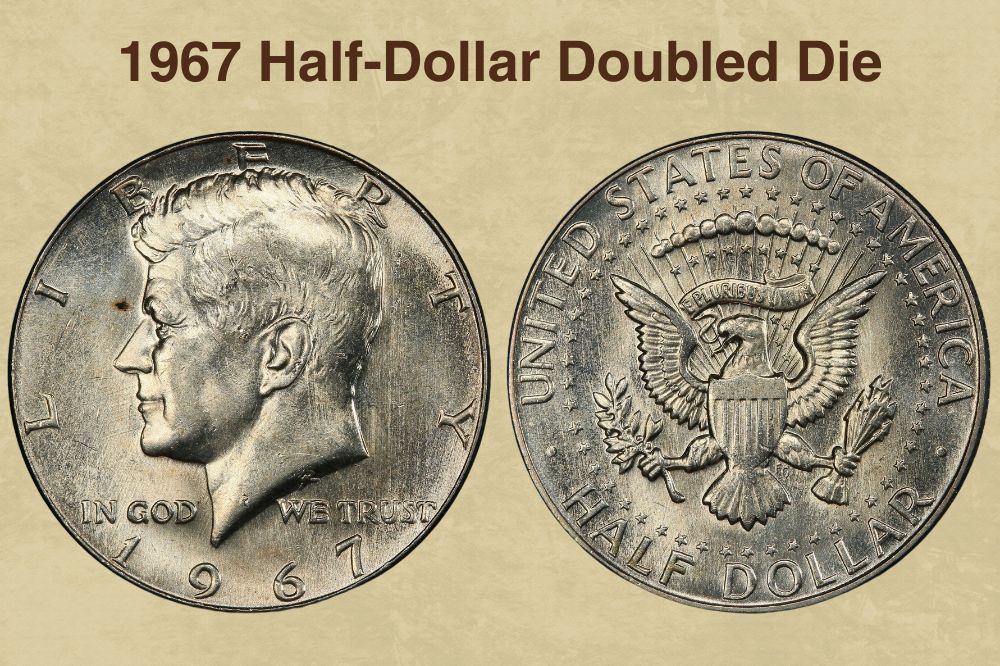
The 1967 DDO FS-102 is one of the rarest circulation-strike varieties in the entire Kennedy half dollar series. The primary diagnostic is strong tripling visible on the motto “IN GOD” — not just doubling, but three distinct impressions.

Lesser but still clear doubling is also present on the word “LIBERTY” and the “1967” date. According to a PCGS Price Guide analysis from November 2025, an MS64 example of this variety is worth 75 to 100 times more than a standard business strike in the same grade.

PCGS has certified only four examples in MS64, which is currently tied for the finest known between both PCGS and NGC — meaning no example has been graded higher by either major service. This extreme scarcity makes it a trophy variety for Kennedy half dollar specialists. The auction record stands at $2,115 for an MS64 example sold at Heritage Auctions on September 7, 2016.

1967 DDO FS-102 Price/Grade Chart

Price by 1-70 Grade (Latest Auction Records Included)

Updated: 2026-03-17 06:34:32

2. 1967 DDO FS-103

1967 DDO FS-103

The 1967 DDO FS-103 is a distinct doubled die obverse variety cataloged separately from the FS-102 due to its different diagnostic characteristics. While the FS-102 shows tripling on “IN GOD,” the FS-103 exhibits rotational spread on “IN GOD” and tripling on “RTY” in the word “LIBERTY.” These two varieties are easy to confuse unless you know which diagnostic area to examine first.

Writers Charles Morgan and Hubert Walker of PCGS have noted that the FS-103 displays very pronounced doubling in the motto and the first few letters of LIBERTY. The highest known auction result for this variety reached $309 for an AU55 example sold at Great Collections on November 23, 2014.

1967 DDO FS-103 Price/Grade Chart

Price by 1-70 Grade (Latest Auction Records Included)

Updated: 2026-03-17 06:34:32

3. 1967 DDR FS-801

1967 DDR FS-801

The 1967 DDR FS-801 (Doubled Die Reverse) is cataloged as PCGS #391391. A doubled die reverse means the reverse die received multiple impressions during its creation, leaving doubled images on every coin it struck. On this variety, look for notching of the stars above the rays and doubling throughout the reverse, including on “UNITED STATES OF AMERICA,” “HALF DOLLAR,” and details within the Presidential Seal.

This variety can be found on circulation business strikes and may also appear on SMS specimens. Well-preserved examples show the doubling with the naked eye under good lighting. Auction records confirm multiple sales in the hundreds of dollars depending on grade and the strength of visible doubling.

1967 DDR FS-801 Price/Grade Chart

Price by 1-70 Grade (Latest Auction Records Included)

Updated: 2026-03-17 06:34:32

4. 1967 SMS QDO FS-101

The 1967 SMS QDO FS-101 is the most dramatic die variety in the entire 1967 Kennedy series. QDO stands for Quintuple Die Obverse — meaning the die received five overlapping impressions during creation, creating a dramatic ghosting effect across the obverse design. This level of multiplied die error is exceptionally rare in modern U.S. coinage.

The primary diagnostics are quadruple imaging in the letters “S” and “T” in “IN GOD WE TRUST” and potential tripling under the “T” in “LIBERTY.” This error is exclusive to SMS coins and appears across all three SMS finish types: SP, CAM, and DCAM.

Auction records confirm $935 for an SP67 regular SMS, $612 for an SP67 CAM, and $2,585 for an SP67 DCAM at Heritage Auctions, demonstrating how dramatically the finish designation amplifies value for the same die variety.

1967 SMS QDO FS-101 (SP) Price/Grade Chart

Price by 1-70 Grade (Latest Auction Records Included)

Updated: 2026-03-17 06:34:32

1967 SMS QDO FS-101 (CAM) Price/Grade Chart

Price by 1-70 Grade (Latest Auction Records Included)

Updated: 2026-03-17 06:34:33

5. 1967 Half Dollar Struck on Wrong Planchet

A 1967 Kennedy Half Dollar struck on a five-cent nickel planchet is one of the most dramatic mechanical errors known for this date. When a smaller planchet accidentally enters the half dollar press, the full design cannot fit, and portions of the coin appear cut off or incomplete. These errors are instantly identifiable by their unusual weight and diameter.

A 1967 half dollar struck on a five-cent planchet sold for $2,820 in 2017 at an NGC auction. An earlier example of a similar wrong-planchet 1967 Kennedy half dollar sold for $747.50 in 2010.

A 1967 SMS half dollar struck on a quarter planchet is also documented — a particularly notable error given the extra quality control supposedly applied to SMS production.

6. 1967 Half Dollar Missing Clad Layer Error

The 1967 Kennedy Half Dollar was struck on a sandwich-composition planchet with silver-clad outer layers and a copper-nickel core. When the bonding process fails and one or both silver layers are missing, the coin looks visually different — appearing darker, thinner, or with an uneven surface on the affected side.

A 1967 Kennedy half dollar with a missing clad layer sold for $124 in 2022. These errors are identified by their lighter-than-normal weight and the exposed copper-colored core visible on the affected face.

A struck-through error — where grease or debris gets between the die and planchet — is another documented mechanical error, with recent examples selling for $80 to $400 depending on the severity and clarity of the struck-through area.


CoinVaueChecker App 10

Where to Sell Your 1967 Half Dollar?

Looking to cash in on your 1967 half dollar? Whether you’ve got a pristine SMS specimen or a circulation find, multiple selling channels await. For common circulated or lower-grade examples worth $10 to $50, local coin shops offer immediate payment but typically pay 50 to 70% of retail value.

For high-grade business strikes (MS67+), SMS DCAM specimens, or documented error varieties, major auction houses such as Heritage Auctions, Stack’s Bowers, and GreatCollections will expose your coin to thousands of serious collectors and typically achieve the strongest realized prices, though consignment fees of 10 to 15% apply. Certified PCGS or NGC coins in the $100 to $500 range also perform well on eBay.

Check out now: Best Places To Sell Coins Online (Pros & Cons) 


1967 Half Dollar Market Trend

Market Interest Trend Chart - 1967 Kennedy Half Dollar

*Market Trend Chart showing the number of people paying attention to this coin.


FAQ About The 1967 Half Dollar Value

1. How much is a 1967 half dollar worth in 2026?

A circulated 1967 half dollar is worth approximately $4.55 to $5 based on the NGC Price Guide, reflecting its 40% silver content. In uncirculated condition, expect $17 to $45 for typical MS grades.

The record high is $31,200 for the sole NGC SP69 Ultra Cameo example, sold at Heritage Auctions in January 2019. Value depends heavily on whether it’s a business strike or SMS coin, its certified grade, and surface contrast level.

2. What makes 1967 SMS half dollars more valuable than regular strikes?

SMS (Special Mint Set) varieties were struck at the San Francisco Assay Office on specially prepared planchets using higher-tonnage presses, producing sharper details, cleaner fields, and distinctive squared-off rims. Their mintage of only 1,863,344 compares to 295 million regular strikes.

Additionally, SMS coins can achieve CAM and DCAM designations based on their surface contrast — these designations dramatically increase value, with SP67 CAM worth $85 to $110 and top DCAM examples worth thousands.

3. How can I tell if my 1967 half dollar is an SMS coin or a regular strike?

Hold both coins under a strong light source at a low angle. SMS coins have sharper, more defined design details, particularly in Kennedy’s hair and the eagle’s feathers, and show squared-off, crisp rims. Business strikes have a standard “cartwheel” luster that flows in a more circular pattern.

The fields of SMS coins also tend to be cleaner and more reflective. If you see mirror-like fields with frosted devices, your coin may be a CAM or DCAM — the most valuable SMS types.

4. How can I identify if my 1967 half dollar is an error variety?

For DDO errors (FS-102 or FS-103), look for doubled or tripled impressions in the motto “IN GOD WE TRUST” and the word “LIBERTY.” For the DDR FS-801, examine the reverse inscriptions and the stars for doubling or notching.

For the QDO FS-101 (SMS only), look for quadruple ghosting in the letters “S” and “T” in “TRUST.” Use a 5x to 10x magnifying loupe and compare against reference images on PCGS CoinFacts. Any suspected variety should be authenticated by PCGS or NGC before purchase or sale.

5. Does the 1967 half dollar contain silver?

Yes — every 1967 half dollar, whether a business strike or SMS coin, contains 40% silver and 60% copper. Each coin holds 0.1479 troy ounces of pure silver. At a silver spot price of approximately $32 per troy ounce, the base silver melt value is roughly $4.73 per coin.

If silver prices rise, so does this floor value. The 1967 issue was one of the last U.S. circulating coins to contain any silver, making it part of a short window of silver-clad Kennedy halves spanning 1965 to 1970.

6. Why do no 1967-D or 1967-S half dollars exist?

The Coinage Act of 1965 (Public Law 89-81) prohibited mint marks on all U.S. circulating coins from 1965 through 1967 as a direct government response to rampant coin hoarding caused by the silver content. Every 1967 half dollar — whether struck at Philadelphia, Denver, or San Francisco — carries no mint mark.

Any coin advertised as a “1967-D” or “1967-S” is either mislabeled or counterfeit. Mint marks returned to Kennedy half dollars starting with the 1968-D issue.

7. What is the 1967 half dollar DDO FS-102 and why is it so valuable?

The DDO FS-102 (Doubled Die Obverse, Fivaz-Stanton #102) is the rarest die variety in the 1967 Kennedy series. It shows strong tripling on the motto “IN GOD,” plus doubling on “LIBERTY” and the date “1967.” PCGS has certified only four examples at MS64, which is the current finest known between both PCGS and NGC.

An MS64 example commands 75 to 100 times the value of a standard business strike at the same grade. The auction record is $2,115 at Heritage Auctions in September 2016.

8. What is the difference between DCAM and CAM on a 1967 SMS half dollar?

CAM (Cameo) means there is a clear, visible contrast between frosted raised devices and reflective fields on both the obverse and reverse — a middle tier of SMS quality. DCAM (Deep Cameo), called “Ultra Cameo” by NGC, requires the highest level: intensely thick frost on the devices against deeply reflective, almost “black mirror” fields, again on both sides.

Both designations require two-sided contrast, but DCAM demands far greater intensity. An SP67 standard SMS trades for $42 to $70; an SP67 DCAM can reach $500 or more. At the SP69 level, the only known DCAM example sold for $31,200.

9. How much is a 1967 half dollar struck on a wrong planchet worth?

Wrong planchet errors — where the half dollar die accidentally strikes a planchet meant for another denomination — are among the most dramatic and valuable 1967 Kennedy errors. A 1967 half dollar struck on a five-cent nickel planchet sold for $2,820 at an NGC auction in 2017, and an earlier example fetched $747.50 in 2010.

A 1967 SMS half dollar struck on a quarter planchet is also documented and particularly notable given the special handling SMS coins were supposed to receive. Values vary significantly based on the denomination of the planchet and the legibility of the design.

10. Should I clean my 1967 half dollar before selling it?

Never clean a coin before selling or having it graded. Cleaning — even gentle polishing — permanently removes the original surface luster and leaves microscopic hairlines that professional graders can easily detect. A cleaned coin receives a “Details” grade from PCGS or NGC, which dramatically reduces its market value compared to an original-surface example at the same grade level.

Light natural toning on an original-surface coin is far more desirable to collectors than the artificial brightness of a cleaned coin. If you believe your coin has special value, submit it to PCGS or NGC in its original, unaltered condition.

Similar Posts