Coin Value Contents Table
- 1965 Half Dollar Value Chart
- History of the 1965 Half Dollars depicting a JFK portrait
- 1965 Half Dollars Types
- Features of the 1965 Half Dollars
- Grading of the 1965 Half Dollars
- the 1965 Half Dollars Value Guides
- 1965 No Mint Mark Half Dollars Value
- 1965 SMS Half Dollars Value
- Rare 1965 Half Dollars Error List
- Where to Sell Your 1965 Kennedy Half Dollar ?
- FAQ about the 1965 Kennedy Half Dollars
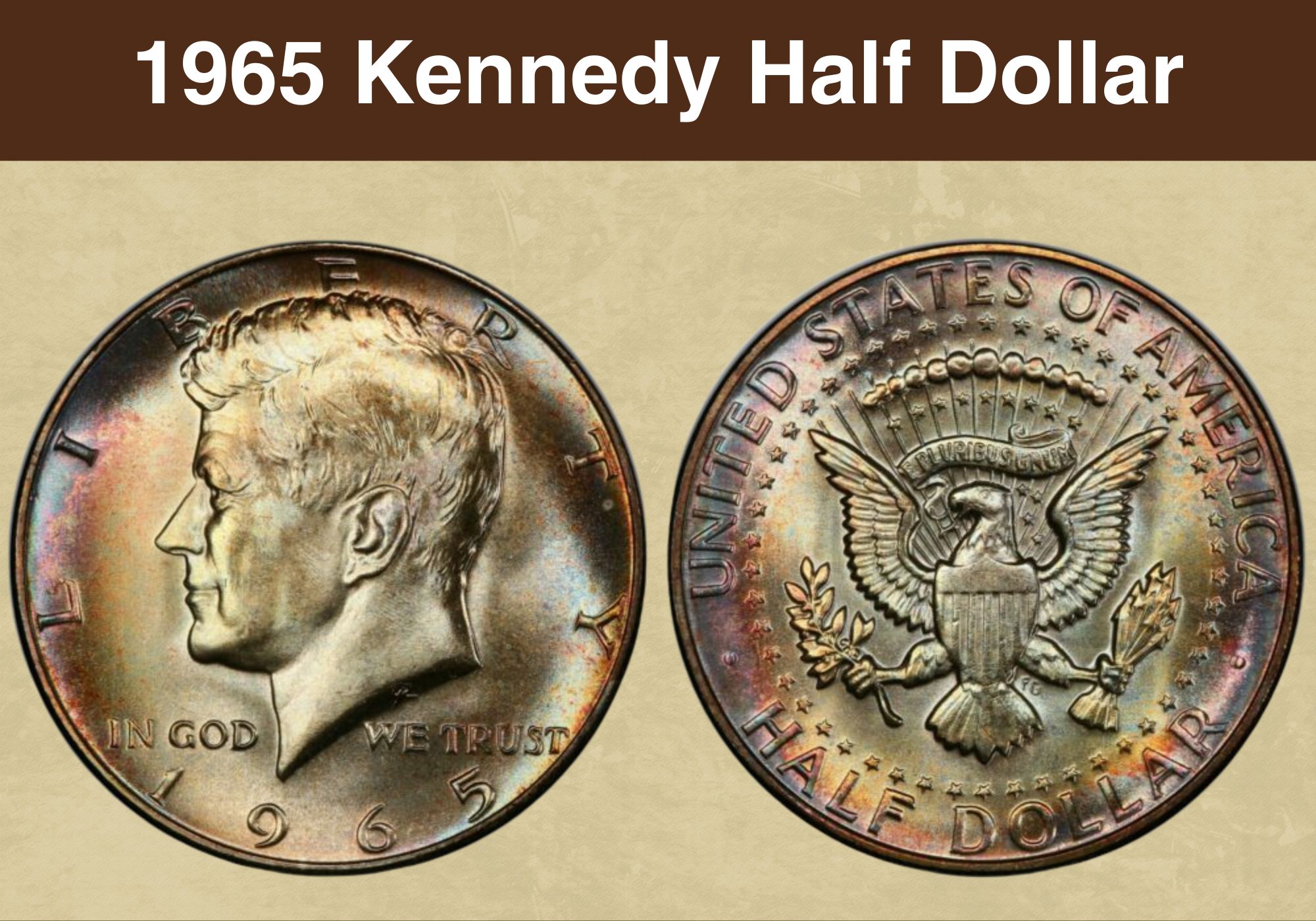
Kennedy halves are symbolic coins reminding Americans of their tragically assassinated President. Besides their market price, these pieces have sentimental value, reflecting the high demand. Most better-preserved coins can reach high prices on the current market.
In other words, the 1965 half-dollar value depends on each specimen’s condition. However, you can count on some cash even for heavily worn-out halves. Even though these coins contain only 40% silver, this precious metal has a melting value.
1965 Half Dollar Value Chart |
|
| Condition | 1965 No mint mark half dollar |
| Good | $7.76 |
| Very good | $7.76 |
| Fine | $7.76 |
| Very fine | $7.76 |
| Extra fine | $7.76 |
| AU | $7.76 |
| MS 60 | $8.73 |
| MS 63 | $87 |
History of the 1965 Half Dollars depicting a JFK portrait
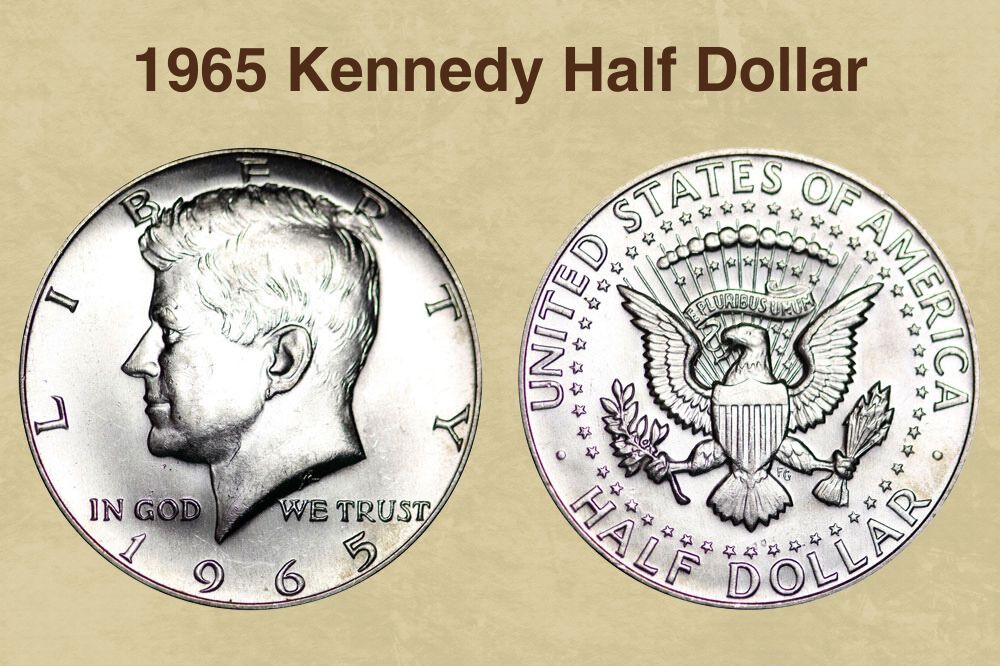
The first Half Dollars with the John F. Kennedy portrait on the obverse showed up in 1964, but 1965 was the first year with changed coin composition. Instead of the previously planned 90% silver, these silver-clad pieces contained only 40% of this precious metal.
The US Treasury and US Mint immediately organized the new coin production after President’s assassination. The initial idea was to put his profile on the quarter dollar, but Mrs. Jacqueline Kennedy didn’t want his late husband to replace George Washington.
1965 Half Dollars Types |
||
| Location | Year | Minted |
| Philadelphia | 1965 no mint mark half-dollar | 65,879,366 |
| San Francisco | 1965 SMS half-dollar | 2,360,000 |
| Total | / | 68,239,366 |
The first specimens were issued in Philadelphia on December 13, 1963, and waited for approval. While Secretary Dillon, Director Adams, and Robert Kennedy supported the offered design, Mrs. Kennedy had an objection to the hair prominence.
After correction, the first half-dollars were released into circulation on March 24, 1964. Since Americans considered these coins memorabilia, they didn’t use them in everyday transactions but kept them at home.
Banks tried to stop hoarding by selling a maximum of 40 pieces per customer, but the continued collecting forced the government to release additional coin amounts. Since this attempt also failed, the next step was reducing silver content the following year.
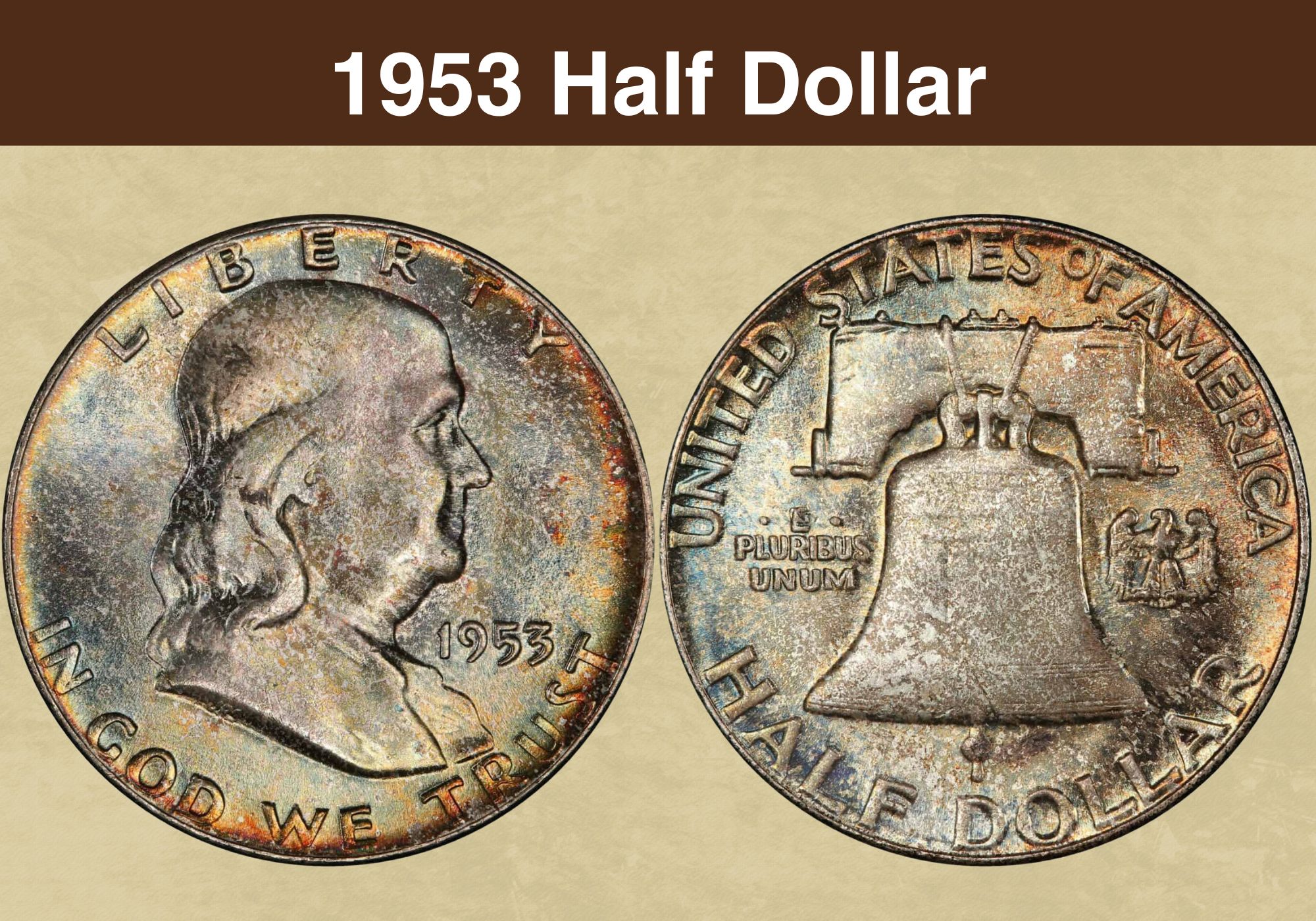
Also read: 13 Most Valuable Franklin Half Dollars Worth Money
Features of the 1965 Half Dollars
Since the plan was to release new half-dollars as soon as possible after Kennedy’s assassination, there was no time for the regular procedure of choosing the design. Therefore, two engravers, Gilroy Roberts and Frank Gasparro, used their previous work as a base for new coins.
The obverse of the 1965 Half Dollars
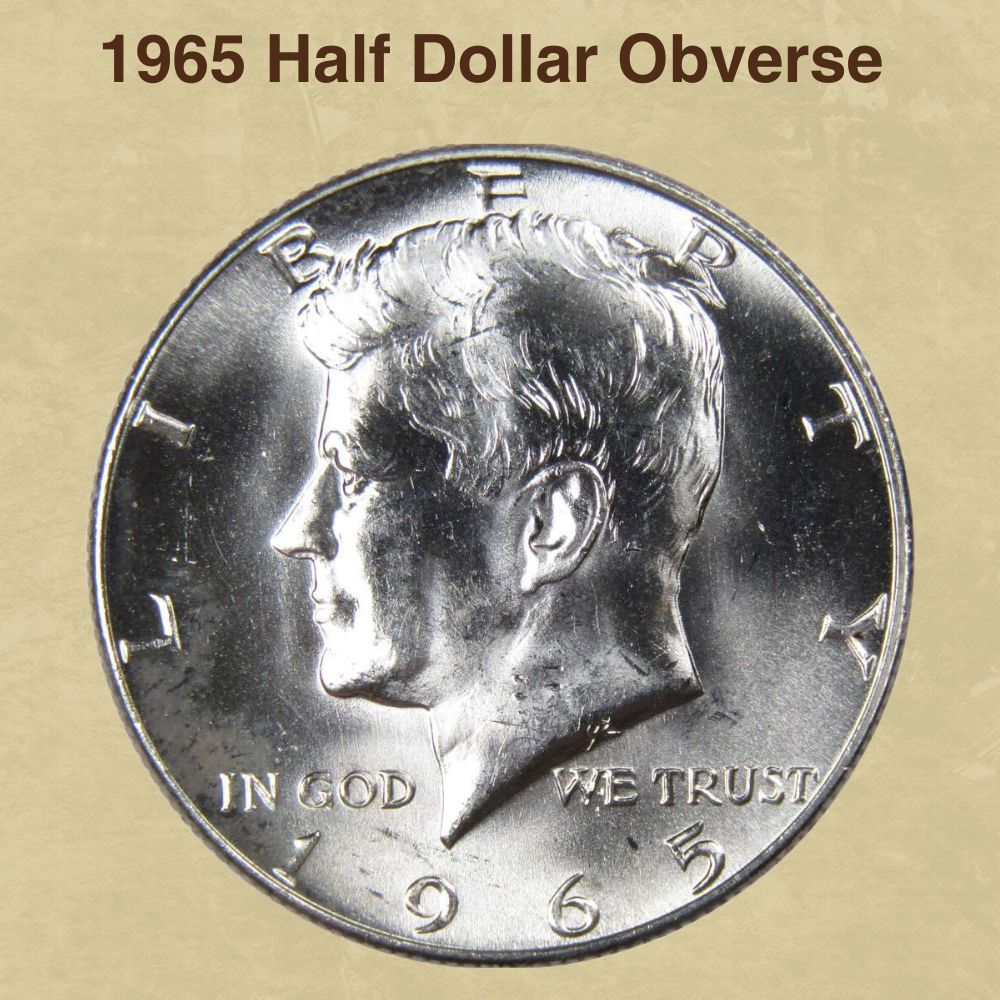
Like other Kennedy Half Dollars, those minted in 1965 depict a profile of JFK, one of the most beloved American presidents. Gilroy Roberts made this coin side concise, clear, and simple.
He added only two inscriptions, LIBERTY and IN GOD – WE TRUST, divided into two parts by the lower edge of the bust’s neck cutout. Besides, there is the date and designer initials GR hidden inside the truncation.
The reverse of the 1965 Half Dollars
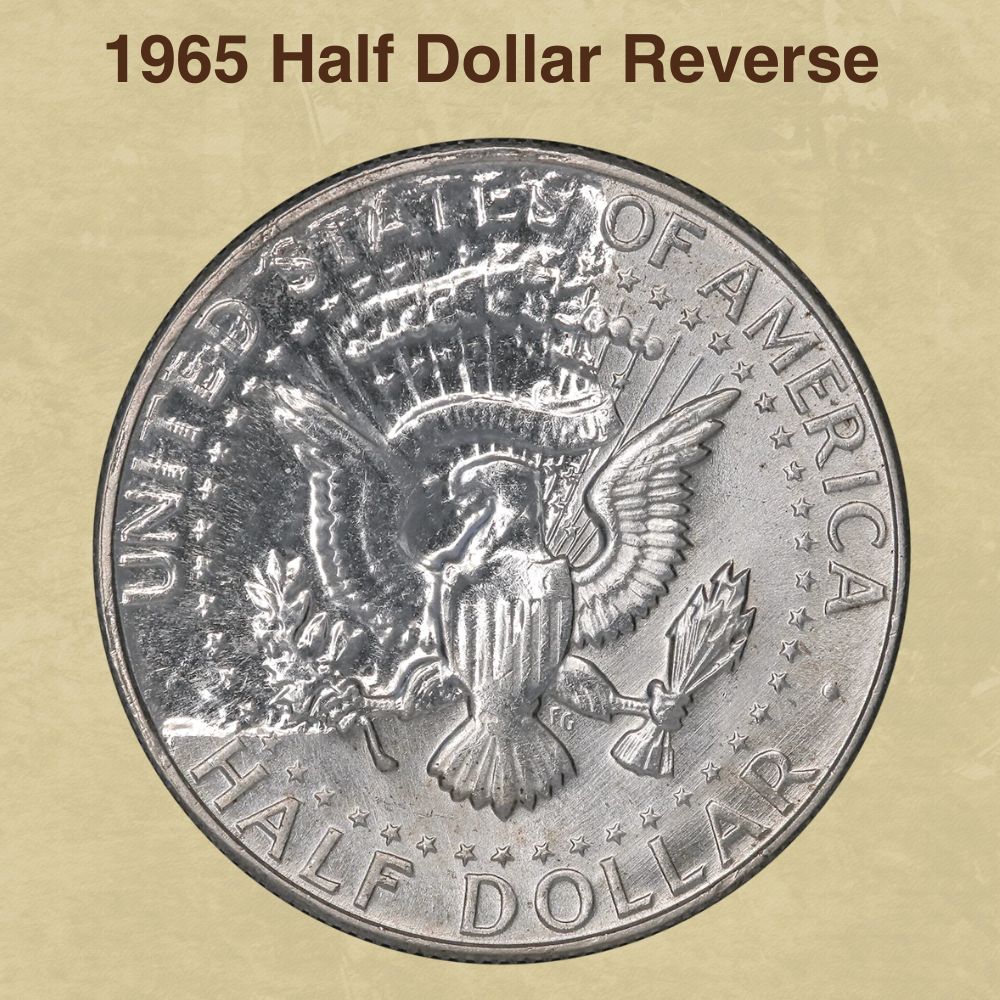
Since Frank Gasparro didn’t have time to create the original reverse for the new American half-dollar, he used one of his previous ideas for this purpose. The coin reverse includes the Seal of the US President in the center surrounded by fifty stars, representing all American states.
A bald eagle has a shield on its chest, symbolic thirteen arrows and an olive twig in its claws, and a ribbon with written E PLURIBUS UNUM in its beak. The additional 13 stars and 13 dots above the eagle’s head and 13 stripes on the shield honor the first states joining the Union by 1790.
The country name on the top and HALF DOLLAR below the eagle are struck along the rim. Finally, the designer placed his initials between the last tail feather and eagle’s leg.
1965 Half Dollars Details |
|
| Compound | Silver and copper (40%: 60%) |
| Silver weight | 0.14789 troy ounces (4.60 g) |
| Face value | Fifty cents ($0.50) |
| Coin weight | 0.36973 troy ounces (11.50 g) |
| Coin thickness | 0.08464 inches (2.15 mm) |
| Coin diameter | 1.20472 inches (30.61 mm) |
| Edge | Reeded (150 Reeds) |
| Shape | Round |
Other features of the 1965 Half Dollars
The 1965 Kennedy Half Dollars belong to the second minted set of these coins and the first one made of 40% silver. They contain 80% silver in the outer layer and 21% of this precious metal in the core. Coins weigh 0.36973 troy ounces (11.50 g), including precisely 0.14789 troy ounces (4.60 g) of silver in each piece.
You can notice a reeded edge as a measure against fraud. These reeds protect the edge surface from filing with the intention of reducing the silver weight. Only that way, all halves have a preserved diameter of 1.20472 inches (30.61 mm) and a thickness of 0.08464 inches (2.15 mm).
Also read: 13 Most Valuable Kennedy Half Dollar Worth Money
Grading of the 1965 Half Dollars
The best way for the 1965 Half Dollar value grading is to check the 70-ranking numerical Sheldon Coin Grading Scale. You can use it to evaluate your coin or to ask one of the professional services to analyze its preservation level, mint mark, attractiveness, color, and luster.
the 1965 Half Dollars Value Guides
The 1965 Kennedy Half Dollar value depends on the high mintage of 68,239,366 coins, their availability on the current market, and each piece’s appearance. Unlike halves minted the first year containing 90% silver, these are silver-clad coins with a lower value. Let’s see.
1965 No Mint Mark Half Dollars Value
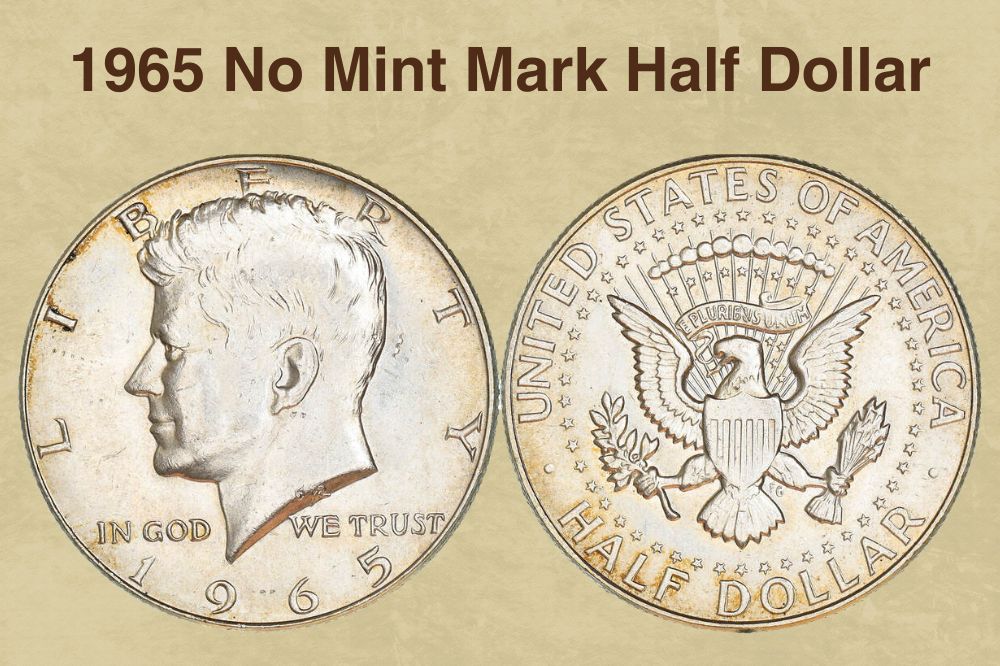
The Philadelphia mint issued 65,879,366 regular No Mint mark Kennedy Half Dollars in 1965. Their value depends on their quality but is relatively affordable for all collectors. For instance, you can buy one piece in AU grade for $4. Those in uncirculated conditions are more valuable, so you should count on the following:
- $7 for the 1965 Kennedy coin in MS 60 grade
- $8 for the 1965 Kennedy coin in MS 61 grade
- $8 for the 1965 Kennedy coin in MS 62 grade
- $10 for the 1965 Kennedy coin in MS 63 grade
- $26 for the 1965 Kennedy coin in MS 64 grade
- $55 for the 1965 Kennedy coin in MS 65 grade
- $160 for the 1965 Kennedy coin in MS 66 grade
On the other hand, the highest-ranked specimens can be pricey. While those graded MS 67 are assessed to $2,600, coins with MS 68 rank are worth about $2,500. However, one half-dollar in MS 67+ grade minted in 1965 exceeded all expectations. Its auction price was $9,000 in 2021.
1965 SMS Half Dollars Value
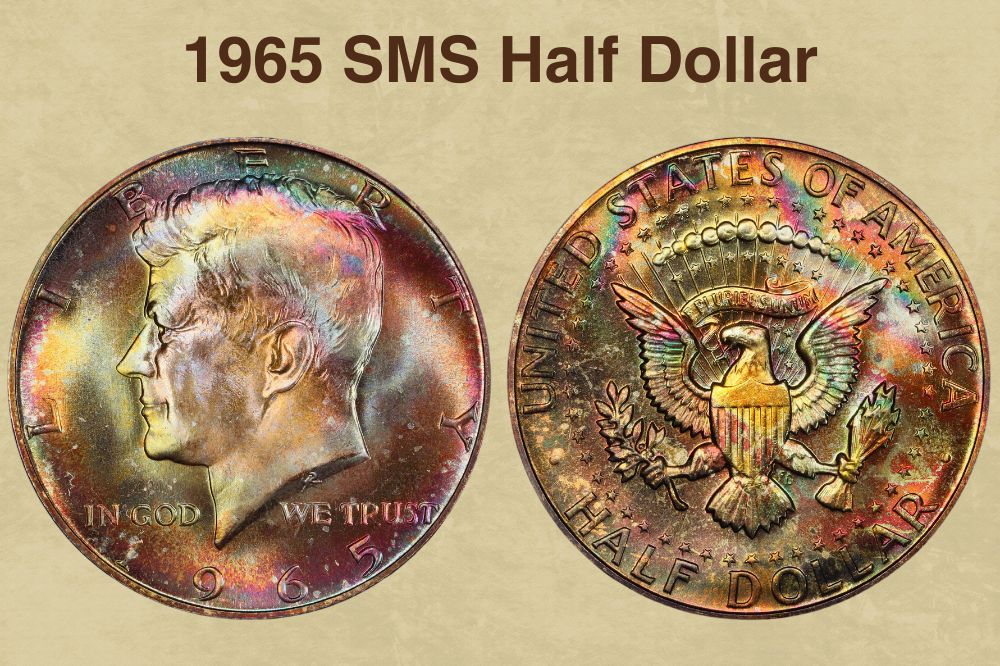
All 2,360,000 Kennedy Half Dollars issued in San Francisco in 1965 were so-called SMS coins only available in Special Mint Sets intended for collectors. Even though their quality is far under standard-proof coins, they look better than regularly struck specimens
Remember that all these SMS halves minted from 1965 to 1967 came from San Francisco but without the mint mark. That was the effort of US Mint officials to stop these coins from hoarding.
The price of these half-dollars is acceptable for most collectors because they need to pay only $4.65 to $42 per piece, depending on each coin’s quality. Besides, you can buy any specimen from SP 60 to SP 67 grade within this price range, depending on your preferences and budget.
On the other hand, SP 68-graded half-dollars have an estimated price of $175 as the priciest option. Interestingly, the SP 67-ranked specimen sold at $1,208 in 2005 is the most expensive SMS half-dollar.
Better-quality SMS half-dollars issued in 1965 are those with CAM quality. You should set aside more money to get one because:
- SP 65-graded half-dollar cost $55
- SP 66-graded half-dollar cost $125
- SP 67-graded half-dollar cost $300
- SP 68-graded half-dollar cost $2500
The best-paid 1965 SP 68 CAM coin from the set reached an impressive $3,565 at an auction in 2008.
The most collectible and expensive 1965 SMS Kennedy Half Dollars feature DCAM quality. They are available only in the highest ranks with an assessed price of:
- $575 for SP 65-graded coin
- $1,050 for SP 66-graded coin
The rare 1965 MS 67 half-dollars are estimated to be $3,250, but it was a limiting factor for one collector who bought one such piece in 2008 for $12,650.
Also read: 11 Most Valuable Half Dollars In Circulation
Rare 1965 Half Dollars Error List
Even though numerous minting errors are regular among American coinage, the 1965 Kennedy Half Dollars are known only for two. If you find a coin with one of these imperfections, you can count on an increased price because most collectors prefer error coins. In fact, some are specialized only for such imperfect pieces.
Doubled die reverse
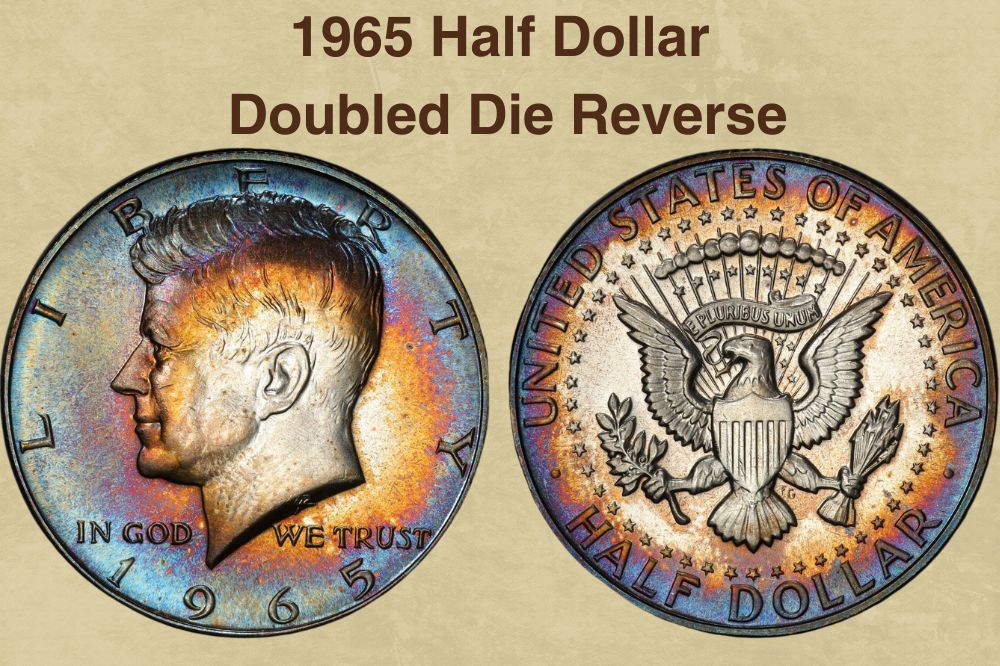
It is possible to find this error among 1965 half-dollar types from regular strikes and those intended for Special Mint Sets.
Their prices vary depending on the mint they were issued and their quality. Interestingly, regular coins with DDR error are more valuable than SMS pieces and typically cost:
- MS 63-ranked halves – $90
- MS 64-ranked halves – $110
- MS 65-ranked halves – $250
- MS 66-ranked halves – $550
The most expensive is the best-quality coin, paid $1,140 in 2018. Even though the PCGS recently estimated SP 66 halves at $450 and SP 67-ranked ones at approximately $700, their prices were far lower in the last few years. For instance, one collector needed only $282 to get an error specimen for the SMS in 2019.
Kennedy Half Dollars struck on a clad quarter planchet
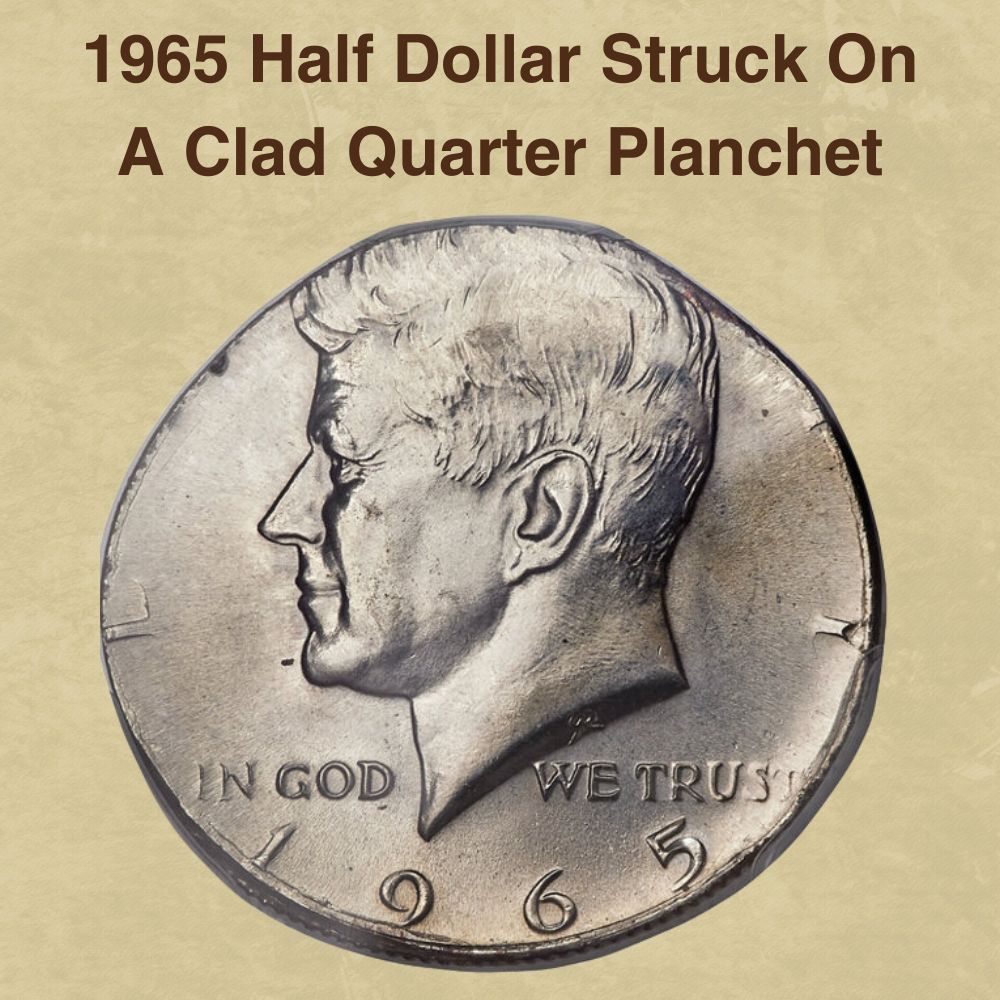
All American coins were produced of clad cupronickel planchets in 1965 except for Kennedy Half Dollars. So, a few halves were struck on the clad 25c blank, probably accidentally.
These coins have shorter diameters and are lighter than standard ones, with a sliced-off part of the word Liberty. It is known that one such error reached $975 at an auction.
Unique 1965 half-dollar containing 25% silver
Besides standard errors typical for half-dollars minted in 1965, there is also one of a kind piece with this date made of 25% silver. No one is sure how it is possible to strike such a coin when all planchets used this year contain 40% silver. It also deviates from the weight of 0.36973 troy ounces (11.5 g) standard for regular halves.
Where to Sell Your 1965 Kennedy Half Dollar ?
Now that you know the value of your coins, do you know where to sell those coins online easily? Don’t worry, I’ve compiled a list of these sites, including their introduction, pros, and cons.
Check out now: Best Places To Sell Coins Online (Pros & Cons)
FAQ about the 1965 Kennedy Half Dollars
What makes 1965 Half Dollars depicting a JFK portrait rare?
The 1965 Kennedy Half Dollars belong to the second set of these coins minted in two mints. You can recognize those from regular strikes and pieces intended for collectors. They were sold only in so-called Special Mint Sets, making them more costly. However, none of these coins is scarce.
Which 1965 Half Dollars depicting a JFK portrait are worth much money?
- The 1965 SP 67 Kennedy Half Dollar from Special Mint Set with deep cameo contrast reached $12,650 in 2008
- The 1965 MS 67+ Kennedy Half Dollar reached $9,000 in 2021
- The 1965 SP 68 Kennedy Half Dollar from Special Mint Set with cameo contrast reached $3,565 in 2008
- The 1965 SP 67 Kennedy Half Dollar from Special Mint Set reached $1,208 in 2005
- The 1965 MS 66 Kennedy Half Dollar with DDR error reached $1,140 in 2018
- The 1965 SP 66 Kennedy Half Dollar from Special Mint Set with DDR error reached $282 in 2019
How much money to set aside for the regular 1965 Half Dollars?
You can quickly find the 1965 half-dollar in AU grade for $4, while uncirculated pieces cost $4.65 to $90, depending on quality. An estimated price range for the best-preserved halves is $1,550 to $2,500, while the most expensive such coin was bought for $9,000 in 2021.
What are the most valuable Half Dollars with a Kennedy portrait on the obverse?
- 1964 SP 68 Kennedy Half Dollar – $156,000
- 1964 PR69DCAM Kennedy Half Dollar Accented Hair – $45,600
- 1967 SP 69 Kennedy Half Dollar DCAM – $31,200
- 1964 D MS 68 Kennedy Half Dollar – $22,325
- 1968 S PR 70 Kennedy Half Dollar DCAM – $21,600
- 1966 SP 68 Kennedy Half Dollar DCAM – $16,450
- 1969 D MS 67 Kennedy Half Dollar – $15,600

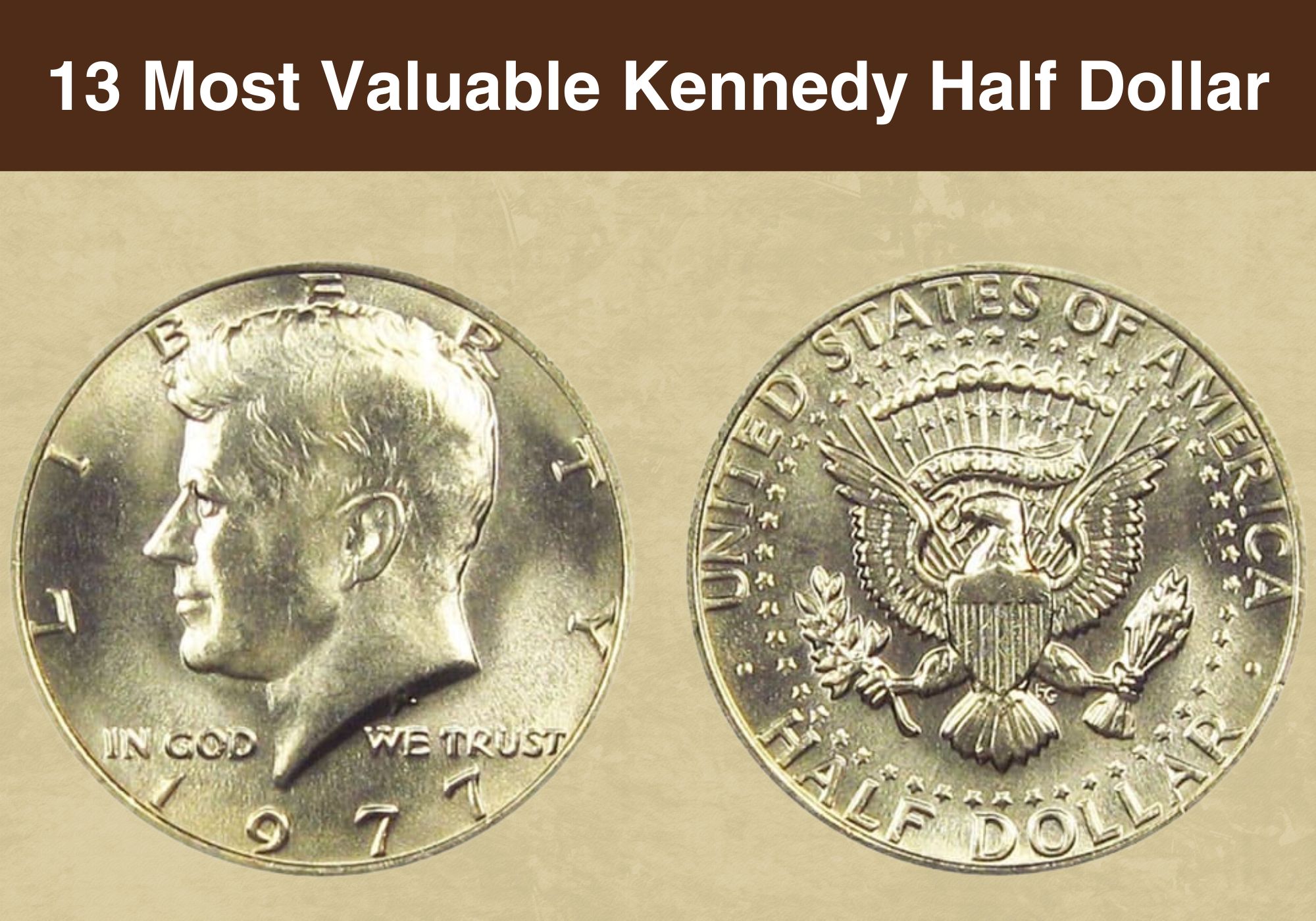
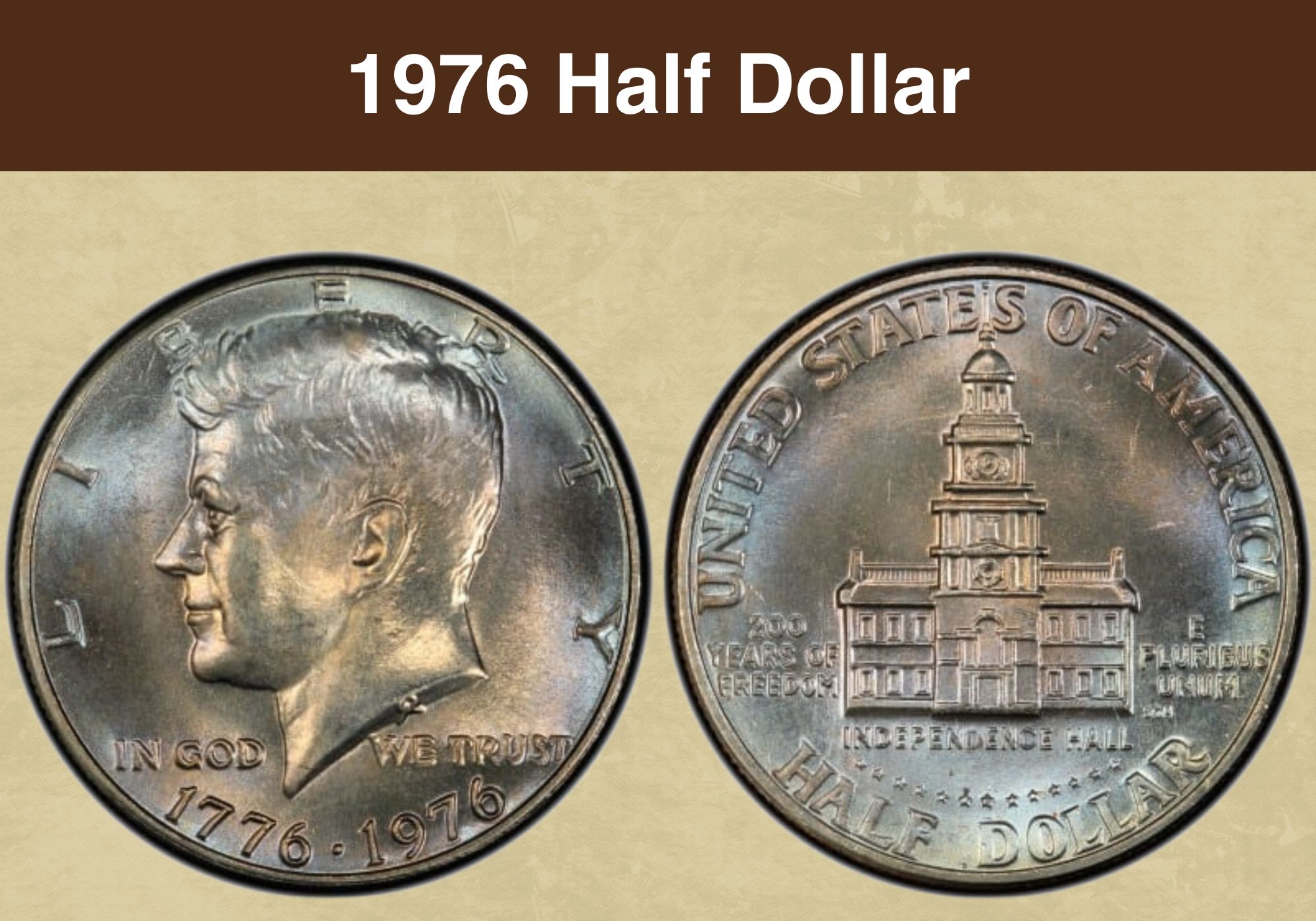
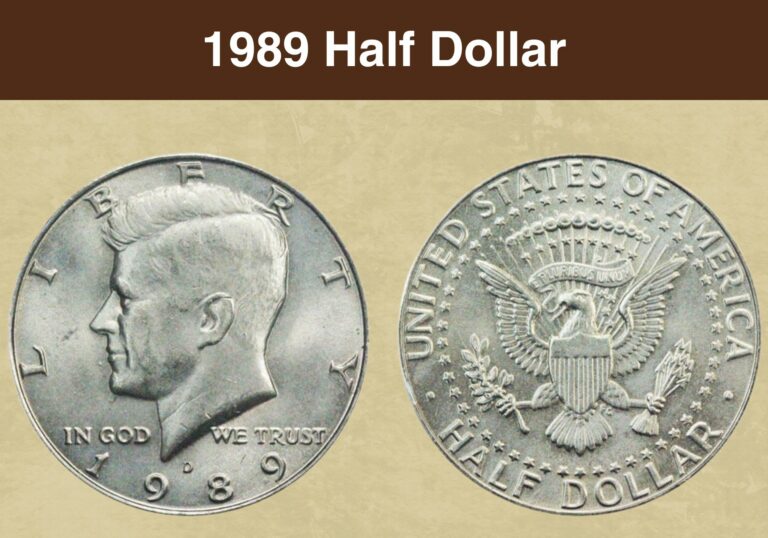
I just happen to have a 1965 Kennedy Half Dollar with a barely visible ‘P’ mint just to the upper right of the #6(further away from the bust than normal located mint marks) that I just recently discovered in my collection I’ve had for a long time.
Would that constitute it as an ‘error’ coin by most experts standards and opinions, and if not, why not, and if so, how mch could it be worth in AU condition?