Coin Value Contents Table
- 1972 penny Value Chart
- History of the 1972 Penny
- 1972 penny Types
- Features of the 1972 Lincoln Penny
- 1972 Penny Grading
- 1972 Penny Value Guides
- 1972 No Mint Mark penny value
- 1972 D Penny value
- 1972 S Penny value
- 1972 S proof Lincoln Penny value
- Rare 1972 Penny Error List
- Where to Sell Your 1972 Lincoln Penny ?
- FAQ about the 1972 Lincoln Penny Value
Memorial Lincoln cents have a very long history. Even though they are American coins with the lowest denomination, they have always attracted significant attention from collectors. Be aware that specimens from an earlier period are highly collectible and can be expensive.
On the other hand, pennies minted in later years are less attractive, making them more affordable. The best way to determine the 1972 penny value successfully is to know how to estimate each specimen. Although the condition and the mint mark are the most influential in this case, the most expensive is still error coins.
1972 penny Value Chart |
||||
| Condition | 1972 No Mint Mark penny | 1972 D penny | 1972 S penny | 1972 DDO penny |
| MS 65 | $1.16 | $1.16 | $1.16 | $674 |
| PR 65 | / | / | $1.16 | / |
History of the 1972 Penny
Lincoln pennies (Lincoln cents) first entered circulation in 1909 in honor of Abraham Lincoln’s birth 100th anniversary. They replaced Indian Head cents minted from 1859 to 1909. Victor David Brenner created this design and featured a portrait of Lincoln on the obverse and a wheat stalk on the reverse, hence the name.
This penny underwent various design changes and composition adjustments throughout its history. In 1959, Frank Gasparro changed the reverse design to feature the Lincoln Memorial. The goal was to commemorate the President’s birth 150th anniversary, while the obverse remained the same.
The penny composition also changed over the years due to increased copper value. Initially, these coins contained 95% copper, but the US Mint changed the metal ratio in 1973 to 97.5% zinc and only a small copper percentage.
1972 penny Types |
||
| Location | Year | Minted |
| Philadelphia | 1972 No Mint mark penny | 2,933,255,000 |
| Denver | 1972 D penny | 2,665,071,400 |
| San Francisco | 1972 S penny | 376,939,108 |
| San Francisco | 1972 S proof penny | 3,260,996 |
| Total | / | 5,978,526,504 |
The Lincoln cent holds historical significance as the first American coin to feature a real person on the obverse. Until then, American coinage typically depicted symbolic figures like imaginary Indian chiefs or Lady Liberty. The Lincoln penny broke this tradition and paved the way for future coins featuring historical figures.
Despite the billions of Lincoln pennies circulating, the coin remains popular with collectors and the general public. People who came across these coins from 1959 to 1972 often kept them because of their valuable copper content. Since the law has forbidden their melting, people sometimes use them for art purposes nowadays.
Also read: 12 Most Valuable Lincoln Penny Worth Money
Features of the 1972 Lincoln Penny
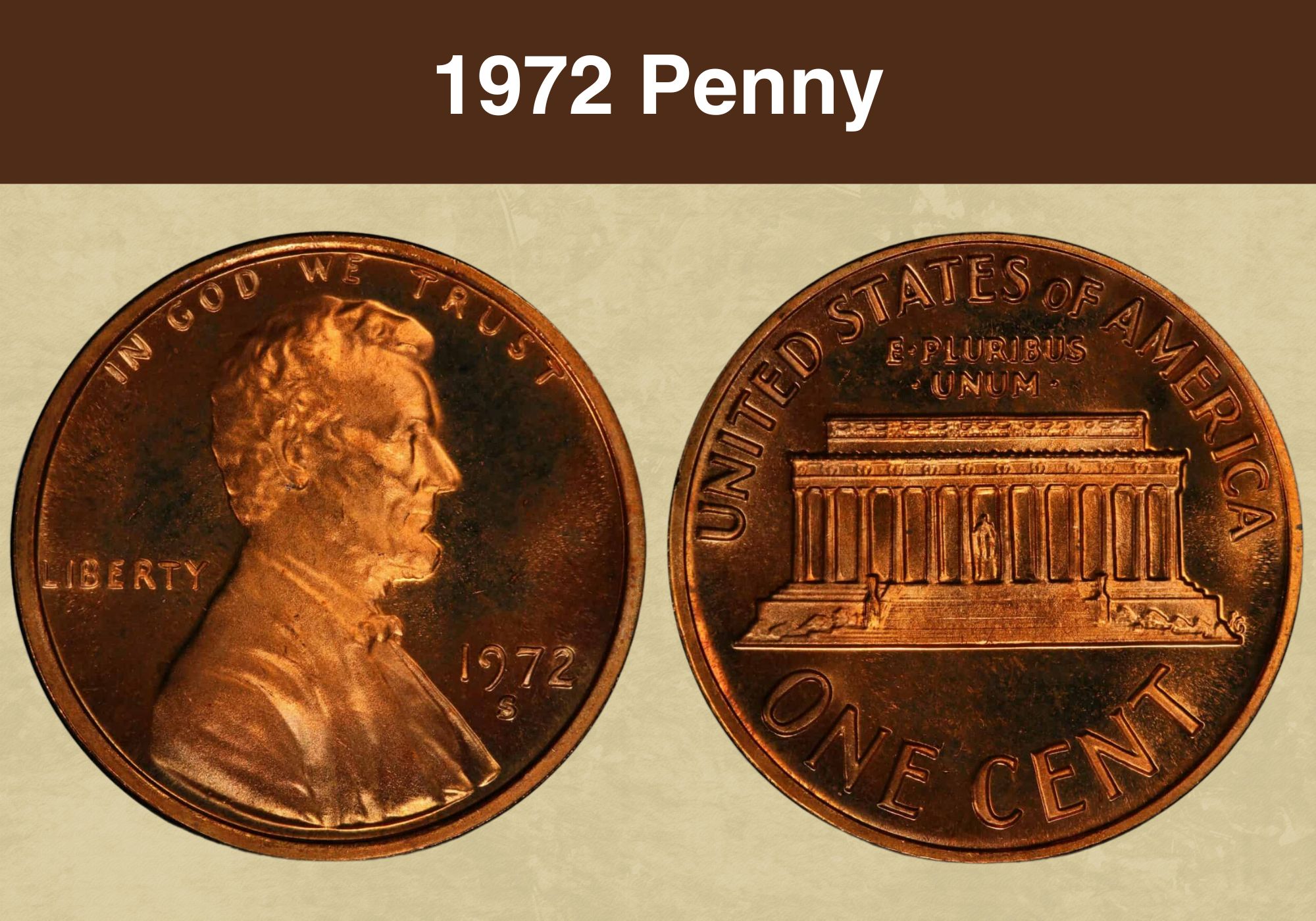
Each coin’s appearance changes periodically. The Lincoln penny era began in 1909, and the obverse appearance remained unchanged. However, the design found on the 1972 Lincoln penny reverse is more recent, dating from 1959.
The obverse of the 1972 Lincoln penny
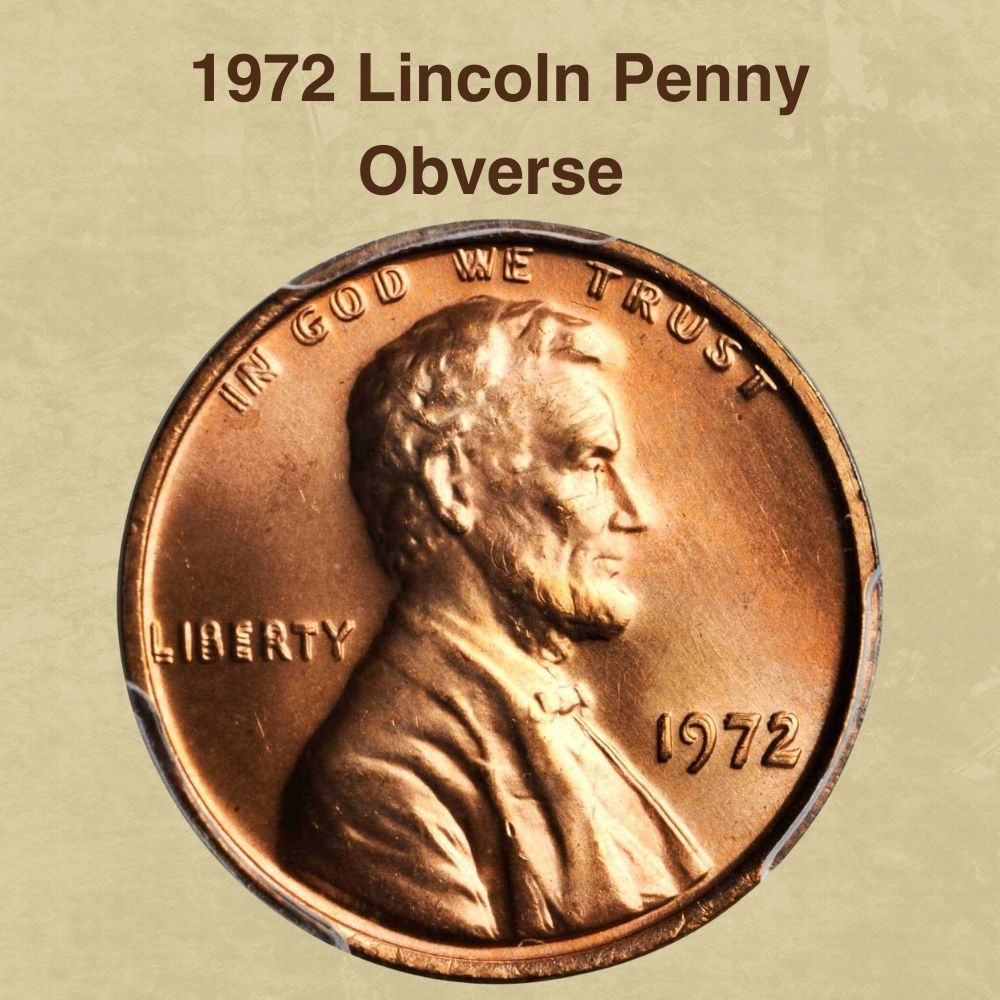
The 1972 Lincoln penny retained the same appearance as older coins from the series. Victor Brenner designed it based on a photo by Mathew Brady showing President’s profile. You can see Lincoln turned to the right, revealing an impressive beard.
You can see the minting year in front of the President’s portrait, while the LIBERTY is struck on the left. IN GOD WE TRUST, the famous American phrase, goes along the upper cent rim.
The reverse of the 1972 Lincoln penny
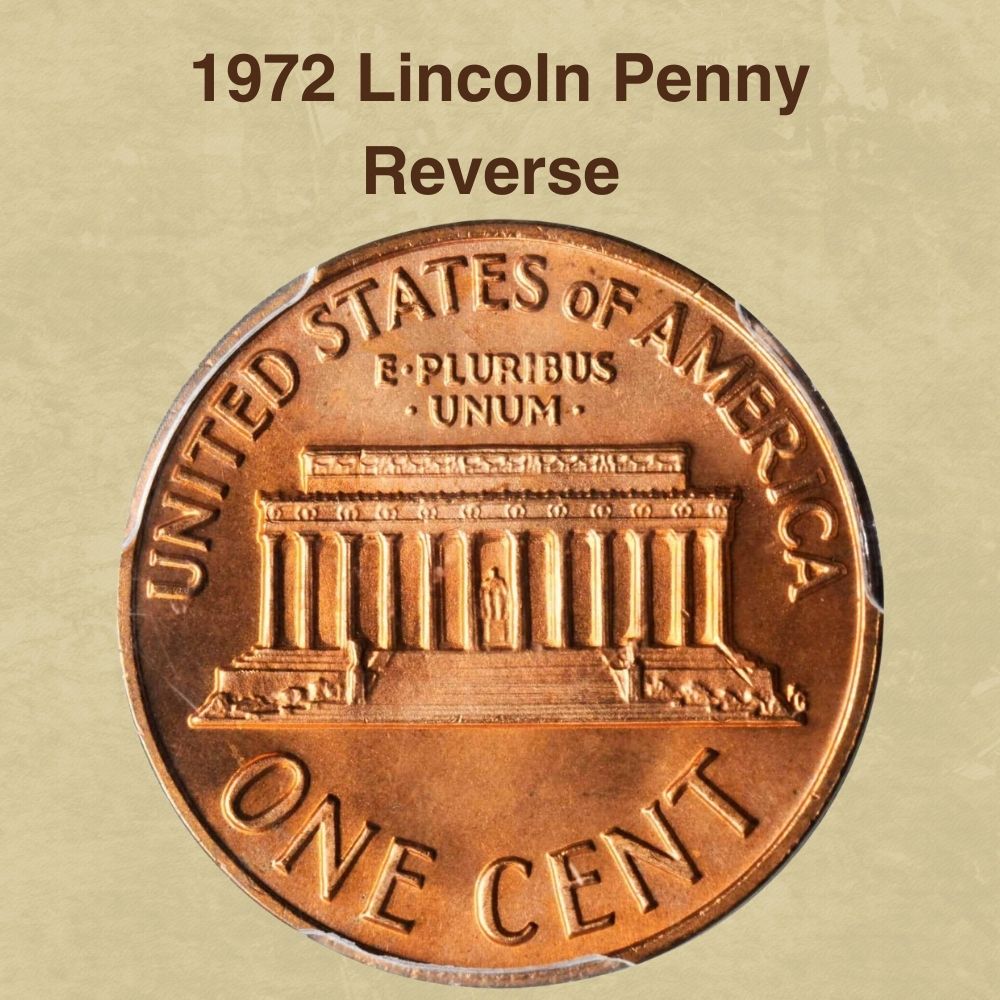
Frank Gasparro, the author of the new reverse design, chose the Lincoln Memorial as the motive for this penny side. This monument, erected in Washington, DC, was the masterpiece of architect Henry Bacon.
The Memorial structure is atypical for American culture due to its resemblance to an ancient Greek temple with twelve Doric pillars. They are all visible on the coin surface, and you can spot the Abraham Lincoln statue between the central ones.
Along the upper rim, you can see the inscription UNITED STATES OF AMERICA, while right below it is a saying – E·PLURIBUS·UNUM·. The ONE CENT denomination sits below the Memorial.
1972 Lincoln Penny Details |
|
| Face value | $0.01 (one-cent coin) |
| Compound | An alloy of 95% copper with tin or zinc (5%) |
| Coin thickness | 0.06 inches (1.5 mm) |
| Shape | Round |
| Coin diameter | 0.75 inches (19 mm) |
| Coin weight | 0.11 ounces (3.1 g) |
| Edge | Plain |
Other features of the 1972 Lincoln penny
The 1972 Lincoln penny contains 95% copper with a small amount of tin or zinc. This coin has a round shape, a plain edge, and a diameter of 0.75 inches (19 mm). Its weight and thickness are indistinguishable from other pennies minted over the years. It weighs 0.11 ounces (3.1 g) and is 0.06 inches (1.5 mm) thick.
Also read: 13 Most Valuable Wheat Penny Worth Money
1972 Penny Grading
Generally, grading coins is a serious process that determines the condition of the specimen and significantly affects its value. During the estimation, the grading company’s experts check the mint mark, coin condition, and surface tone. They typically use the Sheldon scale, ranging coins from the lowest 1 to the highest 70 scores.
| # | Grade |
|---|---|
| 1 | Basal State-1 |
| 2 | Fair |
| 3 | Very Fair |
| 4, 5, 6 | Good |
| 7, 8, 10 | Very Good |
| 12, 15 | Fine |
| 20, 30 | Very Fine |
| 40 | Extremely Fine |
| 50 | About Uncirculated |
| 60 | Mint State |
| 65 | Mint State |
| 70 | Mint State |
Please check our grading guides to know your coin scale, It’s the necessary step to know the exact value of your coin.
Check out now: How to Grade Lincoln Wheat Penny?
1972 Penny Value Guides
The US Mint minted close to 6 billion 1972 Lincoln pennies. You can distinguish four variants of this penny minted in three mints in that total circulation. As their value often doesn’t exceed their face value, it would be more profitable to melt them, but this is prohibited by law.
1972 No Mint Mark penny value
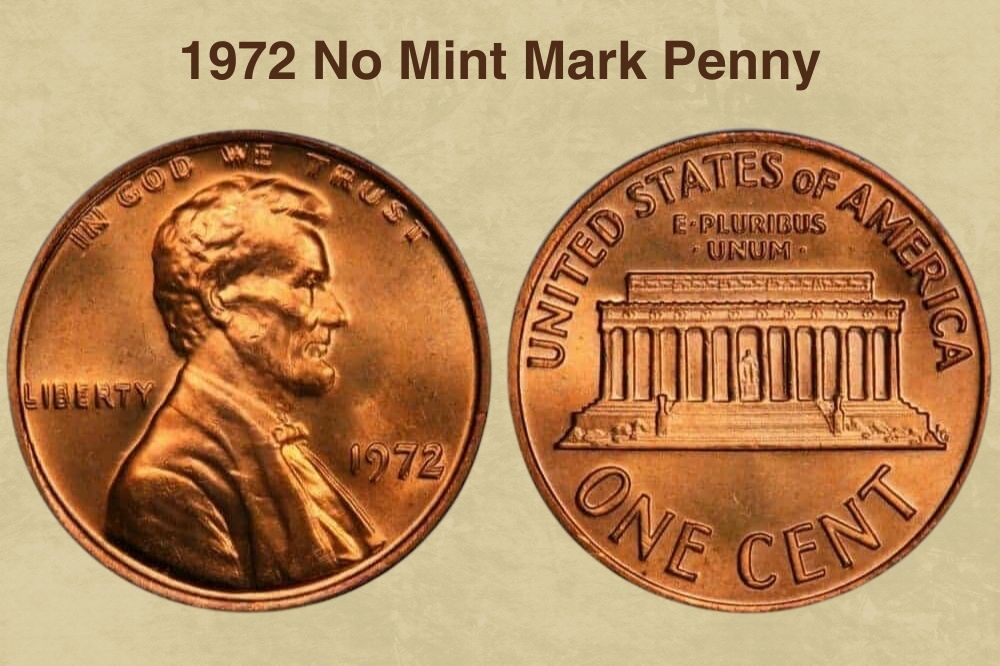
The Philadelphia mint minted 2,933,255,000 Lincoln cents in 1972, the largest mintage of that year. You can quickly distinguish them from other pennies because they don’t have the mint mark.
Most of these coins are affordable, so you can often buy circulated specimens for as little as one cent. The price of pieces in the mint state ranges from 20 cents to $155, depending on their condition.
However, several cents have achieved impressive auction records. The most expensive coin, graded MS 67 with a beautiful red tone, was sold for $3,290 in 2013. One brown penny reached $900 in 2021 on eBay, while the red-brown variety cost less. One collector bought this specimen graded MS 63 for $374 in 2008.
1972 D Penny value
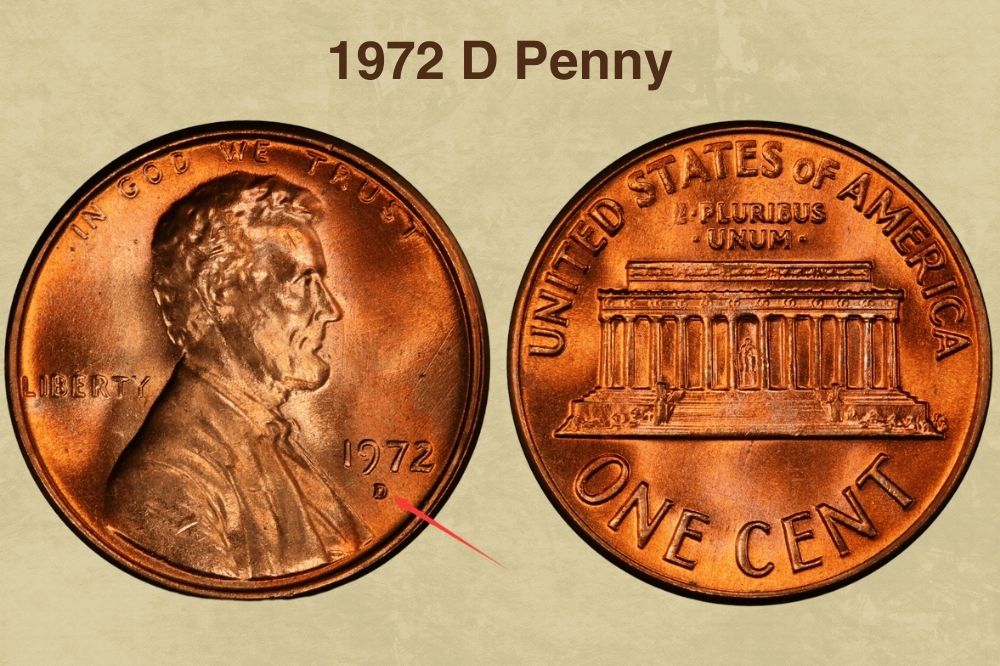
Considering the amount of mintage, the value of these coins is relatively low. Therefore, circulated coins cost only one cent, while those in the mint state are worth between 20 cents and $400.
On the other hand, auction records are significantly higher than these prices. The most expensive 1972 D Lincoln penny sold for $4,250 on eBay in 2012. The attractive red shade and high MS 67+ grade are the crucial reasons for such a high price.
One collector bought a brown 1972 D Lincoln penny on eBay in 2020 for $380, while a red-brown cent reached the lowest price of $207 in 2018.
1972 S Penny value
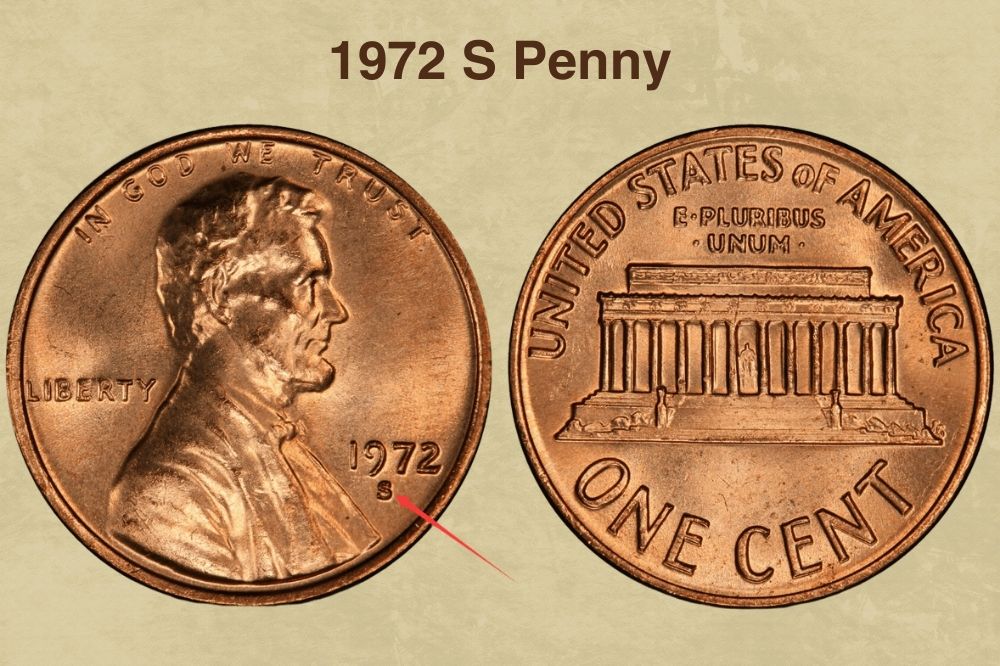
The San Francisco mint had the lowest mintage of only 376,939,108 minted pennies in 1972. You can notice the letter S, signifying the mint mark, on their obverse.
Interestingly, the low mintage doesn’t significantly affect these coins’ value. You can buy pieces in average condition for one cent, while those in the mint state are worth 20 cents to $110. However, auctions show that pennies in perfect condition can cost a lot.
For instance, one collector paid $1,955 for a red 1972 MS 67 Lincoln penny in 2007, while a piece with the same grade in brown tones cost $325. The lowest record goes to a red-brown Lincoln penny with MS 66 grade that sold for just $29 in 2018.
1972 S proof Lincoln Penny value
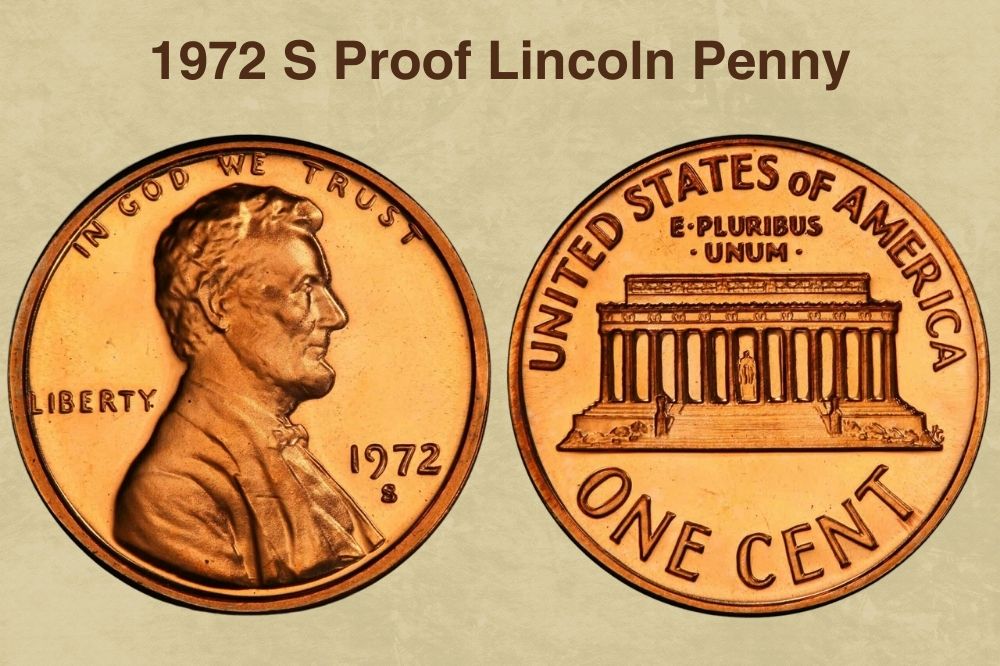
In addition to regular pennies, the mint in San Francisco struck 3,260,996 proof coins. Although being proofs, their value doesn’t differ from other cents minted this year. For instance, you can buy pieces with PR 60 to PR 63 grades for only 18 cents. Others are a bit more expensive, so you can buy one DCAM penny for:
- $0.25 for the 1972 S PR 64 penny
- $1 for the 1972 S PR 65 penny
- $3 for the 1972 S PR 66 penny
- $8 for the 1972 S PR 67 penny
- $25 for the 1972 S PR 68 penny
- $120 for the 1972 S PR 69 penny
Interestingly, prices at auctions are typically higher. The most expensive proof cent from San Francisco was the DCAM coin in PR 69 grade sold at the 2010 Heritage auction for $1,495.
Also read: 17 Most Valuable Indian Head Penny Worth Money
Rare 1972 Penny Error List
With nearly 6 billion Lincoln cents minted in 1972, it is realistic to expect specimens with errors to appear. Despite the US Mint employees’ efforts, about 20,000 pennies minted this year appeared with some kind of imperfection.
Doubled die obverse
When the dies hit the cent two or more times, you can notice the doubled obverse design. In cents minted in 1972, the most common doubling is in:
- LIBERTY
- IN GOD WE TRUST
- 1972
Although these errors are a frequent occurrence, their value is not negligible. Depending on the pennies’ color and condition, you can expect the price to range from $295 to $14,400.
Doubled die reverse
This error is similar to DDO, except the doubling is visible in inscriptions and the Memorial design on the coin reverse. These coins are less valuable than the DDO variant but are still popular among collectors.
Wrong planchet
The accidentally replaced planchet results in pennies with this error type. You can see the too-small or too-big coin for that denomination, with a different color or composition in some cases. The 1972 cent on the wrong planchet is a scarce error and can fetch you thousands of dollars.
Re-punched mint mark
When the mint mark is struck on a coin more than once, it appears duplicated. You can often spot this error with the naked eye. Lincoln pennies from 1972 with this imperfection are common in circulation, so their value is insignificant.
Also read: 11 Most Valuable Wheat Penny Errors
Where to Sell Your 1972 Lincoln Penny ?
Now that you know the value of your coins, do you know where to sell those coins online easily? Don’t worry, I’ve compiled a list of these sites, including their introduction, pros, and cons.
Check out now: Best Places To Sell Coins Online (Pros & Cons)
FAQ about the 1972 Lincoln Penny Value
What makes a 1972 Lincoln penny rare?
The 1972 pennies are unique because that was the last year of making them of the original metal alloy. After 1973, these coins were made of zinc alloy coated with copper. Except this, they are common and valuable only as a part of the series.
Which 1972 Lincoln penny is worth a lot of money?
- The 1972 MS 67+ RD DDO cent cost $14,400 in 2019
- The 1972 MS 67 RD DDO cent cost $12,925 in 2014
- The 1972 S PR EF 45 DDO cent cost $11,500 in 1997
- The 1972 D MS 67+ RD cent cost $4,250 in 2012
- The 1972 MS 67 RB DDO cent cost $4,113 in 2015
- The 1972 MS 67+ RD cent cost $3,290 in 2013
- The 1972 S MS 67 RD cent cost $1,955 in 2007
- The 1972 S PR 66 RD DDO cent cost $1,560 in 2018
- The 1972 S PR 69 DCAM cent cost or $1,495 in 2010
- The 1972 S PR 65 DCAM DDO cent cost $1,226 in 2011
- The 1972 MS 66 BN DDO cent cost $1,150 in 2008
- 1972MS 66 BN DDO BN cent cost $1,000 in 2020
- The 1972 Genuine BN cent cost $900 in 2021
- The 1972 S PR 70 cent cost $638 in 2011
- The 1972 D AU details BN cent cost $380 in 2020
- The 1972 MS 63 RB cent cost $374 in 2008
- The 1972 S PR 66 CAM DDO cent cost $372 in 2017
- The 1972 S MS 67 BN cent cost $325 in 2022
- The 1972 D RB cent cost $207 in 2018
- The 1972 S PR 69 CAM cent cost $200 in 2019
- The 1972 S PR 62 RD DDO cent cost $295 in 2019
- The 1972 S PR 69 cent cost $40 in 2021
- The 1972 S MS 66 RB cent sold for $29 in 2018
How much does 1972 No Mint mark Lincoln cent cost?
The 1972 penny value is affected by several factors, including the coin condition, availability in the coin market, and the mint mark. Most cents from circulation are worth their face value, but those in the mint state mostly cost $0.20 to $155.
What are the most costly Lincoln cents?
Pennies are 114 years old coins, so those with early dates are expectedly collectible and pricey. Interestingly, the most valuable pieces are those from the early 1940s. The top seller piece was the 1943 D MS 64 BN cent sold for $840,000 in 2021. It is followed by:
- 1943 S MS 63 BN bronze cent priced at $504,000
- 1944 S MS 66 steel cent priced at $408,000
- 1943 MS 62 BN bronze cent priced at $372,000

I have a 1972 d no fg copper penny 1936 and 1945 wheat i have dimes and nickles
i have 1972 s, 1972 d, 1972
1962 d, 1961 d, 1961
1983, 1983 d
1982, 1982 d
and more
So I got some rare old pennies that are old and miss strikes or double die or just have major errors and I’m wanting to know what can I do sell them or cash them in ? Could anyone help me figure this out
I have a 1972 D penny and on the reverse the E in E Pluribus is missing. How is this coin worth. It is circulated but in good condition.