1944 Wheat Penny Value (2026 Guide): Errors List, “D”, “S” & No Mint Mark

1944 Wheat Penny Value

The 1944 Wheat Penny is one of the most historically charged coins in American numismatics, forged from recycled battlefield copper at the height of World War II. Most examples are worth only a few cents, but a small handful of rare steel errors have sold at Heritage Auctions for as much as $408,000.

Understanding what separates a common pocket-change coin from a five- or six-figure treasure comes down to four factors: mint mark, composition, color designation, and condition grade. This guide covers all of them so you know exactly what your coin is worth in 2026.


1944 Wheat Penny Value By Variety

While most 1944 wheat pennies remain common pocket change, this value chart demonstrates how specific mint marks and exceptional preservation can elevate these shell-case coins into valuable treasures.

If you know the grade of your coin, you can find the exact price below in the Value Guides section.

1944 Wheat Penny Value Chart

TYPEGOODFINEAUMSPR
1944 No Mint Mark Wheat Penny Value (RD)$0.23$0.78$2.00$11.83
1944 No Mint Mark Steel Wheat Penny Value$5169.35$17700.37$37950.00$58566.67
1944 D Wheat Penny Value (RD)$0.28$0.94$2.41$14.71
1944 D Steel Wheat Penny Value$4567.72$15640.33$36800.00$57500.00
1944 S Wheat Penny Value (RD)$0.15$0.52$1.34$11.17
1944 S Steel Wheat Penny Value$13224.52$45282.07$115944.72$290014.96
Updated: 2026-04-07 08:22:44

Also Read: Top 100 Most Valuable Modern Pennies Worth Money (1959 – Present)


Top 10 Most Valuable 1944 Wheat Penny Worth Money

Most Valuable 1944 Wheat Penny Chart

2005 - Present

The auction data for 1944 wheat pennies tells a dramatic story, with prices ranging from around $34,500 to a record-setting $408,000 achieved by the 1944-S Steel at the Heritage Auctions ANA Signature Auction #1333 in August 2021. That sale shattered the previous record of $373,750 set for the same coin in 2008, demonstrating how rapidly collector demand for the finest examples has accelerated.

The steel varieties dominate the top of the chart because production in 1944 was supposed to use copper-zinc alloy exclusively — any steel coins that exist are accidental survivors from leftover 1943 planchets. San Francisco specimens consistently outprice their Philadelphia and Denver counterparts, while condition grade creates exponential price differences even within the same variety.

The Simpson Collection — a legendary private numismatic holding — contributed several benchmark auction results for 1944 steel cents, including the Philadelphia Mint MS64 example that sold for $158,625 in 2013 and the Denver Mint MS63 that fetched $115,000 in 2007. These sales established the pricing ceiling that today’s market continues to reference.

Also Read: Value Of Old Pennies By Year (1959-Present)


History of the 1944 Wheat Penny

The 1944 wheat penny represents one of the most documented pivots in U.S. Mint history — a triumphant return to copper coinage after the deeply unpopular steel cents of 1943. Those wartime steel pennies rusted quickly, confused vending machines (which used magnets to reject counterfeit slugs and accidentally rejected the legitimate steel coins too), and were routinely mistaken for dimes, prompting widespread public complaints.

In December 1943 congressional testimony, Assistant Director of the Mint Leland Howard officially confirmed the plan: “The War Production Board has granted us sufficient virgin copper and shell casings to resume production of a copper-hued cent on January 1.” Numismatic historian Roger W. Burdette later verified in National Archives records that spent artillery shell casings were delivered by the wagonload to the Philadelphia Mint for smelting into coin metal.

The 1944 composition differed subtly from pre-war pennies. Between 1944 and 1946, tin was removed from the alloy because it had become scarce, leaving these coins at 95% copper and 5% zinc — technically brass rather than bronze, though the change is invisible to the naked eye.

That year, the three U.S. Mint facilities collectively struck over 2.1 billion cents, setting a record that stood for decades: approximately 1,435,000,000 at Philadelphia, 430,578,000 at Denver (D), and 282,760,000 at San Francisco (S). This was the first time in history that a single mint facility — Philadelphia — surpassed one billion coins in a single year.

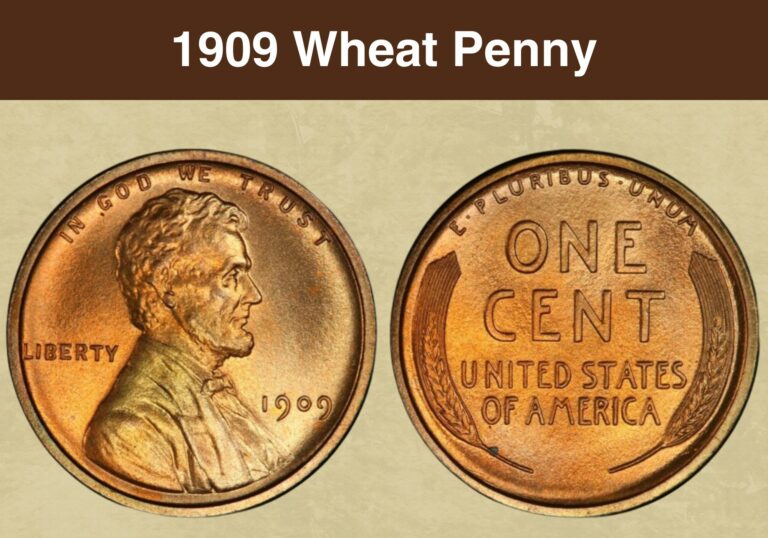
Victor David Brenner’s Lincoln portrait, which had debuted on August 2, 1909 (making the cent the first regular-issue U.S. coin to feature a real American rather than an allegorical figure), graced every 1944 cent without modification. President Theodore Roosevelt had selected Brenner specifically based on a Lincoln plaque the sculptor had created — a detail that connected numismatic art directly to presidential taste.

Buried within this massive production run were approximately 30 accidental steel cents — now among the most coveted error coins in American history. The likely cause was twofold: leftover 1943 steel blanks remained in press hoppers during the changeover, and the Philadelphia Mint was simultaneously striking nearly 25 million Belgian 2-franc coins from identical zinc-coated steel blanks for the newly liberated Belgium. That contract work dramatically increased the number of steel planchets at the Philadelphia facility, raising the odds of accidental mixing.

Also Read: Top 100 Rarest Pennies Worth Money (1787 – Present)


Is Your 1944 Wheat Penny Rare?

32

1944 No Mint Mark Wheat Penny (RD)

Scarce
Ranked 468 in Lincoln Cent (Wheat Reverse)
70

1944 No Mint Mark Steel Wheat Penny

Legendary
Ranked 132 in Lincoln Cent (Wheat Reverse)
34

1944 D Wheat Penny (RD)

Scarce
Ranked 433 in Lincoln Cent (Wheat Reverse)
60

1944 D Steel Wheat Penny

Ultra Rare
Ranked 184 in Lincoln Cent (Wheat Reverse)
29

1944 S Wheat Penny (RD)

Scarce
Ranked 502 in Lincoln Cent (Wheat Reverse)
85

1944 S Steel Wheat Penny

Divine
Ranked 36 in Lincoln Cent (Wheat Reverse)

For collectors seeking to verify current rarity metrics and market positioning, the CoinValueChecker App offers instant access to updated scarcity data and comparative rankings.


Key Features of the 1944 Wheat Penny

Understanding the characteristics of the 1944 wheat penny can help collectors identify genuine pieces, assess their preservation condition, and identify the subtle variations that can significantly impact value within this World War II series.

The Obverse of the 1944 Wheat Penny

The Obverse of the 1944 Wheat Penny
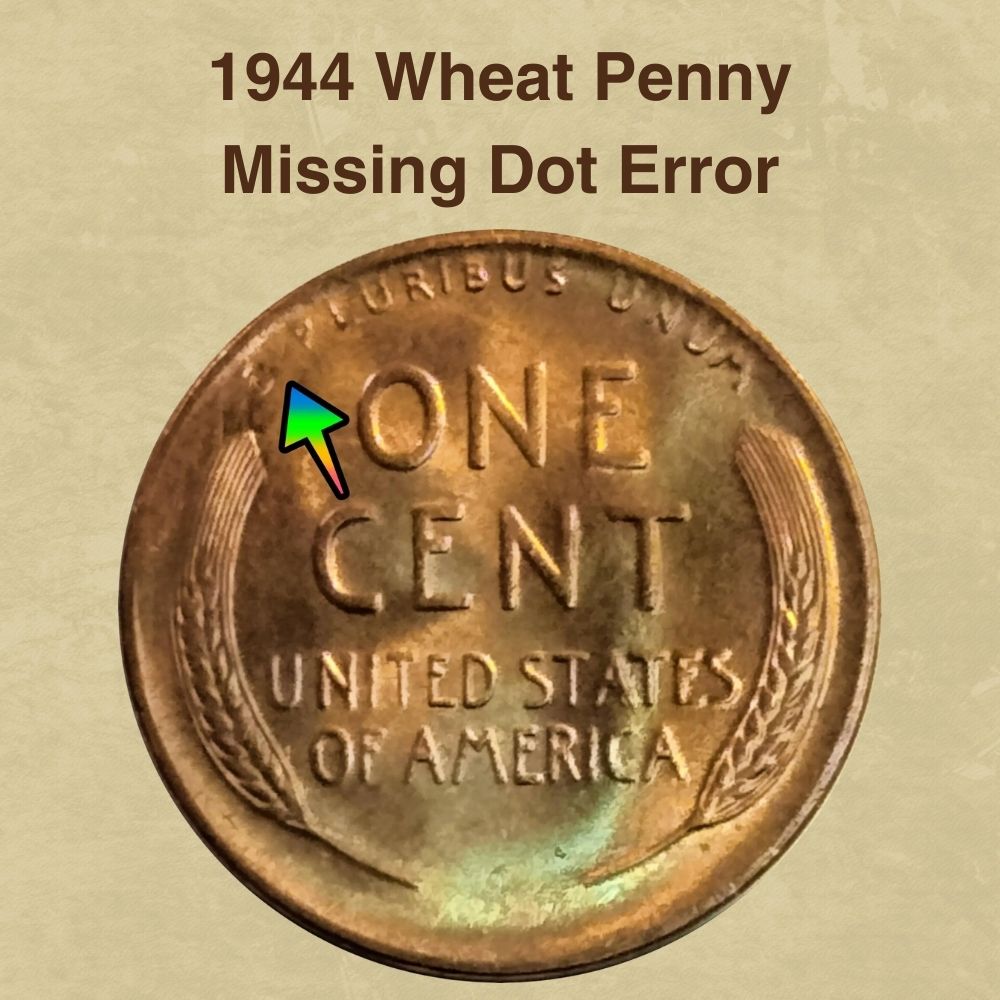
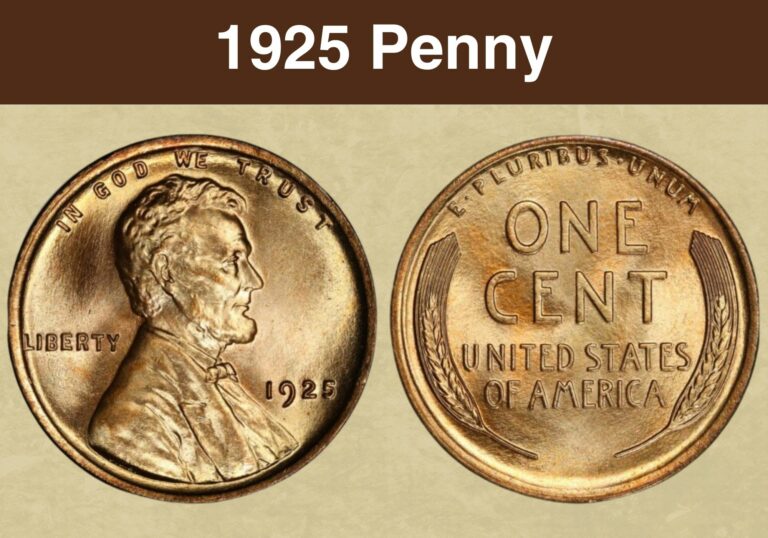
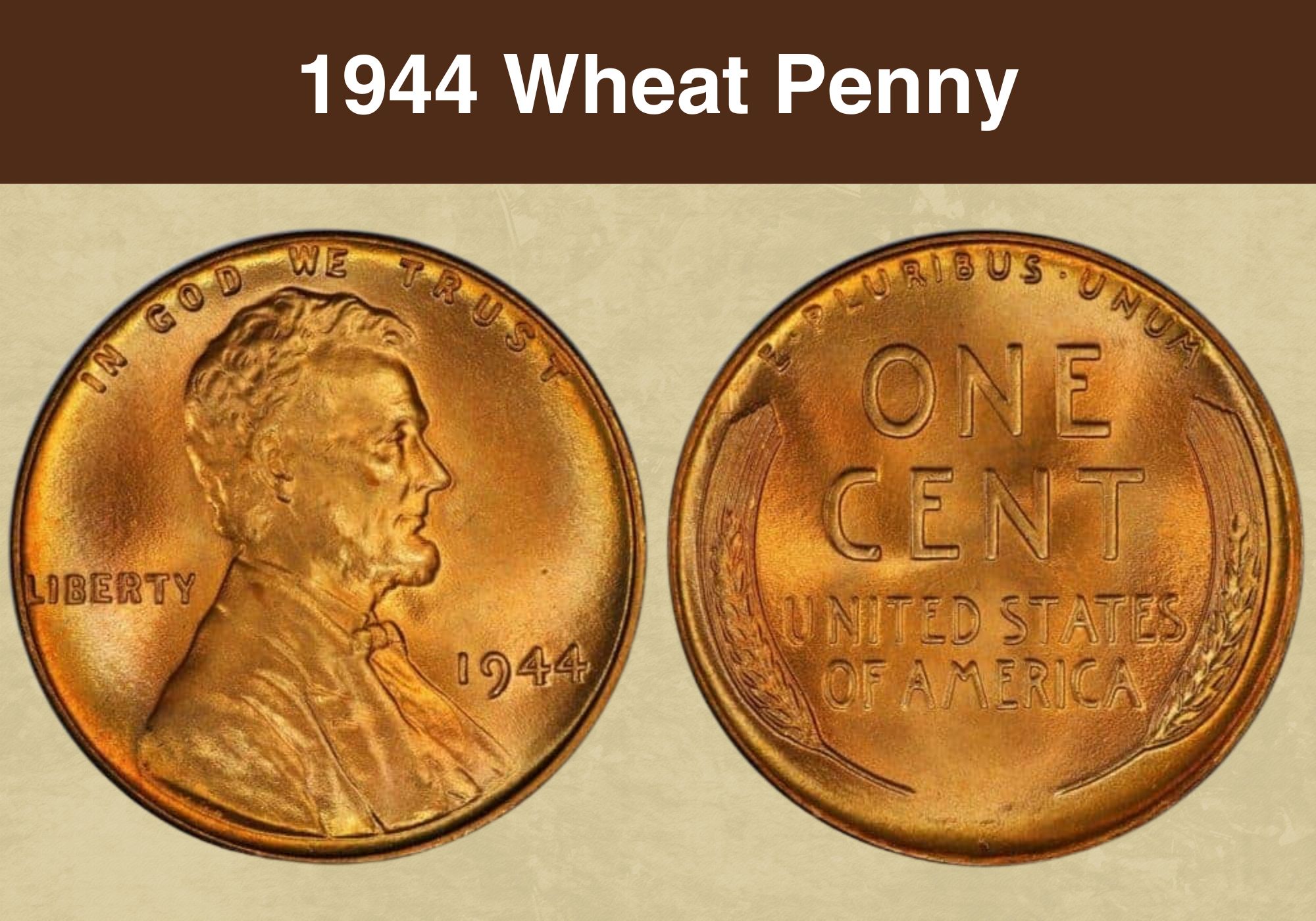
The obverse of the 1944 wheat penny displays Victor David Brenner’s portrait of Abraham Lincoln, which had been in continuous production since 1909 without modification. Above Lincoln’s portrait, “IN GOD WE TRUST” forms a curved arc, while “LIBERTY” appears along the left side — and a key error variety involves the “L” of LIBERTY being struck partially onto the rim, a high-grade example of which can sell for up to $2,500.

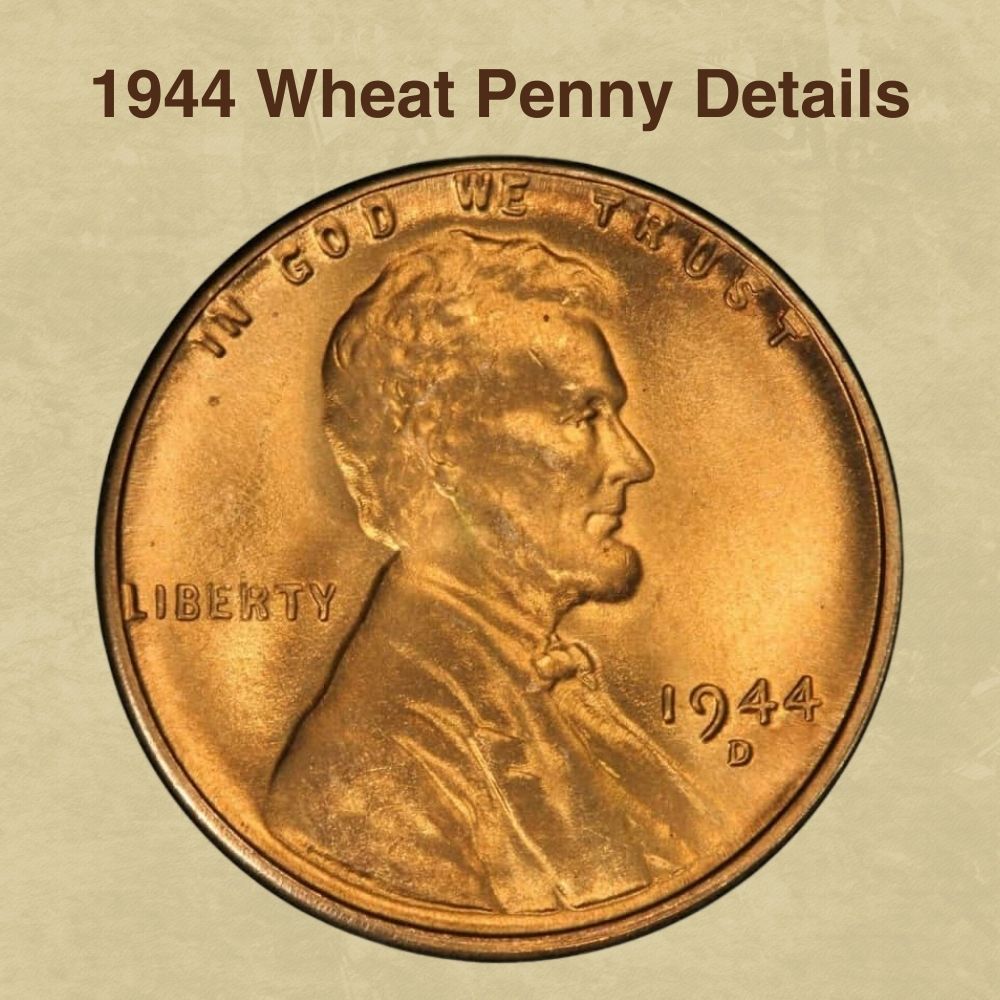
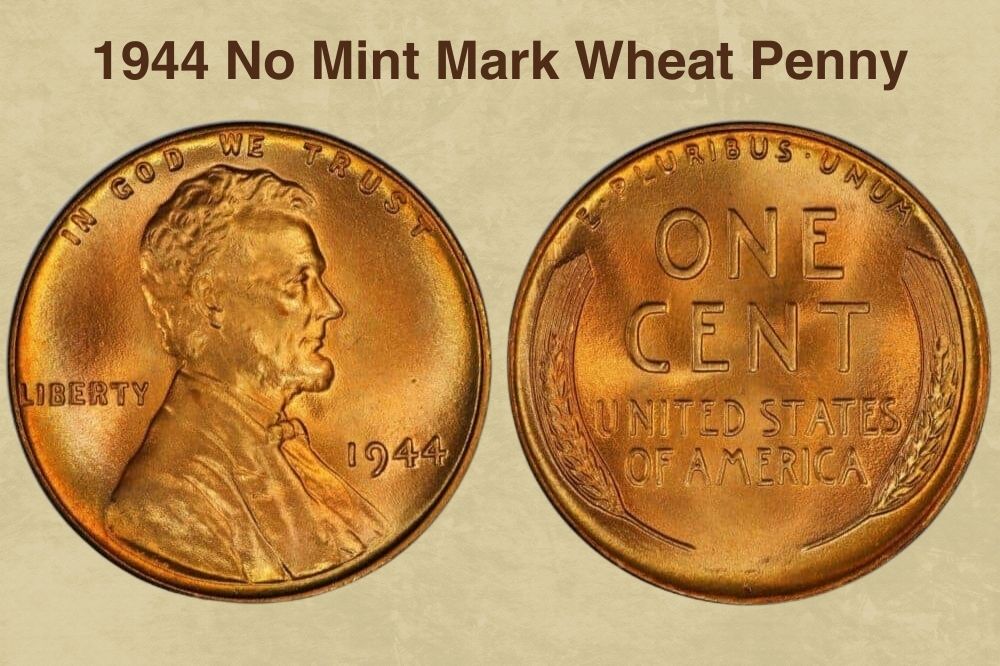
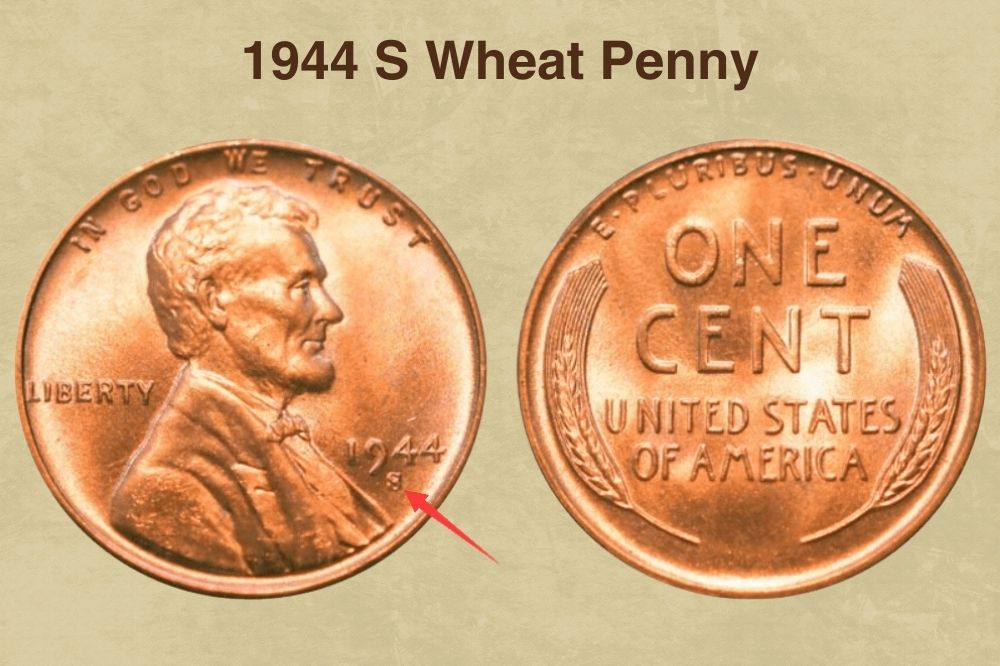
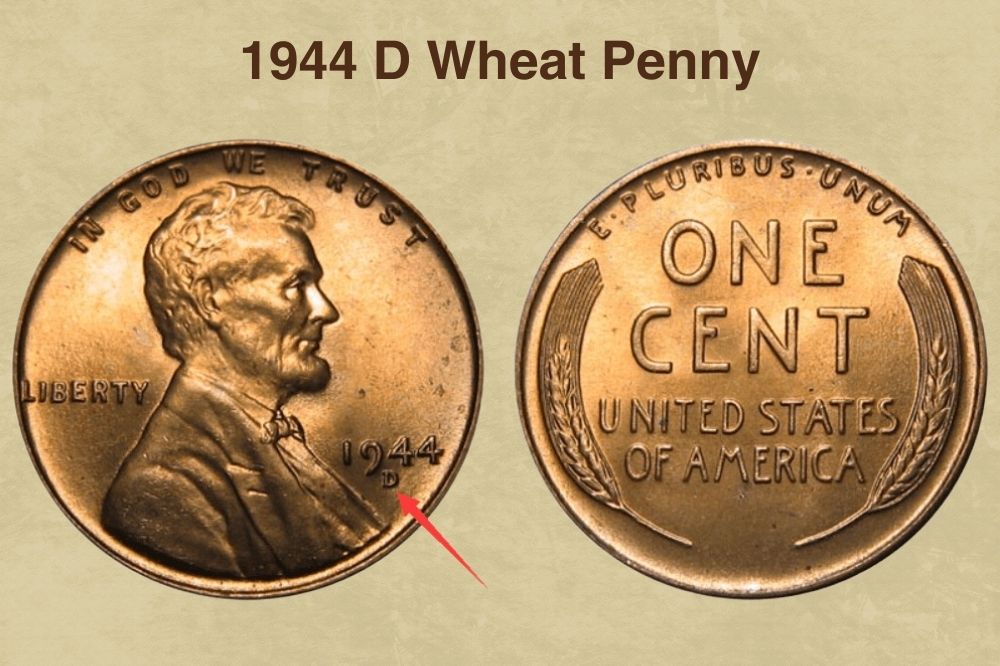
The year “1944” is positioned to the right of Lincoln’s portrait. Branch-mint coins carry either a “D” for Denver or an “S” for San Francisco directly beneath the date, while coins from Philadelphia bear no mint mark at all.

The Reverse of the 1944 Wheat Penny

The Reverse of the 1944 Wheat Penny
The reverse features two stylized ears of durum wheat flanking the denomination “ONE CENT” in large capitals at the center. Below the denomination, “UNITED STATES OF AMERICA” is inscribed, and the Latin motto “E PLURIBUS UNUM” — meaning “Out of many, one” — runs along the top rim.

When grading the reverse, look for well-separated individual wheat grains and clear lines along each stalk. Weak or flat wheat lines can indicate a poorly struck or heavily worn coin, which significantly reduces collector interest.

Other Features of the 1944 Wheat Penny

The regular 1944 copper cent measures 19.05 millimeters in diameter, weighs 3.11 grams, and has a plain (non-reeded) edge. The composition is 95% copper and 5% zinc — note that tin was deliberately removed from the formula between 1944 and 1946 due to wartime scarcity, making these coins technically brass rather than traditional bronze.

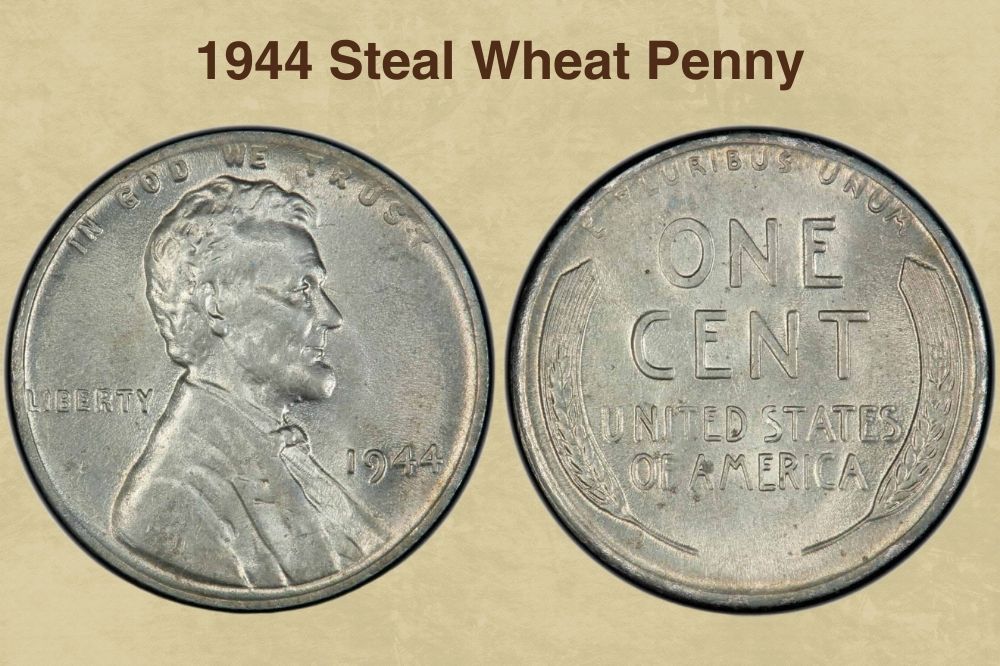
The rare 1944 steel error cents weigh approximately 2.7 grams (noticeably lighter) and will cling firmly to a magnet — the single fastest way to identify a potential steel specimen. Any 1944 penny that sticks to a magnet deserves immediate professional authentication by PCGS (Professional Coin Grading Service) or NGC (Numismatic Guaranty Company).

Also Read: 100 Most Valuable Wheat Pennies Worth Money (1909 to 1958)


1944 Wheat Penny Mintage & Survival Data

1944 Wheat Penny Mintage & Survival Chart

Mintage Comparison

Survival Distribution

TypeMintageSurvivalSurvival Rate
No Mint1,435,400,00018,0000.0013%
D430,578,00016,0000.0037%
S282,760,00024,0000.0085%

Philadelphia’s staggering output of 1.435 billion cents might suggest those coins would be the easiest to find in high grades today — but survival data reveals a striking reversal. San Francisco specimens have endured at nearly seven times Philadelphia’s rate (0.0085% versus 0.0013%), suggesting profound regional differences in how these wartime coins were used and preserved.

The most likely explanation is circulation intensity: Philadelphia-area coins flowed through defense factories, military payroll offices, and urban commerce at an aggressive pace, while San Francisco coins experienced lighter commercial turnover on the West Coast. Early California collectors may also have recognized the “S” mint mark’s quality reputation sooner and set those coins aside. Denver’s survival rate of 0.0037% falls between the two extremes, supporting this geographical theory.

For serious collectors, Q. David Bowers’ reference work “A Guide Book of Lincoln Cents” (Whitman Publishing, 4th edition, 2024–2025) remains the definitive authority on population data and survival estimates for this series. Understanding survival patterns often matters more than raw mintage figures when projecting long-term value.

Also Read: 100 Most Valuable Indian Head Penny Coins Worth Money (1859 – 1909)


Understanding Color Designations on Your 1944 Wheat Penny Value

One of the most important — and most overlooked — factors in determining your 1944 wheat penny value is the color designation assigned by third-party grading services like PCGS and NGC. All copper pennies are struck with a brilliant red-orange luster, but that color fades as the metal oxidizes over time, producing three distinct grades that can make an enormous difference in price.

Red (RD) means the coin retains at least 95% of its original copper luster and requires a grade of MS60 or higher to qualify. Red-Brown (RB) indicates 5%–95% red color remaining and also requires a mint-state grade. Brown (BN) describes coins with less than 5% original red color — the most common designation, applying to most circulated and many older uncirculated examples.

The price differences are dramatic. Research from coins-value.com shows that Red (RD) pennies typically command 2 to 5 times the price of RB coins at the same numeric grade, while BN uncirculated examples generally trade at 30–50% of RB values. On a common-date 1944 cent graded MS65, that means an RD coin might bring $50–$100, an RB coin $15–$30, and a BN coin as little as $10–$15.


The Easy Way to Know Your 1944 Wheat Penny Value

Lincoln’s hair and the space between his cheek and jaw are the first places to check on a 1944 wheat penny. Turn it over and inspect the wheat stalks — well-separated grains indicate better preservation, and marks through the date or mint mark can lower value substantially.

With just a quick photo, the CoinValueChecker App can instantly reveal condition, color, and potential errors, making it simple to see what your coin is really worth.

CoinValueChecker APP
CoinValueChecker APP Screenshot


1944 Wheat Penny Value Guides

  • 1944 No Mint Mark (Philadelphia)
  • 1944-D (Denver)
  • 1944-S (San Francisco)
  • 1944 No Mint Mark Steel (Philadelphia)
  • 1944-D Steel (Denver)
  • 1944-S Steel (San Francisco)

The 1944 wheat penny series encompasses six distinct varieties spanning all three U.S. Mint facilities. The three regular copper issues represent the nation’s triumphant return to traditional composition after wartime steel production, while the three steel counterparts rank among the most coveted treasures in American numismatics — accidental survivors that numismatic market data from Heritage and GreatCollections shows have appreciated an average of 6.8% year-over-year in high grades through 2025.

Also Read: Lincoln Wheat Penny Value (1909-1958)


1944 No Mint Mark Wheat Penny Value

1944 No Mint Mark Wheat Penny
The Philadelphia Mint struck 1.435 billion 1944 cents — yet collector demand for high-grade examples actually runs stronger for the “no mint mark” variety than for Denver or San Francisco copper coins.

This counterintuitive dynamic stems from what numismatists call the “halo effect”: approximately 25–30 Philadelphia cents were accidentally struck on leftover 1943 steel planchets, creating the rarest of the three steel error groups.

PCGS has certified just seven Philadelphia-mint 1944 steel cents at grades above MS60, and the finest known MS64 example from the legendary Simpson Collection sold for $158,625 at auction in 2013. That headline-grabbing scarcity elevates collector interest in all Philadelphia 1944 cents.

Recent auction data confirms the trend: MS67 and MS67+ copper examples from Philadelphia doubled in value between 2019 and 2020, while lower grades held steady, illustrating the “quality-first” principle where the rarest surviving high-grade examples appreciate exponentially.

1944 No Mint Mark Wheat Penny (RD) Price/Grade Chart

Price by 1-70 Grade (Latest Auction Records Included)

Updated: 2026-04-07 08:22:44

The popularity of the coins in the same series directly informs the coin’s detailed auction performance records spanning multiple decades.

Date PlatformPrice Grade

Current trading patterns reflect sustained collector engagement driven by both historical significance and potential error discovery opportunities.

Market Activity: 1944 No Mint Mark Wheat Penny


CoinVaueChecker App 10

1944-D Wheat Penny Value

1944-D Wheat Penny Value
The 1944-D Wheat Penny occupies an appealing middle ground in the series — more scarce than Philadelphia’s oversupply of 1.435 billion coins yet more accessible than San Francisco’s limited 282 million. Denver’s output of 430.5 million cents gives this variety enough depth for beginners while leaving room for premium pricing in the upper grades.

Strike quality on 1944-D coins is generally regarded as slightly softer than San Francisco’s output, with collectors particularly seeking examples showing sharp definition on Lincoln’s hair lines above the ear and fully separated wheat grains on the reverse.

A PCGS MS67 Red 1944-D sold for approximately $2,160 at Heritage Auctions, and MS68 full-red specimens have reached $9,300 — illustrating how each grade step at the top of the scale commands enormous premiums. Color designations matter just as much here: RD examples trade at the strongest premiums, while BN specimens serve as affordable entry points for new collectors.

1944-D Wheat Penny (RD) Price/Grade Chart

Price by 1-70 Grade (Latest Auction Records Included)

Updated: 2026-04-07 08:22:44

These investment fundamentals drive comprehensive auction performance records that chronicle decades of steady market evolution.

Date PlatformPrice Grade

Market activity patterns reveal sustained collector enthusiasm that supports both liquidity and long-term appreciation potential.

Market Activity: 1944-D Wheat Penny


1944-S Wheat Penny Value

1944-S Wheat Penny Value
San Francisco produced the fewest 1944 cents at 282,760,000 — the lowest output of the three mints that year — and its coins have survived at the highest rate of any variety, approximately 0.0085%. This combination of lower mintage and superior preservation creates natural collector appeal, especially since San Francisco’s quality-control standards during the 1940s consistently produced sharper strikes than the other facilities.

The “S” mintmark sits below the date with remarkably uniform depth across known examples, and the wheat stalk details on well-preserved 1944-S coins remain among the sharpest in the entire wartime cent series.

MS67 Red examples have traded between $70 and $1,500 depending on eye appeal and surface quality, while circulated specimens remain accessible at $0.08–$0.30. The 1944-S is also the source of the single most valuable 1944 wheat penny known — the steel error coin discussed in its own section below.

1944-S Wheat Penny (RD) Price/Grade Chart

Price by 1-70 Grade (Latest Auction Records Included)

Updated: 2026-04-07 08:22:44

Historical auction records demonstrate the dramatic price evolution of 1944-S varieties across different collecting eras and market conditions.

Date PlatformPrice Grade

Current market activity for 1944-S pennies shows sustained collector interest driven by both affordable entry points and the tantalizing possibility of discovering ultra-rare steel specimens.

Market Activity: 1944-S Wheat Penny


1944 No Mint Mark Steel Wheat Penny Value

1944 No Mint Mark Steel Wheat Penny Value
The 1944 No Mint Mark Steel Wheat Penny is the most plentiful of the three steel varieties — and “plentiful” here means perhaps 25–30 authenticated specimens worldwide. These coins resulted from two overlapping causes: residual 1943 steel blanks left in press hoppers during the changeover to copper, and the Philadelphia Mint’s simultaneous contract to produce nearly 25 million Belgian 2-franc coins using identical zinc-coated steel planchets for the newly liberated Belgium.

PCGS has certified just seven of these coins above MS60. The finest known example, an MS64 specimen from the Simpson Collection, sold for $180,000 at Heritage Auctions on June 20, 2021 — eclipsing that same coin’s previous record of $158,625 from a 2013 Heritage sale.

Even lower-grade circulated examples in AU (About Uncirculated) condition have sold between $5,875 and $34,500. Every genuine specimen carries a distinctive silvery appearance and weighs only 2.7 grams, verifiable with a simple postal scale.

1944 No Mint Mark Steel Wheat Penny Price/Grade Chart

Price by 1-70 Grade (Latest Auction Records Included)

Updated: 2026-04-07 08:22:44

The auction record chart demonstrates the dramatic value progression these technical marvels have achieved across different preservation levels over the decades.

Date PlatformPrice Grade

Market activity data reveals sustained collector fascination with this pinnacle example of wartime minting innovation, driving consistent premium valuations.

Market Activity: 1944 No Mint Mark Steel Wheat Penny


1944-D Steel Wheat Penny Value

1944-D Steel Wheat Penny Value
Only seven documented 1944-D Steel Wheat Pennies are known to exist, making this the rarest of the three steel varieties by confirmed specimen count. Unlike the Philadelphia issue, the Denver Mint had no Belgian coin contract to explain the presence of steel blanks, so the origin of these seven coins remains attributed solely to residual planchets left behind in press hoppers during the transition to copper production.

The finest known example, an MS63 specimen from the Simpson Collection, sold for $115,000 at a 2007 auction — a record for this variety that remains a benchmark reference price today. AU-grade examples have traded in the $30,000–$40,000 range, making even worn specimens extraordinarily valuable.

The extreme scarcity means that when one of these seven coins surfaces at auction, it draws intense bidding competition from institutional and advanced private collectors alike.

1944-D Steel Wheat Penny Price/Grade Chart

Price by 1-70 Grade (Latest Auction Records Included)

Updated: 2026-04-07 08:22:45

Auction records reveal the compelling price evolution these historically significant specimens have commanded across different collecting eras.

Date PlatformPrice Grade

Market activity demonstrates sustained enthusiasm among collectors who recognize these coins as tangible artifacts of America’s most decisive historical transition.

Market Activity: 1944-D Steel Wheat Penny


1944-S Steel Wheat Penny Value

1944-S Steel Wheat Penny Value
Only two 1944-S Steel Wheat Pennies are known to exist, placing this variety in the company of the rarest coins in American numismatic history. The finer of the two — an MS66 example that belongs to what researchers call the Simpson Collection — sold for a record $408,000 at Heritage Auctions’ ANA Signature Auction #1333 on August 18–22, 2021, surpassing its own previous record of $373,750 from a 2008 sale. The second known specimen grades XF40 (Extremely Fine) and realized $49,200 at a 2018 auction.

What makes the San Francisco steel cents especially mysterious is that, unlike Philadelphia’s Belgian contract explanation or Denver’s residual blank theory, no clear production reason has ever been established for why the San Francisco Mint struck these two coins on steel. That unexplained origin has only amplified their desirability among collectors.

San Francisco’s consistently superior quality control during the 1940s makes finding two perfectly formed steel specimens — both apparently struck with the same care applied to regular production — all the more remarkable.

1944-S Steel Wheat Penny Price/Grade Chart

Price by 1-70 Grade (Latest Auction Records Included)

Updated: 2026-04-07 08:22:45

The auction record chart illustrates how these legendary specimens have transcended traditional numismatic valuations to achieve museum-quality status.

Date PlatformPrice Grade

Market activity reflects the extraordinary collector intensity surrounding these mythical rarities, where even rumors of potential discoveries generate widespread excitement across the numismatic community.

Market Activity: 1944-S Steel Wheat Penny

Also Read: Top 100 Most Valuable Modern Pennies Worth Money (1959 – Present)


Rare 1944 Wheat Penny Error List

At the end of World War II, the pressure of wartime production had not yet fully dissipated, and the rushed changeover from steel to copper created special conditions for coinage errors that produced some of the most sought-after varieties in American numismatic history.

1. 1944-D DDO FS-101 Error

1944-D DDO FS-101
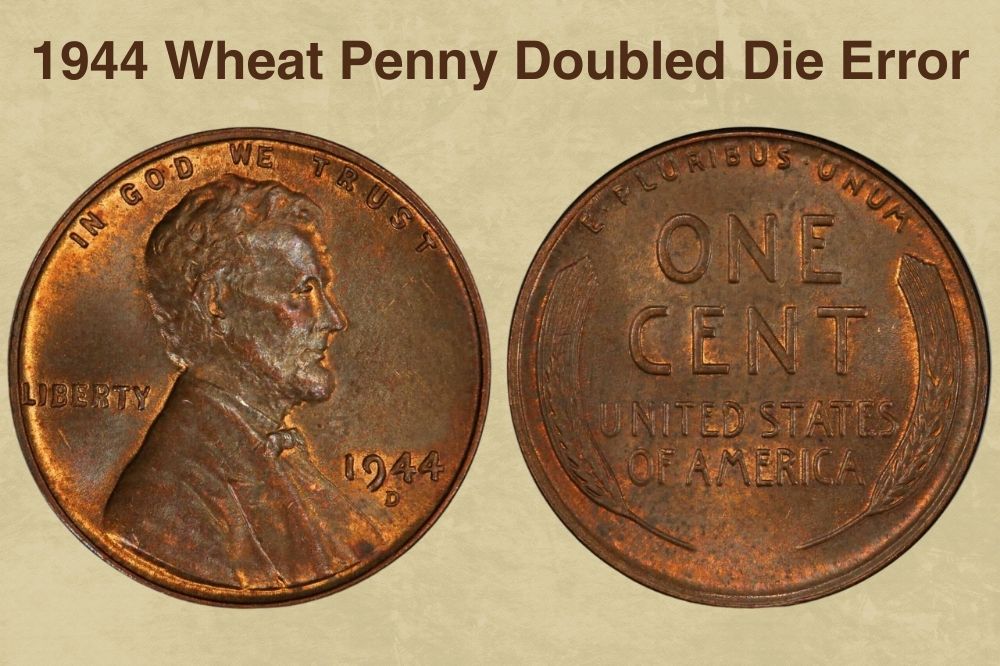
This Denver Doubled Die Obverse variety — catalogued as FS-101 in the Fivaz-Stanton reference system — displays pronounced doubling on Lincoln’s portrait, the date numerals, and the “LIBERTY” inscription. The doubling was created when the master hub impressed the working die at two slightly different angles during the hubbing process, a purely mechanical error that has nothing to do with post-mint damage or polishing.

Under 10x magnification, collectors can observe clear separation between the primary and secondary images, most visibly on Lincoln’s facial features and the top of the date “1944.” Genuine hub doubling shows raised secondary elements, while common machine doubling (which is worth no premium) shows a shelf-like, flat secondary impression. Authentication by PCGS or NGC is strongly recommended before paying any error premium.

1944-D DDO FS-101 Wheat Penny (RD) Price/Grade Chart

Price by 1-70 Grade (Latest Auction Records Included)

Updated: 2026-04-07 08:22:45

2. 1944-D/S Error

1944-D/S
The 1944-D/S overmintmark (OMM) is one of the most historically fascinating varieties in the Lincoln cent series. It originated when two working dies bearing San Francisco “S” mint marks were shipped to the Denver Mint, where a “D” was punched directly over the original “S” — traces of which remain visible under magnification, with portions of the curved “S” extending beyond the boundaries of the overlying “D.”

This pragmatic wartime practice of recycling dies between facilities rather than manufacturing new ones reflects the resource constraints of 1944. The finest known specimen — a PCGS MS67+RD, the only coin graded at that level — sold at auction in August 2019 for $8,400.

In May 2025, an NGC MS66 RD example was listed on eBay for $28,988.78, and a certified specimen sold for $49,937.50 at Legend Rare Coin Auctions. Circulated examples in Very Fine to About Uncirculated grades trade in the $100–$350 range.

1944-D/S Wheat Penny (RD) Price/Grade Chart

Price by 1-70 Grade (Latest Auction Records Included)

Updated: 2026-04-07 08:22:45

1944-D/S Wheat Penny (RB) Price/Grade Chart

Price by 1-70 Grade (Latest Auction Records Included)

Updated: 2026-04-07 08:22:45

1944-D/S Wheat Penny (BN) Price/Grade Chart

Price by 1-70 Grade (Latest Auction Records Included)

Updated: 2026-04-07 08:22:45

3. 1944-D/S OMM FS-511 Error

1944-DS OMM FS-511 Erros

The 1944-D/S OMM FS-511 is a specific die variety within the D/S overmintmark family, distinguishable from other OMM types by the position of the underlying “S.” On FS-511 coins, the remnants of the “S” appear most prominently in the lower curve and to the left side of the “D,” creating what look like serifs at the bottom of the Denver mintmark.

FS-511 requires magnification to identify properly, and authentication can be challenging because weak overmintmarks are easily confused with die wear or polishing marks. This variety trades at premium prices particularly in higher grades with full red surfaces, and a good reference point is the Cherrypickers’ Guide to Rare Die Varieties of United States Coins for die attribution guidance.

1944-D/S OMM FS-511 Wheat Penny (RD) Price/Grade Chart

Price by 1-70 Grade (Latest Auction Records Included)

Updated: 2026-04-07 08:22:45

1944-D/S OMM FS-511 Wheat Penny (RB) Price/Grade Chart

Price by 1-70 Grade (Latest Auction Records Included)

Updated: 2026-04-07 08:22:45

1944-D/S OMM FS-511 Wheat Penny (BN) Price/Grade Chart

Price by 1-70 Grade (Latest Auction Records Included)

Updated: 2026-04-07 08:22:45

4. 1944-D OMM FS-512 Error

1944-D OMM FS-512 Erros

The 1944-D OMM FS-512 is a second, distinct overmintmark variety showing the underlying “S” shifted to a different alignment from FS-511, with remnants appearing more prominently on the right side and upper portion of the mintmark area. The different curve patterns of the “S” in this variety are the key diagnostic when comparing it to FS-511.

FS-512 is considered less visually dramatic than FS-511, making it the more affordable of the two, though it is not the same as the OMM-001 variety. Examples in MS63 Brown condition have sold for around $250. As always, magnification of 10x or higher is required for proper attribution.

CoinVaueChecker App 10

1944-D OMM FS-512 Weak Wheat Penny (RD) Price/Grade Chart

Price by 1-70 Grade (Latest Auction Records Included)

Updated: 2026-04-07 08:22:45

5. 1944-D/D RPM (FS-502 and FS-507) Error

1944-D/D RPM (FS-502 And FS-507)
Repunched Mintmark (RPM) varieties result from the Denver “D” being punched into the working die multiple times at slightly different positions or angles during die preparation. FS-502 shows the secondary “D” impression shifted toward the southwest, creating a thickened lower-left curve and distinctive shadow effect on the bottom of the mintmark. FS-507 shows repunching toward the northeast, with the doubling most visible on the upper right of the “D” vertical stroke.

These RPM varieties are collected for their visible evidence of the hand-punching methods used at U.S. Mint facilities before mintmarks were incorporated directly into master hubs. FS-502 exhibits moderate repunching strength while FS-507 shows stronger, more dramatic displacement — making FS-507 generally the more sought-after of the two.

1944-D/D RPM FS-502 Wheat Penny (RD) Price/Grade Chart

Price by 1-70 Grade (Latest Auction Records Included)

Updated: 2026-04-07 08:22:45

Also Read: 42 Rare Penny Errors List with Pictures (By Year)


Where to Sell Your 1944 Wheat Penny

Now that you know the value of your coins, do you know where to sell those coins online easily? Don’t worry, I’ve compiled a list of these sites, including their introduction, pros, and cons.

Check out now: Best Places To Sell Coins Online (Pros & Cons)


1944 Wheat Penny Market Trend

Market Interest Trend Chart - 1944 Penny

*Market Trend Chart showing the number of people paying attention to this coin.
 

FAQ about the 1944 Wheat Penny Value

1. What makes the 1944 wheat penny value so different from other common wheat cents?

The 1944 wheat penny value is elevated above other high-mintage years because of its direct link to two rare and extraordinarily expensive error coins: the 1944 steel cent (struck accidentally on leftover 1943 planchets) and the 1944-D/S overmintmark.

The steel penny connection alone has created a strong collector “halo effect” around all Philadelphia 1944 cents, pushing MS67 copper examples past $200 — a premium that comparable-mintage years simply don’t command.

2. How can I tell if my 1944 penny is made of steel?

The three-step test is fast and reliable. First, hold a common magnet near the coin — a steel penny will stick firmly, while copper will not respond at all. Second, weigh the coin with a postal or jewelry scale: steel cents weigh approximately 2.7 grams versus 3.11 grams for copper.

Third, look at the color: steel cents have a distinctive silver-gray appearance, not the reddish-brown of copper. Any coin passing all three tests should be sent immediately to PCGS or NGC for professional authentication, as counterfeit steel pennies made from plated copper do exist.

3. What is the highest price ever paid for a 1944 wheat penny?

The record is $408,000, achieved by the 1944-S Steel MS66 example at Heritage Auctions’ ANA Signature Auction #1333 on August 18–22, 2021. This surpassed the same coin’s earlier 2008 record of $373,750 — an increase of nearly 9% over 13 years. The sole other known 1944-S steel penny graded XF40 sold for $49,200 in 2018.

4. What does the color designation RD, RB, or BN mean, and how does it affect my 1944 wheat penny value?

These designations describe how much original copper luster remains. Red (RD) means at least 95% of the original red-orange color survives and requires a Mint State (MS) grade of MS60 or higher. Red-Brown (RB) indicates 5%–95% red remaining, also at Mint State.

Brown (BN) means less than 5% red — the most common designation for circulated coins. At the MS65 grade, an RD 1944 penny typically brings 2–5 times more than an RB coin, and RB coins generally sell for 2–3 times the BN price at the same numeric grade.

5. Is there anything special about a 1944 wheat penny with no mint mark?

A “no mint mark” 1944 penny was struck at the Philadelphia Mint, which did not use a “P” mintmark on cents during this era. These are the most plentiful variety with 1.435 billion produced, but they carry the highest premium in supergrade copper because of their steel error siblings.

Philadelphia also produced approximately 25–30 of the accidental 1944 steel cents — PCGS has certified only 7 at grades above MS60 — and this scarcity at the top end elevates all Philadelphia 1944 cent prices.

6. Why did the composition of the 1944 wheat penny change from earlier Lincoln cents?

Two wartime changes affected the 1944 cent. In 1943, copper was removed entirely and pennies were made from zinc-coated steel to conserve copper for military use — a deeply unpopular change that led to vending machine failures (magnets designed to reject counterfeits also rejected the steel cents) and widespread public confusion.

In 1944, the Mint returned to copper but removed tin from the alloy (tin became scarce from 1944–1946), making the 1944 cent 95% copper and 5% zinc — technically brass rather than the traditional bronze of earlier years.

7. What are the most valuable 1944 wheat penny errors beyond the steel coins?

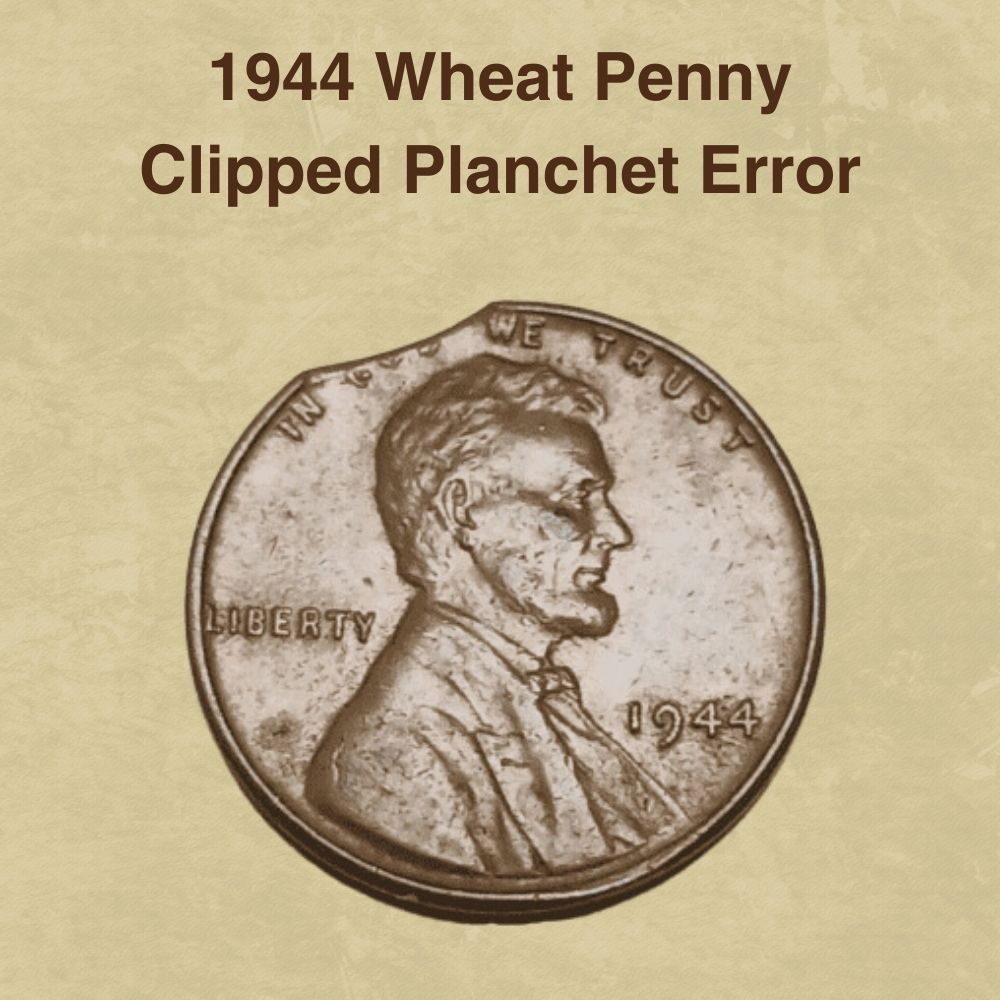
Beyond the steel cents, the most valuable documented errors are: the 1944-D/S overmintmark (finest known MS67+RD sold for $8,400 in August 2019; a May 2025 NGC MS66 RD example listed for $28,988.78); the 1944-D DDO FS-101 doubled die obverse (visible doubling on Lincoln’s portrait and date); the “L” in LIBERTY error (high-grade examples can sell for up to $2,500); and clipped planchet errors, where a segment of the edge is missing due to a minting fault, which can bring up to $100 in otherwise good condition.

8. Should I clean my 1944 wheat penny before having it evaluated?

Never clean a coin — not with soap, not with baking soda, not with any chemical or abrasive. Cleaning damages the microscopic surface details that grading services use to assess originality, and a “cleaned” designation from PCGS or NGC will reduce a coin’s certified value by 50–90% compared to an original-surface example.

Even a coin that looks dull or tarnished is worth more uncleaned than cleaned, because original toning is considered part of the coin’s natural history.

9. How does the 1944-D/S overmintmark error occur, and how do I spot it?

This error happened when San Francisco Mint dies (already stamped with an “S” mintmark) were shipped to the Denver Mint during wartime production sharing. Denver workers then punched a “D” directly over the existing “S” rather than creating new dies.

Under 10x magnification, look for the curved remnants of the “S” peeking out from beneath the “D” — most visible as curved projections at the lower left or upper right of the Denver mintmark, depending on the specific die variety. Tens of thousands of these exist among Denver’s 430 million 1944 cents, making them far more findable than steel cents.

10. What is the best way to get an accurate 1944 wheat penny value for selling purposes?

For coins in circulated grades worth under $50, checking recently completed eBay sales of comparable graded examples gives a reliable market price. For uncirculated examples grading MS63 or above, consulting the PCGS Price Guide and NGC Price Guide provides current dealer bid and ask ranges.

For any coin you believe might be a steel error or a high-grade MS66+ specimen, submit to PCGS or NGC for professional grading before selling — a certified coin can achieve 3–10 times the price of an ungraded equivalent at major auction houses like Heritage Auctions or GreatCollections, and authentication protects both buyer and seller.

Similar Posts