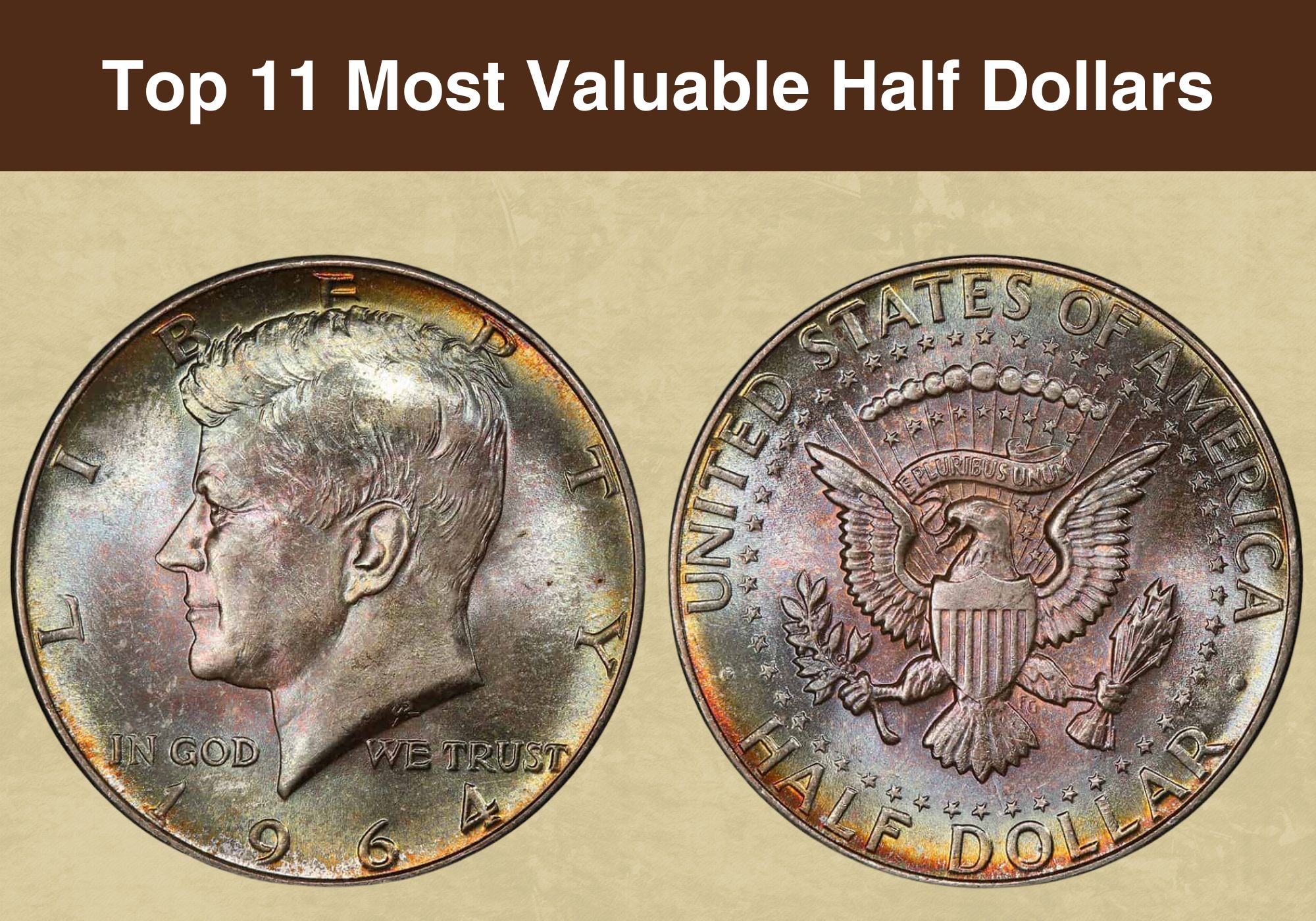
1969 Half Dollar Coin Value: Errors List, “D” & “S” Mint Mark Worth

1969 Half Dollar value ranges from $0.50 face value to $15,600. That record was set by a Grade 67 example sold through Heritage Auctions in June 2019. Upload a photo of yours below and you’ll get a quick value range based on your coin’s condition. Scroll down too to check recent eBay sales and see what collectors are actually paying right now.
1969 Half Dollar Value Checker
Identify 1969 Half Dollar D and S Mint Mark Price
Front Obverse
Upload or Take a Photo
Back Reverse
Upload or Take a Photo
1969 Half Dollar Value By Variety
Here’s what 1969 Kennedy Half Dollars are selling for right now across grades and varieties. If you already know your coin’s grade, jump to the Value Guides section for exact pricing.
| Type | Good(G4-6) | Fine(F12-15) | AU(AU50-58) | MS(MS60-70) | PR(PR60-70) |
|---|---|---|---|---|---|
| ▶1969 D Half Dollar Value | $10 | $10 | $11 | $11 - $1,280 | — |
| ▶1969 S Proof Half Dollar Value | — | — | — | — | $2 - $23 |
| ▶1969 S CAM Half Dollar Value | — | — | — | — | $3 - $500 |
| ▶1969 S DCAM Half Dollar Value | — | — | — | — | $5 - $16,100 |


Also Read: Top 100 Most Valuable Kennedy Half Dollar Worth Money (1964 – Present)
Top 10 Most Valuable 1969 Half Dollar Worth Money
Most Valuable 1969 Half Dollar Chart
2003 - Present
The spread in this series is wild. A typical circulated example brings $5–$7, but the top coin — a single Denver Mint business strike — hammered at $15,600.
That record-setter was a 1969-D graded MS67 by NGC with a Star (★) designation, sold at Heritage Auctions in June 2019. The Star means the coin’s eye appeal goes beyond what the number alone suggests. This one had jaw-dropping rainbow toning — concentric rings of amber, gold, green, blue, and violet. According to PCGS CoinFacts, fewer than 50 examples of the 1969-D are known in MS67, with none graded finer. That’s why the jump from MS66 to MS67 can mean thousands of dollars. On the proof side, pricing stays much calmer — the PR69DCAM tops out at $660 at auction.
History of the 1969 Half Dollar
The Kennedy half dollar exists because of an assassination. President John F. Kennedy was killed in Dallas on November 22, 1963, and Congress fast-tracked legislation to put his portrait on the half dollar almost immediately.
Trial strikes were ready at the Philadelphia Mint by December 13, 1963 — less than three weeks later. Chief Engraver Gilroy Roberts adapted an existing Kennedy Presidential Medal he’d worked on in 1961 for the obverse. Assistant Engraver Frank Gasparro handled the reverse, basing it on the Presidential Seal. His initials “FG” still appear on every Kennedy half dollar below the eagle’s right leg.
Here’s a detail I love: Jacqueline Kennedy personally reviewed the trial strikes and suggested “the part in the hair was less pronounced.” Roberts made the change. That feedback from the First Lady is baked into every Kennedy half ever struck — including your 1969 coin.
When the coin launched on March 26, 1964, the initial supply of 70,000 coins was gone by noon. Hoarding was so intense it triggered a nationwide silver shortage. Congress responded with the Coinage Act of 1965, signed July 23, 1965, which killed silver in dimes and quarters entirely and cut the half dollar from 90% to 40%.
Your 1969 Kennedy was struck under that 40% silver standard. It’s a layered “sandwich” — outer layers of 80% silver bonded to a core of 21% silver and 79% copper, totaling 40% silver and approximately 0.1479 troy ounces of actual silver weight.
By 1969, the Treasury was already pushing to drop that last bit of silver. On December 31, 1970, President Nixon signed the legislation that did exactly that. So the 1969-D is one of the last two years a silver coin was struck for general circulation. That’s a historically significant distinction collectors pay attention to.
Also Read: Top 35 Most Valuable Franklin Half Dollar Worth Money (1948 – 1963)
Is Your 1969 Half Dollar Rare?
1969-D Half Dollar
1969-S Proof Half Dollar
1969-S CAM Half Dollar
1969-S DCAM Half Dollar
For collectors interested in exploring the complete spectrum of Kennedy Half Dollar rarities and market dynamics, our Coin Identifier and Value App provides comprehensive rarity assessments and real-time market data.
Key Features of the 1969 Half Dollar
Two engravers share credit here. Gilroy Roberts, the Mint’s Chief Engraver, did Kennedy’s portrait on the obverse. Frank Gasparro — who later designed the Lincoln Memorial cent reverse — created the eagle on the back. Look for his initials “FG” just below the eagle’s right leg.
Every 1969 half dollar contains 40% silver, making it the second-to-last year with precious metal content for circulation strikes. Quick way to confirm yours is silver: check the edge. You should see solid grey or silver all the way around. If there’s an orange copper stripe, you’ve got a post-1970 clad coin.
The Obverse of the 1969 Half Dollar

“IN GOD WE TRUST” sits on either side of Kennedy’s bust, which dominates the center of the obverse. The minting year runs along the bottom, and “LIBERTY” arcs across the top — three of those letters tuck behind the President’s hair.
Flip the coin to find the mint mark below Kennedy’s neck. The designer’s initials “GR” are tucked into the hairline at the neck truncation. Easy to miss if you’re not looking for them.
The Reverse of the 1969 Half Dollar

The reverse shows a modified Presidential Seal. The eagle spreads its wings wide, wears a shield on its chest, and holds a ribbon reading “E PLURIBUS UNUM” in its beak. Thirteen small stars sit behind the eagle’s head.
Thirteen arrows in the right claw represent war readiness. The olive branch with thirteen leaves and berries in the left claw stands for peace. “UNITED STATES OF AMERICA” and a ring of 50 stars circle the design, with “HALF DOLLAR” at the bottom. Frank Gasparro’s initials “FG” appear below the eagle’s right leg.
Other Features of the 1969 Half Dollar
The 1969 Kennedy Half Dollar holds 0.14792 troy ounces (4.60 g) of silver out of a total weight of 0.36973 troy ounces (11.50 g). Diameter is 1.20472 inches (30.61 mm), thickness is 0.08464 inches (2.15 mm), and the edge is reeded.
At a silver spot price of approximately $48.92 per troy ounce as of late 2025, the melt value of a 1969 half dollar is roughly $7.24. That’s your hard price floor — no 1969 half dollar should ever sell for less than its metal content.
Also Read: Top 60+ Most Valuable Walking Liberty Half Dollar (1916 -1947)
1969 Half Dollar Mintage & Survival Data
1969 Half Dollar Mintage & Survival Chart
Survival Distribution
| Type | Mintage | Survival | Survival Rate |
|---|---|---|---|
| D | 129,881,800 | unknown | unknown |
| S Proof | 2,934,631 | unknown | unknown |
| S CAM | 2,934,631 | unknown | unknown |
| S DCAM | 2,934,631 | 1,173,852 | 40% |
Denver cranked out 129,881,800 business strikes. San Francisco made just 2,934,631 proofs. That’s a 44-to-1 ratio.
The 1969-D is common in circulated grades, but most were pulled from circulation for their silver. Uncirculated survivors are plentiful through MS64. At MS65, you’re looking at a few thousand known. MS66 drops to roughly 1,000. MS67? Fewer than 50, with none graded higher.
The 1969-S Deep Cameo proof has the best survival data — about 1,173,852 examples survive from the original mintage, roughly a 40% survival rate. Proof coins got babied by collectors. Business strikes got spent, banked, or melted. The silver boom of 1979–1980 was especially brutal — record silver prices triggered mass melting of hoarded 1964–1969 Kennedy halves, permanently thinning the supply of high-grade survivors.
Also Read: What Half Dollars Are Worth Money?
The Easy Way to Know Your 1969 Half Dollar Value
Start with Kennedy’s face. Sharp hair detail and clean cheekbones mean a higher grade. Flip it over and check the eagle’s breast feathers — worn feathers tell you the coin saw real circulation.
Scratches, cleaning marks, and toning all matter. A lot. Proof versions from San Francisco play by different rules than Denver business strikes, so don’t compare them directly.
One thing many collectors overlook on the 1969-D: the Prooflike (PL) designation. PL coins are regular business strikes with mirror-like fields that make them look like proofs. A Prooflike 1969-D can bring around $300 at MS65 — a big premium over a standard MS65.
To skip the guesswork, our Coin Identifier and Value App delivers accurate assessments tailored to your coin’s unique characteristics.

Coin Identifier and Value App
Not sure what your coins are worth? Get Instant Value • Grade • Error Detection with coin identifier and value app (FREE Usage Daily)
1969 Half Dollar Value Guides
Four distinct varieties make up the 1969 Kennedy Half Dollar series:
- 1969-D Half Dollar — Business strike from Denver Mint
- 1969-S Proof Half Dollar — Standard proof from San Francisco Mint
- 1969-S CAM Half Dollar — Cameo (CAM) contrast proof; frosted devices against mirror fields
- 1969-S DCAM Half Dollar — Deep Cameo (DCAM) proof; maximum contrast, most valuable proof finish
Denver handled all circulation strikes in 1969 while San Francisco focused exclusively on proofs. This was only the second year of renewed San Francisco proof production after the 1965–1967 Special Mint Set era — worth noting when you see that “S” mint mark.
1969-D Half Dollar Value

Here’s something that surprises people: the 1969-D is the only business strike Kennedy half dollar made that year. Philadelphia struck zero half dollars in 1969. San Francisco only made proofs. So if you want a circulation-grade 1969 Kennedy, Denver is your only option.
It’s also one of the last two years (1969 and 1970) that silver appeared in a coin struck for general circulation. After 1970, silver was gone from circulating U.S. coinage for good.
In lower grades, these are common coins. The rarity kicks in hard at the top of the scale. The $15,600 auction record belongs to a 1969-D graded NGC MS67 with a Star (★) designation, sold at Heritage Auctions in 2019. That coin had extraordinary rainbow toning — concentric rings of amber, yellow-gold, sea-green, blue, and violet. Fewer than 50 coins exist at that grade level. None higher.
1969-D Half Dollar Price/Grade Chart
Price by 1-70 Grade (Latest Auction Records Included)
The Auction Record Chart below tracks pricing trends for 1969-D Half Dollars across grades and time periods.
| Date | Platform | Price | Grade |
|---|---|---|---|
| 11/25 | SB | $930 | 67 |
| 06/25 | SB | $65 | 66 |
| 04/25 | SB | $1,080 | 67 |
| 04/25 | HA | $1,200 | 67 |
| 06/24 | HA | $1,560 | 67 |
| 04/23 | DL | $43 | 66 |
| 04/23 | HA | $240 | 66 |
| 03/23 | HA | $91 | 66 |
| 03/23 | HA | $234 | 66 |
| 02/23 | DL | $65 | 66 |
Market Activity data shows how often these trade and where collector demand is strongest.
Market activity: 1969-D Half Dollar
Market activity score: 61/100 as of Nov 2026 — unchanged since Aug 2026. 12-month peak: 68 (Dec 2025).
1969-S Proof Half Dollar Value

Most collectors don’t realize this was only the second year San Francisco struck proofs after the 1965–1967 Special Mint Set hiatus. Proof coins use polished dies and burnished planchets, giving you those glassy mirror fields and razor-sharp details.
A standard proof (PR or PF) designation means mirror fields but no special frosting on the raised design elements. These are the most common of the four 1969 varieties. With a mintage of 2,934,631, they’re affordable in most grades. The auction record sits at $575 for a PR67 specimen sold on eBay in January 2022. NGC has graded 1,198 examples in PR-69 Ultra Cameo, with none graded higher — that’s the ceiling.
1969-S Proof Half Dollar Price/Grade Chart
Price by 1-70 Grade (Latest Auction Records Included)
The Auction Record Chart below covers pricing history for 1969-S Proof Half Dollars across grades and market conditions.
| Date | Platform | Price | Grade |
|---|---|---|---|
| 10/21 | DL | $21 | 68 |
| 10/21 | DL | $19 | 69 |
| 10/21 | DL | $20 | 69 |
| 08/21 | DL | $19 | 69 |
| 10/20 | HA | $65 | 69 |
| 10/20 | HA | $51 | 69 |
| 07/20 | HA | $69 | 69 |
| 07/20 | HA | $94 | 69 |
| 09/19 | HA | $312 | 67 |
| 01/19 | DL | $12 | 66 |
Market Activity data for this San Francisco proof issue.
Market activity: 1969-S Proof Half Dollar
Market activity score: 50/100 as of Nov 2026 — down 3 points from Aug 2026. 12-month peak: 53 (Sep 2026).
1969-S CAM Half Dollar Value

Can you tell a Cameo from a standard proof at arm’s length? You should be able to. CAM proofs have frosted, white design elements — Kennedy’s portrait, the eagle, the lettering — that pop against the mirror-like background fields. It’s almost a two-tone effect. That frost comes from early die use, before repeated strikes wear it away.
Collectors pay a clear premium for that contrast. A PR67 CAM specimen sold at Heritage Auctions for $403 in June 2005. If you’re cherrypicking raw proof sets from 1969, look for that bright white frost on Kennedy’s cheek and hair. That’s your money coin.
1969-S CAM Half Dollar Price/Grade Chart
Price by 1-70 Grade (Latest Auction Records Included)
Auction data below tracks pricing trends for 1969-S CAM Half Dollars over time.
| Date | Platform | Price | Grade |
|---|---|---|---|
| 06/22 | DL | $70 | 69 |
| 04/22 | DL | $15 | 66 |
| 11/21 | HA | $204 | 69 |
| 07/20 | HA | $75 | 69 |
| 07/20 | HA | $41 | 69 |
| 10/19 | DL | $17 | 67 |
| 06/19 | HA | $43 | 69 |
| 01/17 | HA | $141 | 69 |
| 12/16 | DL | $25 | 66 |
| 12/16 | DL | $30 | 67 |
Market Activity metrics for this cameo proof variety.
Market activity: 1969-S CAM Half Dollar
Market activity score: 50/100 as of Nov 2026 — unchanged since Aug 2026. 12-month peak: 53 (Sep 2026).
1969-S DCAM Half Dollar Value

This is the top of the food chain for 1969 proofs. DCAM means the frost is heavy and bold — thick white ice on Kennedy’s portrait and lettering against nearly black, glass-like fields. Maximum contrast. Maximum eye appeal.
Getting that level of frost requires exceptional die preparation. It only happens at the very start of a die’s life, which makes DCAM examples significantly scarcer than standard proofs or even regular CAM coins. NGC has graded 1,198 examples in PR-69 Ultra Cameo, with none finer.
A PR69DCAM specimen sold at Stack’s Bowers for $660 in March 2021. The estimated value of a theoretical PR70DCAM — the perfect coin from 2.9 million proofs — sits at approximately $17,500. That nearly matches the $15,600 record for the MS67 Denver business strike. I think that tells you everything about how much collectors value flawless contrast.
1969-S DCAM Half Dollar Price/Grade Chart
Price by 1-70 Grade (Latest Auction Records Included)
Auction performance data below chronicles price trends for 1969-S DCAM Half Dollars across certification levels.
| Date | Platform | Price | Grade |
|---|---|---|---|
| 01/23 | DL | $20 | 68 |
| 12/22 | HA | $109 | 69 |
| 08/22 | SB | $100 | 69 |
| 08/22 | HA | $159 | 69 |
| 07/22 | HA | $129 | 69 |
| 05/22 | DL | $36 | 68 |
| 05/22 | HA | $134 | 69 |
| 04/22 | SB | $100 | 69 |
| 12/21 | HA | $154 | 68 |
| 10/20 | HA | $162 | 69 |
Market Activity data for this deep cameo proof variety.
Market activity: 1969-S DCAM Half Dollar
Market activity score: 50/100 as of Nov 2026 — down 3 points from Aug 2026. 12-month peak: 53 (Aug 2026).
Also Read: Rare Half Dollar Coins to Look For
Rare 1969 Half Dollar Error List
Error coins are where things get fun — and potentially very profitable. Here are the documented error types for the 1969 Kennedy Half Dollar, with real auction results where available.
1. Doubled Die Obverse (DDO) Error
A Doubled Die Obverse happens during die production, not during striking. The hub impresses the die twice with a slight misalignment, so every coin struck from that die carries doubled design elements. It’s a true die variety.
On a 1969 DDO, look at “LIBERTY,” “IN GOD WE TRUST,” and Kennedy’s hair and jawline. A 1969-D Doubled Die Obverse graded Fine (F) sold on eBay in approximately 2022 for $598.75. Lower-grade circulated examples typically trade between $20 and $150 depending on doubling strength.
Grab a 5x–10x loupe and examine the lettering closely. Genuine hub doubling shows two distinct, raised sets of letters. Machine doubling is flat and shelf-like with no real relief — that’s worth nothing extra.
2. Double Strike Error
Double strikes happen when a coin fails to eject from the collar and gets hit by the dies a second time. You’ll see overlapping design elements — sometimes dramatically offset.
The more displacement between strikes, the more valuable the coin. A dramatically double-struck 1969 Kennedy half dollar error coin has sold for approximately $3,220. Coins where Kennedy’s portrait or the eagle shows clear doubling with a readable date bring the strongest premiums.
3. Off-Center Strike Error
When the blank planchet isn’t centered under the dies, you get a crescent-shaped blank area where the design is completely missing. Off-center errors are measured in percentages — 10% is minor, 50% is dramatic and quite valuable.
A 1969 Kennedy half dollar with a 25% off-center strike sold for approximately $150 on an online auction platform in around 2020. The key for value: can you still read the full date? If yes, you’ve got a much more desirable coin.
4. Underweight Planchet Error
These happen when the roller dies are set wrong during metal strip preparation, producing planchets that are too thin and too light.
Normal 1969 Kennedy Half Dollars weigh 11.5 grams. A documented 1969-D underweight planchet example weighs only 9.3 grams. The NGC holder on this Heritage Auctions lot confirmed the edge lacks a copper core, ruling out a quarter-stock planchet — the stock was simply rolled too thin. Look for incomplete strikes on the tail feathers and the obverse border between 3 and 6 o’clock. The reduced metal can’t fully fill the die recesses.
Coin Identifier and Value App
Not sure what your coins are worth? Get Instant Value • Grade • Error Detection with coin identifier and value app (FREE Usage Daily)
5. Dime Planchet Indentation Error
This is a weird one. A blank dime planchet gets stuck between the dies and a half dollar planchet during striking, leaving a perfectly dime-sized circular depression in the larger coin’s surface.
The impression often lands right on Kennedy’s portrait while surrounding areas strike normally. A 1969-D Kennedy half dollar with a dime planchet embedded in its center sold for $3,840 in 2020. Value depends on clarity, position relative to the date, and overall preservation.
6. Clipped Planchet Error
When the blanking press punches too close to a previous hole in the metal strip, you get a coin with a “bite” missing from its edge. These range from barely noticeable to dramatic.
Clipped planchet errors on 1969 Kennedy half dollars are valued between $30 and $300 depending on severity and clip type. Want to authenticate one? Look for the “Blakesley Effect” — the area directly opposite the clip often shows a weak strike. That confirms the planchet was genuinely deficient, not damaged after the fact.
7. Strike-Through Error
A foreign object — cloth fiber, metal shaving, grease, whatever — lands between the die and planchet during striking. The result is a smooth, featureless depression where the design should be.
A 1969-D half dollar with a visible strike-through error sold on an auction site for approximately $75 in late 2021. Bigger strike-throughs on major design elements bring more money. Eye appeal matters here too.
Where to Sell Your 1969 Half Dollar?
With comprehensive knowledge of 1969 Kennedy Half Dollar values and varieties, are you ready to turn that expertise into successful transactions? I’ve researched the best platforms for trading them, detailing their features, advantages, and drawbacks to help you choose wisely.
Check out now: Best Places To Sell Coins Online (Pros & Cons)
1969 Half Dollar Market Trend
Market Interest Trend Chart - 1969 Kennedy Half Dollar
Market interest: 6,880 collectors tracking this coin as of Nov 2026 — up 1,100 from Mar 2026. Currently at its 12-month peak.
*Market Trend Chart showing the number of people paying attention to this coin.
FAQ About the 1969 Half Dollar
1. What is the 1969 Half Dollar worth today?
Most circulated 1969-D half dollars sell for $5–$7, roughly melt value. Mint State coins jump fast: MS64 ($34–$719), MS66 ($1,320), MS67 ($15,600). San Francisco proofs range from about $10 (PR65) to $660 (PR69DCAM). Error coins can bring $75 to $3,840 or more depending on type and severity.
2. Is the 1969 Half Dollar made of silver?
Yes. Every 1969 Kennedy half dollar — both the 1969-D business strike and the 1969-S proof — contains 40% silver. The composition is a clad sandwich: outer layers of 80% silver / 20% copper bonded to a core of 21% silver / 79% copper, giving an actual silver weight of 0.1479 troy ounces (4.60 grams). Check the edge — solid grey or silver means silver. An orange copper stripe means post-1970 clad.
3. Which 1969 Half Dollars were paid the most at auction?
The four confirmed auction records for the series are: 1969-D MS67★ at Heritage Auctions for $15,600 (June 9, 2019); 1969-S PR67 on eBay for $575 (January 20, 2022); 1969-S PR67 CAM at Heritage Auctions for $403 (June 6, 2005); and 1969-S PR69DCAM at Stack’s Bowers for $660 (March 31, 2021).
4. What does the “D” mint mark mean on a 1969 half dollar?
The “D” stands for Denver, Colorado. You’ll find it on the obverse below Kennedy’s neckline. Denver was the only mint striking business-strike half dollars in 1969 — Philadelphia made none that year. Any 1969-dated half dollar without a mint mark is not a Philadelphia coin. It’s likely counterfeit or altered and should be examined by a professional.
5. What makes a 1969-D half dollar worth $15,600?
Everything had to go right. The coin was graded MS67 by NGC — the highest known grade for this date, with fewer than 50 examples at that level. It also earned an NGC Star (★) designation for breathtaking rainbow toning in rings of amber, gold, green, blue, and violet. Out of 129+ million coins minted, surviving 50+ years in that condition with that visual appeal is extraordinarily rare.
6. How can I tell if my 1969 half dollar has been cleaned?
Look for fine hairline scratches (often parallel from polishing), an unnaturally bright or “washed-out” look, and missing natural luster. A cleaned 1969-D is worth only melt value to serious collectors, no matter how shiny it looks. Never clean a coin — you’ll permanently destroy its numismatic value. Natural toning actually adds value, as the $15,600 record coin proved.
7. What is a Prooflike (PL) 1969-D half dollar?
A Prooflike (PL) designation goes to business strikes with unusually reflective, mirror-like fields — they look like proofs but were struck for circulation. They come from fresh dies that haven’t lost their polish yet. A 1969-D with a PL designation can bring around $300 at MS65, a solid premium over a standard MS65. Since these entered general circulation, survivors in this condition are especially appealing to registry set collectors.
8. What errors should I look for on a 1969 half dollar?
The big ones: Doubled Die Obverse (DDO) with doubled lettering, worth $20–$598+; off-center strikes (25% shift sold for ~$150); double strike errors (sold for ~$3,220); dime planchet indentation errors (sold for $3,840 in 2020); and underweight planchet errors (a 9.3-gram example appears in Heritage Auctions archives). Clipped planchet errors range from $30–$300, and strike-through errors from $75 up.
9. Should I get my 1969 half dollar professionally graded by PCGS or NGC?
We’d say yes if your 1969-D looks sharply struck, fully lustrous, and MS65 or higher, or if your 1969-S proof shows strong cameo contrast at PR67 or above. At those grade levels, the value jumps make the certification fee worthwhile. Slabbing gives you authentication, an accurate grade, and much better marketability at auction.
10. Why did Philadelphia not mint any 1969 half dollars?
By 1969, the Mint had split duties: Denver handled all circulation half dollars, San Francisco handled proofs. Philadelphia simply wasn’t assigned the half dollar denomination that year.
This setup had been in place since the 40% silver era began in 1965, when mint marks returned after being absent from 1965–1967 coins. The result: only two varieties exist for 1969 — the Denver “D” business strike and the San Francisco “S” proof. Makes variety identification easy.