Coin Value Contents Table
- 1909 Wheat Penny Value Chart
- History of the 1909 Wheat Penny
- 1909 Wheat Penny Types
- Features of the 1909 Wheat Penny Value
- Grading of the 1909 Wheat Penny
- the 1909 Wheat Penny Value Guides
- 1909 No Mint Mark Wheat Penny Value (with and without VDB)
- 1909 S Wheat Penny Value (with and without VDB)
- Rare 1909 Wheat Penny Errors List
- Where to Sell Your 1909 Wheat penny ?
- FAQ about the 1909 Wheat Penny
The 1909 Wheat penny value depends on numerous factors. For instance, red coins always cost more than those with brown toning, and VDB variety pieces are more collectible than regular ones.
Be aware that only about 16,000 of these coins still exist in the mint state, and only 3,000 red-colored pennies are in MS 65 grade or higher. The situation with proofs is even more complicated, making less than 150 red coins rated MS 65 or higher absolutely precious.
1909 Wheat Penny Value Chart |
|||||
| Condition | 1909 penny | 1909 S penny | 1909 VDB penny | 1909 S VDB penny | 1909 S/S penny |
| Good | $3.38 | $96 | $6.80 | $803 | $110 |
| Very good | $4.63 | $115 | $8.07 | $868 | $123 |
| Fine | $5.84 | $134 | $11 | $993 | $144 |
| Very fine | $6.80 | $166 | $14 | $1,109 | $203 |
| Extra fine | $9.35 | $181 | $17 | $1,256 | $233 |
| AU | $14 | $262 | $21 | $1,494 | $322 |
| MS 60 | $20 | $409 | $35 | $1,899 | $437 |
| MS 63 | $28 | $465 | $35 | $2,332 | $492 |
| PR 63 | $868 | / | $14,242 | / | / |
History of the 1909 Wheat Penny
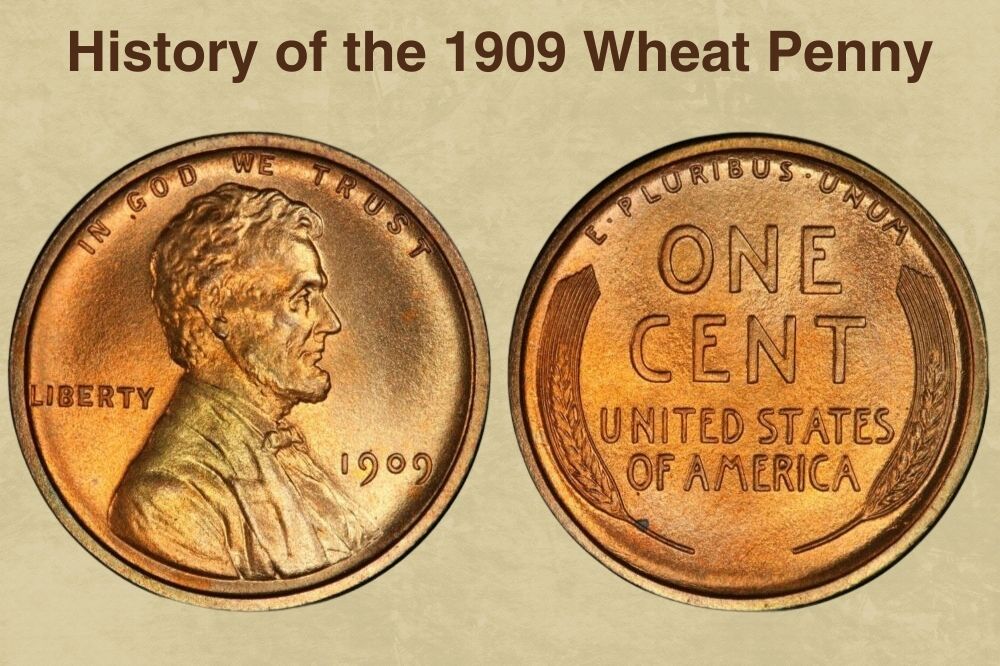
The Wheat pennies appeared in circulation in 1909 for the first time to celebrate the Lincoln centennial of birth. It was also the first American coin with someone real instead of the fictitious figure on the obverse.
Unfortunately, even these coins couldn’t appear in public without controversy. Opponents of the new coinage style looked for reasons for dissatisfaction. One was the too large initials, considered as advertising.
All cents minted after the first bunch from 1909 came without the designer’s initials until 1918. That has made these first pieces sought after among numismatists.
1909 Wheat Penny Types |
||
| Location | Year | Minted |
| Philadelphia | 1909 penny | 72,700,000 |
| Philadelphia | 1909 penny proof | 2,618 |
| Philadelphia | 1909 penny VDB | 27,995,000 |
| Philadelphia | 1909 penny proof VDB | 1,194 |
| q | 1909 S penny | 1,825,000 |
| San Francisco | 1909 S penny VDB | 484,000 |
| Total | / | 103,007,812 |
Nowadays, only a couple of tens of thousands of pieces in the mint state still exist of over 100 million produced. The number of proofs is even lower, and only 272 specimens in the mint state are available, including 137 in the MS 65 or higher.
Also read: 12 Most Valuable Lincoln Penny Worth Money
Features of the 1909 Wheat Penny Value
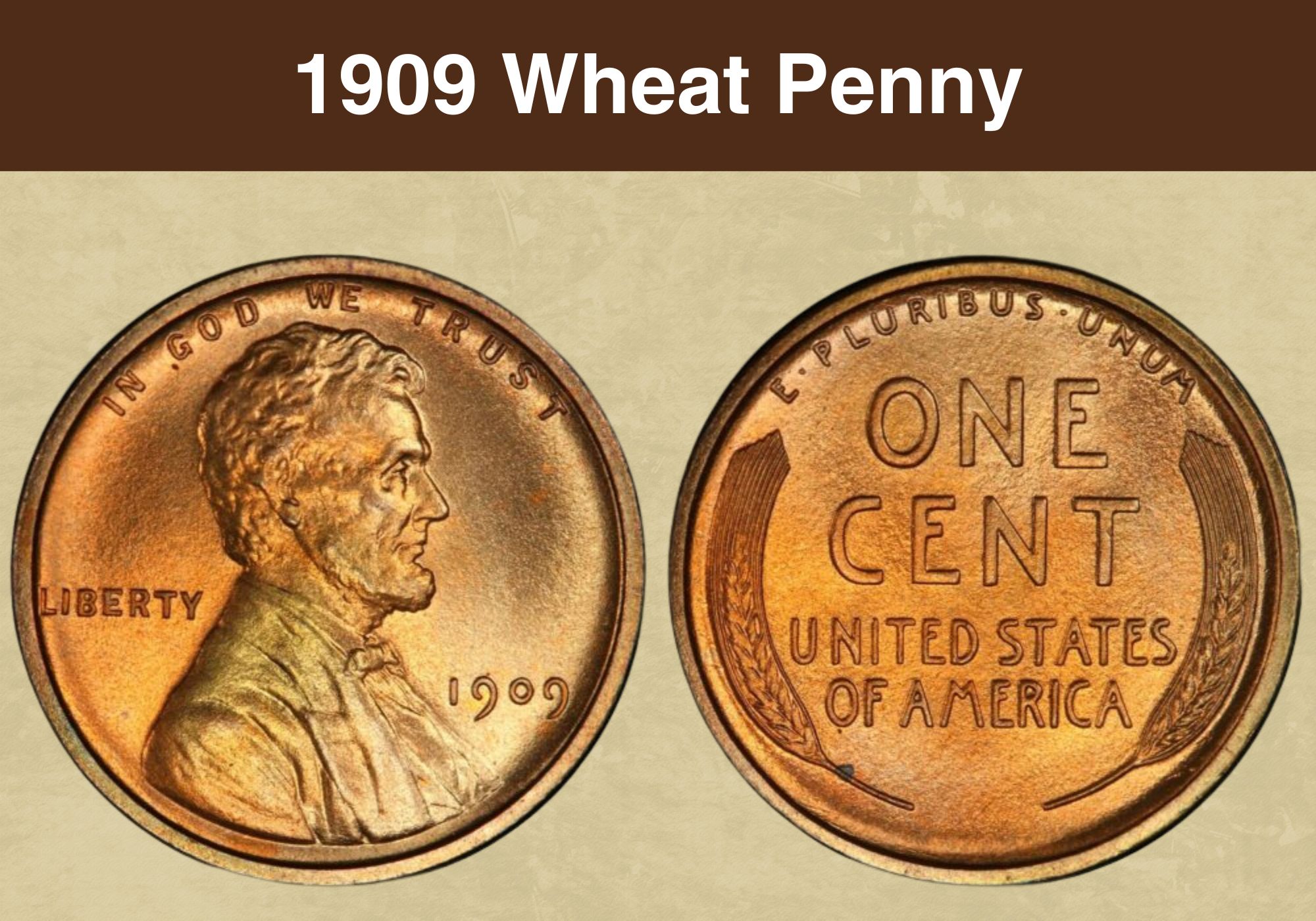
The 1909 penny’s designer was Victor Brenner. You can differentiate two types of these coins existing only this first year of minting, with and without his initials.
The obverse of the 1909 penny
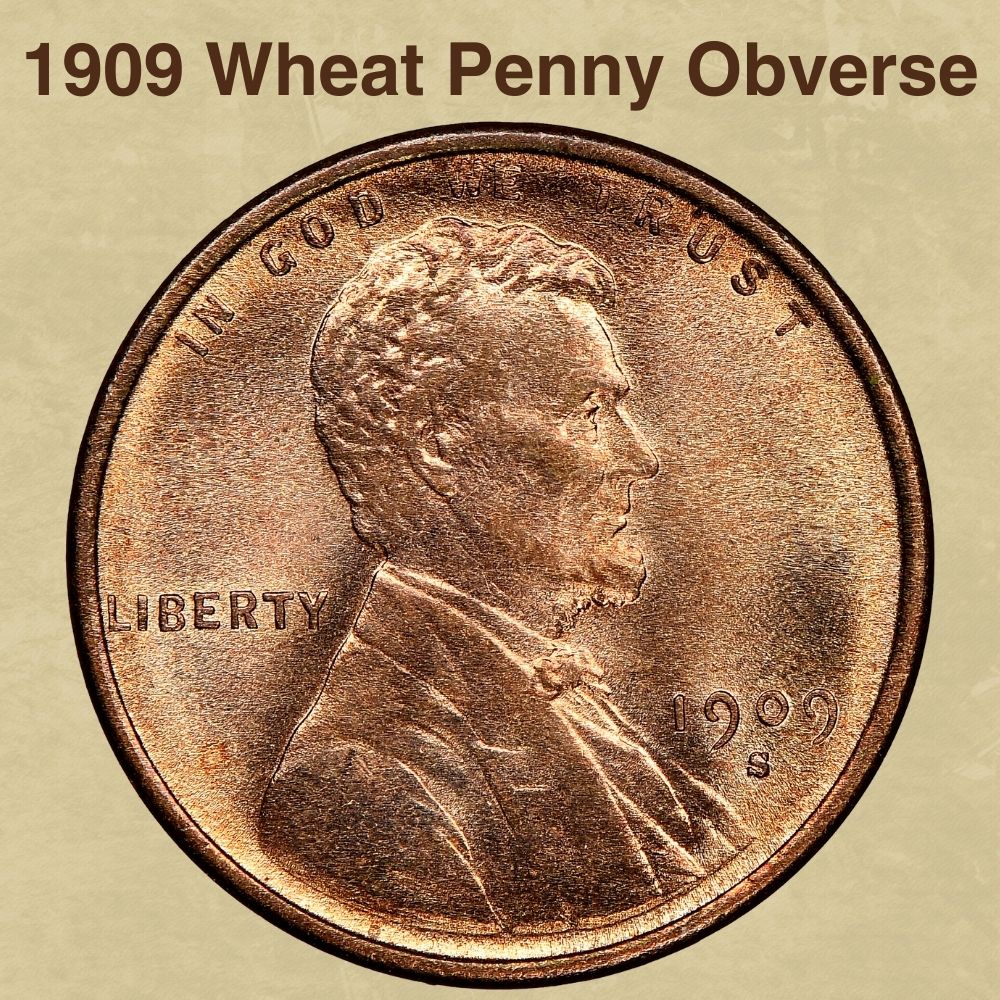
The 1909 penny obverse shows the portrait of the 16th President who did so much for his country. Therefore, his right-facing profile was the first one that ever appeared on one American coin.
On this side, you can also see the date and the mint mark on coins from San Francisco. So-called VDB pieces include the designer’s initials beneath Lincoln’s shoulder.
The reverse of the 1909 penny
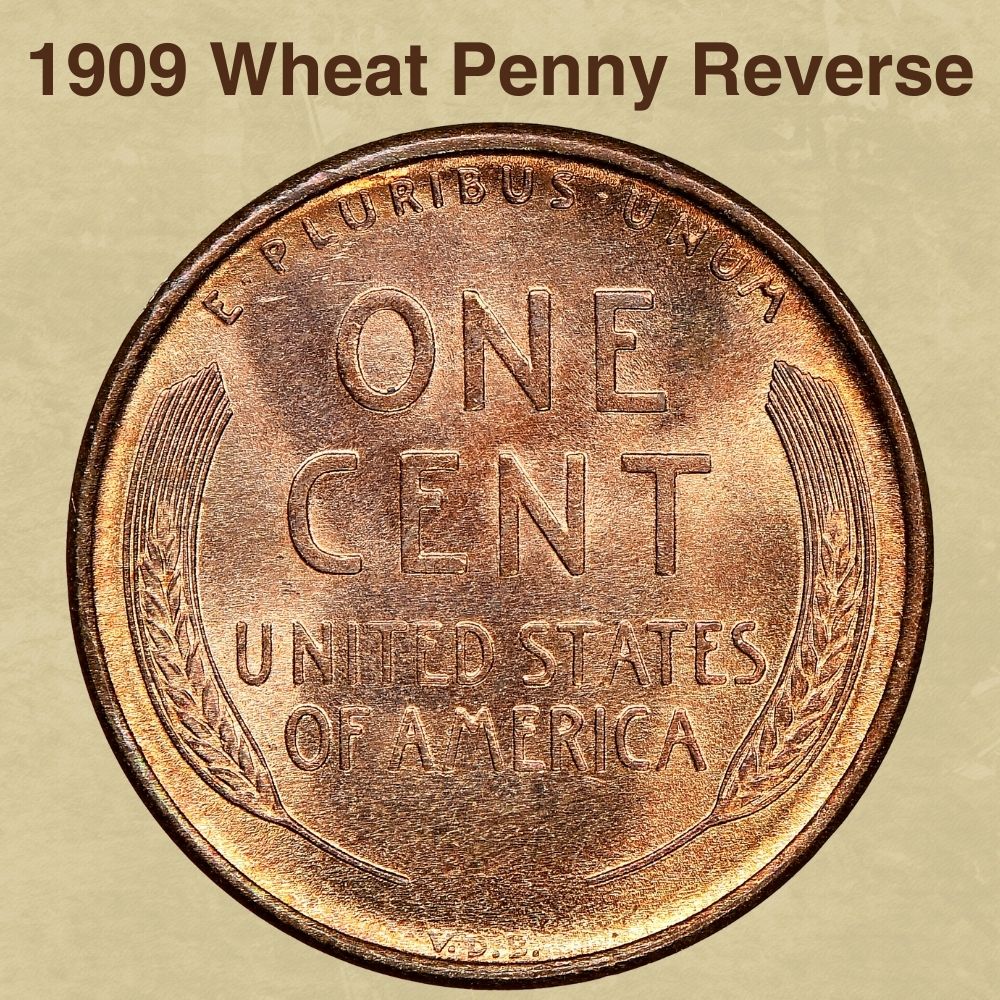
The elegant but simple coin reverse depicts two wheat ears, E·PLURIBUS·UNUM, the denomination, and the name of the country.
1909 Wheat Penny Details |
|
| Compound | An alloy of 95% copper with zinc or tin |
| Coin weight | 3.11 g (0.10970 ounces) |
| Coin thickness | 1.52 mm (0.0598 inches) |
| Coin diameter | 19.05 mm (1.75 inches) |
| Edge | Plain |
| Face value | One cent ($0.01) |
| Shape | Round |
Other features of the 1909 penny
The 1909 pennies are small American coinage with a face value of $0.01. Their composition implies a copper alloy consisting of this metal in 95 percent. Their thickness is 0.0598 inches (1.52 millimeters), their diameter is 1.75 inches (19.05 millimeters), and they weigh precisely 0.10970 ounces (3.11 grams).
Also read: 13 Most Valuable Wheat Penny Worth Money
Grading of the 1909 Wheat Penny
The process of 1909 penny grading is the same as for any other coins, but you should be aware of a few details differentiating them from the standard coin bunch. You can expect them to make a significant difference in prices.
These coins were minted during the first minting year and come in two different types, with and without the designer’s initials. Besides, there are pieces with a few famous errors, including S/horizontal S RPM, typical for those struck in San Francisco.
| # | Grade |
|---|---|
| 1 | Basal State-1 |
| 2 | Fair |
| 3 | Very Fair |
| 4, 5, 6 | Good |
| 7, 8, 10 | Very Good |
| 12, 15 | Fine |
| 20, 30 | Very Fine |
| 40 | Extremely Fine |
| 50 | About Uncirculated |
| 60 | Mint State |
| 65 | Mint State |
| 70 | Mint State |
Please check our grading guides to know your coin scale, It’s the necessary step to know the exact value of your coin.
Check out now: How to Grade Lincoln Wheat Penny?
the 1909 Wheat Penny Value Guides
This year is specific for several penny types recognizable within the total mintage of 103,007,812 coins. For instance, there are four different pieces from Philadelphia, including two standard coins and two proofs. The San Francisco mint issued two types of pennies from regular strikes, including famous and highly sought-after errors.
1909 No Mint Mark Wheat Penny Value (with and without VDB)
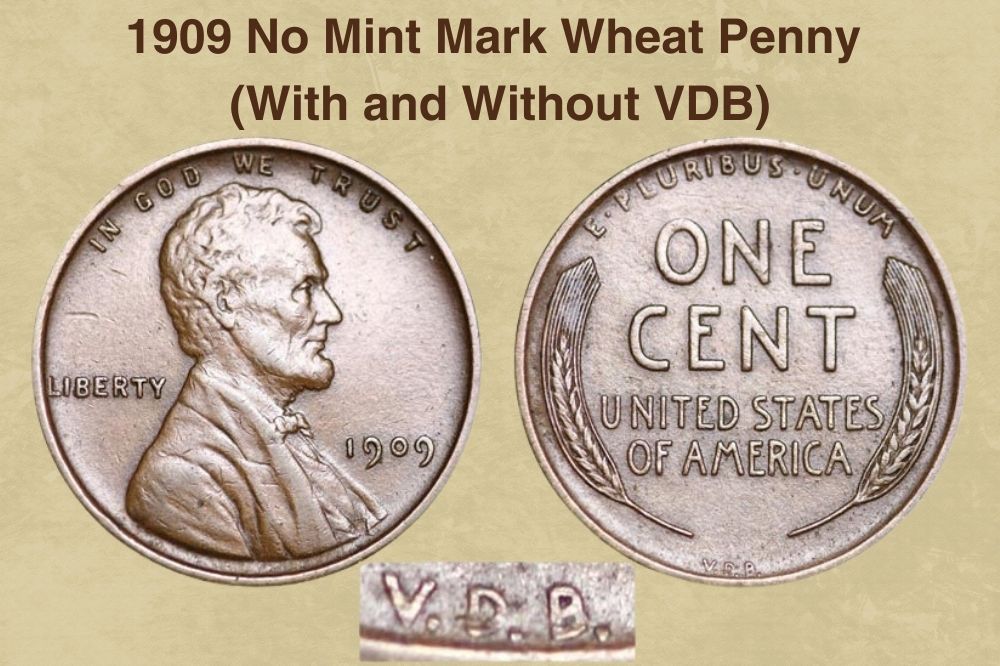
As mentioned, the Philadelphia mint produced four penny types. Two kinds of regular coins came with and without the designer’s initials, dictating their prices. The mintage of pieces without VDB was 72,700,000 coins.
Their value depends on their surface color. For instance, brown pieces cost $1.25 to $12 in circulated condition, while those in the mint state are available at $11 to $54, depending on their appearance.
Red-brown coins, ranking from MS 63 to MS 66, cost $17 to $160, while more expensive red pennies often reach $45 to $330. Only those graded MS 67 are worth approximately $1,200 to $1,800 because of their rarity.
The Philadelphia mint also issued 27,995,000 VDB pennies in 1909. Brown specimens are worth about $3 to $450, depending on their qualities. Red-brown coins are pricier, and you should pay $22 to $828 per one, except for pennies in MS 68 grade. These collectible pieces cost $18,000 to $22,000.
The most expensive 1909 VDB red pennies typically cost $40 to $1,200. The only exception is those with MS 68 ranking. Since they are scarce, you can expect an estimated price of $55,000 to $66,000.
1909 Wheat Penny proofs Value (with and without VDB)
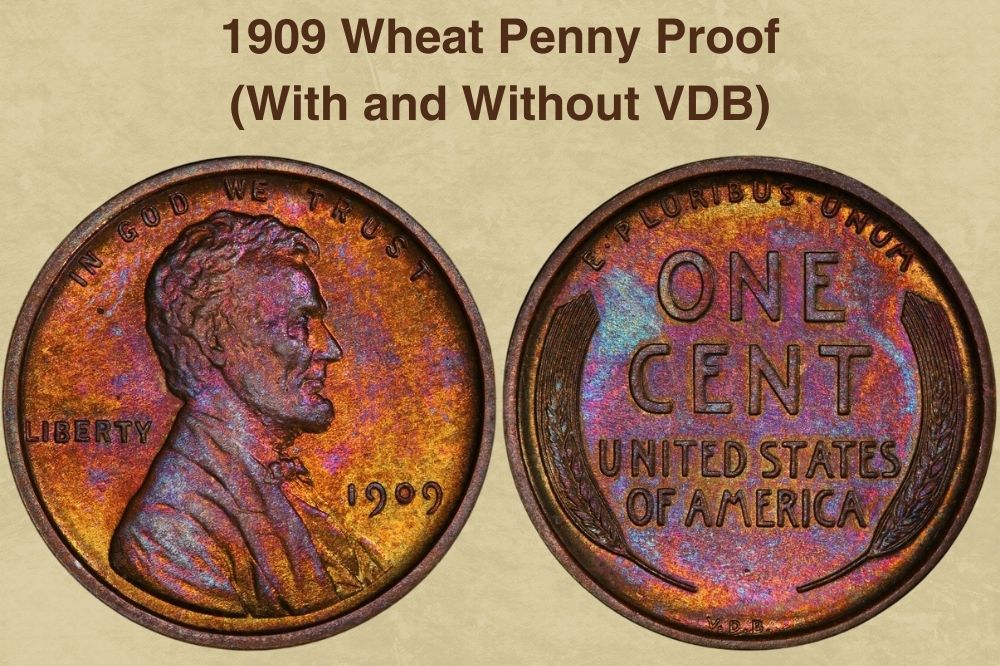
Besides regular coins, the Philadelphia mint produced 2,618 pennies without the designer’s initials and 1,194 VDB pennies in 1909. While standard brown pieces cost $385 to $3,600, you should set aside an incredible $6,500 to $29,400 for rare coins with VDB initials.
Red-brown specimens without VDB have an estimated price range from $425 to $4,560. On the other hand, collectors need to pay those with VDB initials $7,800 to an incredible $100,000, depending on their preservation.
As always, the most collectible are red pennies. You should count on a price range from $1,000 (PR 63) to $65,000 (PR 68) when planning to get one.
The most valuable proofs in the set are red VDB coins with high luster. Their prices are dizzyingly high, ranging from $12,500 to $15,000 for PR 62-graded pennies to $135,000 to $162,000 for PR 67-graded pennies.
1909 S Wheat Penny Value (with and without VDB)
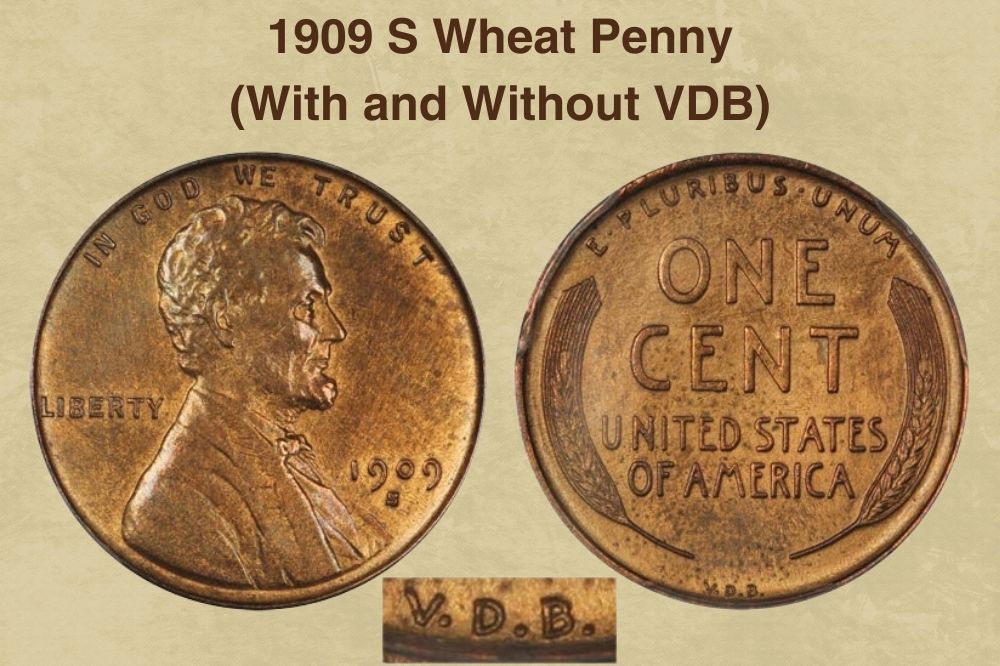
The San Francisco mint issued 1,825,000 pennies in 1909 and 484,000 pieces with VDB initials written at the reverse base. You can recognize coins in three colors, determining the price range.
Regular brown pennies minted in 1909 cost $60 to almost $1,000, while those with VDB are pricier. While circulated coins cost $610 to $1,920, those in the mint state are worth from $1,650 for MS 60-graded pennies to $25,000 for those ranked MS 67.
It is necessary to set aside $280 to $4,800 for red-brown pennies, depending on each piece’s quality. The less expensive cent coins with VDB cost $1,800 to $2,220. The most valuable are those with MS 67 ranking, with an average price of $27,000 to $35,000.
Expectedly, red pennies are the most collectible and valuable. While those without VDB cost $330 to $18,000, finding pieces with VDB for less than $2,000 is impossible.
Scarce specimens in MS 67 grade are a dream for every collector, but only those with an unlimited budget can set aside $102,000 to $150,000 for one.
Also read: 17 Most Valuable Indian Head Penny Worth Money
Rare 1909 Wheat Penny Errors List
The 1909 pennies came with a few specific errors that can cost a lot. Be prepared that some rare VDB pieces with specific imperfections are unexpectedly costly.
DDO
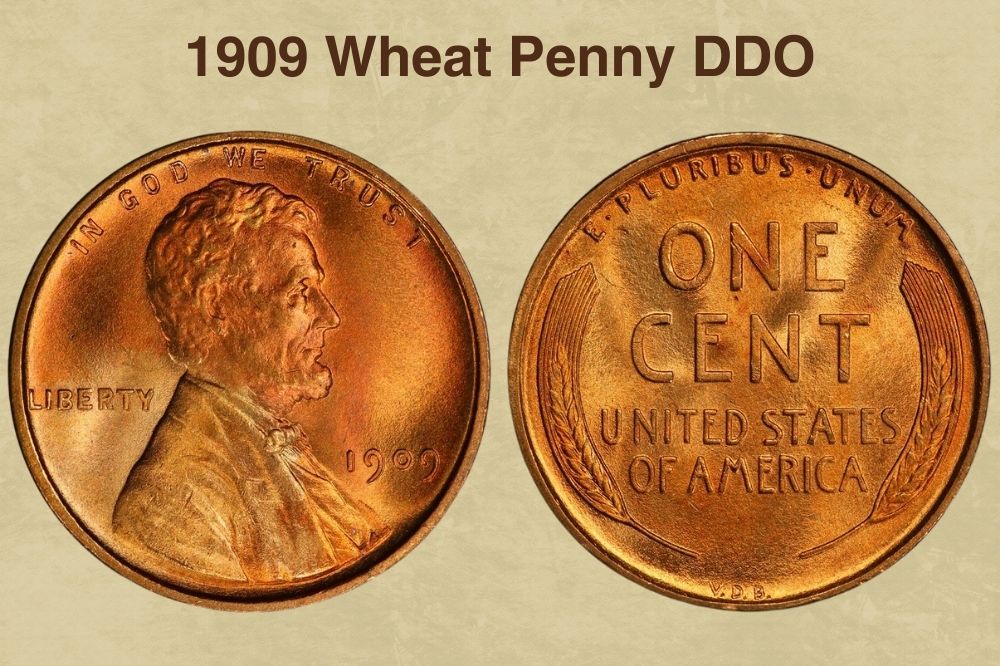
A double die error is present equally in both coin variations with and without VDB. It resulted from the doubled design elements because of a problem during minting. Experts estimate that about 500 VDB pennies produced in 1909 have this error, primarily on LIBERTY.
Their assessed price is approximately $1,000, but auction records are higher. The most expensive is the 1909 VDB MS 67+ red coin with DDO error, paid $31,200 in 2023.
RPM (S over S mint mark)
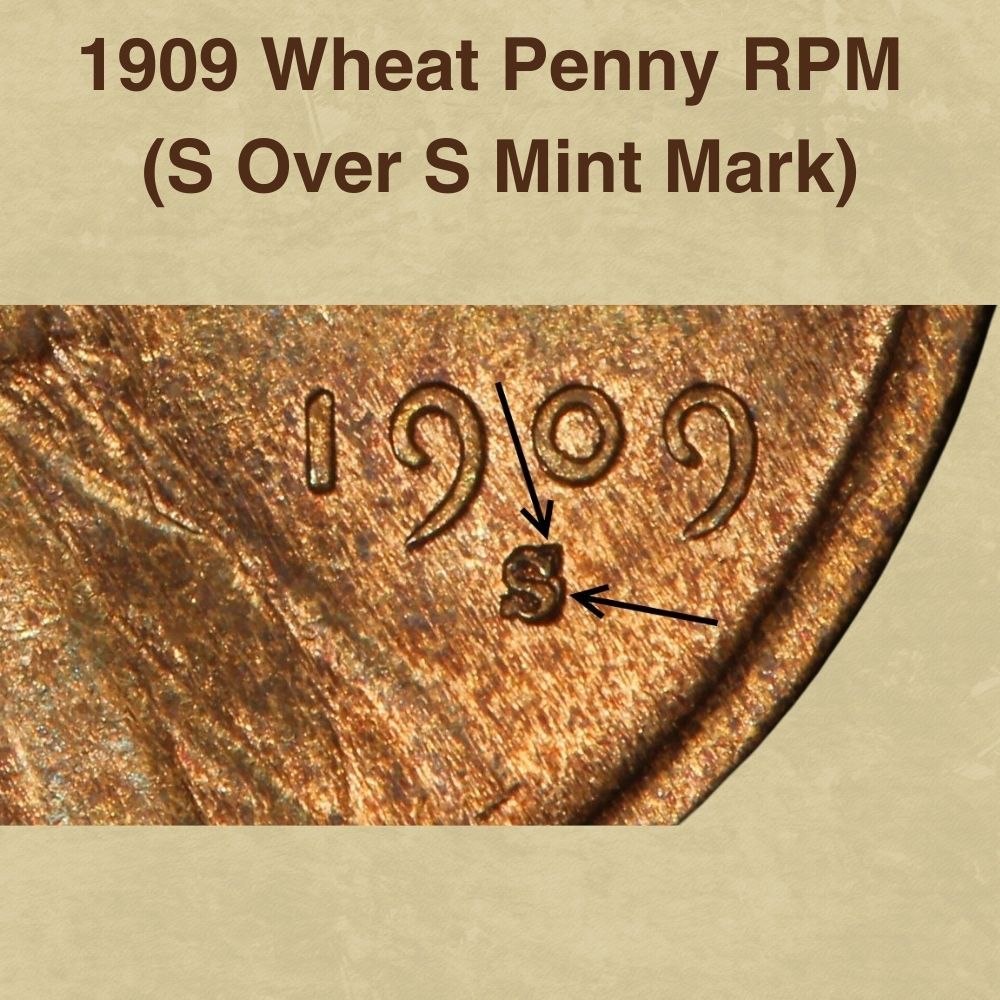
Some Wheat pennies from 1909 came with a re-punched mint mark error, and you can see one S over horizontal S letter on the obverse. This error occurred when the letter was struck wrongly for the first time, and the second one was an attempt to correct it.
Such pennies are about 10% costlier than regular ones, but auction records can be surprisingly high. The most expensive brown error coin cost $875 in 2018, while the red-brown one reached $1,668 in 2006. The red specimen in MS 67 grade is the most expensive, with an auction record from 2022 of $32,900.
Other errors
Besides these two most famous 1909 penny imperfections, you can sometimes find coins with a combination of two errors, such as:
- Off-center with doubling error
- Die chip with doubled die error
Also read: 11 Most Valuable Wheat Penny Errors
Where to Sell Your 1909 Wheat penny ?
Now that you know the value of your coins, do you know where to sell those coins online easily? Don’t worry, I’ve compiled a list of these sites, including their introduction, pros, and cons.
Check out now: Best Places To Sell Coins Online (Pros & Cons)
FAQ about the 1909 Wheat Penny
What makes a 1909 penny rare?
Most circulated 1909 pennies are surprisingly common, considering their age. On the other hand, VDB varieties and pieces in excellent condition can be scarce. Experts consider the 1909 S VDB pennies as the rarest varieties in the series.
Which 1909 penny is worth a lot of money?
- 1909 PR 67+ RB penny (VDB) – $258,500 (2014)
- 1909 S MS 67 RD penny (VDB) – $168,000 (2022)
- 1909 PR 66 RD penny (VDB) – $70,500 (2019)
- 1909 S MS 67 RD penny – $69,000 (2004)
- 1909 PR 68 RD penny – $59,800 (2010)
- 1909 MS 68 RD penny (VDB) – $56,400 (2021)
- 1909 PR 66 BN penny (VDB) – $41,125 (2016)
- 1909 S/Horizontal S MS 67 RD penny – $32,900 (2022)
- 1909 MS 67+ RD penny (VDB, DDO) – $31,200 (2023)
- 1909 MS 67 RD penny (VDB, DDO) – $24,150 (2012)
- 1909 MS 68 RB penny (VDB) – $22,800 (2018)
- 1909 S MS 67 RB penny (VDB) – $19,200 (2021)
- 1909 MS 66 RD penny (VDB, DDO) – $12,075 (2007)
- 1909 PR 67 RB penny – $10,800 (2019)
- 1909 S MS 66 BN penny (VDB) – $10,000 (2022)
- 1909 MS 67+ RD penny – $8,519 (2023)
- 1909 MS 62 BN penny (VDB) – $4,830 (2002)
- 1909 S MS 65 RB penny – $4,000 (2023)
- 1909 PR 67 BN penny – $3,290 (2018)
- 1909 S MS 66 RD penny (RPM) – $3,290 (2019)
- 1909 MS 67 RB penny – $2,800 (2022)
- 1909 MS 66 BN penny (VDB, DDO) – $2,585 (2014)
- 1909 S UNC Details BN penny -$1,680 (2023)
- 1909 S/Horizontal S MS 66 RB penny – $1,668 (2006)
- 1909 PCGS Genuine BN penny -$1,603 (2018)
- 1909 DDO MS 66 RB penny (VDB) – $1,560 (2021)
- 1909 DDO MS 65 RB penny (VDB) – $1,438 (2008)
- 1909 DDO MS 64 RB penny (VDB) – $1,380 (2008)
- 1909 DDO MS 65 BN penny (VDB) – $1,185 (2016)
- 1909 S/Horizontal S VF 35 BN penny – $875 (2018)
How much is the 1909 Philadelphia penny worth?
You can recognize two 1909 penny types, pieces with and without VDB, the designer’s initials. Regular coins cost differently, depending on their color and quality. You can expect the price range of $1.25 to $54 for brown, $17 to $160 for red-brown, and $45 to $1,800 for red coins.
On the other hand, the 1909 VDB pennies are rarer and more valuable. Depending on grade, brown specimens cost $3 to $450, while those with red-brown toning are worth somewhere between $22 to $22,000. The red VDB pennies have a price range from $40 to $66,000.
What is the most expensive Wheat cent?
The most expensive penny Type 1 is the 1944 S MS 66 coin made of steel ($408,000 in 2021). The DDO error red coin in MS 64 grade, minted in 1958 and sold at $336,000 in 2018, is the costliest imperfect piece in the series.
The priciest proof is the 1909 VDB PR 67+ coin, which was paid $258,500 in 2014. The absolute winner in the series is the 1943 D Bronze MS 64 brown piece Type 2. One collector bought it for $840,000 in 2021.