Coin Value Contents Table
- 1925 Stone Mountain Half Dollar Value Chart
- 1925 Stone Mountain Half Dollar Value
- 1925 Stone Mountain Half Dollar “ALA” Value
- 1925 Stone Mountain Half Dollar “FLA” Value
- Grading 1925 Stone Mountain Half Dollar
- 1925 Stone Mountain Half Dollar Rare Error List
- Where to Sell Your 1925 Stone Mountain Half Dollar ?
- 1925 Stone Mountain Half Dollar FAQs
The 1925 Stone Mountain half-dollar was a commemorative fifty-cent coin, mainly familiar to coin collectors due to its attention-grabbing and controversial design and history!
Interestingly enough, the idea to mint this coin was rooted in the need to raise funds for the Stone Mountain Memorial in Stone Mountain, Georgia. It is the largest bas-relief sculpture and is carved high into Stone Mountain.
However, does this coin have any value? The answer is yes! The 1925 Stone Mountain half dollars can be very valuable! So, let’s check the 1925 Stone Mountain half-dollar value and other interesting information!
1925 Stone Mountain Half Dollar Value Chart |
||||||
| Mint Mark | Good | Extremely Fine | MS 63 | MS 65 | MS67 | MS 68 /MS68+ |
| 1925 Stone Mountain Half Dollar Value | $30 | $45 | $90 | $175 | $850 | $15,000 |
1925 Stone Mountain Half Dollar Value
History
The 1925 Stone Mountain half-dollar is a coin with a Southern identity, which is clearly seen in the coin’s design. As mentioned, it was minted in 1925 to raise funds for Confederate memorials, mainly the Stone Mountain Memorial. The project began in 1916 and was ultimately finished in the 1970s’.
The history of the coin is very interesting but controversial at the same time. The coin’s obverse depicts the famous Confederate generals Robert E. Lee and Stonewall Jackson. So, why is that controversial?
In 1861, the Civil War broke out in the U.S. between the Union, also known as the North, and the Confederate states or Confederation, which consisted of Southern states.
There are many causes of the Civil War, such as the issues with the economic policies and practices, cultural values, and the role of slavery in American society, among others. The war lasted four years and ended in 1865 when the Confederacy seceded from the Union.
However, the ideals and ideology of the Confederate South, which glorified slavery and white supremacy over African Americans, persisted and lingered in most southern states. The re-recovery and glorification of those ideals marked the beginning of the 20th century in the U.S.
The seemingly dormant Southern identity emerged, which is why many Confederate Memorials were built in the 20s’ of the previous century. The 1925 Stone Mountain Half Dollar was a part of that resurgence of Southern ideals.
Gutzon Borglum, the American sculptor mainly known for his work on the Mountain Rushmore, did the coin’s design. Interestingly, Borglum was a member of the Ku Klux Klan, the white supremacist and right-wing terrorist group which targeted African Americans.
The Stone Mountain Confederate Monumental Association wanted to erect several Confederate memorials in the 1920s and one of those included the Stone Mountain sculpture. The idea was for the sculpture to depict Confederate warriors, such as General Robert E. Lee.
At the time, the mountain was privately owned, and the association managed to strike a deal with the owners under the condition that the carving was done within 12 years.
The project proved very expensive, so to come up with the funding, the association initiated the idea for the commemorative coin. Borglum, who was already involved in the project of the Stone Mountain memorial, was then hired to design the coin.
One would need Congressional approval to create a new coin design, and Congress did approve it with some resistance. So, to appease the South and the North, the coin was also made in honor of President Warren Harding.
However, Harding was removed from the coin’s design later at the request of President Calvin Coolidge.
The 1925 Stone Mountain half-dollar, the second most minted classic commemorative coin, was sold throughout the South by many supporters, including the United Daughters of the Confederacy.
Obverse
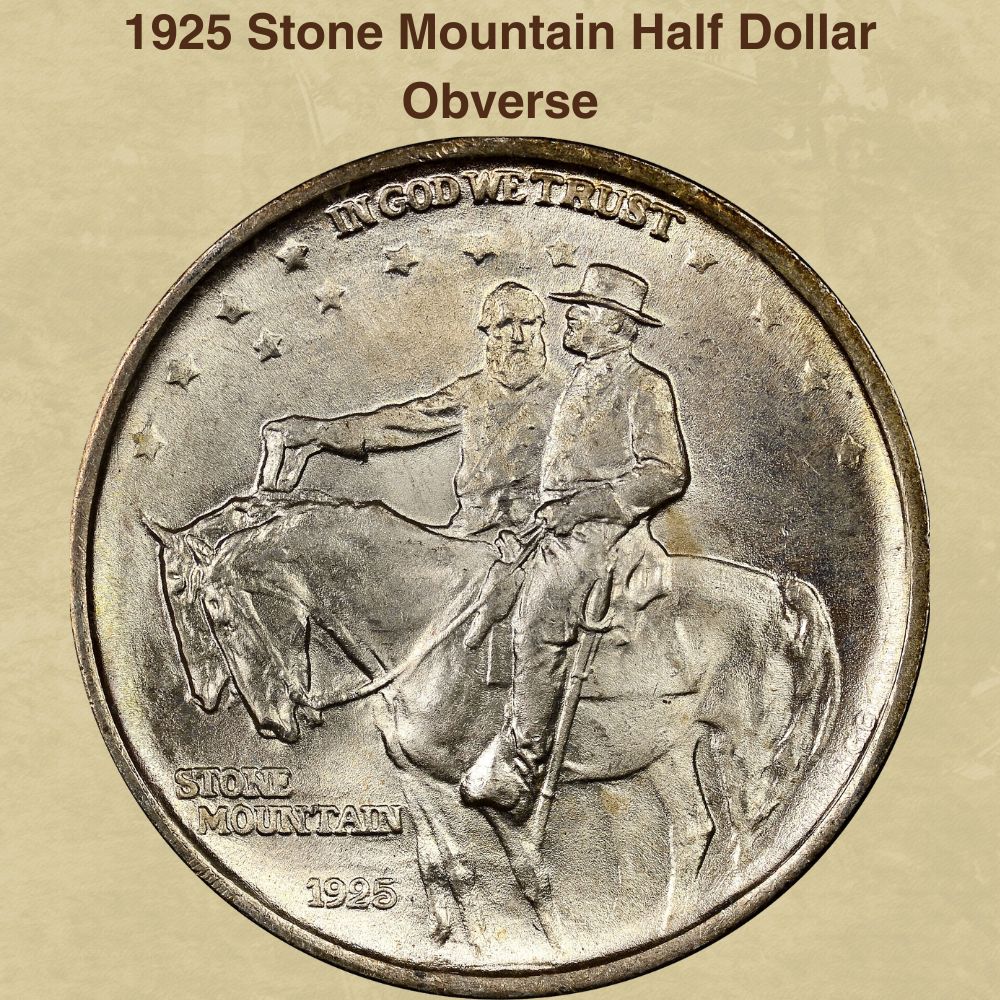
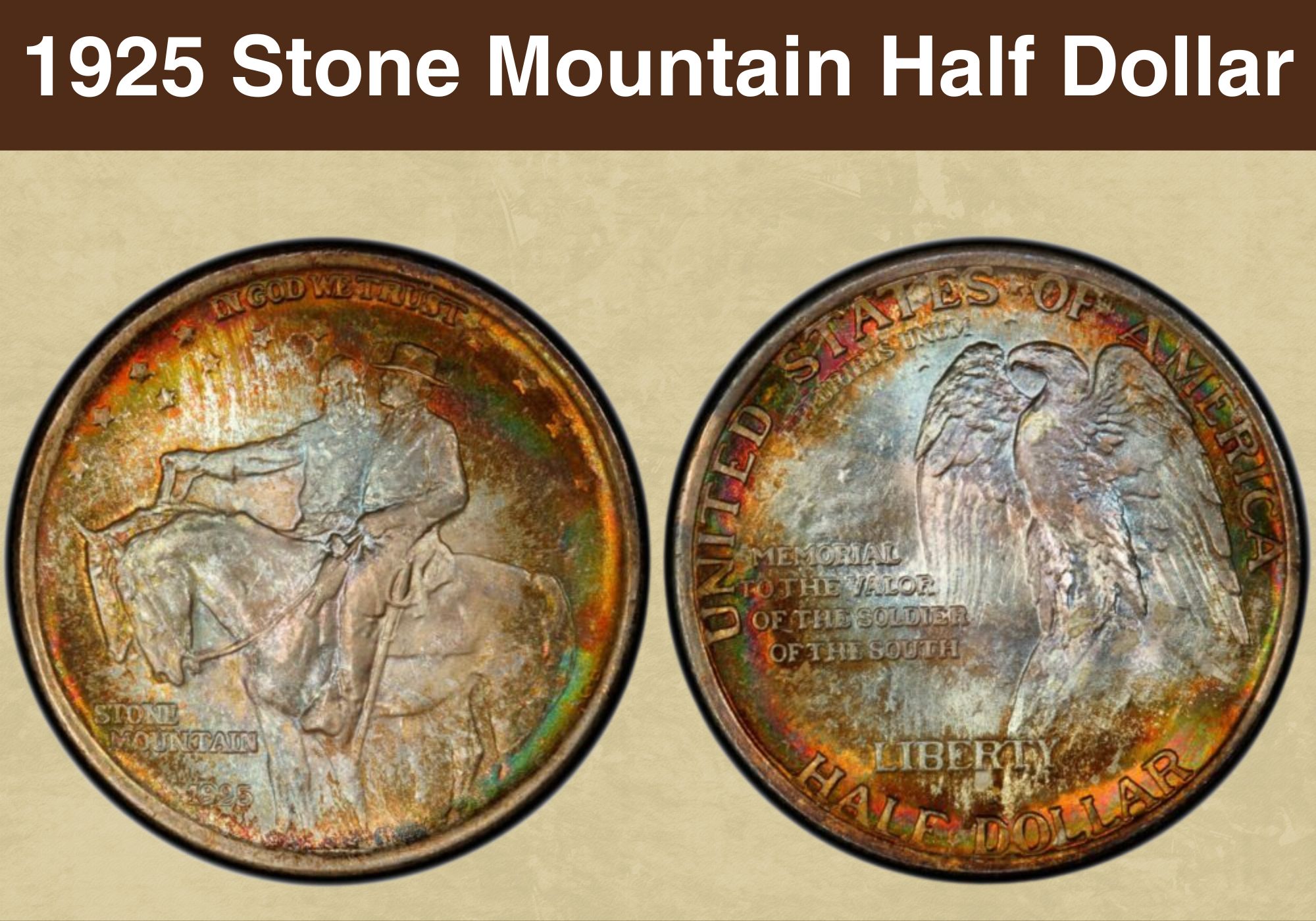
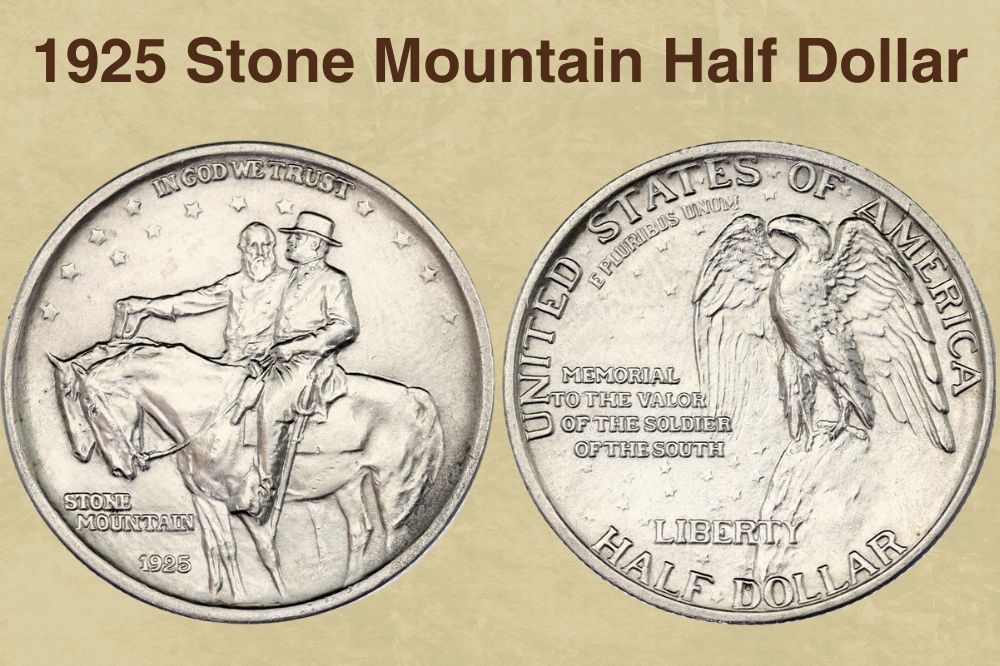
The coin’s obverse, as mentioned, depicts the image of Robert E. Lee and Stonewall Jackson on horseback. The horses and the two generals are struck with great details, which adds to the coin’s aesthetic value.
The inscription “IN GOD WE TRUST” is at the upper rim of the coin, “surrounded with thirteen stars. Although the thirteen stars usually represent the thirteen original colonies, that premise is unclear regarding this coin.
The cause of confusion is that there were also 13 Confederate States before the Civil War, so whether those stars symbolize the original colonies or the Confederate States remains a mystery.
Reverse
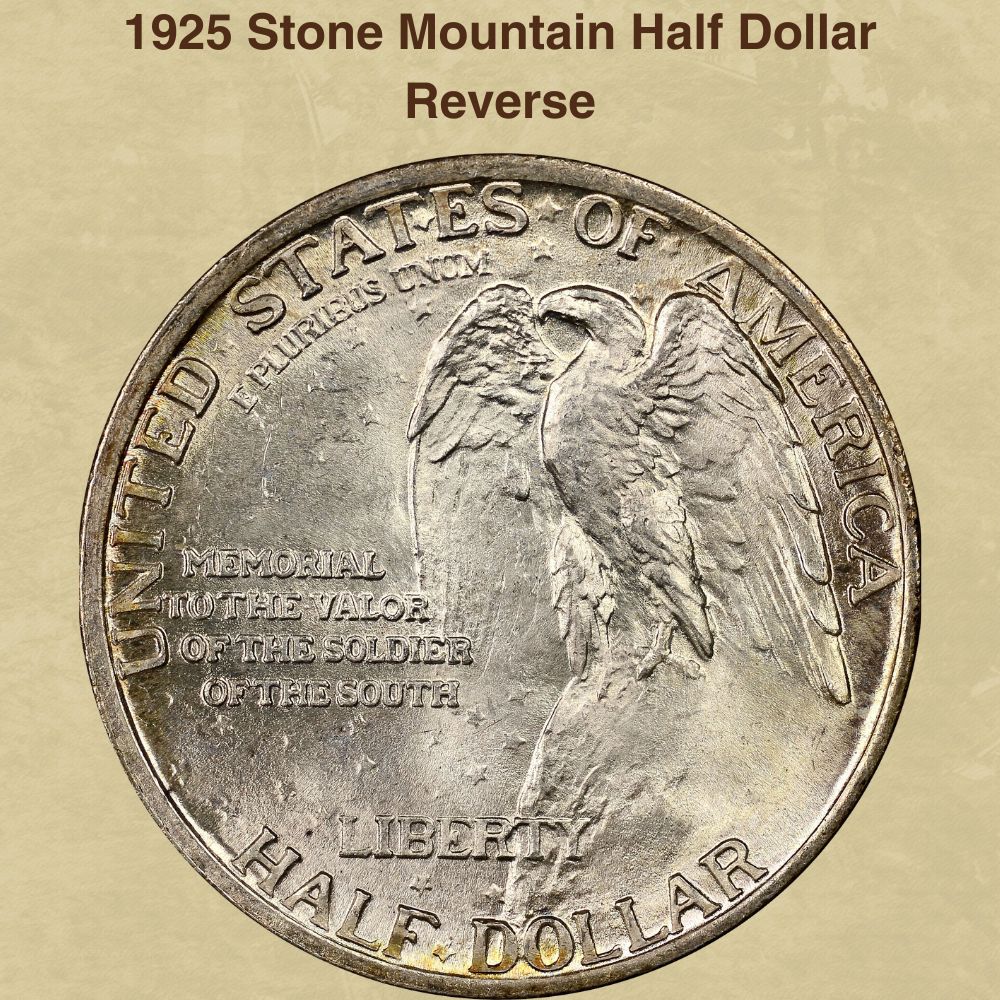
The reverse features the image of the American eagle perched on a mountain crag or a cliff with outstretched wings. The capitalized inscription “UNITED STATES OF AMERICA” is alongside the upper rim.
Underneath the word “STATES,” we can see the second American motto, “E PLURIBUS UNUM.” On the left side of the coin is another inscription, “MEMORIAL TO THE VALOR OF THE SOLDIER OF THE SOUTH.”
Underneath the eagle and the inscription is capitalized “LIBERTY” struck. The coin’s denomination “HALF DOLLAR” is at the center of the coin’s lower rim. So, the 1925 Stone Mountain half-dollar is a special type of coin and was minted only in 1925.
Interestingly some refer to it as “the most racist coin in American history.”
Other Details
Its metal composition is 90% silver and 10% copper. Similarly to other half-dollar coins at the time, this one also weighed 12.5 grams, and its diameter was 30.61 millimeters. The coin’s thickness is 2.15 millimeters, and its edge is reeded.
These coins were sold for $1, twice their face value. The 1925 Stone Mountain half-dollar was only minted in Philadelphia, so they do not have any mint marks.
However, each state produced these coins, and many were counterstamped to indicate the state and increase the auction bids. Ultimately, the 1925 Stone Mountain half-dollar mintage is 5 million; however, only 1,314,709 pieces were sold, despite the great enthusiasm.
Therefore, many of the 1925 Stone Mountain half dollars were released into circulation.
Mintage & Value
So, as mentioned, the Philadelphia Mint distributed 1,314,709 of the 1925 Stone Mountain half-dollar. Despite its controversial history, the 1925 Stone Mountain half-dollar is one of the most valuable coins compared to other commemorative coins.
Considering that it is a silver coin, you can always sell it for its worth in silver, which is currently $9.17. As mentioned, some of the coins were counterstamped, meaning they have stamps such as “ALA” “and the number “191”.
The “ALA” stands for Alabama, and they used these stamps hoping that they would fetch a higher price. That said, no accepted variety of the 1925 Stone Mountain half-dollar exists.
So, the 1925 Stone Mountain half-dollar value without the counter stamps in very fine condition is around $32. The same coin in a one-grade higher state costs around $45. If the coin is in AU 55, the price does not differ greatly, and you can expect to pay around $65 for the 1925 Stone Mountain half-dollar.
These are rare and expensive in higher-mint states and can fetch a decent amount for a commemorative coin. The 1926 Stone Mountain half-dollar value in MS 63 can range between $100 and $700.
In MS 65, the 1925 Stone Mountain half-dollar value ranges between $170 and $250.
In MS 77, the 1925 Stone Mountain half-dollar can be worth between $600 and $1,800. The highest reported mint state for the 1925 Stone Mountain commemorative half-dollar without any stamps is 68+, and its value in that condition is between $3,500 and $28,000.
However, the auction record for the 1925 Stone Mountain half-dollar was set in 2005 at the Stack’s Bowers, and the collectors paid the jaw-dropping $37,375 for the 1925 Stone Mountain half-dollar in MS 65.
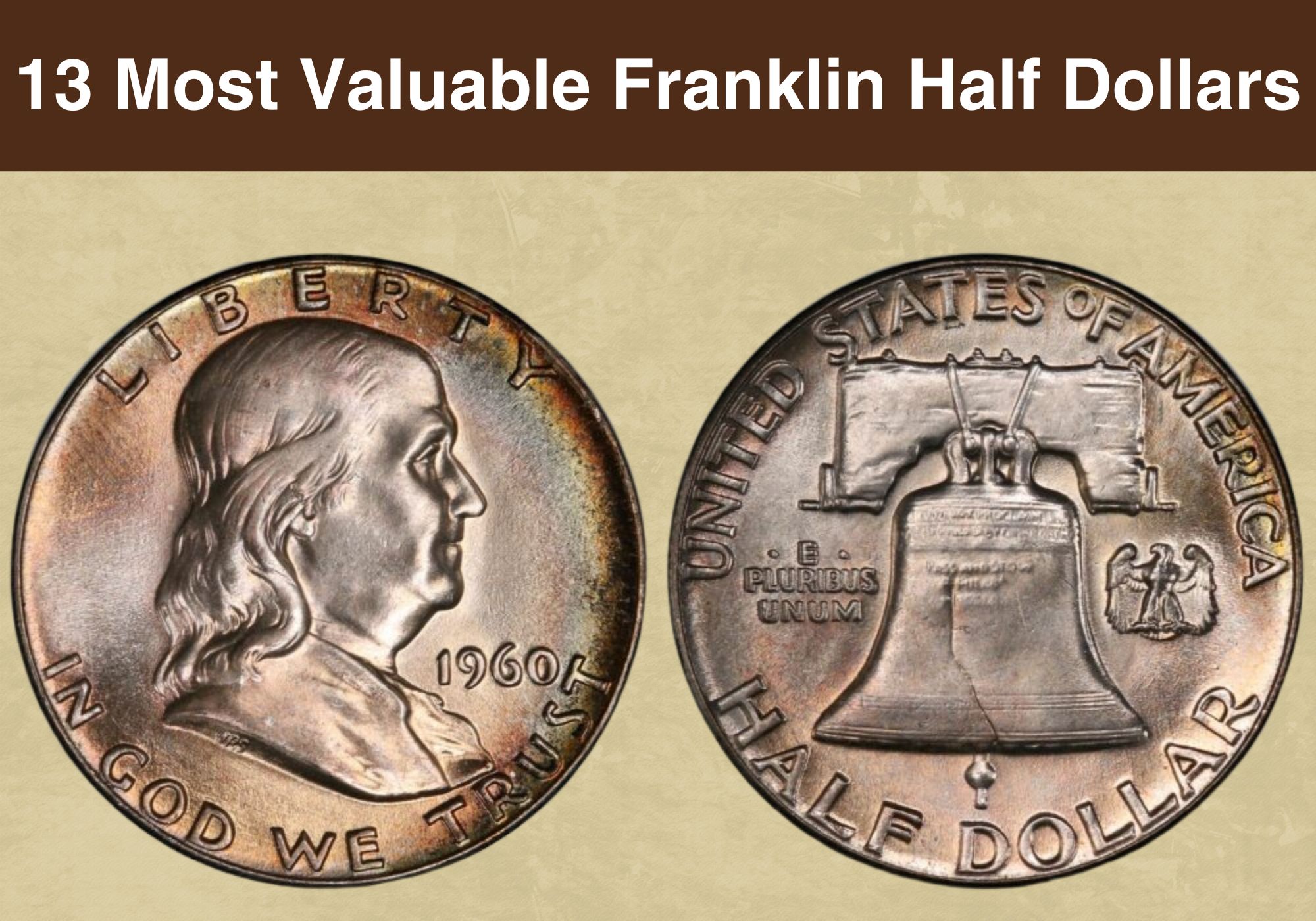
Also read: 13 Most Valuable Franklin Half Dollars Worth Money
1925 Stone Mountain Half Dollar “ALA” Value
Now talking of the 1925 Stone Mountain half-dollars that bear the counterstamps and GL or SL designations, each town with the coin quota was regarded as a unit, and each of those units had the right to stamp some of the coins with the State’s initials and a number.
As mentioned, the goal was to fetch a better price for the coins. The GL and SL abbreviations are Gold Lavalier and Silver Lavalier, which were 1st and 2nd place awards, respectively. Young ladies sold the 1925 Stone Mountain half-dollar; most of those were members of the United Daughters of Confederacy.
So, the girl or girls who had the highest sales or would win the competition in their locale would receive the pieces awarded in bezels.
The most commonly found 1925 Stone Mountain half-dollar is the regular strike coin without the stamps and designations. The rarest are the half dollars with the state stamps and the number. They are so rare that you need to put effort into finding one.
The 1925 Stone Mountain half-dollar with “ALA” stamp in MS 63 was sold for $3,840, a more than attractive price for a commemorative coin. At a recent auction in June 2022, the same coin in VG 10 was sold for $660.
Therefore, the 1925 Stone Mountain half-dollar with “ALA” stamps is highly valuable, and according to the PCGS, they have only one piece with the MS 63 with a value of $5,000.
1925 Stone Mountain Half Dollar “FLA” Value
So, the usual price for the counterstamped 1925 Stone Mountain half-dollar ranges between $10 and $120 although some were sold for less and some for a higher price. The ones in higher states can fetch four figures.
However, most of these are privately owned and rarely come up at auctions; hence it is hard to estimate their value. One of those with a Florida stamp was sold in 1995 for $1,500. Another specimen in AU 55 was sold for the same price in 2006.
The most recent sale was in 2019, and the 1925 Stone Mountain in G 4 grade was sold for $1,020. The highest grade for the 1925 Stone Mountain half-dollar “FLA” is MS 63.
Other counterstamps include “OKLA,” “S.C.,” “TEX,” “KY, “N.C.,” “GA,” and MISS,” which are abbreviations for the Southern states, Oklahoma, South Carolina, Texas, Kentucky, North Carolina, Georgia, and Mississippi respectively.
Their price range is between $500 and $10,000 and depends on the coin’s condition, but due to rarity, even in lower grades, these coins can be very valuable. The 1925 Stone Mountain half-dollar “N.C.” in XF 40 was sold at an auction in 2022 for $2,700.
The highest price for the counterstamped 1925 Stone Mountain half-dollar “MISS” is $9,300.
Also read: 13 Most Valuable Kennedy Half Dollar Worth Money
Grading 1925 Stone Mountain Half Dollar
The process of grading coins can seem complicated, especially if you are new to coin collecting.
The grade and the value are directly connected, and the grade often dictates the value. However, other significant factors must be considered, such as the mint mark, mintage number, designations, and errors.
1925 Stone Mountain Half Dollar Rare Error List
The 1925 Stone Mountain half-dollar is not particularly known for having many errors; the only reported error for this coin is double die obverse or DDO.
1925 Stone Mountain Half Dollar Double Die Obverse Error
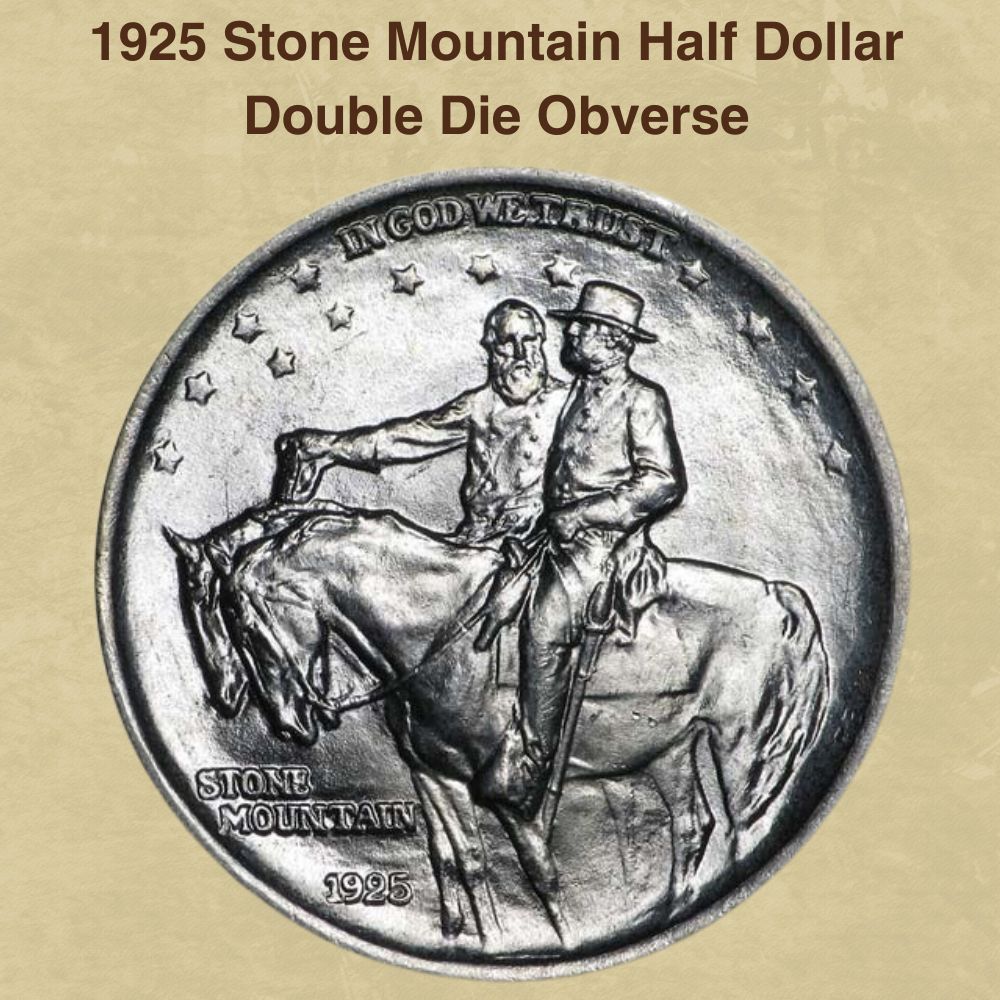
The double die obverse error occurs when the coin is struck with the double die; the die used to strike the coin gets misaligned on the second blow from the working hub, resulting in double details.
The more the doubling is obvious, the more valuable coin will be! The errors, in most cases, boost the price of a coin. The 1925 Stone Mountain half a dollar in MS 63 with DDO is worth around $150, while in MS 65 is worth around $275.
However, the most valuable are the ones with this error in MS 67, which can be worth up to $1,250.
Also read: 11 Most Valuable Half Dollars In Circulation
Where to Sell Your 1925 Stone Mountain Half Dollar ?
Now that you know the value of your coins, do you know where to sell those coins online easily? Don’t worry, I’ve compiled a list of these sites, including their introduction, pros, and cons.
Check out now: Best Places To Sell Coins Online (Pros & Cons)
1925 Stone Mountain Half Dollar FAQs
How many 1925 Stone Mountain half dollars were minted?
The total mintage of the 1925 Stone Mountain half-dollar is 5 million, according to the PCGS. However, the Philadelphia Mint distributed around 1.3 million pieces. Most of the coins were believed to be melted, lost, or privately owned.
How much is a 1925 Stone Mountain half-dollar silver worth?
The 1925 Stone Mountain half-dollar in average condition is worth around $30 in average condition, while its melt value is around $9.