Coin Value Contents Table
- 1972 Dollar Value By Variety
- 1972 Dollar Value Chart
- Top 10 Most Valuable 1972 Dollar Worth Money
- History of The 1972 Dollar
- Is You 1972 Dollar Rare?
- Key Features of The 1972 Dollar
- 1972 Dollar Mintage & Survival Data
- 1972 Dollar Mintage & Survival Chart
- The Easy Way to Know Your 1972 Dollar Value
- 1972 Dollar Value Guides
- 1972 Type 1 Dollar Value
- 1972 Type 2 Dollar Value
- 1972 Type 3 Dollar Value
- 1972-D Dollar Value
- 1972-S Silver Dollar Value
- 1972-S Silver Proof Dollar Value
- 1972-S Silver CAM Dollar Value
- 1972-S Silver DCAM Dollar Value
- Rare 1972 Dollar Error List
- Where To Sell Your 1972 Dollar?
- FAQ About 1972 Dollar
The 1972 Dollar value ranges dramatically based on subtle design variations that most owners never notice. Three distinct types were minted that year, each showing different details of Earth on the reverse.
A Type 1 in Good condition sells for $1.00, while the scarce Type 2 commands $9.03, and in MS grade that gap widens to $32.80 versus $396.80. Type 3 coins, valued at $3.88 in Good condition, display the most defined geographical features with clearly visible islands.
Understanding which variety you own directly impacts value. While most 1972 Dollars traded at face value during circulation, identifying the correct type today can reveal whether you hold a common piece or a key date worth significantly more to collectors.
1972 Dollar Value By Variety
Market values vary significantly by grade and type. The chart below shows current pricing for 1972 Dollars from circulated to mint state condition, reflecting real marketplace data. If you know the grade of your coin, you can find the exact price below in the Value Guides section.
1972 Dollar Value Chart
| TYPE | GOOD | FINE | AU | MS | PR |
|---|---|---|---|---|---|
| 1972 Type 1 Dollar Value | $1.00 | $1.00 | $1.00 | $32.80 | — |
| 1972 Type 2 Dollar Value | $9.03 | $37.83 | $69.50 | $396.80 | — |
| 1972 Type 3 Dollar Value | $3.88 | $5.83 | $16.50 | $43.80 | — |
| 1972 D Dollar Value | $1.00 | $1.00 | $1.00 | $31.17 | — |
| 1972 S Silver Dollar Value | $10.06 | $11.00 | $12.00 | $21.14 | — |
| 1972 S Silver Proof Dollar Value | — | — | — | — | $10.62 |
| 1972 S Silver CAM Dollar Value | — | — | — | — | $13.12 |
| 1972 S Silver DCAM Dollar Value | $11.00 | $11.00 | $11.00 | — | $19.11 |
Also Read: Eisenhower Dollar Value (1971-1978)
Top 10 Most Valuable 1972 Dollar Worth Money
Most Valuable 1972 Dollar Chart
2002 - Present
There are striking value differences among 1972 Eisenhower dollar coins based on their grade and variety. The 1972 Type 2 variant in MS66 grade commands $14,400, making it the most valuable on this list. This variant was accidentally struck with a reverse die intended for proof coins only, which explains its premium status.
The second position belongs to the 1972-D MS67+, valued at $13,200. This auction record was set at Heritage Auctions in July 2023.
The third-ranked coin, the 1972 Type 1 in MS66, reaches $7,475. While also a Philadelphia mint product, its value is roughly half that of the Type 2 variant. This difference stems from the Type 1 being more common.
Denver mint coins demonstrate consistent collector demand across multiple grades. Beyond the top-ranked MS67, lower grades maintain significant premiums with MS63 reaching $7,200 and MS62 fetching $6,325. These figures reflect strong interest in well-preserved specimens from the higher-mintage Denver facility.
The lower portion features 1972-S Silver variants ranging from $3,680 to $5,750. These coins contain 40% silver and were sold in special packaging, contributing to their collector appeal despite their lower relative values.
History of The 1972 Dollar
When President Dwight Eisenhower died on March 28, 1969, Congress moved swiftly to honor his memory with a commemorative dollar. The decision reflected his extraordinary dual legacy.
As Supreme Commander of Allied forces in Europe during World War II, Eisenhower planned and supervised Operation Torch in North Africa and the D-Day invasion of Normandy, two of the war’s most consequential campaigns.
The proposal received widespread bipartisan support, though debate over the coin’s composition delayed its passage for more than a year. Finally, on December 31, 1970, President Richard Nixon signed the legislation authorizing the new dollar.
Designed by U.S. Mint Chief Engraver Frank Gasparro. Production began in early 1971, with the Mint striking over 125 million pieces that year. By 1972, production increased to over 170 million as the Mint worked to meet demand.
During 1972, the Philadelphia Mint produced three distinct reverse varieties as the design was refined, with the Type 2 variety accidentally struck using a die intended only for proof coins. The Mint deployed harder die steel later in the year to address production difficulties. These technical challenges resulted in subtle but collectible variations.
Despite high production numbers, the Eisenhower dollar failed to achieve widespread circulation, finding its primary use in Nevada casinos rather than everyday commerce.
The 1972 issue thus represents a pivotal year marked by design refinements and the creation of varieties that would later become highly sought after by collectors.
Also Read: Top 100 Rarest Silver Dollar Coins Worth Money (Most Expensive)
Is You 1972 Dollar Rare?
1972 Type 1 Dollar
1972 Type 2 Dollar
1972 Type 3 Dollar
1972-D Dollar
1972-S Silver Dollar
1972-S Silver Proof Dollar
1972-S Silver CAM Dollar
1972-S Silver DCAM Dollar
Download the CoinValueChecker App to instantly identify your 1972 Dollar’s type and grade through photo recognition, then check current market values based on verified auction data.
Key Features of The 1972 Dollar
The 1972 Eisenhower Dollar stands out for its large size and dual-composition format, with circulation strikes made from copper-nickel clad and special collector versions struck in 40% silver.
What makes the 1972 issue particularly notable is the existence of three distinct reverse varieties, each reflecting the Mint’s ongoing efforts to refine the design during the coin’s second year of production.
The Obverse Of The 1972 Dollar
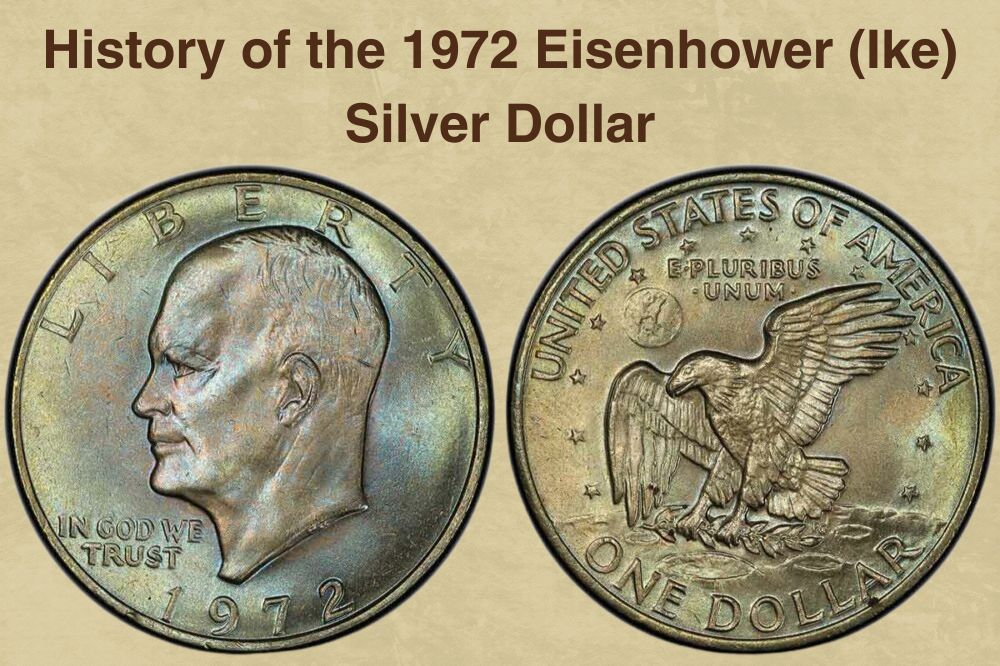
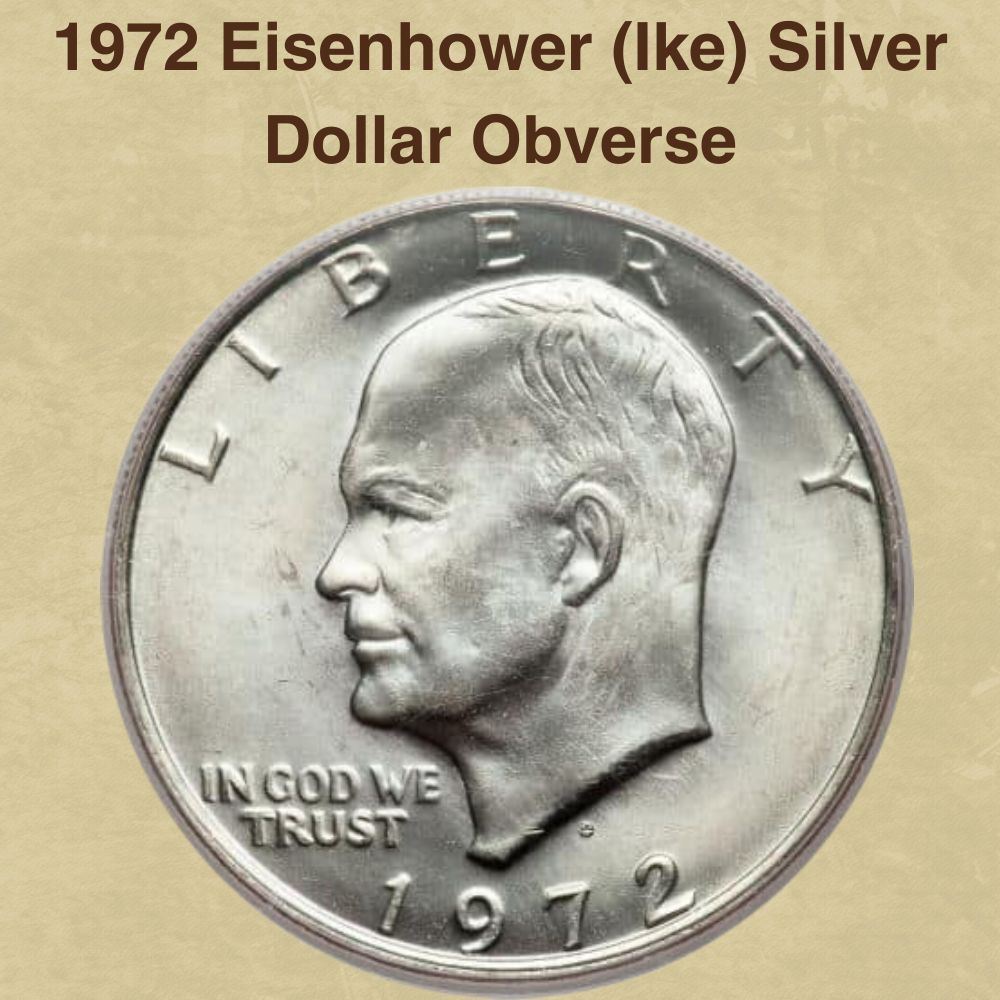
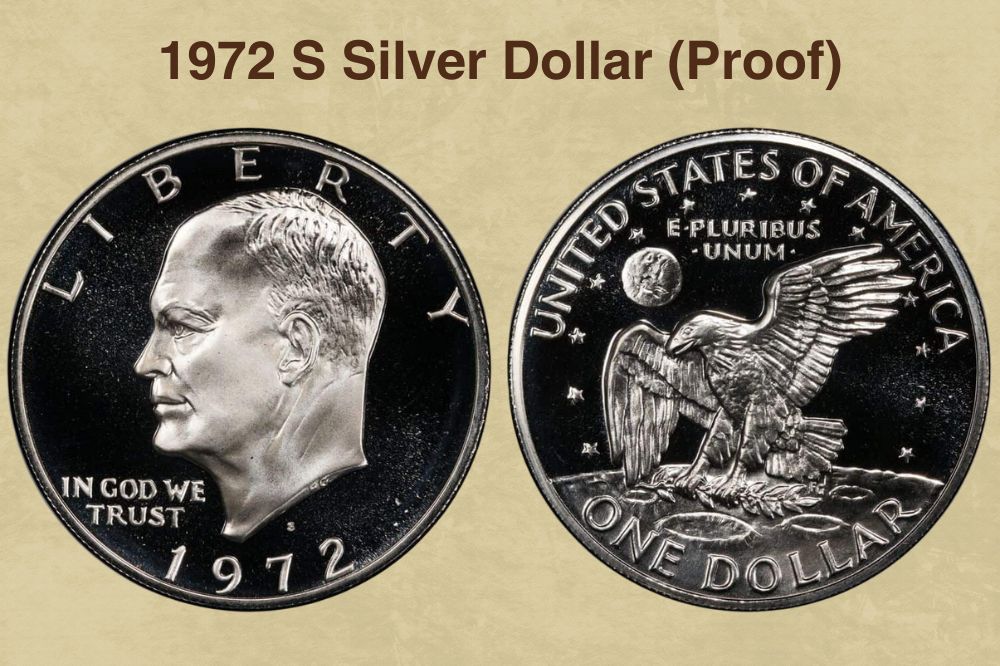
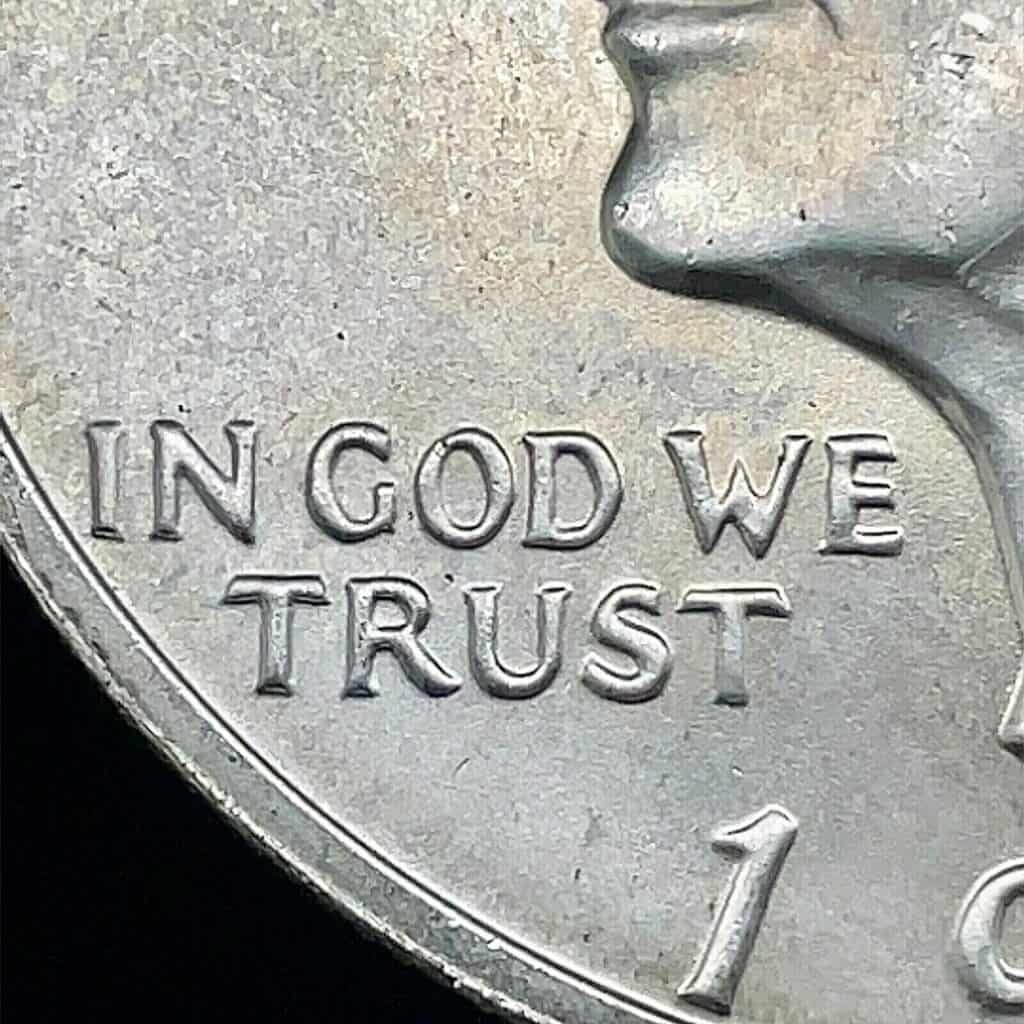
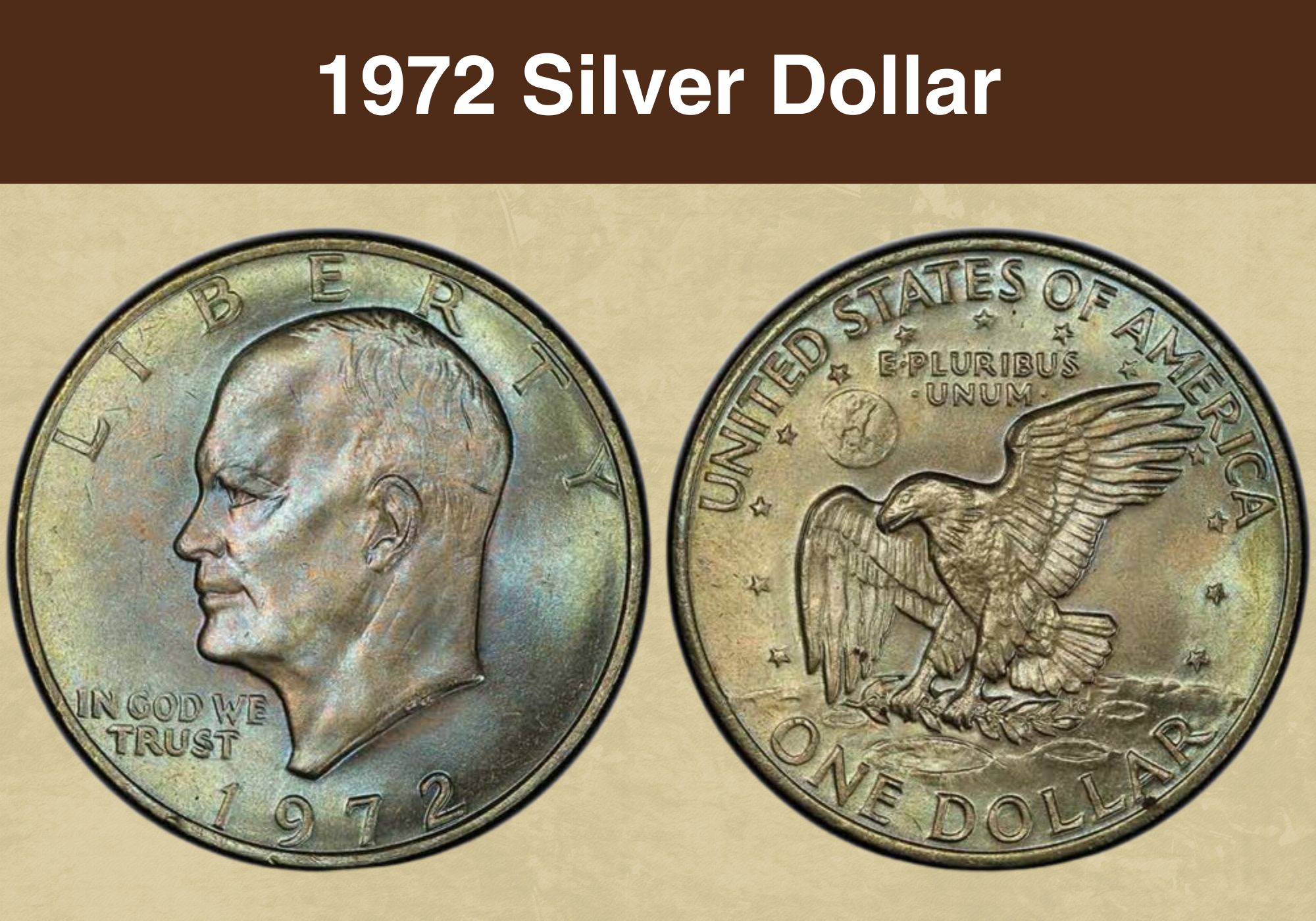
The obverse features Frank Gasparro’s portrait of President Dwight D. Eisenhower in left-facing profile, with the inscription “LIBERTY” positioned above the portrait. Left the president’s bust appears the motto “IN GOD WE TRUST,” while the date “1972” is positioned to the below of Eisenhower’s image.
The mintmark, when present, appears on the obverse below Eisenhower’s neck, just above the date. Philadelphia-minted coins bear no mintmark, Denver coins display a “D,” and San Francisco pieces show an “S.”
The Reverse Of The 1972 Dollar
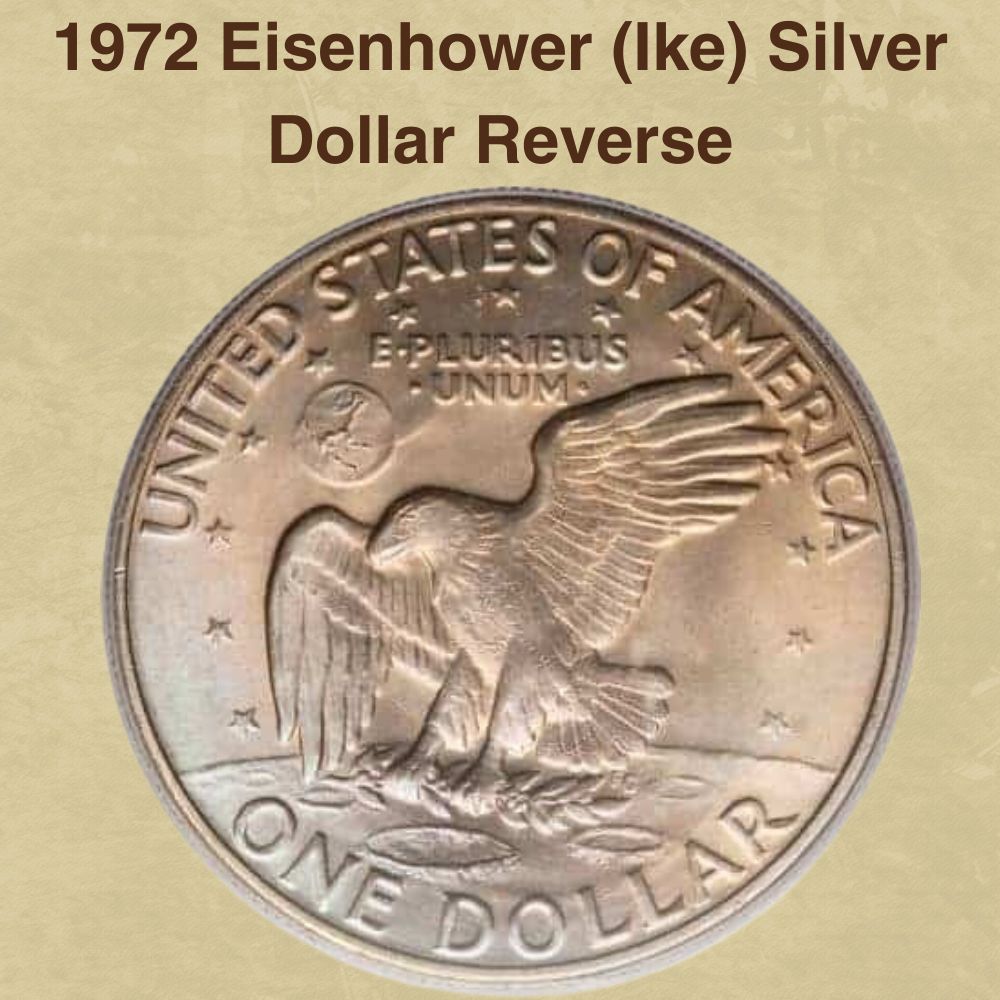
The reverse features an adaptation of the Apollo 11 mission insignia, showing an eagle landing on the moon’s surface while clasping an olive branch. This design was based on the mission patch conceived by astronaut Michael Collins and others, representing both the historic lunar landing and the peaceful intentions of the mission.
Above the eagle’s wing appears a depiction of Earth, showing the continents and the Caribbean region. The UNITED STATES OF AMERICA and the denomination surround the composition, along with the 13 stars. Finally, the required “E PLURIBUS UNUM” is above the eagle’s head.
Other Features Of The 1972 Dollar
The copper-nickel clad circulation strikes measure 38.50 millimeters in diameter and weigh 22.70 grams. These coins feature a composition of 75% copper and 25% nickel outer layers bonded to a pure copper center, with a reeded edge.
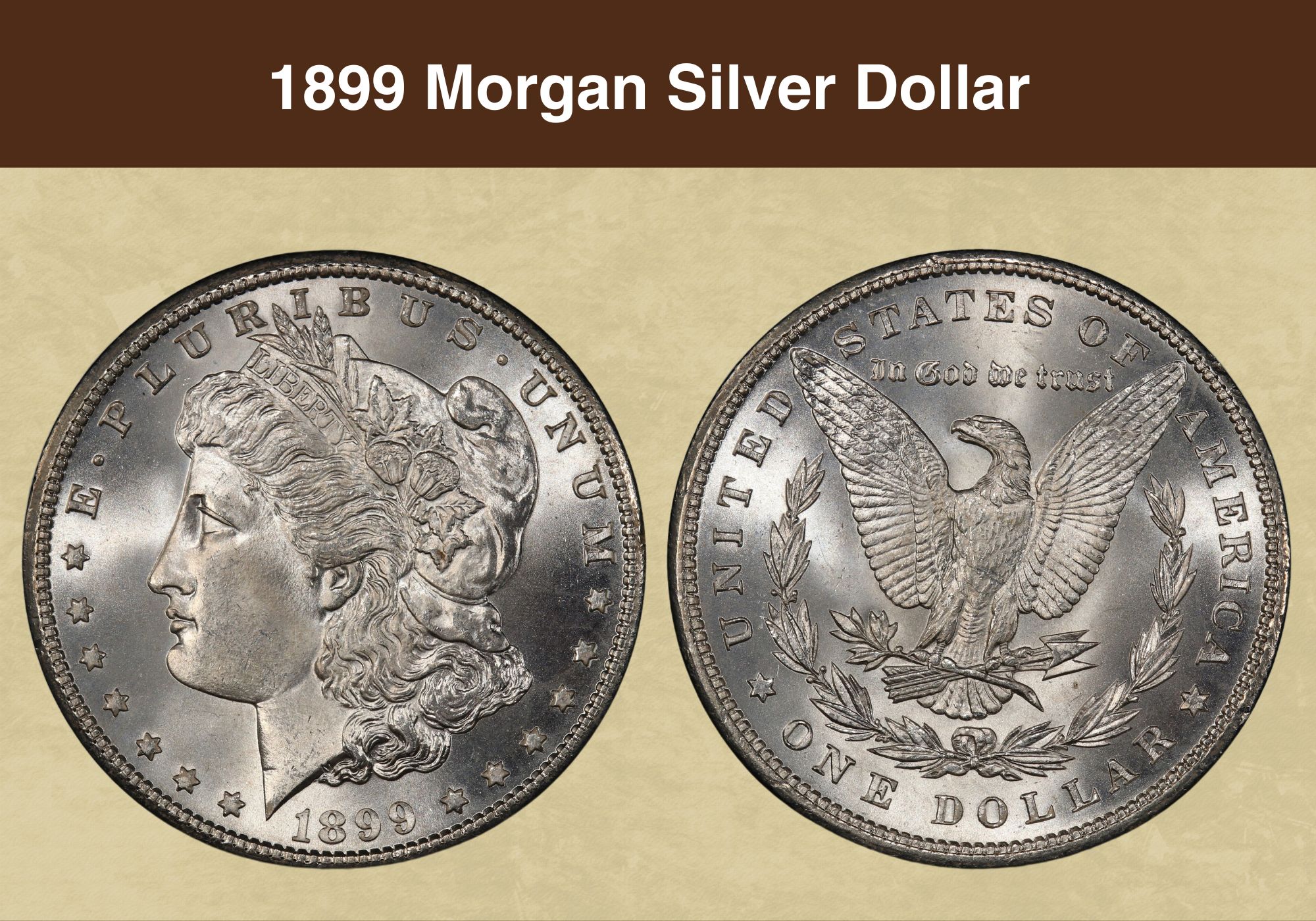
The large size made the 1972 Eisenhower Dollar the same diameter as earlier silver dollar coins like the Morgan and Peace dollars, though slightly lighter in weight.
The silver-clad versions produced at San Francisco weigh 24.60 grams and share the same 38.50-millimeter diameter with a reeded edge. These special collector coins feature outer layers of 80% silver and 20% copper bonded to a center core of 79% copper and 21% silver, resulting in an overall 40% silver content. The silver-clad coins contain 0.3161 troy ounces of pure silver.
Also Read: Top 100 Most Valuable Morgan Silver Dollar Coins Worth Money List
1972 Dollar Mintage & Survival Data
1972 Dollar Mintage & Survival Chart
Survival Distribution
| Type | Mintage | Survival | Survival Rate |
|---|---|---|---|
| Type 1 | 75,890,000 | 35,000,000 | 46.1194% |
| Type 2 | 75,890,000 | 500,000 | 0.6588% |
| Type 3 | 75,890,000 | 35,800,000 | 47.1735% |
| D | 92,548,511 | 92,000,000 | 99.4073% |
| S Silver | 2,193,056 | unknown | unknown |
| S Silver Proof | 1,811,631 | unknown | unknown |
| S Silver CAM | 1,811,631 | unknown | unknown |
| S Silver DCAM | 1,811,631 | 1,385,897 | 76.5% |
The 1972 Eisenhower Dollar mintage totaled approximately 170 million coins across three facilities. Philadelphia struck 75,890,000 pieces split among three reverse types, while Denver minted 92,548,511 coins. San Francisco focused exclusively on collector issues, striking 2,193,056 uncirculated silver pieces and 1,811,631 proof versions in 40% silver composition.
The survival data reveals striking contrasts among the Philadelphia varieties. Type 1 and Type 3 coins maintained similar survival rates at 46.12% and 47.17% respectively. Type 2 stands apart dramatically, with only 500,000 coins surviving from the same original mintage—a mere 0.66% survival rate.
This scarcity stems from the accidental use of a proof die for circulation strikes, making most Type 2 coins indistinguishable once they entered circulation and suffered wear.
Denver-minted coins achieved a remarkable 99.41% survival rate. The silver issues from San Francisco have unknown survival figures for most versions, though the DCAM proofs show a 76.5% survival rate with 1,385,897 examples remaining from the original struck.
Also Read: Top 40+ Most Valuable Presidential Dollar Coins Worth Money
The Easy Way to Know Your 1972 Dollar Value
Check your 1972 dollar’s value by examining the mintmark below Eisenhower’s neck and observing the Earth’s shape with Caribbean islands on the reverse.
For instant, accurate results, use the CoinValueChecker App—simply snap a photo to identify your coin’s type, mintmark, composition, and current worth automatically.

1972 Dollar Value Guides
The 1972 Eisenhower Dollar offers collectors eight distinct categories, each with unique characteristics and value considerations. These varieties range from common circulation strikes to rare proof specimens, appealing to both beginning and advanced numismatists.
The Philadelphia Mint varieties showcase design evolution:
- 1972 Type 1 Dollar – Low relief with flattened Earth appearance
- 1972 Type 2 Dollar – Series key, struck with accidental proof die
- 1972 Type 3 Dollar – Most geographically accurate reverse design
The other mint facilities contributed additional varieties:
- 1972-D Dollar – Denver issue, highest survival rate among varieties
- 1972-S Silver Dollar – Uncirculated 40% silver “Blue Pack” collector edition
- 1972-S Silver Proof Dollar – Mirror-finish 40% silver “Brown Pack” specimen
- 1972-S Silver CAM Dollar – Cameo contrast proof with frosted devices
- 1972-S Silver DCAM Dollar – Deep Cameo proof, strongest contrast finish
Each category presents different opportunities for collectors. Type 2 commands significant premiums due to its scarcity, while Type 1 and Type 3 remain more accessible. The silver issues from San Francisco were sold exclusively to collectors and typically exhibit superior strike quality compared to circulation pieces.
1972 Type 1 Dollar Value
Philadelphia Mint produced three 1972 reverse varieties as Frank Gasparro adjusted designs for improved die steel introduced mid-year. The harder steel enabled better detail and longer die life. Type 1 used initial low-relief dies designed for tough copper-nickel planchets.
This type shows Cuba as a distorted blob and Florida as a truncated stump, with islands falling right of Florida’s edge. Jamaica appears only southeast rather than its proper position. The soft strike produces indistinct features throughout.
Circulated examples trade near face value, yet gem pieces become extraordinarily scarce—only two certified at MS66+ and twenty-one at MS66, with none higher. The coin’s 38.1mm size and soft relief left surfaces prone to bag marks. MS66+ specimens reach $11,500, while MS66 examples command $3,250-$3,500.
The MS66+ ceiling creates absolute limits for registry collectors, as no finer examples exist despite the variety’s large mintage within the 75.89 million Philadelphia strike.
1972 Type 1 Dollar Price/Grade Chart
Price by 1-70 Grade (Latest Auction Records Included)
Comprehensive auction data tracks this variety’s performance across major sale venues since 2005.
| Date | Platform | Price | Grade |
|---|
Market activity over the past twelve months shows an increasing demand for certified examples in all grades.
Market Activity: 1972 Type 1 Dollar

CoinValueChecker App
Not sure what your coins are worth? Get Instant Value • Grade • Error Detection with CoinValueChecker – the ultimate coin value app (FREE Usage Daily)
1972 Type 2 Dollar Value
The 1972 Type 2 Eisenhower Dollar emerged when Philadelphia accidentally deployed a proof die for circulation strikes. The variety shows higher relief with indistinct Caribbean islands that merge beneath Florida, contrasting sharply with the defined landmasses on Types 1 and 3.
An MS66 specimen realized $14,400 at Heritage in August 2022, establishing this as the series’ undisputed key date.
Production came from a single reverse die, yielding an estimated 100,000 strikes with fewer than 50,000 surviving in attributable condition. The coin’s exclusion from 1972 Mint Sets removed the standard preservation channel, making gem survivors genuinely scarce.
This combination—single die, accidental creation, restricted preservation—creates three-dimensional rarity that Types 1 and 3 cannot match.
Current MS66 market value sits at approximately $10,000. With only two MS66+ pieces and no MS67 certified, the population ceiling remains tight. Registry competition intensifies demand while the fixed supply caps availability, creating favorable long-term dynamics.
1972 Type 2 Dollar Price/Grade Chart
Price by 1-70 Grade (Latest Auction Records Included)
A review of past auction results reveals pricing patterns across different grade levels.
| Date | Platform | Price | Grade |
|---|
Tracking recent activity offers insight into collector demand fluctuations for this key date issue.
Market Activity: 1972 Type 2 Dollar
1972 Type 3 Dollar Value
The 1972 Type 3 Eisenhower Dollar represents the Mint’s refined geographical rendering, featuring Florida’s accurate coastline contours and Cuba positioned correctly southwest and southeast of the peninsula.
Introduced in September 1972, this refined reverse became the default design for all subsequent Philadelphia issues through 1978.
Market results show steady demand at the top end: an MS66+ example realized $5,880 in July 2022, while an MS66 brought $552 the following year, underscoring the sharp premium gap between gem and registry-level coins.
Population figures reinforce this structure, with 726 pieces graded MS65 and only 53 in MS66, offering accessible mid-grade entry points while keeping high-end competition intact.
Unlike Types 1 and 2, the Type 3 does not appear in 1972 Mint Sets due to its later introduction, and while improved die steel yielded generally sharper strikes, the large planchet still produced common contact marks.
As the long-term standard reverse for the series, it remains a core variety for full Eisenhower sets, with sustained high-grade demand supporting its continued market relevance.
1972 Type 3 Dollar Price/Grade Chart
Price by 1-70 Grade (Latest Auction Records Included)
Archived auction data captures this variety’s performance across multiple grade tiers.
| Date | Platform | Price | Grade |
|---|
The tracking mechanisms monitor twelve-month collector engagement patterns.
Market Activity: 1972 Type 3 Dollar
1972-D Dollar Value
The 1972-D’s size and weight work against its preservation. During bag shipment, these copper-nickel clad pieces sustained surface marks and contact damage more readily than smaller denominations. Most survivors grade MS60-65, while MS66 pieces grow scarce and MS67 specimens qualify as rare.
Market pricing reflects this scarcity ladder. MS67 examples trade around $3,150, though auction results fluctuate considerably. Top-graded MS67+ pieces have reached $13,200, while recent MS67 sales brought $1,440. The gap between mid-grade and gem-quality specimens widens significantly as condition improves.
Among Type 1 Denver issues, only the 1978-D proves scarcer in top condition. This relative positioning stems from the inherent difficulty of preserving these large, heavy coins without imperfections during their initial distribution.
1972-D Dollar Price/Grade Chart
Price by 1-70 Grade (Latest Auction Records Included)
Collectors can examine detailed auction histories documenting individual specimen performance.
| Date | Platform | Price | Grade |
|---|
Market activity chart tracks collector demand throughout the past twelve months.
Market Activity: 1972-D Dollar
1972-S Silver Dollar Value
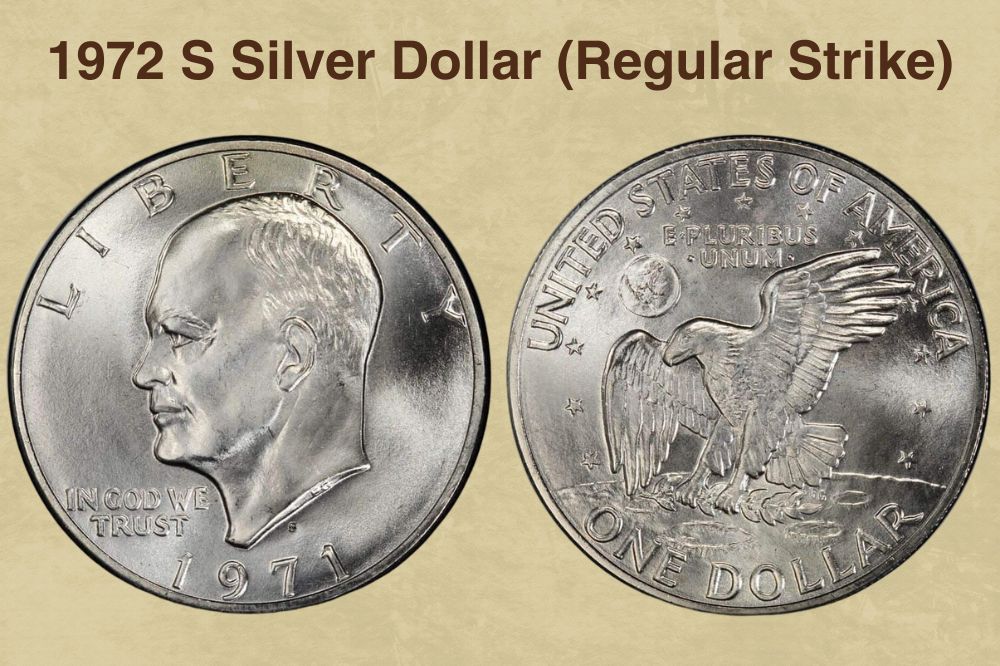
San Francisco Mint handled a unique role during the Eisenhower series, producing 40% silver pieces exclusively for collectors in both uncirculated and proof formats.
These uncirculated silver dollars, though struck using business strike methods, were never released for circulation. Instead, they were sold by mail order at $3 each, packaged in blue envelopes that gave rise to the “Blue Ike” nickname.
The 1972-S uncirculated addressed quality issues that plagued the 1971-S release. The 1971-S suffered from milky surfaces and careless handling during shipment from San Francisco to Denver for packaging. By 1972, these production problems had been corrected, resulting in significantly superior quality. The typical certified 1972-S grades MS66 or MS67.
MS68 examples trade around $125, offering accessible entry into premium grades. MS69 pieces, with just 46 certified by PCGS, have brought $2,200 to $3,680 at recent auctions. Base uncirculated examples start around $13, reflecting both silver content and numismatic interest.
This collector-only distribution model differed from Philadelphia and Denver operations, which allowed the Mint to serve collector demand while avoiding the hoarding issues that affected earlier silver dollars.
1972-S Silver Dollar Price/Grade Chart
Price by 1-70 Grade (Latest Auction Records Included)
The table below chronicles significant auction milestones for this scarce San Francisco issue.
| Date | Platform | Price | Grade |
|---|
Meanwhile, the accompanying chart reveals recent market dynamics spanning twelve months.
Market Activity: 1972-S Silver Dollar
1972-S Silver Proof Dollar Value
The 1972-S Silver Proof Dollar maintains modest pricing in the collector market, with most survivors grading between PR66 and PR69 due to careful handling in original brown wooden boxes. These mid-grade examples typically trade for $13 to $26, reflecting adequate supply from the 1,811,631-piece mintage.
The coin’s 40% silver composition establishes a value floor near melt value, though this provides limited upside since the metal content contributes roughly $16.25 at current prices.
The PR69 level shows the most common high-grade tier at around $26, though prices vary based on eye appeal and surface quality. Top-grade PR70 specimens rarely appear and command significantly higher premiums when available.
What’s more, striking anomalies occasionally surface in the marketplace, with one notable example being a PR63 specimen featuring a detached silver reverse layer that realized $3,450 at Heritage Auctions in 2010.
Such manufacturing defects remain outside typical collector focus for this issue, though they demonstrate the technical challenges inherent in the coin’s multilayer construction.
1972-S Silver Proof Dollar Price/Grade Chart
Price by 1-70 Grade (Latest Auction Records Included)
The complete record of public auction sales traces this issue’s pricing evolution across all grade levels.
| Date | Platform | Price | Grade |
|---|
Market activity over the past year reflects ongoing collector interest in this coin.
Market Activity: 1972-S Silver Proof Dollar
1972-S Silver CAM Dollar Value
The 1972-S Silver Proof Dollar CAM represents a visual middle tier within the proof designation hierarchy.
Most 1972-S proofs stored in original brown box packaging develop toning over decades due to interaction between the silver composition and the plastic holder. Blue-toned haze appears commonly on 1972-S issues, sometimes mixing with green, while attractive bullseye patterns remain scarce.
This chemical reaction affects value significantly—a PR68 CAM example featuring desirable toning realized $800 on eBay in June 2019, nearly triple typical PR68 pricing, as collectors prize aesthetically superior surfaces over coins with unattractive haze or discoloration.
Standard PR67 CAM and PR68 CAM specimens without notable toning brought $456 and $360 respectively in 2019, establishing baseline pricing for the designation.
The cameo effect stems from die preparation variables during proof striking, with fresh dies producing stronger device frost. Population data suggests CAM coins appear with moderate frequency, serving specialists but generating limited crossover appeal beyond dedicated collectors.
1972-S Silver CAM Dollar Price/Grade Chart
Price by 1-70 Grade (Latest Auction Records Included)
The coin’s historical auction results illustrate its performance and value trends in the collector market.
| Date | Platform | Price | Grade |
|---|
Recent market patterns reveal how collector demand shifts across different quality tiers throughout the year.
Market Activity: 1972-S Silver CAM Dollar
1972-S Silver DCAM Dollar Value

CoinValueChecker App
Not sure what your coins are worth? Get Instant Value • Grade • Error Detection with CoinValueChecker – the ultimate coin value app (FREE Usage Daily)
The 1972-S Silver Proof Dollar DCAM demonstrates how modern proof valuations collapsed as certification practices evolved.
A PR70 DCAM specimen brought $4,715 at Heritage Auctions in April 2002, when such grades remained exceptional. Current PR70 DCAM pricing has moderated to $400-$425, reflecting an 91% decline as population figures expanded through decades of resubmissions and refined grading standards.
Survival estimates place approximately 1,178,012 examples at PR65 or better, though deep cameo designation requires maximum device frost against mirrored fields—an effect produced by fresh proof dies that diminishes with wear.
The DCAM designation functions as the market’s de facto standard, concentrating demand while leaving non-DCAM examples with limited appeal beyond budget buyers or completionist set builders seeking affordable entry points.
1972-S Silver DCAM Dollar Price/Grade Chart
Price by 1-70 Grade (Latest Auction Records Included)
Below is a summary of this coin’s historical auction results for reference.
| Date | Platform | Price | Grade |
|---|
Observing current market trends helps gauge collector attention and liquidity for the 1972‑S Silver Deep Cameo.
Market Activity: 1972-S Silver DCAM Dollar
Also Read: 17 Rare Dollar Coin Errors List with Pictures (By Year)
Rare 1972 Dollar Error List
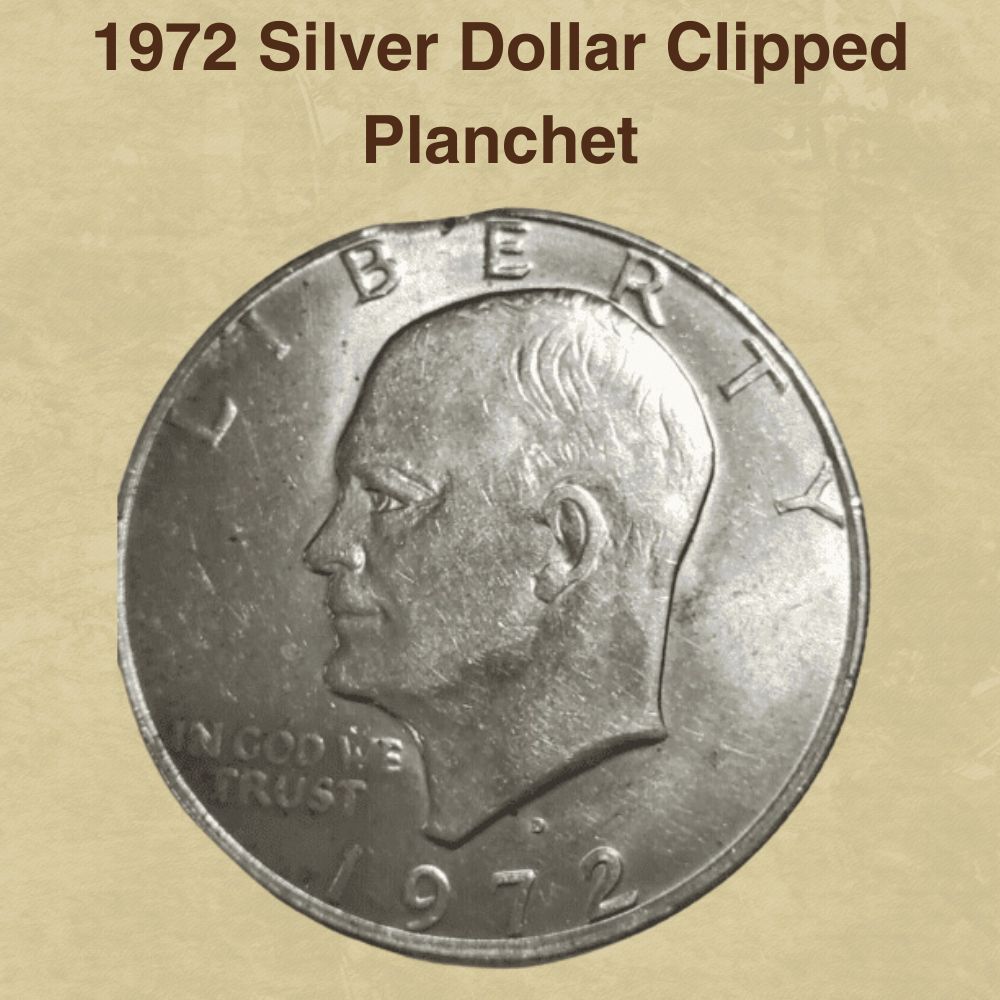
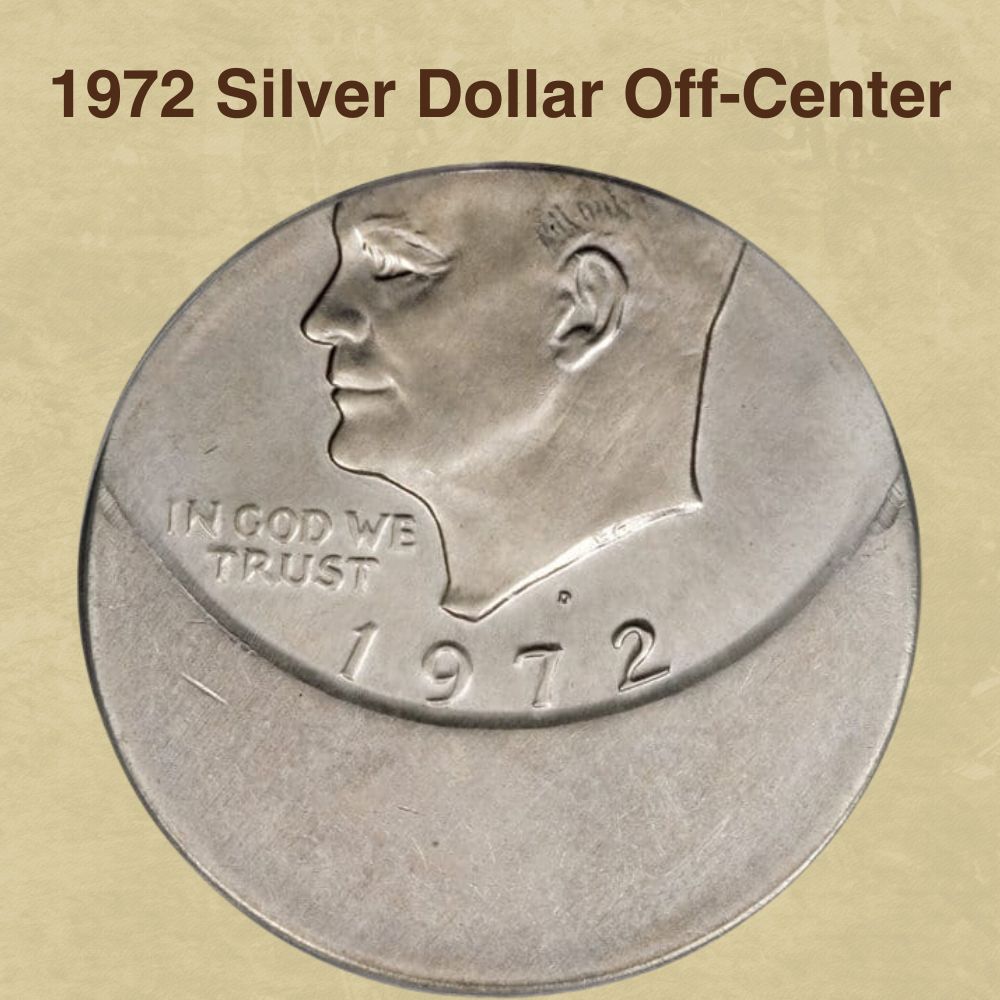
The 1972 Eisenhower dollar series witnessed several minting anomalies that elevated ordinary coins into collectible rarities. Production facilities across Philadelphia, Denver, and San Francisco created errors ranging from planchet mistakes to die doubling.
These manufacturing defects occurred during the second year of Eisenhower dollar production, when minting challenges with large-format coins remained prevalent.
1. 1972-S Silver DDO FS-101
Doubled die errors occur when the die receives multiple impressions from the hub during production, creating overlapping images on struck coins. The planchet moves slightly between strikes, resulting in doubled design elements visible under magnification. On 1972 Eisenhower dollars, doubling appears most prominently on LIBERTY, the date, and IN GOD WE TRUST.
The magnitude and location of doubling determines value. Prominent doubling on major design elements commands higher premiums than minor varieties. Collectors use magnification to identify genuine doubled dies versus machine doubling or strike doubling, which hold no premium.
Values range based on doubling strength and coin grade. Specimens with clear, well-defined doubling in uncirculated condition typically bring $100 or more. Higher-grade examples with exceptional doubling can reach several hundred dollars.
1972-S Silver DDO FS-101 Dollar Price/Grade Chart
Price by 1-70 Grade (Latest Auction Records Included)
2. 1972 Wrong Planchet Errors
A wrong planchet error occurred when proof Eisenhower dollar dies struck clad Kennedy half dollar blanks at San Francisco. The diameter mismatch resulted in incomplete design transfer, with LIBERTY curving beyond the planchet edge. Both denomination and composition differ from intended specifications.
The 30.6mm half dollar planchet could not accommodate the full 38.1mm dollar design. Eisenhower’s profile appears on-center, but peripheral lettering falls outside struck area. Multiple examples exist with varying degrees of off-center strikes.
A PF67 DCAM specimen sold for over $2,800, while a 98% off-center example in PF62 brought $322. These represent unintended planchet mixing during proof production.
3. 1972 Broadstrike Errors
Broadstrike errors result when the retaining collar fails to contain the planchet during striking. Without lateral restraint, metal flows outward under tonnage pressure, creating coins with expanded diameter and plain edges. The standard reeded edge disappears completely.
Normal 1972 Eisenhower dollars measure 38.1mm with 198 reed marks. Broadstrikes measure larger with smooth, unfinished edges. Design elements appear spread across increased surface area. Values start around $125 for typical examples.
Attribution requires measuring diameter and confirming absent reeding. Collectors seek these for error type collections, as broadstrikes demonstrate mechanical failure during the minting process.
Where To Sell Your 1972 Dollar?
Now that you understand your 1972 Dollar’s potential value, selecting the best selling platform is crucial. Each marketplace offers unique advantages tailored to different seller needs and coin conditions.
Check out now: Best Places To Sell Coins Online (Pros & Cons)
FAQ About 1972 Dollar
1. What makes 1972 dollars rare?
The 1972-S silver Eisenhower dollars had significantly lower mintage than clad pieces, with approximately 4 million silver coins produced (including both uncirculated and proof versions) compared to over 168 million clad versions struck at Philadelphia and Denver.
While not exceptionally rare in average condition, these silver-clad coins maintain value due to their 40% silver content and limited production. High-grade examples, particularly those in MS 68 and above, are genuinely scarce and command substantial premiums.
2. What are the 1972-S dollars prices?
The 1972-S silver dollars have a base silver melt value of approximately $16, regardless of condition. Well-preserved pieces typically range from $15 to $50 depending on grade.
For certified high-grade coins:
- MS 67: $25-$55
- MS 68: $100-$125
- MS 68+: $875
- MS 69: $3,400
Proof versions in PR69 DCAM achieve near $36, with PR70 DCAM examples reaching $425.
3. What are the most pricey Eisenhower dollars?
- The 1973-S PR 67 Eisenhower silver dollar (Indented Planchet Error) ($40,250)
- The 1971-S PR 68 DCAM Eisenhower silver dollar (Type 1 Reverse) ($30,550)
- The 1976-S PR 66 Eisenhower clad dollar (Type 2) ($41,400)
- The 1973-S MS 69 Eisenhower silver dollar ($17,500)
- The 1974-S MS 68+ Eisenhower silver dollar ($13,513)