Coin Value Contents Table
- 1797 To 1801 John Adams Dollar Value Chart
- History of the 1797 to 1801 John Adams Dollar Coin
- Features of the 1797 to 1801 John Adams Dollar Coin
- 1797 to 1801 John Adams Dollar Coin Grading
- 1797 to 1801 John Adams Dollar Coin Value Guides
- 1797 to 1801 John Adams Dollar Coin Errors
- Where to Sell Your 1797 to 1801 John Adams dollar ?
- FAQ
Do you own a 2007 John Adams dollar coin and want to know how much it is worth today?
Or are you considering adding a John Adams dollar coin to your collection but want to ensure it is worthwhile?
Well, you have come to the right place! In this article, we explain everything you need to know about the value of the 1797 to 1801 John Adams dollar coin.
You will learn about the factors that influence the coin’s value and how the coins are graded. You will also discover some coin errors that can fetch hundreds of dollars.
So, let’s jump in!
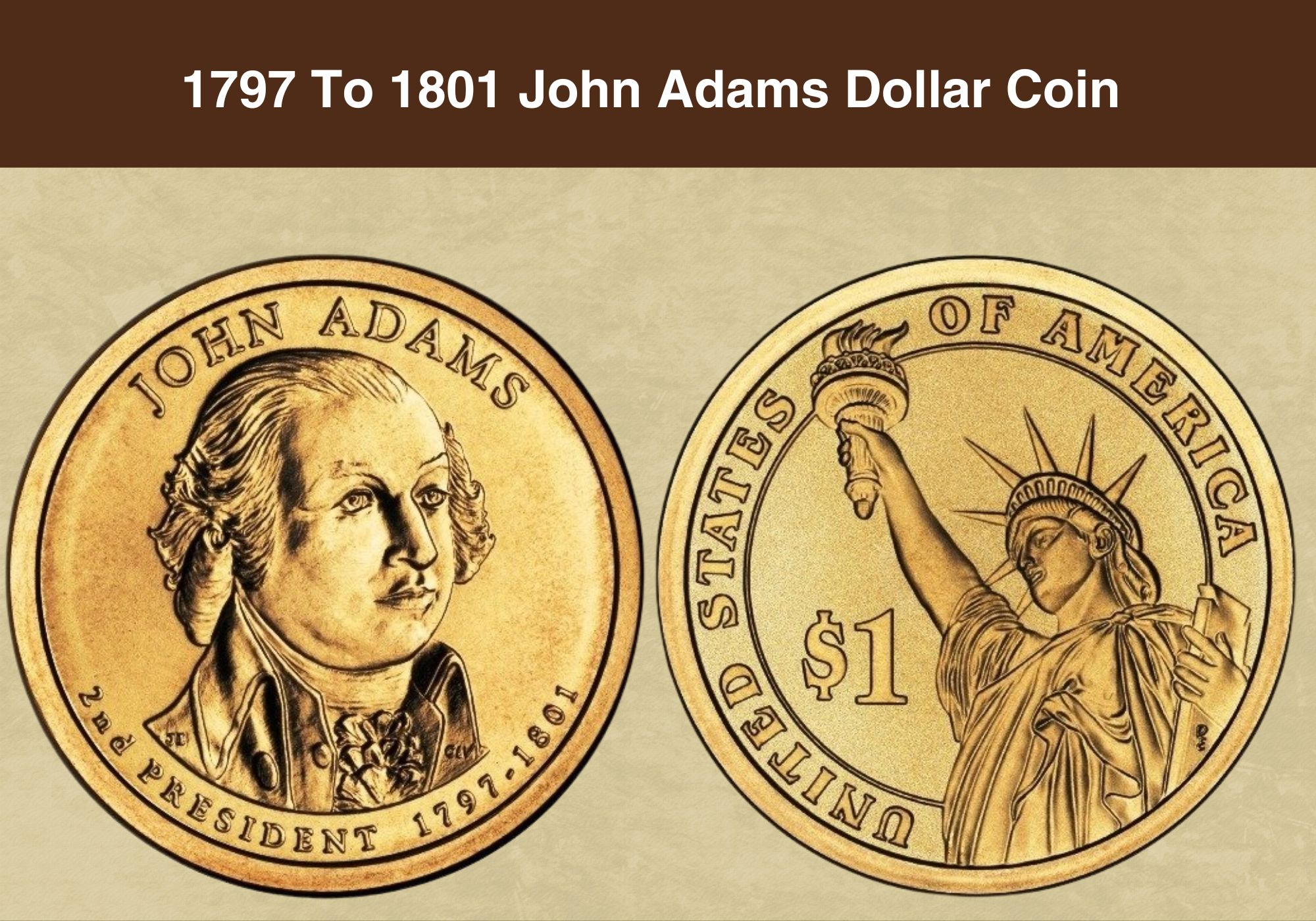
1797 To 1801 John Adams Dollar Value Chart |
||||
| Mint mark | Good | Fine | Extremely Fine | Uncirculated |
| 1797 to 1801 P John Adams Dollar Coin Value | $1 | $1 | $1 | $20 |
| 1797 to 1801 D John Adams Dollar Coin Value | $1 | $1 | $1 | $12 |
| 1797 to 1801 Proof John Adams Dollar Coin Value | – | – | – | $30 |
History of the 1797 to 1801 John Adams Dollar Coin
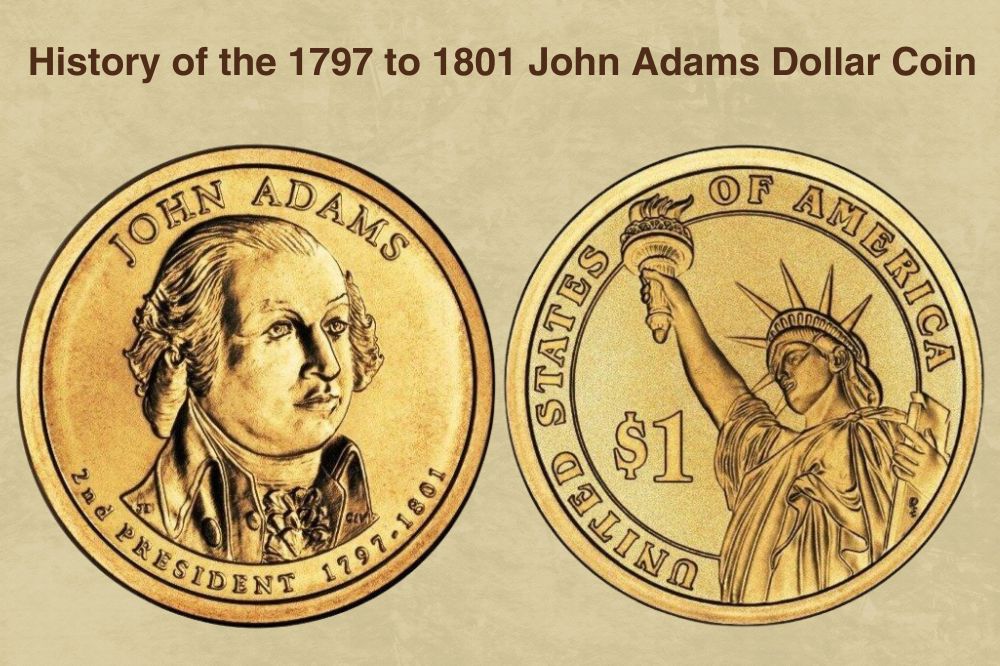
John Adams served as the second president of the United States from 1797 to 1801. Before this, he served eight years as George Washington’s vice president.
Adams was born in 1735 in the colony of Massachusetts Bay. He worked as a lawyer and career diplomat and was critical in advocating for American independence from the colonialists.
John Adams was also instrumental in implementing some of the nation’s most important coinage legislation. For example, he decreed the Act that authorized the United States Mint to retain its facility in Philadelphia.
Adams is remembered for other feats, including his strong leadership role in establishing the Navy Department, a critical move that helped the United States of America (USA) win the 1812 war.
The United States Mint produced the 1797 to 1801 John Adams Dollar Coin in 2007 to commemorate the nation’s second president and his achievements.
This coin was part of the Mint’s Presidential $1 Coin Program that was based on Public Law 109-145. The Mint produced one-dollar gold coins, each with a portrait of the various U.S. Presidents. This initiative was, however, halted in 2012 because coin production exceeded public demand.
The 2007 John Adam dollar coin would definitely be a wonderful addition to your collection of presidential coins.
Let’s now look at the coin’s features.
Also read: 12 Most Valuable One-Dollar Coin Worth Money
Features of the 1797 to 1801 John Adams Dollar Coin
The John Adams dollar coin spots similar features as the other coins in the presidential coin series. Here is what to look out for:
The Obverse of the 1797 to 1801 Johns Adams Dollar Coin
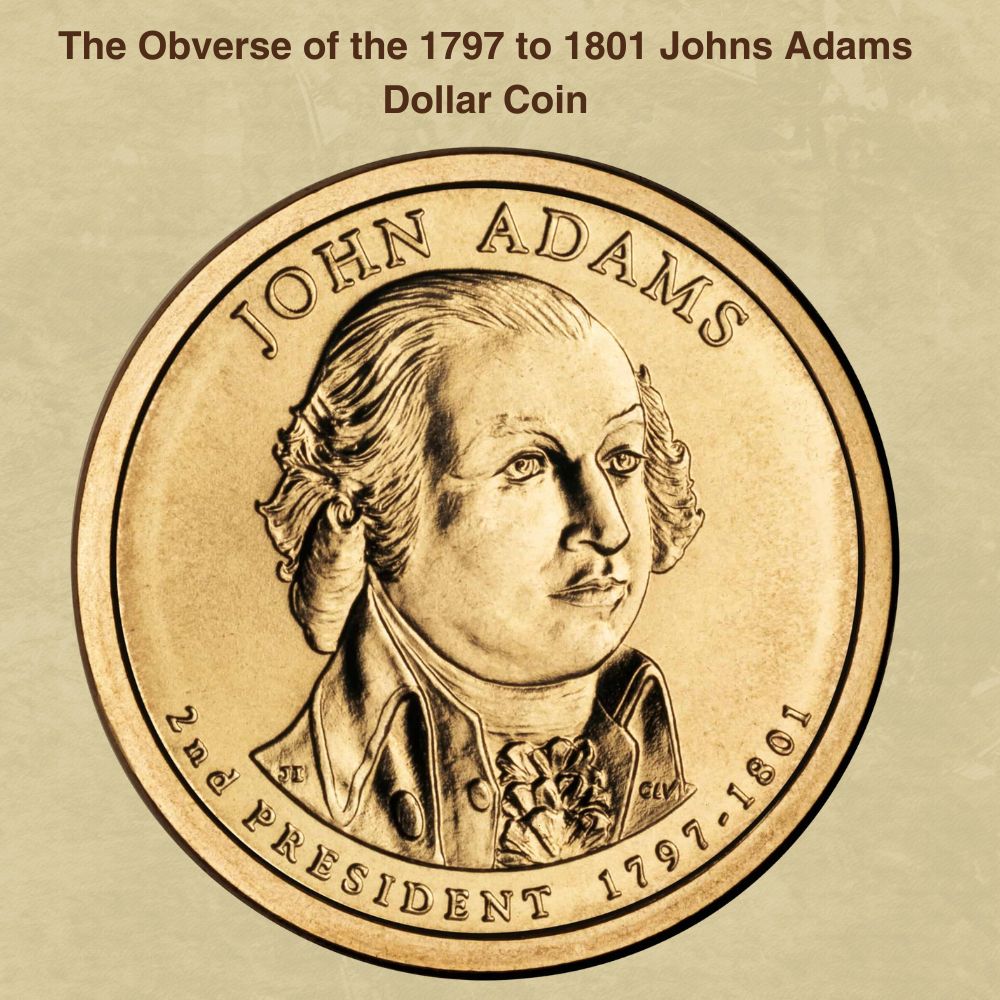
The obverse of the 2007 John Adams gold coin features a slightly right-facing portrait of the president.
At a closer look, you will notice the initials J.I. and CLV on the president’s left and right jacket collars, respectively.
The initials J.I. stand for Joel Iskowitz, the obverse portrait designer, while CLV stands for Charles L. Vickers, the portrait sculptor. In the past, it was common for sculptors and designers to imprint their initials on the coins they made.
The president’s name appears at the top of the coin, while the words 2nd president and the years he served (1797-1801) appear around the coin’s bottom radius.
The Reverse of the 1797 to 1801 John Adams Dollar Coin
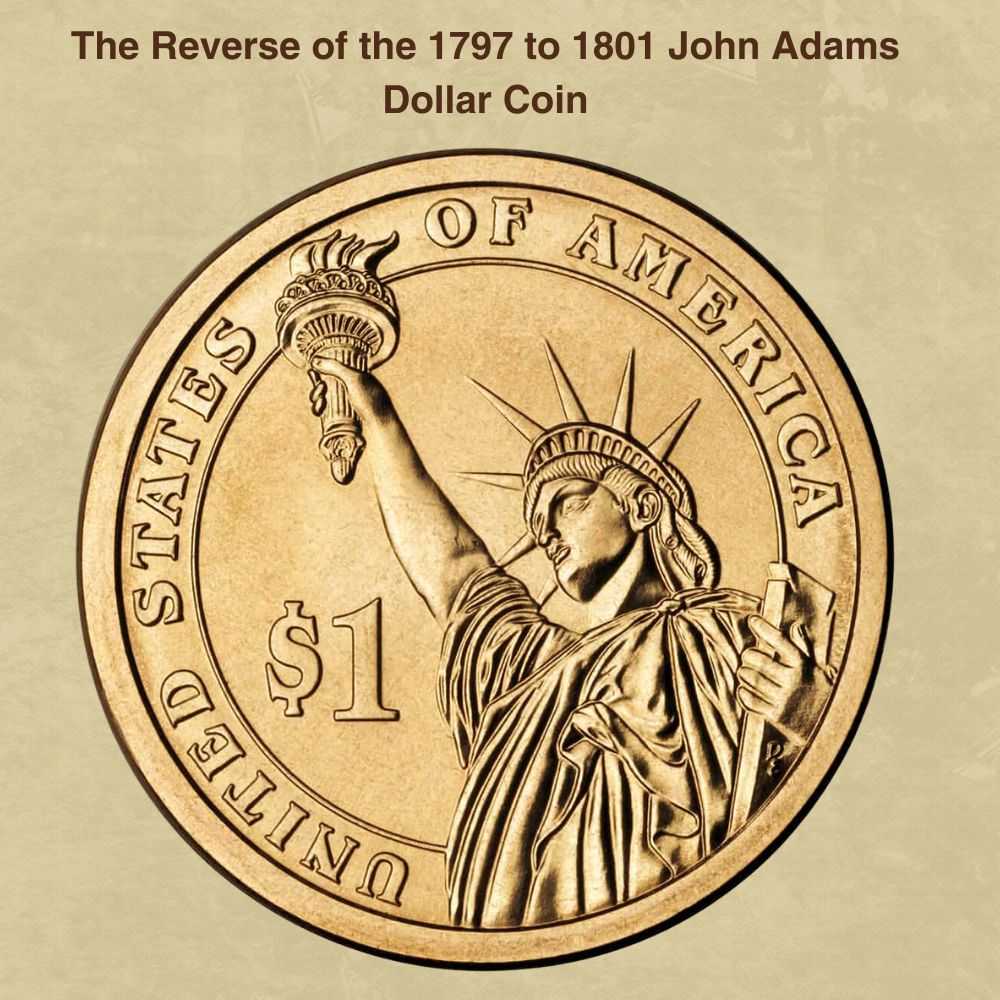
The reverse of the John Adams Dollar coin is similar to other coins in the presidential series. This coin spots a portrait of the Statue of Liberty.
The coin’s denomination, $1, is inscribed on the left side, and the words UNITED STATES OF AMERICA are boldly imprinted around the coin’s radius or rim.
Other Features of the 1797 to 1801 John Adams Dollar Coin
The John Adam 2007 presidential dollar coin comprises 88% copper core, 6$ zinc, 3% manganese and 2% nickel.
This coin weighs 8.10 grams and measures 26.50 millimetres in diameter.
The lettered edge is a notable feature of presidential coins, including this one. This coin features an edge with the inscriptions: 2007- E PLURIBUS UNUM, IN GOD WE TRUST.
It is also worth noting that there are two versions of this presidential dollar coin based on lettering variations. These versions are position A and position B.
Position A coins are those in which the edge lettering normally reads when the coin’s obverse side is facing up.
Position B coins are those in which the edge lettering reads upside down when the coin’s obverse side is facing up.
As you will see later, edge lettering errors are among the most common among the presidential series coins. These errors can significantly increase the value of your coin.
Check out this video for more details on what to look for in a presidential coin to get bang for your money.
Also read: 14 Most Valuable Coins In Circulation
1797 to 1801 John Adams Dollar Coin Grading
The 2007 John Adams dollar coin in the circulated condition is more or less its face value of $1. That said, some circulated specimens may earn you slightly more if they are in really good condition.
The grading of 1797 to 1801 John Adams dollar coins considers several factors. The coin’s condition plays an important factor in how it is graded.
John Adams presidential dollar coins with significant wear and tear typically grade lower than dollar coins with a bright lustre, few dents, and less wear.
Take a look at this video for more details on grading your 1797 to 1801 John Adam dollar coin.
1797 to 1801 John Adams Dollar Coin Value Guides
All three minting facilities, i.e. the Philadelphia, Denver, and San Francisco mints, produced the 1797 to 1801 John Adams coin in 2007.
In this section, we will look at the three varieties of this coin and how much they are worth. They include:
- The 1797 to 1801 P John Adams Dollar Coin Value
- The 1797 to 1801 D John Adams Dollar Coin
- The 1797 to 1801 Proof John Adams Dollar Coin
1797 to 1801 P John Adams Dollar Coin Value
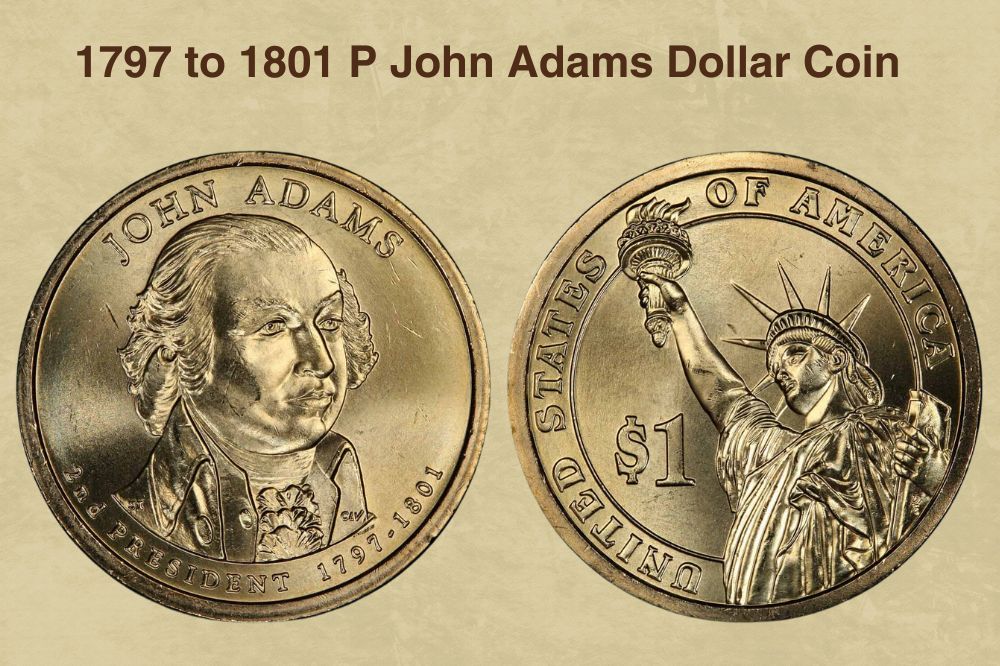
The minting facility at Philadelphia produced 112,420,000 John Adams presidential coins in 2007. These included position A and position B coins.
Many of these coins were released into circulation, so it is quite common to find 2007 John Adams dollar coins in your change.
Because of the large number of coins minted and released into circulation, the John Adams coin is not considered a rare currency. As such, in circulated condition, the coin is worth more or less its face value of $1.
There are a few coins of these coins in mint state (M.S.), meaning they were never circulated and are as good as new. The 2007 John Adams dollar coins graded MS60 are rare and worth about $3.
These coins are extremely rare in higher grades of MS62 and above. The existing specimens are worth between $5-$20.
According to the Professional Coin Grading Service (PCGS), the most expensive John Adams dollar coin was graded MS64 and auctioned for $2,300.
1797 to 1801 D John Adams Dollar Coin Value
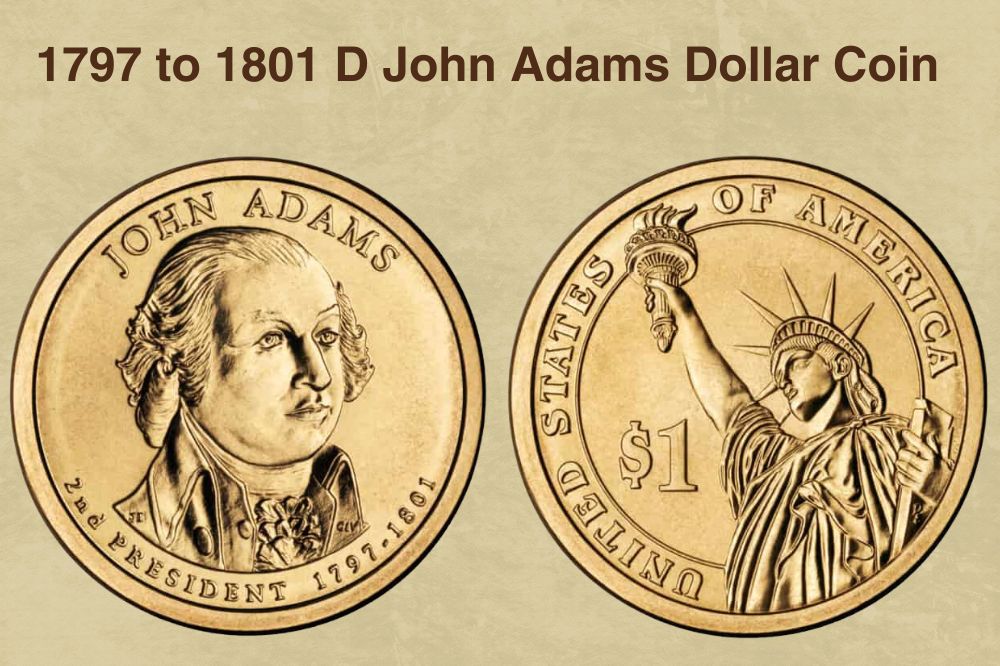
In 2007, the Denver minting facility produced 112,140,000 John Adams dollar coins, almost the same as those produced in Philadelphia. These, too, include position A and position B coins.
Like other presidential dollar coins, the 2007 D John Adams dollar coin was largely circulated, and only a few can be found in mint, uncirculated condition.
John Adams dollar coins graded Extremely Fine to About Uncirculated (A.U.) are worth about $1, the coin’s face value. Most coins fall in this category, and you will only get much from them if the coin has a known error.
As mentioned, 1797 to 1801 John Adams dollar coins in mint state are extremely rare. Expect about $3 to $12 for the few existing specimens in mint state.
The most expensive 2007 John Adams gold dollar coin was graded MS68 and was sold for an impressive $69 in 2008. This specimen had a satin finish, which might explain why it sold for more than a regular strike coin.
1797 to 1801 Proof John Adams Dollar Coin Value
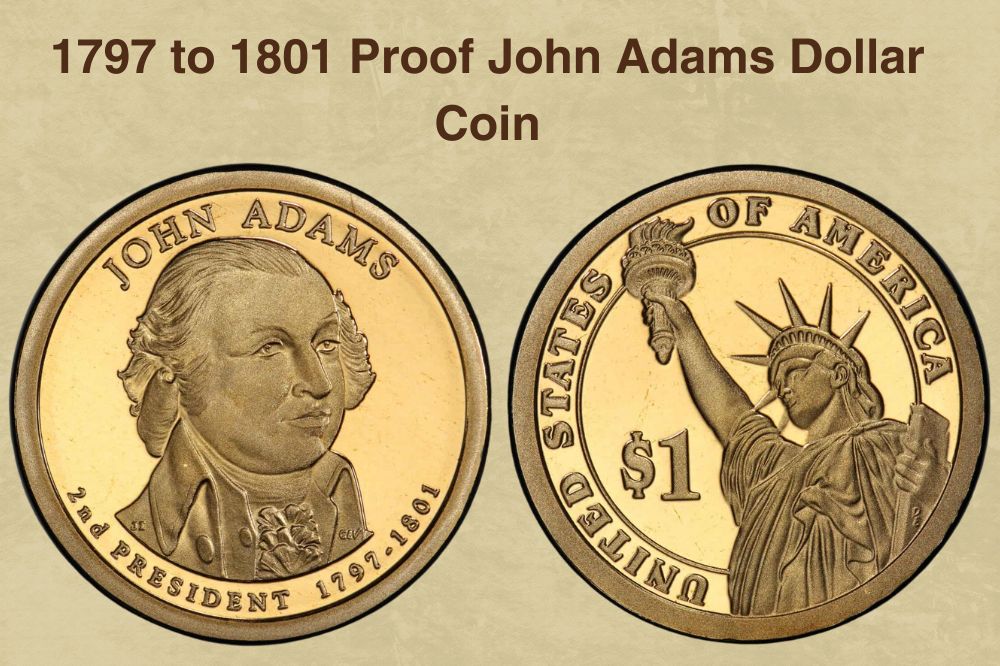
While the Denver and Philadelphia minting facilities produced regular strike coins for circulation, the San Francisco facility minted proof coins.
Mint workers use different dies to mint proofs, producing coins with a brighter lustre, more intense and defined lettering, and artwork.
Proofs are specifically minted for collectors, and the Mint produces few specimens compared to the number of regular strike coins.
In 2007, the San Francisco minting facility produced 3,965,989 proof dollar coins to commemorate the country’s second president as part of the Presidential $1 coin series.
The Mint sold the proofs in a set of four, with each set containing a proof coin with a portrait of the first four presidents, including Washington, Adams, Jefferson, and Madison.
In addition to its brilliant lustre, you can identify a presidential-proof coin by the S mint mark on its edge, indicating that the coin was minted in San Francisco.
Regular strike coins have their edges struck by the Schuler Machine. On the other hand, proofs have their edges made using a three-tonged collar die.
In grade PF67, a John Adams dollar coin proof is worth about $5 and will go up to $12 in PF69. A few specimens graded PF70 are worth as much as $30, with the most expensive having been auctioned for $127 in 2008.
Also read: Top 10 Most Valuable Morgan Silver Dollar Worth Money
1797 to 1801 John Adams Dollar Coin Errors
Errors occur all the time during the coin minting process. But some peculiar errors can drastically increase the value of an otherwise low-value coin such as the John Adams dollar coin.
Here are some 1797 to 1801 John Adams dollar coin errors that are worth some good money.
1797 to 1801 John Adams Dollar Coin Double Edge Lettering Overlapped Error
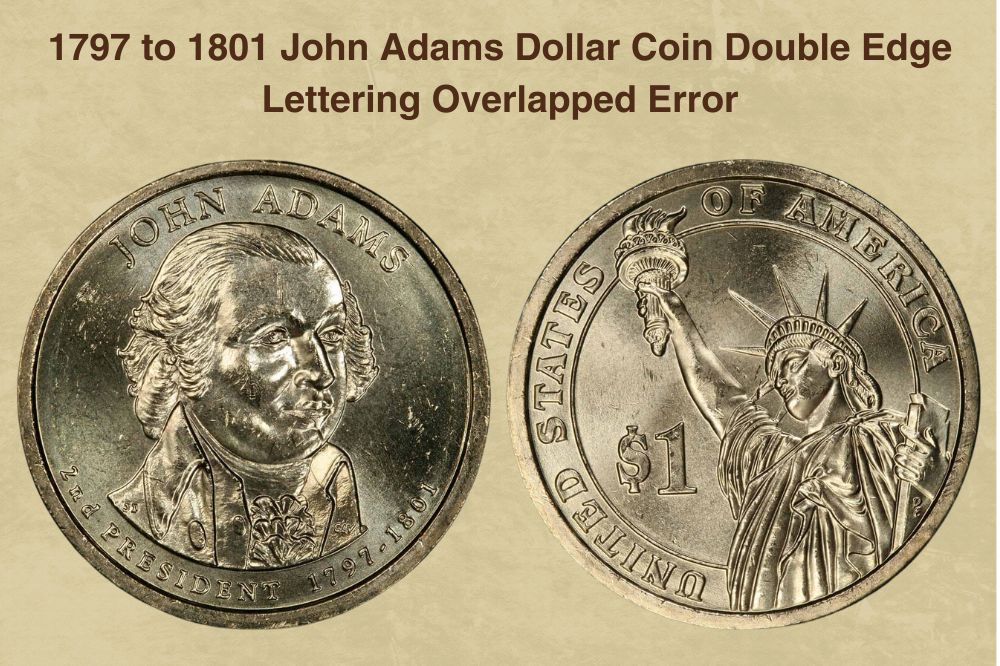
The double-edge overlapped error was among the first of several edge lettering errors in the 2007 Adams dollar coin series.
This error occurs when the coin is passed through the edge lettering machine two times, causing the lettering to be struck twice on the coin’s edge. This also causes the second set of lettering to overlap with the first one. Thus, the name double edge lettering overlapped error.
Such error coins are quite popular among collectors and can be worth up to $288, depending on the coin’s condition, with mint-state coins fetching more.
1797 to 1801 John Adams Dollar Coin Double Edge Lettering Inverted Error
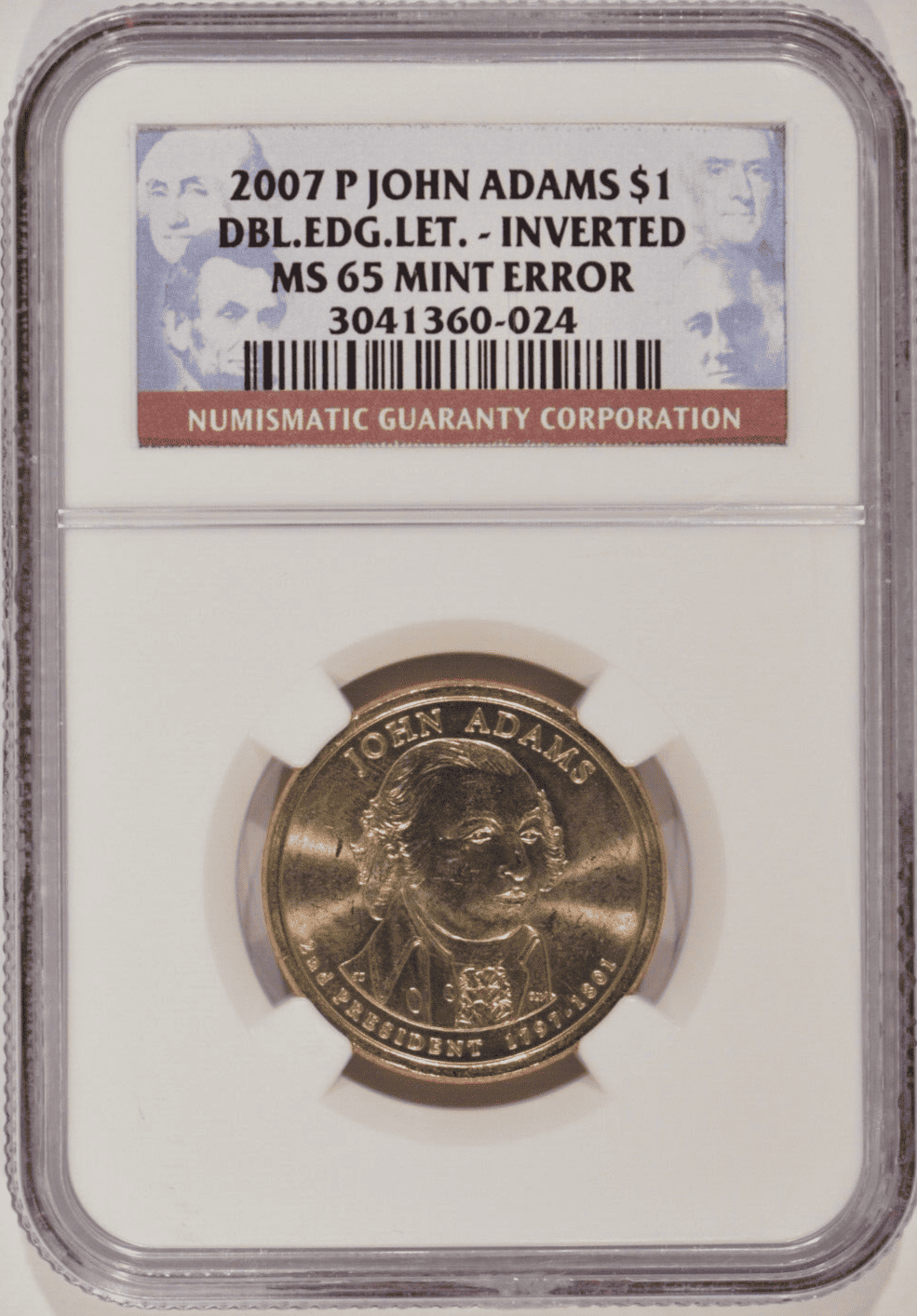
This error occurs when a coin has double edge lettering and the second set of lettering is struck upside down over the first set.
First, the coin is correctly placed in the lettering machine. The second time, the coin’s position is interchanged so that the obverse faces down instead of up or vice versa, resulting in an inverted lettering overlap.
Unlike other presidential edge lettering errors, the Adams edge lettering inverted error is common. In mint state grade, such a coin error can earn you between $15 and $52.
According to the PCGS, the most expensive 2007 John Adams double edge lettering inverted error was auctioned in 2008 for $489.
1797 to 1801 John Adams Dollar Coin Missing Edge Lettering Inverted Error
As the name suggests, missing edge lettering errors occur when the machine fails to stamp the lettering on the coin. The result is regular dollar coins with a smooth edge.
Missing edge John Adams dollar coins are relatively scarce compared to other such errors in the presidential coin series. In addition, the majority of the few existing specimens are graded MS65 and above.
This particular coin error is among the most valuable in the series. Expect to pay about $25 for one graded AU58 and $30-$46 for error coins graded $65 to $68.
One John Adams dollar coin with a missing edge lettering error sold for $3,335 in 2009. The coin was graded MS64.
Where to Sell Your 1797 to 1801 John Adams dollar ?
Now that you know the value of your coins, do you know where to sell those coins online easily? Don’t worry, I’ve compiled a list of these sites, including their introduction, pros, and cons.
Check out now: Best Places To Sell Coins Online (Pros & Cons)
FAQ
How much is a 2007 John Adams dollar coin worth?
This coin is worth more or less its face value of $1. Regular strike John Adams dollar coins can be worth as much as $3 in mint state while proof and those with known errors can fetch hundreds or thousands of dollars.
Is the John Adams coin real gold?
The John Adams coin is not real gold, despite its goldish, shiny appearance. This is actually a copper coin sandwiched between a manganese, zinc, and brass alloy. The brass gives the coin the shiny lustre, but this shine fades with time.
Where is the mint mark on a 1797 to 1801 John Adam dollar coin?
Like in all presidential series coins, the mintmark on the 2007 John Adam dollar coin can be found on the edge lettering of the coin. Coins minted in Philadelphia will not have the “P” mintmark, but those from San Francisco and Denver will have the letter S and D on the edge, respectively.

Hi. I live under a rock and didn’t know these presidential coins were a thing until my wife got one in her change from a vending machine.
You mention the mint mark for the John Adams coin will not have the “P” if minted in Philadelphia. I just looked at the edge letting and it reads “2007 P.”
If the coin shouldn’t have the “P” in the edge lettering but the one I’m looking at does, what does that mean?
Thanks,
T Luck