1934 Silver Dollar Value Checker: Errors List, ā€œDā€, ā€œSā€ & No Mint Mark Worth

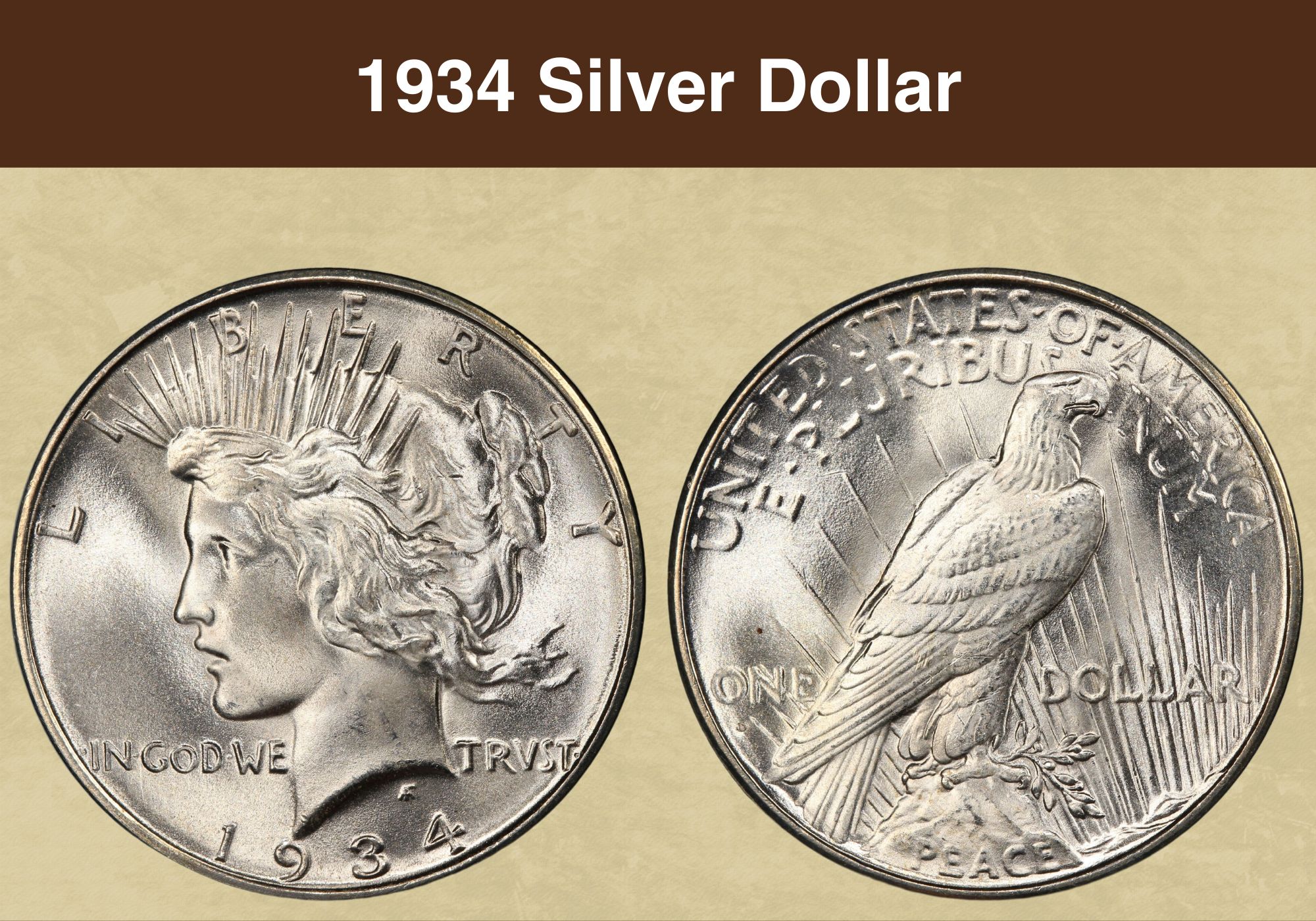
1934 Silver Dollar

The 1934 Silver Dollar, also known as the Peace Dollar, holds a distinctive place in American numismatic history. Production of Peace dollars resumed in 1934 after a six-year hiatus, driven by the Silver Purchase Act of 1934, which required the Mint to purchase domestically produced silver at above-market prices during the depths of the Great Depression. This historical backdrop makes the 1934 issue a particularly meaningful year for collectors.

Three mint varieties were produced — the Philadelphia (No Mint Mark), Denver (D), and San Francisco (S) — each commanding different premiums depending on grade and rarity. Circulated examples typically start around $82, while top-grade uncirculated specimens can climb dramatically: the 1934-S is regarded as the key issue in the Peace dollar series due to its relatively small mintage and rarity in uncirculated condition, reaching $7,048 or beyond in MS condition.

This article will provide a detailed examination of the market value of the 1934 Silver Dollar. Furthermore, you will learn about the methods used for grading the condition of silver dollars, the characteristics of minting errors (error coins) worth noting and identifying, as well as specific techniques for distinguishing between the versions produced by these three different mints.


1934 Silver Dollar Value By Variety

Here’s the table breakdown for each variety — see how they compare across grades. If you know the grade of your coin, you can find the exact price below in the Value Guides section.

1934 Silver Dollar Value Chart

TYPEGOODFINEAUMSPR
1934 No Mint Mark Dollar Value$82.00$82.00$88.00$873.33—
1934 D Silver Dollar Value$82.00$82.00$97.00$1533.33—
1934 S Silver Dollar Value$82.00$99.67$695.00$7048.00—
Updated: 2026-05-09 13:36:27

Also Read: Top 30+ Most Valuable Peace Dollars Worth Money


Top 10 Most Valuable 1934 Silver Dollar Worth Money

Most Valuable 1934 Silver Dollar Chart

2008 - Present

Once a coin crosses into the MS-66 and MS-67 range, prices don’t just rise — they explode. The gap between an MS-65 and an MS-67 can represent tens of thousands of dollars, a reflection of just how scarce truly pristine survivors are after nine decades of circulation and improper storage.

The Philadelphia No Mint Mark variety often assumed to be the most common and therefore least valuable — actually holds the all-time auction record at $108,000. This counterintuitive result speaks to a core principle in numismatics: mintage figures don’t tell the whole story. A coin struck in higher numbers can still become rarer than its peers at the top grades if most examples entered circulation and suffered wear.

The 1934-S, while commanding the highest typical retail values in MS condition, tops out lower on the auction chart simply because its finest-known examples haven’t yet reached MS-67 — a reminder that population data at the major grading services (PCGS, NGC) is just as important as the coin itself.


History of The 1934 Silver Dollar

The 1934 Silver Dollar — officially the Peace Dollar — carries a history shaped as much by politics as by coinage tradition. The Peace Dollar was originally struck from 1921 to 1928, then production ceased when the Pittman Act requirements were fulfilled. It would have remained a closed chapter, had the Great Depression not rewritten the rules of American monetary policy.

Production was halted in 1928 due to the economic depression, which led to a sharp decline in demand for silver dollars. The coins were reintroduced briefly in 1934 and 1935 primarily to provide bullion for the U.S. government. The Silver Purchase Act of 1934 ordered the Treasury Department to buy silver on the open market, and these mandatory purchases had to be turned into coinage to back paper silver certificates — so Peace dollar production resumed.

In 1934, the Peace Silver Dollar made a comeback, and it symbolized the revival of the American economy after the stock market crash. Yet the timing also sealed its fate: commercial demand was low, and the U.S. Mint stopped minting Peace Dollars in 1935. The series never resumed for circulation. This brief two-year window — 1934 and 1935 — makes the 1934 issue not just a coin, but a historical artifact of one of America’s most turbulent economic eras.

Also Read: Top 100 Rarest Silver Dollar Coins Worth Money (Most Expensive)


Is Your 1934 Silver Dollar Rare?

46

1934 No Mint Mark Dollar

Very Rare
Ranked 16 in Peace Dollar
48

1934-D Silver Dollar

Very Rare
Ranked 14 in Peace Dollar
64

1934-S Silver Dollar

Ultra Rare
Ranked 10 in Peace Dollar

Most 1934 Silver Dollars are accessible — but a few rare varieties and high-grade survivors can be worth serious money. The fastest way to know where yours stands? Run it through the Coin Value Checker App for an instant grade, value, and error detection.


Key Features of The 1934 Silver Dollar

The 1934 Silver Dollar is more than a coin — it’s a carefully composed work of art that tells a story on both sides. Understanding what you’re looking at is the first step to understanding what you have.

The Obverse Of The 1934 Silver Dollar

The Obverse Of The 1934 Silver Dollar

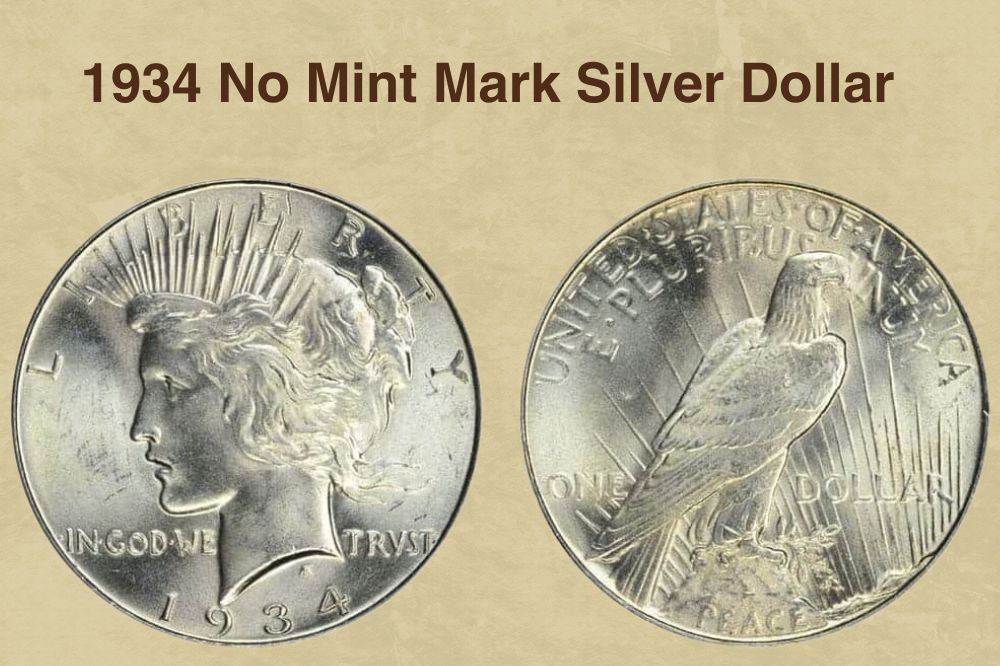
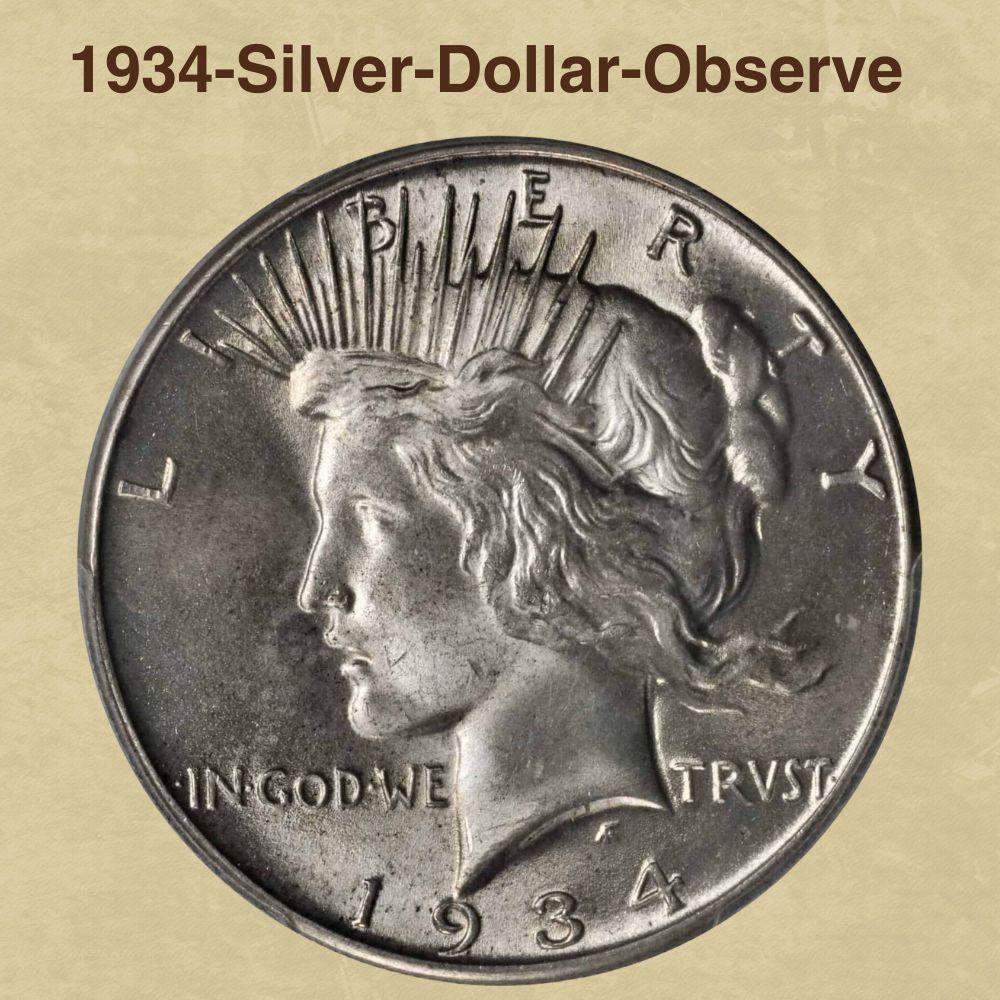
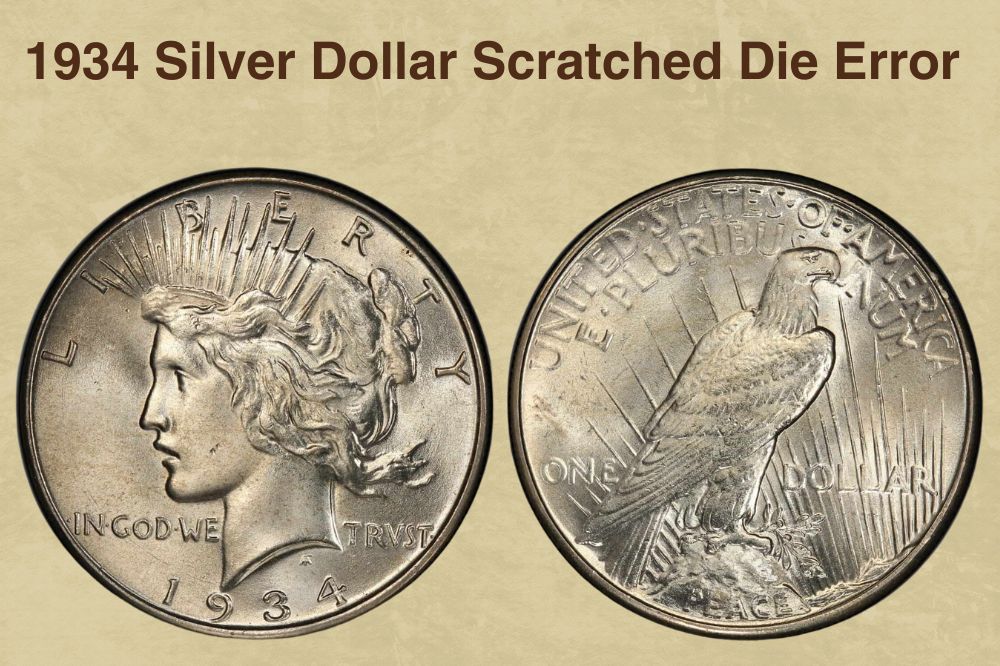
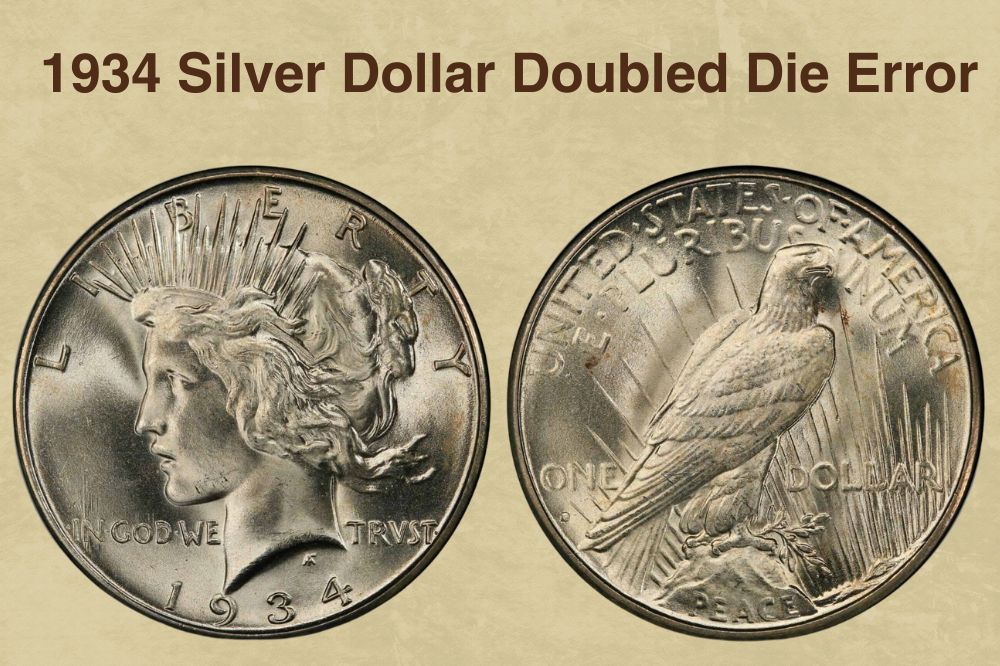
The obverse features the head of Lady Liberty wearing a crown of rays, modeled after the design of the Statue of Liberty. The model for Lady Liberty was 23-year-old Teresa Cafarelli de Francisci, the young sculptor’s wife.

The word “LIBERTY” curves along the top rim, while the phrase “IN GOD WE TRUST” is split across both sides of Lady Liberty’s neck — “IN GOD WE” in front and “TRUST” behind. The minting date 1934 sits below the portrait.

The Reverse Of The 1934 Silver Dollar

The Reverse Of The 1934 Silver Dollar

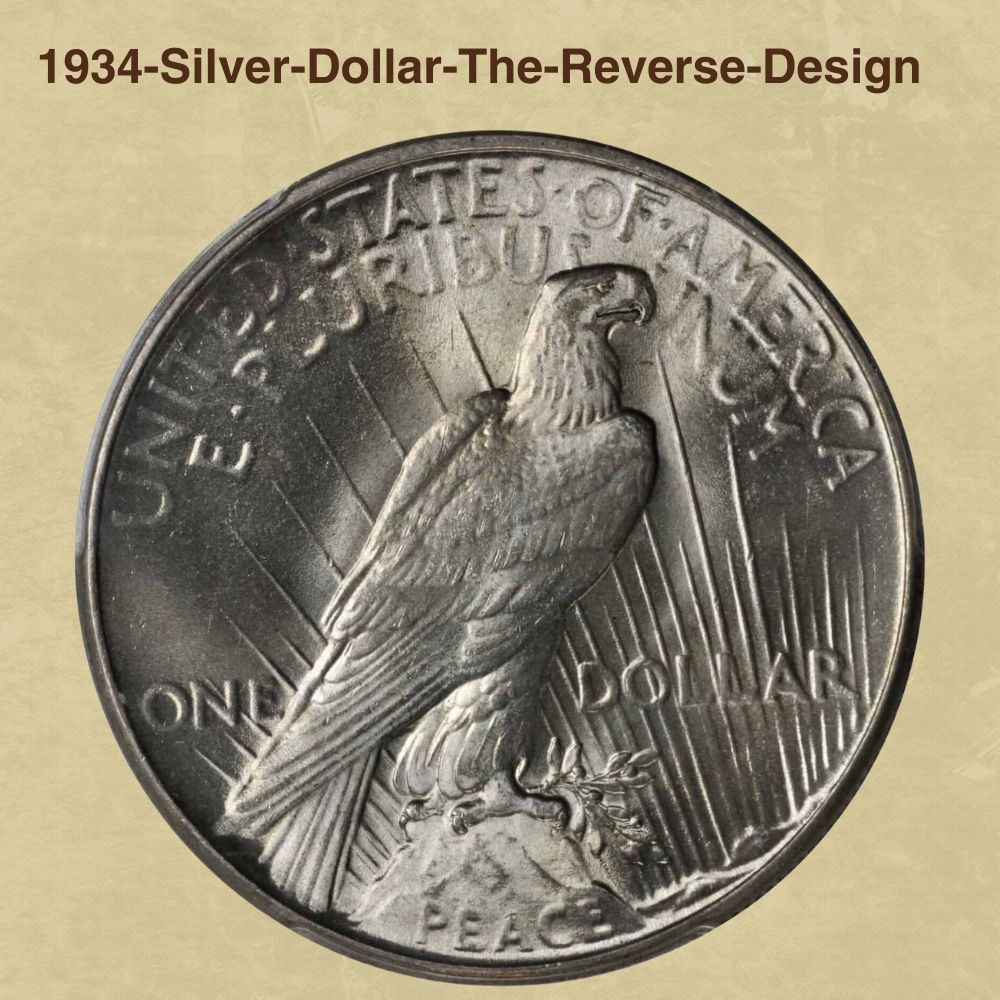
The reverse features an eagle holding the olive branches of peace, deliberately omitting the typical arrows of war — a conscious design choice that set the Peace Dollar apart from every silver dollar that came before it. Rays of sunlight emanate from the horizon behind the eagle, symbolizing the dawn of a new era.

“UNITED STATES OF AMERICA” and “E PLURIBUS UNUM” arc across the top, while the denomination “ONE DOLLAR” is split around the eagle’s body. The word “PEACE” is inscribed on the rock beneath the eagle’s talons — subtle, but the entire point.

Other Features Of The 1934 Silver Dollar

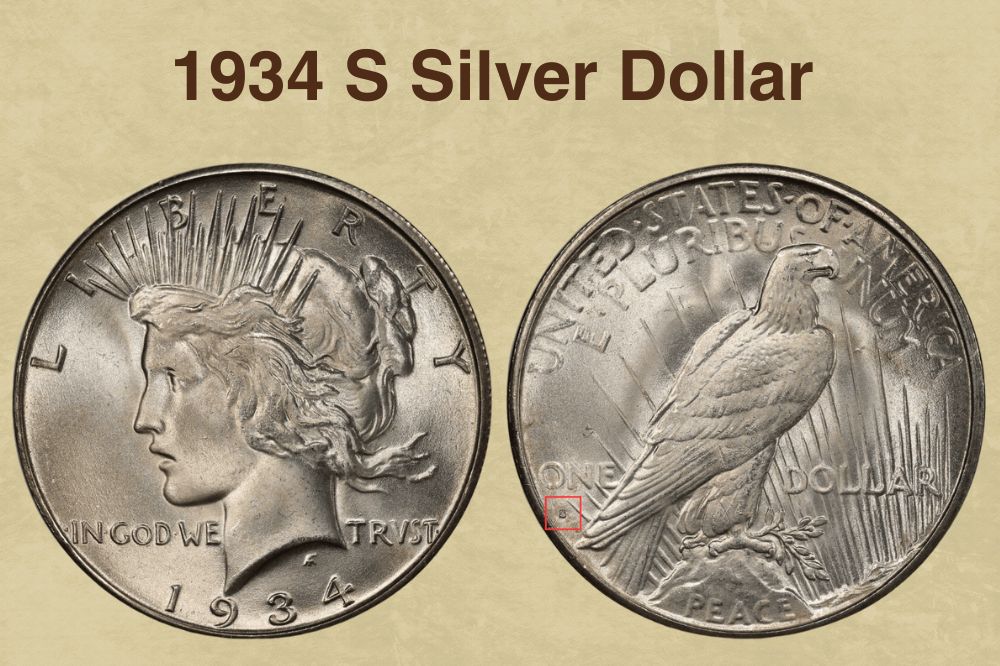
The mint mark, when present, appears on the reverse just above the eagle’s tail feathers. A “D” identifies Denver, an “S” points to San Francisco, and the absence of any letter means Philadelphia struck it.

Struck in a 90% silver and 10% copper alloy, the 1934 Silver Dollar weighs 26.73 grams and carries a troy silver content of 0.77344 oz — meaning even a heavily circulated example holds meaningful bullion value at today’s silver prices. At 38.1 mm in diameter, it’s a large, substantial coin with a reeded edge, and its face value was $1.00.

Also Read: Top 100 Most Valuable Morgan Silver Dollar Coins Worth Money List


1934 Silver Dollar Mintage & Survival Data

1934 Silver Dollar Mintage & Survival Chart

Mintage Comparison

Survival Distribution

TypeMintageSurvivalSurvival Rate
No Mint954,05760,0006.2889%
D1,569,500130,0008.2829%
S1,011,00035,0003.4619%

Denver struck the most coins of the three mints, yet its survival rate sits only modestly above Philadelphia’s — a reminder that higher mintage doesn’t automatically translate to greater availability today. What’s most telling is the San Francisco figure: the 1934-S had the lowest survival rate of all three varieties at just 3.46%, meaning fewer than 1 in 28 original coins are believed to exist today.

This is the numismatic consequence of a coin that was minted into an economy where silver dollars were largely unwanted by the public, who preferred paper silver certificates. Most 1934-S coins entered circulation rather than being preserved, and decades of melting — first for World War II wartime needs, then again during the silver price surge of the 1980s — quietly erased a significant portion of the surviving population.

A coin struck in large numbers but poorly preserved is, in practical terms, rarer at higher grades than one with a modest original output that was carefully saved. The 1934-S exemplifies this paradox, which is precisely why it commands the strongest premium of any standard 1934 variety in mid-to-upper Mint State grades.

Also Read: Top 20+ Most Valuable Eisenhower Dollars Worth Money


The Easy Way to Know Your 1934 Silver Dollar Value

Pinning down an accurate value requires three things: identifying the mint mark, honestly assessing the grade, and checking current market data. Run your coin through the Coin Value Checker App for an instant read on all three — it cross-references live auction results and certified population data to give you a number you can actually trust. Grade matters more than most people expect, and a single point on the grading scale can mean hundreds of dollars.

Coin Value Checker APP Screenshot


1934 Silver Dollar Value Guides

The mint mark on a 1934 Silver Dollar isn’t just a letter — it’s a pricing variable. Collectors have long recognized that the three 1934 varieties behave very differently in the market, from how often they surface at auction to how aggressively bidders compete for top-grade examples:

CoinVaueChecker App 10

  • 1934 No Mint Mark – struck at the Philadelphia Mint
  • 1934-D – struck at the Denver Mint
  • 1934-S – struck at the San Francisco Mint


1934 No Mint Mark Silver Dollar Value

1934 No Mint Mark Silver Dollar Value

The Philadelphia Mint produced Peace dollars of good quality in 1934, with solid strikes and good luster. In circulated grades, this variety sits close to its silver melt floor — accessible, unglamorous, and easy to find.

Uncirculated coins are plentiful through MS-65, though the 1934 Philadelphia issue has long been considered somewhat underappreciated relative to its actual quality. That undervaluation is precisely what makes it interesting.

When a single MS-67 crossed the block at Stack’s Bowers in August 2018, bidders pushed it to $108,000 — nearly double its $52,000 guide price. The market, it turned out, knew something the price guides didn’t.

1934 No Mint Mark Silver Dollar Price/Grade Chart

Price by 1-70 Grade (Latest Auction Records Included)

Updated: 2026-05-09 13:36:27

What does the bidding history actually look like when a gem-grade example goes up for auction? The records below answer that.

Date ↓PlatformPrice ⇅Grade ⇅

Below is how the market has moved for the 1934 No Mint Mark over time — useful context for anyone tracking buy-or-sell timing.


Market Activity: 1934 No Mint Mark Silver Dollar


1934-D Silver Dollar Value

1934-D Silver Dollar Value

Denver’s 1934 output is the variety that serious collectors keep getting wrong. Its scarcity is routinely underrated — luster is exceptional, but inconsistent striking means a fully struck example commands a meaningful premium. No mint-sealed bags are known to have survived, and documented hoards are essentially nonexistent, leaving the market dependent on coins that trickled out one or two at a time.

The grade wall hits hard above MS-65: MS-66 is very scarce, and MS-67 is in a different category entirely. Only one has ever sold at that level — an MS-67 that realized $86,250 at Heritage Auctions in April 2009 — and nothing has come close since. For a coin this overlooked, that record has aged remarkably well.

1934-D Silver Dollar Price/Grade Chart

Price by 1-70 Grade (Latest Auction Records Included)

Updated: 2026-05-09 13:36:27

The auction ceiling for this date is defined by a single sale. Here’s the full picture of what top-end examples have brought over the years.

Date ↓PlatformPrice ⇅Grade ⇅

Activity at the mid-grades tells a different story than the headlines. Here’s the market activity trends for the 1934-D Silver Dollar over the past year.


Market Activity: 1934-D Silver Dollar


1934-S Silver Dollar Value

1934-S Silver Dollar Value

No coin in the Peace Dollar series carries more collector weight than this one. The 1934-S was recognized as the key date within a decade of its release — by 1950, the Red Book already listed it at $15, nearly four times the price of the 1921 Peace Dollar. The reason isn’t mintage — it’s survival.

Most coins entered circulation immediately, and only three or four bags’ worth were ever set aside in Mint State. At the gem level, the math becomes brutal: a true Gem 1934-S can command up to $135,000, and expert John Highfill’s advice to collectors was blunt — buy the 1934-S first, before anything else in the series, because constant demand keeps premiums elevated and stable even through market downturns.

1934-S Silver Dollar Price/Grade Chart

Price by 1-70 Grade (Latest Auction Records Included)

Updated: 2026-05-09 13:36:27

The record prices below trace how the market has valued this coin at its rarest grades.

Date ↓PlatformPrice ⇅Grade ⇅

The activity chart below shows why dealers treat it as one of the most reliably liquid coins in the series.


Market Activity: 1934-S Silver Dollar

Also Read: 17 Rare Dollar Coin Errors List with Pictures (By Year)


Rare 1934 Silver Dollar Error List

Even the most seasoned collectors know that errors can turn an ordinary 1934 Silver Dollar into something far more compelling — and far more valuable.

1. 1934-D VAM 3, DDO, Medium D

1934-D VAM 3, DDO, Medium D

This is one of the most actively traded VAM varieties in the entire Peace Dollar series, and for good reason. The doubling on the obverse is visible across Liberty’s nose, forehead, and the lower rays of her tiara — detectable under modest magnification.

What separates VAM-3 from its Micro D counterpart is the mintmark: a heavier, more prominent “D” positioned lower on the reverse near the eagle’s tail. PCGS records an auction record of $12,350 for an MS-66+ example sold at Heritage Auctions in August 2013 — a figure that reflects how aggressively specialists pursue a gem-grade example of this variety.

In circulated grades, the DDO commands $125 and up, and the spread only widens as condition improves. It earns its place on the PCGS Top 50 VAM list without controversy.

1934-D VAM 3, DDO, Medium D Silver Dollar Price/Grade Chart

Price by 1-70 Grade (Latest Auction Records Included)

Updated: 2026-05-09 13:36:27

2. 1934-D VAM 4, DDO, Micro D

1934-D VAM 4, DDO, Micro D

Where VAM-3 is the more accessible DDO variety, VAM-4 is the one that keeps collectors up at night. It combines the doubled die obverse with the far scarcer Micro D mintmark — placed unusually high on the reverse, closer to the “O” of “ONE DOLLAR” than the standard position.

By some estimates, the Micro D is as much as 100 times scarcer than the Medium D, and pairing it with a DDO only compounds the rarity. The PCGS auction record stands at $5,000 for an MS-64, sold on eBay in April 2019 — modest by headline standards, but the certified population is so thin that meaningful price discovery rarely happens.

A VAM-4 in any Mint State grade is a genuine find, and most examples that surface do so unattributed among generalist silver dealers.

1934-D VAM 4, DDO, Micro D Silver Dollar Price/Grade Chart

Price by 1-70 Grade (Latest Auction Records Included)

Updated: 2026-05-09 13:36:27

3. 1934-S VAM 3, Doubled Tiara

1934-S VAM 3, Doubled Tiara

CoinVaueChecker App 10

The 1934-S already commands the highest premiums of any standard 1934 Peace Dollar — add a confirmed VAM-3 attribution and the conversation shifts entirely. The doubling on this variety appears across several of the rays in Liberty’s tiara, making it visible to a trained eye without extreme magnification.

PCGS records the auction record at $7,500 for an MS-65 sold at Heritage Auctions in May 2022. At that grade level, the certified PCGS population stands at just seven coins, with nothing graded higher — a population figure that puts its true rarity in sharp perspective.

For anyone building a serious 1934-S collection, the VAM-3 Doubled Tiara isn’t an optional upgrade. It’s the piece that defines the set.

1934-S VAM 3, Doubled Tiara Silver Dollar Price/Grade Chart

Price by 1-70 Grade (Latest Auction Records Included)

Updated: 2026-05-09 13:36:27


Where to Sell Your 1934 Silver Dollar?

Having established your coins’ value, you might be asking where to easily sell them online. I’ve put together a detailed list of recommended platforms, featuring their overviews, benefits, and limitations.

Check out now: Best Places To Sell Coins Online (Pros & Cons)


1934 Silver Dollar Market Trend

Market Interest Trend Chart - 1934 Silver Dollar

*Market Trend Chart showing the number of people paying attention to this coin.


FAQ about 1934 Silver Dollar

1. How do I know if my 1934 Silver Dollar is the Philadelphia, Denver, or San Francisco version?

Check the reverse side of the coin near the eagle’s tail feathers. A “D” means Denver, an “S” means San Francisco, and no letter at all means it was struck at the Philadelphia Mint. The mint mark is small but clearly visible under good lighting — a loupe or magnifying glass makes identification much easier. This matters more than most people initially realize, because the three varieties trade at very different price levels. A circulated 1934-S, for example, already commands a premium over the Philadelphia and Denver issues at the same grade, and that gap becomes dramatic once you move into Mint State territory.

2. What makes the 1934-S so much more valuable than the other two varieties?

It comes down to survival, not mintage. Most 1934-S coins went straight into circulation immediately after release and were never set aside by collectors or banks. Only a handful of Mint State bags were preserved, and subsequent decades of silver melting — first during World War II and again during the silver price surge of the 1980s — further reduced what little remained. Today, finding a 1934-S in gem uncirculated condition is genuinely difficult, and the certified population at the major grading services confirms it. PCGS has graded only a small number of examples at MS-65 and above, and nothing has been confirmed at MS-67. That combination of low survival rate, constant collector demand, and a hard ceiling on top-population examples is what keeps premiums elevated year after year.

3. Is a heavily worn 1934 Silver Dollar still worth anything?

Yes, and more than most people expect. Every 1934 Peace Dollar contains 0.77344 troy ounces of silver, which sets a natural price floor regardless of grade. Even a coin graded Good or Very Good holds meaningful bullion value, and at current silver prices that puts it well above face value. For the 1934-S specifically, even circulated examples carry a numismatic premium on top of the silver melt — its key date status means collectors will pay above bullion for almost any surviving example. The only scenario where a 1934 Peace Dollar approaches pure melt value is if it’s heavily cleaned, damaged, or otherwise compromised in a way that removes its collector appeal entirely.

4. Why did the Philadelphia No Mint Mark variety set the all-time auction record if it’s considered the most common?

This is one of the most instructive lessons the 1934 series offers. Overall availability in lower grades has nothing to do with rarity at the top of the grading scale. The Philadelphia issue is easy to find in Fine or Extremely Fine — but locating a flawlessly preserved MS-67 example with full luster and no distracting marks is an entirely different challenge. When that level of quality finally surfaces at auction, the pool of serious bidders who have been waiting for years converges at once, and the result can dramatically exceed published price guides. The $108,000 result at Stack’s Bowers in 2018 — against a guide price of $52,000 — is a perfect illustration of what happens when extreme condition rarity meets deep collector demand.

5. What’s the difference between a VAM variety and a regular error coin?

VAM varieties are die-specific anomalies — they occur when the working die itself carries a doubling, a repositioned mintmark, or another characteristic, meaning every coin struck from that die shares the same identifiable feature. They are systematically cataloged in the Van Allen-Mallis reference and assigned VAM numbers, which gives them a recognized place in the hobby with documented populations and price histories. A random error coin, by contrast, results from a one-time mishap during the striking process — a misaligned die, a struck fragment, an off-center planchet — and is unique or nearly so. Both can carry significant premiums, but VAM varieties tend to have more stable markets because they are attributable, verifiable, and consistently sought by a dedicated community of specialists.

6. How much does professional grading actually affect the value of a 1934 Silver Dollar?

The impact is substantial, and it grows exponentially as grade increases. A coin that appears to be MS-64 could sell for a few hundred dollars raw, while the same coin confirmed as MS-65 by PCGS or NGC might fetch two to three times more. At the gem level — MS-66 and above — the price gaps become even steeper, sometimes representing thousands of dollars per grade point. Beyond the price premium, certification also provides authentication, which matters particularly for the 1934-S where altered coins with added mintmarks are a documented concern. For any coin worth more than a few hundred dollars, the cost of professional grading is almost always justified by the added confidence it gives both buyer and seller.

7. Are 1934-S Peace Dollars ever counterfeited?

Yes, and this is a well-documented risk that any serious buyer should understand. The most common fraud involves removing an “S” mintmark from a lower-value coin and attaching it to a genuine 1934 Philadelphia dollar — effectively creating a fake key date from two legitimate coins. The telltale sign is a seam or discontinuity in the metal at the junction between the mintmark and the coin’s field, visible under 20x magnification or higher. Flow lines on a genuine coin run continuously through the mintmark area; an added mintmark will show a break in those lines. Buying a certified, slabbed example from PCGS or NGC eliminates this risk entirely, which is why serious collectors rarely purchase high-value 1934-S examples without third-party authentication.

8. Does the silver spot price affect the value of a 1934 Silver Dollar?

It depends entirely on the grade. For circulated, lower-grade examples — particularly common Philadelphia and Denver pieces in Good to Fine condition — the silver spot price is the dominant factor, and value tracks closely with the metal market. But for higher-grade Mint State coins, numismatic premium completely overshadows bullion value, and daily silver fluctuations become essentially irrelevant to the coin’s market price. A gem 1934-S trading at several thousand dollars is priced on its rarity as a collectible, not on its 0.77 ounces of silver. The point at which numismatic value begins to dominate is generally around the Extremely Fine to About Uncirculated range, where collector demand starts to meaningfully separate a coin’s price from its melt value.

9. What should I look for when assessing the grade of my 1934 Silver Dollar at home?

The most telling diagnostic is Lady Liberty’s cheek — it’s the highest point of the obverse design and the first place wear appears. Under a pinpoint light source, tilt the coin slowly back and forth. If you see full, unbroken luster radiating evenly across the cheek, the coin may be uncirculated. Any flat, grey, or dulled patch indicates friction and suggests a circulated grade. The hair curls behind Liberty’s neck are a useful secondary check — these high points flatten quickly with wear. On the reverse, examine the eagle’s breast feathers and the top of the wings. Keep in mind that distinguishing a high-grade AU from a low Mint State coin can be genuinely difficult even for experienced graders, which is why professional certification exists. Home assessment is a useful starting point, but for anything potentially valuable, submitting to PCGS or NGC is the only way to know for certain.

10. Is the 1934 Silver Dollar a good long-term investment?

For key dates and high-grade examples, the historical track record is strong. The 1934-S in particular has shown consistent demand across multiple market cycles, and numismatic experts have long noted that key date Peace Dollars tend to hold — and often grow — their premiums even during broader market downturns. The logic is straightforward: the supply of high-grade survivors is fixed and can only decrease over time, while the collector base for classic U.S. silver dollars remains deep and multigenerational. That said, investment performance varies dramatically by grade and variety. Mid-grade common examples don’t appreciate the same way gem-quality or VAM-attributed coins do. The standard advice from serious numismatists is consistent: buy the best grade you can afford, insist on certification from a top grading service, and prioritize coins with strong eye appeal, as those command the best premiums when it comes time to sell.

You May Also Like