Coin Value Contents Table
- 1986 Silver Eagle Dollar Chart
- History of the 1986 Silver Eagle Dollar
- 1986 Silver Eagle Dollar Types
- Features of the 1986 Silver Eagle Dollar
- 1986 Silver Eagle Dollar Value Guides
- 1986 No Mint mark Eagle dollar Value
- 1986 S proof silver Eagle dollar Value
- 1986 Silver Eagle Dollar Grading
- Rare 1986 Silver Eagle Dollar Errors List
- Where to Sell Your 1986 Silver Eagle dollar ?
- FAQ about the 1986 Silver Eagle Dollar
The 1986 American Eagle silver dollars are coins from the first issue of these official silver bullion collectible pieces. Each specimen contains one troy ounce (31.103 g) of pure, 99.93% silver.
Since the collection started with coins released on November 24, 1986, the 1986 silver dollar value can be significant since they are the first in the series. Be prepared that finding the highest-graded pieces can be challenging, but it is worth trying.
1986 Silver Eagle Dollar Chart |
|
| Condition | Price |
| Mint state 65 | $46 |
| Proof 65 | $67 |
History of the 1986 Silver Eagle Dollar
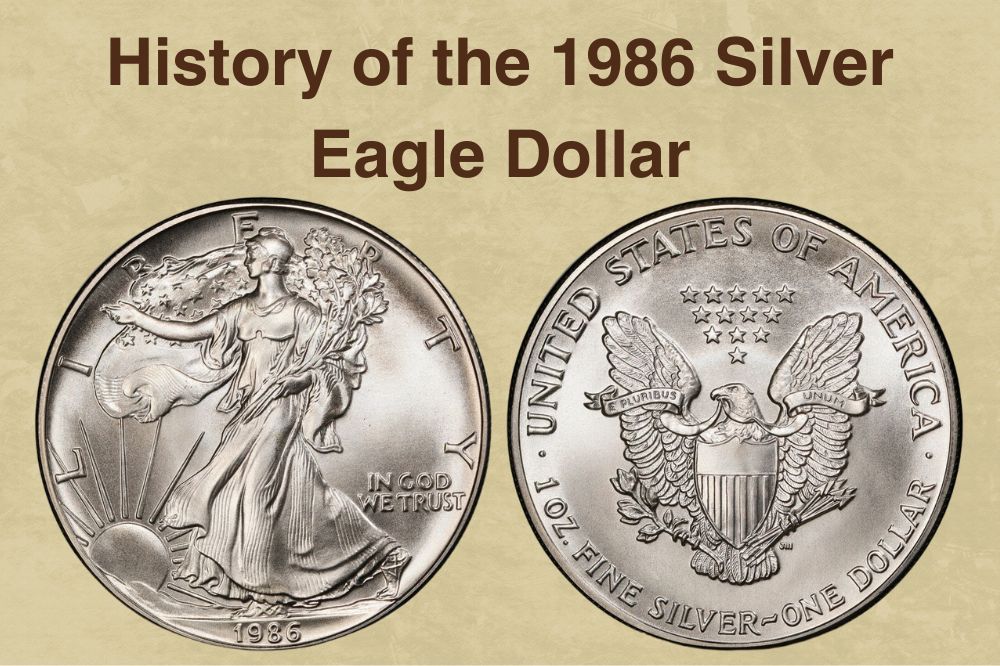
The US Treasury started a unique bullion coin program in 1986, which proved unbelievably popular with collectors and investors. Therefore, the US Mint still issues these coins with the re-designed reverse since 2021.
These coins are highly popular because they have a beloved Walking Liberty design on the obverse and consist of 1 troy ounce (31.101 g) of .9993 fine silver. On the other hand, their minting helped minimize the effects of decreasing silver prices.
1986 Silver Eagle Dollar Types |
||
| Location | Year | Minted |
| San Francisco | 1986 silver eagle dollar (No Mint mark) | 5,393,005 |
| San Francisco | 1986 S silver eagle dollar proof | 1,446,778 |
| Total | / | 6,839,783 |
The first pieces without the mint mark were released into circulation on November 24, 1986, and sold to citizens and verified dealers at a fixed price of $6.50 to $7 per piece. On the other hand, proofs with the S mint mark were intended for collectors. Their selling price was $21 per coin.
Also read: 12 Most Valuable One-Dollar Coin Worth Money
Features of the 1986 Silver Eagle Dollar
The Eagle silver dollars are the official American silver bullion coinage with the original Adolph A. Weinman’s obverse. Designer John Mercanti created the unique reverse intended explicitly for this coin. The first pure silver pieces appeared along with the American Eagle gold dollars.
The obverse of the 1986 Silver Eagle Dollar
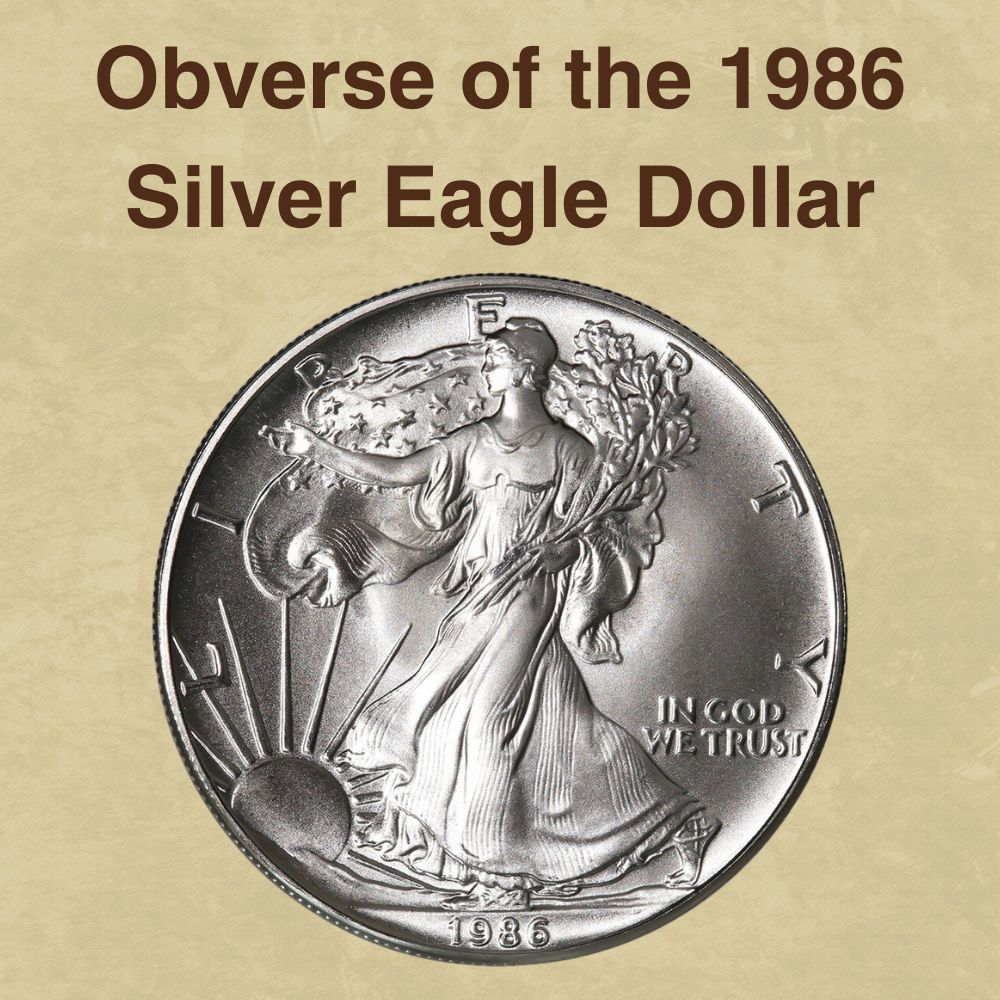
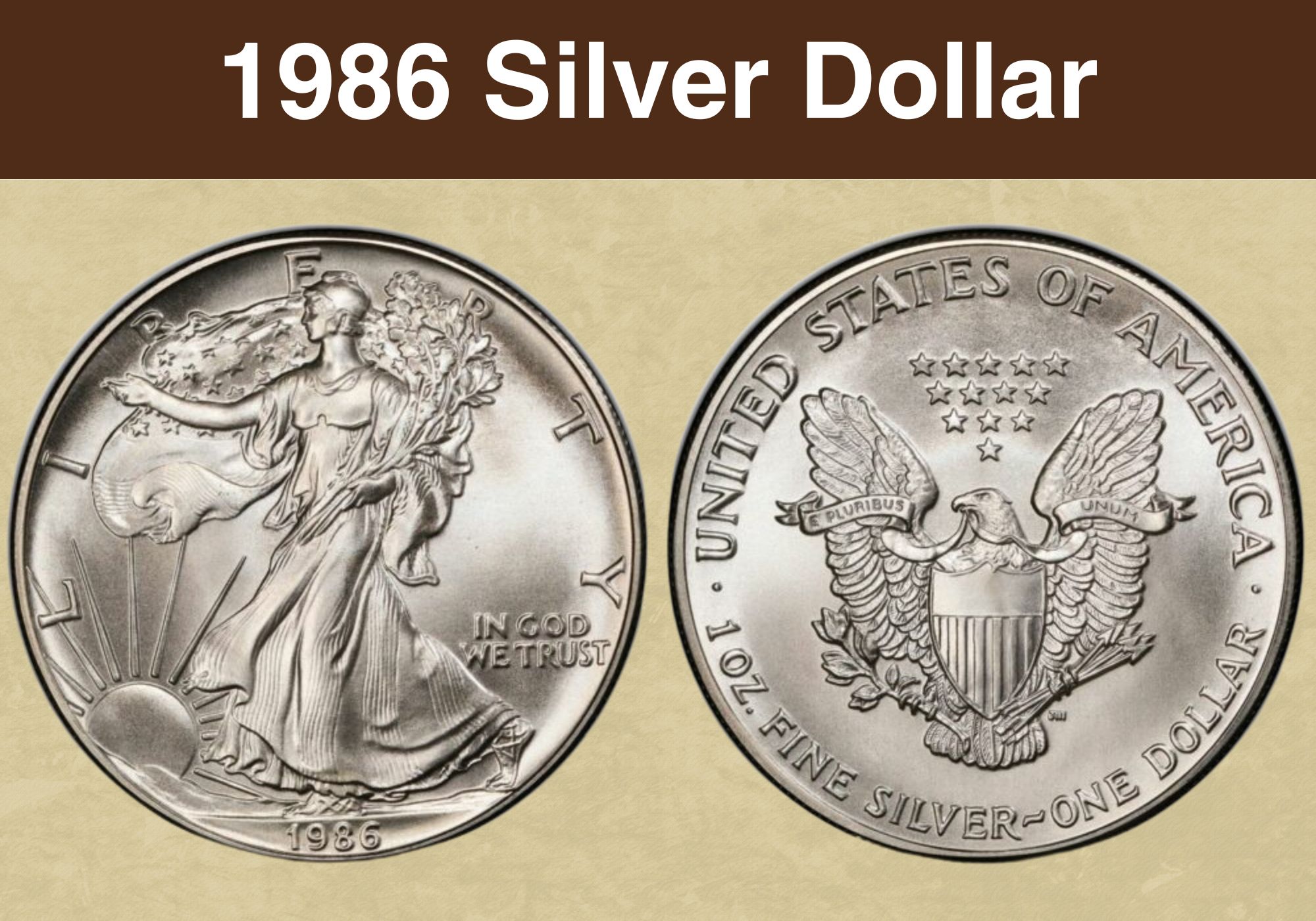
The 1986 silver dollar obverse shows the iconic design of Adolph A. Weinman’s Walking Liberty half-dollars minted from 1916 to 1947.
Lady Liberty strides towards the sunrise with the American flag over her shoulders and oak and laurel branches in her left hand. Design is completed with the words LIBERTY and IN GOD WE TRUST, and the date.
The reverse of the 1986 Silver Eagle Dollar
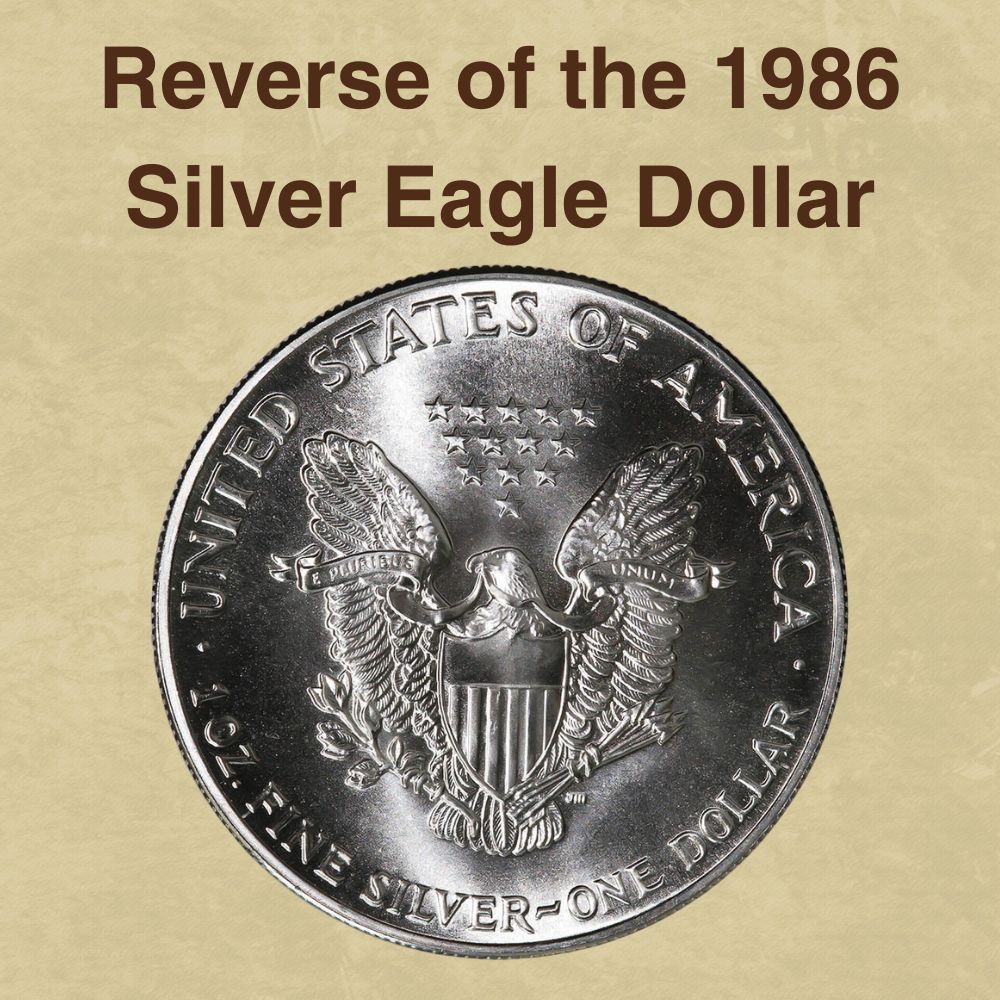
All American Eagle dollars minted from 1986 to 2021 depict the heraldic eagle on the reverse. Designer John Mercanti placed a shield on the bird’s chest, while thirteen five-pointed stars are arranged above its head. The inscriptions include:
- UNITED STATES OF AMERICA ·
- 1 Oz. FINE SILVER ~ ONE DOLLAR
1986 Silver Eagle Dollar Details |
|
| Face value | One dollar ($1) |
| Shape | Round |
| Compound | 99.93% silver – 0.07% copper |
| Coin thickness | 0.117 inches (2.98 mm) |
| Coin weight | 1 troy ounce (31.101 g) |
| Silver weight | 0.9993 troy ounces (31.08 g) |
| Coin diameter | 1.59842 inches (40.60 mm) |
| Edge | 201 reeds |
Other features of the 1986 Silver Eagle Dollar
Each American Eagle silver bullion coin minted in 1986 contains 99.93% silver and copper in a low percentage of 0.07%. In other words, coins weighing one troy ounce (31.101 g) have 0.9993 troy ounces (31.08 g) of precious metal.
These specimens have a reeded edge carrying 201 reeds. They have a diameter of 1.59842 inches (40.60 mm) and are 0.117 inches (2.98 mm) thick.
Also read: 14 Most Valuable Coins In Circulation
1986 Silver Eagle Dollar Value Guides
The Eagle silver coins are the official American bullion pieces made of pure precious metal (99.93% silver). Even though three mints produced them during the years, the 6,839,783 specimens from 1986 came only from San Francisco.
Interestingly, those from the regular strikes were released without the mint mark, while proofs have the S letter on the reverse.
1986 No Mint mark Eagle dollar Value
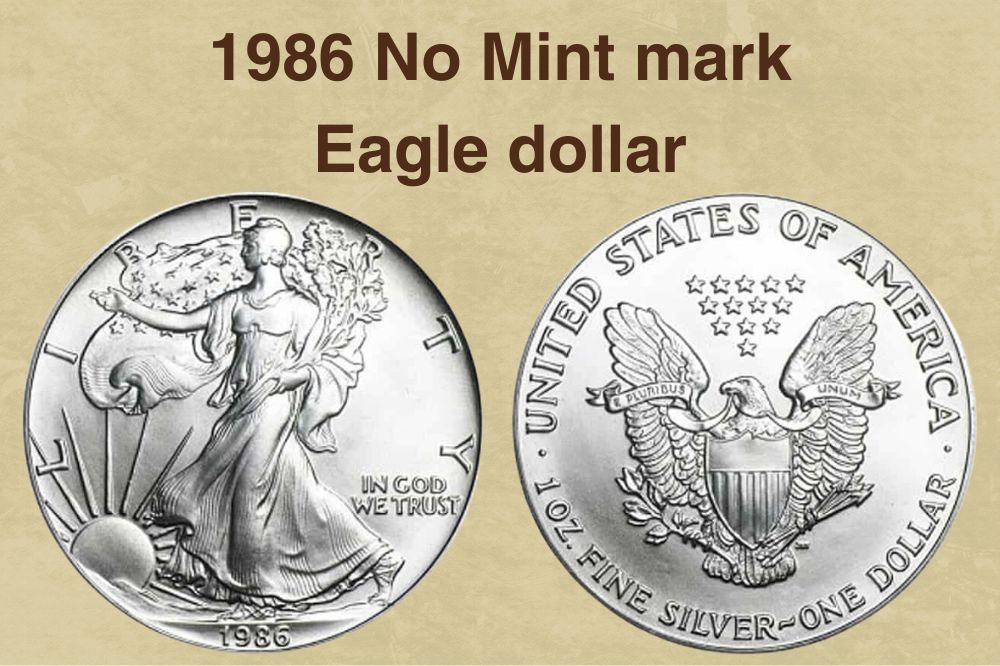
All 5,393,005 regular Eagle dollars minted in San Francisco in 1986 came without the mint mark. Initially, the US Mint offered these coins packaged in a purple outer box and velvet case at $6.50 to $7.
It was a real deal since the average silver price in 1986 was about $5.47 per troy ounce. Each piece came with a signed certificate of authenticity. Nowadays, these bullion coins are collectible only in the highest grades, above MS 68. You can expect to set aside approximately:
- $62 for the 1986 No Mint mark Eagle silver dollar with MS 68 ranking
- $100 for the 1986 No Mint mark Eagle silver dollar with MS 69 ranking
On the other hand, the real surprise comes with pieces graded MS 70. Their estimated price range is from $850 to $975.
However, the most expensive coin in the set is one of those pieces that appeared at Heritage Auctions on February 7, 2013. One 1986 MS 70 Eagle silver dollar outperformed other coins of similar quality thanks to the selling price of $21,150.
1986 S proof silver Eagle dollar Value
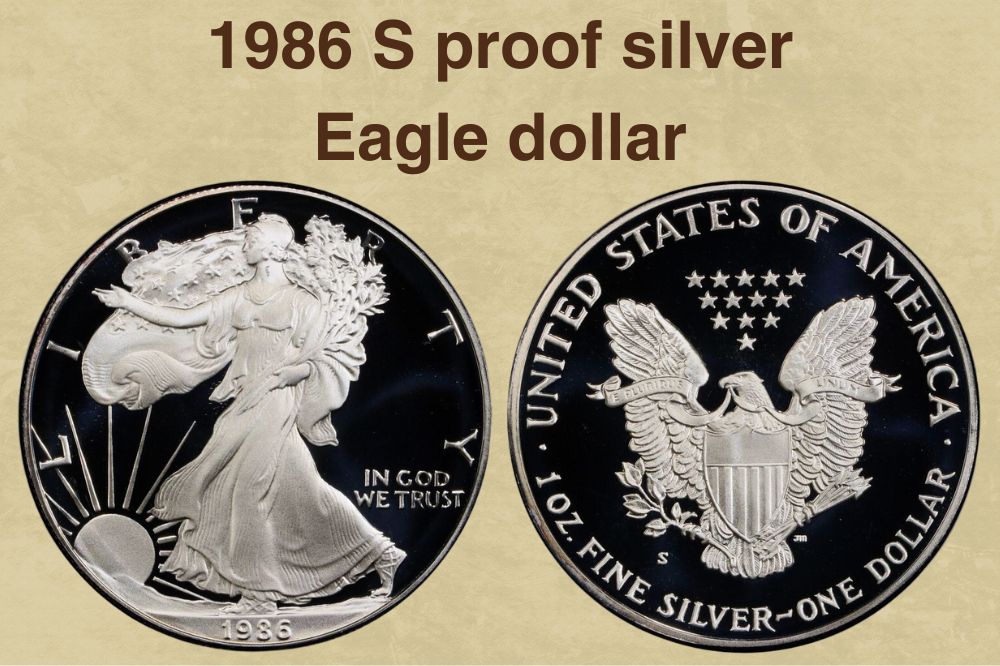
The San Francisco mint was responsible for issuing the 1986 S Eagle silver proof in 1986. It produced 1,446,778 of them in total, which was the highest mintage of proofs in this series.
Their initial price was $21, but you can buy one of these proof silver dollars with deep cameo contrast and PR 69 grade for $121 nowadays. On the other hand, perfect pieces ranked PR 70 are estimated at $450.
The Great Collections auction, organized on May 19, 2013, showed that some coins are particularly valuable to collectors. One bought the 1986 S PR 70 DCAM Eagle dollar for $16,115, making it the costliest proof in the set.
1986 Silver Eagle Dollar Grading
The 1986 Eagle dollars are coins made of 0.9993 fine silver bullion. Therefore, your best option is to have your piece professionally estimated by a reputable service like NGC or PCGS.
Still, collectors who prefer certified coins can find it challenging to buy specimens assessed as perfect and in the highest grade (PR 70) in the PCGS. On the other hand, there are many such silver dollars graded by NGC.
Be aware that almost all existing silver dollars minted in 1986 are in the mint state, so 70-point grading itself is often insignificant and has a low impact on their actual value. On the other hand, even the tiniest detail usually means thousands of dollars in price difference.
Rare 1986 Silver Eagle Dollar Errors List
The US Mint followed the highest standards when producing the 1986 silver dollars, and you can find only a few significant error coins in the set. Such specimens are typically more expensive than regular pieces of the same quality and grade.
You can also find several collectible silver dollars with minor imperfections, while flaws that occurred during circulation make coins cheap. In most cases, only professionals can differentiate valuable specimens with minting errors from non-collectible later damaged Eagle dollars.
Struck through
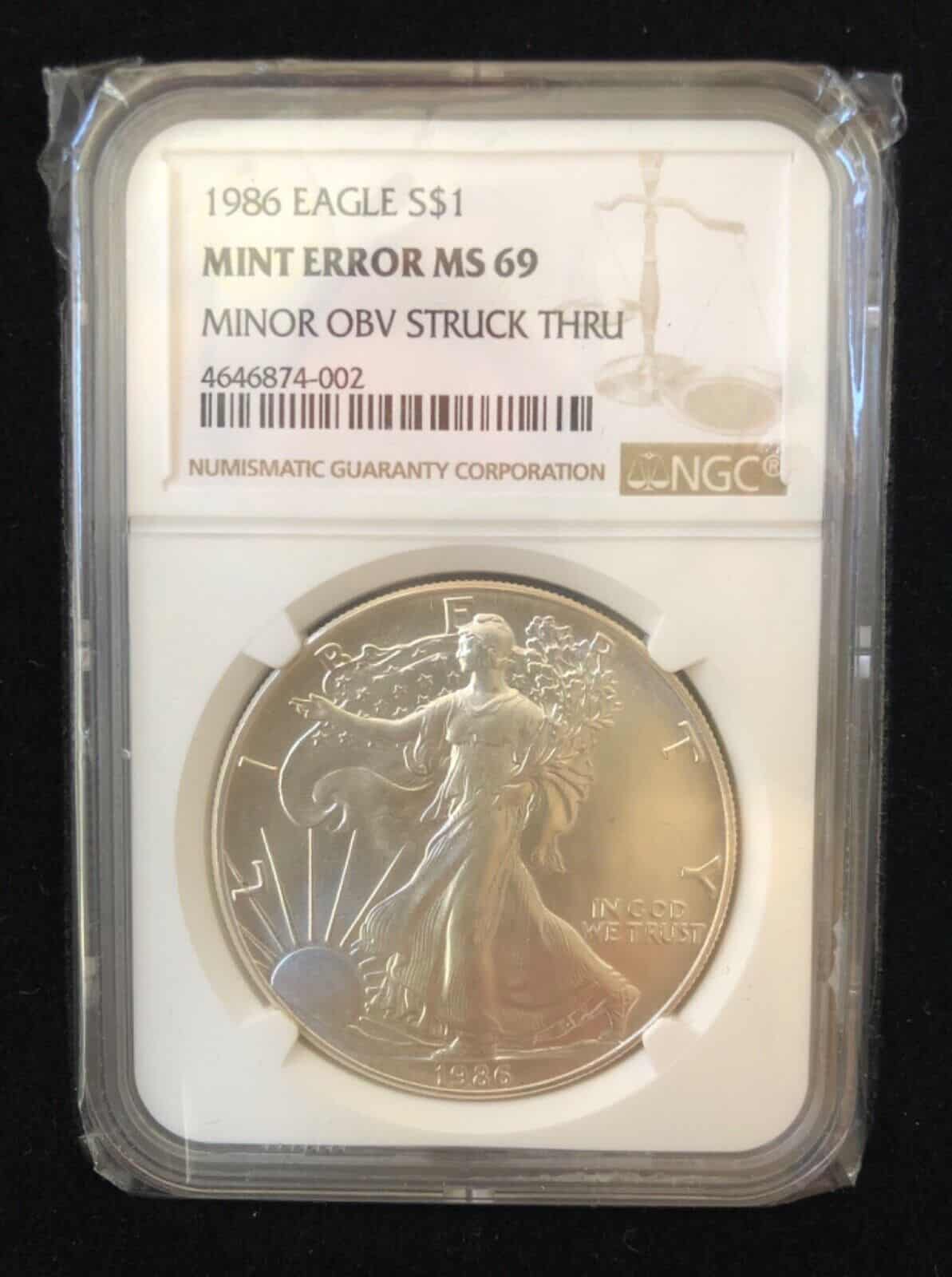
This error is the most famous among the 1986 Eagle silver dollars that appear when small bits of used material get stuck on the dies. Each coin is unique after striking through different materials, like fiber, grease, paper, or dust.
The result is specimens with missing details on the affected area, while the opposite side is intact. If you find such a dollar, you can count on an additional $15 to its actual price.
Broad strike
In rare cases, even modern coinage like 1986 silver dollars can be found with this error type. It appears when the retaining collar surrounding the future coin and giving it a round shape breaks for some reason.
In such a case, silver flows outward, resulting in a deformed coin with a weird shape, flatter appearance, and more sizable diameter than expected. The price of one such silver dollar from 1986 varies, depending on the coin’s overall condition and error severity.
Silver Eagle dollar struck on 3M Emory disc
This super rare error appeared on one 1986 MS 64 silver Eagle dollar. This coin struck on 3M Emory Disc is offered on sale at a price of $3,750.
Also read: Top 10 Most Valuable Morgan Silver Dollar Worth Money
Where to Sell Your 1986 Silver Eagle dollar ?
Now that you know the value of your coins, do you know where to sell those coins online easily? Don’t worry, I’ve compiled a list of these sites, including their introduction, pros, and cons.
Check out now: Best Places To Sell Coins Online (Pros & Cons)
FAQ about the 1986 Silver Eagle Dollar
What makes 1986 Silver dollars rare?
Since the 1986 Eagle silver dollars are the first in the series, they are considered inherently rare. However, they are never so appreciated among collectors as rarities like pieces from a few other years, such as the 1995 W silver Eagle proofs (key date). However, those in the highest grades can be valuable.
Which 1986 Silver dollars are worth a lot of money?
- The 1986 MS 70 silver dollar sold at $21,150 on February 7, 2013 (Heritage Auctions)
- The 1986 S PR 70 silver dollar (DCAM) sold at $16,115 on May 19, 2013 (Great Collections)
- The 1986 MS 70 silver dollar with Mercanti Flag signature sold at $2,465 on May 6, 2021 (eBay)
- The 1986 MS 69 PL silver dollar sold at $2,400 on April 22, 2021 (Heritage Auctions)
- 1986 (S) MS 70 silver dollar struck at San Francisco Mercanti Flag sold at $1,990 on March 16, 2023 (eBay)
- The 1986 MS 70 silver dollar (the First Strike) sold at $1,970 on September 22, 2023 (eBay)
- The 1986 MS 70 silver dollar with Mercanti signature sold at $1,920 on June 29, 2021 (Heritage Auctions)
- The 1986 S PR 70 silver dollar with Mercanti Flag signature (DCAM), sold at $1,900 on December 17, 2021 (eBay)
- The 1986 (S) MS 70 silver dollar struck at San Francisco Mercanti Flag sold at $1,795 on May 30, 2023 (eBay)
- The 1986 MS 64 Moy UHR silver dollar sold at $1,673 on August 19, 2012 (Stack’s Bowers)
- The 1986 MS 70 silver dollar (the First Day of Issue) sold at $1,595 on July 22, 2022 (eBay)
- The 1986 MS 70 silver dollar (Thomas Cleveland Art Deco) sold at $1,440 on April 29, 2018 (Heritage Auctions)
- The 1986 MS 70 silver dollar with a Moy signature sold at $1,320 on April 22, 2021 (Heritage Auctions)
- The 1986 S PR 70 silver dollar with San Francisco picture frame (DCAM) sold at $1,200 on April 22, 2021 (Heritage Auctions)
- The 1986 S PR 70 Mercanti SF DCAM silver dollar (Mint engraver series) sold at $1,195 on April 15, 2023 (eBay)
- The 1986 MS 70 silver dollar with Mercanti SF signature sold at $1,155 on July 11, 2023 (eBay)
How much is the 1986 Silver dollar worth?
Interestingly, silver dollars minted in 1986 didn’t come from Philadelphia. All pieces were struck in the San Francisco mint. Since Americans considered these coins as collectibles from the start, most are still in the highest grades.
You should set aside at least $65 for the 1986 MS 68 No Mint mark Eagle dollar, while pieces in MS 69 grade are estimated at $75. Regularly struck coins with the highest quality in the set (MS 70) are assessed at $850 to $1,300.
What are the most expensive silver Eagle dollars?
Expectedly, all Eagle dollars sold at the highest prices are in the top grades. However, one rare coin minted in West Point in 2016 was an exception to the rule.
This piece ranked AU 58 by NGC with the 30th-anniversary lettered edge PR $1 is still the most expensive coin in the series after selling at $99,000 in 2021. The list of other super-expensive silver dollars in the series includes the following pieces:
- 1995 W PR 70 Eagle silver dollar – $86,655 (Great Collections in 2013)
- 2021 MS 70 Eagle silver dollar Type 1 (Legends) – $85,000 (Stack’s Bowers in 2022)
- 2021 MS 70 Eagle silver dollar Type 2 – $80,000 (Stack’s Bowers in 2022)
- 1991 MS 70 Eagle silver dollar – $34,500 (Heritage Auctions in 2009)
- 2000 MS 70 Eagle silver dollar – $33,275 (Great Collections in 2013)
- 1999 MS 70 Eagle silver dollar – $33,110 (Great Collections in 2013)
- 2000 MS 70 Eagle silver dollar – $29,375 (Heritage Auctions in 2013)
- 1988 MS 70 Eagle silver dollar – $27,500 (Great Collections in 2013)
- 1996 MS 70 Eagle silver dollar – $21,850 (Heritage Auctions in 2009)
- 1986 MS 70 Eagle silver dollar – $21,150 (Heritage Auctions in 2013)