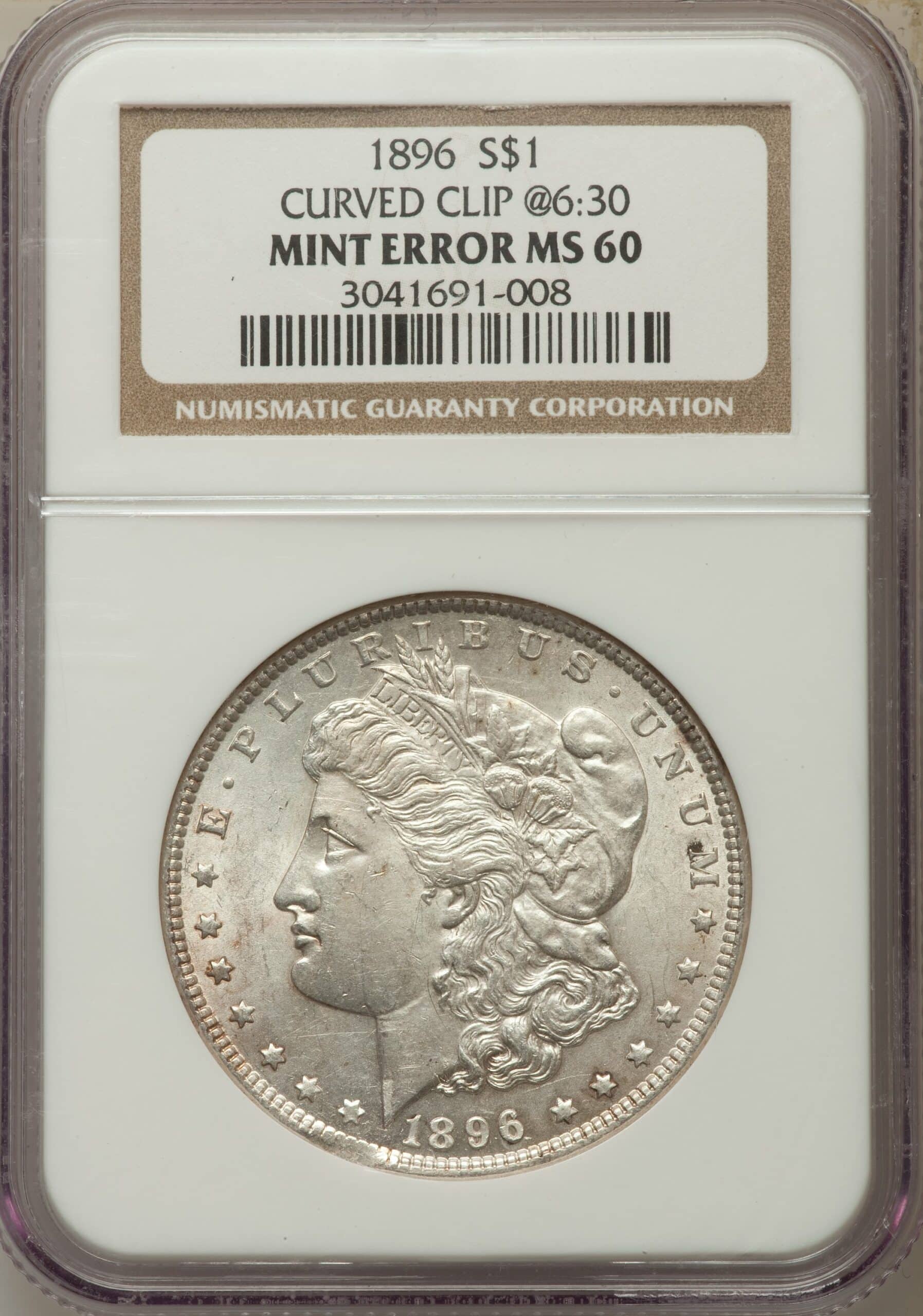
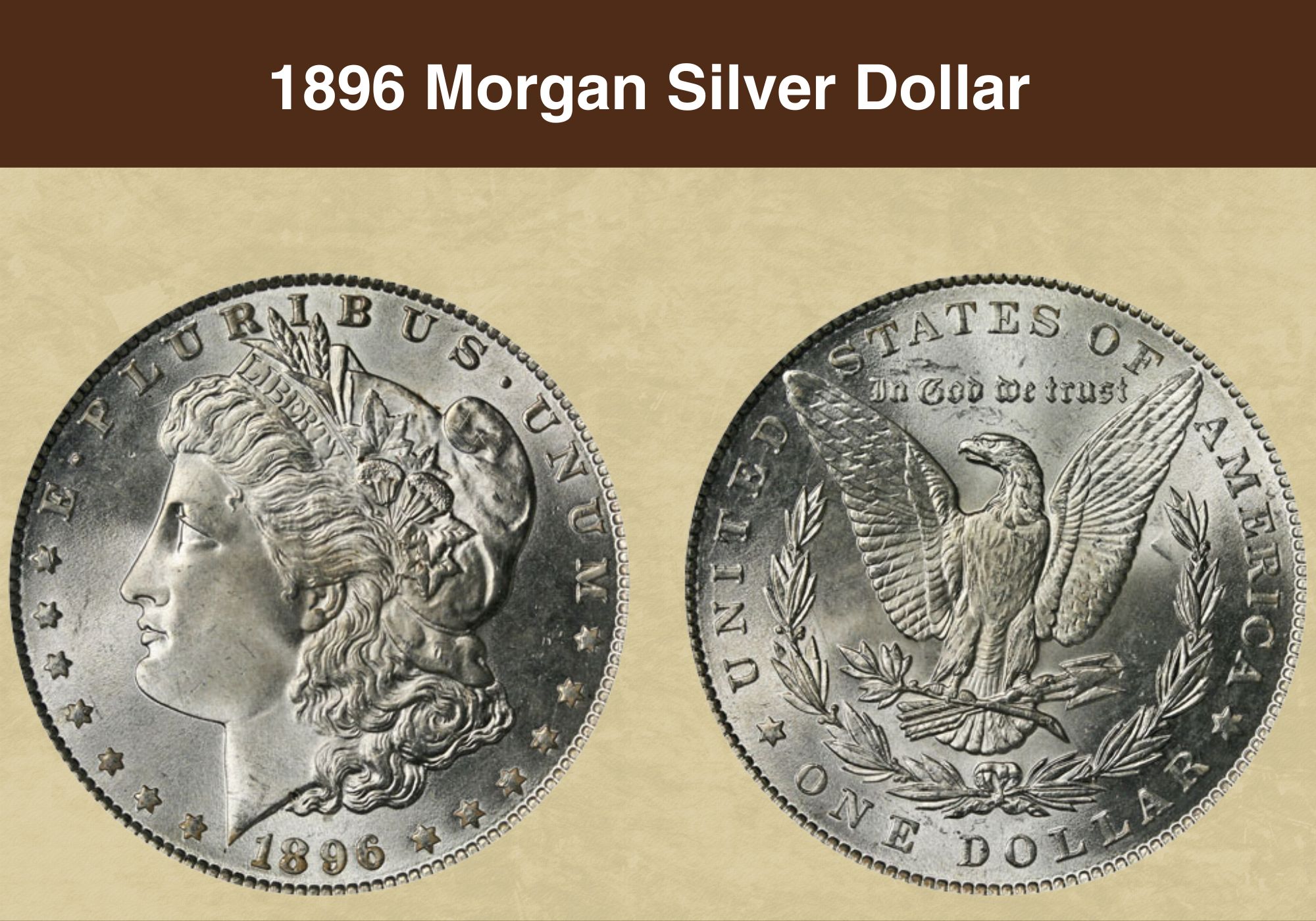
1896 Silver Dollar Value Checker: Errors List, “O”, “S” & No Mint Mark Worth
1896 Silver Dollar value ranges from $1.00 face value to $720,000. That record belongs to an MS-69 example sold at Stack’s Bowers in November 2020 — one of the finest known specimens of the scarce 1896-S issue. Yours could be worth anywhere from a few dollars to thousands depending on mint mark and condition, so upload your coin photo below for a quick value range. Then scroll down to see what 1896 Silver Dollars are actually selling for on eBay right now.
1896 Silver Dollar Value Checker
Identify 1896 Silver Dollar O, S and No Mint Mark Price
Front Obverse
Upload or Take a Photo
Back Reverse
Upload or Take a Photo
1896 Silver Dollar Value By Variety
The mint mark on your 1896 Morgan Dollar is the single biggest factor in what it’s worth. Check that first.
Six varieties exist for this year, and condition plays out differently across each one. If you already know your coin’s grade, jump to the Value Guides section for exact pricing.
| Type | Good(G4-6) | Fine(F12-15) | AU(AU50-58) | MS(MS60-70) | PR(PR60-70) |
|---|---|---|---|---|---|
| ▶1896 No Mint Mark Silver Dollar Value | $84 | $84 | $86 | $87 - $32,200 | — |
| ▶1896 No Mint Mark Silver Dollar (PL) Value | $6 - $8 | $12 - $15 | $47 - $78 | $100 - $13,800 | — |
| ▶1896 No Mint Mark Silver Dollar (DMPL) Value | $11 - $12 | $21 - $24 | $77 - $120 | $160 - $23,000 | — |
| ▶1896 O Silver Dollar Value | $84 | $84 | $140 - $620 | $1,930 - $538,200 | — |
| ▶1896 O Silver Dollar (PL) Value | $160 - $190 | $310 - $370 | $1,160 - $2,070 | $4,600 - $11,500 | — |
| ▶1896 O Silver Dollar (DMPL) Value | $870 - $1,020 | $1,670 - $1,970 | $6,140 - $10,000 | $12,800 - $25,700 | — |
| ▶1896 S Silver Dollar Value | $84 | $100 - $120 | $1,350 - $2,070 | $2,850 - $667,000 | — |
| ▶1896 S Silver Dollar (PL) Value | $400 - $480 | $780 - $920 | $2,870 - $4,670 | $5,980 - $207,000 | — |
| ▶1896 Proof Silver Dollar Value | — | — | — | — | $2,020 - $27,600 |
| ▶1896 CAM Silver Dollar Value | — | — | — | — | $2,530 - $105,800 |
| ▶1896 DCAM Silver Dollar Value | — | — | — | — | $3,120 - $59,800 |
Also Read: Top 100 Rarest Silver Dollar Coins Worth Money (Most Expensive)
Top 10 Most Valuable 1896 Silver Dollar Worth Money
Most Valuable 1896 Silver Dollar Chart
2001 - Present
The 1896-S MS69 sits at the top of this chart at $720,000. At the time of that 2020 sale, only nine Morgan Dollars across all dates had ever been certified MS69 by PCGS. One coin, one grade level, zero competition. That’s what pushed it into six figures and beyond.
The 1896-O tells a completely different story. Nearly 5 million were struck, but almost none survived in gem condition. An MS65 brought $149,500 and an MS66 hit $528,000 — prices driven purely by condition rarity, not low mintage. The Philadelphia proof issues also show up near the top. Only 762 proofs were made in 1896, and the DCAM example reached $126,500 at auction in 2006. Across the board, it’s surface quality and grade that drive these prices, regardless of which mint struck the coin.
History Of The 1896 Silver Dollar
By 1896, the Morgan Dollar had been around for nearly two decades. But the years just before this one were rough. The Panic of 1893 crushed mintages across all three active mints. In 1895, Philadelphia didn’t strike a single circulation Morgan — only proofs.
1896 changed that. Production bounced back hard at Philadelphia, New Orleans, and San Francisco. It became one of the most broadly distributed Morgan issues of the entire decade.
Here’s the fun part: 1896 was also the year the “free silver” debate hit peak intensity during the presidential election. The Morgan Dollar was literally the coin at the center of the argument — silver advocates wanted more of them, gold-standard supporters wanted them gone.
The Philadelphia coins later turned up in huge quantities from Treasury bag releases, which is why they’re so common today. New Orleans and San Francisco pieces actually circulated when they were made, and that difference in how they were used shaped the wildly different survival rates you see now.
Also Read: Top 100 Most Valuable Morgan Silver Dollar Coins Worth Money List
Is Your 1896 Silver Dollar Rare?
1896 No Mint Mark Silver Dollar
1896 No Mint Mark Silver Dollar (PL)
1896 No Mint Mark Silver Dollar (DMPL)
1896-O Silver Dollar
1896-O Silver Dollar (PL)
1896-O Silver Dollar (DMPL)
1896-S Silver Dollar
1896-S Silver Dollar (PL)
1896 Proof Silver Dollar
1896 CAM Silver Dollar
1896 DCAM Silver Dollar
The chart above gives you a general picture, but rarity shifts dramatically depending on mint and grade. A Philadelphia coin in MS64 is everywhere. That same grade from New Orleans? A completely different kind of rare. For a more precise read on your specific coin, the Coin Identifier and Value App can help you pin down its rarity level alongside current market values — handy whether you’re buying, selling, or just curious.
Key Features Of The 1896 Silver Dollar
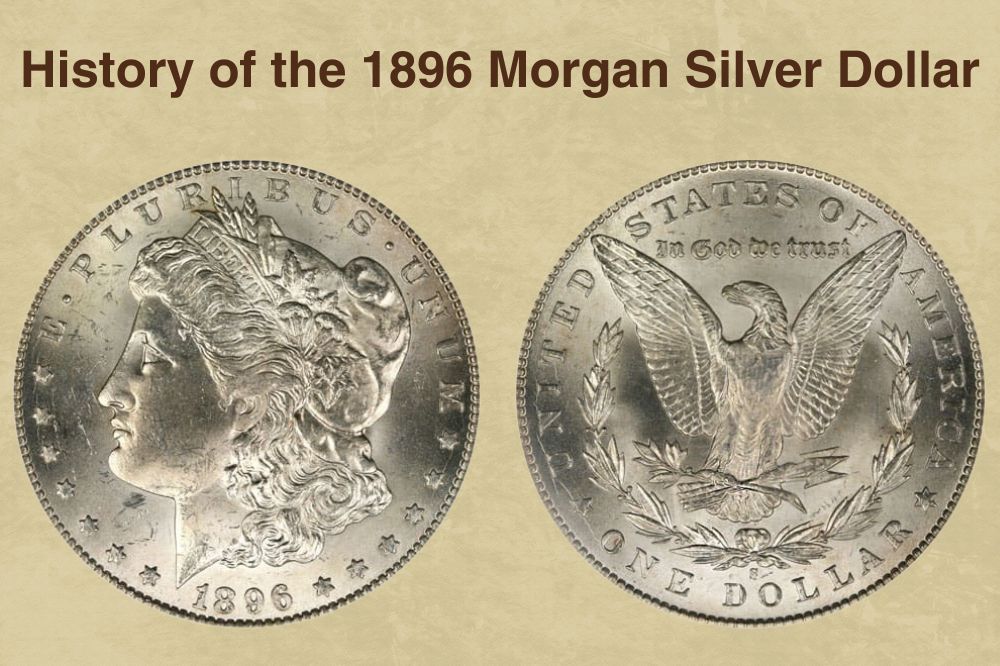
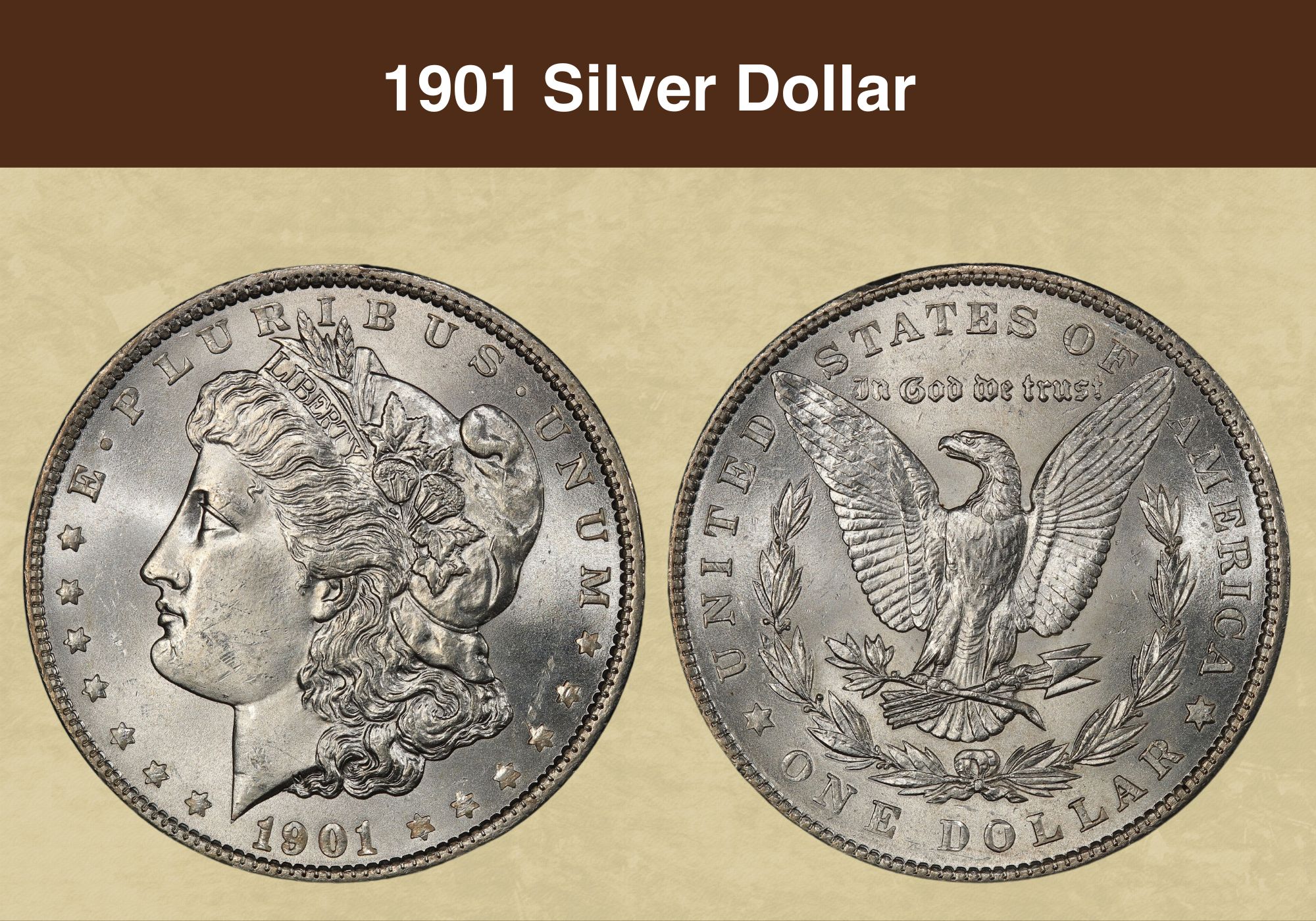
The 1896 Morgan Dollar uses the same George T. Morgan design that ran from 1878 to 1904. Both sides reward a close look, especially if you’re trying to grade or authenticate.
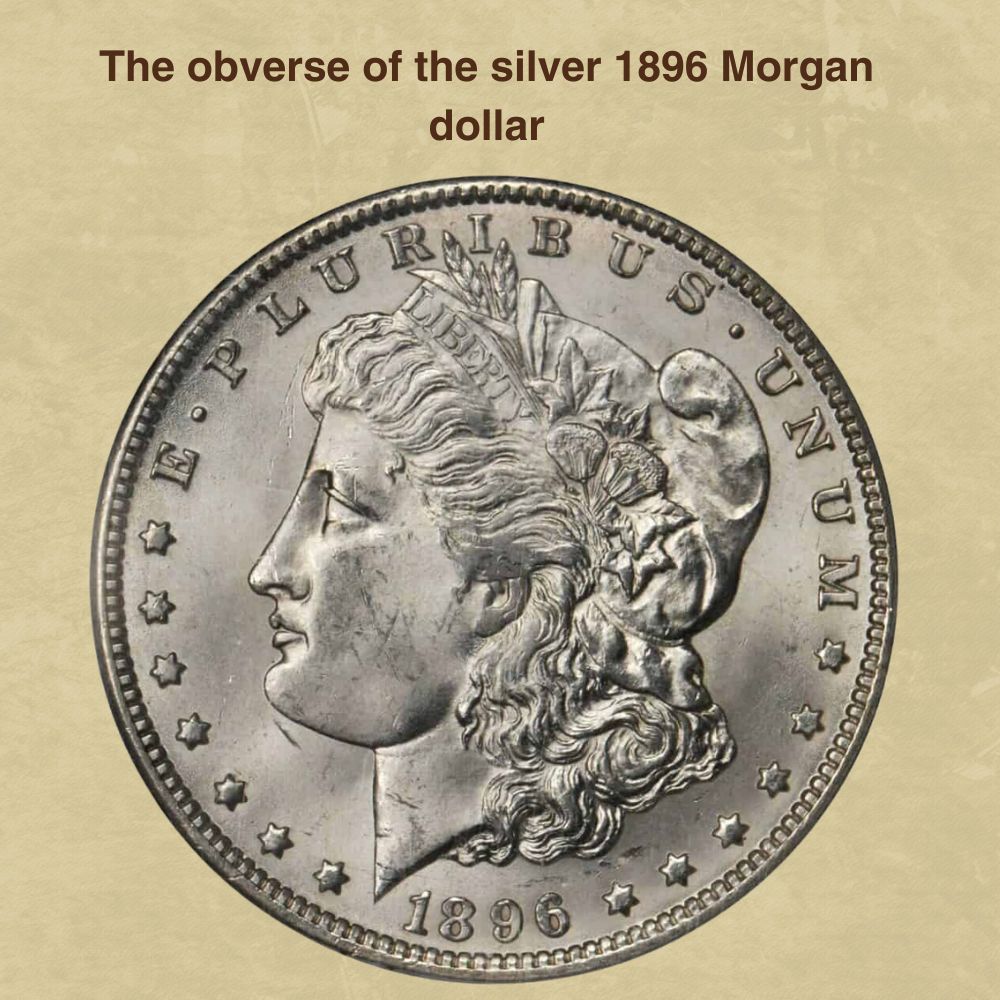
The Obverse Of The 1896 Silver Dollar
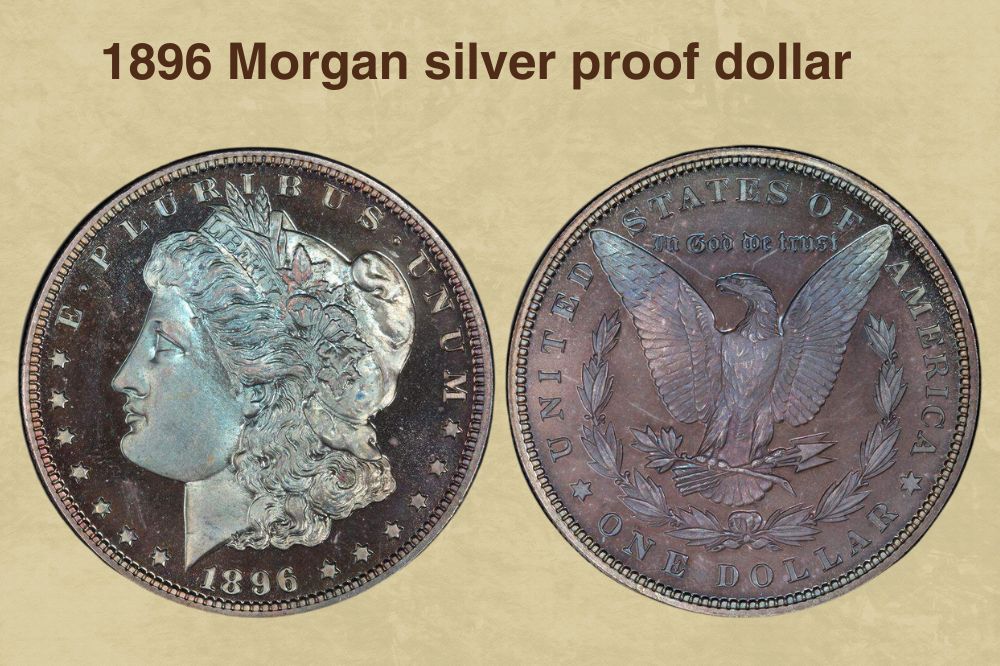
Liberty faces left, her hair curled beneath a Phrygian cap with a “LIBERTY” banner across the front. Small branches of wheat, cotton, and maple sit above the banner.
Morgan used Anna Willess Williams of Philadelphia as his model over five sittings. He called her profile the most perfect he had ever seen. That face ended up on dollar coins for over twenty years.
Around the inside of the rim, you’ll find “E PLURIBUS UNUM” at the top and the date at the bottom. Thirteen small six-pointed stars separate them — seven on the left, six on the right — representing the original colonies. Look directly under Liberty’s neck for Morgan’s initial “M.”
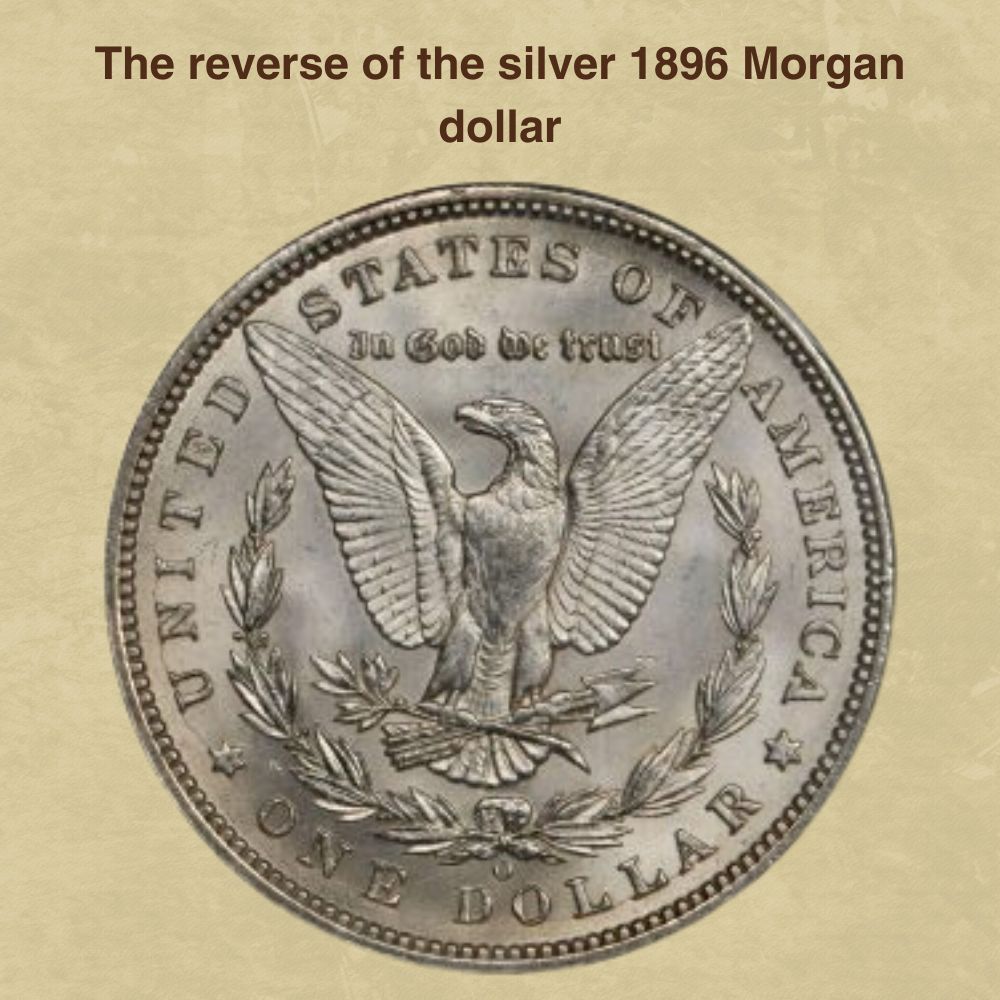
The Reverse Of The 1896 Silver Dollar
Flip it over and you’ll see an eagle with outstretched wings, tips reaching nearly to the rim. The left claw grips three arrows; the right holds a single olive branch. Arrows for defense, olive branch for peace.
“IN GOD WE TRUST” appears above the eagle in a slightly more stylized font than you’d expect. “UNITED STATES OF AMERICA” runs around the upper rim, and “ONE DOLLAR” sits at the bottom, flanked by a single six-sided star on each side.
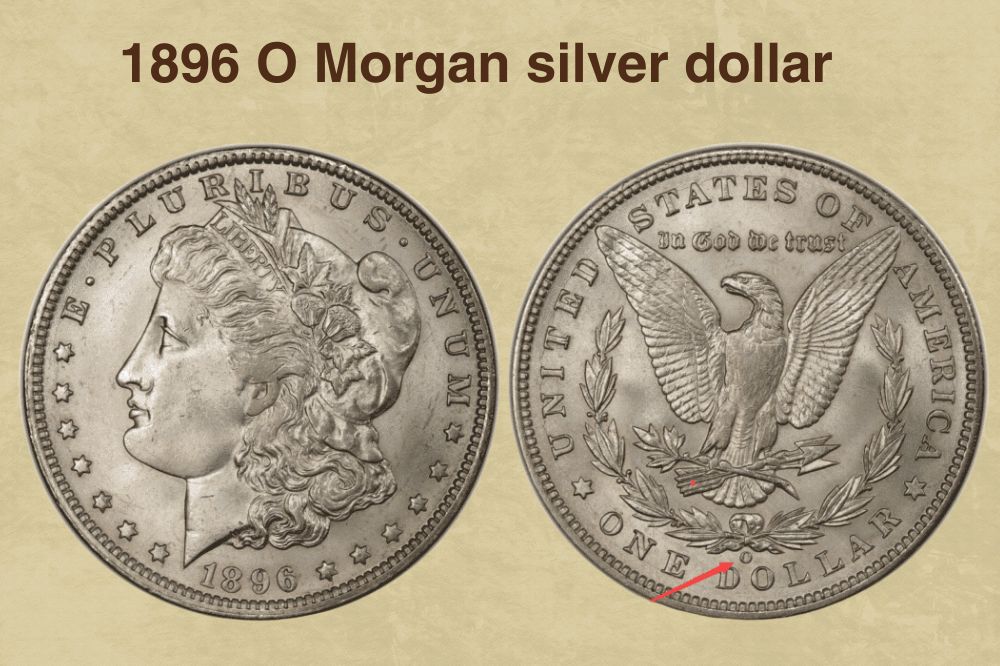
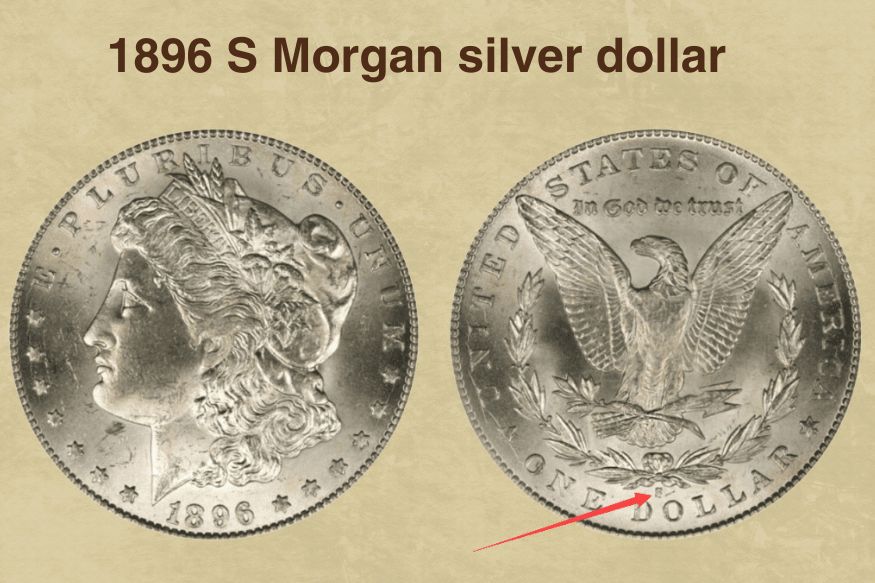
A partial wreath of grain sheaves surrounds the eagle, tied at the bottom with a double-looped ribbon. Check the left loop — Morgan’s “M” is there too, making this one of the few U.S. coins with the designer’s initial on both sides. The mint mark, when present, sits above the “DO” in “DOLLAR.”
Other Features Of The 1896 Silver Dollar
The 1896 Morgan Dollar is 90% silver and 10% copper, weighs 26.73 grams, and measures 38.1 mm across. That works out to 0.7734 troy ounces of pure silver per coin — useful to know when calculating melt value.
The edge is reeded with parallel grooves running around the circumference. Standard for U.S. silver dollars of the era, designed to prevent clipping.
Three mints produced 1896 Morgans: Philadelphia (no mint mark), New Orleans (“O”), and San Francisco (“S”). Same reverse position for the mint mark on all three, but strike quality, surviving populations, and collector value differ enormously between them.
Also Read: Top 80+ Most Valuable Sacagawea Dollar Worth Money (2000-P to Present)
1896 Silver Dollar Mintage & Survival Data
1896 Silver Dollar Mintage & Survival Chart
Survival Distribution
| Type | Mintage | Survival | Survival Rate |
|---|---|---|---|
| No Mint | 9,976,000 | 1,000,000 | 10.0241% |
| O | 4,900,000 | 490,000 | 10% |
| S | 5,000,000 | 500,000 | 10% |
| Proof | 762 | 100 | 13.1234% |
| CAM | 762 | 350 | 45.9318% |
| DCAM | 762 | 200 | 26.2467% |
Philadelphia led production at roughly 9.976 million, with New Orleans at 4.9 million and San Francisco at 5 million. All three circulation strikes share a survival rate around 10%. The Pittman Act of 1918 wiped out huge numbers, and the silver meltings of the 1970s took even more.
To put that in perspective: out of nearly 5 million New Orleans coins, only about 490,000 survive — and the vast majority of those are circulated.
The proof picture is totally different. Only 762 proofs were struck, all at Philadelphia. But collectors saved these carefully from day one. CAM examples survive at around 46%, and DCAM at about 26%. Same year, same denomination, wildly different survival stories depending on what you’re holding.
Also Read: Top 40+ Most Valuable Presidential Dollar Coins Worth Money
The Easy Way to Know Your 1896 Silver Dollar Value
Start with two things: the mint mark and the condition. A common date from a scarcer mint can easily outvalue a tougher date from Philadelphia, so don’t skip that step.
Hold the coin under good lighting and check the highest points first — Liberty’s hair on the obverse, the eagle’s breast feathers on the reverse. Those are the first spots to show wear. Look for original cartwheel luster, bag marks, and any signs of cleaning or damage.
Once you’ve got a handle on the mint mark and condition, the Coin Identifier and Value App can take it further — snap a photo and get an instant AI-powered read on grade and current market value.

1896 Silver Dollar Value Guides
Six categories, each with its own pricing curve:
- 1896 No Mint Mark Silver Dollar — the most accessible 1896 issue, common across all grades
- 1896-O Silver Dollar — affordable in circulated grades, a legendary rarity in Gem condition
- 1896-S Silver Dollar — the key date; scarce and commands premiums across nearly all grades
- 1896 Proof Silver Dollar — rare collector issue with deeply mirrored fields
- 1896 CAM Silver Dollar — proof with frosted devices against reflective fields
- 1896 DCAM Silver Dollar — the most prized proof designation; auction record reached $126,500
Philadelphia circulation strikes are the least expensive, followed by New Orleans, with San Francisco commanding the highest values across grades. For proofs, CAM and DCAM designations reflect the contrast between frosted devices and mirror-like fields — stronger contrast means rarer and more valuable. Proof versions range from $2,200 to $115,000 depending on grade and designation. Each category is broken down below.
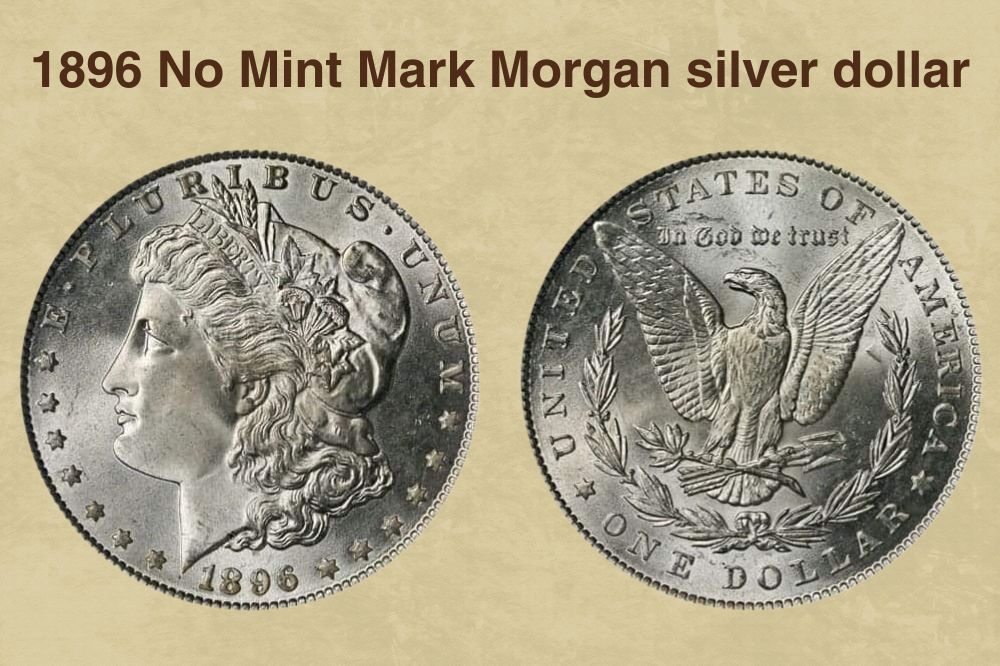
1896 No Mint Mark Silver Dollar Value
If you’re just getting into 1896 Morgans, this is where most people start. Philadelphia coins are everywhere through about MS66. MS67 gets scarce. MS68 is genuinely rare — one hit $30,550 at auction in 2020.
Most examples come well struck but with somewhat muted luster. You want to look for coins with original cartwheel luster and minimal bag marks. Cleaned pieces, even in otherwise strong grades, take a big hit in value.
PL and DMPL designations add real money here. DMPL examples range from $425 to $25,000 depending on grade. If you already own a standard Philly coin and want something more visually impressive from the same date, a DMPL is the natural upgrade.
1896 No Mint Mark Silver Dollar Price/Grade Chart
Price by 1-70 Grade (Latest Auction Records Included)
1896 No Mint Mark Silver Dollar (PL) Price/Grade Chart
Price by 1-70 Grade (Latest Auction Records Included)
1896 No Mint Mark Silver Dollar (DMPL) Price/Grade Chart
Price by 1-70 Grade (Latest Auction Records Included)
Here are past auction results for this issue.
| Date | Platform | Price | Grade |
|---|
The chart below tracks market activity for this coin over the past year.
Market Activity: 1896 No Mint Mark Silver Dollar
1896-O Silver Dollar Value
Here’s a question worth asking: how does a coin with 4.9 million struck become one of the biggest condition rarities in the entire Morgan series? The answer is simple — they all got used.
Circulated 1896-O dollars are cheap and easy to find. An XF45 runs about $125. But above MS62, the population falls off a cliff. In MS65 or better, only an estimated 4 to 8 examples are known. An MS65 is valued around $200,000, and an MS66 sold for $528,000.
The typical 1896-O comes flatly struck with below-average luster. That’s just how New Orleans coins were made this year. Finding one that’s both high-grade and attractive is the real challenge.
One important warning: in 2005, PCGS determined that all 1896-O coins with “Micro o” mint marks are counterfeit. For any Mint State purchase, buy slabbed by PCGS or NGC. No exceptions.
1896-O Silver Dollar Price/Grade Chart
Price by 1-70 Grade (Latest Auction Records Included)
1896-O Silver Dollar (PL) Price/Grade Chart
Price by 1-70 Grade (Latest Auction Records Included)
1896-O Silver Dollar (DMPL) Price/Grade Chart
Price by 1-70 Grade (Latest Auction Records Included)
Every recorded auction sale for the 1896-O, across grades and years, is worth looking at given how sharply prices shift above MS62.

Coin Identifier and Value App
Not sure what your coins are worth? Get Instant Value • Grade • Error Detection with coin identifier and value app (FREE Usage Daily)
| Date | Platform | Price | Grade |
|---|
How this coin has traded over the past twelve months is reflected in the market chart below.
Market Activity: 1896-O Silver Dollar
1896-S Silver Dollar Value
Even a beat-up XF40 will cost you around $500. That tells you everything about where this coin sits in the series. An MS60 starts at approximately $3,100, climbing to $12,000 at MS65.
Strike quality is inconsistent — anywhere from below average to average. But luster is usually excellent. That means eye appeal varies a lot from coin to coin. At higher grades, I think the best examples are genuinely beautiful pieces that reward careful cherrypicking.
The auction record is $720,000 for the sole MS69 known, sold in 2020. Prooflike examples are rare, and DMPL coins are exceedingly rare — most show heavy abrasions. Because of well-documented counterfeiting (fake “S” mint marks added to common Philly coins), buy certified only.
1896-S Silver Dollar Price/Grade Chart
Price by 1-70 Grade (Latest Auction Records Included)
1896-S Silver Dollar (PL) Price/Grade Chart
Price by 1-70 Grade (Latest Auction Records Included)
Given the 1896-S’s position as a key date, its auction history is worth reviewing in full — see below.
| Date | Platform | Price | Grade |
|---|
Price movement for this coin over the past year is captured in the chart that follows.
Market Activity: 1896-S Silver Dollar
1896 Proof Silver Dollar Value
Not all Morgan proofs are created equal. The 1888–1893 proofs are often weakly struck in the centers and frankly unattractive. The 1896–1898 proofs? Among the most beautiful in the entire series. The Philadelphia Mint clearly took extra care with die preparation during this window, and it shows.
Values run from around $2,200 at PR60 up to $17,500 at PR67, with a meaningful jump at each grade level. Surface preservation is everything — proofs pick up hairlines easily, and even light cleaning can drop a coin several grade points.
The highest certified grade is PR68, with seven coins at that level, each valued at approximately $30,000. A handful grade PR69, and those are actively chased by registry set builders. At that point, you’re not just buying a coin — you’re competing for a trophy piece.
1896 Proof Silver Dollar Price/Grade Chart
Price by 1-70 Grade (Latest Auction Records Included)
Auction records reveal how consistently this issue performs across grade levels — the full history is available below.
| Date | Platform | Price | Grade |
|---|
The activity chart that follows shows how collector interest has shifted for this coin over the past twelve months.
Market Activity: 1896 Proof Silver Dollar
1896 CAM Silver Dollar Value
Wayne Miller’s Morgan and Peace Dollar reference put it bluntly: proofs from 1896 to 1898 show the most awesome cameo contrast of any proof Morgans. That’s a direct result of unusually careful die polishing at Philadelphia during this period.
But don’t assume every 1896 proof qualifies for a CAM designation. The coin had to be struck early in the die’s life, before polishing wore the frost away. It’s a premium tier within an already exceptional issue.
CAM examples range from around $2,650 at PR60 to $32,000 at PR67. If there’s a dollar with Deep Cameo in PR69 condition, its value can be reach at $11,500 .
Even within the same numerical grade, contrast strength and evenness vary. The best-looking coins within a grade consistently bring stronger prices at auction.
1896 CAM Silver Dollar Price/Grade Chart
Price by 1-70 Grade (Latest Auction Records Included)
Tracking auction results for CAM-designated proofs is useful given how much surface quality can vary within a single grade.
| Date | Platform | Price | Grade |
|---|
The following bar chart presents current trading momentum and interest trends for this 1896 dollar .
Market Activity: 1896 CAM Silver Dollar
1896 DCAM Silver Dollar Value
Only 200 examples have been graded Deep Cameo from a proof mintage of 762. That’s the number that matters here.
DCAM means the sharpest possible contrast — a stark black-and-white effect between frosted devices and mirror fields. It only happens on the very first strikes from freshly prepared, heavily polished dies. Once striking continues and the dies start to wear, that contrast fades fast.
PR65 DCAM examples typically trade between $10,500 and $13,500. PR66 through PR68 DCAM coins range from $18,500 to $65,000. Each step up represents a noticeably smaller pool of survivors, and prices reflect that directly.
The auction record is $126,500, set in 2006 for the sole PR69 DCAM known. When any DCAM gem surfaces at auction, bidding gets competitive quickly. We think the combination of 1896’s superior die quality and DCAM-level contrast in a certified gem grade is about as good as it gets in the Morgan proof world. If you’re building a complete proof Morgan set by designation, this is the hardest slot to fill.
1896 DCAM Silver Dollar Price/Grade Chart
Price by 1-70 Grade (Latest Auction Records Included)
DCAM examples appear infrequently enough that each auction result adds meaningful context to the market.
| Date | Platform | Price | Grade |
|---|
Shown below is a chart highlighting the market activity of the variety over the past year.
Market Activity: 1896 DCAM Silver Dollar
Also Read: 17 Rare Dollar Coin Errors List with Pictures (By Year)
Rare 1896 Silver Dollar Error List
The 1896 Morgan has several notable die varieties cataloged under the VAM system — named after Leroy Van Allen and A. George Mallis. Over 3,000 VAM varieties exist across the Morgan series, covering everything from die doubling to repunched mint marks.
Most VAMs don’t carry meaningful premiums. But these four do. Some reward patient cherrypicking, and all have earned formal recognition.
1. 1896-S VAM 5 S/S Error
This is a repunched mint mark variety — the “S” was punched into the die more than once, leaving a second impression slightly offset from the first. Under magnification, you can clearly see the secondary “S.”
It’s listed as a Hot 50 Morgan VAM, putting it among the fifty most collectible varieties in the series. Certified AU examples have sold in the $1,425–$2,500 range. Mint State pieces carry a bigger premium on top of the already elevated 1896-S baseline.
Since the 1896-S has a well-documented counterfeiting history, buy any RPM variety certified by PCGS or NGC. The VAM premium depends entirely on confirmed attribution — raw coins won’t command it.
Price by 1-70 Grade (Latest Auction Records Included)1896-S VAM 5 S/S Silver Dollar Price/Grade Chart
2. 1896 VAM 4 Doubled Stars Error
Look at the stars around Liberty’s portrait. On the VAM 4, affected stars appear notched or split under magnification — the result of the hub being applied to the working die with a slight positional shift.
This is a Top 100 variety. It exists across standard business strikes, PL, and DMPL examples, with DMPL being the most sought after. MS64 examples have sold in the $435–$1,125 range at major auction houses.
One thing to watch for: the doubling on VAM 4 is genuine hub doubling, not machine doubling. Machine doubling creates a flat, shelf-like impression and adds zero value. Hub doubling produces a raised, distinct secondary image. Know the difference before you attribute anything as this variety.
Price by 1-70 Grade (Latest Auction Records Included)1896 VAM 4 Doubled Stars Silver Dollar Price/Grade Chart
Price by 1-70 Grade (Latest Auction Records Included)1896 VAM 4 Doubled Stars Silver Dollar (PL) Price/Grade Chart
Price by 1-70 Grade (Latest Auction Records Included)1896 VAM 4 Doubled Stars Silver Dollar (DMPL) Price/Grade Chart
3. 1896 VAM 19 8 in Denticle Error
This is one of the most fun varieties to look for on 1896 Philadelphia coins. Check just below the “8” in the date — you’ll see the top of an extra “8” sitting in two denticle spaces, visible as two raised curved bars. The date also has a mild slant, with the “1” closest to the rim.
What happened? The date punch was positioned too low during die preparation, leaving a partial impression in the denticles before being corrected and repunched in the right spot.
It’s a Top 100 variety. Not terribly hard to find in lower grades, but it gets scarce at MS64 and above. An MS67 sold for $3,360 at auction in 2022 — a solid premium over a standard 1896 Philly dollar in the same grade.
Here’s a cherrypicking tip: on later die state examples, the smaller bar in the adjacent denticle space disappears from die wear. Early die state coins showing both bars are easier to attribute and tend to bring stronger prices.
Price by 1-70 Grade (Latest Auction Records Included)1896 VAM 19 8 in Denticle Silver Dollar Price/Grade Chart
Price by 1-70 Grade (Latest Auction Records Included)1896 VAM 19 8 in Denticle Silver Dollar (PL) Price/Grade Chart

Coin Identifier and Value App
Not sure what your coins are worth? Get Instant Value • Grade • Error Detection with coin identifier and value app (FREE Usage Daily)
Price by 1-70 Grade (Latest Auction Records Included)1896 VAM 19 8 in Denticle Silver Dollar (DMPL) Price/Grade Chart
4. 1896 VAM 20 Bar 6 Error
The VAM 20 “Bar 6” carries Hot 50 status and is listed in the Mega Red 10th edition as one of the MEGARED100. That kind of dual recognition puts it squarely in mainstream collecting, not just specialist VAM circles.
Look inside the lower loop of the “6” in the date. You’ll see a thick curved vertical bar. What caused it? That’s still debated. Most researchers, including Van Allen himself, call it a die gouge. Walter Breen argued it’s a 6/4 overdate. Nobody has settled it definitively, which honestly just adds to the variety’s appeal.
MS64 examples have sold in the $225–$260 range. MS65 coins carry a more meaningful premium. The main challenge is finding a well-struck, original-surface example — those with clear diagnostics and strong eye appeal bring the best money above standard Philly pricing.
Price by 1-70 Grade (Latest Auction Records Included)1896 VAM 20 Bar 6e Silver Dollar Price/Grade Chart
Where To Sell Your 1896 Silver Dollar?
The right venue depends on what you have. A circulated Philadelphia example and a certified 1896-S MS65 belong in very different markets — one suits online platforms, the other a specialist auction house. Matching your coin to the right buyer makes a real difference in what you walk away with.
Check out now: Best Places To Sell Coins Online (Pros & Cons)
1896 Silver Dollar Market Trend
Market Interest Trend Chart - 1896 Silver Dollar
*Market Trend Chart showing the number of people paying attention to this coin.
FAQ About The 1896 Silver Dollar
1. How much is a 1896 Silver Dollar worth?
It depends on the mint mark and condition. A circulated no-mint-mark Philadelphia example starts around $84 in Good condition. The same grade from San Francisco also starts at $84 but jumps to $1,675 in AU and $35,005 in Mint State.
At the top end, an 1896-S graded MS69 sold for $720,000 in 2020, and an 1896-O in MS66 realized $528,000. Proof issues range from around $2,200 at PR60 up to $30,000 for PR68, with DCAM versions reaching $126,500 for the finest known.
2. How do I find the mint mark on my 1896 Silver Dollar?
Flip to the reverse and look just above the letters “DO” in “DOLLAR,” right below the eagle and wreath. An “O” means New Orleans. An “S” means San Francisco. No letter at all means Philadelphia.
The mint mark is small. A loupe or magnifying glass helps, especially on circulated coins where wear may have softened the detail.
3. What is the rarest 1896 Silver Dollar?
Among circulation strikes, the 1896-O in gem Mint State is the rarest — only an estimated 4 to 8 examples are known in MS65 or better. Despite a mintage of 4.9 million coins, nearly all entered circulation and surviving uncirculated examples are typically weakly struck with poor luster.
Among proof issues, the 1896 DCAM is the hardest to find, with only 200 estimated survivors and just one example known at DCAM PR69, which sold for $126,500 in 2006. The 1896-S is the key date among circulation strikes, with an MS69 being the sole example at that grade level.
4. What does “no mint mark” mean on a 1896 Silver Dollar?
It means Philadelphia. The main U.S. Mint didn’t use a “P” mint mark during this era — no letter is the identifier.
With nearly 9.976 million struck, it’s the most common 1896 variety. Easy to find in all circulated grades and even lower Mint State grades.
5. Is a 1896-O Silver Dollar worth more than a Philadelphia coin?
In circulated grades, the gap is modest. Both start around $84 in Good condition, though an XF45 New Orleans coin runs about double the Philadelphia equivalent at roughly $125.
The real difference shows up in Mint State. An MS65 1896-O is valued at approximately $200,000, compared to a few hundred dollars for the same grade from Philadelphia. New Orleans coins from this year are almost always flatly struck with poor luster, so problem-free Mint State examples are exceedingly scarce.
6. What is a VAM variety on a 1896 Silver Dollar, and is it worth more?
VAM stands for Van Allen-Mallis, after the two researchers who cataloged die varieties across the Morgan and Peace dollar series. A VAM variety is a specific die pairing with diagnostic features — doubled elements, repunched mint marks, misplaced digits — that repeat on every coin struck from that die.
For 1896, the big ones are VAM 4 Doubled Stars (Top 100), VAM 19 8 in Denticle (Top 100), VAM 20 Bar 6 (Hot 50 and MEGARED100), and the 1896-S VAM 5 S/S (Hot 50). Certified examples carry premiums — a VAM 19 MS67 sold for $3,360 in 2022 versus a much lower price for a non-variety coin in the same grade.
7. How can I tell if my 1896 Silver Dollar has been cleaned?
Hold the coin under angled lighting and look for fine parallel scratches across the flat fields. Those are hairlines from wiping or polishing. A cleaned coin often looks unnaturally bright and lacks the soft toning that builds naturally in recessed areas around the design.
PCGS and NGC classify cleaning as damage and assign a “Details” grade instead of a numerical one. A cleaned coin can lose 50 to 90 percent of its collector value compared to an original-surface example at the same grade level.
8. What is the difference between a Proof, CAM, and DCAM 1896 Silver Dollar?
All three come from the same proof mintage of 762 coins struck at Philadelphia in 1896. The difference is visual contrast. A standard Proof has deeply mirrored fields but no significant frosting on the devices. A CAM (Cameo) shows frosted devices against mirrored fields — a two-tone effect.
A DCAM (Deep Cameo) is the sharpest contrast — stark black-and-white, achieved only on the very first strikes from freshly polished dies. DCAM coins are the rarest and most valuable, with only an estimated 200 survivors and PR65 DCAM examples valued between $10,500 and $13,500.
9. Should I get my 1896 Silver Dollar graded by PCGS or NGC?
Professional grading makes sense once a coin is likely worth $200 or more slabbed, since fees typically run $30 to $50 per coin.
For the 1896 issue specifically, certification is strongly recommended for any 1896-S — the date has well-documented counterfeiting involving fake “S” mint marks added to common Philadelphia coins. For VAM varieties like the VAM 4, VAM 19, VAM 20, and 1896-S VAM 5, certification with VAM attribution is the market standard. An unattributed raw VAM coin won’t reliably command its premium.
10. What survival rate does the 1896 Silver Dollar have?
The three circulation strikes — Philadelphia, New Orleans, and San Francisco — each carry a survival rate of approximately 10%. Philadelphia has an estimated 1,000,000 survivors from a mintage of 9,976,000, while New Orleans and San Francisco have around 490,000 and 500,000 respectively.
Proof survival rates are much higher thanks to deliberate collector preservation. CAM examples survive at around 46% of their mintage, and DCAM at approximately 26%. The big losses came from the Pittman Act of 1918, which authorized melting millions of silver dollars, and from additional silver meltings in the 1970s when bullion prices spiked.