1901 Silver Dollar Coin Value: Errors List, “O”, “S” & No Mint Mark Worth
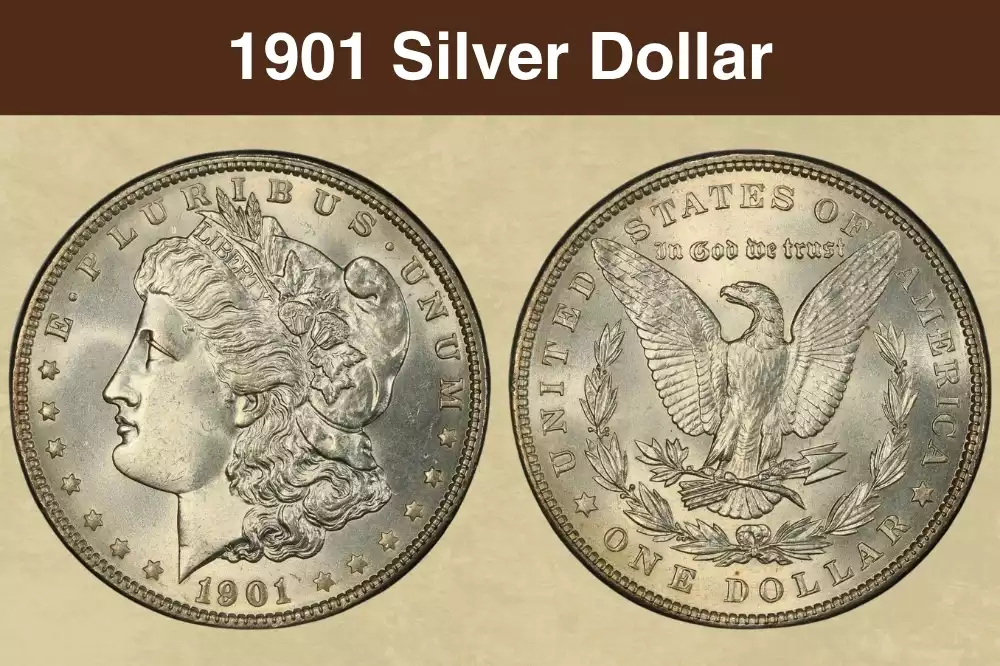
1901 Silver Dollar value ranges from $1.00 face value to $720,000. That record was set by a PCGS MS-66 example sold at Stack’s Bowers in September 2025 — the single finest known specimen of this date. Yours could be worth anywhere in between, so upload your coin photo below for a quick value range. Then scroll down to see what 1901 Silver Dollars are actually selling for on eBay right now.
1901 Silver Dollar Value Checker
Identify 1901 Silver Dollar O, S and No Mint Mark Price
Front Obverse
Upload or Take a Photo
Back Reverse
Upload or Take a Photo
1901 Silver Dollar Value By Variety
Which coin you actually have matters more here than almost any other Morgan date. The value gaps between mint marks are enormous. If you already know the grade, jump to the Value Guides section for exact pricing.
| Type | Good(G4-6) | Fine(F12-15) | AU(AU50-58) | MS(MS60-70) | PR(PR60-70) |
|---|---|---|---|---|---|
| ▶1901 No Mint Mark Dollar Value | $84 | $84 | $430 - $1,650 | $4,600 - $667,000 | — |
| ▶1901 No Mint Mark Dollar (PL) Value | $1,250 - $1,470 | $2,400 - $2,830 | $8,830 - $14,300 | $18,400 - $36,800 | — |
| ▶1901 No Mint Mark Dollar (DMPL) Value | $1,410 - $1,660 | $2,700 - $3,180 | $9,940 - $16,100 | $20,700 - $37,700 | — |
| ▶1901 O Silver Dollar Value | $84 | $84 | $86 | $87 - $69,000 | — |
| ▶1901 O Silver Dollar (PL) Value | $8 - $9 | $15 - $18 | $57 - $93 | $120 - $20,700 | — |
| ▶1901 O Silver Dollar (DMPL) Value | $10 - $11 | $19 - $23 | $71 - $110 | $150 - $11,500 | — |
| ▶1901 S Silver Dollar Value | $84 | $84 | $320 - $620 | $660 - $29,900 | — |
| ▶1901 S Silver Dollar (PL) Value | $56 - $66 | $100 - $120 | $390 - $640 | $820 - $10,500 | — |
| ▶1901 S Silver Dollar (DMPL) Value | $78 - $92 | $150 - $170 | $550 - $890 | $1,150 - $41,400 | — |
| ▶1901 Proof Silver Dollar Value | — | — | — | — | $2,200 - $43,700 |
| ▶1901 CAM Silver Dollar Value | — | — | — | — | $2,480 - $59,800 |


Also Read: Top 100 Rarest Silver Dollar Coins Worth Money (Most Expensive)
Top 10 Most Valuable 1901 Silver Dollar Worth Money
Most Valuable 1901 Silver Dollar Chart
2004 - Present
The $720,000 MS-66 and $288,000 MS-65 sit at the top of a near-vertical price cliff. At the gem level, the 1901 Philadelphia strike is one of the toughest condition rarities in the entire Morgan series. PCGS has certified only single-digit examples in MS-65 and above. Supply is basically fixed, so prices respond to who’s in the auction room, not what silver is doing.
Below MS-65, the market works completely differently. Notice the VAM-3 Shifted Eagle DDR at MS-62 hitting $72,000 — that’s more than the MS-64 base coin at $58,750. A well-documented die variety with strong collector demand can blow right past the normal grade hierarchy.
The 1901-O MS-68 at $55,813 and 1901-S MS-67 at $42,300 show that even the branch mints get genuinely scarce at the top of the grading scale. Those prices aren’t flukes.
History of The 1901 Silver Dollar
By 1901, the Morgan Dollar was winding down. Production that year ran under both the Bland-Allison Act and the Sherman Silver Purchase Act of 1890, with coins struck at Philadelphia, New Orleans, and San Francisco. Combined output topped 22 million pieces, though the Philadelphia issue — just under 7 million — would prove the most consequential for collectors.
Here’s a fun detail: the coin’s designer, George T. Morgan, modeled Liberty after a Philadelphia schoolteacher named Anna Willess Williams. She reportedly hated the attention it brought her.
Production stopped entirely in 1904 when silver supplies dried up. Then the Pittman Act of 1918 sealed the 1901’s fate. Over 230 million silver dollars sitting in government vaults were melted to supply silver to Britain during World War I. Huge numbers of 1901 Philadelphia coins that had never seen a cash register were almost certainly destroyed, turning a routine-looking mintage into one of the scarcest Mint State survivors in the whole Morgan series.
Also Read: Top 100 Most Valuable Morgan Silver Dollar Coins Worth Money List
Is Your 1901 Silver Dollar Rare?
1901 No Mint Mark Dollar Value
1901 No Mint Mark Dollar (PL) Value
1901 No Mint Mark Dollar (DMPL) Value
1901 O Silver Dollar Value
1901 O Silver Dollar (PL) Value
1901 O Silver Dollar (DMPL) Value
1901 S Silver Dollar Value
1901 S Silver Dollar (PL) Value
1901 S Silver Dollar (DMPL) Value
1901 Proof Silver Dollar Value
1901 CAM Silver Dollar Value
The tricky part with 1901 Silver Dollars is that mint mark, surface type, and grade all stack on top of each other. A Philadelphia coin in VF-30 and a New Orleans coin in VF-30 live in completely different price universes. PL and DMPL designations add another multiplier most people don’t expect. That’s exactly where the Coin Identifier and Value App comes in.
Key Features of The 1901 Silver Dollar
Before you worry about grading, spend a minute just looking at the coin. The details tell you a lot.
The Obverse Of The 1901 Silver Dollar

Liberty faces left, wearing a coronet inscribed “LIBERTY.” Thirteen stars frame the portrait — seven left, six right — with 1901 below. Look for Morgan’s initial “M” at the truncation of the neck. On heavily circulated pieces, it’s often worn flat, which gives you a quick read on overall wear.
The high points of Liberty’s hair above the ear and her cheek show wear first. On a well-preserved coin, you’ll see fine individual hair strands still fully defined in those zones. If they’re mushy, you’re looking at a lower grade — or possibly just a weak strike, which is common on this date.
The Reverse Of The 1901 Silver Dollar

Flip it over. You’ll see a heraldic eagle with outstretched wings, clutching arrows and an olive branch, encircled by “UNITED STATES OF AMERICA” and “ONE DOLLAR.”
The eagle’s breast feathers are your main wear checkpoint on this side. Here’s the catch: on weakly struck 1901 Philadelphia coins, those feathers can look flat even on a coin that never circulated. Learning to tell strike weakness from actual wear is critical with this date.
Look for the mint mark below the wreath, directly above the letters “DO” in “DOLLAR.” That tiny detail is the difference between a $50 coin and a potential five-figure one.
Other Features Of The 1901 Silver Dollar
At 38.10 mm in diameter and 26.73 grams, this is a hefty coin. It’s 90% silver with a reeded edge. That edge is actually one of your best authentication checkpoints — counterfeits often have filed or smoothed edges that feel wrong the moment you roll the coin between your fingers.
Also Read: Top 80+ Most Valuable Sacagawea Dollar Worth Money (2000-P to Present)
1901 Silver Dollar Mintage & Survival Data
1901 Silver Dollar Mintage & Survival Chart
Survival Distribution
Type Mintage Survival Survival Rate No Mint 6,962,000 696,900 10.0101% O 13,320,000 1,332,000 10% S 2,284,000 228,000 9.9825% Proof 813 495 60.8856% CAM 813 150 18.4502%
All three circulation strikes show survival rates clustering around 10%. The Pittman Act melt and decades of heavy use wiped out roughly nine out of every ten coins struck.
But those similar-looking percentages hide very different realities. New Orleans had nearly double Philadelphia’s mintage, so its survivor pool skews heavily toward circulated grades. San Francisco had the lowest output of the three, meaning its roughly 228,000 survivors are spread much thinner across both circulated and Mint State — that’s why high-grade S-mint coins carry such steep premiums.
The proof numbers tell the starkest story. From 813 originally struck, about 60.9% of standard proofs survived — roughly 495 coins. The CAM subset? Only 18.5% made it, leaving around 150 confirmed survivors. That’s fewer coins than you’d find at a decent-sized coin show. When one comes to auction, expect a fight.
Also Read: Top 40+ Most Valuable Presidential Dollar Coins Worth Money
The Easy Way to Know Your 1901 Silver Dollar Value
Most people see a silver coin from 1901. What you’re actually holding is a stack of variables, and each one can swing the price dramatically.
Start with the mint mark. For this date, location matters more than almost any other Morgan. A Philadelphia coin and a New Orleans “O” can look identical in circulated grades but sit in totally different price brackets.
Surface quality trips up a lot of people. Can you tell the difference between a standard strike, a proof-like, and a deep mirror proof-like? Without knowing what reflective fields and frosted devices look like, you can’t — and that distinction alone can separate a four-figure coin from a five-figure one.
Then there’s strike weakness. On the 1901-P, a coin grading MS-63 and one that looks worn can share nearly identical detail. The difference is luster and the integrity of the original skin.
The Coin Identifier and Value App bridges exactly this gap, delivering a research-backed estimate the moment identification is complete.

1901 Silver Dollar Value Guides
Five distinct categories exist for the 1901 Morgan Dollar. Each one has its own rarity profile and price structure.
- 1901 No Mint Mark Silver Dollar (Philadelphia)
- 1901-O Silver Dollar (New Orleans)
- 1901-S Silver Dollar (San Francisco)
- 1901 Proof Silver Dollar
- 1901 CAM Silver Dollar
1901 No Mint Mark Silver Dollar Value

Nearly 7 million struck. Barely any survive in Mint State. Aside from the legendary 1895, the 1901-P is the rarest Philadelphia Morgan in uncirculated grades — and nothing about its mintage hints at that. Most coins went straight into circulation, and possibly around 5,000,000 were melted under the 1918 Pittman Act.
The survivors that do exist are mostly plagued by soft strikes — the kind of mushy detail you’d normally associate with New Orleans coins. A sharply defined, lustrous example is genuinely exceptional. Watch out for fakes, too. People have been known to remove the O or S mint mark from branch mint coins to pass them off as Philadelphia issues. Third-party certification by PCGS or NGC is non-negotiable for any serious purchase.
In August 2025, the finest known example — graded MS-66 (PCGS) CMQ — brought $720,000 at Stack’s Bowers Galleries.
1901 No Mint Mark Silver Dollar Price/Grade Chart
Price by 1-70 Grade (Latest Auction Records Included)
1901 No Mint Mark Silver Dollar (PL) Price/Grade Chart
Price by 1-70 Grade (Latest Auction Records Included)
Coin Identifier and Value App
Not sure what your coins are worth? Get Instant Value • Grade • Error Detection with coin identifier and value app (FREE Usage Daily)
1901 No Mint Mark Silver Dollar (DMPL) Price/Grade Chart
Price by 1-70 Grade (Latest Auction Records Included)
The following auction record chart captures the price history of this date’s most significant realized sales.
Date Platform Price Grade 04/25 SB $720 50 04/25 SB $360 53 04/25 SB $552 55 04/25 SB $1,320 58 02/25 SB $360 53 02/25 SB $528 55 02/25 SB $504 55 02/25 SB $600 55 02/25 SB $480 55 02/25 SB $1,110 58
Below, the market activity data shows how rarely this coin actually changes hands at the highest grade levels.
Market Activity: 1901 No Mint Mark Silver Dollar
Market activity score: 81/100 as of Oct 2026 — down 2 points from Jul 2026. 12-month peak: 83 (Sep 2026).
1901-O Silver Dollar Value

Think the 1901-O is rare? In October 1962, the Treasury Department cracked open its vaults and released many thousands of them. Overnight, a coin that had been tough to find in uncirculated condition became one of the most common Morgans on the market.
Today, circulated examples are dirt cheap by Morgan standards. The real money is at the top of the Mint State range, where inconsistent strike quality limits how many coins can reach gem status. PL and DMPL pieces carry strong premiums, especially in MS-65 and above where they become genuine condition rarities.
The auction record is $55,812.50 for a PCGS MS-68 example sold at Legend Rare Coin Auctions in October 2015. That price shows you how dramatically value concentrates at the very top of the grading scale, even for an otherwise common date.
1901-O Silver Dollar Price/Grade Chart
Price by 1-70 Grade (Latest Auction Records Included)
1901-O Silver Dollar (PL) Price/Grade Chart
Price by 1-70 Grade (Latest Auction Records Included)
1901-O Silver Dollar (DMPL) Price/Grade Chart
Price by 1-70 Grade (Latest Auction Records Included)
The auction record chart below tracks realized prices across grade levels, illustrating the sharp premium cliff that emerges above MS-65.
If you want a 1901 Morgan that’s genuinely uncommon in every grade — not just Mint State — the S-mint is your coin. Unlike the Philadelphia issue, which concentrates its rarity almost entirely in uncirculated condition, the 1901-S is scarce even in well-worn grades. That gives it a smoother, more consistent price curve. Most entered circulation on the West Coast. PCGS estimates only 30,000 survive in MS-60 or better and just 1,000 in MS-65 or better. PL and DMPL examples are considerably rarer than standard strikes, with values typically set by individual auction results rather than any published price guide. The auction record is $42,300 for a PCGS MS-67 example sold at Heritage Auctions in March 2015. For collectors building a complete 1901 date set, the S-mint is the most realistic starting point — but you’ll still need patience above MS-65. Price by 1-70 Grade (Latest Auction Records Included) Price by 1-70 Grade (Latest Auction Records Included) Price by 1-70 Grade (Latest Auction Records Included) The chart below documents realized auction prices for the 1901-S, showing a steeper and more consistent price curve compared to the New Orleans issue. Market activity for the 1901-S reflects steady collector demand from last July. Only 813 made. These were never meant for commerce. Back in 1901, collectors who wanted a Morgan for their albums bought proofs because the business strikes didn’t seem special. Nobody realized the circulation strikes would become so rare in Mint State. Once that became common knowledge, demand for the proof issue grew as a (still expensive) alternative. Strike quality on 1901 proofs generally beats the business strikes. Most show medium cameo contrast, though bold contrast is tough to find on this date. Values climb steadily through PR-60 to PR-66, then jump sharply at PR-67 and above where population reports confirm only a handful of slabbed examples. The auction record for a standard proof is $31,200 for a PR-68 example sold by Heritage Auctions in February 2021. Price by 1-70 Grade (Latest Auction Records Included) The auction record chart for the 1901 Proof traces a steadily ascending price history, anchored by a small but consistent pool of collector demand at every grade level. Market activity for the 1901 Proof Silver Dollar is more active than its tiny surviving population might suggest. How rare is roughly 150 surviving coins? That’s the estimated population for the 1901 CAM — the most rarefied tier of the entire 1901 issue. Drawn from the same 813-piece proof run, only those showing pronounced contrast between frosted devices and reflective fields earn the Cameo designation. Finding one with strong, undisturbed contrast is genuinely difficult. The cameo effect is not often bold for this date, so any proof with strong contrast and eye appeal is a keeper. I think the 1901 CAM at PR-66 or above is one of the most challenging and rewarding acquisitions in all of Morgan proof coinage. The auction record is $57,500 for a PR-68 CAM example sold at Heritage Auctions in January 2008. That number hasn’t been topped since, partly because coins at that level almost never come to market. Price by 1-70 Grade (Latest Auction Records Included) The auction record chart below captures the historical price points for certified CAM examples — a sparse but telling dataset given how rarely these coins appear. Among all Proof Morgan subcategories, trading activity for the 1901 CAM is notably sluggish. Also Read: 17 Rare Dollar Coin Errors List with Pictures (By Year) The 1901 Morgan has a handful of recognized errors. Since they’re scarce, collectors will pay serious money to land one. This is the big one. The VAM-3 “Shifted Eagle” shows dramatic doubling you can spot without a loupe — pronounced doubling on the eagle’s tail, legs, and wings, plus the bottoms of the olive branch and arrows. A hub-to-die misalignment during an early impression caused the whole thing. It’s a VAM Top 100 variety, placing it among the most significant die varieties in the entire Morgan series. Finding one in Mint State is a completely different kind of rare — the 1901-P is already tough uncirculated, so everything had to go right for a Shifted Eagle to survive in high grade. The auction record is $43,200 for an MS-61 example sold at Heritage Auctions in January 2023. Think about that — MS-61 is a modest grade on any other date, yet it brought five figures here. Even circulated examples with clear attribution trade well above typical 1901-P values. Price by 1-70 Grade (Latest Auction Records Included) Coin Identifier and Value App Not sure what your coins are worth? Get Instant Value • Grade • Error Detection with coin identifier and value app (FREE Usage Daily) Here’s a cherrypicking opportunity. The DDO shows visible doubling on Liberty’s ear, cataloged under the VAM attribution system by Leroy Van Allen and George Mallis. It’s subtler than the Shifted Eagle — the doubling concentrates at the ear rather than spreading across the whole reverse — so it gets overlooked on raw coins all the time. The market still takes it seriously. PCGS records indicate the most expensive 1901 silver dollar VAM doubled ear error was graded MS-61 and auctioned for $9,000 in 2020. In circulated grades, properly attributed examples still pull a meaningful premium over standard 1901-P coins. As with all VAM varieties on this date, you need third-party certification with explicit attribution. No serious buyer will pay up for a raw example. Price by 1-70 Grade (Latest Auction Records Included) Most collectors walk right past this one. The VAM-7 doesn’t have Top 100 status like the Shifted Eagle, so it flies under the radar. Look at the arrows clutched in the eagle’s talon — you’ll see a raised, distinct secondary image on the arrowheads. That’s genuine hub doubling, not the flat, shelf-like look of machine doubling (which carries zero premium). The lower profile actually works in your favor. Prices are more accessible, making this a realistic pickup for anyone building a variety set of the 1901 issue. The PCGS auction record for the VAM-7 Doubled Arrows stands at $826 for an AU-55 example sold on eBay in April 2012. Without third-party certification and explicit VAM attribution, the premium disappears entirely. Price by 1-70 Grade (Latest Auction Records Included) A rotated die error happens when one die is twisted relative to the other during striking. On a normal Morgan, flip the coin on its vertical axis and both sides line up at 180 degrees. Any measurable deviation means you’ve got a rotated die. How much rotation matters a lot. A few degrees off? Small premium. Approaching 90 or 180 degrees? That’s where serious money comes in. Make sure you can distinguish genuine rotation from post-mint damage — and don’t confuse this with machine doubling, which produces a flat, shelf-like look and carries no premium. On the 1901 specifically, any rotated die coin with confirmed third-party attribution sits in a sweet spot where collector demand reliably outpaces supply, given the date’s already limited survivor pool in problem-free condition. With your coins’ value established, finding reliable online selling venues becomes the priority. I’ve created a comprehensive overview of trusted sites, highlighting their offerings, advantages, and potential drawbacks. Check out now: Best Places To Sell Coins Online (Pros & Cons) *Market Trend Chart showing the number of people paying attention to this coin. Nearly 7 million were struck, but most either circulated hard or got melted under the 1918 Pittman Act. Certified Mint State examples are extraordinarily scarce — gems have sold for six figures, while the same coin with wear might bring under $200. The Philadelphia issue is the clear standout rarity of the 1901 date. Check the reverse directly above the letters “DO” in DOLLAR under good magnification and proper lighting. A genuine Philadelphia coin shows no mark and no tooling signs. Removed mint marks leave faint traces — slightly different texture, flattening, or unusual smoothness compared to the surrounding field. If you suspect alteration, submit it to PCGS or NGC before buying or selling. Absolutely. Thanks to the massive Treasury release in October 1962, circulated 1901-O Morgans are among the most affordable in the series. A decent circulated example won’t break the bank. Just know that strike quality on New Orleans coins is all over the place, so eye appeal varies a lot even within the same grade. PL and DMPL coins were struck from specially prepared dies that created mirror-like fields. These surfaces are far rarer than standard strikes and visually distinctive, which makes them highly desirable. On the 1901-P specifically, DMPL examples are so scarce that only a handful were documented as recently as the 1980s. VAM stands for Van Allen-Mallis — the two researchers who cataloged die varieties across the Morgan and Peace dollar series. Each VAM number identifies a specific die pairing with unique traits like doubled elements or repositioned letters. On the 1901, VAM attribution can massively boost value: the VAM-3 Shifted Eagle has sold for over $70,000 at MS-62, far beyond what a standard 1901-P brings at that grade. The 1901-P is notorious for soft strikes. The dies often failed to bring up fine detail, especially on Liberty’s hair above the ear and the eagle’s breast feathers. This can make an uncirculated coin look worn. The key is luster: a weakly struck but uncirculated coin keeps its original cartwheel luster, while a circulated coin shows luster breaks at the high points. Misreading strike weakness as wear is one of the costliest mistakes you can make with this date. Only 813 were struck. Because collectors handled them carefully, about 60% survived — roughly 495 pieces. The Cameo subset is far rarer at around 150 survivors. These coins never saw circulation and mostly passed through careful hands. Never. Cleaning permanently damages the surface and is immediately detectable. PCGS and NGC assign “Details” grades to cleaned coins, which tanks market value and liquidity. An original coin with light toning will almost always be worth more than a cleaned one at the same apparent condition. Leave it alone and let the grading service assess it as-is. For heavily worn examples, melt value sets a floor — each coin contains 0.7734 troy ounces of pure silver. But for any 1901-P in AU or Mint State, collector demand so far exceeds melt value that silver price swings are basically irrelevant. A coin worth $50,000 to a collector isn’t going to trade at melt because silver dropped five dollars an ounce. Only buy slabbed examples certified by PCGS or NGC. Raw 1901-P coins in apparent high grades are a known target for counterfeiters — the most common fraud involves removing the O or S mint mark from a branch mint coin. A certified slab confirms authenticity and grade, and gives you liquidity since serious buyers and auction houses won’t pay premium prices for unattributed raw examples. For coins valued above a few hundred dollars, the certification cost is trivial compared to the protection.Date Platform Price Grade 04/25 SB $456 66 02/25 SB $105 64 02/25 SB $145 64 01/25 SB $168 65 12/24 SB $145 65 11/24 SB $65 61 11/24 SB $96 64 11/24 SB $120 65 11/24 SB $144 65 11/24 SB $125 65 1901-S Silver Dollar Value

1901-S Silver Dollar Price/Grade Chart
1901-S Silver Dollar (PL) Price/Grade Chart
1901-S Silver Dollar (DMPL) Price/Grade Chart
Date Platform Price Grade 01/25 SB $168 45 12/24 SB $360 55 11/24 SB $264 50 11/24 SB $312 53 11/24 SB $360 55 04/24 SB $360 55 04/24 SB $576 58 08/23 SB $144 40 08/23 SB $408 55 07/23 SB $264 50 Market Activity: 1901-S Silver Dollar
Market activity score: 86/100 as of Oct 2026 — up 5 points from Jul 2026. Currently at its 12-month peak.
1901 Proof Silver Dollar Value

1901 Proof Silver Dollar Price/Grade Chart
Date Platform Price Grade 08/99 HA $10,925 67 07/26 HA $4,026 62 06/26 SB $12,200 66 07/25 HA $3,600 62 06/25 SB $4,800 64 05/25 SB $1,440 55 04/25 SB $4,320 64 04/25 HA $3,240 63 04/25 HA $3,960 64 11/24 SB $3,120 62 Market Activity: 1901 Proof Silver Dollar
Market activity score: 73/100 as of Oct 2026 — up 30 points from Jul 2026. Currently at its 12-month peak.
1901 CAM Silver Dollar Value

1901 CAM Silver Dollar Price/Grade Chart
Date Platform Price Grade 01/26 HA $31,720 66 11/24 SB $18,000 67 05/23 HA $6,900 65 12/22 HA $10,500 67 07/22 HA $22,800 66 04/22 DL $8,500 65 01/22 HA $12,600 67 01/22 LM $31,725 67 11/21 SB $7,800 65 06/21 HA $13,200 67 Market Activity: 1901 CAM Silver Dollar
Market activity score: 57/100 as of Oct 2026 — up 19 points from Jul 2026. 12-month peak: 60 (Aug 2026).
Rare 1901 Silver Dollar Error List
1. 1901 Doubled Die Reverse (DDR)

1901 Doubled Die Reverse (DDR) Silver Dollar Price/Grade Chart
2. 1901 Doubled Die Obverse (DDO)

1901 Doubled Die Obverse (DDO) Silver Dollar Price/Grade Chart
3. 1901 VAM-7 Doubled Arrows

1901 VAM-7 Doubled Arrows Silver Dollar Price/Grade Chart
4. 1901 Rotated Die Error
Where to Sell Your 1901 Silver Dollar?
1901 Silver Dollar Market Trend
Market Interest Trend Chart - 1901 Silver Dollar
Market interest: 5,450 collectors tracking this coin as of Oct 2026 — up 1,000 from Mar 2026. Currently at its 12-month peak.
FAQ about 1901 Silver Dollar
1. What makes the 1901 Philadelphia Morgan Dollar so valuable compared to other Morgan dollars from the same year?
2. How do I know if my 1901 dollar has no mint mark or if the mint mark was removed?
3. Is the 1901-O Morgan Dollar a good coin for a beginning collector?
4. Why do proof-like and deep mirror proof-like versions of the 1901 Morgan dollar cost so much more than regular strikes?
5. What is the VAM system and why does it matter for 1901 silver dollars?
6. How does strike weakness affect grading on the 1901 Morgan dollar?
7. What happened to most of the 1901 proof Morgan dollars, and how many survive today?
8. Should I clean my 1901 Morgan dollar before having it graded?
9. Does the current silver price significantly affect the value of a 1901 Morgan dollar?
10.What is the safest way to buy a high-grade 1901 Morgan dollar?