1996 Penny Coin Value: Errors List, “D”, “S” & No Mint Mark Worth

1996 Penny value ranges from $0.01 face value to $3,565. That record was set by a Grade 69 example sold through Bowers & Merena in November 2008. Upload a photo of yours below and we’ll give you a quick value range. You can also scroll down to check recent eBay sales and see what collectors are paying today.
1996 Penny Value Checker
Identify 1996 Penny D, S and No Mint Mark Price
Front Obverse
Upload or Take a Photo
Back Reverse
Upload or Take a Photo
1996 Penny Value By Variety
Here’s what 1996 pennies are selling for right now across grades and mint marks. If you already know your coin’s grade, jump down to the Value Guides section for exact numbers.
| Type | Good(G4-6) | Fine(F12-15) | AU(AU50-58) | MS(MS60-70) | PR(PR60-70) |
|---|---|---|---|---|---|
| ▶1996 No Mint Mark Penny Value (RD) | $0.30 - $0.35 | $0.50 - $0.60 | $1 - $2 | $2 - $110 | — |
| ▶1996 D Penny Value (RD) | $0.30 - $0.35 | $0.50 - $0.60 | $1 - $2 | $2 - $2,430 | — |
| ▶1996 S DCAM Penny Value | — | — | — | — | $1 - $33 |


Also Read: Top 100 Most Valuable Modern Pennies Worth Money (1959 – Present)
Top 10 Most Valuable 1996 Penny Value Records at Auction
Most Valuable 1996 Penny Chart
2003 - Present
One coin towers over the rest — a 1996-D graded MS69 Red that hammered for $3,565. That’s the finest known Denver cent from this year, and the grade is almost unheard of on a zinc coin. MS69 means one tiny contact mark away from perfect on the 70-point Sheldon Scale. Everything had to go right: a fresh die, a clean planchet, gentle handling, and decades of careful storage.
The other nine results? They range from $10 to $153. That’s a huge gap. You’ll see Philadelphia business strikes, Denver strikes, and San Francisco Deep Cameo proofs in the mix, but Red (RD) color coins consistently outsell Red-Brown (RB) and Brown (BN) pieces. Even a common-date penny can bring serious money if it’s a top-pop survivor — but out of billions struck, coins like that MS69 are one-in-a-million finds.
Also Read: Lincoln Wheat Penny Value (1909-1958)
1996 Penny Value History and Coin Origins
The Lincoln cent debuted on August 2, 1909, honoring the centennial of Abraham Lincoln’s birth. It was the first U.S. circulating coin to feature a real historical person instead of Lady Liberty.
The Memorial reverse came along on February 12, 1959, marking the 150th anniversary of Lincoln’s birth. Frank Gasparro beat out fellow Mint engravers in an internal competition to design it, basing his work on the actual monument in Washington, D.C., designed by architect Henry Bacon.
Here’s a fun detail: Lincoln appears on both sides of this coin. His seated statue is visible between the Memorial’s columns on the reverse. Very few coins in American history can claim that trick.
In 1982, the Mint switched from a mostly copper planchet to a zinc core with thin copper plating. Copper had gotten too expensive. Every penny from 1983 forward — including 1996 — is 97.5% zinc and just 2.5% copper. That zinc core is the enemy of high grades. Microscopic blisters can form under the plating over time, wrecking the surface. That’s exactly why the 1996-D MS69 that sold for $3,565 is such a big deal.
In 1996, three Mint facilities cranked out over 13 billion pennies. Philadelphia struck 6,612,465,000, Denver produced 6,510,795,000, and San Francisco made exactly 2,525,265 proof specimens for collector sets. The mid-’90s economy was booming, and demand for small change was enormous.
Also Read: Top 100 Rarest Pennies Worth Money (1787 – Present)
Is Your 1996 Penny Value Real or Just Face Value?
1996 No Mint Mark Penny (RD)
1996-D Penny (RD)
1996-S DCAM Penny
You can instantly verify the rarity score of any penny in your collection using our Coin Identifier and Value App, which provides detailed rankings across all coin series.
1996 Penny Value Key Features and Design Details
Victor David Brenner’s obverse portrait has been on every Lincoln cent since 1909 — over a century and counting. Paired with the Memorial reverse that started in 1959, the 1996 penny is a design most of us have known our entire lives.
The Obverse of the 1996 Penny

Brenner worked from a Mathew Brady photograph to capture Lincoln’s distinctive profile, and that same portrait has appeared on every Lincoln cent ever made. Lincoln faces right, showing his trademark beard and composed expression.
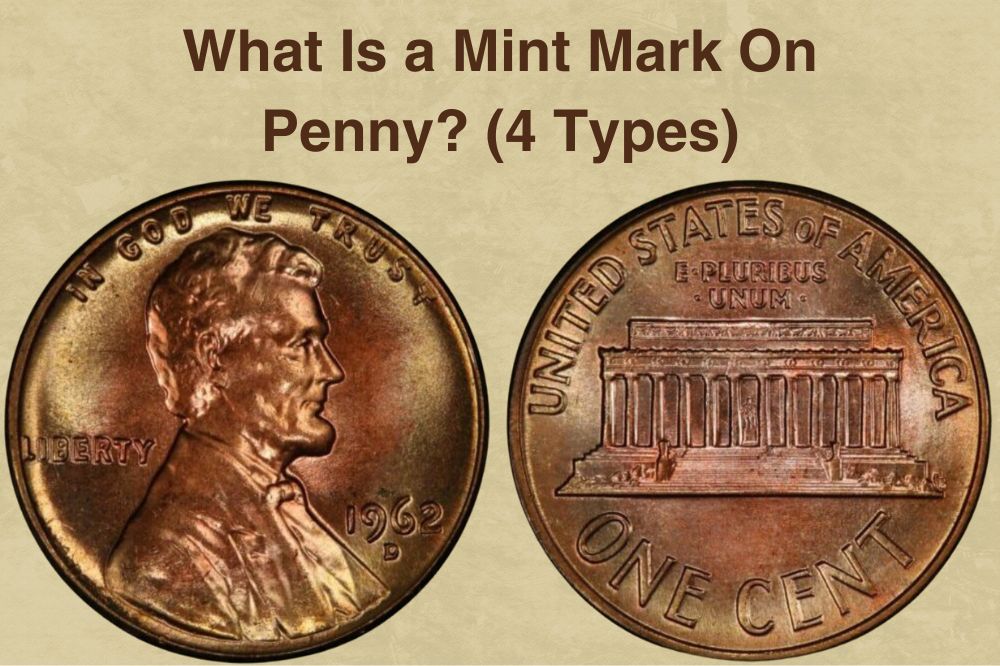
The date “1996” sits in front of Lincoln’s portrait below his collar. LIBERTY runs along the left side of his profile, and IN GOD WE TRUST curves across the top rim.
The Reverse of the 1996 Penny

Flip it over and you’ll see Gasparro’s Lincoln Memorial with twelve Doric columns across the front, inspired by ancient Greek temples. All twelve columns are visible, and if you look between the center pillars, there’s Lincoln’s seated statue — putting him on both sides of the coin.
UNITED STATES OF AMERICA curves along the top, with E PLURIBUS UNUM just below it. ONE CENT is displayed prominently beneath the Memorial.
Pay attention to the spacing between “A” and “M” in “AMERICA.” On standard 1996 pennies, those letters nearly touch — that’s the Close AM variety. On the rare Wide AM (covered in the Errors section), there’s a visible gap. Also look for the tiny “FG” initials near the base on the right side of the Memorial — those are Gasparro’s. Missing FG initials can signal a worn die or a variety worth investigating.
Other Features of the 1996 Penny
The 1996 penny is 97.5% zinc with a thin 2.5% copper plating, a result of the 1982 composition change. It weighs just 2.5 grams — noticeably lighter than the 3.1-gram copper cents made before 1982. Pick up one of each and you can feel the difference.
The coin is circular with a smooth (plain) edge, measuring 19.05 mm (0.75 inches) in diameter and 1.52 mm (0.060 inches) thick. Same specs as every other modern Lincoln cent.
Also Read: 100 Most Valuable Wheat Pennies Worth Money (1909 to 1958)
1996 Penny Value Mintage & Survival Data
1996 Penny Mintage & Survival Chart
Survival Distribution
| Type | Mintage | Survival | Survival Rate |
|---|---|---|---|
| No Mint | 6,612,465,000 | 2,100,000,000 | 31.7582% |
| D | 6,510,795,000 | 2,100,000,000 | 32.2541% |
| S DCAM | 2,525,265 | 2,351,021 | 93.1% |
Philadelphia struck 6,612,465,000 pennies (no mint mark), and Denver produced 6,510,795,000 with the “D” mintmark below the date. San Francisco added exactly 2,525,265 Deep Cameo proof specimens — made only for collector Proof Sets, never for circulation. “Deep Cameo” (DCAM) means frosted raised designs against deeply mirrored fields, giving the coin a striking 3D look.
Here’s where it gets interesting. About 32% of the Philadelphia and Denver coins survive — roughly 2.1 billion from each mint. That sounds like a lot, and it is. But San Francisco proofs survive at a 93.1% rate because collectors tucked them away in protective packaging from day one. High survival doesn’t mean high value, though — it’s the condition that matters.
Also Read: 100 Most Valuable Indian Head Penny Coins Worth Money (1859 – 1909)
The Easy Way to Know Your 1996 Penny Value
Most circulated 1996 pennies are worth one cent. Period. But error varieties and pristine uncirculated examples can change that fast. Start by checking the color. Red (RD) coins with bright original luster bring the most. Red-Brown (RB) shows partial toning. Brown (BN) means the coin has fully darkened to chocolate — generally the least valuable, though high-grade BN pieces still surprise people.
For error hunting, grab a loupe with at least 5x magnification. Zero in on Lincoln’s eye, his bowtie, the lettering in “IN GOD WE TRUST” and “LIBERTY,” and the “AM” in AMERICA on the reverse.
For accurate assessment, use our Coin Identifier and Value App to instantly check your coin’s grade and current market value.
Coin Identifier and Value App
Not sure what your coins are worth? Get Instant Value • Grade • Error Detection with coin identifier and value app (FREE Usage Daily)

1996 Penny Value Guides by Mint Mark
Three Mint facilities produced 1996 Lincoln pennies, each creating a distinct variety.
- 1996 No Mint Mark Penny — Philadelphia Mint production
- 1996-D Penny — Denver Mint production
- 1996-S DCAM Penny — San Francisco Deep Cameo proof
Philadelphia and Denver combined for over 13 billion business strikes. San Francisco produced exactly 2,525,265 proof specimens for collector Proof Sets — the premium variety of the year, with frosted devices and mirrored fields that look nothing like pocket change.
Also Read: Value Of Old Pennies By Year (1959-Present)
1996 No Mint Mark Penny Value — Philadelphia Mint

With 6,612,465,000 struck, this is the most common 1996 penny by a slim margin. Don’t write it off, though.
Color makes or breaks the value here. Red (RD) coins with full original luster top the charts — an MS68+ RD brought $2,500 at auction in 2018. But here’s a curveball: a Brown (BN) example graded MS63 also fetched $2,500 in 2023, proving that unusual color-grade combos attract serious bidders. Red-Brown (RB) pieces fall between those two extremes. Always check the color designation first.
1996 No Mint Mark Penny (RD) Price/Grade Chart
Price by 1-70 Grade (Latest Auction Records Included)
The auction record chart below illustrates how exceptional preservation drives value increases for this otherwise common coin.
| Date | Platform | Price | Grade |
|---|---|---|---|
| 02/25 | SB | $105 | 68 |
| 04/23 | HA | $68 | 68 |
| 01/23 | DL | $90 | 68 |
| 09/22 | HA | $124 | 68 |
| 08/21 | HA | $74 | 68 |
| 01/17 | HA | $104 | 68 |
| 01/16 | HA | $153 | 68 |
| 08/14 | GC | $14 | 67 |
| 08/14 | GC | $15 | 67 |
| 03/14 | GC | $7 | 65 |
Market activity data demonstrates the trading patterns and collector engagement levels for this Philadelphia-minted variety across different time periods.
Market activity: 1996 No Mint Mark Penny
Market activity score: 56/100 as of Oct 2026 — up 6 points from Jul 2026. 12-month peak: 58 (Jan 2026).
1996-D Penny Value — Denver Mint

Can a penny really be worth $3,565? This one was. A 1996-D graded MS69 RD sold through Bowers & Merena in 2008, and it holds the all-time auction record for any 1996 penny variety. Denver struck 6,510,795,000 of these — look for the small “D” below the date on the obverse.
The reason that MS69 is so remarkable comes down to zinc. Zinc planchets develop microscopic blisters under the copper plating as trapped air expands over time. That slowly destroys the surface. Getting a zinc cent to grade MS69 takes extraordinary luck at every stage — minting, handling, and storage. I think that’s what makes this coin so fascinating to collectors. Brown (BN) specimens are more modestly valued, with a Genuine example bringing $475 in 2021.
1996-D Penny (RD) Price/Grade Chart
Price by 1-70 Grade (Latest Auction Records Included)
The auction record chart below demonstrates the premium commanded by superior preservation levels.
| Date | Platform | Price | Grade |
|---|---|---|---|
| 04/23 | HA | $504 | 69 |
| 03/20 | DL | $17 | 67 |
| 06/18 | DL | $50 | 68 |
| 02/17 | SB | $75 | 68 |
| 09/16 | HA | $41 | 68 |
| 09/14 | GC | $12 | 67 |
| 04/14 | GC | $28 | 68 |
| 12/13 | GC | $6 | 66 |
| 12/13 | GC | $13 | 67 |
| 11/13 | GC | $7 | 66 |
Market activity analysis reveals the trading volume and collector engagement patterns specific to this Denver-minted variety.
Market activity: 1996-D Penny
Market activity score: 53/100 as of Oct 2026 — up 6 points from Jul 2026. Currently at its 12-month peak.
1996-S DCAM Penny Value — San Francisco Proof

Ever wonder why proof coins look so different from pocket change? It’s all in the process. San Francisco struck exactly 2,525,265 of these, each one hit multiple times on specially polished planchets using carefully maintained dies. They were never meant for circulation.
The result is deeply mirrored fields with heavily frosted raised devices — that contrast earns the DCAM (Deep Cameo) designation and gives the coin an almost holographic 3D appearance. A perfect PR70 DCAM example sold for $1,610 in a 2003 auction. Most collectors will find their proof grading PR67 to PR69, which is still a beautiful coin. Perfection is just a completely different kind of rare.
1996-S DCAM Penny Price/Grade Chart
Price by 1-70 Grade (Latest Auction Records Included)
The auction record chart below traces the performance of this proof variety across different preservation levels over time.
| Date | Platform | Price | Grade |
|---|---|---|---|
| 03/20 | DL | $10 | 68 |
| 09/18 | DL | $65 | 70 |
| 02/16 | DL | $84 | 70 |
| 02/16 | DL | $85 | 70 |
| 01/16 | HA | $56 | 70 |
| 06/15 | HA | $74 | 70 |
| 07/14 | GC | $25 | 69 |
| 06/14 | GC | $9 | 69 |
| 05/14 | GC | $6 | 69 |
| 05/14 | GC | $9 | 69 |
Market activity data shows the collector trading patterns and demand cycles specific to this San Francisco proof issue.
Market activity: 1996-S DCAM Penny
Market activity score: 53/100 as of Oct 2026 — up 3 points from Jul 2026. Currently at its 12-month peak.
Also Read: Top 100 Most Valuable Modern Pennies Worth Money (1959 – Present)
Rare 1996 Penny Value: Error Coin List
Billions of 1996 pennies were struck, and the Mint’s quality control wasn’t perfect. That’s good news for cherrypickers. Here are the error varieties worth hunting for.
1. 1996 DDO FS-101 (Doubled Die Obverse)

This is the marquee doubled die for 1996. DDO stands for Doubled Die Obverse — it happens during die-making when the hub impresses the working die more than once at a slightly shifted angle.
Don’t expect the dramatic naked-eye doubling of the famous 1955 DDO. You’ll need at least a 5x loupe for this one. Check the letters in “LIBERTY” and “IN GOD WE TRUST” for rounded, separated secondary images that look like shadows. That’s true hub doubling. If the doubling looks flat and shelf-like, that’s machine doubling — worth nothing extra.
A Brown (BN) example graded MS63 realized $175 in February 2020. Higher-grade Red (RD) pieces can reach $200 to $550 depending on doubling strength. Most circulated examples sell for $20 to $50.
1996 DDO FS-101 Penny (RD) Price/Grade Chart
Price by 1-70 Grade (Latest Auction Records Included)
2. 1996 Penny Wide AM Variety
This is one of the most debated 1996 varieties. On a normal 1996 penny (Close AM), the “A” and “M” in “AMERICA” on the reverse nearly touch. On a Wide AM, there’s a clear gap between them.
The theory is that proof dies from San Francisco were accidentally used to strike regular business-strike coins. This mix-up is confirmed on 1998, 1999, and 2000 pennies. The first claimed 1996 Wide AM was attributed to Billy Crawford of South Carolina, author of Die Variety News Magazine and A Detailed Analysis of Lincoln Cent Varieties. But here’s the catch — the coin was reportedly stolen before independent experts could verify it. Some experienced numismatists doubt a genuine 1996 Wide AM circulation strike exists at all.
If you think you’ve found one, compare it side by side with a known normal example under magnification, then submit it to PCGS or NGC for authentication. Claimed circulated examples typically sell for $20 to $75; uncirculated Red specimens with full luster can command $100 to $400 if authenticated.
3. 1996 BIE Error Penny
This is one of my favorite varieties to hunt. A die crack develops between the “B” and “E” in “LIBERTY” on the obverse, and the raised crack on the struck coin looks like a blobby capital letter “I” sitting between them. Hence the name BIE.
You can sometimes spot it without any magnification if the crack is bold enough, making it one of the most beginner-friendly errors out there. Values depend on how dramatic the crack is and the coin’s overall grade. Most 1996 BIE pennies sell for $5 to $15, though really pronounced examples can bring more.
4. 1996 Off-Center Strike Error Penny
When the blank planchet isn’t seated properly between the dies, the design shifts to one side and part of the coin stays blank. Value depends almost entirely on two things: how far off-center it is, and whether the full date is visible.
Less than 3% off-center? No added value. At 5% to 10%, you’re looking at roughly $10 or more. The sweet spot is about 50% off-center with the complete date still showing — those can bring $50 to $100 or higher. One important rule: never clean or straighten an off-center coin. Any post-mint alteration kills the collector value.
Coin Identifier and Value App
Not sure what your coins are worth? Get Instant Value • Grade • Error Detection with coin identifier and value app (FREE Usage Daily)
5. 1996 Double Denomination Error (Overstruck on Dime)
This is the showstopper of error types. A previously struck coin gets fed back into a different press and struck again with another denomination’s dies. The most common version for Lincoln cents is a cent overstruck on a Roosevelt dime, creating a hybrid showing elements of both designs.
These are extremely uncommon. A 1996 Lincoln cent overstruck on a Roosevelt dime graded MS-66 sold for $558.13 at Stack’s Bowers’ 2014 Baltimore auction. If you have what looks like a penny with ghostly traces of a dime design underneath, get it authenticated by PCGS or NGC right away.
6. 1996 Strike-Through Error Penny
A strike-through happens when something — cloth, wire, grease, debris — gets trapped between the die and planchet during striking. The foreign material blocks part of the design, leaving a smooth, recessed area where detail should be.
Value varies wildly. A minor grease-filled die with a faint smear of missing detail is relatively common and adds modest premium. A large, clearly shaped strike-through — like a wire or cloth fiber impression — is much rarer and can bring $20 to $100 or more from error specialists.
Also Read: 42 Rare Penny Errors List with Pictures (By Year)
1996 Penny Value: Where to Sell Your Coins
After discovering what your 1996 Lincoln cents might be worth, the next step is finding reputable buyers who appreciate their true value. I’ve evaluated the leading online marketplaces and auction platforms where collectors actively seek these coins, detailing each option’s benefits and limitations.
Check out now: Best Places To Sell Coins Online (Pros & Cons)
1996 Penny Value Market Trend
Market Interest Trend Chart - 1996 Penny
Market interest: 8,640 collectors tracking this coin as of Oct 2026 — up 1,000 from Mar 2026. Currently at its 12-month peak.
*Market Trend Chart showing the number of people paying attention to this coin.
FAQ About the 1996 Penny Value
1. Are there any 1996 pennies worth money?
Most are worth face value — over 13 billion were struck. But error varieties and high-grade survivors tell a different story. The record is a 1996-D MS69 RD that brought $3,565 in 2008. A 1996 Philadelphia MS68+ RD sold for $2,500 in 2018, and the top proof, a 1996-S PR70 DCAM, sold for $1,610 in 2003.
2. How much is a 1996 D penny worth today?
Most are worth one cent — 6,510,795,000 were minted. Uncirculated examples typically bring $0.10 to $0.30. Errors are where the money is: a doubled die in average condition runs $20 to $50, a 50%-off-center strike with visible date can fetch $50 to $100, and the all-time record is $3,565 for an MS69 RD graded by PCGS.
3. How much is a 1996 penny with no mint mark worth?
Circulated examples are worth face value. Philadelphia struck 6,612,465,000 of them. In uncirculated grades from MS60 to MS65, expect around $0.10 to $0.34. Once you hit MS67 or higher, premiums start climbing. The record is $2,500 for an MS68+ RD sold in 2018.
4. What is the 1996 Wide AM penny, and is it real?
The Wide AM shows a visible gap between “A” and “M” in “AMERICA” on the reverse, supposedly caused by proof dies being used on business strikes. The same error is confirmed for 1998, 1999, and 2000 pennies. The 1996 version is disputed — the only claimed example was reportedly stolen before experts could verify it. If authenticated, circulated examples sell for $20 to $75; uncirculated Red specimens can reach $100 to $400.
5. What is the BIE error on a 1996 penny?
It’s a die crack between the “B” and “E” in “LIBERTY” that looks like a raised capital “I.” Sometimes you can spot it without magnification. Most 1996 BIE pennies sell for $5 to $15 depending on how bold the crack is and the coin’s condition.
6. What does Red (RD), Red-Brown (RB), and Brown (BN) mean for 1996 penny values?
These are color designations from PCGS and NGC describing how much original copper luster remains. Red (RD) means at least 95% of the bright coppery surface survives — these bring the highest prices. Red-Brown (RB) retains between 5% and 95% original red and falls mid-range. Brown (BN) means less than 5% red remains — generally the least valuable among uncirculated coins, though exceptional BN pieces in very high grades can still be worth hundreds.
7. What makes a 1996 off-center penny valuable?
Two things: dramatic misalignment (ideally around 50%) and a fully visible date. Strikes that are only 1% to 3% off-center add no value. At 5% to 10%, you’re looking at around $10 and up. The best examples — roughly 50% off-center with a readable “1996” — can sell for $50 to $100 or more, especially in bright uncirculated Red condition.
8. How do I know if my 1996 penny doubled die is real or just machine doubling?
This is the single most important skill for error hunting. True hub doubling (DDO or DDR) shows rounded, separated secondary images — distinct shadows with clear separation from the original design. Machine doubling looks flat and shelf-like, as if the image was smeared sideways. Machine doubling adds zero value. A genuine 1996 DDO FS-101 shows rounded, separated doubling in “LIBERTY” and “IN GOD WE TRUST” and is worth $20 to $550 depending on grade and color. When in doubt, submit to PCGS or NGC.
9. How much is a 1996-S proof penny worth?
San Francisco struck 2,525,265 Deep Cameo (DCAM) proofs. Most grade PR67 to PR69 DCAM and sell for $1 to $20. The holy grail is PR70 DCAM — a perfect example sold for $1,610 in 2003. Proofs survive at a 93.1% rate because they were stored in protective packaging from day one, so lower grades aren’t scarce. Perfection is.
10. What should I do if I think I found a rare 1996 penny error?
First rule: don’t clean it. Don’t polish it. Handle it as little as possible. Any post-mint alteration destroys collector value. Examine it under good lighting with at least a 5x loupe, then use an app like CoinValueChecker to compare against known error examples. If it looks legit, submit to PCGS or NGC for professional authentication. Slabbed error coins sell for many times more than raw ones and are far easier to move at full market value.