Coin Value Contents Table
- 1989 Quarter value Chart
- History of the 1989 Washington Quarter
- 1989 Washington Quarter coin Types
- Features of the 1989 Washington Quarter
- 1989 Washington Quarter Grading
- 1989 Washington Quarter Value Guides
- 1989 P Quarter Value
- 1989 D Quarter Value
- Rare 1989 Washington Quarter Errors List
- Where to Sell Your 1989 Washington Quarter ?
- FAQ about the 1989 Washington Quarters
The Washington quarters are coins with a long and rich history. Although the original idea was to be a one-year commemorative piece, its production has lasted from 1932 until today. The US Mint placed the image of George Washington on the coin obverse to pay tribute to the first President in this way.
Since 1965, the US Mint has changed the quarters’ composition, and nickel and copper replaced expensive silver in the new composition. Be aware that modern coins are not interesting for collectors like those in the early sets, affecting the 1989 quarter value.
1989 Quarter value Chart |
|||
| Condition | 1989 P quarter | 1989 D quarter | 1989 S quarter |
| MS 65 | $10 | $20 | / |
| PR 65 | / | / | $5 |
History of the 1989 Washington Quarter
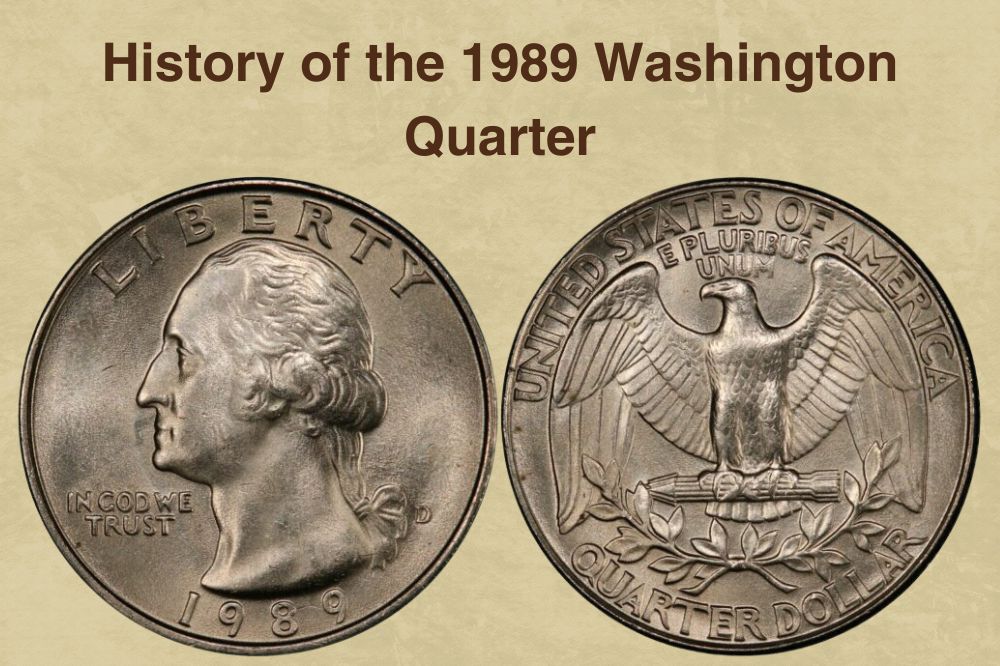
Quarters began their history back in 1796. The design of the first coins featured a bust of Lady Liberty on the obverse and an eagle on the reverse.
These coins got a new design after 134 years. The appearance known as Standing Liberty thematically followed their previous look. Lady Liberty remained on the obverse, and the American bald eagle on the reverse.
The Washington quarter minting began in 1932. Its original purpose was to mark the 200th anniversary of George Washington’s birth, the Founding Father and America’s first President.
Already in 1924, the Congress began preparations for this jubilee celebration by establishing a Commission. Its members proposed that the US Mint issue a commemorative half-dollar coin in Washington’s honor.
With that goal in mind, they announced a competition for a new design and requested that the obverse feature the image based on the bust by Jean-Antoine Houdon. On the other hand, there were no particular demands for the reverse design. The Commission members chose the sculptor Laura Gardin Fraser’s work.
1989 Washington Quarter coin Types |
||
| Location | Year | Minted |
| Denver | 1989 D quarter | 896,535,597 |
| Philadelphia | 1989 P quarter | 512,868,000 |
| San Francisco | 1989 S quarter (proof) | 3,220,194 |
| Total | / | 1,412,623,791 |
In the meantime, Congress decided to redesign quarters instead of half-dollars in honor of the upcoming jubilee. Mrs. Fraser won once more the renewed competition with her elegant conceptual solution.
However, the then-Treasury Secretary chose another artist, John Flanagan, to design these coins, ignoring protests from officials. His decision remained even after the appointment of a new finance minister.
The original composition of the Washington quarter was 90 percent silver. In 1965, this precious metal price on the stock market rose significantly, and the US Mint had to change the coins’ composition to lower production costs. However, the coin design remained unchanged until 1998.
Also read: Top 13 Most Valuable State Quarters Worth Money
Features of the 1989 Washington Quarter
It was the US Mint’s usual practice to change the coins’ appearance and composition occasionally. However, Washington quarters didn’t change their look for a long time and kept the original, recognizable design from the first minted quarter in 1932 until 1998.
On the other hand, the US Mint changed these coins’ composition in 1965. The rapid rise in the silver price forced it to replace the precious metal with a more profitable metal combination.
The obverse of the 1989 Washington Quarter coin
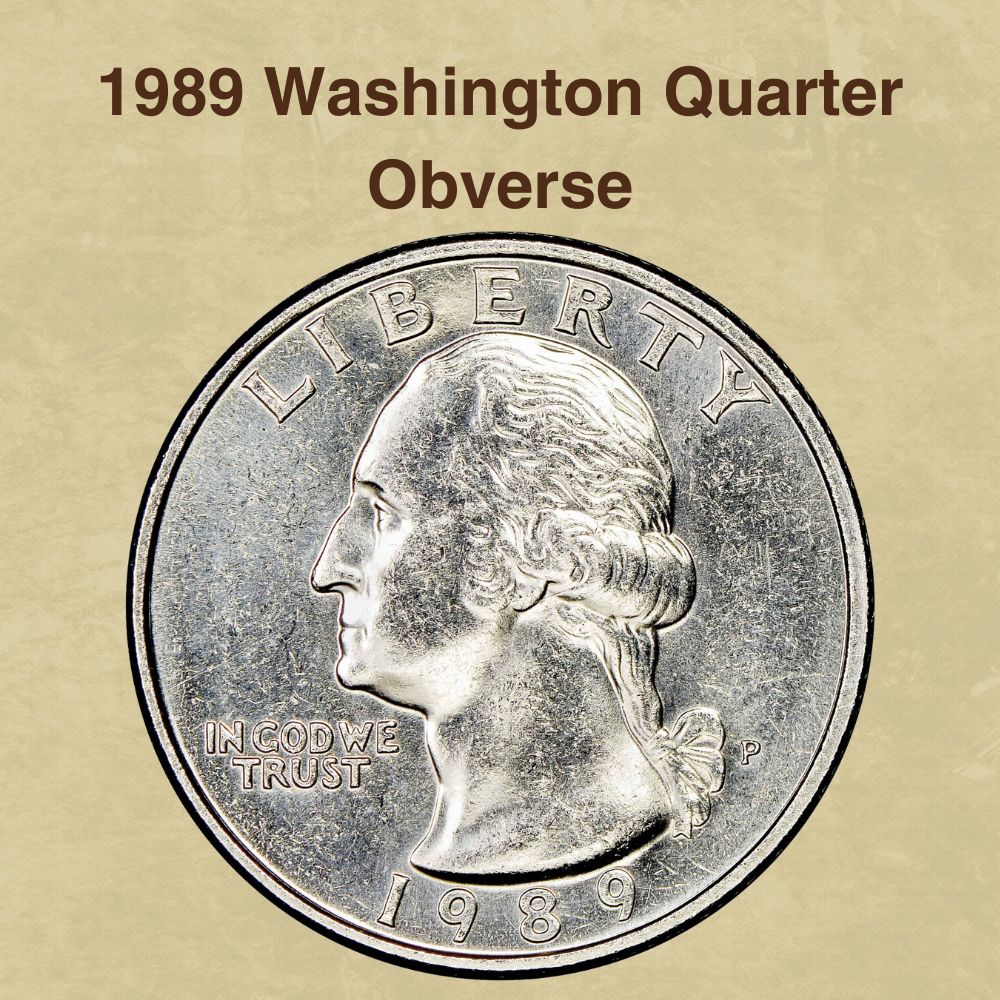
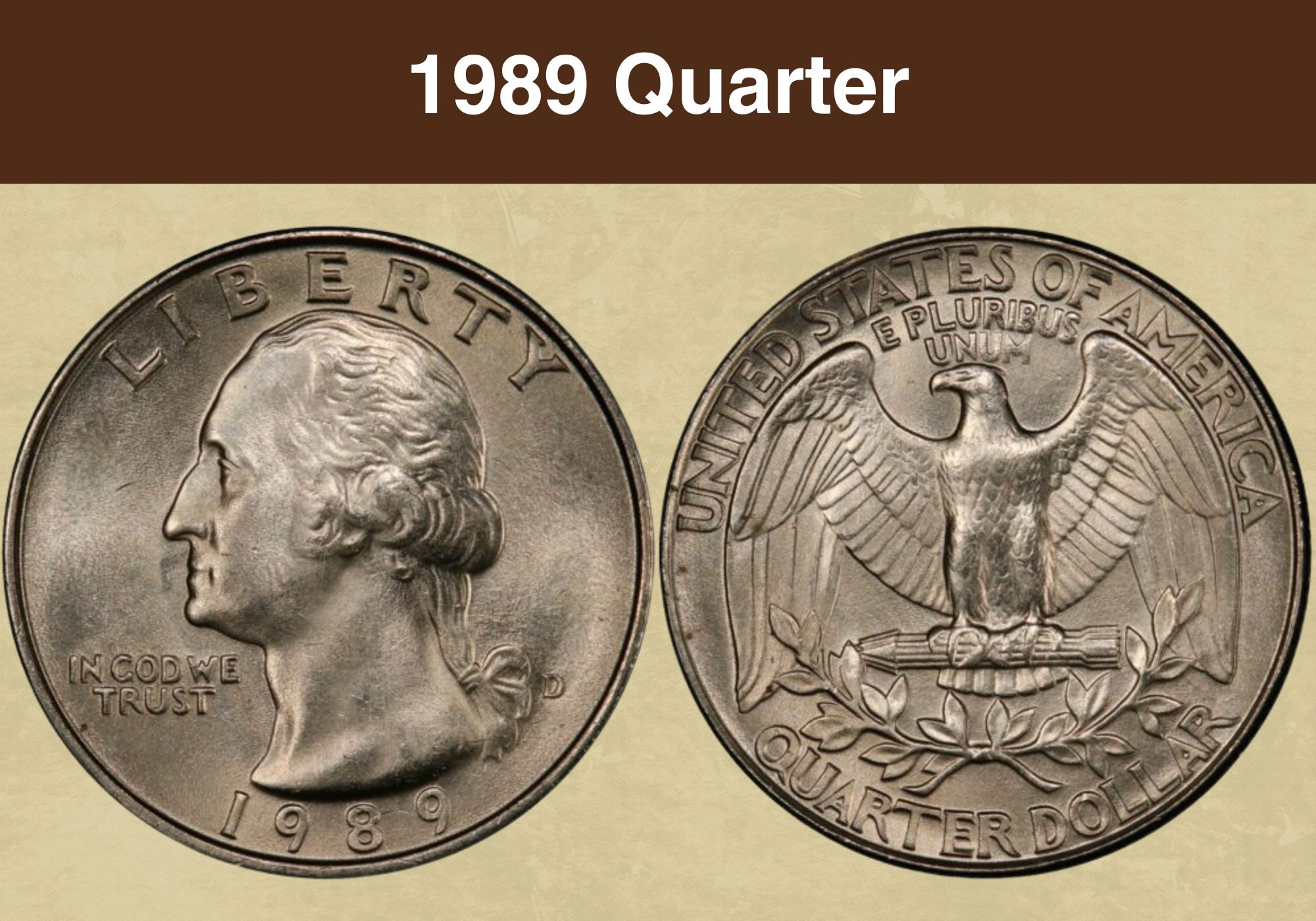
The central part of this coin obverse features a George Washington portrait. His profile facing left is based on Jean-Antoine Houdon’s sculpture from 1785. With this bust, the sculptor succeeded in portraying the first President’s dignified appearance in the proper way.
You can see the word LIBERTY on the upper rim above the President’s bust. The minting year stretches along the lower rim, just below his neck.
You can read the phrase, IN GOD WE TRUST, in front of the portrait, at the height of the President’s chin. The mint mark is struck on the right. Depending on which mint the quarter is from, you can also see the letters P, D, or S there.
The reverse of the 1989 Washington Quarter coin
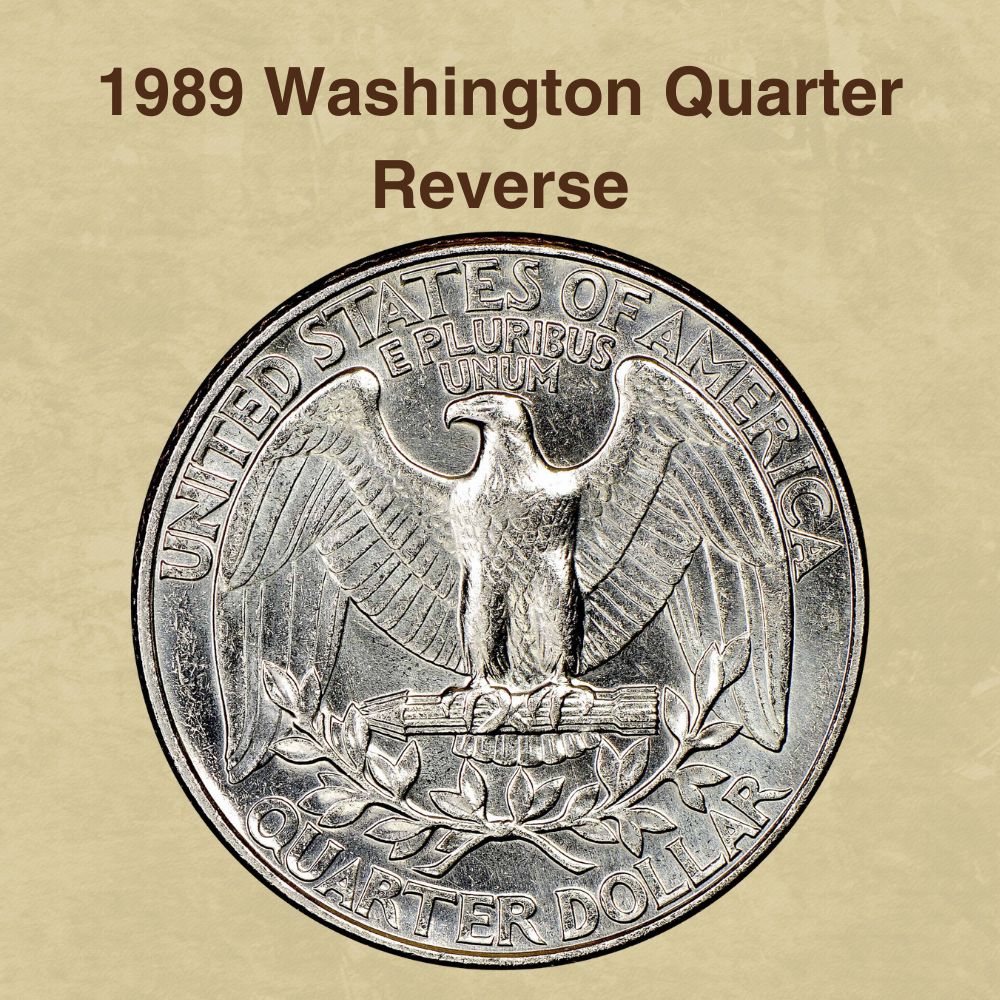
The American bald eagle, the well-known national symbol of America, is dominantly positioned on the coin reverse. The bird is represented with spread wings while looking to the left. He carries an arrow bundle in his claws, symbolizing America’s ability to defend the country.
Under the arrow bundle, you can see two crossed olive branches. They are a recognizable symbol of peace, which balances the presence of arrows in some way.
You can see the Latin saying above the eagle’s head, while the name of the country stretches along the upper rim. You can find the QUARTER DOLLAR on the coin’s bottom rim.
1989 Washington Quarter coin Details |
|
| Face value | 25 cents ($0.25) |
| Coin weight | 0.20 ounces (5.67 g) |
| Compound | Copper (75%) and nickel (25%) with a clad core |
| Coin thickness | 0.06889 inches (1.75 mm) |
| Coin diameter | 0.9551 inches (24.26 mm) |
| Shape | Round |
| Edge | Reeded |
Other features of the 1989 Washington Quarter coin
These 25-cent coins from 1989 have 75% copper in their compositions, while the remaining 25% is nickel. The Washington quarters are round in shape, with a reed rim.
With a weight of 0.2 ounces (5.67 g) and a thickness of 0.06889 inches (1.75 mm), they fit perfectly with the standards of quarters minted in other years. Likewise, the diameter of 0.95669 inches (24.3 mm) doesn’t deviate from the standard measurements.
Also read: Top 16 Most Valuable Modern Quarters Worth Money
1989 Washington Quarter Grading
As with all other coins, the 1989 quarter value primarily depends on their condition. The best option is to hire a professional appraiser to evaluate your piece’s appearance, shine, and possible damage.
During the 1970s, numismatists established Coin Grading standards. Since then, the Sheldon grading scale has made the grading system uniform, making it effortless.
| # | Grade |
|---|---|
| 1 | Basal State-1 |
| 2 | Fair |
| 3 | Very Fair |
| 4, 5, 6 | Good |
| 7, 8, 10 | Very Good |
| 12, 15 | Fine |
| 20, 30 | Very Fine |
| 40 | Extremely Fine |
| 50 | About Uncirculated |
| 60 | Mint State |
| 65 | Mint State |
| 70 | Mint State |
Please check our grading guides to know your coin scale, It’s the necessary step to know the exact value of your coin.
Check out now: How to Grade Washington Quarter?
1989 Washington Quarter Value Guides
Interestingly, 1989 was an extremely successful year for the US Mint when it came to minting the Washington quarters. Three different mints minted as many as 1,412,623,791 coins. Having the mint mark can help you find out which mint your quarter is from.
1989 P Quarter Value
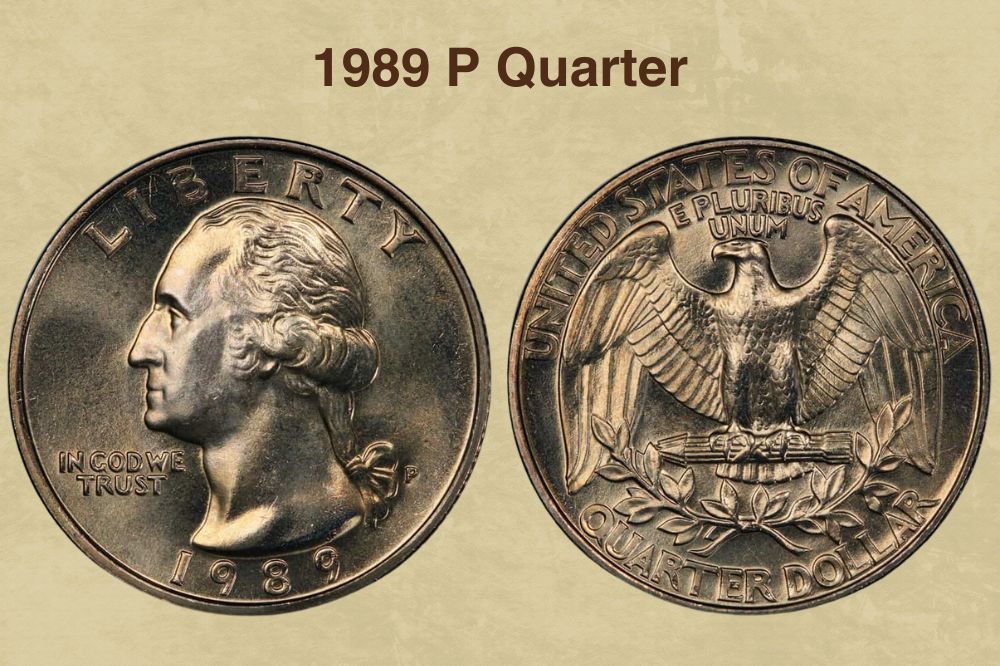
When you see the letter P on the 1989 Washington quarter, it is a sign that the coin is from the mint in Philadelphia. With a mintage of 512,868,000 pieces, this mint ranks second in coin abundance this year.
The heavy circulation has a significant impact on these coins’ value. Circulated specimens can generally only cost you their face value.
However, the 1989 Washington quarters in the mint state don’t have a high price either. You can find pieces graded between MS 60 and MS 65 for $1 to $10. If you have a specimen ranked MS 66, you can sell it for any amount between $35 and $175.
On the other hand, quarters graded MS 67 have a surprisingly high price, and you can get between $465 and $1,500 per one. Expectedly, the auction record height exceeds these sums. One collector paid as much as $1,955 for the 1989 P MS 67 coin at an auction in 2007.
1989 D Quarter Value
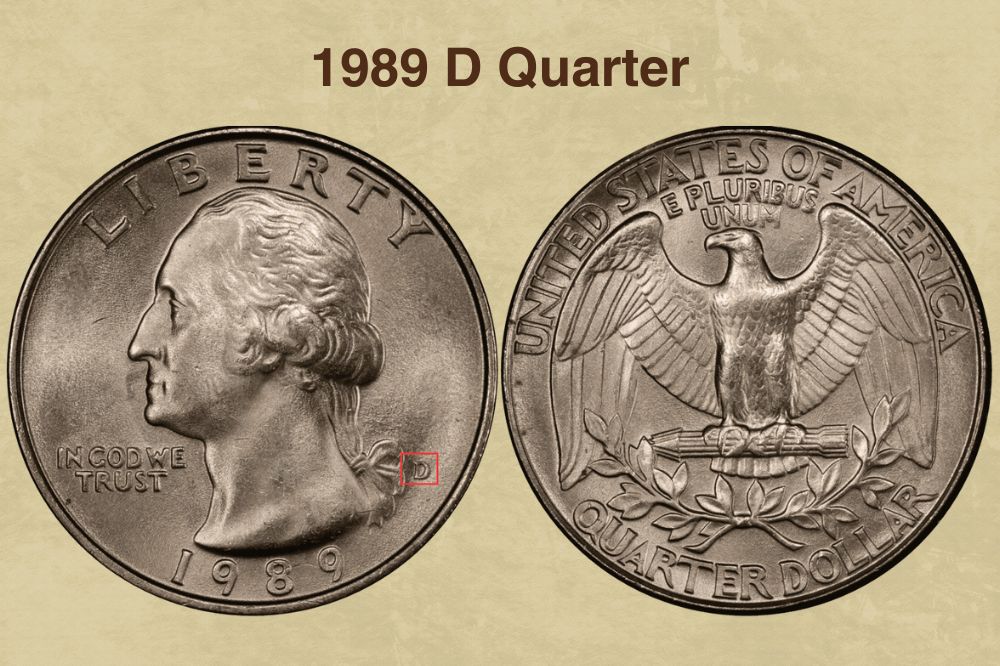
With a mintage of 896,535,597 Washington quarters minted in 1989 in Denver, this mint takes the top spot by far this year. All these coins are recognizable by the mark D on the obverse.
Their value is not very high thanks to such an abundant mintage. Accordingly, the price of specimens from circulation is only $1. Contrary to expectations, quarters in the mint state are not particularly expensive either. You need about $1 to $20 to buy one graded from MS 60 to MS 65.
Coins with higher ranking are usually worth more. Therefore, specimens graded MS 66 cost $25 to $46, while an MS 67-rating coin can bring you $375 to $625 on average.
The current auction record is significantly higher. The 1989 Washington quarter that was graded MS 67 sold at $764 on eBay in 2020.
1989 S Quarter (proof) Value
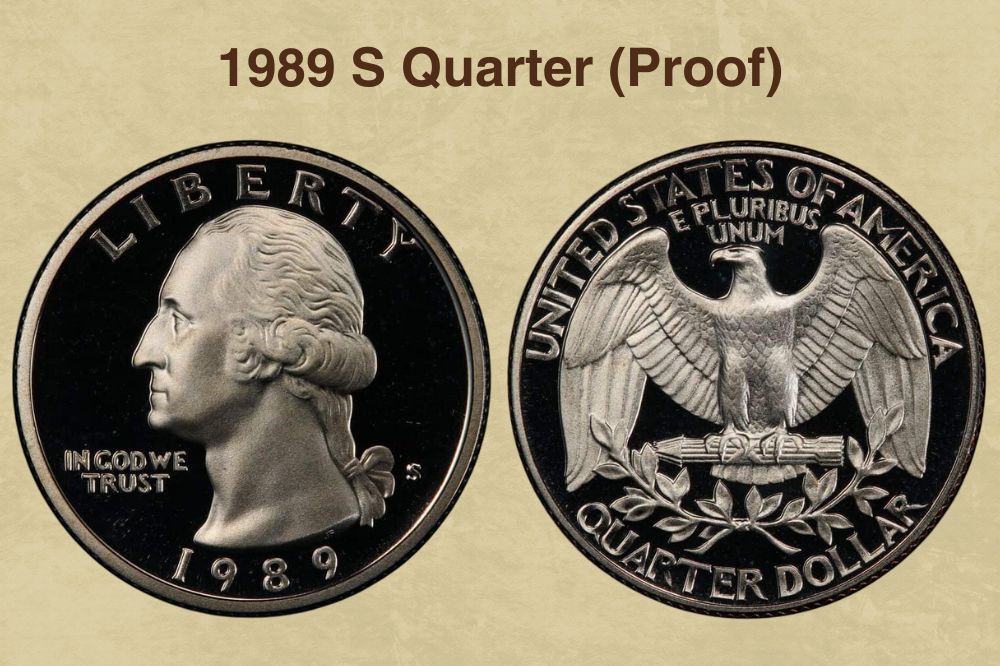
The proof Washington quarters from 1989 bore the mint mark S as a sign they were from the San Francisco mint. Since all are intended for collectors, finding any of the 3,220,194 produced pieces in circulated condition was impossible.
Even their production was different. The planchets were always of high quality, and the design was embossed twice to make them more expressive and precise. In the final processing, mint workers manually polished these coins.
Some proof coins are known for their cameo and deep cameo contrast, which affects their value. The 1989 proof quarters are easy to find in well-preserved conditions nowadays. Their average price range is approximately:
- $6 for PR 67 DCAM coins
- $10 for PR 68 DCAM coins
- $16 for PR 69 DCAM coins
- $34 for PR 70 DCAM coins
The highest selling proof from that year was the 1989 PR 70 quarter of DCAM quality. It reached $253 at an auction in 2004.
Also read: 17 Most Valuable Quarter Errors Worth Money
Rare 1989 Washington Quarter Errors List
It is rare to find the coin series without error specimens. Although they are a nightmare for mints, these pieces are collectible and often more valuable than regular ones. There are even collectors who collect exclusively such quarters.
As the circulation of the 1989 Washington quarters is abundant, it is realistic to expect that there are pieces with errors. Nevertheless, their value is not particularly significant.
Off-center
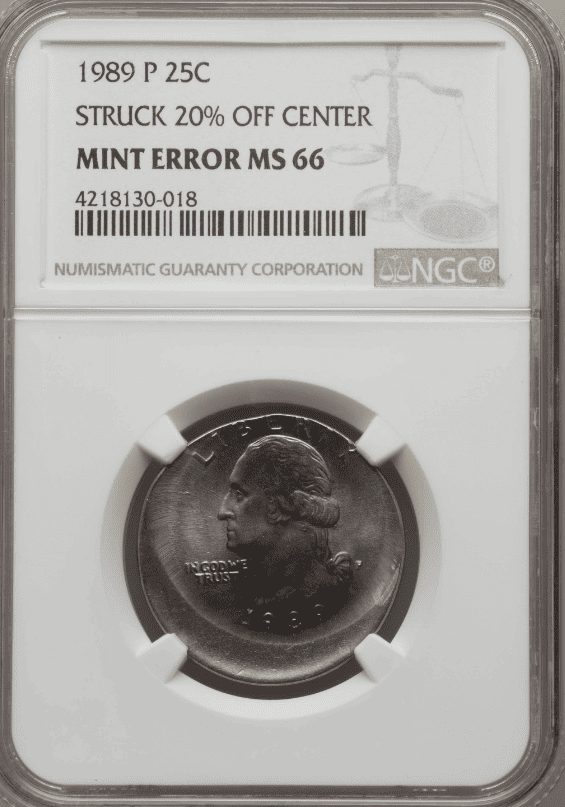
An off-center error is one of the most common during minting. It occurs when the die hits a planchet that is not adequately aligned. That results in a missing part of the design that numismatists express in percentages.
That percentage directly affects coins’ value, but the minting date and the mint mark must be visible. The value of the 1989 Washington quarter with this error ranges from $10 to over $100, depending on the error percentage.
Broad struck
To obtain a coin of standard thickness and round shape, the workers at the mint used collars. It sometimes happened that the collar was damaged or loosened, resulting in coins that were thinner and wider than usual but with a standard weight. The value of the 1989 quarter minted this way was modest, $4 to $80.
Doubled die
Doubled die error is frequent, but such coins sometimes have high values. This error shows a doubling of letters and design elements that may change each specimen’s appearance. The more visible the doublings, the higher the coin’s value. Therefore, you can expect the price of the 1989 error quarter to range from $3.50 to $20 on eBay.
Re-punched mint mark
As the name indicates, these coins have visible errors in the mint mark. Such a thing happens when it is hit several times, and the strikes don’t coincide. The 1989 Washington quarters with this error typically cost $2 to $20.
Where to Sell Your 1989 Washington Quarter ?
Now that you know the value of your coins, do you know where to sell those coins online easily? Don’t worry, I’ve compiled a list of these sites, including their introduction, pros, and cons.
Check out now: Best Places To Sell Coins Online (Pros & Cons)
FAQ about the 1989 Washington Quarters
What makes a 1989 Washington 25-cent coin rare?
With a circulation of almost 1.5 billion, you can’t say 1989 quarters are rare. However, well-preserved specimens in the highest grades can reach significant values at auctions.
Which 1989 Washington 25-cent coins are worth a lot of money?
- The 1989 P MS 67 quarter sold at $1,955 in 2007
- The 1989 D MS 67 quarter sold at $764 in 2017
- The 1989 MS 67 PL quarter sold at $338 in 2020
- The 1989 S PR 70 with DCAM quality sold at $253 in 2004
How much are the 1989 Washington 25-cent coins from Philadelphia worth?
These coins’ values primarily depend on their condition. You can buy specimens from circulation for $0.25, while those in the mint state are more expensive. Their price can be up to $2,4000.
What are the priciest Washington coins in coinage history?
You can distinguish coins from this series by composition. Type 1 are silver quarters, while Type 2 are clad quarters. Accordingly, their values can significantly vary.
The most expensive Washington quarters Type 1:
- The 1932 D MS 66 specimen priced at $143,750 from 2008
- The 1932 S MS 66 specimen priced at $45,500 from 2020
- The 1949 D MS 68 specimen priced at $43,475 from 2019
The most expensive Washington quarters Type 2:
- The 1966 MS 68+ specimen priced at $21,000 from 2023
- The 1983 P MS 65 specimen priced at $15,862.50 from 2014
- The 1970 D MS 69 specimen priced at $15,000 from 2023