Coin Value Contents Table
Have you discovered a 1974 Jefferson nickel in your pocket change and wondered how much it is worth today?
Are you collecting Jefferson nickels and are curious about a fair price for acquiring a 1974 nickel or how much value it would add to your collection?
We wrote this guide just for you!
Jefferson nickels, including those struck in 1974, are collectible more for their sentimental value.
Thomas Jefferson, a Founding Father and our nation’s 3rd president was quite popular, and it was only fit to commemorate him on a coin.
This guide will answer your pressing questions about the 1974 nickel value. You will discover this coin’s interesting history, unique features, grading tips and odd errors that can significantly increase your coin’s value.
So, let’s get started and find out: Is a 1974 nickel worth any money?
1974 Nickel Value Chart |
||||
| Mint Mark | Good | Fine | Extremely Fine | Uncirculated |
| 1974 No Mint Mark Nickel Value | $0.10 | $0.10 | $0.10 | $0.28 |
| 1974-D Nickel Value | $0.10 | $0.10 | $0.10 | $0.28 |
| 1974 Proof Nickel Value | – | – | – | $2.88 |
The History of the 1974 Nickel
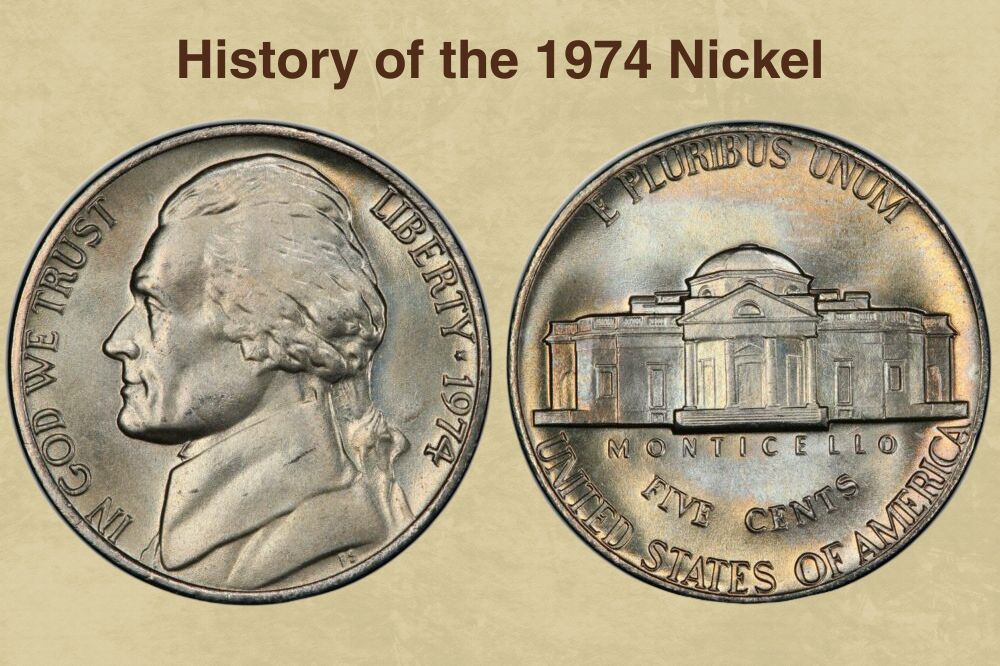
The 1974 nickel is part of the Jefferson nickel coin series struck by the United States Mint in 1938.
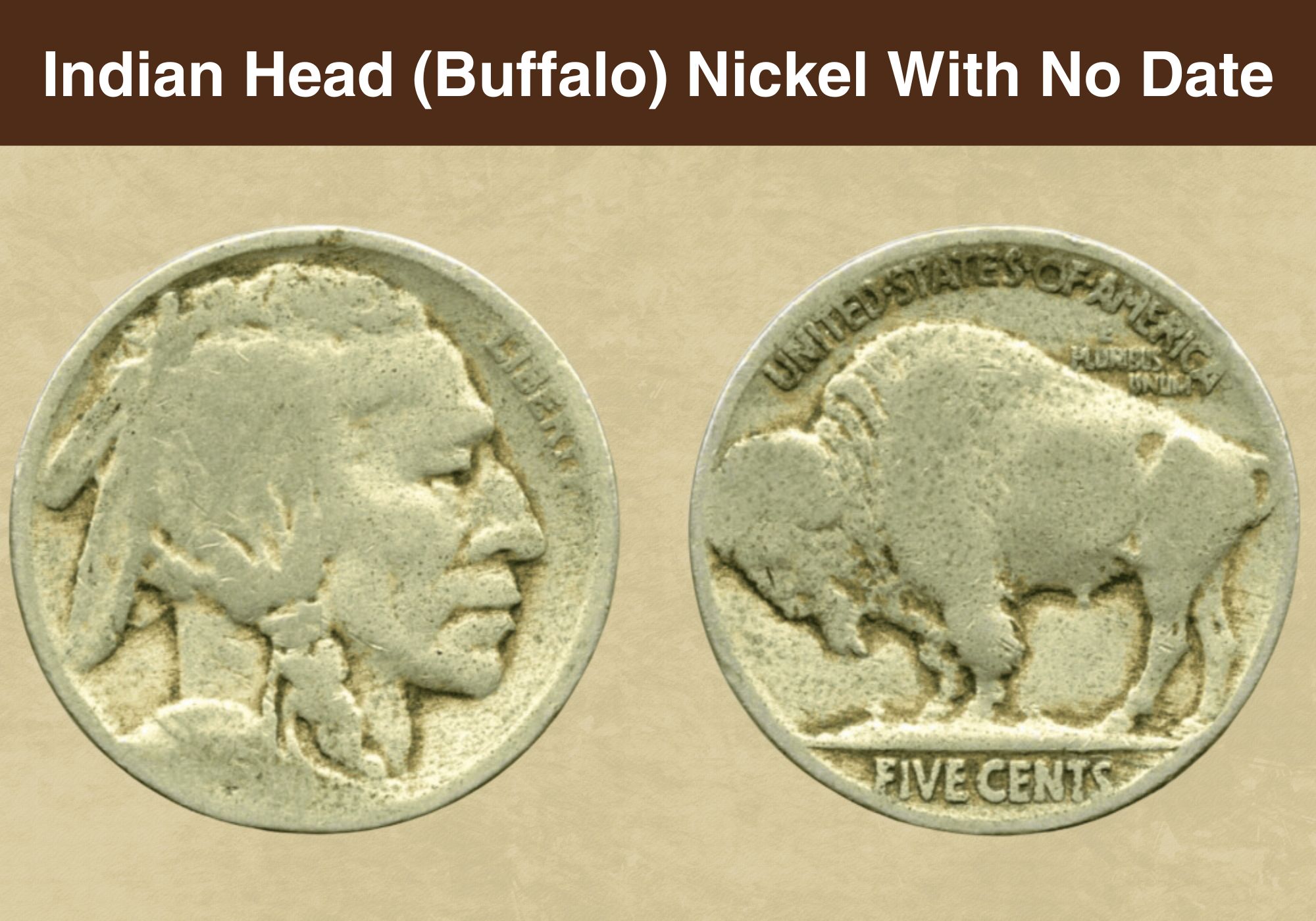
The Jefferson nickel replaced the Buffalo nickel, which, despite being admired today, was quite unpopular in its heydays. This coin was also very difficult and costly to produce, so the Mint was eager to replace it when the chance arose.
The Mint produced the Buffalo nickel between 1913 and 1938. After 25 years of the coin’s production, the Treasury Department did not require congressional approval to replace the Buffalo nickel.
By January 1938, the Mint announced a design competition for a new nickel, portraying Thomas Jefferson on the obverse and his Monticello home on the reverse. The portrait was to be based on a bust sculpted by Jean-Antoine Houdon preserved at the Boston Museum of Fine Arts.
After reviewing hundreds of entries, three sculptors and Mint Director Nellie Tayloe Ross, who acted as the judges, selected Felix Schlag’s design.
After several changes to Schlag’s original design, production of the new coin began in October 1938. The new Jefferson nickels were struck in 75% nickel and 25% copper. The nickel, known as the five cents, is still in circulation, albeit with a few design changes to Jefferson’s portrait.
Also read: Top 10 Most Valuable Nickels Worth Money
The Features of the 1974 Nickel
Let’s now review the features of the 1974 nickel. Familiarizing yourself with these features is one of the best ways to identify nickels worth money.
The Obverse of the 1974 Nickel
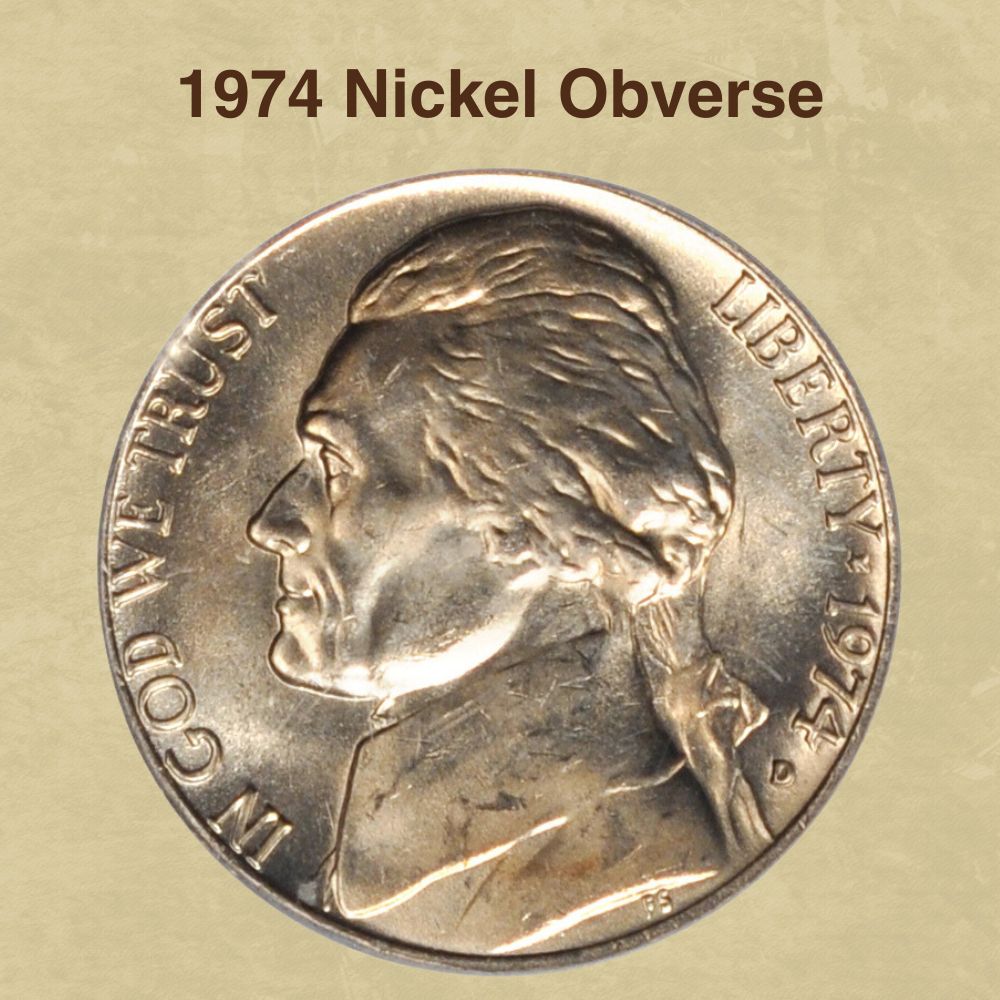
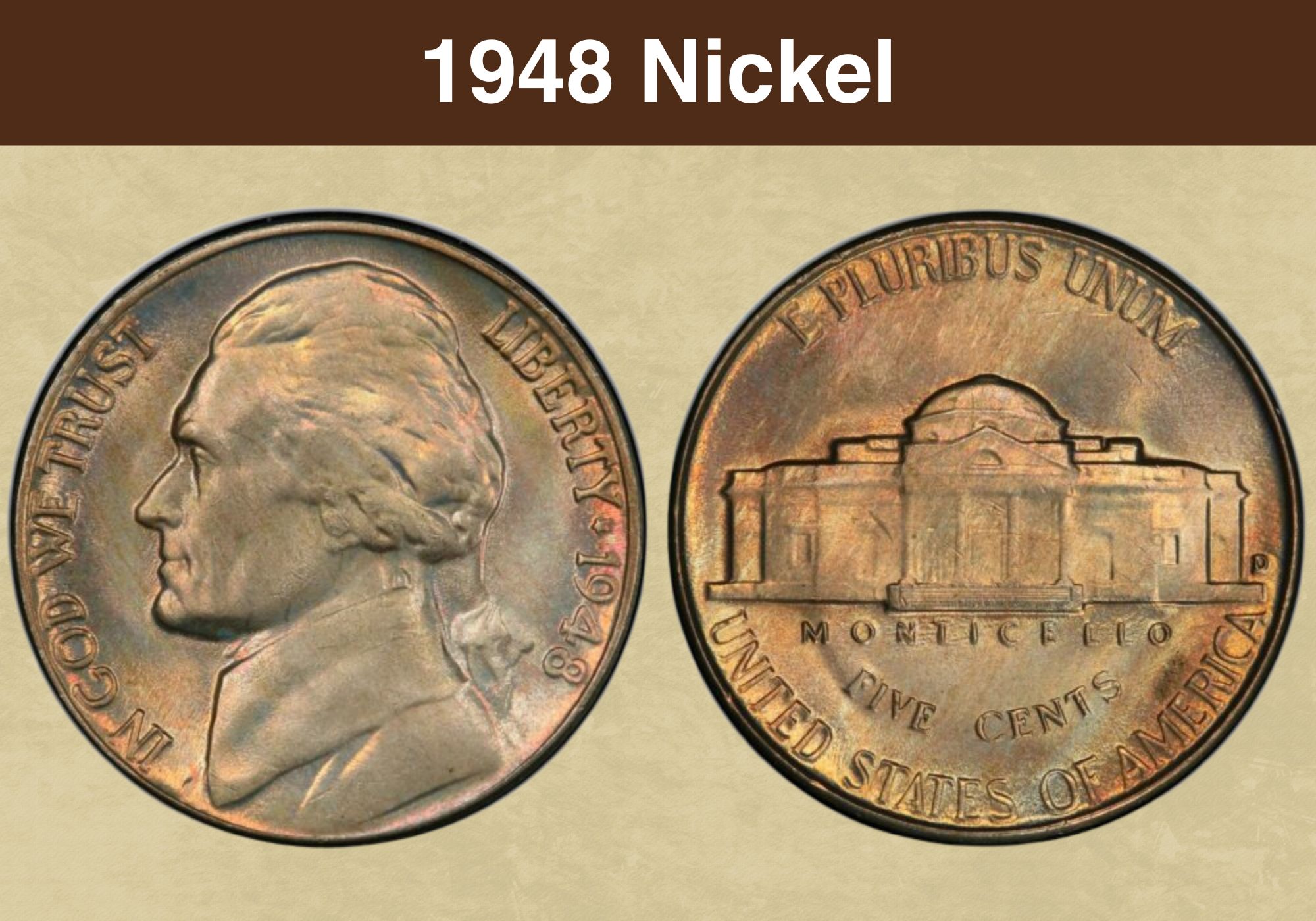
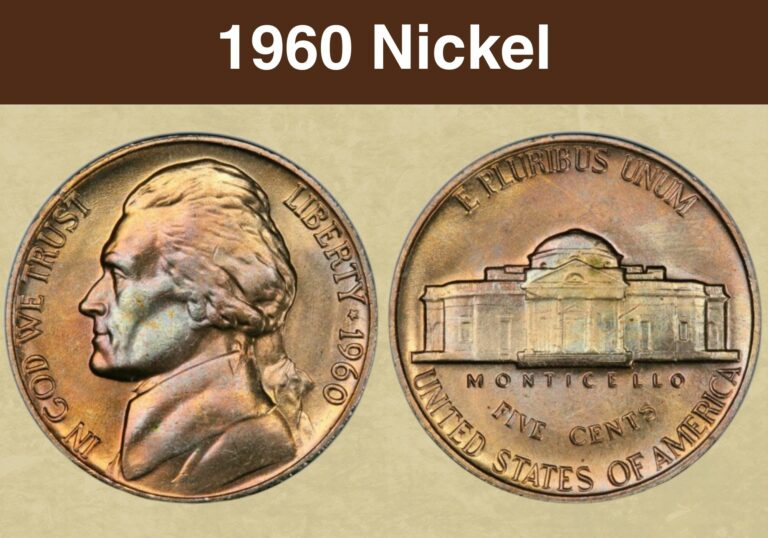
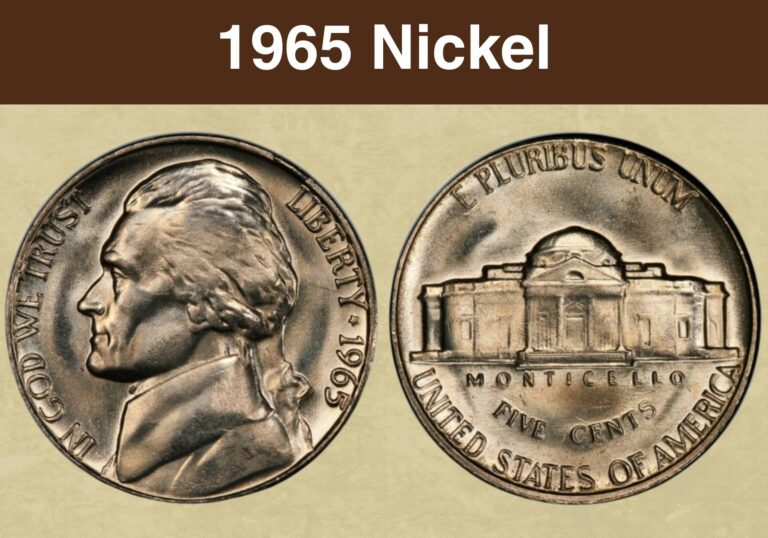
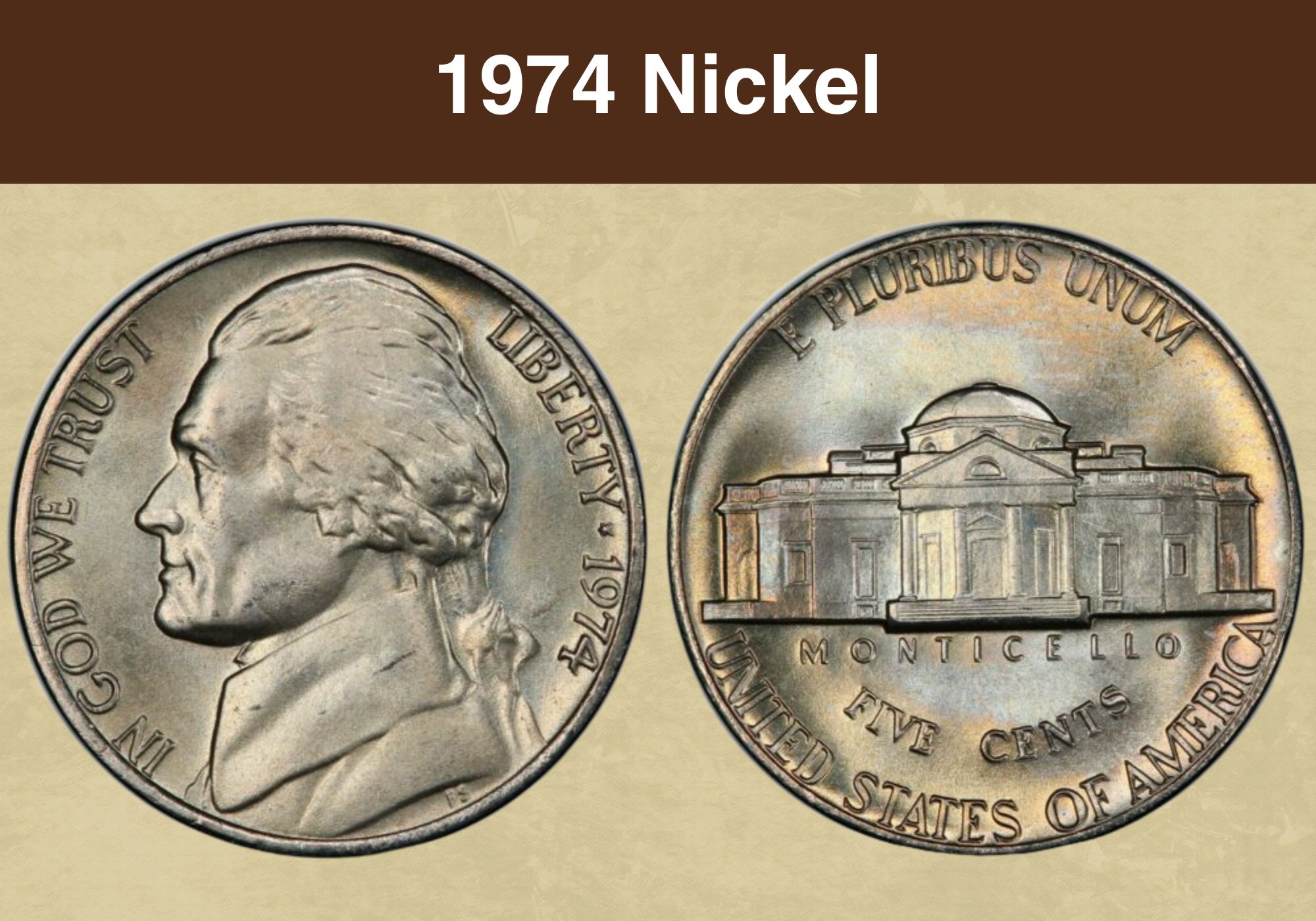
The obverse of the 1974 is very simple, featuring Thomas Jefferson’s left-facing profile. In the portrait, Jefferson adorns a high-neck jacket and has his hair back in a low ponytail.
Our country’s motto, IN GOD WE TRUST, appears along the rim on the left, while LIBERTY and the year date, 1974, are shown along the rim on the right. A tiny star separates these two inscriptions.
The Reverse of the 1974 Nickel
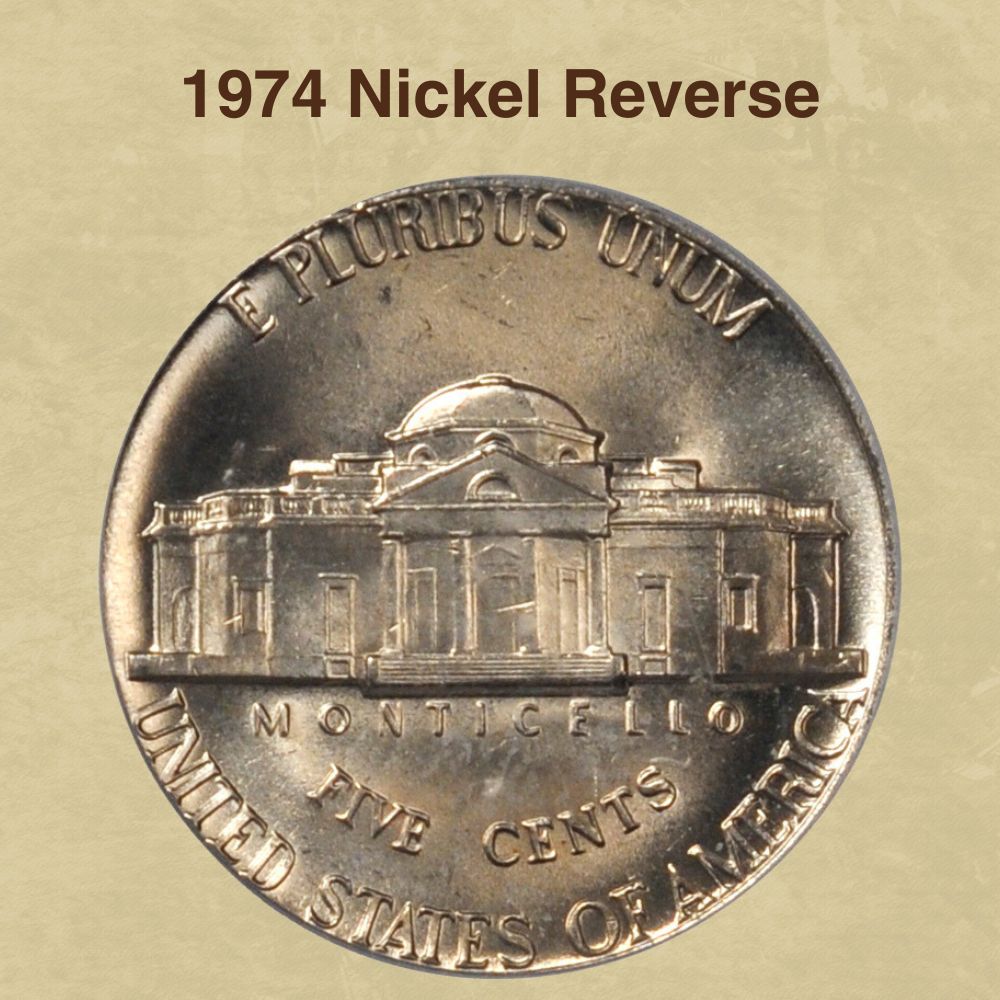
The reverse of the 1974 nickel is a bit more detailed. Jefferson’s house, The Monticello, is the most outstanding feature on the reverse.
Notice the flight of stairs leading up to the building. Collectors often base the value of a 1974 nickel on how well the steps are struck or their visibility.
Generally, the more visible all the six or five stairs are, the more valuable a Jefferson nickel is considered.
The word MONTICELLO appears below the stairs, underlining the building it takes after. This is followed by the denomination FIVE CENTS.
The motto, E PLURIBUS UNUM, appears at the top of the coin along the rim. This motto means ‘’out of one, many.”
Directly opposite, at the bottom, is the inscription UNITED STATES OF AMERICA.
Other Features of the 1974 Nickel
The 1974 nickel is a plain-edged coin struck from 75% copper and 25% nickel.
It is a relatively large coin measuring 21.20 millimeters in diameter and weighing 5.00 grams.
Only the 1974 Denver nickels and San Francisco proof nickels have a mint mark on the obverse. Those struck at the Philadelphia Mint do not have a mint mark either on the obverse or reverse.
Also read: Top 17 Most Valuable Buffalo Nickel Worth Money
1974 Nickel Grading Guides
Obtaining a 1974 Jefferson nickel in high grades can be quite difficult. Generally, grading Jefferson nickels is mostly limited to coins in mint condition.
There are several factors to consider when attempting to grade a 1974 nickel. First, consider the luster, which should be complete from rim to rim in uncirculated coins.
The sharpness of the strike is equally important, especially with regard to the Monticello steps. Ideally, for a coin to be graded mint state, it should display five or all six steps of the building.
The location and intensity of contact marks should also be considered. An uncirculated coin will have few, if any, contact marks on visible locations on the coin.
| # | Grade |
|---|---|
| 1 | Basal State-1 |
| 2 | Fair |
| 3 | Very Fair |
| 4, 5, 6 | Good |
| 7, 8, 10 | Very Good |
| 12, 15 | Fine |
| 20, 30 | Very Fine |
| 40 | Extremely Fine |
| 50 | About Uncirculated |
| 60 | Mint State |
| 65 | Mint State |
| 70 | Mint State |
Please check our grading guides to know your coin scale, It’s the necessary step to know the exact value of your coin.
Check out now: How to Grade Jefferson Nickel?
1974 Nickel Value Guides
So, how much is the 1974 nickel worth?
The coin’s value will depend on factors such as the condition, mintage and rarity, mint mark, and errors.
Let’s determine how much you can expect from your 1974 nickel or how much you need to acquire a piece in circulated or uncirculated condition.
The three varieties of 1974 nickels are:
- 1974 No-Mint Mark Nickel
- 1974-D Nickel
- 1974-S Proof Nickel
1974 No-Mint Mark Nickel Value
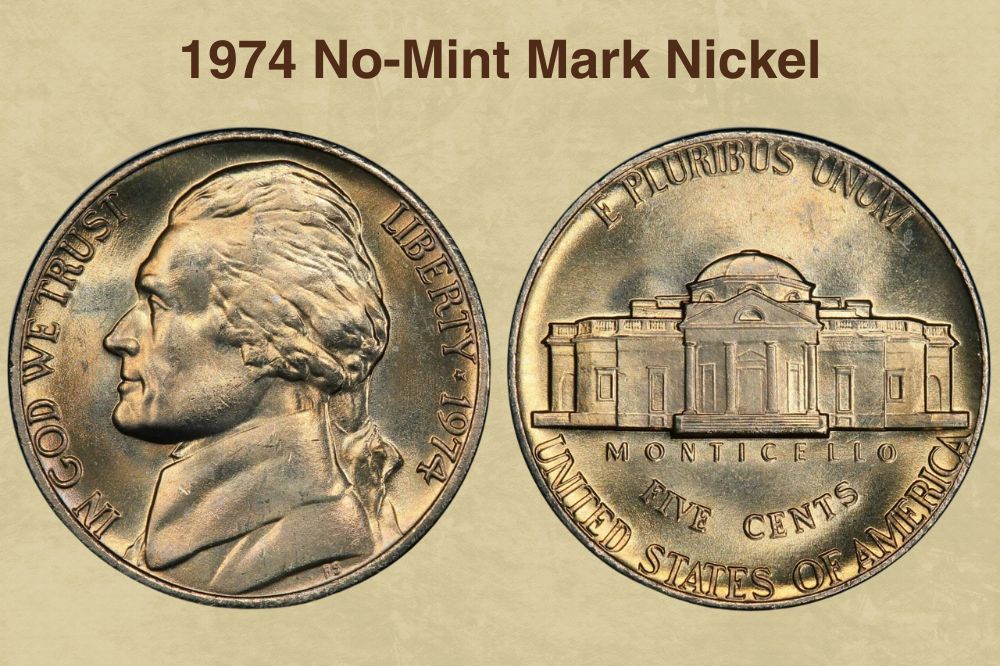
The no-mint mark nickel was struck at the Philadelphia Mint. A whopping 601,752,000 nickels were produced at the facility in 1974.
This extremely high mintage means 1974 nickels are still easily accessible across all grades. On the downside, though, their value decreases because these coins are abundant.
Circulated 1974 nickels will fetch between $0.10 and $0.20, more or less the face value. So, don’t expect a fortune if you are looking to sell your circulated 1974 nickel; this coin is really not worth much.
If you are looking to buy 1974 nickels to add to your collection, you won’t have to break the bank; you can easily acquire these coins even if you are a new collector or don’t have a big budget.
Low-grade uncirculated 1974 nickels are also very affordable. With only $1.5, you can get your hands on an MS63 nickel with few flaws, scratches or dents.
An almost perfect 1974 nickel graded MS65 will set you back only $15 and $200 for an MS67 gem.
When it comes to grading Jefferson nickels, you must consider the five full-steps and six full-steps varieties.
These refer to the steps on the Monticello on the coin’s reverse. Well-struck coins with all six steps visible are considered more desirable and valuable, as was the case with a 1974 nickel with six full steps and graded MS67, which was sold for an enviable $4,230 at a Legend Rare Coins auction in 2020.
1974-D Nickel Value
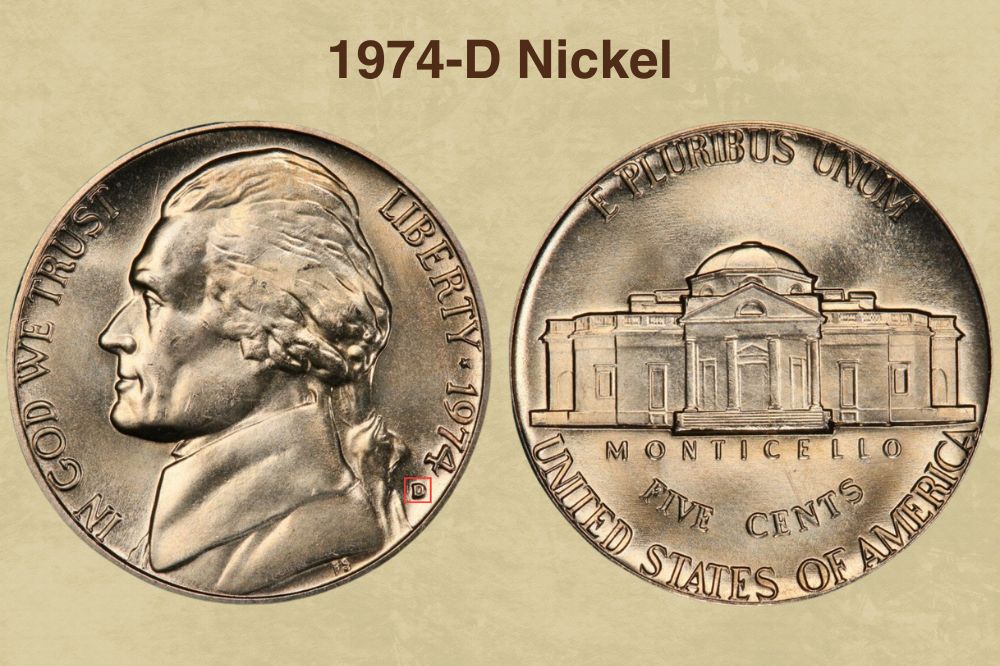
The Denver Mint recorded a lower mintage in 1974, producing 277,373,000. Although fewer than those struck in Philadelphia, these are still plenty of coins, and the high mintage would definitely affect the value.
It is also worth mentioning that the 1974 nickels from Denver were not very well-struck.
Many of these coins bear visible scratches, dents, cuds, and hairline cracks, making them less desirable in terms of their numismatic value.
These coins are readily available today because most of the 1974-D nickels were released into circulation. But, the majority are in a bad state and will generally not fetch much.
Uncirculated gem-quality 1974-D nickels are extremely rare. Consider yourself lucky if you come across any graded MS67 and above; it might be worth a fortune.
While circulated 1974-D nickels are worth between $0.10 and $0.20, an uncirculated one that is graded MS67+ can fetch up to $1,750.
1974-S Proof Nickel Value
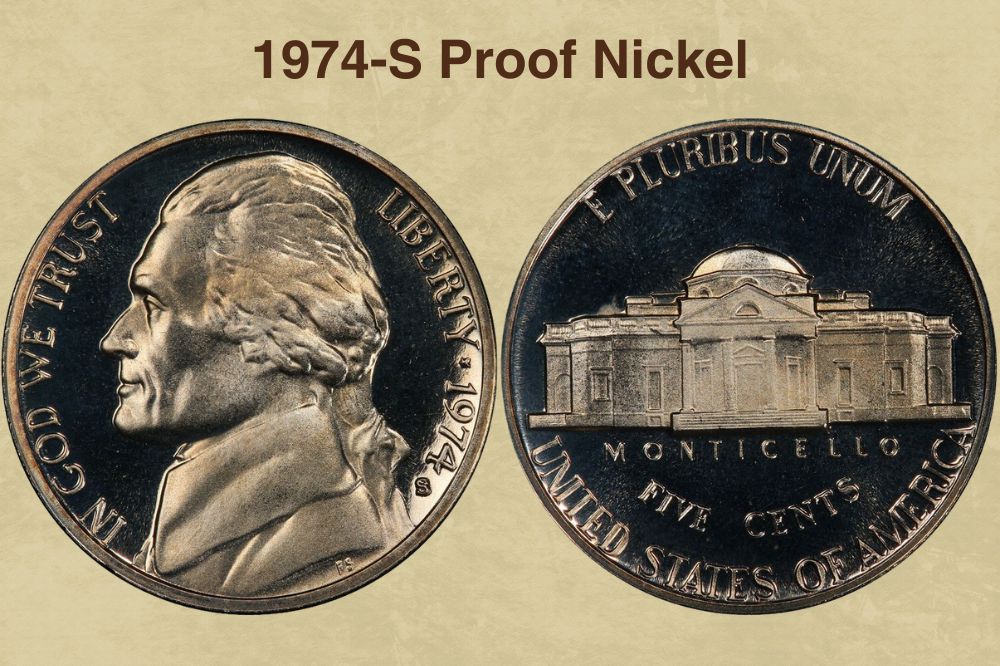
The San Francisco Mint produced proof nickels in 1974. An estimated 2,612,568 proof coins came from the facility that year.
Proof coins are not meant for circulation; they are made for and sold to collectors who preserve them for their numismatic value or keepsakes.
Proof coins are usually very well-struck, with complete, radiating luster and intense contrast between the devices and the field.
The 2.6 million nickels struck in San Francisco are significantly fewer than the regular strike nickels produced in Philadelphia and Denver. But this is still a high mintage for proof coins, which inevitably suppresses the coin’s value.
The upside is that 1974 nickel proofs are available across all grades, from regular proofs to cameo and ultra-cameo.
A regular nickel proof from 1974 graded PF69 is very affordable at $12.50, while with $20, you can get your hands on a cameo gem. Ultra cameo specimens, which are equally abundant, are worth about $25.
There are exceptions, such as the PF70 1974 nickel auctioned for an impressive $3,819 at a Stack’s Bowers auction in 2015.
Also read: Top 17 Most Valuable Jefferson Nickels Worth Money
Rare 1974 Nickel Errors List
As we’ve discovered, 1974 nickels are only worth more or less their face value. Even low-grade uncirculated examples are relatively inexpensive.
That said, some 1974 nickels can be quite valuable, and these are the ones with well-known minting errors. Minting errors are oddities and flaws that can add to a coin’s uniqueness.
Unique coins are every collector’s dream and tend to attract a lot of interest, with collectors willing to pay more to own the coin.
The 1974 nickel series doesn’t have as many interesting errors. But, the few known errors are worth good money. Here are some to look out for:
1974 Nickel Struck on a 1973 Nickel
This is one of the most outstanding nickel errors in U.S. coinage history and is recognized as among America’s 100 greatest error coins.
This error occurred when a 1974 working die was used to strike a 1973 nickel. The 3 in 1973 can be seen on the reverse next to the M in the motto E PLURIBUS UNUM.
This coin is still preserved in its original uncirculated mint set, and its value is estimated to be between $15,000 and $17,500.
1974 Nickel Full Steps
According to the Professional Coin Grading Service, the Full Steps 1974 coin is a sought-after variety in this series.
Full Steps is not an error per se. Rather, it refers to the visibility of the Monticello staircases. Coins in which the stairs leading to the house are visible and clear-cut are more desirable and are known as Full Step nickels.
All six steps are visible in some coins, while only five are visible in others. Full Steps is considered a significant variety, even an error, because the flight of stairs on most of the 1974 nickels is not too visible or missing altogether.
Full Step nickels are rare, contributing to the misperception that these are error coins. The good news is that a 1974 coin with a Full Steps designation can fetch as much as $4,230.
Also read: 14 Most Valuable Nickel Errors Worth Money
Where to Sell Your 1974 Nickel ?
Now that you know the value of your coins, do you know where to sell those coins online easily? Don’t worry, I’ve compiled a list of these sites, including their introduction, pros, and cons.
Check out now: Best Places To Sell Coins Online (Pros & Cons)
FAQ
How do I know if my 1974 nickel is valuable?
The nickels struck in 1974 are generally not worth much more than their face value. That said, you can tell a valuable 1974 by several things, such as the condition. Uncirculated, gem-quality nickels with no flaws are the most valuable; if they are certified and graded MS67 and above, they are probably worth hundreds of dollars.
Are 1974 nickels rare?
No, 1974 nickels are not rare. Nearly 900 million nickels were produced at the Denver, Philadelphia and San Francisco mints in 1974. These are a lot of coins, making it easy to find 1974 nickels in circulation to date. Due to the high mintage, these coins are not worth much, and you should first do your research before acquiring or trying to sell 1974 nickels for a profit.
Where is the mint mark on a 1974 nickel?
Only the nickels struck in Denver and San Francisco in 1974 have a mint mark. This mark appears on the obverse, next to Jefferson’s low-lying ponytail and the four in 1974.