Coin Value Contents Table
- 1948 nickel value Chart
- History of 1948 Jefferson Nickels
- 1948 nickel (Jefferson) Types
- Features of 1948 Jefferson Nickels
- 1948 Jefferson Nickel Grading
- 1948 Nickel Value Guides
- 1948 No Mint Mark nickel Value
- 1948 D nickel Value
- 1948 S nickel Value
- Rare 1948 Jefferson Nickel Error List
- Where to Sell Your 1948 Jefferson Nickel ?
- FAQ about 1948 Jefferson Nickels
You can often find old nickels in circulation without knowing they can be worth something more than their denomination. For instance, the 1948 nickel value is always higher than five cents struck on their obverse.
Additionally, you can count on more money for nickels in the highest grade or those with a rare flaw. As for the metal composition, this year is the third after 1945, when the US Mint produced silver pieces for the last time. So, these coins don’t contain precious metals.
1948 nickel value Chart |
|||
| Condition | 1948 No Mint Mark nickel | 1948 S nickel | 1948 D nickel |
| MS 60 | $1.16 | $1.75 | $3.38 |
| MS 65 | $23 | $17 | $17 |
History of 1948 Jefferson Nickels
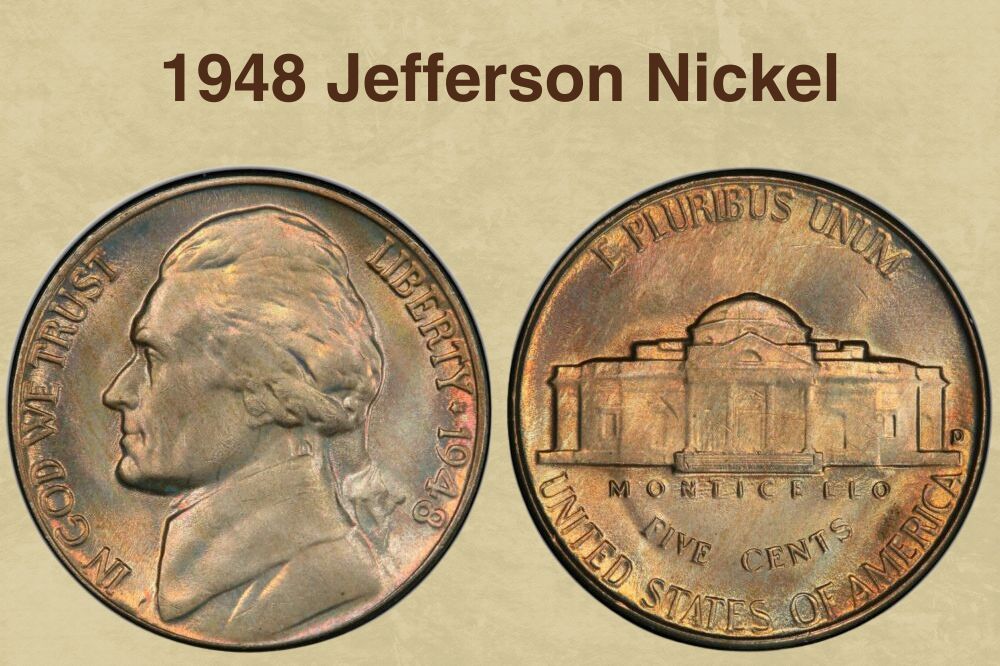
The first five-cent American coins were silver half-disme struck from 1794 to 1805, and the first Shield nickels appeared in circulation in 1866. They were replaced by V-nickels struck until 1913, and Buffalo nickels minted from 1913 to 1938.
The first Jefferson nickels came into American coinage history in 1938, just before the horrible war. The 1948 coins were minted ten years later, shortly after WWII ended when the US tried to recover after war efforts and losses.
1948 nickel (Jefferson) Types |
||
| Location | Year | Minted |
| Philadelphia | 1948 No Mint mark nickel | 89,348,000 |
| Denver | 1948 D nickel | 44,734,000 |
| San Francisco | 1948 S nickel | 11,300,000 |
| Total | / | 145,382,000 |
This coin series honors Thomas Jefferson, who had a crucial role in preparing and signing the Declaration of Independence. The privilege to design this coin got Felix Schlag after winning a competition and getting a cash prize of $1,000 for his effort and talent.
Unlike so-called Wartime Nickels minted from 1942 to 1945 with changed metal composition, those from 1948 were regularly made of cupronickel. They belonged to the last set with above-average strike quality before poorly-struck nickels from the 1950s and 1960s were released into circulation.
Also read: Top 10 Most Valuable Nickels Worth Money
Features of 1948 Jefferson Nickels
Felix Schlag designed the Jefferson nickel, and the US Mint started production in 1938. Within a decade, this coin changed the original composition and the mint mark position and returned to the initial look after the war. Therefore, coins minted in 1948 were made of cupronickel with the mint mark right of the Monticello.
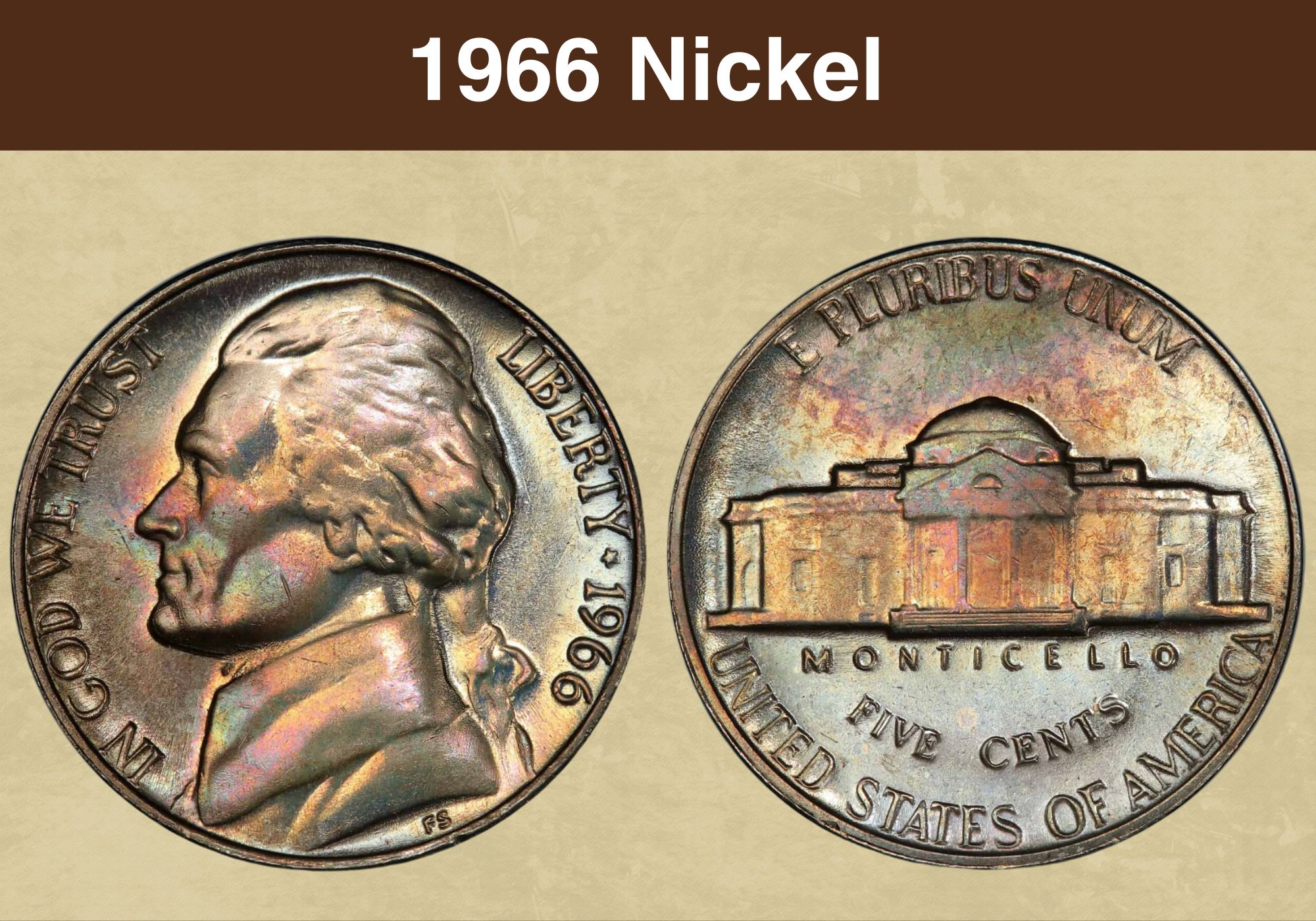
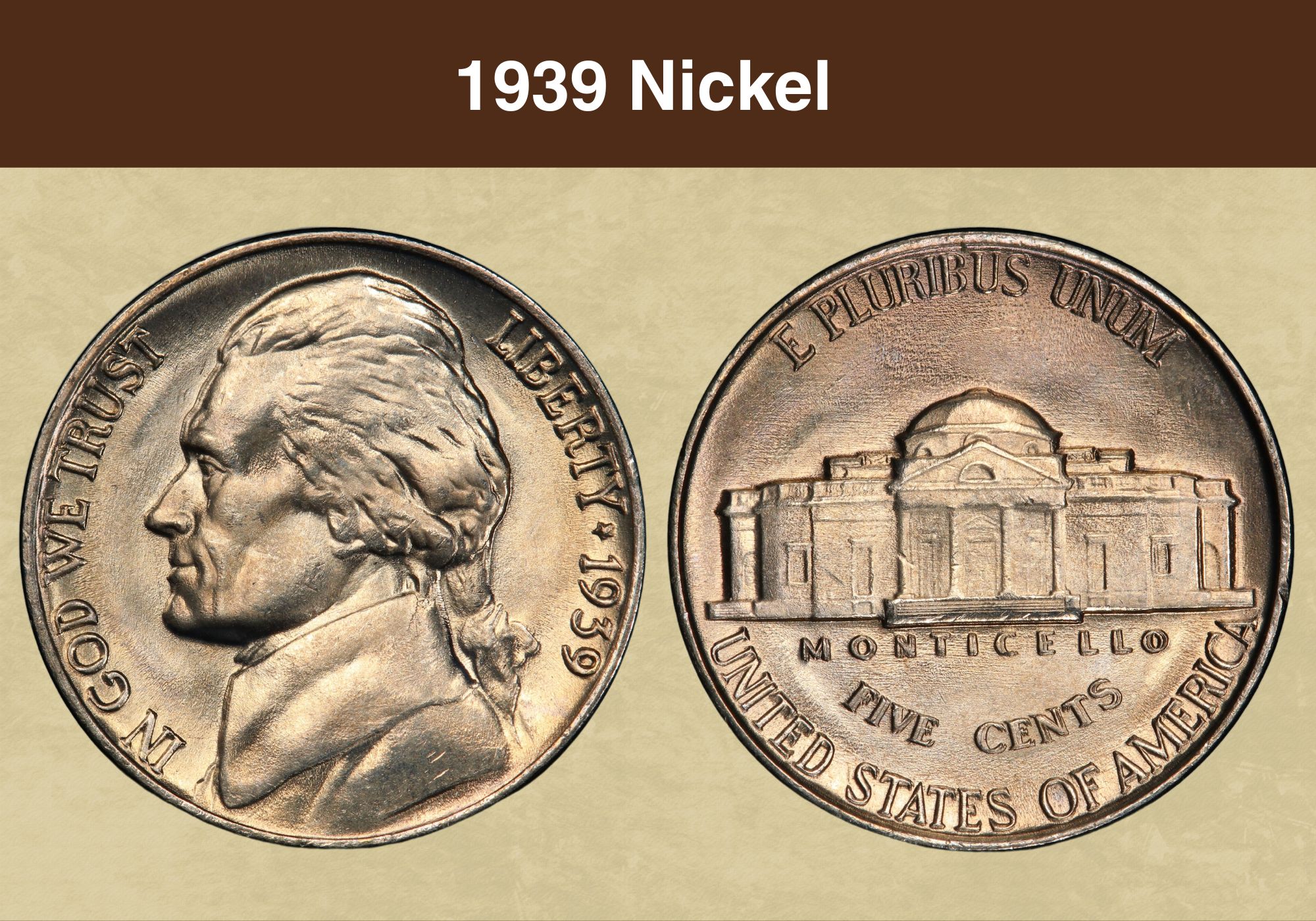
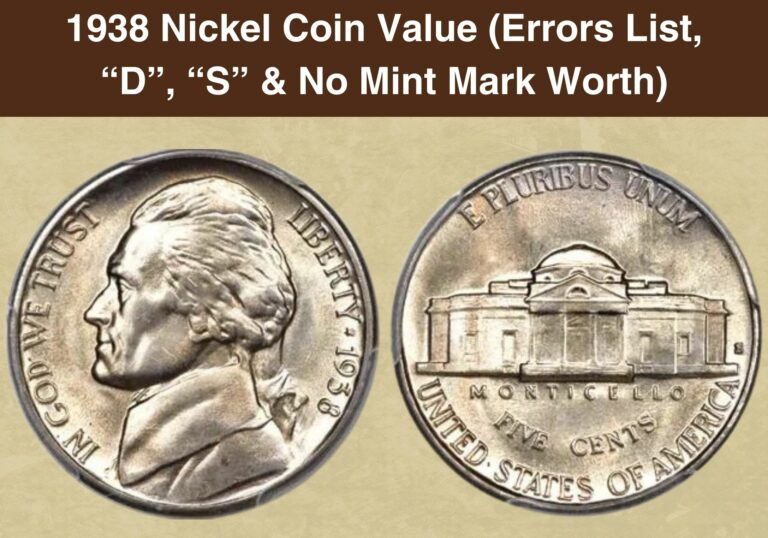
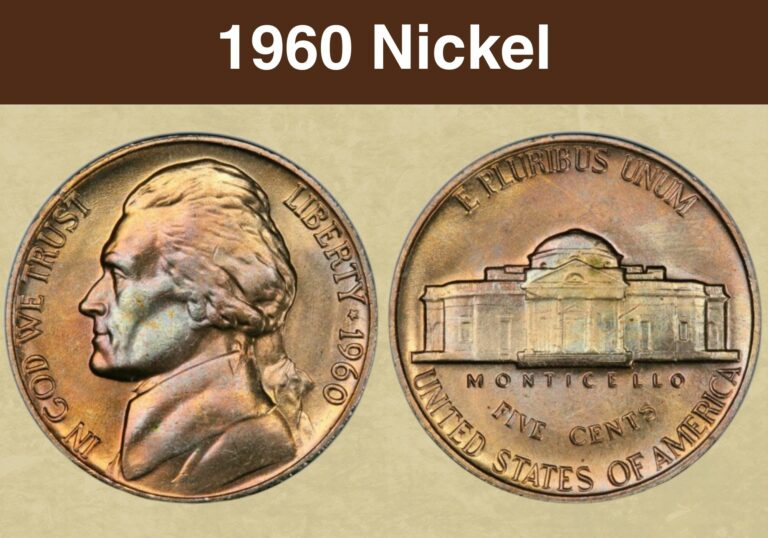
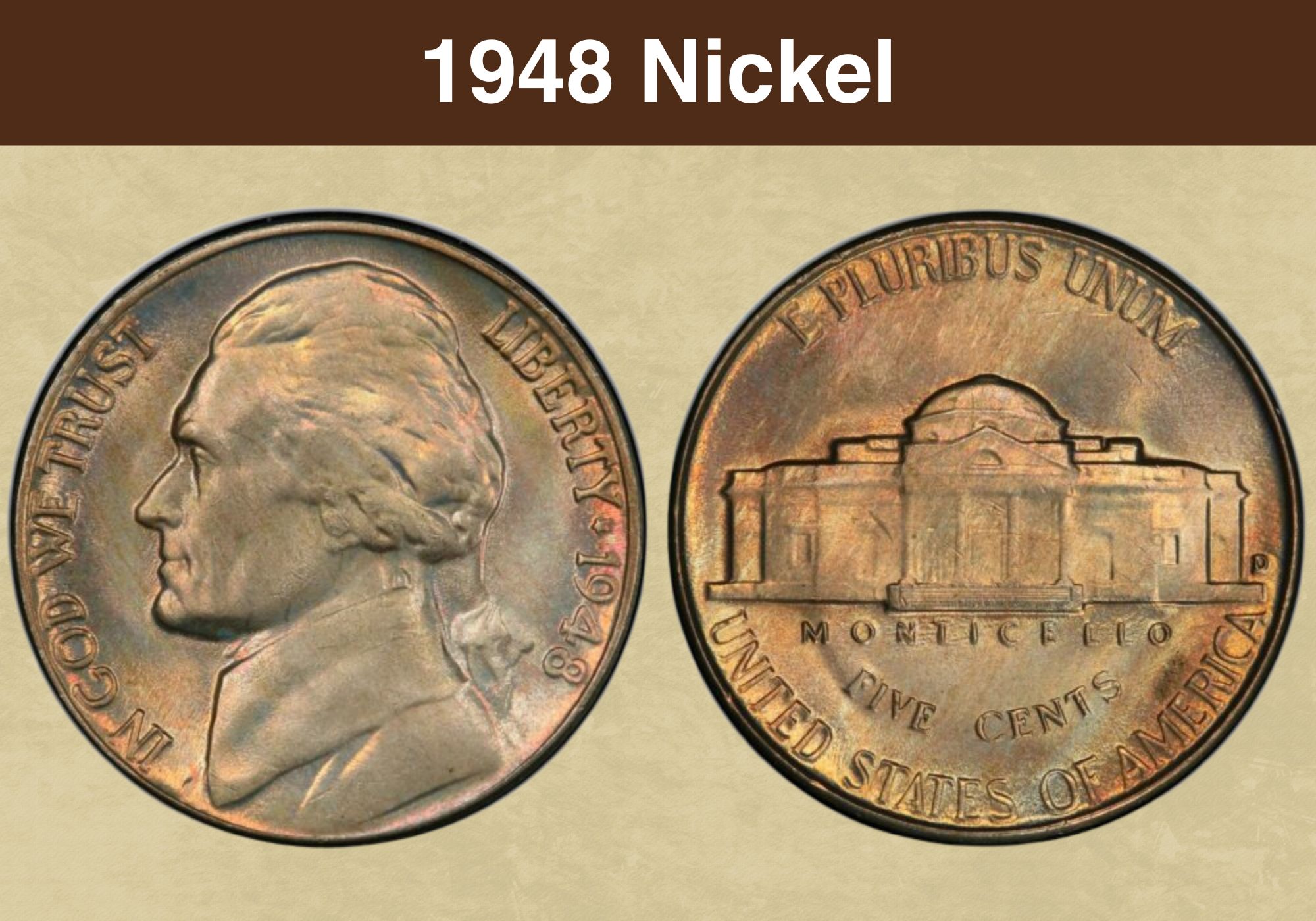
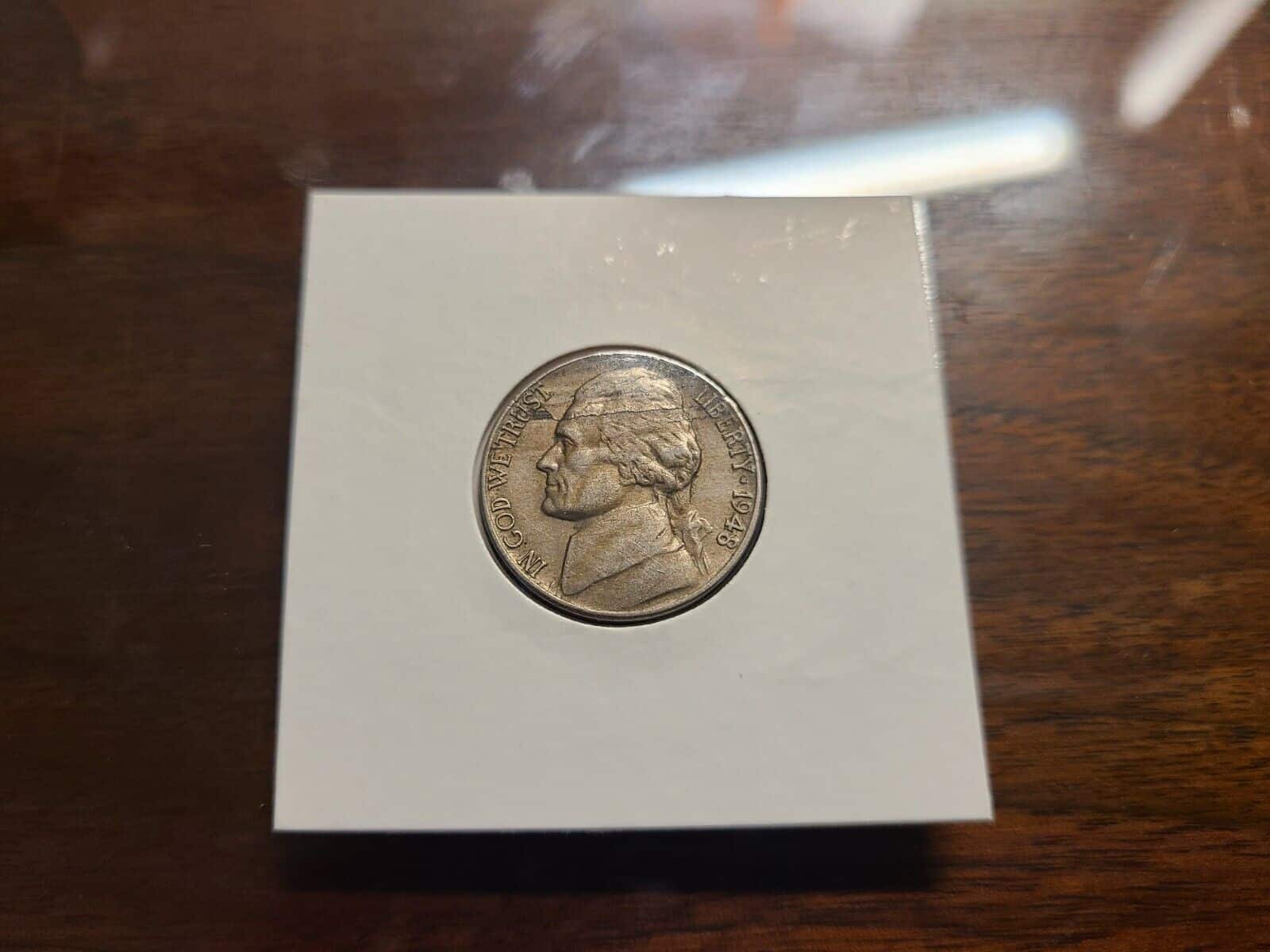
The 1948 Jefferson nickel obverse side
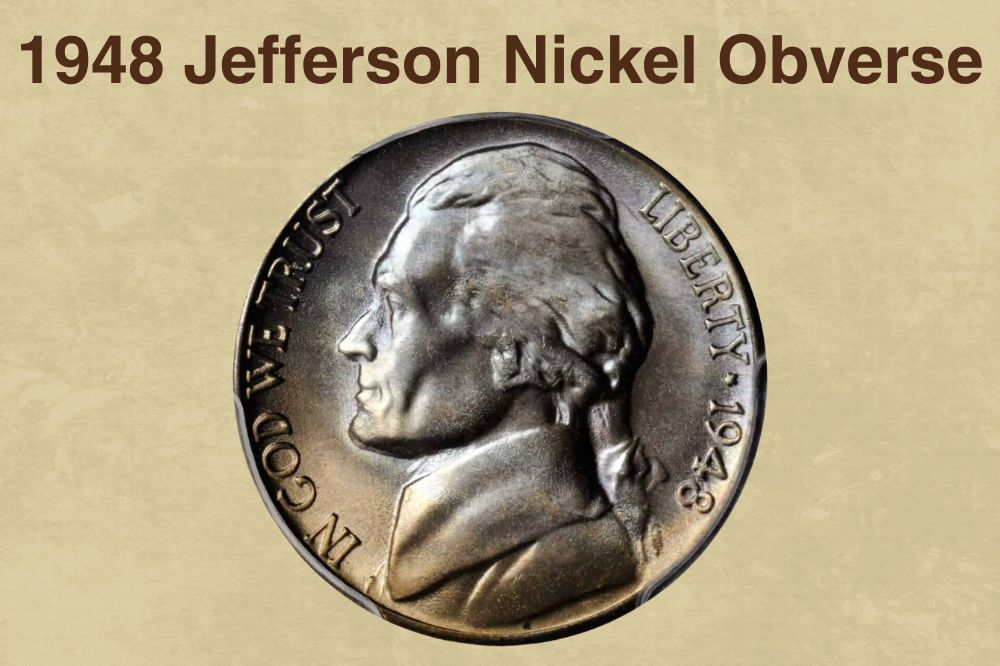
The obverse of the 1948 nickel shows the left-facing profile of Thomas Jefferson, one of the Founding Fathers. His image was based on Jean-Antoine Houdon’s sculpture kept at the Boston Museum of Fine Arts.
Besides the 3rd American President’s bust, you can also read inscriptions, IN GOD WE TRUST and LIBERTY ★ the date. They are struck along the nickel rim surrounding the central figure.
The 1948 Jefferson nickel reverse side
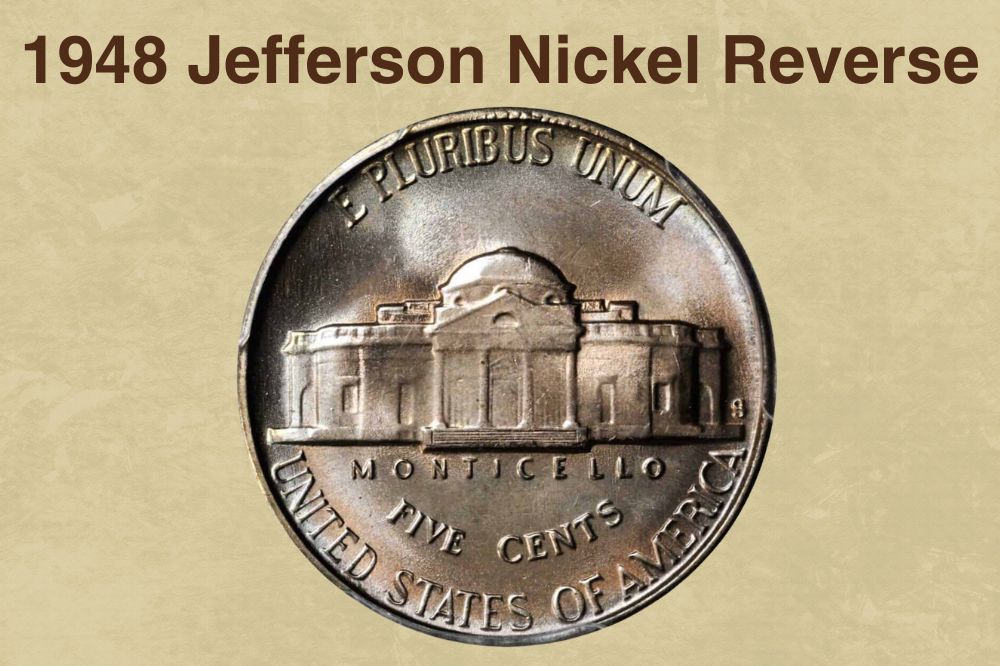
Unlike the relatively simple obverse, the nickel reverse is complicated and full of inscriptions. You can see a centrally positioned mansion with E PLURIBUS UNUM above. Below the house are its name, MONTICELLO, FIVE CENTS, representing a denomination, and UNITED STATES OF AMERICA along the bottom rim.
Monticello is President Jefferson’s residence of high historical importance. The crucial part for collectors is the stairs in front of the building, determining each coin price. The most appreciated are nickels with 5 to 6 stairs, as the designer envisioned.
Unfortunately, poor striking makes these stairs barely visible on most coins. Therefore, you can find pieces with only three or four steps, making them less collectible but more affordable.
1948 nickel (Jefferson) Details |
|
| Face value | Five cents ($0.05) |
| Shape | Round |
| Compound | 75% copper – 25% nickel |
| Coin diameter | 0.83504 inches (21.20 mm) |
| Coin weight | 0.17637 ounces (5 g) |
| Edge | Plain |
| Coin thickness | 0.07677 inches (1.95 mm) |
Other features of 1948 Jefferson nickels
The 1948 Jefferson nickel is a five-cent round coin with a plain edge. This piece containing copper and nickel weighs 0.17637 ounces (5 g). You can expect them to be thick 0.07677 inches (1.95 mm), and has a diameter of 0.83504 inches (21.20 mm).
Also read: Top 17 Most Valuable Buffalo Nickel Worth Money
1948 Jefferson Nickel Grading
Using the Sheldon grading system is the quickest and most reliable option to grade your 1948 nickel. That way, you can estimate its value based on given descriptions, ranking your coin from 1 to 70. Remember that only those graded GOOD or above are collectible while MS-ranking nickels are the most valuable
| # | Grade |
|---|---|
| 1 | Basal State-1 |
| 2 | Fair |
| 3 | Very Fair |
| 4, 5, 6 | Good |
| 7, 8, 10 | Very Good |
| 12, 15 | Fine |
| 20, 30 | Very Fine |
| 40 | Extremely Fine |
| 50 | About Uncirculated |
| 60 | Mint State |
| 65 | Mint State |
| 70 | Mint State |
Please check our grading guides to know your coin scale, It’s the necessary step to know the exact value of your coin.
Check out now: How to Grade Jefferson Nickel?
1948 Nickel Value Guides
Mints in charge of the 1948 Jefferson nickel production made 145,382,000 coins from regular strikes. No proofs were minted this year, like in all years from 1943 to 1949.
1948 No Mint Mark nickel Value
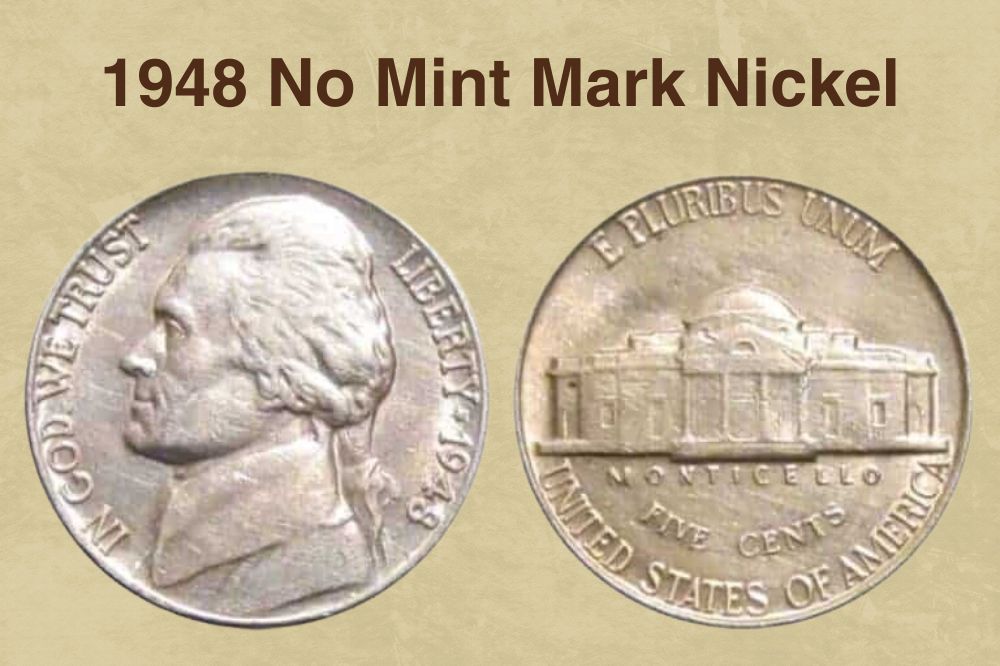
Official data shows that the Philadelphia mint struck 89,348,000 No Mint mark nickels in 1948. Since many of these coins have survived the last decades, you can purchase one that spent years in circulation for $0.30 to $0.70.
Even though coins in the mint state are not particularly expensive, they are worth more than their face value. Dealers offer most such 1948 nickels for $0.75 to $35.
However, there are a few exceptions. For instance, nickels minted this year with the MS 67 grade are rare and can be worth approximately $1,300. The priciest specimen was sold at Great Collections in 2014 for $1,650.
1948 D nickel Value
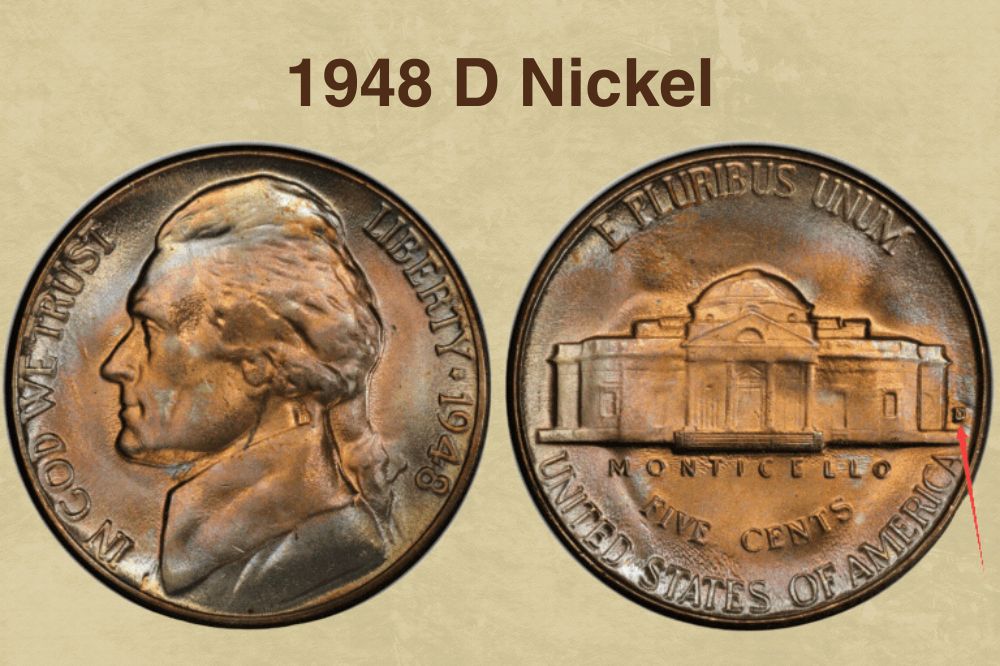
The mintage of 44,734,000 coins was the second highest in 1948. Nickels produced in Denver came with the D mint mark and are considered abundant on the market. Therefore, their prices are modest, and you can buy a circulated specimen for $0.40 to $1.50.
The things are similar when you want to add a perfectly-preserved coin to your collection. Most are affordable and worth $2 to $22. Only MS 67-ranked nickels cost about $275.
Even the most valuable coin with the D mint mark is inexpensive compared to those minted in the other two mints. One collector purchased it for $867 at Stack’s Bowers on February 17, 2014.
1948 S nickel Value
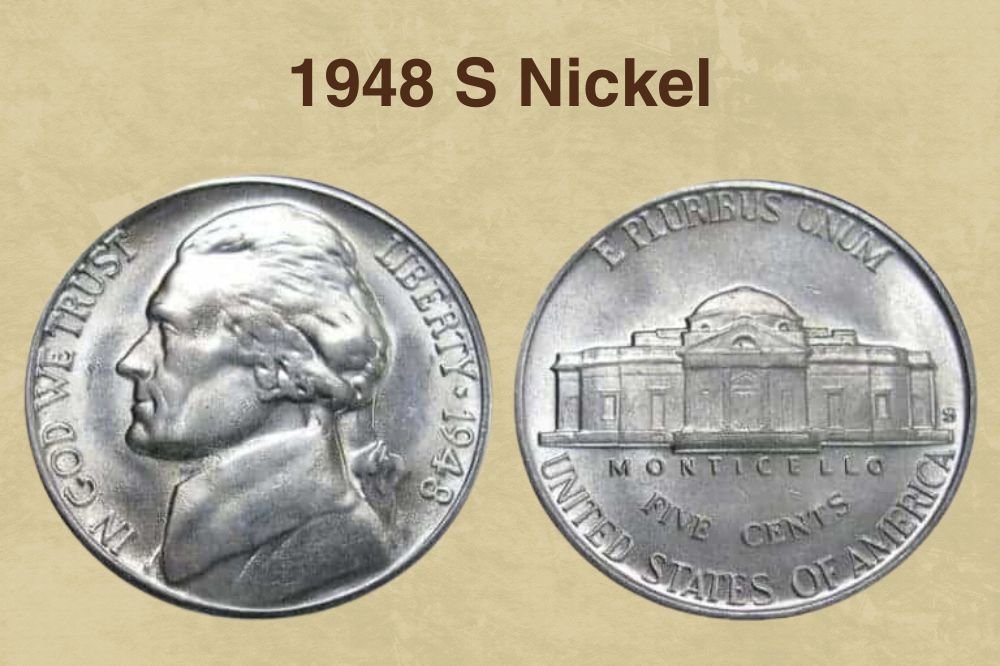
Despite a low mintage of 11,300,000 nickels, the 1948 S pieces are relatively affordable. For instance, the price of circulated coins is $0.25 to $1, while those in the mint state cost a bit more. You should set aside only a few bucks for any of these coins, like:
- $1.75 for the MS 60-graded 1948 nickel
- $2 for the MS 61-graded 1948 nickel
- $4 for the MS 62-graded 1948 nickel
- $6 for the MS 63-graded 1948 nickel
- $14 for the MS 64-graded 1948 nickel
- $17 for the MS 65-graded 1948 nickel
- $26 for the MS 66-graded 1948 nickel
- $250 for the MS 67-graded 1948 nickel
Paradoxically, one nickel produced this year in San Francisco is worth more than record-paying specimens from other mints. One collector set aside $2,240 on October 26, 2021, to get one rare piece in MS 68 grade.
Also read: Top 17 Most Valuable Jefferson Nickels Worth Money
Rare 1948 Jefferson Nickel Error List
Most nickel errors are worth more than the denomination struck on their obverse. Collectors consider 1948 nickels with minting flaws highly desirable, so you can expect them to be more costly than regular pieces.
Full Steps
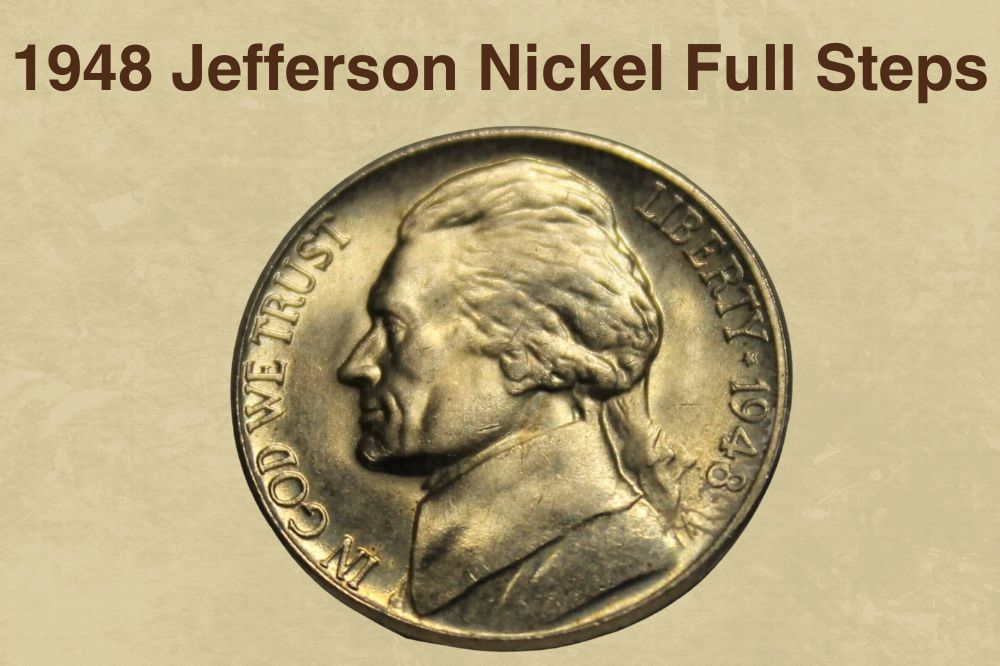
The 1948 nickels with Full Steps are not error coins but a variety. They actually look the way the original design was meant to be. In other words, you can see five to six steps in front of the building on the reverse.
In most other coins, they are poorly struck, barely visible, and often look smudged. That is why these relatively rare varieties are precious for collectors and cost more than regular coins. For instance, specimens in the mint state but of lower quality typically cost $22 to $300.
The highest prices of approximately $2,000 are reserved for MS 67-ranking specimens. However, the best-paid Jefferson nickel with Full Steps feature is with the MS 66 grade. It was sold at $4,800 in 2021.
Interestingly, the 1948 D nickels FS are less desirable, and you can find them at a price range from $11 to $350. On the other hand, one collector bought the 1948 D MS 67 FS Jefferson nickel for an impressive $6,325 at American Numismatic Rarities in 2006.
The things with the 1948 S FS nickels are a bit complicated because you can buy one such coin in MS 64 for only $12, while those with MS 67 ranking are often worth about $800. On the other hand, one of these nickels became the most expensive in the set after selling at $12,000 in 2021.
Re-punched mint mark
The 1948 nickel with this error is relatively uncommon and appeared during the minting process when the mint mark was punched two, rarely three times. The goal was to make the letter look correct when the first attempt resulted in a slanted or inverted one.
Such coins are more valuable than those without such an imperfection, with an average price of $7 to $15. The rule of thumb is that the price is higher when the re-punching is more dramatic.
Off-center (1948 S nickel)
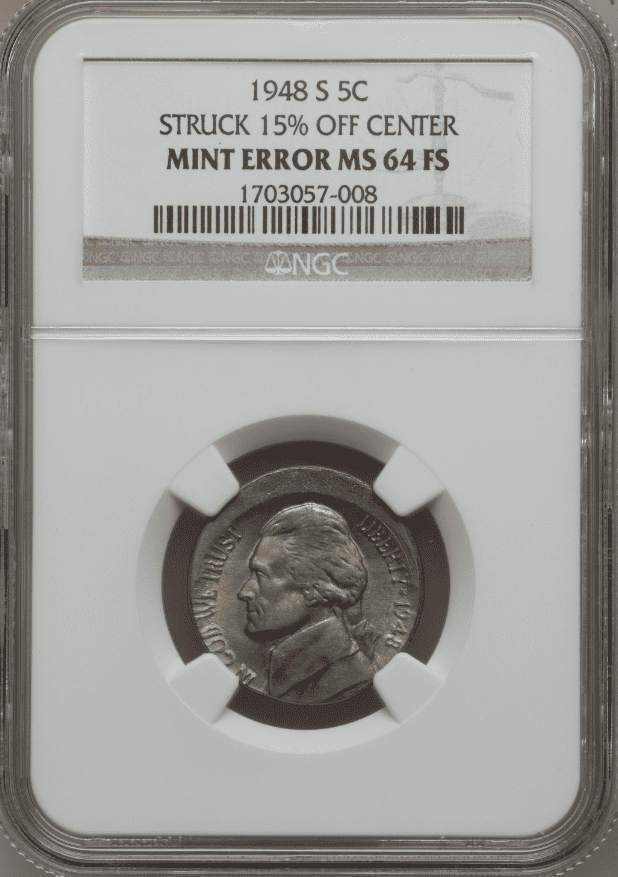
The minting process implies that coins are placed at the die center, ensuring a well-positioned design. When it moves for any reason, the result is an off-center design with a half-moon-looking blank area on the coin surface.
The 1968 nickels with 5% to 10% off-center design are common and cost approximately $3 to $10. On the other hand, those with 50% off-center and visible minting year are often worth over $75.
Die crack and die break
When the die cracks or breaks, it leaves an unintentionally raised area on the struck coin. You can notice a raised line on its surface that increases your nickel value to a few dollars. However, pieces with significant imperfection can cost up to $100.
Doubled die
When an incorrectly aligned die transferred the coin design to the blank planchet, the result was a coin with this error. In such a case, parts of its design (image and-or letters) looked slightly doubled.
The most famous doubled die error among these nickels is doubling on President’s eye, creating a distinctive aesthetic effect. Such a coin is worth $25 to $50.
Lamination error
Despite the name, the 1948 Jefferson nickels contain a copper and nickel combination. Correctly combined metals remain stable, but sometimes metal sheets come with manufacturing errors, including a badly tainted or improperly mixed alloy.
Such a situation leads to coins with a lamination error resulting from the metals split inside the nickel. You can recognize them by sizable raised or recessed areas on their surfaces. The expected price for these pieces typically ranges from $5 to $50.
Also read: 14 Most Valuable Nickel Errors Worth Money
Where to Sell Your 1948 Jefferson Nickel ?
Now that you know the value of your coins, do you know where to sell those coins online easily? Don’t worry, I’ve compiled a list of these sites, including their introduction, pros, and cons.
Check out now: Best Places To Sell Coins Online (Pros & Cons)
FAQ about 1948 Jefferson Nickels
When are 1948 Jefferson nickels considered rare?
Since three mints had a high mintage in 1948, coins produced this year are pretty common nowadays. However, this year is known for a few exciting errors that can be pretty valuable.
Are there 1948 Jefferson nickels worth a lot?
- $12,000 for the 1948 S MS 67+ FS Jefferson nickel on April 25, 2021, at David Lawrence RC
- $6,325 for the 1948 D MS 67 FS Jefferson nickel on August 11, 2006, at American Numismatic Rarities
- $4,800 for the 1948 MS 66 FS Jefferson nickel on August 25, 2021, at Stack’s Bowers
- $2,240 for the 1948 S MS 68 Jefferson nickel on October 26, 2021, on eBay
- $1,650 for the 1948 MS 67 Jefferson nickel on March 2, 2014, at Great Collections
- $867 for the 1948 D MS 67 Jefferson nickel on February 17, 2014, at Stack’s Bowers
What is the 1948 Jefferson nickel (No Mint mark) average price?
The lowest-graded 1948 Jefferson nickels without the mint mark are typically worth $0.30 to $0.70. Excellently preserved ones cost $0.75 to $35, but you should consider that MS 67-ranking coins are rare and cost approximately $1,300.
What are the costliest Jefferson nickels you can find on the market?
- $35,250 for the 1954 S MS 67 nickel (FS)
- $33,600 for the 1969 D MS 65 nickel (FS)
- $33,600 for the 1938 D MS 68+ nickel (FS)
- $32,900 for the 1964 SMS SP 68 nickel (FS)
- $32,900 for the 1949 D MS 67 nickel (D/S)
- $32,200 for the 1942 D MS 64 nickel (D/Horizontal D)
- $28,750 for the 1940 PR 68 nickel (Reverse of 1938)