1942 Nickel Coin Value (Errors List, “D”, “S”, “P” & No Mint Mark Worth)

1942 Nickel

Not every 1942 nickel is the same. That year, Congress authorized a mid-year switch from the regular copper-nickel composition to a 35% silver alloy, creating two completely different types of nickels with the same date.

The difference? Regular 1942 nickels trade for under a dollar in most grades. But the silver versions—marked with a large P or S above Monticello—start at $1.50 in decent shape and climb to over $100 for high-grade pieces with full steps. Some rare varieties have sold for over $32,000.

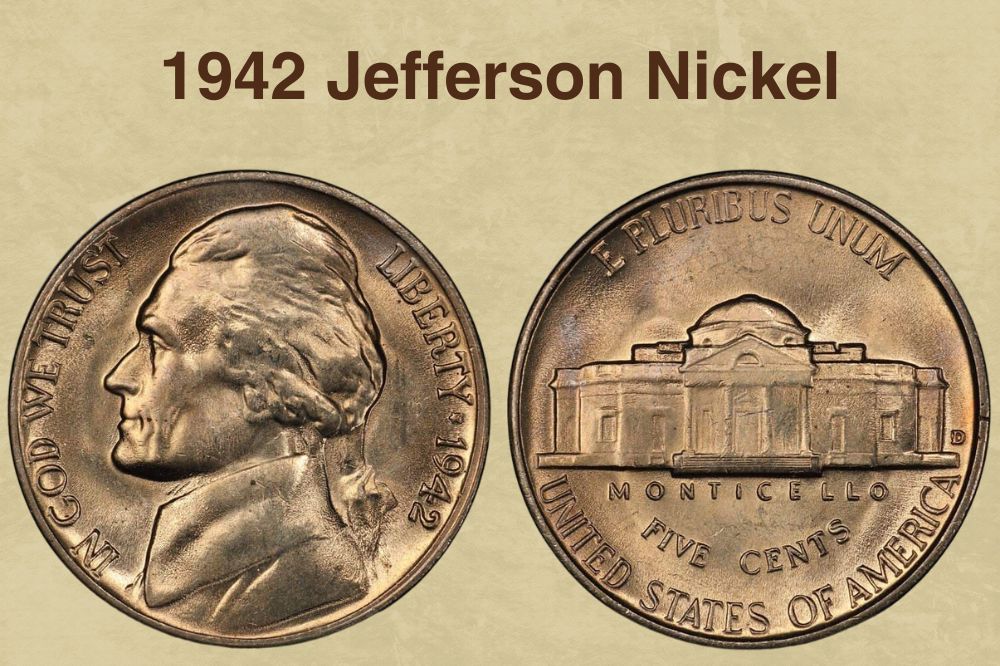
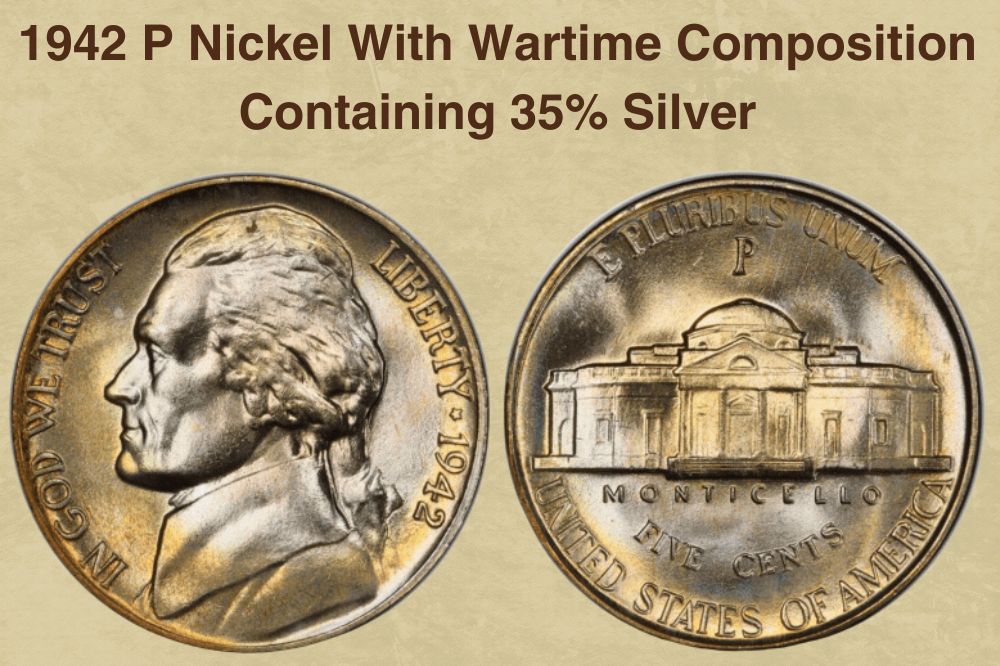
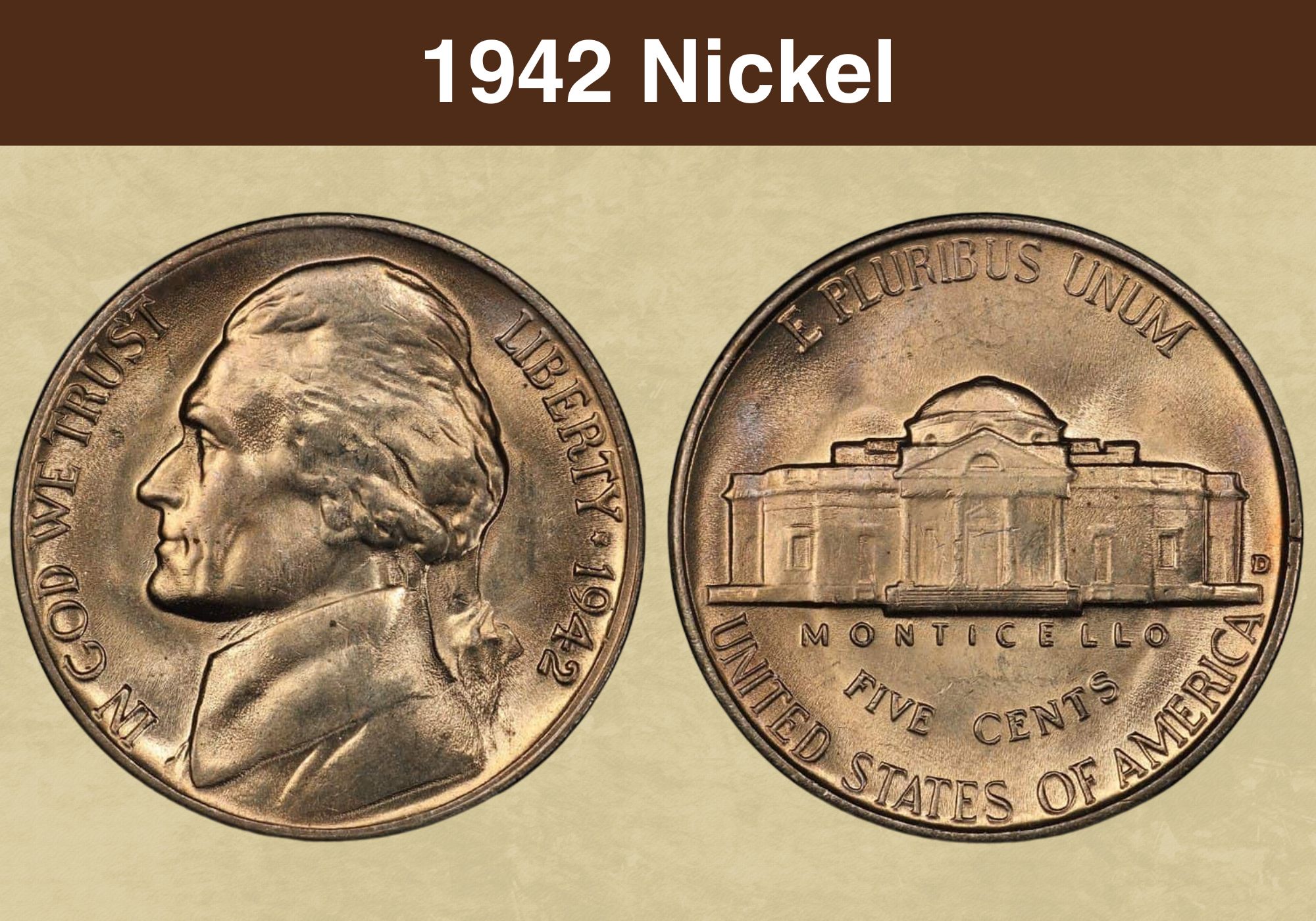
Check the back of your 1942 nickel. A large P or S above the building means you’ve got silver. A small D to the right, or no mintmark at all, means it’s the regular type. Let’s break down what each one is worth.


1942 Nickel Value By Variety

Here’s the breakdown by type and grade. If you know the grade of your coin, you can find the exact price below in the Value Guides section.

1942 Nickel Value Chart

TYPEGOODFINEAUMSPR
1942 No Mint Mark Nickel Value$0.84$1.17$3.50$19.50
1942 No Mint Mark Nickel (FS) Value$0.84$2.87$7.35$115.00
1942 D Nickel Value$0.97$5.83$12.50$40.67
1942 D Nickel (FS) Value$1.68$5.74$14.70$105.14
1942 S Nickel Value$1.07$2.17$3.50$25.29
1942 S Nickel (FS) Value$0.53$1.83$4.68$129.43
1942 P Silver Nickel Value$0.97$1.00$1.50$16.17
1942 P Silver Nickel (FS) Value$0.69$2.35$6.01$37.33
1942 Proof Nickel Value$12.50$74.57
1942 CAM Nickel Value$2460.00
1942 P Silver Proof Nickel Value$30.50$422.00
1942 P Silver CAM Nickel Value$1218.33
1942 P Silver DCAM Nickel Value$1020.00
Updated: 2026-01-08 06:01:24

Also Read: Top 100 Most Valuable Jefferson Nickels Worth Money List (1938-Present)


Top 10 Most Valuable 1942 Nickel Worth Money

Most Valuable 1942 Nickel Chart

2003 - Present

The 1942-D/D over horizontal D variety dominates the value chart, with top-graded examples reaching over $32,000. Lower grades of this same error still command $12,075 to $30,550 depending on condition and Full Steps designation—showing how much preservation matters for error coins.

High-grade silver proofs and regular Type 1 nickels also bring substantial returns. The 1942-P silver proof in PR 68 grade reaches $12,600, while regular Type 1 nickels in MS 67 condition sell for $11,500. The 1942 Nickel PR 68 regular proof commands $16,450, demonstrating strong collector demand for pristine specimens.

The pattern is clear: exceptional preservation combined with either mint errors or proof finishes drives values into five figures. Grade differences of just one or two points can mean thousands of dollars in value.


History of The 1942 Nickel

The Jefferson nickel entered production in 1938, replacing the Buffalo nickel with Felix Schlag’s design featuring Thomas Jefferson and Monticello. Just four years later, World War II forced a fundamental change to the coin’s composition.

On March 27, 1942, Congress authorized the Mint to replace nickel with alternative metals in five-cent coins. The challenge was finding an alloy that conserved strategic war materials while maintaining the same weight and electrical properties required for vending machines across the country. Any composition change that disrupted vending machine operations would have been impractical.

After several months of testing, metallurgists settled on an alloy of 56% copper, 35% silver, and 9% manganese. Silver nickel production began in October 1942, creating the year with two distinct composition types. Coins struck early in the year used the standard copper-nickel alloy that had been in place since 1866. Those minted from October onward contained the new silver composition.

To make the silver nickels easily identifiable, the Mint placed large mintmarks above Monticello—marking the first appearance of the P mintmark on any U.S. coin. The silver composition continued through 1945 before reverting to the original 75% copper, 25% nickel formula in 1946.

Also Read: Top 60+ Most Valuable Buffalo Nickels Worth Money


Is You 1942 Nickel Rare?

23

1942 No Mint Mark Nickel

Uncommon
Ranked 143 in Jefferson Nickel
28

1942 No Mint Mark Nickel (FS)

Scarce
Ranked 83 in Jefferson Nickel
19

1942-D Nickel

Uncommon
Ranked 225 in Jefferson Nickel
21

1942-D Nickel (FS)

Uncommon
Ranked 161 in Jefferson Nickel
22

1942-S Nickel

Uncommon
Ranked 152 in Jefferson Nickel
29

1942-S Nickel (FS)

Scarce
Ranked 68 in Jefferson Nickel
20

1942-P Silver Nickel

Uncommon
Ranked 172 in Jefferson Nickel
27

1942-P Silver Nickel (FS)

Scarce
Ranked 103 in Jefferson Nickel
28

1942 Proof Nickel

Scarce
Ranked 81 in Jefferson Nickel
85

1942 CAM Nickel

Divine
Ranked 7 in Jefferson Nickel
28

1942-P Silver Proof Nickel

Scarce
Ranked 80 in Jefferson Nickel
81

1942-P Silver CAM Nickel

Mythic
Ranked 9 in Jefferson Nickel
87

1942-P Silver DCAM Nickel

Divine
Ranked 4 in Jefferson Nickel

Want to know exactly where your coin ranks? Our CoinValueChecker App gives you the rarity score in seconds.


Key Features of The 1942 Nickel

The 1942 Jefferson nickel features design elements that help collectors identify different varieties and distinguish between the two composition types produced that year.

The Obverse Of The 1942 Nickel

The Obverse Of The 1942 Nickel

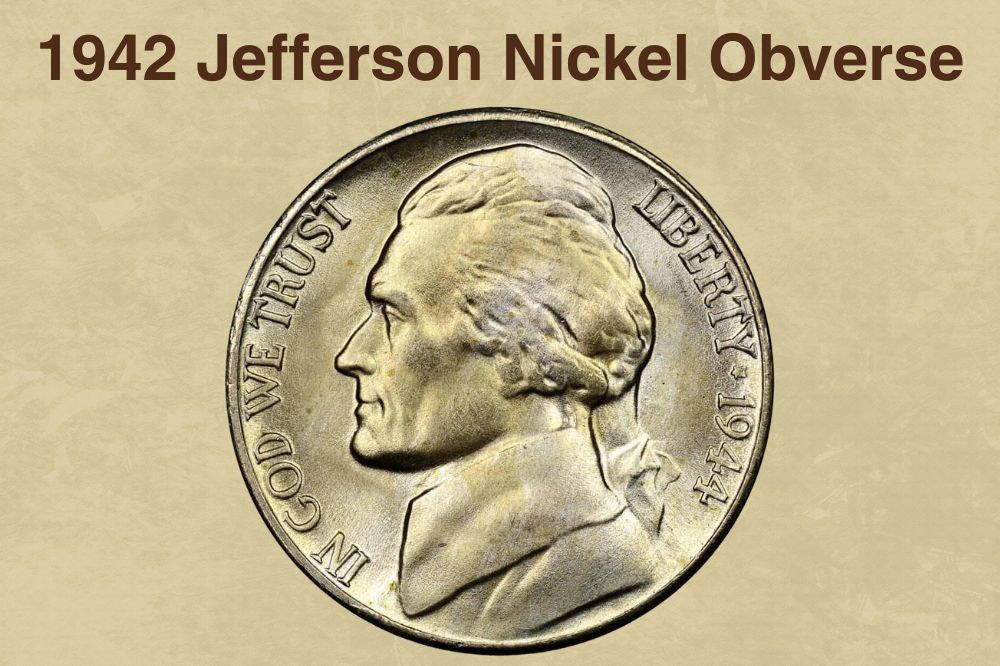
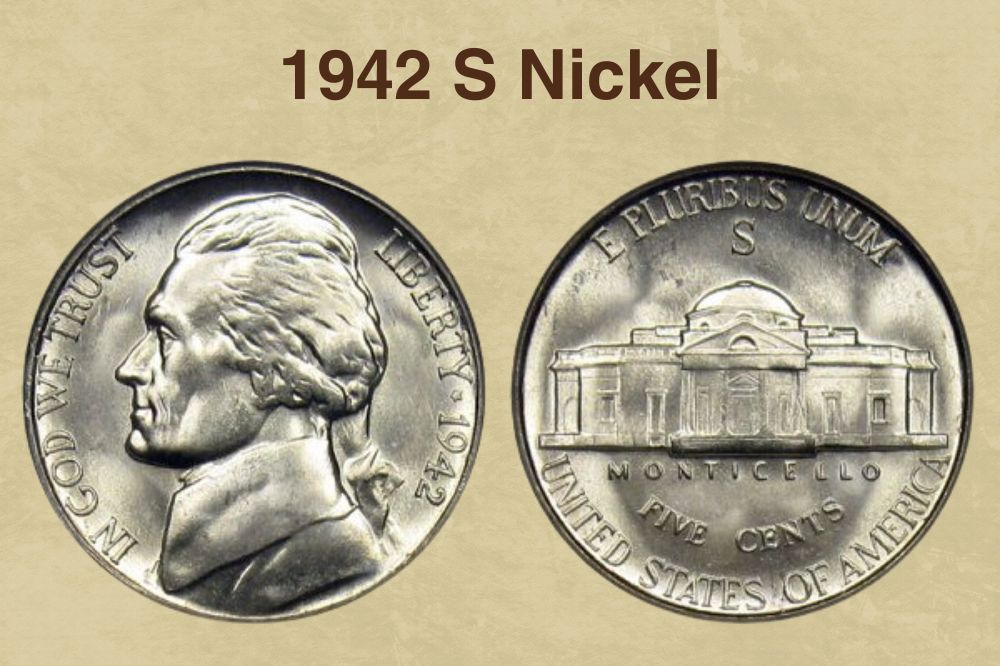
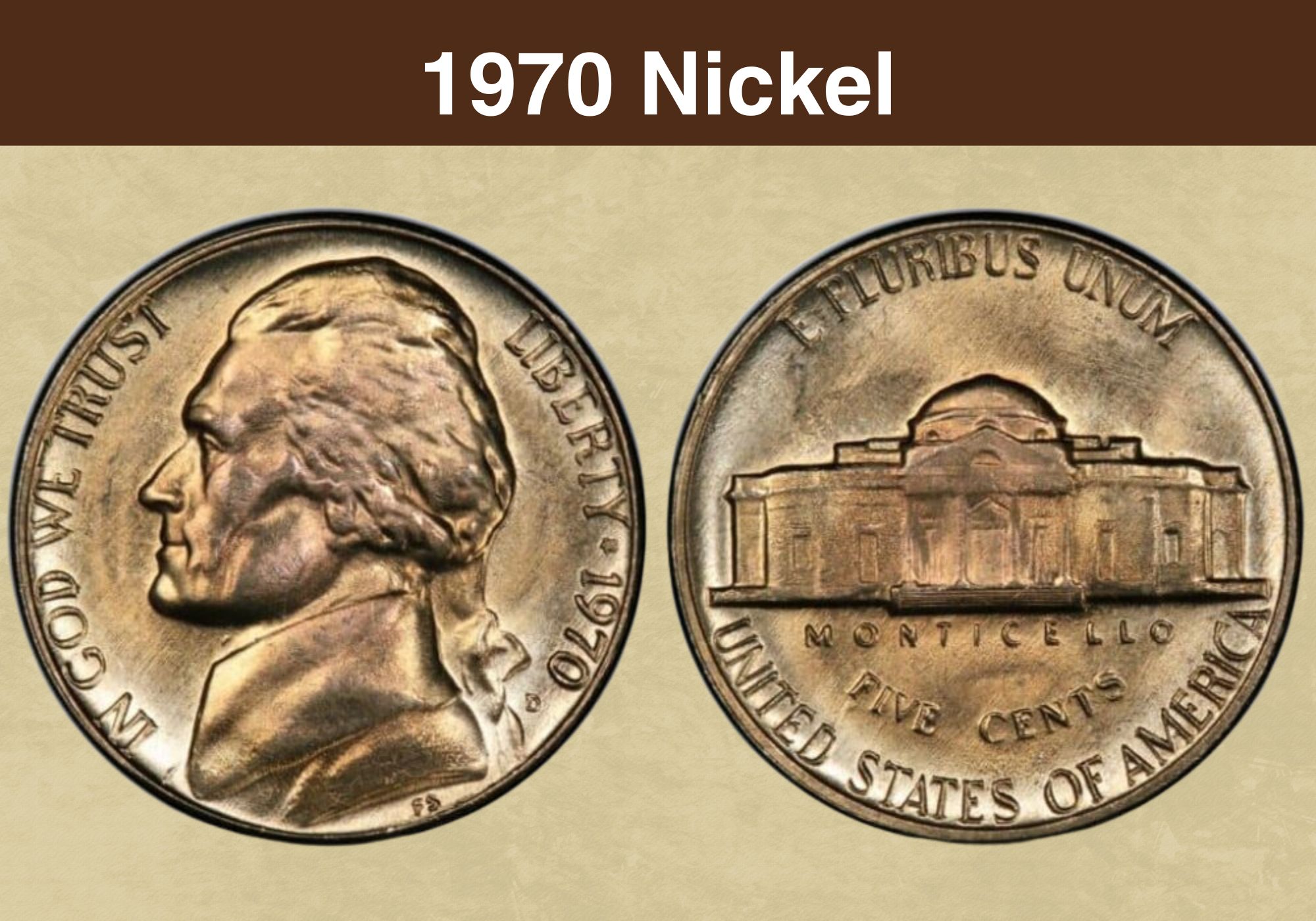
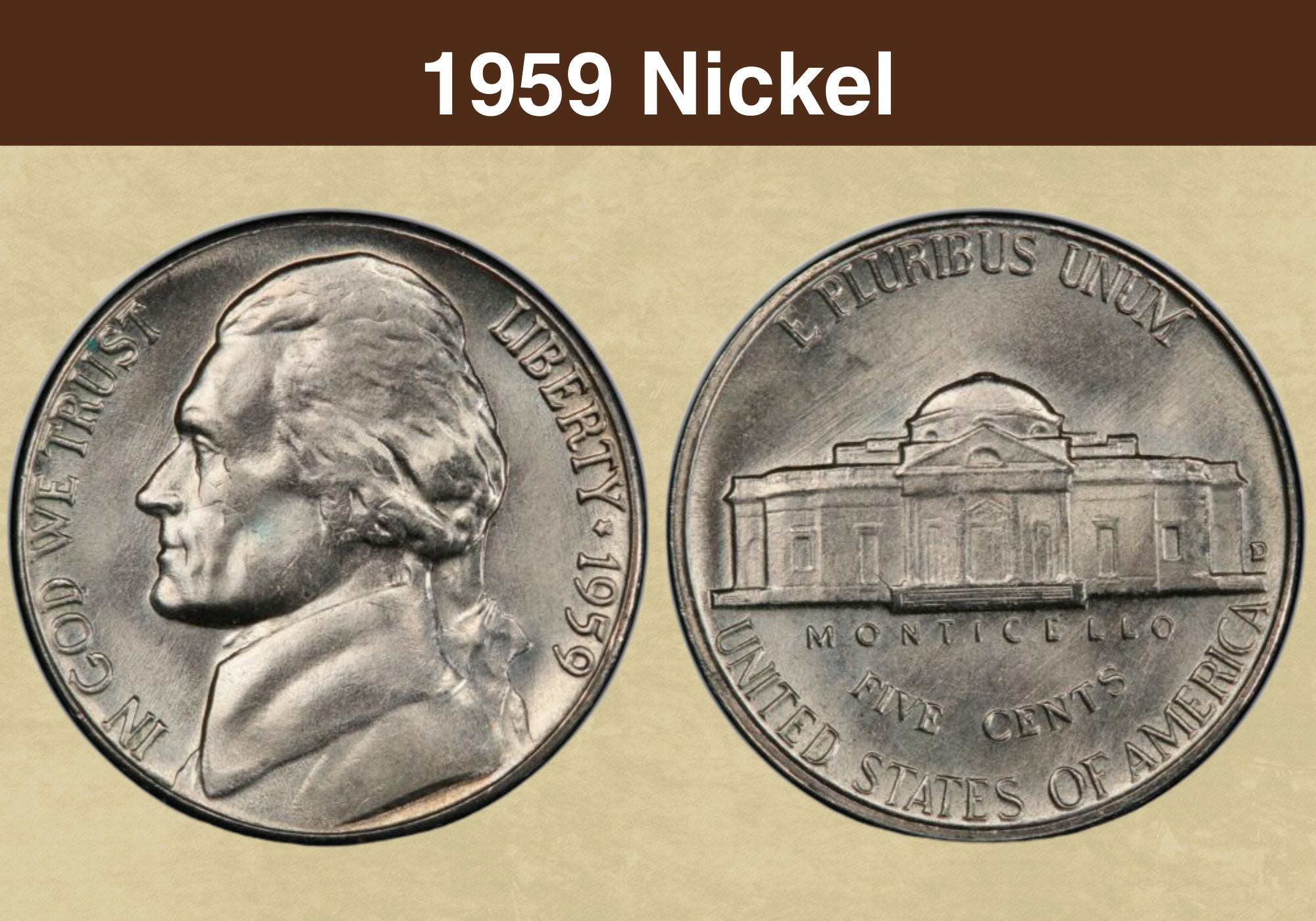
The obverse displays a left-facing portrait of Thomas Jefferson wearing a coat and wig representative of the colonial period. The motto “IN GOD WE TRUST” appears to the left of the portrait, while “LIBERTY” and the date “1942” are positioned to the right, separated by a small five-point star.

The Reverse Of The 1942 Nickel

The Reverse Of The 1942 Nickel

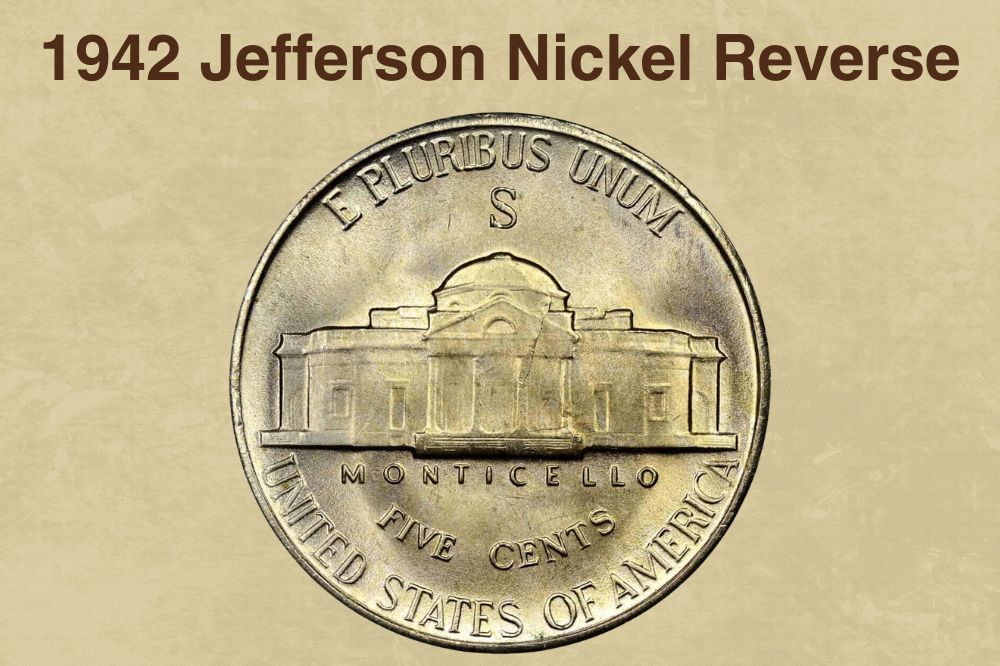
The reverse shows an elevation view of Monticello, Jefferson’s Virginia estate, with the word “MONTICELLO” beneath the building. The motto “E PLURIBUS UNUM” curves along the top rim, while “UNITED STATES OF AMERICA” follows the bottom curve, with “FIVE CENTS” appearing between the building and bottom inscription.

On silver wartime nickels, a large mintmark (P, or S) is placed prominently above Monticello—marking the first use of the “P” mintmark on any U.S. coin. Regular copper-nickel nickels show a small D to the right of Monticello, or no mintmark for Philadelphia issues.

Other Features Of The 1942 Nickel

Composition: Regular 1942 nickels contain 75% copper and 25% nickel. Silver wartime nickels contain 56% copper, 35% silver, and 9% manganese. Both types weigh 5 grams with a 21.2mm diameter.

Appearance: Silver nickels have a duller, grayish tone and may show signs of toning with rainbow or dark patches. Regular nickels maintain the typical copper-nickel appearance.

Full Steps: Collectors prize specimens showing all six steps of Monticello clearly defined. These “Full Steps” examples command significant premiums.

Also Read: Top 100 Rarest Nickels Worth Money (Most Expensive)


1942 Nickel Mintage & Survival Data

1942 Nickel Mintage & Survival Chart

Mintage Comparison

Survival Distribution

TypeMintageSurvivalSurvival Rate
No Mint49,789,00025,000,00050.2119%
D13,938,0007,000,00050.2224%
S32,900,0003,300,00010.0304%
P57,873,0006,000,00010.3675%
Proof 29,60023,00077.7027%
CAM29,600750.2534%
P Silver Proof27,60022,00079.7101%
P Silver CAM27,6001000.3623%
P Silver DCAM27,600500.1812%

The 1942 series shows wide variation in mintage and survival rates across different types. Regular copper-nickel issues account for the largest numbers: Philadelphia struck 49,789,000 pieces without mintmark, while Denver contributed 13,938,000 marked with D. San Francisco’s 32,900,000 pieces fall in the middle range among regular strikes.

Silver wartime nickels from Philadelphia total 57,873,000—the highest single mintage of any 1942 type. However, their survival rate of just 10.37% means only about 6 million examples remain today, compared to 25 million surviving Philadelphia regular strikes.

The proof and collector categories show different results. Regular proof nickels had a mintage of 29,600 with a 77.70% survival rate, while CAM versions show only 75 surviving specimens from the same mintage—a mere 0.25%. Silver proof variants follow similar trends: 27,600 minted with 22,000 surviving, but CAM and DCAM examples number just 100 and 50 respectively.

These survival rates directly affect current market availability and pricing across the series.

Also Read: Jefferson Nickel Value (1938-Present)


The Easy Way to Know Your 1942 Nickel Value

To know your 1942 nickel value, first check the mintmark: large P, or S above Monticello indicates a 35% silver wartime nickel worth more than regular copper-nickel pieces. Silver versions appear brighter white when new or develop a greenish tone. Examine the coin’s condition—circulated pieces start at $1-3, while uncirculated examples reach $80-260 or higher.

Look for rare errors like repunched mintmarks that significantly increase value. For instant, accurate assessment, use our CoinValueChecker App to identify grade, detect errors, and get real-time market pricing.

CoinValueChecker APP Screenshot


1942 Nickel Value Guides

The 1942 Nickel comes in nine distinct varieties:

  • 1942 No Mint Mark Nickel: Philadelphia, copper-nickel
  • 1942-D Nickel: Denver, copper-nickel
  • 1942-S Nickel: San Francisco, copper-nickel
  • 1942-P Silver Nickel: Philadelphia, wartime silver
  • 1942 Proof Nickel: Collector proof, copper-nickel
  • 1942 CAM Nickel: Cameo proof, copper-nickel
  • 1942-P Silver Proof Nickel: Collector proof, silver
  • 1942-P Silver CAM Nickel: Cameo proof, silver
  • 1942-P Silver DCAM Nickel: Deep cameo proof, silver

The 1942 series splits into two main groups: regular copper-nickel coins and wartime silver issues. Regular strikes trade near face value in circulated condition, while silver versions carry a premium due to metal content. Proof coins were made specifically for collectors and show superior detail and finish. CAM and DCAM designations indicate the level of contrast between frosted designs and mirror surfaces—higher contrast means higher value.

Each type appeals to different collectors, from those seeking affordable silver to specialists targeting rare proof finishes.


1942 No Mint Mark Nickel Value

1942 No Mint Mark Nickel Value

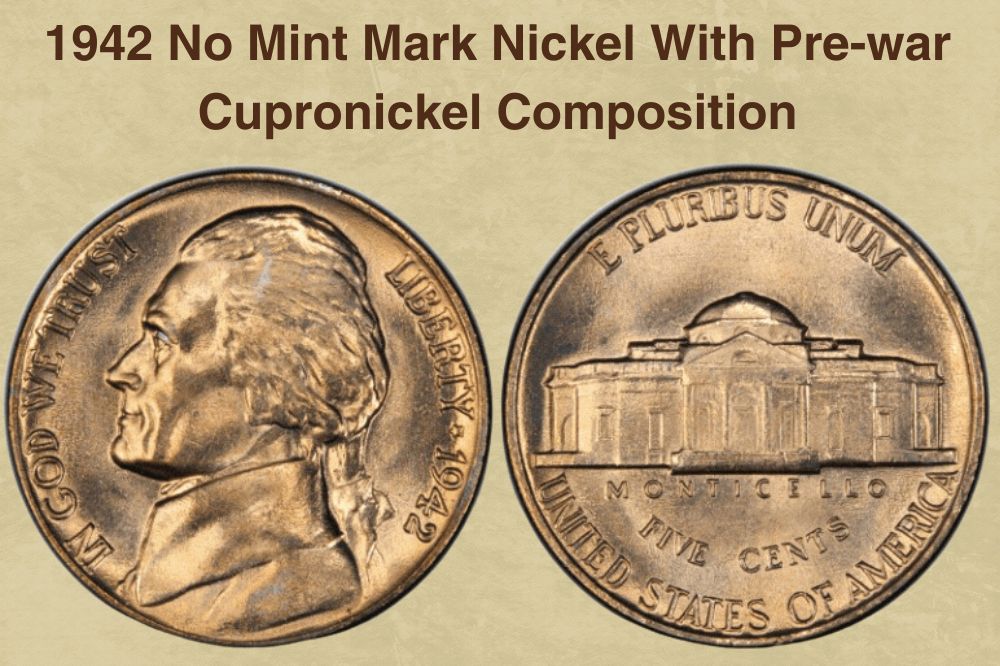
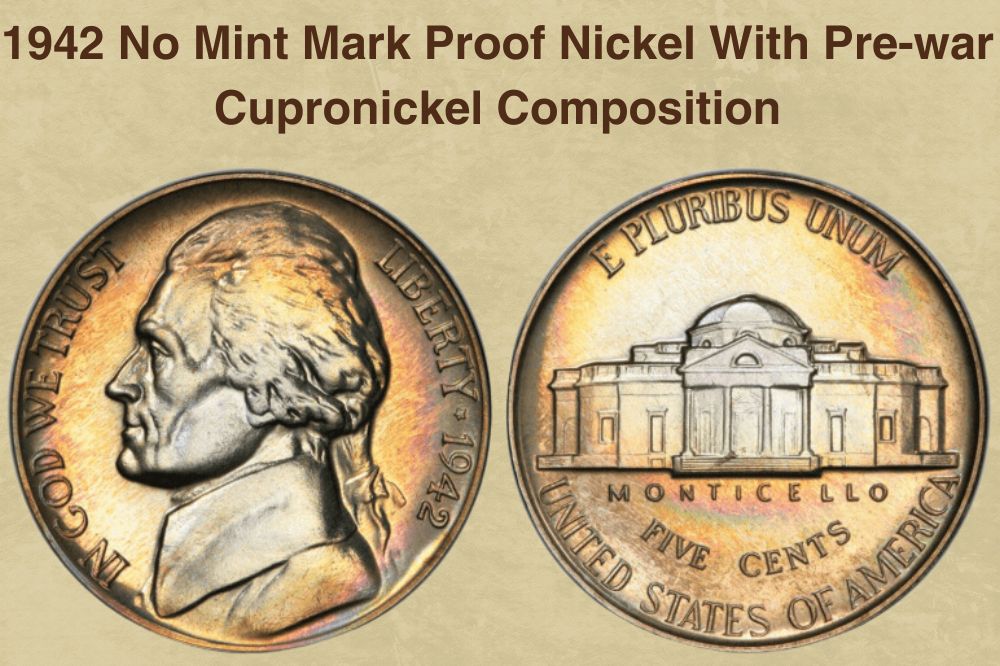
The 1942 no mint mark nickel is the only Philadelphia type without any mintmark. It uses the traditional 75% copper, 25% nickel composition from the early months of 1942, before the October switch to silver.

To identify this circulation strike variety, check both potential mintmark locations on the reverse—no mark to the right of Monticello and no mark above the dome. The coin’s regular strike appearance and typical surface texture distinguish it from proof versions.

Circulated examples trade near face value, while mint state coins start around $1-$5. Prices increase substantially for specimens grading MS-65 or higher. And Full Steps examples—showing all six steps of Monticello clearly defined—can reach into the thousands in top grades.

Most circulated pieces show heavy wear on Jefferson’s cheekbone and Monticello’s steps. Collectors should avoid coins with scratches, cleaning marks, or environmental damage, as these significantly reduce value regardless of technical grade.

1942 No Mint Mark Nickel Price/Grade Chart

Price by 1-70 Grade (Latest Auction Records Included)

Updated: 2026-01-08 06:01:24

1942 No Mint Mark Nickel (FS) Price/Grade Chart

Price by 1-70 Grade (Latest Auction Records Included)

Updated: 2026-01-08 06:01:24

Here are auction records that can give you a clear understanding of its value.

Date PlatformPrice Grade

This variety sees an increasing collector demand as an affordable entry point into the 1942 series.

Market Activity: 1942 No Mint Mark Nickel


1942-D Nickel Value

1942-D Nickel Value

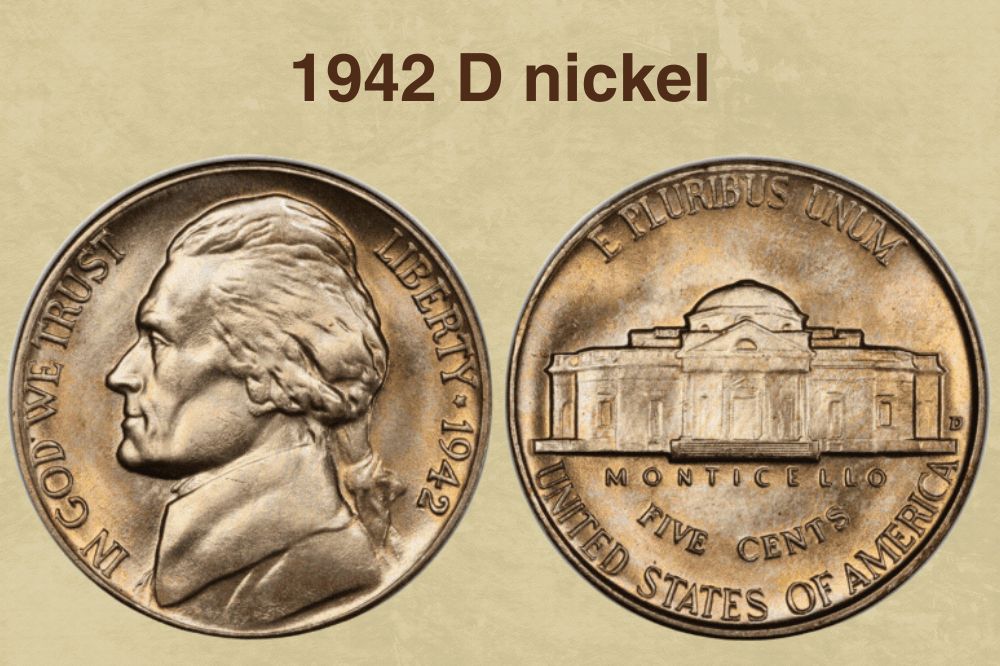
Denver produced only regular copper-nickel nickels throughout 1942, never transitioning to the wartime silver alloy. This contrasts with Philadelphia, which struck both types, and San Francisco, which made exclusively silver versions. The small “D” mintmark appears to the right of Monticello.

Regular circulated 1942-D pieces trade close to face value, making them accessible for new collectors. Mint state examples start around $1-$5 for lower grades, while pieces grading MS-65 and above can reach several hundred dollars.

Condition is the primary value driver for this date, as the coins contain no precious metal content. The record for this issue was set in August 2021 when a Stack’s Bowers auction realized $4,320 for an MS-68 specimen with Full Steps designation, demonstrating the premium collectors place on exceptional preservation.

1942-D Nickel Price/Grade Chart

Price by 1-70 Grade (Latest Auction Records Included)

Updated: 2026-01-08 06:01:24

1942-D Nickel (FS) Price/Grade Chart

Price by 1-70 Grade (Latest Auction Records Included)

Updated: 2026-01-08 06:01:25

Top-graded pieces remain scarce, with the highest certified examples achieving significant multiples over typical mint state coins.

Date PlatformPrice Grade

The market activity chart sees steady demand from both type collectors and those building complete 1942 sets across all three mints.

CoinVaueChecker App 10

Market Activity: 1942-D Nickel


1942-S Nickel Value

1942-S Nickel Value

The large “S” mintmark sits prominently above Monticello’s dome on all 1942-S nickels, marking San Francisco’s entry into wartime production. What distinguishes this issue from other 1942 silver nickels is its preservation quality.

Expert analysis notes that the 1942-S “is one of the better-preserved of all the ‘War’ Nickels. The majority of Mint State survivors are in Gem condition, especially in the MS-65 and MS-66 grades”. This superior strike quality and surface preservation make the 1942-S a preferred choice for collectors building high-grade type sets.

Full Steps versions represent approximately 10% of coins certified to date. The combination of silver content and readily available gem examples creates a practical entry point for those seeking both precious metal value and numismatic appeal without paying significant rarity premiums.

1942-S Nickel Price/Grade Chart

Price by 1-70 Grade (Latest Auction Records Included)

Updated: 2026-01-08 06:01:25

1942-S Nickel (FS) Price/Grade Chart

Price by 1-70 Grade (Latest Auction Records Included)

Updated: 2026-01-08 06:01:25

History auction results provide insight into its market pricing for this date.

Date PlatformPrice Grade

Market patterns over the past year reflect ongoing collector interest in this silver issue.

Market Activity: 1942-S Nickel


1942-P Silver Nickel Value

1942-P Silver Nickel Value

The 1942-P silver nickel holds unique historical significance as the first U.S. circulation coin to bear the Philadelphia “P” mintmark. The large “P” was placed prominently above Monticello’s dome to distinguish silver wartime nickels from their copper-nickel predecessors. For 150 years, Philadelphia had never marked its coins—this wartime change broke that long-standing tradition.

According to Jefferson nickel specialist Bernard Nagengast, 1942-P silver nickels “are always very nice, without the surface roughness of the copper nickel issue. Gems are easy to find”.

The silver alloy produced smoother surfaces than traditional copper-nickel planchets, making high-grade examples readily available. Most uncirculated pieces grade MS-65 or better.

However, coins showing all six steps of Monticello clearly are “very rare,” with Nagengast estimating only 1 in 10 pieces displaying five full steps. In May 2021, an MS-68 specimen realized $5,950 at auction, demonstrating the premium placed on exceptional preservation in this readily available date.

1942-P Silver Nickel Price/Grade Chart

Price by 1-70 Grade (Latest Auction Records Included)

Updated: 2026-01-08 06:01:25

1942-P Silver Nickel (FS) Price/Grade Chart

Price by 1-70 Grade (Latest Auction Records Included)

Updated: 2026-01-08 06:01:25

Major auction houses have documented good results for high-grade specimens.

Date PlatformPrice Grade

Growing recognition of the first P mintmark’s historical significance continues to attract new collectors to this landmark issue.

Market Activity: 1942-P Silver Nickel


1942 Proof Nickel Value

1942 Proof Nickel Value

Philadelphia struck 29,600 proof nickels in 1942 using the traditional copper-nickel composition—the last regular-composition proofs until production resumed in 1950. This eight-year gap occurred because wartime priorities shifted mint resources toward business strikes and military medals, suspending collector coin programs entirely.

Despite the relatively small mintage, approximately 77% of these proofs survive today, making them reasonably accessible compared to other pre-war proof issues. Hand-polished planchets and multiple strikes produced mirror-like surfaces with no mintmark on the reverse—characteristics that distinguish them from both circulation strikes and later silver proofs.

Grade quality drives value, with PR-65 and above specimens commanding two to three times the price of PR-63 examples. As both the final pre-war proof and the last copper-nickel proof for nearly a decade, this date holds a unique position that appeals to Jefferson nickel specialists and transitional-year collectors alike.

1942 Proof Nickel Price/Grade Chart

Price by 1-70 Grade (Latest Auction Records Included)

Updated: 2026-01-08 06:01:25

Grade and surface preservation create significant price variation within the same variety.

Date PlatformPrice Grade

Recent twelve-month trading patterns provide useful context for timing acquisitions and understanding current demand levels.

Market Activity: 1942 Proof Nickel


1942 CAM Nickel Value

1942 CAM Nickel Value

Cameo designations from the 1936-1942 era rank among the scarcest proof varieties in U.S. coinage. The CAM designation requires frosted devices contrasting against mirror fields on both sides—a combination that occurred only during the first few dozen strikes from newly prepared dies.

Authentic cameo contrast shows unbroken white frost on Jefferson’s portrait and Monticello, paired with deep reflective fields. Partial frost or toning can create misleading appearances, but genuine examples display consistent frosting across all raised elements.

Market prices reflect this extreme scarcity. While standard 1942 proofs typically trade around $80-$150, CAM examples command substantial multiples of these values. Documented auction results show PR-66 CAM specimens reaching $5,000, demonstrating premiums of 30-50 times over non-cameo counterparts in similar grades, demonstrating the substantial premium collectors place on this visual rarity.

1942 CAM Nickel Price/Grade Chart

Price by 1-70 Grade (Latest Auction Records Included)

Updated: 2026-01-08 06:01:25

The handful of certified examples that reach auction generate significant collector interest.

Date PlatformPrice Grade

Market activity over the past year provides insight into availability patterns for this scarce variety.

Market Activity: 1942 CAM Nickel


1942-P Silver Proof Nickel Value

1942-P Silver Proof Nickel Value

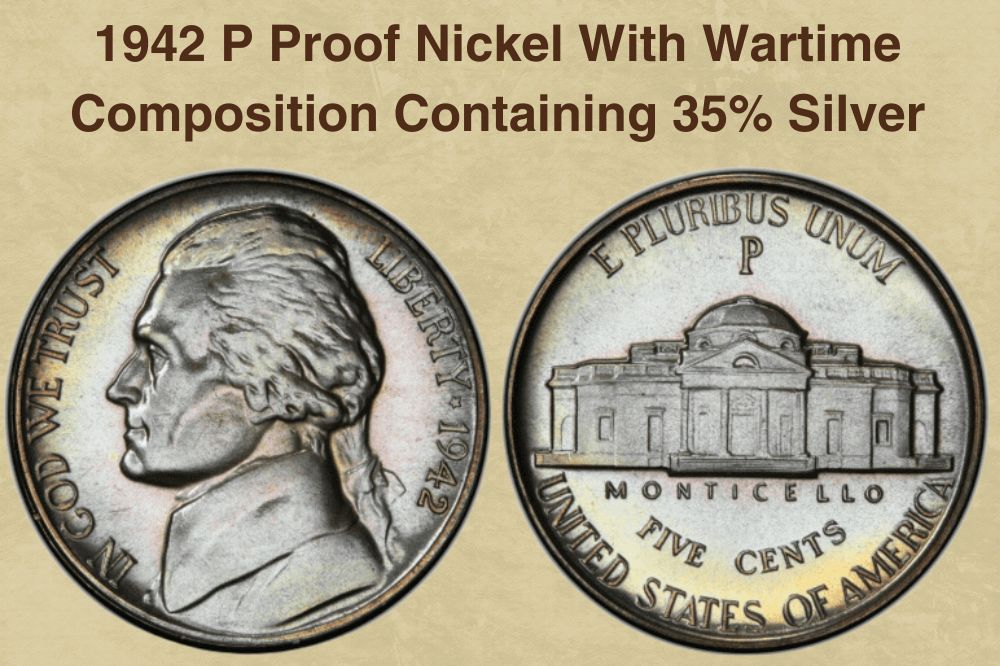
The 1942-P Silver Proof Nickel arrived as an afterthought to the coin market, struck only after proof set production had concluded and sold exclusively as individual pieces rather than in sets.

Certification data reveals over 4,500 graded examples, with nearly all classified as Brilliant proofs and only a single specimen achieving the PR-69 grade level. The 35% silver alloy replaced nickel needed for armor and munitions, while 9% manganese maintained vending machine compatibility.

A PR-68+ example realized $12,600 at auction in 2021, reflecting market recognition of condition rarity. This convergence of historical timing, finite high-grade population, and dual appeal to both numismatists and silver investors creates potential for appreciation as registry competition and institutional interest in documented wartime coinage expand.

1942-P Silver Proof Nickel Price/Grade Chart

Price by 1-70 Grade (Latest Auction Records Included)

Updated: 2026-01-08 06:01:25

Past auction data provides valuation context for this issue.

Date PlatformPrice Grade

The market activity demonstrates its active market interest among collectors and related institutions.

Market Activity: 1942-P Silver Proof Nickel


1942-P Silver CAM Nickel Value

1942-P Silver CAM Nickel Value

Among the 1942 nickel series, the 1942-P Silver Proof CAM occupies the scarcest tier, showing virtually all are Brilliant non-Cameo proofs. Only 9 CAM and 1 DCAM specimen existed in population reports by 2014, representing under 0.2% cameo occurrence rate.

While the 35% silver content provides a baseline melt value of $2.71, market pricing diverges sharply: standard Brilliant proofs trade near $100, yet a PR67 CAM realized $14,100 in April 2014—demonstrating a 140x premium for cameo contrast.

Grade-sensitive pricing spans from lower proof grades through PR67+, with values ranging from hundreds to five figures. The cameo designation transforms an already limited proof issue into a condition rarity pursued by advanced registry collectors.

1942-P Silver CAM Nickel Price/Grade Chart

Price by 1-70 Grade (Latest Auction Records Included)

Updated: 2026-01-08 06:01:25

The auction records reveal how condition differences create meaningful value differentials within this silver cameo series.

Date PlatformPrice Grade

Its rarity is increasingly recognized as evidenced by the market activity chart below.

Market Activity: 1942-P Silver CAM Nickel


1942-P Silver DCAM Nickel Value

The 1942-P Silver DCAM Nickel demands rigorous authentication standards beyond standard cameo verification. Deep Cameo designation requires outstanding frosted white devices on dark fields with no breaks or brilliant patches on the devices, and this contrast must exist on both obverse and reverse. The fields must be highly reflective with deeply frosted designs, as grading services will not assign DCAM designation without both characteristics.

The silver alloy composition creates unique surface aging patterns that require specialized knowledge to evaluate. Q. David Bowers’ “A Guide Book of Buffalo and Jefferson Nickels” (Whitman Publishing, 2017) provides technical standards essential for authenticating wartime proof varieties.

In 2021, a PR66 DCAM example realized $6,463 at auction, reflecting the significant premium for verified Deep Cameo specimens. Collectors should prioritize professionally certified examples with documented provenance.

1942-P Silver DCAM Nickel Price/Grade Chart

Price by 1-70 Grade (Latest Auction Records Included)

Updated: 2026-01-08 06:01:25

Historical auction data reveals the scarcity premium attached to properly designated DCAM examples, with records documenting the narrow market for this elusive variety.

CoinVaueChecker App 10

Date PlatformPrice Grade

Collectors continue pursuing certified specimens with verified Deep Cameo designation.

Market Activity: 1942-P Silver DCAM Nickel

Also Read: 22 Rare Nickel Errors List with Pictures (By Year)


Rare 1942 Nickel Error List

The 1942 Jefferson nickel series includes several minting errors that hold particular appeal for collectors due to their scarcity and historical context during wartime production. These errors reflect the challenges of wartime production and manual mintmark application processes used until the late 1980s.

1. 1942 DDO FS-101 And FS-102

1942 DDO FS-101 And FS-102

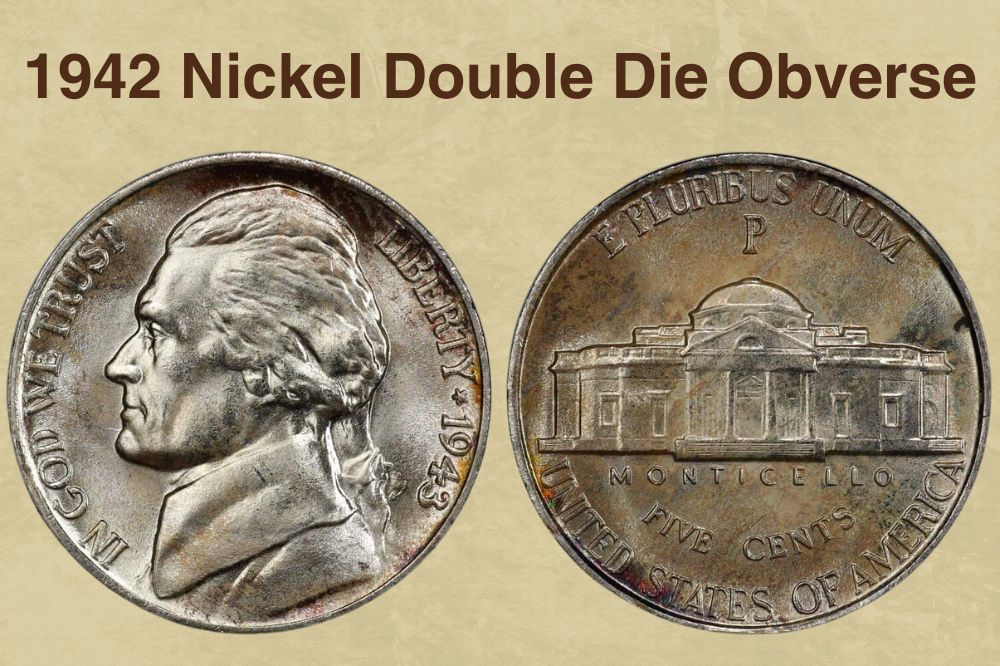
The FS-101 and FS-102 are doubled die obverse varieties on 1942 nickels. The FS-101 shows doubling on Jefferson’s profile and nose, as well as the lower left portion of the “2” in the date, with minor doubling visible on “GOD”. The FS-102 represents a separate doubled die variety with its own distinct characteristics.

These errors occurred when the die received multiple impressions during the hub transfer process, creating slight misalignment between strikes. And magnification is necessary to distinguish genuine doubled dies from machine doubling or post-strike damage. Each doubled die piece is unique, with doubling on different design elements, and typically sells for a few hundred dollars. An MS64 example of the FS-102 reached $275 at auction in 2015.

1942 DDO FS-101 Nickel Price/Grade Chart

Price by 1-70 Grade (Latest Auction Records Included)

Updated: 2026-01-08 06:01:25

2. 1942-D/D D/Horizontal D

1942-D/D D/Horizontal D

This Denver Mint error resulted from a Mint employee punching the mintmark in the wrong position on the working die—first placing the “D” horizontally before correcting it with a properly positioned vertical “D”. The horizontal “D” remains visible beneath the correct mintmark, and this variety is strong enough to see with the naked eye.

It is considered quite scarce, with possibly fewer than a few hundred examples known, and becomes very scarce in uncirculated condition. This scarcity makes it one of the most desirable Jefferson nickel varieties for serious collectors. These nickels range from $135 to $5,750, with Full Steps examples priced from $3,000 to $7,250.

1942-D/D D/Horizontal D Nickel Price/Grade Chart

Price by 1-70 Grade (Latest Auction Records Included)

Updated: 2026-01-08 06:01:25

3. 1942-P/P Silver RPM FS-501

1942-P/P Silver RPM FS-501

The variety holds exceptional interest because it represents the first P mintmark in U.S. history combined with the inaugural silver war nickel composition. Both “P” impressions are right-side-up but offset from each other, with the upper “P” offset to the left of the original impression.

Collectors should examine the large mintmark above Monticello with magnification to identify the doubled impression clearly. The repunching occurred during manual die preparation when mint workers applied the punch twice.

Focus on examples with clear repunching and minimal wear, as circulation quickly diminishes the visibility of the doubled mintmark. Well-preserved specimens with strong eye appeal command premium prices in the current market.

1942-P/P Silver RPM FS-501 Nickel Price/Grade Chart

Price by 1-70 Grade (Latest Auction Records Included)

Updated: 2026-01-08 06:01:25

4. 1942-S/S RPM FS-501

1942-S/S RPM FS-501

This San Francisco variety can be identified by a diagnostic spike protruding from the back of Jefferson’s neck that points at the space between the 9 and 4 of the date. The repunched “S” mintmark shows doubling above Monticello on the reverse.

Later die stages exhibit a die crack in a specific location coming from the base of Monticello down through the right side of the N in CENTS to the O of OF, with the crack positioned closer to the E of Monticello than to the L.

These diagnostic features make authentication relatively straightforward for collectors familiar with the variety. An MS65 example reached $300 at auction in 2019. The variety offers an accessible entry point for collectors interested in wartime nickel errors, combining historical significance with reasonable pricing in most grades.

1942-S/S RPM FS-501 Nickel Price/Grade Chart

Price by 1-70 Grade (Latest Auction Records Included)

Updated: 2026-01-08 06:01:25


Where To Sell Your 1942 Nickel?

Whether you’re looking for quick cash or top dollar from seasoned collectors, knowing the right marketplace makes all the difference.

Check out now: Best Places To Sell Coins Online (Pros & Cons)


1942 Nickel Market Trend

Market Interest Trend Chart - 1942 Nickel

*Market Trend Chart showing the number of people paying attention to this coin.


FAQ About 1942 Nickel

1. What makes a 1942 Jefferson nickel rare?

Most 1942 nickels are common and affordable. The rarest is the Frith 1942 error nickel with the wrongly positioned S mint mark to the right of Monticello instead of above the dome. This unique piece is estimated to be worth around $175,000, though it has not been officially graded by PCGS or NGC.

Other valuable varieties include the D/D (D over Horizontal D) repunched mint mark error and high-grade Full Steps specimens.

2. Which 1942 Jefferson nickels are the most valuable?

Here are the top 5 most valuable 1942 Jefferson nickels sold at auction:

  • 1942 D/D MS 64 FS D/horizontal D nickel – $32,200 (Heritage Auctions, 2006)
  • 1942 D/D MS 66 D/horizontal D nickel – $15,275 (Heritage Auctions, 2013)
  • 1942 P PR 67 CAM nickel Type 2 – $14,100 (Heritage Auctions, 2014)
  • 1942 PR 68+ nickel Type 2 – $12,600 (Heritage Auctions, 2021)
  • 1942 MS 67 FS nickel Type 1 – $11,500 (Bowers & Merena, 2007)

3. How much is the 1942 No Mint mark Jefferson nickel worth?

The 1942 cupronickel nickels (Type 1) without mint mark typically cost $3 to $125 in circulated to uncirculated condition. Specimens with Full Steps designation range from $30 to $750. The Type 2 nickels containing silver with the P mint mark are valued at $1 to $60 in typical grades, with Full Steps examples commanding higher premiums.

Similar Posts