Coin Value Contents Table
- 1947 nickel value Chart
- History of the 1947 Nickels
- 1947 nickel (Jefferson) Types
- Features of the 1947 Jefferson Nickels
- Grading of the 1947 Jefferson Nickels
- 1947 Nickel Value Guides
- 1947 No Mint Mark nickel Value
- 1947 D nickel Value
- 1947 S nickel Value
- Rare 1947 Jefferson Nickels Error List
- Where to Sell Your 1947 Jefferson Nickel ?
- FAQ about the 1947 Jefferson Nickel Value
Although their production has been going on for nearly ninety years, Jefferson’s nickels have lost none of their popularity. Their long history began in 1938 when they replaced the Buffalo nickels. Over the years, these coins have seen modest changes to their design but still kept many elements of the original look.
In addition to age, collectors also appreciate the affordable 1947 nickel value. It is determined based on each coin’s condition, mint mark, existing damages, and specificity. For instance, Full Steps specimens and those with an error have a different, often higher price than regular nickels.
1947 nickel value Chart |
|||
| Condition | 1947 No mint mark nickel | 1947 D nickel | 1947 S nickel |
| Very fine | $0.28 | $0.34 | $0.46 |
| Extra fine | $0.34 | $0.4 | $0.51 |
| AU | $0.4 | $0.46 | $0.57 |
| MS 60 | $0.87 | $1.75 | $1.75 |
| MS 65 | $14 | $13 | $14 |
History of the 1947 Nickels
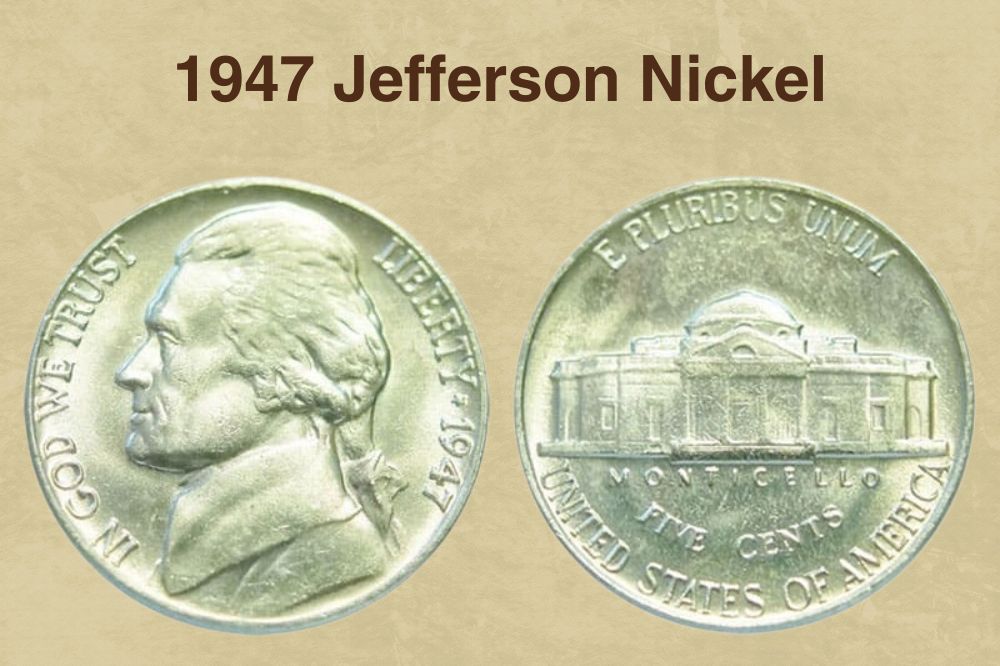
In 1938, the US Mint introduced Jefferson nickels just in time to commemorate the late President’s 200th birthday in 1943. Before them, the Buffalo nickels were in use for over a quarter of a century. The Ministry of Finance could hardly wait to stop minting these coins because the design was too demanding.
At the same time, President F. D. Roosevelt decided to change unimaginative and unattractive American coinage. He believed that his people deserved to get coins with their Presidents images, so the US Mint organized a competition to determine the new nickel design.
There were only two demands for participants, so they needed to include the following images in the design:
- The Thomas Jefferson portrait on the obverse
- The Monticello building on the reverse
From almost 400 proposed ideas, the Commission for Fine Arts chose Felix Schlag’s creative solution. He was a German sculptor who moved to the United States of America just a decade or so before the competition.
Although he won the competition, the officials objected to his design for the coin’s reverse. They needed him to change the inscriptions font and the Monticello position from the side to the front view.
After some improvements, the same design remained on nickel for 65 years. Felix Schlag didn’t receive much credit until the 1960s when the US Mint added his initials, FS, to the bottom of the coin obverse. However, he earned a prize of $1,000 and got an essential place in the history of American coins.
1947 nickel (Jefferson) Types |
||
| Location | Year | Minted |
| Philadelphia | 1947 No Mint mark nickel | 95,000,000 |
| San Francisco | 1947 S nickel | 24,720,000 |
| Denver | 1947 D nickel | 37,822,000 |
| Total | / | 157,542,000 |
By 2003, the nickel appearance remained unchanged while its composition varied. The longest-used metal alloy for this nickel contained copper and nickel in the required ratio (75%: 25%).
Due to the increased demand for nickel during World War II, the US Mint looked for an alternative alloy to continue these coins’ production. The solution was a silver-copper composition with a few percentages of manganese. These so-called Wartime Nickels were in use between 1942 and 1946.
Also read: Top 10 Most Valuable Nickels Worth Money
Features of the 1947 Jefferson Nickels
The Jefferson nickels’ production has lasted for 85 years, and these coins have undergone only minor changes in appearance over the years. Due to the long time spent in circulation, most pieces produced in 1947 show numerous signs of wear and traces of damage.
The obverse of the 1947 Jefferson nickels
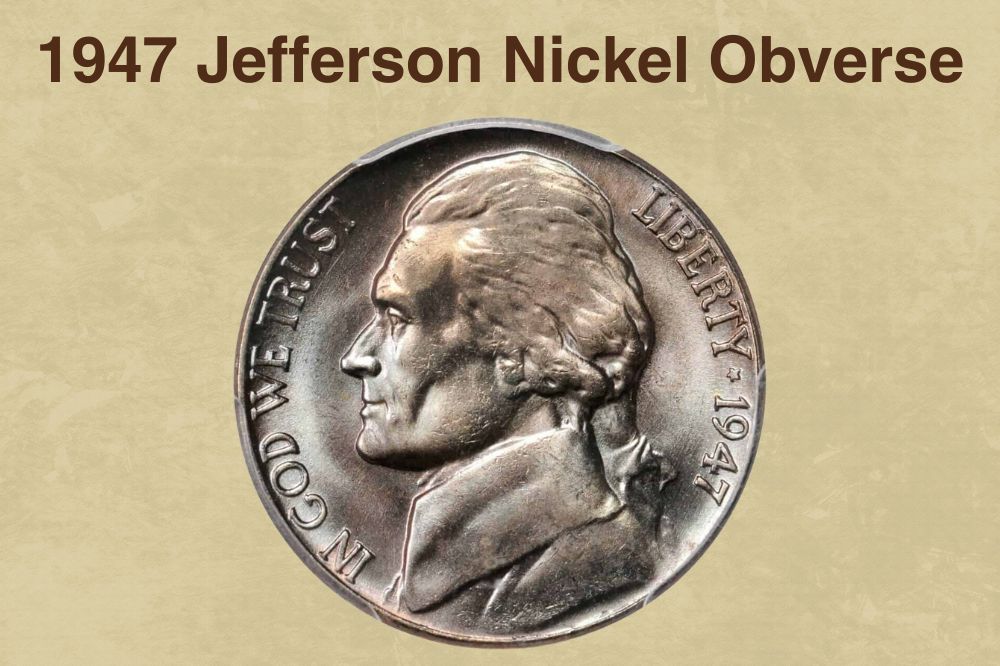
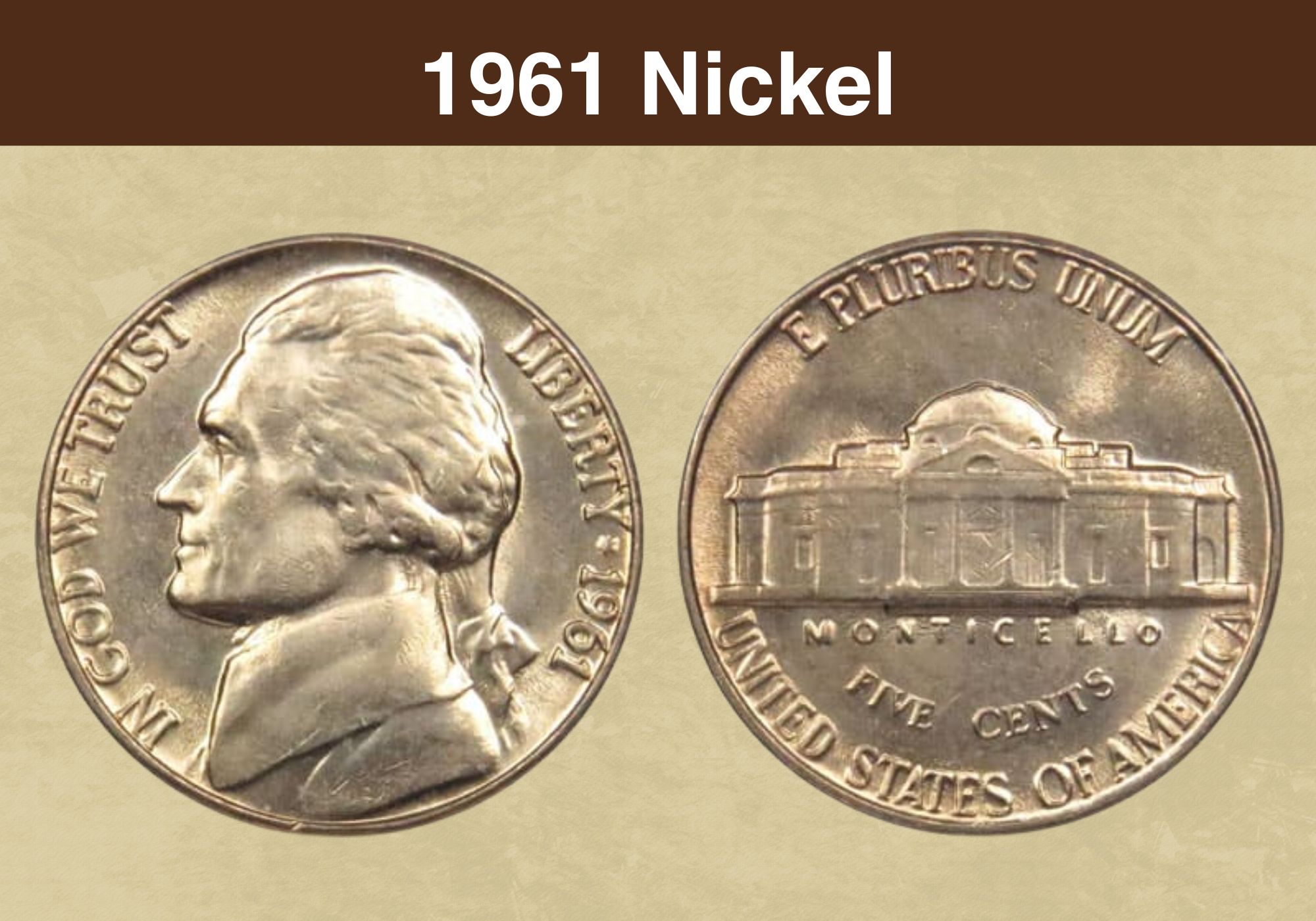
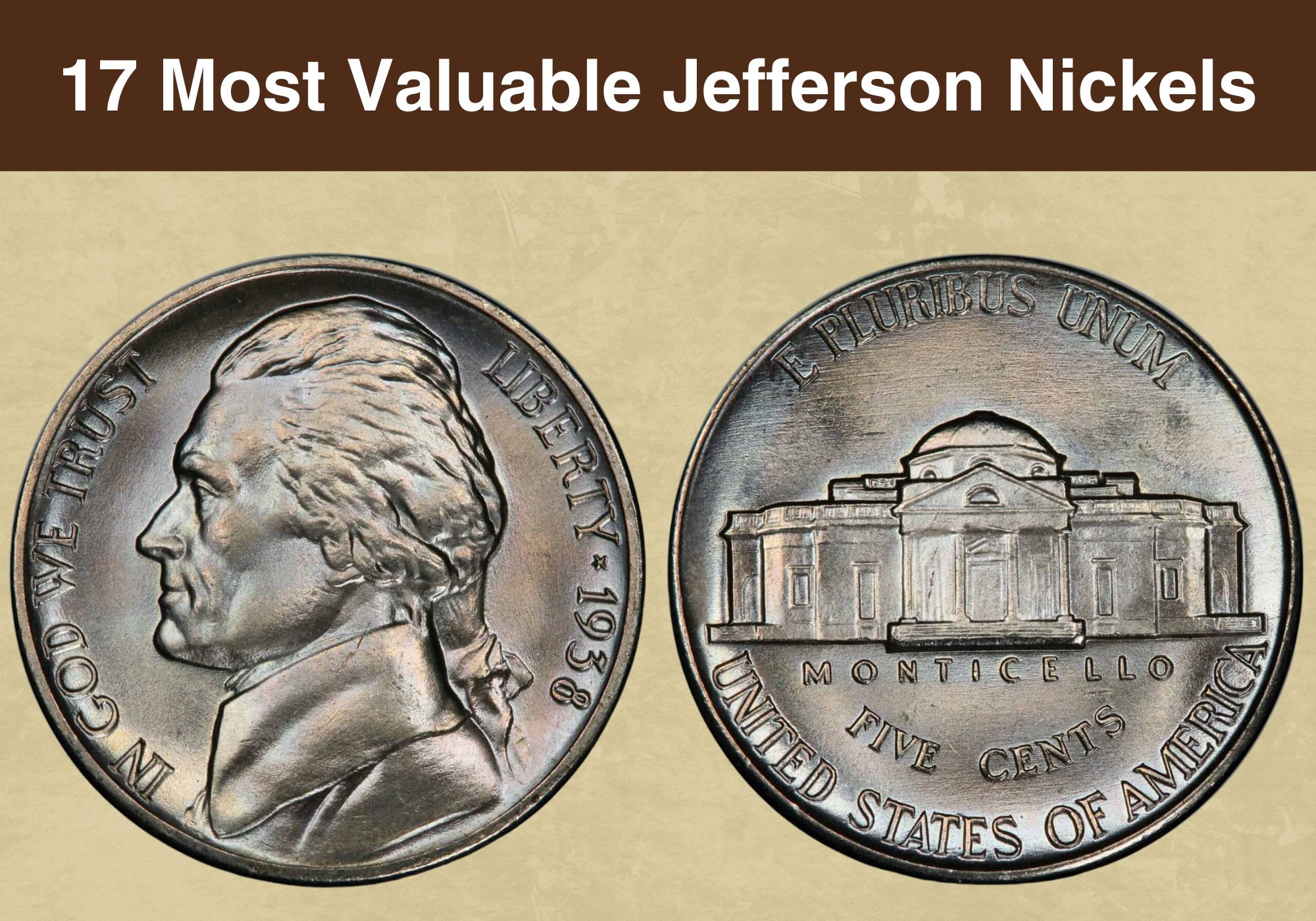
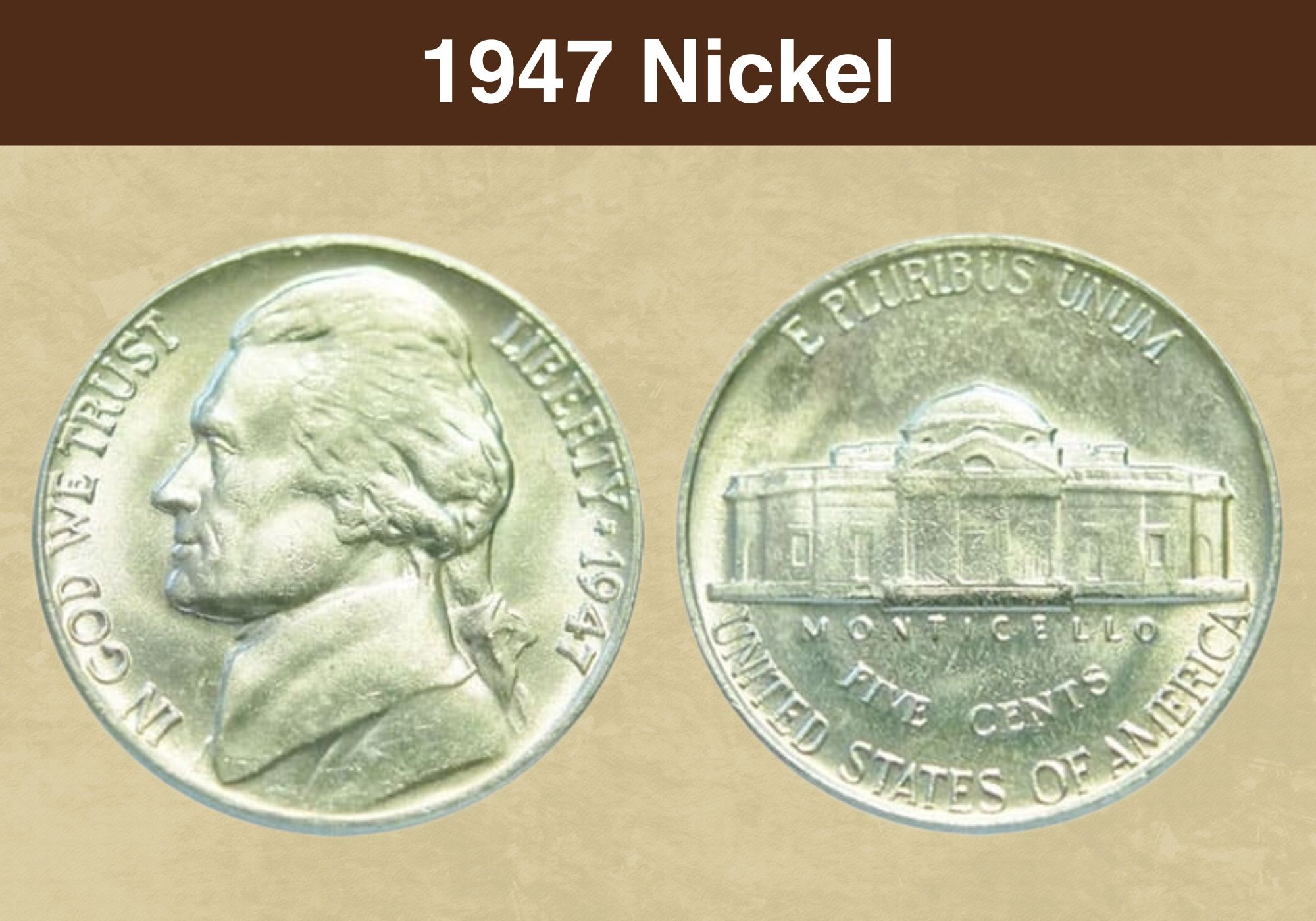
The Jefferson nickel obverse features a bust of President Thomas Jefferson with distinctive features, such as his prominent nose, strong jaw, and specific hairstyle. There is an inscription IN GOD WE TRUST in front of his profile, while the LIBERTY and minting year are behind his head.
The reverse of the 1947 Jefferson nickels
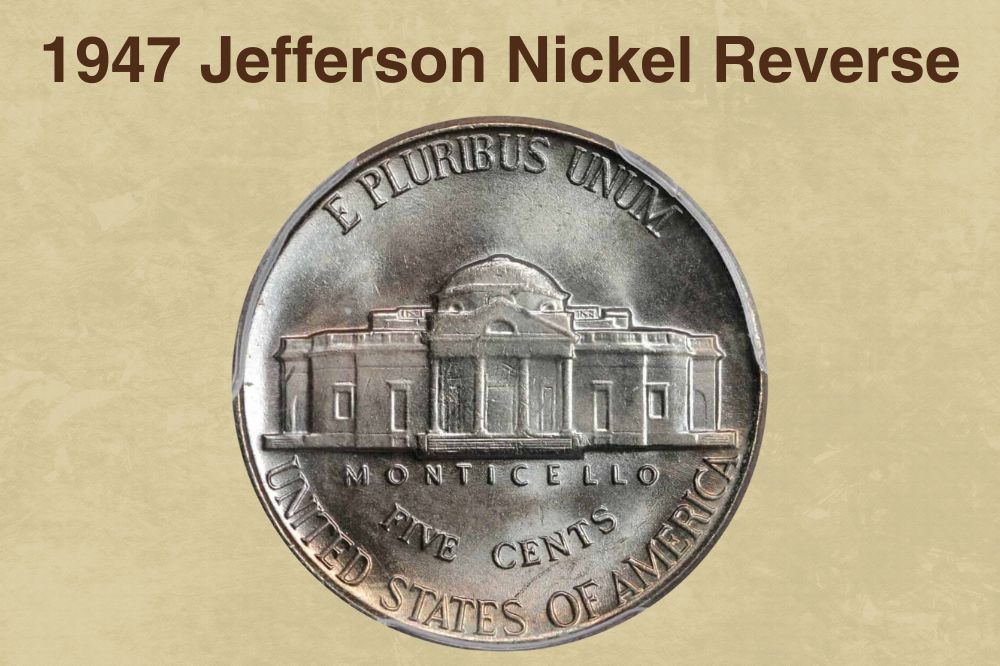
The Jefferson nickel reverse depicts the historically significant Monticello mansion. That was Jefferson’s estate, famous for having designed it himself, including recognizable four pillars resembling the Pantheon temple in Rome.
Immediately below the building is its name MONTICELLO, with the denomination under it. On the bottom rim, you can see the name of the country, while the saying E PLURIBUS UNUM is placed directly above the building.
1947 nickel (Jefferson) Details |
|
| Face value | Five cents ($0.05) |
| Coin diameter | 0.835 inches (21.20 mm) |
| Coin thickness | 0.077 inches (1.95 mm) |
| Shape | Round |
| Coin weight | 0.176 ounces (5 g) |
| Compound | 75% copper and 25% nickel |
| Edge | Plain |
Other features of the 1947 Jefferson nickel
Like most Jefferson nickels, the 1947 coins are round with a plain edge composed of an alloy of 3/4 copper and 1/4 nickel. The coins’ thickness is 0.077 inches (1.95 mm), while they weigh 0.176 ounces (5 g). Each piece’s diameter is the standard 0.835 inches (21.2 mm).
Also read: Top 17 Most Valuable Buffalo Nickel Worth Money
Grading of the 1947 Jefferson Nickels
Coin grading is an exceptionally serious process that precisely determines each piece’s value. During the appraisal, the grading companies’ experts check the coins’ condition, the mint mark, and possible signs of wear, damage, and imperfections. They commonly use the well-known Sheldon scale that ranks coins from the highest 70 to the lowest 1 point.
| # | Grade |
|---|---|
| 1 | Basal State-1 |
| 2 | Fair |
| 3 | Very Fair |
| 4, 5, 6 | Good |
| 7, 8, 10 | Very Good |
| 12, 15 | Fine |
| 20, 30 | Very Fine |
| 40 | Extremely Fine |
| 50 | About Uncirculated |
| 60 | Mint State |
| 65 | Mint State |
| 70 | Mint State |
Please check our grading guides to know your coin scale, It’s the necessary step to know the exact value of your coin.
Check out now: How to Grade Jefferson Nickel?
1947 Nickel Value Guides
The total mintage in 1947 was 157,542,000 Jefferson nickels produced in three mints. Since no proof coins were minted that year, all these pieces were from regular strikes. Unfortunately, the number of survived coins is significantly low, and many are damaged and worn out. Still, they are not rare on the coin market, even in the highest grades.
1947 No Mint Mark nickel Value
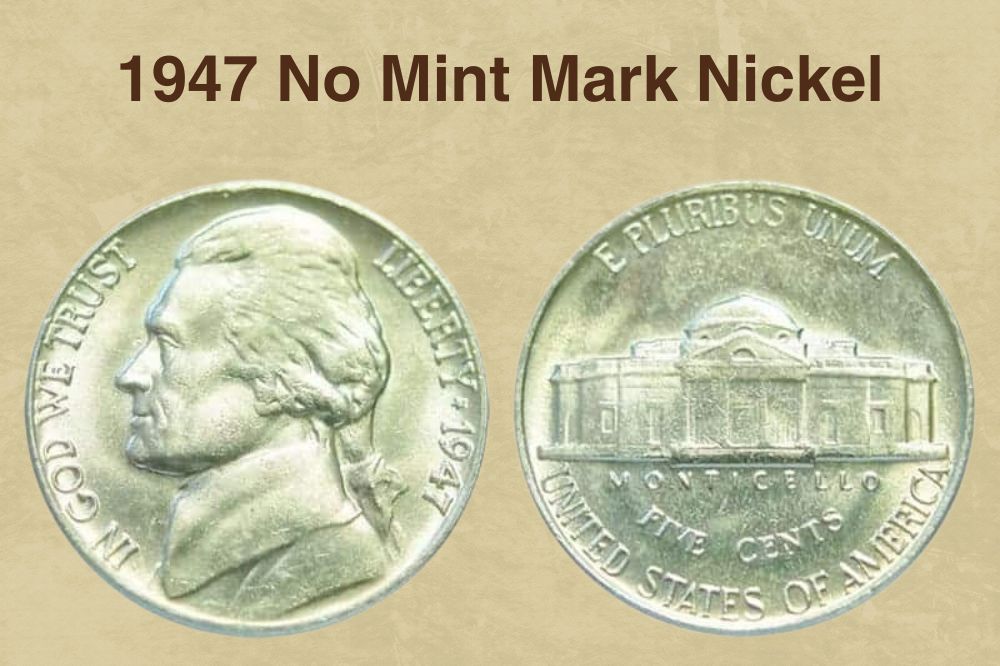
The highest Jefferson nickel mintage of 95,000,000 coins included only pieces without the mint mark in 1947. As expected, that indicates they were produced in Philadelphia. Interestingly, you can still find these coins in circulation.
Their value varies, so you can find specimens in Extra Fine condition for only $0.30, while those in About Circulating state are worth $0.50 to $0.70. Even the highest-graded nickels have a modest value.
Therefore, you can find specimens graded MS 60, MS 61, and MS 62 in the price range from $0.65 to $1. The price increases with the grade but typically stays moderate, as you can see:
- $2 for the 1947 nickels ranked MS 63
- $3 for the 1947 nickels ranked MS 64
- $8 for the 1947 nickels ranked MS 65
- $30 for the 1947 nickels ranked MS 66
- $150 for the 1947 nickels ranked MS 67
It is logical to expect that the Full Steps nickel value is significantly higher, but most coins from 1947 come with only slightly higher prices.
- MS 64 Jefferson FS nickel costs $10
- MS 65 Jefferson FS nickel costs $20
- MS 66 Jefferson FS nickel costs $150
The only exception is the MS 67-graded nickels with Full Steps that cost $1,250 on average. The reason is a high level of preservation atypical for this set.
1947 D nickel Value
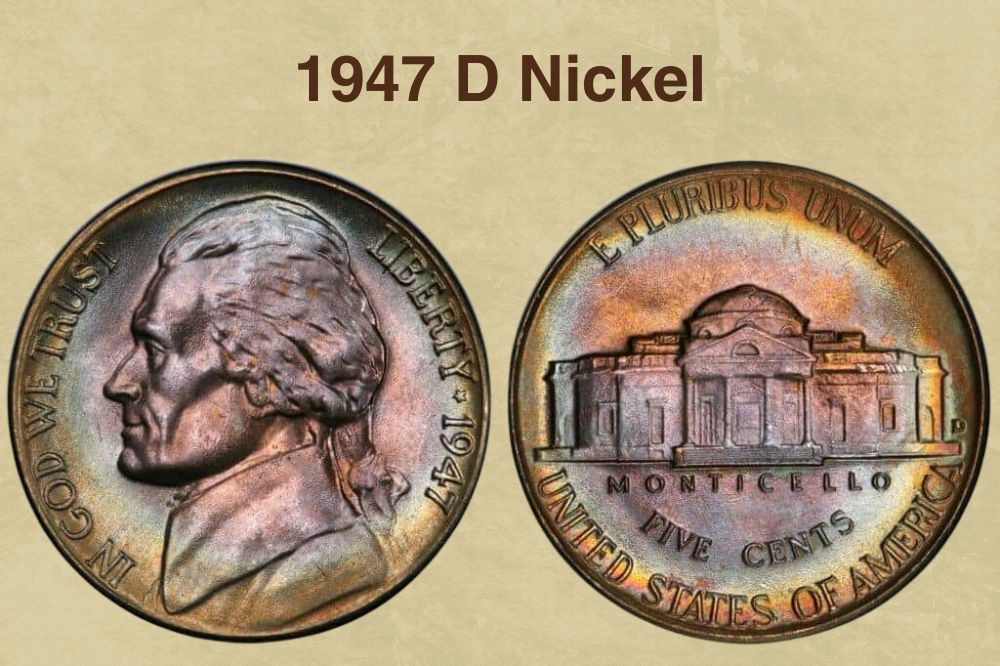
Denver had the second-largest mintage of 1947 nickels in its mint. All 32,822,000 pieces bear the D mark on their reverse. Even though they are somewhat rarer than those from Philadelphia, you can still find them in circulation.
These coins’ values are insignificant. You need to pay as little as $0.30 for specimens in Extra Fine condition, while pieces with an AU grade cost $0.50 to $0.70. Contrary to the realistic expectation that 75-year-old coins in the mint state cost notably more, they are actually worth as follows:
- The 1947 D nickel in MS 60 grade is worth $0.90
- The 1947 D nickel in MS 61 grade is worth $0.95
- The 1947 D nickel in MS 62 grade is worth $1
- The 1947 D nickel in MS 63 grade is worth $2
- The 1947 D nickel in MS 64 grade is worth $3
- The 1947 D nickel in MS 65 grade is worth $8
- The 1947 D nickel in MS 66 grade is worth $22
- The 1947 D nickel in MS 67 grade is worth $200
As expected, the 1947 Jefferson nickels with Full Steps cost slightly more. Depending on their appearance, these pieces are worth $8 to $65, with one exception.
Collectors are prepared to pay about $375 for the MS 67 D Jefferson nickels with Full Steps because these almost flawless, damage-free coins are rare. The MS 68-ranked FS nickels are the most expensive, with an unexpectedly high price of $6,000.
1947 S nickel Value
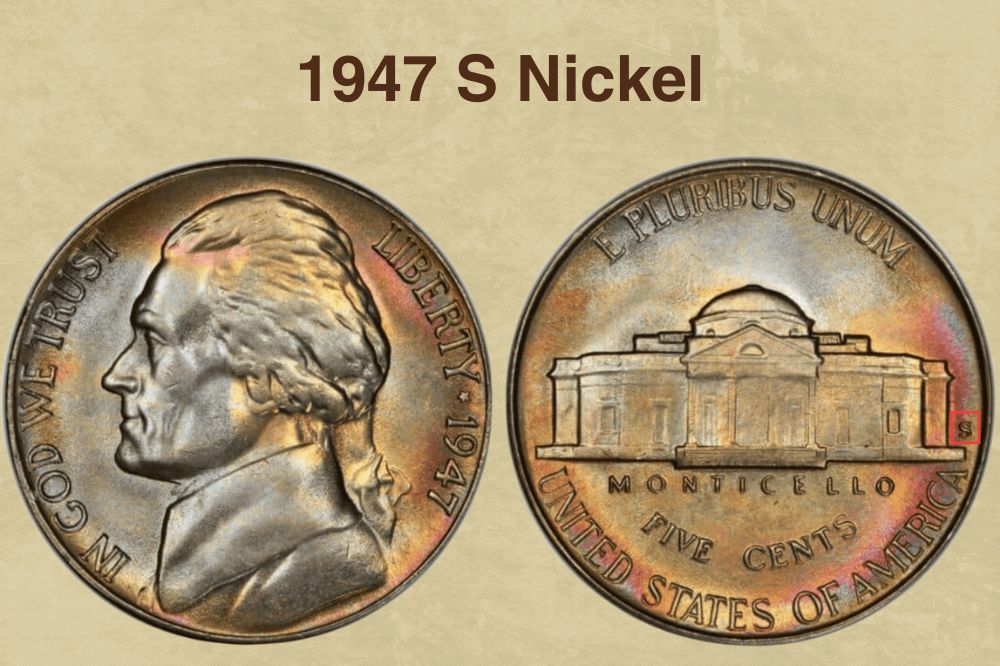
The San Francisco mint released the lowest number of nickels into circulation in 1947, only 24,720,000 coins. Because of this, their value differs slightly from coins produced in the other two mints.
While pieces with EF and AU grades have the same value, the prices of those in the mint state depend on their rank. For instance, MS 60 to MS 65-ranked nickels cost less than $10, while those in MS 66 grade are worth approximately $30.
Since coins with the MS 67 grade are rare nowadays, be prepared to set aside about $585 per piece. The situation is entirely different with Full Steps nickels. Their value is high, so you can expect to pay more to add one to your collection.
- MS 64 FS nickels are worth $45
- MS 65 FS nickels are worth $70
- MS 66 FS nickels are worth $150
- MS 67 FS nickels are worth $3,600
Also read: Top 17 Most Valuable Jefferson Nickels Worth Money
Rare 1947 Jefferson Nickels Error List
Minting errors among American coinage are frequent, although the US Mint makes great efforts to reduce their frequency. Some imperfections are unique and rare, while others are common for particular series. The 1947 Jefferson nickel set is no exception, and you can expect a few typical errors.
Doubled die
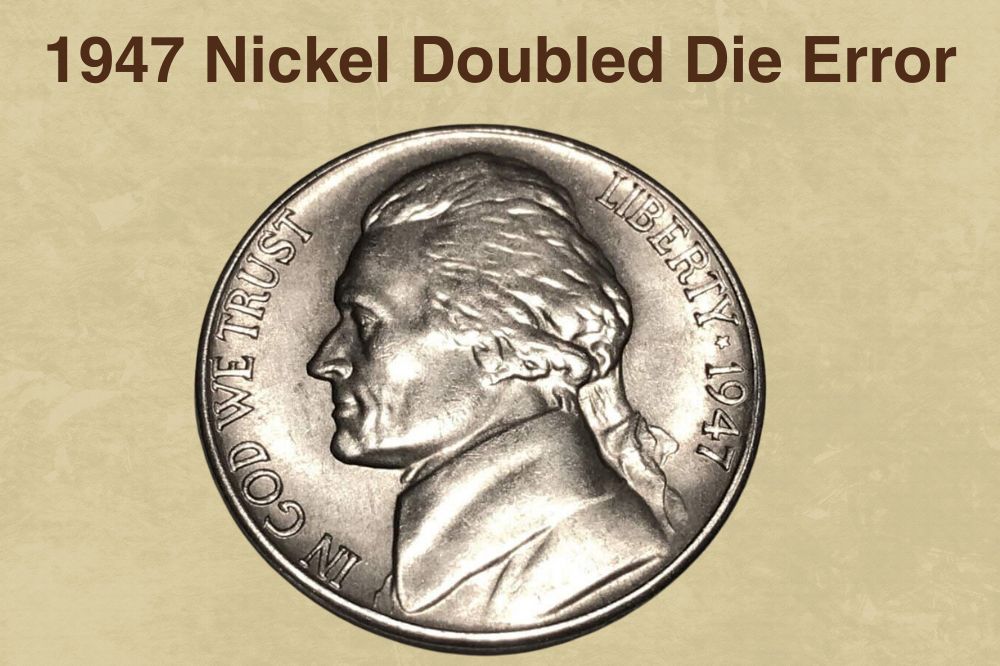
Although this is one of the most common and well-known nickel errors, there is no known 1947 Jefferson nickel with the conspicuous doubled die. However, you can notice a minor doubling when you pay attention to the following details:
- Inscriptions MONTICELO and FIVE CENTS
- Eye on Jefferson’s profile
- Letters and numbers
The value of such a 1947 Jefferson nickel is between $25 and $50.
Re-punched mint mark
During the 1940s, the mint mark was manually struck on the working die. Mint workers sometimes had to strike the mint mark two times to correct an inverted or skewed letter. Since it was impossible to do that absolutely precisely, the result was this error. Most such 1947 Jefferson nickels are worth $3 to $10.
Off-center
It is one of the most popular minting errors among collectors. It occurs when the planchet is not precisely centered, and the crescent-shaped design part is missing from the coin obverse or reverse.
These specimens’ value varies depending on what design percentage is missing and whether the mint date and mint mark are visible. The most valuable is a 50% off-center 1947 nickel, and you can buy such a coin for $100. However, most show only 5% to 10% off-center and can cost around $10.
Also read: 14 Most Valuable Nickel Errors Worth Money
Where to Sell Your 1947 Jefferson Nickel ?
Now that you know the value of your coins, do you know where to sell those coins online easily? Don’t worry, I’ve compiled a list of these sites, including their introduction, pros, and cons.
Check out now: Best Places To Sell Coins Online (Pros & Cons)
FAQ about the 1947 Jefferson Nickel Value
What makes a 1947 Jefferson nickel special?
With a mintage of over 150 million, the 1947 nickel is not one of the rare coins in today’s coin market. However, you can find rarer and more valuable well-preserved specimens marked with Full Steps.
Which are the most expensive 1947 nickels in the set?
- 1947 S MS 67 nickel (FS) sold at $14,950 in 2007
- 1947 D MS 68 nickel (FS) sold at $12,925 in 2020
- 1947 PCGS Genuine nickel sold at $10,000 in 2021
- 1947 D MS 66 nickel sold at $5,295 in 2021
- 1947 MS 67 nickel (FS) sold at $4,113 in 2014
- 1947 S MS 67 nickel sold at $588 in 2017
How much money for the 1947 nickel without the mint mark?
Given that these nickels are 75 years old, it is realistic to expect their value to be significant. Surprisingly, this is not the case, and most 1947 Jefferson nickels from Philadelphia are only worth their face value. Only specimens in the highest grades cost more, with an average price of $150.
What is the priciest Jefferson nickel?
The production of Jefferson’s nickel began in 1938, so it is logical to expect specimens from an earlier period to have a significant value. Plus, Full Steps nickels are more costly than regular coins.
The most expensive is the 1954 S MS 67 nickel with Full Steps. It reached a fantastic $35,250 at an auction in 2020. The following are nickels produced in 1938 and 1969 in Denver with the same auction record of $33,600.