1939 Dime Coin Value: Errors List, “D”, “S” & No Mint Mark Worth
1939 Dime value can reach as high as $42,300. That record was set by a 1939-D example graded MS69 Full Bands, sold through Legend Rare Coin Auctions in September 2019. If you’re curious what yours could fetch, upload a photo of your coin below for a quick value range. Scroll down to see recent eBay sales and what buyers are paying today.
1939 Dime Value Checker
Identify 1939 Dime D, S and No Mint Mark Price
✨ No Sign-up Required
Front Obverse
Upload or Take a Photo
VS
Back Reverse
Upload or Take a Photo
Waiting to analyze
1939 Dime Value By Variety
Here’s what each variety is worth across different grades. If you already know your coin’s grade, jump to the Value Guides section for exact pricing.
Type
Good(G4-6)
Fine(F12-15)
AU(AU50-58)
MS(MS60-70)
PR(PR60-70)
▶1939 No Mint Mark Dime Value
$8
$8
$10 - $12
$15 - $7,590
—
▶1939 No Mint Mark Dime (FB) Value
$1
$3 - $4
$12 - $21
$27 - $3,450
—
▶1939 D Dime Value
$8
$8
$10 - $18
$23 - $460
—
▶1939 D Dime (FB) Value
$1
$2 - $3
$11 - $18
$21 - $10,500
—
▶1939 S Dime Value
$8
$8
$10 - $23
$27 - $1,840
—
▶1939 S Dime (FB) Value
$4 - $5
$9 - $11
$33 - $54
$69 - $13,800
—
▶1939 Proof Dime Value
—
—
—
—
$110 - $1,610
▶1939 CAM Dime Value
—
—
—
—
$400 - $17,000
1939 No Mint Mark Dime Value — eBay market data
Price trend
View:
Recent eBay sales
Filter:
Sort:
Loading eBay data...
1939 P Mercury Dime in About Uncirculated Condition Philadelphia, Pennsylvania Mercury
Sold Nov 9, 2026
$5.95
Vintage 1939⌛US Philadelphia Mint Silver Mercury Dime🪙 Pre World War II Philadelphia Mercury
Sold Nov 9, 2026
$7.00
United States - 1 Dime 1939 - Mercury Dime - Silver
Most Valuable 1939 Dime Chart — top auction records (2000 to present)
#
Coin
Grade
Price
Platform
Date
1
1939-D FB
69
$42,300
LM
09/19
2
1939 PR
68
$21,600
HA
08/21
3
1939
68
$15,860
HA
01/26
4
1939 PR
69
$14,375
HA
02/03
5
1939 FB
68
$12,650
HA
8/00
6
1939-S FB
68
$10,350
HA
10/00
7
1939
67
$7,344
LM
10/17
8
1939-S FB
67
$6,710
HA
01/26
9
1939 MS
69
$6,600
HA
04/21
10
1939-D FB
68
$6,169
LM
04/23
The chart ranks the top ten auction results for 1939 Mercury dimes, covering sales from 2000 to the present.
The king of the hill is a 1939-D FB graded MS69 that brought $42,300 in September 2019. That’s what happens when a razor-sharp Denver strike survives in essentially perfect condition. Only one coin has ever reached that grade. Below it, two proof entries sit in the $14,000–$21,600 range — not surprising given that Philadelphia only struck 9,321 proof dimes that year.
The rest of the top ten spans $4,348 to $12,650, all Philadelphia and Denver Full Bands business strikes in MS66 through MS68. Grade and strike sharpness are what separate these coins from the thousands of ordinary survivors.
History of the 1939 Dime
By 1939, Mercury dimes had been jingling in American pockets for over two decades. The series launched in 1916 and would run through 1945.
What makes 1939 special? Two things. First, it’s the best year to find Cameo proofs in the entire 1936–1942 proof run, though certified examples are still scarce. Philadelphia struck just 9,321 proof dimes — sold directly to collectors from hand-polished dies with mirror-like surfaces.
For business strike collectors, the draw is different. The 1939-D Full Bands issue is the ultimate conditional rarity of the year, with that lone MS69 FB holding the all-time record at $42,300.
Here’s a fun one: in 2016, the U.S. Mint released 125,000 gold Mercury dimes to celebrate the design’s centennial. They sold out in minutes. The 1939 issues sit at a sweet spot where proof rarity, strike quality, and collector demand all overlap in ways few other dates can match.
With 1939 Mercury dimes, the date itself isn’t rare. Strike quality and grade are what matter. A raw 1939-S in VF is a $5 coin. That same date in MS67 FB? You’re looking at five figures. The CoinValueChecker App cross-references grading data and auction records from a simple photo scan, giving you a clearer picture of where your coin actually stands.
Key Features of the 1939 Dime
Strike quality drives value for this date more than almost any other Mercury dime. Knowing exactly where to look — and what separates a $5 coin from a $5,000 coin — starts with the physical details.
The Obverse of the 1939 Dime
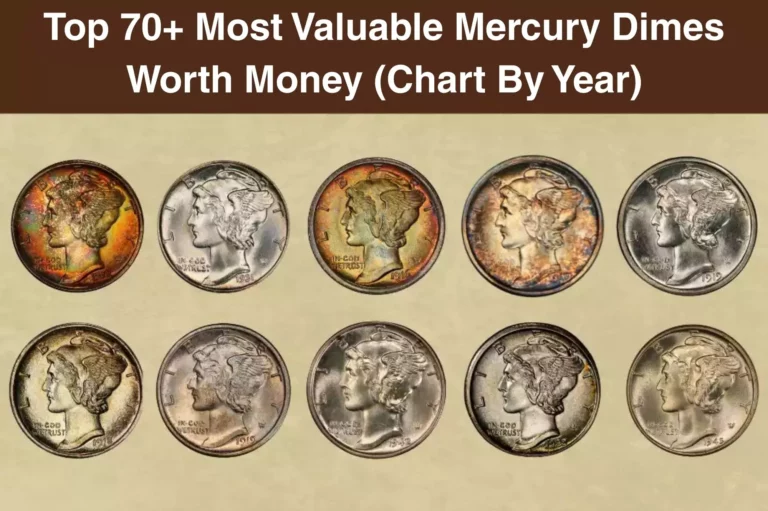
You’ll see Lady Liberty wearing a winged Phrygian cap — a classic symbol of freedom of thought. That winged cap is why everyone calls these “Mercury” dimes, even though the figure is Liberty, not the Roman god.
“LIBERTY” arches above and behind her head. “IN GOD WE TRUST” runs along the left side of the bust, and Adolph A. Weinman’s initials “AW” sit on the right. The date 1939 appears below Liberty’s neck.
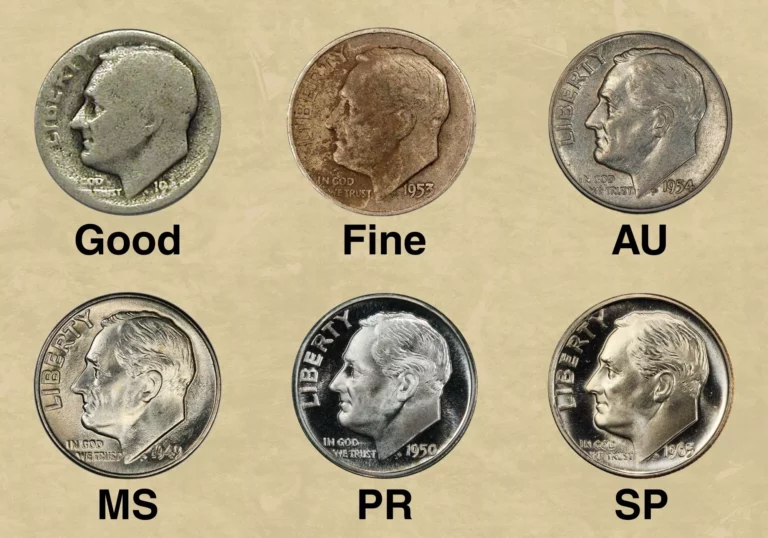
When you’re grading, focus on three spots: Liberty’s cheek, the hairline above her ear, and the center of the wing. These are the highest points and the first places to show wear. That’s where you’ll see the difference between an AU and a true Mint State coin.
The Reverse of the 1939 Dime
Flip it over and you’ll find a fasces at the center — a bundle of rods bound with a leather strap and topped with an axe blade. It’s an ancient Roman symbol of authority. An olive branch wraps around the fasces, adding a peace element to balance the strength imagery.
Around the reverse you’ll see “UNITED STATES OF AMERICA,” “ONE DIME,” and “E PLURIBUS UNUM.” The mint mark sits below the fasces bundle. “D” means Denver, “S” means San Francisco, and no letter means Philadelphia.
Now here’s the money spot. Look at the horizontal bands crossing the fasces rods. For the Full Bands designation, the two central horizontal bands must be fully separated with a clear, recessed line between them. The diagonal bands need to be distinct too — not mushy or merged. This tells you about the original strike, not wear.
Other Features Of the 1939 Dime
Every 1939 Mercury dime shares the same specs: 90% silver, 10% copper, 2.50 grams, 17.9 millimeters in diameter. That works out to 0.0723 troy ounces of actual silver weight. The edge is reeded.
Unlike many Mercury dime dates, 1939 includes a proof issue struck exclusively at Philadelphia. Among the 1936–1942 proof run, it’s the go-to year for cameo hunters — more Cameo examples turn up from 1939 than any other date in that range.
There’s also one documented die variety worth a premium: the 1939-D/D repunched mint mark. Everything else about the design stays the same across all three mint varieties.
Philadelphia dominated production in 1939. Denver and San Francisco both came in well below, with the San Francisco issue being the scarcest business strike of the three.
Only 9,321 proof dimes were struck that year. Maybe a couple thousand survived. Cameo examples? PCGS estimates roughly 100 across all grades. To put that in perspective, you could fit every known 1939 Cameo proof dime in a single coin album page.
Decades of circulation, the silver melt craze of the late 1970s and early 1980s, and plain old attrition wiped out huge numbers. Most survivors today are worn circulated pieces. A well-preserved example is the exception.
Three things drive what your 1939 Mercury dime is worth: mint mark, condition, and whether it qualifies for Full Bands.
Start by checking the reverse for a mint mark below the fasces. Then look at Liberty’s cheek and wing on the obverse for wear. For Full Bands, you need the two central horizontal bands on the fasces to show as fully split, clearly separated lines. If they look merged or flat, no FB designation.
Those details can be tough to spot without practice. The CoinValueChecker Apptakes a photo of your coin and cross-references its features against grading data and auction records. You get an instant estimate without needing a loupe or years of experience.
CoinValueChecker APP Screenshot
1939 Dime Value Guides
Each 1939 variety carries a different value range depending on grade, strike, and issue type. Full Bands examples command the biggest premiums among business strikes, while proofs and cameos play by their own rules.
1939 No Mint Mark Dime — most common business strike, but Full Bands are harder to find than expected
1939-D Dime — affordable across grades; holds the all-time auction record for the entire 1939 date in FB
1939-S Dime — semi-key date; consistently outperforms in gem grades
1939 Proof Dime — mirror-finish collector issue; only a few thousand believed to survive
1939 CAM Dime — uniquely available in 1939; approximately 100 cameo survivors known
Circulated examples across all three business strikes trade near melt value. The real price separation kicks in at upper Mint State grades, especially with Full Bands. For proofs, condition and cameo contrast are the main drivers. The guides below break down each variety so you can match your coin to the right price range.
1939 No Mint Mark Dime Value
Coin Identifier and Value App
Not sure what your coins are worth? Get Instant Value • Grade • Error Detection with coin identifier and value app (FREE Usage Daily)
Don’t let the big mintage fool you. Philadelphia 1939 dimes are common up through MS67, and circulated pieces are cheap. But Full Bands? That’s a different story. A collar preparation issue seems to have kept metal from fully filling the die cavity on most strikes. The result: sharply struck examples are far scarcer than the mintage alone suggests.
The auction record for a Philadelphia FB example is $12,650, sold through Heritage Auctions in August 2000. Below that peak, lower FB grades are more accessible, but the population drops off fast above MS66.
1939 No Mint Mark Dime Price/Grade Chart
Price by 1-70 Grade (Latest Auction Records Included)
1939 No Mint Mark Dime value by grade (updated Nov 10, 2026)
Below is a full list of auction records for the 1939 No Mint Mark Dime across all grades and designations.
Date ↓
Platform
Price ⇅
Grade ⇅
08/26
SB
$89
66
07/26
SB
$149
67
06/26
SB
$79
67
03/26
SB
$960
68
01/26
SB
$1,320
68
05/25
SB
$65
66
10/24
SB
$85
67
08/24
SB
$65
66
06/24
SB
$45
66
12/23
HA
$552
68
The following chart tracks market activity for this variety over the past year.
Market activity: 1939 No Mint Mark Dime
Market activity score: 84/100 as of Nov 2026 — up 3 points from Aug 2026. Currently at its 12-month peak.
1939-D Dime Value
How does a Denver dime end up as the most expensive 1939 Mercury dime ever sold? Full Bands. In circulated and lower uncirculated grades, 1939-D examples are easy to find and cheap. But the value curve goes vertical once you hit gem FB territory. Strike quality plus top-end preservation at the highest grades creates a completely different kind of rare.
The record: $42,300 for an MS69 FB through Legend Rare Coin Auctions in September 2019. Nothing else from 1939 — any variety — has come close. Below that, MS68 FB examples and lower gem grades are more within reach.
1939-D Dime Price/Grade Chart
Price by 1-70 Grade (Latest Auction Records Included)
Every recorded auction result for the 1939-D Dime is listed below.
Date ↓
Platform
Price ⇅
Grade ⇅
04/25
SB
$85
65
02/25
SB
$480
66
02/24
SB
$288
65
01/24
HA
$84
66
07/23
SB
$168
67
06/23
SB
$168
66
12/22
DL
$36
63
11/22
DL
$70
65
11/22
HA
$50
67
11/22
SB
$144
67
Here is a look at how this variety has moved in the market over the past twelve months.
Market activity: 1939-D Dime
Market activity score: 50/100 as of Nov 2026 — down 6 points from Aug 2026. 12-month peak: 74 (Dec 2025).
1939-S Dime Value
If you’re cherrypicking 1939 Mercury dimes, the S-mint is where I’d start looking. It has the lowest mintage of the three business strike varieties, making it the semi-key date for the year. Circulated examples carry a small premium over Philadelphia and Denver. In gem grades, the gap widens — variable strike quality means there’s a huge spread between weak and sharp examples.
Full Bands specimens carry the steepest premiums in the entire 1939 series. Top-grade FB examples are estimated between $12,000 and $13,300 — well above comparable Philadelphia or Denver pieces. The auction record for a non-FB example is $2,160 for an MS68 sold in 2019.
1939-S Dime Price/Grade Chart
Price by 1-70 Grade (Latest Auction Records Included)
The table below covers all known auction results for the 1939-S Dime.
Date ↓
Platform
Price ⇅
Grade ⇅
12/24
SB
$145
65
11/23
HA
$1,560
68
07/23
HA
$324
67
04/23
HA
$264
67
04/23
SB
$168
67
12/22
DL
$450
67
11/22
DL
$51
62
06/22
SB
$60
66
06/22
SB
$216
67
12/21
DL
$90
66
The chart that follows shows market activity for this variety over the last year.
Market activity: 1939-S Dime
Market activity score: 53/100 as of Nov 2026 — down 3 points from Aug 2026. 12-month peak: 56 (Oct 2026).
1939 Proof Dime Value
Only 9,321 proof dimes rolled out of Philadelphia in 1939. These were struck with polished dies to produce mirror-like surfaces and sold directly to collectors. Maybe a couple thousand survived. They occupy a completely separate market from business strikes.
The top sale is $21,600 for a PR68+ through Heritage Auctions in August 2021. Below that level, lower proof grades are more accessible, though the population gets thin above PR67. If you find one slabbed PR66 or better, you’re holding something genuinely scarce.
1939 Proof Dime Price/Grade Chart
Price by 1-70 Grade (Latest Auction Records Included)
1939 Proof Dime value by grade (updated Nov 10, 2026)
Below is a full list of auction records for the 1939 Proof Dime across all grades.
Date ↓
Platform
Price ⇅
Grade ⇅
03/26
SB
$168
61
12/25
SB
$216
66
11/25
SB
$360
66
11/25
SB
$336
66
11/25
SB
$408
66
11/25
SB
$384
66
11/25
SB
$9,600
68
09/25
SB
$240
66
09/25
SB
$660
67
09/25
SB
$456
67
See how this variety has moved in the market over the past twelve months in the chart below.
Market activity: 1939 Proof Dime
Market activity score: 60/100 as of Nov 2026 — down 14 points from Aug 2026. 12-month peak: 81 (Sep 2026).
1939 CAM Dime Value
Here’s something most collectors don’t realize: 1939 is the only year in the entire 1936–1942 proof run where Cameo examples show up with any regularity. PCGS estimates about 100 Cameo survivors across all grades, with roughly 80 grading PR65 or better. Deep Cameo pieces with intense frost on both sides? Likely single digits.
The auction record for a 1939 PR68 CAM example hit $9,775. Any certified Cameo at PR65 or above is a genuine rarity within an already scarce issue. I think these are underappreciated relative to how few exist.
1939 CAM Dime Price/Grade Chart
Price by 1-70 Grade (Latest Auction Records Included)
1939 CAM Dime value by grade (updated Nov 10, 2026)
Not every 1939 dime is created equal. A handful left the mint with documented die varieties and strike errors that carry real premiums. Here’s what to look for.
1. 1939 Dime DDO FS-101
This is the Full Bands version of the FS-101 doubled die obverse. The doubling on “IN GOD WE TRUST” is your diagnostic, but the FB designation confirms a sharp, complete strike on the reverse fasces bands too.
Getting both a documented die variety and a premium strike on one coin is what makes this special. Price guide values for MS65 FB examples run $175 to $300. Any example carrying both designations on a PCGS or NGC holder is a genuinely uncommon find — you won’t stumble across these in a dealer’s junk box.
1939 DDO FS-101 Dime (FB) Price/Grade Chart
Price by 1-70 Grade (Latest Auction Records Included)
1939 DDO FS-101 Dime (FB) value by grade (updated Nov 10, 2026)
This is the top of the 1939-D variety food chain. A coin needs both the clearly doubled mint mark and fully separated horizontal bands on the reverse fasces to qualify for this designation.
Greysheet values for the FB version run roughly $23 to $198 across grades — a solid step up from the non-FB equivalent. To cherrypick one, confirm the RPM under magnification first, then flip it over and check whether the bands meet Full Bands standards. Coins that pass both tests get certified separately by PCGS and NGC.
1939-D/D RPM FS-501 Dime (FB) Price/Grade Chart
Price by 1-70 Grade (Latest Auction Records Included)
1939-D/D RPM FS-501 Dime (FB) value by grade (updated Nov 10, 2026)
Getting the right price for a 1939 Mercury dime comes down to more than the coin itself — the platform you choose shapes who sees it, what they’re willing to pay, and how smoothly the transaction goes.
Market interest: 5,290 collectors tracking this coin as of Nov 2026 — up 1,100 from Mar 2026. 12-month peak: 6,910 (Dec 2025).
*Market Trend Chart showing the number of people paying attention to this coin.
FAQ about the 1939 Dime
1. How much is a 1939 dime worth?
Anywhere from $4.50 for a common circulated example to $42,300 for the finest-known 1939-D with Full Bands. Mint mark, grade, and strike quality all matter.
The 90% silver content gives you a melt value floor around $3.52, which compresses premiums on lower grades. The real money starts at upper Mint State, especially with Full Bands.
2. Where is the mint mark on a 1939 dime?
Check the reverse, below the fasces bundle. “D” means Denver, “S” means San Francisco, no letter means Philadelphia.
One thing that trips people up: the letter “W” on some coins isn’t a mint mark. It’s Adolph A. Weinman’s designer monogram, located on the obverse to the right of Liberty’s neck.
3. What is the Full Bands designation and why does it matter?
Full Bands (FB) means the horizontal bands on the reverse fasces are completely separated with no merging. It signals a razor-sharp strike from fresh dies. A standard 1939 dime in MS65 might sell for $40. The same coin with Full Bands? $100 or more.
For the 1939-S, top-grade FB examples are estimated between $12,000 and $13,300 — way above comparable Philadelphia or Denver pieces. The FB vs. non-FB gap at the gem level is one of the widest in the entire Mercury dime series.
4. Which 1939 dime is the rarest?
Among business strikes, the 1939-S has the lowest mintage and consistently outperforms the other two mints in gem grades.
For overall rarity, the 1939 Proof CAM stands alone. PCGS estimates approximately 100 Cameo examples survive across all grades, with roughly 80 grading PR65 or better. Deep Cameo specimens? Likely single digits.
5. Is a 1939 dime made of silver?
Yes. 90% silver, 10% copper, 2.50 grams, with 0.0723 troy ounces of actual silver weight.
Even a beat-up example is worth more than face value. At current silver prices, every 1939 dime sits well above its original ten-cent denomination.
6. What is the highest price ever paid for a 1939 dime?
$42,300 for a 1939-D MS69 Full Bands through Legend Rare Coin Auctions in September 2019.
For proofs, the record is $21,600 for a PR68+ through Heritage Auctions in August 2021. Among Cameo proofs, it’s $9,775 for a PR68 CAM.
7. What makes the 1939 proof dime special?
Philadelphia struck only 9,321 proof dimes in 1939, and maybe a couple thousand survived. These were sold directly to collectors and feature hand-polished dies with mirror-like surfaces.
1939 is the only year in the 1936–1942 proof run where cameo contrast examples turn up with any regularity. No other year in that range can match it.
8. How do I check the condition of my 1939 dime?
Look at Liberty’s cheek, the hair above her ear, and the bands on the reverse fasces. Those are the highest design points and the first to show wear.
For Full Bands, grab a 10x loupe and examine the two central horizontal bands on the fasces. They must be fully separated with a clear, recessed line between them. Merged or flat? No FB designation.
9. How do I know if my 1939 dime has a DDO error?
The 1939 DDO FS-101 shows Class V Pivoted Hub Doubling. The strongest doubling appears on “IN GOD WE TRUST,” where the letters show full-relief secondary images with distinct separation and corner notching.
Don’t confuse it with machine doubling, which looks flat and shelf-like with no depth. The genuine FS-101 has rounded, three-dimensional letter outlines. Auction records show $506 for an MS67 in 2013, and $792 for an MS66 FB in 2014.
10. Should I clean my 1939 dime before selling it?
Never. Cleaning destroys value. Grading services spot it immediately, and a cleaned coin gets a details grade instead of a numeric one. That tanks what buyers will pay.
Even a tiny bag mark or faint scratch on Liberty’s face can cost hundreds on a high-grade example. Original surfaces — even with natural toning — are always preferred over a cleaned coin. Every serious collector and every grading service agrees on this.
John Saechao is a respected California-based coin collector, known for his diverse and intricate collection. His lifelong passion for numismatics has shaped an impressive portfolio, spanning multiple eras and continents. Celebrated not just for his collection, John is appreciated for his knowledge-sharing, greatly influencing the coin collecting community.