Coin Value Contents Table
- 1900 Silver Dollar Value Chart
- History of the 1900 Morgan Silver Dollar
- 1900 Morgan Silver Dollar coin Types
- Features of the 1900 Morgan Silver Dollar Coins
- 1900 Morgan Silver Dollar Coin Grading
- 1900 Silver Dollar Value Guides
- 1900 No Mint mark Silver Dollar Value
- 1900 Silver Dollar proofs Value
- 1900 O Silver Dollar Value
- 1900 S Silver Dollar Value
- Rare 1900 Morgan Silver Dollar Coin Errors List
- Where to Sell Your 1900 Silver dollar ?
- FAQ about the 1900 Morgan Silver Dollar Coins
Morgan silver dollars are iconic American coins minted from 1878 to 1904 and one more time in 1921. They are still highly collectible, while the high silver content makes them an excellent investment. The 1900 silver dollar value depends on the mint mark, condition, and possible imperfections visible on the coin surface.
According to the practice of the time, specimens from Philadelphia were without the mint mark. Interestingly, you can notice Morgans with partially removed CC letters and replaced with the O mint mark. If your budget allows that, go for such a piece!
1900 Silver Dollar Value Chart |
||||
| Condition | 1900 No Mint Mark dollars | 1900 O dollars | 1900 O over CC dollars | 1900 S dollars |
| Good | $36 | $36 | $115 | $37 |
| Very good | $38 | $38 | $150 | $40 |
| Fine | $40 | $40 | $175 | $44 |
| Very fine | $42 | $42 | $200 | $50 |
| Extra fine | $46 | $46 | $315 | $85 |
| AU | $50 | $50 | $415 | $185 |
| Mint state 60 | $75 | $75 | $600 | $475 |
| Mint state 65 | $275 | $240 | $2,700 | $1,600 |
| Proof 63 | $4,350 | / | / | / |
History of the 1900 Morgan Silver Dollar
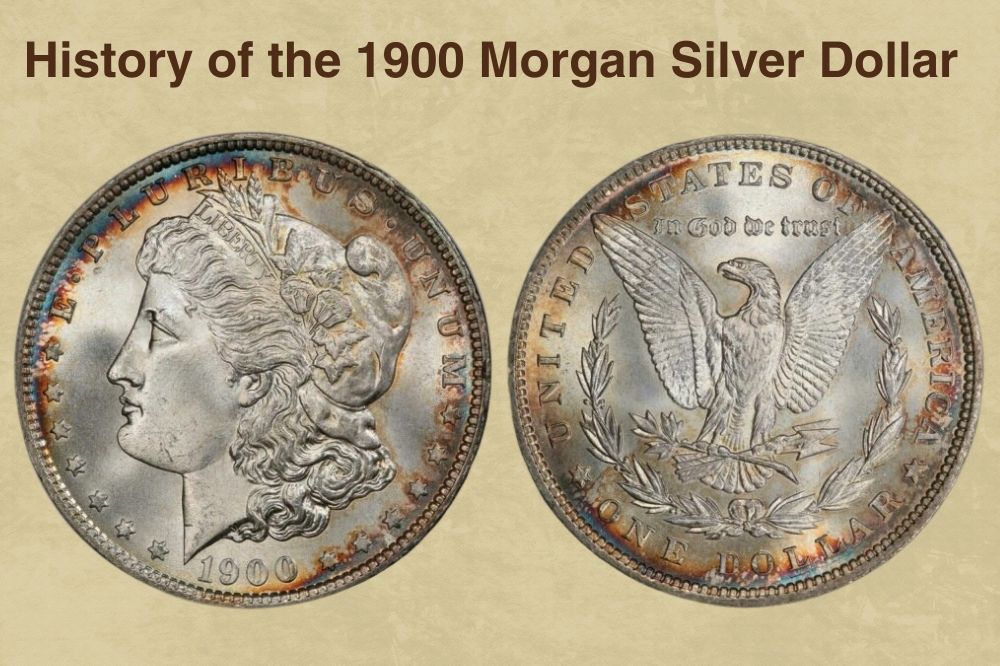
Morgan dollar history began in 1878 when the first silver coins with this design were realized in circulation. Their minting lasted until 1904, with one more set produced in 1921.
These coins were the first standard American dollars made of silver after the Coinage Act of 1873 ended the Seated Liberty dollar production.
1900 Morgan Silver Dollar coin Types |
||
| Location | Year | Minted |
| Philadelphia | 1900 silver dollars | 8,830,000 |
| Philadelphia | 1900 proof silver dollars | 912 |
| New Orleans | 1900 O silver dollars | 12,590,000 |
| San Francisco | 1900 S silver dollars | 3,540,000 |
| Total | / | 24,960,912 |
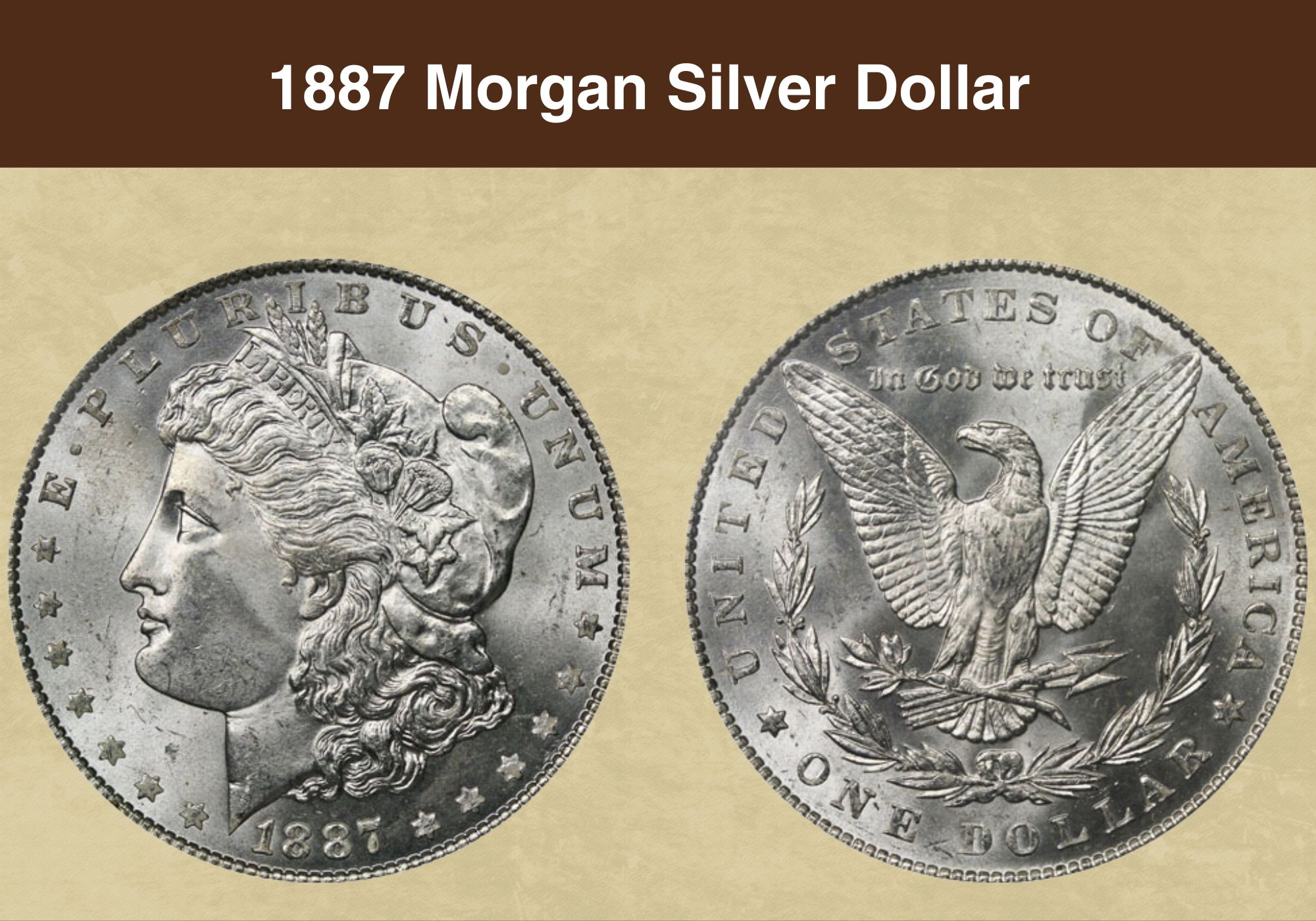
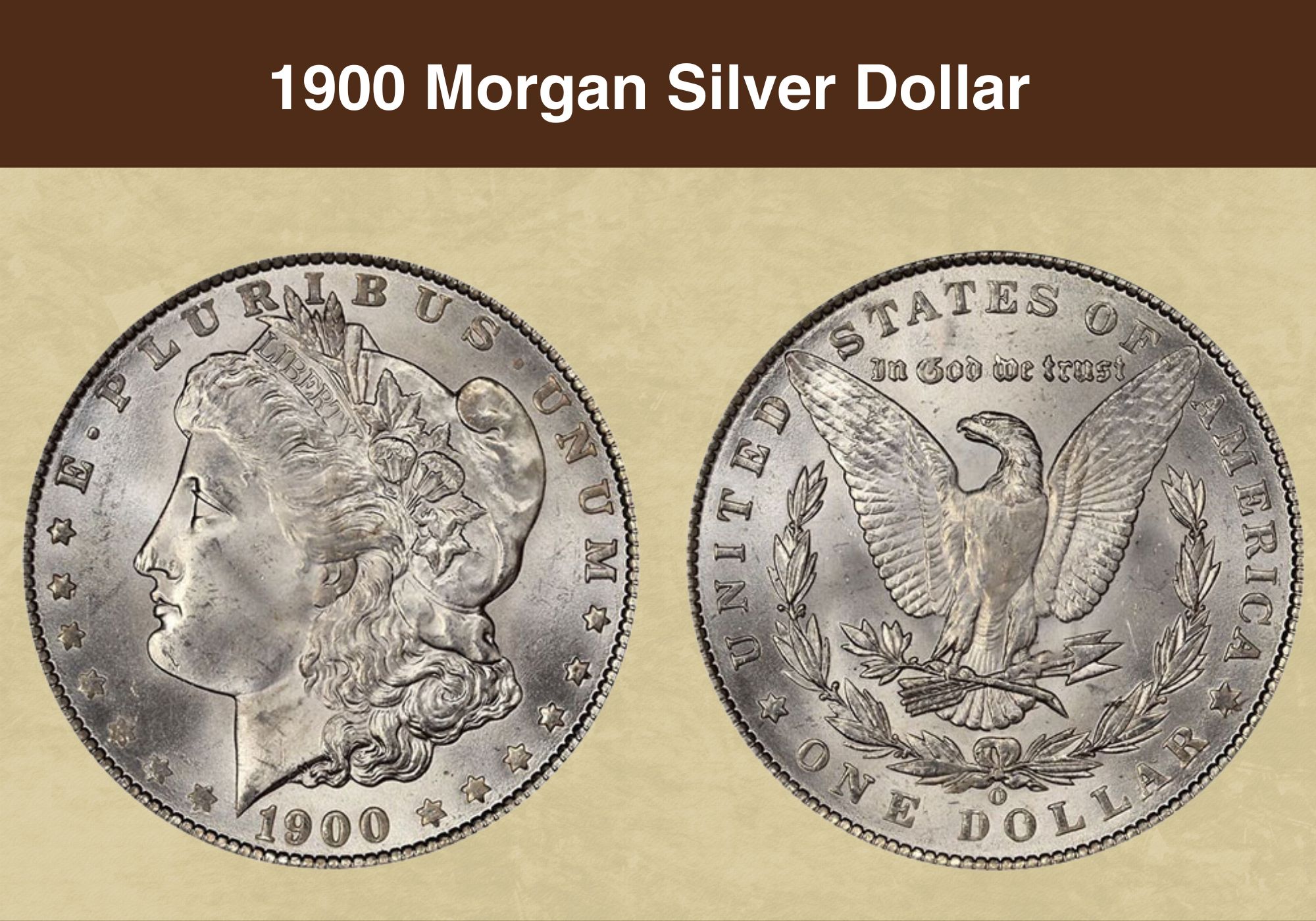
Engraver George T. Morgan used Anna Willess Williams’ profile as a model for the new coinage, making her a Silver Dollar Girl. On the other hand, he depicted a bald American eagle on the coin reverse, symbolizing America.
Also read: 12 Most Valuable One-Dollar Coin Worth Money
Features of the 1900 Morgan Silver Dollar Coins
Most Americans agree that George T. Morgan did an excellent job with these silver coins. The first set appeared in circulation in 1878, but the US Mint was forced to stall minting in 1904. That makes 1900 Morgan dollars one of the last mintages produced at the turn of two centuries.
The obverse of the 1900 Morgan Silver Dollar coins
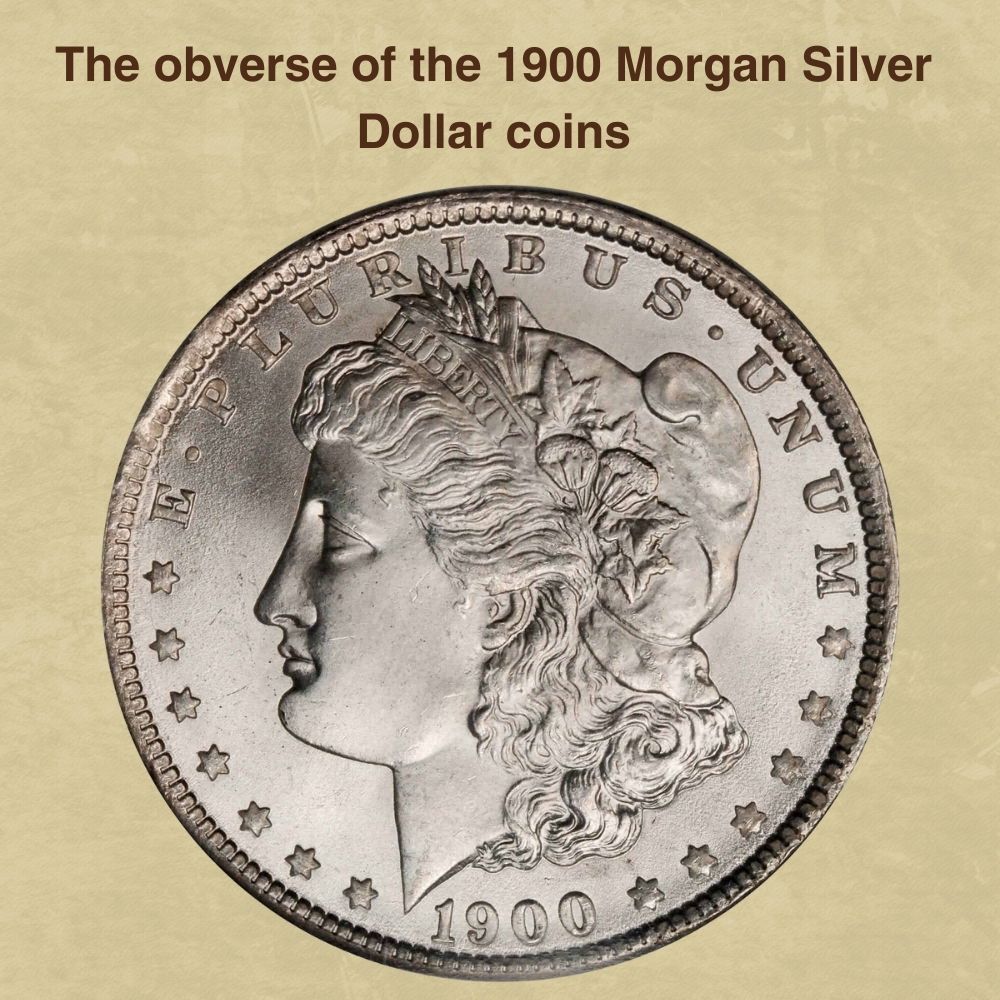
Morgan chose to depict Lady Liberty with an elegant Phrygian cap on her head. It was decorated with wheat ears, flowers, leaves, and a ribbon with the inscription LIBERTY.
Her perfect profile is turned left and surrounded with ✶✶✶✶✶✶✶ E · PLURIBUS · UNUM ✶✶✶✶✶✶ 1900. Interestingly, you can see the letter M, representing the designer’s initial, on both coin sides. The first is hidden inside the last curl at the neck’s base.
The reverse of the 1900 Morgan Silver Dollar coins
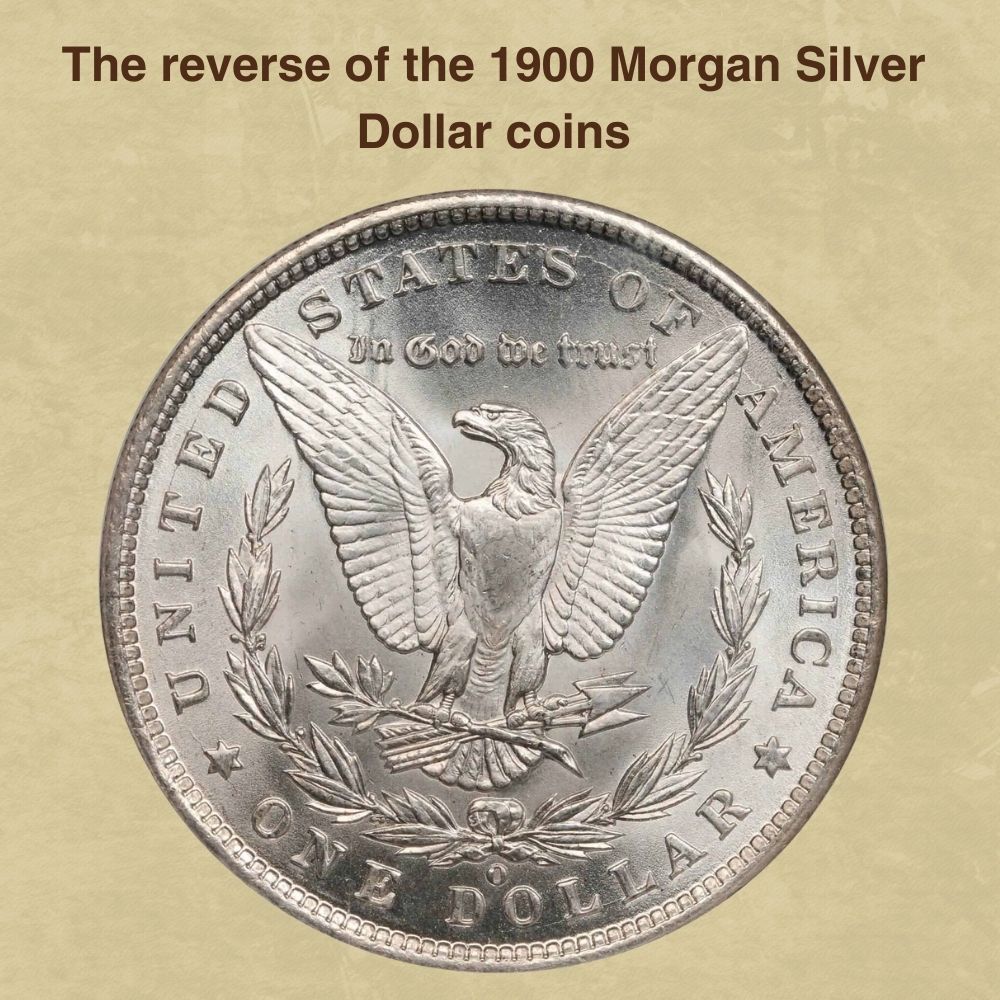
The central position of the Morgan dollar is reserved for a bald eagle, a prominent American symbol. Between its spread wings is a famous motto In God we trust written in a font atypical for American coinage.
Its claws tightly hold the three arrows and one olive branch above the laurel wreath. Along the edge are ✶ UNITED STATES OF AMERICA ✶ ONE DOLLAR. The second M is placed left of the ribbon wrapping the laurel wreath.
1900 Morgan Silver Dollar coins Details |
|
| Face value | One dollar ($1) |
| Shape | Round |
| Compound | 90% silver and 10% copper |
| Coin thickness | 0.0945 inches (2.40 mm) |
| Coin weight | 0.8594 troy ounces (26.73 g) |
| Silver weight | 0.7734 troy ounces (24.5 g) |
| Coin diameter | 1.5 inches (38.10 mm) |
| Edge | Reeded |
Other features of the 1900 Morgan Silver Dollar coins
The 1900 Morgan dollar is a round American coin with a reeded edge that is made of silver. Since a precious metal is 90% of coin weight, you can calculate that each piece weighing 0.8594 troy ounces (26.73 g) contains 0.7734 troy ounces (24.50 g) silver. These coins are thick 0.0945 inches (2.4 mm), and have a diameter of 1.5 inches (38.10 mm).
Also read: 14 Most Valuable Coins In Circulation
1900 Morgan Silver Dollar Coin Grading
The 1900 Morgan silver coins grading is a complicated procedure you should leave to experts. The problem is that the price range for specimens in MS 60 to MS 68 grade can be from a few bucks to ten thousand dollars. In other words, it can cost you a lot if you overlook a little thing.
| # | Grade |
|---|---|
| 1 | Basal State-1 |
| 2 | Fair |
| 3 | Very Fair |
| 4, 5, 6 | Good |
| 7, 8, 10 | Very Good |
| 12, 15 | Fine |
| 20, 30 | Very Fine |
| 40 | Extremely Fine |
| 50 | About Uncirculated |
| 60 | Mint State |
| 65 | Mint State |
| 70 | Mint State |
Please check our grading guides to know your coin scale, It’s the necessary step to know the exact value of your coin.
Check out now: How to Grade Morgan Silver Dollar?
1900 Silver Dollar Value Guides
Three mints released 24,960,912 silver Morgan coins into circulation. The highest mintage was reached in New Orleans, while the mint in Philadelphia produced a few hundred of proofs besides those from regular strikes.
1900 No Mint mark Silver Dollar Value
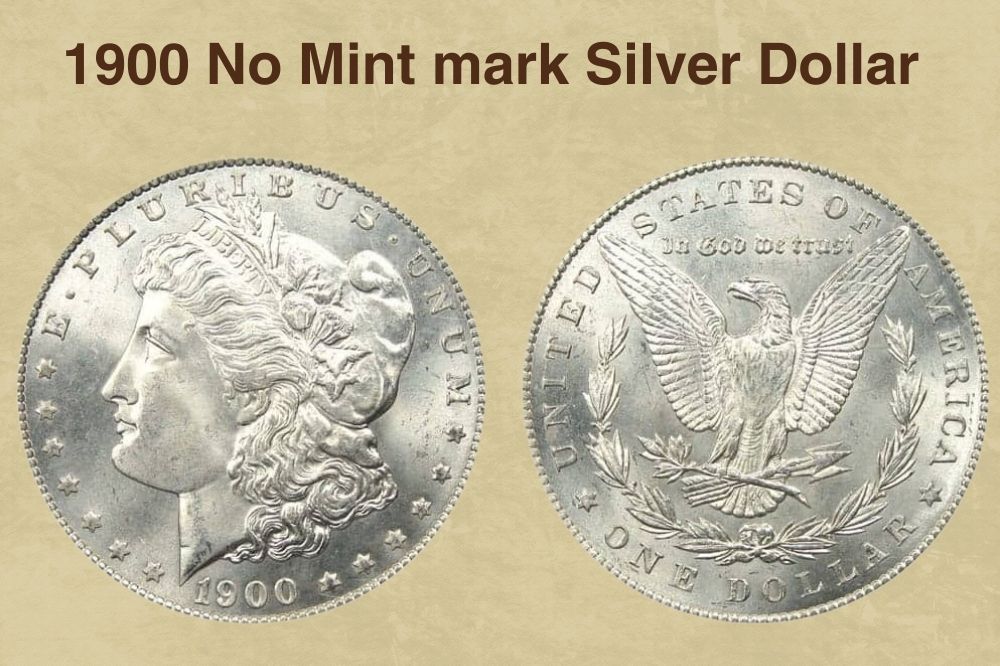
According to the regulations of the time, the Philadelphia mint produced 8,830,000 silver dollars without the mint mark in 1990. Most ended up in circulation, and you can buy such pieces for $37 to $70 nowadays. Even lower-graded coins in the mint state cost an affordable $75 to $275.
On the other hand, you need to set aside about $625 for the MS 66-ranked specimens, while those in MS 67 grade are genuinely expensive. Their estimated price range is $5,000 to $6,000, but the costliest is the 1900 MS 67+ Morgan coin, sold at $45,600 in 2019.
You can also purchase most 1900 PL Morgans for $75 to $1,100, but the best-graded coins cost:
- MS 65 – $3,000 to $4,000
- MS 66 – $6,250 to $9,000
The best-paid is the 1900 PL Morgan dollar in MS 66 grade, sold at $7,500 in 2021.
Undoubtedly the priciest Morgans minted in 1900 are those with a DMPL quality. Those ranging from MS 63 to MS 65 are assessed at $4,000 to $62,500, but one such coin in MS 65+ grade won the record price in 2021 when sold at $67,563.
1900 Silver Dollar proofs Value
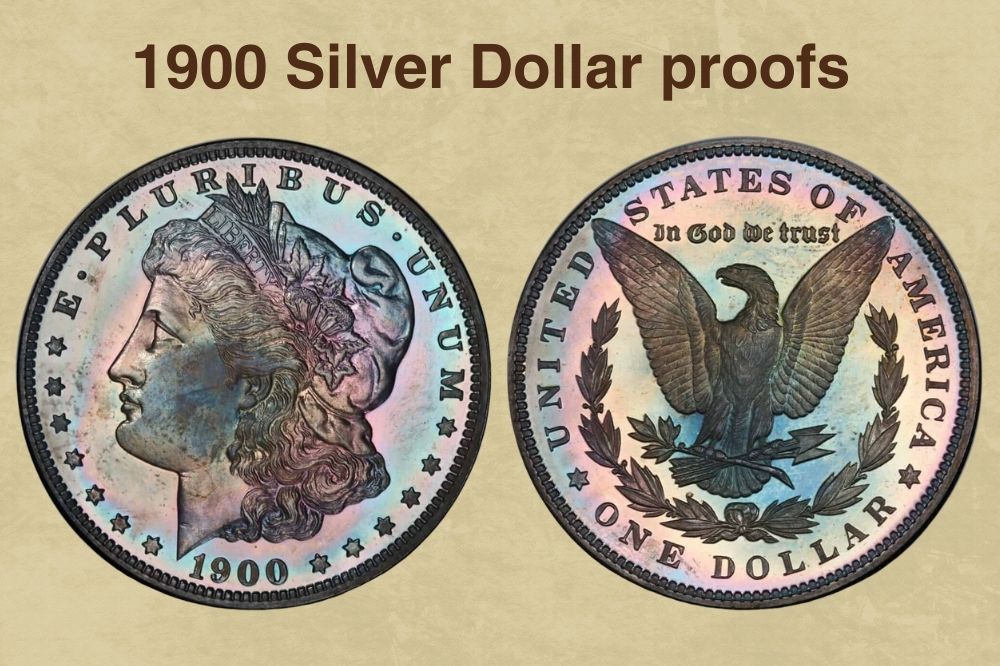
The Philadelphia mint struck 912 silver proofs in 1900, making them collectible and relatively scarce nowadays. Depending on quality, you can buy one of these lovely coins for $850 to $8,000, but the best-graded specimens are more costly.
For instance, the 1900 PR 67 Morgans are worth $29,000, while those graded PR 68 are estimated at $50,000. The record price of $32,200 reached in 2010 is still unbeaten.
The 1900 PR CAM silver dollars are sought-after among collectors, and those with a high budget can pay $2,600 to $52,500 for these coins. For now, the auction record for the 1900 PR 68 Morgan dollar with cameo contrast is $34,800.
Expectedly, silver Morgans with DCAM quality are the most expensive, and you can get one for $5,250 to $20,000. Interestingly, the estimation for PR 67-graded coins is $62,500, while those ranking PR 68 are assessed at $85,000.
However, the auction record went to one 1900 Morgan dollar with deep cameo contrast in PR 67 grade. One collector paid $52,875 to add it to their collection in 2018.
1900 O Silver Dollar Value
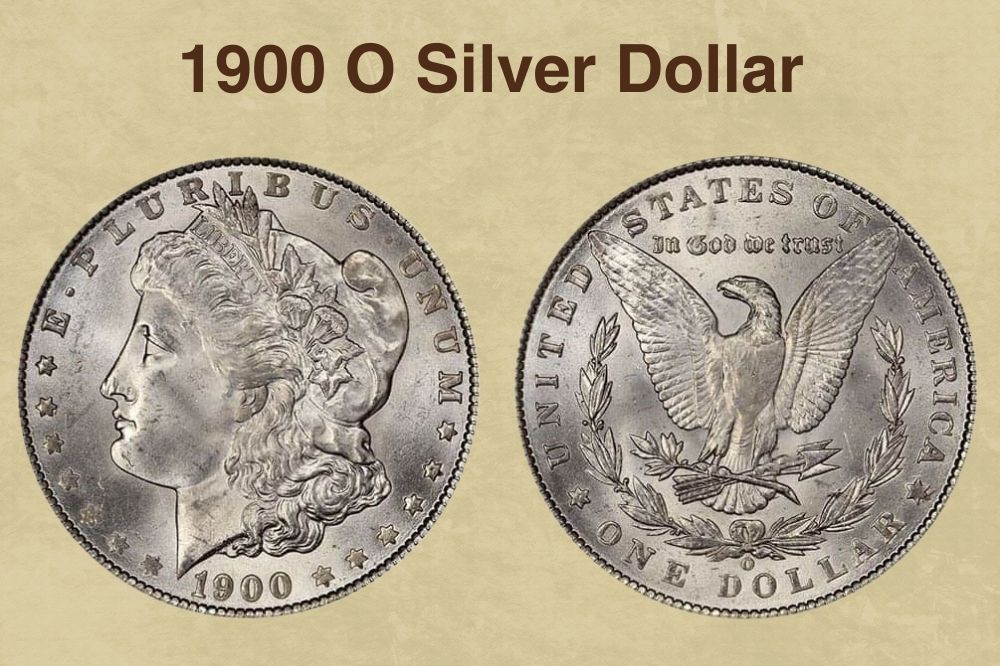
Most surviving Morgan coins with the O mint mark of 12,590,000 produced in 1900 in New Orleans are valuable. You can buy one for $32 to $70 if you prefer circulated pieces or set aside $75 to $3,250 for impeccable coins. However, one collector paid an impressive $9,694 for the 1900 O MS 67+ Morgan in 2017.
The estimated price for the 1900 O PL silver dollars is $1,300 for the MS 66-ranked coin. On the other hand, one scarce piece in MS 67 won an auction record of $15,000 in 2019.
Finally, experts have estimated 1900 O DMPL Morgans at $375 (MS 61 grade) to $8,500 (MS 65 grade). Still, one of them stood out from the crowd after it sold at $10,925 in 2008.
1900 S Silver Dollar Value
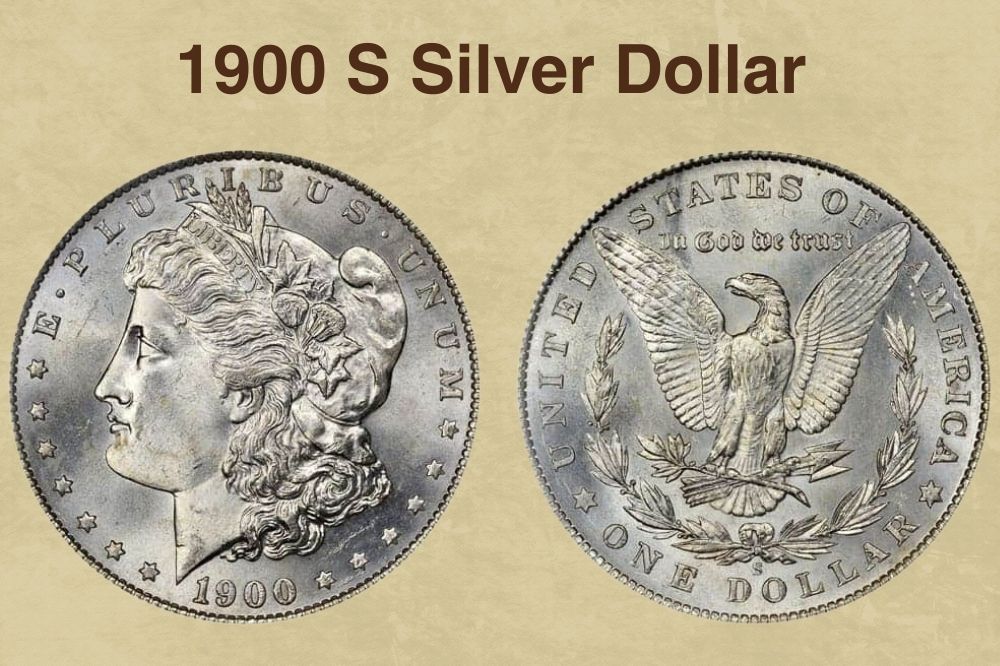
The San Francisco mint released the lowest number of the 1900 S silver dollars, 3,540,000 pieces. Their average prices go from $37 to $425 for coins that circulated for years, while those in the mint state cost $475 to $2,650.
Only specimens in MS 67 grade are genuinely expensive, with an estimated price range from $20,000 to $45,000. The priciest 1900 S Morgan in MS 67 grade is the one sold at $39,950 in 2016.
You can also find 1900 S PL Morgans on the market. While most cost $350 to $7,000, depending on preservation level, the MS 67-rating coins are worth $45,000 to $54,000. The record price confirmed the estimated price range since one of these silver coins won an auction record of $48,875 in 2007.
Finally, the most appreciated coins among those with the S mint mark are the 1900 S DMPL silver dollars. Their cost depends on their look, so you should set aside the following:
- $1,800 to $4,650 for MS 62-graded dollar coins
- $6,100 to $8,500 for MS 63-graded dollar coins
- $13,000 to $14,500 for MS 64-graded dollar coins
- $26,000 to $30,000 for MS 65-graded dollar coins
The auction record holds an MS 64-ranked DMPL coin from San Francisco sold at an auction in 2008 for $17,250.
Also read: Top 10 Most Valuable Morgan Silver Dollar Worth Money
Rare 1900 Morgan Silver Dollar Coin Errors List
Since millions of Morgan dollars were minted in 1900, you can expect to see some imperfect specimens among them. Such pieces are expensive, particularly one scarce and specific error with this minting year struck on the coin obverse. Let’s see.
O over CC (O/CC)
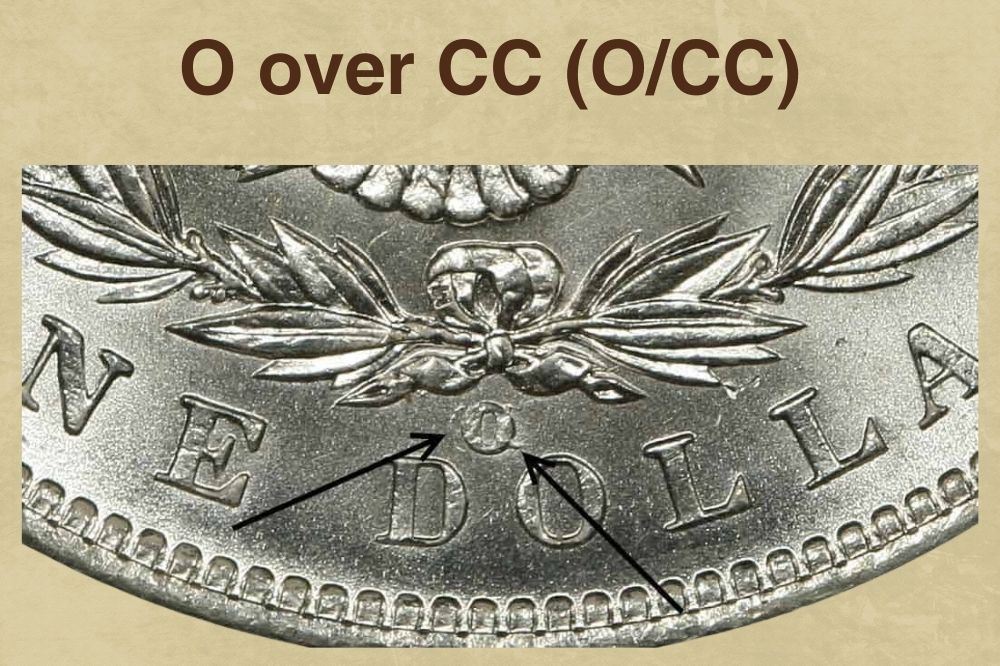
The 1900 O over CC error Morgan coins are those with the O mint mark minted over the one typical for the New Orleans mint. Collectors adore these pieces and are willing to pay $100 to $545 for one of them in circulated condition.
On the other hand, error silver dollars in the mint state cost $600 (MS 60) to $2,400 (MS 65). Believe it or not, scarce specimens are even more valuable, so you should pay:
- $4,600 to $5,520 (MS 66)
- $35,000 to $45,000 (MS 67)
Despite these high estimations, one 1900 O/CC, MS 67+ silver dollar is even more expensive. One collector paid $52,875 for it in 2015.
Doubled die reverse
This error visible on the reverse is common when an old die struck the planchet. Although these coins are available on the market, their prices are often higher than regular pieces, ranging from $30 to $250.
Where to Sell Your 1900 Silver dollar ?
Now that you know the value of your coins, do you know where to sell those coins online easily? Don’t worry, I’ve compiled a list of these sites, including their introduction, pros, and cons.
Check out now: Best Places To Sell Coins Online (Pros & Cons)
FAQ about the 1900 Morgan Silver Dollar Coins
What makes 1900 Morgan Silver Dollar coins rare?
Along with other pre-1900 Morgan silver dollars, those minted in 1900 are the rarest in the series. Besides proofs and regular coins in the highest grades, you should pay particular attention to the scarce, sought-after, and potentially expensive 1900 O/CC over mint mark error coins.
Which 1900 Morgan Silver Dollar coins are the most valuable?
- 1900 silver Morgan coin (DMPL, MS 65+) – $67,563 in 2021
- 1900 silver Morgan coin (O/CC, MS 67+) – $52,875 in 2015
- 1900 silver Morgan coin (DCAM, PR 67) – $52,875 in 2018
- 1900 S silver Morgan coin (PL, MS 67) – $48,875 in 2007
- 1900 silver Morgan coin (MS 67+) – $45,600 in 2019
- 1900 S silver Morgan coin (MS 67) – $39,950 in 2016
- 1900 silver Morgan coin (CAM, PR 68) – $34,800 in 2021
- 1900 silver Morgan coin (PR 68) – $32,200 in 2010
- 1900 S silver Morgan coin (DMPL, MS 64) – $17,250 in 2008
- 1900 O silver Morgan coin (PL, MS 67) – $15,000 in 2019
- 1900 O silver Morgan coin (DMPL, MS 65) – $10,925 in 2008
- 1900 O silver Morgan coin (MS 67+) – $9,694 in 2017
- 1900 silver Morgan coin (PL, MS 66) – $7,500 in 2021
How much are the 1900 Morgan Silver Dollar coins (No Mint mark) worth?
The 1990 Morgan dollars’ prices significantly vary depending on their grade. For instance, you can buy circulated coins for $36 to $70, while those in the mint state come in a huge price range. While those in MS 60 rank cost $75, MS 67-graded pieces quickly reach $5,000.
What are the most valuable silver Morgan coins?
- The most expensive Morgan coin from Carlson City is the 1889 CC MS 68 coin, sold at $881,250 in 2013
- The most expensive Morgan coin from New Orleans is the 1886 O MS 67 DMPL coin, sold at $780,000 in 2020
- The most expensive Morgan coin from San Francisco is the 1884 S MS 68 coin, sold at $750,000 in 2020
- The most expensive Morgan coin from Philadelphia is the 1901 MS 66 coin, sold at $587,500 in 2015
- The most expensive Morgan coin proof is the 1895 PR 67+ DCAM coin, sold at $269,500 in 2020