1887 Silver Dollar Value Checker: Errors List, “O”, “S” & No Mint Mark Worth

1887 Silver Dollar Value

The 1887 Dollar was struck at three U.S. Mint facilities — Philadelphia, New Orleans, and San Francisco — and the mint where your coin was made matters more than most people expect.

Philadelphia set a production record that year, turning out over 20 million coins, which keeps most Philadelphia examples within easy reach for new collectors today.

The 1887 Silver Dollar value, however, is far from uniform across the board. A Philadelphia piece in Good grade sits at $84, while an 1887-O DMPL in MS condition can reach $3,472 — nearly 41 times higher.

The 1887-S had a mintage of just 1.771 million coins, making it the scarcest of the three mints that year. Mint mark, surface designation, and grade each pull the value in a very different direction.

1887 Silver Dollar Value Checker

Identify 1887 Silver Dollar O, S and No Mint Mark Price

✨ No Sign-up Required
Obv

Front Obverse

Upload or Take a Photo

Rev

Back Reverse

Upload or Take a Photo


1887 Silver Dollar Value By Variety

Where your coin was minted is only part of the equation. Surface designation — whether a coin is standard, Prooflike, or Deep Mirror Prooflike — plays just as big a role in what a buyer is willing to pay. The same year, the same mint, and the price gap between two coins can still be enormous.

If you know the grade of your coin, you can find the exact price below in the Value Guides section.

1887 Silver Dollar Value Chart

TYPEGOODFINEAUMSPR
1887 No Mint Mark Silver Dollar Value$84.00$84.00$86.00$157.33
1887 No Mint Mark Silver Dollar (PL) Value$7.62$26.10$66.83$315.00
1887 No Mint Mark Silver Dollar (DMPL) Value$12.20$41.76$106.93$428.00
1887 O Silver Dollar Value$84.00$84.00$86.00$672.00
1887 O Silver Dollar (PL) Value$12.96$44.37$113.61$1734.00
1887 O Silver Dollar (DMPL) Value$29.73$101.79$260.64$3472.00
1887 S Silver Dollar Value$13.40$45.88$96.00$2150.00
1887 S Silver Dollar (PL) Value$25.92$88.74$227.23$3830.00
1887 S Silver Dollar (DMPL) Value$41.92$143.55$367.57$3770.00
1887 Proof Silver Dollar Value$700.00$1190.00$11511.25
1887 CAM Silver Dollar Value$6061.67
Updated: 2026-05-12 02:02:03

Also Read: Top 100 Rarest Silver Dollar Coins Worth Money (Most Expensive)


Top 10 Most Valuable 1887 Silver Dollar Worth Money

Most Valuable 1887 Silver Dollar Chart

2000 - Present

Among all 1887 Morgan Silver Dollar auction results recorded since 2000, the New Orleans coins dominate the top spots by a wide margin.

Three separate 1887-O examples in MS66 have sold for $78,000, $69,000, and $61,688 respectively — the New Orleans issue becomes genuinely scarce in gem condition, and high-grade survivors are far harder to find than the mintage numbers alone might suggest.

The 1887-S in MS66 follows at $58,800. San Francisco coins from this era are recognized for their sharp strikes and strong luster, and with a much smaller original mintage, high-grade survivors are genuinely hard to find.

Proof coins round out the upper tier. Only 710 proof dollars were struck at Philadelphia in 1887, and one graded PR68 reached $51,750 at Heritage Auctions.

The overdate variety 1887/6-O in MS65 sold for $37,375, while the top Philadelphia business strike — an MS63 — reached $78,000 at Stack’s Bowers in November 2024. That result currently stands as the auction record for the Philadelphia issue.


History Of The 1887 Silver Dollar

The Bland-Allison Act of 1878 brought silver coinage back after the Coinage Act of 1873 had effectively ended it, requiring the Treasury to purchase millions of dollars’ worth of silver each month to be struck into dollars. That legislation is what put the Morgan Dollar into existence.

The coin took its name from U.S. Mint Assistant Engraver George T. Morgan, who designed the Liberty portrait on the obverse. From the beginning, production was driven by law rather than by what the market actually needed.

Millions of silver dollars were minted each year, yet the coin rarely saw active circulation — paper dollars were simply more practical for everyday use. The excess sat in bags inside Treasury vaults, untouched, for decades.

The 1887 issue fit squarely into this pattern. Philadelphia broke its own production record that year, adding further to a stockpile that was already growing faster than demand. Most 1887 dollars were bagged and stored the same day they were struck.

Coins from that stored inventory were gradually released — in 1938, through the 1940s, in December 1954, and into the early 1960s — which explains why so many uncirculated 1887 examples are still around today.

Also Read: Top 100 Most Valuable Morgan Silver Dollar Coins Worth Money List


Is Your 1887 Silver Dollar Rare?

24

1887 No Mint Mark Silver Dollar

Uncommon
Ranked 671 in Morgan Dollar
49

1887 No Mint Mark Silver Dollar (PL)

Very Rare
Ranked 374 in Morgan Dollar
58

1887 No Mint Mark Silver Dollar (DMPL)

Ultra Rare
Ranked 328 in Morgan Dollar
49

1887-O Silver Dollar

Very Rare
Ranked 365 in Morgan Dollar
83

1887-O Silver Dollar (PL)

Mythic
Ranked 223 in Morgan Dollar
90

1887-O Silver Dollar (DMPL)

Divine
Ranked 153 in Morgan Dollar
48

1887-S Silver Dollar

Very Rare
Ranked 375 in Morgan Dollar
100

1887-S Silver Dollar (PL)

Transcendent
Ranked 21 in Morgan Dollar
98

1887-S Silver Dollar (DMPL)

Transcendent
Ranked 78 in Morgan Dollar
85

1887 Proof Silver Dollar

Divine
Ranked 198 in Morgan Dollar
90

1887 CAM Silver Dollar

Divine
Ranked 157 in Morgan Dollar

Rarity in the Morgan Dollar series runs a wide spectrum, and the 1887 is no exception. Grades, mint marks, and surface designations all pull a coin’s rarity in different directions. The free daily evaluation on Coin Value Checker App gives you a clearer picture of exactly where your coin stands.


Key Features Of The 1887 Silver Dollar

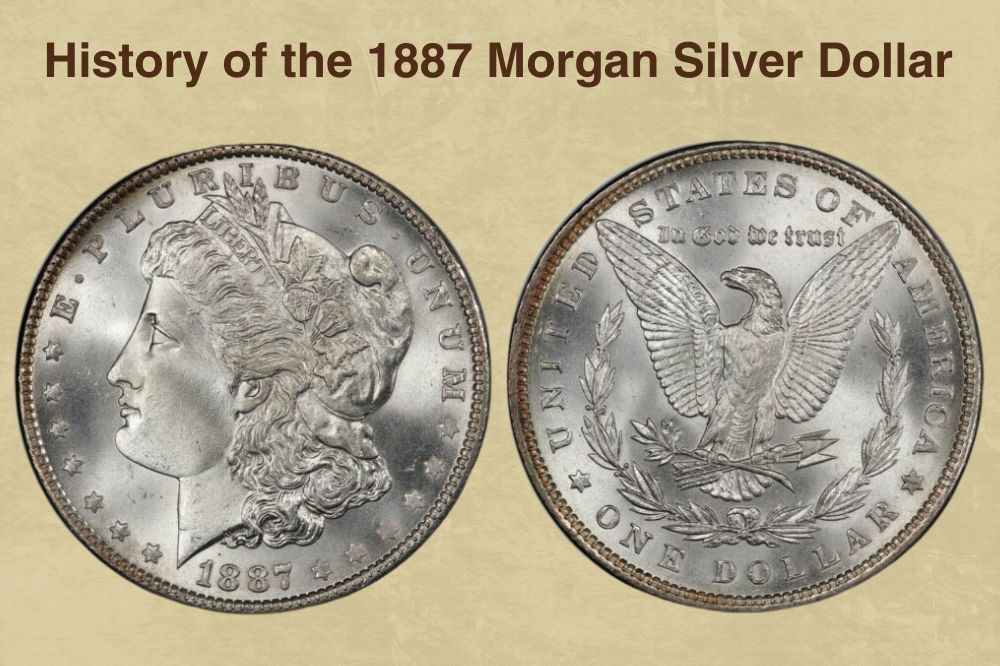
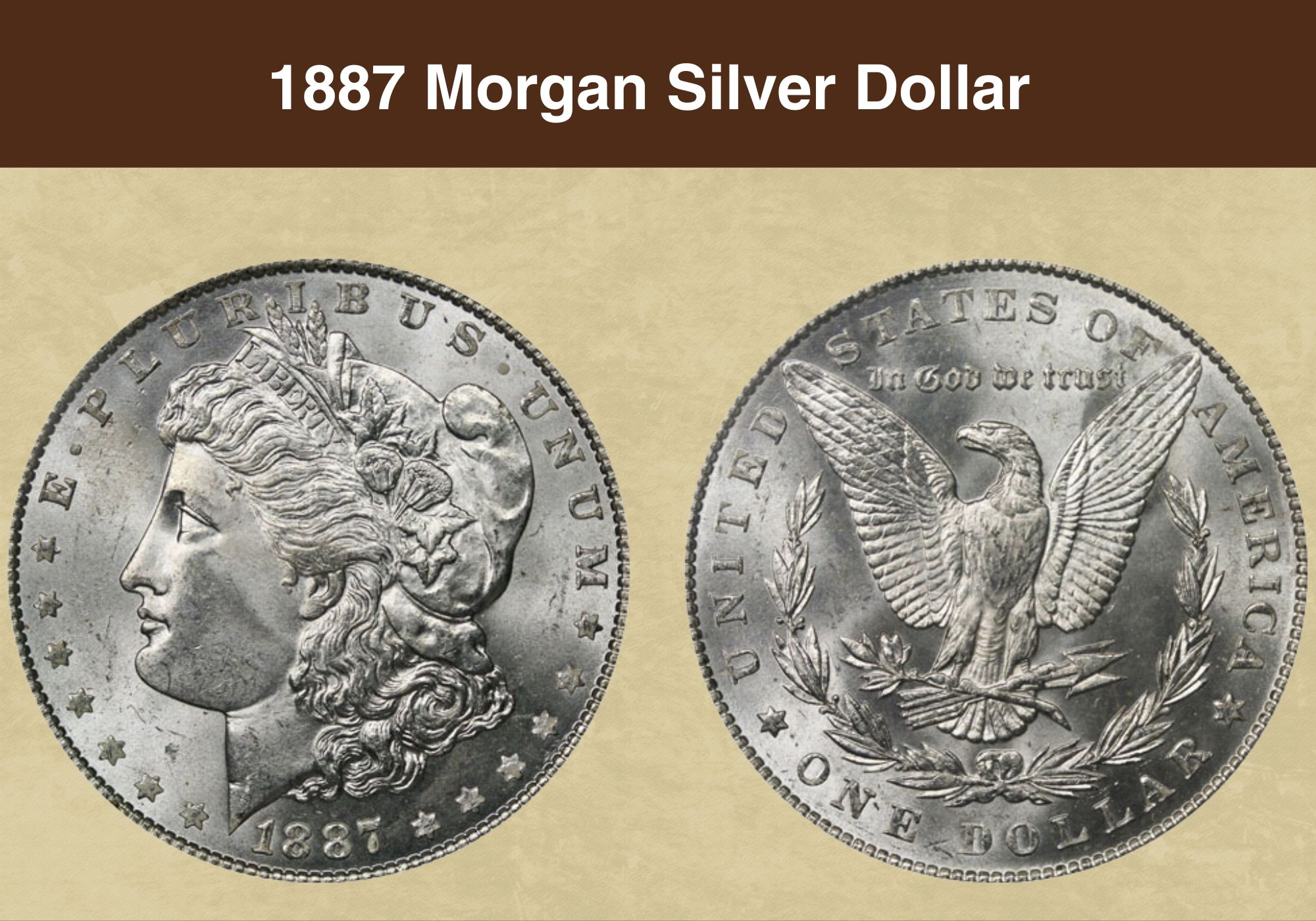
The 1887 Silver Dollar carries the same design used across the entire Morgan Dollar series, but a closer look at each side reveals exactly how much detail George T. Morgan packed into a 38-millimeter coin.

Both the obverse and reverse are worth understanding — not just for identification, but because condition on these specific design elements is what graders look at first.

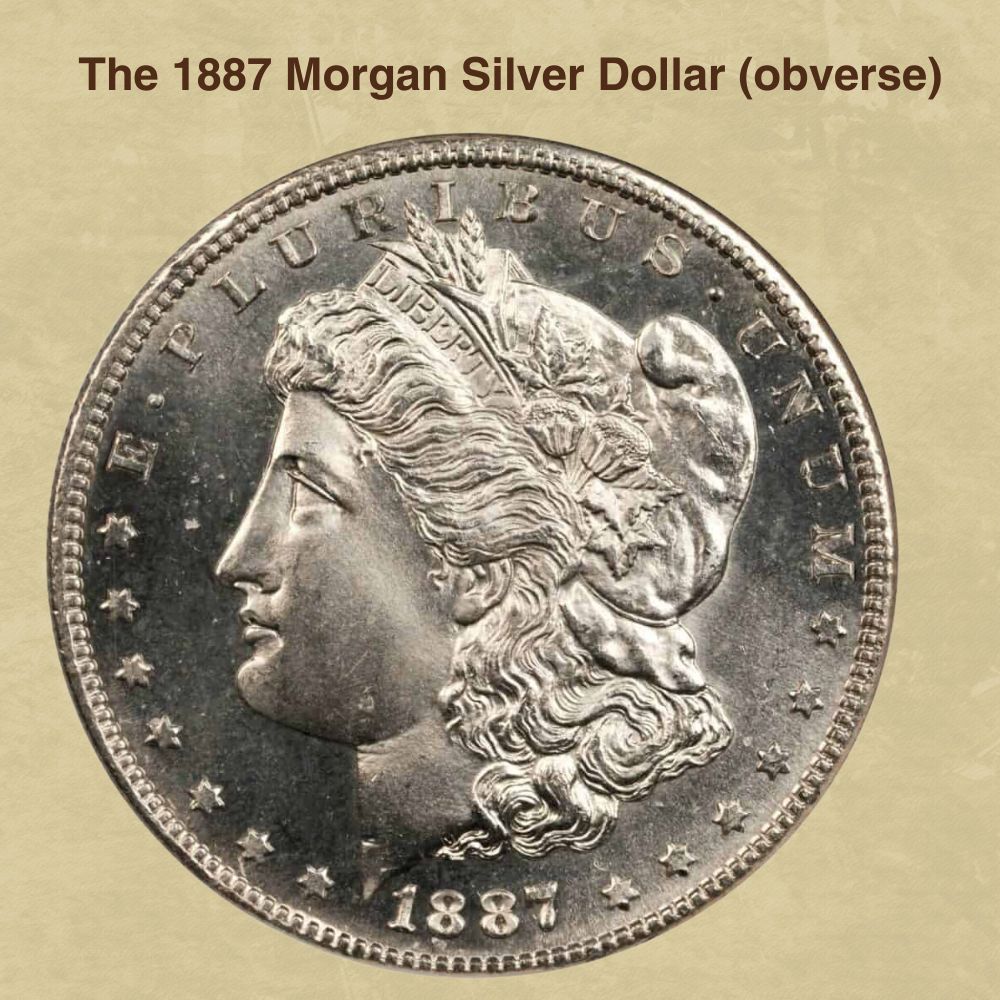
The Obverse Of The 1887 Silver Dollar

The Obverse Of The 1887 Silver Dollar

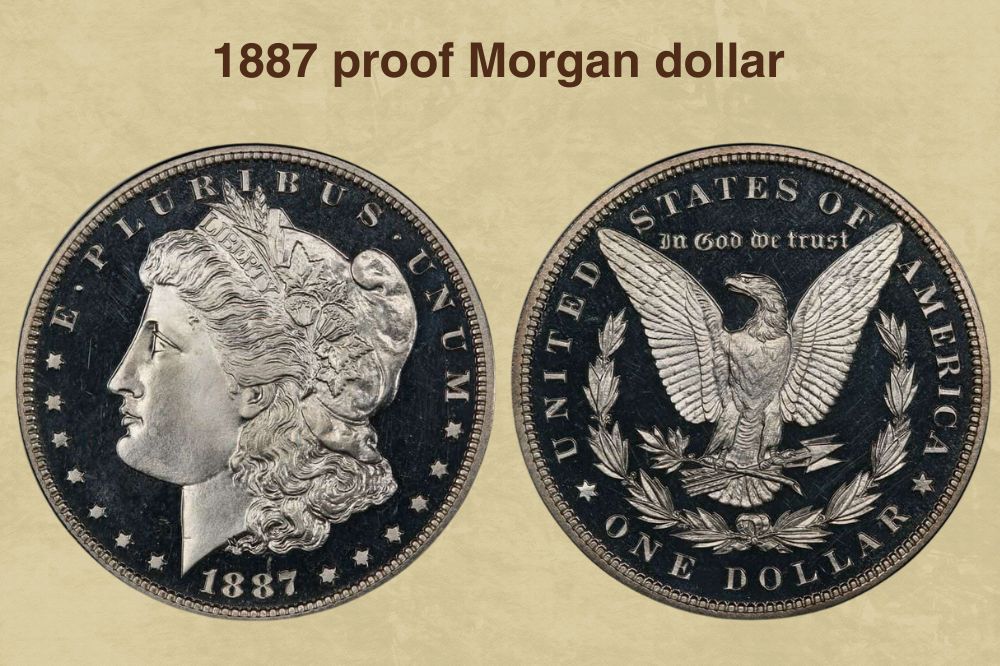
The obverse features the characteristic left-facing Liberty Head motif seen across the Morgan Dollar series. The central bust wears a Phrygian cap encircled with a ribbon inscribed “LIBERTY”, and a crown of wheat and cotton — two of the nation’s most significant agricultural assets in the 19th century.

For the representation of Liberty, Morgan sought to depict an American woman rather than the usual Greek-style figures. His friend, artist Thomas Eakins, suggested he use Anna Willess Williams of Philadelphia as a model. Morgan declared her profile to be the most perfect he had seen.

The motto “E PLURIBUS UNUM” arches across the upper half of the obverse rim, and the date “1887” is centered at the bottom adjacent to the rim. Seven stars appear on the left side between the date and the inscription, while six stars fill the right side — thirteen in total, representing the original colonies.

The Reverse Of The 1887 Silver Dollar

The Reverse Of The 1887 Silver Dollar

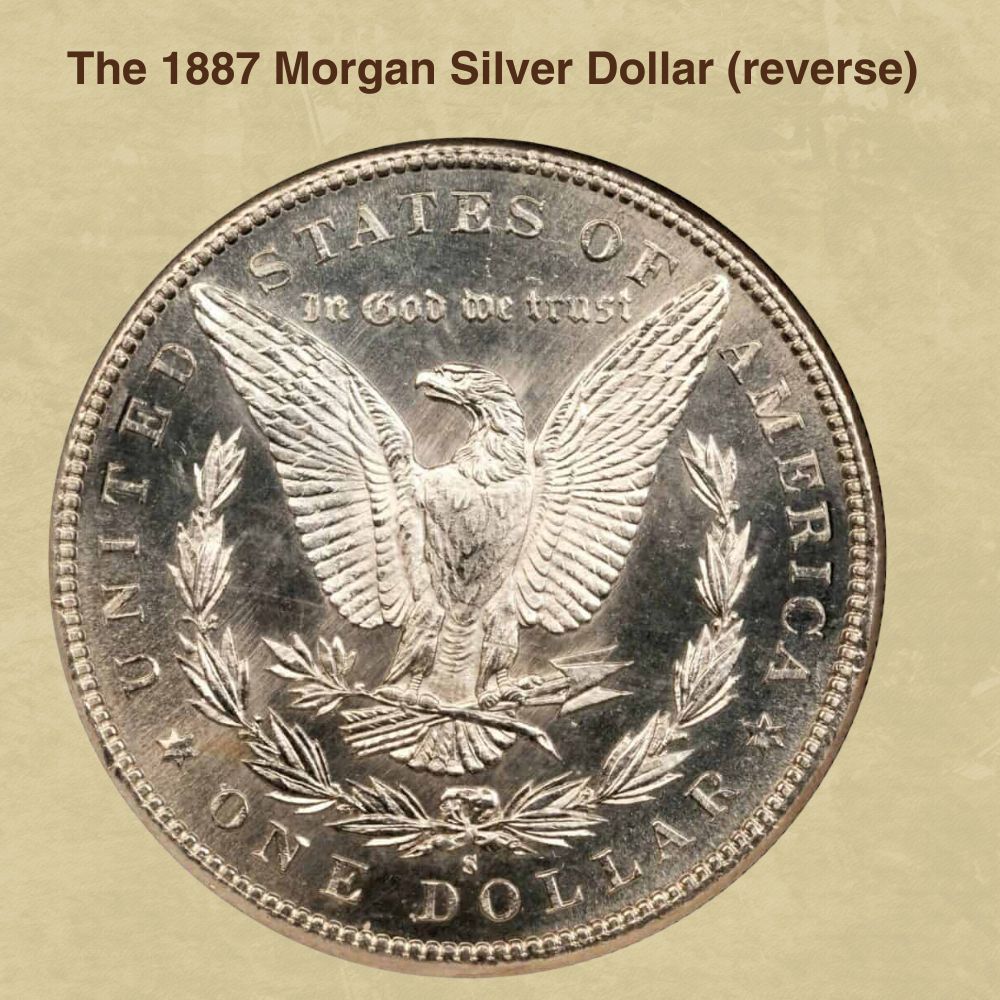
The reverse is dominated by a heraldic eagle, its wings spread across the upper half of the coin. The key elements are:

  • Eagle — center of the design, wings outstretched, facing right
  • Olive branch — clutched in the eagle’s right talon, representing peace
  • Three arrows — clutched in the eagle’s left talon, symbolizing the nation’s ability to defend itself
  • Laurel wreath — partially encircles the eagle below
  • “IN GOD WE TRUST” — inscribed above the eagle’s head in Gothic script
  • “UNITED STATES OF AMERICA” — arching around the upper rim
  • “ONE DOLLAR” — at the bottom of the reverse
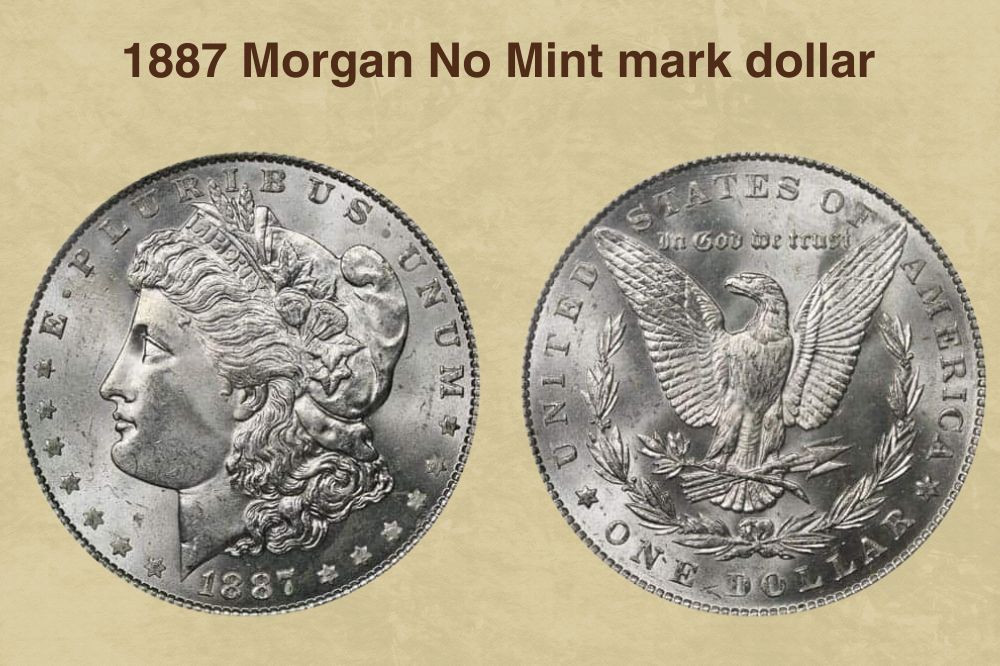
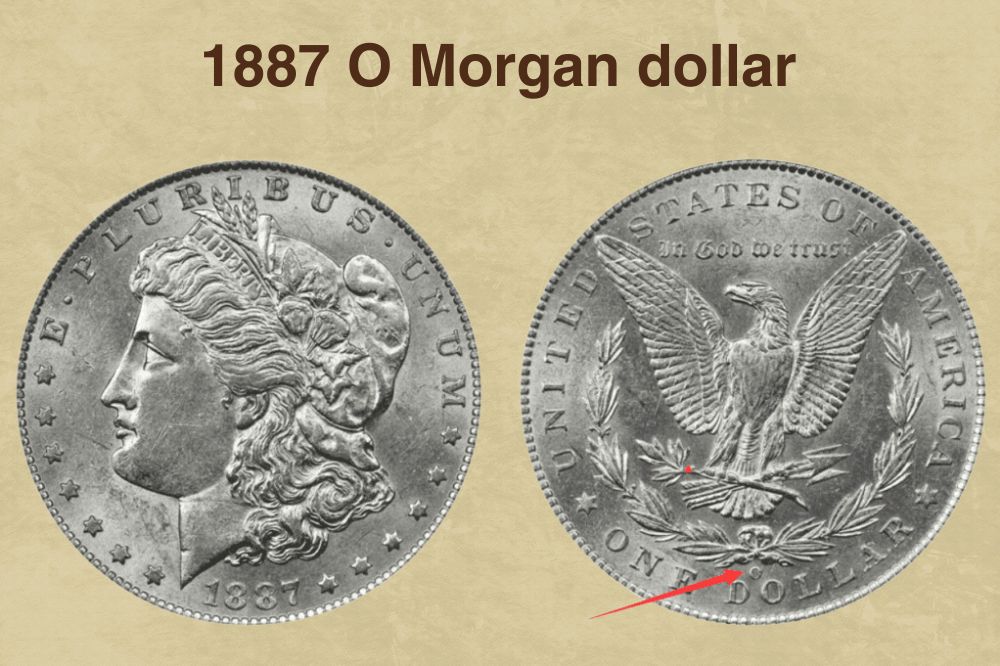
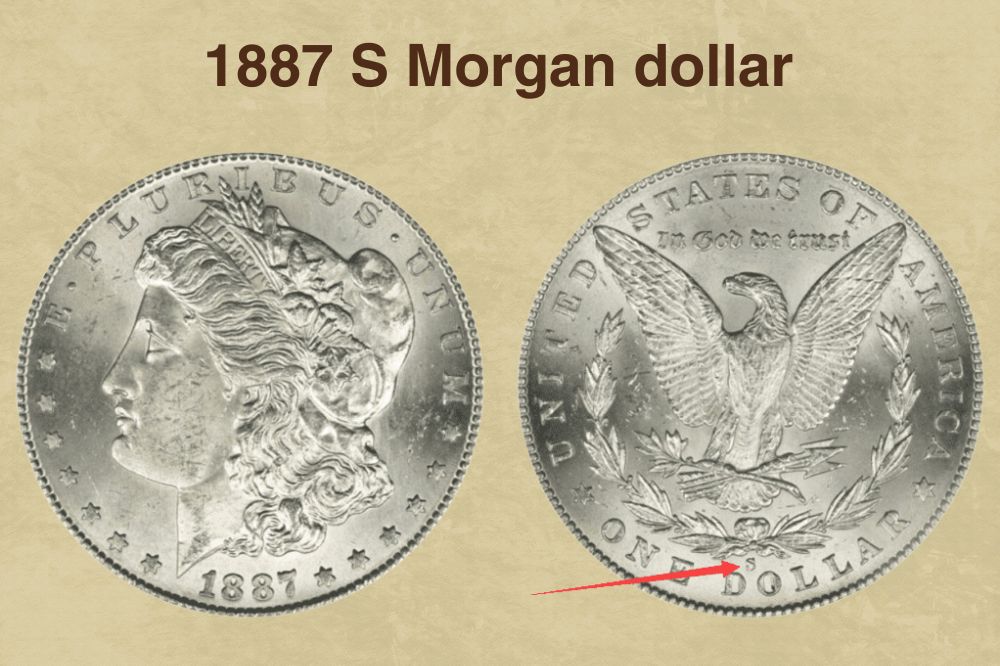
  • Mint mark — appears on the reverse above the “DO” in “DOLLAR”, present on New Orleans (“O”) and San Francisco (“S”) issues; Philadelphia coins carry no mint mark

Other Features Of The 1887 Silver Dollar

The 1887 Silver Dollar has a diameter of 38.10 millimeters and weighs 26.73 grams. The coin contains 90% silver and 10% copper, with a pure silver content of 0.7734 troy ounces. Its thickness is 3.1 mm.

The edge is reeded — meaning it features a series of parallel ridges running around the circumference of the coin. This was a standard anti-counterfeiting measure on U.S. silver coinage of the era.

Also Read: Top 80+ Most Valuable Sacagawea Dollar Worth Money (2000-P to Present)


1887 Silver Dollar Mintage & Survival Data

1887 Silver Dollar Mintage & Survival Chart

Mintage Comparison

Survival Distribution

TypeMintageSurvivalSurvival Rate
No Mint20,290,0002,000,0009.8571%
O11,550,0001,000,0008.658%
S1,771,000180,00010.1637%
Proof71029040.8451%
CAM71025035.2113%

The three business-strike mints followed very different paths in 1887. Philadelphia had a mintage of 20,290,000 that year — its highest output up to that point in the series — with an estimated 2,000,000 surviving today.

New Orleans struck 11,550,000 that year, and while the vast majority were ultimately melted, sufficient numbers remained in Treasury vaults through the early 1960s, leaving a survival of around 1,000,000.

San Francisco’s mintage of 1,771,000 was far smaller, yet its survival rate of roughly 10% sits slightly above the other two — a reflection of the generally superior strike quality and state of preservation associated with San Francisco coins of this era.

The Proof and CAM issues stand apart entirely. Only 710 Proof coins were struck in 1887, sold directly to collectors and never intended for circulation.

Their survival today is roughly proportional to their original mintage — around 290 Proof and 250 CAM pieces are estimated to remain, giving both a survival rate well above 35%. These were handled with care from day one, and the numbers reflect that.

Also Read: Top 40+ Most Valuable Presidential Dollar Coins Worth Money


The Easy Way to Know Your 1887 Silver Dollar Value

Three things shape what an 1887 Silver Dollar is worth: which mint struck it, its surface designation, and its condition. A coin from San Francisco commands a very different price than one from Philadelphia, even in the same grade. Surface type — standard, Prooflike, or DMPL — adds another layer on top of that.

Reading all three accurately takes a trained eye. The Coin Value Checker App uses AI image recognition to identify the coin, cross-reference mint data, and return a grade range along with a current market value estimate — all from a photo taken on your phone. It’s a practical starting point before any buying or selling decision.

Coin Value Checker APP Screenshot


1887 Silver Dollar Value Guides

The 1887 Silver Dollar was struck at three mints, each producing coins with distinct market characteristics. On top of that, Philadelphia also issued a small number of specially struck coins for collectors that year. Together, these five types cover the full range of what the 1887 issue has to offer — from the most accessible circulated examples to some of the rarest collector pieces in the Morgan Dollar series.

Each type has its own value range, its own level of scarcity in higher grades, and its own place in the market. The five types are:

  • 1887 No Mint Mark Silver Dollar — the most common variety of the year, widely available across all grades
  • 1887-O Silver Dollar — more valuable than the Philadelphia issue, with high-grade examples commanding strong premiums
  • 1887-S Silver Dollar — one of the key semi-key dates in the Morgan Dollar series, with lower survivorship in top grades
  • 1887 Proof Silver Dollar — specially struck collector coins with mirror-like fields, never intended for circulation
  • 1887 CAM Silver Dollar — a highly collectible proof variety with frosted devices, sought after by dedicated collectors

Proof examples of Morgan Dollars from all years, including 1887, are rare, which makes them expensive. For the business-strike coins, grade and surface designation are what separate an affordable circulated piece from one worth thousands.


1887 No Mint Mark Silver Dollar Value

1887 No Mint Mark Silver Dollar Value

The Philadelphia issue is the most accessible entry point into the 1887 Morgan Dollar series. Strike quality is a real variable here — 1887 issues often appear softer struck than their 1886 counterparts, so cherrypicking for a sharply detailed specimen is worth the extra effort.

At the MS63 level, expect to pay between $90 and $120 for a professionally graded example. The value curve steepens considerably at MS66 and above, where luster and strike quality become the deciding factors.

The PL and DMPL surface varieties add a separate collecting dimension. A PL example graded MS67 sold for $8,100 at Heritage Auctions in 2019, while a DMPL in MS66 brought $9,000 at Heritage in October 2025.

The most dramatic result came in November 2024, when an MS63 example realized $78,000 at Stack’s Bowers — a result that reflects just how much eye appeal and pedigree can move the market even on a common-date coin.

MS67 is scarce and MS68 is extremely rare, with only a tiny number of specimens known at that level. If you’re building a type set or just starting with Morgans, an MS64 or MS65 Philadelphia example offers strong value for the grade.

1887 No Mint Mark Silver Dollar Price/Grade Chart

Price by 1-70 Grade (Latest Auction Records Included)

Updated: 2026-05-12 02:02:03

1887 No Mint Mark Silver Dollar (PL) Price/Grade Chart

Price by 1-70 Grade (Latest Auction Records Included)

Updated: 2026-05-12 02:02:03

1887 No Mint Mark Silver Dollar (DMPL) Price/Grade Chart

Price by 1-70 Grade (Latest Auction Records Included)

Updated: 2026-05-12 02:02:03

Past auction records for this issue are listed in the table below.

Date PlatformPrice Grade

The chart tracks how market prices have moved over the past twelve months.

Market Activity: 1887 No Mint Mark Silver Dollar


1887-O Silver Dollar Value

1887-O Silver Dollar Value

The New Orleans issue sits in an interesting position in the market. In grades MS60 through MS63 it is common, but at MS64 it becomes scarce, with only 3,000 to 6,000 estimated to survive. Fully struck MS65 coins are rare and number only in the hundreds.

The typical Mint State example is heavily bagmarked, has dull luster, and is poorly struck. This is what makes a well-struck, original-surface 1887-O so hard to find — and so rewarding when you do. At MS65, current market pricing sits around $2,500, climbing steeply to $28,000 at MS66.

The DMPL examples are the most sought-after of the New Orleans issues. In grades of MS65 DMPL or higher, the 1887-O is very rare. An MS66 DMPL is priced at $65,000 in the current guide. For this variety, condition rarity is the real story — the gap between an average specimen and a gem-quality one is enormous.

1887-O Silver Dollar Price/Grade Chart

Price by 1-70 Grade (Latest Auction Records Included)

Updated: 2026-05-12 02:02:03

1887-O Silver Dollar (PL) Price/Grade Chart

Price by 1-70 Grade (Latest Auction Records Included)

Updated: 2026-05-12 02:02:03

1887-O Silver Dollar (DMPL) Price/Grade Chart

Price by 1-70 Grade (Latest Auction Records Included)

Updated: 2026-05-12 02:02:03

The table below documents every major auction result for this issue, from circulated grades through the top of the population.

Date PlatformPrice Grade

If you want to see how the market has responded to those results in real time, the activity chart covers the past twelve months.

Market Activity: 1887-O Silver Dollar


1887-S Silver Dollar Value

1887-S Silver Dollar Value

The 1887-S has a lower mintage than the 1887-O, yet it actually trades for less in Mint State — because more high-quality survivors have been preserved than the numbers alone would suggest. That counterintuitive dynamic makes it one of the more interesting pricing puzzles in the 1887 date set.

Most coins that left San Francisco entered circulation fairly quickly. A scarce issue in Mint State, the 1887-S is rare in grades MS66 and above, with the majority of survivors distributed before Treasury vaults were emptied in the early 1960s.

An About Uncirculated (AU58) example already commands $135–$145, two to three times the price of its Philadelphia counterpart at the same grade. That premium accelerates sharply into Mint State. The auction record stands at $58,800 for an MS66+ example sold at Stack’s Bowers in 2018.

CoinVaueChecker App 10

At the top of the market, MS66 and above coins are genuinely difficult to source. When one does appear, competition among registry set collectors tends to push realized prices well above guide values.

1887-S Silver Dollar Price/Grade Chart

Price by 1-70 Grade (Latest Auction Records Included)

Updated: 2026-05-12 02:02:03

1887-S Silver Dollar (PL) Price/Grade Chart

Price by 1-70 Grade (Latest Auction Records Included)

Updated: 2026-05-12 02:02:03

1887-S Silver Dollar (DMPL) Price/Grade Chart

Price by 1-70 Grade (Latest Auction Records Included)

Updated: 2026-05-12 02:02:03

Given how rarely gem-quality examples appear, the auction table below is worth reviewing carefully — the spread between grades tells its own story.

Date PlatformPrice Grade

The chart shows where prices have been heading over the past year, which matters more for this issue than most.

Market Activity: 1887-S Silver Dollar


1887 Proof Silver Dollar Value

1887 Proof Silver Dollar Value

Just 710 Proof Morgan dollars were struck at the Philadelphia Mint in 1887, and only about 500 examples survive in any condition. These were never intended for circulation — they were sold directly to collectors and struck with specially prepared dies on polished planchets, resulting in deeply mirrored fields and sharply defined devices.

Most examples are encountered in the PR60–PR64 range. Pieces grading PR65 and above are relatively scarce, and only a few rare examples reach PR67 or higher.

The auction record is $51,750 for a PR68 example sold at Heritage Auctions in August 2011 — currently the finest confirmed at that grade. Only one PR68 is known to exist; if a PR69 were ever discovered and certified, numismatic consensus suggests it could approach $85,000.

The quality of Proof Morgan dollars struck from 1878 through 1887 is generally considered high, making the 1887 Proof one of the more visually refined examples from this early period.

1887 Proof Silver Dollar Price/Grade Chart

Price by 1-70 Grade (Latest Auction Records Included)

Updated: 2026-05-12 02:02:03

Complete auction records document historical prices across all grades.

Date PlatformPrice Grade

Market activity from the past year clearly shows its appeal to collectors.

Market Activity: 1887 Proof Silver Dollar


1887 CAM Silver Dollar Value

1887 CAM Silver Dollar Value

The cameo designation on a Proof coin is not guaranteed — it depends entirely on what happens at the very beginning of the striking process.

Cameo contrast is seen on approximately 20–30% of Proof Morgan dollars struck through 1901, produced when freshly prepared dies retain enough frosting on the devices to contrast sharply against the polished fields. As a die is used repeatedly, that frost wears away — which is why CAM examples from any year are a subset, not a given.

Most 1887 Proof survivors are rarely found above PR64, and many show signs of cleaning or hairlines from decades of mishandling. Finding a CAM example that has avoided these issues — one with original surfaces, clean fields, and genuine contrast — is a real challenge.

That difficulty is priced in. Most CAM examples trade in the $2,650 to $14,500 range, but a PR67 CAM sold for $31,200 at Heritage Auctions in April 2021. The gap between a worn, dipped survivor and a clean gem with strong contrast can be tens of thousands of dollars.

1887 CAM Silver Dollar Price/Grade Chart

Price by 1-70 Grade (Latest Auction Records Included)

Updated: 2026-05-12 02:02:03

Because CAM examples vary so widely in eye appeal and surface quality, the realized prices in the auction table below reflect a broad range — grade alone does not fully explain the spread.

Date PlatformPrice Grade

The market chart gives a clearer picture of where demand has been sitting recently.

Market Activity: 1887 CAM Silver Dollar

Also Read: 17 Rare Dollar Coin Errors List with Pictures (By Year)


Rare 1887 Silver Dollar Error List

The 1887 Morgan Dollar is one of the more variety-rich dates in the entire series. Across all three mints — Philadelphia, New Orleans, and San Francisco — collectors can find overdates, repunched dates and mint marks, doubled dies, die breaks, and clashed dies, many of which have earned a place on the Top 100 or Hot 50 lists.

If you enjoy looking closer at your coins, this date gives you a lot to work with.

1. 1887-S VAM 2 S/S Error

1887-S VAM 2 S/S Error

The S/S is the Top 100 variety for the 1887-S, and it is exactly what the name suggests — the “S” mint mark was punched into the die more than once, leaving the ghost of the first impression visible around the edges of the final mark.

To find it, look closely at the mint mark on the reverse, just above “DO” in DOLLAR. The remnants of the first punch show at the top and bottom serifs of the primary “S.” A loupe at 10x makes attribution straightforward once you know where to look.

The PCGS certified population for this variety is extremely small — just 18 examples attributed at MS65, with a single MS66 finer. Given that the 1887-S already starts from a lower mintage base, finding a well-preserved S/S in Mint State takes genuine effort.

1887-S VAM 2 S/S Silver Dollar Price/Grade Chart

Price by 1-70 Grade (Latest Auction Records Included)

Updated: 2026-05-12 02:02:03

2. 1887 Doubled Date Error

1887 Doubled Date Error

Both Philadelphia and San Francisco produced doubled date varieties for the 1887 issue. The Philadelphia VAM 5 is a Top 100 variety where the entire date was punched twice with a slight rightward shift, producing a secondary impression across the “18” and “87.”

VAM 5 is listed among the Top 100 Morgan Dollar varieties and differs from the 1887/6 overdate in that both impressions come from the same year — there is no underlying digit from a prior date. The San Francisco VAM 11 shows similar date doubling and carries an R4 rarity rating, making it scarce in all grades and genuinely hard to find in Mint State.

The Philadelphia VAM 5 has a modest certified population at MS65, with only a handful of examples confirmed by PCGS at that level. For both varieties, mid-uncirculated grades offer a more attainable entry point without significantly sacrificing the visual impact of the doubling.

1887-S VAM 11 Doubled Date Silver Dollar Price/Grade Chart

Price by 1-70 Grade (Latest Auction Records Included)

Updated: 2026-05-12 02:02:03

1887 VAM 5 Doubled Date Silver Dollar Price/Grade Chart

Price by 1-70 Grade (Latest Auction Records Included)

Updated: 2026-05-12 02:02:03

3. 1887/6 Overdate Error

1887/6 Overdate Error

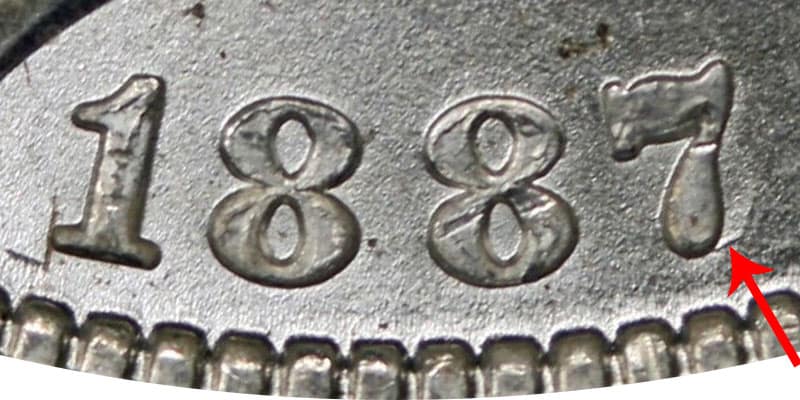
The overdate is one of the most collectible varieties the 1887 issue has to offer, and it exists at two mints: Philadelphia (VAM 2) and New Orleans (VAM 3).

It was created when leftover dies from 1886 were repunched with the 1887 date rather than discarded — most likely to save production time, as sinking a die from scratch took at least a week in the 19th century. The remnant of the earlier “6” is visible beneath the final “7” in the date, detectable under magnification.

These pieces are tough in all grades, becoming especially challenging around the AU level and rare at Gem and above. PL examples are quite scarce, and DMPLs in the Gem range are truly rare. This variety has long been included in the Red Book as a recognized date.

The New Orleans overdate (VAM 3) commands additional premium due to its mint mark. An MS65 1887/6-O sold for $37,375 at Heritage Auctions, which remains one of the benchmark results for this variety.

1887/6-O Silver Dollar Price/Grade Chart

Price by 1-70 Grade (Latest Auction Records Included)

Updated: 2026-05-12 02:02:03

1887/6 Silver Dollar Price/Grade Chart

Price by 1-70 Grade (Latest Auction Records Included)

Updated: 2026-05-12 02:02:03

4. 1887-O Doubled Stars Error

1887-O Doubled Stars Error

The 1887-O VAM 5 is a Top 100 variety showing doubling across the obverse stars and the motto. VAM 5 has doubled stars and motto and is quite scarce. It carries an R5 rarity rating — placing it among the genuinely rare varieties for this date.

The doubling on the stars is best observed under a 10x loupe on the inner and outer tips of the left and right obverse stars. The motto doubling provides a secondary confirmation when attributing the coin.

Because New Orleans coins of this era tend to come weakly struck and heavily bagmarked, a well-struck VAM 5 with clean surfaces is a meaningful find. PL and DMPL examples exist but are rare in any grade. One MS65 example can be sold for $2,700 now.

1887-O VAM 5 Doubled Stars Silver Dollar Price/Grade Chart

Price by 1-70 Grade (Latest Auction Records Included)

Updated: 2026-05-12 02:02:03

5. 1887-O VAM 2 Double 1 Triple 7 Error

1887-O VAM 2 Double 1 Triple 7 Error

This is one of the most visually dramatic date-repunching varieties in the entire 1887 series. The entire date was doubled with a shift to the right. The top points of the original “1” are visible to the left of the new “1,” and the “7” is tripled — with doubling at the top and a dot of metal to the left of the crossbar. It has been described as one of the largest shifts of date doubling known in the Morgan series.

It was discovered by Francis Klaes in June 1963 and is a Top 100 Morgan VAM. When attributing this variety, take care to distinguish it from VAM 3, where the repunching shows more strongly on the outside of the “7” rather than the inside.

This variety is available in PL and DMPL surface designations as well, though high-grade DMPL examples are especially hard to find given the 1887-O’s general tendency toward dull, weak strikes. Auction records show one example achieved $840 in MS64 condition in 2023.

1887-O VAM 2 Double 1 Triple 7 Silver Dollar Price/Grade Chart

Price by 1-70 Grade (Latest Auction Records Included)

Updated: 2026-05-12 02:02:03

6. 1887-OVAM 22A DDO Pitted Rev Error

1887-OVAM 22A DDO Pitted Rev Error

This Top 100 variety combines two distinct die characteristics on a single coin: a doubled die obverse and a pitted reverse. The obverse doubling is visible on Liberty’s portrait, while the reverse shows small raised bumps caused by deterioration of the die surface — the result of the die being used well past its optimal service life.

The pitting is not a random defect on individual coins. It is a permanent feature of the die itself, meaning it appears consistently across every coin struck from that die pair. That consistency is actually what makes it attributable — and what earns it a place on the Top 100 list alongside the obverse doubling.

VAM 22A is recognized by PCGS and is available in standard, PL, and DMPL surface designations. High-grade examples in any finish are scarce, and DMPL examples in particular are very rarely offered.

1887-O VAM 22A DDO Pitted Rev Silver Dollar Price/Grade Chart

Price by 1-70 Grade (Latest Auction Records Included)

Updated: 2026-05-12 02:02:03

7. 1887 VAM 12 Alligator Eye Error

1887 VAM 12 Alligator Eye Error

The Alligator Eye is one of the best-known and most approachable Top 100 VAMs in the entire Morgan series. It takes its name from the doubled cornea visible on Liberty’s eye, which resembles the nictitating membrane found in alligators. The doubling is bold enough to be seen without magnification by a trained eye.

The doubling was caused by a slight error in the die-making process, producing an additional parallel line to the right of Liberty’s eye. Portions of the word LIBERTY on the headband also show doubling, as do some letters in PLURIBUS.

This variety is fairly common, with upwards of one thousand examples certified in Mint State, making it one of the most accessible Top 100 entries for new collectors. If you find such one error in MS66 condition, it can be worth around $650-$1,150.

It appears in both the Top 100 Morgan Dollar Varieties book and the Cherrypicker’s Guide, Vol. II — two of the most widely referenced works in Morgan variety collecting.

1887 VAM 12 Alligator Eye Silver Dollar Price/Grade Chart

Price by 1-70 Grade (Latest Auction Records Included)

Updated: 2026-05-12 02:02:03

1887 VAM 12 Alligator Eye Silver Dollar (PL) Price/Grade Chart

Price by 1-70 Grade (Latest Auction Records Included)

Updated: 2026-05-12 02:02:03

1887 VAM 12 Alligator Eye Silver Dollar (DMPL) Price/Grade Chart

Price by 1-70 Grade (Latest Auction Records Included)

CoinVaueChecker App 10

Updated: 2026-05-12 02:02:03

8. 1887 VAM 1B Partial E Rev Error

1887 VAM 1B Partial E Rev Error

The VAM 1B is a Hot 50 variety produced by clashed dies — a situation where the obverse and reverse dies struck each other without a planchet between them, transferring part of one die’s design onto the other.

The result is a partial “E” from the word LIBERTY on the obverse, transferred to the reverse close to the eagle’s tail feathers, left of the wreath bow. It was discovered by Maurice Dubreuil in November 1974. Variety specialists regard finding a clashed E on an 1887 dollar as a notable event — this VAM is on just about every serious collector’s hit list.

The variety is virtually unknown in Mint State, with most certified examples appearing in circulated grades. Even a strong AU specimen is considered a solid find. The clashed letter is most visible on the reverse with good lighting and a clean, unpolished surface.

1887 VAM 1B Partial E Rev Silver Dollar Price/Grade Chart

Price by 1-70 Grade (Latest Auction Records Included)

Updated: 2026-05-12 02:02:03

9. 1887 VAM 25A Donkey Tail Error

1887 VAM 25A Donkey Tail Error

The Donkey Tail takes its name from a prominent die break at the bottom curve of the “D” in DOLLAR on the reverse. The break creates a small tail-like extension descending from the letter — visible on every coin struck from that die. Die breaks form when a crack develops in an overused die and metal flows into the fracture under striking pressure.

This is a Top 100 variety and one of the more visually distinctive die breaks in the Morgan series. Attribution is straightforward once you know where to look: examine the “D” in DOLLAR on the reverse and look for the downward extension at the bottom of the letter’s curve.

A PCGS MS63 Donkey Tail example has been recorded selling for $5,760, showing that well-preserved Top 100 die break varieties command meaningful premiums even on what is otherwise one of the most common Philadelphia issues in the series.

1887 VAM 25A Donkey Tail Silver Dollar Price/Grade Chart

Price by 1-70 Grade (Latest Auction Records Included)

Updated: 2026-05-12 02:02:03


Where To Sell Your 1887 Silver Dollar?

With accurate identification and valuation complete, selecting the right sales channel becomes essential. Multiple venues exist for selling your quarters, from traditional dealers to specialized online platforms, each suited to different seller needs.

Check out now: Best Places To Sell Coins Online (Pros & Cons)  


1887 Silver Dollar Market Trend

Market Interest Trend Chart - 1887 Silver Dollar

*Market Trend Chart showing the number of people paying attention to this coin.


FAQ About The 1887 Silver Dollar

1. How much is an 1887 Silver Dollar worth today?

The value depends heavily on which mint struck your coin and what condition it is in. A Philadelphia example in Good grade is worth $84, while an 1887-O DMPL in MS condition can reach $3,472.

At the top of the market, auction results go far higher. An MS66+ 1887-S sold for $58,800, and a single MS63 Philadelphia example reached $78,000 at Stack’s Bowers in November 2024 due to exceptional eye appeal and pedigree.

2. How do I know which mint struck my 1887 Silver Dollar?

Flip the coin to the reverse and look just above the “DO” in DOLLAR. An “O” indicates New Orleans, an “S” indicates San Francisco, and no mint mark means Philadelphia.

Philadelphia struck the most coins that year — over 20 million — so no-mint-mark examples are the most commonly encountered. New Orleans and San Francisco issues are scarcer in gem condition and generally command higher premiums.

3. What is the rarest 1887 Silver Dollar variety?

Among business strikes, the 1887-S PL and DMPL are among the rarest, ranked in the Transcendent tier with rarity scores of 100 and 98 respectively. The 1887-O DMPL is also exceptionally scarce in gem grades, rated Divine at 90.

Among collector coins, the 1887 CAM Proof is one of the hardest to find with original surfaces and genuine contrast. Only about 250 CAM examples are estimated to survive from the original 710-coin Proof mintage.

4. What is the difference between the 1887 Proof and the 1887 CAM Silver Dollar?

Both are Proof coins struck at Philadelphia from the same 710-coin mintage, but the CAM designation indicates something additional: the devices — Liberty’s portrait and the eagle — show a frosted contrast against the deeply mirrored fields.

This frosting only occurs on coins struck from freshly prepared dies at the very beginning of the production run, which is why CAM examples are a subset of the Proof issue rather than a separate strike.

In practical terms, the CAM commands a higher premium. Standard Proofs trade mostly in the $2,650 to $14,500 range depending on grade, while a PR67 CAM sold for $31,200 at Heritage Auctions in April 2021.

5. What is the 1887 Alligator Eye error and how do I find it?

The 1887 VAM 12 Alligator Eye is a doubled die obverse variety where Liberty’s eye shows a doubled cornea — an extra parallel line to the right of the eye — along with doubling on the word LIBERTY and some letters in PLURIBUS. It is a Top 100 Morgan VAM.

The doubling is bold enough to be seen without magnification by a trained eye, making it one of the most accessible Top 100 varieties for new collectors. In MS66 condition, examples are worth approximately $650 to $1,150.

6. How do I tell if my 1887 Silver Dollar is a Proof or a business strike?

Proof coins were struck at the Philadelphia Mint with specially prepared, polished dies on polished planchets. They have deeply mirrored fields and sharply defined, frosted devices — a visual quality that is immediately distinct from a standard business strike.

Only 710 Proof examples were struck in 1887, and only about 500 survive. Most business-strike coins, even high-grade ones, have a different surface character — luster rather than mirror depth — which makes the distinction visible even without equipment once you know what to look for.

7. What is the 1887/6 overdate and how do I identify it?

The 1887/6 overdate was created when leftover dies from 1886 were repunched with the 1887 date rather than discarded, leaving the remnant of the “6” visible beneath the final “7” in the date. It exists at both Philadelphia (VAM 2) and New Orleans (VAM 3).

The “6” is detectable under magnification, typically at 10x. The New Orleans version commands a higher premium due to its mint mark — an MS65 1887/6-O sold for $37,375 at Heritage Auctions. These pieces are tough in all grades and rare at the Gem level and above.

8. Why is the 1887-O Silver Dollar worth more than the Philadelphia issue in high grades?

Although the 1887-O had a mintage of 11,550,000 — more than six times the 1887-S — New Orleans coins are notorious for weak strikes, dull luster, and heavy bagmarks. Fully struck MS65 examples number only in the hundreds, making them genuine condition rarities.

By comparison, the Philadelphia issue is far more common in Mint State. A well-struck, original-surface 1887-O in MS65 is therefore worth considerably more than a standard Philadelphia MS65, and three separate 1887-O examples in MS66 have sold for $61,688, $69,000, and $78,000 respectively.

9. How many 1887 Silver Dollars still exist today?

Survival estimates vary by type. Approximately 2,000,000 Philadelphia examples survive from the original 20,290,000 struck — a survival rate of around 9.86%. New Orleans has roughly 1,000,000 survivors from 11,550,000 struck, while San Francisco has an estimated 180,000 remaining from 1,771,000.

The Proof and CAM issues are far scarcer. Only about 290 standard Proof examples and 250 CAM examples are estimated to survive from the original 710-coin Proof mintage, giving both a survival rate above 35% — reflecting the careful handling they received as collector pieces from the day they were struck.

10. Is the 1887 Silver Dollar a good investment?

The 1887 is one of the more approachable dates in the Morgan Dollar series, which makes it accessible for new collectors but means common examples in circulated grades are not likely to appreciate dramatically on their own.

The real investment case lies in condition rarity — coins at MS66 and above, or surface designations like PL and DMPL in gem grades, are genuinely scarce and have a track record of strong auction results.

The 1887-O DMPL and 1887-S PL and DMPL issues rank among the rarest varieties of the year, while the 1887 Proof and CAM coins offer a fixed and declining pool of survivors. For collectors focused on long-term value, targeting certified examples in the top population tiers is a more defensible approach than chasing common circulated pieces.

You May Also Like