Coin Value Contents Table
Do you want to know the 1966 nickel value? If you answered yes, do not worry, we have got you covered! The 1966 nickel is also known as the Jefferson nickel because it features Jefferson’s image on the obverse and his famous mansion or house on the reverse.
The five-cent nickel is not made of special metal like most nickels, but regardless, it can be very valuable. You may not be able to melt it and earn some money, but if you have some of the special specimens, you can fetch a small fortune!
So, let’s check the coin’s history, details, varieties, and errors!
1966 Nickel Value Chart |
||||
| Mint Mark | Good | MS 65 | MS 66 | MS 67 |
| 1966 No Mint Mark Nickel Value | / | $20 | $110 | $2500 |
| 1966 FB Nickel Value | / | $20 | $65 | $675 |
| 1966 SMS Nickel Value | / | $18 | $20 | $26 |
1966 Nickel Grading
Why is grading important? The grade of your coin is directly related to the value of the coin, so to determine the value, one must first establish the grade of the coin.
The grading might seem complicated and challenging, but remember that coin grading can be subjective and that experts can disagree on the grade and value.
| # | Grade |
|---|---|
| 1 | Basal State-1 |
| 2 | Fair |
| 3 | Very Fair |
| 4, 5, 6 | Good |
| 7, 8, 10 | Very Good |
| 12, 15 | Fine |
| 20, 30 | Very Fine |
| 40 | Extremely Fine |
| 50 | About Uncirculated |
| 60 | Mint State |
| 65 | Mint State |
| 70 | Mint State |
Please check our grading guides to know your coin scale, It’s the necessary step to know the exact value of your coin.
Check out now: How to Grade Jefferson Nickel?
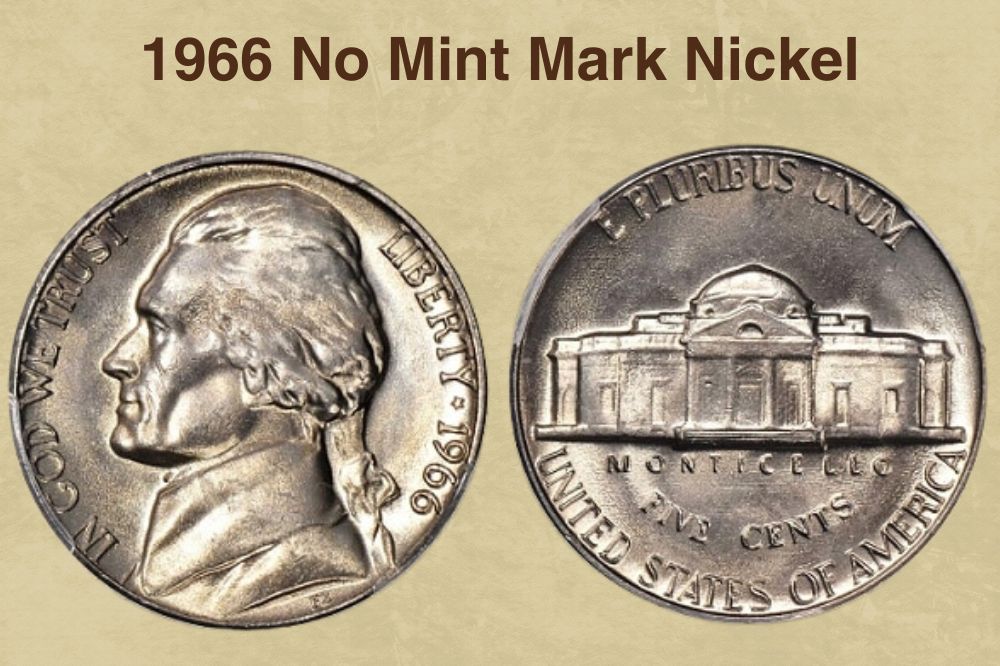
1966 Nickel No Mint Mark Value
History
The 1966 nickel belongs to the category Jefferson nickel; it was first minted in 1938. This coin is minted to this day. The 1966 nickel replaced the Buffalo nickels minted from 1918 to 1938.
According to a law enacted in 1890 by Congress, the coin design cannot be changed more frequently than every 25 years. So, when the Buffalo nickel design “turned” 25 in 1938, the US Mint moved quickly to replace it.
As usual, the US Mint launched a contest for a new nickel designer and engraver, with clear instructions that the new design must feature the image of Thomas Jefferson and his popular mansion Monticello. Thomas Jefferson is known as one of the Founding Fathers and the 3rd American president.
The winner of the competition was Felix Schlag, the German-born American sculptor. Although Shlag’s design proved the most appealing, the US Mint required some changes.
The original Shlag’s design depicted a three-quarters view of the mansion and a palm tree. The U.S. Mint officials were displeased with the palm tree placed next to the Monticello mansion because they believed it was unlikely that Jefferson had grown such a tree on his land.
Another issue with the design was the lettering that Schlag used, which was deemed too complex and modernistic. Ultimately, the requested changes were sent to Schlag, who followed the instructions and modified the design.
Then, the design was sent to the Commission of Fine Arts for potential recommendations and suggestions. The Commission and the Secretary of Treasure approved the design. The production of the coins began in October 1938, and the nickels entered circulation in November of the same year.
However, the 1966 series saw several changes to the coin design. The designer’s initials FS were added to the obverse under Jefferson’s bust. The US Mint struck two 1966 proof nickels with the initials to commemorate that change. There were also special mint sets that were minted from 1965 to 1967.
However, in 1966 there were no mint marks as the coins were only produced in Philadelphia.
Reportedly, the US Mint switched from silver coinage to nickel-copper alloy in 1964, and one of the major issues was hoarding or collecting silver coins, which caused the lack of silver.
To prevent that, the U.S. Mint canceled the production in San Francisco and Denver, so there would be no varieties to collect. However, the measures were counterproductive. The 1966 Jefferson nickel was minted from August to December due to production issues.
Obverse
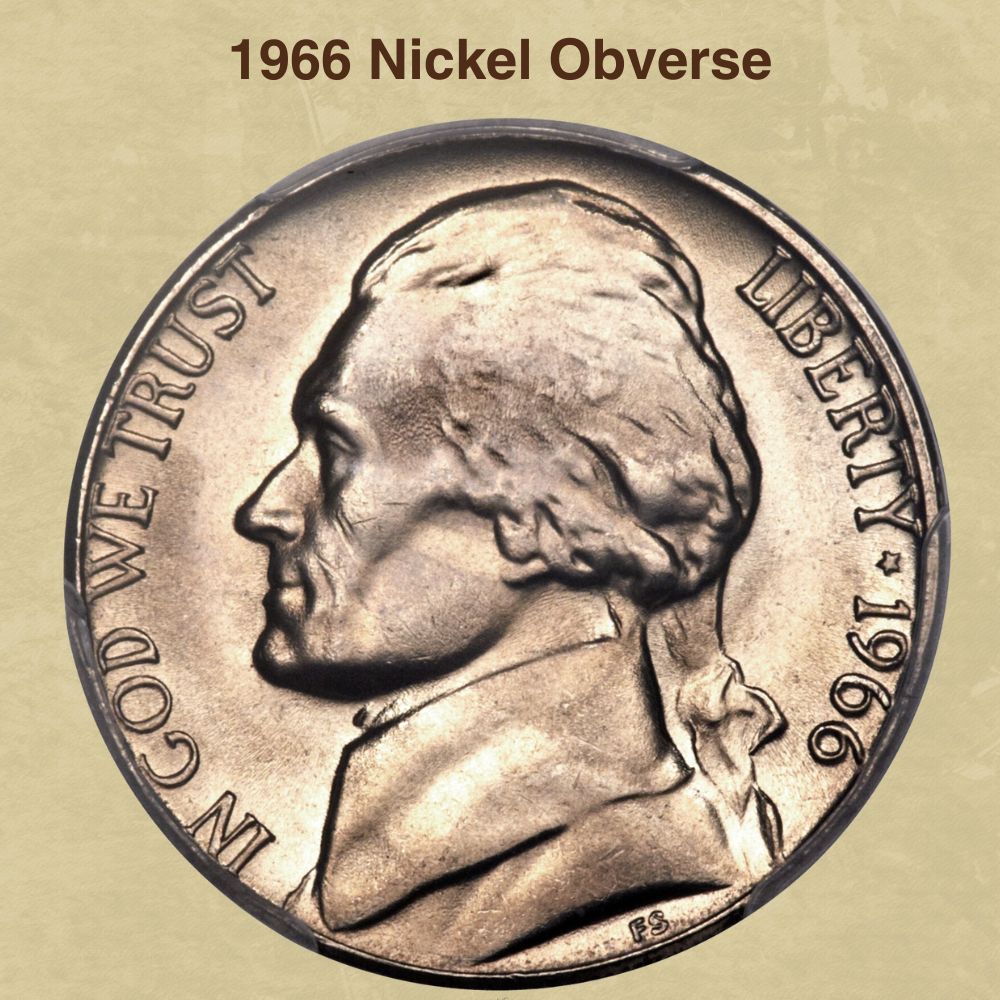
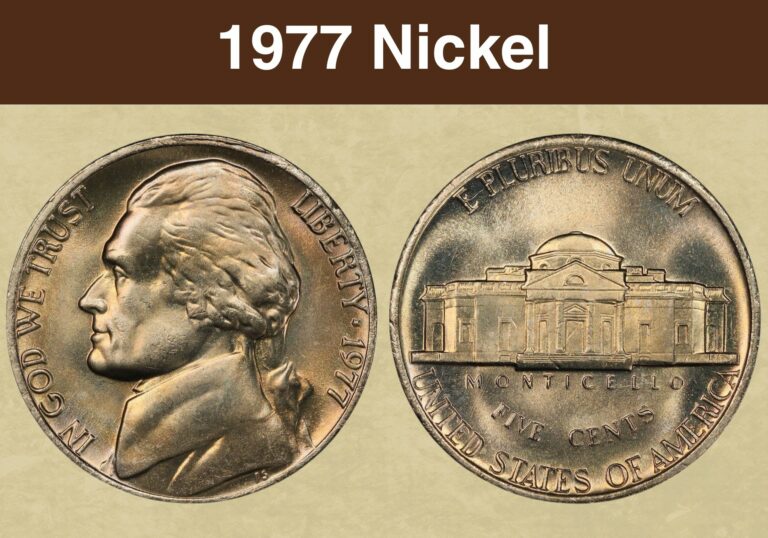
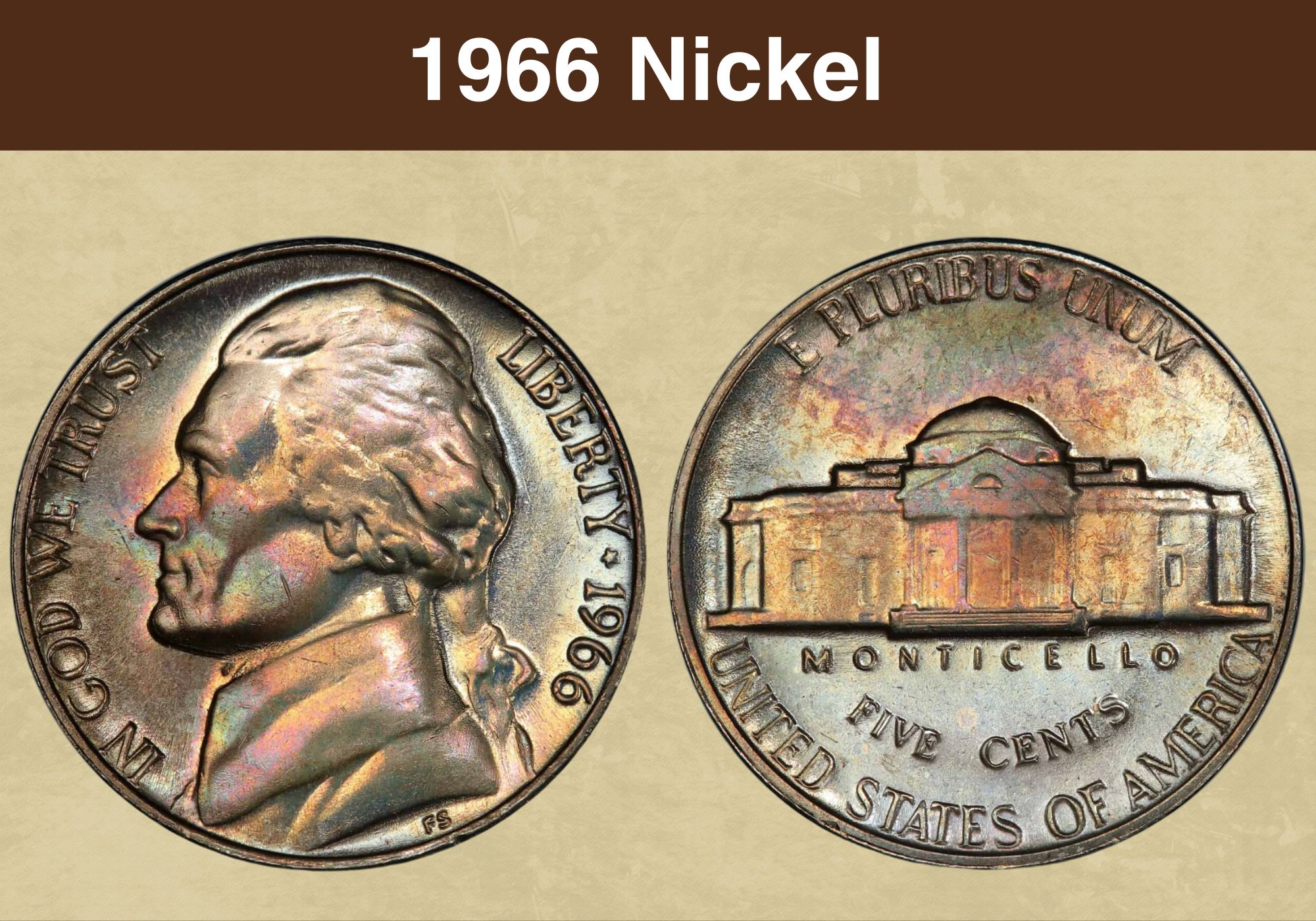
The coin’s obverse features the image of Thomas Jefferson facing left, with the inscription “IN GOD WE TRUST” on the left side of the coin’s rim. On the other side or the right side of the coin’s rim is the inscription “LIBERTY” and the mint year “1966”, separated by a tiny star.
Reverse
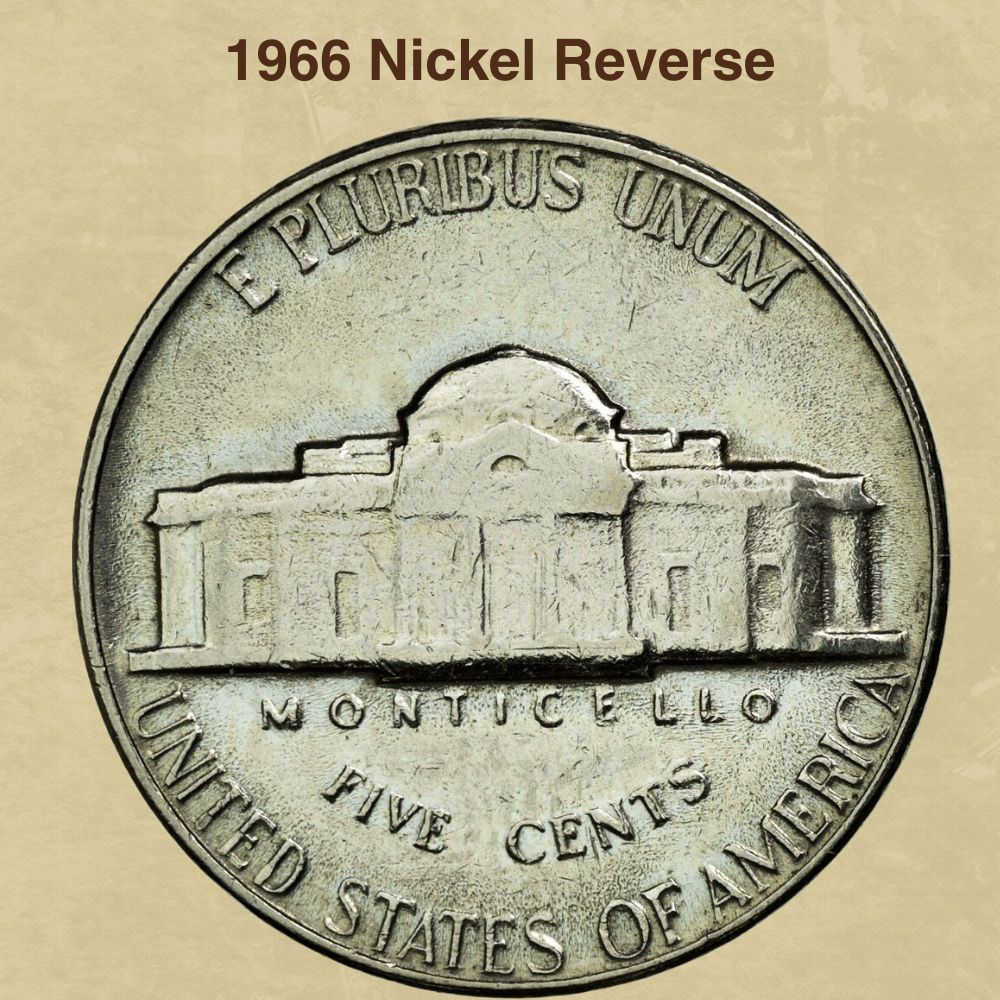
The reverse highlights the image of Jefferson’s famous mansion Monticello in the center of the coin, with the capitalized inscription “MONTICELLO” underneath it. Below that inscription, we can see the denomination “FIVE CENTS.”
The inscription “UNITED STATES OF AMERICA” is struck on the coin’s lower rim, while on the upper rim, we can see the second American motto, “E PLURIBUS UNUM,” which translates to “Out of one, many.”
Other Details
The face value of the 1966 nickel is five cents or $0.05. The coin’s shape is round, 21.21 millimeters or 0.0835 inches in diameter. The coin weighs 5 grams or 0.1764 ounces, while its thickness is 1.95 millimeters or 0.0768. The edge is plain, and the coin’s metal composition is 75% copper and 25% nickel.
Mintage and Value
As mentioned, Jefferson nickel was only minted in Philadelphia in 1966. The total mintage of 1966 No Mint Mark dime was 156,208,283, and most of these coins entered circulation.
Most of these are in bad condition and have many scratches and damage; hence they are not very valuable. However, the value changes for the rare specimens in high mint states.
So, in average and good condition, the 1966 No Mint Mark nickel is worth around $0.10, according to the Numismatic Guarantee Company (NGC). As noted, they are practically worthless even in fine and extra fine condition. When it comes to the mint states, they can fetch up to four figures.
However, when it comes to auctions, it often happens that the same coin in the same grade can fetch two completely different prices on two different auctions. Therefore, the 1966 Jefferson nickel in MS 65 can be worth around $6 to $8 and sometimes even higher.
In MS 66, the value of the 1966 nickel is around $110. The 1966 Jefferson nickels are very rare in MS 67 and expensive. In 2014, a collector paid $800 for the 1966 No Mint Mark nickel.
Also read: Top 10 Most Valuable Nickels Worth Money
1966 Nickel SMS Special Strike Value
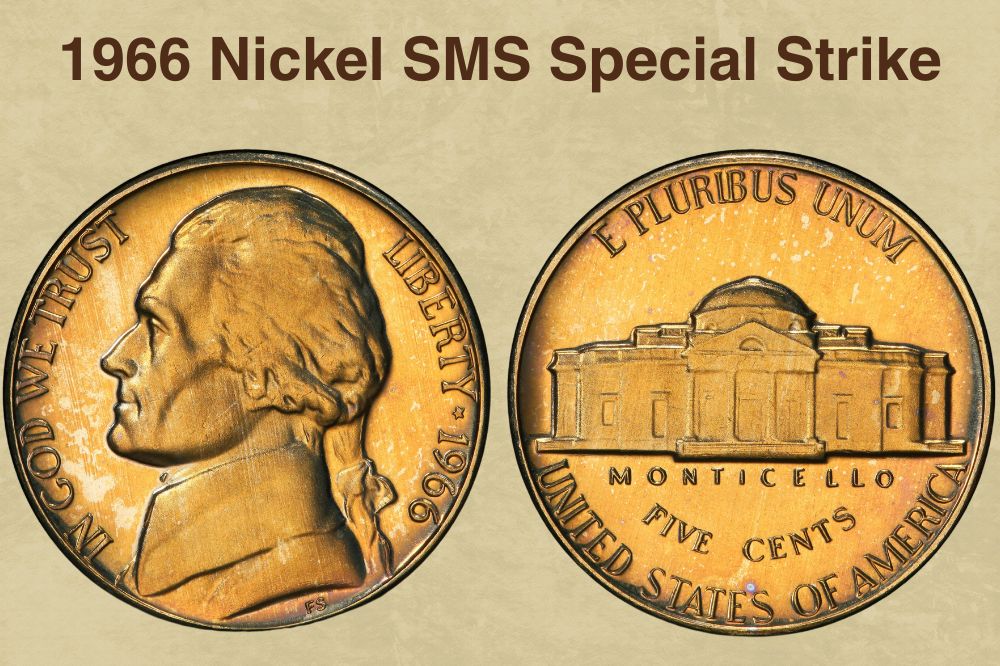
Besides the regular strike 1966 nickel, the Philadelphia Mint also made a limited number of special strike nickels abbreviated as SMS. The Mint produced 2,260,000 of the 1966 nickels SMS. These specimens, as noted, were made with a more quality strike and hence had more pronounced details and elements.
The 1966 nickel SMS came in a special mint set containing the 1966 issues of the Lincoln Cent, Washington Quarter, Roosevelt Dime, and Kennedy half-dollar. Despite the excellent strike and high-quality details, these coins in MS 65 can cost $65
The price stays relatively the same for MS 66 and even MS 67. Although, if you go to the PCGS site, you will see that some specimens of the 1966 nickel SMS in MS 66 have been sold for $20. However, that does not happen often.
The most valuable 1966 nickel SMS is in MS 68, which generally costs 120. The auction record for this special strike coin in MS 68 is $712 at an eBay auction in 2021. The special strike is also considered a type of proof coin, and they can have a special designation such as “DCAM” or “CAM.”
Deep Cameo or “DCAM” is a designation given to brilliant proofs, with deep and even frosted devices on the obverse and reverse. Any coin with this designation is highly attractive and sought-after by collectors.
“CAM” is usually given to coins that show light or moderate frosting with frosted devices on one side of the coin. The 1966 nickel SMS with these designations is mainly valuable in high-mint states.
The 1966 SMS nickel with CAM generally costs between $ 8 and $80. The most valuable is the 1966 SMS CAM nickel in MS 68, which can fetch between $200 and $2,000. The auction record for the 1966 SMS CAM nickel in MS 67 is $3,738. The auction took place in 2006.
On the other hand, the 1966 SMS DCAM nickel can cost between $300 and $2,000, depending on the condition. In MS 65, you can get around $360 for the 1966 SMSM DCAM nickel. In MS 66, expect to pay between $300 and $700 for the 1966 SMS DCAM nickel.
Obviously, the most coveted is the 1966 SMS DCAM nickel in MS 68, which costs between $5,000 and $9,000. The auction record for the 1966 SMS DCAM nickel in MS 68 is $9,718.
1966 Nickel (FS) Full Steps Value
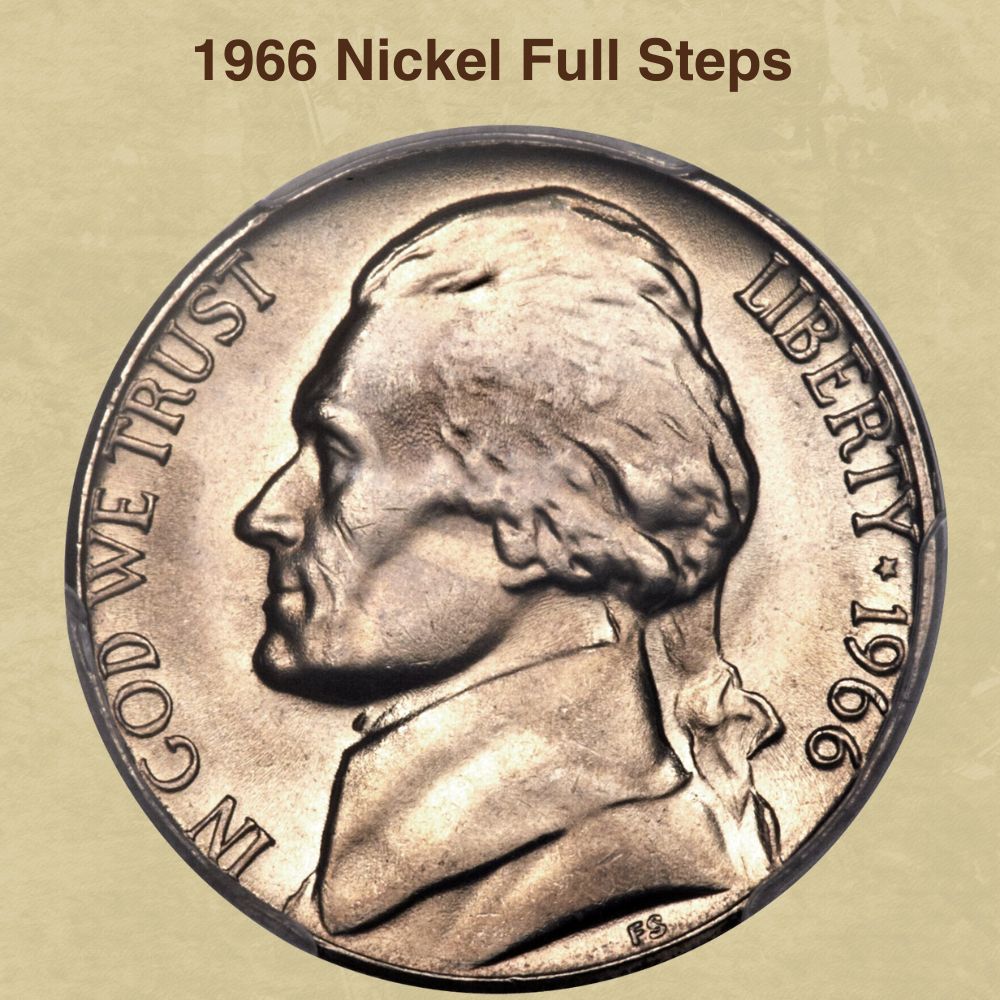
When it comes to the Jefferson nickels, there is a specific designation for these coins called Full Steps. The term refers to the steps of Monticello’s mansion on the obverse. If the image of Monticello depicts no disturbance of the steps due to a weak strike or planchet issues that coin can be designated FS.
This designation is also reserved for nickels in mint states, starting with 60 through 70. Basically, this designation reflects the quality of the coin’s elements or details, which is why these coins are automatically considered MS 60 or higher.
Regarding the value of the 1966 nickel with FB designation, these coins are the most coveted in the series. The 1966 nickel FB in MS 64 was sold for $1,260 in 2022 at Heritage Auctions.
According to PCGS, the price of the 1966 nickel FB in MS 64 can range between $1,200 and $1,500. For the 1966 nickel FB in MS 65, you can expect to pay between $4,000 and $11,000. The most recent sale of the 1966 nickel in MS, 65 was in 2022, and the coin was sold for $6,300.
The auction record for 1966 in MS 65 with FB is $11,750. Interestingly, the 1966 nickel FB value in MS 65+ is around $5,000. So, these valuable pieces generally fetch a price between $1,200 and $7,000, depending on the grade and the market/auction.
The most famous 1966 nickel FS is the one in MS 66, the rarest grade for this coin. There are only two reported specimens in this grade with FS designation. That specimen was sold for a jaw-dropping $40,000.
Also read: Top 17 Most Valuable Buffalo Nickel Worth Money
Rare 1966 Nickel Error List
The 1966 nickel is known for a couple of errors that usually fetch high prices at auction and boost the coin’s original price. Let’s check those errors and price differences!
1966 Nickel Struck 60% Off-Center Error
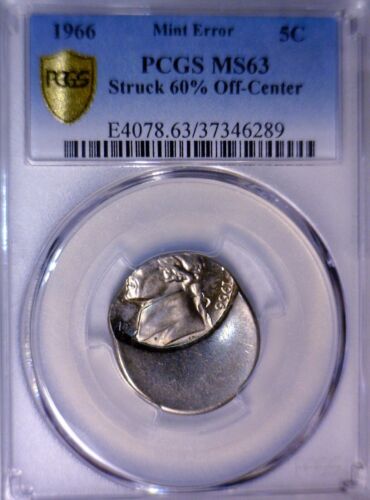
As the name implies, the 60% off-center error happens when the dies strike the coin off-center, resulting in a very interesting design. Considering this is over 60% off-center, the coin has a big area of blank metal, while the other part shows part of the original design.
This is often considered a desirable error on the 1966 nickel. The 1966 SMS nickel in MS 66 was sold at an auction for over $550, a very nice amount compared with the value of the 1966 SMS nickel without the error.
1966 Nickel Double Struck Second Strike Off Center Error
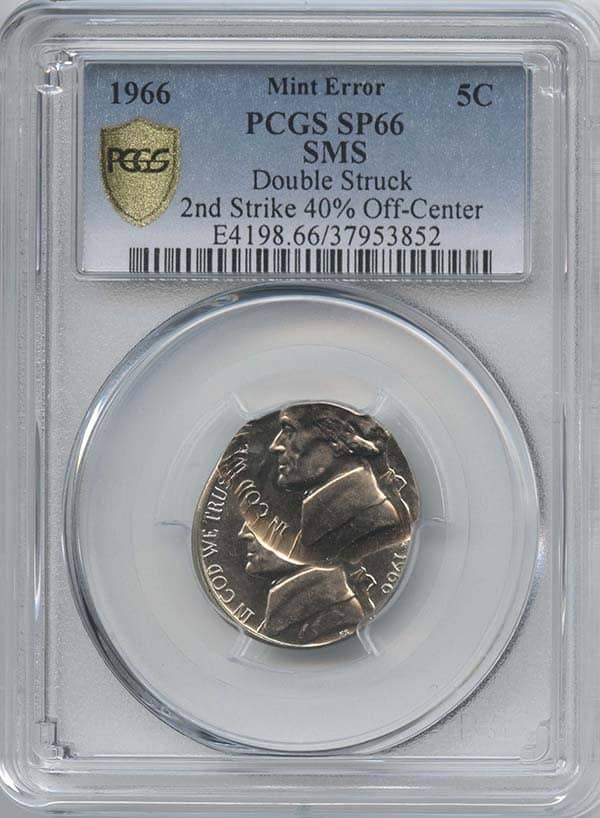
The second strike off-center is a self-explanatory error; basically, the die used to strike the coin is off-center for the second strike, not the first, as was the case with the previous error. The result of this error is the doubled image.
1966 Nickel Struck on 10C Planchet Error
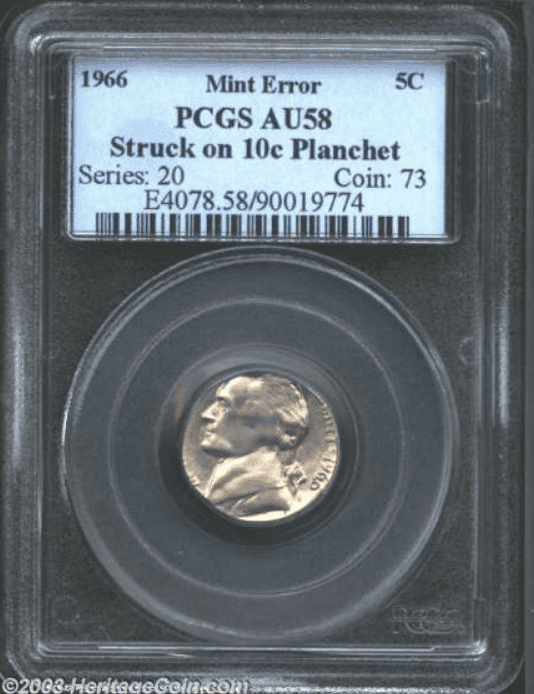
As you already know, the planchet is the blank metal disc onto which the coin design is struck or stamped. Coins usually have a specific weight and size of the planchet, and the same goes for nickels.
So, this coin has the error where the die struck the 10c or dime planchet instead the one intended for the nickel. This error results in an incomplete design because the nickel planchet is larger than the dime planchet.
The 1966 nickel in AU 58 with the struck-on 10c planchet error was sold for over $300. This error can happen with other planchets as well. For example, the 1966 nickel can also be struck on 1c planchet- the specimen with this error in MS 64 and RB designated was sold for over $800.
Also read: 14 Most Valuable Nickel Errors Worth Money
Where to Sell Your 1966 Nickel ?
Now that you know the value of your coins, do you know where to sell those coins online easily? Don’t worry, I’ve compiled a list of these sites, including their introduction, pros, and cons.
Check out now: Best Places To Sell Coins Online (Pros & Cons)
1966 Nickel FAQS
Does a 1966 nickel have silver in it?
No, the 1966 nickel does not contain silver. The metal composition of the 1966 nickel is 75% nickel and 25% copper. The production of silver coinage, specifically dimes, half-dollars, nickels, and quarters, was halted in 1964.
What is a valuable 1966 nickel worth?
The 1966 nickel is mainly valuable in high mint states with an error, such as the struck 60% off center error. The value of the 1966 nickel depends on several factors, such as the level of preservation, mint mark, mint year, designations, and errors.
The most valuable is the special strike 1966 in high-mint states with the “DCAM” designation.
What errors do you look for on nickels?
The most valuable errors on nickels are the struck off-center and the struck on the wrong planchet errors!
Also read: Top 17 Most Valuable Jefferson Nickels Worth Money