Coin Value Contents Table
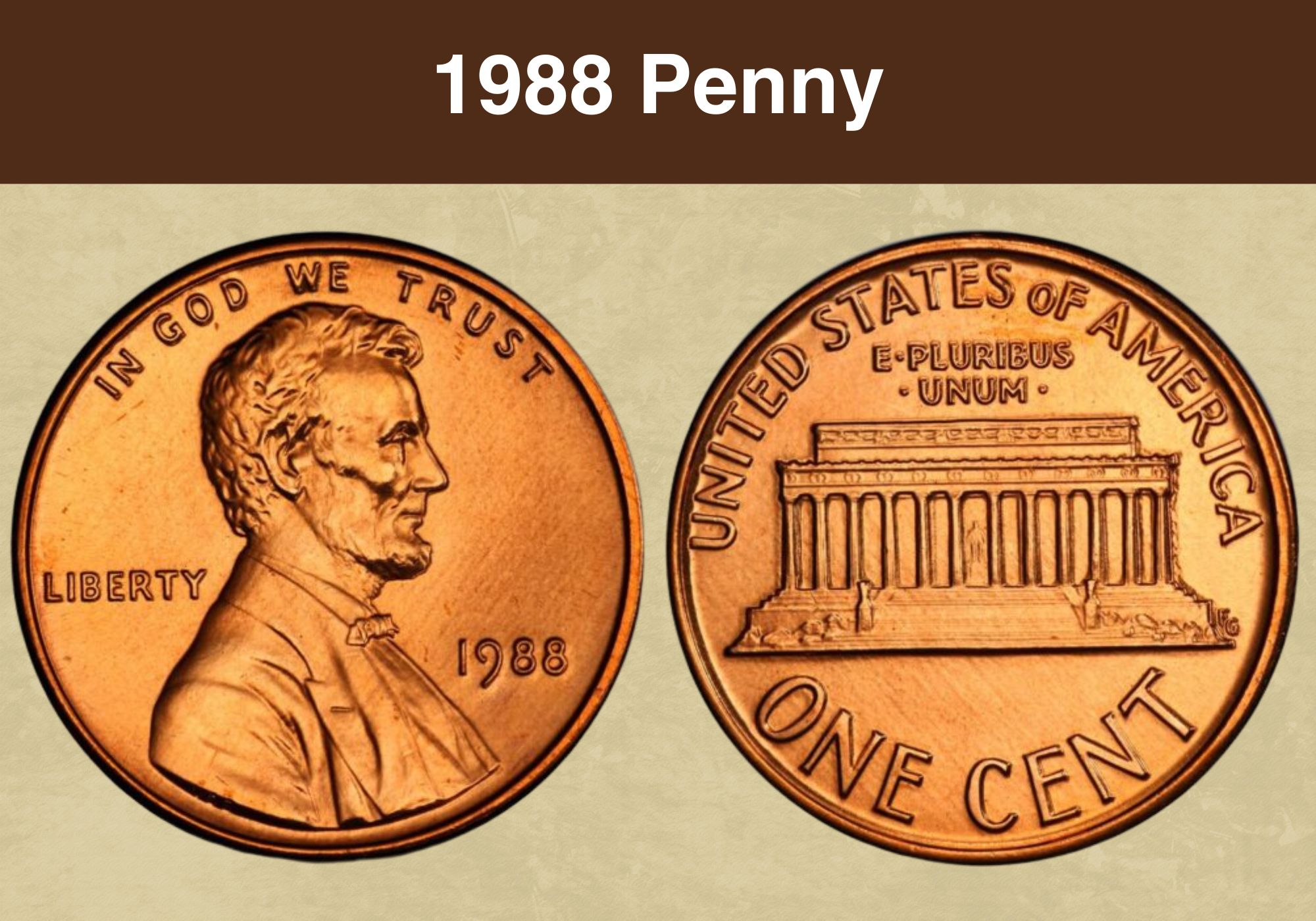
The 1988 Memorial pennies were issued in large numbers, and you can probably find them in a pocket change. Their face value is one cent, and pieces in a circulated condition rarely cost more than that. In uncirculated conditions, the 1988 penny value can exceed a thousand dollars, depending on their grade and potential errors.
1988 Penny value Chart |
|||
| Condition | 1988 No mint mark penny | 1988 D penny | 1988 S penny |
| MS 65 | $14 | $10 | / |
| PR 65 | / | / | $4 |
History of the 1988 Penny
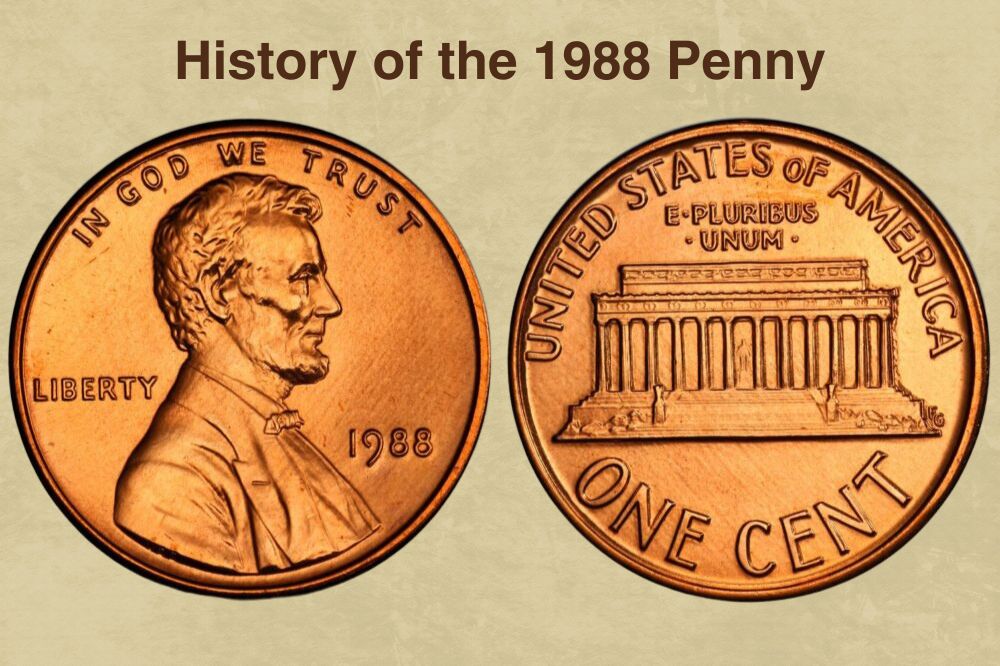
The US Mint issued the first Lincoln pennies in 1909 to appreciate Abraham Lincoln and honor his 100th birthday. Victor D. Brenner designed them featuring the President on the obverse and wheat ears on the reverse.
This design lasted for the following 50 years when the reverse look was replaced with the Memorial as the dominating detail in 1959. Frank Gasparo created it, honoring the 150th Lincoln’s birthday.
This design also contained a small Lincoln statue between the two middle pillars. That made this cent the first and the only US coin featuring the same man on both sides.
1988 Memorial Penny Types |
||
| Location | Year | Minted |
| Philadelphia | 1988 penny | 6,092,810,000 |
| San Francisco | 1988 proof penny | 3,262,948 |
| Denver | 1988 D penny | 5,345,467,111 |
| Total | / | 11,441,540,059 |
The 1988 Lincoln penny belongs to the Memorial cent series but with a different composition. In 1982, the US Mint transitioned to copper-plated zinc for pennies due to a copper price increase, and it has remained unchanged up to now. Nowadays, the Lincoln Memorial penny from 1988 is quite common and affordable.
Also read: 12 Most Valuable Lincoln Penny Worth Money
Features of the 1988 Penny
The 1988 penny design dates back to 1959, when it was implemented for the first time to honor Lincoln’s 150th birthday. Abraham Lincoln was the first historical person depicted on one American coin.
The obverse of the 1988 Penny
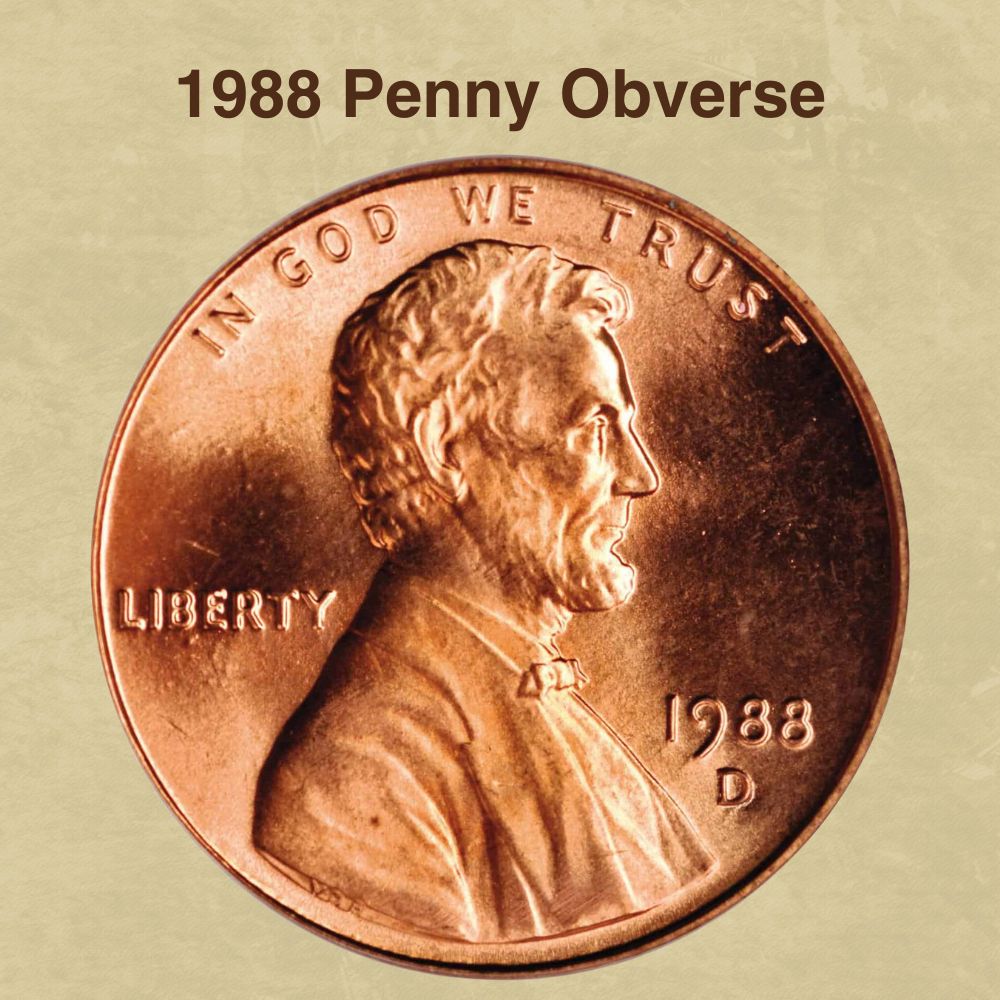
Victor Brenner designed the penny obverse, featuring Abraham Lincoln’s portrait. He pictured the President reading a book to a child and transferred that image to the coin design.
However, some numismatic historians suggested that Lincoln’s portrait resembled the photo by Mathew B. Brady and that Banner based his work on it. In any case, the designer placed his initials, DVB, under Lincoln’s right shoulder edge.
The motto, IN GOD WE TRUST, was above the portrait and along the coin’s edge. LIBERTY was in the left field in line with Lincoln’s neck. The designer positioned the minting year, 1988, on the right and aligned it with the President’s chest.
The mint mark, if any, was positioned under the date. You can see the D mint mark on this penny and know it is a circulated coin from the Denver mint. Those with the mint mark S are proof coins. Philadelphia pennies have No Mint mark.
The reverse of the 1988 Penny
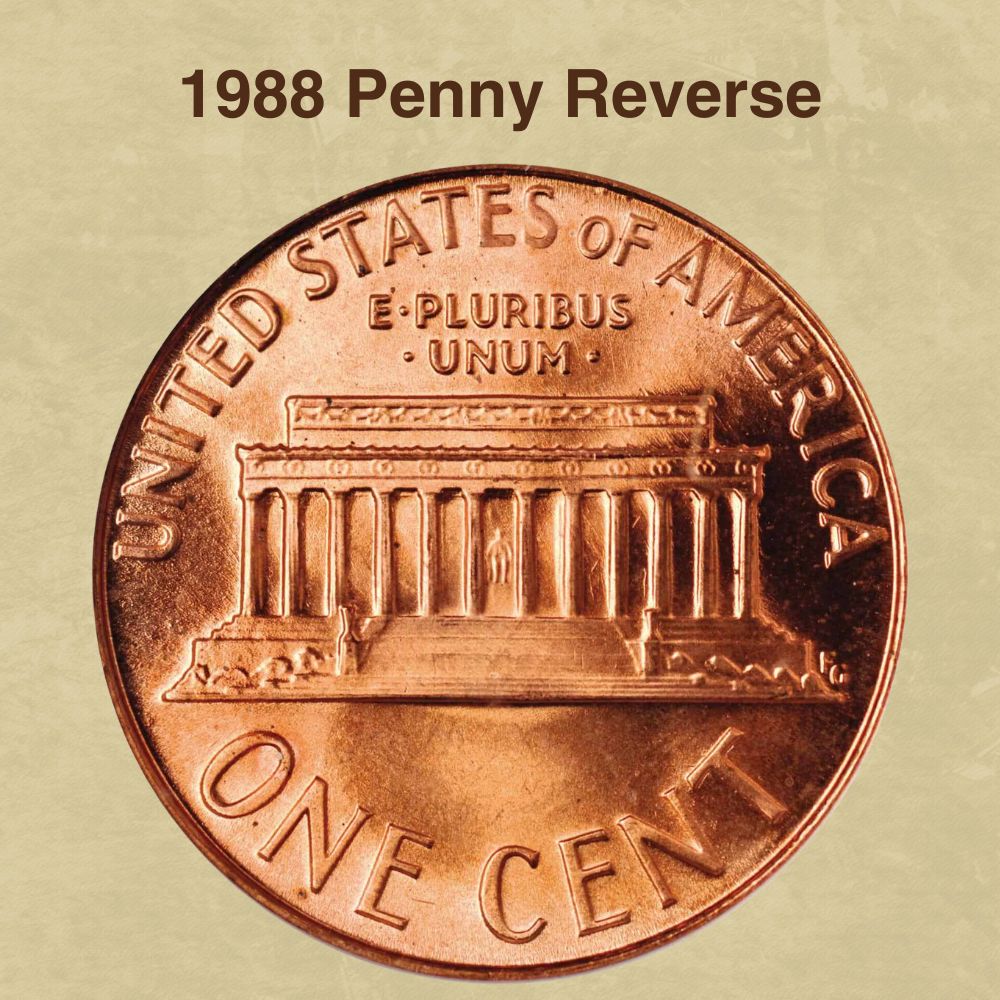
Frank Gasparo, the US designer and engraver, created the reverse penny side in 1959. The dominating element on the coin surface is the Lincoln Memorial, the building located in Washington, DC.
When you look closer, you can see Lincoln’s bust inside the Memorial, between the two middle pillars. The designer’s initials, FG, are indicated in the lower right corner of the building.
The lettering UNITED STATES oF AMERICA is along the upper edge line, while E PLURIBUS UNUM is between the lettering and the central design image. The coin’s denomination, ONE CENT, is positioned at the bottom field of the reverse.
1939 Memorial Penny Details |
|
| Face value | One cent ($0.01) |
| Coin diameter | 0.750 in (19.05 mm) |
| Shape | Round |
| Compound | Copper-plated zinc (97.5% Zn, 2.5% Cu) |
| Edge | Plain |
| Coin thickness | 0.03937 inches (1 mm) |
| Coin weight | 0.08818 ounces (2.5 g) |
Other features of the 1988 Penny
This round penny has a plain edge and a denomination of one cent. Its planchet is made of 97.5% Zn and 2.5% Cu, and you can measure 0.750 inches (19.05 mm) as a diameter. Each coin is 0.03937 inches (1 mm) thick, and it weighs precisely 0.08818 ounces (2.5 g).
Also read: 13 Most Valuable Wheat Penny Worth Money
1988 Penny Grading Guides
When you want to determine the value of your cent, you should send it for grading. Different factors, such as scratches, corrosion, contact marks, and holes in the coin, are considered during this process. Other issues that play a role in each coin’s quality are its luster, die state, and strike.
Besides, signs of wear are significant for penny rating. When the coin shows strong wear signs, it gets the lowest grade, POOR, making it non-collectible. Coins in excellent condition are graded as PERFECT UNCIRCULATED and are the most valuable in the series.
| # | Grade |
|---|---|
| 1 | Basal State-1 |
| 2 | Fair |
| 3 | Very Fair |
| 4, 5, 6 | Good |
| 7, 8, 10 | Very Good |
| 12, 15 | Fine |
| 20, 30 | Very Fine |
| 40 | Extremely Fine |
| 50 | About Uncirculated |
| 60 | Mint State |
| 65 | Mint State |
| 70 | Mint State |
Please check our grading guides to know your coin scale, It’s the necessary step to know the exact value of your coin.
Check out now: How to Grade Lincoln Wheat Penny?
1988 Penny Value Guides
In 1988, the US Mint produced 11,441,540,059 Lincoln pennies. This impressive mintage makes these coins very common nowadays. In circulated condition, they are affordable and worth their face value. However, it is possible to find the 1988 Lincoln cents in the highest MS 68 grade for a little over one hundred dollars.
1988 No Mint Mark Penny Value
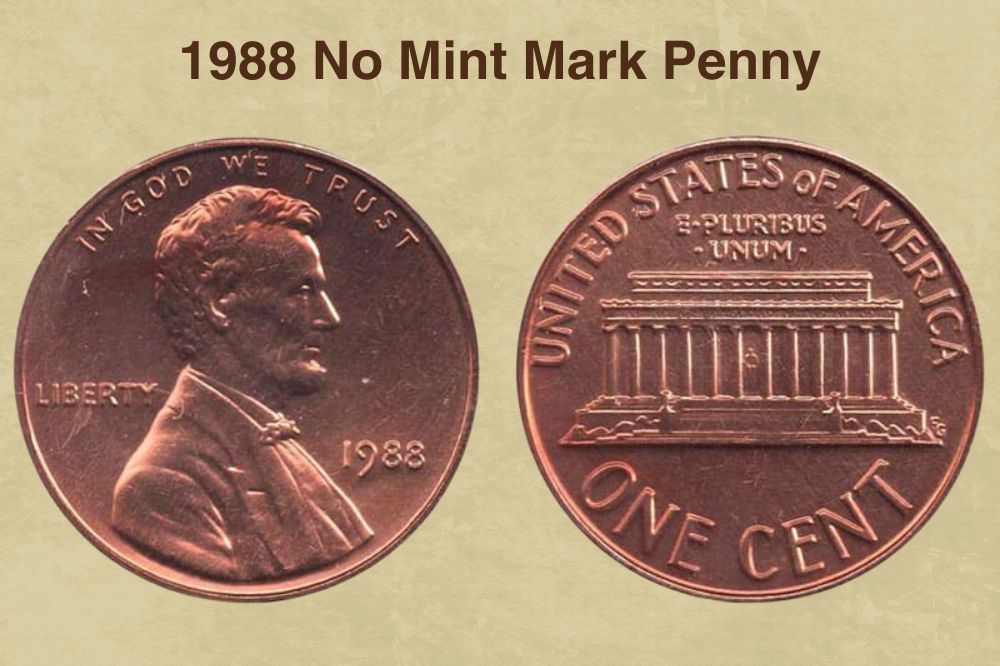
No mint mark Lincoln cents in 1988 were struck in the Philadelphia mint. The total mintage was 6,092,810,000 coins. Their current value in MS 60 to MS 62 rating is $0.10 to $0.50, but they are not much costlier even in higher grades.
- The 1988 pennies RD in MS 63 grade can be purchased for $6
- The 1988 pennies RD in MS 64 grade can be purchased for $10
- The 1988 pennies RD in MS 65 grade can be purchased for $14
- The 1988 pennies RD in MS 66 grade can be purchased for $20
- The 1988 pennies RD in MS 67 grade can be purchased for $42
The most valuable 1988 red penny is in MS 68 rating and is worth $250. The record price for the Philadelphia penny was $7,040 for the red coin in MS 69 grade in May 2021 on eBay.
1988 D Penny Value
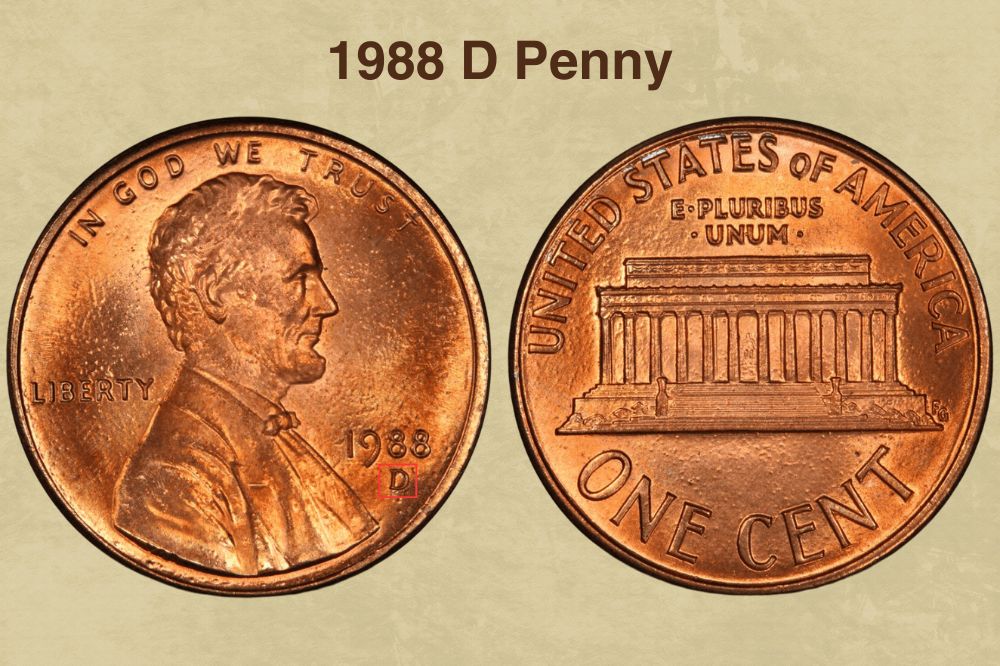
The Denver mint produced regular Memorial pennies in 1988. Over five billion coins (5,345,467,111 pieces) came out from this mint. The value of the D mint mark cents in uncirculated condition (MS 60 to MS 63 grades) is $0.10 to $0.50. In higher ranks, they cost approximately:
- In MS 64 grade, the red 1988 D cents cost $7
- In MS 65 grade, the red 1988 D cents cost $10
- In MS 66 grade, the red 1988 D cents cost $16
- In MS 67 grade, the red 1988 D cents cost $36
The 1988 D red pennies with MS 68 rating are worth $300, but their prices can be much higher at auctions. One of these cents in MS 68 grade was sold at Heritage Auction in June 2007 for $1,495.
1988 proof Penny Value
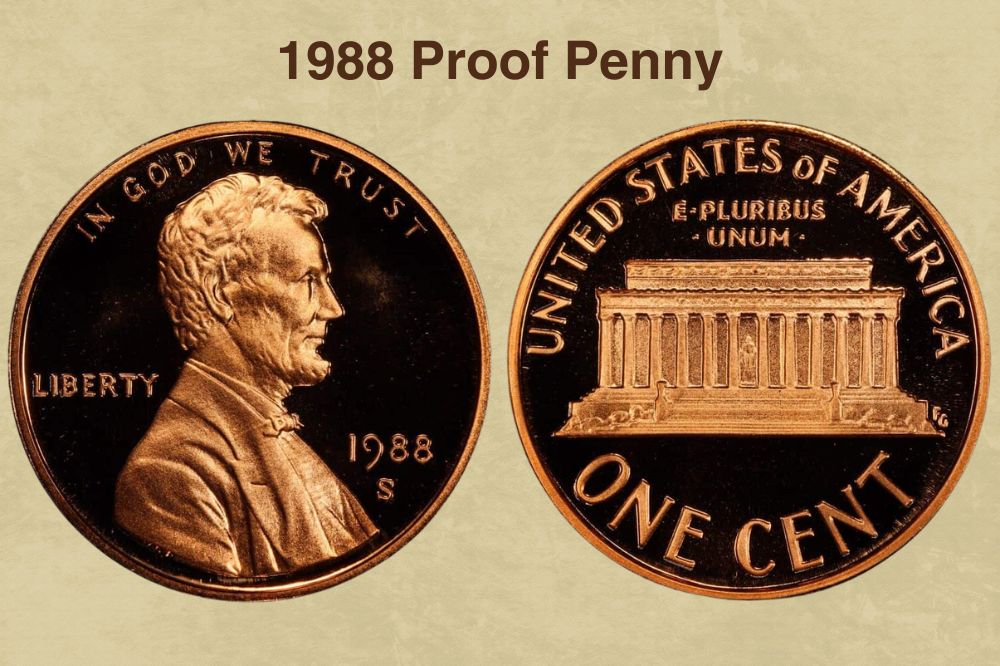
The San Francisco mint produced 3,262,948 coins, with Lincoln’s image on the obverse in 1988. The price for red DCAM proof coins graded PR 60 to PR 63 is $1 to $2, while those rated PR 64 cost $3.
You can expect slightly higher prices for first-class pieces, from PR 65 to PR 66. They typically cost $4 to $5. The most valuable 1988 S red DCAM pennies with a PR 69 rating are worth about $14. At the Heritage Auctions in July 2004, one of the proofs in PR 70 grade with DCAM quality was sold for $1,438.
Also read: 17 Most Valuable Indian Head Penny Worth Money
Rare 1988 Penny Errors List
Every minting year has error coins, and 1988 was no different. They happen for various reasons and can be barely visible or so significant as to interfere with the coin’s design. The 1988 penny set came with a few error varieties, and you can expect those in good condition to bring a premium.
1988 P and D Penny with the reverse of 1989
Due to different dies used in two minting years, 1988 pennies sometimes appear with subtle differences in design details. In such a case, it may happen (accidentally or intentionally) that the obverse dies are paired with a reverse die meant for the following or previous year.
These coins are well-known as transitional errors. In 1988, several pennies from the Denver and Philadelphia mints got the correct obverse paired with the 1989 reverse. Those minted in Denver were particularly rare and collectible.
Thinner designer’s initials in 1988 cents with 1989 reverse
Transitional 1988 cents have thinner designer’s initials, particularly visible in the letter G. It is noticeable that this letter from the 1988 reverse is much thinner than the one on the reverse intended for the 1989 coins.
The G letter on the wrongly used reverse has a shorter upper curve. It also has a hook that goes horizontally to the end of the lower G curve. The vertical bar is also visible, and it goes below the letter body.
Doubled die obverse
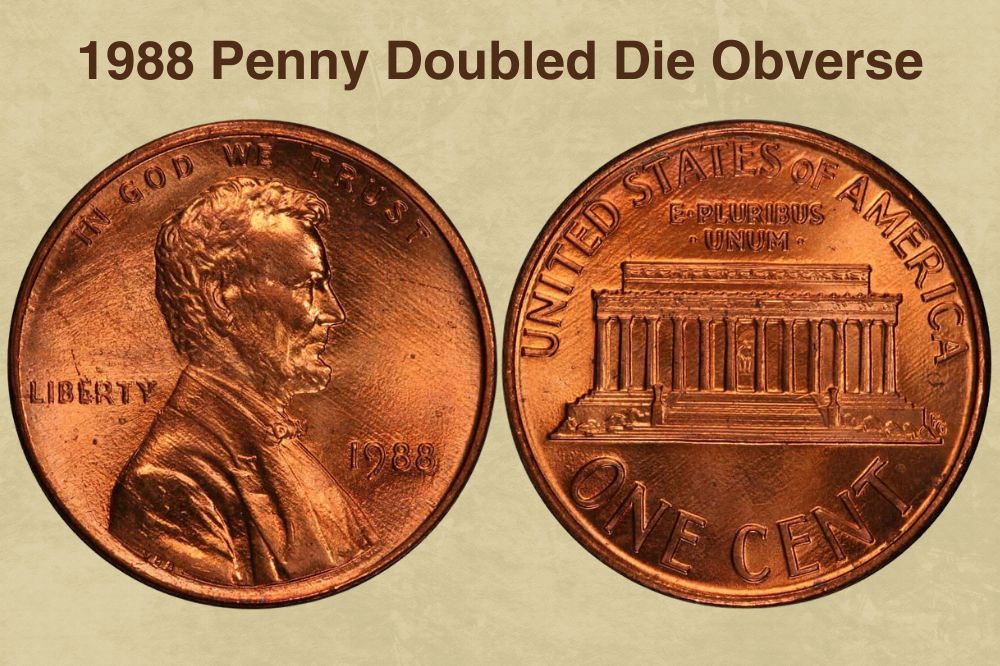
This DDO error appears during the minting process and is usually visible in the lettering. For instance, the doubled die error on pennies from Denver is visible on the date, usually on the number nine.
On the other hand, the 1988 pennies from Philadelphia have the doubling on Lincoln’s ear, making a famous Doubled Ear error. One of these red 1988 pennies in MS 66 grade reached a price of $3,120 in 2020 at Heritage Auctions.
Re-punched mint mark
In 1988, the mint mark punching was manual, making the process more prone to errors. Sometimes, the letter punch used to hit the mint mark into the working dies left two or more marks.
It happened for various reasons, but the most common was the second try to reposition the mint mark. In the pennies from 1988, this error was typical for those with the D mint mark.
Also read: 11 Most Valuable Wheat Penny Errors
Where to Sell Your 1988 penny ?
Now that you know the value of your coins, do you know where to sell those coins online easily? Don’t worry, I’ve compiled a list of these sites, including their introduction, pros, and cons.
Check out now: Best Places To Sell Coins Online (Pros & Cons)
FAQ about the 1988 Penny
What makes a 1988 Penny rare?
Pennies minted in 1988 are not rare due to their minting volume. On the other hand, coins with errors can be scarce and available for over one thousand dollars.
Which 1988 Penny are worth the most?
- The 1988 RD penny in MS 69 grade sold for $7,040 on eBay in May 2021
- The 1988 RD penny in MS 66 grade sold for $3,120 at Heritage Auctions in April 2020
- The 1988 D RD penny in MS 67 grade sold for $2,600 on eBay in April 2023
- The 1988 BN penny in MS 66 grade sold for $1,950 on eBay in January 2023
- The 1988 D RD penny in MS 68 grade sold for $1,495 at Heritage Auctions in November 2007
- The 1988 DCAM penny in PR 70 grade sold for $1,438 at Heritage Auctions in January 2004
- The 1988 RD penny in MS 66 grade sold for $890 on eBay in July 2023
- The 1988 RB penny in MS 65 grade sold for $661 at Heritage Auctions in February 2002
- The 1988 BN penny in PO1 grade sold for $650 on eBay in September 2018
- The 1988 D RB penny in MS 63 grade sold for $550 on eBay in February 2021
- The 1988 RB penny in MS 64 grade sold for $250 on eBay in March 2021
- The 1988 D BN penny in MS 63 grade sold for $129 at Heritage Auctions in April 2023
- The 1988 D RB penny in MS 64 grade sold for $5 on eBay in May 2023
How much is the 1988 Philadelphia Penny worth?
The No Mint mark 1988 pennies in circulated condition are worth one cent. On the other hand, those in MS 68 grade cost $120 per coin. If you consider the auction prices, the situation is even better. One Philadelphia penny in MS 69 grade from 1988 was sold at $7,040.
What are the priciest Lincoln Penny?
Memorial cents
- The 1999 Memorial reverse cent (MS 66 grade) – $138,000
- The 1969 S Memorial reverse cent with DDO (MS 64 grade) – $126,500
- The 1959 D Memorial reverse cent (MS 60 grade) – $48,300
Wheat pennies
- The 1943 D brown Wheat reverse bronze cent with wrong planchet error (MS 64 grade) $840,000
- The 1943 S brown Wheat reverse bronze cent (MS 63 grade) – $504,000
- The 1944 S Wheat reverse steel cent (MS 66 grade) – $408,000 in 2021

I found a 1988 d with triple date as well as the liberty . Doubling in Lincoln as well as the reverse has doubling . Next to mint . Red and has couple tiny scratches;(