Coin Value Contents Table
- 1976 Penny Value Chart
- History of the 1976 Penny
- 1976 Penny Value Types
- Features of the 1976 Penny
- 1976 Penny/Cent Grading
- 1976 Penny Value Guides
- 1976 No Mint Mark penny Value
- 1976 S proof penny Value
- 1976 D penny Value
- Rare 1976 Penny/Cent Errors List
- Where to Sell Your 1976 penny ?
- FAQ about the 1976 Memorial Penny/Cent
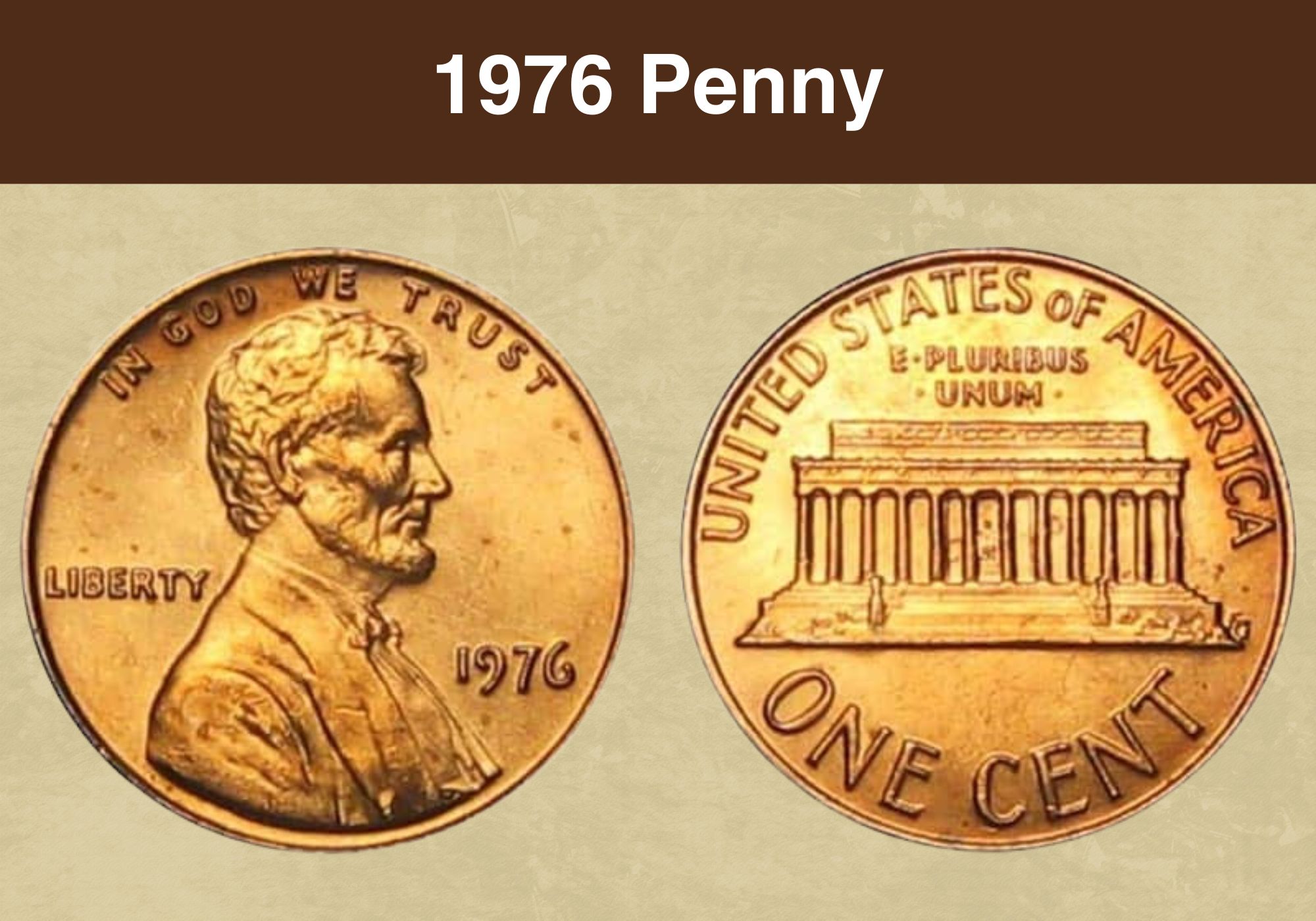
Most Memorial cents are cheap and widely available coins, but the 1976 penny value can increase in rare cases. This minting year was special for American coinage, and some denominations were realized with a double date.
Americans celebrated 200 years of the Declaration of Independence adoption in 1976. That was why several cents with this date reached impressive prices at auctions of a few hundred or sometimes thousands of dollars.
1976 Penny Value Chart |
|||
| Condition | 1976 No Mint Mark penny | 1976 D penny | 1976 S penny |
| MS 65 | $14 | $28 | / |
| PR 65 | / | / | $7 |
History of the 1976 Penny
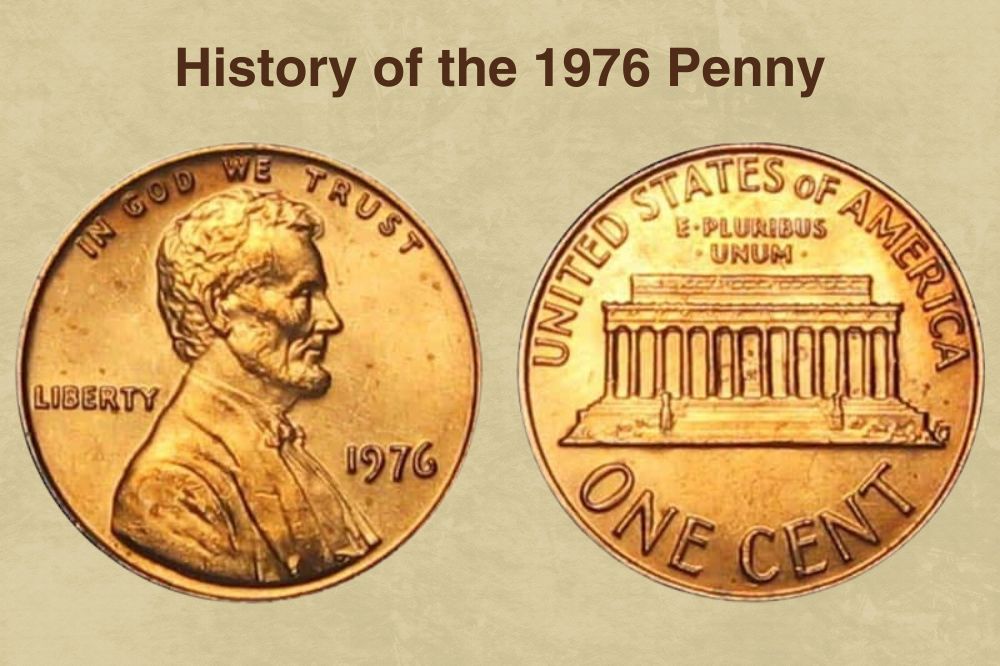
The 1976 pennies are a part of the Memorial series honoring the 150th Lincoln birthday. As you probably know, the first cents with President Lincoln on the obverse appeared in 1909, but pieces minted during the first 50 years had wheat ears on the reverse.
That was changed to commemorate another jubilee birthday of this respectable man who brought freedom to African Americans. The new series produced from 1959 to 2008 had Lincoln Memorial instead.
Besides, they were struck during a jubilee year when Americans celebrated the Declaration of Independence’s signing on July 4, 1776. Unlike Bicentennial coinage with the double date (Ike dollar, Kennedy half-dollar, and Washington quarter), pennies had only the current year struck on the obverse.
1976 Penny Value Types |
||
| Location | Year | Minted |
| San Francisco | 1976 S penny proof | 4,149,730 |
| Philadelphia | 1976 No Mint Mark penny | 4,674,292,426 |
| Denver | 1976 D penny | 4,221,592,455 |
| Total | / | 8,900,034,611 |
Interestingly, the West Point mint produced pennies in 1976, like every year from 1974 to 1986. Unfortunately, it is impossible to tell which pieces came from this mint since they were without the mint mark, like those from Philadelphia.
Also read: 12 Most Valuable Lincoln Penny Worth Money
Features of the 1976 Penny
Unlike other American coins minted with the double 1776-1976 date, pennies struck this jubilee year had the identical reverse as those from other years. Besides the original Victor D. Brenner’s obverse design, they have the Lincoln Memorial on the reverse created by Frank Gasparro.
The obverse of the 1976 penny
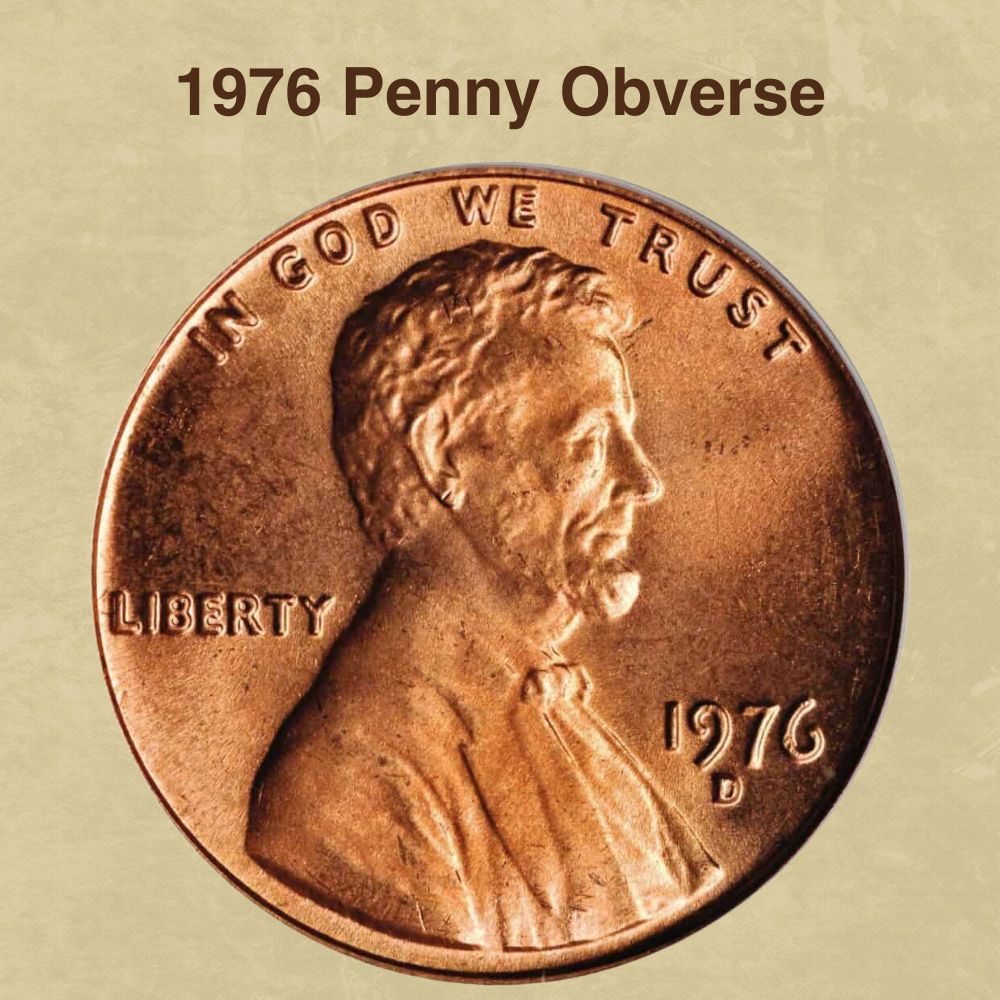
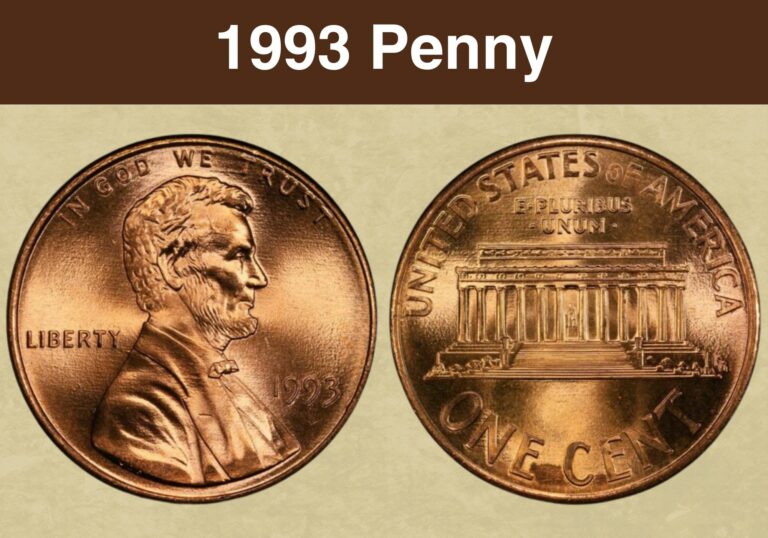
The 1976 penny obverse has President Lincoln’s bust in the center. His face is turned right, with the minting year and the mint mark in front.
The word LIBERTY is placed behind the coat collar, while the motto, standard for American coinage (IN GOD WE TRUST), is placed above the 16th President’s head. You can also see tiny VDB initials at the bust truncation.
The reverse of the 1976 penny/cent
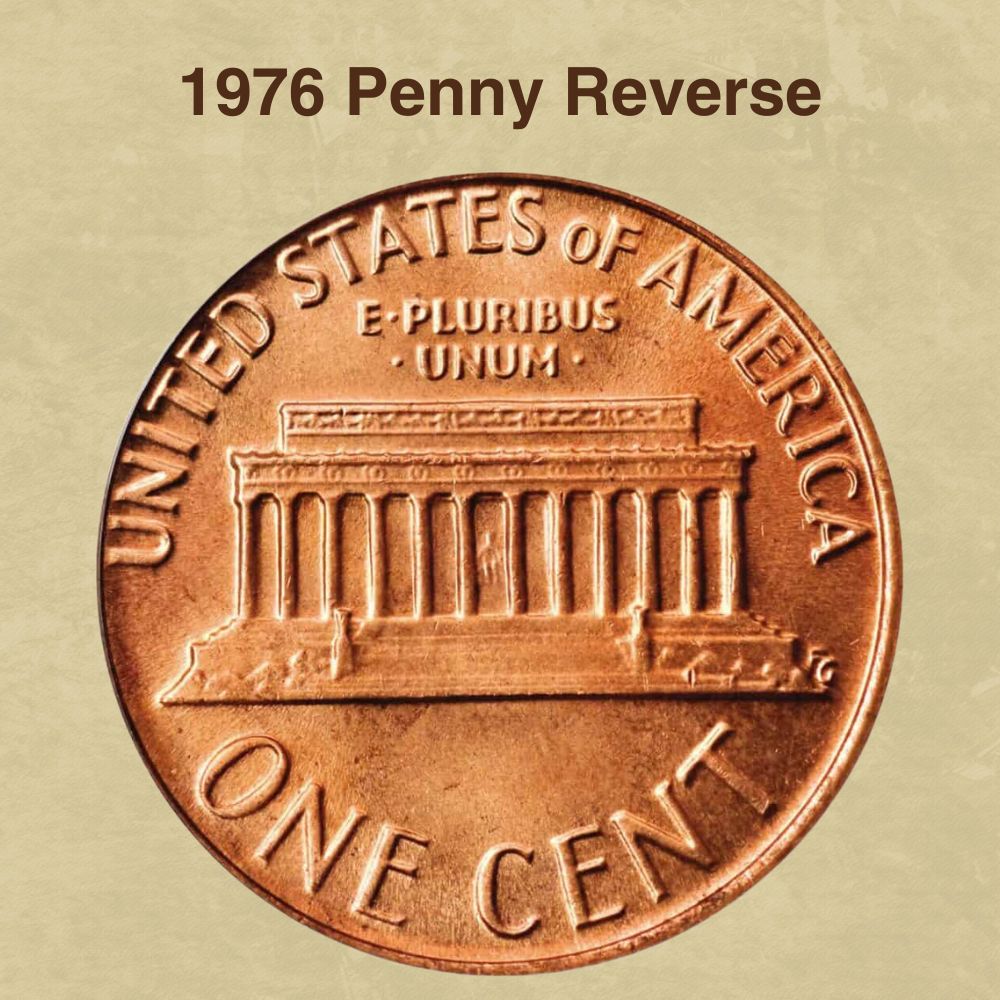
Frank Gasparro created the reverse of pennies minted from 1959 to 2008. The first thing to notice when looking at the piece from 1976 is the Lincoln Memorial and the designer’s initials FG on the right.
The building has twelve pillars on the front side, with a small President’s statue between the 6th and 7th ones. The denomination is located at the foot and makes the full circle with the name of the country on the top. Words E • PLURIBUS • UNUM • are struck between this inscription and the building.
1976 penny/cent Details |
|
| Face value | $0.01 (one-cent coin) |
| Compound | Gilding metal (an alloy of 95% copper with a low percentage of zinc or tin) |
| Coin thickness | 0.06 inches (1.52 mm) |
| Shape | Round |
| Coin diameter | 0.75 inches (19.05 mm) |
| Coin weight | 0.11 ounces (3.11 g) |
| Edge | Plain |
Other features of the 1976 penny/cent
Like other pennies minted from 1962 to September 1982, the Memorial pennies/cents struck in 1976 weigh 48 grains, equal to 0.11 ounces or 3.11 grams. These round coins made of gilding metal have a diameter of 0.75 inches (19.05 mm) and are 0.06 inches (1.52 mm) thick.
Also read: 13 Most Valuable Wheat Penny Worth Money
1976 Penny/Cent Grading
Most collectors prefer buying professionally graded coins, but it can be an unacceptable option for cheap pieces like pennies. Therefore, each owner can use the Sheldon grade and determine the approximate condition of their coin by following detailed instructions and descriptions.
| # | Grade |
|---|---|
| 1 | Basal State-1 |
| 2 | Fair |
| 3 | Very Fair |
| 4, 5, 6 | Good |
| 7, 8, 10 | Very Good |
| 12, 15 | Fine |
| 20, 30 | Very Fine |
| 40 | Extremely Fine |
| 50 | About Uncirculated |
| 60 | Mint State |
| 65 | Mint State |
| 70 | Mint State |
Please check our grading guides to know your coin scale, It’s the necessary step to know the exact value of your coin.
Check out now: How to Grade Lincoln Wheat Penny?
1976 Penny Value Guides
The total 1976 No Mint mark penny mintage was 8,900,034,611 coins. Most pieces were from regular strikes, but the third mint issued only proofs specifically intended for collectors. Since their number is still high and you can find some in circulation, their prices are rarely exceptionally high.
1976 No Mint Mark penny Value
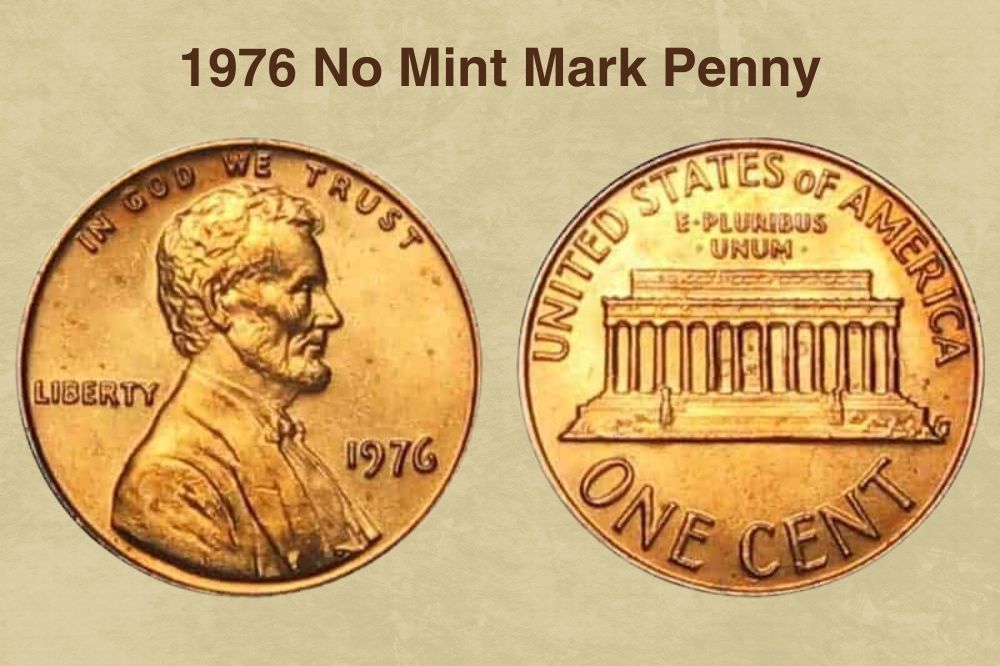
The 1976 penny mintage was the highest in the Philadelphia mint. It released 4,674,292,426 coins into circulation that jubilee year and some are still in use. Therefore, pieces in circulated condition are non-collectible, while you can find red-toned cents in the mint state for less than a dollar.
Only specimens in MS 66 grade are worth more, with an average price of $4. Experts estimate 1976 MS 67 red pennies at $100, but even one red-brown piece in this condition reached $123 at an auction in 2020.
One collector bought a rare MS 69-graded brown cent minted this year for $295 in 2022, while the most expensive piece in the set is a red coin in MS 68 rank. Its auction record from 2014 is $7,931.
1976 S proof penny Value
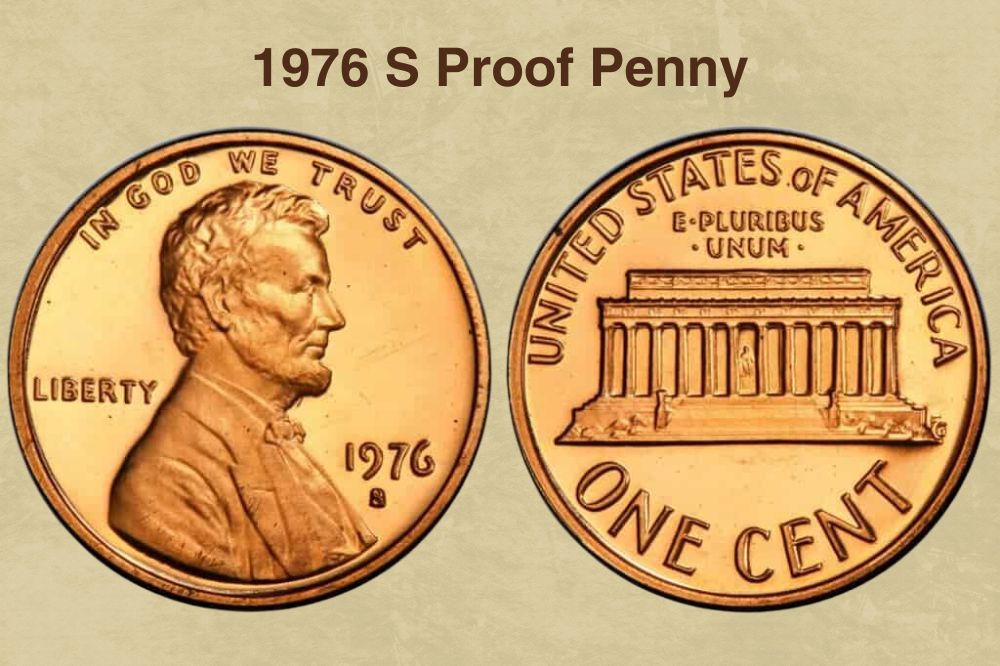
In 1976, the San Francisco mint issued only penny proofs, precisely 4,149,730 pieces. The market value for red DCAM coins depends on their condition, but most graded from PR 60 to PR 64 cost less than 25 cents. Better-rated specimens are worth about:
- $1 (PR 65-rated pennies)
- $3 (PR 66-rated pennies)
- $5 (PR 67-rated pennies)
- $7 (PR 68-rated pennies)
- $20 (PR 69-rated pennies)
Like in most cases, auction records are significantly higher, and the best-paid red coins in the highest grades were sold at $207. The priciest piece was the one with DCAM quality that won an auction record of $1,208 in 2002.
1976 D penny Value
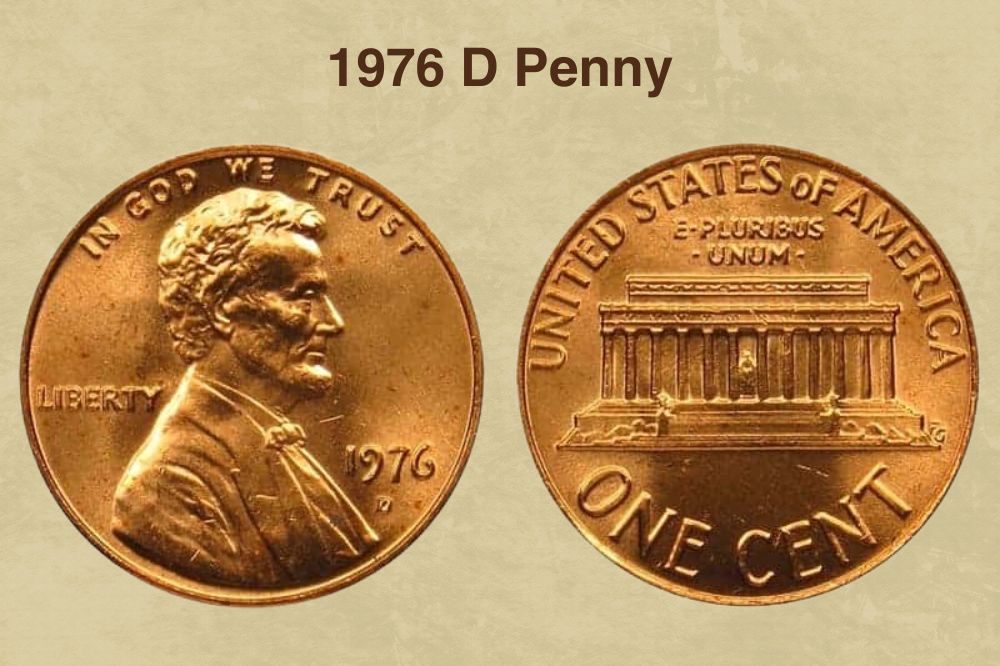
Most of the 4,221,592,455 pennies minted in Denver in 1976 are uninteresting to collectors, but those in uncirculated condition have some value as a part of the series. You can expect red cents to cost $0.20 to $1 in lower grades, while MS 66-ranking pieces are worth $55.
The most expensive pennies are those in MS 67 grade, with an assessed price of $500. However, even one brown cent in MS 60 ranking sold at an auction in 2007 was more expensive than that since its final cost was $1,265. Atypically, the 1976 D MS 67 red cent was cheaper, with a 2016 auction record of $999.
Also read: 17 Most Valuable Indian Head Penny Worth Money
Rare 1976 Penny/Cent Errors List
The US Mint released numerous imperfect 1976 pennies, making collectors delighted. They try to find all the possible variations and errors to complete the set. While some are common and inexpensive, others can be scarce and of a high value.
Off-center
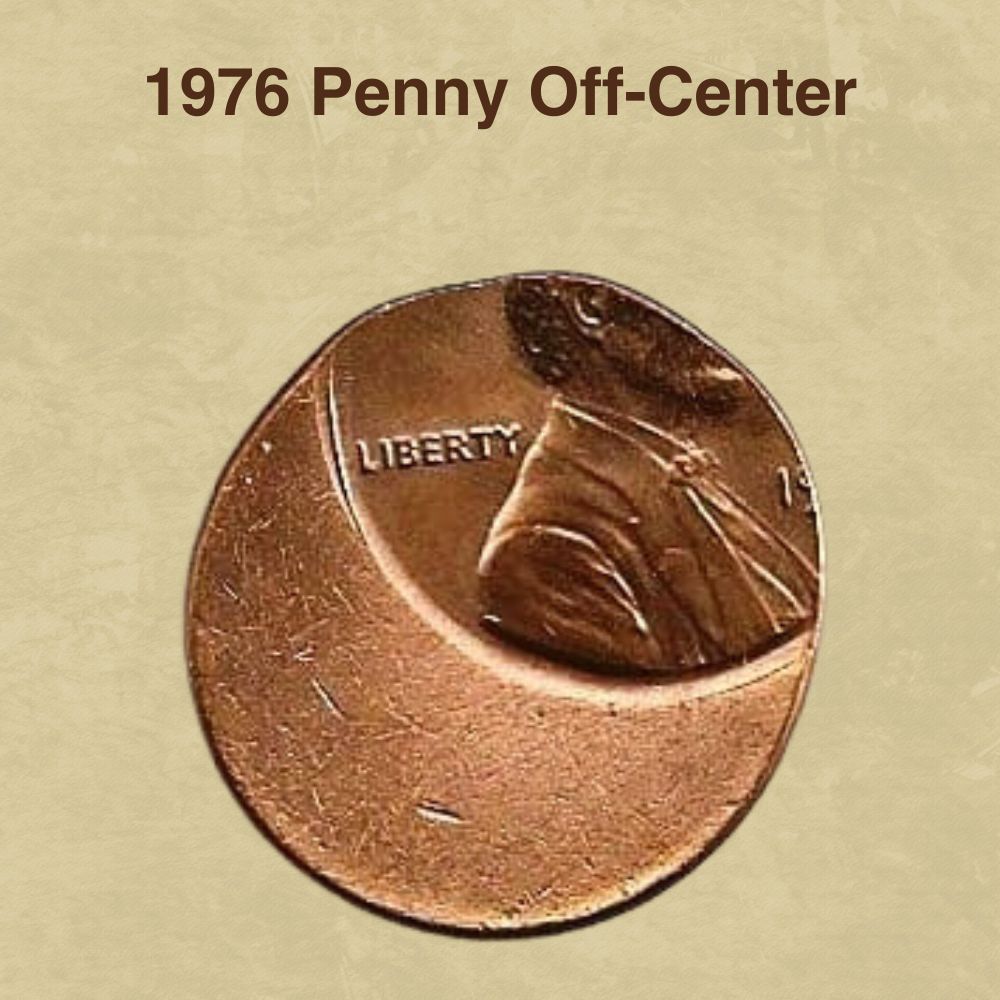
When the penny planchet moves during the first die strike, it results in a partially blank coin. The 1976 penny with 50% off-strike and preserved date cost about $50 to $110, while pieces with only 5% to 10% off-center are worth up to $10.
You can also find some other variations. For instance, the 1976 penny with 60% off-center error typically sells for $60. Those with 80% off-center coins are often worthless, but rare specimens with the visible date can bring $185 to $230 to their owners.
Die break obverse
One old, damaged die inevitably leaves a mark on the coin surface. Some pennies have visible die breaks or cuds this year, making them about $100 valuable.
Penny struck on a 5c (clad nickel) planchet
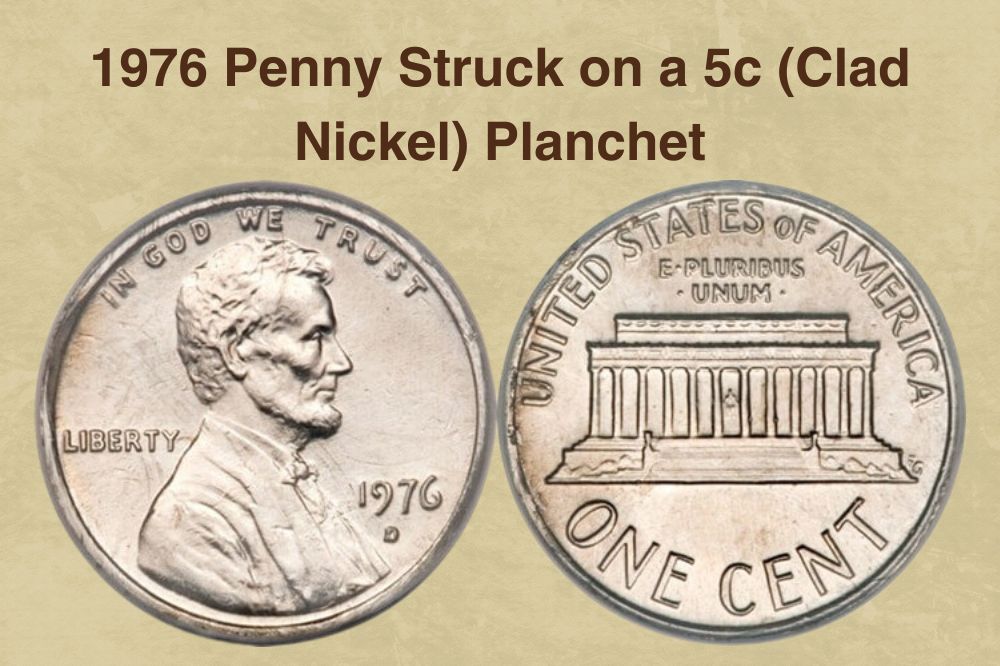
The 1976 penny minted in Denver on a nickel planchet is a rare error worth over $1,200. It is interesting to see this error piece struck on a nickel planchet with a diameter of 0.835 inches (21.21 mm) instead of 0.75 inches (19.05 mm) standard for pennies.
It was also of a different color because the planchet was made of cupronickel instead of the 95% copper piece used for pennies minted until 1982.
Penny struck on a 10c (dime) planchet
You can effortlessly notice copper-colored, 0.598-inch (1.52 mm) thick pennies measuring 7.50 inches (19.05 cm) in diameter. On the other hand, dimes are nickel-plated 0.531 inches (1.35 mm) thick coins with a reeded edge.
After striking over a blank dime planchet 7.05 inches (17.91 mm) in diameter, the penny appears without a proper rim and with partially cut lettering. You can expect to get up to $400 for such a coin.
One collector found the 1976 penny with double imperfection. It was struck on a dime planchet with a 25% off-center error. Another collector paid $1,350 in 2018 for this unique piece weighing 0.0811 ounces (2.30 g) instead of the required 0.1097 ounces (3.11 g).
Penny struck on a thin planchet
This year, the mint in Denver issued a few pennies on too-thin planchets, resulting in coins with the wrong weight or even diameter. For instance, you can find a cent weighing 0.0596 ounces (1.69 g) instead of a standard 0.1097 ounces (3.11 g). Its assessed price is about $25.
Doubled die
Such a penny appeared after minting by a die with a mistake doubling. You could find a few pennies with this error produced in 1976, but visible imperfections were often minor, making these coins approximately $25 to $100 valuable. The final price always depends on doubling significance and coin quality.
BIE
These error pennies are highly collectible, and you can expect to get $5 to $15 for one struck in 1976. It has a visible letter I in the word LIBERTY, between the B and E letters.
RPM
By 1989, mint workers punched the mint mark by hand. It sometimes happened to do that twice to correct an improperly placed letter. In the case of the 1976 D penny, you can notice the first punch mark underneath the correctly placed one. Such a piece costs about $10 to $12.
Double-struck error
When the same die was struck over a blank coin twice while the planchet slightly shifted during the process, the DBL error was a result. In this case, the original penny gets an extra part hanging off the regular piece’s side. Some collectors appreciate such a deformed cent and are prepared to pay about $145 to get one.
Also read: 11 Most Valuable Wheat Penny Errors
Where to Sell Your 1976 penny ?
Now that you know the value of your coins, do you know where to sell those coins online easily? Don’t worry, I’ve compiled a list of these sites, including their introduction, pros, and cons.
Check out now: Best Places To Sell Coins Online (Pros & Cons)
FAQ about the 1976 Memorial Penny/Cent
Are 1976 Memorial pennies/cents rare nowadays?
You can still find some of these coins in circulation, making them abundant and non-collectible. Even pennies in the mint state are not particularly rare, and you can find them in a wide grade range at low prices.
Which 1976 Memorial pennies/cents cost the most?
- The 1976 MS 68 red cent cost $7,931 in 2014
- The 1976 D MS 60 brown cent cost $1,265 in 2007
- The 1976 S PR 69 DCAM cent cost $1,208 in 2002
- The 1976 D MS 67 red cent cost $999 in 2016
- The 1976 MS 69 brown cent cost $295 in 2022
- The 1976 S PR 69 red cent cost $207 in 2005
- The 1976 MS 67 red-brown cent cost $123 in 2020
- The 1976 S PR 69 CAM cent cost $118 in 2015
- The 1976 D MS 66 red-brown cent cost $23 in 2018
- The 1976 S PR 67 DCAM LB Treasure Hunt cent cost $51 in 2018
- The 1976 S PR 10 red LB Treasure Hunt cent cost $9 in 2018
How much are the 1976 Memorial pennies/cents (Philadelphia) worth?
Be aware that circulated 1961 No Mint mark red pennies are non-collectible, while coins in the lowest uncirculated grades cost approximately $0.20 to $4. However, you should count on the price of at least $65 when buying one specimen with an MS 67 rating.
What are the priciest Memorial pennies/cents?
The undoubtedly priciest Lincoln cent was the one with Wheat reverse struck in Denver in 1943. One collector set aside $840,000 for this brown bronze coin in MS 64 grade in 2021.
Lincoln cents with the Memorial on the reverse never reached such incredibly high sums. However, one piece minted in 1999 was unexpectedly expensive. The 1999 MS 66 penny was sold at $138,000 in 2006.
The costliest Memorial cent from Denver was the 1959 D MS 60 coin that won an auction record of $48,300 in 2003. The sought-after coin produced in San Francisco in 1969 was the most expensive among errors. This DDO penny in MS 64 grade was paid $126,500 in 2008.

I cant find my 1976 penny amongst the errors listed have u seen a 1976 s penny mint mark error where the s is sideways and blends with the 6
I found a 1976 penny no mint stamp with a penny side ways on it on both sides.
I have a 1976 penny with Lincoln s head cut up , the 6 in 1976 is an upside down 9, the B in LIBERTY IS AN 8 , and the D for mint mark is filled in.
Is it worth anything?