Coin Value Contents Table
- 1925 Peace silver dollar value Chart
- History of the 1925 Peace Silver Dollar
- 1925 Peace silver dollar Types
- Features of the 1925 Peace Silver Dollar
- 1925 Peace Silver Dollar Grading
- 1925 Peace Silver Dollar Value Guides
- 1925 No Mint Mark silver dollar Value
- 1925 S silver dollar Value
- Rare 1925 Peace Silver Dollar Errors List
- Where to Sell Your 1925 Peace Silver dollar ?
- FAQ about the 1925 Peace Silver Dollar
In 1921, the US Mint started producing beautiful silver coins to celebrate peace and post-war prosperity. This series lasted until 1935, and these coins were the last circulated that contained 90% silver.
Therefore, you can expect the 1925 silver dollar value to be high. Exceptionally costly are superior-quality specimens in the highest grades because they are scarce among these one-century-old coins.
1925 Peace silver dollar value Chart |
||
| Condition | 1925 No Mint Mark silver dollar | 1925 S silver dollar |
| Good | $34 | $41 |
| Very good | $34 | $43 |
| Fine | $34 | $43 |
| Very fine | $34 | $44 |
| Extra fine | $36 | $46 |
| AU | $42 | $70 |
| MS 60 | $52 | $150 |
| MS 65 | $185 | $40,000 |
History of the 1925 Peace Silver Dollar
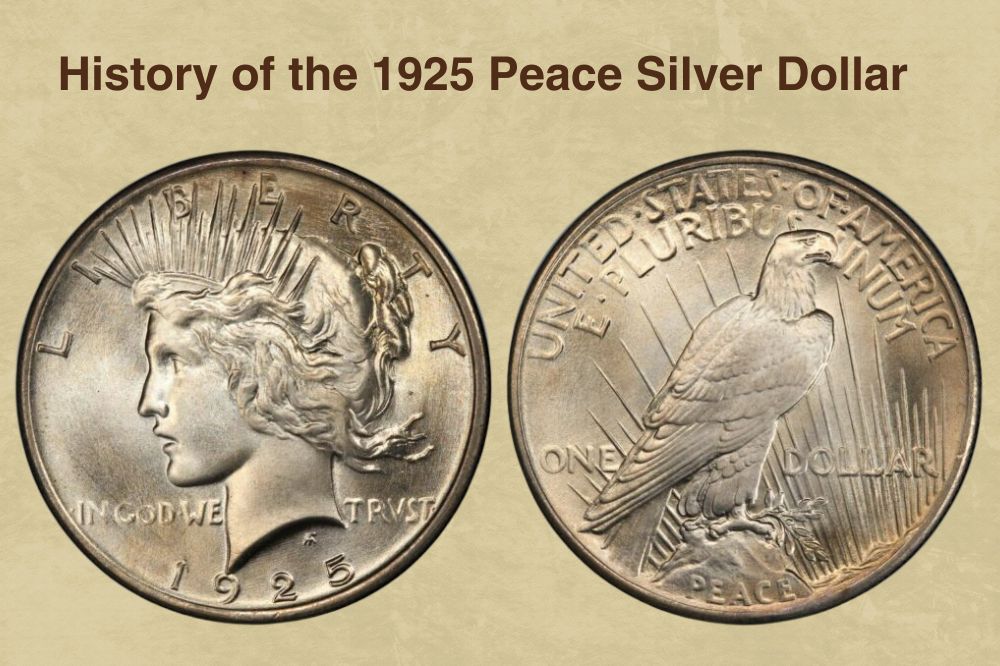
The first silver Peace dollars appeared in 1921, replacing popular Morgan dollars, and their minting continued until 1935. The idea was to create a coin to celebrate the end of WWI and the newly established peace between the US and Germany.
Most people were unaware that the USA never ratified the Treaty of Versailles in 1919 like other Allied Powers and did it in 1921. So, these new coins symbolized this late peace ratification.
1925 Peace silver dollar Types |
||
| Location | Year | Minted |
| Philadelphia | 1925 no mint mark silver dollar | 10,198,000 |
| San Francisco | 1925 S silver dollar | 1,610,000 |
| Total | / | 11,808,000 |
Before that, the US decided to help the British support their paper currency with silver by melting down silver Morgan dollars. In other words, the US Mint converted millions of Morgan dollars to Peace dollars from 1920 to 1933.
Also read: 12 Most Valuable One-Dollar Coin Worth Money
Features of the 1925 Peace Silver Dollar
Anthony de Francisci was a talented sculptor who got the privilege to create one dollar at the beginning of the 1920s. He based the portrait of Lady Liberty on his spouse, Teresa, and created one of the most beautiful American coins for circulation. The 1925 Peace dollars are a part of the early series, making them collectible.
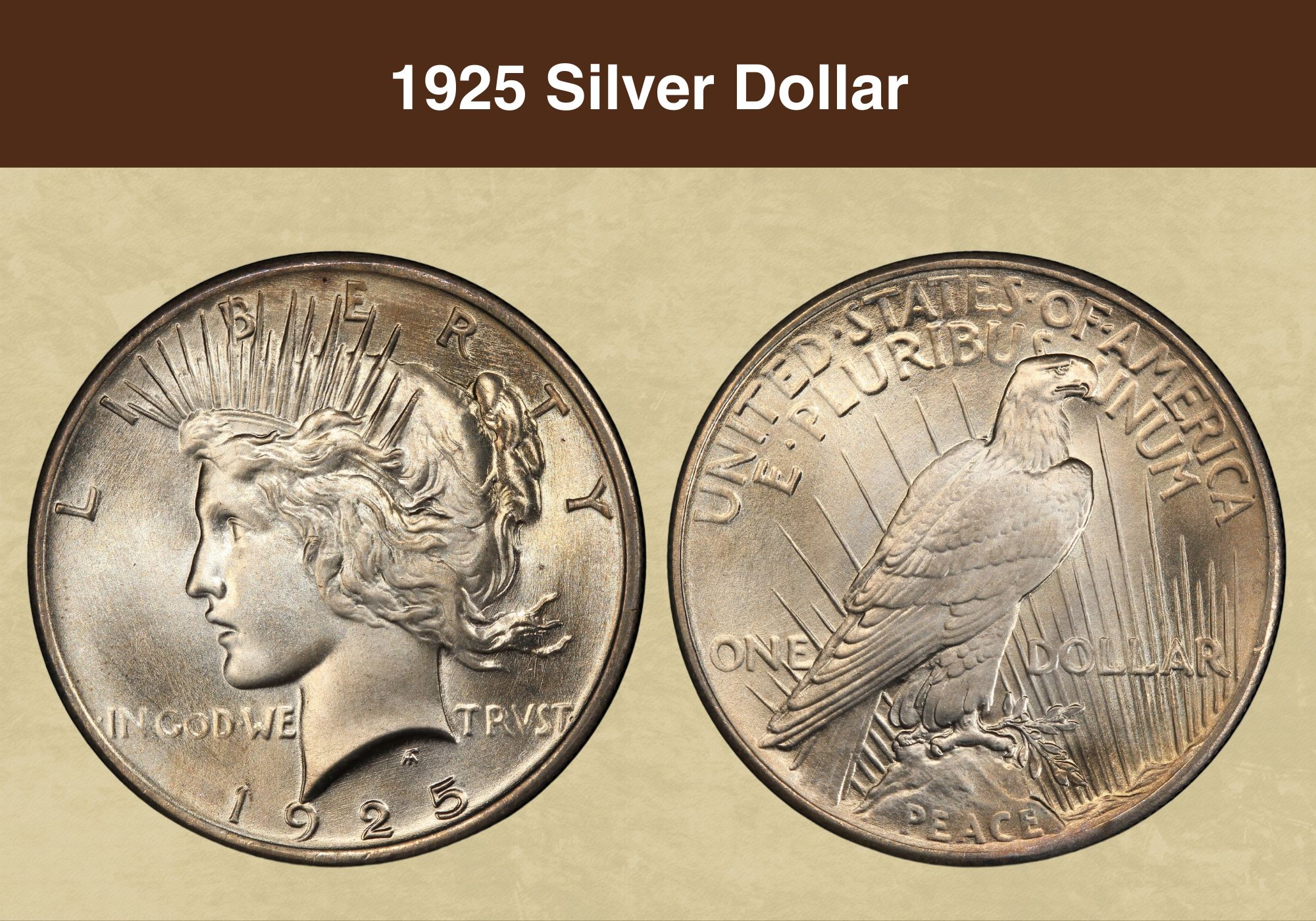
The obverse of the 1925 Peace silver dollar
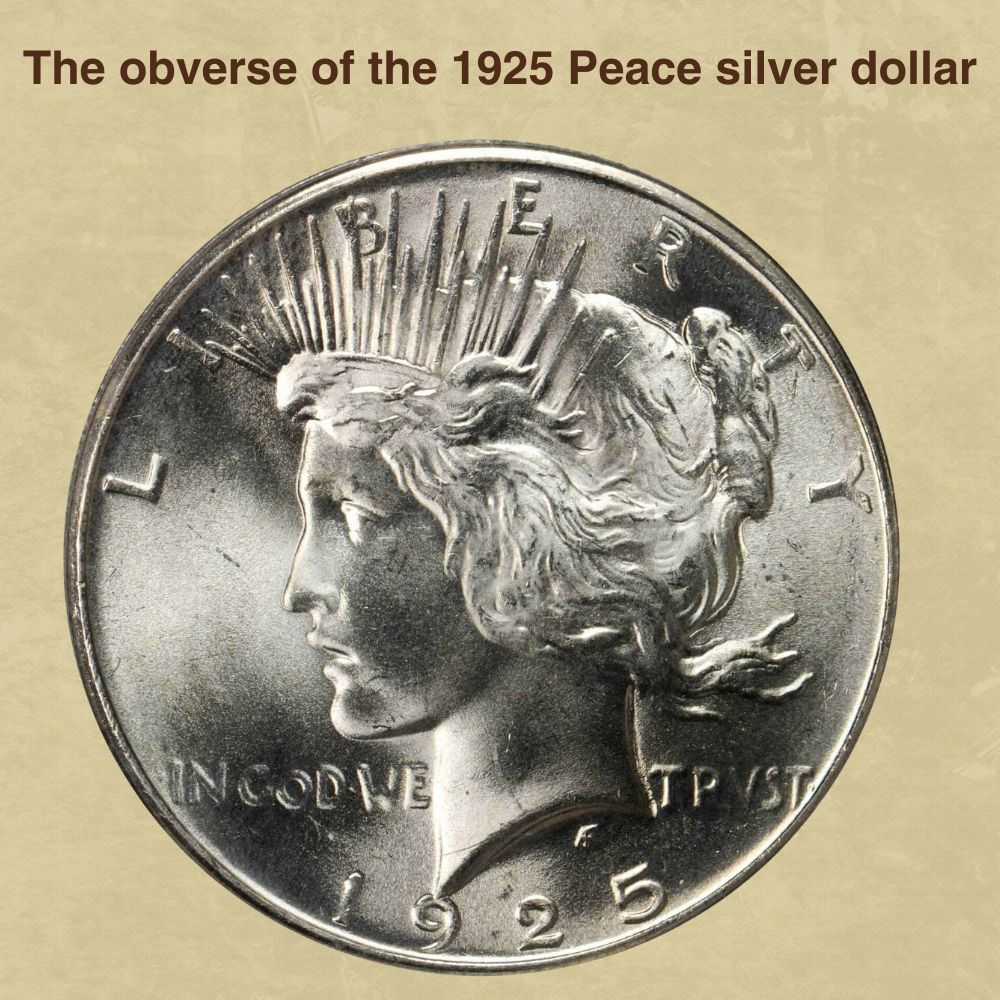
The complex 1925 silver dollar obverse shows Lady Liberty with loose hair that flutters in the wind and a crown on her head. Her elongated portrait faces left while her lips are slightly parted. The image is based on the 151-foot (46 m) high Statue of Liberty in New York.
Anthony de Francisci added the word LIBERTY along the upper coin rim, while the date is placed under the portrait. The artist put his initials AF under the neck truncation.
The inscription IN GOD/WE TRVST is separated into two parts. One is written on the left, and the second is on the right part of the Liberty’s neck.
The reverse of the 1925 Peace silver dollar
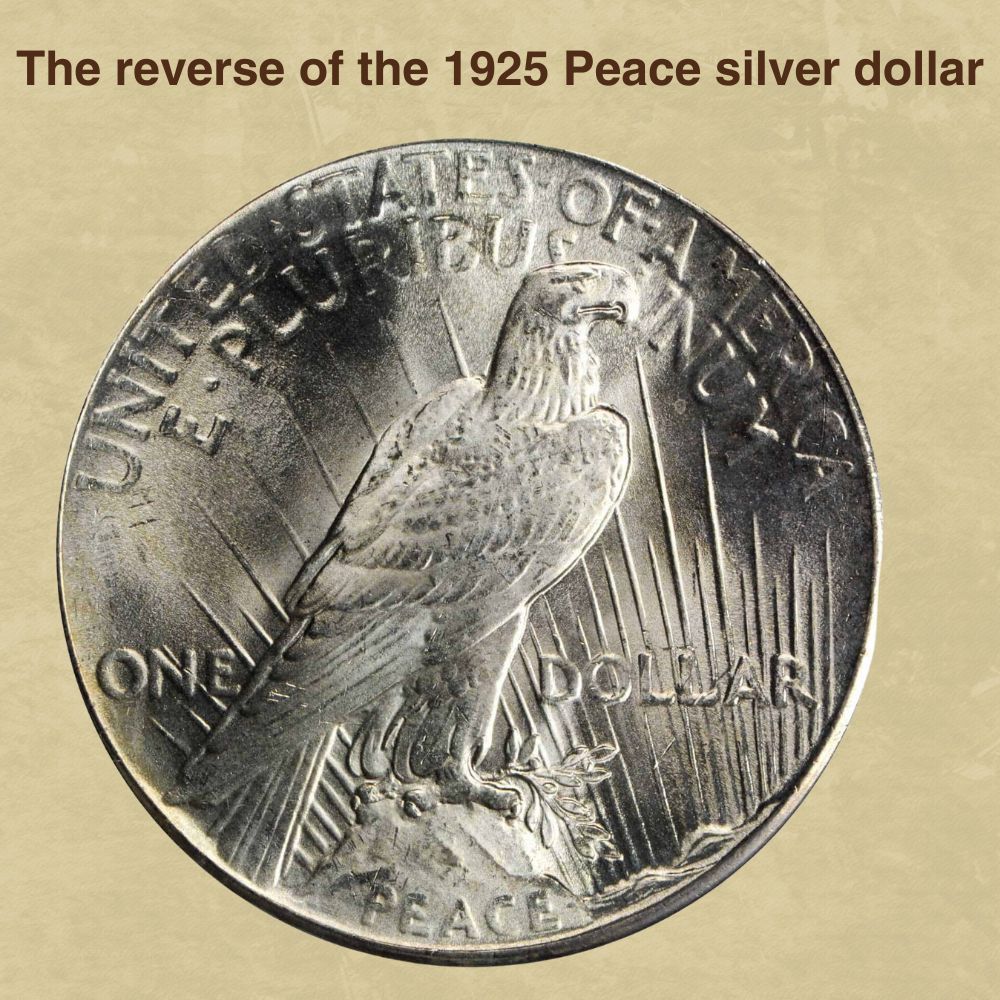
The 1925 silver dollar depicts an eagle standing on the rock. Unlike birds on most other American coins, this bald eagle has folded wings and a gaze directed into the distance. Two inscriptions are above its head, including:
- EPLURIBUS UNUM
- UNITEDSTATES·OF·AMERICA
The denomination of ONE DOLLAR is struck to the left of the eagle’s wings and the right of its feet, separated by its body. These coins include one unusual detail, the word PEACE, because of the purpose of their minting.
The initial version included a broken sword and an olive twig between the eagle’s talons. Since the public recognized it as a symbol of defeat, this piece of arms was removed. George T. Morgan (then chief engraver) covered the gap so skillfully that no one noticed the change for 85 years.
1925 Peace silver dollar Details |
|
| Face value | One dollar ($1) |
| Shape | Round |
| Compound | 90% silver and 10% copper |
| Coin thickness | 0.09449 inches (2.4 mm) |
| Coin weight | 0.8594 troy ounces (26.73 g) |
| Silver weight | 0.77344 troy ounces (24.5 g) |
| Coin diameter | 1.5 inches (38.1 mm) |
| Edge | Reeded |
Other features of the 1925 Peace silver dollar
The 1925 Peace dollar is the last American coin intended for circulation with this denomination that contained such a high silver percentage. It has 90% precious metal, meaning 0.77344 troy ounces (24.5 g).
These lovely coins have a diameter of 1.5 inches (38.1 mm), while their overall weight is 0.8594 troy ounces (26.73 g). Their thickness is 0.09449 inches (2.4 mm).
Also read: 14 Most Valuable Coins In Circulation
1925 Peace Silver Dollar Grading
The grading aims to precisely determine each coin, including the Peace dollar’s condition and value. Many professional grading companies offer their services to collectors, and their evaluation can significantly increase coinage prices.
Nowadays, the best option is to check the Sheldon scale, modified in the 1970s, for the most precise rating.
| # | Grade |
|---|---|
| 1 | Basal State-1 |
| 2 | Fair |
| 3 | Very Fair |
| 4, 5, 6 | Good |
| 7, 8, 10 | Very Good |
| 12, 15 | Fine |
| 20, 30 | Very Fine |
| 40 | Extremely Fine |
| 50 | About Uncirculated |
| 60 | Mint State |
| 65 | Mint State |
| 70 | Mint State |
Please check our grading guides to know your coin scale, It’s the necessary step to know the exact value of your coin.
Check out now: How to Grade Peace Silver Dollar?
1925 Peace Silver Dollar Value Guides
Only two mints struck silver Peace dollars in 1925, with a total mintage of 11,808,000 coins. While those from Philadelphia came without the mint mark, pieces from San Francisco had the letter S on the reverse. None of these coins were proofs.
1925 No Mint Mark silver dollar Value
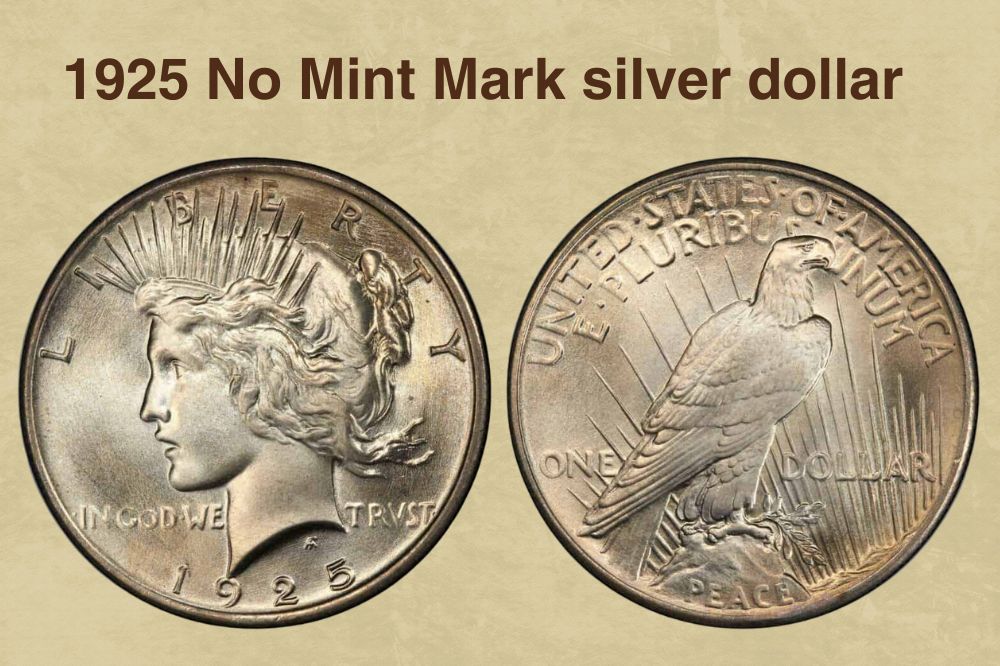
You should set aside about $34 to $42 when planning to buy one 1925 peace silver dollar in an average condition produced in Philadelphia. Since the mintage was 10,198,000 coins, even those in the mint state are relatively affordable. Their average cost is $32.50 to $485.
However, specimens in the highest possible grades for this coin type are estimated at significantly higher sums. For instance, you should count on $3,000 to $4,250 for a piece with an MS 67 rating, while MS 68-graded coins come with a price range from $80,000 to $100,000.
As usual, the auction record is even higher, so one collector purchased the silver Peace dollar from 1925 in MS 68 grade for $89,125 in August 2011.
1925 S silver dollar Value
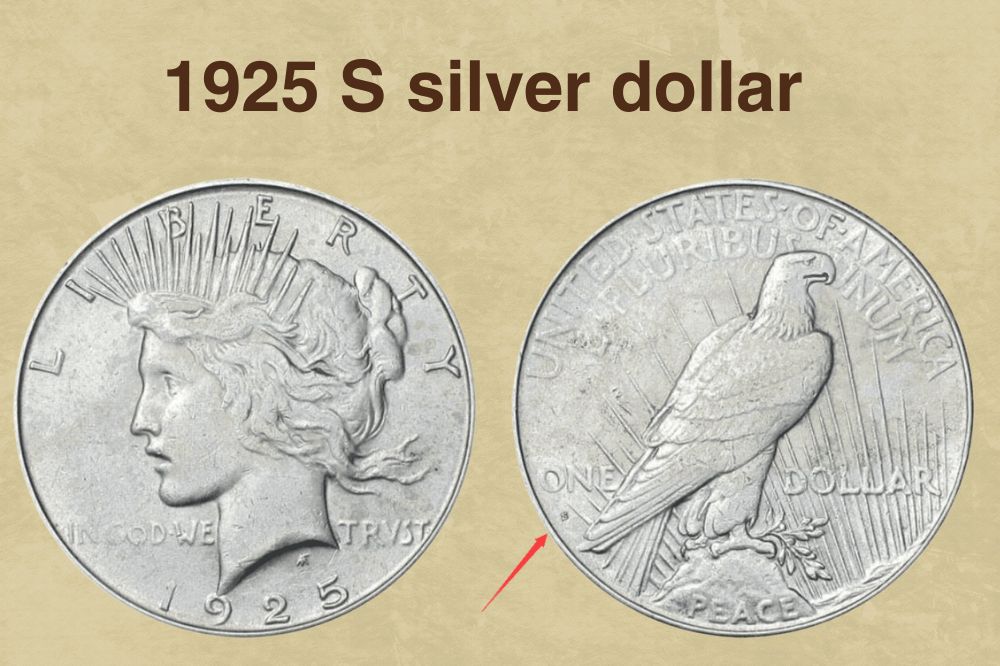
The mint in San Francisco also produced 1925 S silver dollars from regular strikes. However, their number was significantly lower than in Philadelphia, with only 1,610,000 coins.
The lowest-graded collectible specimens cost approximately $41 to $52, but those with an AU rating are worth $70 to $135. Expectedly, you need to pay more for those in the mint state.
- MS 60-graded Peace dollars have an estimated price of $100 to $150
- MS 61-graded Peace dollars have an estimated price of $150 to $185
- MS 62-graded Peace dollars have an estimated price of $210 to $235
- MS 63-graded Peace dollars have an estimated price of $305 to $425
- MS 64-graded Peace dollars have an estimated price of $750 to $950
The real surprises come with the best-graded silver dollars. Experts estimate those in MS 65 grade at $15,000 to $40,000, while MS 66-ranking coins can reach $75,000 to $95,000 on eBay and at auctions.
However, the dedication of collectors doesn’t end there. One bought the 1925 S MS 65+ silver Peace dollar in August 2022 for an incredibly high $132,000.
Also read: Top 10 Most Valuable Morgan Silver Dollar Worth Money
Rare 1925 Peace Silver Dollar Errors List
Some errors can significantly increase the 1925 Peace dollar price, especially a few scarce in high grades. These coins are well-known for six VAM varieties (VAM 1, 1A, VAM 1T (5), 2, 3, and 4), while silver dollars from San Francisco have an additional three VAM errors from 1 to 3.
Tiara die gouge (VAM 1A)
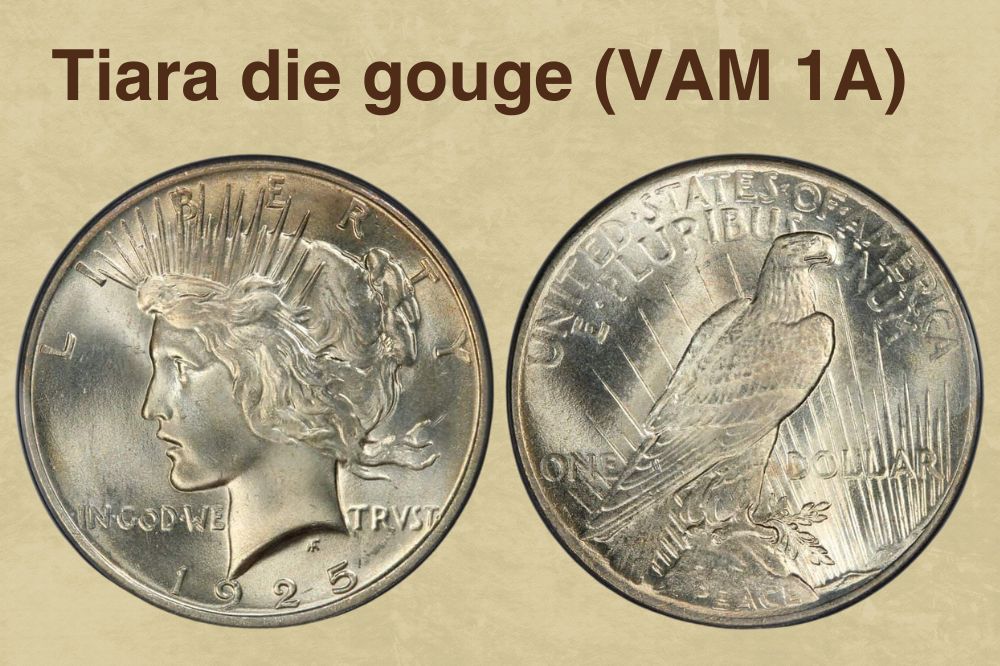
This VAM error always adds value to the 1925 Peace silver dollar. You can find an imperfection at the Liberty tiara’s bottom that includes a horizontal line under the letter B in LIBERTY. Typically, it is invisible to the naked eye, and you need to use a magnifying glass or even a microscope to notice it. Such pieces cost:
- $65 for the MS 60-graded error coins
- $120 for the MS 65-graded error coins
- $700 for one of nine existing MS 66-graded error coins
It is known that only one 1925 MS 66+ Peace dollar with this error exists, but it has never been offered on sale.
Shortened and missing rays at the eagle’s tail (VAM 1T)
This rare error is tiny, and the only way to notice it is to use a microscope. It includes the die file lines at the eagle’s left wing’s top, a missing ray at the bird’s tail, and another weaker ray next to its shoulder. Despite almost invisible imperfections, these coins have a price range from $85 (MS 60 grade) to $750 (MS 66 grade).
Doubled lower reverse (VAM 2)
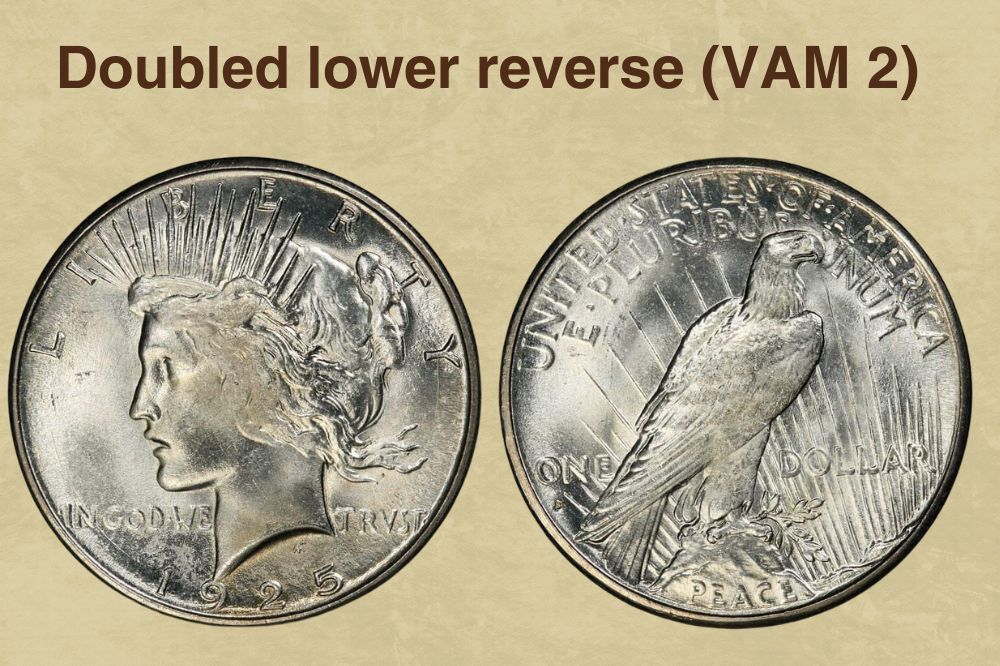
This coin error comes from the San Francisco mint and implies two doublings. The first is on the eagle leg’s feathers, while you can see the second on the olive branch on the right-hand rock side.
Be aware that these coins are evaluated differently, depending on their grade. For instance, one piece in modest MS 60 grade costs approximately $130, while the MS 65-rating silver dollar is valued at an incredible $27,500.
Doubled rays right of the eagle’s shoulder (VAM 3)
Coins minted in the Philadelphia mint sometimes come with this imperfection on the reverse. In this case, you can notice a doubling of rays above the word DOLLAR, particularly those above the D letter. You can buy such a piece with MS 60 rating for $85, while those in MS 66 grade are estimated at $400 to $750.
Cracked planchet
This easy-to-notice error includes a crack on the coin surface and a missing piece from its edge. The crack size is the primary factor affecting the price, but you should be careful. It is necessary to be sure you have a valuable coin with a minting error, not a worthless one damaged while circulated.
Where to Sell Your 1925 Peace Silver dollar ?
Now that you know the value of your coins, do you know where to sell those coins online easily? Don’t worry, I’ve compiled a list of these sites, including their introduction, pros, and cons.
Check out now: Best Places To Sell Coins Online (Pros & Cons)
FAQ about the 1925 Peace Silver Dollar
What makes a 1925 Peace silver dollar rare?
You shouldn’t have a problem finding silver Peace dollars from 1925, particularly low-graded ones. The only rare pieces are those in superior condition, plus a few specific errors can bring you a premium.
Which 1925 Peace silver dollars are the most valuable?
- The 1925 S MS 65+ silver Peace dollar won the auction record of $132,000 in August 2022
- The 1925 MS 68 silver Peace dollar won the auction record of $89,125 in August 2011
Besides coins from regular strikes, this series is well-known for numerous VAM errors. Six are typical from No Mint mark coins, while you can recognize three among pieces from the San Francisco mint. Several coins with these famous imperfections reached impressive auction records, including:
- The 1925 S MS 64+ silver Peace dollar (Doubled Wing error) won the auction record of $2,390 in July 2022
- The 1925 MS 66 silver Peace dollar (Missing Ray error) won the auction record of $1,920 in February 2019
- The 1925 S MS 64+ silver Peace dollar (doubled reverse error) won the auction record of $1,800 in June 2017
- The 1925 MS 64 silver Peace dollar (Doubled Shoulder error) won the auction record of $920 in December 2007
- The 1925 MS 67 silver Peace dollar (VAM 1 error) won the auction record of $725 in June 2022
- The 1925 MS 66 silver Peace dollar (Tiara Die Gouge) won the auction record of $600 in June 2021
- The 1925 MS 65 silver Peace dollar (VAM 2 error) won the auction record of $238 in December 2022
- The 1925 MS 65 silver Peace dollar (GSA Hoard) won the auction record of $167 in September 2022
- The 1925 S MS 64 silver Peace dollar (VAM 1 error) won the auction record of $85 in February 2019
How much is the 1925 Peace silver dollars (No Mint mark) worth?
You can buy the 1925 silver Peace dollar in circulated condition for $24 to $41.50, but it is necessary to set aside $32.50 to $485 for most pieces in the mint mark. The highest-graded coins in the MS 67 rating can cost $2,100 to $4,100, while scarce MS 68-graded dollars minted this year have an estimated price of $60,000 to $80,000.
What are the most expensive Peace silver dollars?
The most expensive silver Peace dollars are proofs (high relief, Type 1) from 1922. One of these coins in high relief (matte finish) in PR 67 grade cost $458,250 at Goldberg Auctioneers auction in 2014. A piece with a satin finish from 1921 (PR 67 grade) was sold at $150,000 in 2023.
On the other hand, auction winner proof coins Type 2 with low relief are:
- 1922 PR 65 silver Peace dollar with matte finish – $192,000in 2023
- 1922 PR 63 silver Peace dollar satin finish – $108,000 in 2023
The costliest coins from this series from regular strikes are:
- 1921 MS 67 silver Peace dollar with high relief bought for $132,000 in 2018
- 1922 PR 67 silver Peace dollar with modified high relief (Production Trial J-2020) bought for $381,875 in 2014
- 1927 D MS 66+ silver Peace dollar with low relief bought for $176,250 in 2019